



Poor diet is the leading preventable risk factor globally for many non-communicable diseases( 1 ). People who experience greater social disadvantage have poorer diets and consequentially increased risks of non-communicable diseases( Reference Novaković, Cavelaars and Geelen 2 – Reference Shaikh, Siahpush and Singh 4 ).
Much research has highlighted the relationships between food systems and local food environments and healthy eating( Reference Swinburn, Sacks and Hall 5 – Reference Townshend and Lake 8 ). Accordingly, policy-focused global initiatives have identified effective nutrition policy actions aimed at improving food environments. NOURISHING was developed to identify policy areas and actions that promote healthy eating, and to create a framework that facilitates the ongoing monitoring, reporting and communication of policy actions for the use of policy makers( Reference Hawkes, Jewell and Allen 9 ). The Healthy Food Environment Policy Index (Food-EPI), developed by INFORMAS (International Network for Food and Obesity/Non-communicable Diseases Research, Monitoring and Action Support), is a tool for monitoring and evaluating public-sector policies relating to the food environment for the purpose of strengthening accountability across sectors with the goal to reduce non-communicable diseases( Reference Swinburn, Sacks and Vandevijvere 10 – Reference Vandevijvere, Mackay and Swinburn 12 ).
Increasingly, there is evidence suggesting that a number of the determinants of healthy eating, and particularly the social inequities in healthy eating, exist outside the food system and food environments( Reference Friel, Hattersley and Ford 13 – Reference Taylor, Tan and Coyle 16 ). To date, however, there has been no analytical approach to help guide the identification of policy actions targeting the social determinants of inequities in healthy eating and to provide an organising framework for good practice in these policy areas. The purpose of the current short communication is to present social determinants of inequities in a healthy and equitable eating policy framework (hereafter the HE2 Framework) and to make a call to action to populate the framework with effective policies.
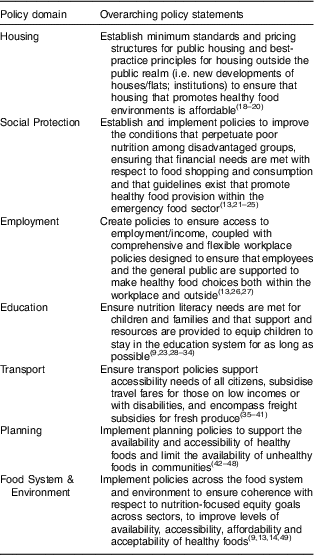
The HE2 Framework derives from a recent study, whereby a systems-based causal loop diagram of the inequities in healthy eating was produced. The purpose of that analysis and diagram was both to illustrate the complexity of determinants of inequities in healthy eating and to provide a basis for planning for the prevention of inequities in healthy eating by traversing multiple levels of causes and policies( Reference Friel, Pescud and Malbon 14 ). The proposed policy domains of the HE2 Framework emerged from the sub-systems featuring within the systems diagram. Overarching policy statements were then generated for each domain using expert knowledge from the research team and literature.
The HE2 Framework
The HE2 Framework is presented in Table 1. It includes policy domains and an overarching statement for each policy domain. As Table 2 highlights, the HE2 Framework presents a conceptual innovation for addressing inequities in healthy eating. It provides an organising policy framework for populating the domains of housing, social protection, employment, education, transport, planning, and the food system and environment. HE2 complements and extends existing frameworks, such as NOURISHING and Food-EPI, to include the social determinants of inequities in healthy eating (Table 2).
The Healthy and Equitable Eating (HE2) Framework
Policy domains and actions included in the NOURISHING, Healthy Food Environment Policy Index (Food-EPI) and Healthy and Equitable Eating (HE2) frameworks

NCD, non-communicable disease.
Yes = included in the framework; No = not included in framework.
A call to action
This is a call to researchers and policy makers globally to expand their conceptualisation of the drivers of inequities in healthy eating to include the social determinants and to populate the HE2 Framework with evidence-based policies in each of these domains. A key next step will involve engagement with stakeholders in the policy domains of housing, social protection, employment, education, transport, planning and the food system to gain a better understanding of the different values and sectoral goals. This will enable identification of mutually beneficial outcomes that will help effect changes in these areas. Ultimately, it will be important to benchmark and monitor the policy actions within each of the domains. Benchmarking and monitoring could follow a similar methodology to that used in Food-EPI INFORMAS( Reference Vandevijvere and Swinburn 17 ). This process requires input from government representatives who are charged with providing evidence relating to the types of policies and stages of implementation in their various jurisdictions. The HE2 Framework represents an important step in advancing work in the area of the social determinants of inequities in health, and in particular healthy eating. As the epidemics of non-communicable diseases and obesity continue, and the associated inequities widen in many instances, it is important that governments, practitioners and researchers focus attention on the development and implementation of policies beyond the food environment that can address the social determinants of inequities in healthy eating.
Acknowledgements
Financial support: This research was supported by The Australian Prevention Partnership Centre through the National Health and Medical Research Council Partnership Centre grant scheme (grant number GNT9100001) with the Australian Government Department of Health, the NSW Ministry of Health, ACT Health and the HCF Research Foundation. At the time of the research, M.C. and E.M. were working for the NSW Ministry of Health and J.G. was working for the ACT Government, who are funders of The Australian Prevention Partnership Centre. Conflict of interest: None. Authorship: S.F. received funding to conduct the study. All authors developed the original idea for the study. M.P. drafted the initial version of the manuscript and all authors critically reviewed and approved of the final version. Ethics of human subject participation: Not applicable.



