


Introduction
Jellyfish are widely distributed throughout the world’s oceans (Brotz et al., Reference Brotz, Cheung, Kleisner, Pakhomov and Pauly2012). However, a comprehensive understanding of species distributions and dynamics is lacking even at smaller regional scales (Doyle et al., Reference Doyle, Houghton, Buckley, Hays and Davenport2007). It is important to document jellyfish distributions because populations can respond opportunistically to changes in the surrounding environment (e.g. climate), with subsequent effects on populations of zooplankton and fish through competition and predation (Brodeur et al., Reference Brodeur, Decker, Ciannelli, Purcell, Bond, Stabeno, Acuna and Hunt2008). Importantly, these effects may vary regionally (Lynam et al., Reference Lynam, Hay and Brierley2005), making such variations particularly difficult to detect while some regions remain understudied. In particular, there is a need to expand sampling in biodiversity-rich regions outside of Europe and North America (Schmeller et al., Reference Schmeller, Böhm, Arvanitidis, Barber-Meyer, Brummitt, Chandler, Chatzinikolaou, Costello, Ding, García-Moreno, Gill, Haase, Jones, Juillard, Magnusson, Martin, McGeoch, Mihoub, Pettorelli, Proença, Peng, Regan, Schmiedel, Simaika, Weatherdon, Waterman, Xu and Belnap2017).
Jellyfish are difficult to study due to their unpredictable occurrences (Schnedler-Meyer et al., Reference Schnedler-Meyer, Kiørboe and Mariani2018), similar morphologies, and sampling challenges, necessitating the implementation of diverse methods (Magalhães et al., Reference Magalhães, Martins and Dos Santos2020). Observations of jellyfish can be enhanced through citizen science, which allows for more comprehensive monitoring across large spatial and temporal scales (Gueroun et al., Reference Gueroun, Piraino, Kéfi-daly and Daly Yahia2022). Identification of jellyfish by citizen scientists can, however, be difficult as morphological characteristics may be similar among species, and cryptic species – two or more distinct species that were classed as a single species due to morphological similarities (Bickford et al., Reference Bickford, Lohman, Sodhi, Ng, Meier, Winker, Ingram and Das2007) – are known to exist, though the extent of cryptic species diversity is currently unknown (Lawley et al., Reference Lawley, Gamero-Mora, Maronna, Chiaverano, Stampar, Hopcroft, Collins and Morandini2021). While early identifications of jellyfish by taxonomists have often relied on highly variable morphological features, more recent observations of morphological characteristics by taxonomists have been combined with molecular identification of captured samples, helping to overcome identification limitations (Gómez Daglio and Dawson, Reference Gómez Daglio and Dawson2017). When specimens can be obtained, DNA analysis is an effective method for examining jellyfish identity (Lindsay et al., Reference Lindsay, Grossmann, Nishikawa, Bentlage and Collins2015).
Distinguishing jellyfish species of the genus Cyanea can be particularly challenging due to their high morphological variability and considering that jellyfish, in general, are difficult to locate and capture for DNA analysis (Kolbasova et al., Reference Kolbasova, Zalevsky, Gafurov, Gusev, Ezhova, Zheludkevich, Konovalova, Kosobokova, Kotlov, Lanina, Lapashina, Medvedev, Nosikova, Nuzhdina, Bazykin and Neretina2015). Historically, taxonomic confusion based on highly plastic morphology in Cyanea has complicated species delineation; however, an integrative approach has contributed to reaching consensus on species (Samsodien et al., Reference Samsodien, Brown and Gibbons2024). As noted above for jellyfish in general, combining morphological descriptions with molecular analyses can also be an effective method for distinguishing Cyanea species (Dawson, Reference Dawson2005). Using citizen science observations to inform the collection of specimens for molecular analysis has the potential to be particularly beneficial when applied in regions where we are still coming to understand the diversity of jellyfish, such as in Hong Kong.
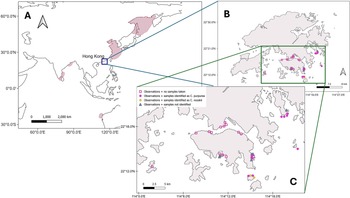
In Hong Kong, one of the most common species of jellyfish is Cyanea nozakii (Terenzini et al., Reference Terenzini, Li and Falkenberg2023), although as Cyanea is a wide-ranging genus, it is likely that other Cyanea species – including C. purpurea – may also be present (Kingsford et al., Reference Kingsford, Schlaefer and Morrissey2021), extending the currently known occurrence (Figure 1). Previously, four species of Cyanea – specifically C. nozakii, C. capillata, C. ferruginea, and C. purpurea – have been reported in Chinese waters, with C. nozakii being the most common and widespread (Hong and Lin, Reference Hong and Lin2010). Moreover, C. purpurea has been recorded in Shenhu Bay, Fujian Province, bringing the species distribution range to within 500 km of Hong Kong waters (Feifei et al., Reference Feifei, Huang, Li and Li2015). Cyanea purpurea has also been documented in the East China Sea (Hong and Lin, Reference Hong and Lin2010; Zhang et al., Reference Zhang, Mu, Zhang and Chen2012b; Zuo et al., Reference Zuo, Wang, Wu, Yuan and Luan2016) and the Yellow Sea (Zuo et al., Reference Zuo, Wang, Wu, Yuan and Luan2016). Taking a broader perspective, the range of C. purpurea is listed as extending between northern Japan and Sakhalin, Russia (Jarms and Morandini, Reference Jarms and Morandini2019), with records from the Okhotsk Sea (Uchida, Reference Uchida1954). Further from the region, C. purpurea has also been recorded in three locations along the east coast of India; the West Bengal, Orissa, and Tamil Nadu coasts (Ramakrishna and Sarkar, Reference Ramakrishna and Sarkar2003). Cyanea purpurea has also been documented on the west coast of nearby Sri Lanka (Fernando, Reference Fernando2001). The World Register of Marine Species (WoRMS) indicates that the species is present in the Indo West Pacific, but does not specify a particular range (Collins et al., Reference Collins, Jarms and Morandini2025). The farthest mention of C. purpurea in the literature from this Hong Kong record comes from the Ningaloo Reef in Queensland, Australia where the species identity was molecularly validated to be C. purpurea (Ingram, Reference Ingram2015).
Map showing areas (A, coloured red) where C. purpurea is reported in the literature (Fernando, Reference Fernando2001; Hong and Lin, Reference Hong and Lin2010; Ingram, Reference Ingram2015; Jarms and Morandini, Reference Jarms and Morandini2019; Ramakrishna and Sarkar, Reference Ramakrishna and Sarkar2003; Uchida, Reference Uchida1954; Zhang et al., Reference Zhang, Mu, Zhang and Chen2012b; Zuo et al., Reference Zuo, Wang, Wu, Yuan and Luan2016). The insets show the locations within Hong Kong overall (B), and the specific region where samples were concentrated (C), of citizen scientist observations of purple Cyanea reported to the HKJP for which either: sampling and molecular analysis were not completed (purple square; n = 16); samples were taken for molecular analysis and C. purpurea presence confirmed (purple circle; n = 10); samples were taken and confirmed as C. nozakii (tan circle; n = 2); or samples were taken but identity could not be confirmed (grey triangle; n = 7).

In identifying Cyanea jellyfish, common features across each species reported in Chinese waters include eight marginal lobes, eight rhopalia, strong manubrium, and long tentacles (Dong et al., Reference Dong, Sun, Wang and Liu2008). However, the similar morphologies of Cyanea make it difficult for citizen science observers to distinguish C. purpurea from other Cyanea species. It is recognised that, unlike the other species, morphologically C. purpurea is often purple in colour and has a smaller umbrella diameter (Dong et al., Reference Dong, Sun, Wang and Liu2008). Notably, C. purpurea was originally described by Kishinouye (Reference Kishinouye1910) as found on the coasts of Saghalin (sic), with a violet-coloured, discoidal umbrella, up to 360 mm across, and with reddish oral arms (Kishinouye, Reference Kishinouye1910).
Here, we describe the first confirmed record of C. purpurea through molecular validation in the waters of the Hong Kong SAR based on citizen science observations and molecular identification.
Materials and methods
The Hong Kong Jellyfish Project (HKJP) (www.hkjellyfish.com) started in early 2021 to examine the presence of jellyfish in Hong Kong using citizen science. When citizen scientists observe jellyfish during the course of their daily lives or during water-based activities, they are invited to submit photographs or videos along with simple information (date, time, location, and number of jellyfish) to the HKJP website (www.hkjellyfish.com), iNaturalist project (https://www.inaturalist.org/projects/hong-kong-jellyfish-project), or social media (Facebook and Instagram) (Terenzini et al., Reference Terenzini, Li and Falkenberg2023). The project is promoted, and jellyfish information is shared with the general public through a bilingual species identification poster (English and Traditional Chinese), website pages featuring local species and general jellyfish information, public presentations, and both social and traditional media. The HKJP is a contributory citizen science project, with no formal training provided to observers who submit sightings. Identification of photographic observations to the lowest taxonomic level is conducted by an HKJP researcher with reference to the literature and taxonomic experts. Whole specimen collection was performed by citizen scientists and an HKJP researcher using manual collection methods, including hand nets and buckets. No specific training is provided to citizen scientists for the collection of whole live jellyfish specimens using nets and buckets. Morphological analysis of collected specimens was not conducted, as no member of the project team had sufficient expertise to carry out species identification at the time of C. purpurea’s appearance in Hong Kong. Rather, tissue samples were taken from the jellyfish bell by a trained HKJP researcher and preserved in 95% ethanol. As tissue sampling was performed exclusively by the HKJP researchers, citizen scientists were not trained in this procedure. DNA analysis of collected jellyfish samples was conducted by a researcher at the Simon F.S. Li Marine Science Laboratory at the Chinese University of Hong Kong.
Following reports from citizen scientists between March and May, 2022 of purple-coloured Cyanea sp. made to the HKJP website (report n = 7; note: each report typically indicated numerous jellyfish), iNaturalist (n = 7), and through personal communications (n = 2), an HKJP researcher visited the described locations and collected specimens when feasible (sampled locations shown in Figure 1). Citizen scientist divers and sailors also collected specimens during their activities. In total, 19 individual specimens (whole, live jellyfish) and samples of jellyfish (partial, dead jellyfish) identified morphologically as possible purple Cyanea sp. were collected from across Hong Kong by citizen scientists and an HKJP researcher (Figure 1, all figures created in QGIS Desktop 3.32.2) and taken to the Simon F.S. Li Marine Science Laboratory at the Chinese University of Hong Kong for molecular analysis. There was a bias toward citizen science sightings and specimen collection in the east and south-east of Hong Kong. This spatial bias in citizen science observations likely reflects more recreational opportunities in these areas (Terenzini et al., Reference Terenzini, Li and Falkenberg2023), with those conducting opportunistic collections (i.e., divers or sailors) predominantly concentrating their activities in the south-east.
Upon delivery to the laboratory, samples were washed twice with phosphate-buffered saline (PBS) to remove surface contaminants. Mechanical homogenisation was performed using a TissueRuptor II homogeniser (QIAGEN) in 2 ml digestion buffer (1.8 ml ATL buffer with 200 µl proteinase K [ThermoFisher]). Genomic DNA was subsequently extracted using the QIAamp DNA Mini Kit (QIAGEN) following the manufacturer’s protocol. To amplify the cnidarian mitochondrial COI gene (Geller et al., Reference Geller, Meyer, Parker and Hawk2013), polymerase chain reaction (PCR) amplifications were conducted on a T100TM thermocycler (Bio-Rad). Each PCR reaction mixture (50 µl) contained 5.0 µl of 10 × buffer, 0.8 mM dNTPs, 1.5 mM MgCl2, 0.5 µM of forward and reverse primers, 1 µl DNA template, 32 µl of water, and 5 U of Taq DNA polymerase. The amplification process consisted of an initial denaturation step at 95 °C for 3 min, followed by 35 cycles of amplification at 95 °C for 45 s, 50 °C for 45 min, and 72 °C for 1 min. A final elongation step was performed at 72 °C for 10 min. Negative controls (1 µl water replacing the DNA template) were included in each run. The amplified PCR products were then visualised on 1.0% agarose gels stained with SYBR green. PCR products showing a single band of the expected size were selected for further analysis. These selected PCR products were subjected to Sanger sequencing. To confirm the species identification, we compared the COI sequences obtained from the collected specimens with sequences available in the National Center for Biotechnology Information (NCBI) nr database. The obtained sequence data were deposited in the NCBI database and assigned accession numbers: PP627176-PP627182 and PQ044589-PQ044596.
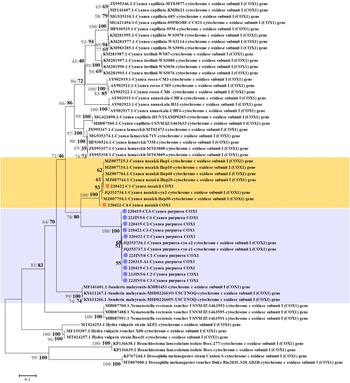
Additionally, phylogenetic analysis of the cytochrome c oxidase I genes was performed. The sequences were aligned using Multiple Sequence Comparison by Log-Expectation (MUSCLE) (Edgar RC, 2004), and phylogenetic trees were constructed in MEGA7 (Kumar et al., Reference Kumar, Stecher and Tamura2016) after removing all alignment gaps. Both Neighbor-Joining and Maximum Likelihood methods (GTR + G + I model) with 1000 replicates were used to generate rooted phylogenetic trees. Bootstrap values (≥50%) are from neighbour-joining and maximum likelihood trees. Reference sequences were downloaded from the NCBI database, although very few records on C. purpurea are available there.
Results and discussion
Systematics
Subclass: Discomedusae Haeckel, 1880
Order: Semaeostomeae Agassiz, 1862
Family: Cyaneidae L. Agassiz, 1862
Genus: Cyanea Péron & Lesueur, 1810
Species: Cyanea purpurea Kishinouye, 1910
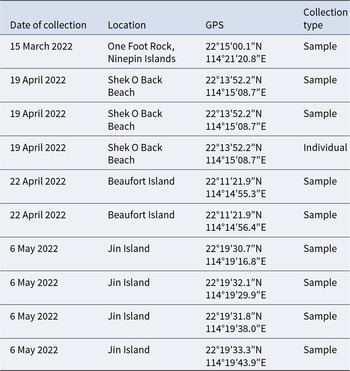
Jellyfish in Hong Kong SAR were identified as potential C. purpurea based on observations of purple-coloured Cyanea sp. made by citizen scientists that facilitated subsequent molecular analysis (sighting and sampling locations are shown in Figure 1). Specifically, samples were taken between 15 March and 6 May, 2022, from 19 jellyfish individuals, with the identity of 10 confirmed as C. purpurea through molecular analysis (Table 1). Two samples were identified as C. nozakii, and the remaining seven samples were not able to be identified due to low-quality gDNA and low similarity with the NCBI database. The phylogenetic tree created from the analysed samples highlights the close genetic relationship of C. purpurea to other Cyanea species, particularly C. nozakii (Figure 2).
Maximum-likelihood phylogenetic tree of Cyanea species based on mitochondrial cytochrome oxidase subunit i (COI) genes. Purple circles represent C. purpurea specimens from this study (n = 10), and orange squares represent C. nozakii specimens from this study (n = 2). Dark grey values ahead the bootstrap values are the bootstrap support values from neighbour-joining trees.

Collection information for each citizen science observation of a jellyfish (represented by a single row) that was molecularly validated as C. purpurea

Under collection type ‘sample’ refers to situations where a live individual was collected from which a tissue subsample was obtained in the field, preserved in ethanol, and taken to the lab; ‘individual’ refers to a situation where a whole live individual was collected and taken to the lab, where a tissue sample was then taken.
The purple-coloured Cyanea reported by the citizen scientists and documented here were likely C. purpurea. We suggest this overlap primarily given the morphological consistency (i.e., appearance as purple-coloured Cyanea sp.) between jellyfish observed by citizen scientists and thought to be C. purpurea and those confirmed to be C. purpurea through molecular analysis. Another species, C. nozakii, is common and abundant in Hong Kong, with colouration ranging from tan to white. As noted above, however, the purple colour does not always indicate C. purpurea because of the variability across Cyanea species, especially in adult individuals (Holst, Reference Holst2012). Moreover, cryptic species are known to be present in Cyanea and may add to the diversity of the genus (Dawson, Reference Dawson2005), including those species present in Hong Kong. Investigating the potential presence of cryptic species will be an important area for future research on the diversity of Hong Kong’s jellyfish. While there is the potential for the observed jellyfish to be other species, the timing of the citizen scientist observations and sample collection supports the C. purpurea identification. That is, there was a relatively short period (March – May 2022) during which both observations of purple Cyanea by citizen scientists and the collection of samples, later identified as C. purpurea through analysis, occurred.
The occurrence of C. purpurea in Hong Kong waters documented here is likely a consequence of transport from nearby areas. Specifically, we suggest that these individuals were brought to Hong Kong from the north by currents during the spring months (after which the currents would have changed direction, and the transport stopped) (Hu et al., Reference Hu, Kawamura, Hong and Qi2000). Such transport has been seen in other species, with seasonal changes in biodiversity in Hong Kong brought on by the movement of different water masses (Morton and Morton, Reference Morton and Morton1983), especially from three major ocean currents, the Hainan Current from the South China Sea in summer, as well as the Kuroshio current from the Pacific Ocean and the Taiwan current from the East China Sea in winter (Tpt et al., Reference Tpt, Cheng, Kky, Lui, Leung and Williams2017). For example, the China Coastal Current also brings zooplankton into Hong Kong waters from the Yellow and East China Seas during winter and spring months (Tse et al., Reference Tse, Hui and Wong2007). We suggest this record of C. purpurea reflects a temporary seasonal occurrence, rather than the jellyfish being established locally, as C. purpurea has not been reported in Hong Kong waters outside of this March–May 2022 time frame (Terenzini et al., Reference Terenzini, Fan, Liu and Falkenberg2024). In terms of a possible source, The World Atlas of Jellyfish records C. purpurea’s distribution off of Russia and northern Japan (Jarms and Morandini, Reference Jarms and Morandini2019), with further observations in East China and Yellow seas (Hong and Lin, Reference Hong and Lin2010; Zhang et al., Reference Zhang, Mu, Zhang and Chen2012b; Zuo et al., Reference Zuo, Wang, Wu, Yuan and Luan2016). It is therefore probable that the individuals reported in Hong Kong originated from the China seas to the north of Hong Kong. A study of plankton communities in Hong Kong came to a similar conclusion, suggesting that gelatinous zooplankton were likely carried into Hong Kong by the China Coastal Current from the East China Sea during the winter and spring months (Wong et al., Reference Wong, Yau and Chan2022). The rapid changes in the jellyfish community composition in Hong Kong at the transition period between the northern and southern monsoons during the spring to summer months (April/May), supports the feasibility of monsoon and current-related transport for jellyfish (Terenzini et al., Reference Terenzini, Li and Falkenberg2023) which we propose can also include C. purpurea.
Here, the consideration of citizen science observations and molecular analysis facilitated the first identification of C. purpurea individuals in Hong Kong’s waters. While this contributes to the understanding of the distribution of this species, ongoing long-term monitoring through citizen science approaches that incorporate additional metrics (e.g., monthly submission rates) or enhanced digital tools (e.g., mobile app integration) will provide understanding of patterns over time. Moreover, as there is limited published information on C. purpurea in the literature besides descriptions (Kishinouye, Reference Kishinouye1910; Kramp, Reference Kramp1961; Mayer, Reference Mayer1910), we still have an incomplete understanding of the implications of this occurrence. As such, investigations regarding aspects including the seasonality, reproductive biology, and trophic interactions of C. purpurea will further strengthen our understanding of jellyfish population dynamics and ecological impacts within Hong Kong. To recognise the occurrence of this species elsewhere, and also other species at this location, we advocate for the simultaneous use of citizen science methods alongside molecular techniques and morphological analysis for an integrative approach.
Acknowledgements
The authors would like to thank Josy Lai, Max Leung, and Ho Yin Yip for their collection efforts in sampling. We would also like to thank Edie Hu, W. K. Lo, and other citizen science observers for their reports of C. purpurea allowing researchers to collect them. We thank Dr. Jerome Hui for his support during the lab analysis of samples.
Author contributions
J.T.: Conceptualisation, methodology, investigation, resources, data curation, writing – original draft, visualisation, project administration. Y.L.: Validation, formal analysis, investigation, resources; L.F.: Writing – review & editing, visualisaton, supervision, funding acquisition.
Funding
We would like to thank the TUYF Charitable Trust for their support of the molecular component.
Competing interests
The authors declare no competing interests.

 Open access

