




Background
Indigenous knowledge is not static; it is dynamic and continuously expressed through cultural practices. The paper highlights how practices like net-making and yarning circles serve as powerful examples of cultural revitalization, actively demonstrating the ongoing relevance and application of Indigenous ways of knowing and being. These practices underscore the active agency of Bundjalung ontological processes, which continually shape connection to Country. The northeast coast of New South Wales bears a history of colonization, which has led to the continued unraveling of cultural practices. However, this paper reveals that the Bundjalung connection to Country is not merely as a fixed territory but a living, dynamic system, constantly shaped by the flow of humans and more-than-humans through these spaces and by their everyday activities and social relationships. The concept of (un)raveling is deliberately employed to foreground the active agency of Bundjalung ontological processes, illustrating that while colonization is a continuous and ongoing process, so too is the Bundjalung people’s connection to their land and ecosystems. This perspective emphasizes resilience and the persistent reassertion of Indigenous identity and practice.
The authors explore the notion that the colonial project perpetuates the structural exclusion of Indigenous worldviews. As well as the visceral oppression of bodies, we understand this exclusion as a problem of ontology (worldviews are excluded) and epistemology (forms of knowledge are diminished). Through a project embedded in the Bundjalung nation, we unpack the insistence that “cultural property” and “rights” are analytically valuable ideas or classifications of reality. Further, we locate this inquiry within a broader debate about whether culture can be governed or regulated at all.
We observe and enable a set of actions (sitting, yarning [storying], harvesting, processing, twisting, weaving, etc.) and a system of knowledge and ontological processes. We understand these actions to be assertions of ontological sovereignty. As part of a larger research project at Gnibi College of Indigenous Australian Peoples, Southern Cross University, the “Stories behind the fishing net: Sitting with the aunties” initiative focused on recording oral histories (yarns) and reviving traditional net-weaving techniques using local plant fibers. The project fostered community connection, knowledge sharing, and cultural governance from these yarns. In acknowledging the ancestors, we foreground the methodological significance of acknowledgement as a political action. Thus, we acknowledge Aunty Gwen Williams, a senior member of the Bundjalung nation and an honorary coauthorFootnote 1 in the research.
Researchers background: Developing the research project and relational ontology with Bundjalung elders, aunties, and uncles
Kylie Day’s journey as an Aboriginal scholar is a testament to resilience, cultural strength, and a deep commitment to Indigenous education and research. Her work is intricately woven with her lived experiences, cultural responsibilities, and community connections. From a young age, Kylie was driven by a sense of wonder and determination, which was further fueled by the tragic loss of her brother. This loss led her to pursue education as a means of healing and supporting young Indigenous students. Her thesis, born out of grief and rebuilding, speaks to loss and the rekindling of hope, aiming to prevent others from experiencing similar senseless loss. Kylie’s connection to Country, initially not fully understood, grew over time into a profound understanding of it as an Indigenous way of relating to the world, ancestors, and spirituality.
Aunty Gwen, an elder pivotal in Kylie’s doctoral studies, played a significant role in shaping her approach to community research. Gwen’s teachings on weaving stories, relationships, and responsibilities, and on engaging students with respect and relational accountability, have left a lasting impact on Kylie. Gwen’s vision of unity and collaboration continues to guide Kylie’s efforts to dismantle the divides left by colonization. Kylie acknowledges the importance of owning Indigenous intellectual property and the need for continuous critical self-reflection, guided by the wisdom of elders and cultural protocols of Bundjalung Country.
Jenelle Benson’s story adds another layer to this narrative. Originally from the United States, Jenelle grew up immersed in diverse tribal traditions in California and Alaska. Her work at Gnibi College of Indigenous Peoples brought her into contact with Kylie, and their shared interest in science, technology, engineering, and mathematics education created a natural link. Jenelle’s participation in weaving and waterways projects with Bundjalung elders aimed to increase relational ontology and improve resource-gathering and string-making knowledge. These projects, governed by elders, involved knowledge sharing from expert weavers and elders from the Yolngu peoples of Arnhem Land, further enriching the collaborative efforts.
Aimee Andersen, an educational designer at Southern Cross University, brings her expertise in culturally responsive curriculum and inclusive learning design to the team. Her lived experience in remote Aboriginal communities and raising her Yolngu sons within these cultural landscapes informs her work. Aimee collaborates with Indigenous academics to embed Indigenous knowledge systems into teaching and learning, supporting systemic change, cultural empowerment, and transformative education. Her focus on amplifying Indigenous voices and fostering culturally safe learning environments is crucial to the team’s mission.
Tom Dick brings extensive strategic and research expertise, alongside a demonstrated commitment to ethical and globally minded allyship. His values-driven approach has played a key role in enabling numerous successful Indigenous enterprises that remain firmly community-led. His focus on Bundjalung biocultural knowledge and perspectives for healthy land management is complemented by his background in designing and developing transdisciplinary cultural heritage and cultural values projects with First Nations peoples across Australia, Asia, and the Pacific Islands. Tom’s PhD research, grounded in decolonizing methodologies, reveals both the benefits and barriers in cross-cultural enterprises led by First Nations peoples.
Together, these stories form a cohesive narrative of resilience, collaboration, and a shared commitment to Indigenous education, research, and cultural preservation. Each member brings unique experiences and expertise, contributing to a collective effort to honor the legacy of elders, foster unity, and dismantle the divides left by colonization. Their work is a testament to the strength and resilience of Indigenous communities and the importance of relational accountability and cultural integrity in research and education.
Introduction
Underpinning the governance and regulation of cultural property, at both domestic and international levels, is the recognition that knowledge fundamental to Aboriginal and Torres Strait Islander people’s health is deeply connected to their cultural heritage and practices. Enabled through engagement with Aboriginal and Torres Strait Islander individuals and communities, this knowledge remains the inherent property of these groups and communities.Footnote 2 Despite this, these systems continue to be shaped by colonial frameworks that fragment and exclude Indigenous worldviews. For decades, Indigenous peoples have navigated imposed systems to reclaim, reestablish, and reaffirm their cultural property and their rights to it.Footnote 3 These systems are marked by power imbalances and inconsistent legal standards.Footnote 4 Nonetheless, Indigenous peoples continue to strongly demand and advocate for meaningful recognition and protection of their cultural property and heritage, rooted in their systems of law and lore.
The Bundjalung nation is a place of extraordinary biocultural diversity.Footnote 5 Spanning from the mountains to the Pacific Ocean, it is home to numerous clan groups,Footnote 6 who collectively identify as Goorie peoples.Footnote 7 This culturally rich landscape is sustained through a deep, dynamic connection between people and Country, guided by law and lore that shape relationships within the community and ensure the continuity of cultural knowledge.Footnote 8 The land itself tells stories through its intricate seasonal cycles marked by the flowering of bloodwoods, migration of whales, annual mullet run, and the fattening of possums, eels, and turtles.Footnote 9
Colonization and cultural (un)raveling
The Doctrine of DiscoveryFootnote 10 played a crucial role in the European mindset of exploration and treatment of Indigenous peoples across the globe. The belief that Christianity was superior to all other beliefs and the need to change all those who did not have Catholicism or the Christian religion was central to the Doctrine of Discovery, giving explorers the right to subjugate and take control of all lands, resources, and Indigenous rights in the name of Christianity and salvation.Footnote 11 The Vatican did not rebuke this five-hundred-year-old doctrine until March 2023.Footnote 12 The implications of this one doctrine have impacted all Indigenous peoples and many lifeforms across the globe to justify colonialism, including the Goorie peoples and the mullet runs. Although the doctrine was rebuked in 2023, the decolonization of non-European countries will take decades, as legal, educational, and religious systems were all built on the ideals of the Doctrine of Discovery. This religious doctrine creates a superiority of European ideas and knowledge above all others, which is seen in the divine right idealism in European colonization.Footnote 13 Our coauthor, Aunty Gwen Williams, made it clear that her motivation for being involved in this research project is a clear (un)raveling of the Doctrine of Discovery, explaining the inclusive nature of net-making as a cultural practice in which “everyone can be involved.”
The idea that white European religion, culture, and knowledge were superior to all others is embedded in the text of the Doctrine of Discovery, with the need to civilize Indigenous peoples by bringing Christianity and European culture to the uncivilized.Footnote 14 Historically, the concept of terra nullius was central to colonial justifications, falsely assuming that lands were empty and uninhabited. This doctrine was underpinned by the notion that Indigenous peoples, deemed uncivilized, lacked the capacity for self-governance, thereby creating a perceived “moral obligation” for Europeans to establish a trusteeship until these populations became “civilized.”Footnote 15 However, this perspective fundamentally failed to recognize the inherent and continuously asserted sovereignty of Indigenous peoples over their lands and cultures. In Australia, this damaging assumption of terra nullius directly negated the longstanding and active Indigenous sovereignty that had always existed and been asserted by Indigenous peoples.Footnote 16 The lack of ability for Indigenous Peoples to have self-determination is directly rooted in the 1493 Doctrine of Discovery and the whiteness it established for empires based on Christianity. This ancient view of European supremacy and the need to save the souls of the “uncivilized” due to religious teachings has led to the exclusion of all other “uncivilized” worldviews and knowledge. This has created a whiteness power structureFootnote 17 that oppresses Indigenous peoples, diminishes their knowledge, and excludes their worldviews from the dominant cultural norms.Footnote 18
These empires determined the fate of First Nations peoples’ ability to maintain their ways of knowing and being on ancestral lands.Footnote 19 For Aboriginal and Torres Strait Islander peoples, ways of knowing are processes of learning that include social, political, historical, and spatial aspects that are taught and learned in certain ways and at certain times.Footnote 20 Each person has a set of knowledge that fulfils and reflects a particular role that is purposeful at that time. Ways of knowing also take place within networks, groups, and relationships and occur at different levels, in this way contributing to group function.Footnote 21
In most instances, families were separated to indoctrinate the young into Christian ways to save their souls without regard to the mental and physical trauma this caused. The disregard for Indigenous knowledge and cultural practices was ingrained in the social norms of the European colonies in Australia.Footnote 22 This is evident in the belief that the Australian government needed to manage all aspects of Indigenous life, effectively removing self-determination and the ability of Indigenous peoples to connect with their families and traditional grounds.Footnote 23 Such actions have profoundly affected the acceptance of Indigenous ways of knowing and being within broader society, creating an imbalance of power and fostering the perception that Indigenous worldviews are of lesser importance.Footnote 24 Importantly, colonialism is not merely a historical event; it is an ongoing structural force that continues to shape and influence legal, educational, and governance frameworks, perpetuating systemic disadvantage for Indigenous peoples.
Through this religiously motivated act of colonization, many ways of knowing and being, along with deep connections to Country, the Dreaming, and cultural practices and rituals, have been disrupted or suppressed across Australia as Christian empires persecuted First Nations peoples. This enduring power imbalance extends into various aspects of Indigenous life, affecting art, work, cultural practices, and mental health. The (un)raveling of Indigenous knowledge impacts all facets of Australian life, as we risk losing the vital connection to Country that nourishes the knowledge of ways of knowing and being.Footnote 25 This ongoing disruption not only threatens cultural heritage but also erodes the spiritual and communal ties that sustain Indigenous identities and practices.
The project
Within this context, our community-engaged project explores the reclamation and renewal of cultural practices through a sustainable and intergenerational lens. By weaving a fishing net from native fibers, guided by local elders, we honor ancestral skills and stories while fostering resilience for future generations. This process exemplifies the relational ethos of Indigenous governance, where collaboration, reciprocity, and respect are foundational principles.Footnote 26 Crucially, the project also serves as a pathway to reducing racism and fostering social cohesion in a nation where debates about whether Aboriginal and Torres Strait Islander peoples’ histories and cultures should be remembered persists.Footnote 27 In this setting, the harvesting, string making, and weaving are examples of actions that assert ontological (and political) sovereignty in a generative and inclusive mode that celebrates the strength and continuity of Aboriginal and Torres Strait Islander peoples’ traditions amid ongoing cultural and political challenges.
The interconnectedness between the tangible and intangible aspects of an Indigenous knowledge (IK) system is paramount to safeguarding cultural integrity and the ongoing struggle for self-determination.Footnote 28 It also situates our research methodology within a broader context of social and political issues related to Indigenous rights and cultural sovereignty. The creation of a fishing net, a tangible artifact, is often deeply embedded within a rich tapestry of stories, songs, and cultural practices, representing the intangible dimensions of cultural knowledge.
Methodology
This research methodology encompassed collaborative net-making and yarning circles, striving for a holistic understanding of culture by acknowledging both its tangible and intangible facets. The study underlying this discussion was conducted on the rich red soils of Widjabal Wyabul (Wia-bal)Footnote 29 Country, a land imbued with sacred sites and ongoing cultural significance. Elders were the experts in holding and transmitting the IK that Country held; they were advocates for a more inclusive and just recognition of cultural property and heritage. The significance of community roles such as eldership in cultural practice renewal was underscored through six workshops, which engaged over 50 participants and several senior elders in the shared act of making nets, exchanging yarns, and reflecting on their connections to Country. Each session was guided by an elder and supported by local Aboriginal rangers to ensure appropriate cultural protocols were observed. For men’s business, a male knowledge holder led the net construction, while experienced local weavers and aunties facilitated string making, with some traveling from as far as the Northern Territory. Participants included Aboriginal academics, local community members, and artists, each contributing their perspectives and lived experiences to the collective process.
The co-design approach was intentionally relational and respectful, grounded in Indigenous methodologiesFootnote 30 that prioritized community-led direction and reciprocal knowledge sharing. Elders’ wisdom guided the process, affirming their authority as cultural custodians and teachers. As Aunty Bertha Kapeen reminded us, quality education and research were about “positioning yourself well.”Footnote 31 This positioning allowed Indigenous and non-Indigenous knowledges to coexist harmoniously.Footnote 32 Deeply embedded in Bundjalung Country and informed by local elders, this work exemplified how IK was both living and cyclical, continually renewed through practice, reflection, and storytelling.
In alignment with the project’s aim to safeguard and revitalize IK, strong Indigenous governance principles were embedded throughout all stages of this research. Governance was guided by Bundjalung elders and grounded in local cultural protocols, ensuring that all processes were conducted in the “right way.”Footnote 33 Elders served as the ultimate knowledge authorities, responsible for granting permissions, setting parameters for participation, and determining which cultural materials and narratives could be shared publicly.
To protect IK, the project was conducted in partnership with local Aboriginal ranger groups, Aboriginal-led community groups, established weavers, the Living Lab Northern Rivers, and Bundjalung elders, ensuring ethical oversight through the Human Research Ethics Committee (HREC 2020/075). This framework affirmed Indigenous data sovereignty and recognized that all cultural materials, stories, and artworks remained the intellectual and cultural property of the contributing elders and communities. The governance structure emphasized collective decision making and reciprocity, ensuring that any knowledge shared within this paper had been approved for dissemination through culturally appropriate channels and with direct input from knowledge holders.
These governance mechanisms were vital in resisting extractive research practices and ensuring that knowledge transmission aligned with cultural law, respect, and relational accountability. They extended beyond Western ethical standards to affirm Indigenous self-determination in research design, data ownership, and dissemination. The project’s governance approach thus embodied its broader purpose: to protect, safeguard, and revitalize IK through methods that honored sovereignty, cultural continuity, and community control. The subsequent section illustrates how these governance principles and collaborative methodologies came to life through the collective act of making the net—a process that wove together relationships, responsibilities, and the living presence of Country.
Net making (tangible)
The net-making process was a collaborative effort to continue the revitalization of weaving in the Bundjalung nation. The process started about 17 years ago when Merrkiyawuy (Merrki) Ganambarr-Stubbs, a Yolngu woman from Yirrkala in northeast Arnhem Land, Northern Territory, met with Bundjalung women from Cabbage Tree Island who had started a small weaving group. Yolngu Country is located in remote northern Australia, where Yolngu people have retained cultural practices and language, unlike other parts of Australia where culture has been heavily impacted by colonization. Merrki has strong connections to the Northern Rivers through her husband’s family and spent a lot of time in the area during the summers. She is a master weaver and knowledge holder. Merrki met the women and shared her knowledge to help revitalize the practice as there were very few people in the area who still had the weaving knowledge. The reciprocity demonstrated through the sharing of knowledge between different nation groups is a vital aspect of culture, reflecting deep respect, interconnectedness, and collective responsibility within and across Indigenous communities.
The importance of shared knowledge across different regions and clans in Australia is critically important in revitalizing IK that has been impacted through colonization. The Bundjalung elders were able to share this knowledge with others during the workshops. Not only the weaving process of making the string, but the uncles and aunties were able to lead in the collection of the required native resources and in the preparations of those resources. This whole process has given local weavers agency to reclaim this cultural knowledge for themselves. The project is a cooperative co-design approach with non-Indigenous participants that is clearly led by Bundjalung elders, aunties, and uncles. The importance of following cultural protocols while making the net has come to the forefront during this process.
The importance of involving both men and women in the process and adhering to cultural practices has strengthened the community and highlighted the health and well-being aspects for each gender as they lead their respective groups in building the net. The whole net-making process builds community as the women weave their stories into the string, making it stronger through building relationships; the string is handed off to the men, who build their own stories into the knots they use to make the net. The fishing net becomes a symbol of the collaborative nature of cultural practice. Collaborative craftwork, by directly involving participants in the creation of the fishing net, provides valuable insights into the tangible aspects of cultural transmission, such as the skills involved and the cultural significance of the object.Footnote 34
Recognizing local yarns with elders (intangible)
The richness of Country and the passion of the Bundjalung people for fishing and sustainable practices are powerfully expressed through this project. Elders eagerly offered their support and guidance, motivated by the shared purpose of revitalizing traditional fishing knowledge. The land itself, alive with stories and seasonal rhythms, plays an essential role in guiding these practices. The deep connection between people and Country is reflected in the cultural significance of fishing and the knowledge embedded within it. As Uncle Charles MoranFootnote 35 explained, “Fishing was a major occupation of my people and a valuable source of food.”Footnote 36 Traditional methods of fishing involved weaving nets from fibrous plants such as reeds gathered from riverbanks, dams, and swamps. These practices, rich with cultural meaning, have been passed down through generations.
Yarning circles have been essential for understanding the cultural importance of fishing-net making within the Bundjalung community. As a culturally integral method for creating knowledge and strengthening identities, yarning circles foster intimacy, trust, and recognition of cultural knowledge holders.Footnote 37 Unlike Western focus groups, yarning circles focus on collaborative knowledge creation,Footnote 38 where participants share stories and perspectives in a safe, inclusive, and respectful environment. They uphold the principles of Indigenous data sovereignty,Footnote 39 ensuring knowledge is shared and preserved in culturally appropriate ways. The process aligns with the United Nations Declaration on the Rights of Indigenous Peoples.Footnote 40
Through yarning circles, stories of sustainable fishing practices were shared. Uncle CharlesFootnote 41 spoke of stone traps built in tidal waters like cattle yards using rocks. As the tide receded, fish could be easily gathered from the ponds, kept alive to prevent spoilage, or collected for larger gatherings and corroborees. These practices were not only practical but were guided by a deep respect for Country. “Lagoons were places spirits lived in the form of giant eels,”Footnote 42 Uncle Charles explained, highlighting how spiritual beliefs and ecological knowledge were intertwined. The choice of fishing spots was inherently connected to place-based law, honoring the spirits and ancestral stories held by the landscape.Footnote 43
Aunty Gwen’s recollections also reveal the joy and cultural richness of traditional practices. She spoke of swimming in “Salty Lagoon,” a woman-only area near the Evan’s River, and diving for cobra worms when she was nine years old. “They said you can eat that, you know. So, I ate it – traditional food in a traditional place,”Footnote 44 she recalled. Such memories highlight the importance of shared experiences and communal knowledge passed down through generations. For her, these were times of happiness, family connection, and cultural continuity. “We loved those days; they were families’ days,”Footnote 45 she reminisced.
The yarning circles provided a powerful framework for cultural transmission, allowing knowledge to be shared across generations.Footnote 46 Communal memory and shared experiences were central to preserving and passing on IK, with elders guiding discussions.Footnote 47 The approach also addressed misconceptions that IK lacked documentation, emphasizing that cultural knowledge is recorded through storytelling, land markings, and ceremonial practices. By acknowledging these forms of documentation, the yarning circles affirmed the legitimacy of IK systems and their relevance to contemporary cultural practices.Footnote 48
Gathering is a cultural restorative methodology that fosters trust and leads to meaningful and sustainable community engagement. This approach has led to outcomes such as strengthened relationships, culturally respectful and inclusive decision making, and practical solutions that have real-world impacts. These gatherings deepened the connection between people and Country, reinforcing the importance of relationships within the learning process. The knowledge shared extended beyond practical skills, representing a holistic approach to cultural sustainability and renewal.Footnote 49 As participants shared their experiences, they contributed to a richer understanding of what it means to live in harmony with the land and honor the wisdom of their ancestors.
Data analysis
The video recordings were transcribed into text and then anonymized. The research team identified Themes and Subthemes from their own personal interactions within various weaving groups within the Bundjalung region and discussions with elder groups. The themes and subthemes were then discussed in a final workshop with the elders and researchers to validate the Indigenous ways of knowing, being, and doing as seen through elders, aunties, and uncles that participated in the various workshops. These six themes and 18 subthemes, as seen in Table 2, were used to code the transcribed texts from the various workshops held for the purpose of making string and weaving a fishing net. The transcripts, themes, and subthemes were coded using NVivo 14. Further analysis was completed through a statistical package in MS Excel. One person was identified to code the text for consistency. The themes and subthemes were mapped at face value for the words used. No underlying meaning was assumed. Only subthemes were matched to passages, and each passage was only matched to one subtheme. This was done so that no one area was inflated from matching passages to multiple areas. The subthemes that most closely matched the meaning or context of the passage were mapped.
The first transcript was coded, and then the transcript with the coding was sent to all research members made up of Indigenous and non-Indigenous people for input. This was done to ensure that the coding was completed as all research members would have done. Any areas that needed further explanation and adjustment were made before the rest of the transcripts were coded. Once consensus was reached, the rest of the transcripts were transcribed using the same process. A final debriefing of the data analysis was held with the Indigenous and non-Indigenous researchers, elders, aunties, and uncles that were part of the oversight committee to discuss the initial findings. This allowed for additional input and a shared understanding of the elders, aunties, and uncles to ensure all data were used in a respectful and supportive manner according to the oversight committee.
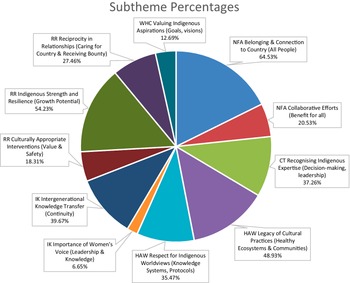
The overall themes in Figure 1 display the number of passages that matched the subthemes within the main theme. These subthemes were then counted, and the percentage of each theme was determined out of the total of all themes and subthemes. Within the data, the main areas were the “Intergenerational Knots,” comprising 26.65% of the discussions, and “A Net for All,” comprising 20.78% of the discussions. These two areas exemplified the importance of connection to Country, connection to others and the importance of transferring knowledge to younger generations to retain and maintain cultural practices and cultural identity.
The main themes of the research are displayed as percentages.

The two areas (Figure 1) that had the smallest percentages were “Reciprocity and Respect,” comprising 7.87% of the discussion, and “Collaborative Threads,” comprising 11.75% of the discussion. These two areas, which contain self-determination, recognizing Indigenous expertise, cultural grounding, and reciprocity in relationships, were the most difficult areas for many to discuss as the (un)raveling of cultural practices and Indigenous voices have been silenced through the practices inherent in the Doctrine of Discovery and the colonization of Australia. The importance of Australia’s First Nations peoples sharing knowledge and cultural practices across the different regions of Australia is and was important during this process. Through this sharing of knowledge, interrupted practices are reignited, and the growth potential for these two areas of the Framework comes to the forefront for future generations.
The top subthemes for how colonization have impacted cultural practices and the (un)raveling of Indigenous worldviews, which then diminishes IK, are displayed in Figure 2, and the main themes are identified at the beginning of each subtheme.
The main subthemes from the research and their percentages.

Within the subthemes, there are six that are brought to the forefront: “Belonging and Connection to Country,” comprising 64.53% of the A Net for All theme; “Recognizing Indigenous Expertise,” comprising 37.26% of the Collaborative Threads theme; “Legacy of Cultural Practices,” comprising 48.93% of the Honoring the Ancestral Weave theme; and “Respect for Indigenous Worldviews,” comprising 35.47% of the Honouring the Ancestral Weave theme (84.4% combined); “Intergenerational Knowledge Transfer,” comprising 38.67% of the Intergenerational Knots theme; and “Indigenous Strength and Resilience,” comprising 54.23% of the Reciprocity and Respect theme. Looking at these subthemes, a trend around the discourse of IK and cultural practices emerges. The need to value Indigenous worldviews and cultural practices and see the value in connection to Country is paramount in the decolonization of Australia. This will lead to respect and reciprocity as we acknowledge the strength and resilience Australian Indigenous culture has had over the last 60,000 years and incorporate Indigenous knowledge and expertise into societal norms. This research demonstrates the importance of Indigenous self-determination to forge interrupted connections to Country and ancestral grounds to help reignite impacted cultural practices and knowledge to heal Country and its people.
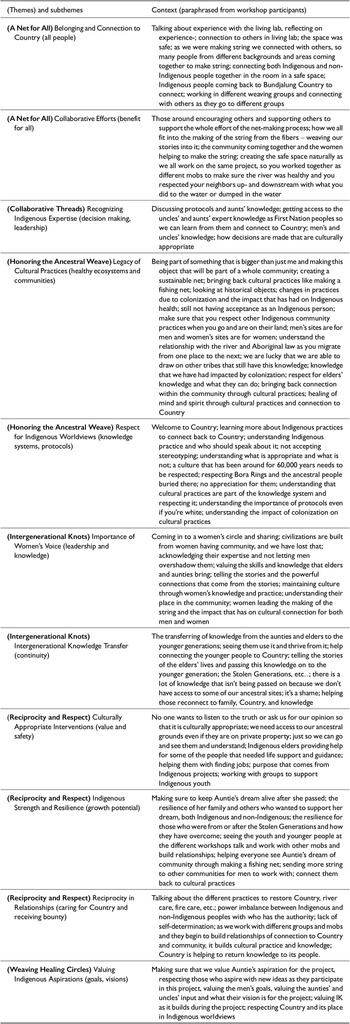
Table 1 documents paraphrased participant ideas within each of the main subthemes to provide context for what was openly yarned in the safe spaces created during the making of string and weaving of the net. The community connection and sharing of knowledge occurred across all workshops as the string was created and later as the men wove the net. The yarning was led by elders in each of the spaces according to cultural protocols.
Context around corresponding themes and subthemes from workshops

Note: The Living Lab is a community-led, place-based research environment fostering cultural practice and knowledge sharing.
Results
The ongoing influence of colonialism continues to shape legal approaches to cultural property, often prioritizing Western legal concepts over Indigenous perspectives.Footnote 50 This colonial legacy can hinder the recognition and protection of Indigenous cultural property, underscoring the need for legal reforms that incorporate IK systems and values.Footnote 51 Our study of identifying sources of native fibers, harvesting, making string, and weaving a fishing net, rooted in community-engaged research, foregrounds an agential process of “raveling” cultural practices and strengthening identity through active participation.Footnote 52 By working with Bundjalung elders and community members, we showcased the resilience and richness of Indigenous cultural heritage, highlighting the broader implications of cultural property protection and value(s) of an ongoing practice of reticulated governance and inclusive legal and community frameworks when reviving cultural practices.
Thematic results displayed in Figure 1 are project themes and subthemes (Figure 2). Each theme relating to cultural property rights is expanded on in the following sections.
A net for all: Building community and connection
The project fostered all participants’ strong sense of belonging and connection to Country. Participants felt connected to Country by creating the net and reflecting on their connection to place and the importance of cultural practices in fostering a sense of belonging. Sentiments from Aunty Jacqui highlight the shared learning experience during the final workshop: “And what we do is we learn off one another and we follow through with it. And we’re blessed in that manner as we are. I believe we’ve all got some gift.”Footnote 53 The shared act of string making fostered a sense of unity. Other statements shared during the first small workshop, such as, “And I’m connected to Saltwater Country, Yolngu Country and Northeast Arnhem Land through my two sons. So, I feel very blessed to be here and to be working with you, Aunty, and this group as well,”Footnote 54 exemplified how the workshop provided a space for participants to share their own connections to Country and acknowledge the diverse cultural backgrounds represented within the group.
“For me it’s like really lovely to be here with everyone and be part of it and really fortunate to have opportunities like this to be on Country, be out on Country and caring for Country and part of that is understanding the cultural protocols and cultural economies.”Footnote 55 This statement from the Namabunda Farm workshop emphasizes the significance of direct engagement with Country and the importance of understanding and respecting cultural protocols in environmental stewardship. These quotes demonstrate the deep understanding of traditional ecological knowledge held within the community and the importance of intergenerational transmission of this knowledge.Footnote 56
This community-based approach to cultural revitalization fostered social cohesion and a sense of belonging. It directly countered the historical and ongoing dispossession of Indigenous peoples from their lands and cultural heritage.
Collaborative threads: Weaving together knowledge and action
The research emphasized the importance of recognizing and valuing Indigenous expertise and leadership throughout all stages. “Getting access to the uncles’ and aunts’ expert knowledge as First Nation peoples so we can learn from them and connect to Country,”Footnote 57 a statement made during the Living Lab workshop, highlighted the participants’ understanding of the importance of learning from elders and recognizing their authority in cultural knowledge. The process prioritized culturally appropriate decision-making processes, ensuring that IK and perspectives were central to the project’s direction. This centering of Indigenous voices and knowledge, from planning and design to implementation and evaluation, reflects a successful model for community-based cultural projects, offering valuable lessons for other initiatives seeking to engage with Indigenous communities and support cultural revitalization efforts.
Honoring the ancestral weave: Reclaiming cultural practices
The findings recognized the deep and enduring connection between cultural practices, environmental care, and community well-being. “Bringing back how to make a fishing net is fantastic, changes in practices due to colonisation and the impact that has had on Indigenous health,”Footnote 58 acknowledged the historical significance of traditional practices and their impact on community well-being. This highlighted the importance of reclaiming traditional knowledge and practices, such as weaving, to reconnect with their cultural heritage and foster a deeper understanding of their relationship with the environment.Footnote 59 The research also emphasized respecting Indigenous worldviews and cultural protocols, recognizing the legacy of cultural practices in maintaining healthy ecosystems and communities. Statements like, “reclaiming a relationship with the river to help improve its health, understanding the relationship with the river and Aboriginal law as you migrate from one place to the next”Footnote 60 emphasized the interconnectedness of cultural practices with environmental care and the importance of traditional ecological knowledge.Footnote 61 This reclamation and revitalization operate in a generative tension with the (un)raveling of cultural rights caused by the removal of cultural property.
Intergenerational knots: Weaving the future
The project valued the importance of women’s voices in leadership and knowledge transmission.Footnote 62 “Coming into a women’s circle and sharing, civilization is built from women having community and we have lost that,”Footnote 63 acknowledged the critical role of women in preserving and transmitting cultural knowledge. This further emphasized strengthening connections between generations, ensuring knowledge transfer and cultural continuity. “The transferring of knowledge from the aunties/elders to the younger generations, seeing them use it and thrive from it, helping to connect the younger people to Country,”Footnote 64 highlighted the importance of intergenerational learning and the passing down of cultural knowledge. The study valued the skills and knowledge that elders and aunties brought, telling the stories and the powerful connections that came from the stories. This intergenerational knowledge transmission is crucial for ensuring the continuity of cultural practices and the resilience of Indigenous communities, directly combating the impact of cultural property removal on the continuity of Indigenous cultural practices.
Reciprocity and respect: Walking together on Country
The investigation promoted culturally appropriate interventions aligned with Indigenous values and cultural safety. “Make sure to respect other Indigenous community practices when you go and are on their land, men’s sites are for men, and women’s sites are for women,”Footnote 65 highlighted the importance of respecting cultural protocols and sensitivities within different Indigenous communities. The outcomes acknowledged Indigenous communities’ inherent strength, resilience, and growth potential in the face of adversity.Footnote 66 “The resilience of her family and others that wanted to support her dream, both Indigenous and non-Indigenous, the resilience for those that were from or after the Stolen Generations and how they have overcome,”Footnote 67 recognized the strength and resilience of Indigenous communities in overcoming historical and ongoing challenges. The project emphasized relationship reciprocity – caring for Country and receiving its bounty in return. Participants discussed the importance of living in harmony with the natural world, respecting the land and its resources, and recognizing the interconnectedness of all living things. This focus on reciprocity and respect for Country aligns with Indigenous values and cultural safety, offering a powerful counter-narrative to the ongoing influence of colonialism, which can be identified as shaping legal approaches to cultural property.
Weaving healing circles: Empowering visions and aspirations
The study valued the aspirations, goals, and visions of Indigenous individuals, families, and communities. The comment “Making sure that we value Aunty Gwen’s aspiration and the Aunties aspiration for the project, respecting those that aspire with new ideas as they participate in this project, valuing the men’s goals, valuing the aunt and uncles’ input and what their vision is for the project”Footnote 68 emphasized the importance of respecting and supporting the aspirations and visions of all community members. This demonstrated the vital role of intergenerational knowledge transfer in preserving and revitalizing cultural practices. Elders were crucial in guiding the process of sharing their expertise and stories, which provided a platform for the reclamation and revitalization of traditional Bundjalung weaving practices. By working closely with elders and engaging in hands-on learning, participants were able to reconnect with their cultural heritage and rediscover these interrupted skills.
The research emphasized the importance of environmental sustainability by using locally sourced and sustainable materials. Participants learned the importance of respecting the natural environment and responsibly utilizing resources. This provided a space for decolonization and reconciliation by challenging dominant narratives and creating space for Indigenous voices and perspectives.Footnote 69 It fostered a deeper understanding of Indigenous ways of knowing and being and their significance in contemporary society. By working collaboratively with Bundjalung elders and community members, the project demonstrated the importance of respecting Indigenous sovereignty and cultural integrity. These project elements, including honoring aspirations, knowledge transfer, cultural revitalization, environmental sustainability, and decolonization, highlight the community’s agency in protecting and reclaiming their cultural property.
Discussion: Decolonising methodologies and Indigenous self-determination
Challenging colonial perspectives
Our discussion builds upon the critical examination of Western research practices by First Nations peoples over the last three decades. Scholars like Linda Tuhiwai Smith,Footnote 70 a Māori scholar, have critically analyzed how conventional research methodologies are embedded in colonial perspectives that marginalize IK systems. This critique directly informs our approach to political sovereignty, advocating for research that centers Indigenous perspectives and prioritizes Indigenous self-determination.
Bundjalung approach to research
In this light, we are developing a Bundjalung approach to methodologies designed to engage our community in knowledge sharing and research. This initiative is a direct application of self-determination, asserting the right of the Bundjalung community to define its own research paradigms. By acknowledging the work of Indigenous scholars in New ZealandFootnote 71 and Polynesia,Footnote 72 we situate our Bundjalung approach within a broader movement of Indigenous peoples asserting their intellectual and cultural sovereignty over research processes.
A framework for a practice of reticulated governance: Connecting culture, Country, and rights
Our project demonstrates a praxis of decolonization fostering cultural and ecological interconnectedness through a collaborative and sustainable approach to traditional practices.Footnote 73 Guided by Bundjalung weavers, we conducted research to identify the most sustainable fiber sources for string making, emphasizing the importance of using natural, locally available materials. This process not only re-raveled the ancient art of weaving and also built connections between Indigenous and non-Indigenous participants. By engaging in knowledge-sharing workshops, participants contributed to a cultural and ecological act of repair, where stories, skills, and experiences were woven into the fabric of community life. One participant stated as they showed the string-making process, “And that’s the binding technique which has been used in multiple cultures all over the world,”Footnote 74 this statement acknowledges the global interconnectedness of knowledge and the shared human experience of weaving and creating. Furthermore, “And when you put the strands together, that’s wonderful. It’s wonderful, the Banya right up along the bank and you sit and talk about them. Their stories, those fellas out there that’s what they’re doing."Footnote 75 This participant’s observation highlights the deep connection between the act of weaving, storytelling, and the natural environment, emphasizing the interconnectedness of human activity with the natural world. The final collaborative effort – constructing a net using the sustainably sourced string – symbolises the mutual interdependence and respect inherent in practice of reticulated governance, fostering harmony between human practices and the environment.
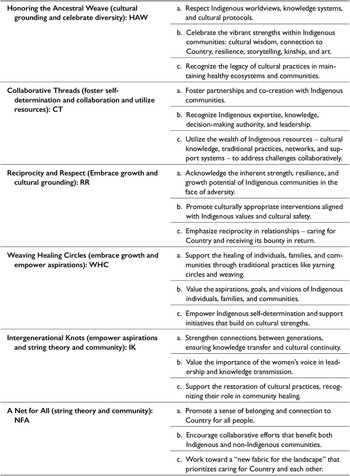
Our framework, like a net, is meant to be strong and flexible, adapting to the specific needs and contexts of Indigenous communities. By weaving together these principles, we can create a framework that supports Indigenous strengths, fosters healing, and restores connections to Country. It blends strengths-based principles with themes of community, healing, and cultural restoration. Table 2 displays the themes that emerged during the workshops that were used for our data analysis.
Themes and expanded subthemes within the research framework

Western and Indigenous perspectives clash in their approaches to nature, with the former categorizing and the latter emphasizing balance, a conflict often exploited to obstruct decolonization. This historical tension, stemming from doctrines like the Doctrine of Discovery and challenged by United Nations Declaration on the Rights of Indigenous Peoples (UNDRIP) articles,Footnote 76 underscores the need for transformative change in human–nature relations. The analysis of our data reveals the need for a new framework that contributes to the field of cultural property rights. Our framework emphasizes the integration of diverse knowledge domains, promoting a holistic understanding that transcends binary framing and embraces the complexity of human and ecological interactions.Footnote 77 Crucially, this framework recognizes that the past informs the present, allowing contemporary interpretation to shape its use. It also acknowledges the current environmental predicament as both scientific fact and social narrative, moving beyond technocratic solutions toward a deeper engagement with ontological politics and the diverse responses needed to address this complex challenge.
Our framework, grounded in the lived experiences shared during the net-making workshop, emphasizes the interconnectedness of knowledge, community, and Country. Participants highlighted the wealth of traditional knowledge present, exemplified by the discussion of sustainable materials like plant fibers versus nylon and the impact of each on the ecosystem. The workshop, held on Widjabul Wyabul (Wia-bal) land, acknowledged elders past, present, and emerging and honored ancestors, fostering a sense of shared purpose. The act of creating the net symbolized renewing old ways and practices, embodying care for Country through cultural protocols and economic understanding. The project, supported by the Water Storage Project, connects to broader narratives of water, flooding, and the complex relationship between people and place.
The net is not only the weaving of the strings that are tied into knots and the knots creating the wefts and warps of the net that make up the voids. But these voids represent the liminal spaces between the fibers that allow for the (un)raveling of colonization. These voids that run through the net give it structure and design. Like the voids of the net, the knowledge and cultural practices that are passed on from elders give structure and design to community past and present and provide the space for (un)raveling whiteness and raveling cultural processes, cultural identity, and Country.
The net is more than a metaphor for the interconnectedness of the community, echoing historical practices of shared resources like the mullet run, where reciprocity with Country ensured abundance. Our framework recognizes the gathering as part of a long history of such events, acknowledging the changes to the landscape and the need to address their consequences. It seeks to create a “new fabric for the landscape,” one that prioritizes care for Country and for each other, building on the knowledge shared and fostering future collaborations. The framework emphasizes principles of law, like taking only what is needed and sharing abundance, reinforcing reciprocity with both Country and community.
This research project, grounded in Bundjalung cultural protocols, highlights the deep, relational significance of specific language and practice. The project is centered on the revival of the traditional practice of net-making, which is linguistically framed by the Bundjalung language terms ngarbany (meaning “time for nets” or net season) and muhng (meaning stomach/net). The use of ngarbany signals that stories and experiences related to this practice reside within the community, passed down through generations and actively reinvigorated in spaces like this workshop. The multifaceted meanings of muhng illustrate the profound connections within Bundjalung ontology, directly linking sustenance, culture, and Country by asserting the net (a cultural tool) as a source of life (stomach). These terms originate from the Bundjalung language group (specifically the Yaegl/Bandjalang dialects of the Northern Rivers region of New South Wales), anchoring the practice within a specific cultural and geographic location.
Our framework highlights how such cultural practices embody human rights by preserving cultural identity, fostering community, and strengthening connection to Country. Ultimately, this framework emerges from the collective “yarns” and shared journeys of the participants, aiming to support the growth of individuals and community through continued connection and collaborative action. This is seen not only in the shared heritage (including recognition of historical connections like the Tasmanian Basque language) but also in the creation of tangible cultural objects, such as the string worn on the leg.Footnote 78 This cultural object is personally imbued with shared heritage and individual stories, physically fostering community ties and affirming personal identity through tangible connection to place.Footnote 79
The project goes beyond sustainability to embody the deeply interconnected worldview central to Indigenous cultural heritage, challenging Western notions of categorization. The traditional net-making process became a form of decolonization for non-Indigenous participants, allowing them to connect with Bundjalung people and their stories while strengthening community bonds. For local weavers, the project offered agency to reclaim and practice cultural knowledge, reaffirming their roles as custodians of heritage. As one participant described, “the process is focusing on symbiosis and mutual benefit.”Footnote 80 This project aligns with that vision, offering a holistic, community-centered model of cultural revitalization and ecological sustainability where participants collectively weave a tapestry of shared stories and knowledge, fostering both cultural and environmental resilience.
One participant reflected, “It means that things are healing. And that’s really what I think I’m here to heal myself, but also to work with others to heal this beautiful Country that’s experienced such dislocation and disruption. But it’s strong and it’s coming back.”Footnote 81 This reflection emphasizes the interconnectedness of personal healing and the healing of Country, aligning with the practice of reticulated governance for caring for Country, supporting biocultural diversity and ecological balance and fostering a more harmonious relationship between humans and the environment.
This framework is inspired by Indigenous and non-Indigenous people who live on or have a connection to Bundjalung Country. It is a story of creating a fishing net out of native fibers and a community of people learning immediate skills that “holds” generations of people on Bundjalung Country practicing cultural knowledge and sustainably living into the future. This sustainable holding of people is termed the “mullet run.” This story highlights the lawfulness associated with Indigenous cultural practices, collaboration, and connection to Country.Footnote 82
Repairing the net: Social capital, cultural (un)raveling, and artistic sovereignty
Like the woven strands of a fishing net, Bundjalung social structures are held together by trust, reciprocity, and shared responsibility. The net represents the strength of cultural knowledge passed down through kinship systems that sustain and nourish the community.Footnote 83 When intact, it provides literal and cultural sustenance, ensuring that knowledge, stories, and artistic practices remain vibrant. This is the essence of social capital: the ability to rely on one another, exchange knowledge, and reinforce a shared identity through cultural practice.Footnote 84
Colonization, however, tore through this net, severing connections between people, land, and tradition. Dislocation, banning cultural practices, and imposition of Western frameworks (un)raveled these relationships, embedding lateral violence within the system.Footnote 85 When people are removed from their lands and kinship networks, trust is weakened and cultural capital is diminished.Footnote 86 In the art world, we continue to see these effects in the exclusion of Indigenous artists from markets and the appropriation of their work without reciprocity.Footnote 87 As an auntie and a participant highlighted, access to selling art is inconsistently shared, mirroring the disruptions caused by colonial interference.
Yet, like the net, these social bonds can be repaired. Strengthening social capital requires intentional reconnection—artists and knowledge holders actively weave their relationships back together.Footnote 88 By reclaiming cultural authority, fostering collaboration, and ensuring ethical engagement, we reinforce the strength of the net. In doing so, we resist the ongoing impacts of colonization and lateral violence, ensuring that Bundjalung cultural property remains in the hands of those to whom it belongs.
Indigenous cultural property is deeply embedded within relational knowledge systems that regulate access, transmission, and custodianship of heritage. Knowledge shared through yarning circles, encompassing reflections on ancestral governance, relational autonomy, and the principle of knowing what belongs to whom, underscores that IK is not a universal commodity but a culturally and legally governed system of relations and responsibilities. This principle is exemplified in the discourse surrounding the long-necked and short-necked turtles. Within this context, knowledge of Country and ecological practices is inextricably linked to familial and communal rights, ensuring that knowledge remains safeguarded within its rightful custodians. Elders articulate that long-necked turtles signify resilience and adaptability, typically associated with inland waterways that sustain their communities, while short-necked turtles represent coastal connections and the marine ecosystems vital to coastal mobs. This distinction not only reflects the ecological diversity of the land but also embodies the differentiated identities, histories, and ontologies of various Indigenous groups. A compelling instance of this relational understanding emerged when a family member of Dr. Day (the lead researcher of this study), who was preparing to study at Gnibi, reflected upon two paintings at the university depicting these turtles. Viewing the short-necked turtles evoked a connection to the coastal mob; however, encountering the long-necked turtles elicited a profound sense of comfort and belonging, affirming her identity with her inland mob. This moment illustrates how cultural safety, recognition, and identity are intricately intertwined and how visual representation within educational spaces can affirm relational belonging and continuity. Ultimately, this account reinforces that IK manifests in diverse forms and is governed by protocols upheld through the authority of elders as custodians of cultural property. The recognition that cultural property cannot be extracted, commodified, or freely transferred aligns with broader global Indigenous assertions against the misappropriation of traditional knowledge, sacred objects, and artistic expressions.
Despite colonial systems that have sought to fragment these governance structures, the transcript highlights the continued assertion of cultural authority through lived experiences and the recognition that knowledge itself is a form of property that requires ethical and legal protection. Indigenous governance over cultural property, including oral traditions, ecological practices, and artistic expressions, is essential in challenging Western legal frameworks that often commodify knowledge without acknowledging Indigenous sovereignty.
A central theme in the findings is the role of elders as custodians of cultural property and the need to respect their governance over knowledge transmission and access. Discussions about spirituality, cultural symbols, and the power of lived experience in teaching exemplify how Indigenous knowledge is safeguarded through both tangible and intangible heritage. The concept of waiting for knowledge to be passed down when the time is right, rather than extracting it for external use, aligns with the principle of free, prior, and informed consent (FPIC) in Indigenous cultural property frameworks.Footnote 89 The critique of institutional frameworks, particularly in the context of educational institutions, centers on the enduring effects of colonialism that have shaped these systems. These frameworks often fail to incorporate Indigenous worldviews, neglecting the rich spiritual and relational knowledge that Indigenous communities possess. Such oversight is not merely an academic shortcoming; it undermines the cultural heritage and identity of Indigenous peoples. By failing to recognize and integrate Indigenous perspectives, educational and legal systems perpetuate a form of cultural erasure. This critique calls for a transformation toward inclusive practices that not only acknowledge but actively honor Indigenous intellectual property rights. It emphasizes the necessity of relational accountability, which entails a respectful and reciprocal sharing of knowledge that aligns with Indigenous values.Footnote 90 Furthermore, elders, as custodians of cultural and legal wisdom, should be integral to shaping policies and discussions surrounding the governance of Indigenous cultural property. Their involvement is crucial for ensuring that any frameworks developed are genuinely reflective of Indigenous needs and perspectives, thereby fostering a more equitable and just educational landscape. This shift is essential for reconciling past injustices and building a future that respects and uplifts Indigenous voices and knowledge systems.
Further research and implications
Throughout the workshops, there was a passion to reduce the environmental impacts of fishing with plastic nets and address the silence of ghost nets and their impact on sustainable fishing. There was also discussion on the current restrictions on how many local people can catch fish and the number of fish that can be caught, which impacts cultural practices and caring for Country. We have much more research to do with respect to what the net is made from. We have been asked to repeat the project with different native plant fibers with the aim to determine and compare the strength and durability of each fiber type, allowing us to better understand their practical applications and structural properties. There are three specific fibers we would like to pursue along with investigating native preservation techniques and how these contribute to the longevity of the net. There are also areas of men’s knowledge that have surfaced with the cultural protocols of making the net that have highlighted the importance of cultural practice and men’s health.
Conclusion
By working with the aunties who are descendants of the Stolen Generations, this research project aims to reclaim and share these stories, celebrating resilience and cultural continuity. These same descendants help guide our study and voice the ongoing processes of raveling and (un)raveling for many local knowledge holders and elders in terms of art and silencing of renewal practices. It has yet to be amended or solved, and it is an unfinished business. “But a lot of people don’t know how to, don’t know their roots or where they come from, or they don’t want to know. Because it’s denial. But not everybody’s in denial about everything.”Footnote 91 This statement identifies how the loss of cultural knowledge from colonial dispossession has impacted knowledge transmission and cultural practices.
Through reciprocity, respect, and relationality principles, Bundjalung culture fosters harmony within the community and with Country. The kinship systems provide a framework for listening to the land and its people’s needs, ensuring knowledge remains dynamic and emergent.Footnote 92 As Martin and MirraboopaFootnote 93 emphasize, Indigenous research must align with the critical features of Indigenous ontology, privileging relational accountability and ethical engagement. Elders remind us that Country actively participates in knowledge production, revealing its secrets only when approached with respect.
This principle was central to our project, guided by our “fierce” aunties, who consistently challenged misappropriation—ironically, often from non-Indigenous people. This reinforces the ongoing impact of the Doctrine of Discovery and its persistent influence in how research is conducted. Working alongside the aunties highlights the enduring sovereignty of Goorie knowledge, which remains adaptive while staying deeply rooted in place. These cultural practices offer a powerful counter-narrative to colonial erasure and hold significance beyond the community, impacting broader educational and social contexts.Footnote 94
By integrating Indigenous perspectives into Western educational systems, educators can create spaces where Aboriginal and Torres Strait Islander peoples feel supported and empowered to learn as Aboriginal and Torres Strait Islander peoples.Footnote 95 Strength-based approaches incorporating cultural knowledge into education are a step toward decolonizing practices and honoring the voices of Bundjalung elders, who continue to advocate for the inseparability of Country, community, and cultural identity.Footnote 96
Acknowledgments
Particular thanks are given to elders Aunty Gwen Williams, Uncle Frank Kransa, Uncle Marcus Ferguson, Aunty Jacqui Williams, Aunty Margaret Torrens, and Aunty Merrkiyawuy Ganambarr-Stubbs, and the Gnibi Elders Council as well as Namabunda Farm, Dhinawan Baker, Jagun Alliance, Oliver Costello, Yirrkala Art Centre, Reimagining Aboriginal Arts Centre, the Tweed Byron Local Aboriginal Land Council, Living Lab Northern Rivers, Bundjalung Tribal Society, Namitja Haven, Casino Weavers, Arts Northern Rivers, Environmental Protection Agency (EPA), Nalingah Mijung Dubais, Healing Hub and Jagun Dandii for sharing their stories and knowledge, Wanda DeVerille Hill, and the Centre of Children of Young People.
Disclosure of interest statement
All authors declare that they have no conflicts of interest.


 Open access

