

Introduction
Over the last two decades, a growing body of research has explored the shifts in employment patterns spurred by technological progress, notably robotics, digitalisation, and more recently, artificial intelligence. The routine-biased technological change (RBTC) has emerged as a prominent approach to assess the effects of automation on employment (Autor and Dorn Reference Autor and Dorn2013; Autor et al Reference Autor, Levy and Murnane2003). According to RBTC, firms produce goods and services by combining a bundle of tasks, achievable through either capital or labour. The allocation of capital or labour to each task depends on their relative costs and the feasibility of task automation. Consequently, routine tasks, easily translated into algorithms and characterised by well-defined procedures and rules, are more prone to be replaced by machines. In this paper, our focus will be on the extensive margin of the de-routinisation process, which entails altering the employment structure and reallocating labour between occupations based on their intensity in routine tasks. This is distinct from the intensive margin of de-routinisation, which examines internal variation of routine task intensity within individual occupations. In the following, ‘employment de-routinisation’ will denote the declining proportion of jobs highly intensive in routine tasks, in favour of those with a higher intensity in non-routine tasks. Conversely, ‘employment routinisation’ refers to the opposite process.
The empirical literature on (de-)routinisation (Fernández-Macías et al Reference Fernández-Macías, Klenert and Antón2023; Fonseca et al Reference Fonseca, Lima and Pereira2018; Lewandowski et al Reference Lewandowski, Park and Schotte2023; Longmuir et al Reference Longmuir, Schröder and Targa2020; Montresor Reference Montresor2019) underscores a decline in routine task-intensive jobs in developed countries, driven by advancements in automation and a substantial decrease in investment costs (Das and Hilgenstock Reference Das and Hilgenstock2022).
In contrast, the scenario in developing economies is more nuanced. Apart from slower technology adoption, some studies (Das and Hilgenstock Reference Das and Hilgenstock2022) suggest that structural transformation may shift labour from mainly low-routine agricultural occupations to more routine-intensive manufacturing and service jobs, sparking the process of routinisation. Additionally, the increase in vertically integrated trade contributes to higher employment routinisation through offshoring. Even among developing countries, the empirical landscape on labour transformation is nuanced (Gradín et al Reference Gradín, Lewandowski, Schotte and Sen2023). A comprehensive review of literature enables the categorisation of the existing studies into two groups: those indicating minimal to no de-routinisation, possibly even a trend towards routinisation, and those providing clear evidence of substantial de-routinisation.
Within the scope of the first category, De Vries et al (Reference de Vries, Gentile, Miroudot and Wacker2020) found a decline in routine manual (RM) jobs in high-income countries with increased robot adoption, contrasting with no such correlation in emerging markets. Maloney and Molina (Reference Maloney and Molina2019) observed limited automation-induced job displacement in developing economies, with only slight polarisation in Mexico and Brazil. Das and Hilgenstock (Reference Das and Hilgenstock2022) noted developing economies have lower routine exposure than developed counterparts. Nevertheless, according to the authors, routine exposure in developing economies has risen steadily over time.
Concerning recent studies demonstrating de-routinisation, Lewandowski et al (2020) confirmed its presence in low- and lower-middle-income economies, albeit at a slower pace compared to higher-income countries. Brambilla et al (Reference Brambilla, César, Falcone, Gasparini and Lombardo2023) focused on Latin America’s six largest nations, uncovering a significant impact of automation on routine-intensive occupations. Similarly, Lo Bello et al (Reference Lo Bello, Sanchez Puerta and Winkler2019), exploring information and communication technology (ICT) adoption and employment rates in eleven developing countries, identified a discernible trend of employment de-routinisation.
The observed heterogeneity in developing countries underscores the complexity of ongoing interactions affecting de-routinisation and employment polarisation. Existing literature identifies several factors that could explain the absence of de-routinisation, or even a reversal towards employment routinisation in some developing economies. These factors, though not exhaustive, can be categorised into four groups:
-
Technological absorptive capacity
The extent of automation adoption is closely tied to a country’s technological absorptive capacity, encompassing factors like firms’ technological capabilities and their ability to invest substantially in automation technologies (Maloney and Molina Reference Maloney and Molina2016). This proposition is supported by recent studies (Lewandowski et al Reference Lewandowski, Park and Schotte2023), revealing a negative association between technology use and the intensity of routine tasks in employment. The diverse readiness of firms to embrace new technologies, evident within and across countries, may explain limited signs of polarisation and de-routinisation in developing countries, characterised by a prevalence of small and technologically lagged firms (Cirera et al Reference Cirera, Comin, Cruz, Lee and Soares Martins-Neto2021). Moreover, a country’s technological absorptive capacity heavily relies on the availability of skilled human capital (Comin and Hobijn Reference Comin and Hobijn2004). In developing countries with weaker educational systems, developing a skilled workforce for utilising automation technologies poses a significant challenge (Maloney and Molina Reference Maloney and Molina2016).
-
Structural change and premature deindustrialisation
The phenomenon of (de-)routinisation is closely connected to the process of structural change. Typically, growth-enhancing structural transformation is narrowly defined as the movement of labour from low-productivity to higher-productivity sectors (McMillan et al Reference McMillan, Rodrik and Verduzco-Gallo2014). According to this traditional pattern of structural change, the movement of activities and factors of production in the initial phase occurs from agriculture to manufacturing, then, as the economy achieves higher levels of development, the movement continues from manufacturing to the service sector.
Throughout this process, employment and value-added shares of manufacturing follow a hump shape, by increasing at lower levels of GDP per capita, and then decreasing after having reached a peak at medium levels of GDP per capita (Herrendorf et al Reference Herrendorf, Rogerson and Valentinyi2014). In such conditions, the initial phase of the structural transformation process may result in employment routinisation as the industrial base expands (Das and Hilgenstock Reference Das and Hilgenstock2022).
While this pattern was observed earlier in the cases of developed countries and some manufacturing-exporting countries from East Asia, the literature (Rodrik Reference Rodrik2016; Van Neuss Reference van Neuss2019) shows that in recent decades many developing economies, mainly in Latin America and Africa, and to a lesser extent in South Asia, witnessed a decreasing share of manufacturing employment and value added, after having peaked at lower levels of GDP per capita, than in the past. This phenomenon, referred to as ‘premature deindustrialisation’ (Rodrik Reference Rodrik2016), is also confirmed by numerous studies from the more recent literature (Araújo et al Reference Araújo, Peres and Punzo2021; Lar and Taguchi Reference Lar and Taguchi2022; Lee and Kim Reference Lee and Kim2020; Özçelik and Özmen Reference Özçelik and Özmen2023; Ravindran and Manalaya Reference Ravindran and Manalaya2023; Taguchi and Tsukada Reference Taguchi and Tsukada2022), although, in the case of some countries, particularly in Africa, a few alternative studies question the presence of such a phenomenon (Mensah Reference Mensah2020; Abreha et al Reference Abreha, Kassa, Lartey, Mengistae, Owusu and Zeufack2021).
Overall, it is conceivable to suppose that premature deindustrialisation could imply employment de-routinisation in developing countries, deviating from the opposite scenario of employment routinisation (Das and Hilgenstock Reference Das and Hilgenstock2022), expected in the case of a traditional process of structural change. To our knowledge, with the exception of rare attempts (Kunst Reference Kunst2020), the literature lacks clear analysis of the interactions between structural change and the process of (de-)routinisation in developing countries undergoing premature deindustrialisation. Kunst (Reference Kunst2020) suggests that disappearing jobs are among the least skilled and the most vulnerable to ICT automation. However, his analysis of (de-) routinisation remains limited at an aggregate level of occupational classification (1 digit), overlooking the heterogeneity in terms of routine task intensity within broad categories. This empirical gap serves as motivation for further exploration within the scope of our study.
-
The prevalence of informal labour
The significant presence of the informal sector in emerging and developing economies plays a pivotal role in explaining the extent of employment (de-)routinisation. In relation to the previous point, early deindustrialisation in developing countries results in the shifting of the labour surplus towards services sector. However, it is noteworthy that services absorbing this surplus in developing countries, often constitute low-value-added activities, primarily relying on informal and low-skilled labour.
The informal sector is characterised by a delayed adoption of state-of-the-art technologies (Cirera et al Reference Cirera, Comin, Cruz, Lee and Soares Martins-Neto2021), as well as lower wages and the absence of barriers to entry for low-skilled workers. Consequently, given the availability of an important stock of low-skilled and cheap informal labour, along with the expensive cost of automation technologies in developing countries, the technology-induced job displacement in these countries is likely to remain very limited, with a subdued impact in terms of de-routinisation.
An intriguing secondary effect emerges from the interplay between technology adoption in the formal sector and the size of the informal sector. Gomez (Reference Gomez2021) reveals that an increase in technology adoption within the formal sector leads to a proportional expansion of the informal sector, in the sense that the latter partially absorbs the labour surplus generated by the former. In sum, while existing literature has explored the relationship between informality and routinisation to some extent, it has not provided definitive answers regarding the differential sensitivity of occupational employment changes to routine task intensity according to job formality status.
-
Offshoring/reshoring flows
Technological advancements have significantly reduced the costs associated with offshoring jobs to regions characterised by lower wages, inciting firms from developed economies to offshore routine-intensive jobs, although offshoring can also involve less routine tasks (Blinder and Krueger Reference Blinder and Krueger2013). Consequently, the inflow of offshored routine jobs may serve as a mitigating factor against the forces of job polarisation and de-routinisation in specific host countries (Maloney and Molina Reference Maloney and Molina2019).
Nevertheless, the impact of offshored jobs remains ambiguous. Emerging offshoring destinations compete with established ones among developing countries, potentially introducing a counteracting diversion effect that might offset the expected positive impact. Empirical studies by Hanson et al (Reference Hanson, Robertson, Brambilla, Feenstra and Wei2010) and Wood and Mayer (Reference Wood and Mayer2011) acknowledge the significance of this diversion effect, albeit with limited amplitude, suggesting it may not pose a serious threat to other developing countries.
Furthermore, the current political emphasis on rebuilding industrial sovereignty and the rapid spread of automation in developed economies could accelerate job polarisation and de-routinisation in developing nations. Automation in advanced countries enhances productivity and lowers in-shore production costs, potentially leading to the re-shoring of previously offshored jobs (Faber Reference Faber2020; Krenz et al Reference Krenz, Prettner and Strulik2021).
Building upon these observations, our study addresses three research questions while drawing attention to two often-overlooked structural aspects within (de-)routinisation literature in developing countries, namely premature deindustrialisation and the prevalence of informal labour.
First, utilising survey microdata, we investigate the presence or absence of the phenomenon of de-routinisation of employment structure in Morocco, emphasising the potential non-monotonic nature of the relationship between shifts in occupational employment structure and the level of routine task intensity.
Next, our work investigates the extent to which structural transformation relates to the dynamics of occupational employment by routine task intensity level, in the context of a developing country experiencing premature deindustrialisation. We hypothesise that this premature deindustrialisation challenges prevailing views associating the increasing share of highly routine-intensive occupations with structural transformation and employment shift from agriculture to manufacturing.
Through our third research question, we investigate the effect of informal labour prevalence across various industries on the employment (de-)routinisation process. We argue that, unlike formal labour, informal workers may experience less pronounced displacement effects in routine-intensive occupations due, among other factors, to their competitive cost relative to automation in developing countries, coupled with the low technological absorptive capacity of informal units.
Lastly, Morocco serves as a fitting empirical focus due to its status as a middle-income country that encapsulates the two aforementioned structural features: symptoms of a slight process of premature deindustrialisation (Ait Ali and Bourhriba Reference Ait Ali and Bourhriba2023; Chauffour Reference Chauffour2018; Lopez-Acevedo et al Reference Lopez-Acevedo, Betcherman, Khellaf and Molini2021) and the prevalence of informal labour. Our contribution is further distinguished by the fact that it lies in a comprehensive exploration of the Moroccan occupational nomenclature at a granular level, setting our study apart from prevailing analyses in developing economies that mostly rely on aggregated occupational classifications (1 or 2 digits).
Employment in Morocco
Before exploring employment structure de-routinisation in a developing country like Morocco, it is crucial to scrutinise the key trends in overall employment dynamics. Over the past two decades, several indicators have underscored a decline in the labour market performance. The Moroccan economy’s ability to generate employment steadily diminished, particularly between 2000–2010 and 2011–2022 (Figure 1), coupled with a persistent decline in the employment rate (Figure 2).
Net jobs creation per percentage point of GDP growth in Morocco. Source: Calculated on the basis of Haut Commissariat au Plan Data.

Employment rate in Morocco (%). Source: Haut Commissariat au Plan.
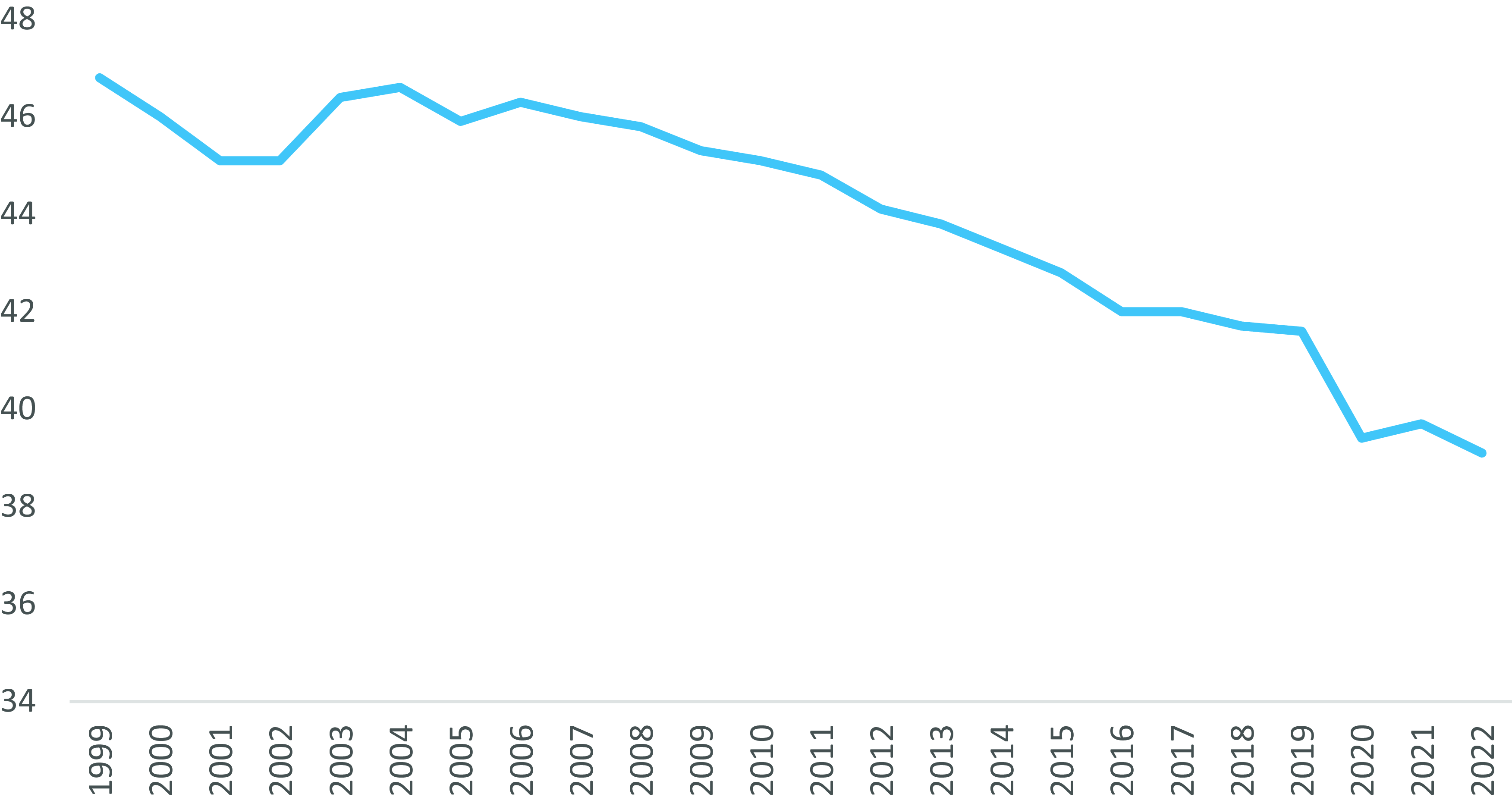
At the sectoral level, Morocco’s employment dynamics are undergoing structural transformation. The agricultural sector is consistently shrinking from a share of 46% in total employment in 2000 to 31% at the end of 2021, driven by many factors, including mechanisation (although that remains predominantly limited to large farms), and rural migration among young residents seeking job opportunities in urban areas. This transformation yields a surplus of labour, traditionally expected to transition towards the manufacturing sector.
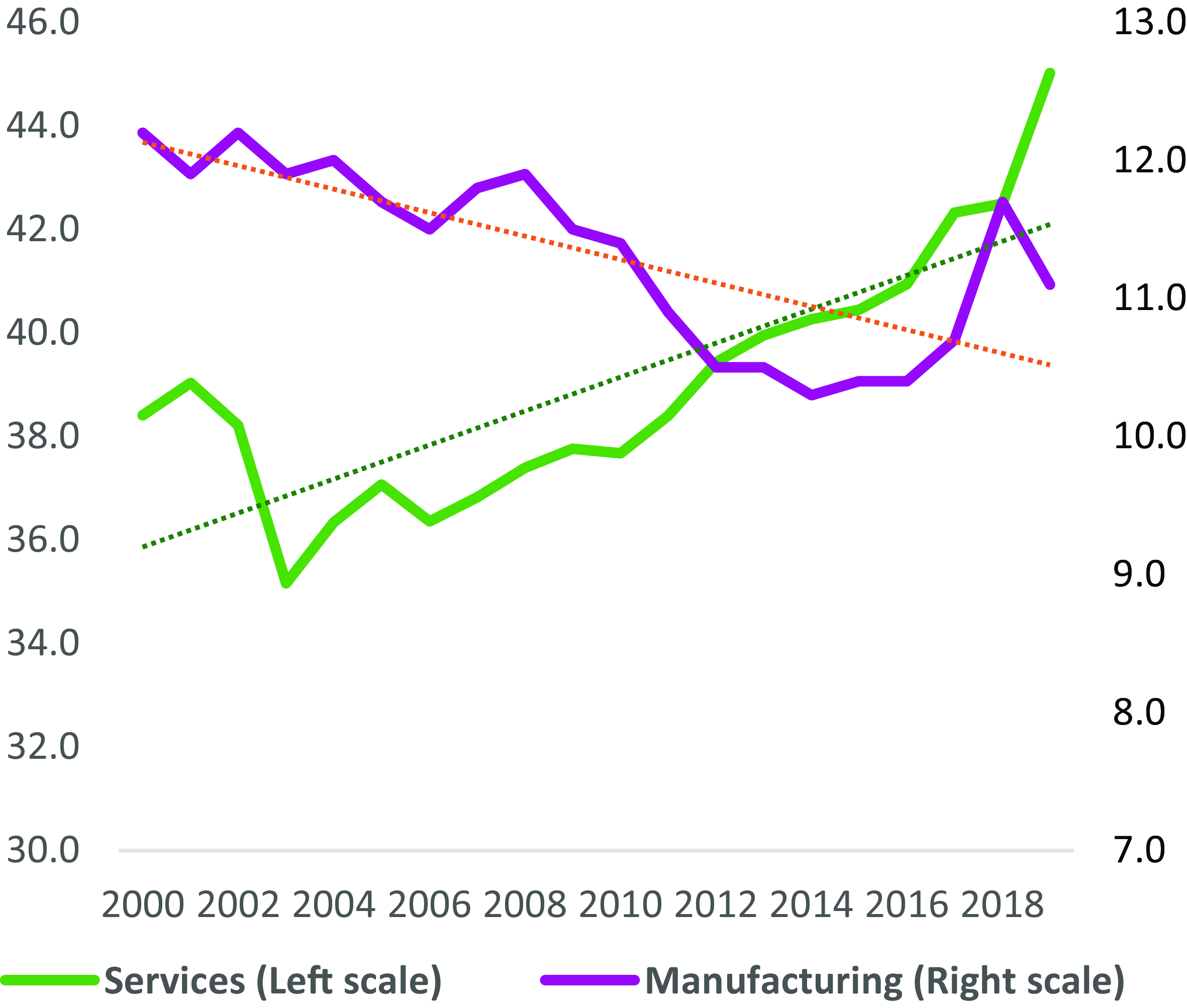
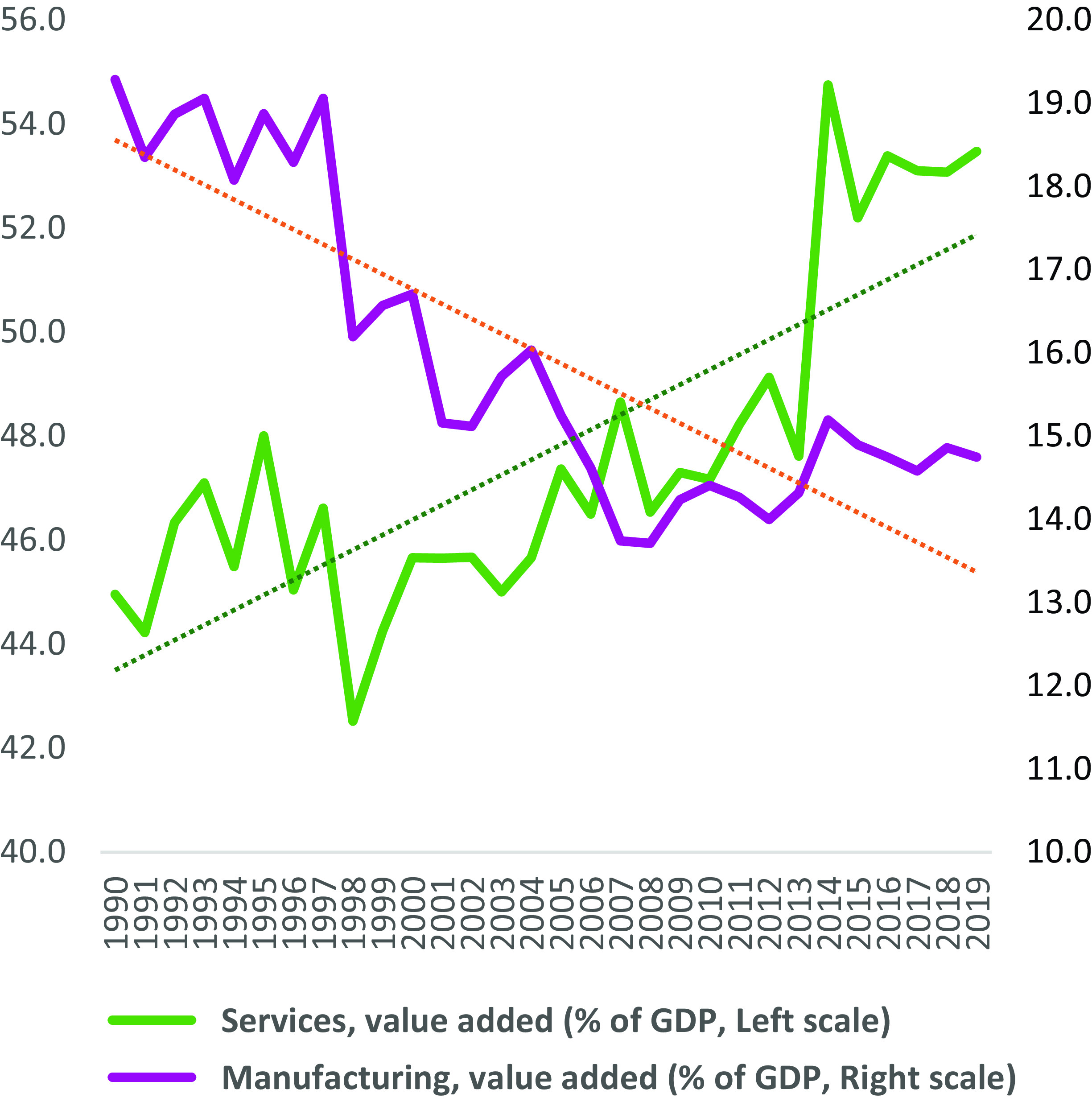
Yet, the Moroccan economy shows a slight decline in the share of the manufacturing sector, both in terms of employment and value added (Figures 3 and 4), albeit with some stabilisation in recent years. This decline, however, occurs as per capita GDP remains at a modest level. These characteristics point to a premature deindustrialisation, aligning with various recent studies which highlight symptoms of this phenomenon in Morocco (Ait Ali and Bourhriba Reference Ait Ali and Bourhriba2023; Chauffour Reference Chauffour2018; Lopez-Acevedo et al Reference Lopez-Acevedo, Betcherman, Khellaf and Molini2021). These developments illustrate that, similar to many developing countries experiencing premature deindustrialisation, the manufacturing sector has failed to absorb the surplus labour released from agriculture (Islam Reference Islam2017; Nassif et al Reference Nassif, Morandi, Araújo and Feijó2020).
Manufacturing and services employment share in Morocco (% of total employment). Sources: HCP, WDI database.
Manufacturing and services value-added share in Morocco (% of GDP). Sources: HCP, WDI database.
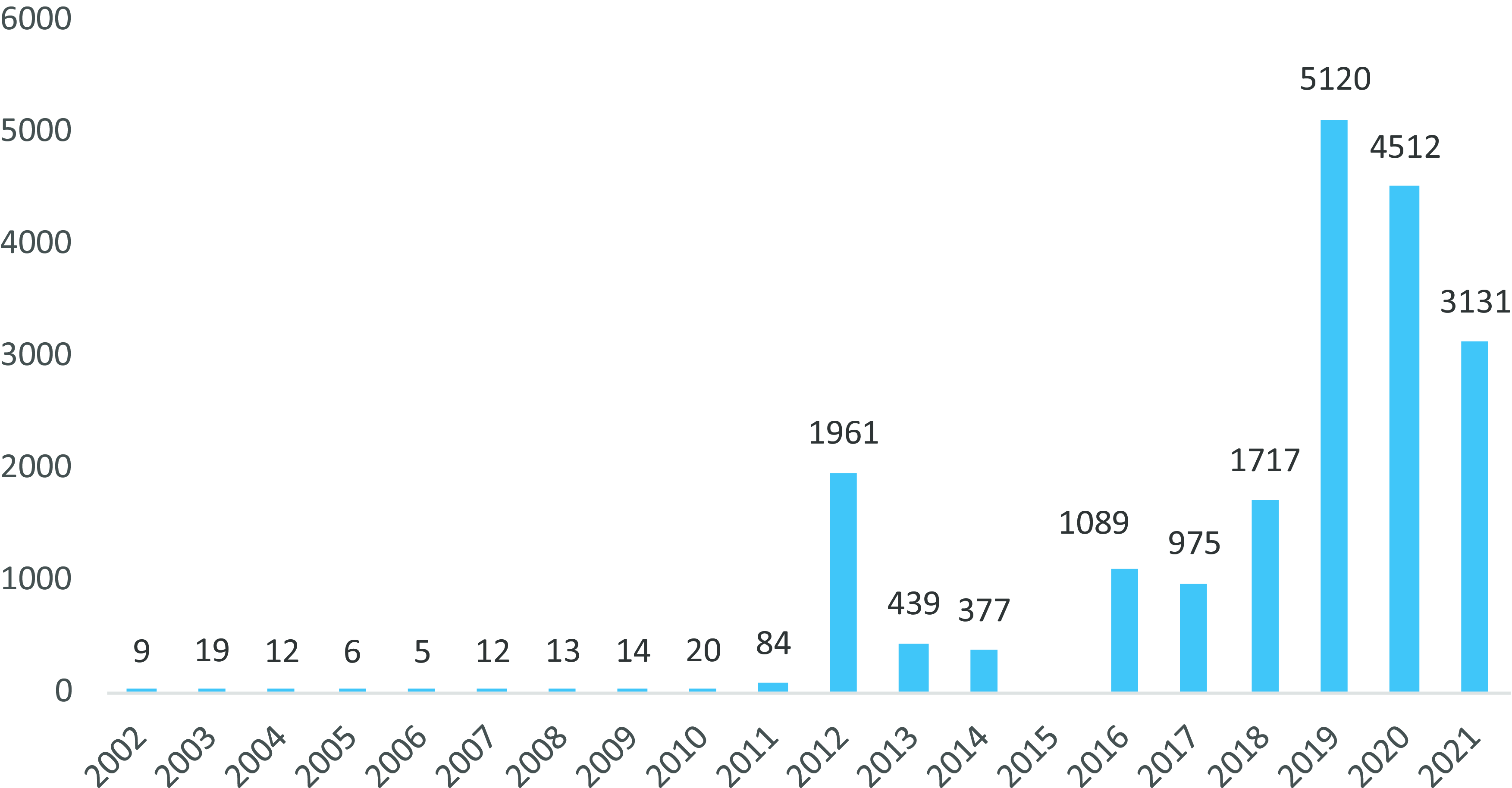
Despite the recent surge in imports of industrial robots (Figure 5), attributing the current deindustrialisation in Morocco solely to automation is misleading. Automation, which is primarily confined to select modern and capital-intensive industries, remains notably lower than in advanced or leading emerging economies. Moreover, the weakening of the declining trend of the relative price of investment since 2011Footnote 1 (Figure 6) poses challenges for local firms, especially considering 88% of the entrepreneurial landscape in Morocco is composed of micro-firms that grapple with substantial financial constraints.Footnote 2 Therefore, the impact of automation on employment in Morocco is probably limited, and consequently, cannot solely explain the observed phenomenon of premature deindustrialisation.
Number of Industrial robots imported by Morocco. Source: WITS database.
Relative price of investment in Morocco. Source: Calculated on the basis of data from Penn table 10.1 and Haut commissariat au Plan.

Apart from productivity gains in a few modern manufacturing segments, Morocco’s deindustrialisation could be associated with increased trade openness and a gradual reduction in import tariff rates on manufactured products (Figure 7). This exposure has left largely unprepared domestic small firms in the manufacturing sector vulnerable to intense foreign competition. Consequently, the rising penetration rate of imported manufactured products (Figure 8) has resulted in bilateral manufacturing trade imbalances with numerous partners. This trend is likely to have a negative impact on employment within the manufacturing sector.
Manufactured imports penetration ratio (%). Source: Ait Ali and Bourhriba (Reference Ait Ali and Bourhriba2023).
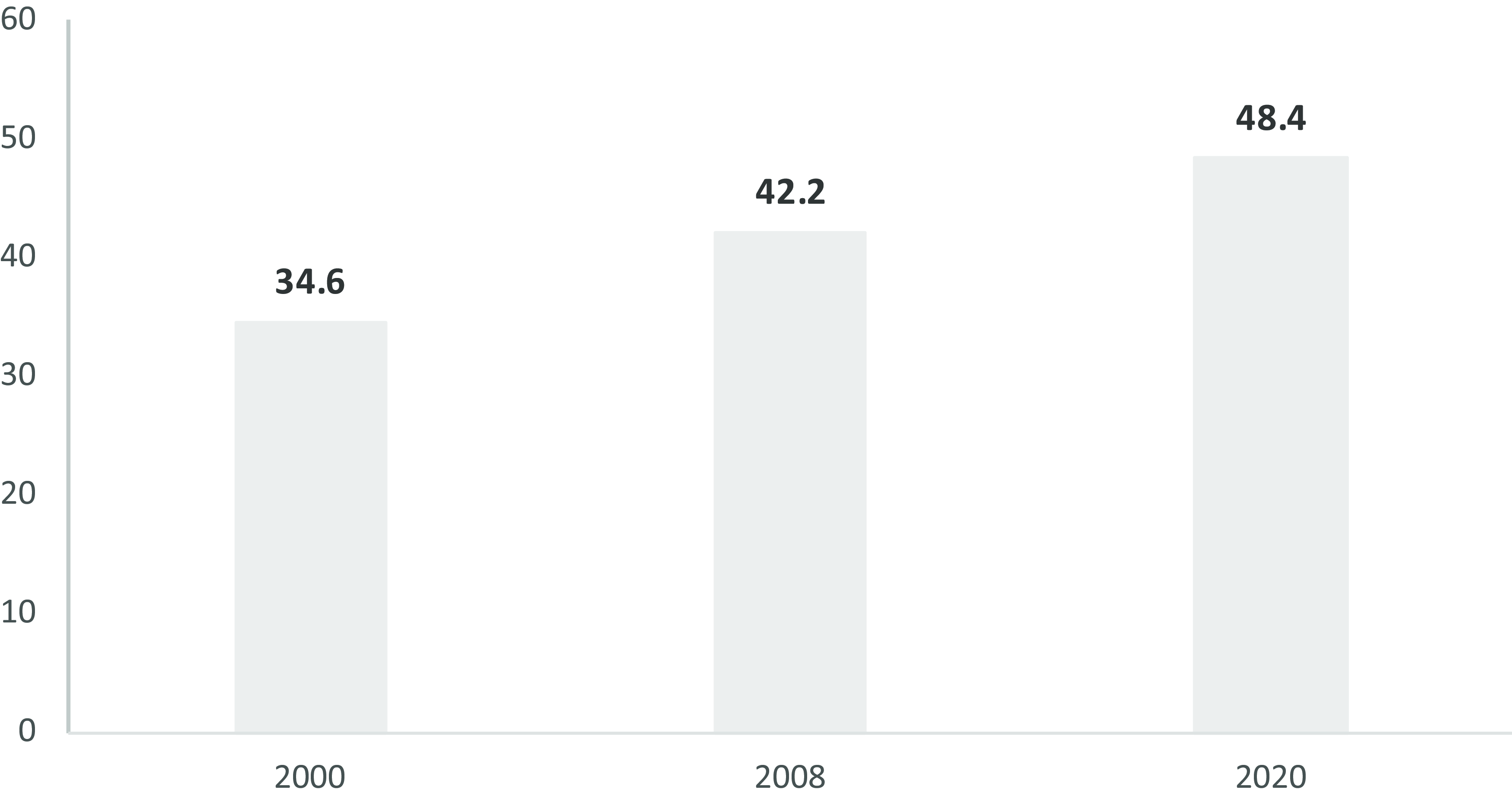
Average import tariff rate on manufactured products imported by Morocco (%). Source: UNCTAD database.

Deviating from the trajectory of the manufacturing sector, employment in the services sector continues to rise, playing a pivotal role alongside construction in absorbing surplus labour from agriculture and manufacturing. The quality of these jobs tends, however, to be notably low, primarily in low-value-added services, with a prevalence of informal jobs. Informal labour constitutes nearly 68% of the overall employment in Morocco.Footnote 3
Data, measurements, and descriptive analysis
In this section, we present an overview of the data used in our study. We then detail the methodology for calculating the routine task intensity (RTI) index, our measure for assessing occupational intensity in routine tasks, and the offshorability index (Offsh), indicating the susceptibility of a job to offshoring.
Data
In our empirical analysis, we have relied on two primary data sources. The first, the Moroccan Labour Force Survey for the years 2004 and 2018, provides a comprehensive dataset with individual demographic and socio-professional characteristics of employed population. To ensure consistency, our sample excludes occupations related to politics, diplomacy, religion, military/security and unpaid workers.
Our second data source is the U.S. Department of Labour’s Occupational Information Network (O*NET) database, offering detailed task content information for over 900 occupations. The use of O*NET data is prompted by the absence of national data-capturing task characteristics in Morocco. This aligns with a common practice in the empirical literature in studies on emerging or developing countries (Apella and Zunino Reference Apella and Zunino2017; Chang et al Reference Chang, Rynhart and Huynh2016; Das and Hilgenstock Reference Das and Hilgenstock2022; Adamczyk et al Reference Adamczyk, Ehrl and Monasterio2023).
While acknowledging the limitations of this choice, we do not assume a similarity between the U.S. and Moroccan labour markets. Rather, our emphasis lies in the ranking of task importance within occupations that is supposed to be more or less comparable across countries (Poole et al Reference Poole, Santos-Paulino, Sokolova and DiCaprio2017). In this respect, we preferred adopting the O*NET database over the World Bank’s Skills Measurement Program database (STEP).Footnote 4 Despite the latter being the first to measure task importance in certain low- and middle-income countriesFootnote 5 , it is appropriate not to adopt it due to its exclusion of rural workers. This omission would have resulted in overlooking a substantial part of the agricultural employment, a critical element in analysing the structural transformation process in developing countries.
Measuring routine task intensity
To measure RTI, we opted for the methodology proposed by Autor and Dorn (Reference Autor and Dorn2013) which was applied in several more recent studies (Acemoglu et al Reference Acemoglu, Koster and Ozgen2023; Koster and Ozgen Reference Koster and Ozgen2021; Lewandowski et al Reference Lewandowski, Keister, Hardy and Górka2020a). Despite criticisms directed at Autor and Dorn’s RTI measure (Haslberger Reference Haslberger2022), identifying an alternative in the context of developing countries poses a considerable challenge. Recent methods, such as Lewandowski et al’s (Reference Lewandowski, Park and Schotte2020b) parametric approach, also have inherent limitations. Their regression-based approach, utilising a restricted set of explanatory variables, raises concerns about the optimality of the model’s specification and the risk of omitted variable bias, which could potentially impact the accuracy of the proposed measure. Furthermore, this method would be challenging to apply to detailed occupational classifications beyond 2-digits. Similarly, regarding the approaches of Haslberger (Reference Haslberger2022) and Lewandowski et al (Reference Lewandowski, Park, Hardy, Du and Wu2022), they remain unfeasible for Morocco, given the lack of national surveys incorporating workers’ individual task assessments. Ultimately, the constrained application of Autor and Dorn’s (2013) method still enables a meticulous categorisation of occupations based on two primary criteria: routine versus non-routine and manual versus abstract tasks. In line with Acemoglu and Autor (Reference Acemoglu and Autor2011), we initially matched sixteen task descriptors (t o ) from O*NET to the microdata of the Moroccan labour survey (Table 1). For consistency, we subsequently homogenised the occupational nomenclature between 2004 and 2018 labour surveys by creating a correspondence table between NAP2014 (2018 survey) and NAP2001 (2004 survey) classifications.
Composition of aggregated indices of task importance a
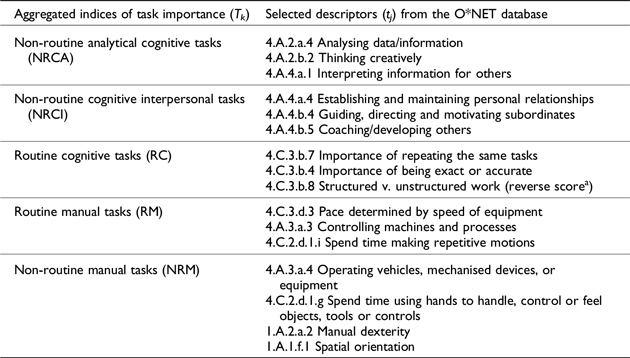
Source: Acemoglu and Autor (Reference Acemoglu and Autor2011).
a Reverse score = 6 – original score, knowing that the original score varies between 1 and 5.
Next and due to the absence of official crosswalks between the Moroccan NAP2001 and the detailed 4-digit O*NET-SOC nomenclature, we elaborated an adapted mapping procedure that involves an intermediate phase using the ISCO-88 nomenclature from the International Labour Organisation. This process resulted in a harmonised occupational structure, encompassing 479 occupations.Footnote 6 , Footnote 7
Having assigned the task items to the labour force survey data, we followed Acemoglu and Autor (Reference Acemoglu and Autor2011) and Lewandowski et al (Reference Lewandowski, Park, Hardy, Du and Wu2022), standardising the worker-level values of each task descriptor (t i ) using weights from the aforementioned surveys to ensure data comparability:
 $${{\rm{V}}_{{i}}}{{\rm{V}}_{{{j}} \in {{J}}}}{{\rm{t}}_{{{i,j}}}} = {{{{{t}}_{{i}}} - {\mu _{{j}}}} \over {{\sigma _{{j}}}}}$$
where J is the set of sixteen task descriptors (j) listed in Table 1, i is the i
th observation in the labour force survey, and ${\mu _j}$
and
${\mu _j}$
and ${\sigma _j}$
are, respectively, the weighted average and standard deviation of j
th task descriptor.
${\sigma _j}$
are, respectively, the weighted average and standard deviation of j
th task descriptor.
Following Acemoglu and Autor’s (Reference Acemoglu and Autor2011) methodology, we aggregated these descriptors into five task indices (T k ): ‘non-routine cognitive analytical’ (NRCA), ‘non-routine cognitive interpersonal’ (NRCI), ‘routine cognitive tasks’ (RC), ‘RM’, and ‘non-routine manual’ (NRM), as illustrated in Table 1. We calculated the five aggregated tasks by adding up the appropriate task descriptors as depicted in the following formula. Subsequently, we normalised the five task indices to the range [0,1] to ensure comparability.
 $$\boldsymbol{{T_{i,k}} = \;\mathop \sum \nolimits_{i = {{\bf 0}}}^n t_{i,j}^k}$$
where ${T_{i,k}}$
is the value of aggregated task indice k for the observation i and
${T_{i,k}}$
is the value of aggregated task indice k for the observation i and $k\; \in \;\left\{ {NRCA,\;NRCI,\;RC,\;RM,\;NRM} \right\}$
The RTI index results from combining the five task indices, aligning with methodologies outlined by Acemoglu et al (Reference Acemoglu, Koster and Ozgen2023), Autor and Dorn (Reference Autor and Dorn2013), and Lewandowski et al (2020). In recognition of the distinct employment composition in developing countries, we adapted the original RTI formula by incorporating the aggregated index of NRM tasks. This adjustment underscores the pivotal role of this task category in shaping labour dynamics in the context of a developing country. For consistency, we normalised the RTI measure to the range [0,1]. On the basis of the formula (3), occupations with higher RTI values are more intensive in routine tasks and may face increased vulnerability to automation.
 $${\rm{RTI}} = \;\ln \left( {{{{\rm{RC}} + {\rm{RM}}} \over 2}} \right) - \ln \left( {{{{\rm{NRCA}} + {\rm{NRCI}} + {\rm{NRM}}} \over 3}} \right)$$
The findings indicate that over the period from 2004 to 2018 (Table 2), the average routine task intensity index remained relatively stable. The Moroccan labour market exhibited high intensities in both RM and NRM tasks, as well as RC tasks. In contrast, NRCA tasks recorded the lowest scores, consistent with expectations for a lower-middle-income economy. This feature aligns with existing literature indicating weaker intensity in terms of non-routine cognitive tasks in developing countries compared to advanced economies (Lewandowski et al Reference Lewandowski, Park and Schotte2020b; Lo Bello et al Reference Lo Bello, Sanchez Puerta and Winkler2019). This pattern can be attributed to several factors such as the prevalence of low-skilled workers in the labour supply and an industrial structure dominated by small and micro-firms with limited technological absorptive capacity, resulting in lower demand for non-routine analytical tasks and a higher emphasis on manual tasks.
Routine task intensity and aggregated task indices for Morocco a
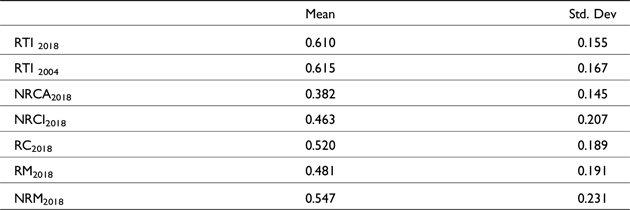
a All the indicators in the table are calculated on the basis O*Net 23.1 database and labour force surveys’ weights that correspond to the year indicated. For purpose of readability and comparability, RTI, Offsh and aggregated task indicators are 0–1 normalised.
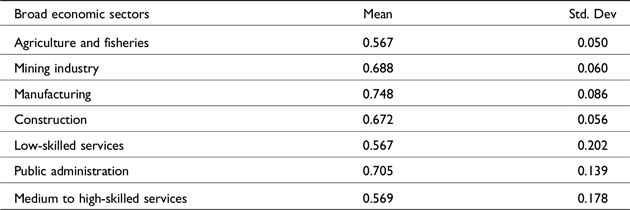
Sectoral employment patterns (Table 3) align with expectations.Footnote 8 The manufacturing sector, including roles such as assemblers and machine operators, shows the highest concentration of routine tasks, rendering its workforce highly susceptible to automation. Public administration services also show significant routine task intensity as do mining and construction sectors. Conversely, agriculture, fisheries and services, rank lower in the occupation hierarchy based on RTI level, indicating comparatively lower routine task intensity in these sectors.Footnote 9 The differences observed across industries in terms of their intensity in routine tasks affirm the importance of examining the impact of the structural change process in Morocco, specifically the phenomenon of premature deindustrialisation, on the evolution of occupational employment composition in terms of routinisation.
Routine task intensity by main industry in Morocco (Employment structure 2018) a
a Indices are weighted based on the weights from the 2018 Moroccan labour survey. For purpose of readability RTI are 0–1 normalised.
Differences in routine task intensity are also observable between formal and informal employment. Figure 9 illustrates that formal workers are, on average, involved in occupations with a relatively higher RTI than informal workers, suggesting that, at an aggregate level, formal workers may be more exposed to automation than their informal counterparts. These results are in line with our expectations, as informal workers in Moroccan labour market are commonly concentrated in occupations with moderate routine task intensity (low-skilled services and sales, etc.). This concentration tends to lower the average RTI of informal workers relative to their formal counterparts.
RTI by job’s formality status in Morocco*. *Average RTI for formal and informal jobs, weighted according to 2018 labour survey structure.

Measuring offshorability index
Considering the potential role of offshorability in explaining the lack of de-routinisation in the employment composition of specific developing economies within the literature, we have adopted Firpo et al’s (Reference Firpo, Fortin and Lemieux2011) methodology that allows measuring the predisposition of a given occupation to be offshored. This approach, building on Jensen and Kletzer (Reference Jensen and Kletzer2010) pioneering work, addresses criticisms raised by Blinder (Reference Blinder2009). The framework outlined by Firpo et al (Reference Firpo, Fortin and Lemieux2011) utilises 26 work descriptors from the O*NET database, which are classified into five categories of work characteristics, namely ‘Information content’ (IC), ‘Automation/Routinisation’ (AR), ‘Face-to-Face’ (FtF), ‘On-Site Job’ (OSJ), and ‘Decision making’ (DM). However, the approach we have adopted incorporates several modifications compared to the original version. Specifically, the category of descriptors labelled ‘Automation/Routinisation’ has been excluded from the calculation of the offshorability indicator (Table 4). This decision is justified by our concern to avoid any suspected overlap with the RTI indicator as these two indicators are interrelated (Blinder Reference Blinder2009, Blinder and Krueger Reference Blinder and Krueger2013, Goos et al Reference Goos, Manning and Salomons2014) and thus mitigate the risk of multicollinearity in subsequent regression analyses. Additionally, within the scope of this study, we have opted to combine the four selected descriptor categories into a single composite index (Offsh) that encompasses various dimensions associated with offshorability. The formula utilised for this purpose is as follows:
 $$\rm Offsh = IC - FtF - OSJ - DM $$
Descriptors used in measuring the composite index of occupational offshorability
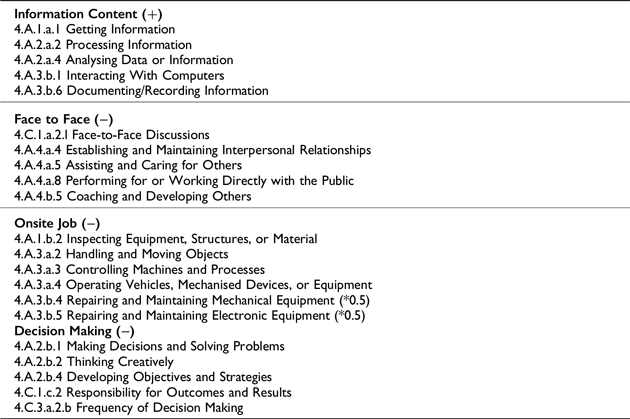
Source: Elaborated on the basis of the approach of Firpo et al (Reference Firpo, Fortin and Lemieux2011). The category of tasks labelled ‘Automation/routinisation’ by Firpo et al (Reference Firpo, Fortin and Lemieux2011) is omitted from our calculation of the offshorability index. The positive sign (+) indicates that the corresponding category is positively related to offshorability, while the negative one (−) indicates that the corresponding group is negatively related.
The score for each of the four categories corresponds to the average of the values of the descriptors composing it. The four scores and Offsh index have been normalised within the range of [0, 1].
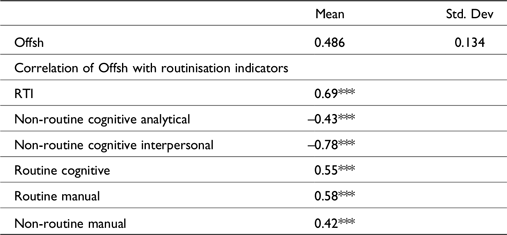
Our results (Table 5) indicate that, despite methodological adjustments, the offshorability index exhibits a significant positive correlation with the RTI index, consistent with Goos et al (Reference Goos, Manning and Salomons2014), while supporting the hypothesis of Blinder and Krueger (Reference Blinder and Krueger2013), which states that offshorability is conceptually distinct from, though related to, an occupation’s routineness. Additionally, the Offsh index shows a negative correlation with non-routine cognitive task intensity (NRCA and NRCI) and a positive correlation with routine task intensity (RM and RC), further supporting the assumption that jobs that can be broken down into simple routine tasks are easier to offshore than those requiring complex thinking, judgement, and human interaction. This, however, does not exclude the fact that numerous non-routine cognitive tasks are increasingly offshorable due to advancements in telecommunications and information technology (Blinder and Krueger Reference Blinder and Krueger2013).
Offshorability index in Morocco (Employment structure 2018)a
a Indices are weighted based on the weights from the corresponding Moroccan labour survey.
*** Significant at 0.01.
Methodology
This section outlines the methodological approaches used to address the three primary research questions stated in the introduction.
Is the employment de-routinisation process confirmed in the context of a lower-middle-income country like Morocco?
To verify the existence of a process of de-routinisation of employment structure, we adopted a two-step approach. The initial phase, predominantly descriptive, aims to highlight the presence or absence of a process of employment de-routinisation through a tertile analysis. The rationale behind selecting this initial step lies in its simplicity, offering a straightforward way to categorise jobs into three major groups based on routine-task intensity. It also provides an initial insight into the evolving profile of occupational employment structure over the studied period. The second phase is based on regression estimations with the objective of confirming the results of the first step and checking their robustness through various validation tests.
First, we grouped harmonised occupations into tertiles of RTI in 2004 to get three categories: low (Ter1), medium (Ter2), and high (Ter3) routine-intensive occupations. This categorisation enables an assessment of whether employment shares in the most routine-intensive occupations (Ter3) declined in favour of the least routine-intensive ones (Ter1) over the 2004–2018 period.
In the second phase, the approach employed entails regression analysis, adapted from prior research that links the RTI indicator to variables measuring employment volume, either in levels or in growth rates (Goos et al Reference Goos, Manning and Salomons2014; Sebastian Reference Sebastian2018; Cirillo et al Reference Cirillo, Rinaldini, Staccioli and Virgillito2021; Consoli et al Reference Consoli, Marin, Rentocchini and Vona2023; Brambilla et al Reference Brambilla, César, Falcone, Gasparini and Lombardo2023). We regressed average annual growth in occupational employment from 2004 to 2018 (g) on the corresponding RTI level in 2004. To flexibly control for industry-level factors impacting employment dynamics, we organised data by grouping workers into cells based on harmonised 4-digit occupation and 1-digit industry combinations. Sociodemographic control variables were included to minimise omitted variable bias. The Offshorability index (Offsh) served as a time-invariant determinant of occupational employment change, capturing the influence of global value chains and foreign direct investments (FDI) on (de-)routinisation dynamics.
Several specifications are then adopted: the first one includes the RTI as independent variable, while the second specification introduces the squared RTI to take into account a suspected non-monotonic relationship between RTI and change in employment. In the third specification, we introduced several control variables ${X_{oj,2004}}$
including the offshorability index. To check the robustness of our estimates, we performed the same estimations while excluding the agricultural sector.
${X_{oj,2004}}$
including the offshorability index. To check the robustness of our estimates, we performed the same estimations while excluding the agricultural sector.
As for the last specification, we have replaced the RTI with the five aggregated indexes of task importance $\;{T_{o,2004}}$
at the starting period, to detect potential differentiated effects by main task category. The objective of this latest specification is to discern the divergent impacts on employment dynamics between tasks requiring high qualifications, specifically non-routine cognitive analytical and interpersonal tasks (NRCA, NRCI), and those necessitating modest to intermediate qualifications, encompassing routine cognitive and manual tasks alongside non-routine manual tasks (RC, RM, NRM).
$\;{T_{o,2004}}$
at the starting period, to detect potential differentiated effects by main task category. The objective of this latest specification is to discern the divergent impacts on employment dynamics between tasks requiring high qualifications, specifically non-routine cognitive analytical and interpersonal tasks (NRCA, NRCI), and those necessitating modest to intermediate qualifications, encompassing routine cognitive and manual tasks alongside non-routine manual tasks (RC, RM, NRM).
 $${g_{o,j,2004 - 2018}} = \alpha + \beta {\rm{\;RT}}{{\rm{I}}_{o,2004}} + {\varepsilon _{o,j}}$$
 $${g_{{\rm{o}},{\rm{j}},2004 - 2018}} = \alpha + {\rm{\beta }}\,{\rm{RT}}{{\rm{I}}_{o,2004}} + \partial \,{\rm{RT}}{{\rm{I}}^2}_{o,2004} + {\varepsilon _{o,j}}$$
 $${g_{o,j,2004 - 2018}} = \alpha + {\rm{\beta \;RT}}{{\rm{I}}_{{\rm{o}},2004}} + \partial {\rm{\;RT}}{{\rm{I}}^2}_{o,2004} + {\rm{\;}}\mu {\rm{\;}}{X_{o,j,2004}} + {\varepsilon _{o,j}}$$
 $${g_{o,j,2004 - 2018}} = \alpha + \beta {\rm{\;}}{T_{o,2004}} + {\rm{\;}}\mu {\rm{\;}}{X_{o,j,2004}} + {{\rm{\varepsilon }}_{o,j}}$$
Where ${g_{o,j,2004 - 2018}}\!$
= average annual growth of employment in the occupation o and industry j from 2004 to 2018
${g_{o,j,2004 - 2018}}\!$
= average annual growth of employment in the occupation o and industry j from 2004 to 2018
RTI = Routine Task Intensity Index
X = Vector of control variables by occupation–industry cell (Offshorability index, Share of workers in the corresponding occupation-industry cell working in firms with less than 5 employees (micro firms), Share of workers in the corresponding cell with middle skills, share of workers in the corresponding cell with low skills.
‘o’ refers to the occupation (harmonised 4-digits)
‘j’ refers to sector or industry (1-digit)
T = (NRCA, NRCI, RC, RM, NRM)
To confirm the hypothesis of employment structure de-routinisation, we need a negatively significant coefficient for the RTI variable. Concerning offshorability, we anticipate a positive impact of the variable (Offsh) on employment changes. The growing integration of developing countries into global value chains and the inflow of routine jobs through offshoring are expected to contribute to an increase in routine task-intensive jobs (Das and Hilgenstock Reference Das and Hilgenstock2022; Martins-Neto et al Reference Martins-Neto, Cirera and Coad2023).
How does the process of structural transformation and employment (de-) routinisation interact within a premature deindustrialisation context in a middle-income country?
Regarding this second question, we propose a shift-share decomposition of employment share changes for each of the three RTI tertile-based occupational groups (Ter1, Ter2, and Ter3). This method, acknowledged for its ability to distinguish between within effect and between effect (Bárány and Siegel Reference Bárány and Siegel2019; Intraligi et al Reference Intraligi, Vittori and Ricci2021), allows for a nuanced analysis of contributions from the structural transformation process, including the impact of premature deindustrialisation, and those arising from intra-sectoral changes.
Formally, the change in the share of each occupational group in total employment comprises two components: the between-sector component, representing the effect of structural transformation, and the within-sector component. The former captures variations in the occupational group’s share due to shifts in the sectoral composition, while the latter reflects changes in the distribution of different occupations within each major industry.
 $${\Delta _{2004 - 2018}}\left( {{{{E_{{\rm{Ter\;}}i}}} \over E}} \right) = \mathop \sum \limits_{j = 1}^N {{{E_{{\rm{Ter\;}}i,j}}} \over {{E_j}}}\Delta \left( {{{{E_j}} \over E}} \right) + \mathop \sum \limits_{j = 1}^N {{{E_j}} \over E}\Delta \left( {{{{E_{{\rm{Ter\;}}i,{\rm{\;}}j}}} \over {{E_j}}}} \right)$$
With ${E_{{\rm{Ter\;}}i,{\rm{\;}}j}}$
being the employment in the occupational category Ter i and industry j
${E_{{\rm{Ter\;}}i,{\rm{\;}}j}}$
being the employment in the occupational category Ter i and industry j
and E = total employment
In the initial phase of traditional structural transformation process, as the economy is shifting from agriculture to manufacturing, we anticipate a positive contribution of the between-sector effect to the change in the share of the most routine-intensive occupational group in total employment (Ter3). As emphasised by Das and Hilgenstock (Reference Das and Hilgenstock2022), structural transformation in developing nations tends to mitigate or counteract the employment de-routinisation effect associated with the adoption of labour-saving technologies.
However, as noted earlier, premature deindustrialisation in some developing countries like Morocco challenges this scenario. In nations where there has been an early move of labour from manufacturing to services with low routine task intensity, the expected process of routinisation of employment structure may be hindered. To test this assumption, we decomposed the between effect (structural change) to highlight the contributions of each major industry (Agriculture and fisheries; Mining; Manufacturing; Utilities; Construction; Low-skill services; Medium-to-high skill services; Public administration). A negative contribution from manufacturing would confirm the role of premature deindustrialisation in reducing the share of high-routine task intensity jobs.
In parallel with investigations related to the role of premature deindustrialisation, in this section, we will also conduct specific-sector tertile analysis to examine the internal processes of (de-)routinisation within each major industry to highlight potential heterogeneity among them. Confirming such heterogeneity could also contribute to influencing the overall process of employment (de-)routinisation.
To what extent does the prevalence of informal labour in various industries influence the process of employment (de-)routinisation?
To explore this issue, we employ a three-way interaction model to uncover the nuanced variations in the response of changes in occupational employment composition to routine task intensity across industries and according to formal/informal worker status. The inclusion of informality status represents a novel contribution to the existing literature. As public administration comprises almost solely formal employment, this sector was excluded from the model.
The dataset utilised is structured across three-dimensional cells: occupation, industry, and worker informality status. The regression model includes a three-way interaction term between three explanatory variables: occupational RTI index, industry dummy (ref = agriculture and fisheries), and job informality status dummy (informal = 1), along with control variables. The dependent variable represents the change in employment within a specific cell. This approach allows for flexible estimation of distinct slopes for RTI based on both industry and workers’ informality status.
Results and discussions
The de-routinisation of employment structure is not fully supported in the Moroccan labour market
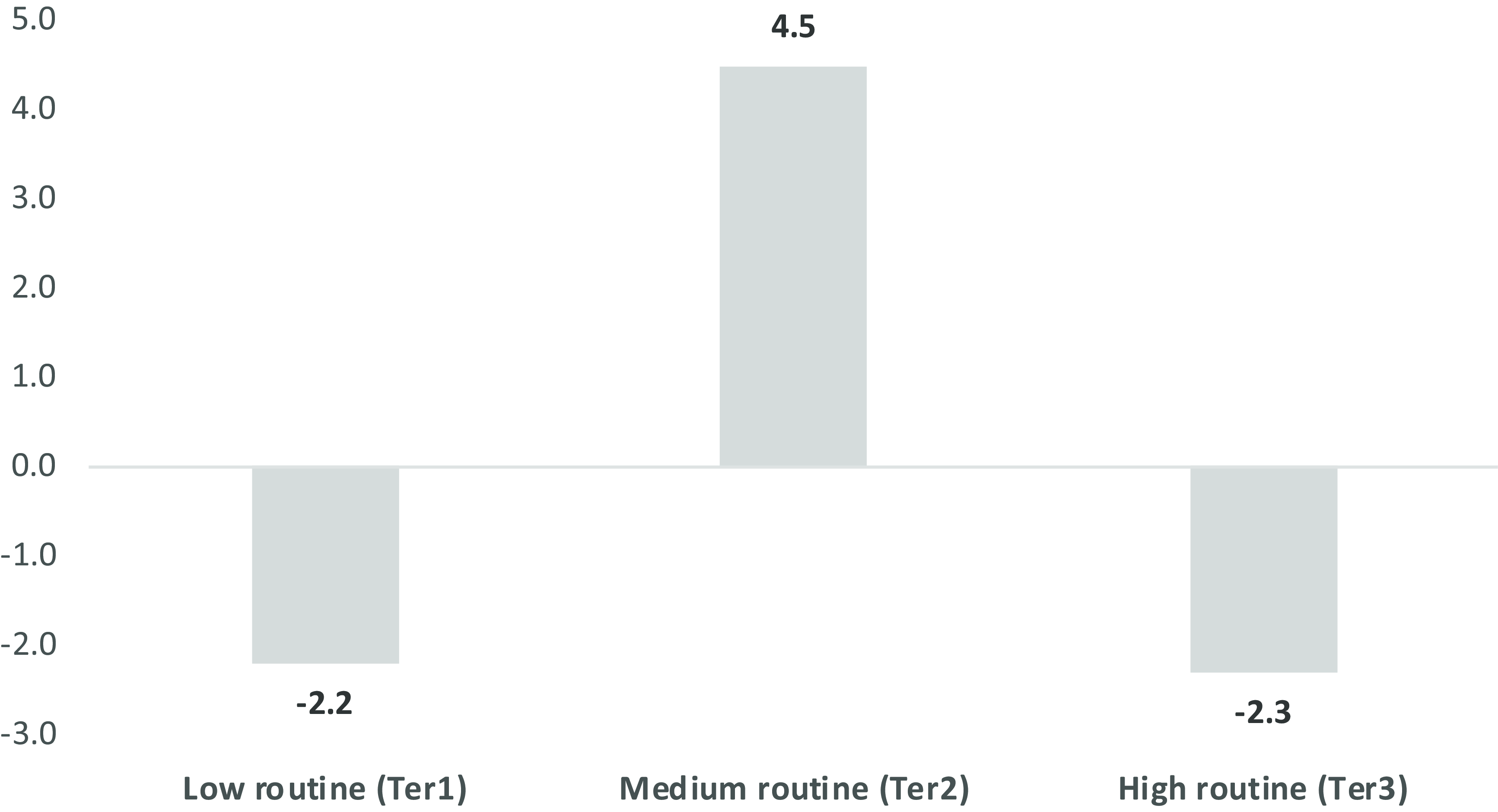
The tertile analysis, all sectors combined, indicates a potential inverted U-shaped pattern in the distribution of employment by RTI level (Figure 10). Employment shares declined in both the most routine-intensive and least routine-intensive occupations with, however, an atypical rise in share of occupations with a medium level of RTI. These results suggest that, unlike advanced economies, the employment de-routinisation hypothesis is not fully supported in the case of a developing country like Morocco. At the same time, neither do these results find evidence of a clear trend of employment routinisation, which is typical of developing countries in the early stages of traditional structural transformation.
Change in the occupational composition over the period 2004–2018 (percentage point’s change in total employment) by tertile of RTI.
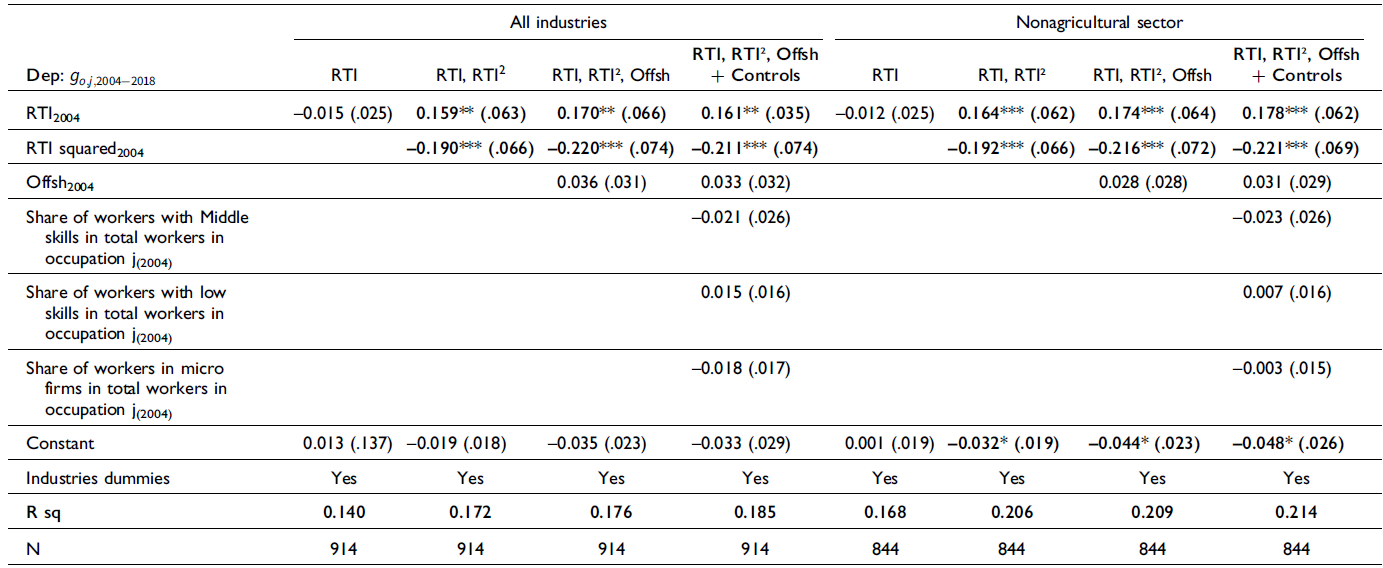
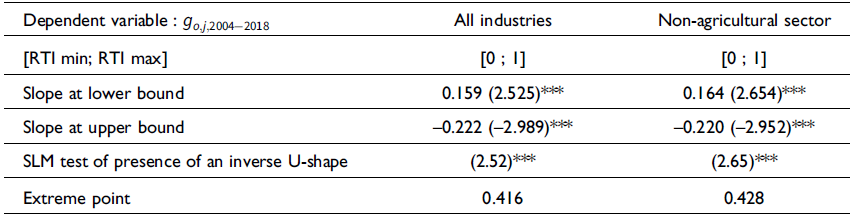
The regression models estimated further substantiate these findings. The outcomes from the first specification (Table 6) reject the employment de-routinisation hypothesis as the coefficient for RTI is not statistically significant. However, the findings consistently back an inverted U-shaped link between occupational employment change and RTI level, challenging the employment de-routinisation hypothesis. This is evident through the significantly negative coefficient for the squared RTI term across various model specifications, even when adding control variables or after excluding the agricultural sector from the sample. The Sasabuchi–Lind–Mehlum test further confirms the inverse U-shaped pattern (Table 7). The lower bound slope of RTI is positive and significant, while the upper bound slope is significantly negative. Moreover, the extreme point (–β/2 ∂ = 0.416) falls within the range of the RTI variable [0; 1].Footnote 10
Regressions between occupational employment change and RTI level a
a OLS estimation. Unit of analysis: occupation–industry cells. All models are estimated using labour survey weights of the starting period 2004. Robust standard errors in () are clustered at occupation–industry pairs level. N is the number of cells.
* p < .1.
** p < .05.
*** p < .01.
Sasabushi-Lind-Mehlum test (SLM) of presence of an inverse U-shape a
a t-Statistics in parentheses.
*p < .1.
**p < .05.
***p < .01.
The estimated coefficient for the variable Offsh is non-significant, which may appear counterintuitive for Morocco, a developing country where offshoring activities are expected to counterbalance the de-routinisation process. This could result from conceptual limitations of the offshorability indicator, impacting its accuracy in reflecting the predisposition of occupations to be offshored. The lack of significance might also be attributed to a potential diversion effect, with some offshoring investments favouring more attractive developing countries over Morocco. Additionally, the overall impact of offshoring through FDI in developing countries depends on factors like the share of foreign firms in total employment (Martins-Neto et al Reference Martins-Neto, Cirera and Coad2023). In Morocco, the non-significant coefficient may be explained by the limited employment share of multinational enterprises (MNEs) in a few modern industries, while the majority of employment is generated by domestic microenterprises unrelated to foreign firms.
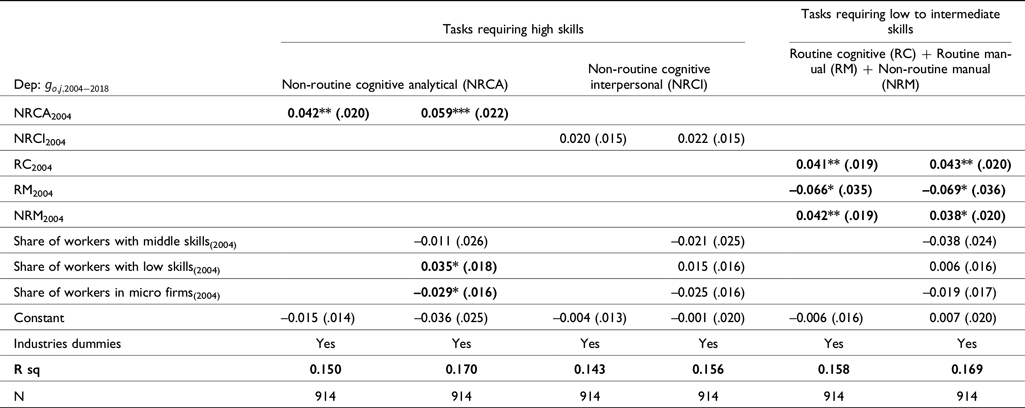
The estimations reported in Table 8 offer a nuanced understanding of the heterogeneous reactions of occupational employment change by task category. Initially, concerning the tasks demanding high qualifications (NRCA, NRCI), we had to estimate the effects of the NRCA and NRCI indices separately due to their significant correlation. Likewise, the Offsh variable was omitted from the specification to mitigate issues of multicollinearity within the equations. The results reveal a positive and statistically significant association between NRCA tasks index and changes in occupational employment over the specified period. This aligns with a conventional scenario of employment de-routinisation observed during the process of social and economic development, generally indicating a catching-up effect in developing countries with a gradual shift towards an economic structure with higher demand for labour in occupations intensive in non-routine cognitive tasks (doctors, engineers, lawyers…). Indeed, according to the Moroccan labour survey, the proportion of employment in the ISCO category ‘professionals’, which typically entails significant NRCA intensity, surged from 1.1% to 3.8% during the analysed period (2004–2018).
Estimates of the relationship between occupational employment change and aggregated task indices a
a OLS estimation. Unit of analysis: occupation–industry cells. All models are estimated using labour survey weights of the starting period 2004. Robust standard errors in () are clustered at occupation–industry pairs level. N is the number of cells.
* p < .1.
** p < .05.
*** p < .01.
However, concerning NRCI tasks, their index yields non-significant coefficient. This finding is in line with the stylised facts observed in Morocco, where the share of managerial positions has remained relatively stagnant, fluctuating between 0.7% and 0.8% of total employment. This phenomenon could be attributed to several factors, particularly the structural characteristics of the entrepreneurial landscape in developing countries like Morocco, persistently predominated by small and micro-enterprises. Such firms are often characterised by a simple and limited hierarchical structure that does not necessitate a significant number of management and supervisory roles intensive in NRCI. Consequently, this result does not further a de-routinisation process within the employment structure.
Regarding tasks requiring low to intermediate qualifications (RC, RM, and NRM), the regression results initially show a positive association between the routine cognitive tasks indicator (RC) and changes in occupational employment. Unlike findings related to NRCA tasks, results for routine cognitive tasks (RC) contradict the de-routinisation hypothesis. The outcomes suggest a growing demand for labour with an intermediate qualification in occupations intensive in routine cognitive tasks, especially within the service sector that acts, in many developing countries, as a natural absorber of labour surplus from other sectors, particularly in a context of premature deindustrialisation.
Concerning routine manual tasks (RM), the analysis reveals a negative association with occupational employment growth, though significant only at the 0.10 level. Although this outcome may contribute to the process of employment de-routinisation, it nevertheless contradicts the expected pattern of structural change in developing countries, where one would anticipate an increase in routine manual task-intensive employment during the transition from agriculture to manufacturing. The concept of premature deindustrialisation might explain this scenario, as manufacturing employment is often highly intensive in routine manual tasks, and its diminishing share in total employment within a context of early-stage deindustrialisation could neutralise the expected effect of the conventional structural change process.
As for NRM tasks, we find a positive and significant coefficient. In the context of a developing country like Morocco, this outcome could be primarily attributed to the surplus of low-skilled labour transitioning away from sectors such as agriculture. This surplus is absorbed into low value-added activities or the urban informal sector, both of which are often highly intensive in non-routine manual tasks.
In summary, our findings do not fully support the existence of a process of de-routinisation of employment structure in Morocco. Nor could we confirm a clear trend of employment routinisation typical of developing countries in the initial stage of traditional structural transformation. Instead, we identified an unconventional inverted U-shaped pattern indicating a growing share of occupations with intermediate routine task intensity, while the proportions of both low and high routine-intensity jobs declined.
Structural change and premature deindustrialisation play a significant role in shaping the dynamics of the occupational composition of employment by routine task intensity level
As explained in the methodological section, the unconventional pattern of occupational employment dynamics can be associated, among other factors, with structural transformation, particularly the phenomenon of premature deindustrialisation.
The previously explained shift-share decomposition highlights the significant roles of both structural transformation (between effect) and within-sector effects in shaping occupational dynamics from 2004 to 2018. As illustrated in Figure 11, structural transformation contributed to a 27% decline in the share of the least routine-intensive jobs (first RTI tertile), roughly 47% of the increase in middle routine-intensive jobs and about 66% of the observed decrease in the share of the most routine-intensive jobs (third tertile). Interestingly, the findings for the third tertile diverge from those in some developed countries. Intraligi et al (Reference Intraligi, Vittori and Ricci2021), using a standard shift-share decomposition, noted that the decline in routine employment in Italy is only marginally influenced by the structural change pattern (between effect).
Shift-share decomposition of change in the occupational employment (percentage points).

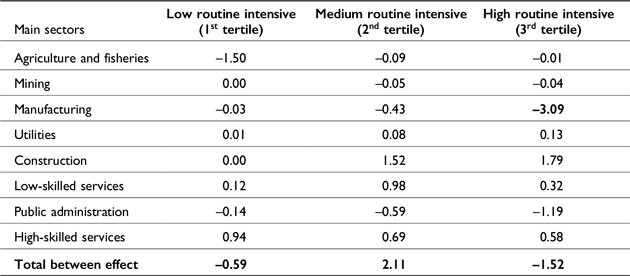
The negative between-effect for the least routine-intensive jobs (first tertile) is primarily due to a reduction in employment in the agriculture sector. This decrease counteracted the positive contribution of non-routine task-intensive activities in high-skilled services (Table 9). Nevertheless, the negative impact of agricultureFootnote 11 cannot be solely attributed to the automation process. Factors such as financial constraints for small subsistence farmers, farms’ fragmentation and the inherently low routine intensity of many agricultural occupations hinder the adoption of automation technologies in this sector.
The negative between-sector effect for the most routine-intensive occupational group (3rd tertile) diverges from the pattern seen in countries undergoing traditional structural transformation. It is mainly influenced by the reduced share of the manufacturing sector and, to a lesser extent, the public administration sector in total employment (Table 9). These findings support our hypothesis regarding premature deindustrialisation. The shift-share analysis suggests that the decline in the proportion of jobs highly intensive in routine tasks is primarily due to the adverse impact of Morocco’s early deindustrialisation, outweighing the positive effect from the growth of this job category in other sectors. Additionally, the diminishing share of manufacturing in total employment could result from shifts within the sector, where traditional labour-intensive industries (e.g. textile) are giving way to more capital-intensive activities (e.g. automotive industry). Conversely, the construction and services sectors show a positive contribution to the most routine task-intensive occupations and those with an intermediate level of routine task intensity, by absorbing an increasing flow of low-skilled workers from rural areas and manufacturing.
Contributions of individual sectors to the between effect (or structural transformation effect) over the period 2004–2018
Alongside structural transformation (between-effect) and premature deindustrialisation, the shift-share decomposition unveils a significant within-sector effect (Figure 12), particularly in the changes in job shares within the first two RTI tertiles. Analysing each industry individually reveals substantial heterogeneity, with most industries exhibiting within dynamics significantly deviating from the de-routinisation scenario. Manufacturing, although showing a marginal increase in the share of less routine-intensive occupations (Ter1), is an exception. Moreover, only the low-skilled services and agriculture and fisheries sectors demonstrate internal dynamics similar to the overall economy’s U-inverted pattern. In contrast, medium- to high-skilled services show a clear trend towards routinisation, rendering them more susceptible to future automation.
Change in the occupational composition within each major sector over the period 2004–2018 (percentage point’s change in total employment) by tertile of RTI.
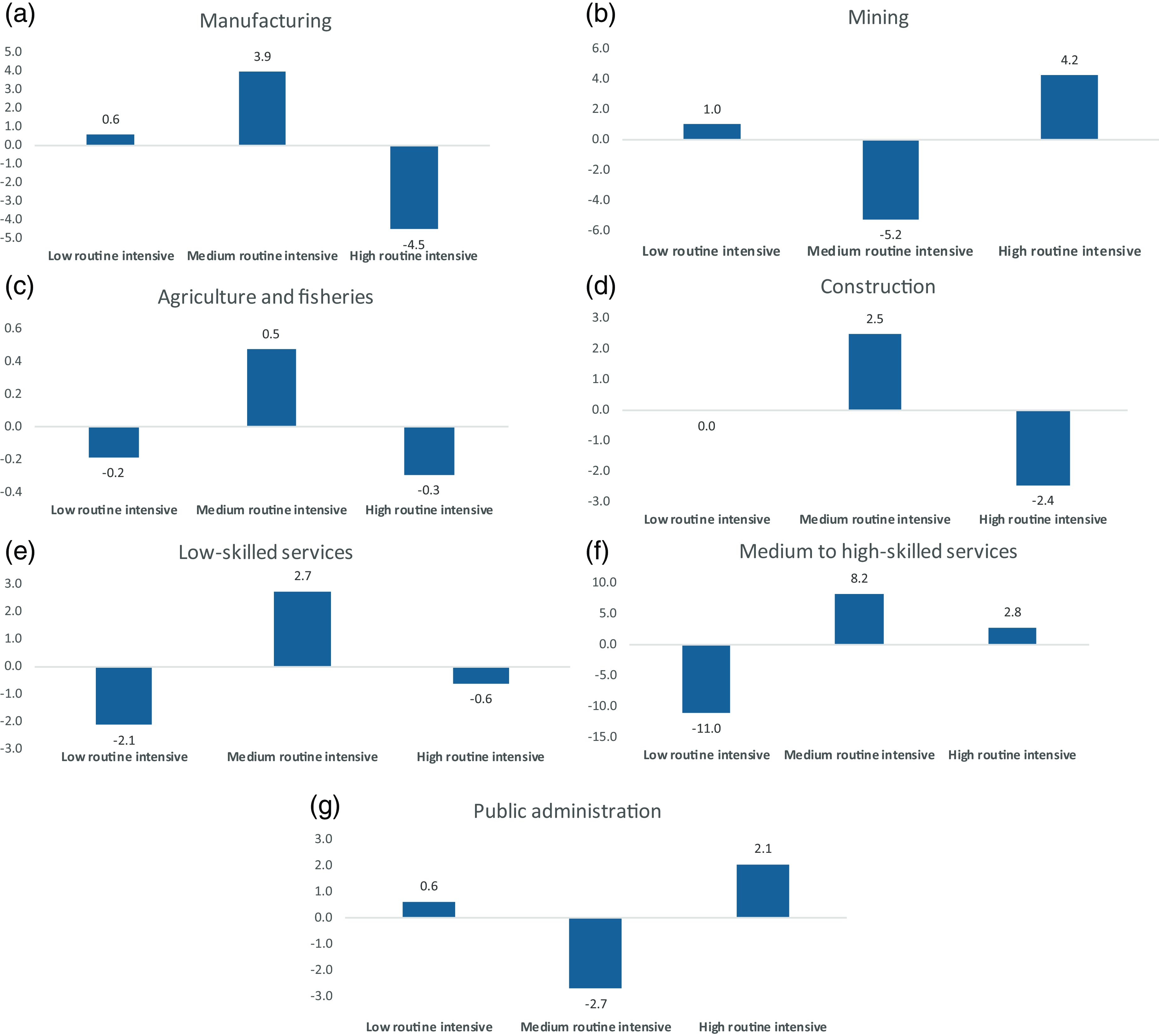
In summary, the shift-share decomposition indicates that sectoral structural changes played a significant role in influencing the composition of occupational employment dynamics. Premature deindustrialisation countered the expected routinisation effect. There is also notable heterogeneity across industries in terms of (de-)routinisation processes, explaining the absence of a typical and clear profile in total employment dynamics by RTI level.
The relative resilience of informal workers to the process of de-routinisation in comparison to their formal counterparts within various industries
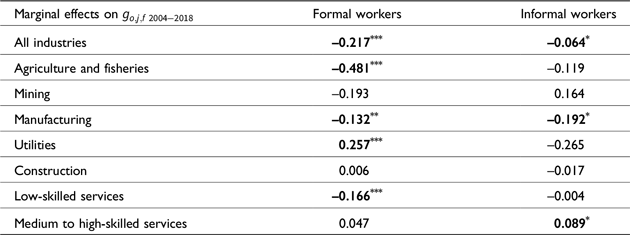
As highlighted in the methodological section, we attempted to answer the question: To what extent does the prevalence of informal labour within various industries condition the (de-)routinisation process. The findings from our estimated three-way interaction model show a lower sensitivity of informal employment growth to the RTI index, as opposed to formal employment (Appendix). Indeed, the estimates reveal negative marginal effects for both groups of workers, albeit with a greater impact observed in formal employment, significant at the 1% level. In contrast, the marginal effect for informal employment is notably lower, with a significance level of 10% only (Table 10).
Marginal effects of the three-way interaction model a
a Significance level. Public administration sector is not included as this sector comprises solely formal employment positions.
* p < .1.
** p < .05.
*** p < .01.
The marginal effects of RTI on occupational employment by industry (j) and workers’ informality status (f) (Table 10) reveal significant and negative impacts on formal workers in agriculture and fisheries, manufacturing, and low-skilled services. This suggests a noteworthy internal de-routinisation process among formal jobs within these sectors, signifying a shift in demand away from occupations with higher routine task intensity. Conversely, for the same three industries, the reported marginal effects for informal workers are either non-significant, as seen in agriculture and fisheries and the low-skilled services sector, or weakly significant (at a 10% significance level only), as observed in the manufacturing industry.
For the agricultural sector, there is a statistically significant negative marginal effect of RTI on the growth of formal employment, despite the sector’s limited reliance on routine tasks. This negative impact may primarily be attributed to large-scale farms capable of investing in mechanisation. Therefore, it is not justified to generalise this negative effect to all agricultural workers, as the majority engage in informal jobs within small-scale farms and perform non-routine, low-paid tasks. The absence of a significant marginal effect for informal workers in agriculture (Table 10) supports this conclusion.
In the case of the medium-to-high-skilled services sector, the marginal effect is non-significant for formal workers and somewhat positive but weakly significant at 10% level for informal workers, suggesting a slight process of employment routinisation within this sector.
These findings substantiate our assumption that informal labour within a specific industry is generally less susceptible to de-routinisation process and automation compared to formal labour within the same industry. This resilience can be attributed to specific characteristics of informal labour, including lower wages (making automation costs comparatively higher than labour cost in developing countries), the limited technological capacity in informal units, and the financial constraints preventing informal micro-firms from investing in automation technologies.
Conclusion
This paper explores employment structure (de-)routinisation in developing countries, through the case of Morocco to highlight often overlooked structural aspects in (de-)routinisation literature, such as premature deindustrialisation and the prevalence of informal labour.
The hypothesis of the existence of a process of employment structure de-routinisation lacks complete support in Morocco. At the same time, we could not confirm a clear trend of employment routinisation typical of developing countries in the initial stage of traditional structural transformation. Instead, an unconventional inverted U-shaped pattern emerges in the dynamics of occupational employment by routine task intensity, suggesting a growing share of occupations with intermediate routine task intensity.
Two factors contribute to this atypical pattern:
-
According to our empirical findings, premature deindustrialisation significantly reduces the proportion of highly routine-intensive jobs. It is acting in contrast to the usual dynamics of employment routinisation expected during the initial phase of traditional structural change process, where employment in developing countries is supposed to move from agriculture to more routine task intensive activities in manufacturing. These findings support our hypothesis that premature deindustrialisation may counterbalance the process of employment routinisation observed in some developing countries.
-
The second factor involves the prevalence of informal labour. Unlike the impact of premature deindustrialisation implying employment de-routinisation, our findings suggest that in a developing country like Morocco, the widespread use of informal labour hampers the de-routinisation process. The three-way interaction model indicates a reduced responsiveness of informal employment growth to the RTI index compared to formal employment at the economy-wide level and across various industries.
In addition to the two preceding factors, it is crucial to consider that heterogeneity in terms of internal (de-)routinisation processes across industries adds complexity to the dynamics of total employment, thereby hindering the emergence of a homogeneous and clear process of (de-)routinisation at the level of overall employment. Heterogeneity is also apparent across the five major task categories. On one hand, employment growth increases with the intensity of non-routine analytical cognitive tasks, while it decreases with routine manual tasks, thus promoting de-routinisation. Conversely, employment growth is positively linked to the intensity of routine cognitive tasks, which tends to mitigate the employment de-routinisation process.
While a conventional job de-routinisation process may not be prevalent in Morocco, it is crucial to recognise the fast technological progress, especially in fields like artificial intelligence. Urgent actions are needed in developing nations to implement innovative education policies and cultivate adaptable skills aligned with technological advancements. Simultaneously, policy interventions should steer clear of what Acemoglu and Restrepo (Reference Acemoglu and Restrepo2019) termed ‘so-so technologies’ that replace workers without significant benefits in terms of productivity and additional demand. Instead, investments should prioritise automation technologies that maximise productivity gains and reduce production costs, fostering economic expansion and increasing demand for labour in non-automated tasks (Acemoglu and Restrepo, Reference Acemoglu and Restrepo2019). This, in turn, offsets the direct negative displacement effect of automation on employment. Achieving this, however, would necessitate measures focused on strengthening domestic industrial integration to intensify indirect employment at upstream and downstream levels as a compensatory effect.
Karim El Mokri holds a Ph.D. in Economics from Mohammed V University of Rabat, where he is a research associate. He is also currently serving as a senior expert at the Economic, Social, and Environmental Council of Morocco. His research interests encompass industrial policy, structural transformation and economic complexity, labour markets, the economic impact of automation and artificial intelligence, and macroeconomic policies. He has contributed to several books, articles, and reports in these fields.
Idriss El Abbassi is a professor of economics at Mohammed V University in Rabat. Formerly the head of the economics department, he currently coordinates the master’s program in economics. His research interests are in open-economy macroeconomics, growth and structural transformation and his publications cover a variety of economic issues. He teaches a broad range of economics courses at the master’s and PhD levels, including international macroeconomics and economic development.
Aomar Ibourk is Professor of quantitative methods and social economics at Cadi Ayyad University and serves as the director of the Research Laboratory in Social and Solidarity Economy, Governance, and Development. Affiliate Professor at Mohammed VI Polytechnic University and a member of the Africa Institute for Research in Economics and Social Sciences.Senior Fellow at the Policy Center for the New South.


 Open access

