

Context
As has been discussed in more detail previously (Trafford, Reference Trafford2017), the current (legacy) IB Diploma Classical Languages syllabus falls neatly into three strands (see Figure 1).
Classical Languages assessment outline (last assessment 2023) (IBO, 2014)

Paper 1, Language (35%), which is assessed through a translation exam of either a passage from Cicero's Speeches or Ovid's Metamorphoses (the student can decide which to choose). Paper 2, Literature (45%), which is assessed through an examination on two thematic topics. The paper consists of short answer questions on four passages from the two topics (three for Standard Level students) from set lines the student would have studied in class. For Higher Level students, there is also the requirement to write a short essay on one of the topics they have studied. The Literature paper examines understanding and literary appreciation of set texts, as well as the contextual knowledge necessary for the understanding of prescribed passages within the options. The third component is the Research Dossier (20%), which is an internally assessed (externally moderated) coursework task that encourages the students to ask: how do we know what we know about the ancient world? The student is required to assemble a Research Dossier of annotated primary source material relating to a topic in Roman or Classical Greek history, literature, language, religion, mythology, art, archaeology. The task offers students the opportunity to examine in some depth an aspect of classical language, literature or civilisation that is of particular interest to them, which develops academic research skills and critical thinking and is clearly framed around analysis and discussion of primary and secondary source material.
What has changed?
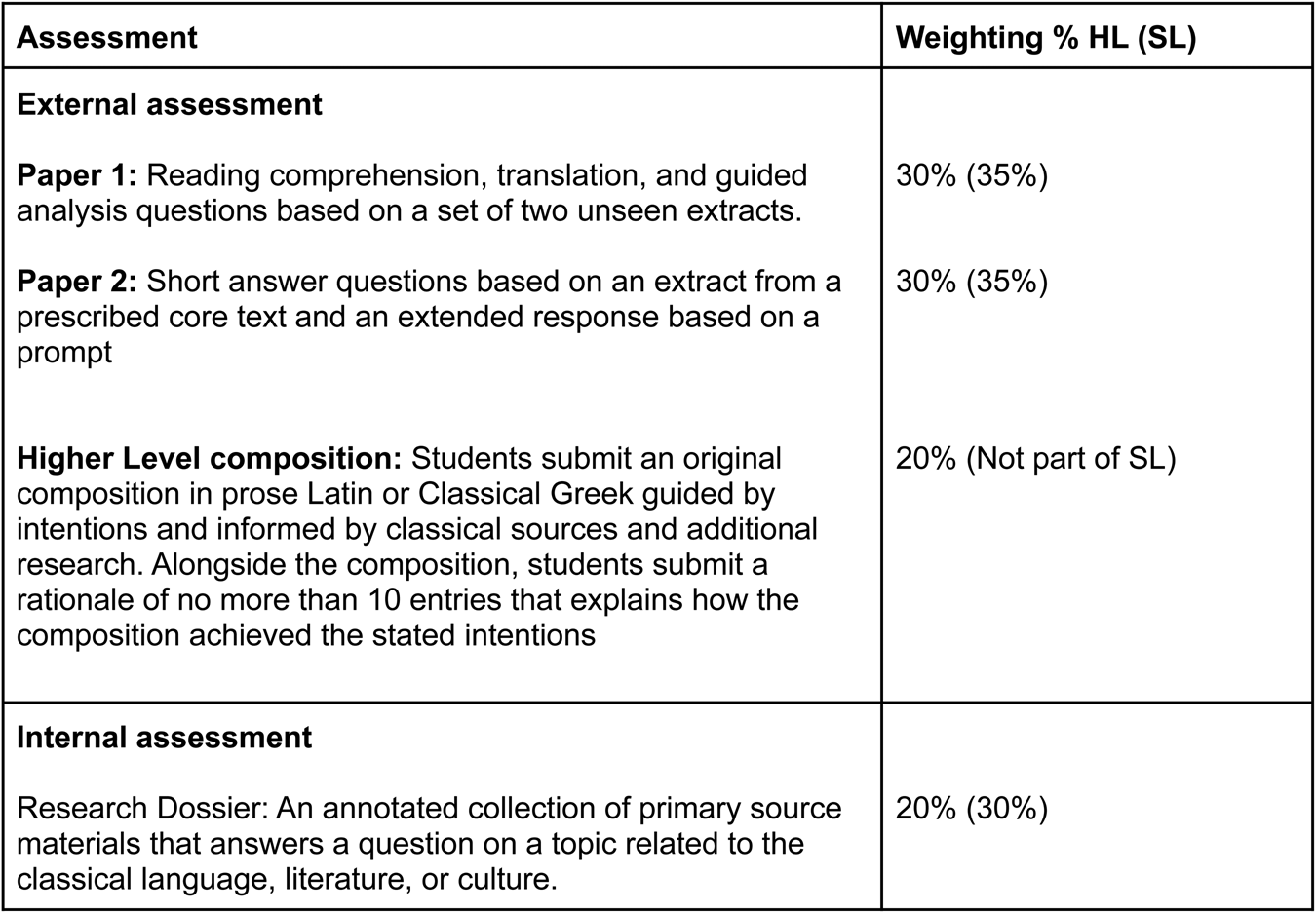
The new syllabus, by contrast, has tried to break down some of the seemingly artificial barriers that are created by the division of the externally assessed components into a study of language and study of literature. This is reflected in the four Assessment Objectives (AOs) and the manner in which they are examined. In the words of the Classical Languages Guide: AO1: Students will demonstrate, in a variety of ways, their understanding of the classical language and texts read in the classical language. AO2: Students interpret and analyse texts written in the classical language through their knowledge of literary, stylistic, historical and cultural contexts. AO3: Students will synthesise evidence from a variety of primary, secondary, and reference sources. AO4: Students will learn to construct arguments supported by relevant analysis of texts in the classical language and of other products of classical cultures or their traditions (IBO, 2022: 18-20). It is stated that each of the AOs will be assessed in each of the four components (three for Standard Level) (see Figure 2).
Classical Languages assessment outline (first assessment 2024) (IBO, 2022)
It is worth looking at the form assessment will take. This will give a better idea of how the new syllabus delivers on an integrated curriculum, because as all teachers understand, the nature of the examination will more often than not determine what is taught and how the content is taught in the classroom.
At Higher Level, Paper 1 is two hours long and worth 30% of the final grade. The paper takes the form of reading comprehension, translation, and guided analysis questions based on a set of two unseen extracts, one prose one verse. In the exam, candidates are permitted to use a dictionary, just as is the case for the current syllabus. The IB makes clear that the paper is not a vocabulary test but one that recreates the conditions that students will find themselves in when they come to university or academic life. The first extract is accompanied by three types of question: i) short-answer questions that focus on comprehension and knowledge of the classical language, for which students will not have to provide evidence from the extract; ii) a short-answer question for which students will cite evidence from the extract; iii) a translation of approximately one-third of the extract into the response language. The second extract is accompanied by two questions: i) a short answer question that requires students to use evidence from both the extracts in the option; ii) a guided analysis of only the second extract, that asks students to comment on the author's style or technique to achieve a stated effect. For Standard Level, Paper 1 is 1 hour and 30 minutes long and worth 35% of the final grade. It takes the same form as the Higher Level paper and examines the same things, but students only need to answer on either a prose or a verse text, not both as is the case at Higher Level.
From what can be determined from the syllabus and Specimen Papers the new Paper 1 is a real success (Specimen Papers can be accessed through the Programme Resource Centre on MyIB website). As is the case on the current (legacy) syllabus, Paper 1 still retains the function of being the unseen language component of the external assessment. In contrast with the current syllabus, the new syllabus has developed the manner of assessment and provides a variety of methods to assess understanding. This includes comprehension questions and translation, as well as a guided analysis on two unseen passages. The Specimen Papers provide the following example questions for the guided analysis of unseen Latin: ‘Compare how the wonder of natural disasters is explored in both (i.e. prose and verse) extracts. Support your answer by quoting precise evidence from the Latin text of both extracts’. The other analysis question refers to a verse passage only: ‘Analyse how Ovid uses his theme of transformation to describe the events of the great flood. Support your answer by quoting precise evidence from the Latin text.’ As is clear from these sample questions, in Paper 1 the student is expected to elicit meaning from the lines beyond simply translating into good English. If we consider again the Assessment Objectives, it is possible to see how Paper 1 delivers on the desire for students not only to demonstrate their understanding of classical language (AO1), but also to interpret and analyse texts through their knowledge of literary, stylistic, historical and cultural contexts (AO2). This is done through answering comprehension questions and translation (AO1) and by writing a guided literary analysis on an unseen extract (AO2). This is a significant - and welcome - change from the current Paper 1 assessment of unseen Latin and does seem to deliver on the promise of an integrated curriculum that breaks down some of the barriers of the study of language and study of literature.
Another positive of the new syllabus is the Higher Level composition, which is worth 20% of the final grade. As is implied in the title of the Higher Level composition, students are not required to complete this task at Standard Level. This is a coursework task, which is assessed externally and is a completely new part of the course. Students submit an original ‘free composition’ in prose Latin (or Classical Greek, if they are studying Greek) guided by intentions and informed by classical sources and additional research. Alongside the composition, students submit a rationale of no more than 10 entries that explains how the composition achieved the stated intentions. The composition has two strands: one is to produce a ‘free composition’ of Latin (or Greek) that engages with how the language creates meaning, how literary elements, register, and intertextuality all enhance an audience's reading of a text; the second is the rationale which encourages the student to reflect on and develop their own understanding of how they have improved and enhanced their composition. The task asks students to explore their knowledge and understanding of, as well as interest in, the classical language, literature and culture by researching and reflecting on a variety of ancient and modern sources; expressing intentions for an original composition in the classical language; experimenting with communicating in the classical language; drafting, finalising, and presenting a resolved original composition; explaining, in an accompanying rationale, findings from research and decisions taken in drafting and editing that affected how well the composition achieved its stated intentions.
Candidates will produce an original composition in Latin (or classical Greek), which will only be 100 words of Latin (120 of Greek). Indeed the composition itself only counts for 6 of the 25 marks available - with the rest of the marks reserved for the student's commentary that outlines their intentions, discusses their rationale and use of sources, and explains their choices and process. This is an innovative and creative task that is a welcome break from the more traditional assessment tasks. There also seems to be real academic value to the task, especially in how it will require students to read widely of commentaries, grammars or primers - as well as a range of Latin texts which should act as inspiration for the composition itself. The composition will also help students reflect on how the ancient language creates meaning.
In spite of these positives, there is a potential issue with the nature of the assessment because the mark scheme is unclear about the way it will judge the quality of the Latin composition. For example, there is no apparent consideration or allowance for how the difficulty level of each composition will be assessed. All assessment criterion B says for the composition to reach the top band is: ‘The composition effectively communicates the intended meaning; lexical and grammatical errors do not impair communication.’ So, does that mean that a student can produce an excellent piece of Latin comprising simple vocabulary and grammar? One would hope not! It seems that clarity needs to be provided by the guide's authors on the composition.
The composition does hold true to the ideals of the integrated Assessment Objectives. The students’ compositions demonstrate an understanding of how the classical language creates meaning and the rationale demonstrates an understanding of source materials and their influence on the composition (AO1); in the rationale, students discuss relevant literary, stylistic, historical, and cultural information that informed the composition (AO2); students’ compositions and rationales demonstrate engagement with a variety of primary, secondary, and reference sources (AO3); students discuss logical conclusions from their investigation of sources and resources in the rationale (AO4). In many respects, though one aspect of the assessment needs clarifying, the composition and accompanying commentary compiled by the candidate is something that could prove exceptionally valuable as an assessment task, which brings together the study of language and literature in a new and innovative way.
The final component of the course which is an unrivalled success is the Internal Assessment Research Dossier, which is worth 20% of the final grade for Higher Level, 30% of the final grade for Standard Level. The Research Dossier is internally assessed by the teacher and externally moderated by the IB at the end of the course. The Research Dossier is an annotated collection of seven to nine primary source materials that answers a question on a topic related to the classical language, literature, or culture. The dossier is introduced by a supplementary source that captures the inspiration for the line of inquiry. This is the same task as the Internal Assessment Research Dossier on the current syllabus, except for the new introductory source which acts as a point of departure or inspiration for the new research task. The dossier is an excellent task that had near unanimous support from IB teachers in the review which was completed before the creation of the new syllabus commenced and is probably why so little of the old task has been adapted or amended for the new course. Further discussion on the importance of the Research Dossier on the current (legacy) syllabus has been discussed in more detail previously (Trafford, Reference Trafford2017).
The Research Dossier encourages students to think about the nature, reliability and usefulness of both primary and secondary sources. Students’ annotations of primary sources in the classical language demonstrate they understand their contents (AO1) and their analysis and interpretation of the primary sources is informed by an understanding of their contexts (AO2). Students will also make decisions about which of primary sources available represent a broad, complete treatment of the research question and which will answer their research question most effectively (AO3). Finally students organise their chosen sources and annotations to develop a logical argument in response to their research question (AO4). The Research Dossier is an excellent assessment task which encourages students to think critically about the nature of how we know what (we think) we know about the ancient world, to synthesise a range of evidence and to read widely on the topic they have chosen to study.
The one aspect of the new course I have serious reservations over is Paper 2. At Higher Level the assessment consists of a 1 hour and 30 minutes exam that is worth 30% of the final grade. The paper takes the form of short-answer questions based on an extract from a prescribed core text and an extended response based on a prompt. Paper 2 examines understanding, essential background knowledge, and literary appreciation of prescribed core texts, as well as broader perspectives on these texts, as supplemented by knowledge and understanding of additional reading. The examination contains four options, of which students answer one. Each option contains an extract from a prescribed core text, a series of questions based on that extract, and two prompts for an extended response of which students respond to one. This written response assesses the ability to construct an argument in response to the question/prompt, supported by relevant examples from the prescribed core text and from supplementary reading. These additional examples could come from the prescribed companion texts, literature read in translation, or secondary sources. The extended response is identical to the Section B essay on the current syllabus. Higher Level students are required to read both a prose core text and verse core text. They write their extended response on the opposite literary form than that of the extract on which the short-answer questions were based. So, a student who answered the short-answer questions on a verse prescribed core text, must respond to the prompt using evidence from a prose prescribed core text, or vice versa. For Standard Level, Paper 2 is 1 hour and 30 minutes long and is worth 35% of the final grade. SL candidates need only study one core text, because they can answer the short-answer questions on the same text as the extended response. So far, so good.
As is the case with the current (legacy) syllabus, Paper 2 still retains the function of being the Literature paper, where students are assessed on their ability to learn a selection of set texts, about which they are asked a series of short-answer questions on prescribed core texts, as well as an extended response based on a prompt on another. There are however a couple of noteworthy differences from the current (legacy) syllabus. The first is the requirement for Higher Level students to read both prose and verse as part of the assessment, which currently is not a requirement, though it can (and often is) done by teachers. For Latin the first round of set texts include: either Virgil's Aeneid or Ovid's Amores for verse; Livy or Cicero for prose, which provides a commendable range of the canonical authors. The second significant difference from the current syllabus is that the quantity of material expected to be covered is drastically reduced - indeed potentially more than the authors of the guide intended (more on this below) - and this is where the issues with Paper 2 reside. Students at Higher Level will be required to read approximately 600 lines (or equivalent number of words for prose) for the core texts, while for Standard Level half that amount. This is a marked reduction in the quantity of material to be assessed from 1100 lines for Higher; 700 for Standard. Though this is increased when one factors in the companion texts, where HL and SL students are expected to read two companion texts, amounting to 300 additional lines of Latin reading, the purpose of these companion texts and the manner in which they are assessed is unclear (and are thus potentially redundant).
It seems to me that there is a flaw in the format of the Paper 2 exam, where students do not in fact need to read one of the core texts, or indeed any of the companion texts. This is because students are only required to answer the short-answer questions on one extract from one of the set texts - for which they will of course need to know the Latin text in detail. However, students are not required to know the Latin text (at all) on the other core text, because they need only answer the essay prompt. The essay prompt, in contrast to the short questions, does not require knowledge of the Latin text; rather an understanding of the nature of the text and its relevant literary and historical contexts, for which they need only demonstrate an appreciation of the content of the text and of the genre and thus only need to read the text in translation should they desire. To give an example from the sample assessment material for the prose essay prompt candidates are asked: ‘“Individuals in Roman prose texts serve as role models or exemplars.” Discuss.’; or ‘To what extent is it important to consider the author's own connection to events, people, or culture when considering a text by that author as a source for the study of Roman history or culture?’ Neither essay prompt requires the student to engage with the Latin core text. The requirements of both essay prompts necessitate an understanding of the set texts more broadly and wider scholarship, which is corroborated by the demands of the Section B essay on the current (legacy) syllabus on which the new syllabus’ essay prompt is based. Such a conclusion is supported by the wording in the guide, which states: ‘In addition to constructing a logical argument, students are expected to demonstrate an understanding of the works themselves and background and contexts related to them, as well as analyse and evaluate how textual features and authors’ broader choices shape meaning and create effect.’ (IBO, 2022: 39) There is no mention here of the requirement to analyse the core Latin texts in a way comparable to what is needed in the shorter-answer questions in the other half of Paper 2. Indeed, the only requirement when it comes to the set texts is to understand the works themselves, which can of course be done in translation when analysis of specific lines of a set passage is taken off the table. This is a potentially worrying oversight. We may ask why the teacher would spend the time reading both set texts in Latin when time and resources could be more effectively devoted eslewhere?
Another significant difference from the current (legacy) syllabus is the use of the prescribed companion texts. These are a curious inclusion in the syllabus, because their purpose and means of assessment are unclear. The guide states: ‘Prescribed companion texts are shorter extracts of literary work. They have been selected to expose students to a diversity of perspectives, time periods, and styles in each language's literary tradition… This allows for comparison and contrast among all of the prescribed literature, as well as connections to the students’ own experience.’ The guide is also prescriptive in that it states: ‘As part of the course, SL and HL students MUST [my own emphasis] read any two prescribed companion texts.’ (IBO, 2022: 25) But, paradoxically, the guide admits on the next page: ‘Prescribed companion texts are not directly assessed.’ (IBO, 2022: 26) It is suggested that ‘students may draw on their study of the companion texts as supplemental evidence in their extended response for Paper 2, or as inspiration or evidence as they prepare their Research Dossier, or their composition (for HL students).’ It is also suggested that they will also help in preparation for Paper 1. There is admittedly the implication that the companion texts will help when answering the extended response question on Paper 2, but that cannot really be the case as the selection of companion texts is so broad and diverse that no single question could encompass or be relevant to all companion texts. Also, by that logic students could simply read the companion texts in translation, because as has already been established, the extended response questions do not require knowledge of the texts in Latin. The other implied purpose of the companion texts stated by the guide is that they help with preparing for the unseen. Well, of course, reading texts in Latin helps with Latin translation skills - but I suppose the question is why should students and teachers read these Latin companion texts when there does not seem to be a direct need or purpose?
A syllabus cannot effectively prescribe material that is not explicitly assessed. It seems that not only will one of the core texts not be formally assessed as a set text in the exam, neither will the ‘prescribed’ companion texts. So, while on the face of things students should read around 900 lines of text at Higher Level and 600 lines at Standard Level, they are both (Higher Level and Standard Level) only in reality assessed on 300 lines. The concern is that a syllabus so full of holes will not fulfil the goals the authors of the guide had intended, because different schools, teachers and students will all be doing their own thing, reading anywhere between 300-900 lines or between one and four set texts. What is potentially more concerning for IB teachers and students is that with such a drastic reduction in the number and range of texts that will be assessed, the rigour of the IB classical languages syllabus is dramatically reduced from its current standing.
In summary, the new IB Classical Languages guide (assessment from 2024) retains the well-rounded assessment, which has been the hallmark of IB classical languages guides for many years now. The new syllabus differs by putting greater stress on appreciating the way in which the classical languages communicate meaning and on the fundamentals of understanding the language. This is seen clearly in the expectations of Paper 1 and the Higher Level composition. In addition, the reduction in the formally assessed set texts for Paper 2 means that less teaching time needs to be devoted to Paper 2, which in turn means that more could (and probably will) be devoted to language teaching for Paper 1 and the Higher Level composition. I think the greatest success of the new syllabus is Paper 1, where the fundamentals of an unseen paper are merged with a discussion of style, form and meaning in the guided analysis. The paper provides nuanced assessment that will allow students to show their understanding in a variety of ways. The retention of the Research Dossier must also be welcomed wholeheartedly as it provides (together with the Higher Level composition) another path by which to approach the ancient world.
In spite of all these positives, the dramatic reduction in the formally assessed lines of set texts must be interpreted as a reduction in the rigour of this classical languages qualification. While I think the 1100 lines assessed in the current syllabus is too great, the holes in the new Paper 2 assessment model which means that only one set text of approximately 300 lines must be read in Latin has gone too far in the other direction. For all the positives of Paper 1, the Research Dossier, and the Higher Level composition, the reduction in the formally assessed set texts and, by consequence, the removal of rigour in Paper 2 detracts from much which is to be praised about this innovative classical languages qualification.


 Open access

