

Chronologies fundamentally underpin all other aspects of archaeological thought. The time frames we employ structure not only the broad brushstrokes of cultural process at the regional scale but also the questions we are willing to ask of our data and the answers we are willing to accept. The use of Bayesian modeling for the interpretation of radiocarbon dates and the construction of refined archaeological chronologies has had a tremendous impact on the discipline (Bayliss Reference Bayliss2009, Reference Bayliss2015; Bayliss and Bronk Ramsey Reference Bayliss, Ramsey, Buck and Millard2004; Bronk Ramsey Reference Bronk Ramsey2009a), resulting in the rethinking of long-held ideas about the historical development of societies in multiple world regions (e.g., Bronk Ramsey et al. Reference Bronk Ramsey, Dee, Rowland, Higham, Harris, Brock, Quiles, Wild, Marcus and Shortland2010; Higham and Higham Reference Higham and Higham2009; Manning et al. Reference Manning, Ramsey, Kutschera, Higham, Kromer, Steier and Wild2006, Reference Manning, Birch, Conger, Dee, Griggs, Hadden, Hogg, Ramsey, Sanft, Steier and Wild2018; Needham et al. Reference Needham, Ramsey, Coombs, Cartwright and Pettitt1998; Whittle Reference Whittle2018; Whittle et al. Reference Whittle, Bayliss and Healy2011). The ability to refine and revise archaeological chronologies forces a critical recontextualization of both regional cultural sequences and the conceptual frameworks we use to explain them.
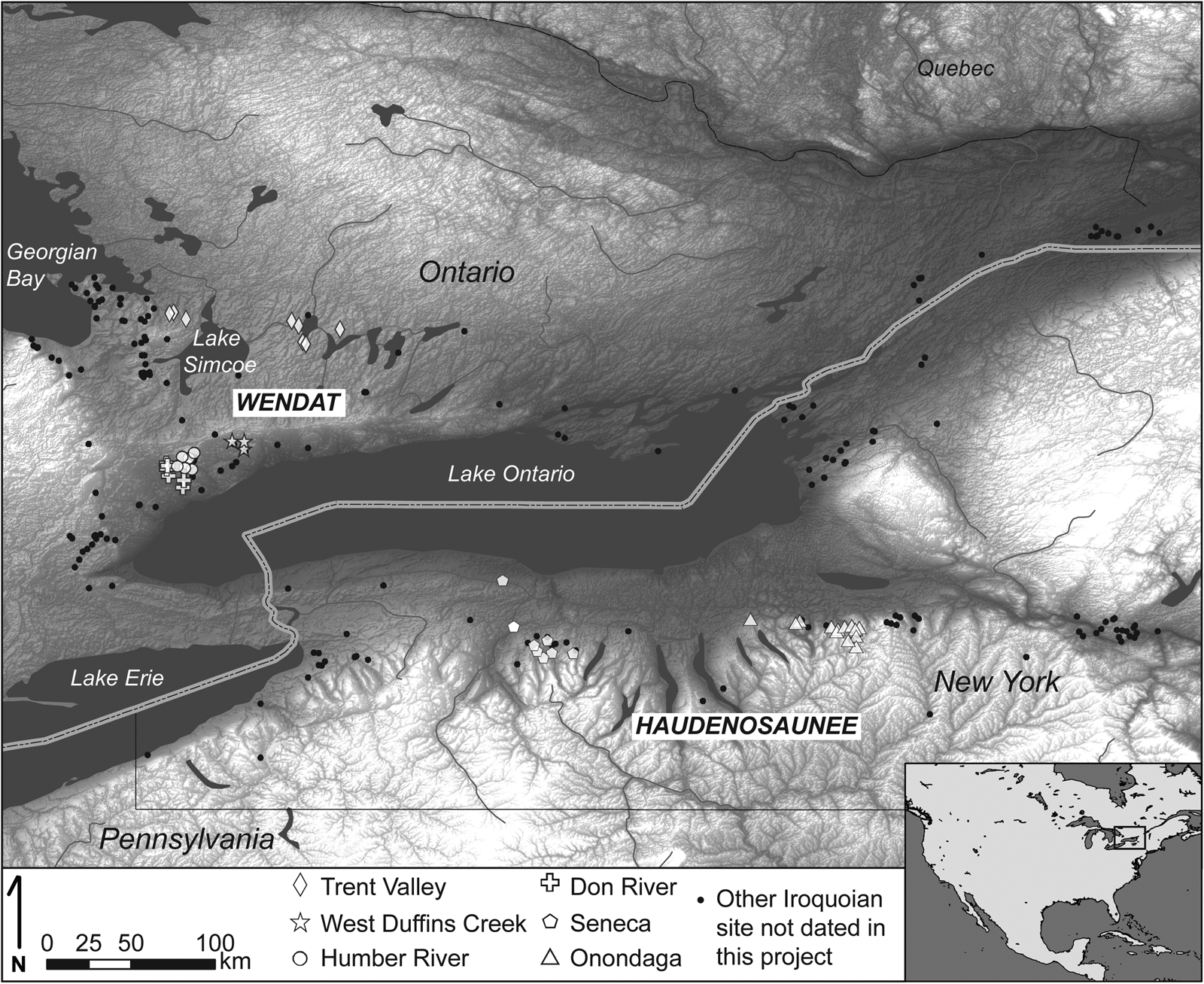
This article describes the initial results of the Dating Iroquoia project. Our objective has been to construct high-precision radiocarbon chronologies for selected Northern Iroquoian site relocation sequences in eastern North America (Figure 1). Results suggest that in some cases, previous age estimates were in error by some 75–100 years (see also Manning et al. Reference Manning, Birch, Conger, Dee, Griggs, Hadden, Hogg, Ramsey, Sanft, Steier and Wild2018). Given the largely single-component nature of site occupations, estimated to span some 0–40 years, such shifts can be seismic. Although our results should be viewed as a first step toward a refined, radiocarbon-derived chronology for northeastern archaeology, these findings nevertheless require a rethinking of long-held notions about cultural process in Northern Iroquoia. This includes current understandings of the timing and nature of coalescence and conflict as well as the spread of European goods and influences from the fifteenth to seventeenth century. Our discussion of these data and findings stress the importance of using derived insights from enhanced chronological resolution for archaeological interpretation. In particular, we highlight that refined chronologies permit the writing of a new kind of archaeological history that extends beyond generalized cultural processes and focuses on the relational histories of communities, peoples, and places. In doing so, we forefront the agency of Indigenous peoples and the positionality of specific community groups during processes of coalescence, conflict, and early encounters with European objects and persons.
Map of the study region with dated and selected undated sites indicated (undated site locations are intended to be representative as opposed to definitive; dataset follows Hart et al. Reference Hart, Winchell-Sweeney and Birch2019). Basemap: United States Geological Survey 2017. Waterways and inset basemap: Natural Earth 2019.
Iroquoian Archaeology
Northern Iroquoian societies inhabited what is now southern Ontario, southwest Québec, upper New York State, and the Susquehanna Valley of Pennsylvania and New York. These populations shared cultural traits, including settlements of bark-covered longhouses sometimes surrounded by palisades; subsistence based on maize horticulture, hunting, fishing, and gathering; and a sociopolitical structure organized around matrilineal descent, clan membership, and decision making based on councils and consensus building (Engelbrecht Reference Engelbrecht2003; Trigger Reference Trigger1976). In the sixteenth and seventeenth centuries, certain of these groups, notably the Wendat (Huron) and Haudenosaunee (Iroquois) were organized into regional confederacies that included nations of allied villages and a confederacy council (Fenton Reference Fenton1998; Trigger Reference Trigger1976), although the specific structure and social networks comprising each were variable (Birch and Hart Reference Birch and Hart2018).
Seventeenth-century European explorers and missionaries left a detailed ethnohistoric record of Iroquoian lifeways. As a result, a great deal of Iroquoian archaeology has involved variants of the direct historical approach. Archaeological remains that include Iroquoian cultural traits or stages of their development are thought to represent ancestral Iroquoian-speaking peoples (Snow Reference Snow1994; Warrick Reference Warrick2000:417). However, the relationship between what has been interpreted as constituting early forms of longhouses, horticulture, and sociopolitical organization versus historically documented phenomena is less clear than such models assume (e.g., Hart Reference Hart, Rieth and Hart2011; Hart and Brumbach Reference Hart and Brumbach2003; Pihl et al. Reference Pihl, Monckton, Robertson, Williamson and Hart2008). Contemporary Indigenous peoples have been particularly critical of inferred relationships between material culture and ethnic identity (Gaudreau and Lesage Reference Gaudreau and Lesage2016).
Iroquoian Chronology and Cultural Process
Chronological frameworks for Iroquoian archaeology have primarily been based on ceramic seriation (ca. AD 1000–1550; all dates in this article are AD) and European trade goods (ca. AD 1550 through to the historic period), together with small numbers of modern radiocarbon dates and larger numbers of legacy dates (Figure 2). Although archaeologists in Ontario have a basic understanding of long-term cultural process during the Woodland period, it has been recognized for some time that this framework is inadequate for addressing questions related to complex cultural behavior (Ferris and Spence Reference Ferris and Spence1995:83; Williamson Reference Williamson, Williamson and Watts1999). It has started to become clear, however, that enhancing our chronological resolution does not serve to clarify existing chronological frameworks. Instead, it renders them obsolete—both in practice and in theory.
Traditional regional chronology (after Bradley Reference Bradley2005; Ellis and Ferris Reference Ellis and Ferris1990; Engelbrecht Reference Engelbrecht2003; Wright Reference Wright1966).

Focused effort on ceramic seriation in Iroquoian archaeology began in the mid-twentieth century with the definition of ceramic types and their chronological associations, working backward from documented interactions with Europeans in the early seventeenth century to what was interpreted as early manifestations of Iroquoian culture (Emerson Reference Emerson1954; MacNeish Reference MacNeish1952; Wright Reference Wright1966). Beginning in the 1970s, analytical approaches shifted to seriation based on ceramic attributes rather than types, but they maintained similar relative chronologies (e.g., Engelbrecht Reference Engelbrecht1971; Ramsden Reference Ramsden1977). The growth of settlement archaeology led to the construction of inferred site relocation sequences based on ceramic seriation that have been the basis for narratives of cultural development in both Ontario and New York State (e.g., Ramsden Reference Ramsden1977; Sempowski and Saunders Reference Sempowski and Saunders2001; Tuck Reference Tuck1971).
From the mid-sixteenth century on, sites are more commonly dated based on the presence or absence of European metal and chronologically diagnostic glass-bead assemblages. It is generally accepted that European metal appears on Iroquoian sites as early as the mid-sixteenth century (Bradley Reference Bradley2005, Reference Bradley2007; Bradley and Childs Reference Bradley, Childs and Ehrenreich1991; Fitzgerald Reference Fitzgerald1990; Loewen and Chapdelaine Reference Loewen and Chapdelaine2016; Wray and Schoff Reference Wray and Schoff1953). Small amounts of European iron and copper are assumed originally to have passed through Indigenous trade networks, and they were later followed by other goods acquired directly from Europeans, including glass beads, copper and brass kettles, and iron knives and axes. Trade good distributions have been used to construct timelines such as the glass-bead chronology (Kenyon and Fitzgerald Reference Kenyon and Fitzgerald1986; Kenyon and Kenyon Reference Kenyon, Kenyon and Hayes1983; Rumrill Reference Rumrill1991) and to chronologically order sites more generally based on frequencies and types of European goods (e.g., Birch and Williamson Reference Birch and Williamson2013; Loewen Reference Loewen, Loewen and Chapdelaine2016). Contemporary perspectives on processes of cultural entanglement, Indigenous agency, and differential engagements between multiple Indigenous and European actors in the sixteenth and seventeenth centuries prompt critical reflection on the logic of both these frameworks (Jordan Reference Jordan, Majewski and Gaimster2009, Reference Jordan2013; Loewen and Chapdelaine Reference Loewen and Chapdelaine2016).
Generally, radiocarbon dating has only been utilized on pre-1550 Iroquoian sites, with trade-good chronologies the preferred dating method on “protohistoric” and “historic” era sites. In the past, radiocarbon dating in Late Woodland Iroquoian archaeology was often employed in order to confirm the assignment of sites to certain cultural phases (e.g., Uren, Chance, etc.; see Figure 2), with dates that did not “fit” the dominant paradigm being dismissed as inaccurate (e.g., Ellis and Ferris Reference Ellis and Ferris1990). An oft-cited problem in Iroquoian archaeology over the last several decades is the lack of chronological resolution possible from radiocarbon dates. This stems from the combination of short durations of site occupation and multiple possible intercepts in the calibration curve between 1300 and 1650 (e.g., Chapdelaine Reference Chapdelaine, Loewen and Chapdelaine2016; Ramsden Reference Ramsden2014; Rossen Reference Rossen and Rossen2015), and it applies especially between 1480 and 1620, where a major plateau and reversal in the calibration curve renders radiocarbon dates ambiguous in the absence of chronological modeling (Figure 3). More precise AMS dating, together with chronological modeling, has demonstrated that we now have the ability to begin to overcome those concerns (Manning and Hart Reference Manning and Hart2019; Manning et al. Reference Manning, Birch, Conger, Dee, Griggs, Hadden, Hogg, Ramsey, Sanft, Steier and Wild2018, Reference Manning, Birch, Conger, Dee, Griggs and Hadden2019, Reference Manning, Birch, Conger and Sanft2020).
Calibration curve with area of sixteenth-century plateau/wiggle and related cultural phenomena indicated. Simulated dates illustrate the multiple intercepts, long date intervals, and therefore the challenges associated with radiocarbon dating in this period. The new IntCal20 calibration curve (dark gray; Reimer et al. Reference Reimer, Austin, Bard, Bayliss, Blackwell, Ramsey, Butzin, Cheng, Lawrence Edwards, Friedrich, Grootes, Guilderson, Hajdas, Heaton, Hogg, Hughen, Kromer, Manning, Muscheler, Palmer, Pearson, van der Plicht, Reimer, Richards, Marian Scott, Southon, Turney, Wacker, Adolphi, Büntgen, Capano, Fahrni, Fogtmann-Schulz, Friedrich, Köhler, Kudsk, Miyake, Olsen, Reinig, Sakamoto, Sookdeo and Talamo2020) is shown as well as the previous IntCal13 calibration curve (light gray; Reimer et al. Reference Reimer, Bard, Bayliss, Warren Beck, Blackwell, Ramsey, Buck, Cheng, Lawrence Edwards, Friedrich, Grootes, Guilderson, Haflidason, Hajdas, Hatté, Heaton, Hoffman, Hogg, Hughen, Felix Kaiser, Kromer, Manning, Niu, Reimer, Richards, Marian Scott, Southon, Staff, Turney and van der Plicht2013).

Coalescence, Conflict, and Interactions with Europeans
The cultural processes at the center of this investigation are (1) the timing and process of coalescence and conflict, and (2) the entry and distribution of European-manufactured material culture in the region. Both phenomena have been placed in the mid-1400s and mid-1500s, respectively.
At the end of the Late Woodland period in both Ontario and New York State, people came together into heavily palisaded and defensively situated, aggregated village settlements in the context of heightened regional conflict. Some sites also include clear sequences of village expansion where palisades were extended to incorporate newcomers (Birch Reference Birch2012; Finlayson Reference Finlayson1985; Finlayson et al. Reference Finlayson, Smith, Spence and Timmins1987; Ramsden Reference Ramsden2016; Sempowski and Saunders Reference Sempowski and Saunders2001; Snow Reference Snow1995; Tuck Reference Tuck1971). Palisaded village sites in both regions are often, although not always, found to contain human remains in nonburial contexts—such as midden deposits—with perimortem trauma interpreted as evidence of the torture and killing of captives (Williamson Reference Williamson, Chacon and Dye2007).
It has been assumed that coalescence and conflict in Ontario were occurring as early as approximately 1450 (Birch Reference Birch2010, Reference Birch2012; Birch and Williamson Reference Birch and Williamson2013). The early onset of conflict, together with analysis of human skeletal remains (Dupras and Pratte Reference Dupras and Pratte1998; Williamson Reference Williamson, Chacon and Dye2007), led to the inference that conflict in Ontario was primarily occurring between local groups and that it declined in intensity during the very early 1500s (Birch Reference Birch2010, Reference Birch2012). In New York State, however, palisaded settlements were thought to appear somewhat later, in the very late 1400s to early 1500s (Engelbrecht Reference Engelbrecht2003; Snow Reference Snow1994). This pattern was also understood as having developed as the result of intrasocietal conflict, based in part on ethnographic accounts of the founding of the Haudenosaunee confederacy in order to quell intrasocietal violence (e.g., Fenton Reference Fenton1998). It has been assumed that conflict between the Haudenosaunee and Wendat only escalated in the very late 1500s to early 1600s (Trigger Reference Trigger1976). Multiple ethnohistoric accounts also describe external warfare between various Iroquoian and non-Iroquoian nations and tribal groups. Ultimately, the intensification of attacks by the Haudenosaunee eventually led to dispersal of the Wendat and other Iroquoian nations in the early 1650s.
After limited Norse presence approximately AD 1000, direct interaction between Indigenous peoples and Europeans was first recorded by Jacques Cartier in the St. Lawrence River valley in 1535 (Biggar Reference Biggar1929–1936), although Basque fishers and whalers had a presence on the coast some decades earlier (Turgeon Reference Turgeon2001). Until the early seventeenth century, when Europeans established a sustained presence in the Northeast, it is assumed that European goods on Indigenous sites in Ontario and New York originated mostly from direct exchanges between Basque or French mariners and Indigenous peoples along the north Atlantic Coast and in the Saint Lawrence Valley. It was assumed that these items were then traded inland through existing Indigenous networks of exchange and affiliation (e.g., Loewen and Chapdelaine Reference Loewen and Chapdelaine2016). Although archival research has characterized “diagnostic” assemblages of European goods being produced and exported at specific times from specific places (e.g., Bradley Reference Bradley1980; Fitzgerald Reference Fitzgerald, Hook and Gaimster1995; Fitzgerald et al. Reference Fitzgerald, Turgeon, Whitehead and Bradley1993; Turgeon Reference Turgeon2001), relative chronologies of European goods—such as glass beads—have largely been constructed using the direct historical method, working backward along site sequences anchored by sites supposedly identified in the ethnohistoric record (e.g., Kenyon and Kenyon Reference Kenyon, Kenyon and Hayes1983; Wray and Schoff Reference Wray and Schoff1953). Even though the impact of Indigenous perceptions of, and preferences among, these newly available goods has been explored to a certain extent (Anselmi Reference Anselmi2004), such goods are still widely used as temporal markers (e.g., Hawkins et al. Reference Hawkins, Petrus, Anselmi and Crawford2016; Walder Reference Walder2018), following the fundamental assumption that once they became available, they would be present in all communities in identifiable quantities. While variability among communities in terms of trade-good assemblages has been acknowledged for some time (Ramsden Reference Ramsden1978), it was not until recently that this variability was explicitly demonstrated through independent dating (Manning and Hart Reference Manning and Hart2019; Manning et al. Reference Manning, Birch, Conger, Dee, Griggs, Hadden, Hogg, Ramsey, Sanft, Steier and Wild2018, Reference Manning, Birch, Conger, Dee, Griggs and Hadden2019).
Current narratives about these processes mainly fit into time frames based on tentative associations between sites and rough, approximately 20–50-year phases, making it difficult to associate processes in one sequence or region with another. Figure 2 illustrates the time frames previously assigned to sites in this study. Traditional chronologies do not permit the teasing out of associations between sites and sequences with enough precision to engage meaningfully in relational approaches to archaeological histories (e.g., Kosiba Reference Kosiba2019). For example, what does coalescence on the north shore of Lake Ontario have to do with similar processes taking place in the Finger Lakes Region of New York State? How does evidence for the intensification of conflict in one area relate to the co-occurrence or absence of evidence for conflict in others? Does the entry of European goods into communities actually occur at the same time across the region? Alternatively, is there variability between subregions, as recent work on the West Duffins Creek sequence seems to demonstrate (Manning et al. Reference Manning, Birch, Conger, Dee, Griggs, Hadden, Hogg, Ramsey, Sanft, Steier and Wild2018)? What, if any, influence did long-distance trade and the onset of early European interaction have on communities, and how did those events impact processes of coalescence and conflict? These questions are historical in nature—they focus on a fundamental interest in diversity and specific, localized experience. To answer them, we require finer chronological resolution than relative means of dating currently offer.
Village Relocation Sequences
This study focuses on dating village sites that comprise subregional sequences of village relocations. Iroquoian villages were generally single-component, and they were occupied for no more than 40 years. Multiple lines of evidence support this interpretation. Warrick (Reference Warrick1988) provides a lengthy and compelling argument for estimating Iroquoian village duration using various methods. He argued that the average density of house wall posts was the most viable means of estimation (Warrick Reference Warrick1988, Reference Warrick2008:125). Counts of excavated posts in longhouse walls, combined with estimated rates of rotting and repair of multiple tree species available to Iroquoian builders, were employed to determine the average length of occupation for village sites in various periods of Iroquoian cultural development. He determined that sites were occupied for an average of 25–30 years in the fifteenth and sixteenth centuries.
Ethnohistoric accounts of Iroquoian village relocation are highly variable. In the writings of Champlain and Sagard, who visited Wendake during the 1610s and 1620s, village durations are reported variously as ranging from 10 to 40 years (Biggar Reference Biggar1929–1936; Wrong Reference Wrong1939 [1632]). In the 1630s and 1640s, Jesuits living among the Wendat reported village abandonment occurring after 8–12 years (Thwaites Reference Thwaites1896–1901).
Typically, village duration is stated as a likely maximum duration of no greater than 40 years. There is furthermore a general view that the larger, later sites were typically occupied for much shorter intervals (Birch Reference Birch2015; Birch and Williamson Reference Birch and Williamson2013; Warrick Reference Warrick1988). Consequently, most village durations in the sixteenth to seventeenth century were probably closer to 10–20 years, and only a few were occupied for more than 20 or, at most, 30–40 years. When villages were relocated, they often moved nearby—usually only a few kilometers away—although longer migrations also took place. Explanations for village relocation have been functional or ecological as well as social and political (Jones and Wood Reference Jones and Wood2012; Warrick Reference Warrick2008).
Numerous site relocation sequences have been constructed that represent hundreds of years of activity by contiguous groups (e.g., Birch and Williamson Reference Birch and Williamson2013; Bradley Reference Bradley2005; Niemczycki Reference Niemczycki1984; Ramsden Reference Ramsden1977; Sempowski and Saunders Reference Sempowski and Saunders2001; Snow Reference Snow1995; Tuck Reference Tuck1971). Although in most cases the general sequence of site occupations in each subregion is relatively well established, contemporaneity between sites across sequences has been inferred based on subregional ceramic chronologies and trade-good frequencies. This study is the first attempt to establish largely independent time frames for several known sequences.
For example, a refined chronology for the community relocation sequence representing the Draper, Spang, and Jean-Baptiste Lainé (Mantle) sites has demonstrated this potential and the implications for associated conceptual frameworks. These three sites are understood to be sequential iterations of the same village community (Birch and Williamson Reference Birch and Williamson2013). This village sequence was previously thought to date to roughly 1450–1530. However, 67 new radiocarbon dates modeled in keeping with current understandings have shown that it actually dates to approximately 1528–1616 (Manning et al. Reference Manning, Birch, Conger, Dee, Griggs, Hadden, Hogg, Ramsey, Sanft, Steier and Wild2018)—75–100 years later than previous estimates. This independent, radiocarbon-derived chronology is at odds with the long-standing ceramic and trade-good chronologies (Kenyon and Kenyon Reference Kenyon, Kenyon and Hayes1983; Ramsden Reference Ramsden, Ellis and Ferris1990). If this sequence was so misdated, what then of others in the region?
This investigation focuses specifically on three sequences of village sites ancestral to the Huron-Wendat Nation located in the Humber, Don, and Trent River systems in southern Ontario and two associated with the Seneca and Onondaga Nations of the Haudenosaunee in New York State (Figure 1; see Supplemental Table 1 for detailed site descriptions). These site sequences were chosen because of their centrality in explanatory constructs related to the archaeological histories of Iroquoian peoples in each region and the availability of sample material.
New Radiocarbon Dates Produced by This Project.

Note: For the complete dataset—including project identification numbers, sample identification to species, taxonomic identification of split and replicate samples, sample provenience, and data for the Warminster, Sopher, Ball, and Benson sites (previously published in Manning et al. Reference Manning, Birch, Conger, Dee, Griggs and Hadden2019)—see Supplemental Table 1. The δ13C, 15N, and C values are reported from separate IRMS measurements.
Methods
Sample Selection
All samples selected for radiocarbon dating were acquired from extant collections derived from cultural resource management, research, or avocational field projects. For some villages, only site-level provenience data were available. For others, samples were acquired from intact features such as pits, posts, and midden deposits (Table 1; Supplemental Table 1). When sites included multiple occupational phases, samples were taken from longhouses or other features associated with each phase and used to inform the modeling. In keeping with the wishes of descendant communities in both Canada and the United States, as well as policies established by the Native American Graves Protection and Repatriation Act (USA), no materials from burials or burial contexts were sampled.
Preference for sample selection was given to carbonized maize, followed by other short-lived annuals (beans, seeds, nutshells, etc.), followed by herbivore animal bone such as deer or other fauna known to follow a nonaquatic diet. All bone was identified to the taxonomic level of species. In some cases, the nature of collections from sites included the possibility of residual and/or more recent material being sampled. In those cases, the derived dates were used to exclude samples deemed too old or too recent.
Radiocarbon Dating
AMS 14C dates were obtained from two laboratories—the Center for Applied Isotope Studies (CAIS) at the University of Georgia and the Center for Isotope Research (CIO) at the University of Groningen. These included a number of split, or replicate, samples to establish that similar results were achieved independent of the individual laboratory (Supplemental Table 1). See Supplemental Material for sample pretreatment and lab methods as well as discussion of the comparability of replicate samples, which were found to be good.
Bayesian Modeling
Calibration and Bayesian chronological modeling used the OxCal software (version 4.4.1 [2020]; Bronk Ramsey Reference Bronk Ramsey2009a, Reference Bronk Ramsey2009b), forms of outlier analysis (Bronk Ramsey Reference Bronk Ramsey2009b; Dee and Bronk Ramsey Reference Dee and Ramsey2014; Dee et al. Reference Dee, Wengrow, Shortland, Stevenson, Brock, Flink and Ramsey2013), and the IntCal20 14C calibration dataset (Reimer et al. Reference Reimer, Austin, Bard, Bayliss, Blackwell, Ramsey, Butzin, Cheng, Lawrence Edwards, Friedrich, Grootes, Guilderson, Hajdas, Heaton, Hogg, Hughen, Kromer, Manning, Muscheler, Palmer, Pearson, van der Plicht, Reimer, Richards, Marian Scott, Southon, Turney, Wacker, Adolphi, Büntgen, Capano, Fahrni, Fogtmann-Schulz, Friedrich, Köhler, Kudsk, Miyake, Olsen, Reinig, Sakamoto, Sookdeo and Talamo2020), with curve resolution set at one year. We employ capitalized forms of words such as Sequence, Phase, Boundary, Date, Interval, Span, and Order to refer to OxCal Chronological Query Language (CQL2) Command Reference terms.
Because the historical contingencies within each site relocation sequence were unique, each was modeled using parameters that best fit current archaeological understandings of those local sequences (supplemental materials for site data and models, including variations on select parameters, as well as discussion in Results are below). We recognize that this means that our assessments of the chronology are not fully independent of other assumptions within each sequence, although each sequence is independent of the others. Consequently, in contrast with previous efforts where we sought to employ the radiocarbon evidence as an entirely independent temporal arbiter or indicator (Manning et al. Reference Manning, Birch, Conger, Dee, Griggs, Hadden, Hogg, Ramsey, Sanft, Steier and Wild2018), here we have necessarily incorporated best current archaeological assessments, and so there is an element of circularity. As a result, the plausibility of a model suggests that it is possible (i.e., all interpretative hypotheses are consistent with the data and constraints available), but with the caveat that by itself it cannot offer entirely independent confirmation of those assumptions. We acknowledge that the assumption of temporal order from this archaeological knowledge is key to the results we obtain (and resolution of the ambiguities otherwise caused by the plateau in the calibration curve). We discuss this issue in the Supplemental Material.
All single-component sites were modeled as Phases. We assume that the dates in a Phase are random examples from a uniform probability distribution, because we have no reason to assume otherwise (e.g., the data do not come from either end-of-Phase destructions or foundation deposits but rather from the random processes of human presence across the few decades of each site and Phase in total). Where internal phasing existed due to village expansion, we considered a Sequence with each component modeled as a Phase. Date estimates were calculated as a summary of each Phase. The Date function in OxCal determines a hypothetical event describing the temporal extent of the Phase between its start and end Boundaries. The Interval function was employed to estimate the duration of each Phase between its start and end Boundaries (in contrast, the Span query quantifies the time period between the first and last dated elements within a Phase, or other parent group). Where we have only a few data and no way to judge whether these are in fact representative of the overall Phase, and yet seek a conservative overall site duration estimate, the Interval query offers the best—or rather, safest (i.e., longer, conservative)—guide. Where we have more data and especially evidence from a range of a site's history, then the available dates may be considered more representative, so a Span query can be considered to indicate approximate Phase duration (e.g., Manning et al. Reference Manning, Birch, Conger, Dee, Griggs, Hadden, Hogg, Ramsey, Sanft, Steier and Wild2018). Where we have closely spaced Phases arranged in a contiguous Sequence, then the before and after constraints within the Sequence restrict the Boundary distributions and Phase duration estimates, and both Interval and Span queries give more similar values.
A key element of prior, expert knowledge for estimating the dates of Iroquoian site Phases in the period we address is the understanding from ethnohistoric reports and archaeological analysis that such village sites were occupied for between approximately 0 and 40 years. As noted before (e.g., Manning and Hart Reference Manning and Hart2019; Manning et al. Reference Manning, Birch, Conger, Dee, Griggs and Hadden2019), however, with no additional constraint, Interval queries applied to models employing the radiocarbon dates available will, to the contrary, often estimate much longer possible durations (and especially across the 1480–1620 plateau in the calibration curve). We therefore apply a prior constraint to an Interval query for each site Phase. Following the discussion in Manning and others (Reference Manning, Birch, Conger and Sanft2020), we employ a prior using a LnN distribution: LnN(ln(20),ln(2)) (for the shape of the probability distribution, see Supplemental Figure 1a). This prior probability distribution gives a peak probability for around a 5–20-year site duration, with much-–reduced probability after 40 years—but it allows for a few possible exceptions. (A benefit of a LnN prior, versus a Uniform prior, is that if the data indicate otherwise, then they can overwhelm the prior.) This prior reflects reasonably the expert knowledge available (see above). It appears slightly better than a Normal Distribution (e.g., 20 ± 10 years) for any single settlement since (1) it places higher probability more to the earlier end of the ranges (e.g., 5–20 years) rather than in the middle of the range, since the ethnohistoric evidence suggests durations typically more in the 10–20-year range, and less than 30–40 years (see above); and (2) it better allows for possible longer-lived exceptions. To illustrate the effect of this prior, we can consider the Middle Humber case. With no such extra constraint, both sites in this model give over-long Interval ranges (Black Creek, Parsons; see Supplemental Figure 1b). Applying the above Interval constraint, however, the two site Phase Intervals are constrained to be more appropriate in length given the expert knowledge available (Supplemental Figure 1c). See further discussion in the Supplemental Material.
The estimated Dates and Intervals for each site and component are listed in Table 2. Unless otherwise indicated, estimated Dates for each site (constructed as one or more Phases) are discussed as “interpretative” 68.3% highest posterior density (hpd) intervals in the text below, with the conservative 95.4% hpd intervals provided in Table 2, along with any subranges. Where there are subranges, we sometimes cite a clearly more likely subrange in the text. It should be noted that results from different OxCal runs can vary slightly. We list the Convergence (C) values for the elements in each model in Supplemental Figures 2–7, all ≥ 95, to illustrate that the models are robust (and where ambiguity remains, it is robust ambiguity).
Date and Interval Estimates of Sites as per Modeled Site Sequences.
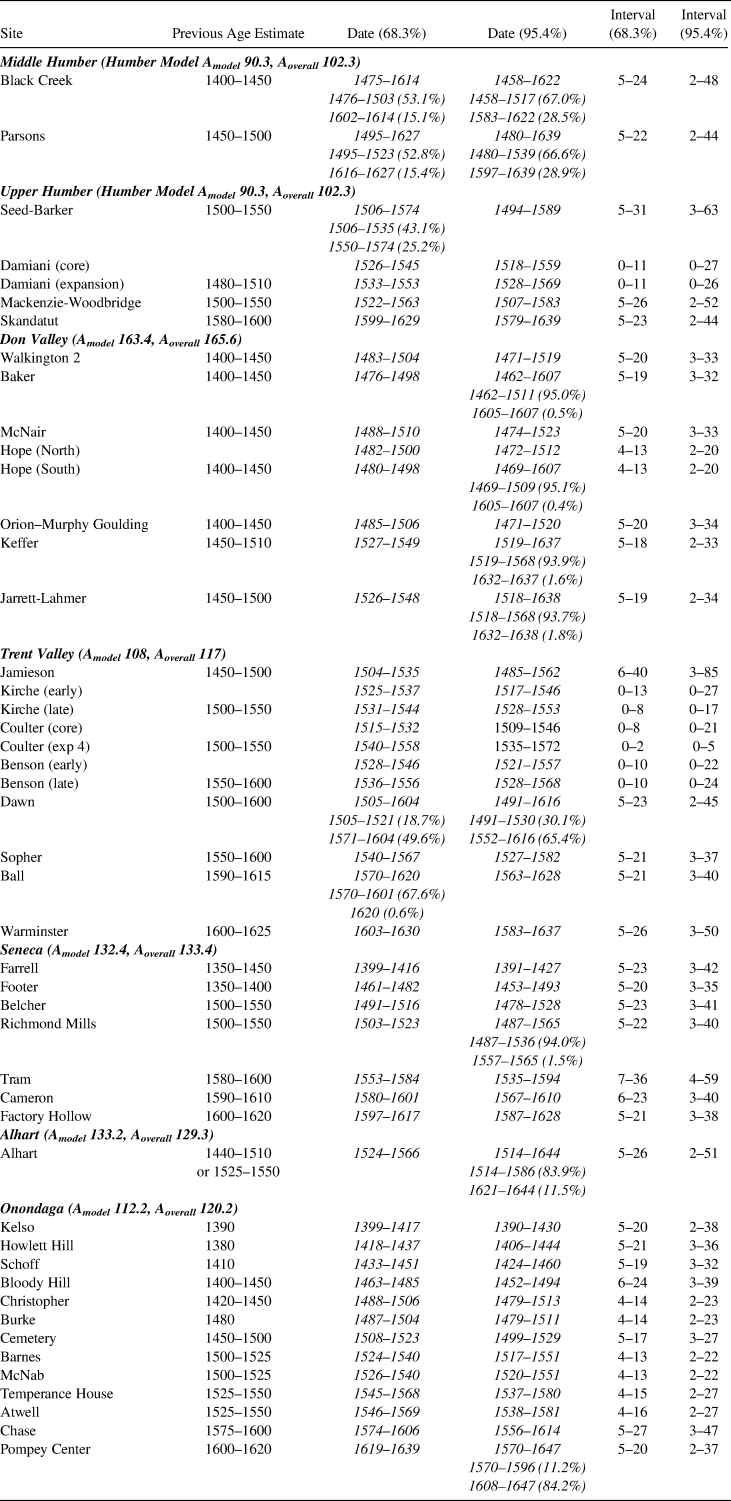
Note: See Supplemental Tables 3–8 for model specifications. Supplemental Table 9 includes an Order analysis for the Don Valley sequence. Supplemental Figures 8–12 and Supplemental Tables 10–12, 14–15 consider variations on the modeling parameters, including the effects of incorporation of prior archaeological knowledge. Supplemental Table 13 lists the start and end Boundaries for each site. Rounding errors mean that probabilities, when there are sub-ranges, sometimes add up to 0.1% more, or less, than the stated 68.3% and 95.4%.
Results
Humber Valley
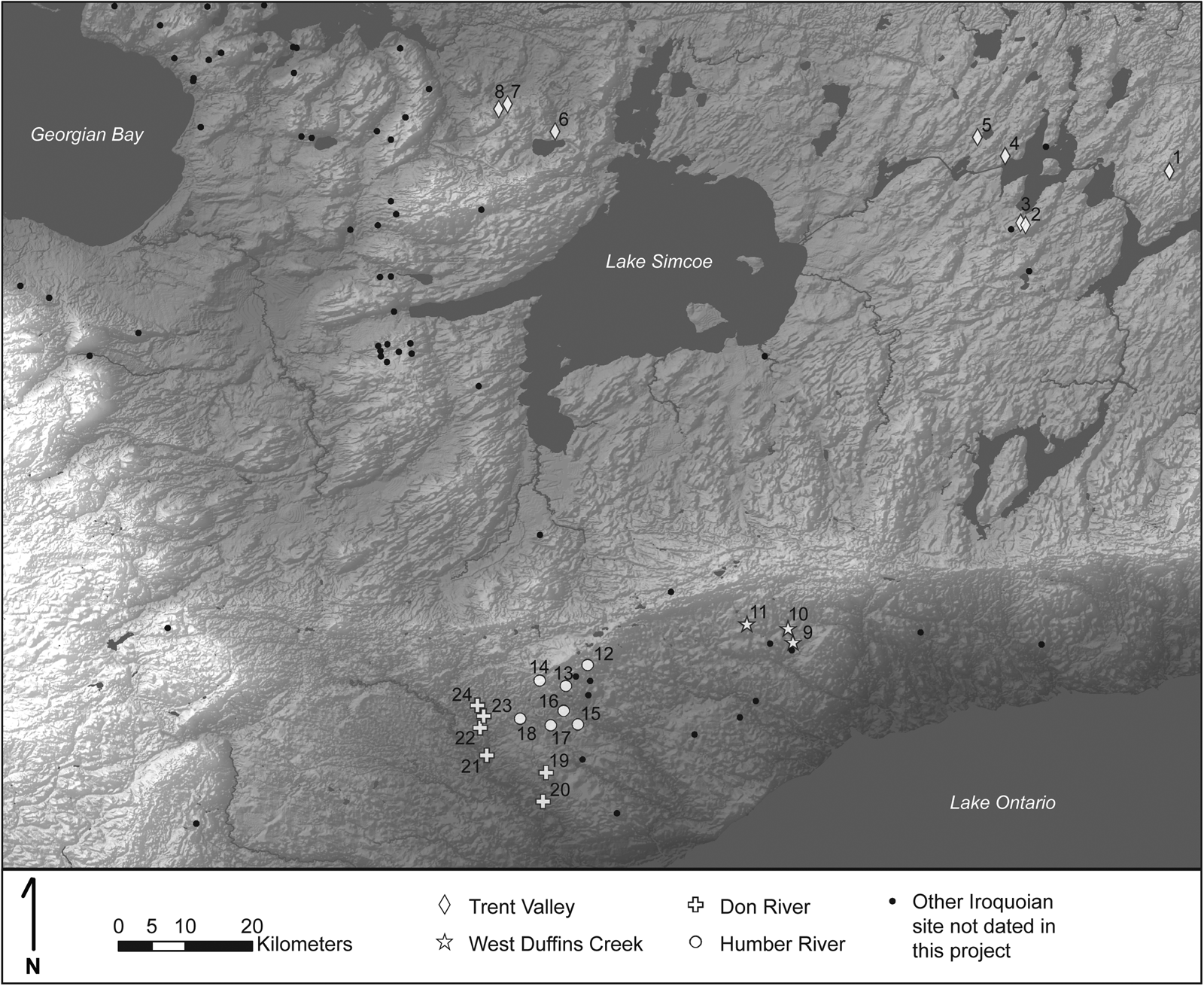
Differences in ceramic assemblages suggest that two distinct community groups occupied the Humber Valley in the Late Woodland period (Figure 4). In the Middle Humber Valley, at least two small villages, including the Black Creek site, coalesced at the Parsons site (Williamson and Robertson Reference Williamson and Robertson1995). There are three sites in the Upper Humber River valley previously thought to date to the late fifteenth to mid-sixteenth century: Damiani, Seed-Barker, and Mackenzie-Woodbridge. All are palisaded, and their sizes suggest that they were the product of settlement aggregation, although the temporal relationships between each is not clear, and this is reflected in the model parameters. Seed-Barker and Mackenzie-Woodbridge were both found to contain small amounts of European metal (Emerson Reference Emerson1954; Fox et al. Reference Fox, Hancock and Pavlish1995). Skandatut is another large palisaded village that has been assumed as the latest in the sequence on account of nine pieces of European metal identified from limited excavations in the village area (Williamson Reference Williamson2014:25). Skandatut is also associated with the Kleinberg Ossuary that was found to contain a sizable assemblage of European-derived grave goods—including early-style iron trade axes, an iron kettle, shell beads, native copper beads, and a large quantity of glass trade beads—leading to the site being assigned a relative date of 1580–1600 (ASI 2012).
Map of Wendat site sequences, with dated and undated sites indicated. Dated sites are numbered. Trent Valley: (1) Dawn, (2) Kirche, (3) Jamieson, (4) Coulter, (5) Benson, (6) Sopher, (7) Warminster, (8) Ball; West Duffins Creek: (9) Draper, (10) Spang, (11) Mantle; Don River Valley: (12) Orion-Murphy-Goulding, (13) McNair, (14) Hope, (15) Baker, (16) Walkington 2, (17) Keffer, (18) Jarrett-Lahmer; Humber River Valley: (19) Parsons, (20) Black Creek, (21) Mackenzie-Woodbridge, (22) Seed-Barker, (23) Skandatut, (24) Damiani. Basemap: United States Geological Survey 2017. Waterways and inset basemap: Natural Earth 2019.
Middle Humber
When modeled as a Sequence the data indicate that Black Creek dates to 1475–1503 (53.1% of the 68.3% hpd) and Parsons to 1495–1523 (52.8% of the 68.3% hpd). This places the precoalescent Black Creek site as being occupied in the later fifteenth to early sixteenth century, as opposed to the previous age estimate of 1400–1450, pushing the site well into what has been understood as the period of widespread community coalescence. Parsons then dates somewhat later than its previous age estimate of 1450–1500. Both sites are palisaded, and Parsons contained more than a thousand scattered skeletal elements (Williamson Reference Williamson, Chacon and Dye2007), suggesting involvement in the hostilities that characterized the later Woodland period.
Upper Humber
Modeled Date estimates for these sites indicate an early to mid-sixteenth-century occupation for Seed-Barker (1506–1535, 43.1% of the 68.3% hpd), Mackenzie-Woodbridge (1522–1563), and Damiani (1526–1553). The lack of European goods and presence of human remains in midden contexts at Damiani has led some to assume that it may have been in the earlier portion of the local sequence (ASI 2015), but that does not seem to have been the case. Skandatut now has an estimated Date of 1599–1629—somewhat later than has been previously assumed and coincident with documented direct European contact farther north and east (e.g., Biggar Reference Biggar1929–1936). Even when the 95.4% confidence interval is considered (1579–1639), the new date estimate for the Skandatut site creates a gap of some roughly 5–20 years between its occupation and the occupation of those sites believed to predate it in the local sequence (but see Supplemental Table 12 for modeled Boundaries for each site occupation, which serve to close this gap somewhat). Since it is unlikely that there are undiscovered sites located in the Upper Humber Valley, this may be an artifact of the small sample size available for most of these sites such that the dates do not represent the full occupational span of each (see Table 1; Supplemental Table 1). The small sample of material culture available for Skandatut, owing to its history of investigation, hampers further investigation of this disparity in date ranges. Nevertheless, these data, together with the understanding that sites in the West Duffins drainage were occupied longer than previously assumed, suggest that the north shore of Lake Ontario may have continued to be occupied later than 1610. This date has been referenced as marking the abandonment of the north shore region by Huron-Wendat, based on assumptions derived from ethnohistoric accounts (e.g., Trigger Reference Trigger1976:244).
Don River Valley
In the Don River Valley, there are at least 15 small village sites assumed to date to the fifteenth and sixteenth centuries (Birch and Williamson Reference Birch and Williamson2013), seven of which were dated for this study (Figure 4; Supplemental Table 2). It has been assumed that at least some of the smaller, unpalisaded sites came together to form the larger Keffer site. It seems likely that another palisaded site in the valley, Jarrett-Lahmer, may have been at least partly contemporary with Keffer. None of these sites was found to contain European materials. An Order query applied to the precoalescent grouping of six sites (with each of the Hope site components considered separately) shows the following likely order (oldest to most recent—but also with some likely substantial overlaps): Baker, Hope South, Hope North, Walkington, Orion–Murphy Goulding, McNair (Supplemental Table 9). This order fits within an overall precoalescent Phase estimated to last about 30–57 years (68.3% hpd) or 21–76 years (95.4% hpd). It is likely several sites overlapped to some extent (especially Hope South and Hope North and Walkington and Orion-Murphy Goulding). An Order query applied to the two coalescent sites, Keffer and Jarrett-Lahmer, does not indicate a clear order (p = 0.52 Jarrett-Lahmer older), and the sites may well be approximately contemporary.
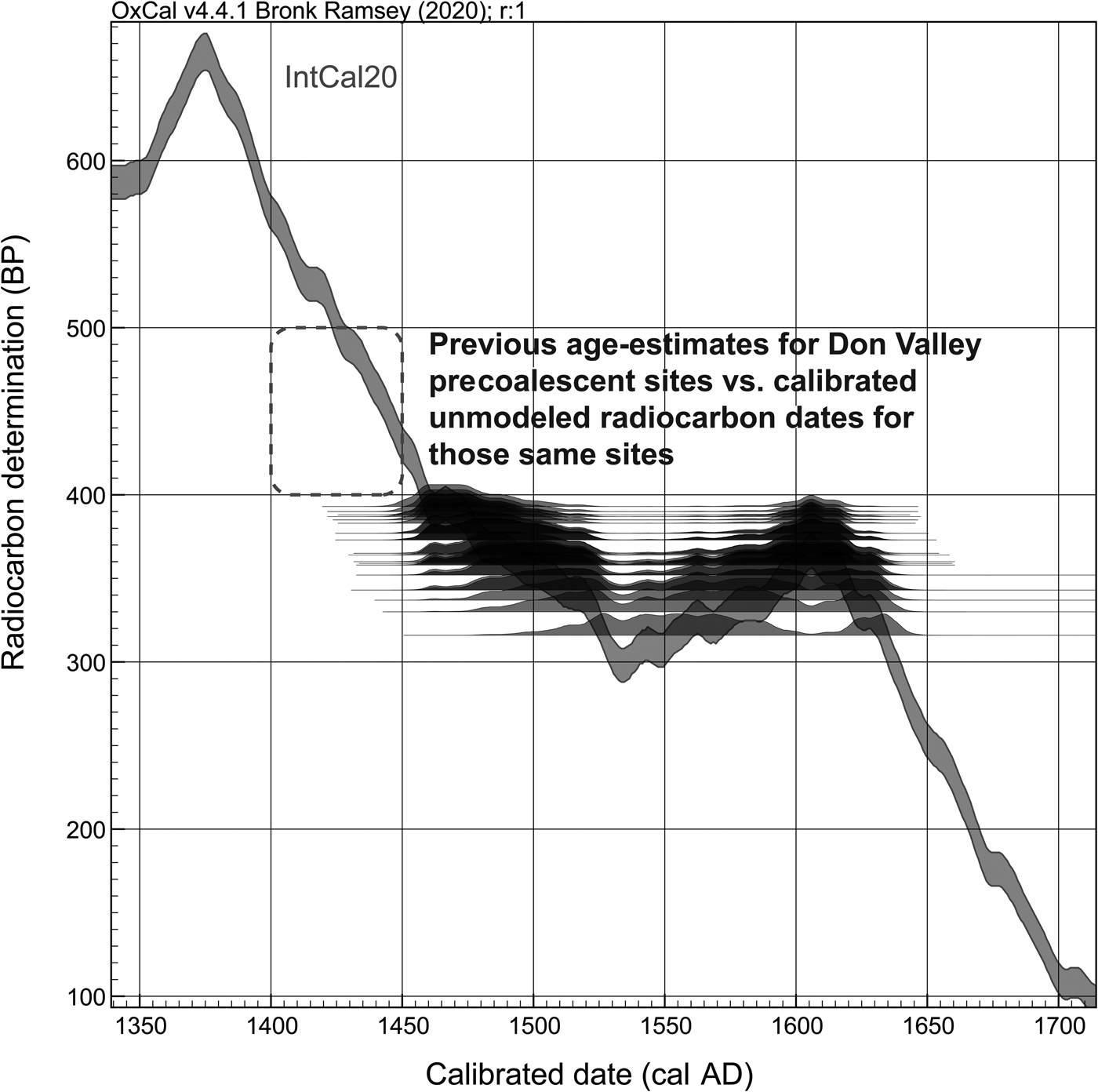
Previous assumptions held that none of the unpalisaded sites in the Don Valley postdated 1450. Our results, however, indicate that none of these sites predates 1450 (Table 2). Even when all dates from these sites are calibrated with no additional constraints, the earliest dates calibrate to a start date of not before 1445 (95.4%; Figure 5). When modeled, the earliest Date estimates for precoalescent site occupations start at 1476–1498 and end at 1488–1510, some 75–100 years later than previously assumed. The effect of these data alone requires the rejection of the inference that conflict on the north shore of Lake Ontario was widespread around 1450, as has previously been assumed (Birch Reference Birch2012; Birch and Williamson Reference Birch and Williamson2013).
Calibrated, unmodeled radiocarbon dates for Don Valley precoalescent sites, 95.4% hpd range indicated. All were previously thought to date to AD 1400–1450 and now can be shown to postdate that period.
The Keffer and Jarrett-Lahmer sites both produced almost identical Date estimates of 1527–1549 and 1526–1548. When modeled as Phases in isolation with no other constraints, Keffer dates to a very similar range of 1527–1560 as does Jarrett-Lahmer (1524–1560, 63.3% of the 68.3% hpd). Before now, it has been unclear where Jarrett-Lahmer should be placed in the local sequence: before, after, or concurrent with Keffer (Birch and Williamson Reference Birch and Williamson2013). Our data suggest that Jarrett-Lahmer may have been occupied concurrently with Keffer, but they do not rule out a sequential relationship between the two sites, although the smaller size of Jarrett-Lahmer makes it unlikely that it could accommodate the same population.
Trent Valley
The local sequence in the Upper Trent Valley has been the subject of extensive study by Peter Ramsden and colleagues, resulting in the documentation of multiple village sites thought to span the late fifteenth through late sixteenth centuries (e.g., Damkjar Reference Damkjar2009; Nasmith Reference Nasmith2008; Ramsden Reference Ramsden, Keenlyside and Pilon2009, Reference Ramsden2016; Figure 4). This local sequence is understood to represent the genesis of the Wendat Arendarhonon Nation (Trigger Reference Trigger1976) and to have potentially involved the incorporation of eastern Iroquoian and Anishinaabeg peoples (Ramsden Reference Ramsden, Keenlyside and Pilon2009, Reference Ramsden2016). A historical and radiocarbon intersection for this sequence exists with Samuel de Champlain's likely 1615–1616 stay at the Warminster site (Manning et al. Reference Manning, Birch, Conger, Dee, Griggs, Hadden, Hogg, Ramsey, Sanft, Steier and Wild2018, Reference Manning, Birch, Conger, Dee, Griggs and Hadden2019). This model incorporates dates from the Jamieson, Kirche, Coulter, Benson, Dawn, Sopher, and Ball sites. Short-lived botanical samples and a series of rings on a preserved tamarack (Larix laricina) post from the Warminster site (as per Manning et al. Reference Manning, Birch, Conger, Dee, Griggs, Hadden, Hogg, Ramsey, Sanft, Steier and Wild2018, Reference Manning, Birch, Conger, Dee, Griggs and Hadden2019) serve as a TAQ for the sequence.
Current archaeological understandings of the Trent Valley sequence, based on multiple lines of material evidence—including ceramic seriation, the appearance of material culture indicative of populations originating in the St. Lawrence Valley to the east, and the presence or absence of European metals—were used to inform the parameters of the model (as per Ramsden Reference Ramsden, Keenlyside and Pilon2009, Reference Ramsden2016). Jamieson has been thought to be the earliest-known Iroquoian village site in the present study and is thought to date to the mid to late fourteenth century. Kirche is thought to have been at least partly contemporary with Jamieson. At some point during Kirche's occupation, an additional cluster of longhouses was added outside the palisaded village core. Ramsden (Reference Ramsden2016) suggested that the Coulter village core might have been established at the same time that Kirche was occupied. Coulter then went on to expand five times. Benson was thought to be among the latest sites in the sequence. St. Lawrence–associated pottery and fragments of European metal (but no glass beads) have been recovered from the Kirche site expansion, Coulter, and Benson. Dawn is the least-known site in the upper Trent Valley, but it has one of the highest percentages of eastern pottery types, suggesting a later date in the sequence. Where sites included expansions or early and later phases of occupation, that information was also used in the model construction (e.g., Damkjar Reference Damkjar2009; Ramsden Reference Ramsden, Keenlyside and Pilon2009).
Modeled Date estimates for the Trent Valley suggest a significant degree of overlap between site occupations. The modeled age estimate for the Jamieson site is 1504–1535, coincident with evidence for the onset of conflict on the north shore of Lake Ontario to the west. The early phase of occupation at Kirche is estimated to date to 1525–1537, with the later addition of houses outside the palisade occurring between 1531 and 1544. The establishment of the Coulter village core is estimated between 1515 and 1532, with the final phase of village expansion occurring between 1540 and 1558. The Benson village early phase is estimated to have been occupied from 1528 to 1546, with a portion of the houses then abandoned and the remainder continuing to be occupied until approximately 1536–1556. Dawn most likely dates to 1571–1604 (49.6% of the 68.3% hpd). Sopher is estimated to date to 1540–1567, Ball 1570–1601 (67.6% of 68.3% hpd), and Warminster 1603–1630 (see alternative model results in Supplemental Table 9). These Date estimates are very similar to those reported in Manning and others (Reference Manning, Birch, Conger, Dee, Griggs and Hadden2019; see Supplemental Table 14).
Although the dates for the Trent Valley model do not diverge significantly from what was previously thought about this sequence and indeed incorporate some of those assumptions, the modeled Date estimates suggest that the sites of Kirche, Coulter, Benson, and Sopher may have all been at least partly contemporaneous in the mid-sixteenth century. This suggests that the area was home to a substantial local population and that it corresponds with ethnohistoric accounts of the Arendarhonon being a populous nation (Trigger Reference Trigger1976). It also concurs with understandings about an influx of population from both the east and west in the early to mid-sixteenth century (Ramsden Reference Ramsden2016). Although it is possible that Dawn was occupied until the turn of the seventeenth century, the majority of the Trent Valley population may have left the valley before approximately 1560. Ethnohistoric references indicate that the Arendarhonon joined the Wendat Confederacy in about 1590 (Thwaites Reference Thwaites1896–1901:16:227–229), postdating Sopher's entire occupation and the establishment of Ball village. These data suggest that more complex or prolonged processes of population movement and alliance building may have taken place in eastern Wendake than has previously been assumed.
Seneca
In New York State, researchers have been somewhat more cautious about assigning dates to sites prior to the arrival of European diagnostic trade goods. This caution derives from limited site-level settlement pattern data and the relatively small sizes of material assemblages, although generalized sequences have been constructed for each subregion (Figure 6; Bradley Reference Bradley2005; Engelbrecht Reference Engelbrecht2003; Sempowski and Saunders Reference Sempowski and Saunders2001; Tuck Reference Tuck1971; Wray and Schoff Reference Wray and Schoff1953).
Map of Haudenosaunee site sequences, with dated and undated sites indicated. Dated sites are numbered. Onondaga: (1) McNab, (2) Atwell, (3) Chase, (4) Temperance House, (5) Barnes, (6) Pompey Center, (7) Cemetery, (8) Christopher, (9) Burke, (10) Bloody Hill, (11) Howlett Hill, (12) Schoff, (13) Kelso; Seneca: (14) Footer, (15) Belcher, (16) Factory Hollow, (17) Richmond Mills, (18) Tram, (19) Cameron, (20) Farrell, (21) Alhart. Basemap: United States Geological Survey 2017. Waterways and inset basemap: Natural Earth 2019.
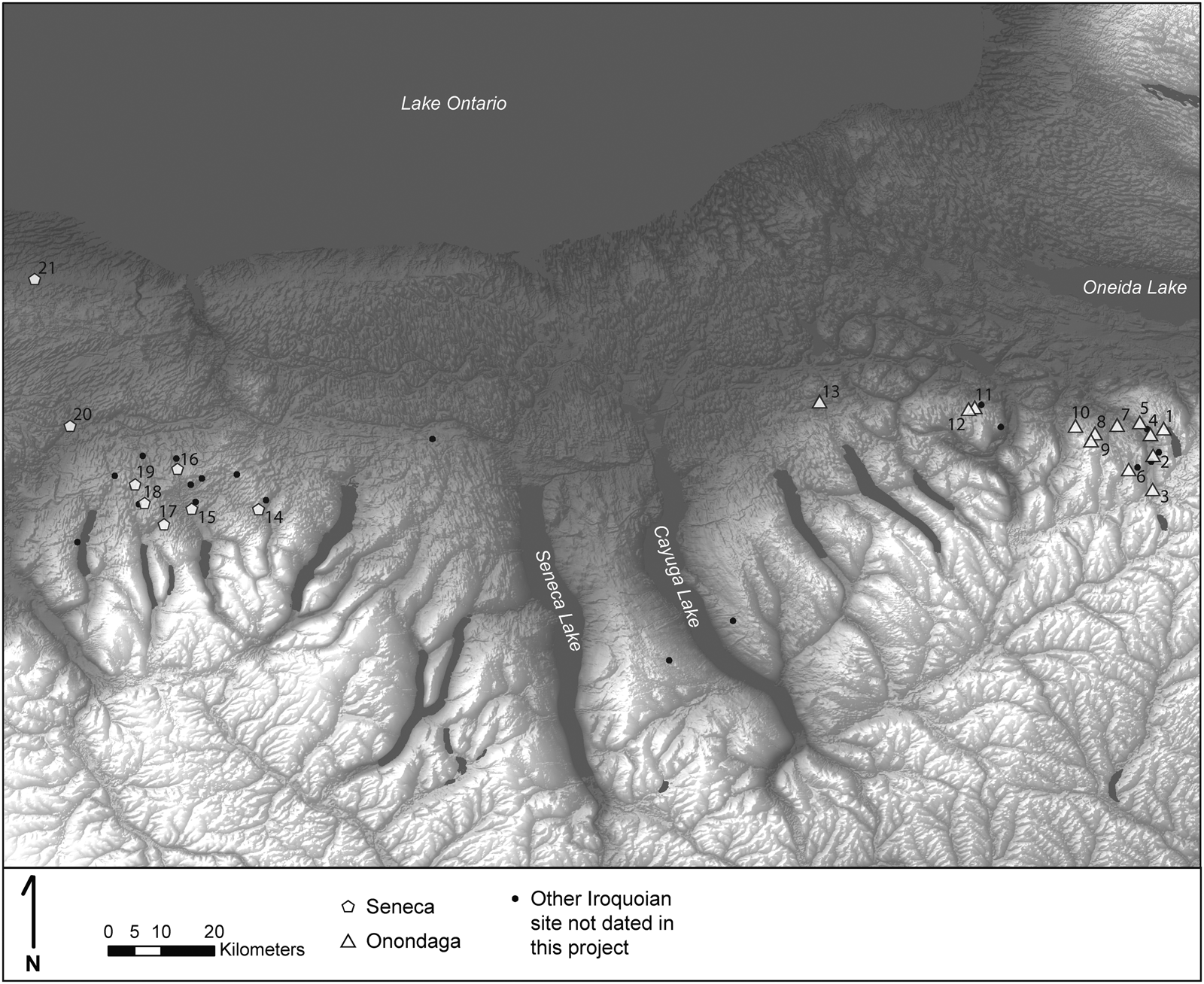
The early portion of the Seneca model was constructed as a Sequence of noncontiguous site occupations. Farrell and Footer are small village sites that were dated to provide a terminus post quem for the later portion of the sequence, which includes the Belcher, Richmond Mills, Tram, Cameron, and Factory Hollow sites. The latter three have been hypothesized as representing sequential iterations of the same village occupied by the Eastern Seneca (Sempowski and Saunders Reference Sempowski and Saunders2001; Wray et al. Reference Wray, Sempowski and Saunders1991). The non-Seneca Alhart site, located immediately north of Seneca traditional territory, bears on the timing of regional conflict.
Earlier Seneca Sequence
Farrell and Footer have been loosely estimated to date to approximately 1300–1350 and 1350–1450, respectively (Engelbrecht Reference Engelbrecht2001 [1981]; Niemczycki Reference Niemczycki1984). The new Date estimates suggest that each, in fact, dates somewhat later and noncontiguously, with Farrell estimated to have been occupied from 1399 to 1416 and Footer from 1461 to 1482. This shifts the occupation of each site 50–100 years later than previous interpretations, and it may have implications for understandings of early settled village life in this subregion.
Belcher and Richmond Mills are among the first larger village sites in the Seneca region, and they have been postulated as being the start of the eastern and western Seneca sequences (Niemczycki Reference Niemczycki1984; Wray et al. Reference Wray, Sempowski, Saunders and Cervone1987). Although little is known about Belcher, one decapitated skull was reported as being uncovered in the burial area. Richmond Mills was reported as containing charred human remains (Parker Reference Parker1918:8) and small amounts of European metal. Our model, with no assumed order between the two, places Belcher at 1491–1516, slightly earlier than Richmond Mills’s Date estimate of 1503–1523. This is more or less in keeping with the early sixteenth-century dates assumed for both sites.
Alhart
The non-Seneca Alhart site is located some 50 km north of Seneca territory. The burning of the village and 15 male skulls found in a pit have been interpreted as evidence of violent conflict (Hamell Reference Hamell1977; Niemczycki Reference Niemczycki1984; Wray et al. Reference Wray, Sempowski, Saunders and Cervone1987). Biodistance markers suggest that Alhart females may have been incorporated into the Seneca Adams site population (Wray et al. Reference Wray, Sempowski, Saunders and Cervone1987:248). The community may have been related to populations from further west that were subsequently driven out, destroyed, or absorbed by the Seneca (Engelbrecht Reference Engelbrecht2003:115; Hamell Reference Hamell1977). Dates on short-lived botanicals from this site modeled in isolation from the rest of the sequence suggest a Date range of 1524–1566.
Later Seneca Sequence
Samples for the Tram, Cameron, and Factory Hollow sites were obtained for the later eastern Seneca sequence. We lack data for the Adams and Culbertson sites that presumably link the earlier and later parts of the eastern and western sequences. One of the challenges we faced in sampling was the avoidance of material from burial contexts, which comprises a large portion of curated Seneca assemblages. Although no dates are available from these sites, it should be noted that at Adams, a large, roughly rectangular palisade enclosing 4 ha was mapped by Squier in 1848 and archaeologically identified, together with male skeletons excavated from the cemeteries that show evidence of combat trauma in the form of “parry fractures” (Wray et al. Reference Wray, Sempowski, Saunders and Cervone1987:13, 31–21). Both Adams and Culbertson are located on hilltops, suggesting a concern for defensive siting.
A postulated sequence of relocations was constructed as Tram to Cameron to Factory Hollow, with some question about Cameron's place in either the eastern or western sequences, or possible partial contemporaneity with Factory Hollow (Sempowski and Saunders Reference Sempowski and Saunders2001; Wray et al. Reference Wray, Sempowski and Saunders1991). Our results are more or less in keeping with the most recent “revised” sequence presented by Sempowski and Saunders (Reference Sempowski and Saunders2001): Tram, 1553–1584; Cameron, 1580–1601; and Factory Hollow, 1597–1617. Evidence for conflict continues to be apparent in these later sites: Tram was a reportedly fortified village that also included an earthwork (Wray et al. Reference Wray, Sempowski and Saunders1991), and Cameron is not only heavily palisaded but also has a mortuary population that includes evidence of violent death (Engelbrecht Reference Engelbrecht2003; Wray et al. Reference Wray, Sempowski and Saunders1991). No palisade has been identified at Factory Hollow, although it is located on a steep promontory.
Onondaga
The Onondaga settlement pattern is characterized by pairs of large and small villages, and these were used to construct a sequence of paired sites that the model assumed to be roughly contiguous (Figure 6; Bradley Reference Bradley2005; Tuck Reference Tuck1971). Few of these have been subject to extensive or professional investigation. A robust independent testing program is hampered by the small collections and lack of documentation for many sites in the Onondaga sequence. For example, only one sample per site was available for dating from the Howlett Hill, Schoff, Christopher, and Barnes sites (Table 1). These small sample sizes also have the result of over-constraining Interval estimates for the occupation of each site (Table 2).
The earliest Onondaga sites we dated are Kelso, Howlett Hill, and Schoff. These were modeled with the inferred relocation of Howlett Hill to Schoff as per Tuck's understanding of the sequence. The model placed Kelso at 1399–1417, Howlett Hill at 1418–1437, and Schoff at 1433–1451. Whereas Kelso is dated only slightly later than Tuck's estimate, Howlett Hill and Schoff are placed some 20–40 years later.
Next, Bloody Hill produced a Date estimate of 1463–1485, some 40 years later than previously assumed. A roasting pit at the Bloody Hill site was found to contain numerous fragments of human bone interpreted by Tuck (Reference Tuck1971:113–114) as evidence for cannibalism.
The Burke site, which follows Bloody Hill, is defensively located and heavily palisaded. Our models place the Burke and Christopher sites in a Phase spanning 1487–1504. These sites are followed in the sequence by the Cemetery site at 1508–1523. The Cemetery village occupies a location on a triangular peninsula that drops off very sharply to the east and west and appears to have been selected for its defensibility (Tuck Reference Tuck1971:141).
The McNab site is one of the largest in the Onondaga sequence, and the assumption is that it represents a coalescent village. In our model, the McNab site is placed in a phase with Barnes. The Barnes site assemblage includes one piece of European copper as identified by Sanft using pXRF, charred human remains in middens, and a defensive location and partial palisade (Bradley Reference Bradley2005:35–37). Modeled as a Phase, both fall into a narrow date range at 1526–1540 and 1524–1540, respectively.
Temperance House and Atwell, considered the first “protohistoric” sites in the sequence, are estimated to date to 1545–1568 and 1546–1569 respectively, followed by the Chase site with a modeled age estimate of 1574–1606. All are more or less in line with the chronology presented by Bradley and Tuck. Each of these sites were found to contain very small quantities of European goods. The Onondaga sequence ends with the Pompey Center site, which most likely dates to 1619–1639. An Interval between Chase and Pompey allows for sites in the local sequence, for which material could not be acquired, likely of 0–21 (68.3%) or 0–42 (95.4%) years.
The most significant insights to emerge from the Onondaga sequence are the slightly later dates for the Howlett Hill and Schoff sites early in the sequence, and for Pompey Center at the very end. Incomplete understanding of site-level settlement patterns, small artifact assemblages, and lack of available samples with secure provenience for radiocarbon dating for most sites obscures deeper insight into this local sequence. We note, however, that evidence for conflict first appears here at the Bloody Hill site as early as 1460, some 75–100 years earlier than evidence for conflict on the north shore of Lake Ontario.
Discussion: A New History for Iroquoia
These new date estimates for key sites and sequences represent a substantial replotting of the historical development of these two Northern Iroquoian societies (Figure 7). We note and accept that the chronologies we have developed and presented are not independent of prior inferences due to the limitations of available data. We have used previous archaeological assessments of site sequences and order in several cases, and we have tentatively accepted these when the radiocarbon data successfully model consistent with these hypotheses. For example, in multiple site sequences, gaps between sites presumed to be sequential are present. These gaps may be real or an artifact of those samples selected or available for dating, and more dates representing the true occupational spans of sites are required in order to evaluate that question. This does not, of course, prove that these assumptions are correct, but it suggests that they are not substantially incorrect. However, placing these new radiocarbon data within models based on current best knowledge of the archaeology of the region, we find that we are nevertheless forced to rethink the basic time frames in which these sequences are placed, as well as the associated explanatory frameworks for processes of sociocultural development. The existing status quo cannot stand. Moving forward, we can then target the need for more independent chronological analysis and reform (since changing the prior assumptions will only make even more of a case for doing this). In the future, with many more 14C dates and additional independent modeling—for example, as per techniques discussed elsewhere (Manning et al. Reference Manning, Birch, Conger and Sanft2020)—we can test even the general previous settlement sequence assumptions and further clarify the relevant time frames and site placements. Our findings indicate that this should be a research priority for the field.
Previously accepted age estimates for Iroquoian village sites dated in this study compared to new, revised chronological associations for those same sites. Previous chronology modeled after Birch and Williamson (Reference Birch and Williamson2013), Bradley (Reference Bradley2005), Engelbrecht (Reference Engelbrecht2003), Hamell (Reference Hamell1977), Niemczycki (Reference Niemczycki1984), Sempowski and Saunders (Reference Sempowski and Saunders2001), Ramsden (Reference Ramsden2016), and Tuck (Reference Tuck1971).

Implications for Coalescence and Conflict
Arguably, the most significant shift in our understanding of the archaeological history of Iroquoia is the change in the timing of coalescence and conflict. Previously, the approximately 1450–1500 period in Ontario and the early to mid-1500s period in New York were understood to have represented the onset of settlement aggregation and endemic violence. Now, the earliest sites with clear signs of violent conflict (defensive siting, human remains bearing traumas) come from Onondaga (Bloody Hill) and Seneca (Belcher, Richmond Mills) territory sites and the Humber Valley (Black Creek) at the west end of Lake Ontario in the later 1400s to early 1500s. Small, unpalisaded sites to the northeast in the Don River sequence previously thought to date to roughly 1400–1450 are now understood as dating to as much as a century later—this same later 1400s to early 1500s interval. Conflict does not come to the Don Valley until approximately 1525, perhaps after the Middle Humber is abandoned. Date ranges for heavily palisaded sites in the Upper Humber similarly cluster around the early to mid-1500s. Previous work on the West Duffins Creek sequence (Manning et al. Reference Manning, Birch, Conger, Dee, Griggs, Hadden, Hogg, Ramsey, Sanft, Steier and Wild2018) determined that the aggregated Draper community likewise formed in the mid-1500s—not around 1450, as previously assumed. Together, the new data suggest that heightened conflict occurred first in western New York and around the west end of Lake Ontario in the late 1400s, and it then spread east by approximately 1525. The palisading of sites in the Trent Valley occurred around and after the first decade of the 1500s. Another potentially earlier Trent Valley site with evidence for conflict, Quackenbush, could not be dated for this study. We acknowledge the need to consider how similar processes were playing out around the east end of Lake Ontario. Additional research has begun to provide new insights into how the defensive positions and eventual dispersal of St. Lawrence Iroquoian populations by around 1550 factor into the regional scene (Abel Reference Abel2019; Abel et al. Reference Abel, Vavrasek and Hart2019).
All of the available data from the west end and north shore of Lake Ontario, however, are pointing to conflict within ancestral Haudenosaunee territory and between ancestral Haudenosaunee and ancestral Wendat communities—not internal conflict between ancestral Wendat communities, as has previously been understood. Although internal conflict between some Wendat communities is possible, the radiocarbon and settlement data strongly suggest that shifts in Wendat settlement patterns north along major drainages and the eventual consolidation of population in the Simcoe Uplands (historic Wendake) occurred with the intent of creating a buffer zone between the Wendat and the Haudenosaunee. The escalation of both internal and external conflict on the part of the Haudenosaunee coincides with the formation of village clusters associated with the formative Seneca and Onondaga nations.
In short, based on the data presented here, coalescence and conflict can now be understood as beginning in the Finger Lakes region and around the west end of Lake Ontario between populations ancestral to the Haudenosaunee and Wendat confederacies in the late 1400s and early 1500s. By the second decade of the 1500s, communities around the west end of Lake Ontario were abandoned, creating a buffer zone between these emergent political entities. Conflict then spread to the rest of the region, such that by around 1525, all communities in both Ontario and New York had assumed a defensive posture in the context of heightened regional hostilities. The “traditional” hostilities between the Haudenosaunee and Wendat did not begin shortly before direct engagement with Europeans, as previously assumed (Trigger Reference Trigger1976). Instead, they had their roots as early as the late 1400s, with widespread intersocietal conflict characterizing the region from about 1525 onward.
New understandings about the timing and directionality of conflict suggest that hostilities with the Haudenosaunee influenced the relocation of ancestral Wendat settlement northward in the sixteenth century and, ultimately, the formation of the Wendat Confederacy. The variability in the timelines between community sequences highlights that these relocations were not a discrete event but rather a protracted process that played out over more than two centuries. We acknowledge that a complex mix of internal and external factors were at work during processes of Wendat and Haudenosaunee politogenesis, and as such, no single “cause” led to the development of the allied Nations that came to identify themselves as confederacies. This revised timeline, however, provides a step toward an enhanced understanding of the different positionalities and dispositions of individual communities vis-à-vis coalescence, conflict, and initial processes of confederacy formation.
Implications for Entry of European Goods
Modeled dates both confirm and complicate current understandings of the timing and nature of Indigenous use of European goods. The first European-manufactured materials incorporated into Indigenous societies were fragments of copper and brass from kettles, along with iron from axes and nails, as early as the first half of the 1500s (at the sites of Richmond Mills, Barnes, Seed-Barker, Mackenzie-Woodbridge, Coulter, Kirche, and Benson). These items are found in small numbers, and they are often worked into Indigenous cultural forms, illustrating how individuals indigenized European objects by repurposing them to fit their own desires and needs (e.g., Bradley and Childs Reference Bradley, Childs and Ehrenreich1991). Toward the end of the 1500s, assemblages on sites began to include European glass beads as well as European metals, first in small quantities (as seen at Tram and Chase), with numbers of both glass beads and metal objects increasing exponentially after approximately 1600 (as seen at Factory Hollow, Pompey Center, Skandatut, Warminster, and Ball).
It has also become clear that there was considerable variability among communities in terms of the initial appearance and use of European materials and, by proxy, engagement with European settlers. Although much of the trade goods data fit previously understood patterns, it is perhaps more interesting to discuss the sites that do not. The Jean-Baptiste Lainé (Mantle) site in the West Duffins Creek sequence was occupied at the turn of the seventeenth century, and it contained only three pieces of European metal (Birch and Williamson Reference Birch and Williamson2013; Manning et al. Reference Manning, Birch, Conger, Dee, Griggs, Hadden, Hogg, Ramsey, Sanft, Steier and Wild2018), in contrast to sites now known to be contemporaneous—such as at Factory Hollow, Pompey Center, Skandatut, Warminster, and Ball—from which hundreds of metal and glass objects have been recovered. Mid-sixteenth-century sites in the Don Valley (Jarret-Lahmer and Keffer) have no trade goods at all, contrasting with contemporaneous sites such as Mackenzie-Woodbridge and Seed-Barker, which are located only 10 km to the west. These latter sites were occupied at the same time as the neighboring Damiani site, which was fully excavated and yet produced no European-manufactured objects.
The variable distribution of European trade goods in space and time highlights the flawed nature of artifact frequency seriation. For the majority of the 1500s, European goods were not evenly distributed across the region and therefore can no longer be used as “horizon” markers. Results suggest that there was not synchronous access to and/or adoption of European goods throughout the 1500s Northeast. This erases the idea that Indigenous peoples were passively accepting European goods, and it foregrounds Indigenous agency in trade-related decision-making processes. Although this complicates regional histories, it also arguably creates the space to ask questions that are more interesting. Perhaps the occupants of sites such as Jean-Baptiste Lainé, Jarrett-Lahmer, Keffer, and Damiani were intentionally choosing not to participate in the long-distance exchange networks operating at this time. Alternatively, perhaps they were being excluded from these networks for political or cultural reasons by virtue of who controlled those connections (as per Chapdelaine Reference Chapdelaine, Loewen and Chapdelaine2016). From the data presented, we can no longer safely assume that the timing of the introduction of European materials—and by proxy, the entry of Indigenous peoples into European politico-economic networks—was homogenous. We suggest that other factors relating to geography, political alignment, and/or Indigenous agency influenced the timing and tempo of those processes.
Conclusions
Past formulations of Iroquoian culture-history were based on imprecise—and in some cases, inaccurate—time frames that resulted in interpretations of processes of coalescence, conflict, and the introduction of European goods that flattened out variability in how these processes were actually enacted “on the ground.” This is especially true in the context of traditional versus new understandings of early trade-good chronologies among ancestral Wendat peoples and assumptions about the timing and directionality of conflict. The effect of relying on such imprecise formulations is that history becomes presented as something that happens to people, as opposed to something that people actively produce as agents in their time.
Enhanced chronological resolution permits us to understand the past in a way that privileges relational histories (sensu Robb and Pauketat Reference Robb, Pauketat, Robb and Pauketat2013). It forces us to acknowledge persons and communities as active decision makers, bound up in social and political networks, with specific social, geographic, and ecological contexts influencing their actions and reactions. These data make it clear that to say “the Wendat or Haudenosaunee did X or Y” is erroneous. There were more complicated processes playing out within local communities that were not a microcosm of some greater cultural phase, but rather speak to distinct actions and responses to local contingencies and dispositions. More work remains to flesh out how this revised chronology will allow us to reposition communities in the social contexts that led to the development of tribal nations and confederacies in northeastern North America.
In redating the sites and sequences presented here, it was not our intent to simply reframe the culture-historical building blocks of northeastern archaeology—instead, we have sought to eliminate them. In this way, radiocarbon-based site-sequence chronologies allow us to appreciate the texture of local and regional histories. Rather than presenting a definitive revision, however, this work should be understood as a first step and call for further action (sensu Whittle Reference Whittle2018:248). It is our hope that the methods and results presented here will be met with additional efforts toward chronology building in eastern North America.
Supplemental Material
For supplemental material accompanying this article, visit https://doi.org/10.1017/aaq.2020.73.
Supplemental Figure 1. A. The OxCal LnN(ln(20),ln(2)) prior probability distribution for site Phase duration. B. The Middle Humber model run without Interval constraints on the site Phase durations showing the (much longer) Interval estimates that result. C. The Interval estimates for the Middle Humber sites with the model using the LnN(ln(20),ln(2)) prior for each site Phase duration-compared to those from B.
Supplemental Figure 2. A. Humber River Sequence plot and B. Date estimates with previous age-estimate indicated.
Supplemental Figure 3. A. Don Valley Sequence plot and B. Date estimates with previous age-estimate indicated by red line.
Supplemental Figure 4. A. Trent Valley Sequence plot and B. Date estimates with previous age-estimate indicated by red line.
Supplemental Fig 5. A. Seneca Sequence plot and B. Date estimates with previous age-estimate indicated by red line.
Supplemental Fig 6. A. Alhart site Phase plot and B. Date estimate.
Supplemental Figure 7. A. Onondaga Sequence plot and B. Date estimates with previous age-estimate indicated by dashed red line.
Supplemental Figure 8. Hope site modelled in isolation. A. with no site Phase duration constraint. B with the site Phase duration constraints in the Supplemental Table 4 model.
Supplemental Figure 9. Intervals calculated from the models in Supplemental Figure 8. A. The Hope site modelled in isolation with no site Phase duration constraints. B. The Hope site modelled in isolation but including the site Phase constraints in Supplemental Table 4. C. The results of the Difference query applied to the period between the start and end Boundaries for the overall Hope site with a N(20,10) prior.
Supplemental Figure 10. Re-run of the Seneca model (Supplemental Table 6) without the assumed site relationships used there-i.e. all sites treated as independent.
Supplemental Figure 11. The effect of incorporating prior expert knowledge for the Seneca model. A. Site Date estimates for the Seneca model from Supplemental Figure 10 with no prior expert knowledge. B. Site Date estimates for the Seneca model if we do incorporate prior expert knowledge about site relationships.
Supplemental Figure 12. Comparison of the 34 instances where the identical sample was split between the University of Georgia (UGAMS) and the Groningen (GrM) radiocarbon laboratories.
Supplemental Table 1. All 184 Radiocarbon Samples and Conventional Radiocarbon Ages (CRA) used in this study.
Supplemental Table 2. Descriptive information for all sites dated in this study.
Supplemental Table 3. OxCal runfiles for Middle and then Upper Humber Valley sequences.
Supplemental Table 4. OxCal runfile for Don Valley sequence.
Supplemental Table 5. OxCal runfile for Trent Valley sequence.
Supplemental Table 6. OxCal runfile for Seneca sequence.
Supplemental Table 7. OxCal runfile for the Alhart site.
Supplemental Table 8. OxCal runfile for the Onondaga sequence.
Supplemental Table 9. Order analysis from the Don Valley model for the precoalescent site Phase.
Supplemental Table 10. Comparison of the dating ranges for the Sopher, Ball and Warminster sites from the Trent model depending on whether or not an approximate contiguous order of Ball then Warminster is used.
Supplemental Table 11. Comparison of Date estimate results for the Humber model using no prior, versus several different priors.
Supplemental Table 12. Comparison of date ranges for the Hope site considering three different prior assumptions for the overall duration of the site versus no prior assumptions for any of the site Phase durations in the Don Valley model.
Supplemental Table 13. The start and end Boundaries calculated for each of the sites from the modelled site sequences.
Supplemental Table 14. Comparison of the Date estimates for the Benson, Sopher, Ball and Warminster sites from the models in this paper versus those from the Manning et al. (2019) paper re-run with IntCal20.
Supplemental Table 15. The results from the model for the Onondaga Sequence in Table 2 and Supplemental Tables 13 run, as in Supplemental Table, and applying the OxCal outlier models, compared to running the same model with the 4 outliers included but with the outlier models applied.
Supplemental Table 16. The results from the model for the Onondaga Sequence in Table 2 and Supplemental Tables 13 and 15 run, as in Supplemental Table 8, applying the OxCal outlier models, are compared to running an example of the same model minus the same four outliers but with no outlier models then applied.
Acknowledgments
We thank Jim Bradley and Greg Sohrweide for assistance with acquiring Onondaga samples; George Hamell for assistance with acquiring Seneca-region samples; Peter Ramsden for providing samples from the Trent Valley; Ron Williamson and the staff of Archaeological Services Inc. for providing access to samples from southern Ontario; Neil Ferris for access to samples at Sustainable Archaeology: Western and the Museum of Ontario Archaeology; Chris Watts for access to samples at the University of Waterloo; Scott Martin for access to samples held at Sustainable Archaeology McMaster; Trevor Orchard for access to samples held at University of Toronto Mississauga; Kathryn David and Ted Banning for samples at University of Toronto; Douglas Armstrong for access to samples curated at Syracuse University; John Hart, Jonathan Lothrop, Andrea Lain, Ralph Rataul, and Susan Winchell-Sweeney for access to samples and data from the New York State Museum; Kathryn Murano Santos for access to Rochester Museum & Science Center samples; and Louis Lesage of the Huron-Wendat Nation for his collaboration and comments on a draft of this article. Funding for this project was provided by the National Science Foundation (Award #1727802).
Data Availability Statement
All data used in the analyses for this article are included in the Supplemental Materials and available via the Digital Archaeological Record (tDAR) and the Canadian Archaeological Radiocarbon Database (CARD).


 Open access

