1. Introduction
The Lagrangian investigation of laboratory and numerical turbulent flows has been intensively developed over the last thirty years, as reviewed in Yeung (Reference Yeung2002), Toschi & Bodenschatz (Reference Toschi and Bodenschatz2009) and Pinton & Sawford (Reference Pinton and Sawford2012), following an intense and vast effort aimed at characterizing with precision the statistical behaviour of the Eulerian velocity field (Frisch Reference Frisch1995). Following velocity along the path of fluid particles is not only important from a fundamental point of view (Monin & Yaglom Reference Monin and Yaglom1971; Tennekes & Lumley Reference Tennekes and Lumley1972), it is also an appropriate way to describe the mixing and dispersion properties of emitted tracers in geophysical situations (LaCasce Reference LaCasce2008).
Fluctuations of velocity along trajectories were initially observed in direct numerical simulations (DNSs) of the Navier–Stokes equations in controlled situations aimed at investigating some aspects of homogeneous and isotropic turbulence (Yeung & Pope Reference Yeung and Pope1989; Chevillard et al. Reference Chevillard, Roux, Lévêque, Mordant, Pinton and Arneodo2003; Biferale et al. Reference Biferale, Boffetta, Celani, Devenish, Lanotte and Toschi2004; Bentkamp, Lalescu & Wilczek Reference Bentkamp, Lalescu and Wilczek2019), and soon after in von Kármán swirling flows (Voth, Satyanarayan & Bodenschatz Reference Voth, Satyanarayan and Bodenschatz1998; Mordant et al. Reference Mordant, Metz, Michel and Pinton2001). Despite the artificial nature of the boundary conditions of DNSs, and the strong anisotropy of the experimental realisation of such flows driven by propellers, a remarkable agreement was observed in the statistical properties of the Lagrangian velocity in both situations (Arneodo et al. Reference Arneodo2008). The Johns Hopkins Turbulence Database (Yu et al. Reference Yu, Kanov, Perlman, Graham, Frederix, Burns, Szalay, Eyink and Meneveau2012) could, for instance, be used to further confirm the picture which follows.
We recall in a few words some of the key ingredients of the phenomenology of homogeneous and isotropic turbulence in the Lagrangian framework, as reviewed by Chevillard et al. (Reference Chevillard, Castaing, Arneodo, Lévêque, Pinton and Roux2012). Using the notation of Shnapp (Reference Shnapp2021), the statistical and multiscale nature of a Lagrangian velocity component  $v_i(t)$, with $i\in \{1,2,3\}$, is well captured by the following probabilistic ansatz:
where the velocity increment $\Delta _\tau v_i(t)=v_i(t+\tau )-v(t)$ is introduced. Equation (1.1) relates an equality in probability law between the random variable $\Delta _\tau v_i$, made up of the instances of the increments along the trajectories at a given time scale $\tau$, and its instances $\Delta _{T_L} v_i$, at the large integral time scale of the flow $T_L$ at which velocity decorrelates, weighted by a random scale-dependent multiplier $\mathcal {B}$. At large scales $\tau \gg T_L$, $\mathcal {B}$ tends to the deterministic value $1$, meaning that the increment is statistically equal to $\Delta _{T_L} v_i$, usually taken to be a Gaussian random variable of zero average and of variance $2\langle v_i^2\rangle$, as dictated by observations. In the inertial range $\tau _\eta \ll \tau \ll T_L$, where $\tau _\eta$ is the Kolmogorov dissipative time scale, $\mathcal {B}$ fluctuates in the same way as $(\tau /T_L)^h$, the randomness being encoded in the exponent $h$. Dimensional arguments, mostly based on the irrelevance of viscosity at these scales (Tennekes & Lumley Reference Tennekes and Lumley1972), suggest that $\langle h \rangle \approx {1}/{2}$, at any scale $\tau$. Using the language of the multifractal formalism (Frisch Reference Frisch1995), in this statistically averaged sense, we can say that the Lagrangian velocity shares the same local regularity as that of the Brownian motion. Further analyses of experimental and numerical data (Chevillard et al. Reference Chevillard, Roux, Lévêque, Mordant, Pinton and Arneodo2003; Arneodo et al. Reference Arneodo2008) indicate that, indeed, $h$ fluctuates around its mean value, independently of both the Reynolds number and the geometry of the flow, which is known as intermittency. The level of Lagrangian intermittency is observed in the right proportion compared to that measured in the Eulerian framework, consistently with the elegant theory of Borgas (Reference Borgas1993).
2. Overview
Much more could be said on the statistical behaviour of the multiplier $\mathcal {B}$ entering in (1.1), in particular on the rich and predictive physics that has been developed to include the differential action of viscosity at small scales $\tau \ll \tau _\eta$, where fluctuations of the velocity increment are similar to those of acceleration. Let us keep in mind that this ansatz is well posed and closed from a probabilistic point of view if we furthermore assume that $h$ and $\Delta _{T_L} v_i$ are statistically independent. It is then possible to derive explicit predictions for the probability density function (p.d.f.) of $\Delta _{\tau } v_i$ and its moments (i.e. the structure functions), at any scale $\tau$, for a given Reynolds number and a prescribed level of intermittency.
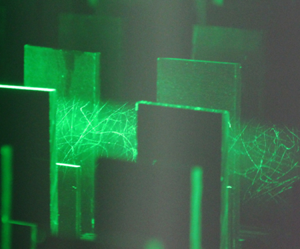
The novelty of the analysis of Shnapp (Reference Shnapp2021) is to show that this aforementioned Lagrangian phenomenology, initially designed for isotropic turbulent flows, gives a fair account of the fluctuations of velocity along the trajectories obtained in his wind tunnel (Shnapp et al. Reference Shnapp, Shapira, Peri, Bohbot-Raviv, Fattal and Liberzon2019). Despite the presence of a strong mean flow, and a model canopy laid out on the bottom of the tunnel, Shnapp (Reference Shnapp2021) evidences that the subset of particles flying just above this rough surface exhibits a statistical behaviour in quantitative agreement with the theoretical predictions for the velocity increment p.d.f.s and moments obtained within this formalism, with furthermore the same level of intermittency. Noticing that the characteristic height of the canopy is of the order of $U_{\infty }T_L$, where $U_{\infty }$ is the wind mean velocity, this important observation further illustrates that Lagrangian fluctuations at small scales are universal and decoupled from the large scale flow. Nonetheless, signatures of the anisotropic nature of the canopy are evidenced when comparing the variance and correlation time scales of the different components $v_i$, which impact $\Delta _{T_L} v_i$, changing weakly the distribution of $\mathcal {B}$, similarly to what was observed by Ouellette et al. (Reference Ouellette, Xu, Bourgoin and Bodenschatz2006) and Huck, Machicoane & Volk (Reference Huck, Machicoane and Volk2019).
To characterize more precisely the anisotropic nature of the large scale flow from a Lagrangian perspective, Shnapp (Reference Shnapp2021) decomposes the set of the trajectories according to four quadrants which represent different directions of Lagrangian velocity with respect to the mean Eulerian flow. This original method of classification allows him to analyse the distribution of kinetic energy depending of the amplitude of the streamwise component, and makes some connections with the fluctuating nature of the drag induced by the canopy.
3. Future
The results of Shnapp (Reference Shnapp2021) remarkably show that Lagrangian tracking experiments are an original and fertile characterization of realistic turbulent flows, such as wind tunnels (Ayyalasomayajula et al. Reference Ayyalasomayajula, Gylfason, Collins, Bodenschatz and Warhaft2006; Shnapp et al. Reference Shnapp, Shapira, Peri, Bohbot-Raviv, Fattal and Liberzon2019), jets (Poulain et al. Reference Poulain, Mazellier, Gervais, Gagne and Baudet2004; Viggiano et al. Reference Viggiano, Basset, Solovitz, Barois, Gibert, Mordant, Chevillard, Volk, Bourgoin and Cal2021) and channel flows (Stelzenmuller et al. Reference Stelzenmuller, Polanco, Vignal, Vinkovic and Mordant2017). These newly developed techniques shed new light on Eulerian measurements and simulations of modelled canopies (Bai, Katz & Meneveau Reference Bai, Katz and Meneveau2015; Glick et al. Reference Glick, Ali, Bossuyt, Calaf and Cal2020), and their consequences for the intermittency phenomenon (Katul et al. Reference Katul, Porporato, Cava and Siqueira2006; Dupont et al. Reference Dupont, Argoul, Gerasimova-Chechkina, Irvine and Arneodo2020).
From a theoretical perspective, the Lagrangian framework naturally calls for the stochastic modelling of the trajectories using random walks, as they were developed for isotropic flows (Sawford Reference Sawford1991; Pope Reference Pope2002; Viggiano et al. Reference Viggiano, Friedrich, Volk, Bourgoin, Cal and Chevillard2020). In the spirit of recent propositions made by Innocenti et al. (Reference Innocenti, Mordant, Stelzenmuller and Chibbaro2020) and Shnapp et al. (Reference Shnapp, Bohbot-Raviv, Liberzon and Fattal2020), generalizing these approaches to anisotropic situations sounds like a fantastic perspective.






1. Introduction
The Lagrangian investigation of laboratory and numerical turbulent flows has been intensively developed over the last thirty years, as reviewed in Yeung (Reference Yeung2002), Toschi & Bodenschatz (Reference Toschi and Bodenschatz2009) and Pinton & Sawford (Reference Pinton and Sawford2012), following an intense and vast effort aimed at characterizing with precision the statistical behaviour of the Eulerian velocity field (Frisch Reference Frisch1995). Following velocity along the path of fluid particles is not only important from a fundamental point of view (Monin & Yaglom Reference Monin and Yaglom1971; Tennekes & Lumley Reference Tennekes and Lumley1972), it is also an appropriate way to describe the mixing and dispersion properties of emitted tracers in geophysical situations (LaCasce Reference LaCasce2008).
Fluctuations of velocity along trajectories were initially observed in direct numerical simulations (DNSs) of the Navier–Stokes equations in controlled situations aimed at investigating some aspects of homogeneous and isotropic turbulence (Yeung & Pope Reference Yeung and Pope1989; Chevillard et al. Reference Chevillard, Roux, Lévêque, Mordant, Pinton and Arneodo2003; Biferale et al. Reference Biferale, Boffetta, Celani, Devenish, Lanotte and Toschi2004; Bentkamp, Lalescu & Wilczek Reference Bentkamp, Lalescu and Wilczek2019), and soon after in von Kármán swirling flows (Voth, Satyanarayan & Bodenschatz Reference Voth, Satyanarayan and Bodenschatz1998; Mordant et al. Reference Mordant, Metz, Michel and Pinton2001). Despite the artificial nature of the boundary conditions of DNSs, and the strong anisotropy of the experimental realisation of such flows driven by propellers, a remarkable agreement was observed in the statistical properties of the Lagrangian velocity in both situations (Arneodo et al. Reference Arneodo2008). The Johns Hopkins Turbulence Database (Yu et al. Reference Yu, Kanov, Perlman, Graham, Frederix, Burns, Szalay, Eyink and Meneveau2012) could, for instance, be used to further confirm the picture which follows.
We recall in a few words some of the key ingredients of the phenomenology of homogeneous and isotropic turbulence in the Lagrangian framework, as reviewed by Chevillard et al. (Reference Chevillard, Castaing, Arneodo, Lévêque, Pinton and Roux2012). Using the notation of Shnapp (Reference Shnapp2021), the statistical and multiscale nature of a Lagrangian velocity component $v_i(t)$, with $i\in \{1,2,3\}$, is well captured by the following probabilistic ansatz:
where the velocity increment $\Delta _\tau v_i(t)=v_i(t+\tau )-v(t)$ is introduced. Equation (1.1) relates an equality in probability law between the random variable $\Delta _\tau v_i$, made up of the instances of the increments along the trajectories at a given time scale $\tau$, and its instances $\Delta _{T_L} v_i$, at the large integral time scale of the flow $T_L$ at which velocity decorrelates, weighted by a random scale-dependent multiplier $\mathcal {B}$. At large scales $\tau \gg T_L$, $\mathcal {B}$ tends to the deterministic value $1$, meaning that the increment is statistically equal to $\Delta _{T_L} v_i$, usually taken to be a Gaussian random variable of zero average and of variance $2\langle v_i^2\rangle$, as dictated by observations. In the inertial range $\tau _\eta \ll \tau \ll T_L$, where $\tau _\eta$ is the Kolmogorov dissipative time scale, $\mathcal {B}$ fluctuates in the same way as $(\tau /T_L)^h$, the randomness being encoded in the exponent $h$. Dimensional arguments, mostly based on the irrelevance of viscosity at these scales (Tennekes & Lumley Reference Tennekes and Lumley1972), suggest that $\langle h \rangle \approx {1}/{2}$, at any scale $\tau$. Using the language of the multifractal formalism (Frisch Reference Frisch1995), in this statistically averaged sense, we can say that the Lagrangian velocity shares the same local regularity as that of the Brownian motion. Further analyses of experimental and numerical data (Chevillard et al. Reference Chevillard, Roux, Lévêque, Mordant, Pinton and Arneodo2003; Arneodo et al. Reference Arneodo2008) indicate that, indeed, $h$ fluctuates around its mean value, independently of both the Reynolds number and the geometry of the flow, which is known as intermittency. The level of Lagrangian intermittency is observed in the right proportion compared to that measured in the Eulerian framework, consistently with the elegant theory of Borgas (Reference Borgas1993).
2. Overview
Much more could be said on the statistical behaviour of the multiplier $\mathcal {B}$ entering in (1.1), in particular on the rich and predictive physics that has been developed to include the differential action of viscosity at small scales $\tau \ll \tau _\eta$, where fluctuations of the velocity increment are similar to those of acceleration. Let us keep in mind that this ansatz is well posed and closed from a probabilistic point of view if we furthermore assume that $h$ and $\Delta _{T_L} v_i$ are statistically independent. It is then possible to derive explicit predictions for the probability density function (p.d.f.) of $\Delta _{\tau } v_i$ and its moments (i.e. the structure functions), at any scale $\tau$, for a given Reynolds number and a prescribed level of intermittency.
The novelty of the analysis of Shnapp (Reference Shnapp2021) is to show that this aforementioned Lagrangian phenomenology, initially designed for isotropic turbulent flows, gives a fair account of the fluctuations of velocity along the trajectories obtained in his wind tunnel (Shnapp et al. Reference Shnapp, Shapira, Peri, Bohbot-Raviv, Fattal and Liberzon2019). Despite the presence of a strong mean flow, and a model canopy laid out on the bottom of the tunnel, Shnapp (Reference Shnapp2021) evidences that the subset of particles flying just above this rough surface exhibits a statistical behaviour in quantitative agreement with the theoretical predictions for the velocity increment p.d.f.s and moments obtained within this formalism, with furthermore the same level of intermittency. Noticing that the characteristic height of the canopy is of the order of $U_{\infty }T_L$, where $U_{\infty }$ is the wind mean velocity, this important observation further illustrates that Lagrangian fluctuations at small scales are universal and decoupled from the large scale flow. Nonetheless, signatures of the anisotropic nature of the canopy are evidenced when comparing the variance and correlation time scales of the different components $v_i$, which impact $\Delta _{T_L} v_i$, changing weakly the distribution of $\mathcal {B}$, similarly to what was observed by Ouellette et al. (Reference Ouellette, Xu, Bourgoin and Bodenschatz2006) and Huck, Machicoane & Volk (Reference Huck, Machicoane and Volk2019).
To characterize more precisely the anisotropic nature of the large scale flow from a Lagrangian perspective, Shnapp (Reference Shnapp2021) decomposes the set of the trajectories according to four quadrants which represent different directions of Lagrangian velocity with respect to the mean Eulerian flow. This original method of classification allows him to analyse the distribution of kinetic energy depending of the amplitude of the streamwise component, and makes some connections with the fluctuating nature of the drag induced by the canopy.
3. Future
The results of Shnapp (Reference Shnapp2021) remarkably show that Lagrangian tracking experiments are an original and fertile characterization of realistic turbulent flows, such as wind tunnels (Ayyalasomayajula et al. Reference Ayyalasomayajula, Gylfason, Collins, Bodenschatz and Warhaft2006; Shnapp et al. Reference Shnapp, Shapira, Peri, Bohbot-Raviv, Fattal and Liberzon2019), jets (Poulain et al. Reference Poulain, Mazellier, Gervais, Gagne and Baudet2004; Viggiano et al. Reference Viggiano, Basset, Solovitz, Barois, Gibert, Mordant, Chevillard, Volk, Bourgoin and Cal2021) and channel flows (Stelzenmuller et al. Reference Stelzenmuller, Polanco, Vignal, Vinkovic and Mordant2017). These newly developed techniques shed new light on Eulerian measurements and simulations of modelled canopies (Bai, Katz & Meneveau Reference Bai, Katz and Meneveau2015; Glick et al. Reference Glick, Ali, Bossuyt, Calaf and Cal2020), and their consequences for the intermittency phenomenon (Katul et al. Reference Katul, Porporato, Cava and Siqueira2006; Dupont et al. Reference Dupont, Argoul, Gerasimova-Chechkina, Irvine and Arneodo2020).
From a theoretical perspective, the Lagrangian framework naturally calls for the stochastic modelling of the trajectories using random walks, as they were developed for isotropic flows (Sawford Reference Sawford1991; Pope Reference Pope2002; Viggiano et al. Reference Viggiano, Friedrich, Volk, Bourgoin, Cal and Chevillard2020). In the spirit of recent propositions made by Innocenti et al. (Reference Innocenti, Mordant, Stelzenmuller and Chibbaro2020) and Shnapp et al. (Reference Shnapp, Bohbot-Raviv, Liberzon and Fattal2020), generalizing these approaches to anisotropic situations sounds like a fantastic perspective.
Declaration of interests
The author reports no conflict of interest.