




1. Introduction
In the evolving landscape of educational technology, the application of mobile-assisted language learning (MALL) has become a focal point of investigation in academic research, particularly in language education (Loewen et al., Reference Loewen, Crowther, Isbell, Kim, Maloney, Miller and Rawal2019; Salhab & Daher, Reference Salhab and Daher2023). MALL, a subdomain of computer-assisted language learning (CALL), is widely used for language learning (Klímová, Reference Klímová2018), particularly where device mobility provides potential benefits (Kukulska-Hulme, Reference Kukulska-Hulme and Chapelle2018). Mobile phones are one of many inventions that have become almost indispensable tools, used for communication, socializing, entertainment, and learning (Han & Yi, Reference Han and Yi2019; Lin & Lin, Reference Lin and Lin2019). As a result, various mobile-based instruction and learning methods have been developed to take advantage of scientific advancements in the educational sector. This study centres on integrating MALL in the context of English phrasal verbs (PVs), a challenging aspect of language acquisition for English as a foreign language (EFL) learners (Thom, Reference Thom2017).
English PVs are often regarded as one of the most complex and problematic lexical items (Abdul Rahman & Abid, Reference Abdul Rahman and Abid2014; Bronshteyn & Gustafson, Reference Bronshteyn and Gustafson2015; Celce-Murcia & Larsen-Freeman, Reference Celce-Murcia and Larsen-Freeman1999; Imrose, Reference Imrose2013; Shahrokhi & Kamyabi, Reference Shahrokhi and Kamyabi2016). Typically, a PV comprises two (or more) parts: a lexical verb and an adverb or a preposition; the entire combination acts as a single word. EFL learners often encounter difficulties due to the complicated nature of PVs and perhaps also to conventional instructional methods (Imrose, Reference Imrose2013; Thom, Reference Thom2017). First, PVs are “highly polysemous” (Thim, Reference Thim2012: 11) and numerous, probably making them a challenge for EFL learners to master (Garnier & Schmitt, Reference Garnier and Schmitt2015; Siyanova & Schmitt, Reference Siyanova and Schmitt2007; White, Reference White2012). Learners tend to be unsure of the meaning and avoid employing PVs in spoken or written discourse (Abdul Rahman & Abid, Reference Abdul Rahman and Abid2014; Barekat & Baniasady, Reference Barekat and Baniasady2014; Garnier & Schmitt, Reference Garnier and Schmitt2015). Second, instructors often find it difficult to define a specific PV precisely because different grammarians and linguists may have described it from varying perspectives. Ineffective teaching techniques also severely limit EFL learners’ capacity to acquire and use PVs in written and spoken language (Imrose, Reference Imrose2013). Therefore, instructors usually prefer that the learners remember the PVs and encourage them to understand how they are formed structurally (i.e. the rules of syntax [syntactic meaning]) so that they can retain as many PVs as possible. However, remembering lengthy lists of PVs and their meanings seems ineffective (Celce-Murcia & Larsen-Freeman, Reference Celce-Murcia and Larsen-Freeman1999). Nevertheless, any method that requires EFL learners to comprehend the meanings of PVs can enhance their learning over time (Bronshteyn & Gustafson, Reference Bronshteyn and Gustafson2015). MALL integration in EFL settings is gaining attraction with the increasing popularity of mobile phones. A well-designed MALL environment and a broad repertoire of words may aid language acquisition (Salhab & Daher, Reference Salhab and Daher2023; Xue, Reference Xue2022; Yoong, Kaur & Keat, Reference Yoong, Kaur and Keat2019).
The present study serves a twofold purpose. First, to the best of the author’s knowledge, only a handful of studies have been conducted on the efficacy of mobile apps for learning English PVs (Amaraweera, Reference Amaraweera2016; Shahrokhi & Kamyabi, Reference Shahrokhi and Kamyabi2016), and even so, they are very limited in duration. In addition, few studies have contributed to this research area by employing digital game-based language learning, a subset of CALL, to improve PV knowledge (Siahpoosh & Ilkhani, Reference Siahpoosh and Ilkhani2020; Vazirabad & Farrokhi, Reference Vazirabad and Farrokhi2020). The present research explores the efficacy of MALL for learning PVs with an app to achieve these research objectives. Second, experimental-based insights are limited in m-learning (Liu & Correia, Reference Liu and Correia2021), necessitating further research. The study offers experimental-based pedagogical insights for instructors, curriculum designers, and researchers to inform MALL in EFL contexts.
2. Literature review
2.1 PV teaching approaches in EFL contexts
Learning PVs is essential for EFL learners to attain precision and fluency in their language skills (Garnier & Schmitt, Reference Garnier and Schmitt2015). However, Gardner and Davies (Reference Gardner and Davies2007) emphasized that PVs present a significant challenge for learners to master. Contemporary research presents different pedagogical approaches to instruction in PVs (Spring, Reference Spring2018; Thom, Reference Thom2017; White, Reference White2012). For example, White (Reference White2012) proposed a five-step conceptual approach to teaching PVs in reading tasks to ESL students. It appealed to learners’ creativity by producing images and drawings of the targeted PVs. Also, individual conceptualizations of PVs were encouraged by creating personal symbolic tools and helped learners understand the PVs’ symbolic meanings. The study indicated that students gained better understanding of PVs from pre-instruction to post-instruction tasks. Additionally, sharing drawings with their classmates seemed to increase students’ learning capacities.
Likewise, Thom (Reference Thom2017) suggested a cognitive linguistic (CL) approach to PVs that focused on the polysemic attributes of PVs, emphasizing both their unique and shared features. Thom (Reference Thom2017) asserted that the literal sense of a PV generates all other polysemic meanings. The CL approach to PVs supports integrating visualisation but rejects the over-conceptualisation of PVs. Furthermore, Spring (Reference Spring2018) developed a list of approximately 95% of the most commonly used PV particles and their meanings via corpus-based research. The author combined CL theory, specifically Talmy’s theory of event conflation, with corpus-based research to create a comprehensive list of PV particles and their meanings. An experiment demonstrated that learners taught using this particle list (conflation group) significantly improved their PV proficiency compared to those who memorized PVs as whole units (whole-unit group). Thus, Spring (Reference Spring2018) suggested that teaching PVs through the conflation method, which focuses on understanding the meanings of individual particles and their combinations with verbs, is more effective than teaching them as whole units.
2.2 Vocabulary and PV learning through MALL
MALL has rapidly flourished in the education sector (Burston, Reference Burston2014). Palalas and Hoven (Reference Palalas, Hoven, Palalas and Ally2016) state that MALL has altered language usage and learning process prospects. It offers a broader range of possibilities for active language learning (Oberg & Daniels, Reference Oberg and Daniels2013) with easy portability and flexible use of time and space (Alzahrani, Reference Alzahrani2015; Sung, Chang & Liu, Reference Sung, Chang and Liu2016). The availability of a range of portable mobile devices can greatly support and enhance spontaneous and continuous learning (Kwangsawad, Reference Kwangsawad2019; Loewen et al., Reference Loewen, Crowther, Isbell, Kim, Maloney, Miller and Rawal2019; Sauro & Zourou, Reference Sauro and Zourou2019). Mobile phone apps have become integral to learning vocabulary in EFL (Deng & Trainin, Reference Deng and Trainin2015; Salhab & Daher, Reference Salhab and Daher2023). Research indicates such mobile apps can motivate learners to expand their word knowledge (Rosell-Aguilar, Reference Rosell-Aguilar2018; Zhang, Reference Zhang2016) because many apps offer features designed to learn single words, collocations, idioms, and PVs (Klímová, Reference Klímová2018; Nisbet & Austin, Reference Nisbet and Austin2013).
Wang, Teng and Chen (Reference Wang, Teng and Chen2015) evaluated the effects of English vocabulary acquisition through an iPad app in Taiwan. The experimental group, which used the app, performed better than the control group. Similarly, Zhang (Reference Zhang2016) conducted an empirical study over one academic year for the app English Fun Dubbing to assess the benefits of this mobile app as a teaching tool. The participants’ e-questionnaire responses expressed satisfaction with the app’s useful features. Likewise, Çelik and Yavuz (Reference Çelik and Yavuz2018b) investigated the effects of apps on contextual (context meaning) and literal (direct meaning) vocabulary instruction for university students. The scores of the literal instruction group were reported to be better than those of the contextual instruction group. Thus, the authors support Klímová’s (Reference Klímová2018) view that apps can positively affect EFL vocabulary learning.
Despite their valuable contributions, previous studies have limitations. More specifically, most studies on m-learning were conducted for a limited duration – in most cases, a month or less (e.g. Heil, Wu, Lee & Schmidt, Reference Heil, Wu, Lee and Schmidt2016; Sung et al., Reference Sung, Chang and Liu2016). Researchers agree that studies with a shorter time frame might not be representative of real-world language learning, as learners do not have sufficient time to become adequately acquainted with the hardware, software, techniques, and essential processes (Sung et al., Reference Sung, Chang and Liu2016). Conversely, some more extended studies may show little or no effective learning results. For example, this could happen if the studies only provided devices or computers to the learners without implementing teaching strategies.
A few studies have been conducted to assess the effectiveness of learning PVs via mobile apps (Amaraweera, Reference Amaraweera2016; Shahrokhi & Kamyabi, Reference Shahrokhi and Kamyabi2016) and SMS services (Abadikhah & Rastegar, Reference Abadikhah and Rastegar2016). The findings conclude that apps can benefit EFL learners in learning PVs. In a study by Shahrokhi and Kamyabi (Reference Shahrokhi and Kamyabi2016), the experimental group was solely engaged through a combination of SMS and a mobile app. While they received instructional content and guidance via SMS on their smartphones, the core learning activities were conducted using the Phrasal Verbs Machine app developed by Cambridge University Press. This innovative approach capitalized on the direct and immediate nature of SMS for communication and reminders, while the app offered an interactive platform for in-depth learning of PVs. The data analysis from this study indicated that such a combined approach to MALL could effectively improve vocabulary knowledge and facilitate the learning of complex lexical items like PVs. Amaraweera’s (Reference Amaraweera2016) study also gauged the effects of learning PVs but was similarly relatively short in duration (eight days).
The present study utilized an in-class m-learning environment for the experimental group. The app chosen for the study was PHRASAL VERBS developed by Loc Nguyen, available in the iOS App Store. It was selected for its intuitive design, functionality, and extensive library of PVs. Most significantly, it included all of the PVs that were planned to be included in the study. Other improvements over previous studies include a large sample size (122 participants), a large number of target items (200 PVs), a longer duration (eight weeks), and weekly tests to monitor learning progress. These features are intended to improve the ecological validity of the present study.
3. Research questions
The research questions are as follows:
-
1. What are the effects of using the app to teach and learn PVs in an instructional setting?
-
2. What are students’ perceptions of using the app to improve their learning of PVs?
4. Methodology
4.1 Study participants
The initial study sample comprised 125 female sophomore students at a Saudi university, aged 18–21 years (M = 19.67, SD = 0.876). All participants had taken the Oxford Placement Test, and the majority were at intermediate level. The participants lacked proficiency in using PVs when speaking and writing, established via a pilot test with a similar group of students.
Given previous teaching experience with the participants, the researcher expected them to be motivated for MALL and to actively engage intentional vocabulary learning without direct supervision. Three participants withdrew for personal reasons, leaving 122 participants engaged in the study throughout its duration.
4.2 Research instrument
This study investigated the impact of MALL on learning PVs for EFL learners. Accordingly, the author created an in-class m-learning-supported environment using an app. The researcher considered constructive learning theory for this purpose because it focuses on context and content-dependent mobile learning (Keskin & Metcalf, Reference Keskin and Metcalf2011). The constructive learning theory refers to learners building a new idea or concept based on prior or present knowledge (Yoong et al., Reference Yoong, Kaur and Keat2019). It involves providing authentic context-based information, exploring questions with examples, solving problems, and making decisions. However, the study focused on the efficacy of the app for learning PVs in an EFL context rather than assessing the overall effectiveness of constructive learning theory.
Before choosing the app, an extensive literature review partly informed the choice of PVs. This involved examining authentic academic publications, EFL textbooks, and language learning resources to identify PVs that are frequently encountered by learners at various proficiency levels. The selected PVs were those that appeared consistently across multiple sources, indicating their importance in EFL learning contexts. The review helped in ensuring that the PVs chosen for the study were not only educationally significant but also aligned with common learning objectives in other EFL courses.
The app selection criteria were based on several key factors: context and content-depending mobile learning, inclusion of relevant media content (audio and video) for the selected PVs, available for free on mobile app stores, usability in various settings (Son, Reference Son, Palalas and Ally2016), provision of motivation to learn in both academic and non-academic contexts along with personalized experiences (Kacetl & Klímová, Reference Kacetl and Klímová2019), and verification of authenticity by at least three EFL teachers. After finalizing the PVs choice set, the author evaluated several apps based on the set criteria to gauge their suitability for employing them in the research. Consequently, the PHRASAL VERBS app by Loc Nguyen (Figure S1) (Figures S1–S8 are available in the supplementary material) was selected.
To ensure educational credibility and relevance, three experienced EFL teachers verified the app’s content against authoritative sources like the Cambridge Phrasal Verbs Dictionary (Cambridge University Press, 2006) and various EFL textbooks. The target items for the research were 200 English PVs from these textbooks, which were also found in the app. The app’s comprehensive media content, including audio and video clips, was also reviewed to ensure the PVs were used appropriately in context, enhancing the learning experience. The selected free app meets Son’s (Reference Son, Palalas and Ally2016) criteria for language learning apps by motivating learning in various settings and providing personalized experiences (Kacetl & Klímová, Reference Kacetl and Klímová2019), with screenshots shown in Figure S2 (a, b, c).
Furthermore, to align with the majority of campus students using iOS-based devices, the study exclusively utilized the iOS version of the app, ensuring access and reducing cognitive burden bias among participants. The app features the following three sections: (1) learn, (2) test, and (3) cards and games, as described below.
4.2.1 Learn feature
This section introduces PVs, with definitions, context samples, and separability indications aiding users in PV learning. Separable PVs can be broken up by other words, while inseparable PVs cannot be separated by other words; for example, “break into” is inseparable, and “cut out” is separable. The app provides target PVs with contextual meanings, audio pronunciations, and video presentations, as shown in Figure S3a, S3b, and S3c, respectively, utilizing content from songs, TV shows, or movies, supporting vocabulary development for EFL learners (Peters & Webb, Reference Peters and Webb2018; Rodgers, Reference Rodgers2018; Webb, Reference Webb, Nunan and Richards2015).
4.2.2 Test feature
The app offers 29 tests of varying difficulty, each including 15 five-option multiple-choice questions with immediate feedback, as shown in Figure S4 (a, b, c) and Figure S5 (a, b, c).
4.2.3 Cards feature
The visual PV cards have an audio program, which helps develop vocabulary size (Staehr, Reference Staehr2009). The app presents each PV with audio and meaning in this section, as shown in Figures S6a and S6b. Finally, the app offers an interesting feature for matching games, as shown in Figures S7a and S7b. Gaming-based language learning may be able to significantly amplify foreign language lexical learning (Roohani & Vincheh, Reference Roohani and Vincheh2023).
4.3 Intervention procedure
The intervention was conducted over a period of eight weeks to gain a comprehensive understanding of the differences and similarities between the app-based (experimental) and paper-based (control) learning methods employed in the study. Table 1 contains a detailed side-by-side comparison of the two approaches, such as instructional methods, interactive elements, and feedback mechanisms, and serves as an essential reference for a clear and concise overview of the study’s methodology.
Comparative overview of app-based and paper-based learning methods for the experimental group and control group, respectively, in the study of phrasal verbs

The experimental group was introduced to the selected app to learn the PVs. Before the study began, the author confirmed that all participants had access to mobile phones. The details of the intervention procedure are presented in Appendix I (Appendices I–IV are available in the supplementary material). Before the intervention period’s commencement, the author conducted an in-class training session for the experimental group, guided them through the procedure, and interacted with students regarding the app’s features, navigation and capabilities. The participants were instructed to use the app for 20 minutes daily in an in-class setting for five working days. They were requested to fully focus on the tasks and not let themselves be distracted during the treatment sessions. They were requested to activate the airplane mode on their devices before the start of the treatment sessions to avoid distraction. Further, the screen time spent on the app was tracked using the in-built feature on the students’ iOS devices.Footnote 1 They were instructed not to use the app after the class sessions.
Meanwhile, the control group received instructions for using paper-based learning materials (and had no access to the app). The paper-based learning materials consisted of specially designed booklets covering the same PV content and designed along the same lines as the app. It comprised the list of PVs, meanings, example sentences, game cards, etc. The control group engaged with the paper-based learning material for the same amount of time as the experimental group was allotted. At the end of each session, the instructor collected all the booklets from the participants of the control group, provided feedback and encouraged class discussion.
Since the PVs in the app were arranged alphabetically, the participants were instructed to select five PVs each day by choosing one PV each from the lists of the first five letters (i.e. A, B, C, D, and E) for a given day. In this way, participants studied 25 PVs covering most of the letters of the alphabet. These five PVs were set as the block size to quantify the number of PVs learned each day (Appendix II). The rationale for using five PVs as one block size was to expose them to smaller vocabulary block sizes, which provide more learning gains (Nakata & Webb, Reference Nakata and Webb2016). Appendix III shows the complete learning regime over eight weeks for both groups with the cumulative frequency of learning.
4.4 Evaluation of PV learning
The evaluation of PV learning consisted of the following data collection instruments:
-
1. The pre-test and post-test, with each comprising 60 multiple-choice items using PVs with four options. The tests were paper-based; all items were independently scored by two raters and final scores approved by two experienced EFL teachers. For example:
-
Q. Read the statement and choose the correct phrasal verbs:
-
1. “Why are you staring out the window? __________ now and focus on your lesson.”
(a) turn over (b) turn on (c) turn off (d) turn around
-
-
The test’s reliability and validity were confirmed in a pilot study with a group of 70 students with comparable vocabulary proficiency to participants in the main study. Initially, they took a pre-test (M = 29.23, SD = 9.05). The students then underwent an intervention similar to the experimental group in the main study for seven weeks. Following the intervention, a post-test (M = 36.97, SD = 12.41) showed significant learning gains (F = 13.49, p < 0.05) for the pilot study group, establishing the instrument’s validity. This supports its use in the main study, which involved a larger sample size and included a control group.
Further, the instruments’ internal consistency was also measured using the split-half reliability method. The obtained Cronbach’s alpha coefficients of .79 for the pre-test and .80 for the post-test indicate that the instrument consistently measured the targeted construct.
Eight in-class tests were conducted to monitor participants’ learning performance during the intervention period. The experimental group completed tests from Levels 16 to 23 in the app, answering the first 10 out of 15 questions within seven minutes. Screenshots of their test results were sent to the author via email or WhatsApp, ensuring reliable and timely transfer of responses. Meanwhile, the control group was assessed using paper-based tests derived from the same levels in the app.
-
2. An electronic questionnaire comprising 19 closed questions was used to collect data about students’ perceptions of using MALL for learning PVs, using a 5-point Likert scale for responses. The reliability analysis was conducted on the raw data of the MALL questionnaire using IBM SPSS. Since the scale had categorical variables, they were coded to their corresponding numerical values (strongly agree = 5 to strongly disagree = 1). Cronbach’s alpha was used to test internal consistency.
5. Results
5.1 Pre-test results
The normality of data was confirmed using the Anderson–Darling normality test, which showed normal distribution for both the control group (A 2 = 0.37, p > 0.05) and experimental group (A 2 = 0.39, p > 0.05). This allowed the safe utilization of one-way analysis of variance (ANOVA) for data analysis, minimizing the risk of false positive results (Type I error).
The results of one-way ANOVA conducted for the pre-test revealed that no significant differences were present between the control (M = 33.13, SD = 8.328) and experimental (M = 32.43, SD = 8.476) groups’ mean scores (F = .215, p = .644, hence > α). The descriptive statistics and results obtained from one-way ANOVA are summarised in Table S1 and Table S2, respectively (Tables S1–S5 are available in the supplementary material).
5.2 Progress checks during intervention
During the intervention period, both groups completed weekly tests, as described in Section 4.4; descriptive statistics for these tests are shown in Table 2. Overall, the experimental group’s mean score increased by 117.2% (from 3.02 to 6.56), whereas the control group experienced a 42.6% increase (from 2.98 to 4.25) after the eight weeks.
Descriptive statistics of the weekly tests conducted for the two groups
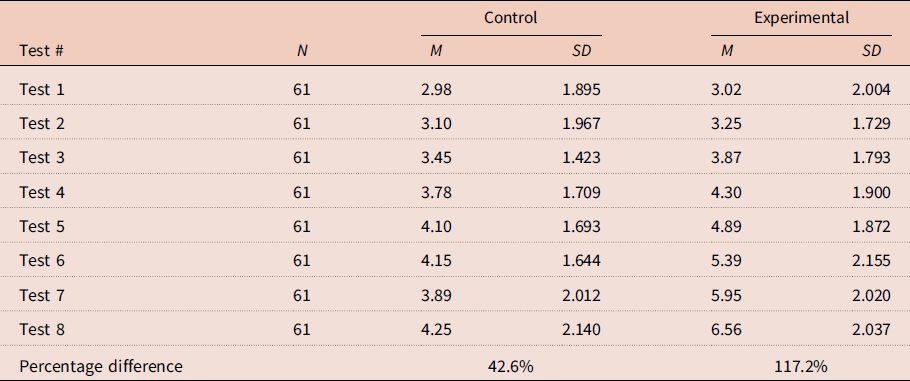
Finally, a repeated measures ANOVA was conducted on the above collected app test results to evaluate the differences between the mean scores of the groups over time, as presented in Table S3. A presence of significant difference between both groups in terms of their weekly test mean scores (F = 31.68, p = .000, hence < α) was revealed over time, and coupled with the line chart in Figure 1, the results clearly depict that the experimental group showed considerable improvement over the control group due to the use of the MALL medium. These results answer the first research question concerning the effects of using the app to teach and learn PVs in an instructional setting.
Improvement in the control and experimental groups’ learning curves during the weekly tests.

5.3 Post-test (paper-based)
As noted above, both the control and experimental groups were given a paper-based multiple-choice post-test after the eight-week intervention period to assess the differences in their learning gains. The results of the normality tests for the control (A 2 = 0.42, p > 0.05) and experimental groups (A 2 = 0.26, p > 0.05) showed that the data were normally distributed. Table S4 shows the descriptive statistics of the post-test and Table S5 shows the results obtained from one-way ANOVA. The post-test scores of the students in the control (M = 35.44, SD = 8.982) and experimental (M = 39.59, SD = 9.578) groups confirmed the significant differences in their learning gains (F = 6.09, p = .015, hence < α) for the validity of the alternative hypothesis (H a). Furthermore, Cohen’s d, used as a measure of effect size, reported a value of d = 0.45, indicating a nominal effect.
Further, the estimated marginal means (also termed observed means) shown in Figure 2 indicate a much steeper mean score improvement for the experimental group compared to the control group over time. Given that both groups spent approximately the same amount of time on performing the tasks and the similarity of the content and activities proposed, this significant learning gain can be attributed to the app usage by the experimental group.
Estimated marginal means for both groups over two testing periods.

5.4 E-questionnaire to gauge participants’ perception of MALL
After the post-test, an electronic questionnaire with 19 questions was administered to 61 experimental group students to gauge their perceptions of using m-learning apps for learning PVs. The students responded on a 5-point Likert scale (refer to Appendix IV for the detailed table of aggregated responses to the online MALL e-questionnaire items).
These responses offer useful insights and eventually enable the author to support the results of the second research question. Findings of questions 1 and 2 support Klímová’s (Reference Klímová2018) relatively positive attitude toward using mobile phones for language learning. Concerning their motivation, a significant proportion of students had agreed with the statement that PVs are essential for improving English (Q3).
However, respondents were divided on the question of learning through an app versus a textbook (Q4). Interestingly, the highest proportion of neutral or unsure responses (27.4% each) among all questions was noted for Q4 (ease of learning) and Q5 (learning productivity). Although a majority favoured the app for the ease of learning (64.6%) and learning productivity (72.5%), between one quarter and almost a third of students favoured a more conventional method (textbook), perhaps indicating some initial resistance to change. As far as learning productivity is concerned, some students might have felt a higher sense of accountability to an instructor compared to an app. Further, these findings might represent a novelty effect: students had not been routinely exposed to an m-learning environment before and had no substantive experience using a mobile app in a classroom setting for academic purposes.
Positive responses to questions 6, 7, and 9 support findings from Sung et al. (Reference Sung, Chang and Liu2016) and Kukulska-Hulme (Reference Kukulska-Hulme and Chapelle2018), indicating a perception among users that MALL’s flexibility and portability are beneficial to learning. Regarding the feedback feature of the mobile application (Q10), the students may have perceived it to be inadequate in terms of providing detailed and thorough feedback. This is because the app provided only a basic indication of whether the answer was correct or incorrect, whereas an instructor’s feedback in a face-to-face classroom setting typically includes a more elaborate analysis of students’ performance to help them identify and address their mistakes. Despite this, the app’s review feature (Q11) was appreciated by most students. Perhaps the students noticed that they did not have to wait for the regular revision class to review their work.
Similarly, students liked that the app was free to use (Q12) and agreed that they could save time and express themselves more effectively via apps (Q13, Q14, and Q15). They also agreed that their writing (Q16) and speaking abilities could be improved (Q17). After using the app, some students told the researcher they thought they could speak more naturally and be understood better (Q18). Therefore, they felt inclined to recommend the app to others (Q19).
The results of the average responses are shown in Figure S8. Overall, the results indicate students’ high agreement with the statements (over 85% agreeing in one form or the other) and show a favourable perception of m-learning apps to improve their learning of PVs.
To measure the reliability of the e-questionnaire, Cronbach’s alpha was employed, which, as a measure of internal consistency, checks whether the responses on the items correlate with each other or not, and its value was found to be .87. All the items were positively coded; therefore, no reverse coding was required.
6. Discussion and conclusion
To summarise the main findings, this study focused on using a mobile app to facilitate the learning of PVs for EFL learners. First, pre-tests were administered to the control and experimental groups. The results confirmed equivalent proficiency and knowledge about PVs, and the possibility of any pre-existing differences among the participants of the two groups was eliminated. Consequently, these results validated the hypothesis that the higher average scores of the experimental group were due to app-based learning. These results align with previous studies; for example, Amaraweera (Reference Amaraweera2016) and Shahrokhi and Kamyabi (Reference Shahrokhi and Kamyabi2016) suggest that apps can be highly useful for EFL learners to learn PVs. In the present study, both groups were provided with the same learning materials and equivalent amounts of time. The only difference was in the instructional method: the use of an app to teach PVs to the experimental group compared to paper-based teaching for the control group. However, the post-test results indicated that learning PVs through an app is a more effective way to learn PVs, supported by e-questionnaire responses.
The effect size (Cohen’s d = 0.45) indicated that the MALL approach effectively improved the learning abilities of the experimental group, whereas the control group did not experience significant improvement in their PVs knowledge.
The MALL approach helped the experimental group improve their language learning skills by providing a more comprehensive understanding of the PVs they had learned using the app. The results in Table S4 and S5 give a valid answer to the first research question and clearly show that the MALL integration was quite useful, as it significantly improved the learning gains of the experimental group in the post-test. Thus, the findings of the current study support the results of previous research that a learning app can be used as a helpful teaching tool for learning PVs (Çelik & Yavuz, Reference Çelik and Yavuz2018a, Reference Çelik and Yavuz2018b; Deng & Trainin, Reference Deng and Trainin2015; Kacetl & Klímová, Reference Kacetl and Klímová2019; Kim & Kwon, Reference Kim and Kwon2012; Kim, Rueckert, Kim & Seo, Reference Kim, Rueckert, Kim and Seo2013).
Second, the scores of the eight weekly tests presented in Table 2 and Figure 1 show gradual learning gains of PVs for both groups. The results affirm that the app effectively enhanced the experimental group’s proficiency in learning PVs throughout the intervention period. One reasonable explanation for the experimental group outperforming the control group could be attributed to the app’s smart features. The participants might have paid more attention to the PVs when presented in an exciting and fun way (as noted in responses to questions 2, 4, and 6). Thom (Reference Thom2017) proposed the CL approach to PV teaching, which centres on the polysemic nature of PVs and combines visualization of the target items. Similarly, the app also presented videos for relevant PVs, possibly enhancing opportunities for learning via visual input. It is worth noting that the paper-based materials did not include comparable visual aids. Therefore, while the current study suggests that the mobile application significantly enhanced learning outcomes, the role of visual input as a contributing factor cannot be entirely ruled out. Future research could delve deeper into isolating these variables to determine the distinct impact of visual input versus the mobile-assisted approach on learning PVs.
Further, the analysed data support Spring’s (Reference Spring2018) findings that PV learning with a corpus-based list and focus on particle meaning is an efficient approach. In this study, the app presented 200 PVs alphabetically with their meanings and example sentences, which allowed learners to learn the target PVs easily and conveniently. Wyss (Reference Wyss2002) asserted that meaningful and relevant contexts can engage learners by reinforcing memorisation, and that learners should deduce the meaning of the PVs from context. The data collected through the e-questionnaire suggests that the participants could explore the context of the PVs through the written text in the example sentences, audio, and visual aids (in the form of cards and videos) provided by the app.
The app aligns with the principles of contextual learning endorsed by constructive learning theory (Yoong et al., Reference Yoong, Kaur and Keat2019), offering a comprehensive learning environment. It also facilitates studying and collaboration with teachers and classmates. Furthermore, previous research suggests that students’ motivation and interest in language learning are driven by convenience and enthusiasm (Kim et al., Reference Kim, Rueckert, Kim and Seo2013). Although the quantitative data gathered from the weekly tests and post-tests were sufficient to provide evidence of the app’s efficacy for learning PVs, the e-questionnaire responses provide an additional opportunity to understand students’ perceptions of MALL and answer the second research question. Most participants responded that they appreciated using an app for learning PVs (Q2: 74.1% agreed). These results align with Klímová (Reference Klímová2018), which shows a generally positive attitude toward using mobile phones for language learning. The findings from the e-questionnaire also support previous studies, such as Kim et al. (Reference Kim, Rueckert, Kim and Seo2013) and Zhang (Reference Zhang2016). Kim et al. (Reference Kim, Rueckert, Kim and Seo2013) proposed that one of the many ways MALL appeals to learners is through its ubiquitous and personalized experience, which helps them learn the language purposefully. As noted in the participants’ responses to the e-questionnaire, the app used in this study created an environment in which they may have experienced personalized learning. They could go through the material at their own pace (Q7). They could assess their learning if they went through the tests provided by the app, which supports Hazaea and Alzubi’s (Reference Hazaea and Alzubi2018) argument that MALL has an expansive physical and virtual teaching range. In the present study, the use of the mobile app was restricted only in class; however, outside the context of the present study, students could have the opportunity to use mobile apps portably. Considering the above, MALL offers mobility (Palalas & Hoven, Reference Palalas, Hoven, Palalas and Ally2016) and accessibility. It can induce profound changes in students’ learning achievements by engaging learners at any time (Saran & Seferoǧlu, Reference Saran and Seferoǧlu2010). Since feedback plays an important role in L2 language learning (Ko, Reference Ko2019), immediate feedback (Q10) encouraged the participants to learn further. The e-questionnaire responses showed that the participants were motivated to learn PVs through the app in an integrated m-learning environment. These findings align with previous research indicating that apps can promote learning performance and motivation (Chang, Chen & Yang, Reference Chang, Chen and Yang2018). According to the constructive learning theory, motivation is the primary element of learning (Yoong et al., Reference Yoong, Kaur and Keat2019).
Meanwhile, only a trivial proportion of responses were in overall disagreement (about 2% disagreeing in one form or another) along the Likert scale. In comparison, 11.5% of the total responses were neutral. The above findings are in line with Liu (Reference Liu2016), which cites the positive impact of MALL on students’ attitudes to vocabulary learning acquisition and retention (p. 131). In addition, the findings lend further credence to Taj, Sulan, Sipra and Ahmad (Reference Taj, Sulan, Sipra and Ahmad2016), indicating that MALL significantly affects EFL learning.
Implementing MALL in Saudi Arabian higher education settings may provide a useful contribution to the technological advancement in language learning; however, this research has several limitations. First, it focused exclusively on female college students due to organizational and cultural norms, which may limit the generalizability of the findings. Additionally, there were potential constraints related to available resources and trained faculty, which could have impacted the implementation and effectiveness of MALL. Furthermore, the app provided limited feedback to students, which may have affected the measurement of learning outcomes. Lastly, the present study measured the effects by considering only the completely correct answers due to the app’s limitation of minimal feedback. Future research can explore scoring systems that credit partially correct interpretations of PVs. While similar apps may aid PV learning, effectiveness relies on factors like learner motivation, engagement, prior exposure to m-learning, and app user interface. Therefore, future studies should explore how these variables interact to optimize the design and implementation of MALL tools. Understanding these factors can help in developing more effective educational apps tailored to diverse learner needs.
This study evaluated the efficacy of MALL in the form of a learning app in enhancing students’ English PV skills. The statistical analysis results indicate that a well-designed app can be a useful tool for teaching and learning PVs for EFL learners in a relatively appropriate period. Furthermore, the findings suggest that integrating MALL into EFL can be a helpful teaching resource from a pedagogical perspective. The results from the online students’ e-questionnaire reflect their positive perceptions of the app, suggesting that MALL can become a popular choice among EFL learners to master the more challenging aspects of the English language. An app like the one used in this study offers instructors affordances, mobility, portability, and a rich toolkit for contextual learning (Kukulska-Hulme, Reference Kukulska-Hulme and Chapelle2018; Son, Reference Son, Palalas and Ally2016). The author recommends that mobile phones be utilized more extensively for instructional purposes in academic settings, as they offer rich learning experiences for EFL learners. Instructors can utilize m-learning environments for diverse learning opportunities and learner engagement. Supporting the integration of advanced technologies such as MALL in educational institutions can benefit future research. However, this study’s findings are based on a single app with a specific teaching method. Future research should explore different apps and varied teaching methods to better understand the most effective ways to utilize these technologies in language learning. Furthermore, future studies should explore integrating diverse app types with other lexical aspects as well. Expanding the study to include larger, more diverse samples from multiple institutions around the world will help generate findings that are applicable and beneficial to educators and researchers in different contexts.
Supplementary material
To view supplementary material referred to in this article, please visit https://doi.org/10.1017/S0958344024000223
Acknowledgements
The researcher would like to thank the Deanship of Graduate Studies and Scientific Research at Qassim University for financial support (QU-APC-2-24-9/1).
Ethical statement and competing interests
Throughout the study, all ethical protocols were meticulously followed to the best of the researcher’s ability. This included obtaining informed consent from all participants, which ensured that their participation was entirely voluntary, and the confidentiality of their data was maintained at all stages. Participants were fully informed about the nature and purpose of the research, and their right to withdraw at any time was respected. The study’s integrity and ethical standards were upheld at all stages. The author declares no competing interests and no use of generative AI tools.
About the author
Hailah Alhujaylan is an associate professor in the Department of English Language and Literature, College of Languages and Humanities, at Qassim University. She earned her MA and PhD in applied linguistics from the University of Essex, UK. Her research interests include computer-assisted language learning, vocabulary and formulaic language learning and teaching, and technology-supported learning and teaching.


 Open access

