

Art in education
Critical thinking, creativity, cognitive flexibility, adaptation of acquired knowledge, alternative perspectives, and the ability to solve real-world problems are among the essential skills of our time. Consequently, an educational system that aims to shape individuals capable of meeting modern demands must use every available means to contribute effectively in this regard. One such means is art, which, when integrated into the educational process, can bring multiple benefits. The pedagogical use of art is highlighted by theorists such as John Dewey (Reference Dewey1980), who emphasises that art fosters imagination – an essential component of learning; Gardner, Reference Gardner1990), who considers art necessary for understanding and recognising aspects of reality that are not easily perceived through logic; and Kokkos (Reference Kokkos, Mega, Raikou, Giannakopoulou, Deligiannis, Ziogas, Hadoulitsi, Gogou, Barlos and Katrouvidis2011), who argues that exposure to works of art enhances students’ aesthetic experience, sharpens their thinking and judgment, and cultivates their imagination and creativity.
When discussing the integration of art into education, it is often understood as the teaching of art as an independent subject (e.g., music, visual arts). However, artworks of various forms can also serve as educational tools, providing multiple benefits in the teaching of different subjects. The organisation and implementation of this interschool programme fall under this second approach, as it is based on the connection of Sophocles’s Antigone with works of different artistic forms. The main objective of this connection was to enable students to gain a deeper and more comprehensive understanding of the meanings embedded in the play and to encourage them to develop their own interpretations within the framework of their personal reception.
Interschool collaboration through distance learning
The fundamental principle guiding the implementation of this programme was collaboration and the belief that such cooperation could yield multiple benefits – primarily for students but also for teachers and their educational methods. The exchange of knowledge and experiences, the presentation of different perspectives and viewpoints, and students’ diverse receptions of the material can enrich teaching, contribute to achieving its objectives, and produce interesting results. At the same time, teachers gain opportunities for professional development through co-teaching practices at the school level, such as team teaching (Dilaveri Reference Dilaveri2010), and for improving their instruction through collective critical self-inquiry – a process in which educators of the same subject collaborate to reflect on their teaching across different educational settings.
The collaboration between 2 schools of different types (a model high schoolFootnote 2 and a conventional general high school) from different regions, as well as the formation of mixed student groups who were meeting for the first time, was undoubtedly a challenge. However, this initiative would not have been possible without distance learning. The educational platform Webex (https://webex.sch.gr/) and the digital classroom environment (www.eclass.sch.gr) of the Greek National School Network, which were used in Greek schools during the periods of remote education, provided a variety of tools for synchronous and asynchronous teaching. Additionally, social media platforms such as Instagram and Viber proved to be ideal and highly effective tools for achieving comprehensive collaboration.
This collaboration extended beyond the completion of assignments by mixed student teams. It encompassed joint initial planning, necessary adjustments along the way, co-teaching sessions, the creation of a shared resource bank, collective presentations of the produced materials, and the co-organisation of a final event at both schools, featuring a distinguished guest speaker.
Through the implementation of this interschool programme, a learning community was established – one that respected and used differences, set and achieved common goals, and contributed to the dissemination of good practices and innovation within the broader educational community.
Selection of the topic – Sophocles’s Antigone
The complex nature of Sophocles’s tragedy allows for multiple interpretations. Indeed, the conflict between Antigone and Creon, which dominates the play, serves as a vehicle through which the poet not only vividly depicts the ethos of the 2 protagonists but also highlights issues and dilemmas crucial to his time. It is worth recalling that classical-era tragedy was not merely a form of entertainment but also a means of education and political engagement, as it raised essential questions, provoked thought, and, directly or indirectly, took a stance on them. Thus, the debate between the 2 heroes takes on a multi-layered character and evolves into a clash of 2 different worldviews: the old versus the new generation, human versus divine law, the city versus the family. All these themes preoccupied Athenian society in the 5th century BCE but also possess a timeless nature, as similar conflicts have persisted throughout human history in different eras and societies.
Antigone is a work of great significance and enduring relevance, influencing various fields of intellectual thought (Goff and Simpson Reference Goff and Simpson2007; Mee and Foley Reference Mee and Foley2011; Strauss Reference Strauss2013; Karakantza Reference Karakantza2023; Zupančič Reference Zupančič2023). Over the years, it has not only been the subject of study and numerous literary analyses but has also been reinterpreted through art, lending its voice to different perspectives, expressing diverse ideas of individuals or broader groups. Its various receptions in later works, shaped by their historical and social contexts, allow us to better understand the original play and discover new dimensions within it, possibly different from dominant interpretations (Steiner Reference Steiner2001). These different receptions of Antigone can be explored and used in education to offer students the opportunity to engage with multiple versions of the character.
Objectives
The objectives set for the students were as follows:
-
To understand the key themes of the play and recognise their timeless relevance.
-
To explore different forms of artistic expression and examine their thematic connections with Sophocles’s tragedy.
-
To identify elements of the ancient text in modern works and investigate how these elements were used to articulate contemporary concerns.
-
To enhance their social skills in communication and collaboration.
-
To develop technological competencies through the use of digital learning environments and the completion of projects using digital tools.
Description – methodology
The programme, as previously mentioned, used interpretations of Antigone through various art forms. Teachers proposed relevant works, and the students, in collaboration with them, selected those that aligned with their preferences, ensuring a diverse representation of artistic forms. Specifically, the following works were chosen:
-
Theatrical plays: Antigone by J Anouilh (Anouilh Reference Anouilh2015) and Antigona Furiosa by G Gambaro (Feitlowitz Reference Feitlowitz1992; Andújar Reference Andújar2024).
-
Poetry: Ismene by Yannis Ritsos.Footnote 3
-
Prose: Antigone by Elias VenezisFootnote 4 and Antigone by Aris AlexandrouFootnote 5 (Van Steen Reference Van Steen2010).
-
Paintings: Antigone Strewing Dust on Polynices by V J Robertson and Antygona by Sofokles by Wiestaw Grzegorczyk.
These works, differing in form and era, illuminate the tragedy from various perspectives, depending on how each creator received and interpreted it. They demonstrate that Sophocles’s text, as with every great work of art, is a living entity that conveys universal, timeless, and multi-faceted messages. It has transcended time and space, been adapted to various historical and socio-political contexts, and inspired works through multiple expressive means beyond verbal language alone.
Regarding the methodology, emphasis was placed on interpretation, the political dimension of the tragedy, and its connection to the present. Additionally, active student participation was encouraged through critical reflection on the value systems presented in the play, using experiential and collaborative teaching methods, as well as comparative analysis with other works. The programme also followed the principles of autonomous student engagement and guided exploratory learning, where teachers acted as facilitators, providing essential instructions and information that students processed and expanded upon (Matsagouras Reference Matsangouras2000). The group-based cooperative learning method was applied, as it is particularly suitable for lessons requiring perspective shifts and problem-solving (Matsagouras Reference Matsangouras2000). Work was conducted in mixed teams comprising students from both schools, aiming to foster meaningful communication and collaboration. Team distribution was done in consultation with students, based on their preferences and interests in specific art forms (Kongoulis Reference Kongoulis2004). Learning within groups using computers provided the advantage of spontaneous and decentralised learning through peer communication, while the process of explaining their thoughts to others helped students grasp and retain knowledge more effectively, as shall be demonstrated in the next section (http://www.pi-schools.gr/hdtc/material/ict/ict31.htm).
Finally, it is worth noting that, since the programme was implemented in direct relation to the teaching of Antigone, efforts were made to align it with the core principles of the curriculum for this subject. As a teaching proposal, it is consistent with the curriculum of Ancient Greek Language and Literature for the 2nd grade of General High School (Government Gazette B’ 3321/21-09-2017), as the specific educational objectives for Antigone aim, among other things, to facilitate the understanding of the play’s symbolism and fundamental contradictions, highlight its socio-political context, and explore its influence. Moreover, students are encouraged to use the central concerns of the play to ‘formulate their own responses and develop their own stance’ (Government Gazette B’ 3321/21-09-2017: 39700). The curriculum guidelines emphasise the theatrical nature of the play, the application of innovative teaching methods (collaborative, discovery-based, experiential, information and communication technology [ICT]-assisted learning), and the use of diverse and creative teaching practices that ‘promote the development of critical thinking and expression’ (Government Gazette B’ 3321/21-09-2017: 39701).
Implementation
Initially, teachers informed students about the rationale and planned teaching process while also discussing the timeless significance of Antigone and the existence of numerous artistic works inspired by it. The aim was to prepare them to explore the various interpretations of Antigone. Additionally, an e-class was created and presented to serve as an asynchronous teaching platform, offering various learning resources, guidelines for assignments, an event calendar, a discussion forum/wiki system for group members, and a submission area for final projects. This platform was progressively enriched with material, particularly after the finalisation of groups and assigned works.
The 5 synchronous student meetings took place via Webex, each time in one of the 2 electronic classrooms of the responsible teachers. The first meeting, aimed at familiarisation among all participants, took place in December. Subsequently, teachers provided students with a selection of artistic works from various forms, asking them to individually choose 2 they wished to work on owing to their interests. This selection process was conducted using the Poll tool. On the basis of these preferences, with the essential criterion of maintaining a balanced number of students from both schools in each group (4 from Varvakeio and 2 from the 3rd General High School), 6 groups were formed. The group composition and work selection were finalised with minor adjustments in the second synchronous meeting (January 2021). In the following 3 meetings (February, March, April), each of the 6 groups, working in breakout sessions, analysed their chosen works using guiding questions/worksheets and resources from the e-class and their own research.
Upon completion, the group projects were submitted to the e-class, reviewed by teachers, formatted uniformly, and compiled into an electronic book (e-book), which served as the final deliverable. The programme concluded (June 2021) with a Webex presentation of the final projects in the respective schools. Additionally, Professor Karakantza of the University of Patras participated through a distance, discussing Antigone’s reception and presenting The Island by Athol Fugard, inspired by the same ancient myth.
Programme evaluation
After the completion of the programme and considering that it was a pilot initiative, implemented for the first time in the 2 schools, its evaluation by the participating students was deemed necessary. For this purpose, an electronic questionnaire was created using the digital tool Google Forms; this was distributed and completed by 25 students from both schools (participation rate: 70%). Of the 9 questions, one was closed-ended, 7 were multiple choice, and one was open-ended. The results of the questionnaire are illustrated in figures (discussed in continuation) through bar charts using the statistical programming language R (Falissard Reference Falissard2012).
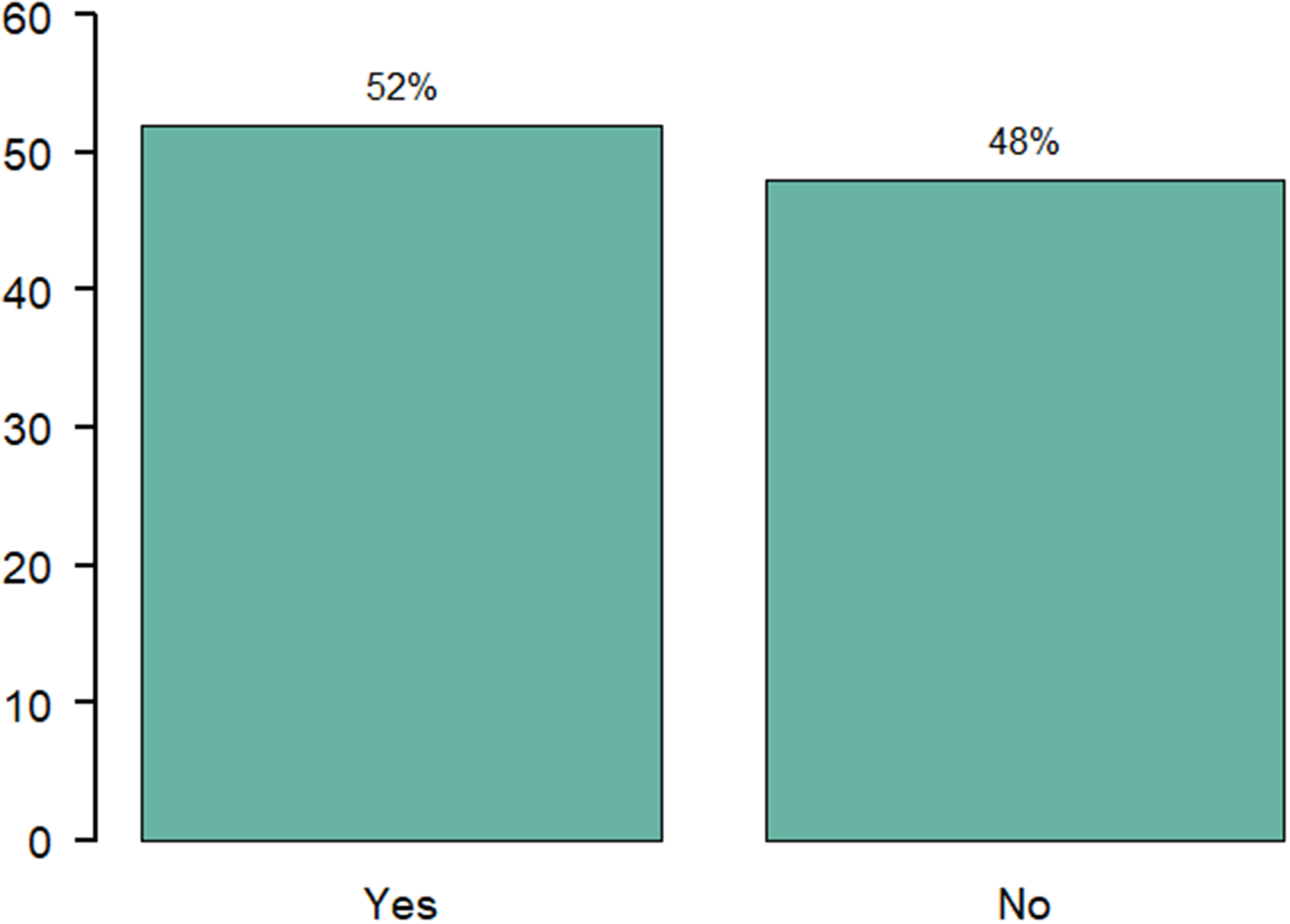
As shown in Figure 1, approximately half of the students had previously participated in a cultural programme and had experience in collaboration. This proved to be very useful, as the individual teams were formed without significant difficulties, and tasks were allocated harmoniously.
Have you participated in a cultural programme before?

Regarding the question about their motivation to participate in the programme, as illustrated in Figure 2, students found the idea of joining an interschool programme appealing, as it provided them with the opportunity to communicate remotely and connect with students from another school whom they did not know, especially during the quarantine period. Online education and the e-learning platform made this collaboration possible, as students met several times in the e-class and in the individual groups they had created on Viber and Instagram.
What motivated you to participate in this programme?
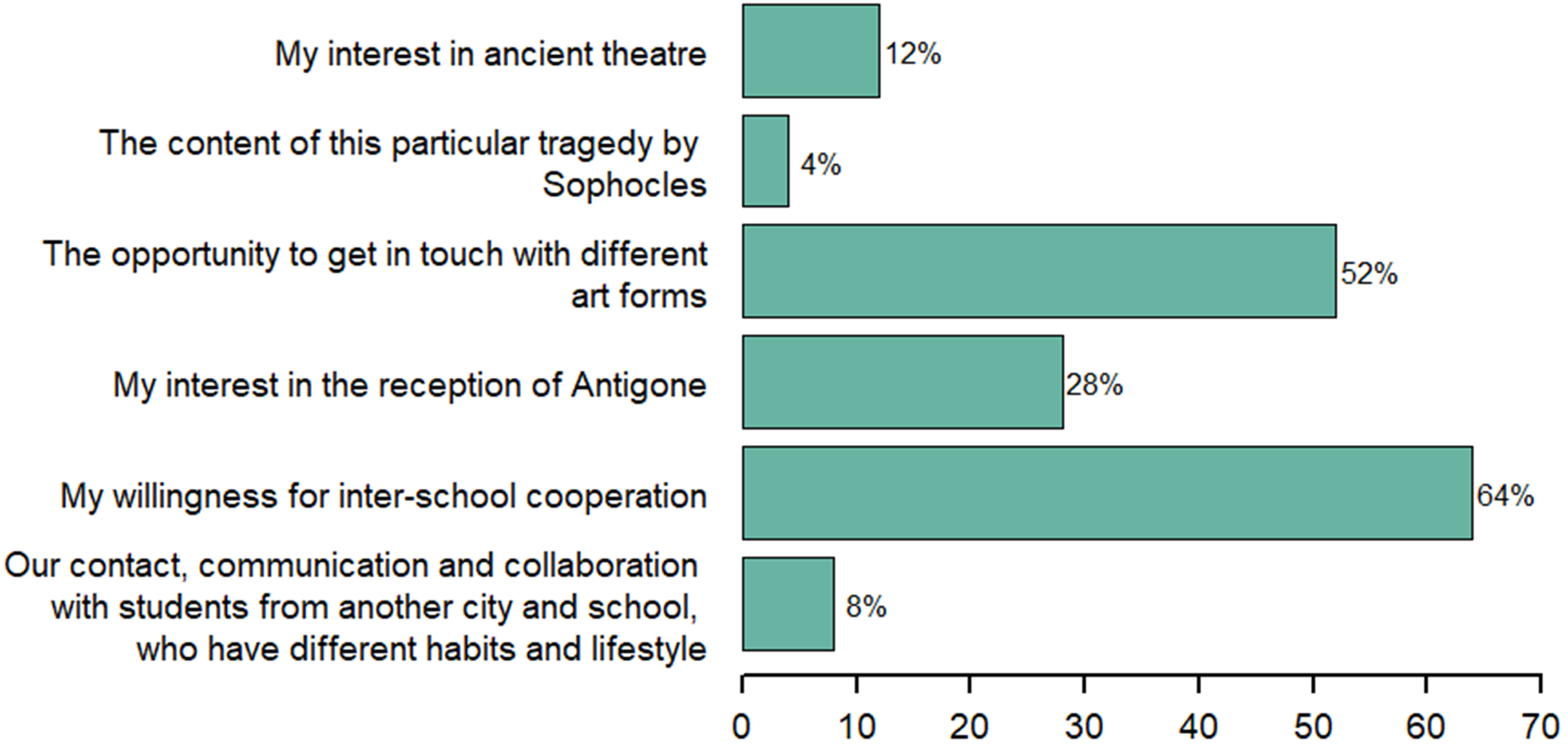
Figure 2 Long description
The bar graph compares various factors motivating participation in a program, with six horizontal bars. The x-axis represents the percentage values ranging from 0 to 70, while the y-axis lists the factors: My interest in ancient theatre, The content of this particular tragedy by Sophocles, The opportunity to get in touch with different art forms, My interest in the reception of Antigone, My willingness for inter-school cooperation, and Our contact, communication and collaboration with students from another city and school, who have different habits and lifestyle. The bars are colored teal. The opportunity to get in touch with different art forms has the highest percentage at 52 percent, followed by My willingness for inter-school cooperation at 64 percent. My interest in the reception of Antigone stands at 28 percent, My interest in ancient theatre at 12 percent, Our contact, communication and collaboration with students from another city and school, who have different habits and lifestyle at 8 percent, and The content of this particular tragedy by Sophocles at 4 percent. All values are approximated.
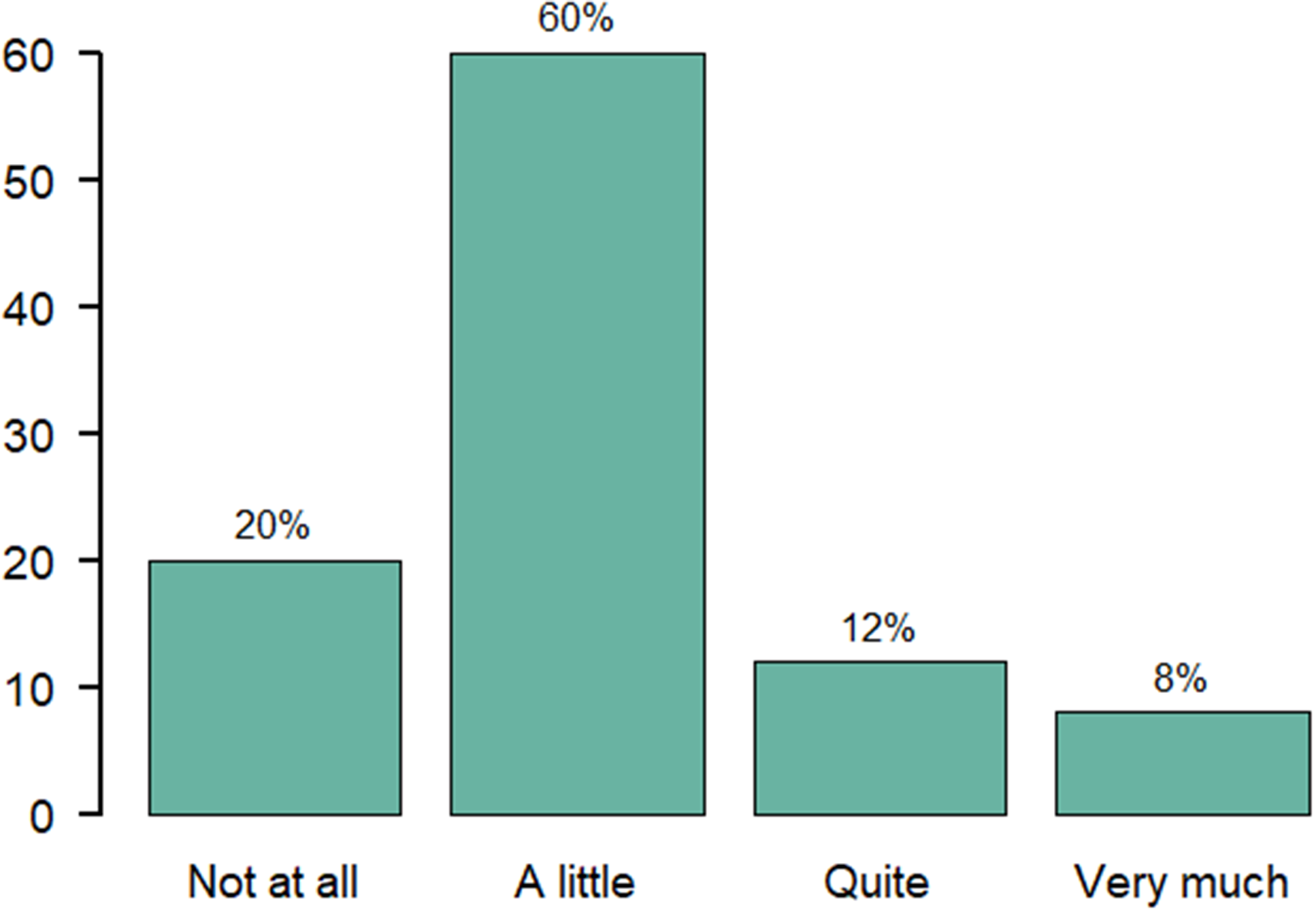
Furthermore, as indicated by responses to the question about how distance education affected the implementation of the programme (Figure 3), the mode of communication significantly influenced both its execution and quality, as stated by 80% of respondents. The e-class platform and the online meetings between students were fundamental to its success, not merely a tool to enhance the process.
To what extent do you think that the distance implementation has influenced the quality of the programme?

Figure 3 Long description
The bar graph compares the extent to which distance implementation has influenced the quality of the programme across four categories: Not at all, A little, Quite, and Very much. There are four vertical bars, each representing a different category. The x-axis is labeled with the categories, and the y-axis is labeled with percentage values ranging from 0 to 60. The bar for 'Not at all' reaches 20 percent, the bar for 'A little' reaches 60 percent, the bar for 'Quite' reaches 12 percent, and the bar for 'Very much' reaches 8 percent. The bars are colored in teal. All values are approximated.
However, while it was fortunate that the e-learning platform enabled the implementation of the programme, which would have been difficult to carry out otherwise, students felt that remote teaching and communication were among its weaknesses (Figure 4). It was not always easy for students to engage both in plenary sessions and in the smaller groups they had formed, which hindered their collaboration.
What do you consider to be the most important weakness in the implementation of the programme?

Figure 4 Long description
The horizontal bar graph compares different factors considered weaknesses in the implementation of a program, with each factor represented by a bar. The x-axis measures the percentage of respondents, ranging from zero to thirty. The y-axis lists the factors: the small number of joint meetings, the organization by the teachers, working in groups, distance learning, the cooperation of pupils from different schools, and the technical problems. The small number of joint meetings is the most cited weakness at twenty-eight percentage, followed by distance learning at twenty-four percentage. The cooperation of pupils from different schools and the technical problems are both noted by sixteen percentage of respondents. Working in groups is identified by twelve percentage, while the organization by the teachers is the least cited weakness at four percentage. The bars are colored in teal, and all values are approximated.
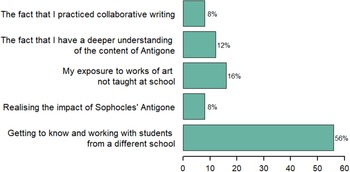
Despite the challenges, students recognised working with students from a different school as the most positive aspect of the programme – an opportunity that would not have been possible without technological support (Figure 5). The students showed a clear desire for interaction and acquaintance with peers from another school, particularly during the lockdown period, when social communication was significantly restricted. This highlights both the social role of the school and the importance of interschool collaborations, as it is widely acknowledged in the educational community that the quarantine caused emotional challenges for students and negatively impacted their socialisation.
What do you consider to be the most positive thing gained from this programme?

Figure 5 Long description
The bar graph compares the most positive things gained from a program, with five horizontal bars. The categories on the y-axis are 'The fact that I practiced collaborative writing', 'The fact that I have a deeper understanding of the content of Antigone', 'My exposure to works of art not taught at school', 'Realising the impact of Sophocles' Antigone', and 'Getting to know and working with students from a different school'. The x-axis represents the percentage values ranging from 0 to 60. The bar for 'Getting to know and working with students from a different school' is the longest at 56 percent, followed by 'My exposure to works of art not taught at school' at 16 percent, 'The fact that I have a deeper understanding of the content of Antigone' at 12 percent, and both 'The fact that I practiced collaborative writing' and 'Realising the impact of Sophocles' Antigone' at 8 percent each. The bars are colored in teal. All values are approximated.
This need for communication during the lockdown period was emphatically expressed by students in their responses regarding the factors that helped them collaborate and complete their assignments (Figure 6). Of the respondents, 64% emphasised that their communication – whether through online meetings or electronic means – was crucial for their cooperation. The availability of materials uploaded to the e-class, providing guidance and reference, as well as clear instructions given to them, also played a key role. Additionally, students creatively used the internet to search for information relevant to their projects.
Which elements/tools helped you the most to collaborate and work on the projects of the programme?

Figure 6 Long description
The horizontal bar graph compares the percentage of students who found different elements or tools helpful for collaborating and working on projects. The x-axis represents the percentage values ranging from 0 to 70, while the y-axis lists the elements or tools: Teleconferences via Webex, The eclass material, The face-to-face or electronic communication between team members, The instructions from the teachers in charge, and Internet search. The bars are colored in teal. Teleconferences via Webex is at 20 percent, The eclass material is at 60 percent, The face-to-face or electronic communication between team members is at 44 percent, The instructions from the teachers in charge is at 32 percent, and Internet search is at 28 percent. All values are approximated.
Interesting insights also emerged from students’ responses about which works of art impressed them the most after the final presentation (Figure 7). The works Antigone Furiosa by G Gambaro and The Island by Athol Fugard (which were introduced to students through a lecture by Prof. Karakantza) received the most votes.1 It is noteworthy that students were particularly moved by these 2 contemporary works, with a strong political character, which reinterpret the ancient Greek myth – one set during the 7-year military dictatorship in Argentina (1976 to 1983) that led to the deaths of over 30,000 people and the other in a South African prison during the apartheid era.
Which of the projects studied during this programme impressed you the most in terms of Antigone?

Figure 7 Long description
The bar graph compares student responses about which works of art impressed them the most after the final presentation. The graph features seven horizontal bars, each representing a different work of art. The x-axis measures the percentage of students impressed, ranging from 0 to 60 percent. The y-axis lists the works of art: Antigona Furiosa by Griselda Gambaro, Antigone by Ares Alexandrou, Antigone by Elias Venezis, Antigone by Jean Anouilh, Ismene by Yannis Ritsos, Paintings by Robertson and Grzegorczyk, and The Island by Athol Fugard. Antigona Furiosa by Griselda Gambaro received the highest percentage at 52 percent, followed by The Island by Athol Fugard at 40 percent, and Paintings by Robertson and Grzegorczyk at 28 percent. Antigone by Ares Alexandrou, Antigone by Jean Anouilh, and Ismene by Yannis Ritsos each received 16 percent. Antigone by Elias Venezis received the lowest percentage at 8 percent. The bars are colored in teal. All values are approximated.
As reflected in the responses to question 8 (Figure 8), 92% of students expressed a positive to very positive opinion about their participation in the programme.
What is your overall impression of the programme?

Figure 8 Long description
The bar graph compares overall impressions of a program across five categories: Inadequate, Adequate, Good, Very good, and Excellent. The graph features five vertical bars, each representing a different impression category. The x-axis labels the categories, while the y-axis indicates the percentage of respondents. The Inadequate and Adequate categories each have a bar reaching four percentage, while the Good and Excellent categories each have a bar reaching sixteen percentage. The Very good category has the highest bar, reaching sixty percentage. All values are approximated.
Finally, in the open-ended question regarding programme improvements, students primarily suggested more virtual meetings among group members and the opportunity for in-person interaction, possibly through an educational trip. However, they acknowledged that such an initiative was extremely difficult owing to the circumstances during quarantine.
Conclusions
From the implementation of this interschool programme, the discussion that followed its completion, and the analysis of the questionnaire, it is evident that the overall effort was successful and beneficial for students from both schools. Initially, the students found the programme’s content, which used art and linked it with a mandatory curriculum subject, to be engaging, as indicated by the high participation rate (24 out of 24 from Varvakeio, 12 out of 19 from the 3rd General High School). Students specifically highlighted the value of engaging with art and noted the limited opportunities schools provide in this area, especially at the high school level. Additionally, the connection between an ancient text and modern works by foreign creators was positively received, as it helped them become acquainted with these works and better understand the concept of tragedy.
The reliable Webex e-learning platform, despite the challenges posed by remote collaboration, enabled meaningful communication and cooperation among students and teachers through live meetings and breakout rooms. Meanwhile, the electronic class of the Greek School Network served as a reference point for completing the asynchronous stages of the programme and its overall execution. This demonstrates that technology, with its educational tools, was crucial to organising and conducting the programme, rather than merely adding value to it.
Furthermore, it should be noted that, after the end of the pandemic, distance education in Greece remains available as a complementary tool and is used occasionally and in a targeted manner, mainly in cases where in-person schooling becomes impossible owing to extreme weather conditions or other emergency situations. Within this framework, it was concluded that, despite minor challenges, the idea of interschool collaboration could be applied to other academic subjects, facilitating interaction and cooperation between schools with different learning profiles and offering clear benefits for both students and teachers. With necessary modifications and improvements, this model could serve as a best practice applicable to other schools. Finally, it is worth noting that in-person contact and extension of the programme through presentations or school trips involving students from both schools would likely enhance their connection, as face-to-face interaction cannot be fully replaced by remote collaboration.
Competing interests
The authors declare none.
Author biographies
Panagiotis Seranis is an affiliated lecturer at Open University of Cyprus and a secondary school teacher in Greece. He holds a BA in Greek Philology (University of Athens) and an MA in Theory and Practice of Teaching and School Assessment from the same university. His PhD (University of Cambridge) focused on the place of reader response in the teaching of the Odyssey. His research interests include the teaching of classical languages with the use of ICT, the use of modern methods in the teaching of classical Greek and Latin, and distance learning. He is a member of the committee who designed and implemented the new curriculum of Ancient Greek Language and Literature in the Greek Lyceum (upper secondary school).
Eleni Liousa is a philologist in Public Secondary Education in Greece, holding a BA in Greek Philology (Aristotle University of Thessaloniki) and an MA in Greek Language and Literature (Open University of Cyprus). Her research interests focus on the use of art in the teaching of philological subjects, and she has presented papers and published articles on related topics.




 Open access

