





Introduction
Research on language contact, that is the interaction between different language communities, has provided extensive evidence for transfer of grammatical patterns from the majority language to the minority language (Argyri & Sorace, Reference Argyri and Sorace2007; Backus, Reference Backus2005; Demirçay, Reference Demirçay2017; Daller, Treffers-Daller & Furman, Reference Daller, Treffers-Daller and Furman2011; Heine & Kuteva, Reference Heine and Kuteva2005; Myers-Scotton, Reference Myers-Scotton2002), in addition to the more common patterns of lexical borrowing. However, previous studies have so far almost exclusively focused on the spoken modality, i.e., speech. Language production, nonetheless, is often multimodal and speakers tend to accompany their speech with gestures (Goldin-Meadow, Reference Goldin-Meadow2003; McNeill, Reference McNeill1992), including speakers who are blind from birth (Iverson & Goldin-Meadow, Reference Iverson and Goldin-Meadow1997; Özçalışkan, Lucero & Goldin-Meadow, Reference Özçalışkan, Lucero and Goldin-Meadow2016). There is also growing evidence that gesture and speech form a single, integrated system (McNeill, Reference McNeill1992; Kendon, Reference Kendon2004; see Özyürek, Reference Özyürek, Church, Alibali and Kelly2017 for a review). Gestures convey lexical, syntactic and pragmatic information that is relevant to what is encoded in the speech they temporally overlap with (Alferink, Reference Alferink2015; Brown & Gullberg, Reference Brown and Gullberg2008; Kendon, Reference Kendon2004; Kita & Özyürek, Reference Kita and Özyürek2003; Krahmer & Swerts, Reference Krahmer and Swerts2007; Özçalışkan, Reference Özçalışkan2016). Importantly, gestures differ cross-linguistically in terms of frequency and form (see Kita, Reference Kita2009; Nicoladis, Reference Nicoladis2007; Özyürek, Reference Özyürek, Church, Alibali and Kelly2017 for review). Based on recurrent and frequent speech and gesture usage patterns within and across languages, some scholars have even argued for multimodal construction units in language within the tradition of Construction Grammar (CG). These constructions are symbolic units that comprise multiple channels of conceptualization and expression (e.g., Langacker, Reference Langacker, Cienki and Müller2008; Zima, Reference Zima2014; Kok & Cienki, Reference Kok. and Cienki2016). Moreover, language input is multimodal (Clark & Estigarribia, Reference Clark and Estigarribia2011; Goldin-Meadow, Reference Goldin-Meadow, Müller, Cienki, Fricke, Ladewig, McNeill and Teßendorf2013) and from early on, bilingual children are exposed to the gestural repertoire of the two languages they grow up speaking.
Given the tight links that have been observed between speech and gesture patterns, and the cross-linguistic variations in those patterns, it is an intriguing question whether and how gestures are influenced when two languages come into contact. Even though there is previous research on gesture production by second language (L2) learners with different proficiency levels in their first and second language (e.g., Aziz & Nicoladis, published online 18 June 2018; Gullberg, Reference Gullberg2006; Nicoladis, Pika, Yin & Marentette, Reference Nicoladis, Pika, Yin and Marentette2007; Sherman & Nicoladis, Reference Sherman and Nicoladis2004), no study so far has investigated what happens to gestures when languages come into contact by speakers of a heritage /minority language who were born and raised in a majority language context. Heritage speakers are typically second-generation immigrants whose home language is a minority language. They usually acquire the minority language as their first language (L1) at home during early years and the majority language as their second language (L2) to which they have increasing exposure after starting (pre)school (Montrul & Polinsky, Reference Montrul. and Polinsky2011; Polinsky & Kagan, Reference Polinsky and Kagan2007).
This paper aims to contribute to the literature by exploring possible changes in gesture rate in general and also as a function of different types of gestures in a language contact context. It investigates gestures as produced by second-generation Turkish heritage speakers in the Netherlands (born and raised in the Netherlands), comparing bilingual speakers’ gesture production in both Turkish (relatively higher gesture rate language) and Dutch (relatively lower gesture rate language) to monolingual baselines in each language. Note that throughout the paper, we use ‘monolingual’ as an operational term to refer to participants who were raised monolingually (i.e., in Turkey for Turkish and Netherlands for Dutch) and spoke only one of the languages that we study, Turkish or Dutch. All participants in this study, both bilingual and monolingual speakers, reported to have knowledge of English to some extent. However, none of the participants grew up with English as an early first language and they were all exposed to English after the age of 10 in a classroom context.
There is overall a high level of attainment of both Turkish and Dutch in the Turkish community in the Netherlands (Backus, Reference Backus, Bhatia and Ritchie2012). Heritage speakers are usually exposed to mainly Turkish at home and start to get exposed to Dutch as early as 4 years old when they start elementary school. The Turkish community in the Netherlands, albeit integrated to the Dutch culture, is also highly connected among themselves and they also have close ties to culture in Turkey and to their acquaintances and relatives who are still living there (i.e., through watching Turkish TV at home and frequent visits to Turkey etc.). Hence, heritage speakers of Turkish have frequent contact with both language communities throughout their lives. Bilingual speakers in this study have high proficiency in both Turkish and Dutch and use both languages regularly. Thus, gestures used by this population can reveal some insights about whether a) the gestures of the minority language adapt to those of the majority language or b) bilingual speakers maintain the language-specific gesture rates as they are proficient users in each language , and/or c) some cognitive factors such as the possible cognitive cost of inhibiting the task-irrelevant language can explain gesture use as bilinguals may exploit iconic and/or deictic gestures to help organize their speech and to help reduce cognitive load (Nicoladis, Reference Nicoladis2006, Reference Nicoladis2007; Nicoladis, Pika & Marentette, Reference Nicoladis, Pika and Marentette2009).
Cross-linguistic differences in gesture
Gestures accompanying speech (i.e., co-speech gestures) can vary in form and function. For example, they may present images of physically present or absent concrete entities and/ or actions (i.e., iconic gestures), locate physically non-present entities in gesture space (i.e., abstract deictic gestures), point at physically present objects (i.e., concrete deictic gestures) or be simple and rapid hand movements which direct attention to the rhythmical peak of speech (i.e., beat gestures) (McNeill, Reference McNeill1992, Reference McNeill and Brown2006). Irrespective of their form, gestures are tightly linked to speech (Kita & Özyürek, Reference Kita and Özyürek2003; McNeill, Reference McNeill1992; So, Kita & Goldin-Meadow, Reference So, Kita and Goldin-Meadow2009); they convey relevant information to what is expressed in the parts of speech they overlap with (see Özyürek, Reference Özyürek, Church, Alibali and Kelly2017 for a review). Even though all types of gestures can be found in different languages, there are also systematic cross-linguistic differences in patterns of gestures (cf. Gullberg, Reference Gullberg, Bhatia and Ritchie2012; Kita, Reference Kita2009).
One of the most studied domains in relation to cross-linguistic differences in gesture patterns is expression of motion events due to cross-linguistic variation in the linguistic encoding of path and manner of those events (Talmy, Reference Talmy2000). For example, native speakers of English tend to conflate manner and path components of an event into a single clause in their speech (e.g., ‘The boy ran into the house’), while native speakers of Turkish tend to encode path information in the verb in the main clause and optionally express manner outside the verb in another subordinate clause e.g., Oğlan (koşarak) eve girdi ‘The boy (by running) entered the house’ (cf. Özçalışkan, Reference Özçalışkan2016). Following speech patterns, native speakers of English tend to conflate manner and path components into a single gesture (e.g., moving fingers in rapid movements while moving them forward as if running) while native speakers of Turkish tend to produce separate gestures for manner (i.e., ran) and path (i.e., entered) (Kita & Özyürek, Reference Kita and Özyürek2003; Özçalışkan, Reference Özçalışkan2016; Özçalışkan & Slobin, Reference Özçalışkan, Slobin, Greenhill, Littlefield and Tano1999). Therefore, speakers show cross-linguistic variation with regard to the shape and form of gestures that accompany speech (see for further evidence: Brown & Gullberg, Reference Brown and Gullberg2008; Kita & Özyürek, Reference Kita and Özyürek2003; McNeill & Duncan, Reference McNeill, Duncan and McNeill2000; Özçalışkan, Reference Özçalışkan2016; Özyürek, Kita, Allen, Brown, Furman & Ishizuka, Reference Özyürek, Kita, Allen, Brown, Furman and Ishizuka2008). Recently, similar gesture patterns have been found in a comparison of blind English and Turkish speakers’ motion event descriptions, showing that these gesture patterns are shaped by language specific ways of encoding and packing semantic information rather than seeing or adopting to others’ gesture patterns in the culture (Özçalışkan et al., Reference Özçalışkan, Lucero and Goldin-Meadow2016). These findings have been explained by the Interface Theory (Kita & Özyürek, Reference Kita and Özyürek2003) which postulates interactions between gesture and spoken language production where language-specific encoding and packaging of semantic information influence the form of gestures.
Cross-linguistic differences in gestures have also been found for spatial frames of reference, e.g., absolute frame of reference (e.g., north, south) versus relative frame of reference (e.g., right, left) (Kita & Özyürek, Reference Kita and Özyürek2003; Levinson, Reference Levinson2003), spatial expression of time (Kita, Reference Kita2009) and time metaphors (Bostan, Börütecene, Özcan & Göksun, Reference Bostan, Börütecene, Özcan, Göksun, Papafragou, Grodner, Mirman and Trueswell2016; Casasanto & Jasmin, Reference Casasanto and Jasmin2012; Gu, Mol, Hoetjes & Swerts, Reference Gu, Mol, Hoetjes and Swerts2017; Núñez & Sweetser, Reference Núñez and Sweetser2006).
Frequent and recurrent speech and gesture pairings, at different levels of semantic and syntactic encodings within and across languages, have also been used to argue for the existence of multimodal construction units. Such an argument postulates the existence of language-specific lexical and syntactic multimodal constructions that are entrenched symbolic units in line with a usage-based approach to language. For example, in Turkish, expressions that encode manner and path would exist as separate symbolic units co-occurring with verbs and corresponding manner and path gestures; whereas, in English, both the manner and the path particle would constitute a symbolic unit together with conflated manner and path gestures (Zima, Reference Zima2014).
Previous studies also point to differences in the amount of gestures per speech units across languages. For example, Italian culture has been suggested to be a high gesture culture (Efron, Reference Efron1941; Kendon, Reference Kendon1992) while (British) English has been described as low gesture culture (Graham & Argyle, Reference Graham and Argyle1975). Direct comparisons of gesture rate, on the other hand, are rare in the literature. So (Reference So2010) for example showed that Mandarin speakers in mainland China gestured less than American English speakers, suggesting English is a relatively higher gesture culture than Mandarin-Chinese. In another study, Cavicchio and Kita (Reference Cavicchio and Kita2013) found that Italian is a relatively higher gesture culture than British English.
Building upon previous research on this topic, here we focus on gesture rate as a measure to investigate to what extent gestures change as a result of language contact between speakers of two different languages, and whether contact can influence gesture rates in bilinguals. We should note that what gives rise to gesture rate differences across languages is not well-understood as the differences might be linked to the specificity of the language at different levels (e.g., lexical, syntactic, information packaging, prosody or simply to the speech rate itself). It is beyond the scope and the ambition of this paper to account for the differences in gesture rate in the languages we study. We do, however, present some speculations in the discussion section about the link between gesture rate and type of languages we study.
Gestures and bilingualism
Few previous studies have investigated what happens to different types of gestures when speakers regularly use more than one language – especially when the two languages differ in their gesture rates. Even though such a question has not been asked for bilinguals growing in language contact situations before, most of the earlier work on bilingual gestures focused on second language learning and the amount of gestures in relation to language proficiency and dominance in L2 speakers (e.g., Gullberg, Reference Gullberg1998, Reference Gullberg2006; Pika, Nicoladis & Marentette, Reference Pika, Nicoladis and Marentette2006; Sherman & Nicoladis, Reference Sherman and Nicoladis2004) and has produced some mixed results.
Some of the previous studies investigated whether bilinguals use more gestures in their weaker second language (L2) than in their stronger first language (L1) as a possible learner's strategy, comparing gesture rate in the L1 to the gesture rate in the L2. It has been found that bilingual adults use abstract deictic gestures more often with their L2 than with their L1 (e.g., Gullberg, Reference Gullberg1998; Marcos, Reference Marcos1979; Sherman & Nicoladis, Reference Sherman and Nicoladis2004). As for iconic gestures, some studies found no difference across L1 and L2 with regard to gesture rate (Sherman & Nicoladis, Reference Sherman and Nicoladis2004) while some found more iconic gestures in the L1 (Gullberg, Reference Gullberg1998). In the light of these findings, it has been suggested that iconic and abstract deictic gestures (henceforth, we refer to abstract deictics when we mention deictics) might be related to speech in different ways (Gullberg, 2013; Nicoladis, Mayberry & Genesee, Reference Nicoladis, Mayberry and Genesee1999; Sherman & Nicoladis, Reference Sherman and Nicoladis2004). Deictic gestures have been suggested to co-occur with grammatical or discourse organizational difficulties. Gullberg (Reference Gullberg1998) for example suggest that speakers may use deictic gestures when they have problems with expressing tense, using deictic gestures to help indicate the sequence of events by mapping them out spatially (Gullberg, Reference Gullberg1998). Deictic gestures can also help with discourse organization by allocating a specific gesture space to referents, for example, and by referring back to those spaces the next time the same referent is mentioned (Gullberg, Reference Gullberg1998, Reference Gullberg2006; Yoshioka, 2008). Iconic gestures, on the other hand, may emerge when speakers are trying to be particularly detailed or imagistic (Alibali, Kita & Young, Reference Alibali, Kita and Young2000) and may be used to mediate difficult speech for the listener (Beattie & Shovelton, Reference Beattie and Shovelton2000; Sherman & Nicoladis, Reference Sherman and Nicoladis2004).
Some other studies have focused on the effects of high vs. low rate of gesturing on bilingual gesture rate. Pika et al. (Reference Pika, Nicoladis and Marentette2006) found that English(L1) –Spanish and French(L1) –English bilinguals living in the English-speaking part of Canada produced more iconic gestures while speaking English compared to English monolingual speakers. This difference was not present for deictic gestures. The authors interpreted these findings as evidence for gesture rate transfer from higher-gesture language (Spanish and French) to lower-gesture language (English), assuming Spanish and French are both higher-gesture languages than English. Note, however, that the study did not have monolingual baselines for gesture rate in Spanish and French. Therefore, it is also possible that bilinguals might have gestured more than monolinguals overall rather than transferring gesture rate. Such a trend was indeed shown by Nicoladis et al. (Reference Nicoladis, Pika and Marentette2009) who found no evidence for gesture rate transfer for English–French bilingual children in Canada even though bilingual children tended to use more iconic gestures than monolingual comparison groups while speaking in both English and French. The authors suggested that bilinguals have more “choices” for how to package verbal messages compared to monolinguals, and bilinguals may gesture more than monolinguals which will help them hold information in memory while they search for how to package their message.
Smithson, Nicoladis and Marentette (Reference Smithson, Nicoladis and Marentette2011) on the other hand did not find differences for iconic gestures in English between monolingual and bilingual children living in Canada (Chinese–English and French–English bilinguals) which they interpreted as “bilingualism alone does not lead to a higher gesture rate” (p. 342). The study, however, again did not have monolingual baselines either for French or Chinese, which makes it difficult to evaluate whether the authors’ proposition is generalizable to the other language of bilinguals.
Collapsing iconic and deictic gestures into one category, representational gestures, So (Reference So2010) compared the gesture rate of Chinese–English bilingual speakers in Singapore, where English is taught in schools from early on, to the gesture rate in monolingual Mandarin-Chinese and in monolingual US English speakers. So found higher gesture rate in monolingual English than in monolingual Chinese. Even though bilingual speakers’ gesture rate was not different from the monolingual baseline while speaking in English, they produced more gestures than the monolingual baseline while speaking in Chinese. Based on those findings, So argued that gesture rate for representational gestures was more likely to be transferred from the relatively higher gesture language (i.e., English) to the relatively lower gesture language (i.e., Chinese) than the other way around. No transfer effect was found for non-representational gestures, i.e., gestures that do not bear semantic relations to their referent (for example beat gestures that direct attention to the rhythmical peak of speech, McNeill, Reference McNeill1992, Reference McNeill and Brown2006). So, therefore, concluded that representational gestures were more likely to be transferred than non-representational gestures.
In a more recent study, Cavicchio and Kita (Reference Cavicchio and Kita2013) investigated the gesture rate of Italian–English bilinguals, some of whom were living in Italy and some in the UK. They found higher gesture rate in monolingual Italian than in monolingual English speakers. Unlike the findings from Pika et al. (Reference Pika, Nicoladis and Marentette2006) and So (Reference So2010), Cavicchio and Kita did not find evidence for gesture rate transfer. Instead, bilingual speakers maintained the cross-cultural differences in gesture rate. Note that Cavicchio and Kita did not differentiate between different types of gestures (e.g., differentiating between iconic versus deictic gestures as in Pika et al. or representational versus non-representational gestures as in So). If representational gestures are indeed more likely to be transferred than non-representational gestures (So, Reference So2010), the lack of gesture rate transfer in Cavicchio and Kita might have been conflated by collapsing all types of gestures together in the analysis.
Overall, the mixed findings in the literature make it hard to draw strong conclusion regarding whether gesture rate is transferred or not. Also, due to the absence of monolingual comparison groups in most of the published studies, it is hard to tease apart the effects of being bilingual in general versus proficiency on gesture rate. Previous studies have not provided an explanation for a mechanism for adaptations of gesture rates from one language pattern to another, either (e.g., from high to low levels). Finally, while some studies report general gesture rate, others focus on the rates of different gesture types such as iconics and deictics, which makes the comparison of findings across different populations difficult.
Present Study
The purpose of this study is to explore what happens to gesture rate when one relatively higher-gesture language (as minority language) comes into contact with a relatively lower-gesture language (as majority language) and whether gesture rate is more likely to be transferred for some gesture categories than others (i.e., iconic versus deictic). To answer those questions, we study gestures of Turkish–Dutch bilingual speakers in the Netherlands (while speaking in both Turkish and Dutch) as well as gestures of monolingually raised speakers of Turkish in Turkey and monolingually raised speakers of Dutch in the Netherlands.
We also test if Turkish is indeed a higher gesture language than Dutch as Mediterranean cultures are usually found to be relatively higher gesture cultures (Barzini, Reference Barzini1964; Cavicchio & Kita, Reference Cavicchio and Kita2013; Kendon, Reference Kendon1992; Scheflen, Reference Scheflen1972) even though the reasons for this are not clear. We expected Turkish monolinguals to produce more gestures than Dutch monolingual speakers, as previous studies usually found gesture rate to be higher in Mediterranean area than that in North Europe (Barzini, Reference Barzini1964; Cavicchio & Kita, Reference Cavicchio and Kita2013; Kendon, Reference Kendon1992, Scheflen, Reference Scheflen1972). However, we acknowledge that the reasons for cross-linguistic differences in gesture rate are not completely understood and therefore we do not have clear predictions about the status of iconic versus deictic gesture rate.
As for the bilingual gesture rate, one possibility is that bilingual speakers will transfer gesture rate due to daily contact between the Turkish and Dutch speaking communities, as speakers are known to adjust their gestures according to their interlocutors: for example, due to a mimicking strategy (Holler & Wilkin, Reference Holler and Wilkin2011). Bilinguals may reduce gesture rate in their higher gesture language, Turkish, as an adaptation to the lower gesture rate of the majority language, Dutch, due to everyday contact with Dutch speakers. These predictions would derive from an account that considers social factors influencing gesture production.
An alternative prediction, based on usage-based accounts, is that gesture rates should not differ between monolinguals and bilinguals considering that the speakers in this study have been frequently exposed to each language from very early on in their lives and are proficient in each language.
A third possibility is that bilinguals will have higher gesture rates than either monolingual group. This prediction is based on previous literature that has suggested that bilinguals activate their two languages simultaneously (Broersma, Carter & Acheson, Reference Broersma, Carter and Acheson2016; Grosjean, Reference Grosjean and Nicol2001) and inhibiting the task-irrelevant language might induce cognitive cost (Sorace & Serratrice, Reference Sorace and Serratrice2009). In that case, bilinguals may exploit iconic and/or deictic gestures to help organize their speech and to reduce cognitive load, a pattern that has been suggested to be in place for monolingual speakers (Alibali & DiRusso, Reference Alibali and DiRusso1999; Goldin-Meadow, Reference Goldin-Meadow, McClelland and Siegler2001; Goldin-Meadow, Nusbaum, Kelly & Wagner, Reference Goldin-Meadow, Nusbaum, Kelly and Wagner2001; Wagner, Nusbaum & Goldin-Meadow, Reference Wagner, Nusbaum and Goldin-Meadow2004) (see Nicoladis, Reference Nicoladis2006, Reference Nicoladis2007; Nicoladis et al., Reference Nicoladis, Pika and Marentette2009 for a similar discussion about bilingual gestures).
We contribute to existing literature on bilingualism as well as multimodal language production in following ways. First, we provide gesture rate data from a novel language pair in the domain of bilingual gestures, i.e., Turkish and Dutch. Second, we study a different population of bilinguals from those studied earlier. Bilingual participants in this study were early learners and highly proficient in the L2. Therefore, they are different from previously studied speakers who started learning their L2 at a later stage and mostly had weaker proficiency in their L2 than in their L1. The advantage of studying such a population is that the gesture rate in each language is less likely to be modulated by language dominance. Furthermore, speakers growing up with both languages and cultures have had enough exposure to each culture to test whether some accommodation of gesture rate can take place from minority to majority languages or vice-versa.
Finally, going beyond previous research on gesture rate transfer, we situate our predictions on cognitive and social mechanisms that might modulate speech and gesture production.
Participants
Twenty heritage speakers of Turkish studying in Nijmegen, the Netherlands (14 females; M age = 23.3, SD = 2.95), twenty monolingually raised Turkish speakers studying in Istanbul, Turkey (17 females; M age = 22.2, SD = 1.75) and twenty monolingually raised Dutch speakers studying in Nijmegen, the Netherlands (14 females; M age = 21.5, SD = 2.73) participated in the study in return for payment or course credit. All heritage speakers were second-generation immigrants who were born and were raised in the Netherlands by first-generation parents, who themselves were first-generation immigrants who moved to the Netherlands from Turkey (Mean immigration age was M age = 15.9, SD = 5.12 for the mothers and M age = 19, SD = 7.24 for the fathers). When the participants in this study were born, the mothers on average had already lived in the Netherlands for 9.2 years (SD = 6.66) and fathers for 11.15 years (SD = 7.46).
The bilingual speakers acquired Turkish as their first language (L1) at home during early years and Dutch as their second language (L2) to which they have had increasing exposure after the age of 4. They also had an early exposure to some Dutch from their parents, who were themselves late learners of Dutch. The speakers are highly proficient in both languages – within and beyond their home situations – and use each language regularly on a daily basis. On a 5-point Likert scale, bilinguals rated the frequency of their current language use in various environments and with various interlocutors (1 = never; 2 = rarely; 3 = sometimes; 4 = most of the time; 5 = all the time) as well as their proficiency in both Turkish and Dutch (1 = native; 2 = native-like; 3 = advanced; 4 = intermediate 5 = beginner). The analysis on the ratings showed that bilinguals’ self-rated frequency of language use for Turkish (M = 2.43, SD = 0.92) and Dutch (M = 2.91, SD = 1.31) was not significantly different, ß = −0.484, SE = 0.330, t-value = −1.465. Bilinguals rated their overall proficiency in Turkish to be somewhere between native-like and advanced (M = 2.40), although the rating scores were even higher for Dutch (M = 1.50), ß = 0.900, SE = 0.15, t-value = 2.853 (see Table C1 in Appendix C for the random effect structure of the analyses). Bilinguals also reported speaking mostly in Dutch at school and in Turkish at home with their parents while mostly mixing the two languages among Turkish speaking friends.
We used speech analysis software Praat (Boersma, Reference Boersma2001) to measure participants' articulation rate across both languages (number of syllables/time) for a 10 second speech sample from the elicited narratives (cf. De Jong & Wempe, Reference De Jong and Wempe2009 for the script). The articulation rate of bilinguals in Dutch (M = 4.42, SD = 0.57) did not significantly differ from that of the monolingual baseline in Dutch (M = 4.62, SD = 0.71) (ß = 0.191, SE = 0.204, t-value = 0.934). The comparison of articulation rate in Turkish did not show a significant difference between bilingual speakers (M = 4.44, SD = 0.63) and the monolingual baseline, either (M = 4.81, SD = 0.55) (ß = 0.375, SE = 0.188, t-value = 1.994, p = .053Footnote 1).
Stimuli
We used two short silent videos (Azar, Backus & Özyürek, Reference Azar, Backus, Özyürek, Papafragou, Grodner, Mirman and Trueswell2016, Reference Azar, Backus, Özyürek, Gunzelmann, Howes, Tenbrink and Davelaar2017) to elicit narratives. In one video, three women engaged in cooking activities (kitchen video, Perniss & Özyürek, Reference Perniss and Özyürek2015) and, in the other video, two women and a man engaged in office activities (office video). Figure 1 illustrates stills depicting different segments from each video. See Appendix A for a detailed list of events taking place in each video stimulus.
Stills form the two video stimuli, kitchen video at the top and office video at the bottom

Procedure
Prior to the data collection session, participants were informed that the study was about language production without any mention of gestures and then they signed consent forms. Participants watched the two stimulus videos one by one on a computer screen and narrated what they had watched to an addressee after each video. The computer screen turned white after each video and stayed white during the narrations. The addressees were not confederates; there was a different addressee in each session; and they did not see the videos before or during the narrations. Addressees were instructed that they could ask clarification questions once the narrative was complete and they were going to answer two short written questions about each narrative. Once the instructions were given, the experimenter left the room and came back after each narrative with questions for the addressee. Speakers repeated the task once in Turkish with a Turkish monolingual addressee and once in Dutch with a Dutch monolingual addressee, with at least a two-week interval between the two sessions. Turkish monolingual addresses were recruited from exchange university students from Turkey who were visiting the Netherlands for a semester abroad. The order of the two videos and the two language sessions was counterbalanced. All sessions were videotaped. Monolingual participants performed the task once.
Data coding
Data were transcribed and annotated using ELAN video annotation software (available online: https://tla.mpi.nl/tools/tla-tools/elan/) (Lausberg & Sloetjes, Reference Lausberg and Sloetjes2009). The data we present in this study were collected and annotated for a corpus of multimodal reference tracking by Turkish–Dutch bilinguals (in preparation). Meta-narratives such as commentaries about the characters were excluded from the corpus and the same exclusion criteria were used for all language and speaker groups.
First, the narratives were divided into clauses, units with a single subject argument and a single predicate (Berman & Slobin, Reference Berman and Slobin1994). Coordinated clauses were coded as separate clauses (e.g., ‘the man stood up and he walked to the bookshelf’ was coded as two clauses). Relative clauses that modified nouns (e.g., ‘the woman who was helping the man’) were not coded as separate clauses but as the modifier of the noun (in this case ‘who was helping the man’ was not coded as a separate clause). This was to make sure that the coding scheme was comparable across Turkish and Dutch (relative clauses are finite in Dutch but non-finite in Turkish).
Next, gesture strokes that co-occurred with any part of the speech clauses were identified. Stroke is the meaningful part of the gestural movement (Kendon, Reference Kendon2004; McNeill, Reference McNeill1992) as the expressive segments of the stream of manual production (Kita, van der Hulst & van Gijn, Reference Kita, van der Hulst, van Gijn, Wachsmuth and Fröhlich1998). We categorized strokes into iconic, deictic and non-representational gestures (gestures that do not depict information about their referent). However, we analyze only iconic and deictic gestures as these two types of gestures show up most frequently in adult storytelling (McNeill, Reference McNeill1992) and they are more likely to be transferred by bilingual speakers (So, Reference So2010). In total, 743 non-representational gestures were excluded from the analyses (185 in bilingual Turkish, 270 in monolingual Turkish, 155 in bilingual Dutch and 133 monolingual Dutch). The proportion of excluded gestures was similar across all speaker groups (15% for bilingual Turkish and monolingual Dutch and 16% for bilingual Dutch and monolingual Turkish).
Iconic gestures represent images of actions and entities (McNeill, Reference McNeill1992). Figure 2 illustrates an example of an iconic gesture. Deictic gestures are pointing motions that use spatial location to indicate discourse entities (e.g., Azar et al., Reference Azar, Backus, Özyürek, Gunzelmann, Howes, Tenbrink and Davelaar2017; Sherman & Nicoladis, Reference Sherman and Nicoladis2004). They can be executed with an extended index finger, thumb or with all fingers extended. Deictic gestures in our data set are abstract pointing gestures that co-occurred with referents that were physically absent in the environment and they could refer to persons or the objects in the narratives. Figure 3 illustrates an example of a deictic gesture.
Bilingual speaker speaking in Dutch (left panel) is producing an iconic ‘stirring’ gesture, referring to the action performed by the woman who is standing in the stimulus video (right panel). Her gesture is temporally aligning with roeren ‘stirring’ in her speech.

Bilingual speaker speaking in Turkish (left panel) is producing a deictic gesture referring to the woman who is walking in the stimulus video (right panel). His gesture is temporally aligning with o bayan ‘that woman’ in his speech.

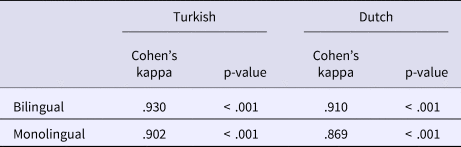
A second coder coded around 13% of the gestures for reliability. The two coders had a high initial agreement for the presence of a stroke (84% for bilingual Turkish, 85% for monolingual Turkish, 87% for bilingual Dutch and 91% for monolingual Dutch); also a high agreement for the gesture type (iconic gestures, deictic gestures or other category of gestures). The two coders reached 100% agreement for the presence/ absence of a gesture stroke and the gesture type for each speaker group in a meeting where the initial discrepancies were discussed and resolved. Table 1 summarizes the initial agreement values for gesture type coding.
Inter-rater reliability scores for gesture type coding
Analyses
Table 2 summarizes the total and mean number of speech clauses that were produced by each speaker group.
Total and average number of speech clauses in Turkish and Dutch per speaker group (Standard Deviation)

Gesture rate is usually calculated in relation to speech based on either the number of clauses (So, Reference So2010; Gullberg, Reference Gullberg1998) or the number of (100) words (Cavicchio & Kita, Reference Cavicchio and Kita2013; Pika et al., Reference Pika, Nicoladis and Marentette2006; Sherman & Nicoladis, Reference Sherman and Nicoladis2004). We calculated gesture rate in relation to the number of speech clauses, as clause is considered to be an important processing unit for speech as well as for gesture production (Levelt, Reference Levelt1989, Kita, Reference Kita2009; Kita & Özyürek, Reference Kita and Özyürek2003). Additionally, we aimed to account for the structural differences between Turkish and Dutch, Turkish being an agglutinative language while Dutch is not. In most cases, the same event unit is expressed with fewer words in Turkish than in Dutch because Turkish uses suffixes to mark some information such as case marking which is mostly expressed with separate words in Dutch. For example, the event unit showing a man walking towards the bookshelf can be expressed with three words in Turkish (e.g., Adam kitaplığa yürüdü ‘Man walked to the bookshelf’), but six words in Dutch (De man liep naar de boekenkast ‘The man walked towards the bookshelf’). The same event unit, however, is expressed with one clause in each language. Therefore, while gesture rate that is calculated based on the number of words in speech would yield a higher gesture rate for Turkish (0.33) than for Dutch (0.17), calculating gesture rate per speech clause yields the same rate for both speaker groups, accounting for the cross-linguistic differences in morpho-syntax. Finally, subject and/or object arguments are usually dropped in Turkish but not in Dutch, therefore a word-based rate count would disadvantage Dutch gesture rate.
We performed linear mixed-effect models on the mean number of gestures per clause per participant (hence each participant contributing one data point for gesture rate) using lmer function from the lme4 package (cf. Bates, Maechler, Bolker & Walker, Reference Bates, Maechler, Bolker and Walker2015) in the software R, version 3.4.3. We simultaneously entered Language Type (Dutch versus Turkish) and Language Status (monolingual versus bilingual) as well as the interaction term of Language Type and Language Status as fixed effects in each analysis. Random intercepts for participants were also included in the analyses (see Table C2 in Appendix C for the random effects structure of the gesture analyses). We first examined the overall gesture rate collapsing two types of gestures – as in Cavicchio and Kita (Reference Cavicchio and Kita2013) and in So (Reference So2010) – so that we can compare our findings to those studies. Later, we performed separate analyses on iconic and deictic gestures (following Sherman & Nicoladis, Reference Sherman and Nicoladis2004; Gullberg, Reference Gullberg1998; Pika et al., Reference Pika, Nicoladis and Marentette2006). Appendix B provides a detailed summary of the fixed effect structures for each gesture rate analysis.
Results
There were in total 4066 iconic and deictic gestures in the data set. Table 3 summarizes the total and mean number of gestures per gesture type.
Total and mean number gestures per gesture type category in Turkish and Dutch per speaker group (Standard Deviation)

Overall gesture rate
The analysis on overall gesture rate – i.e., the mean number of gestures per clause per participant – showed a significant main effect of Language Type (ß = 0.223, SE = 0.100, t-value = 2.227), such that gesture rate was higher in Turkish than in Dutch. However, there was no significant main effect of Language Status (ß = −0.149, SE = 0.137, t-value = −1.090) and no significant interaction between Language Type and Language Status (ß = 0.208, SE = 0.169, t-value = 1.228). Figure 4 illustrates the overall gesture rate in Turkish and Dutch for monolingual and bilingual speakers.
Mean number of gestures per clause in Turkish and Dutch in bilingual and monolingual narratives (the number of iconic and deictic gestures collapsed)

Iconic gesture rate
The analysis on iconic gesture rate calculated as the total number of iconic gestures divided by total number of speech clauses returned a significant main effect of Language Type (ß = 0.110, SE = 0.044, t-value = 2.515) such that iconic gesture rate was higher in Turkish than in Dutch. However, there was no significant main effect of Language Status (ß = 0.032, SE = 0.078, t-value = 0.414) and there was no significant interaction between Language Type and Language Status (ß = 0.135, SE = 0.090, t-value = 1.503). Figure 5 illustrates iconic gesture rate in Turkish and Dutch for monolingual and bilingual speakers.
Mean number of iconic gestures per clause in Turkish and Dutch in bilingual and monolingual narratives

Deictic gesture rate
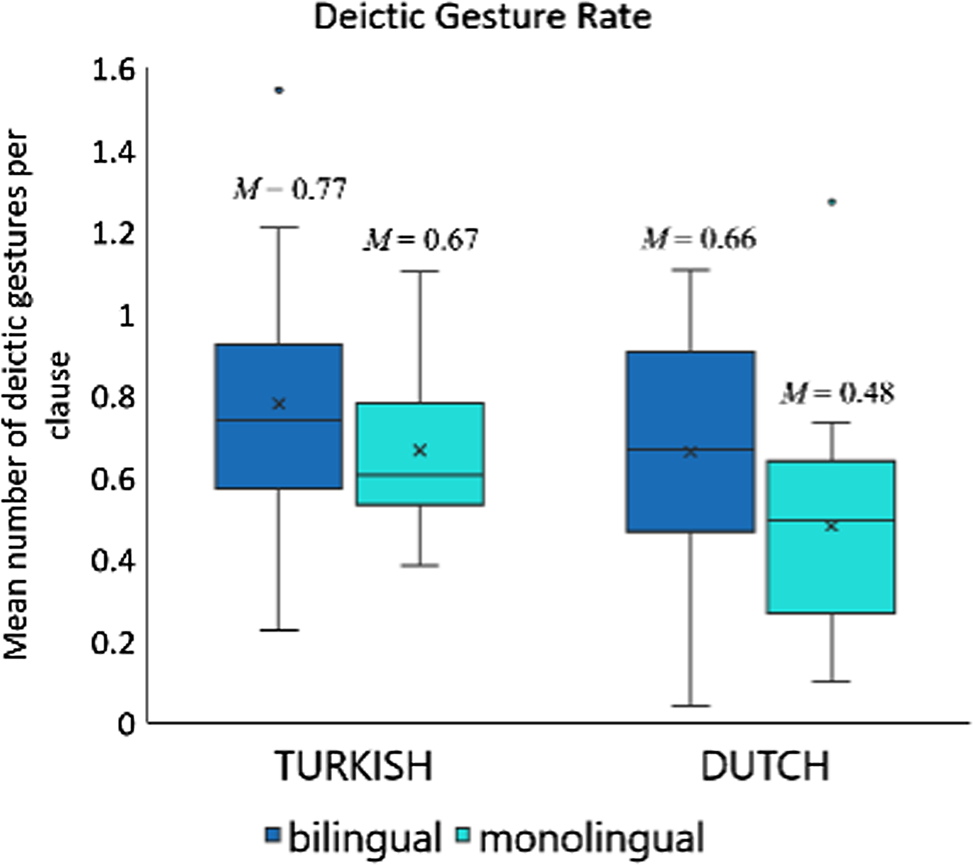
The analysis on deictic gesture rate calculated as the total number of deictic gestures divided by total number of speech clauses did not return a significant main effect of Language Type (ß = 0.112, SE = 0.070, t-value = 1.608) but a significant main effect of Language Status (ß = −0.181, SE = 0.085, t-value = −2.129). There was, however, no significant interaction between Language Type and Language Status (ß = 0.073, SE = 0.110, t-value = 0.664). Figure 6 illustrates the deictic gesture rate in Turkish and Dutch for monolingual and bilingual speakers. Unlike the analysis on overall gesture rate and iconic gesture rate, we did not find a higher deictic gesture rate in Turkish than in Dutch. We will discuss possible explanations later, in the Discussion section.
Mean number of deictic gestures per clause in Turkish and Dutch in bilingual and monolingual narratives
Gesture rate and language measures
We explored whether there were significant correlations between bilingual gesture rate and bilinguals’ self-rated language use, self-rated language proficiency and oral fluency calculated as the articulation rate. Correlations between gesture rate on the one hand and language proficiency and language use on the other hand were measured with Spearman correlation. The correlation between gesture rate and oral fluency rate was measured with Kendall's tau. Table 4 summarizes the correlation coefficients for iconic and deictic gestures by language group. None of the correlations was significant, p > .05, suggesting that the rate of iconic and deictic gestures that bilingual speakers produced was not related to their self-rated language use, self-rated language proficiency or their oral fluency.
Relation between bilingual gesture rate and language measures

Discussion
The purpose of this study was to examine what happens to gesture rate in language contact situations when a relatively higher gesture rate language comes into contact with a relatively lower gesture language. Considering three alternative hypotheses (e.g., transfer of gesture rate, not transfer of gesture rate and an overall increase in gesture rate in each language as a general effect of bilingualism), we analyzed gesture rate of Turkish–Dutch bilinguals in the Netherlands, comparing bilingual patters to a monolingual baseline in each language.
Overall gesture rate
We found that gesture rate was higher in Turkish than in Dutch and bilingual speakers overall did not differ from monolinguals in either language.
Findings for overall gesture rate suggested that bilingual speakers maintained the cross-linguistic differences in gesture rate and gestured more while speaking in Turkish than they did while speaking in Dutch, similar to the differences in the gesture rate in the monolingual baselines. Hence, we found no evidence for change in gesture rate in bilingual Turkish or bilingual Dutch compared to monolingual baselines, in line with those from Cavicchio and Kita (Reference Cavicchio and Kita2013) but not with those from So (Reference So2010). These results show that speakers do not necessarily adapt their gesture rate to the dominant language in the society, as some social adaptation theories of gesture production such as mimicry would predict (e.g., Holler & Wilkin, Reference Holler and Wilkin2011). This suggests that gesture rate might be tied to the act of speaking in a particular language, and gesture rate might be a convention that is possibly learned through socialization with each speaker community; especially with regard to the referential aspect of language, as the gestures we analyzed for gesture rate were produced during mentions of third-person references and the actions they performed.
We suggest that the reason why bilinguals maintain language specific gesture rates might be related to frequency and proficiency level of using each language, Turkish and Dutch, in the respective language community. Bilingual speakers in this study reported mainly speaking in Dutch at school and in Turkish at home with their parents, while mostly mixing the two languages among friends. Cavicchio and Kita (Reference Cavicchio and Kita2013) reports this also being the case for the Italian–English bilinguals they studied who use one of their languages with mainly family and friends. We suggest that when the contexts in which each language is used are separated, as is the case for the bilinguals in this study, the gesture rate in each language is likely to be maintained. Bilingual speakers in So (Reference So2010), on the other hand, grew up in Singapore where multilingualism is a prominent feature of the society. So (Reference So2010) reports that English is recognized as the ‘working language’ in education and work in Singapore but does not seem to be the language of a particular social/cultural group.
Bilinguals in our study grew up speaking two languages and have had extensive exposure to both languages. They, therefore, have had the opportunity to acquire gesture patterns, including gesture rate that is associated with each of their languages. Furthermore, bilingual speakers are highly proficient in each language without clear dominance in one, and they use each language regularly on a daily basis. It is possible that, due to high proficiency and frequent language use, bilinguals in this study are able to maintain gesture rate for each language. Such a proposal, i.e., that there is a relation between language proficiency and language use on the one hand and the maintenance of language-specific patterns on the other hand, is in line also with views of bilingual language production from a usage-based approach to language.
The usage-based approach proposes that the aspects of a language that are frequently used have strong and highly activated representation in the memory of an individual speaker, i.e., they are highly entrenched (Brooks & Tomasello, Reference Brooks and Tomasello1999; Bybee, Reference Bybee2006). Therefore, they are resistant to cross-linguistic influence (Backus, Reference Backus, Bhatia and Ritchie2012). The possibility that gestures rate patterns might be entrenched would be in line with multimodal construction grammar approaches (Cienki, Reference Cienki2017; Steen & Turner, Reference Steen, Turner, Borkent, Dancygier and Hinnell2013; Zima, Reference Zima2014). Based on those models, we speculate that certain speech-gesture constructions might be entrenched as a result of frequent multimodal use (Cienki, Reference Cienki2017; Steen & Turner, Reference Steen, Turner, Borkent, Dancygier and Hinnell2013; Zima, Reference Zima2014), and if there are more entrenched multimodal units in one language than the other, this might result in gesture rate differences across languages. Proficient bilingual users who use each language frequently on a daily basis then would keep using multimodal constructions in each language and thus have similar gesture rates as the monolingual baseline. Note that these are, at the moment, speculations; and further research is needed to reveal at what level gesture rate might be tied to language (e.g., lexical, syntactic, and prosodic levels).
The findings we present here also support previous research showing that language and gesture are tightly linked in the relation to semantic and grammatical packaging of information in speech and gesture (Kita & Özyürek, Reference Kita and Özyürek2003; Özyürek, Reference Özyürek, Church, Alibali and Kelly2017). This study shows that the gesture rate may also be tied to language specific constraints and, when both languages are proficiently experienced, the gesture patterns are maintained in contact situations. Therefore, gesture rate in language contact situations does not seem necessarily to adapt either to the higher gesture rate language as suggested earlier (cf. So, Reference So2010) or to the majority language as has been often found for speech patterns in language contact situations (e.g., Montrul, Reference Montrul2004).
Recently, Aziz and Nicoladis (published online 18 June 2018) provided gesture rate data from English–French bilinguals which support that daily language usage and linguistic environment might have an effect on bilinguals’ gesture use. They argue that when bilinguals do not regularly use their L2, they may have weaker accesses to the language and have problems with, for example, lexical access. This in turn may lead them to produce more iconic gestures in their L2 to aid lexical access. Even though we did not find an increase in iconic gestures in bilinguals, and bilinguals in our study did not have trouble accessing words in either language (i.e., high oral fluency which is comparable to the monolingual baselines), these results support our proposal that actual language use as well as language proficiency may indeed modulate the gesture use of bilinguals.
Gesture type
Even though we found higher gesture rate for iconic gestures in Turkish than in Dutch, we did not find an effect of language type for deictic gestures. This suggests that the overall differences in gesture rate between Dutch and Turkish might be due to more frequent use of iconic gestures in Turkish than in Dutch. One possibility is that there are cross-language differences in iconic gesture rates due to differences in how information is packaged in speech (Brown & Gullberg, Reference Brown and Gullberg2008; Gu et al., Reference Gu, Mol, Hoetjes and Swerts2017; Kita & Özyürek, Reference Kita and Özyürek2003; McNeill, Reference McNeill, Duncan and McNeill2000; Özçalışkan, Reference Özçalışkan2016; Özyürek et al., Reference Özyürek, Kita, Allen, Brown, Furman and Ishizuka2008). For example, Turkish is a verb-framed and a pro-drop language which allows omission of arguments, both subject and object language (Azar, Backus & Özyürek, published online 19 September 2018; Enç, Reference Enç, Slobin and Zimmer1986; Küntay & Slobin, 1996) more than non-pro-drop Dutch which is also a satellite-framed language. Therefore, the utterances where the focus is on verbs are common in Turkish (Furman, Küntay & Özyürek, Reference Furman, Küntay and Özyürek2014) and more so than in Dutch. It is then plausible that gestures tend to align with verbs (as opposed to other parts of speech) in Turkish more than they do in Dutch. Considering verbs describing the stimuli we used would mainly refer to actions, iconic gestures that represent those actions then might be more likely to occur in Turkish narratives than in Dutch narratives (see Furman et al., Reference Furman, Küntay and Özyürek2014 for a similar claim for early appearance of iconic gestures for Turkish speaking children). Further research should test whether this is a plausible explanation. Much richer corpus data would be needed to study whether, in Turkish, verbs and iconic gestures co-occur more often than other parts of speech; and whether such co-occurrence happens more often in Turkish and in other verb-framed languages compared to satellite-framed languages.
As we pointed out in the introduction, why speakers of some languages gesture more than the speakers of other languages is beyond the scope of our study – as we are interested mostly in the adaptations on the patterns of gesture rate in language contact situation. However, it is plausible that, for the reasons we explained above, iconic gestures might be tied to a particular language to a greater extent than deictic gestures, and iconic gestures might be more linked to verbs that show more variation across languages.
We also found that bilingual speakers produced a higher number of deictic gestures, but not iconic gestures, per clause than monolingual speakers. This contrasts Pika et al. (Reference Pika, Nicoladis and Marentette2006), who observed greater rates of iconic gestures for bilinguals relative to monolinguals but found no difference in deictic gestures. They attributed their finding to gesture rate transfer from higher gesture languages (i.e., French and Spanish) to lower gesture language (i.e., English) but also recognized that effects of bilingualism could not be ruled out. We suggest that our findings actually point in the direction of that possibility: higher gesture rate by bilingual speakers as a general effect of bilingualism.
Most previous studies on bilingual gesture rate have found that bilinguals produce higher rates of deictic gestures in their L2 than in their L1. This has been largely interpreted as reflecting grammatical difficulties in the less dominant language (Gullberg, Reference Gullberg1998, Marcos, Reference Marcos1979; Sherman & Nicoladis, Reference Sherman and Nicoladis2004). Unlike previous research on L2 gestures, we did not find the increase in the deictic gestures to be modulated by the language type (L1 Turkish versus L2 Dutch), but we found an increase in both L1 Turkish and L2 Dutch.
In our case, we did find that it was deictic rather than iconic gestures that increased in bilinguals compared to monolinguals. This might be related to the fact that narrative production is a complex task that requires planning at both sentential and discourse level and the overall coherence between different characters and events has to be observed and ensured continuously (Gullberg, Reference Gullberg1998). Even though monolingual and bilingual speakers had the same task demands in this study, it is possible that bilingual speakers had the added demands of inhibiting the nontarget language, which might have induced extra cognitive load for them (Sorace & Serratrice, Reference Sorace and Serratrice2009). It is possible that deictic gestures helped bilinguals organize discourse (Gullberg, Reference Gullberg1998; Reference Gullberg2006) and package their message more easily by means of locating characters, objects and action in gesture space (Nicoladis, Reference Nicoladis2006, Reference Nicoladis2007), therefore reducing the cognitive load by externalizing the characters on to gesture space.
Even though we found an increase in the deictic gesture rate in bilinguals, we did not find differences between bilingual and monolingual speakers with regard to iconic gesture rate unlike some previous studies (Nicoladis et al., Reference Nicoladis, Pika and Marentette2009). It has been previously suggested that iconic gestures may emerge when speakers are trying to be particularly detailed or imagistic (Alibali et al., Reference Alibali, Kita and Young2000) and may be used to mediate difficult speech for the listener (Beattie & Shovelton, Reference Beattie and Shovelton2000; Sherman & Nicoladis, Reference Sherman and Nicoladis2004). Iconic gestures have also been suggested to help accessing conceptual or linguistic information that has a visuospatial component (Hadar & Butterworth, Reference Hadar and Butterworth1997; Krauss & Hadar, Reference Krauss, Hadar, Campbell and Messing1999; McNeill, Reference McNeill1992; Wesp, Hesse, Keutmann & Wheaton, Reference Wesp, Hesse, Keutmann and Wheaton2001) – therefore they are associated with difficulties in lexical retrieval more than other types of gestures. We suggest that we did not find an increase in bilinguals’ iconic gestures compared to monolinguals because bilinguals were highly proficient in each language and their speech was as fluent as the monolingual speakers. Therefore, they probably did not need to exploit iconic gestures that might help them with the representations of events taking place in the stimulus videos.
Conclusion
We studied bilingual gesture use in a language contact situation and did not find evidence for gesture rate transfer between a high gesture and a low gesture language. We suggest that factors such as frequent and daily use of each language within the relevant speech community, Turkish and Dutch, and high proficiency in each language contribute to the maintenance of language-specific gesture rate. However, we found a seemingly general effect of bilingualism on gesture rate in the form of higher deictic gestures by bilinguals compared to monolingual baselines in each language. In the light of our findings, we suggest that bilinguals might have exploited gestures more than monolinguals as a mechanism to reduce cognitive load, suggesting bilingualism may influence gesture rate in other ways than gesture rate transfer.
Our findings suggest that when a minority language comes into contact with the majority language, gestures do not necessarily adapt to one of the languages. Rather, proficiency, frequency of language use and cognitive factors related to being bilingual seem to drive gesture patterns in language contact situations. Therefore, language and gesture go hand in hand not only across diverse languages but also in bilinguals where language use is frequent and the language is mastered with a high-level proficiency for each language – in line with usage-based approaches to language.
Acknowledgements
This research is funded by the Center for Language Studies, Radboud University Nijmegen, the Netherlands and partially by the Erasmus Staff Training grant granted to the first author by the International Office Radboud University. The Max Planck Institute for Psycholinguistics also provided technical support. We thank Dr. Ayşe Caner and Dr. Nihan Ketrez for providing the location and participants for the data collection in Istanbul, Turkey. We also thank Dr. Pamela Perniss for the kitchen stimulus video and Dr. Kazuki Sekine for the gesture reliability coding. We are also grateful to Dr. Susanne Brouwer for her help with the R script.
Appendix A. List of events in the stimulus videos
A1. Kitchen video
Characters in the video:
Woman sitting at the table, closer to the camera (W1)
Woman sitting at the table away from the camera (W2)
Woman standing and cooking to the right (W3)
Events/ state units in the kitchen video

A2. Office video
Characters in the video:
The woman working at a computer away from the camera (W1)
The man sitting at a desk to the left (M)
The woman sitting at the desk to the right (W2)
Events/ state units in the office video

Appendix B. Fixed effect structures of the statistical models
Results of the mixed-effect analyses for gesture rate

Appendix C. Random effect structures of the statistical models
Specifications of the random effects in the mixed-effect analyses for language use and proficiency

Specifications of the random effects in the mixed-effect analyses for gesture rate


 Open access

