


Banking panics and bank failures were defining characteristics of the Great Depression in the United States. According to monetary theory, panics drained deposits from banks, reduced the money supply, raised prices, triggered debt deflation, and inhibited purchasing and investment (Friedman and Schwartz Reference Friedman and Schwartz1963; Fisher Reference Fisher1933). According to the information theory, bank failures disrupted bank-borrower relationships that facilitated financial flows and destroyed information that had been compiled by failed banks, raising the costs of credit and reducing the availability of funds to firms to small- and medium-sized firms that needed to borrow from banks (Bernanke Reference Bernanke1983). An important question, however, remains unanswered. How did the banking panics of the early 1930s impact the lending of banks that weathered the storm and survived the deepest downturn in U.S. history?
To answer this question, this paper provides new estimates of the decline in commercial bank lending during the contraction of the early 1930s due to banking panics. Due to data and methodological constraints, previous scholarship has shed little light on this issue. We introduce new data and utilize recent innovations in identifying panics to show that lending by banks that remained in operation fell precipitously during panics. From July 1929 and December 1932, we find that, in aggregate, panics forced banks to reduce lending by $6.1 billion, which was 17 percent of all loans outstanding on the eve of the Depression and 38.9 percent of the total decline in lending over that span. Comparing our findings to other channels, loans trapped in failed banks summed to $2.6 billion or approximately 7.4 percent of loans outstanding in June 1932 and 16.8 percent of the decline in lending from peak to trough (Richardson Reference Richardson2008; Cohen, Hachem, and Richardson Reference Cohen, Hachem and Richardson2021). In other words, the deposit crunch explored in this paper accounts for more than twice the decline in lending due to failed banks. It is also greater than the retrenchment of interbank networks, which reduced aggregate lending by about 12 percent (Mitchener and Richardson Reference Mitchener and Richardson2019).Footnote 1
Our methods rest upon four observations. First, the majority of commercial banks (more than 15,000) survived the financial crises of the 1930s. Second, local and regional panics featured prominently in the banking distress of the early 1930s (Friedman and Schwartz Reference Friedman and Schwartz1963; Wicker Reference Wicker1996; Jalil Reference Jalil2015). Banks experienced these shocks in different locations and times. We use the variation in timing and location of panics to identify how these shocks reduced aggregate lending independent of other factors. Third, since deposit insurance did not exist during this era, we can observe banks’ responses in a setting where depositors were known to have monitored banks and where withdrawals would be the normal response when bank runs occurred (Diamond and Dybvig Reference Diamond and Dybvig1983).Footnote 2 Fourth, except for a few Federal Reserve banks, the Federal Reserve System did little to counteract the panics, allowing us to analyze how banks respond to a deposit crunch free of modern policy responses.
Our analysis draws on two new data sets. The first is composed of the balance sheets of all commercial banks in the United States aggregated by: (i) call report date, which is the highest frequency possible using nationally representative data; (ii) Federal Reserve district, which enables us to control for economic shocks observed at the district level and the policies of Federal Reserve banks; and (iii) membership in the Federal Reserve, which is necessary because member and nonmember banks had different specialties and responded differently to shocks during the depression. Member and nonmember banks also reported to different regulators, and their reports were tabulated differently, so more detailed data are available for the balance sheets of Fed member banks. The second new data set is a panel containing balance sheets from weekly-reporting banks aggregated by Fed District, which has been corrected for sampling biases. We use this high-frequency data set in event studies to document the decline in deposits and lending that occurs during panics.Footnote 3
Our method identifies panics’ impact on lending by comparing highly treated observations (districts that have more intense panics at time t) to less treated observations (districts with less intense panics at time t), and untreated observations (districts without panics at time t). We control for changes in lending that are explained by the downward trend in deposits from 1929 to 1932, by the capital crunch, by shocks that impacted all districts at a point in time, and by factors unique to districts. We also control for changes in lending that could be explained by Federal Reserve policies (proxied by movements in each Reserve Bank’s discount rate), changes in aggregate economic activity (proxied by changes in consumption, the largest component of GDP), and changes in expectations of future economic activity (proxied by changes in district-level equity returns and building permits).
To control for other unobserved shocks that may have affected lending and clustering of suspensions, including those that investors and businessmen did not anticipate or that consumers as well as the possibility that depositors panicked when they anticipated lending to decline in their Fed district, we employ an instrumental variables approach inspired by Friedman and Schwartz (Reference Friedman and Schwartz1963) and Jalil (Reference Jalil2015). The first stage of our instrumental variables (IV) specification predicts panic intensity using narrative evidence of exogenous events triggering panics in a particular Fed district during a particular call interval, such as the financial crisis in Europe in 1931 and the counter-party cascade following the unexpected collapse of Caldwell and Company in 1930. The historical record reveals 26 such events during the contraction of the early 1930s. We check the robustness of our estimates by demonstrating that our conclusions do not depend upon any particular Fed district, time period, or reading of the historical literature. The IV estimates are slightly smaller than our baseline estimates, although we cannot reject the null hypothesis that the baseline and IV estimates of panics’ impact on lending are equal.
We combine the IV estimates with data on suspensions during panic periods to generate an estimate for the aggregate decline in lending due to the deposit crunch. We then compare the importance of the deposit crunch relative to other factors scholars have identified as reducing lending during this period, including the failure of banks and contractions in the interbank network.
In addition to deepening our understanding of the Great Depression, our analysis relates to the growing literature on credit supply shocks (Chodorow-Reich Reference Chodorow-Reich2014; Khwaja and Mian Reference Khwaja and Mian2008), and in particular, research exploring how shocks to banks’ balance sheets alter the aggregate supply of lending. In the deposit channel literature on monetary policy, deposit outflows depend upon the market power of banks: the response to changes in monetary policy is strongest where the concentration of local deposits is greatest (Drechsler, Sakov, and Schnabl Reference Drechsler, Sakov and Schnabl2017). Our research relates to this literature’s emphasis on deposit flows, but the source of the shock differs (unexpected funding shocks in our case versus monetary policy shocks in theirs) as does the transmission mechanism (changes in bank risk premia versus changes in risk-free rates). Moreover, in our setting, the magnitude of the deposit crunch depends upon the severity of the panic and the banks’ ability (or inability) to replace withdrawals with other borrowed funds. During a financial crisis, a deposit crunch and the deposits channel of monetary policy may both be in operation if the crisis induces the central bank to alter the discount rate, either downward, as is typical today, or upwards, as in the fall of 1931 and as called for in Bagehot’s classic rule.
Our research also relates to broader literature exploring credit-supply shocks arising from financial crises. Research on the Great Recession uses firm-level data to identify changes in employment and investment in tangible assets or looks at how particular markets for loans, such as syndicated lending or shadow banking, fell in response to the financial crisis of 2008 (Ivashina and Scharfstein Reference Ivashina and Scharfstein2010). Our research complements this study, but our focus and methodology differ in that we analyze the aggregate decline in lending across the entire commercial banking system due to exposure from well-defined panics as opposed to proxies meant to measure the exposure to credit-supply shocks or the exposure to a single, distressed financial institution, such as Lehman Brothers.
THE BANKING PANICS OF THE 1930S
Scholars have long recognized the regional nature of bank runs during the Great Depression (Wicker Reference Wicker1996). Analysis proceeded either by aggregating regional data and analyzing national aggregates, as in Friedman and Schwartz (Reference Friedman and Schwartz1963) and Bernanke (Reference Bernanke1983), or by focusing on subsets of events whose unique features aided statistical identification, as in Calomiris and Mason (Reference Calomiris and Mason1997, Reference Calomiris and Mason2003) and Richardson and Troost (Reference Richardson and Troost2009). We combine these approaches by using regional panics for identification and then aggregating those estimates to the national level.
During banking panics, large numbers of banks suspended operations in short periods of time, like two to four weeks, in small areas, like a single county, state, or Federal Reserve district. Scholars can clearly observe these spatial-temporal clusters, making them useful indicators of panic incidences. To detect these clusters, we apply the approaches of Davison and Ramirez (Reference Davison and Ramirez2014) and Mitchener and Richardson (Reference Mitchener and Richardson2019). The former characterizes panics by (i) a distance, measured in miles; (ii) a rolling window, measured in days since the last suspension of a bank within the potential cluster; and (iii) a threshold for a minimum number of banks. The latter characterizes panics by join counts. A join indicates the number of pairs of banks that suspended operations within a given distance (measured in miles) and given interval of time (such as a week). This method identifies spatial and temporal clusters of events exceeding those expected by random chance. Both methods provide a measure of the severity of panics relative to each other and relative to the large number of banks failing for other reasons.
We apply these methods to geocoded data from the Federal Reserve Board’s Division of Bank Operations collected from the National Archives of the United States. Both methods detect all the panics discussed in leading accounts of the era and smaller regional shocks that those accounts overlooked. Table 1 depicts the distribution of bank suspensions in 10-mile, 30-day joins.Footnote 4 Higher numbers of joins indicate tighter clustering of bank suspensions over time and across space. The number of clusters peaked in the fourth quarter of 1930 and the third and fourth quarters of 1931. Smaller clusters occurred often. These marked local banking panics, when depositors rushed to withdraw funds from the banks in a single municipality or county.
BANK SUSPENSIONS DURING PANICS, MARCH 1929–DECEMBER 1932
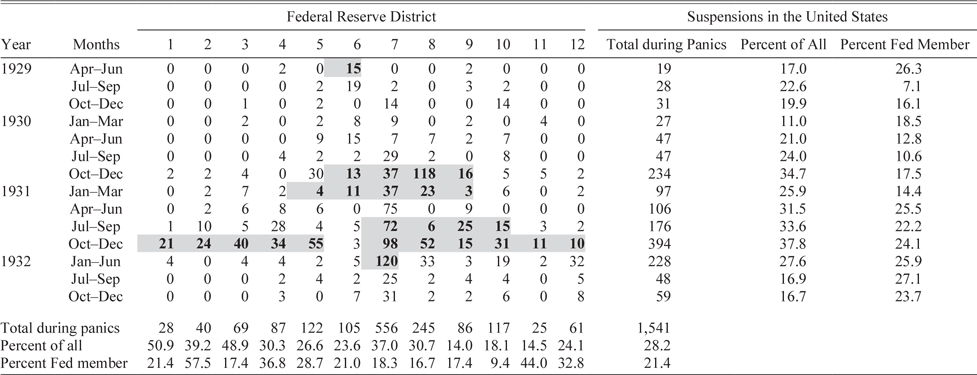
Notes: The table reports bank suspensions occurring during panics in each Federal Reserve District where panics are defined as suspensions occurring within a 10-mile radius, no more than 30 days apart, and statistically different from being spatially random (“10–30 joins” as described in the text). The column labeled percent of all is share of panic suspensions relative to all suspensions for a given period or district. The column labeled percent Fed member indicates share of panic suspensions that were Fed members. Totals reflect suspensions from April 1929 through end of 1932. The cells with bold text and gray shading indicate panics that academic literature and contemporary observers deemed exogenous as described in text.
Source: Authors’ calculations from database created for this study from sources described in the Online Data Appendix.
Most of the clusters of suspensions enumerated in Table 1 coincide with contemporary reports and academic accounts of runs on banks. The clusters in Fed District 6 in the spring and summer of 1929, for example, began when fears of financial instability due to a fruit-fly infestation triggered runs on banks outside the afflicted area (Carlson, Mitchener, and Richardson Reference Carlson, Mitchener and Richardson2011). The clusters in Districts 5 through 9 in the last quarter of 1930 reflected runs that spread through the center of the United States following the collapse of Caldwell and Company and the Bank of United States (Richardson and Troost Reference Richardson and Troost2009; Wicker Reference Wicker1996; Friedman and Schwartz Reference Friedman and Schwartz1963). The clusters in District 7 emerged when a series of panics struck the central reserve city of Chicago (Friedman and Schwartz Reference Friedman and Schwartz1963; Calomiris and Mason Reference Calomiris and Mason1997; Vickers Reference Vickers2011; Wicker Reference Wicker1996; Postel-Vinay Reference Postel-Vinay2016). The clusters in late 1931 were associated with financial crises that affected continental Europe in the summer of that year and the United Kingdom in the fall. Historical accounts emphasize that during these events, bank distress was due to a broad flight to liquidity rather than information about the solvency of particular banks or information that lending would decline in particular banks or localities. In other words, historical narratives indicate that, in these events, causality ran from deposits to lending rather than the other way around.
This observation concerning causality is consistent with the relationship between clusters of suspensions and two key monetary ratios presented in Table 2. Columns (1)–(4) regress the log change in the currency-deposit ratio on the join-count for each observation divided by 120, or in other words, the number of clustered suspensions divided by the size of the largest cluster. The results reveal a strong correlation between suspensions clustered in time and space and currency flowing out of commercial banks. Depending on the specification, when the size of the suspension cluster increased by 1 percent, the flow of currency out of commercial banks increased from 0.37 to 0.64 percent (depending on the specification). These large currency outflows, which are the defining feature of bank runs, only occurred at the time suspensions were tightly clustered. They did not precede clusters, follow clusters, or coincide with suspensions that were not clustered in time and space. The same strong-consistent relationship does not exist for the loan-to-deposit ratio (Columns (5)–(8)). This second result implies that during panics, when bankers scrambled to gather cash to satisfy depositors’ demands, they did so by shedding cash, reserve deposits, bonds, and loans in roughly equal proportions. Panics were not periods when bankers altered their investment behavior or when borrowers for some reason decided to default, cease borrowing, or repay loans en masse.
PANICS, CURRENCY, AND LENDING
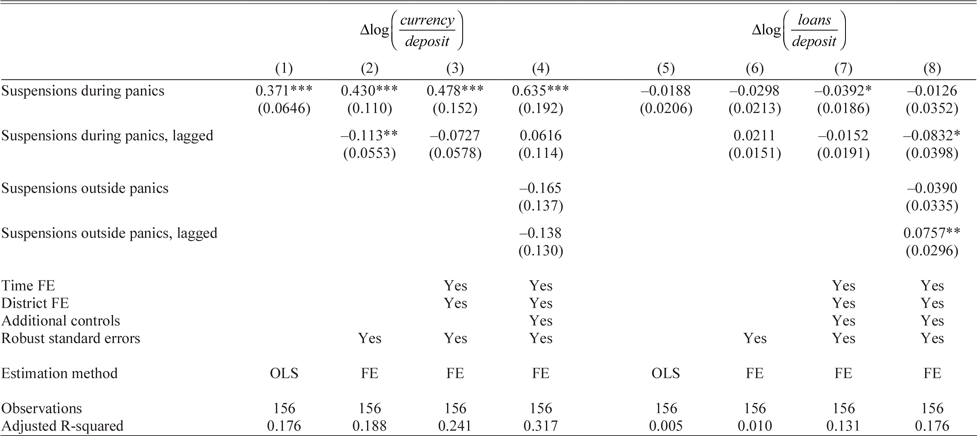
Notes: Data panel covers 12 Fed districts and 14 call intervals from July 1929 to December 1932. Estimation methods are ordinary least squares (OLS) or panel fixed effects (FE). Panic intensity for each observation is the number of suspensions in 10–30 joins divided by the maximum join count over all observations (120). Distress outside panics intensity is the number of suspensions outside of 10–30 joins (i.e., # not clustered in time and space). Time fixed effects are indicators for all but one call interval. Fed district fixed is controlled for using panel fixed-effects methods. Additional time-varying district-level controls include the change in each district’s consumption index, building permits, stock-price index, and Fed reserve bank discount rate. Standard errors are in parentheses: *** p<0.01, ** p<0.05, and * p<0.1.
Source: Authors’ calculations from database created for this study from sources described in the Online Data Appendix.
PANEL-DATA EVIDENCE PANICS’ IMPACT ON LENDING
Given a measure of panic intensity, we are now equipped to explore the correlation between panics and lending. We employ a treatment and control model where treatment intensity varies across observations and over time. Our outcome variable is lending for commercial banks. Our estimates are obtained from comparisons between the flow of deposits in Fed districts exposed to different intensities of treatment (panics of different intensities) controlling for factors that influenced deposit flows. Our baseline model takes the following form:
 $${L_{it}} = {\rm{ }}{\sum _k}{\beta _k}{S_{kit}} + \varphi {X_{it}} + {\alpha _i} + {\gamma _t} + {\varepsilon _{it}}.$$
L it indicates the change in lending in banks in operation on date t – 1 that survive to date t in observation i, where the dates are the call dates from June 1929 to December 1932.Footnote 5 The lowest level of aggregation available for estimating lending at the frequency of the call report (roughly quarterly, indexed by t) for all commercial banks is at the Federal Reserve District level. Because the reporting categories of balance-sheet data differ by bank charter, we present estimates for Fed member and nonmember banks separately.Footnote 6
The principal explanatory variable is the number of banks suspending operations. Commercial bank suspensions include all member and nonmember banks. S kit indicates the number of commercial bank suspensions in Federal Reserve district i from call t – 1 to call t. In our key specifications, we disaggregate suspensions by type k = {panic, non-panic}. Our measure of panic intensity is the number of banks suspending operations during banking panics. The number of banks suspending operations outside of panics measures financial distress for other reasons, primarily declining asset values and increasing loan losses. The coefficient, β k , indicates the average change in lending in banks remaining in operation in response to a suspension of type k. Suspensions during panics are defined in Table 1. The number of banks in these clusters is our measure of panic intensity.Footnote 7
The number of non-panic suspensions captures banking distress occurring for reasons other than depositor runs. The preponderance of banks that suspended outside of panics failed with losses to stockholders and depositors. Almost all were insolvent, and few reopened. The number of non-panic suspensions controls for the range of factors that influenced bank failure rates, including increases in loan defaults and declines in asset values, which are the root cause of the capital crunch (Calomiris and Wilson Reference Calomiris and Wilson2004).
Fixed effects for each Federal Reserve District are captured by the intercept term, αi. These fixed effects remove averages for each variable for each unit of observation, i, yielding the within estimator. Time fixed effects remove averages for all variables in each period. In other words, our estimator reveals whether lending changed more (or less) than a trend in districts experiencing larger (or smaller) panics relative to other districts at that time and their own district average over all periods.
The matrix of controls, X it, includes time and district-varying factors that may have influenced lending. These factors include (i) the change in the discount rate in Federal Reserve district i from date t – 1 to t; (ii) the change in consumption in each Fed district from date t – 1 to t, which we derive from the Fed’s index of department store sales; (iii) the change in building permit applications filed per month between call dates t to t – 1; and (iv) the change in the return to common stocks issued by firms operating in each Federal Reserve district in the three quarters preceding date t.Footnote 8 Discount rates summarize the range of policies used by Reserve Banks in this era, including the open-market purchase rate, the quantity of open-market purchases, and quantity rationing at the discount window.Footnote 9 The consumption index is the best extant measure of regional economic activity for the era we study. It proxies aggregate output, since consumption is the largest component of gross domestic product.
Building permits and stock returns control for economic expectations of two types. Building permits reflect the expectations of real estate developers and the firms and households that finance them. Permit requests increase when developers and financiers anticipate economic expansions will raise rental incomes and decline when those economic agents anticipate the economy will contract. Equity returns reflect investors’ expectations regarding the profitability of public corporations and often also reflect short-term sentiment, which venerable scholars of the Great Depression and recent Nobel Laureates termed “animal spirits” (Keynes Reference Keynes1936; Akerlof and Schiller 2009). Expectations of both types update rapidly to reflect new information and economic events. To ensure that our measures of expectations do not reflect endogenous responses to banking panics, we use lagged values that reflect information possessed by firms, households, and investors at the onset of each interval.
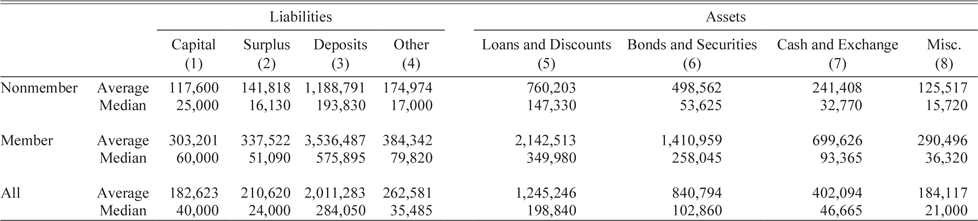
Interpretation of the coefficients that we estimate depends in part on how they compare to the balance sheet of typical member and nonmember banks. Table 3 presents information drawn from the Rand McNally Bankers Directory in 1932. Lending by nonmember banks averaged $760,000, while lending by member banks averaged over $2,100,000. For both, the average was much larger than the median because the distribution of bank sizes was skewed, with many small banks of similar size (near the median in the table) and smaller numbers of much larger banks.
COMMERCIAL BANK BALANCE SHEETS IN 1932
Source: Rand McNally Bankers’ Directory, July 1932.
Table 4 shows how panics affected credit extended by nonmember banks. Columns (1) and (5) demonstrate that when suspensions rose, the total value of loans on balance sheets of nonmember banks typically declined, while the total value of bonds (typically termed “investments” in contemporary documents) on average remained about the same. Columns (2) and (6) differentiate between the impact of suspensions during panics and outside of panics. As the results show, panics typically triggered declines in lending and bondholding whereas suspensions outside of panics had little impact on lending but were correlated with increased bondholding. The latter result seems to be driven by the reallocation of bonds from banks short of cash to banks with surpluses, particularly during quarters when panics occurred in some districts, whose banks sold bonds to raise cash, but not in others, whose banks bought bonds being sold by cash-strapped institutions.
PANICS AND ASSETS AT NONMEMBER BANKS
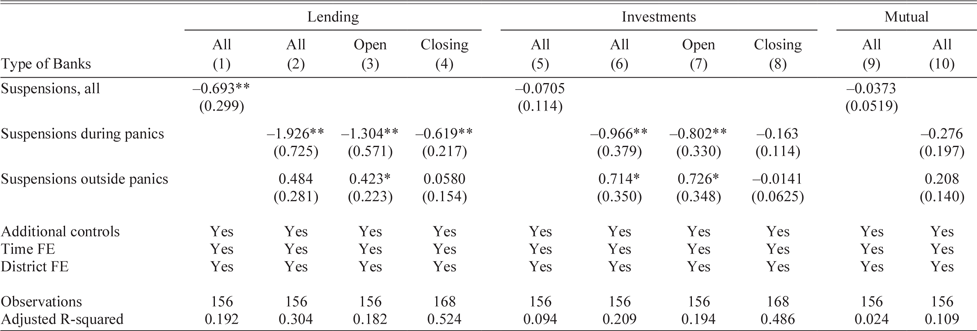
Notes: Data panel covers 12 Fed districts and 13 call intervals from September 1929 to December 1932. Estimation method is panel fixed effects. The number of suspensions during panics is defined as the count of all suspensions in each district in each interval that are in 10–30 joins. Suspensions outside panics are all suspensions minus suspensions during panics. Time fixed effects are indicators for all but one call interval. Fed district fixed are controlled for using panel fixed-effects methods. Additional time-varying district-level controls include the change in each district’s consumption index, building permits, stock-price index, and Fed reserve bank discount rate. Standard errors are in parentheses: *** p<0.01, ** p<0.05, and * p<0.1.
Source: Authors’ calculations from database created for this study from sources described in the Online Data Appendix.
Columns (3), (4), (7), and (8) compare the lending of banks that remained in operation to those that ceased operations.Footnote 10 For each bank that suspended operations during a panic, lending at banks that remained in operation declined by $1.3 million, while lending trapped in a failed bank averaged $0.6 million.Footnote 11 The correspondence between these estimates from aggregate data and the average size of nonmember banks from microdata (see Table 3) is noteworthy. Our aggregate estimates indicate that on average each suspension during a panic trapped $600,000 in a failing nonmember bank, which is reasonable since banks that failed tended to be below-average size. Each suspension coincided with a decline of lending in banks that remained in operation by $1.3 million, which is the size of two average banks. The microdata indicates an average nonmember bank held $760,000 in loans.
These results indicate that panics had about double the impact on lending at banks that remained in operation versus banks that failed. A different pattern prevailed for bondholding. For each bank in their district that suspended operations during panics, banks that remained in operation in that district shed about $0.8 million in bonds, presumably because the panic forced them to liquidate their secondary reserves to satisfy depositors’ demand. Banks in neighboring districts that were not run, however, acquired those bonds, so that on aggregate, the value of bonds on banks’ balance sheets did not change.
A placebo group—mutual savings banks—is examined in Columns (9) and (10). Mutual banks could not be run since they did not issue demand deposits and could compel depositors to wait for the maturity of their shares before redeeming withdrawal requests and because they only invested in public debt and safe mortgages on real estate. It is thus not surprising that the reported coefficients show that lending by mutual savings banks was uncorrelated with distress among commercial banks.
Table 5 examines Fed member banks. Its structure reflects the more detailed data available for member banks’ balance sheets. Column (1) indicates that total assets declined substantially in Fed districts during panics. Columns (2), (9), and (10) indicate that during panics most of the decline in assets was due to declines in lending, and most of the decline in lending occurred at banks that remained open for business. Banks’ holdings of corporate bonds and interbank balances (including reserves at the Fed) also declined (Columns (3), (5), and (6)). However, banks’ holdings of their most liquid assets, government bonds and vault cash (Columns (4) and (8)), did not decline because banks typically used the former as collateral for discount loans and replenished the latter by selling less-liquid assets. Our data on bond holdings at banks that closed do not distinguish corporate from government bonds, which limits what we can conclude on this topic, but the hypothesis that the decline in bondholding at banks that remained open equaled the decline at banks that closed cannot be rejected.
PANICS AND ASSETS AT MEMBER BANKS
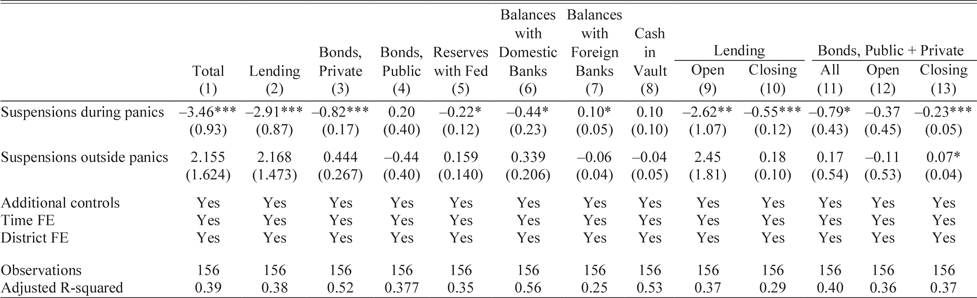
Notes: Data panel covers 12 Fed districts and 13 call intervals from September 1929 to December 1932. Estimation method is panel fixed effects. The number of suspensions during panics is defined as the count of all suspensions in each district in each interval that are in 10–30 joins. Suspensions outside panics are all suspensions minus suspensions during panics. Time fixed effects are indicators for all but one call interval. Fed district fixed is controlled for using panel fixed-effects methods. Additional time-varying district-level controls include the change in each district’s consumption index, building permits, stock-price index, and Fed reserve bank discount rate. Standard errors are in parentheses: *** p<0.01, ** p<0.05, and * p<0.1.
Source: Authors’ calculations from database created for this study from sources described in the Online Data Appendix.
Outside of panics, experiences varied for member banks. Those located in money centers, especially Manhattan, received large inflows of deposits, often the result of funds fleeing from financial institutions caught up in panics located elsewhere. Others experienced outflows. So, the standard error on the coefficient for non-panic suspensions is large and the null hypothesis that the coefficient is zero cannot be rejected.
INSTRUMENTAL VARIABLES ESTIMATES
Our baseline results indicate that lending by commercial banks that remained in operation fell substantially during panics, even after controlling for the state of the economy, Fed policies, agents’ expectations, and shocks (both observed and unobserved) to Fed districts or across time. It is possible, however, that rather than panics causing lending to decline, a decline in lending triggered outflows of deposits and clusters of bank suspensions. Perhaps deposits and loans declined because local businesses used funds on call to repay outstanding debts. Perhaps depositors withdrew funds because they anticipated lending would decline due to negative shocks to firms’ profits that might put their survival at risk.
To address these possibilities, we present IV estimates of the effects of suspensions on commercial bank lending. The first stage of the IV predicts panic intensity using narrative and qualitative evidence describing banking panics triggered by exogenous events in certain Fed districts at certain dates. Friedman and Schwartz (Reference Friedman and Schwartz1963) introduced this approach for the analysis of national aggregates. Wicker (Reference Wicker1996) and Jalil (Reference Jalil2015) expanded this identification strategy to a broader range of panics. We focus on events for which a consensus exists among these scholars as well as other researchers including Calomiris and Mason (Reference Calomiris and Mason1997), Meltzer (Reference Meltzer2003), Richardson (Reference Richardson2007a, 2007b), Carlson, Mitchener, and Richardson (Reference Carlson, Mitchener and Richardson2011), and Vickers (Reference Vickers2011).
For each event, the consensus must have two parts. First, a banking panic occurred. Contemporaries characterized panics as periods when runs on banks were widespread. Runs struck banks indiscriminately. Depositors rapidly drew funds from strong as well as weak banks. Banks acted to allay the drawdown of deposits either by borrowing from the Fed and money-center correspondents or slowing withdrawals by refusing early withdrawals of time deposits, invoking the 30-day clause for demand deposits, or suspending payments entirely. Second, the panic had a trigger that was (i) observed, (ii) exogenous to most or all of the banks in that district, and (iii) independent of anticipating that commercial lending in the district would suddenly and substantially decline more than trend and more than expected given the decline in consumption and investment in the district at that time. The latter condition would be fulfilled if observers noted that depositors participating in the runs had little direct information about the financial health of banks from which they withdrew funds and were inspired to run on their bank after observing withdrawals of other depositors or after hearing news of financial difficulties at banks in other cities, states, Fed districts, or nations. Twenty-six of the clusters of suspensions that we identify in Table 1 reflect exogenous panics that fit these three criteria. These events include the financial crisis in Europe in 1931, which weakened confidence in commercial banks throughout the United States in the summer and fall of that year; the Chicago banking crises in the spring of 1931 and 1932; the initial banking crisis of the Depression, which was triggered by the counterparty cascade following the collapse of Caldwell and Company; and the Mediterranean fruit fly infestation in Florida, which triggered runs in the 6th Federal Reserve district in 1929. Our instrument is a variable that equals zero for all observations except those affected by the events described previously for which it equals our measure of panic intensity. Table 1 indicates the panics deemed exogenous with bold highlights and grey shading.
Our IV estimates utilize two-stage least squares (2SLS). The first stage regresses panic intensity on our instrument plus controls. It yields a measure of exogenous panic intensity. The second stage regresses changes in lending on panic intensity predicted by the first stage. 2SLS estimates for the effects of panics on lending are presented in Table 6. The coefficient on our instrument is substantial and statistically significant, and the first-stage F-statistic exceeds 50. All tests reject the possibility of a weak instrument. The first stage remains statistically significant with an F-stat well above 10 for any permutation of our control variables.
INSTRUMENTAL VARIABLE ESTIMATES

Notes: For the first and second stages, notes for Columns (1) to (4) are identical to those for Table 4. Notes for Columns (5) to (8) are identical to Table 5. The robustness results at the bottom of the table indicate the average coefficient on suspensions during panics from a set of first stage regressions generated by iteratively altering the IV indicator or sample as indicated in the row headings.
Source: Authors’ calculations from database created for this study from sources described in the Online Data Appendix.
The second stage regresses lending on instrumented exogenous panic intensity plus controls as in Equation (1). All specifications in Table 6 indicate that panics reduced lending. In the full specification, the failure of one additional bank during a panic reduced lending by nonmember banks that remained in operation by about $1.4 million and member banks that remained in operation by about $2.6 million. For both members and nonmembers, the null hypothesis that the IV coefficients for panic intensity equal the corresponding baseline coefficients cannot be rejected. These tests compare the coefficients for nonmember banks in Column (4) of Table 6 to Column (3) of Table 4 and the coefficients for member banks in Column (8) of Table 6 to Column (9) of Table 5. The similarity between the reduced-form and IV coefficients suggests our baseline estimates in Tables 4 and 5 are unbiased.
The bottom half of Table 6 reports a series of exercises that examine the robustness of the 2SLS estimates. One question is whether the existing literature correctly identifies exogenous panics. A related question is whether our estimates stem largely from a few outlying observations or events in a single period or Federal Reserve district. To address the first issue, we re-estimate our 2SLS iteratively, dropping each call interval in turn, collecting the coefficients on the variable “Suspensions During Panics,” and then reporting the average of those coefficients and the standard error of those estimates. We next conduct a similar exercise where we iteratively drop each Fed district.
To address the second issue, we re-estimate our 2SLS iteratively, in turn switching each indicator of an exogenous panic to an endogenous panic. We then repeated this exercise switching two panics at a time from exogenous to endogenous. This iterative procedure addresses the concern that our sources (or our reading of our sources) might mischaracterize some panics as having an external trigger, when in fact the cluster of suspensions might have been generated by the decline in lending, rather than the other way around.
Almost all the coefficients on suspensions resulting from these robustness permutations have the same sign and significance level as the coefficients reported in the upper half of Table 6. When we iteratively drop districts in Columns (3), (5), (7), and (8), for example, all 12 of the resulting coefficients are negative and significant for three columns and all but one in the fourth. When we iteratively drop time periods, all 14 of the resulting coefficients are negative and statistically significant in two cases and all but one in the other two. Similar results arise when we iteratively reclassify panics from exogenous to endogenous. While the magnitudes of the resulting coefficients vary, with roughly half larger and half smaller than the coefficient that we report at the top of the table, we cannot reject the null hypothesis that the coefficients resulting from these permutations on average are equal to the coefficients reported in our preferred specification. In other words, our results do not stem from events in a single call interval or Federal Reserve district, nor do they depend on a particular reading of the historical record.
AGGREGATE IMPACT OF PANICS ON COMMERCIAL BANK LENDING
Our estimates allow us to calculate the aggregate decline in lending due to banking panics from 1929 through 1932 and compare those figures to declines in lending for other reasons. The economy-wide decline implied by our estimates is the coefficient on suspensions during panics (e.g., –2.649 in Column (8) of Table 6 for member banks) multiplied by the number of suspensions during panics during the contraction of the early 1930s (1,522 according to the join counts in Table 1). These estimates and their standard errors appear in the first and second rows of Table 7. The remaining rows compare our estimates of panics’ impact on lending to the overall decline in lending by commercial banks.
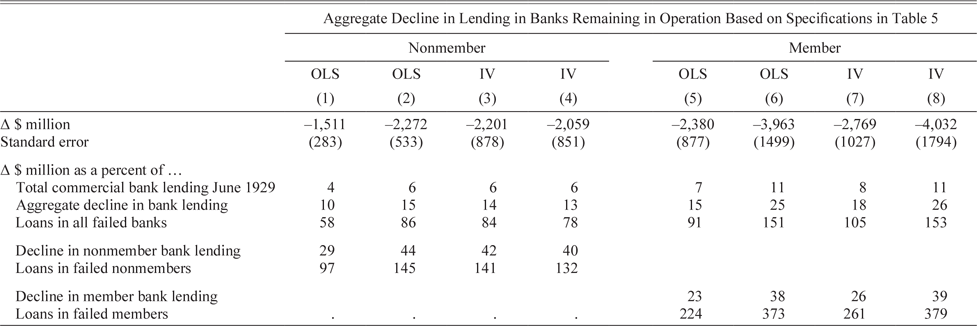
The overall decline is documented by data from call reports. The last call before the Depression occurred on 29 June 1929. On that date, aggregate lending by commercial banks amounted to $35.7 billion, with nearly $25.6 billion of those loans on the books of Fed member banks and $10.1 billion on the books of nonmembers. On 31 December 1932, the last call before the Banking Holiday in the winter of 1933, aggregate commercial bank lending totaled $20.1 billion, nearly 44 percent below its value at the start of the contraction. Member bank lending stood at $15.2 billion, 41 percent below its pre-Depression level, and nonmember bank lending stood at $4.9 billion or 52 percent below its pre-Depression level. Between the beginning of June 1929 and the end of December 1932, roughly $2.7 billion in loans were trapped in banks that entered liquidation.
Rows 3–5 of Table 7 compare our estimates of total commercial lending at the onset of the Depression (row 3), the aggregate decline in bank lending (row 4), and loans trapped in all failed banks (row 5). The first four columns present estimates for nonmember banks while the latter columns present estimations for member banks. Panics’ total impact on lending is thus the sum of its impact on nonmember and member banks. So, our IV estimate with all controls (in Columns (4) and (8)), indicates the total decline in lending due to panics amounted to 17 percent (6% + 11%) of commercial bank lending on June 1929, 39 percent (13% + 26%) of the decline in bank lending from June ’29 to December ’32, and 231 percent (78% + 153%) of lending trapped in failed banks. The penultimate estimate, 39 percent, is the headline result for our paper, and varies between 30 to 40 percent, depending on the specification. In other words, roughly one-third of the decline in bank lending during the Great Depression took place at banks that remained in operation. The final estimate, 231 percent, means that lending at banks in operation declined $2.31 for every dollar of lending trapped in banks entering liquidation.
A natural question is how much of the decline in lending at banks in operation occurred in banks that remained in operation from peak to trough of the contraction versus those that were in operation at the peak in June 1929 but that failed and entered liquidation before the end of December 1932. Banks that eventually failed held about $3 billion in loans on 30 June 1929. Those banks held about $2.7 billion in loans on the date of failure. So, they shed about $300 million in loans from June 1929 until the date of failure. This amount is less than 10 percent of the decline in loans eventually attributed to bank failures, less than 5 percent of the total decline in lending due to panics, and less than 2 percent of the total decline in bank lending during the Depression.
Our findings illuminate an important but overlooked dynamic during the banking crises of the 1930s. All banks lost deposits during the depression. Deposits declined in part because the economy contracted, leaving firms and households with fewer funds to place in banks. Deposits also declined due to shifting preferences for or perceptions of liquidity and risk, which induced firms and households to hold cash, bonds, and other assets instead of deposits in banks. To withstand the drain in deposits, banks on average needed one-third of their loans to be repaid. Banks whose borrowers could repay a substantial share of their loans survived the storm. Banks whose borrowers could not eventually liquidated. On average, banks that failed converted 10 percent of their loans to cash before they ceased operations—a fraction far too small to survive the nationwide deposit drain.
The aggregate lending estimates also allow us to compare the dollar decline in lending due to panics versus declines due to other reasons. The member bank decline in lending of $10.4 billion included $4 billion shed by operating banks due to panics, $1.1 billion trapped in failed banks, and $5.3 discontinued for other reasons, including borrowers’ declining demand for loans and bankers’ increasing desire for reserves. The nonmember bank decline in lending of $5.2 billion decline included $2 billion shed by operating banks due to panics, $1.6 billion trapped in failed banks, and $1.2 discontinued for other reasons. The drawdown of loans during panics was clearly a substantial cause of the decline in lending by member banks that remained in operation and the predominant reason for the decline in lending by nonmember banks that remained in operation during the Depression.
WHY PANICS FORCED OPERATING BANKS TO CUT LENDING
During panics, banks reduced lending. They did so because they lacked viable alternatives for paying depositors who were demanding cash en masse. This section explains why. We first discuss the nature of banking in the 1930s, particularly the short-term structure of commercial lending. We then explore banks’ responses to panics using higher-frequency data. Finally, we examine banks’ aggregate response to panics using balance-sheet regressions based on methods from previous sections.
On the eve of the Great Depression, banks held few liquid assets on their balance sheets. For example, in July 1929, the assets of commercial banks consisted of about 1 percent of cash in their vaults and 10 percent of bankers’ balances (Table 8). Nearly half of those interbank deposits were reserves on deposit at the Fed. Member banks could not use reserves at will. Almost all were needed to satisfy reserve requirements. Typically, less than 10 percent of reserves kept at the Fed could be withdrawn to satisfy drawdowns in demand deposits; a smaller proportion, typically under 3 percent, could be used to satisfy withdrawals of time deposits.Footnote 12
BANKS’ ASSET COMPOSITION IN 1929 AND 1932
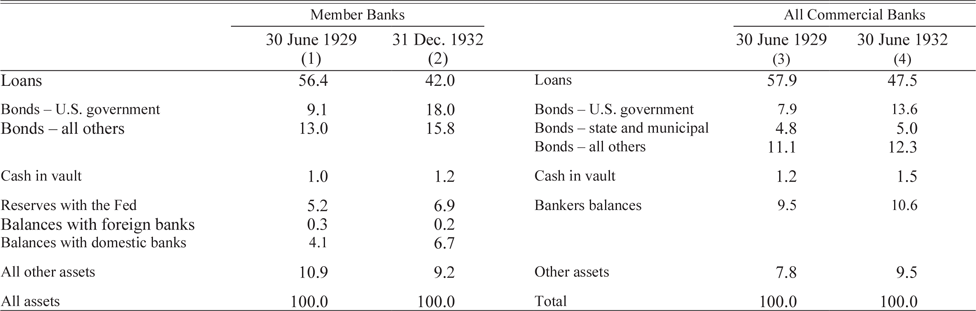
Notes: These data, particularly the division of bonds into three types and the separation of cash in vault and bankers’ balances, is estimated in part for nonmember banks. All commercial banks include all national and state chartered commercial banks.
Sources: Data for member banks from Board of Governors (1943). The data are tabulated from comprehensive call reports. Data for all commercial banks from Board of Governors (1959).
Bonds comprised about a quarter of the assets on commercial banks’ balance sheets, but rising defaults lowered the market value of many bonds. Selling depressed assets required banks to realize losses. U.S. government bonds could be sold near and sometimes above face value, but banks preferred to use those assets as collateral for loans from correspondent banks or the Federal Reserve. While banks sold bonds in response to local panics, the banking system as a whole could not shed bonds without lowering prices because banks held much of the outstanding supply (particularly of U.S. government bonds).Footnote 13 While our estimates indicate the total value of bonds on banks' balance sheets fell during panics, we find that outside of panics, banks generally bought bonds. During panics, in other words, bonds shifted through the banking system, with banks being run shedding bonds, and stronger banks buying bonds. On net, the aggregate quantity of bonds held by banks, which we measure at the Fed district level, seldom declined.
Loans comprised more than half of the assets on banks’ balance sheets. Except in New York and Chicago, where money-center banks loaned substantial funds to brokers, most of these loans were commercial since member banks loaned almost no funds directly to consumers and made few loans upon real estate. Commercial lending was almost entirely short-term (Cohen, Hachem, and Richardson Reference Cohen, Hachem and Richardson2021). Commercial loans typically matured in a year or less, with an average maturity of about six months, which was the maximum maturity of loans eligible for discount at Federal Reserve banks.
Given the short maturities of commercial loans, banks’ loan books turned over frequently, with one-quarter to one-half of a typical bank’s loan book rolling over each quarter. Short maturities allowed banks to reduce lending substantially over a couple of months simply by not renewing loans. Banks that needed cash quickly could call loans since commercial lines of credit were commonly callable, which means that banks could require firms to repay their loans with only a few days’ notice. It was also possible for banks to sell loans during a crisis. However, loans that could be marketed most readily were loans with standardized paperwork making them eligible for a discount at the Federal Reserve; loans backed by real estate collateral (mortgages), which could not be issued or held by banks in many states; and loans to brokers collateralized by stocks and bonds (although these loans were concentrated in New York, Chicago, and a few other cities with equity and commodity exchanges).
Banks, however, seldom sold loans during panics since the eligible paper could be used as collateral when borrowing at the Fed’s discount window, the mortgage market froze during the early 1930s, and loans to brokers could be called quicker than they could be marketed. Since information was asymmetric and collateral had to be transferred physically, sales of loans tended to be between banks operating in the same cities. If banks sold loans to nearby banks, however, those sales would not reduce the sum of lending within a Fed district, which is what we measure. Thus, selling loans locally could not be the reason for the decline in lending that we observe in our data. Banks might also sell loans to out-of-district correspondents, but standardized loans could also typically be used as collateral for interbank loans and may have been eligible for discounts at the Fed. For that reason, interdistrict loan sales were likely to have been limited. Our estimates indicate flows of loans from districts with panics to districts without were too small to be statistically significant in our data.
Therefore, lending during panics declined because, when depositors withdrew funds, banks had to reduce lending to repay them. Banks could repay only a small fraction of deposits with the cash they kept in their vaults and on-call at reserve repositories. After those sources of ready funds ran out, banks could borrow funds from money-center correspondents or Federal Reserve banks if they had sufficient collateral and if these lenders were willing to extend loans and had the resources to do so. If potential lenders failed to provide sufficient funds, however, then banks had to liquate assets—usually loans and usually by calling them.
We illustrate the liquidation of loans during crises by examining high-frequency data on the behavior of banks’ balance sheets during the panics that struck commercial banks in the South and Midwest during the fall of 1930 and spring of 1931. The data come from weekly-reporting banks in the reserve cities of each Fed district. We correct the weekly-reporting data for sampling biases using a method described in the Online Data Appendix. Figure 1 depicts events in November and December 1930 following the failure of Caldwell and Company. Runs initially afflicted banks in the Sixth Federal Reserve District. Deposits rapidly flowed out of weekly-reporting banks in Tennessee and adjacent states. In the first few weeks, all types of deposits flowed out, but after a few months, demand and interbank deposits returned to pre-panic levels; permanent declines consisted almost entirely of time deposits. The Federal Reserve Bank of Atlanta immediately responded to the panic by rushing credit to distressed institutions. After a few weeks, the Atlanta Fed encouraged state and local governments to support member banks in panic regions with new deposits. These new liabilities partially offset outflows of deposits, but in response to the substantial, prolonged decline in time deposits, member banks eventually cut lending, with each $1 decline in time deposits triggering roughly a $0.60 decline in lending.
WEEKLY-REPORTING BANKS DURING THE PANIC IN THE FALL OF 1930
Notes: Data reflects balance sheets of all Fed member banks in reserve cities in the indicated district.
Source: Authors’ calculations from data on weekly-reporting Fed member banks corrected for changes in sample composition as described in the Online Data Appendix.
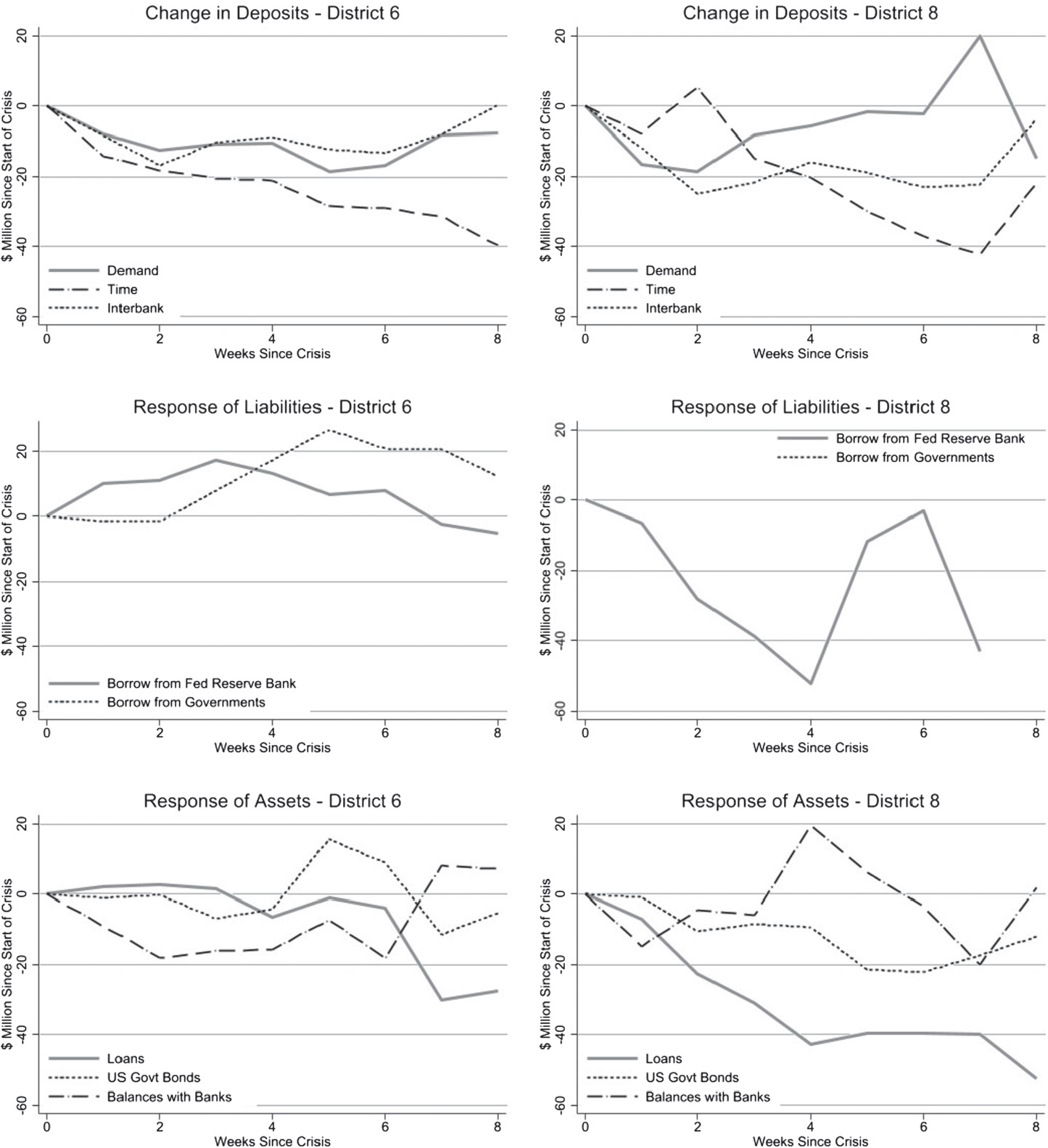
The post-Caldwell panic took a different course in the Eighth Federal Reserve District. The St. Louis Fed limited discount lending during the panic. The Fed’s reluctance to counteract the crisis forced commercial banks to cut lending swiftly and substantially. Banks that could not raise cash by calling loans or convincing borrowers to repay at maturity had to shut their doors to depositors. The Fed’s reluctance to act as a lender of result, in other words, not only forced many banks into liquidation (as described in Richardson and Troost (Reference Richardson and Troost2009)), but also forced banks that remained in operation to reduce lending more than in adjoining districts.
Six months later, depositors ran banks in Chicago and other locations in the Seventh Federal Reserve District (Figure 2). The Chicago Fed’s response to these deposit outflows was limited and delayed. Circumstances once again force banks to raise funds to repay depositors by cutting lending to commercial clients.
WEEKLY-REPORTING BANKS DURING THE PANIC IN JUNE 1931
Notes: Data reflects balance sheets of all Fed member banks in reserve cities in the indicated district. All member banks in Chicago appear to be member banks. Several member banks in Chicago suspended operations during the panic. Data for suspended banks appears to be held constant after the date of suspension.
Source: Authors’ calculations from data on weekly-reporting Fed member banks corrected for changes in sample composition as described in the Online Data Appendix.
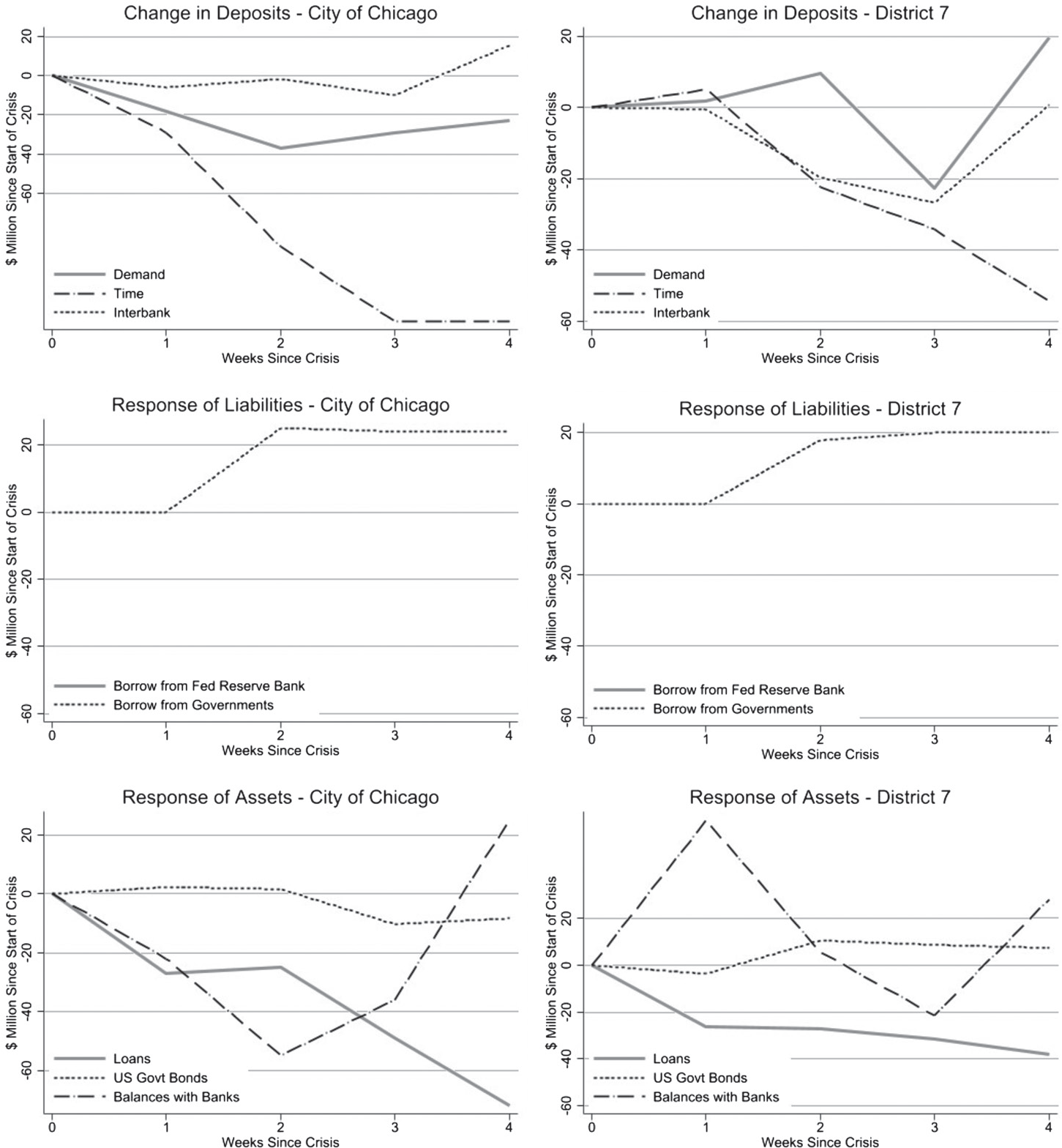
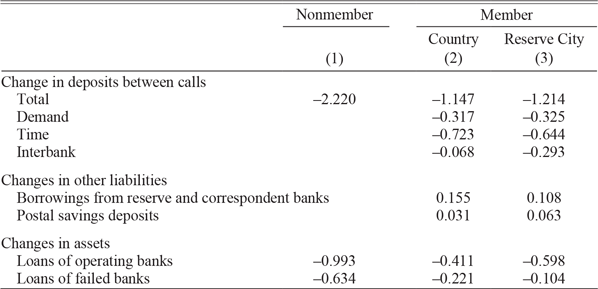
These event studies clearly illustrate the rapid decline in lending during panics in the early 1930s. Weekly-reporting banks, however, amounted to a minority of banks in operation at the time, and the data that they voluntarily provided do not encompass all the categories on a bank’s balance sheet. Table 9 overcomes these limits by examining the broadest possible data on the balance sheets of all commercial banks, which is the panel of data initially analyzed in Tables 4 to 7. In Table 9, we report coefficients from regressions of each balance sheet category that we measure on panic intensity and control variables, as per Equation (1). In other words, each number in the table represents a larger regression from which we report only the coefficient indicating the relationship between panic intensity and the change in the variable of interest. For brevity, we only report coefficients whose magnitudes were large enough to be economically meaningful.
PRINCIPAL CHANGES IN BANK BALANCE SHEETS IN RESPONSE TO PANICS
Source: Authors’ calculations from database created for this study from sources described in the Online Data Appendix.
The table shows that each suspension during a panic resulted in an average loss of about $1.2 million in deposits from member banks in reserve cities. Half of the decline came from time deposits; the remainder was evenly split between demand and interbank deposits. On average, reserve-city bankers funded about half of these withdrawals (0.598/0.1214) by cutting lending at banks that remained in operation. They funded about 15 percent ((0.108 + 0.063)/0.1214) of the withdrawals with a combination of borrowing from banks (typically Federal Reserve banks) and deposits from the postal savings system. Country member banks lost roughly the same amount of deposits. They funded these withdrawals by borrowing a bit more from the Fed and correspondent banks, receiving a little less in deposits from the postal savings system, and cutting loans a little less. The data do not allow us to discern nonmember banks borrowing from other institutions. The data do reveal, however, that nonmembers funded about half of the deposit outflow by reducing lending to businesses.
Overall, the three types of data examined in this section yield a consistent message: banks had to cut lending during panics in order to raise enough cash to satisfy depositors’ demands.
CONCLUSION
Our analysis focuses on how commercial banks that survived the financial tsunami of the early 1930s responded to the crisis. We use detailed information on the timing and location of suspensions to compare panic periods with non-panic periods of distress to identify how banks responded to periods when depositors suddenly changed their behavior and withdrew funds en masse. We show that panics of the early 1930s were characterized by a deposit crunch, with households shifting from deposits to currency and banks shedding loans and investments in response to depositor withdrawals. Surviving banks significantly reduced lending in response. This panic-induced deposit crunch accounted for over one-third of the decline in aggregate lending during the Depression, making it one of the largest shocks to credit supply in the early 1930s. In contrast, while bank failures played a role in the contraction of credit to firms and households during this same period, they accounted for less than a fifth of the aggregate decline in lending.
Our findings shed more light on the Federal Reserve’s mistakes of the 1930s. Arguments over the Fed’s inaction during panics focus on whether the Fed could have or should have prevented banks from failing (see Richardson and Troost (Reference Richardson and Troost2009) for a summary of this literature). Some scholars argue that the Fed should have acted more forcefully to forestall failures. Other scholars, however, argue that the Fed could not have stemmed the failures because it lacked the financial resources to do so since the gold standard tied the Fed’s hands or because the banks that failed were insolvent, and therefore, could not legally borrow at the Fed’s discount window and could not be saved by the type of assistance—providing liquidity—that the Fed could provide. Other scholars argue that even if the Fed could have prevented banks from failing during panics it should not have done so since such actions would have spawned zombie banks in the short term and engendered moral hazard in the long run.
Our finding, that the panics impacted aggregate lending largely by forcing banks that remained in operation to curtail lending to businesses, undercuts arguments against an aggressive Federal Reserve response to the banking panics that occurred in the early 1930s. Banking panics triggered deposit crunches that forced operating banks to cut lending. Banks that remained in operation were indisputably solvent since they survived the deepest downturn in modern American history. Their commercial customers who repaid loans were also indisputably healthy. Amid the maelstrom, they came up with the cash needed to cover their obligations. The Fed was set up as a lender of last resort to ensure that loans from healthy banks to healthy borrowers did not need to be curtailed during a contraction. The Fed did not perform this function. It certainly had the resources to do so, since profitable loans to operating banks would have increased its profits and relaxed the gold constraint. Recognition of the magnitude of the deposit crunch strengthens arguments that the Fed should have acted more aggressively as a lender of last resort during the Great Depression.


 Open access

