


I. INTRODUCTION
Impedance tuners are key instruments used for the characterization and load- /source-impedance optimization of active components, circuits, and systems. They are used for example for transistor characterization [Reference Fregonese, De Matos, Mele, Maneux, Happy and Zimmer1], power amplifier design [Reference Leite, Kerherve, Ghiotto, Larie, Martineau and Belot2], low-noise amplifier design [Reference Perez, Segovia-Vargas, García-Muñoz, Jiménez-Martín and Gonzalez-Posadas3], and oscillator measurement [Reference Wang, Ghiotto and Wu4]. They could also be used to determine optimal impedances of more complex integrated circuits [Reference Ghiotto, Vuong and Wu5]. Passive, active, and hybrid tuner technics are found in literature [Reference Hashmi and Ghannouchi6]. The type of required measurement will determine the tuner choice [Reference Muller and Gyselinckx7]. Passive tuners have many advantages, including rapid impedance synthesis, relatively higher-power handling capability, measurement of high-power devices without any non-linear effect, ease of usage, low maintenance cost, relatively low implementation cost, and the absence of any oscillation [Reference Hashmi and Ghannouchi6]. They are commercially available from Focus Microwaves [8] and Maury Microwave [9]. Their principle is based on sliding carriages along a transmission line and vertically positioned RF probes. The main disadvantage of such passive tuners is that they do not allow one to achieve very high-voltage standing wave ratio (VSWR) to synthesize impedances located nearby the Smith chart outer boundary [Reference Hashmi and Ghannouchi6].
AdvTech and the IMS Research Center are developing and characterizing an original high-performance programmable coaxial impedance tuner that is presented in this paper. Early results were introduced in [Reference Curutchet10]. This tuner is of particular interest to achieve very high VSWR. It will allow component and circuit designers finding optimal source and load impedances, when located close to the Smith chart outer boundary.
Section I will introduce the operating principle of the proposed tuner. Then a fabricated prototype will be introduced in Section II. Finally, Section III presents the experimental results. Compared with [Reference Curutchet10], this paper provides a better understanding of the prototyped tuner with improved connections and an identification of ways to further improve performances.
II. OPERATING PRINCIPLE
The developed high VSWR impedance tuner original concept was proposed for the first time by Vellas et al. [Reference Vellas, Gaquiere, Bue and Ducatteau11]. It was based on two short-length low characteristic impedance coaxial sections (called slugs) independently sliding along a 50 Ω coaxial transmission line. However, due to the implemented slugs’ positioning mechanism, prototypes based on this original concept never allowed one to experimentally demonstrate the expected theoretical performances due to the breakage of mechanical elements and poor repeatability. The required clearance, between the slugs’ outer boundary and the main coaxial transmission line outer conductor, allowing slugs displacement within the main coaxial line, provided a poor electrical contact between those two parts. Furthermore, a good axiality of the different mechanical elements was very difficult to obtain.
An alternative solution based on an outer coaxial conductor composed of a fixed bottom part and movable upper part was proposed in [Reference Curutchet12]. With this approach, the main coaxial transmission line can be opened to allow the slugs’ displacement, providing at the same time a low wear of the mechanical elements. When slugs are positioned, the main coaxial line is closed to provide a good electrical contact and perfect axiality at the same time.
Figure 1(a) illustrates the main coaxial line of Z 0 characteristic impedance. Its important dimensions are D C , the inner diameter of the outer conductor, and d C , the diameter of the inner conductor (Fig. 1(b)). The two slugs, of inner diameter D S and length L S , inserted within the main coaxial line, results in a Z S low characteristic impedance coaxial section (Fig. 1(c)). The two slugs can be independently slide along the main coaxial line. L 1 and L 2 are the length between the input and the first slug and in-between the two slugs, respectively.
(a) Illustration of the tuner principle with cross-sectional view of (b) the main coaxial line, and (c) the two coaxial slugs.

The equivalent transmission line model is illustrated in Fig. 2. Varying L 1 and L 2 allows synthesizing desired impedance Z tuner at the tuner input port. A schematic model on ADS from Keysight was used to validate the tuner principle. A closed-form equation of the impedance tuner reflection coefficient can be obtained considering successive stubs in series of length L stub_i , impedance Z stub_i , and propagation constant β stub_i to transform an output impedance Z out_i to an input impedance Z in_i [Reference Pozar13].
 $$Z_{in\_i} = Z_{stub\_i} \left( {\displaystyle{{Z_{out\_i} + jZ_{stub\_i} \tan (\beta _{stub\_i} L_{stub\_i} )} \over {Z_{stub\_i} + jZ_{out\_i} \tan (\beta _{stub\_i} L_{stub\_i} )}}} \right),$$
Impedance tuner transmission line model.

Figure 3 reports measured synthesized impedances on the Smith chart at 10 GHz using the prototype introduced in the next section. Figure 3(a) shows one of the impedance synthesis options. The first slug is positioned at a L 1 distance from the tuner input allowing one to change the circle center travelled on the Smith chart when displacing the second slug away from the first slug (increasing L 2). This way, the all Smith chart impedances can be synthesized. A second impedance synthesis option is illustrated in Fig. 3(b). The distance L 2 is fixed to obtain different circle radius on the Smith chart, and the L 1 distance is increased to synthesize impedance along the circle.
Measured synthesized impedances using (a) the first and (b) second principle at 10 GHz.

To design the proposed tuner, it is important to determine its main characteristics, including the characteristic impedances, single-mode frequency ranges, and transmission losses of the main coaxial line and slugs.
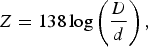
The characteristic impedance Z of the main coaxial line (Z 0) and of the short-length low characteristic impedance slugs (Z S ) are obtained using (2) [Reference Pozar13]:
 $$Z = 138\log \left( {\displaystyle{D \over d}} \right),$$
where D and d are the inner diameter of the outer conductor and the diameter of the inner conductor, respectively.
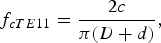
The single-mode frequency band of the fundamental transverse electromagnetic mode (TEM) mode of the coaxial line is limited by the TE11 modes which cut-off frequency f cTE11 is given by:
 $$f_{cTE11} = \displaystyle{{2c} \over {\pi (D + d)}},$$
where c is the light velocity.
Taking into consideration air as dielectric, the attenuation constant α, neglecting surface roughness loss, and considering conductor loss, is obtained using:
 $$\alpha = \displaystyle{{8.686} \over {2 \times 138}}\sqrt {\left( {\displaystyle{{f\mu _0} \over \pi}} \right)} \left( {\displaystyle{{\sqrt \rho} \over D} + \displaystyle{{\sqrt \rho} \over d}} \right)\displaystyle{1 \over {\log (D/d)}},$$
where f is the frequency, μ 0 is the vacuum permeability, and ρ is the conductor resistivity.
As proposed in [Reference Curutchet12], the coaxial transmission line outer conductor can be divided in two parts to allow slugs’ displacement. A view of the tuner mechanics is illustrated in Fig. 4 in opened and closed positions.
View of the proposed tuner in (a) opened and (b) closed positions.

At the tuner input and output, 3.5 mm connectors are used to target a frequency band of operation up to 26.5 GHz. To avoid mismatch at the interconnection between the main coaxial line and connector, D C is chosen at 3.5 mm, and (2) gives d C = 1.52 mm to obtain a characteristic impedance Z 0 = 50 Ω. Therefore, the single-mode frequency band of operation of the fundamental TEM mode is determined to be up to 38 GHz using (3).
For practical reasons, brass, with resistivity ρ brass = 6.67 × 10⁻⁸ Ω.m, is used for the fabrication of the prototype. However, a low loss main coaxial line is desired to achieve very high VSWR. Plating the element with silver, ρ silver = 1.64 × 10⁻⁸ Ω.m, with a thickness t silver of at least three skin depth δ silver at the lower frequency of operation can provide better performances. Considering a lower frequency of operation of 2 GHz, t silver must be more than 4.3 µm. Using (4), at 15 GHz, transmission loss can be improved from 0.71 dB/m using brass to 0.35 dB/m using silver plating. The transmission loss improvement versus frequency obtained in simulation using HFSS from ANSYS is show in Fig. 5 for a 160 mm long main coaxial line. This figure also compares performances of the main coaxial line without and with two 400 µm slots on both sides resulting from the splitting of the main coaxial line in two parts. It can be observed that the two slots do not impact transmission loss.
Simulated S 21 parameter of the 16 mm long 3.5 mm main coaxial line without and with two 400 µm slots using brass and silver conductors.

The transmission line model shown in Fig. 2, was implemented on ADS Schematic taking into account conductor loss and also the 18 mm long access coaxial line between the input connector and the main coaxial line. This access line length could be reduced redesigning the mechanics to reduced losses between the input connector and the slugs and therefore increase VSWR. A set of three slugs of length L S = 3, 7, and 14 mm allows one to achieve high VSWR over the 2–26.5 GHz frequency range as shown in Fig. 6. Figure 6 also highlight the improvement in VSWR that can be achieved silver plating the conductors. In this figure, the minimum and maximum values of the maximum VSWR achieved around the Smith chart periphery (for all reflection coefficient angles on the Smith chart) are shown versus frequency. As L 1 and L 2 sections have losses, they decrease the maximum VSWR. This also explains why the centers of circles shown in Fig. 3(b) do not appear to be centered at the Smith chart center.
Simulated maximum and minimum VSWR versus frequency for (a) L S = 3, (b) 7, and (c) 14 mm long slugs using brass- and silver-plated conductors.

Figure 7 shows the minimum values of maximum VSWR achieved around the Smith chart periphery versus frequency for D S = 1.8, 2, and 2.2 mm corresponding to characteristic impedances Z S = 10.1, 16.4, and 22.1 Ω, respectively. It can be seen that reducing the slugs sections characteristic impedances, higher VSWR can be reached. However, for practical reasons, D S was limited to 1.8 mm in this study.
Simulated minimum VSWR versus frequency for 3 mm long slugs with D S = 1.8, 2, and 2.2 mm using brass.

Figure 8 shows the return loss achieved for L S = 14 mm long slugs with Z S = 10.1 Ω versus normalized inter-slug distance x = L 2/λ for the minimum value of L 1. It can be seen that for those slugs, the maximum VSWR is achieved for L 2 ≈ λ/3, and that an impedance close to 50 Ω is synthesized for L 2 ≈ 2λ/3.
Simulated S 11 parameter versus normalized inter-slug distance x = L 2/λ for D S = 1.8 mm and a L S = 14 mm long slugs.

III. FABRICATED IMPEDANCE TUNER
For demonstration purpose, a tuner based on the principle described in the previous section has been fabricated with D C = 3.5 mm, d C = 1.52 mm, and a total length of 160 mm. The fabricated prototype is shown in Fig. 9. The slugs’ displacement is provided by ETEL linear motors associated with linear positioning ruler from Heidenhain achieving an accuracy as low as 4 µm. Figure 9(b) shows a detailed view of the fabricated tuner. The two brass slugs shown in Fig. 9(b) are 3 mm long. The mechanical tuner design allows operators to manually change slugs in <10 min. This permits to optimize the tuner performances during measurement in a given frequency range.
(a) Overall view of the fabricated prototype and (b) detailed view in opened position.

Figure 10 shows the measured S 21-parameter of the tuner without slugs. In [Reference Curutchet10], return loss and transmission loss performances were limited by the implemented 3.5 mm connector that did not provide a good matching. A new 3.5 mm connector has been implemented to achieve good performances up to 26.5 GHz. This new 3.5 mm connector has been machined to achieve a better electrical contact with the coaxial line outer conductor.
Comparison of the tuner S 21 parameters with the old and new 3.5 mm connectors (slugs are removed).

IV. EXPERIMENTAL RESULTS
The tuner characterization has been achieved using a four-port N5242AS PNA-X vector network analyzer (VNA) from Keysight Technologies. A high-performance coaxial cable has been used to connect the tuner to the VNA. A short open load thru calibration was performed to define the reference plane at the tuner input. A dedicated software has been developed to drive the impedance tuner together with the VNA. It allows the tuner calibration, the impedance synthesis, and some other options.
Figure 11 shows Smith chart examples of synthesized impedances at 4, 9, and 12 GHz using the 3, 7, and 14 mm long slugs, respectively. Figure 11(a) and 11(b) illustrates the impedance synthesis using the second and first principles introduced in previous sections. Figure 11(c) shows a Smith chart with much more impedances achieved using the second impedance synthesis principle. It can be observed that the tuner can achieve any impedance and reach very high VSWR values located at the Smith chart edge.
Measured synthesized impedances at (a) 4 GHz with 14 mm long slugs using the second principle, (b) 9 GHz with 7 mm long slugs using the first principle, and (c) 12 GHz with 3 mm long slugs using the first principle.

In Fig. 12, the minimum and maximum values of the maximum VSWR achieved around the Smith chart periphery (for all reflection coefficient angles on the Smith chart) versus frequency in simulation using ADS schematic for 3 and 7 mm long slugs are compared to the measured maximum VSWR. It can be seen that measured results are quite in a good agreement with the simulated results. Investigations are ongoing to explain the discrepancy between simulated and measured results to improve both the model accuracy and the prototype performances. The axiality of the main coaxial line inner conductor could be a first issue. Also, additional surface roughness loss due to a poor milling surface finishing of the main coaxial line outer conductor achieved using a ball end milling cutter could be the reason of the disagreement at high frequencies. Additional loss explains that the maximum measured VSWR is below the ADS schematic model minimum VSWR in Fig. 12(b).
Measured and simulated VSWR versus frequency for (a) 3 mm and (b) 7 mm long slugs.

V. CONCLUSION
This paper presented theoretical, simulated, and experimental results related to the development of a novel type of programmable impedance tuner offering high VSWR. This tuner is based on two independent reflective coaxial slugs having low characteristic impedance and sliding with high repeatability [Reference Curutchet10] along a 50 Ω coaxial line. Depending on the targeted frequency band, different slugs can be used to obtain an optimal VSWR. A prototype has been fabricated with a set of three pairs of slugs to demonstrate the interest of the proposed approach for impedance synthesis. This prototype, based on brass, can be optimized. It has been demonstrated in theory and simulation that silver plating the tuner coaxial elements, a significant improvement in term of VSWR and transmission loss can be achieved. Additionally, the minimal distance between the input connector and first slug can be reduced by a mechanical redesign of the prototyped tuner, to provide even higher VSWR. The IMS Research Center and Advtech are now looking for partners to develop and push forward this promising technology.
ACKNOWLEDGEMENTS
The authors would like to thank MC2 technologies for its support and more particularly Mr. Werquin.
 Arnaud Curutchet received the Ph.D. degree from the University Bordeaux 1, France, in 2005 in characterization and modeling of low-frequency noise on AlGaN/GaN HEMT technologies. Since 2007, he has been an Associate Professor at the IMS Laboratory of Bordeaux, France. His research interests are focused on HF characterization of devices and on AlGaN/GaN technology, with the characterization and modeling of these transistors in DC, pulsed I–V, and low-frequency noise. He has published more than 40 peer-reviewed scientific articles and holds three patents.
 Anthony Ghiotto received the M.Sc. degree in 2005 and the Ph.D. degree in 2008 all in Electrical Engineering from the Grenoble Institute of Technology, Grenoble, France. He has been a Post-Doctoral fellow from 2009 to 2011 and a Research Associates from 2011 to 2012 at the Poly-Grames Research Center from the École Polytechnique de Montréal, Montréal, QC, Canada. Since September 2012, Dr. Ghiotto holds an Assistant Professor position at the ENSEIRB-MATMECA Engineering School from the Bordeaux Institute of Technology and the Laboratory of Integration from Materials to Systems (IMS) from the University of Bordeaux in Talence, France. He has authored more than 100 research articles and was the recipient of the Young Scientist Award of the International Union of Radio Science (URSI) in 2008. His current research interests include the analysis, design and integration of microwave, and millimeter wave passive and active circuits.
 Manuel Potéreau received the Dipl.-Ing degree from the ENSEIRB-MATMECA, Talence, France in 2012. He received the M.Sc. and Ph.D. degrees in Microelectronics from the University of Bordeaux, Talence, France, in 2012 and 2015, respectively. Since October 2015, he has been a researcher with the Laboratory of Integration from Materials to Systems (IMS), at the University of Bordeaux. His current research interests are focused on the design of millimeter-wave integrated silicon-based power amplifiers and linearization techniques dedicated to spatial telecommunication in K-band.
 Magali De Matos received the M.S. degree in Microelectronics from the University of Bordeaux, France in 1999. Then she joined IMS, the Laboratory of Integration from Materials to Systems of the University of Bordeaux, as a design engineer being involved in the design of RFIC up to 2002. At this date, she joined the University of Bordeaux as a Research Engineer to support Ph.D. students working in the domains of IC design. Since 2007, Mrs. De Matos is in charge of the IMS NANOCOM IC characterization platform.
 Sébastien Fregonese received the M.Sc. and the Ph.D. degrees in Electronics from the Université Bordeaux, Talence, France, in 2002 and 2005, respectively. During his Ph.D. research, he investigated bulk and thin-film SOI SiGe HBTs, with emphasis on compact modeling. From 2005 to 2006, he was with the Technical University of Delft, Delft, The Netherlands, with a postdoctoral position in the field of the Si strain FET. In 2007, he joined the “Centre National de la Recherche Scientifique” (CNRS). His research interests are focused on electrical compact modeling and characterization of HF devices such as the SiGe HBTs and carbon-based transistors. From 2011 to 2012, he was a visiting researcher at the IEMN Laboratory in Lille. He has published more than 43 journal articles and 40 conference papers.
 Eric Kerhervé received the Ph.D. degree in Electrical Engineering from Bordeaux University, France in 1994. He is a Professor in Microelectronics and Microwave applications in Polytechnic Institute of Bordeaux and IMS Laboratory. Since 2015, he has been the Director of the STMicroelectronics/IMS joint Laboratory. His main research activities focus on the design of RF, microwave, and millimeter-wave circuits (power amplifiers and filters) in silicon, GaAs, and GaN technologies. He has authored or co-authored more than 200 technical papers in this field, and was awarded 24 patents. He has organized eight RFIC/MTT workshops on advanced silicon technologies for radiofrequency and millimeter-wave applications. He was the General Chair of IEEE ICECS'2006 in Nice, France, IEEE NEWCAS'2011 in Bordeaux, France, and EuMIC'2015 in Paris, France. He is a member of the Executive Committee of SiRF. He was 2-years associate editor of IEEE Transactions on Circuits and Systems II.
 Thomas Zimmer received the M.Sc. degree in Physics from the University of Würzburg, Germany, in 1989 and the Ph.D. degree in Electronics from the University Bordeaux 1, Talence, France, in 1992. From 1989 to 1990, he was with the Fraunhofer Institute, Erlangen, Germany. Since 2003, he has been a Full Professor at the University Bordeaux. His research interests are focused on electrical compact modeling and characterization of HF devices such as HBT (SiGe, InP), graphene nanotubes, and graphene transistors. He is a cofounder of the company, XMOD Technologies and a Senior Member of IEEE. He has served as a Reviewer for many journals (IEEE ED, EDL, SSE, etc.), participated on the Program Committee of several conferences (BCTM, ESSDERC, EuMW, IMCL, etc.). He served as a Guest Editor for the Journals iJOE, iJIM, and for Solid State Electronics. He has published more than 200 peer-reviewed scientific articles, two books, and contributed to eight book-chapters.



