





There is growing interest in developmental psychopathology for the notion of callous-unemotional (CU) traits, which are characterized by a lack of guilt and remorse, a lack of concern for the feelings of others, limited prosociality, and shallow affect (Frick, Reference Frick2009). Initial conceptualizations highlighted neurobiological and genetic factors as key contributors to childhood CU traits (Blair et al., Reference Blair, Peschardt, Budhani, Mitchell and Pine2006; Viding et al., Reference Viding, Blair, Moffitt and Plomin2005). However, growing evidence suggests that warm and supportive parent–child relationships may help mitigate the risk of developing CU traits (Waller & Hyde, Reference Waller and Hyde2017). This is congruent with the long-standing hypothesis that child secure attachment to parent plays a role in the development of conscience and moral reasoning (Kochanska & Thompson, Reference Kochanska, Thompson, Grusec and Kuczynski1997), important skills that are deficient in children with high CU traits. The potential protective role of secure parent–child attachment is also highlighted in contemporary conceptual models of childhood CU traits (Kimonis, Reference Kimonis2023; Waller & Wagner, Reference Waller and Wagner2019). Yet, the role of attachment relationships in the development of CU traits has received little direct empirical attention, and most relevant studies have focused on attachment among adolescents (Craig et al., Reference Craig, Dawson, Chen, Moretti and Pepler2024).
This focus on adolescence is unexpected given that early childhood is considered an ideal period to investigate the origins of CU traits (Waller & Hyde, Reference Waller and Hyde2017). Indeed, individual differences in key characteristics related to CU traits, such as empathy, guilt, and prosocial behavior, begin to emerge at around 2–3 years of age (Kochanska et al., Reference Kochanska, Barry, Jimenez, Hollatz and Woodard2009; Reference Kochanska, Koenig, Barry, Kim and Yoon2010; Svetlova et al., Reference Svetlova, Nichols and Brownell2010; Willoughby et al., Reference Willoughby, Mills-Koonce, Propper and Waschbusch2013). Furthermore, CU traits can be reliably and validly measured starting in toddlerhood (Kimonis et al., Reference Kimonis, Fanti, Anastassiou-Hadjicharalambous, Mertan, Goulter and Katsimicha2016; Willoughby et al., Reference Willoughby, Waschbusch, Moore and Propper2011). Such early measured traits are distinguishable from other forms of behavioral disturbances (Waller, Hyde, et al., Reference Waller, Hyde, Grabell, Alves and Olson2015; Willoughby et al., Reference Willoughby, Waschbusch, Moore and Propper2011), moderately stable into school years (Waller, Dishion, et al., Reference Waller, Dishion, Shaw, Gardner, Wilson and Hyde2016), and uniquely predictive of later aggression and antisocial behavior (Waller, Hyde, et al., Reference Waller, Hyde, Grabell, Alves and Olson2015; Willoughby et al., Reference Willoughby, Mills-Koonce, Gottfredson and Wagner2014). In addition, parental influences are considered at their peak in early childhood due to children’s marked dependence on parents (Hyde et al., Reference Hyde, Waller, Trentacosta, Shaw, Neiderhiser, Ganiban, Reiss and Leve2016; Waller, Gardner, et al., Reference Waller, Gardner, Shaw, Dishion, Wilson and Hyde2015) and indeed, there is some evidence that the quality of parent–child interactions may be more strongly related to CU traits when measured earlier in development (Hawes et al., Reference Hawes, Dadds, Frost and Hasking2011; Willoughby et al., Reference Willoughby, Mills-Koonce, Propper and Waschbusch2013). Focusing on early-appearing CU manifestations can also help identify targets for preventive interventions that can be implemented early in the developmental trajectory, as a mean to prevent CU traits from crystallizing into more severe behavioral disorders (Frick, Reference Frick2009).
Yet, only a handful of studies have examined the associations between parent–child attachment and CU traits in early childhood and their results often consisted of preliminary bivariate analyses, conducted before central research questions were tested (Lynch et al., Reference Lynch, Bedford, Propper and Wagner2022; Willoughby et al., Reference Willoughby, Mills-Koonce, Gottfredson and Wagner2014). As a result, research on attachment and CU traits in early childhood is considered to be still in its infancy (Craig et al., Reference Craig, Dawson, Chen, Moretti and Pepler2024). Addressing this gap, the current study examines the prospective links between the quality of mother–child attachment relationships and subsequent CU traits in early childhood.
Parenting and CU traits
Evidence shows that CU traits are moderately to highly heritable and linked to identifiable neurobiological markers (Moore et al., Reference Moore, Blair, Hettema and Roberson-Nay2019; Viding & McCrory, Reference Viding and McCrory2012; Yang & Raine, Reference Yang, Raine and Patrick2018). However, genetic predispositions and neurobiological differences do not preclude the influence of environmental factors (Waller et al., Reference Waller, Gardner, Viding, Shaw, Dishion, Wilson and Hyde2014; Willoughby et al., Reference Willoughby, Mills-Koonce, Propper and Waschbusch2013). Different mechanisms likely contribute to the emergence of CU traits, including family influences (Craig et al., Reference Craig, Goulter and Moretti2021). In fact, robust evidence from at least four lines of research now highlights the importance of parenting, particularly warm and supportive practices, in shaping the expression of CU traits in children.
First, various indicators of parenting such as warmth, sensitivity, and discipline relate to children’s CU traits at different ages in both clinical and community samples (see Waller & Hyde, Reference Waller and Hyde2017 for review). In some cases, such parenting indicators account for associations between more distal parental factors (e.g., marital intimacy) and child CU traits (Xu et al., Reference Xu, Wang, Zhang, Zeng and Yang2022; Yang et al., Reference Yang, Zhong, Zhang, Wang and Gao2024). Second, twin studies indicate that these parenting effects operate above and beyond genetically mediated effects (Henry et al., Reference Henry, Dionne, Viding, Petitclerc, Feng, Vitaro, Brendgen, Tremblay and Boivin2018; Waller et al., Reference Waller, Hyde, Klump and Burt2018). Third, adoption studies show that warm parenting by adoptive parents buffers the genetic risk for CU traits inherited from biological parents (Hyde et al., Reference Hyde, Waller, Trentacosta, Shaw, Neiderhiser, Ganiban, Reiss and Leve2016; Waller, Trentacosta, et al., Reference Waller, Trentacosta, Shaw, Neiderhiser, Ganiban, Reiss, Leve and Hyde2016). Fourth, interventions aiming to promote optimal parenting practices lead to reductions of CU traits in children (Fleming et al., Reference Fleming, Neo, Briggs, Kaouar, Frick and Kimonis2022). Overall, there is now solid evidence that parenting plays a role in the development of CU traits in children (Waller et al., Reference Waller, Hyde, Klump and Burt2018).
Initial studies into the role of parenting mostly focused on harsh and punitive parenting (e.g., Pardini et al., Reference Pardini, Lochman and Powell2007; Viding et al., Reference Viding, Fontaine, Oliver and Plomin2009). Increasingly, however, it is suggested that positive affective features of parent–child relationships may be of particular relevance to CU traits (Kochanska et al., Reference Kochanska, Kim, Boldt and Yoon2013). Indeed, given that CU traits entail atypical functioning in both basic (fear) and complex (guilt, empathy) emotions (Willoughby et al., Reference Willoughby, Mills-Koonce, Waschbusch and Gottfredson2015), an emotionally rich and supportive parent–child relationship is thought to protect children against the development of CU traits by fostering emotional expression and communicating the importance of emotional bonds with others (Pardini et al., Reference Pardini, Lochman and Powell2007; Waller & Hyde, Reference Waller and Hyde2017). One of the clearest manifestations of an emotionally positive parent–child relationship is child secure attachment to parent and the sensitive parenting that promotes its development (Madigan et al., Reference Madigan, Deneault, Duschinsky, Bakermans-Kranenburg, Schuengel, van IJzendoorn and Verhage2024).
Parent-child attachment, sensitive parenting, and CU traits
Attachment is a specific, preferential, and long-lasting emotional tie between a child and a caregiver (Bowlby, Reference Bowlby1969/1982). Children in high-quality (i.e., secure) attachment relationships can move away from their caregiver to explore their environment and play, but they keep track of the caregiver’s whereabouts and return to seek proximity when they need soothing (Cassidy, Reference Cassidy, Cassidy and Shaver2016). Secure parent–child attachment relationships and the associated responsive and predictable parenting are thought to mitigate the risk of CU manifestations in children (Kimonis, Reference Kimonis2023). According to Kochanska and colleagues (2004), securely attached children are relatively free of anxious arousal. As a result, they have more cognitive and emotional resources to process parental messages about prosocial values. They are also more eager to collaborate with the parent’s socialization efforts (Kochanska et al., Reference Kochanska, Aksan, Knaack and Rhines2004). This capacity and willingness to embrace parental messages is thought to promote children’s internalization of parental norms and values, thus facilitating the normative development of guilt, prosociality, and empathy (Kochanska et al., Reference Kochanska, Forman, Aksan and Dunbar2005; Pasalich et al., Reference Pasalich, Witkiewitz, McMahon and Pinderhughes2016; Waller, Gardner, et al., Reference Waller, Gardner, Shaw, Dishion, Wilson and Hyde2015). In contrast, in an insecure attachment relationship, the less sensitive and emotionally available parent may be unable to gain the trust required for the child to internalize socialization messages (Craig et al., Reference Craig, Dawson, Chen, Moretti and Pepler2024). Overall, a parent–child relationship characterized by sensitive parenting and secure attachment is likely to scaffold children’s sensitivity to others, support their conscience development and their capacity for prosocial actions, thereby protecting them against the development of CU traits.
Much of the research inspired by these attachment notions has focused on the links between maternal sensitivity (the ability to recognize, interpret, and respond to child signals and needs in warm and appropriate ways) and CU traits in children. Bedford and colleagues reported that higher maternal sensitivity in infancy was predictive of lower CU traits in toddlerhood, although only in girls (Bedford et al., Reference Bedford, Pickles, Sharp, Wright and Hill2015) and marginally associated with lower CU traits at school age (Bedford et al., Reference Bedford, Wagner, Rehder, Propper, Willoughby and Mills-Koonce2017). Mills-Koonce et al. (Reference Mills-Koonce, Willoughby, Garrett-Peters, Wagner and Vernon-Feagans2016) observed that a composite of maternal sensitivity across infancy and toddlerhood was negatively predictive of CU traits at school age. Likewise, Wagner and colleagues reported that maternal sensitivity, whether in infancy (Wagner et al., Reference Wagner, Mills-Koonce, Willoughby, Propper, Rehder and Gueron-Sela2017) or throughout toddlerhood and preschool age (Wagner et al., Reference Wagner, Mills-Koonce, Willoughby, Zvara and Cox2015), was associated with lower levels of CU traits in first grade. Although relatively few in number, these studies mostly converge to suggest negative associations between maternal sensitivity and child CU traits, albeit generally at school age.
One of the ways in which sensitivity may impact child CU traits is by shaping the developing attachment relationship between child and parent. Yet, as summarized by Craig et al. (Reference Craig, Dawson, Chen, Moretti and Pepler2024), only four studies have examined the links between parent–child attachment and CU traits in early childhood. Among these, two considered disorganized attachment only (the most problematic form of insecurity) and found it to be positively associated with CU traits (Kohlhoff et al., Reference Kohlhoff, Mahmood, Kimonis, Hawes, Morgan, Egan, Niec and Eapen2020; Willoughby et al., Reference Willoughby, Mills-Koonce, Gottfredson and Wagner2014). The other two studies reported negative but small and non-significant associations between secure parent–child attachment at 12–14 months and child CU traits at age 3 years (Lynch et al., Reference Lynch, Bedford, Propper and Wagner2022) or between 2.5 and 5 years (Wright et al., Reference Wright, Hill, Sharp and Pickles2018).
Hence, the evidence base pertaining to attachment security and CU traits in early childhood is very thin and somewhat inconclusive. As we argue next, an important consideration with these results pertains to methodological choices.
Assessment considerations in the study of attachment, sensitivity, and CU traits
Craig et al.’s (Reference Craig, Dawson, Chen, Moretti and Pepler2024) meta-analysis revealed that across developmental periods, associations with CU traits were significantly stronger when attachment was assessed on a continuous scale versus a categorical classification scheme. Although scoring format (continuous vs. categorical) was confounded with assessment method (self-report vs. observation, respectively) in this analysis, this finding is worth noting because all four early childhood studies mentioned above used the Strange Situation Procedure (SSP; Ainsworth et al., Reference Ainsworth, Blehar, Waters and Wall1978) to assess mother–child attachment. The SSP is a gold-standard, widely used measure; however, it has a drawback, namely the fact that its coding system generally results in assigning each child to an attachment category, such as secure or insecure attachment (or a specific type of insecurity).
In contrast to this categorical approach, a continuous approach is more coherent with the structure of individual differences in child attachment, maximizes statistical power by affording excellent detection of individual differences, and produces more accurate parameter estimates (Groh et al., Reference Groh, Propper, Mills-Koonce, Moore, Calkins and Cox2019; Raby et al., Reference Raby, Fraley, Roisman, Thompson, Simpson and Berlin2021). A continuous approach also overcomes problems associated with the conflation of heterogeneous behavioral profiles into single categories. For instance, one securely attached child may show many clear features of secure attachment and no indication of insecurity while another securely attached child may display considerable signs of insecurity even though security ultimately predominates. These potentially important differences in degree of security are lost with categorical assessment, which implies mutual exclusivity (Deneault et al., Reference Deneault, Bureau, Yurkowski and Moss2020). It is perhaps for these reasons that the Attachment Behavior Q-Sort (AQS; Waters & Deane, Reference Waters and Deane1985), a widely used measure of parent–child attachment that yields a continuous score of security-insecurity, demonstrates such excellent validity. For example, three distinct meta-analyses suggest that the AQS has about twice the predictive power of the SSP with respect to child internalizing problems (Groh et al., Reference Groh, Roisman, Van IJzendoorn, Bakermans-Kranenburg and Fearon2012), externalizing problems (Fearon et al., Reference Fearon, Bakermans-Kranenburg, Van IJzendoorn, Lapsley and Roisman2010), and social competence (Groh et al., Reference Groh, Fearon, Bakermans-Kranenburg, Van IJzendoorn, Steele and Roisman2014).
A different methodological issue is that much of the research on parenting and child CU traits has relied on parents’ own perceptions of their parenting behavior. The validity of parenting self-reports is frequently questioned, notably due to their weak convergence with objectively assessed parenting (Hendriks et al., Reference Hendriks, Van der Giessen, Stams and Overbeek2018) and sometimes stronger associations with social desirability (Bornstein et al., Reference Bornstein, Putnick, Lansford, Pastorelli, Skinner, Sorbring, Tapanya, Uribe Tirado, Zelli, Alampay, Al-Hassan, Bacchini, Bombi, Chang, Deater-Deckard, Di Giunta, Dodge, Malone and Oburu2015). Consequently, it is deemed critical for research on CU traits to rely on well-validated observational measures of parent–child interactions (Wagner et al., Reference Wagner, Mills-Koonce, Willoughby, Zvara and Cox2015; Wright et al., Reference Wright, Hill, Sharp and Pickles2018). All in all, assessing maternal sensitivity with a direct observational measure and mother–child attachment with the AQS appear to be promising next steps for advancing research on parenting, attachment, and CU traits in early childhood.
The current study
Relatively few studies have examined the links between maternal sensitivity or parent–child attachment and CU traits in early childhood, a developmental period deemed particularly well-suited to do so (Waller, Gardner, et al., Reference Waller, Gardner, Shaw, Dishion, Wilson and Hyde2015; Willoughby et al., Reference Willoughby, Mills-Koonce, Propper and Waschbusch2013). Furthermore, while many have highlighted the need to disentangle which aspects of warm and positive parenting serve as the most salient protective factors against the development of CU traits (Bedford et al., Reference Bedford, Wagner, Rehder, Propper, Willoughby and Mills-Koonce2017; Clark & Frick, Reference Clark and Frick2018; Wright et al., Reference Wright, Hill, Sharp and Pickles2018), relevant research remains very limited. Finally, a traditional expectation of attachment theory is that parental sensitivity influences child outcomes through the quality of parent–child attachment (Deneault et al., Reference Deneault, Duschinsky, van Ijzendoorn, Roisman, Ly, Fearon and Madigan2023). To the best of our knowledge, only Wright et al. (Reference Wright, Hill, Sharp and Pickles2018) have sought to test this hypothesis as it pertains to child CU traits. While they found that different dimensions of maternal sensitivity were negatively related to CU traits, they were unable to test the mediated pathways due to the lack of significant association observed between mother–child attachment and CU traits.
Taking advantage of an ongoing longitudinal study that includes extensive home-based observational assessments of maternal sensitivity and mother–child attachment along with rich parent- and teacher-reported child behavioral outcomes, this study pursued three main goals. First, we sought to investigate which of three dimensions of maternal sensitivity, assessed at age 12 months, were associated with CU traits at age 4 years. The three targeted dimensions of maternal sensitivity were positivity, attunement, and availability, which have been found differentially predictive of child attachment security, externalizing and prosocial behavior, and subcortical brain anatomy (Bailey et al., Reference Bailey, Bernier, Bouvette-Turcot, Tarabulsy, Pederson and Becker-Stoll2017; Bernier et al., Reference Bernier, Dégeilh, Leblanc, Daneault and Beauchamp2019, Reference Bernier, Tarabulsy, Cyr and Matte-Gagné2021). Given their associations with these constructs that are related to CU traits, these dimensions were deemed relevant to this investigation. Second, we aimed to investigate for the first time the association between AQS-derived mother–child attachment security, assessed at age 15 months, and subsequent CU traits. Third, building on Wright et al. (Reference Wright, Hill, Sharp and Pickles2018), we examined whether any associations between dimensions of maternal sensitivity and later CU traits were mediated by attachment security. Per recommendations (Clark & Frick, Reference Clark and Frick2018), we used a multi-informant approach to assess CU traits, which were reported by mothers, fathers, and preschool teachers when children were aged 4 years. While allowing us to obtain a more robust estimate of CU traits, this approach decreased methodological overlap with the mother–child predictor variables, thereby arguably producing conservative estimates.
Given that several different aspects of parenting have been found to relate to CU traits in early childhood (e.g., Hyde et al., Reference Hyde, Waller, Trentacosta, Shaw, Neiderhiser, Ganiban, Reiss and Leve2016; Waller et al., Reference Waller, Gardner, Hyde, Shaw, Dishion and Wilson2012, Reference Waller, Gardner, Viding, Shaw, Dishion, Wilson and Hyde2014, Reference Waller, Dishion, Shaw, Gardner, Wilson and Hyde2016; Willoughby et al., Reference Willoughby, Mills-Koonce, Propper and Waschbusch2013; Wright et al., Reference Wright, Hill, Sharp and Pickles2018), we expected that all three dimensions of maternal sensitivity would be predictive of lower levels of CU traits in children. Considering also the well-documented predictive role of maternal sensitivity in the development of mother–child attachment (Madigan et al., Reference Madigan, Deneault, Duschinsky, Bakermans-Kranenburg, Schuengel, van IJzendoorn and Verhage2024) along with the meta-analytic result that continuous attachment indicators are associated with CU traits at different ages (Craig et al., Reference Craig, Dawson, Chen, Moretti and Pepler2024), it was further hypothisezed that attachment security would partly mediate the associations between sensitivity and CU traits.
Method
Participants
The sample consisted of 208 mother–child dyads (104 girls, 104 boys), of which 193 had maternal sensitivity data, 194 had attachment data, and 153 had CU traits data. Families were recruited from birth lists of a large Canadian metropolitan area provided by the Ministry of Health and Social Services. Criteria for participation were full-term pregnancy and the absence of any known disorder in the infant. Mothers were between 20 and 45 years old (M = 31.6; SD = 4.3) at the birth of their child and had between 8 and 18 years of schooling (M = 16.0; SD = 2.2). Fathers were aged between 21 and 55 years (M = 33.8; SD = 5.4) and had between 6 and 21 years of schooling (M = 15.6; SD = 2.4) Most parents (88.7%) were White. Annual family income was based on the following categories: 1 = < 20K$ (n = 5); 2 = 20–39K$ (n = 26); 3 = 40–59K$ (n = 24); 4 = 60–79K$ (n = 42); 5 = 80–99K$ (n = 34); 6 = ≥ 100K$ (n = 77). The sample’s mean income on this 1–6 scale was 4.5. In the Canadian context, this constitutes a middle-class sample, albeit with an over-representation of White participants (who constituted approximately 75% of the population at large during the years of data collection; Statistics Canada, 2023).
Measures
Maternal sensitivity
Sensitivity was assessed at 12 months of age using the Maternal Behavior Q-Sort (MBQS; Pederson & Moran, Reference Pederson and Moran1995), a multi-item measure that assesses the quality of maternal behavior during interactions with a young child. Following a 1.5-hour home visit (detailed in the procedure section), items describing maternal behaviors were sorted into nine piles, ranging from very unlike to very similar to the observed mother’s behaviors. In doing so, each item was assigned a score between 1 and 9 (corresponding to the number of the pile in which the item was sorted), indicating the extent to which it resembled the mother’s behavior. In the present study, we used the three MBQS dimensions derived by Bailey et al. (Reference Bailey, Bernier, Bouvette-Turcot, Tarabulsy, Pederson and Becker-Stoll2017) with factor analysis: positivity (positive attitude and delight in the child; 11 items; Cronbach’s α in the current sample = .89); attunement (accurate interpretation of child cues and capacity to adjust the interaction correspondingly; 9 items; α = .90); and availability (consistent attentiveness toward the child, even when engaged in other tasks; 7 items; α = .90).
The MBQS is based on Mary Ainsworth’s original, in-depth descriptions of maternal sensitivity (Pederson et al., Reference Pederson, Bailey, Tarabulsy, Bento and Moran2014). It is extensively validated and considered a gold-standard instrument for assessing sensitivity (Behrens et al., Reference Behrens, Parker and Kulkofsky2014; Booth et al., Reference Booth, Greenwood, Youssef, McIntosh, Nguyen, Letcher, Edwards, Hutchinson, Sanson, Olsson and Macdonald2023). The three dimensions used in this report likewise demonstrate excellent construct validity, showing theoretically consistent associations with their presumed antecedents and outcomes in this sample (Bailey et al., Reference Bailey, Bernier, Bouvette-Turcot, Tarabulsy, Pederson and Becker-Stoll2017; Bernier et al., Reference Bernier, Miljkovitch, Tarabulsy, Sirois and Bailey2018, Reference Bernier, Dégeilh, Leblanc, Daneault and Beauchamp2019, Reference Bernier, Tarabulsy, Cyr and Matte-Gagné2021). To assess inter-rater reliability, 25% of the home visits were conducted by two research assistants who then completed the MBQS independently. Inter-rater reliability was found to be excellent, intraclass correlation (ICC) = .89 (for all three dimensions, as they are based on the same item sort, on which the ICC was computed).
Mother–child attachment security
Attachment was assessed at 15 months using the 90-item Attachment Behavior Q-Sort (AQS; Waters & Deane, Reference Waters and Deane1985), based on observations performed throughout a 1.5-hour home visit. As with the MBQS, items describing child behaviors were sorted into nine piles, reflecting the degree of similarity between each item and the child’s behavior, ranging from very unlike to very similar. Per standard procedure to derive the global attachment security score (Waters & Deane, Reference Waters and Deane1985), each child’s sort was then correlated with a criterion sort provided by the authors of the instrument, representing the prototypical securely attached child. Attachment scores can thus vary from –1 = most insecure to 1 = prototypically secure. Prototypical security is indicated by a fluid balance between autonomous exploration of the environment and proximity seeking to the parent when needed (e.g., after being scared by a noise).
Several meta-analyses indicate that the AQS shows excellent construct validity, with scores converging with maternal sensitivity and child attachment assessed with the SSP (Cadman et al., Reference Cadman, Diamond and Fearon2018; Van IJzendoorn et al., Reference Van IJzendoorn, Vereijken, Bakermans-Kranenburg and Riksen-Walraven2004), as well as with child internalizing problems (Groh et al., Reference Groh, Roisman, Van IJzendoorn, Bakermans-Kranenburg and Fearon2012), externalizing problems (Fearon et al., Reference Fearon, Bakermans-Kranenburg, Van IJzendoorn, Lapsley and Roisman2010), and social competence (Groh et al., Reference Groh, Fearon, Bakermans-Kranenburg, Van IJzendoorn, Steele and Roisman2014). To assess inter-rater reliability, 25% of the home visits were conducted by two research assistants who then completed the AQS independently. AQS inter-rater reliability was satisfactory (ICC = .70).
Child CU traits
CU traits at age 4 were reported by mothers, fathers, and preschool teachers using the five-item measure derived by Willoughby et al. (Reference Willoughby, Waschbusch, Moore and Propper2011) from the preschool Achenbach System of Empirically Based Assessment (ASEBA; Achenbach & Rescorla, Reference Achenbach and Rescorla2000). Each item was scored on a 0 to 2 scale and the total score consisted of the mean of the five items (e.g., “Doesn’t seem to feel guilty after misbehaving”; “Seems unresponsive to affection”). The factor analysis that led to the identification of these five ASEBA items to assess a CU trait factor has been replicated in independent samples (Waller, Hyde et al., Reference Waller, Gardner, Shaw, Dishion, Wilson and Hyde2015; Willoughby et al., Reference Willoughby, Mills-Koonce, Gottfredson and Wagner2014), showing that this factor is distinct from other early forms of problem behaviors as early as age 3. In addition, this score has a distinct set of correlates (e.g., temperament) and uniquely predicts later CU traits and behavioral problems (see Waller et al., Reference Waller, Shaw, Neiderhiser, Ganiban, Natsuaki, Reiss, Trentacosta, Leve and Hyde2017 for review). Scores on this measure also correlate with lower levels of empathy, guilt, and prosocial behavior, further highlighting its construct validity (Donohue et al., Reference Donohue, Hoyniak, Tillman, Barch and Luby2021).
Internal consistency (calculated as ordinal alpha given the limited and ordinal 0–2 scale; Zumbo et al., Reference Zumbo, Gadermann and Zeisser2007) in the current sample was .72 for mothers, .82 for fathers, and .78 for teachers. Given the moderate inter-correlations among maternal, paternal, and teacher reports (rs ranging from .31 to .53, all ps ≤ .004), we averaged these three scores to minimize reporter-specific variance and thereby obtain a more robust CU traits indicator (ordinal alpha = .88).
Procedure
Mother–child dyads took part in three home visits when children were approximately 12 (T1: M = 12.6 months; SD = 1.0) and 15 months old (T2: M = 15.5 months; SD = 0.8) as well as 4 years of age (T3: M = 48.8 months; SD = 0.8). Maternal sensitivity was assessed at T1 and mother–child attachment at T2. The T1 and T2 visits were modeled after Pederson and Moran’s (1995; 1996) landmark work on home-based observations of mother–child interactions. The procedure aimed at reproducing the multitasking challenge that is characteristic of parenting a young child by creating a situation where maternal attention was solicited by both child demands and research-related tasks. The visits included child-centered tasks, a brief interview with the mother, a mother–child interactive sequence, and questionnaires for mothers to complete. During the questionnaire sequence, the research assistants refrained from interacting with the child, who consequently might require maternal attention. Restricting maternal availability is a classic trigger for attachment system activation in early childhood and is often used to maximize the ecological validity of sensitivity and attachment assessments (e.g., Pederson & Moran, Reference Pederson and Moran1995, Reference Pederson and Moran1996; Tarabulsy et al., Reference Tarabulsy, Bernier, Provost, Maranda, Larose, Moss, Larose and Tessier2005). Sensitivity (T1) and attachment (T2) were scored by graduate research assistants immediately following each visit, based on their observations of the mother’s or child’s behavior throughout the visit. Sensitivity and attachment were scored by different coders for all families.
In order to maximize the reliability of the home observations, which were central to this study, we followed Pederson and Moran’s (1995) recommendations for training our home visitors. Research assistants first attended a two-day training workshop on techniques of home visiting and structured observation of mother–child interactions. They reviewed several videotapes to practice coding the MBQS and the AQS. The assistants then performed their initial home visits with an experienced colleague, and the two completed the MBQS or the AQS together. When the junior assistants were ready to run home visits independently, the following two or three visits were followed by a debriefing session with an experienced colleague to review the salient elements of the visit before the junior assistant scored the MBQS or the AQS. Inter-rater reliability testing (as reported above) took place only after assistants had succeeded in this training.
The T3 visit mostly consisted of child-centered tasks that are not used in this report. At the end of this visit, parents were given questionnaires, including the CU traits measure. These were to be completed independently by the mother and father and returned by mail to our laboratory in separate prepaid envelopes. Parents were also given an envelope for their child’s teacher, containing a letter of explanation, questionnaires to complete (including the CU traits measure), and a prepaid envelope for return to our laboratory. They were asked to give this envelope to the teacher at their next visit to the preschool. In total, 138 mothers, 116 fathers, and 108 teachers provided valid child CU data, for a total of 153 children with CU data reported by at least one adult. Study procedures were approved by the University of Montreal and parents and teachers provided written informed consent.
Analytic plan
Data were first screened for outliers and descriptive and correlational statistics were computed. Next, to examine the associations between the three indicators of sensitivity (i.e., positivity, attunement, and availability) and mother–child attachment with child CU traits, as well as the mediating effect of attachment in the relations between sensitivity indicators and CU traits, a path model was constructed in R (version 4.2.3) using the lavaan 0.6-13 package (Rosseel, Reference Rosseel2012). Full information maximum likelihood (FIML) and maximum likelihood (ML) estimators with bootstrap sampling (5,000 samples) were used to handle missing data and non-normal distributions.
In building the model, positivity, attunement, and availability were first entered as exogenous variables, alongside child sex (covariate; see Preliminary analyses below). As per convention, the covariances among all exogenous variables were modeled. Next, direct links were modeled from positivity, attunement, availability, and child sex toward the two endogenous variables, namely, mother–child attachment and child CU traits. Finally, a direct link was modeled from mother–child attachment to child CU traits. As per our mediation hypothesis, the indirect effects of positivity, attunement, and availability on child CU traits via mother–child attachment were all estimated. Given that the model was just-identified (i.e., all links were estimated), its fit indices were necessarily perfect and therefore, not interpreted. A just-identified model was deemed adequate because it allowed for the estimation of all coefficients. This was advantageous given that the targeted dimensions of sensitivity have not been examined in relation to child CU traits in prior research, nor has the mediating role of mother–child attachment in these relations. In this context, imposing constraints (e.g., fixing certain paths to zero) would have been premature.
Results
Preliminary analyses
The data were first screened for outliers. Five families were identified as multivariate outliers, with Mahalanobis distances between 21.19 and 30.24. These five families were excluded from all further analyses. We then screened for univariate outliers (defined as ± 3.29 standard deviations from the mean; Tabachnick & Fidell, Reference Tabachnick and Fidell2013) among the remaining 203 families. Two univariate outliers were found on maternal positivity, two on attunement, two on availability, none on attachment, and two on child CU traits. In total, they represented seven different families, with only one family being an outlier on two scores – namely on attunement and availability. Given that there was less than 1% of outlying values on each variable and that all distributions were normal or near-normal after removing the five multivariate outliers (skewness: −1.75 – 1.55; kurtosis: 0.13– 3.34), we chose to retain the seven univariate outliers in further analyses so as to fully represent the variability present in this low-risk sample.
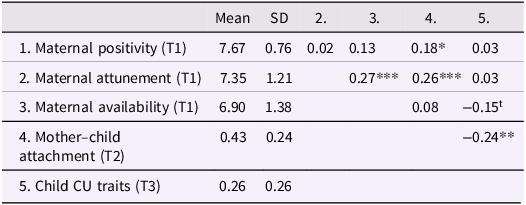
Table 1 presents the descriptive statistics and inter-correlations among main study variables on the resulting final sample of 203 families. Mean levels of child CU traits were similar to those found by Willoughby et al. (Reference Willoughby, Waschbusch, Moore and Propper2011) in the original validation study of this CU traits measure. As already reported on a sample that largely overlapped with this one (Bailey et al., Reference Bailey, Bernier, Bouvette-Turcot, Tarabulsy, Pederson and Becker-Stoll2017), attunement was the dimension of maternal sensitivity most strongly related to child attachment, followed by positivity, and lastly by availability. Child attachment, but not the dimensions of maternal sensitivity, was negatively associated with child CU traits.
Descriptive statistics and inter-correlations for the core study variables

Note. SD = standard deviation.
t p < .10. * p < .05. ** p < .01. *** p < .001.
Child CU traits were not associated with sociodemographic indicators like parental age, education and ethnicity, family income, or child age and sex (all ps ≥ .15). Nonetheless, given increasing recommendations to consider sex differences in CU research (Bégin et al., Reference Bégin, Fontaine, Vitaro, Boivin, Tremblay and Côté2023; Tomlinson et al., Reference Tomlinson, Hyde, Dotterer, Klump and Burt2022), child sex was retained as a covariate in the model.
Main analyses
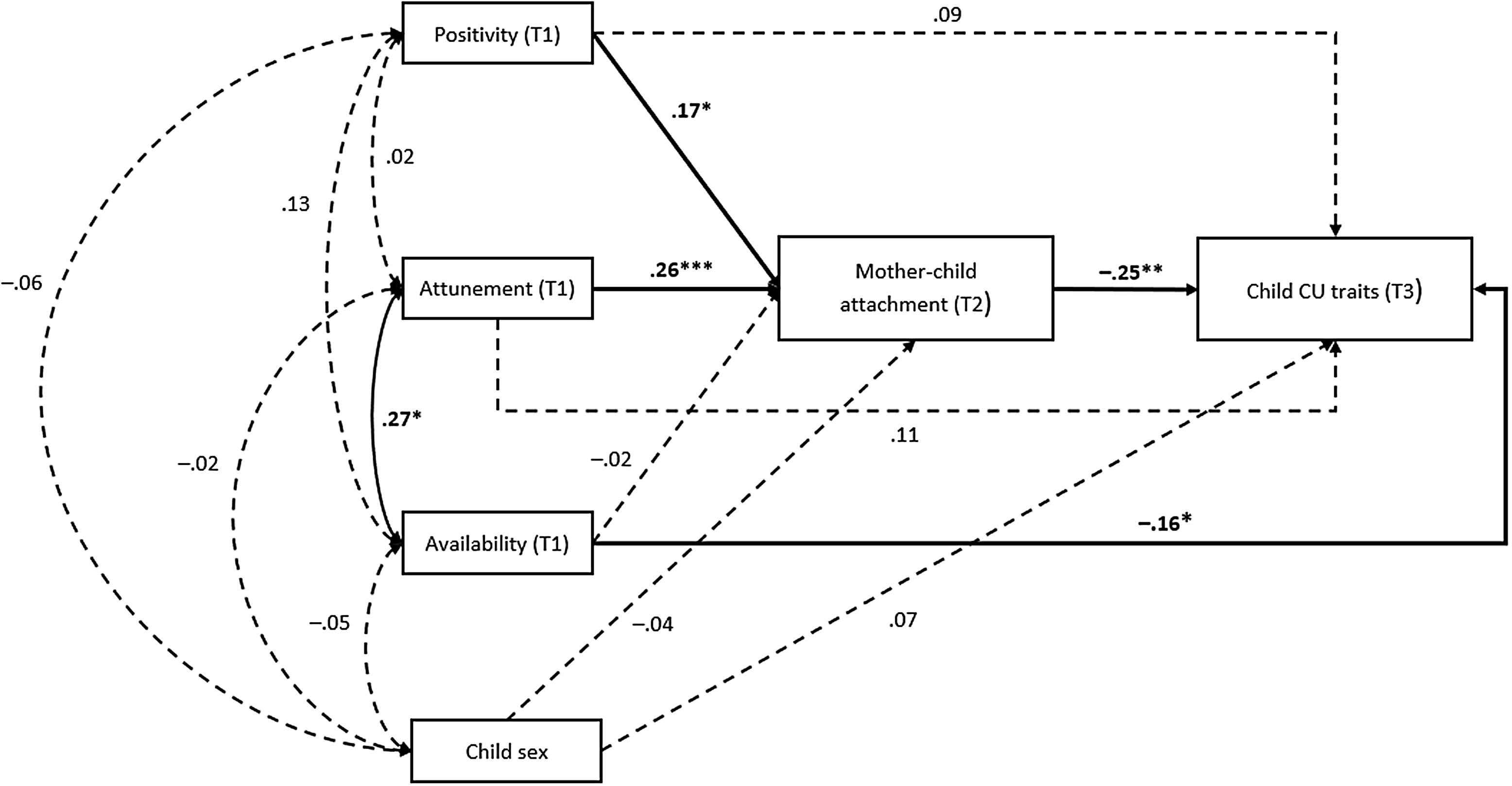
Figure 1 shows the results of the mediational path analysis. After controlling for child sex and covariances among the three indicators of sensitivity, the model suggests that maternal positivity and attunement were significant positive predictors of mother–child attachment security. In turn, mother–child attachment was a significant negative predictor of child CU traits – alongside maternal availability.
Path model of the direct and indirect links between the three dimensions of maternal sensitivity, mother–child attachment, and child CU traits. note. CU = callous-unemotional. Dotted lines indicate non-significant (p ≥ .05) paths. Child sex: 1 = boy; 2 = girl. * p < .05. ** p < .01. *** p < .001.

Regarding the mediation results, only the indirect effect involving attunement and child CU traits via mother–child attachment was statistically significant: children of more attuned mothers were more likely to develop a secure attachment bond with their mother in toddlerhood and this security, in turn, predicted lower levels of CU traits in preschool years (β = –.06, SE = .03, 95% CI [–.13, –.02]). Although maternal positivity was a significant predictor of attachment, which in turn was predictive of lower CU traits, the mediated pathway linking positivity to CU traits through attachment was not significant (β = –.04, SE = .03, 95% CI [–.10, .002]). Finally, there was no significant association between maternal availability and attachment and therefore, the mediated pathway to CU traits was also non-significant (β = .004, SE = .02, 95% CI [–.04, .04]).
Discussion
Research has convincingly shown that parenting plays an important role in the development of childhood CU traits (Waller & Hyde, Reference Waller and Hyde2017). However, the specific aspects of positive parenting that may offer the strongest protection against the development of CU traits (Bedford et al., Reference Bedford, Wagner, Rehder, Propper, Willoughby and Mills-Koonce2017; Clark & Frick, Reference Clark and Frick2018), as well as the role of parent–child attachment in this protective process (Wright et al., Reference Wright, Hill, Sharp and Pickles2018), remain poorly understood. Accordingly, the aim of this study was to examine the mediating role of mother–child attachment security in the associations between three aspects of maternal sensitivity (positivity, attunement, availability) and subsequent CU traits in early childhood. The findings showed that after controlling for child sex, maternal attunement was uniquely linked to lower levels of child CU traits through the mediating role of mother–child attachment security. There was also a direct, non-mediated effect of maternal availability, such that children of more available mothers were less likely to manifest CU traits in preschool years, independently of their attachment security.
Attachment and CU traits
To the best of our knowledge, this is the first study to find the expected links between the security of mother–child attachment relationships in early childhood and children’s CU traits. As mentioned in the introduction, only four studies have addressed this question, two of which focused on the distinction between organized and disorganized attachment and did not consider attachment security (Kohlhoff et al., Reference Kohlhoff, Mahmood, Kimonis, Hawes, Morgan, Egan, Niec and Eapen2020; Willoughby et al., Reference Willoughby, Mills-Koonce, Gottfredson and Wagner2014). The other two relevant studies found non-significant associations between attachment security and child CU traits (Lynch et al., Reference Lynch, Bedford, Propper and Wagner2022; Wright et al., Reference Wright, Hill, Sharp and Pickles2018). At the bivariate level, both these latter studies yielded correlations at or below .10 between attachment insecurity and CU traits, representing less than half the magnitude of the bivariate association found between the same constructs (.24) in the current study. Of note, these two studies were, like this one, based on non-clinical samples and had sample sizes comparable to the current study’s, and therefore equivalent statistical power. Both studies relied solely on maternal reports to assess child CU traits (which could have inflated relations with mother–child attachment) and Lynch et al. (Reference Lynch, Bedford, Propper and Wagner2022) used the same measure of CU traits as in the present study. Accordingly, the sizeable differences in results regarding the links between attachment and CU traits may be due to the attachment measure used, which appears to be the only clear methodological difference between our study and these previous ones. Indeed, both Lynch et al. (Reference Lynch, Bedford, Propper and Wagner2022) and Wright et al. (Reference Wright, Hill, Sharp and Pickles2018) assessed parent–child attachment with the categorical SSP measure. Continuous measures provide better detection of individual differences (Groh et al., Reference Groh, Propper, Mills-Koonce, Moore, Calkins and Cox2019) including those within attachment classifications (Deneault et al., Reference Deneault, Bureau, Yurkowski and Moss2020). Thus, it may be that the variations in parent–child attachment implicated in the development of child CU traits exist along the whole continuum of security-insecurity, rather than being limited to the few cut-off points that define the boundaries between attachment categories. Such an interpretation would be consistent with Craig et al.’s (2024) meta-analytic findings (although at later ages) that continuous attachment measures provide better prediction of CU traits than categorial assessments.
Hence, the very limited support found thus far for the protective role of secure attachment against the development of CU traits in young children may partly be due to the exclusive reliance on the SSP to investigate that question. Yet, because the current study is the first to our knowledge to use a continuous attachment measure in early childhood to address the issue, the attachment assessment method is confounded with other study characteristics (sample, etc.). To tease apart those factors, more studies should use the AQS with infants and toddlers to examine the associations between parent–child attachment security and child CU traits. Nevertheless, in contrast to the SSP, the AQS does not tap into disorganized attachment, which has been shown to be associated with CU traits in early childhood (Kohlhoff et al., Reference Kohlhoff, Mahmood, Kimonis, Hawes, Morgan, Egan, Niec and Eapen2020; Willoughby et al., Reference Willoughby, Mills-Koonce, Gottfredson and Wagner2014). In addition, the AQS does not distinguish between other types of insecurity as does the SSP. Given the very different (if not opposite) patterns of emotional reactivity and regulation that characterize avoidant and resistant attachment patterns (Obeldobel et al., Reference Obeldobel, Brumariu and Kerns2022), they might not represent the same degree of risk for the development of CU traits. Finally, although not commonly used, a continuous scoring system does exist for the SSP (Richters et al., Reference Richters, Waters and Vaughn1988), which could be employed to use SSP data while maximizing variability through the use of continuous indicators. Overall, the combined use of the SSP and the AQS may be necessary to fully delineate the (likely diverse) facets of parent–child attachment relationships that are involved in the development of CU traits among young children. This appears feasible, considering the large number of attachment studies worldwide that have used the ASEBA to document children’s socioemotional adjustment, thereby unknowingly assessing child CU traits. There is likely a substantial pool of existing data that can be leveraged to conduct secondary analyses and provide in-depth answers to the questions surrounding the role of attachment in CU traits.
From a theoretical perpective, the present findings offer support for the role of parent–child attachment proposed in conceptual models of CU traits development such as the STAR (Waller & Wagner, Reference Waller and Wagner2019) and ESCAPE‑AL (Kimonis, Reference Kimonis2023) models. Secure parent–child relationships lay the groundwork for emotion regulation, empathy, and moral development, capacities often impaired in children with elevated CU traits. By showing a significant negative association between CU traits and earlier attachment security assessed using a continuous measure, the current results suggest that variations (even if subtle) in the quality of early caregiving relationships may serve as a foundational mechanism through which children become receptive to caregivers’ socialization efforts, including moral guidance and emotional support. As such, early attachment security may not only buffer against later emotional and behavioral dysregulation broadly but also represent a key protective factor against the emergence of CU traits by fostering emotional responsiveness and concern for others.
Mediation of maternal sensitivity through mother–child attachment
The other central finding of the current study is that the role played by mother–child attachment in linking different dimensions of sensitivity to child CU traits was different for each aspect of sensitivity considered here. Attunement, the facet of sensitivity most closely associated with attachment security in our prior work (Bailey et al., Reference Bailey, Bernier, Bouvette-Turcot, Tarabulsy, Pederson and Becker-Stoll2017), was indirectly connected to CU traits through the mediating role of attachment. Therefore, children exposed to more attuned mothers during their infancy, namely, mothers who more accurately interpreted child cues and more effectively adjusted their behavior correspondingly, were likely to develop a more secure attachment relationship with their mother, which in turn, reduced the risk of their displaying CU traits at preschool age. Parental attunement, as assessed here, requires the empathic capacity to correctly read the child’s emotional signals. More empathic mothers may teach the same skills to their children, explicitely encouraging them to notice and value other people’s emotions, and implicitely modeling these skills through their own empathic reactions to their child’s emotional expressions. Promoting such a prosocial orientation to emotions in young children could act as a strong protective factor against CU manifestations. Of note, though, there was no significant direct link between maternal attunement and child CU traits (whether in bivariate or multivariate analyses). It is only when mother–child attachment was entered in the model as a mediating factor that a significant indirect effect arose between attunement and CU traits. Thus, testing an indirect effect model allowed us to observe a developmental process linking maternal attunement to child CU traits through attachment that would have gone unnoticed had we focused only on direct associations. We suggest that testing other such mediation models may advance research on the relational pathways to CU traits in young children.
With respect to the other dimensions of sensitivity, positivity showed no significant direct or indirect relations to CU traits – although statistical power may be at play with the indirect effect given that the basic conditions for mediation were met and indeed, the confidence interval just hardly included 0. Finally, maternal availability was significantly predictive of lower CU traits when accounting for its shared variance with the other dimensions of sensitivity, and this pathway did not transit via attachment. Available mothers are consistently accessible and aware of their infant’s cues, as illustrated by items such as “Monitors and responds to baby even when engaged in other activity such as having a conversation with the research assistants” or “Seems to be aware of baby even when not in the same room.” The direct effect on CU traits that we observed suggests that this consistent attentiveness, although potentially not critical for fostering attachment security, which might primarly require responsiveness to distress (Leerkes, Reference Leerkes2011), may provide mothers with multiple opportunities to promote children’s internalization of parental norms and foster the development of guilt and empathy. Consistently attentive parents are more likely to notice acts of disobedience such as deliberately breaking toys, hitting a sibling, or touching forbidden items (e.g., sharp objects). These situations do not call for parental responsiveness to distress but rather require inductive discipline, including setting limits, explaining the rationale behind the rules, and underscoring the consequences of the child’s behavior on others. Such parental responses are known to promote rule internalization, guilt, empathy, and prosocial behavior (Gibbs, Reference Gibbs2019) and may therefore protect children against the development of CU traits. Overall, in line with the phenomenon of equifinality, different aspects of parenting probably shape the expression of child CU traits to different degrees and via different mechanisms, with some but not all of those mechanisms involving parent–child attachment.
Aside from their relevance to CU traits research, the current results also contribute to an ongoing discussion among attachment researchers. It is often assumed that early parental sensitivity impacts later child development through its intermediate effect on parent–child attachment. While sometimes taken for granted, this mediating role of attachment has received little empirical support. Based on their meta-analytic findings pertaining to child cognitive outcomes, Deneault et al. (Reference Deneault, Duschinsky, van Ijzendoorn, Roisman, Ly, Fearon and Madigan2023) concluded that the mediation from sensitivity to child development through parent–child attachment may have been overestimated. Consistent with this suggestion, we identified studies that tested such mediated pathways in relation to child socioemotional outcomes and did not find evidence of mediation (Booth-Laforce & Oxford, Reference Booth-LaForce and Oxford2008; Sirois & Bernier, Reference Sirois and Bernier2018; Wright et al., Reference Wright, Hill, Sharp and Pickles2018). In contrast, we were unable to find any studies that confirmed such mediation models (aside from some reports based on unvalidated or self-report measures of attachment). In addition, although interventions aiming to promote parental sensitivity succesfully increase child attachment security, they do not reduce child externalizing behavior problems (Van IJzendoorn et al., Reference Van IJzendoorn, Schuengel, Wang and Bakermans-Kranenburg2023). Overall, while there may be relevant studies that we did not locate, it does not appear that the long-hypothesized role of attachment in mediating the associations between sensitivity and child outcomes has received a great deal of empirical support. Thus, the current results with maternal attunement appear to provide a rare example of this presumed mediation being corroborated with well-validated observational measures of both sensitivity and attachment. However, given that only one of the three tested aspects of sensitivity showed an indirect link to child CU traits via parent–child attachment, we tentatively suggest that only some aspects of sensitivity may be mediated by attachment security in their prediction of different socioemotional outcomes.
Methodological considerations
The design of this study was not genetically informed; accordingly, we cannot rule out that part of the associations observed between maternal sensitivity, mother–child attachment, and child CU traits may be due to maternal genetic characteristics inherited by children. There are several reasons, however, to question whether shared genetic variance played a major role in the results. Genetically informed studies show that the variance found in measures of maternal sensitivity (Roisman & Fraley, Reference Roisman and Fraley2008) and in observational measures of mother–child attachment in early childhood, whether the SSP (Bokhorst et al., Reference Bokhorst, Bakermans-kranenburg, Pasco Fearon, Van Ijzendoorn, Fonagy and Schuengel2003; O’Connor & Croft, Reference O’Connor and Croft2001) or an adaptation of the AQS (Roisman & Fraley, Reference Roisman and Fraley2008), is almost entirely attributable to environmental influences, with small to negligible genetic contributions. In addition, Klahr & Burt’s (Reference Klahr and Burt2014) meta-analysis of genetically informed studies of parenting showed that genetic contributions – from either parent or child – were especially high with parents’ retrospective reports of their parenting but non-significant with behavioral observations of positive aspects of parenting, such as sensitivity. Therefore, considering the measures used here, shared genetic variance appears unlikely to have played a strong role in the findings.
Nonetheless, we would argue that one of the most exciting avenues for the continued investigation of the origins of CU traits is that of reciprocal influences between parents and children (Clark & Frick, Reference Clark and Frick2018; Flom et al., Reference Flom, White, Ganiban and Saudino2020). Bidirectional associations between parenting and child CU traits have been observed (Hawes et al., Reference Hawes, Dadds, Frost and Hasking2011), including in early childhood (Waller et al., Reference Waller, Gardner, Viding, Shaw, Dishion, Wilson and Hyde2014). Having a young child who displays CU traits (notably due to genetic factors) would likely challenge parents’ capacity to be sensitive, undermining the quality of attachment relationships, which in turn, may foster the continued development of CU traits in the child (Flom et al., Reference Flom, White, Ganiban and Saudino2020). Hence, parent- and child-driven effects may operate in a bidirectional cascade (Waller et al., Reference Waller, Hyde, Klump and Burt2018) and such transactions likely better account for the development of CU traits than unidirectional processes. Genetic influences may also take the form of gene-environment interactions, by which different facets of parent–child relationships have a more or less important function in the expression of CU traits according to the child’s genotype (Moore et al., Reference Moore, Blair, Hettema and Roberson-Nay2019). Overall, not only do relational and genetic influences not contradict one another but in fact, they probably function synergistically following different forms of interplay.
Besides the lack of genetic information and of a disorganized attachment indicator mentioned previously, other study limitations should be noted. First, although the longitudinal design is useful in suggesting the directionality of the developmental process at play, a superior approach would involve a panel design allowing to disentangle the direction of associations. The use of a panel design was, unfortunately, not possible here, as CU traits cannot be assessed reliably before age 3 (or 2 at the earliest; see Waller, Dishion et al., Reference Waller, Dishion, Shaw, Gardner, Wilson and Hyde2016) and thus could not be assessed here in infancy, when sensitivity and attachment were evaluated. Second, although statistical power was adequate to test the hypothesized model, the study was under-powered to run a multigroup analysis so as to test the moderating effect of child sex in the pathways of interest. There is some evidence, albeit inconsistent, that links between parenting and CU traits may differ by child sex (Barker et al., Reference Barker, Oliver, Viding, Salekin and Maughan2011; Bedford et al., Reference Bedford, Pickles, Sharp, Wright and Hill2015; Hawes et al., Reference Hawes, Dadds, Frost and Hasking2011) – thus, this is an area of investigation worth pursuing. Also, we used a community sample with correspondingly low levels of CU traits. Low CU traits in community samples are expected and commonly observed (Henry et al., Reference Henry, Dionne, Viding, Petitclerc, Feng, Vitaro, Brendgen, Tremblay and Boivin2018; Kochanska et al., Reference Kochanska, Kim, Boldt and Yoon2013; Payot et al., Reference Payot, Monseur and Stievenart2023; Willoughby et al., Reference Willoughby, Waschbusch, Moore and Propper2011, Reference Willoughby, Mills-Koonce, Gottfredson and Wagner2014). Nonetheless, the limited variability probably contributed to the generally small effect sizes that we obtained and, consequently, reduced statistical power. One way around this issue for future studies of community samples may be to use the Inventory of Callous–Unemotional Traits (Frick, Reference Frick2004), which is composed of 24 items, thereby potentially generating more variability in scores. It has also been argued that associations between attachment and CU traits may differ between clinical and community samples (Craig et al., Reference Craig, Dawson, Chen, Moretti and Pepler2024); hence, the current findings may not generalize to clinical samples. Nevertheless, researchers studying CU traits argue for the value of community samples, which produce greater generalizability to the population level (Lynch et al., Reference Lynch, Bedford, Propper and Wagner2022; Wagner et al., Reference Wagner, Mills-Koonce, Willoughby, Propper, Rehder and Gueron-Sela2017; Willoughby et al., Reference Willoughby, Mills-Koonce, Waschbusch and Gottfredson2015) and increase the ability to study subtle individual differences in both parent and child behaviors (Kochanska & Kim, Reference Kochanska and Kim2012). Overall, there are advantages and drawbacks to the study of both clinical and community samples. The representation of both types of samples in the scientific literature will allow for strong conclusions to be drawn about similarities and differences between populations in terms of the relations between parenting, attachment, and CU traits. Finally, the relative homogeneity of the sample, especially in terms of racial background, limits the generalizability of the results.
This study’s limitations should be interpreted in light of its strengths, especially the use, for the first time in CU research, of a continuous early childhood attachment measure and the consideration of different aspects of maternal sensitivity – which showed different direct and indirect relations to CU traits, highlighting the value of this approach. These constructs were assessed using high-quality home-based observational measures rated by intensively trained observers, and used to longitudinally predict CU traits assessed with a multi-informant approach (i.e., mothers, fathers, teachers). A multi-informant approach to assess CU traits in children aligns with recommendations made in the Diagnostic and Statistical Manual of Mental Disorders, 5th edition (DSM-V; American Psychiatric Association, 2013) to base assessments of CU characteristics on multiple information sources, which enables evaluation across relationships and settings (Clark & Frick, Reference Clark and Frick2018). Combined with the use of observational data for sensitivity and attachment, the multi-informant approach makes the risk of Type-I error due to shared method variance very low. Therefore, the estimates obtained in the current study can be considered conservative.
Future directions
As mentioned, there is a need for research examining bidirectional transactions between parents and children, as well as for the use of different types of attachment measures. Another important future direction is the inclusion of fathers, who are nearly absent from the CU scientific literature. This is particularly important given the prominent role that fathers play in their children’s development (Volling & Cabrera, Reference Volling and Cabrera2019), with influences that may go above and beyond the influence of mothers (Bureau et al., Reference Bureau, Deneault and Yurkowski2020; Cabrera et al., Reference Cabrera, Jeong Moon, Fagan, West and Aldoney2020). Moreover, it would be valuable to investigate the associations between parental sensitivity, attachment, and CU traits in the context of different developmental pathways for CU traits. This approach may help clarify whether different CU variants – one primarily driven by genetic and neurobiological factors (primary variant) and one shaped more by environmental adversity (secondary variant) – are differently influenced by caregiving and attachment processes (Craig et al., Reference Craig, Goulter and Moretti2021, Reference Craig, Dawson, Chen, Moretti and Pepler2024).
Conclusion and clinical implications
This study found that some aspects of higher-quality maternal behavior in infancy were linked to a lower risk of children showing CU traits at age 4, either directly or indirectly through mother–infant attachment security. These findings underscore the potential benefits of early interventions, such as Parent–Child Interaction Therapy adapted for preschoolers with CU traits (PCIT-CU; Kimonis et al., Reference Kimonis, Fleming, Briggs, Brouwer-French, Frick, Hawes, Bagner, Thomas and Dadds2019), of which the promotion of parental warmth, sensitivity, and responsiveness is an important component. To our knowledge, the impact of such interventions at ages younger than 3 years on CU traits has yet to be investigated. The current findings, showing that relational factors assessed as early as 12 or 15 months forecast preschool-age CU traits, suggest that earlier intervention may be possible. Therefore, we propose that current intervention strategies for CU traits could perhaps be usefully complemented by attachment-based videofeedback intervention approaches, which show effectiveness in promoting parental sensitivity and secure parent–child attachment (Van IJzendoorn et al., Reference Van IJzendoorn, Schuengel, Wang and Bakermans-Kranenburg2023) and are increasingly used with parents of infants (Alsancak-Akbulut et al., Reference Alsancak-Akbulut, Sahin-Acar and Sumer2020; Barone et al., Reference Barone, Carone, Salazar-Jimenez and Ortíz Muñoz2020) as well as maltreated children (Moss et al., Reference Moss, Dubois-Comtois, Cyr, Tarabulsy, St-Laurent and Bernier2011), a population with a higher risk of CU traits (Gao et al., Reference Gao, Tian, Assink, Meng, Zhong and Chan2025). Considering that multimodal intervention models targetting both child and parent factors effectively prevent other types of behavioral disturbance (Castellanos-Ryan et al., Reference Castellanos-Ryan, Séguin, Vitaro, Parent and Tremblay2013) and the combined role of child and parental characteristics in the development of CU traits, early interventions should also target child factors (e.g., temperament; Kimonis, Reference Kimonis2023; Waller & Wagner, Reference Waller and Wagner2019). Such integrative approaches may show effectiveness in preventing the development of CU traits in children by interrupting maladaptive developmental cascades involving mutual influences between vulnerable parents and children.
Acknowledgements
The authors wish to acknowledge N. Ballen, L. Bastien, M.- È. Bélanger, A.-F. Boatswain-Jacques, S. Bordeleau, A.-A. Bouvette-Turcot, M.-P. Côté, C. Cimon-Paquet, I. Demers, M. Deschênes, C. Gagné, É. Y. T. Guo, S. Hertz, É. Hébert, C. Houde-Labrecque, G. Lalonde, J. Laranjo, É. Larose-Grégoire, R. Lapolice Thériault, J. Laranjo, É. Leblanc, G. Leclerc, M.-N. Lortie, C. Marquis-Brideau, R. Perrier, N. Marzougui, C. Matte-Gagné, S. Regueiro, É. Rochette, M.-S. Sirois, E. Sycheva, É. Tétreault, N. Whipple, and E. Wyckaert for help with data collection. The authors also want to express special gratitude to the participating families of the Grandir Ensemble project who generously opened their homes to us.
Funding statement
Funding for this project was provided by the Canadian Institutes of Health Research (grant number MOP-119390), the Social Sciences and Humanities Research Council of Canada (grant numbers 410-2010-1366 & 435-2016-1396), the Natural Sciences and Engineering Research Council of Canada (grant number RGPIN-2019-05084), the Fonds de Recherche du Québec-Société et Culture (grant number 2012-RP-144923), and the Center for Interdisciplinary Research on Learning and the Brain. The analyses presented in this manuscript were not preregistered. The data used in this study cannot be made public due to ethical constraints but are available along with the analytic code upon reasonable request to the corresponding author.
Competing interests
The authors declare none.

 Open access

