





A new historical classification of Africa's Bantu languages appeared in 2015.Footnote 1 It rests on fresh vocabulary evidence from 424 members of the group analyzed using statistical tools guided by explicit assumptions about language change and its chronology. The results present an unambiguous peeling movement of the Bantu languages from their formation as a distinct branch of Niger-Congo, in today's Nigeria-Cameroon borderlands, slowly into southern Cameroon, then along a savannah corridor through West Central Africa's rainforests, south into the savannahs, then to Southern Africa, East Africa's Great Lakes region, and its Indian Ocean coast (Fig. 5).Footnote 2 The apparent clarity of this long history of movement, language change, and social interaction masks the constraints and contingencies behind the choices people made in moving along the way. Transformations from foraging, hunting, and fishing to agriculture and pastoralism or from no use of metals to full engagement with metals and metal-making, long taken for granted as driving this sprawling story, were actually changeable, unfolded with varying velocity, and involved interactions with a wide array of firstcomers. Sometimes, as in much of Central Africa, Bantu-speakers were the first farmers and metal-users in a region. Often, in the rest of their expansions, they were neither. Whichever was the case, their arrivals did not lead to the immediate disappearance of firstcomers. Hard-to-reverse commitments to particular food systems — such as agropastoralism — often only set in after initial expansions had occurred.
Historians now have a clearer chronology and a sharper sense of directionality in this world-famous example of language dispersal. But the variety of histories they must explore has grown more complex. Teams of archaeologists, paleoecologists, statisticians, coders, and geneticists, some of whom were not trained in humanities and social science disciplines, must hone their skepticism and blend the scales at which contingencies shape people's lives in taking up the challenge of writing histories of technology, wild resource use, food production, mobility, and multilingualism.Footnote 3 Our phylogenetic classification of the Bantu languages encodes a sequence of language spread that must not be mistaken for history. It depicts the history of languages most directly which must then be interpreted and qualified with new knowledge of what people were doing in the earlier African past.Footnote 4 As that knowledge grows, new models must incorporate its details to depict the array of choices people made about where and how to live and use Bantu languages. The result will increase understanding of diverse mobilities in Africa's early past, widen historical context beyond the long-standing focus on agriculture and metals, and displace the assumption that people were monolingual. Computational methods are well suited to that task.
A brief history of Bantu language expansions
In the nineteenth century, many observed that the wide presence of Bantu languages over the southern half of Africa meant they must belong to a single language family and they must descend from an ancestral language once spoken in a single place of origin. They set out to discover that place of origin and to trace the family's branches by comparing basic vocabulary among those languages.Footnote 5 Since that search was launched many others have followed suit.
To trace the family's branchings, scholars applied the comparative method in historical linguistics that was developed during the study of the Indo-European languages. But they met with limited success because the two language families differed. While the languages of the main branches of Indo-European are so distinct from each other that this feature leaps out, the Bantu languages present themselves without such stark internal contrasts.Footnote 6 Significant progress beyond middle- and low-level groupings was only made in 1949, when Joseph Greenberg used his mass comparison method to determine Bantu's region of origin. Mass comparison, which involved studying the resemblances observed among words in a set of languages, showed that Bantu languages constitute a subfamily within the Niger-Congo family and that their expansion started in the Nigeria-Cameroon border area.Footnote 7
In the 1950s, Morris Swadesh developed lexicostatistics, letting scholars sample and compare more languages than Greenberg.Footnote 8 Lexicostatistics counts basic vocabulary shared between two or more related languages. Basic vocabulary is usually kept to 100 meanings chosen because their commonness resists borrowing. Languages that present a high percentage of shared, or cognate basic vocabulary are more likely to be related and to have diverged more recently than those presenting lower percentages.
In 1973 Alec Henrici published the first classification of Bantu languages based on lexicostatistics. His tree had three main branches: North-Western, Western, and Eastern Bantu.Footnote 9 During the same year, Bernd Heine (Fig. 1B) proposed a lexicostatistical classification of 137 Bantu languages.Footnote 10 Christopher Ehret had reached the same conclusion a decade earlier in an unpublished paper, using the approach Henrici later used.Footnote 11 These trees locate the proto-Bantu nucleus in Cameroon, a second center of expansion in Congo, and a third center of expansion in Zimbabwe, showing that the Bantu-speaking populations had expanded from Cameroon in a southeasterly direction. In 1999, Yvonne Bastin, André Coupez, and Michael Mann published a study comparing nearly 600 Bantu languages.Footnote 12 It yielded different possible genetic trees, depending on which statistical approach one chose from a set of ten alternatives. One of their most important findings was that the Bantu languages can be divided into four genetic subgroups: the Mbam-Bubi, the North-Western, the Central-Western, and the South-Eastern. Each possible tree explained a particular set of historical outcomes, undertaken by groups of differing sizes. But all the trees agreed on the four genetic subgroups. Based on this agreement, Jan Vansina postulated a first migration path along the northern contours of the rainforest whereas a second path followed the coasts of modern-day Cameroon, Equatorial Guinea, and Gabon (Fig. 1A).Footnote 13
A. Vansina's 1995 tree. Source: Vansina, ‘New linguistic evidence’, 175. B. Heine, Hoff, and Vossen's 1977 tree. Source: B. Heine, H. Hoff, and R. Vossen, ‘Neuere ergebnisse’, 61. C. Early split vs late split. Source: B. Pakendorf, K. Bostoen, and C. de Filippo, ‘Molecular perspectives on the Bantu expansion: a synthesis’, Language Dynamics and Change, 1 (2011), 57.

To sum up, two theories explaining the Bantu expansion emerged by the 1990s (Fig. 1C). In the east-next-to-the-west model, or deep split, promoted by Vansina, Eastern Bantu separated from Western Bantu north of the rainforest boundary, at an early stage. In the east-out-of-the-west model, or late split, Eastern Bantu emerged from Western Bantu groups south of the rainforest, at a later stage.Footnote 14 After 2000, advances in computing and computational linguistics let scholars apply statistical methods borrowed from evolutionary biology to linguistic data, deepening historical debate.
Numerous analogies have been developed between language evolution and biological evolution.Footnote 15 Languages and species evolve in similar ways, by descent with modification from earlier forms. The parts of linguistic diversity which, like biological diversity, vary ‘according to general evolutionary processes’ can be explained by such principles.Footnote 16 When similarities in words exist between languages, one explanation lies in hypothesizing the existence of a common ancestor from which the languages with the similarities have descended. By extension, the tools used to classify organisms to investigate their biological evolution can be used to classify languages and investigate their evolution.
Since 2000, most linguistic classifications established for Bantu languages were done by scholars who had mastered computational methods.Footnote 17 Between 2002 and 2013, they built trees using the evidence provided by Bastin, Coupez, and Mann in their monumental 1999 study.Footnote 18 Despite some skepticism regarding computational methods — notably because modeling language death eludes the methods, they are difficult to replicate, and the underlying concepts are opaque, as discussed in the following section — the methods have changed the field of historical linguistics.Footnote 19 Understanding the findings is a precondition to arguing their interpretation.
Computational methods
Computational methods build trees by computing patterns of presence and absence of features, usually of words and their meanings, in a set of languages.Footnote 20 Bayesian statistics produce probabilities that a new cognate appears in the tree or that a reflex, or descendant form, of an old cognate disappears. Then, it treats those results as ‘prior knowledge’, or parameters, to produce probabilities that one tree shape, and not another, best accommodates the two parameters.Footnote 21 In other words, it incorporates the prior knowledge in figuring probabilities for subsequent branchings in a tree.Footnote 22 In using prior knowledge to compute changes in likelihood, Bayesian statistics models the ways in which the existence of one branch in a tree changes the probabilities that other branches existed. The result is a ‘likelihood score’ for the probability that one tree and not another explains — in the simplest terms possible but not simpler — the course of descent with modification, resulting in today's linguistic diversity.
Results can differ in their structure, because sound systems (phonology), how words are formed (morphology), and vocabulary do not change in lockstep.Footnote 23 And, software packages vary in applying Bayesian statistics to make these trees. Thus, different trees can be made from the same data. The trees a ‘likelihood score’ builds cannot confirm if the favored tree actually happened. The favored tree must be interpreted using other historical evidence, as we do in this essay. Phylogenetic trees should always be read with findings from other fields.
Bayesian statistical models may be calibrated to time, providing probability ranges of dates for the branching represented in trees. Branchings may then be mapped as a series of movements of the speech communities the branches represent (see Figs. 5 and 6). Branchings can be dated with approximate calendar dates. In the absence of ancient texts, scholars choose archaeological ‘events’ that occurred in the part of the language area in which the speech community forming the branch to be dated arguably lived. Bayesian statistics then generate likelihoods for the ‘fits’ between rates of linguistic change and the calibration points, using other kinds of prior knowledge. One approach calculates different rates for creating new cognates.Footnote 24 One rate represents innovations occurring continuously during the life of a subgroup while another rate represents new words developing quickly, as new subgroups formed.
To recount, computational methods and conventional historical linguistics rely on the same base of evidence: judgments of similarity and difference in one or another linguistic feature, most often vocabulary. But computational methods estimate the paths followed by each feature, represented as a probability or ‘likelihood’. At each step on the path, Bayesian statistics incorporates prior findings to estimate likely next steps. Estimations of the paths followed by each feature test a given choice against others in a set of choices the researcher made about what changed and how. Scholars choose the things to study in this way, but the things they choose resulted from what people did with their language(s). The classifications discussed in the next section, including the one published here, exploit in varying ways the ability of computational methods to quickly account for multiple scenarios. But there are limits.
Language death is one limit. Depending on when language death occurred in the course of Bantu expansions, evidence from such departed languages could change a given tree. Language death is more than a theoretical possibility. Analysis of the densities through time of radiocarbon dates from across the Inner Congo Basin reveal dramatic reductions, in a distinct regional sequence, between 400 and 600 CE. This suggests population collapse.Footnote 25 Reductions were earliest in southern Cameroon and Gabon and slightly later in the western and northern regions of the Inner Congo Basin. Further archaeological work may confirm or revise this broad conclusion, but it cannot tell us if a group of Bantu languages ceased to exist as populations collapsed. Possible language death qualifies the routes implicit in any tree of the Bantu languages.Footnote 26
Another limit has to do with trees themselves. Trees represent ‘the amount of divergence’ but not the ‘character of evolution’. They ‘force the analysis and the conclusion into a single hypothesis’ namely that language evolution involves the splitting of a language into two or more new languages, ‘resulting in the extinction of the ancestor’.Footnote 27 Language change is more complex than that single option. Some features may be shared among languages through processes other than descent with modification. In convergence or drift, two languages develop the same word or grammatical feature independently. If phonology is less susceptible to borrowing than vocabulary, it may carry clearer signals of descent with modification.Footnote 28 Yet, speakers of a language may reverse a sound-change once shared with other languages. Lastly, contact between speakers of different languages or prolonged multilingualism leads to borrowing among languages. Networks (Fig. 2) can represent those complexities while trees highlight the splitting processes implicit in the vast geographical distribution of today's Bantu languages. Representing the dynamic interplay of context with language change and continuity is thus a methodological rather than theoretical challenge.Footnote 29
Network representation for 95 Bantu languages.
Source: Holden and Gray, ‘Rapid radiation’, 28.

The Bantu languages tree generated by Bayesian statistics discussed here, foreground the social and ecological importance of agriculture in guiding the choices people made that produced the story of movement the tree represents. As new knowledge about the past accumulates, scholars can use Bayesian statistical methods to grapple with other historical contexts influencing the paths taken and the time taken traversing them. They can model multilingualism. They can incorporate a greater range of economic activities than agriculture into assumptions about favored environments, rates of language change, and so forth.Footnote 30 Multilingualism, economic eclecticism, and mobility put inventive and ambulatory people, as well as creatures of habit and home, at the center of language histories.
Computational classifications of Bantu languages
Computational methods debuted in African history with Claire Holden's 2002 analysis of a sample of 75 languages from the 542 languages Bastin's team studied. Holden's sample included few languages spoken in Cameroon and Gabon near the proto-Bantu nucleus.Footnote 31 Languages nearest to the homeland of proto-Bantu display a high degree of linguistic diversity. Leaving them out meant Holden could not account for the earliest periods of expansions. Holden defined subgroups and built her classification by applying the criterion of maximum parsimony to the judgments made by the Bastin team.Footnote 32 In other words, Holden's classification represented the fewest possible branchings needed to account for observed patterns of cognation. More shared cognates increase the likelihood that the languages sharing them had a common ancestry.Footnote 33 Holden's tree showed six groups diverged: North-Western, West Bantu-Equatorial, West Savannah, Central, East Bantu-East Africa and East Bantu-Southeast (Fig. 4). Based on the limited sample, Holden found the four Western groups did not share a common ancestor, whereas her Eastern groups did share one of the Western groups as a common ancestor. Based on her findings, and on radiocarbon dates for archaeological evidence of farming, Holden argued her tree reflected the spread of farming.
To resolve the uncertainties in this first tree, Holden, Andrew Meade, and Mark Pagel published a new study, based on 95 languages from the Bastin team's data (Fig. 3B).Footnote 34 They applied Bayesian methods to cognation judgments to construct a sample of possible trees. The resulting tree represents uncertainty with a confidence interval for the choice of each branch. This new Bayesian tree accorded some with the 2002 parsimony tree, but also differed. It displayed a succession of branches, implying that Western languages divided sequentially into several groups whereas the 2002 parsimony tree showed the Western languages (minus the North-Western languages) in a single group without a clear common ancestor. The 2002 parsimony tree supports a single group of Eastern languages which then divides into three subgroups: East-Central, East, and Southeast. In the Bayesian tree, the Central Bantu languages divide into East-Central and West-Central groups. Holden's 2002 tree suggested the Eastern languages came out of the Western languages in one branching. The Bayesian tree presented a scenario with many branches, suggesting the Bantu expansions occurred in many steps.
Simplified trees. A. Based on Holden (2002). B. Based on Holden, et al. (2005). C. Based on Holden and Gray (2006). D. Based on Rexová, Bastin, and Frynta (2006).
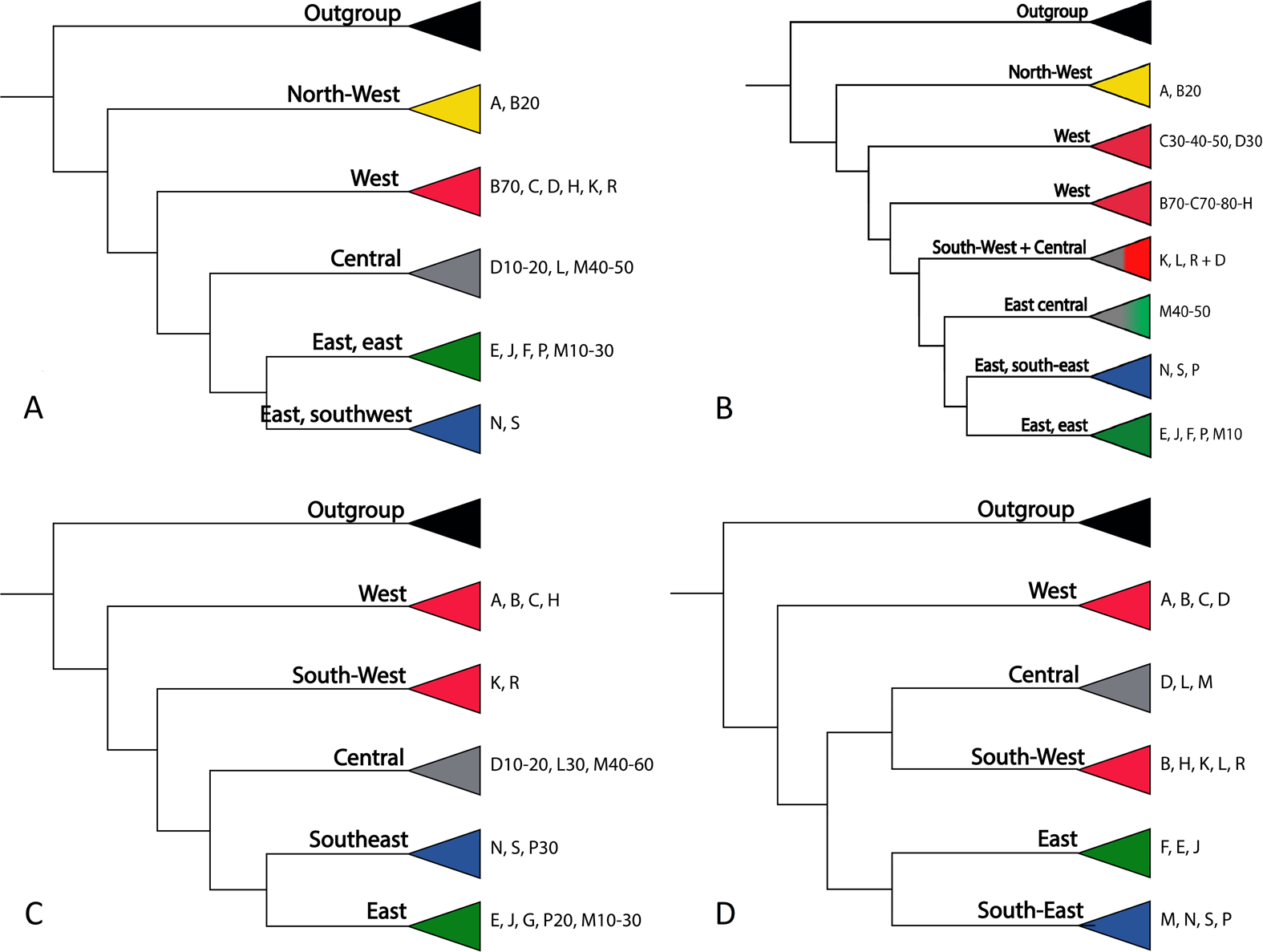
In 2006, Holden and Russell Gray reanalyzed the sample of 95 languages and built two phylogenetic trees, one using distance-based methods and another using character-based methods.Footnote 35 Distance-based methods compare rates of resemblance, usually in vocabulary, without determining if the words resemble one another because inherited from a common ancestor or borrowed. Character-based methods distinguish between those two possibilities, counting only those words shared between languages because they descend from a common ancestor. The Bayesian tree in Fig. 3C rests on a character-based method and shows the divergence of four main groups: West Bantu, followed by a Southwest Bantu group, Central Bantu, and East Bantu (divided into Southeast Africa and East Africa). This tree differs from the 2005 Bayesian tree. In the group elsewhere called West Bantu they include both North-Western Bantu languages and Western Bantu languages. Moreover, the first languages to diverge are spoken today in Democratic Republic of the Congo (DRC). This implies that, from the proto-Bantu nucleus in Cameroon, Bantu-speaking populations went directly to DRC, but soon returned to Cameroon, and then expanded in the Western Bantu area. Their Southwest Bantu and the Central Bantu groups are distinct, whereas in the 2005 study, Central languages split into the South-West group and the East group. Lastly, their Eastern Bantu group split into East and Southeast, not the three groups of the 2005 study.
In the same study, Holden and Gray published a network representation (Fig. 2). Networks are webs, not trees, so they can represent the effects of contact between different languages in a subgroup. The trapezoidal shapes near the heart of Fig. 2 represent that contact. They used an algorithm that calculates the distance — the number of cognates shared — between each pair of branches to produce a matrix of distances. The algorithm then combines branches into progressively larger and overlapping clusters. Thus, the webbing in the network represents possible histories of Bantu expansions. The network confirms the groupings in their Bayesian tree. For Holden and Gray, the network suggested a rapid radiation (few trapezoids) amongst Western Bantu languages and extensive borrowing (many trapezoids) between Eastern Bantu languages.Footnote 36
The same year, Bantuists joined the computational methods revolution. Katerina Rexová, Bastin, and Daniel Frynta classified 87 languages selected from the Bastin team's data, improving coverage of the Bantu area by including North-Western languages.Footnote 37 Uniquely, they built their classification with the Bastin team's cognation judgments and 52 phonological and morphological features.Footnote 38 They produced a parsimony tree and a Bayesian tree. The two trees show similar ordering of the main groupings and differences in the smaller groups. Their results showed Bantu expansions unfolding in four steps. After an initial radiation from Cameroon, a second expansion moved through the equatorial rainforest. The third step was a large radiation in the southeast DRC, followed by a spread westward. Finally, and from this third zone in southeastern DRC, Bantu-speakers radiated southeastward, into the eastern half of Africa, south of the equator.
In 2013, Thomas Currie, Meade, Myrtille Guillon, and Ruth Mace proposed a new classification of the Bastin team's entire sample of 542 languages, applying Bayesian statistics to the cognation judgments to build a tree. The larger sample improved the performance of phylogenetic methods by reducing the geographical bias of smaller samples.Footnote 39 To reconstruct a migration path, they mapped onto their tree the geographical location of the research that generated the sampled vocabulary from each of the Bantu languages studied. They incorporated ecofacts — such as the presence of savannah or rainforest — into the parameters generating language geographies, to test which versions of trees fit with or departed from routes favoring or disfavoring particular environments. The tree and the migration paths they reconstructed favored Bantu expansions from the region between the upper Sangha and middle Ubangi rivers through the rainforest in a southerly direction.Footnote 40
A comprehensive classification, based on vocabulary evidence
In 2015, Rebecca Grollemund's team published the phylogenetic classification of the Bantu languages (Fig. 4) this essay interprets.Footnote 41 The study departs from the previous ones because the team worked from entirely new data. Grollemund selected 424 languages covering the entire area in which people speak Bantu languages. Grollemund collected new vocabulary data from fieldwork and dictionaries and provided cognation judgments based on establishing sound correspondences. She worked with a 100-word list of a basic lexicon deemed the least susceptible to borrowing.Footnote 42 The team used Bayesian methods to build their tree and estimate calendar dates for all branches of the tree. The pace at which speakers created new words for old meanings and continued to use them emerges by interpolation. They calibrated the clock with four archaeological ‘events’.
Bayesian Consensus tree showing the five Bantu groups
Source: Grollemund, Branford, Bostoen, Meade, et al., ‘Bantu expansion’, 13297.
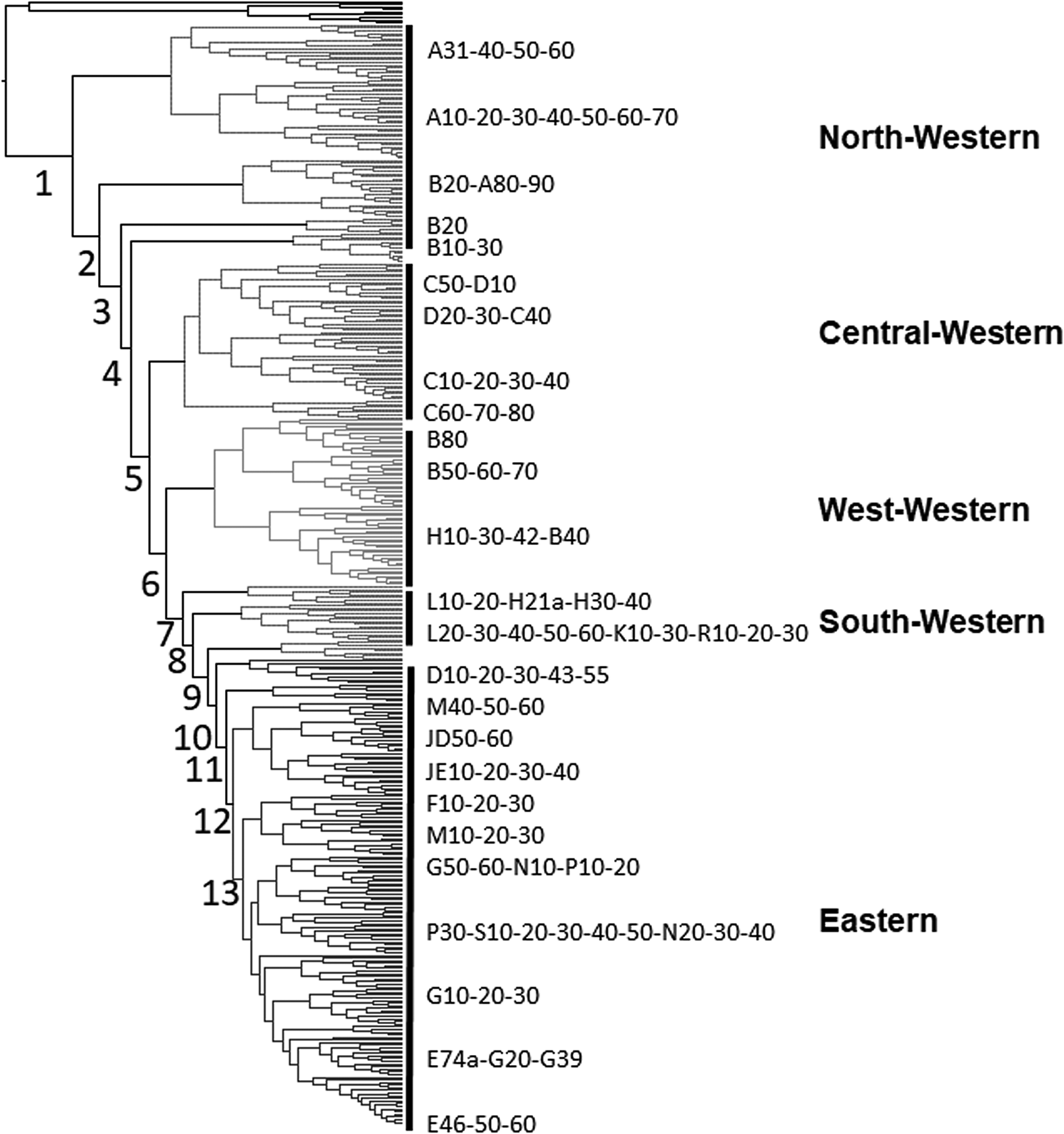
The first two events are dated from excavations at Shum Laka rock shelter, in Cameroon.Footnote 43 Between 5000 and 2000 BCE, Shum Laka's material culture changed from microlithic to macrolithic, including polished stone tools and a new type of pottery. The change grew clear between 4000 and 3000 BCE. The new technologies have deeper time-depths to the north, suggesting they moved from there into the grassfields, home to Shum Laka. The source area is also home to Benue-Congo languages, the group ancestral to Grassfields languages, Bantu's immediate ancestor. Therefore, Grassfields predates ca. 3000 BCE and proto-Bantu was later, between 3000 and 2000 BCE. This second event — the predominance of polished stone tools and a new type of pottery over previously abundant microliths — anchors the formation of proto-Bantu and gives it a life span of a millennium. The third calibration event occurred in southern Cameroon, between 1500 and 1000 BCE. It involved people building the region's first villages, using polished stone tools, grinding stones, and processing fat-rich nuts.Footnote 44 This event is treated as marking the initial steps in the Bantu expansions from the Grassfields. Today's distribution of the languages composing Mbam-Bubi and North-West Bantu — the first two groups to form with expansion — make southern Cameroon the most likely region in which they diverged. The fourth event took place in the Great Lakes region, at 500 BCE. It involved the advent of a distinctive kind of pottery — called Urewe — often but not always appearing with the region's first evidence of ironworking.Footnote 45 Scholars have linked the distribution of Urewe pottery, and its descendant potting traditions, with the distribution of Eastern Bantu languages. The links suggest the appearance of Urewe implied the appearance of people speaking proto-Eastern Bantu. But some dates for Urewe are several centuries older than 500 BCE, so we revisit its associations with proto-Eastern Bantu. To calibrate the time-tree, three of these ‘events’ were given date ranges while the fourth event was fixed at 500 BCE.
The time-tree depicts groups of Bantu language-speakers successively peeling away from a trunk, beginning around 4,800 years ago in Cameroon. The team used the geographical positions of the languages to reconstruct migration paths (Fig. 5) from the proto-Bantu homeland. They kept constant the consensus tree and the calibration points just discussed, only permitting simulated routes to consider ‘places that Bantu have actually inhabited historically or at present’. Movement over large bodies of water, including the Atlantic ocean, was prohibited and ‘a newly simulated position was not allowed to occupy a space already occupied (defined as within 10 km of any previously simulated point, unless the distance to be traveled was less than this)’.Footnote 46 These assumptions favored paths in savannah environments and confined movements to at least 10 kilometers ahead of an established settlement. In the next section, archaeological evidence for eclectic foodways supplements this geography of expansion with important nuances.
Movements, vegetation, and physical geography. People hunted, fished, or foraged ahead of or alongside movements indicated by arrows. The sequence of branchings are marked by numbers 1–13. The model assumes metal-using farmers dominated after the third branching.
Source: Grollemund, Branford, Bostoen, Meade, et al., ‘Bantu expansion’, 13297.
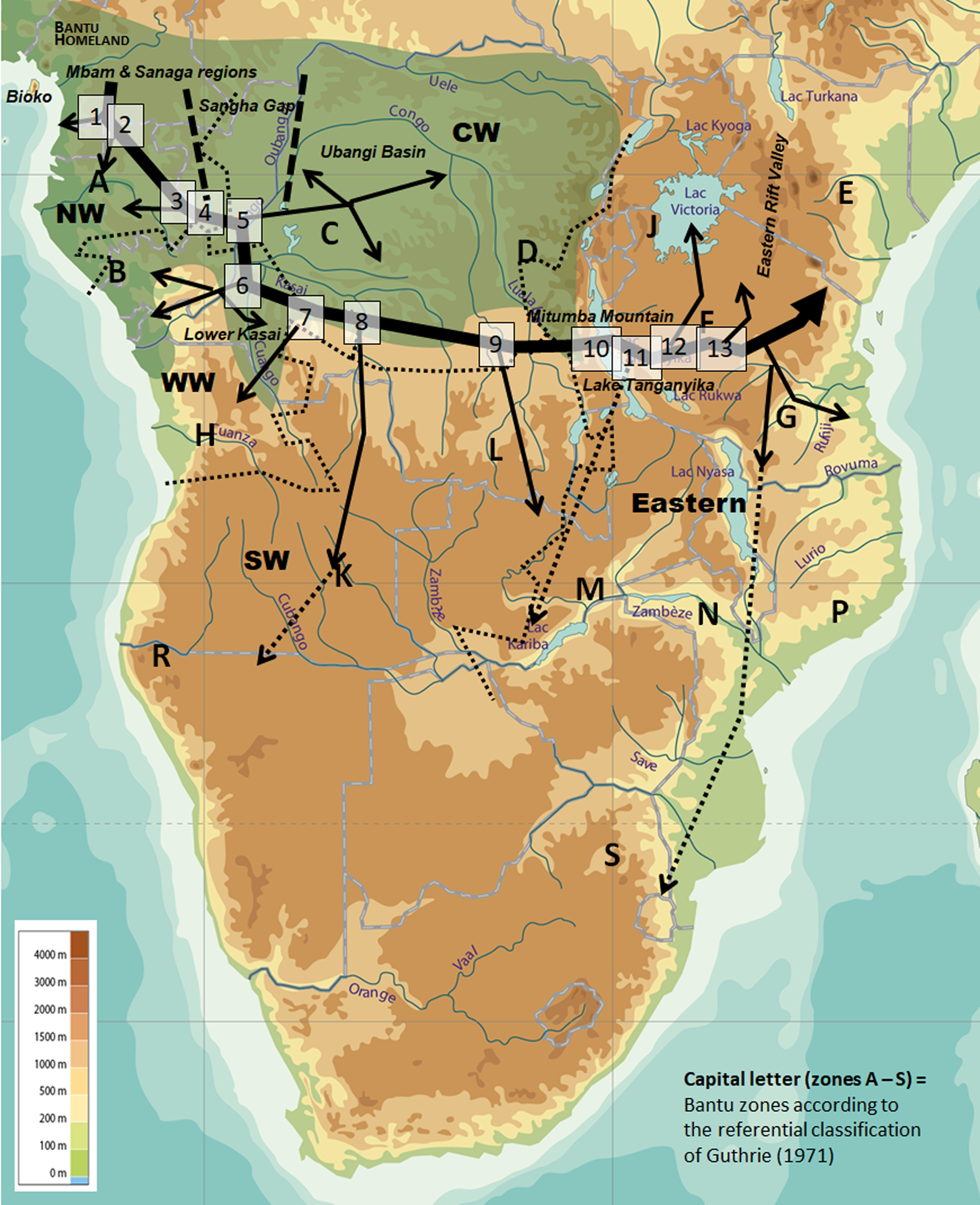
The results show Bantu-speaking people moved from southern Cameroon southeastwards, when a corridor of savannah existed in the rainforests, called the Sangha Gap. In other words, people preferred expansion into environments with savannah-rainforest ecotones, initially bypassing closed rainforest. Their descendants then expanded into the South-Western and Eastern areas (Fig. 5). The date estimates allowed the team to link these movements with paleoclimatic changes in Central Africa at 2,000 BCE and 500 BCE.Footnote 47 In the second change, patches of savannah expanded to form corridors in the rainforest, allowing Bantu speakers to move through the forest openings. The study tested the savannah corridor hypothesis by generating ‘random walks’ from the ancestral homeland, using criteria favoring the random-walks hypothesis. The results revealed that Bantu-speaking populations did not follow a random walk, they did not move with equal likelihood in all directions. They preferred savannah.
The classification is comprehensive in the sense that further research which includes new vocabulary evidence from existing languages will yield only marginal improvements. The classification does have limitations, however. Language death, multilingualism, a tiny universe of vocabulary evidence, assumptions about the salience of eclectic food ways, and the possibilities of movement into already settled locations and over large bodies of water, lessen the authority of its chronology and migration paths.Footnote 48
Computational methods have yet to account for many choices people made that produced the history of the languages they used. But these supple statistical procedures allow scholars to stipulate where and when important moments of social and economic change in the history of a set of languages happened. That helps confront the findings with other evidence, principally that of archaeology, to flesh out historical dimensions of the tree. This is a major advance.
Interpreting the classification historically
Bantu expansions involved small communities on the move from the start and, for century after century, in search of lands in one new environment after another.Footnote 49 Eventually, they raised grain, grew pulses, kept livestock, and used iron and copper, in unstable combinations. Unlike the breakup of the Indo-European languages from a common trunk in a limited number of mighty branches, the Bantu languages peeled away in successive branches as Bantu speakers spread from habitat to habitat. Every boundary between environments was a branch in the splitting process. If paleoecological research establishes ecotones in the period and region where branches were located (Fig. 5), we can envision languages splitting from the trunk as a new branch, whose speakers settled the new habitat.Footnote 50 This is a crucial feature of expanding farming populations elsewhere in the world.Footnote 51
Yet, early Bantu speakers developed eclectic food systems. Not every expanding community was fully or primarily or perpetually a farming community.Footnote 52 Thus the peeling off of groups from a main body was more complicated than one group moving away in a steady search for new fields to plant. In early Bantu-speaking communities, people who fished, hunted, and foraged covered more ground than when they farmed. Moving in these ways, they learned about the opportunities and constraints of working across a given ecotone. Fishers, hunters, and foragers knew the needs of their community-members. So, when they found places meeting those needs, others might go there when they liked or needed. Generating useful ecofacts must have included (perhaps multilingual) interactions with communities already present on the land.Footnote 53 Bantu speakers encountered new social environments not only new ecologies.
One result was the kind of gene flows reflected in anthropological genetic studies demonstrating various scenarios for spread. Some scenarios involve Bantu-speaking men having procreative sex with women in preexisting communities, with different genetic histories.Footnote 54 Other scenarios involve Bantu-speaking women having procreative sex with non-Bantu-speaking men.Footnote 55 In still other scenarios, Bantu-speaking women moved but left no genetic trace perhaps because their procreative sex lives revolved around those of Bantu-speaking men rather than firstcomers. Indeed, in Southern Africa, ‘[t]here is very little discernible structure in the maternal genepool of the Bantu-speaking populations’.Footnote 56 Large, stable groups of Bantu speakers moved together yet a gendered sociology of movement was varied.
Links between environment and the Bantu expansion are clear in the split between the sequence of Western groups and the single Eastern Bantu group. This split occurred in a zone of stark differences between East and Southern African environments and those of Central Africa (Fig. 5, branch 10). Eastern highlands and tectonic rifts had climates regulated by the Indian Ocean. In the west, the South Atlantic Ocean dominates the climates of overall low relief. Once in eastern Africa, Bantu-speaking farmers abandoned much of their agriculture in favor of pre-existing local usages. They incorporated new crops, including cereals such as sorghum and finger millet, and they replaced their former word for pearl millet with one already in use in East Africa.Footnote 57 These developments complemented hunting, foraging, fishing, and stock-keeping, providing numerous options for how and where to live. The current patchy knowledge of ironworking in Central Africa need not prevent imagining that some of the first Bantu speakers to live south of the forest bloc used iron.Footnote 58 Cereal farming emerged early northwest of the rainforests. But later farmers in parts of the rainforest did not necessarily use cereals as staples.Footnote 59 Environment alone cannot explain this history of economics, adaptation, and belonging.
Another feature of the Bantu expansions pertains to the division between Central and East Africa. The Bantu expansions went through two successive phases with significantly different dynamics. During the first phase, in West Central Africa, the Bantu speakers who were the first farmers lived where they could hunt, fish, and forage as well as farm (Fig. 5, branches 1–9). In both settings, Bantu speakers got their calories and knew their environments by hunting, fishing, and foraging as well as cultivating and herding.Footnote 60 But during the second phase, in East and Southern Africa, they usually were no longer the first farmers (or herders). They were less free to live where they chose, because many of the sites favoring eclectic food systems were already occupied. That difference shaped the social dynamics, pace, and direction of the successive expansions.Footnote 61
We can now describe the whole dispersion. Once the eclectic, horticultural — but probably not yet cereal-farming — Bantu speakers reached the confluence of the Mbam and Sanaga rivers they found themselves in a patch of fertile land facing rainforests, pocked with islands of more open forest and patches of grassland savannah southwards and also downstream to the west.Footnote 62 Some left the main body to go westwards (Fig. 5, branch 1). There the Sanaga River plunged into the forests eventually reaching the marshy shores behind the beaches at the foot of the mountains facing the island of Bioko and ringing the island as well.Footnote 63 Marshes were good for fishing, so we suspect the speakers of the Mbam-Bubi branch of languages who went this way emphasized fishwork, while the main body moved upstream along the Sanaga River valley and adapted to its environments (Fig. 5, branch 2). Even if they were farmers without iron tools, nothing there prevented them from following the river upstream. But the forest-savannah along the southern edge of that valley perhaps slowed those favoring cereal agriculture from living far inside the humid rainforests. Those who emphasized hunting, fishing, and foraging could have lived in the forests, particularly with the aid of hunter, gatherer, and fisher groups already familiar with the forests.Footnote 64 Thus the movements in question could have unfolded both quickly and slowly. Groups investing in farming and ironworking, century after century, moved upstream along a familiar forest-savannah ecotone, as the overall climate changed, between 2000 and 1500 BCE. Hunters, fishers, and foragers moved faster. They could enter or bypass the forests so daunting to farmers, learning about their socio-ecological qualities, including the locations of savannah patches, the ecotone farmers favored.Footnote 65
After 500 BCE, a new climate regime fragmented the forest bloc, reshaping the forest-savannah ecotone.Footnote 66 Pearl millet grows in forested environments but the new climate regime increased the number of locations welcoming the cereal.Footnote 67 Rapid variations in sea-surface temperature brought a new seasonality, involving more — and stronger — thunderstorms, increasing the value of taller tree crops to shielding annuals like legumes and millet.Footnote 68 In the Sangha Gap (Fig. 5), southeast of the Sanaga River valley, contracting forests left a corridor of savannah eventually repopulated by shade-tolerant trees and, five centuries later, in the corridor's eastern parts, seasonally inundated swampland.Footnote 69 Bantu speakers growing pearl millet and living in villages moved through the gap in the rainforests.Footnote 70 The consensus time-tree shows this movement (between branches 2 and 3, in Fig. 5). Yet, cereal farming was not always the principal motivation for taking this direction. Recent research has shown that ancient diets at this time rested on a mix of forest- and freshwater-based sources of calories sometimes including cereals.Footnote 71 This diet does not suggest people relied primarily on cereal agriculture.
South of the gap, three major splits occurred successively, branches 3, 4, and 5. Most speakers of each of the three branches had grown comfortable in three different environments: the equatorial forests, the mixed savannah and forest lands of the coastal west, and the poor Kalahari sands south of the lower Kasai. When people next chose to move, most went up the lower Kasai River (Fig. 5, branch 6), following the rainforest margins. As they went eastwards, keeping to the rainforest's undulating southern edges, they next shed the Kongo Cluster (Fig. 5, branch 7), the Lweta group of the middle Kasai River (Fig. 5, branch 8), and then the Central Savanna languages (Fig. 5, branch 9). The forbidding Mitumba Mountains beyond the Lualaba River halted this first phase of expansions in its foothills.
The second phase of the expansions (Fig. 5, branch 10, along the foothills of the Mitumba range, just west of Lake Tanganyika) with its different dynamics soon followed. On arrival the immigrant Bantu-speaking farmers found other food producers — and accomplished fishers, foragers, and hunters — in many, if not all areas. Indeed the presence of domestic cattle provides clear evidence for the spread of pastoralists or mixed farmers before Bantu speakers arrived.Footnote 72 In the northern tier of Southern Africa, pastoralism and mixed farming arrived as early as 300 BCE, perhaps before Bantu-speaking herders and farmers.Footnote 73 Archaeological evidence of networking among hunters, gatherers, and livestock-keepers reveals a social history in which pigeon-holing people according the ways in which they got food makes little sense.Footnote 74 Likewise, after 500 BCE, in northern East Africa, fisher-hunter-forager communities, a few of which included livestock, made long-term homes near prime fishing grounds on the major rivers entering Lake Victoria.Footnote 75 Instead of being technological pioneers, newcomer food producers with ceramics but not necessarily metals, became imitators, absorbing most of the technologies of the communities they met. Newcomers who used iron and farmed could compete with established iron-using communities.Footnote 76 It is unnecessary to essentialize food producers or wild resource users. People often used all these ways of getting calories, abandoning and taking them up as they saw fit.Footnote 77 These were skills not core elements of an individual's understanding of belonging to a group.
These circumstances shaped Bantu expansions in East Africa proper, slowing it down as newcomers found places in the human environment of the habitats they entered.Footnote 78 In this phase of their dispersal, some Bantu-speaking communities were unremarkable. Their languages enjoyed no advantage over those of earlier farmers in the area, at least until later, when Bantu-speaking newcomers introduced metals and metalworking into new regions. Smithing or smelting or herding or farming histories do not necessarily begin with the arrivals of Bantu speakers, at least in the northern Great Lakes region.Footnote 79
This new situation alters correspondence between historical linguistic evidence and archeological sites. Because newcomer Bantu-speaking farmers were no longer necessarily the earliest food producers — if food production was indeed their principal source of calories — in most of eastern Africa, the earliest archeological evidence for food production does not always relate to their arrival.Footnote 80 Scholars must not systematically associate all the oldest sites bearing evidence of iron (and the ceramic practice associated with Urewe wares) with the arrival of Bantu speakers. East of Lake Victoria, Urewe pots appear at sites that are not associated with a region's first food production and other Urewe pots have been found at sites not associated with agriculture at all.Footnote 81 A muddier picture invites reframing the history of Bantu expansions.
These dynamics characterized the second phase of the expansion, which began with the split by Branch 10, at the foot of the Mitumba Mountains, being followed by another split (Fig. 5, branch 11), on the eastern side of Lake Tanganyika. The first offshoot entered the dense Maniema rainforests. The second, known as the Central Woodlands or the Sabi-Botatwe branch, occupied the dry forests along the slopes of the Mitumba Mountains, from upper Katanga southwestwards, eventually reaching the Caprivi Strip.Footnote 82 Lake Tanganyika blocked movement eastwards. Some people eventually moved around the Lake's northern or southern shores or they crossed in canoes, its opposite shore visible from the Burton peninsula. People relied again on fishworkers, hunters, or foragers who knew this Lake.
In today's western Tanzania, the speech community ancestral to Great Lakes Bantu languages (Fig. 5, branch 12) split off, moving north and northeast of Lake Tanganyika. Speakers of West Tanzanian languages (Fig. 5, branch 13) expanded east of Lake Tanganyika and the remainder spread to the Indian Ocean coast and a few of its Islands, after which people stopped moving eastward.Footnote 83 Bantu speakers failed to cross the eastern rift valley, perhaps blocked by its natural environments and by the presence of other mixed farmers and pastoralists. The corridor between Lakes Tanganyika and Malawi channeled some Bantu speakers who settled near hunter-gatherers and other mixed farmers and herders.Footnote 84 Once there, movement divided in two directions. Some went east and northeast around the southern end of the eastern rift valley reaching coastal Tanzania and Kenya. The ancestors of the southern Bantu languages moved to the southeast.Footnote 85 These last movements of the second phase concluded Bantu expansions on the continent.
Reliability
Remembering previous studies, how reliable is this sketch of the dispersal of the Bantu languages? A number of changes arise when our classification is compared to the 1999 lexicostatistic classification. One major difference is the deletion of the first branch to hive off from Bantu (Fig. 1A). This is more important than it seems at first glance. Known as the ‘Northeast Group’ this small branch included the Lebonya and Boan languages, spoken in the northeast corner of the forest and the adjacent savannah to the north.Footnote 86 The 1999 data linked them directly to the Bantu homeland in Cameroon. The new classification places them in a much lower level, in other words in a more recent part of the forest group. This finding accounts for vocabulary evidence from languages underrepresented in earlier classifications, revealing that Boan and Lebonya are closely related to other languages of the forest group further west.Footnote 87 The earlier lack of such data now explains the position of this branch high up in the 1999 trees. Many of its words seemed rare because scholars knew little of the surrounding languages.
In 1995, Vansina used the trees eventually appearing in the volume by Bastin, Coupez, and Mann, to propose that Eastern Bantu branched soon after Northeast branched (Fig. 1A). Scholars soon labeled this scenario as the ‘deep split’. Our classification deletes this split as well.Footnote 88 The new classification casts Eastern Bantu as the remaining core of Bantu in the southern savannah after Southwestern Bantu, the final branching in the west. Many scholars were convinced of a deep split, and that the Eastern Bantu speakers arrived in the Great Lakes area by traveling eastwards along the northern fringe of the rainforests until they reached the mountain wall of the western rift valley, just as the speakers of the Northeast Group had done. Eastern Bantu speakers, it was hypothesized, then turned southwards into the valley itself.Footnote 89 But Ehret, Heine, and others, long held that they had broken off from Bantu-speaking groups in the savannahs south of the rainforests and moved eastward along the southern edge of these forests to reach the Great Lakes. Vansina had dismissed the appearance of such a link as a consequence of heavy borrowing from east to west, in later times.Footnote 90 Grollemund, Branford, Bostoen, Meade, et alia's results validate Ehret and Heine.Footnote 91 Research in human genetics also provides evidence against a deep split.Footnote 92
However, Thembi Russel, Fabio Silva, and James Steele suggest statistical evidence for the deep split. It applies spatial modeling techniques to existing radiocarbon dates from pottery-bearing sites within the current distribution of Bantu languages. Pottery, most commonly, is used as a proxy for the first arrival of Bantu-speaking farmers in an area. Their paper thus assumes a package of horticulture/crops and pottery marks the presence of Bantu speakers. It further assumes that cereal-growing Bantu speakers would always favor forest-savannah boundaries. This essay questions the stability of these assumptions. Early Bantu speakers had fully eclectic economies, with shifting use of farming, so it is arbitrary to model the spread of all Bantu-speaking people by obtaining a ‘set of cost factors for each ecoregion and water corridor’ pegged to one part of that economic profile.Footnote 93 Given the broad universe of sources of food that we have argued Bantu speakers could combine in various and shifting ways, the notion of ‘cost’ was historical and cultural, not fixed. Perhaps choosing between east versus west or east-out-of-west constrains envisioning such a complex history of language dispersal.
While we are convinced by the correspondence between our classification and older findings that the main branching down to low levels is clear, adjustments will be made when further information becomes available. Sometimes the addition of hitherto unrecorded languages to a group leads to reordering the lower levels of a classification.Footnote 94 Or, when the place of a language or a group of languages in this classification contradicts its position in a phonological set, the phonological grouping prevails.Footnote 95 Indeed, phonological evidence could produce a very different tree.Footnote 96
Our classification does not consider any of the later language histories of the various branches it proposes. Yet such histories yield much relevant information. The initial dispersal of the Bantu languages which had induced their divergence, was often followed by a countervailing dynamic of convergence when new contacts between distant languages were laid through long distance trade, hunting, and wide adoption of prestigious innovations. A striking case of convergence occurred after people moved into the southeastern DRC and Zambia. A succession of mutual influences between groups in the West and Eastern Bantu groups produced an obvious and distinctive Central Bantu core. Soon after initial settlement, the sound change processes of spirantization and of the reduction of seven to five vowels started in southeastern DRC and Zambia, eventually affecting a large portion of the Bantu languages.Footnote 97 As the succession of linguistic developments in this region grows clearer, we will learn whether or not savannah Bantu was part of Eastern Bantu.Footnote 98
This classification supports our claims about the directionality and timing of the Bantu expansions, but the assumptions modeling those claims do not account for language death.Footnote 99 Among the Western groups of Bantu languages, the overall chronology of the first sites with evidence for the early production of food does not fit with the chronology of the coastal site of Tchissanga-West near Pointe Noire (ca. 550 BCE). This mismatch is sometimes mentioned as an instance of language death.Footnote 100 Yet apart from ceramics and stone tools, the site contains only carbonized oil palm nuts. That is not direct evidence for agriculture, and hence no safe connection to any Bantu-speaking farming community. It is possible, even likely, that the people who lived at this site spoke a Bantu language but did not farm.Footnote 101 Our insistence on Bantu speakers’ eclectic food ways invites such direct associations between historical linguistic evidence and the archaeological record's variability. There is reliable evidence that some Bantu languages died out, after linguistic convergence, shift, standardization, or imperial violence.Footnote 102 But even if strong evidence could be adduced from archaeology that whole branches later completely died out, that by itself cannot alter the existing genetic classification, because it does not adduce any new linguistic data. It would, however, suggest that our classification remains incomplete and cast doubt on inferences about the directionality of movement in periods lacking language evidence because of language death.
Recent research suggests language death did occur across a wide swathe of Central Africa, at different times, between 400 and 600 CE.Footnote 103 In a mere two centuries, many communities with eclectic economies appear to have shrunk in size to the point of disappearing. What may have been a degree of linguistic complexity dwindled or disappeared with them. The languages spoken by the people who moved east along the savannah edges of the southern Inner Basin rainforests, and their many descendants in East and Southern Africa proper, became the remaining examples of that diversity. Should Central African population collapse bear up under further research, it would suggest that our phylogeny is more comprehensive for its second phase than for the first phase.
Finally, the scope of this classification rests on a narrow base of one hundred meanings from most of the still living Bantu languages. As scholars expand the group of meanings explored, they will reveal the ecological and sociological complexities of mobility, society, and economy touched on here. Multilingual and areal dimensions of language use will emerge, revealing a richer history than ‘dispersal’ encompasses.Footnote 104 Examples appear in monographs, cited below, focused on more recent branches in the tree. As to the number of languages involved, the classification shown in the diagrams (Fig. 4) includes only a sample.Footnote 105 Each branch or sub-branch includes a varying number of languages, even though data are available for many more.
A tentative chronology
The classification may be comprehensive within these limits, but the proposed chronology that accompanies it is not authoritative. For the first phase the chronology is strong where relevant reliable archeological data are available. That holds for the expansion of North-West Bantu (Fig. 5, branches 1, 2, and 3), the dating of the window of climatic opportunity which enabled Bantu speakers committed to farming to cross the rainforests (Fig. 5, branch 4), and dates further south that document early settlements of Forest Bantu and West Coastal Bantu (Fig. 5, branches 5 and 6).Footnote 106 Of course, if fishers, hunters, and foragers partly guided expansion during this long first phase, they most likely found — or learned of from firstcomers — the savannah patches inside a shrinking forest. Material traces of such activity have unsurprisingly eluded archaeologists working in this vast region over the last 80 years.Footnote 107 As a result, the reliable chronology might refer to later settlement of comparatively larger groups of Bantu speakers. This is easy to imagine where cereal and pulse farming, small-stock raising, and iron-use remained choices in an eclectic food system for centuries after they were taken up, although their adoption was not necessarily simultaneous.Footnote 108
Difficulties compound because one cannot sequence radiocarbon dates that fall between 800 BCE and 100 CE. The amounts of 14C in the atmosphere during those centuries changed so rapidly that their probability curves are too irregular to ‘be expressed as an average with its confidence interval’.Footnote 109 Without a confidence interval, one cannot distinguish one date from another in this period. Moreover, we lack material signatures for the successive appearance of Southwestern Bantu (including Lweta; Fig. 5, branch 7), Central Savannah (Fig. 5, branch 8), Maniema and Central Woodland branches (Fig. 5, branches 9 and 10). No relevant archeological research exists from most of Angola nor from the DRC's southern provinces.Footnote 110 The absolute chronology for the last stages of the first phase of the expansion and the onset of the second phase remains unknown.
Rethinking a deep split hypothesis invites rethinking the chronology of the second phase of the expansion, even though that was hitherto held to be particularly solid. The anchor for that chronology has been the Urewe culture and pottery in the Great Lakes area. Urewe was the earliest Iron Age culture outside the rainforests in East Africa and its earliest sites in Burundi date with a nearly 80 per cent probability to ca 800 BCE.Footnote 111 This date is one of a tiny number drawn from material with good provenience that fall just before 800 cal BCE. All other dates for the earliest iron working in Africa, from Senegal to the Indian Ocean coast, which meet high standards of provenience and sampling, fall between 800 and 400 cal BCE. This is the blind spot for radiocarbon dating techniques just mentioned. The items or technological processes thus dated could have occurred at any time during those centuries.Footnote 112
However, since the late 1950s, scholars have associated Urewe ware with the arrival of Bantu speakers in the Great Lakes area. They based the claim on the perception that Bantu speakers with Urewe ceramics seemed to be the first farmers in the region.Footnote 113 The only evidence yet adduced that Bantu speakers made Urewe pots is Bostoen's demonstration that a Bantu verb root, *-búmba, and a noun, °-kádango, might apply to Urewe ceramics.Footnote 114 Yet, the early dates for Urewe do not fit any realistic time of arrival of Eastern Bantu speakers in the Great Lakes area. In the consensus time-tree published here, Eastern Bantu speakers split off Southwestern Bantu centuries after the majority of Bantu speakers who farmed at the time had crossed the Sangha Gap around 500 BCE. Thus, the early Urewe ware tradition, which dates from about the same time, 500 BCE, may have held no exclusive connection to Bantu speakers.
The fixation on Bantu speakers has prevented scholars from focusing on the extraordinary longevity of Urewe ware. Urewe ware lasted over a millennium, perhaps a millennium and a half, far longer than other known wares from this period in sub-Saharan Africa.Footnote 115 During that time these ceramics likely acquired a special significance, perhaps as an emblem of the industrial skill of its makers.Footnote 116 We therefore suspect that the languages of the successive or even simultaneous communities that smelted iron on such sites were irrelevant to the Urewe ware they used. The earliest users of Urewe likely were not Bantu speakers, but as Bantu-speaking newcomers entered the area they probably first participated in Urewe potting and iron smelting and later borrowed the prestigious ware, along with the iron smelting technology, and coined °-kádango as part of the process. Despite the appeal of this scenario, it seems invisible in the archeological record. Therefore no chronological indication yet exists as to precisely when Bantu speakers first arrived in the Great Lakes region.
The case of Urewe underlines a well-known weakness in equating particular ceramics and particular languages, namely that there does not need to be any such link.Footnote 117 For example, nineteenth century Bushong villagers did not exclusively use pottery in one style and from one provenance but resorted to two and at times to three different styles of pottery from different provenances.Footnote 118 However, the spread of a special design on ceramics and on other objects in a given society may be limited to a particular language family, as in the correspondence between characteristic geometric patterns in Kongo designs and Kongo languages, after 1100 CE.Footnote 119 Inspired by Olivier Gosselain's oeuvre, Alexandre Livingstone Smith studied potting repertoires in Katanga and found their distributions varied and not coterminous with regional language boundaries.Footnote 120 Paul Lane, Ceri Ashley, and their colleagues have challenged an exclusive connection between Bantu speakers and Urewe ceramics.Footnote 121 Historical contingencies, not an absolute law, link language and ceramics.Footnote 122
Archeologists have demonstrated that the Urewe ‘industry’ is the fountainhead of the so-called ‘Chifumbaze industrial complex’ from which many iron-using cultures with similar ceramics derive further south and east.Footnote 123 Since scholars assumed that Bantu speakers exclusively made the first Urewe ware, they interpreted the sites where such ceramics occur as having been created by Bantu speakers and therefore as providing a solid chronology for the dispersal of the main branches of Eastern Bantu languages in Zambia, Malawi, and on the coast of the Indian Ocean. Urewe ware is therefore especially important for fixing the chronology for the long second phase of the Bantu expansion.
This needs to be reexamined. If Urewe ceramics do not indicate a particular language, Bantu or otherwise, that could hold for its derivative wares. Other-than-Bantu-speakers could be involved in their archaeological patterning. Secondly, some scholars hold that Great Lakes Bantu was the fountainhead of all Eastern Bantu languages and they assume all those languages belonged to iron-using societies.Footnote 124 Our classification shows that Great Lakes Bantu derived from narrow Eastern Bantu. So if all the people in speech communities descended from Eastern Bantu belonged to iron-using societies, their languages should have inherited one or more ancestral proto-Eastern words related to iron. It seems so, but the evidence is worth reexamining.Footnote 125 Ancestral terms would have been coined at Urewe sites and some have most likely been borrowed from the language of their predecessors at these sites.Footnote 126
Ehret has suggested that Eastern Bantu speakers borrowed a few of their terms for ironworking from various Sudanic speech communities, over a long period of time.Footnote 127 Ehret sees the two speech communities as neighbors, with Sudanic speakers influencing Eastern Bantu speakers. This pattern of borrowing in Eastern Bantu could have emerged in multilingual communities of ironworking practice. So, nothing prevents envisioning Urewe ware or ironworking developing in a multilingual community of practice with that multilingualism waning or disappearing as a consequence of social shifting toward using a single or smaller number of languages. Indeed, like this pattern of borrowing, the evidence for discrete ceramic styles overlapping in time and using the same clay sources, cited from Wadh Lang'o, perhaps materializes a similar circumstance.Footnote 128
A more reliable chronology needs to be established for the dispersal of the Eastern Bantu languages. That necessitates a systematic reexamination of equivalences between particular branches of Eastern Bantu and particular sites, not just on Chifumbaze industry sites but also on the East African coast.Footnote 129 Until then we cannot have any precise chronology. For now, the oldest calendar date directly associated with any Bantu language comes from the earliest known written Bantu word, penned by al-Djahiz who died in 869 CE (255 AH).Footnote 130
What now?
With a comprehensive classification based on vocabulary evidence in hand, deeper understanding of the expansions of Bantu speech and speakers it portrays requires a reliable chronology and new conceptualizations of relationships between language and material culture. The first requires more archaeological research on the ground. This is urgent given the voids of any relevant sites in the DRC and in Angola. That gap separates the Late Stone Age sites of the Western groups of Bantu speakers and the Iron Age sites of the Eastern Bantu speakers. Without well-distributed and well-dated sites, solidly associated with particular linguistic groups, a valid chronology of the whole expansion may never be established. Direct dating of animal bones, crops, and material culture must replace dating by association with a particular stratigraphic layer. Ancient DNA of animal bones must replace morphological identifications. Such identifications rely on fine differences in the form of bones to distinguish species, but poor bone preservation makes such differences hard to measure accurately or consistently.Footnote 131 Funding must expand for dating techniques not subject to the fatal chronological imprecision implied for sites radiocarbon-dated between cal 800 BCE-cal and 100 CE-cal. Accelerator Mass Spectrometry, Thermo-Luminescence, and the related Optically Stimulated Luminscence do not suffer from this blind spot and may be used on ceramics, but have other limitations.Footnote 132 At a minimum, scholars must establish the relative probabilities of the more precise alternative dates involved in each case. The need is keenest for the chronologies of the earliest iron smelting sites in the Central African Republic and Cameroon, the earliest villages between southern Cameroon and the Grassfields, the earliest Urewe sites, and the sites used to date the formation of the Sangha Gap. Were they all truly synchronous or not, as is much more likely? If asynchronous, what was their most probable chronological sequence?
Linguists must validate our classification branch by branch, using the comparative method. Patterns of sound changes may generate alternative trees. They should also weigh the significance of the many irregular but very similar phonological and semantic patterns the comparative study of Bantu languages routinely turns up. These likely reflect enduring features of social life in multilingual speech communities.Footnote 133 Incorporating multilingualism into the history that comparative language evidence supports will restrain envisioning that history in terms of singular speech communities, better orienting such narratives to variability in the archaeological record.Footnote 134 Computational methods make this easier.
A reliable classification is a gateway to the remote history of every region now occupied by Bantu-language speakers. One way to take advantage of this is to use the proto-vocabularies of genetic language groups as internal evidence about the social and cultural lives of the ancestral societies which used those languages. This evidence helps construct histories of the societies over the whole area occupied by all the daughter languages of the original language.
Such narrative histories exist for several branches of Bantu.Footnote 135 They are hypotheses providing agendas for future historical research.Footnote 136 Beside these obvious uses of the classification for historians, other uses include analyzing the interaction of languages over time and in specific areas. Such interactions range from the borrowing of single words to complete language mergers and even to total language displacement. Clearly, different dynamics drove the concrete record of internal and external change. By focusing on dense social facts, such as gender, belonging, motherhood, slavery, or wealth and poverty, in the context of such genetic classifications, the play of contingency emerges in such overviews.Footnote 137
This underscores the need to theorize material and spatial patternings made by people using languages from more than one language group.Footnote 138 That is, we need historical imagination receptive to the idea that archaeological evidence of material culture and spatial patterns were produced by groups of people who spoke more than one language (of the same family, or not) and by people who spoke different languages (of the same family, or not) but enjoyed enough multilingual competency to collaborate on technological or other projects. Iron smelting, cereal farming, ceramics, and the politics of belonging are not equivalent social contexts for the language divergence that classification uncovers, sequences, and locates in time-space for a single set of languages. Each social context places different pressures on multilingualism — for and against its persistence — and its incidence. But none of them belongs naturally, and forever, to a particular group of languages. When sources of information give us the impression that they do, that is the result of historical struggle and the (perhaps) unintended consequences of many individual choices. The historian must explain how that effect of isomorphism between language, cultural and economic history, and genetic material comes to be and disappears. Historians must consider overarching narratives of such a complex story quite limited, until we know more about the threads in its many chapters.
Acknowledgements
This article was initiated by Jan Vansina in 2016, with the collaboration of Rebecca Grollemund. At Vansina's death in 2017 the manuscript was unfinished. Therefore, the Editors suggested a collaboration with David Schoenbrun who helped develop and enrich this final product. This is Jan Vansina's last publication. Schoenbrun would like to thank Kate de Luna for valuable comments on an earlier draft. Grollemund's email is grollemundr@missouri.edu.


 Open access

