




Introduction
The Humid Pampa of the Pampean region is a large plain ecotone located mainly in Buenos Aires Province, Argentina, that has undergone significant floristic and faunal changes during the Quaternary period (Clapperton, Reference Clapperton1993). The extinction of the Pleistocene megafauna in relation to climatic factors and the arrival of the first human populations in this region has been a focus of attention from the nineteenth century to the present day (e.g., Tonni et al., Reference Tonni, Cione and Figini1999; Cione et al., Reference Cione, Tonni, Soibelzon and Haynes2009, Reference Cione, Tonni and Soibelzon2011; Prado et al., Reference Prado, Martinez-Maza and Alberdi2015; Politis et al., Reference Politis, Messineo, Stafford and Lindsey2019; Tonni, Reference Tonni2017; Prates and Pérez, Reference Prates and Pérez2021; Politis and Borrero, Reference Politis and Borrero2024 and references cited therein).
The fossil record of small mammals can play a significant role in advancing our understanding of the ecological context of these changes, as small mammals respond quickly to environmental changes due to their limited ecological requirements, relatively small home ranges, and low dispersal rates (e.g., Pardiñas, Reference Pardiñas1999a; Fernández, Reference Fernández2012; García Morato, Reference García Morato2023). They also belong to the r-strategy group, which means they have a fast metabolism, short life spans, and rapid generation times and can easily occupy new habitats and niches (MacArthur and Wilson, Reference MacArthur and Wilson.1967; Stearns, Reference Stearns1992). Despite the significant role of microfauna in paleoecological interpretations, the study of Late Pleistocene small mammals has not been central to Pampean research. This may be partly because most paleontological fieldwork does not involve water-screening sediments to recover microfauna. Nevertheless, several interesting taxonomic and paleoenvironmental studies of the Late Pleistocene have been conducted in the Humid Pampa (e.g., Pardiñas, Reference Pardiñas1999a, Reference Pardiñas1999b; Pardiñas et al., Reference Pardiñas, Teta, D’Elía, Polop and Busch2010; Quintana, Reference Quintana1996, Reference Quintana2001; Fernández et al., Reference Fernández, García-Morato, Gómez, Fernández-Jalvo and Prado2025). The interior of this area yields a sparse fossil record of small mammals (Gómez et al., Reference Gómez, Prado and Alberdi1999; Scheifler et al., Reference Scheifler, Messineo and Pardiñas2015), like most of the Pleistocene fossiliferous areas along the Atlantic shore and the main tributary rivers of the Río de La Plata (Pardiñas, Reference Pardiñas, Alberdi, Leone and Tonni1995, Reference Pardiñas1999a, Reference Pardiñas1999b, Reference Pardiñas2004; Pardiñas and Lezcano, Reference Pardiñas and Lezcano1995; Voglino and Pardiñas, Reference Voglino and Pardiñas2005; Pardiñas and Teta, Reference Pardiñas and Teta2011). However, much remains to be explored regarding the Pleistocene–Holocene transition, particularly in terms of extinctions, extirpations, expansions, and contractions of small mammal populations.
The taphonomic analysis of micromammal remains enables detailed inferences about biodiversity and past environments (Efremov, Reference Efremov1940; Andrews, Reference Andrews1990). The main causes of the accumulation of small mammal remains are predation and, less frequently, catastrophic events and/or transport accumulation by wind or water (Denys, Reference Denys1985; Andrews, Reference Andrews1990; Fernández-Jalvo and Andrews, Reference Fernández-Jalvo and Andrews1992; Cheme-Arriaga et al., Reference Cheme-Arriaga, Montalvo and Sosa2012). Depending on the identified predator and the recorded micromammal species, a more precise understanding of the environmental conditions, paleoecological interpretations, and climatic conditions can be achieved (Andrews, Reference Andrews1990; Fernández-Jalvo et al., Reference Fernández-Jalvo, Denys, Andrews, Williams, Dauphin and Humphrey1998, Reference Fernández-Jalvo, Scott and Andrews2011; García-Morato et al., Reference García-Morato, Fernández-Jalvo and Montalvo2021). In recent decades, the increased interest in micromammal bone inclusion in the Pampean record has led to the development of several taphonomic analytical methods and techniques (e.g., Pardiñas, Reference Pardiñas1999a; Fernández et al., Reference Fernández, Montalvo, Fernández-Jalvo, Andrews and López2017; Scheifler et al., Reference Scheifler, Messineo and Pardiñas2015; Montalvo et al., Reference Montalvo, Fernández, Bargo, Tomassini and Mehl2017; Gómez and Bonomo, Reference Gómez and Bonomo2018; Montalvo and Fernández, Reference Montalvo and Fernández2019; García-Morato et al., Reference García-Morato, Fernández-Jalvo and Montalvo2021; García-Morato, Reference García Morato2023; Pardiñas and Cenizo, Reference Pardiñas and Cenizo2023). Predation is the most frequent source of small mammal fossils, and digestion traits recorded in their skeletal elements provide direct evidence of predation (Andrews, Reference Andrews1990; Fernández et al., Reference Fernández, Montalvo, Fernández-Jalvo, Andrews and López2017; Montalvo and Fernández, Reference Montalvo and Fernández2019). Andrews (Reference Andrews1990) proposed a pioneering methodology to identify the predator responsible for the fossil assemblage and postdepositional agents that could affect the fossil assemblages during fossilization. Andrews (Reference Andrews1990) based his work on present-day predators to make extrapolations to the past. However, South American species were less represented in the original publication, which mainly focused on North American, African, and European species. Several researchers have extended present-day studies to characterize the modifications caused by these predators (whether nocturnal birds of prey, diurnal birds, or carnivorous mammals) on their prey (neotaphonomy; Denys et al., Reference Denys, Stoetzel, Linchamps, Fernandez-Jalvo and Andrews2024). Fernández et al. (Reference Fernández, Montalvo, Fernández-Jalvo, Andrews and López2017) adapted Andrews’s methodology to South American taxa (see more details in Montalvo and Fernández, Reference Montalvo and Fernández2019).
This paper addresses the taphonomy, taxonomy, and paleoecology of small mammal fossils (rodents and marsupials ≤ 1 kg) recovered from the Salto de Piedra paleontological locality (hereafter SPPL) in the central Humid Pampa. Unit 4 in SPPL contains remains of megafauna (animals > 1000 kg) like Glyptodon, Megatherium, Notiomastodon, and Toxodon; large herbivores (between 45 and 1,000 kg) such as Lama, Hemiauchenia and Hippidion, and Equus; as well as large carnivores such as the saber-toothed cat Smilodon. Additionally, SPPL has yielded small game, including the South American hare (Dolichotis) and fossils of a canid identified as Dusicyon avus, an extinct fox comparable in size to a jackal (Prado et al., Reference Prado, Duval, Demuro, Santos-Arévalo, Alberdi, Tomassini and Montalvo2024; Bellinzoni et al., Reference Bellinzoni, Bonini, García-Morato, Gómez, Steffan, Marín-Monfort and Zurita2025), along with extinct caviine rodents Galea tixiensis and Microcavia cf. M. robusta (Fernández et al., Reference Fernández, García-Morato, Gómez, Fernández-Jalvo and Prado2025). Extant small vertebrates were found in Facies 7, among which representatives of Columbina (Columbiformes), Liolaemus (Squamata), and Chelonia (Testudines) stand out. In Facies 8, additional non-mammal microvertebrates have not been registered, while several representatives of Anura (Ranidae and Buffonidae) and Liolaemus were recovered from Facies 9.
The micromammal-bearing levels at SPPL provide valuable climatic and ecological insights into the Late Pleistocene, aligning with evidence from the Campo Laborde, located 17 km to the south (Prado et al., Reference Prado, Bonini, Favier-Dubois, Gómez, Steffan and Alberdi2019; Favier Dubois et al., Reference Favier Dubois, Herrera Villegas, Bonini, Gómez, Steffan, Bax, Flores, Bellinzoni, Alberdi and Prado2021; Politis et al., Reference Politis, Messineo, Stafford and Lindsey2019). Campo Laborde is an open-air archaeological site associated with the hunting or processing by humans of the extinct giant ground sloth Megatherium americanum, radiocarbon dated to 12.6 cal ka BP (Politis et al., Reference Politis, Messineo, Stafford and Lindsey2019). Notably, the Campo Laborde archaeological site exhibits a low diversity of small mammals (Scheifler et al., Reference Scheifler, Messineo and Pardiñas2015). In this context, with accurate taphonomic control, the study of micromammal assemblages from SPPL can contribute to our understanding of local biodiversity and climatic changes in the environment in which the first humans and the latest megafauna lived in the Humid Pampa.
Regional setting
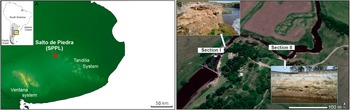
The Argentine Pampas, or Pampean Region, is located approximately between latitudes 30 and 39°S and longitudes 57 and 66°W, covering an area of around 370,000 km2. These vast plains are interrupted only by the low hills of the Ventana and Tandilia systems (Fig. 1). This biogeographic region is home to characteristic fauna and flora and is divided into two subregions: the Humid Pampa in the southeast and the Dry Pampa in the west (Prieto, Reference Prieto2000; Morrone, Reference Morrone2014).
SPPL is situated in the heart of the Humid Pampa, more precisely in the upper basin of Tapalqué Creek, near the city of Olavarría, Buenos Aires Province (36°56′54.6′′S, 60°22′19.9′′W; Fig. 1). This small valley is carved into loessic Plio-Pleistocene sediments, which are exposed discontinuously along the creek banks. The interfluves are covered by a mantle of Late Pleistocene and Holocene aeolian deposits that provide the parent materials for most of today’s soils (Prado et al., Reference Prado, Bonini, Favier-Dubois, Gómez, Steffan and Alberdi2019; Favier Dubois et al., Reference Favier Dubois, Herrera Villegas, Bonini, Gómez, Steffan, Bax, Flores, Bellinzoni, Alberdi and Prado2021).
(A) Location of the Pampas region on the general map of South America (area in the box at the top left) and location of Salto de Piedra paleontological locality (SPPL) on the map of the Pampas showing the Tandilia and Ventana hills mentioned in the text. (B) Aerial view of SPPL and sections of excavation I and II.

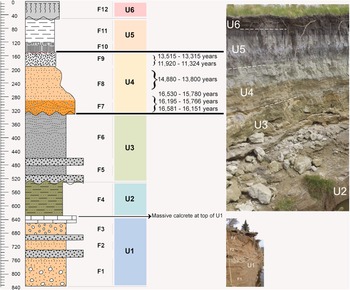
Six main depositional units (U) and 12 facies (F) have been identified along the sequence. These units represent different sedimentation cycles marked by discontinuities, such as erosive discordances or pedogenetic horizons. The facies identified in the sequence consist of deposits characterized by one or more lithofacies (Favier Dubois et al., Reference Favier Dubois, Herrera Villegas, Bonini, Gómez, Steffan, Bax, Flores, Bellinzoni, Alberdi and Prado2021) and represent sedimentation subenvironments within each depositional unit (Fig. 2).
Stratigraphic sequence of Salto de Piedra paleontological locality (SPPL), indicating facies (F1–F12) and units (U1–U6), modified from Favier Dubois et al. (Reference Favier Dubois, Herrera Villegas, Bonini, Gómez, Steffan, Bax, Flores, Bellinzoni, Alberdi and Prado2021) and Bellinzoni et al. (Reference Bellinzoni, Bonini, García-Morato, Gómez, Steffan, Marín-Monfort and Zurita2025).

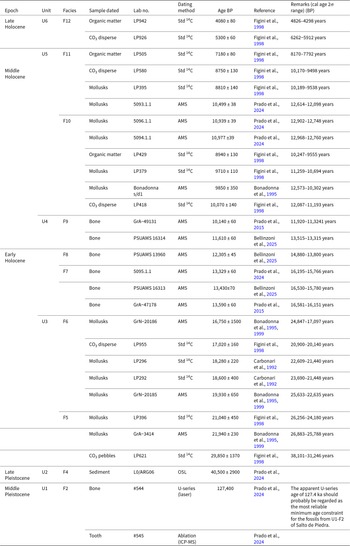
Recently, we dated the SPPL using electron spin resonance (ESR), U-series, optically stimulated luminescence (OSL), and radiocarbon dating (Prado et al., Reference Prado, Duval, Demuro, Santos-Arévalo, Alberdi, Tomassini and Montalvo2024; Table 1).
Synthesis of dates available at Salto de Piedra paleontological locality.a

a Abbreviations: AMS, accelerator mass spectrometry; ICP-MS, inductively coupled plasma mass spectrometry; OSL, optically stimulated luminescence.
Systematic excavations during the 2019–2021 seasons have provided a fossil assemblage and sediments spatially coordinated using a total station theodolite. Wet-sieved sediments yielded the small vertebrate assemblage; only micromammals were studied here. This work focuses on the Late Pleistocene–Early Holocene records of the sequence. The fossil assemblages of micromammals from Unit 4, which include facies F7 to F9, correspond to deposits of the Luján Formation (Guerrero Member). According to Favier Dubois et al. (Reference Favier Dubois, Herrera Villegas, Bonini, Gómez, Steffan, Bax, Flores, Bellinzoni, Alberdi and Prado2021), Unit 4 has an erosive basal contact with Unit 3 and an erosive disconformity at the top contact with Unit 5. This is a fine- to medium-grained sequence with a decreasing grain size upward. Unit 4 begins with gravelly sandy lenticular deposits with cross-bedded fine sand in F7. Facies 7 is followed by a tabular sandy silty deposit of F8. Facies 7 and 8 of Unit 4 were interpreted as channel and floodplain sandy deposits generated under rapid sedimentation conditions with good preservation of sedimentary structures. Unit 4 ends with a lenticular silty sand deposit in F9 (Table 1). Facies 9 represents back-swamp environments with more permanent water conditions (Favier Dubois et al., Reference Favier Dubois, Herrera Villegas, Bonini, Gómez, Steffan, Bax, Flores, Bellinzoni, Alberdi and Prado2021).
Unfortunately, neither micromammals nor dating information has been obtained from the subsequent Facies 10 of Unit 5, except for an abundant malacofauna described by Steffan et al. (Reference Steffan, Gómez, García-Morato, Bellinzoni, Bonini, Favier-Dubois and Montalvo2026). For the upper layers (F8 and F9), Steffan et al. (Reference Steffan, Gómez, García-Morato, Bellinzoni, Bonini, Favier-Dubois and Montalvo2026) report the presence of a single species, Succinea meridionalis (palustrine environments). Toward the upper layers (F10 and F11), gastropod species assemblages indicate an increase in humidity conditions and fluvio-lacustrine environments.
Material and methods
The upper part of the Salto de Piedra sedimentary sequence is characterized by a moderate abundance of remains from small mammalian rodents and marsupials (≤1 kg) and the upper layers yielded 409 NISP (number of identifiable specimens) recovered from wet-sieved samples during recent systematic excavations. These samples were obtained from a horizontal area of 8 m2 organized in a 1 m2 excavation grid. Sediment samples from the three facies (F9–F7) of Unit 4 were excavated in spits (every 10 cm), covering a vertical extension of ∼1 m and controlled using a total station. The sediments were first dried and then immersed in buckets of water to disaggregate the sediment before being sieved with a 1 mm mesh. It is important to highlight that the use of the wet-sieving technique has yielded a significant number of different species with minimal damage due to extraction. All the specimens are housed in the micromammal paleontological collections of SPPL (labelled as SDP) at INCUAPA (CONICET-UNICEN).
Bones and teeth of rodents and marsupials were analyzed under a Leica Stereo S6D binocular magnifying glass from a 6.3× to 40× range of magnification and photographed with a high-resolution digital camera (Leica DFC450C). Anatomical and taxonomic identifications were based on comparison of anatomical features and measurements with fossil material housed in the collections of Grupo de Estudios en Arqueometría of Facultad de Ingeniería (GEArq-FIUBA, Buenos Aires) and the Museo Argentino de Ciencias Naturales “Bernardino Rivadavia” (MACN, Buenos Aires), and osteological atlases (e.g., Pardiñas and Teta, Reference Pardiñas and Teta2011; Udrizar Sauthier et al., Reference Udrizar Sauthier, Formoso and Andrade2020). The NISP, minimum number of skeletal elements (MNE), and minimum number of individuals (MNI) were calculated following Lyman (Reference Lyman1994).
The taphonomic methodology considers the MNE to be more informative than the NISP, in contrast to taxonomic research, which is mainly based on NISP. The MNE counts, for instance, the proximal and distal ends plus the shaft of a humerus as a single MNE, whereas these would be counted as three NISP. The MNI for taphonomic analyses is obtained from the highest number of any single skeletal element expected to be present in an individual, while MNI in taxonomy considers the laterality of the skeletal element (usually teeth) in the skeleton or mandible. The Supplementary Material contains an Excel file with the complete and detailed taphonomic analysis according to Andrews’s (Reference Andrews1990) methodology and Fernández et al.’s (Reference Fernández, Montalvo, Fernández-Jalvo, Andrews and López2017) taphonomic reevaluation for the South American fauna.
1. The relative abundances of each skeletal element (Ri) recovered in the sample are calculated using the following formula: [MNEi/(Ei × MNI)] × 100, where MNEi is the minimum number of elements of a particular skeletal element i, Ei the skeletal element i, and MNI is the minimum number of individuals calculated for the study sample.
2. Indices of cranial versus postcranial skeletons: two indices are considered: (Pc/C) [(femur + tibia + humerus + radius + ulna) × 16/(mandible + maxilla + molars) × 10] × 100, and H + F/Md + Mx [(humerus + femur)/(mandible + maxilla)] × 100. To assess the proportions between distal and proximal limb elements, the index T + R/F + H was calculated: [(tibia + radius)/(femur + humerus)] × 100. Two other indices evaluate the molar/incisor loss or proportions of isolated teeth (incisors and molars) compared with empty alveolar spaces from mandibles and maxillae (Andrews, Reference Andrews1990).
3. Breakage in cranial and postcranial (femora, tibiae, humeri) skeletons is recorded according to proportions established by Andrews (Reference Andrews1990). This methodology is used and described in the text, tables, and Supplementary Material; breakage was summarized as complete versus broken remains. We have tried another breakage classification based on the description of the broken edges, that is, irregular (frequent breakage in dry bones), spiral (fresh green bone breakage type), and transversal (typical of fossil bone breakage), following a modified classification stated by Lyman (Reference Lyman1994).
4. Digestion of teeth (incisors and molars) is categorized into light (L), moderate (M), heavy (H), and extreme (E) grades (Fernández et al., Reference Fernández, Montalvo, Fernández-Jalvo, Andrews and López2017). Digestion in postcranial bones (i.e., distal humerus and proximal femur) has been categorized according to the classification by Marin-Monfort et al. (Reference Marin-Monfort, García-Morato, Olucha, Yravedra, Piñeiro, Barja, Andrews and Fernández-Jalvo2019), displayed in detail in the Supplementary Material.
Postdepositional and fossilization processes such as weathering, rounding and polishing, scratches and striations, trampling, deformations, tooth marks, soil corrosion, carbonate crusts, mineral stains, microbial attack, insect damage, or plant root marks (Fernández-Jalvo and Andrews, Reference Fernández-Jalvo and Andrews2016) were also evaluated in SPPL small mammals.
Paleoenvironmental analysis was performed using small mammal taxa as an indicator of environmental conditions, usually based on frequencies of NISP and the presence/absence of some stenotopic species (Andrews, Reference Andrews1990; Pardiñas, Reference Pardiñas1999a; Fernández, Reference Fernández2012; García Morato, Reference García Morato2023). Before the palaeoecological analyses were carried out, differences in the relative abundance (using the NISP) of small mammal taxa between sedimentary levels were assessed in R (R Core Team, 2024) using exact binomial tests (Clopper-Pearson method) for each taxon. Ninety-five percent confidence intervals were calculated for each proportion using the binom package to account for sampling uncertainty. Taxa were considered to differ significantly between levels if any pairwise comparison returned a P value < 0.05. This test was applied only to those taxa identified at the genus or species level, which were considered the most informative for the palaeoecological analyses. Results from this test are presented in Supplementary Table S7.
Owl pellet samples are good estimators of abundance of small mammal prey; therefore, they are a widely accepted tool for yielding paleoenvironmental models (e.g., Fernández, Reference Fernández2012; López et al., Reference López, Aguilar and Fernández2021) under the theoretical framework of the modern analog method (Overpeck et al., Reference Overpeck, Webb and Prentice1985). In this sense, comparative current small mammal communities in the surroundings of SPPL were assessed, considering a pellet assemblage of barn owls (Tyto furcata) located near Olavarría city (Buenos Aires Province; Fig. 1) analyzed by Fernández et al. (Reference Fernández, Idoeta, García-Esponda, Carrera, Moreira, Ballejo and De Santis2012). Tyto furcata is a generalist predator that hunts prey available in the nearby environment, with a low rate of digestion and breakage. The pellets of this predator are a good indicator of microfauna inhabiting the immediate environment (Andrews, Reference Andrews1990; Montalvo and Fernández, Reference Montalvo and Fernández2019). Paleoecological methods applied are mainly based on Taxonomic Habitat Index (THI), chorotypes, and bioclimatic models adapted to South American faunas (García-Morato et al., Reference García-Morato, Fernández-Jalvo and Montalvo2021). Landscape interpretation relies on ecological methodologies initially described by Whittaker (Reference Whittaker1984), Rowe (Reference Rowe1956), and Gauch (Reference Gauch1989) and later adapted for fossil faunas by Evans et al. (Reference Evans, Van Couvering and Andrews1981) and Andrews (Reference Andrews1990). This approach uses a quantitative method that assigns each species a value between 0 and 1 based on its habitat preferences. Weighted values for each habitat are multiplied by the abundance of each species represented at various levels within the fossil site. The habitat classification applied here follows the one proposed by García-Morato et al. (Reference García-Morato, Fernández-Jalvo and Montalvo2021). These authors described a simple habitat classification for the Pampean region, based on the characteristic vegetation of the Humid/Dry Pampa and incorporating the presence of waterbodies:
• Steppes/Pseudosteppes (St/PSt): These temperate grasslands, found in the Humid Pampa region, are primarily composed of Poaceae family grasses, including genera such as Nassella, Piptochaetium, and Andropogon, which Baccharis and Eupatorium may accompany. Low rainfall and stable temperatures characterize the climate.
• Arid/Semiarid (A/SA): This vegetation consists of xerophilous shrubs, thorny plants, and sparse ground cover. The predominant family is Zygophyllaceae, with Larrea being the most common genus. Cactaceae are also present, alongside xeric trees of the Fabaceae family, like Neltuma. This climate is characterized by minimal rainfall and greater temperature fluctuations.
• Wetlands–permanent rivers (W): Hygrophilous vegetation areas, marshes, swamps, fens, and peatlands are included in this category. This habitat category is considered because some small mammals are highly dependent on the presence of waterbodies.
To evaluate fluctuations in the small mammal assemblages with ecological preferences, a chorotype classification based on the one proposed by García-Morato et al. (Reference García-Morato, Fernández-Jalvo and Montalvo2021) was applied to the identified specimens. This classification defines five chorotypes for categorizing small mammal species found in fossil assemblages of the Pampean region (including the Köppen-Geiger climate classification in brackets; see Beck et al., Reference Beck, Zimmermann, McVicar, Vergopolan, Berg and Wood2018; García-Morato et al., Reference García-Morato, Fernández-Jalvo and Montalvo2021):
• Chorotype 1 (C1): Associated with cold and predominantly arid conditions in the southern part of the country (BWk, arid-desert-cold), this Chorotype includes regions such as the Espinal, Low Monte, and Patagonian Steppe.
• Chorotype 2 (C2): Characterized by the presence of a single species, Reithrodon auritus, this species is typically included in Chorotype 1. However, we have reclassified it as Chorotype 2 because it serves as an indicator of both cold/arid (BWk; BSk, semiarid-steppe-cold) and temperate/humid conditions (Cfa, temperate-without dry season-hot summer; Cfb, temperate-without dry season-warm summer). Reithrodon auritus is therefore adaptable to shifts between humid, temperate environments and arid, colder ones.
• Chorotype 3 (C3): Encompasses species found in the Pampa that exhibit some tolerance to semiarid conditions, whether hot or cold (BSh, arid-steppe-hot; BSk). The distribution of these species primarily spans the Humid Pampa and the colder, semiarid Dry Pampa, while also extending into the warmer semiarid climate (BSh) of the Chaco Province.
• Chorotype 4 (C4): Comprises species adapted to the Humid Pampa climate with minimal tolerance to climatic variation (Cfa; Cfb).
• Chorotype 5 (C5): Includes generalist species with broad climatic tolerance, although they may exhibit specific habitat preferences.
The habitat weighting method and chorotype classification were applied only to specimens identified at the species or genus level to ensure greater accuracy. For specimens identified at the genus level, habitat proportions were averaged across the species included within that genus.
The bioclimatic model developed by Hernández-Fernández (Reference Hernández Fernández2001) is used to reconstruct paleoclimatic trends based on the presence/absence of mammal species across 10 different climates, following Walter’s (Reference Walter1973) classification (I: equatorial; II: tropical with summer rains; II/III: transition tropical semiarid; III: subtropical arid; IV: winter rain and summer drought; V: warm temperate; VI: typical temperate; VII: arid temperate; VIII: cold temperate [boreal]; IX: artic). To apply this model, the Climatic Restriction Index (CRI) is calculated as CRIi = 1/n, where i is the climatic zone in which the species appears, and n is the number of climatic zones where the species is present. The bioclimatic component (BC) is computed as BCi = (∑CRIi)*100/S, where i is the climatic zone and S is the total number of species. The values derived from the BC are then used in a multiple linear regression model to estimate mean annual precipitation (MAP) and mean annual temperature (MAT) values (for details, see Hernández-Fernández, Reference Hernández Fernández2001). One limitation of this method is that it can only incorporate taxa identified to the species or genus level. In cases where identifications were restricted to the genus, or where two similar species could not be distinguished (e.g., Calomys cf. C. musculinus–laucha), “chimeric” species were created for climatic characterization by averaging the climatic ranges of all potential taxa, following the approach of Royer et al. (Reference Royer, Yelo, Laffont and Fernández2020). Another limitation is that the model relies on presence/absence data and is therefore sensitive to richness values: larger samples provide more reliable richness estimates, while smaller ones increase the probability of error and yield less robust results, which must be interpreted with caution (Royer et al., Reference Royer, Yelo, Laffont and Fernández2020).
Results
Taphonomic analysis
The record of micromammals at the SPPL is moderately scarce even though these sediments were wet sieved from systematic excavations. The abundance is, however, much higher than if the sediments had only been dry sieved, as in previous sampling. This paper focuses on Unit 4, which has a moderate abundance of small mammal content. U4-F7 yielded the richest fossil abundance (MNE: 210), followed by U4-F9 (MNE: 95) and U4-F8 (MNE: 81).
More detailed descriptions and values of taphonomic analyses for both cranial and postcranial skeletons can be found in the Supplementary Material.
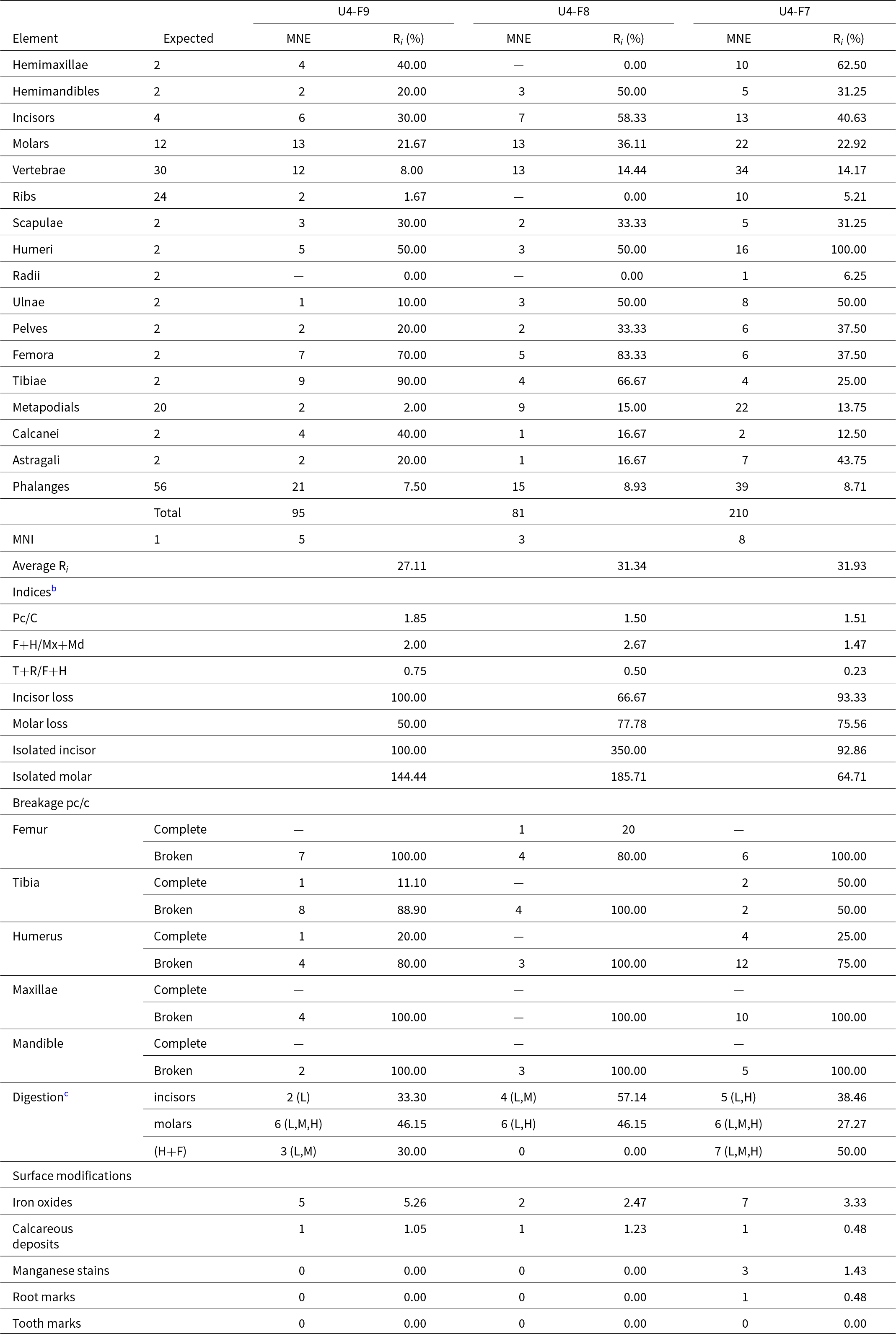
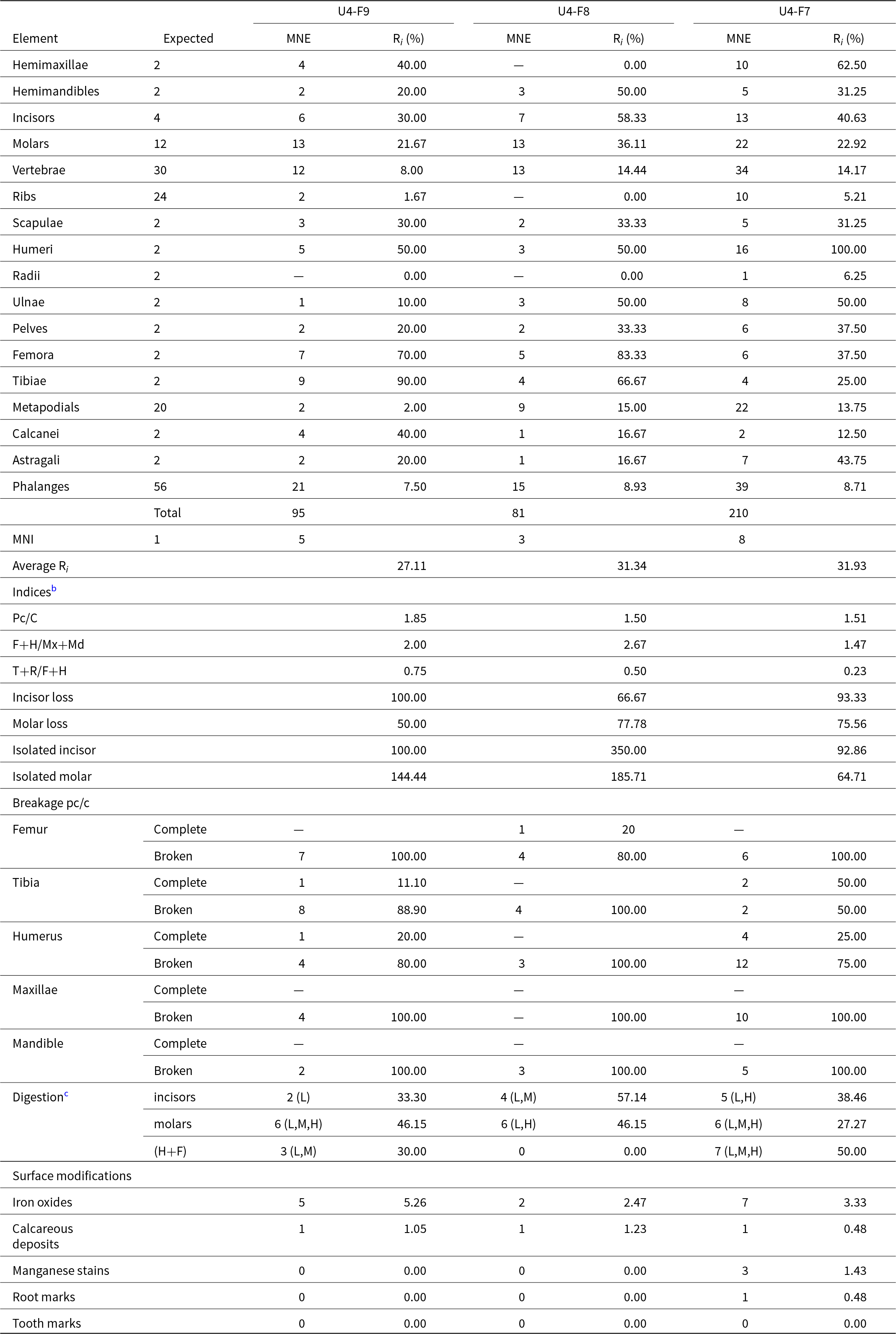
Table 2 displays the skeletal elements and various taphonomic modifications observed in each small mammal bone assemblage from SPPL. Digestive corrosion is recorded in the small mammals from all the three facies of Unit 4, indicating predation involvement. The taphonomic indicators, such as indices and traits like breakage and digestion, provide information about the predators that brought these remains to the site and the postdepositional events that affected these fossil assemblages. However, the taphonomic results are based on a relatively small number of skeletal elements and should be interpreted with caution.
Summary of small mammal taphonomic modifications of Salto de Piedra paleontological locality (SPPL).a
a Abbreviations: Ri, relative abundance; MNE, minimum number of elements; MNI, minimum number of individuals.
b Indices: Pc/C, postcranial vs. cranial (see “Material and Methods”); H, humeri; F, femora; Mx, maxilla; Md, mandible; T, tibia; R, radius.
c Digestion: L, light; M, moderate; H, heavy.
The indices of isolated incisors and molars in F9 and F8 exceed 100%, indicating that isolated teeth outnumber the empty sockets of jaws in the sample, suggesting a high rate of jaw destruction. In contrast, F7 has these values below 100%, especially for molars (64.71%), indicating that the isolated molars and incisors fit into the empty alveoli in the hemimandibles. The three facies also show that breakage is high in both cranial and postcranial skeletons. All cranial elements are broken to their maximum degree (see Supplementary Fig. S1, Supplementary Tables S1 and S2), although some long bones have been preserved complete.
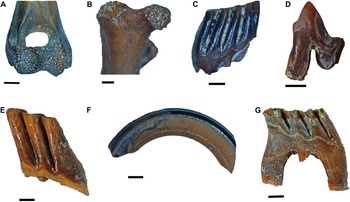
Signs of corrosion by digestion are indicated by high grades reaching heavy in the three facies (Fig. 3, Table 2). In F9, while digestion in molars is close to 50% and heavily digested, the incisors and postcranial elements present much lower percentages and lighter degrees of digestion. In F8, there is also less evidence of digestion traits in incisors (slightly above 50% reaching moderate grades) compared with molars (below 50%, and 15% with heavy grades). These are contradictory values, with higher numbers and/or grades of digestion in incisors than molars, which usually result from high postdepositional breakage such as trampling (Andrews, Reference Andrews1990). F7 is more consistent in digestion traits affecting incisors, molars, and postcranial elements, with percentages ≤50% and heavy grades of digestion. None of the skeletal elements analyzed reach extreme degrees of digestion (see Supplementary Fig. S2, Supplementary Tables S3 and S4), and none bear tooth mark surface modification (Table 2).
Examples of taphonomic modifications on small mammal remains recovered from Salto de Piedra paleontological locality (SPPL) according to the classification of Fernández et al. (Reference Fernández, Montalvo, Fernández-Jalvo, Andrews and López2017). (A) Distal humerus of Caviinae showing light digestive corrosion (SDP C:2 146.6-146.5 No. 9; F7); (B) femur of Sigmodontinae with heavy digestion; note the wavy aspect of the bone surface (SDP C:2 146.6-146.5 No. 28, F7); (C) molar of Reithrodon auritus with light digestion and total manganese oxide impregnation (SDP C:2 146.6-146.5 No. 96, F7); (D) lower premolar of Lestodelphys halli with heavy digestion (SDP C:2 147.8-147.7 No. 2, F9); (E) molar of R. auritus with moderate digestion (SDP C:2 146.6-146.5 No. 56, F7); (F) upper incisor of R. auritus with moderate digestion (SDP C:2 147.6-147.5 No. 2, F7); (G) molar of R. auritus with heavy digestion (SDP C:2 147.4-147.5 No. 14, F8). Scale bars = 1 mm.

Other modifications appear in very low percentages (Table 2) and consist of mineral oxidation surface stains caused by iron or manganese, as well as calcareous deposits. Organic acids in the soil produce brown spots, and in oxygenated soils rich in iron, a reddish color can appear, indicating oxygenated and biologically active soils at the time of burial. If the water is recently oxygenated, a growth of manganese dioxide can be observed, turning the bone black. Manganese deposits are related to humid alkaline and oxidizing environmental conditions, as well as the development of bacteria (López-González et al., Reference López-González, Grandal-d’Anglade and Ramón Vidal-Romaní2006; Fernández-Jalvo and Andrews, Reference Fernández-Jalvo and Andrews2016).
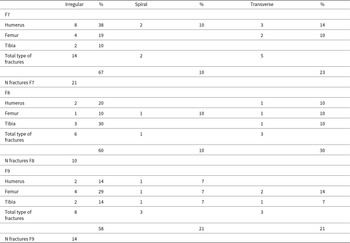
The most relevant traits of postdepositional processes affecting these fossil assemblages mainly involve breakage (Table 3). In this table, the bones are categorized based on the total types of fractures identified in each skeletal part and each facies, allowing for the observation of their stratigraphic distribution. The types of fractures analyzed are irregular, spiral, and transverse, which are the most representative in the record and provide insights into the origin of these fractures (Lyman, Reference Lyman1994). While there is a greater record of irregular fractures, there is a small percentage of spiral fractures, which have been produced when the bones were fresh. There are also transverse fractures, which are primarily of diagenetic origin. Therefore, irregular breaks may have resulted from trampling, while transverse fractures may be due to diagenetic movements, subsequent trampling, or extraction processes. Irregular fractures in the humeri, femora, and tibiae are predominant, followed by transverse fractures and, to a lesser extent, spiral fractures.
Type of fracture, fractured bones, and their distribution across the different facies analyzed according to Lyman (Reference Lyman1994) in long bones for each facies.

Taxonomic composition
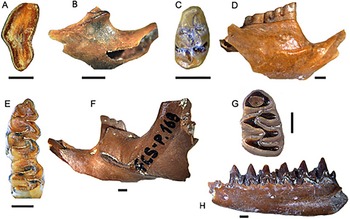
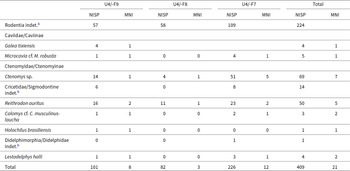
The abundance of the small mammals for each stratigraphic unit of SPPL is detailed in Table 4. Recorded taxa include three caviomorph rodents, the extinct cavies Galea tixiensis and Microcavia cf. M. robusta, and the fossorial Ctenomys sp. (Fig. 4A). Additionally, there are three sigmodontine rodents, Calomys cf. C. musculinus-laucha (Fig. 4B and C), Reithrodon auritus (Fig. 4D and E), and Holochilus brasiliensis (Fig. 4F and G), and one didelphid marsupial, Lestodelphys halli (Fig. 4H). Ctenomys, Galea, and Reithrodon are recorded throughout the three studied facies, but Calomys, Microcavia, and Lestodelphys are restricted to Facies 7 and 9; Holochilus is exclusive to Facies 9 (Table 4).
Small mammal taxa recovered from Salto de Piedra paleontological locality (SPPL). (A) Ctenomys sp. complete left PM4 (SDP C:2 146.5–146.6 No. 103, F8); (B) Calomys cf. C. musculinus-laucha: fragment of right mandible (SDP C:2 147.4-147.5 No. 13, F9); (C) Calomys cf. C. musculinus-laucha: isolated right M1 (SDP C:2 146.6-146.5 No. 158, F7); (D and E) Reithrodon auritus: fragment of left mandible with completes m1 and m2 (SDP C:2 146.6-146.5 No. 35, F7); (F and G) Holochilus brasiliensis: fragment of left mandible with complete m1 (P1658, ETID 19 147503, F9); (H) Lestodelphys halli: fragment of left mandible with completes 6 molariforms pm2- m4 (SDP C:2147.8-147.7 No. 2, F9). Scale bars = 1 mm.

Taxonomic composition of the small mammal samples from the Salto de Piedra paleontological locality (SPPL) (expressed NISP and MNI).a

a Abbreviations: MNI, minimum number of individuals; NISP, number of identifiable specimens.
b Postcranial elements, possibly corresponding to identified taxa.
The recent assemblage of Tyto furcata pellets collected near the SPPL (in Olavarría city; Fernández et al., Reference Fernández, Idoeta, García-Esponda, Carrera, Moreira, Ballejo and De Santis2012, table 1) includes the sigmodontines Calomys cf. C. musculinus-laucha (MNI = 46), Calomys sp. (MNI = 4), and H. brasiliensis (MNI = 1), as well as two other Pampean sigmodontines (Oligoryzomys flavescens [MNI = 17]; Akodon azarae [MNI = 15], and exotic murid rodents (Rattus sp. [MNI = 6]; Mus musculus [MNI = 5]), that were not recorded at SPPL. Representatives of Calomys had the highest relative frequency (MNI% = 53.19), followed by O. flavescens (MNI% = 18.08) and A. azarae (MNI%= 15.96). The remaining rodents accounted for less than 7% of the total abundance (Fernández et al., Reference Fernández, Idoeta, García-Esponda, Carrera, Moreira, Ballejo and De Santis2012).
Paleoecology
Most small mammal taxa showed significant differences in relative abundance between sedimentary levels (Supplementary Table S7), reflecting shifts in community composition. The only exception was Holochilus brasiliensis, which did not differ significantly between levels. This species was absent in F7 and F8 and occurred at very low abundance in U4/F9, and the low number of individuals prevents the detection of statistically significant differences due to restricted occurrence. Nonetheless, the presence of this species is especially relevant to the paleoecological analyses. It should also be noted that level F8 had a particularly low number of individuals and richness overall, resulting in wider confidence intervals and greater uncertainty for the proportions in this level.
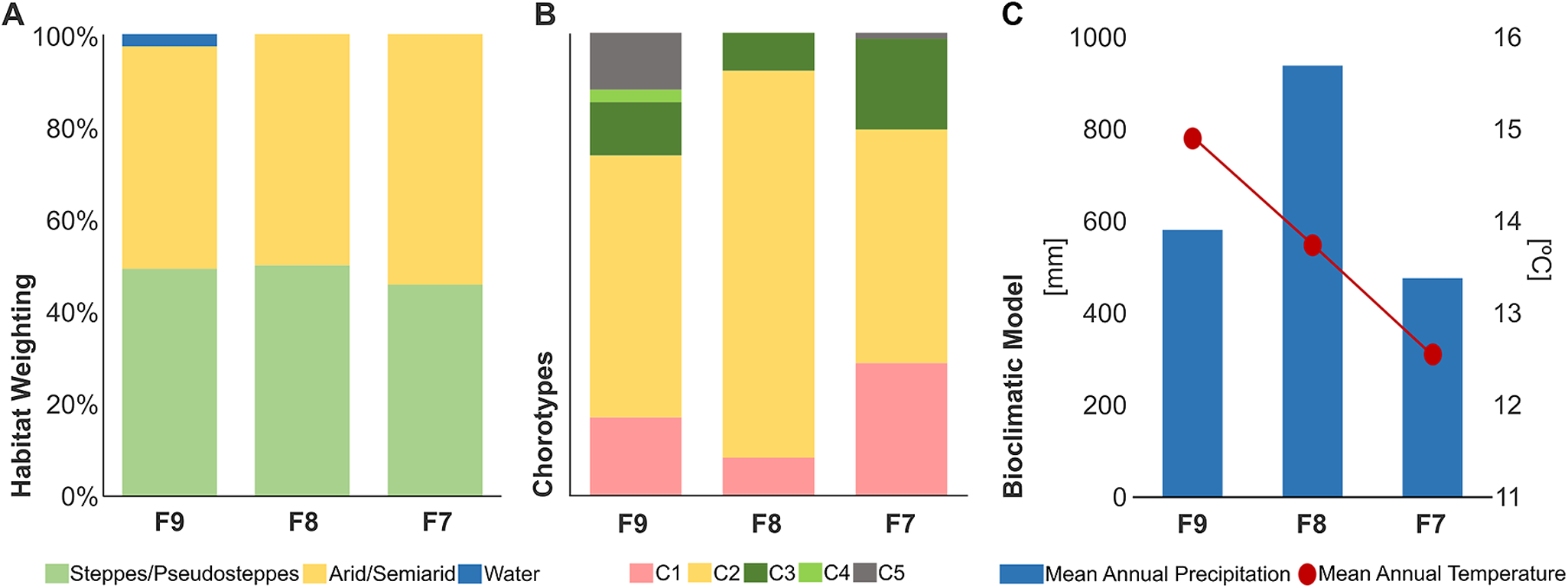
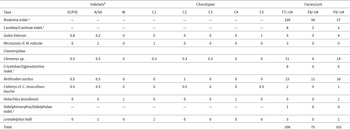
Paleoecological analyses indicate a trend from arid/cold conditions at the base of Unit 4 (F7) to humid/warm conditions toward the top (F9; see Fig. 5, Table 5). However, the three paleoecological methods suggest that a humid phase could have already started in F8 (Fig. 5, Table 5). These facies are characterized by a low diversity of small mammals, with a notable absence of species adapted to arid zones (e.g., L. halli and cf. M. robusta). Landscape composition changes (Fig. 5A) are minimal, with only a slight increase in grasslands in F8 and the appearance of waterbodies in F9, primarily associated with H. brasiliensis. Chorotype distributions (Fig. 5B) follow a similar pattern. In F7, taxa adapted to arid/cold conditions dominate, largely due to the presence of L. halli and cf. M. robusta, together with Ctenomys sp., which may include species linked to arid or semiarid environments. In F9, Chorotype 4—indicative of moist/temperate conditions—is represented by H. brasiliensis. In F8, the apparent increase in Chorotype 2 is driven almost entirely by R. auritus, the sole taxon assigned to this group. Consequently, results from F8 should be interpreted with caution, both for chorotypes and for habitats.
Paleoecological and paleoclimatic results of the different facies (F7, F8, and F9) analyzed in Unit 4 of Salto de Piedra paleontological locality (SPPL) (see “Material and Methods”; García-Morato et al., Reference García-Morato, Fernández-Jalvo and Montalvo2021, Reference García-Morato, Marin-Monfort, Fernández-Jalvo, Neme and Fernández2022). (A) Habitat weighting method. (B) Chorotype classification: C1 = cold arid (BWk); C2 = cold/arid (BWk, BSk) and temperate/humid (Cfa, Cfb); C3 = semiarid conditions hot or cold (BSh, BSk); C4 = Humid Pampa (Cfa, Cfb); C5 = generalists (abbreviations in parentheses correspond to Köppen-Geiger climate classification; see Beck et al., Reference Beck, Zimmermann, McVicar, Vergopolan, Berg and Wood2018). (C) Bioclimatic model with an estimation of the mean annual precipitation (MAP) and the mean annual temperature (MAT) obtained from each component displayed in Table 6.

Habitats and chorotypes classification modified from García-Morato et al. (Reference García-Morato, Fernández-Jalvo and Montalvo2021) for the small mammal taxa here analyzed.a

a Methods were applied using the NISP values and those specimens identified at least to the genus level.
b St, steppe; PSt, pseudo-steppe; A, arid; SA, semiarid; W, wetlands.
c Postcranial elements, possibly corresponding to identified taxa.
Results from the bioclimatic model (Fig. 5C, Table 6) support these observations, indicating that the lowest temperature and precipitation values occur in F7, followed by a potential humid pulse in F8 and a decline in precipitation in F9, which nonetheless remains slightly higher than in F7. Across this sequence, temperatures show a gradual increase of nearly 2°C from F7 to F9. These results, based on presence/absence data, are strongly influenced by the occurrence of two arid-adapted species in F7 (L. halli and cf. M. robusta), which are absent in F8. In F9, L. halli reappears together with the humid-adapted H. brasiliensis, likely explaining the slightly more humid conditions in F9 relative to F7. By contrast, the apparent humid pulse in F8 should be interpreted with caution, as the bioclimatic model for this level was based solely on Ctenomys sp. and R. auritus.
Classification of the small mammal taxa at genus and species levels in the different bioclimatic types following the method proposed by Hernández-Fernández (Reference Hernández Fernández2001): I, equatorial; II, tropical with summer rains; II/III, transitional tropical semiarid, III, subtropical arid; IV, winter rain with summer drought; V, warm temperate; VI, typical temperate; VII, arid temperate.

Discussion
Taphonomy
Field observations of skeletal remains (e.g., their positions within the sedimentary sequence and preservation features) provide insights into the taphonomic histories of the micromammal specimens recovered from Unit 4. Sediments with fossil content of micromammals in the Salto de Piedra correspond to channel and floodplain sandy deposits formed under conditions of rapid sedimentation (Favier Dubois et al., Reference Favier Dubois, Herrera Villegas, Bonini, Gómez, Steffan, Bax, Flores, Bellinzoni, Alberdi and Prado2021). These authors linked certain taphonomic characteristics of the fossils recovered from these levels to their origin. In general, fluvial and swampy environments influence the quality of the taphonomic results, because the fossil assemblages do not reach the minimum quantity required for a reliable taphonomic study (>100 dental elements; Fernández-Jalvo et al., Reference Fernández-Jalvo, Andrews, Denys, Sesé, Stoetzel, Marin-Monfort and Pesquero2016). Even so, enough postcranial and cranial fossil remains were recovered from Unit 4 to interpret the probable processes that occurred in these levels and how these fossil assemblages of microfauna formed.
The results obtained from the taphonomic analysis of small mammals from SPPL, focusing mainly on anatomical representation and degrees of breakage and digestion, indicate the involvement of predators. The average relative abundance of micromammal skeletal elements is low across the three facies. Variation in the representation of skeletal elements across facies suggests the possible involvement of different taphonomic agents (including predators), differences in preservation conditions linked to depositional processes, or a combination of both. We are also aware that the more-digested skeletal elements are more fragile and could have been destroyed by trampling or other diagenetic processes (e.g., sediment compression). Therefore, we may not be able to recover even the most-digested elements (dental and postcranial), but some testimonial fragments should survive (Fernández-Jalvo et al., Reference Fernández-Jalvo, Rueda, Fernández, García-Morato, Marin-Monfort, Montalvo, Tomassini, Chazan, Horwitz and Andrews2022). Although we cannot proceed further in the identification due to the scarce number of remains from the facies of U4, we may consider some taphonomic traits and potential candidates.
Even with certain differences among the three assemblages, we may attempt to establish the potential category and the most likely predators of the Salto de Piedra microfauna. According to South American neotaphonomic studies (Montalvo and Fernández, Reference Montalvo and Fernández2019 and references cited therein), nocturnal raptors exhibit well-preserved to excellently preserved cranial portions, along with a low percentage of fragmented postcranial remains. These characteristics enable us to exclude light categories of nocturnal raptors, as all skeletal elements in the three SPPL samples are fragmented. In the case of carnivorous mammal assemblages, they contain much higher broken cranial and postcranial elements and extreme grades of digestion. Diurnal birds of prey cause a high level of breakage, as they cannot swallow their prey whole as nocturnal raptors do, and tear the prey apart with their claws and beaks. Their gastric juices, more acidic than those of nocturnal birds of prey, round and smooth the edges of fractures.
Regarding the effects of digestion on bones and teeth, in F9, corrosion in molars fits the category of a heavy predator, but the percentages and light degrees of digestion in incisors correspond to a light category. In F8, molar corrosion indicates a heavy category, but incisors reach a moderate category. These apparently contradictory indications can be the result of post-predation taphonomic agents. F7 is more consistent in digestion traits referred to incisors, molars, and postcranial, indicating moderate/heavy predator categories.
In summary, raptors of light grades of modifications (e.g., Tyto furcata, Asio flammeus) and raptors of mild–moderate degrees of digestion and breakage, high average relative abundance. and large amounts of prey remains (e.g., Strix chacoensis, representatives of Bubo and Pseudoscops) can be excluded according to observations by Montalvo and Fernández (Reference Montalvo and Fernández2019). Carnivorous mammals such as Leopardus geoffroyi and Lontra longicaudis can also be ruled out as predators of SPPL due to the absence of remains or fragments with extreme corrosion by digestion or tooth mark damage on the prey bone surfaces (Fernández-Jalvo and Andrews, Reference Fernández-Jalvo and Andrews2016; Montalvo and Fernández, Reference Montalvo and Fernández2019). With the lightest and most extreme categories of predators ruled out, the most likely agent should be considered diurnal raptors classified within the moderate–heavy category (Supplementary Fig. S2, Supplementary Table S6) such as Caracara plancus, Circus buffoni, Elanus leucurus, Geranoaetus melanoleucus, and Geranoaetus polyosoma. An exception to nocturnal raptors is Athene cunicularia, a small strigiform, active during the day, which cannot be ruled out.
The high breakage observed in these fossil assemblages is too extreme to be attributed exclusively to predators. The results obtained from the SPPL samples were compared with the data of degree of breakage reported by Montalvo and Fernández (Reference Montalvo and Fernández2019). Irregular fracture is the most frequent type of breakage observed in the SPPL small mammal long bones (Table 3). The high breakage of long bones and skulls, along with the preservation of astragali and calcanei (small square bones; Supplementary Table S1, Supplementary Fig. S1), suggests that breakage could be caused by trampling. This is supported by experimental work by Andrews (Reference Andrews1990) and Fernández-Jalvo et al. (Reference Fernández-Jalvo, Rueda, Fernández, García-Morato, Marin-Monfort, Montalvo, Tomassini, Chazan, Horwitz and Andrews2022) and observations in fossil assemblages by Fernández (Reference Fernández2012) and Marin-Monfort et al. (Reference Marin-Monfort, Garcia-Morato, Andrews, Avery, Chazan, Howitz and Fernández-Jalvo2022). Trampling could have been caused by large-sized animals coming to the riverbank to drink and by the predator itself in their nests.
There is no apparent selection of skeletal elements by hydrodynamic or aerodynamic features (see Supplementary Fig. S3 and Supplementary Table S5), and because all the anatomical elements are represented, micromammal remains could have been affected by trampling while still inside the pellets, likely shortly after they were produced by predators, and then buried. This interpretation is supported by the absence of evidence of abrasion and weathering (Andrews, Reference Andrews1990).
Finally, postdepositional taphonomic attributes, such as the presence of iron and manganese stains, calcareous deposits, and root marks agree with the type of environment, but these modifications are rare. The F7 microfaunal assemblage seems to be less altered and the digestion more consistent than in F8 and F9, despite the fact that all of them are scarce and make it difficult to obtain fully reliable taphonomic interpretations. Root marks are almost absent in this assemblage, with only insignificant values registered in F7. This can be explained by the variations in these periods of aridity and moisture, which may have at times facilitated the development of vegetation that impacted the supply of micromammal bones.
Paleoenvironmental reconstruction at the end of the Pleistocene
The taphonomic interpretations align with the small mammals recorded at SPPL. All the species, including caviomorph and sigmodontine rodents as well as marsupials, are frequent prey of diurnal raptors and could inhabit open-air environments such as grasslands, scrublands, floodplains, and marshes (e.g., Pardiñas, Reference Pardiñas1999a; Fernández, Reference Fernández2012; Fernández et al., Reference Fernández, Idoeta, García-Esponda, Carrera, Moreira, Ballejo and De Santis2012; Montalvo et al., Reference Montalvo, Fernández, Bargo, Tomassini and Mehl2017; Montalvo and Fernández, Reference Montalvo and Fernández2019; Pardiñas and Cenizo, Reference Pardiñas and Cenizo2023).
The findings of Microcavia cf. M. robusta and Galea tixiensis at SPPL (see more details in Fernández et al., Reference Fernández, García-Morato, Gómez, Fernández-Jalvo and Prado2025), both extinct caviine rodents, along with the marsupial Lestodelphys halli, which is absent today in the Humid Pampa, indicate a more arid environment during 16–11.6 cal ka BP than at present. Neither Lestodelphys nor Galea–Microcavia were found in the recent pellet sample collected near SPPL (Fernández et al., Reference Fernández, Idoeta, García-Esponda, Carrera, Moreira, Ballejo and De Santis2012). Microcavia robusta became extinct in the Late Pleistocene, and G. tixiensis in the nineteenth century. Both caviine species have been preferentially associated with shrub-steppe environments rather than the typical grasslands of the Humid Pampa (e.g., Quintana, Reference Quintana1996, Reference Quintana2001; Fernández et al., Reference Fernández, García-Morato, Gómez, Fernández-Jalvo and Prado2025). Lestodelphys halli has several Pleistocene and Holocene records in the Humid Pampa, primarily located in coastal areas to the south and north, but not in the interior of this subregion, where SPPL is situated (Prado et al., Reference Prado, Goin and Tonni1985; Pardiñas, Reference Pardiñas1999a; Martinelli et al., Reference Martinelli, Forasiepi and Jofré2013; Formoso et al., Reference Formoso, Martin, Teta, Carbajo, Sauthier and Pardiñas2015, fig. 1). Geographic distribution models based on climatic and soil variables suggest that this marsupial experienced a significant biogeographic reduction since the Middle Holocene, a trend that culminates in the Late Holocene, when it went extinct in the Humid Pampa and northeastern Patagonia (Formoso et al., Reference Formoso, Martin, Teta, Carbajo, Sauthier and Pardiñas2015). At present, L. halli is restricted to the Patagonian steppe, and its presence in the Monte Desert of central and west-central Argentina has been considered a relict population from a wider distribution during the Late Pleistocene–Holocene (e.g., Formoso et al., Reference Formoso, Martin, Teta, Carbajo, Sauthier and Pardiñas2015; Montalvo et al., Reference Montalvo, Fernández, Bargo, Tomassini and Mehl2017; Fernández et al., Reference Fernández, Mange and Prates2021).
However, four of the small mammals found in SPPL are rodents that currently inhabit the grasslands of the Humid Pampa: Calomys cf. C. musculinus-laucha, Ctenomys sp., Holochilus brasiliensis, and Reithrodon auritus (Pardiñas et al., Reference Pardiñas, Teta, D’Elía, Polop and Busch2010; Teta et al., Reference Teta, Gonzáles-Fischer, Codecido and Bilenca2010; Fernández et al., Reference Fernández, Idoeta, García-Esponda, Carrera, Moreira, Ballejo and De Santis2012). Both paleoecological analyses and the bioclimatic model, based on the small mammal assemblages recovered from SPPL, showed a slight trend from arid conditions at the base (F7 = 16 cal ka BP) of Unit 4 to more humid environments toward the top (F9 = 13.9–11.6 ka BP). In particular, the amphibious rodent H. brasiliensis, found only at F9, is a species well adapted to lowland and mesic habitats near streams, grassy marshes, swampy savannas, and gallery forests along watercourses (Pardiñas and Teta, Reference Pardiñas and Teta2011). Although there are some records of Holochilus in Pleistocene sediments, most belong to the Holocene (Pardiñas and Teta, Reference Pardiñas and Teta2011). Coincidentally, the record of the gastropod Heleobia parchappi, along with Succinea meridionalis in palustrine facies of SPPL, suggests greater water availability in the plains during the Late Pleistocene–Holocene transition (Steffan et al., Reference Steffan, Gómez, García-Morato, Bellinzoni, Bonini, Favier-Dubois and Montalvo2026). These authors concluded that Unit 4 shows a trend toward increased humidity, which becomes more prominent in Unit 5 (F10 and F11). Our results align with the paleoenvironmental information documented for the region toward the end of the Pleistocene (Bonadonna et al., Reference Bonadonna, Leone and Zanchetta1999; Prado and Alberdi, Reference Prado and Alberdi1999; Tonni et al., Reference Tonni, Cione and Figini1999, Reference Tonni, Huarte, Carbonari and Figini2003; Muhs and Zárate, Reference Muhs, Zárate and Markgraf2001; Quattrocchio et al., Reference Quattrocchio, Borromei, Deschamps, Grill and Zavala2008; Tonello and Prieto, Reference Tonello and Prieto2008, Reference Tonello and Prieto2010).
The sympatric occurrence of subtropical (Holochilus brasiliensis) and Patagonian–Central (Galea tixiensis, Microcavia cf. M. robusta, and Lestodelphys halli) small mammals found at the top of the sequence of SPPL (F9) is characteristic of “no-analog communities,” which indicate environmental conditions during 13.4–11.6 cal ka BP that are clearly different from the current ones. In fact, the synchronous findings of these species could reflect the transition between the Pleistocene and Holocene. Although the median calibrated ages place F9 within a short time span (1.8 ka), caution is needed when interpreting these non-analog assemblages, as every fossil association is mediated by time averaging, which may introduce species from different periods. It is important to note that the small mammals recorded in the oldest levels of Campo Laborde (Buenos Aires Province), which are chronologically and stratigraphically correlated with SPPL (Politis et al., Reference Politis, Messineo, Stafford and Lindsey2019; Prado et al., Reference Prado, Bonini, Favier-Dubois, Gómez, Steffan and Alberdi2019; Favier Dubois et al., Reference Favier Dubois, Herrera Villegas, Bonini, Gómez, Steffan, Bax, Flores, Bellinzoni, Alberdi and Prado2021), exhibit some interesting similarities and differences (Scheifler et al., Reference Scheifler, Messineo and Pardiñas2015) and are much scarcer than in SPPL. The small mammals of Campo Laborde are mostly composed of sigmodontines typical of the Pampean grassland (Reithrodon auritus and Akodon cf. A. azarae), and the caviomorphs Ctenomys sp. and Galea leucoblephara (Scheifler et al., Reference Scheifler, Messineo and Pardiñas2015). In Arroyo Seco 2, another open-air archaeological site with early human occupation associated with extinct megafauna (located 165 km south of SPPL), A. azarae, R. auritus, and Ctenomys sp. were also recorded from the Late Pleistocene to the Early Holocene transition (e.g., Gómez et al., Reference Gómez, Prado and Alberdi1999; Politis and Borrero, Reference Politis and Borrero2024). In this site, the preservation conditions of the micromammal material are good, although with a high fracturing index, except at the lower levels. The micromammal research at Arroyo Seco 2 shows that toward the final Pleistocene, the conditions would be subhumid dry (Gómez, Reference Gómez, Politis, Gutiérrez and Scabuzzo2014). In addition to some Pampean species, other diagnostic species of climatic conditions that reflect more arid periods are recorded in the SPPL, such as the marsupial Lestodelphys halli and rodents like Microcavia cf. M. robusta and Galea tixiensis. At other levels, there are very humid pulses with species such as Holochilus brasiliensis. Thus, part of the differences between Arroyo Seco 2 and Campo Laborde compared with SPPL is the variability of the species record. However, the diagnosis of environmental conditions is similar in both Campo Laborde and SPPL, providing an image of climatic conditions in the same area for the same chronology.
In this regard, these results contribute to understanding the paleoenvironmental variability that marked the period of megafaunal extinction and the earliest human occupation of the region (Politis and Borrero, Reference Politis and Borrero2024). The environmental conditions of arid scrub-steppe of Patagonia and the typical Pampean grasslands, with a trend toward increasing humidity and temperature, as suggested by the small mammals from SPPL, are indicative of the Pleistocene–Holocene transition. Confirmed radiocarbon dates indicate that the first humans arrived in the Humid Pampa around 14 ka BP, during the Antarctic Cold Reversal arid climatic event (Politis et al., Reference Politis, Gutiérrez, Rafuse and Blasi2016; Prates et al., Reference Prates, Politis and Perez2020; Politis and Borrero, Reference Politis and Borrero2024). According to the prevailing view, this initial exploratory phase was followed by a broader dispersal wave from North America, associated with the Clovis culture during the Younger Dryas (ca. 12.9–11.7 ka BP). The Fishtail points found at several South American sites from this period may reflect the transmission of Clovis fluted projectile point technology, which was optimized for megafaunal hunting (Politis et al., Reference Politis, Gutiérrez, Rafuse and Blasi2016; Prates et al., Reference Prates, Politis and Perez2020; Prates and Perez, Reference Prates and Pérez2021; Politis and Borrero, Reference Politis and Borrero2024). Despite scarce evidence of early human–megafauna interactions in the Humid Pampa, archaeological sites near SPPL—such as Campo Laborde, Arroyo Seco, and Paso Otero 5—have yielded megafaunal skeletal remains bearing clear traces of human butchery (Martínez and Gutiérrez, Reference Martínez, Gutiérrez. and Vialou2011; Politis et al., Reference Politis, Messineo, Stafford and Lindsey2019). The considered drivers of megafaunal extinction include climate-induced habitat loss, trophic collapse, disease, and human presence, factors that likely contributed to ecological stress through hunting pressure and competition for space and associated resources (Cione et al., Reference Cione, Tonni, Soibelzon and Haynes2009; Prates and Perez, Reference Prates and Pérez2021). With the increased humidity of the Early Holocene, humans adapted their hunting strategies and lithic technology—replacing Fishtail points with triangular ones—to changing ecosystems, diversifying their diet to include a range of smaller animals still found today, such as the camelid Lama guanicoe, the cervid Ozotoceros bezoarticus, the armadillo Chaetophractus villosus, and the rodent Lagostomus maximus (Martínez and Gutiérrez, Reference Martínez, Gutiérrez. and Vialou2011).
Despite these changes, climatic fluctuations during this period appear to have had less impact on small mammal communities than on the megafauna (Pardiñas, Reference Pardiñas1999a; Tonni et al., Reference Tonni, Cione and Figini1999; Cione et al., Reference Cione, Tonni, Soibelzon and Haynes2009, Reference Cione, Tonni and Soibelzon2011; Prado et al., Reference Prado, Martinez-Maza and Alberdi2015). This contrast is evident when considering the mass extinction of large and megafauna, which resulted in the disappearance of 80% of genera >44 kg from the fossil record (Cione et al., Reference Cione, Tonni, Soibelzon and Haynes2009), whereas most extant small mammal species in the Humid Pampa have persisted since the Late Pleistocene (e.g., Pardiñas et al., Reference Pardiñas, Teta, D’Elía, Polop and Busch2010 and references therein). However, the greater diversity of caviine rodents recorded in the Humid Pampa likely reflects climatic and ecological changes associated with the Pleistocene–Holocene transition (Fernández et al., Reference Fernández, García-Morato, Gómez, Fernández-Jalvo and Prado2025). During the Holocene, the replacement of shrub-steppes by grasslands in the region led to the disappearance of species such as Microcavia robusta and Galea ortodonta, while Cavia aperea expanded southward from northern areas. At present, Cavia aperea is the sole caviine species inhabiting the core of the Humid Pampas (Fernández et al., Reference Fernández, García-Morato, Gómez, Fernández-Jalvo and Prado2025). In contrast, Microcavia australis and Galea leucoblephara are confined to the southern xeric coastal areas, and Galea tixiensis likely became extinct in the nineteenth century, primarily because of human activities such as the introduction of exotic livestock, intensive agriculture, field burning, and urban expansion (Fernández et al., Reference Fernández, García-Morato, Gómez, Fernández-Jalvo and Prado2025). In sum, the earliest humans, together with climate change, exerted a stronger influence on large and megafauna than on smaller mammals at the Pleistocene–Holocene boundary; however, human impact became more pronounced in historical times, when small mammal communities were restructured due to the adverse effects of human activities on grassland ecosystems.
Conclusions
Considering the context of the SPPL, a floodplain and swampy area is supported by the taphonomic characteristics of the small mammal assemblages recovered from Unit 4 (F7, F8, and F9). We conclude that small mammal fossil remains were accumulated due to predatory activity in areas close to the deposit of the remains, as no evidence of abrasion indicates transport. Other attributes recognized include high breakage and oxidation stains, as well as little or absent bone selection by wind or water, suggesting that they were buried rapidly and/or protected by pellets. These micromammal assemblages were produced by predators with a high degree of modification. Most carnivorous mammals can be ruled out as predators, however, because bone remains with extreme digestion corrosion and bone surface tooth marks are absent. The information provided by each facies assemblage is insufficient to further identify the possible predator (e.g., scarcity of dental remains); based on grades of digestive taphonomic attributes, it appears likely that diurnal raptors were involved. Trampling processes would have also affected pellets after predation, and the low abundance of remains prevents us from characterizing the raptor with precision. These taphonomic interpretations align with both caviomorphs and sigmodontines recorded at SPPL. All the species are frequent prey of raptors and could inhabit open-air environments, including grasslands, scrublands, floodplains, and marshes.
The microfauna from the SPPL, in addition to recovered mollusks, shows evidence of change at the time of the Pleistocene–Holocene transition (16–11.6 cal ka BP). This fauna is highly interesting from a taxonomic perspective, including species that became extinct during the Late Pleistocene (Microcavia cf. M. robusta) and the Holocene (Galea tixiensis), as well as the extirpation of Lestodelphys halli. The sympatric occurrence of these species with subtropical small mammals (Holochilus brasiliensis) found in SPPL is characteristic of “non-analog communities,” which indicate environmental conditions that are different from the current ones and could reflect the transition between the Pleistocene and Holocene periods. However, this fossil association may reflect time averaging, with species incorporated from different periods.
The paleoecological indications provided by the small mammals from SPPL suggest ecotonal conditions in this area between the arid scrub-steppe of Patagonia and the typical Pampean grasslands, with a trend toward increasing humidity and temperatures. This trend continued into the Holocene, as indicated by the fauna recorded at Salto de Piedra, the natural context of nearby sites that yielded the first human occupations in Argentina. Despite these changes, climatic fluctuations and the arrival of the first humans in the Pampas during this period had a lesser impact on the small mammal communities than on large mammals and megafauna. The effects of humans became increasingly significant in historical periods, driving changes in small mammal communities through the degradation of grassland ecosystems.
Supplementary material
The supplementary material for this article can be found at https://doi.org/10.1017/qua.2025.10055.
Acknowledgments
This work has been made possible thanks to Research Projects from the Spanish Ministry of Science and Innovation (PGC2016-79334-P and PID2021-126933NB-I00) and from the Spanish Council of Research (CSIC) (I-COOPB 24012). This research has also received grants from the National University of Central Argentina (UNICEN), National University of La Pampa (UNLPam) Grant 25-G, and CONICET to INCUAPA. JLP has a PICT Project (PICT 2019-03480) from Agencia Nacional de Promoción Científica y Técnica, Argentina. SG-M currently has a Juan de la Cierva contract (ref.: JDC2023-051162-I) at the Institute of History. The authors are especially grateful to Tyler Faith (associate editor), Esperanza Cerdeño, and an anonymous reviewer for their constructive comments and suggestions, and to Mary Safford Curioli for her careful and meticulous good work. All of them have substantially improved this article.


 Open access

