





1 Introduction
Expanding maps of the unit interval are the most elementary class of dynamical systems that exhibit chaotic behaviour. There is an extensive body of literature on limit theorems for Birkhoff sums of expanding maps as summarized in [Reference Denker8, Reference Fernando and Liverani10, Reference Hennion and Hervé15]. In particular, in [Reference Rousseau-Egele34], the central limit theorem (CLT) is established for observables with bounded variation ( ${\operatorname {BV}}$
) over piecewise uniformly expanding maps whose inverse derivative is also
${\operatorname {BV}}$
) over piecewise uniformly expanding maps whose inverse derivative is also ${\operatorname {BV}}$
. Further, in [Reference Fernando and Liverani10], Edgeworth expansions describing the error terms in the CLT are established in the case of
${\operatorname {BV}}$
. Further, in [Reference Fernando and Liverani10], Edgeworth expansions describing the error terms in the CLT are established in the case of ${\operatorname {BV}}$
observables over
${\operatorname {BV}}$
observables over $C^2$
uniformly expanding maps that are covering. In both cases, the results are limited to bounded observables since the observables considered are
$C^2$
uniformly expanding maps that are covering. In both cases, the results are limited to bounded observables since the observables considered are ${\operatorname {BV}}$
.
${\operatorname {BV}}$
.
One standard technique of establishing limit theorems for dynamical systems is the Nagaev–Guivarc’h spectral approach that was first introduced by Nagaev in the Markovian setting in [Reference Nagaev32], and later, adapted to deterministic dynamical systems by Guivarc’h in [Reference Guivarc’h and Hardy14]. The key idea is to code the characteristic function using an iterated twisted transfer operator (one can think of this as the deterministic counterpart of the dual of the Markov operator in the Markovian setting) and to analyse the spectral data of these families of operators in a suitable Banach space. More precise formulations of this idea can be found in [Reference Boyarsky and Góra4, Reference Gouëzel13, Reference Hennion and Hervé15].
Though transfer operator techniques to handle unbounded observables are available, see for example, [Reference Butterley5, Reference Fernando and Pène11, Reference Hervé and Pène16, Reference Liverani28], there are only a few results for limit theorems for unbounded observables over uniformly expanding maps of the interval; see for example, [Reference Arabieto and Smania1, Reference Chen, Zhang and Zhang6] of which the latter, however, does not use transfer operator techniques. In [Reference Arabieto and Smania1, Reference Butterley5, Reference Liverani28], the goal was to obtain bounds for the spectral radius and the essential spectral radius of the (twisted) transfer operators associated with expanding maps acting on their corresponding Banach spaces. While the first two works did not address limit theorems, in [Reference Arabieto and Smania1], a CLT and an almost sure invariance principle were proven. However, to the best of our knowledge, nothing is known about the first-order Edgeworth expansion (the quantitative CLT) or the mixing local central limit theorem (MLCLT) in this setting.
Notably, [Reference Hervé and Pène16] introduced a general framework for establishing the first-order Edgeworth expansion in a Markovian context that is nearly optimal, comparable to conditions in the independent identically distributed (IID) setting. This framework was further extended in [Reference Fernando and Pène11] to obtain expansions of all orders in both the CLT and the MLCLT, with applications to systems modelled by shifts of finite type or Young towers and unbounded observables with nearly optimal order of integrability. Despite its potential, this generalized theory has not been applied to expanding maps until this work.
In this paper, we introduce a class of Banach spaces that are not contained in $L^\infty $
and for which the conditions introduced in [Reference Fernando and Pène11, Reference Hervé and Pène16] can be verified in the context of
$L^\infty $
and for which the conditions introduced in [Reference Fernando and Pène11, Reference Hervé and Pène16] can be verified in the context of $C^2$
uniformly expanding maps of the interval. In Remark 2.4, we compare the class of Banach spaces we introduce with other Banach spaces in the literature that include unbounded observables and are known to possess a spectral gap for the associated transfer operator.
$C^2$
uniformly expanding maps of the interval. In Remark 2.4, we compare the class of Banach spaces we introduce with other Banach spaces in the literature that include unbounded observables and are known to possess a spectral gap for the associated transfer operator.
The observables $\chi :(0,1)\to \mathbb {R}$
we focus on and which belong to our Banach space are unbounded heavily oscillating observables characterized by the conditions
$\chi :(0,1)\to \mathbb {R}$
we focus on and which belong to our Banach space are unbounded heavily oscillating observables characterized by the conditions
 $$ \begin{align*} |\chi|\lesssim x^{-a}(1-x)^{-a} \quad \text{and} \quad \max\{|\chi'(x+)|, |\chi'(x-)|\}\lesssim x^{-b}(1-x)^{-b}\, \end{align*} $$
for some $a,b> 0$
. The permissible ranges for a and b vary depending on the specific interval map and the limit theorem of interest.
$a,b> 0$
. The permissible ranges for a and b vary depending on the specific interval map and the limit theorem of interest.
As the underlying transformations we consider are full-branched $C^2$
uniformly expanding maps of the interval, we see that the non-removable singularities of
$C^2$
uniformly expanding maps of the interval, we see that the non-removable singularities of $\chi $
are always at a fixed point of the interval map. (This, however, could easily be extended to any periodic point.) The behaviour of such maps can be considered as particularly interesting: once an orbit lands close to a fixed point, a few subsequent iterates might stay relatively close to the fixed point and the Birkhoff sum might be very large locally. Such situations can cause the system to behave qualitatively different from the IID setting, see for example, [Reference Kesseböhmer and Schindler24, Theorem 1.10].
$\chi $
are always at a fixed point of the interval map. (This, however, could easily be extended to any periodic point.) The behaviour of such maps can be considered as particularly interesting: once an orbit lands close to a fixed point, a few subsequent iterates might stay relatively close to the fixed point and the Birkhoff sum might be very large locally. Such situations can cause the system to behave qualitatively different from the IID setting, see for example, [Reference Kesseböhmer and Schindler24, Theorem 1.10].
Further, we show that the general framework developed in [Reference Fernando and Pène11] for limit theorems involving unbounded observables can be applied to our class of observables. By adapting the ideas in [Reference Fernando and Pène11] to our context, in §3, we identify a set of sufficient conditions on both the system and the observables that ensure the validity of limit theorems. In particular, we establish the CLT, its first-order correction – the first-order Edgeworth expansion – and an MLCLT for the Birkhoff sums of $\chi $
.
$\chi $
.
Indeed, we consider a sequence of increasing Banach spaces (all of them containing unbounded observables) on each of which the twisted transfer operators corresponding to full-branch $C^2$
expanding maps satisfy Doeblin–Fortet Lasota–Yorke (DFLY) inequalities and other good spectral properties. These properties, in turn, lead to the establishment of the limit theorems for this class of expanding maps. In the previous literature (including [Reference Fernando and Pène11]), the conditions in the general framework were not verified in a context similar to ours, and there lies the key novelty of this work. Though our results regarding the introduced Banach spaces are tailored to prove limit theorems in the spirit of [Reference Fernando and Pène11], similar, general techniques using a chain of Banach spaces were established in [Reference Hervé and Pène16] and also used in [Reference Pène33]. Having this in mind, the intermediate technical results of this paper regarding the precise details of the chain of Banach spaces (relegated to Appendix A) might be helpful to prove further limit theorems in the future.
$C^2$
expanding maps satisfy Doeblin–Fortet Lasota–Yorke (DFLY) inequalities and other good spectral properties. These properties, in turn, lead to the establishment of the limit theorems for this class of expanding maps. In the previous literature (including [Reference Fernando and Pène11]), the conditions in the general framework were not verified in a context similar to ours, and there lies the key novelty of this work. Though our results regarding the introduced Banach spaces are tailored to prove limit theorems in the spirit of [Reference Fernando and Pène11], similar, general techniques using a chain of Banach spaces were established in [Reference Hervé and Pène16] and also used in [Reference Pène33]. Having this in mind, the intermediate technical results of this paper regarding the precise details of the chain of Banach spaces (relegated to Appendix A) might be helpful to prove further limit theorems in the future.
As an immediate application, we deduce limit theorems for a Boolean-type transformation $\phi : \mathbb {R} \to \mathbb {R}$
given by
$\phi : \mathbb {R} \to \mathbb {R}$
given by $\phi (x)=1/2(x-1/x)$
if
$\phi (x)=1/2(x-1/x)$
if $x\neq 0$
and observables that heavily oscillate at
$x\neq 0$
and observables that heavily oscillate at $\pm \infty $
. This application makes use of a smooth conjugacy between the doubling map on the unit interval and
$\pm \infty $
. This application makes use of a smooth conjugacy between the doubling map on the unit interval and $\phi $
. In particular, this has applications to sampling the Lindelöf hypothesis, a line of research in analytic number theory that deals with understanding the properties of the Riemann zeta function on the critical strip. We elaborate on this in §2.6.
$\phi $
. In particular, this has applications to sampling the Lindelöf hypothesis, a line of research in analytic number theory that deals with understanding the properties of the Riemann zeta function on the critical strip. We elaborate on this in §2.6.
The structure of the paper is as follows: §2 is dedicated to preliminaries and main results; in §2.1, we introduce the relevant notation and common definitions that we will use throughout the paper; in §2.2, we state precisely the class of expanding maps we consider; in §2.3, we introduce our Banach spaces; in §2.4, we state our main results for the interval maps; and in §2.5, we state the corresponding results for the Boolean transformation on $\mathbb {R}$
and their implications to sampling the Lindelöf hypothesis is discussed in §2.6. In §3, we recall known abstract results in [Reference Fernando and Pène11, Reference Hervé and Pène16] tailored (with justifications) to our setting. The spectral properties of twisted transfer operators acting on these spaces including the DFLY inequality are established in §4. In §5, we collect the proofs of our main results. In particular, the proofs of the limit theorems for interval maps appear in §5.1, and in §5.2, we prove the corresponding results for the Boolean-type transformation. Finally, we have relegated some technical results to the Appendices; in particular, an in-depth discussion about our Banach spaces appears in Appendix A.
$\mathbb {R}$
and their implications to sampling the Lindelöf hypothesis is discussed in §2.6. In §3, we recall known abstract results in [Reference Fernando and Pène11, Reference Hervé and Pène16] tailored (with justifications) to our setting. The spectral properties of twisted transfer operators acting on these spaces including the DFLY inequality are established in §4. In §5, we collect the proofs of our main results. In particular, the proofs of the limit theorems for interval maps appear in §5.1, and in §5.2, we prove the corresponding results for the Boolean-type transformation. Finally, we have relegated some technical results to the Appendices; in particular, an in-depth discussion about our Banach spaces appears in Appendix A.
2 Main results
2.1 Preliminaries
Let X be a metric space with a reference Borel probability measure m and let $T :X\to X$
be a non-singular dynamical system, that is, for all
$T :X\to X$
be a non-singular dynamical system, that is, for all $U \subseteq X$
Borel subsets,
$U \subseteq X$
Borel subsets, $m(U)=0$
holds if and only if
$m(U)=0$
holds if and only if $m({ T}^{-1} U)=0$
holds. We denote by
$m({ T}^{-1} U)=0$
holds. We denote by $\mathcal {M}_1(X)$
the set of Borel probability measures on X. Let
$\mathcal {M}_1(X)$
the set of Borel probability measures on X. Let $\nu \in \mathcal {M}_1(X)$
. For
$\nu \in \mathcal {M}_1(X)$
. For $p\geq 1$
, by
$p\geq 1$
, by $L^p(\nu )$
, we denote the standard Lebesgue spaces with respect to
$L^p(\nu )$
, we denote the standard Lebesgue spaces with respect to $\nu $
, that is,
$\nu $
, that is,
 $$ \begin{align*}L^p(\nu) = \{ h: X \to X\,|\, h\, \text{is Borel measurable},\, \nu(|h|^p)<\infty \},\end{align*} $$
where the notation $\nu (h)$
refers to the integral of a function h with respect to a measure
$\nu (h)$
refers to the integral of a function h with respect to a measure $\nu $
and the corresponding norm is denoted by
$\nu $
and the corresponding norm is denoted by $\|\cdot \|_{L^p(\nu )}$
. When
$\|\cdot \|_{L^p(\nu )}$
. When $\nu =m$
, we often write
$\nu =m$
, we often write $L^p$
instead of
$L^p$
instead of $L^p(m)$
and
$L^p(m)$
and $\|\cdot \|_{p}$
instead of
$\|\cdot \|_{p}$
instead of $\|\cdot \|_{L^p(m)}$
.
$\|\cdot \|_{L^p(m)}$
.
For us, an observable is a real valued function $f \in L^{2}$
for which we consider the Birkhoff sums (also commonly referred to as ergodic sums),
$f \in L^{2}$
for which we consider the Birkhoff sums (also commonly referred to as ergodic sums),
 $$ \begin{align} S_{n}({ f,T}) = \sum_{k=0}^{n-1} { f \circ T}^{k}, \end{align} $$
which we denote by $S_{n}(f)$
when the dynamical system T is fixed.
$S_{n}(f)$
when the dynamical system T is fixed.
We say $\widehat { T}:L^1\to L^1$
is the transfer operator of
$\widehat { T}:L^1\to L^1$
is the transfer operator of ${ \widehat {T}}$
with respect to m if for all
${ \widehat {T}}$
with respect to m if for all ${ f}\in L^1$
and
${ f}\in L^1$
and ${ f}^{*} \in L^\infty $
,
${ f}^{*} \in L^\infty $
,
 $$ \begin{align} m(\widehat{ T}({ f})\cdot { f}^{*}) = m({ f}\cdot { f}^{*} \circ { T} ). \end{align} $$
Let ${\overline {m}} \in \mathcal {M}_1(X)$
be absolutely continuous with respect to m with density
${\overline {m}} \in \mathcal {M}_1(X)$
be absolutely continuous with respect to m with density $\rho _{\overline {m}}$
. Then, from equation (2.2), it follows that
$\rho _{\overline {m}}$
. Then, from equation (2.2), it follows that
 $$ \begin{align} {\mathbb{E}}_{\overline{m}}(e^{isS_{n}({ f})})=m( {{\widehat{ T}}}^n_{ is}(\rho_{\overline{m}})), \end{align} $$
where ${\mathbb {E}}_{{\overline {m}}}$
is the expectation with respect to the law of
${\mathbb {E}}_{{\overline {m}}}$
is the expectation with respect to the law of $S_n$
, where the initial point x is distributed according to
$S_n$
, where the initial point x is distributed according to $ {\overline {m}}$
and
$ {\overline {m}}$
and
 $$ \begin{align} {\widehat{ T}}_{is}(\cdot)=\widehat{ T}(e^{is { f}}\, \cdot ),\ s \in \mathbb{R} , \end{align} $$
see, for example, [Reference Hennion and Hervé15, Ch. 4]. Eventually, we are interested in the asymptotics of quantities of the form ${\overline {m}}(S_n(f) \leq z_n)$
and
${\overline {m}}(S_n(f) \leq z_n)$
and ${\mathbb {E}}_{{\overline {m}}}(V_n(S_n(f)))$
as
${\mathbb {E}}_{{\overline {m}}}(V_n(S_n(f)))$
as $n \to \infty $
, where
$n \to \infty $
, where $z_n \in \mathbb {R}$
and
$z_n \in \mathbb {R}$
and ${V_n : \mathbb {R} \to \mathbb {R}}$
are from a suitable class of observables, and to obtain these asymptotics, we exploit the relation in equation (2.3).
${V_n : \mathbb {R} \to \mathbb {R}}$
are from a suitable class of observables, and to obtain these asymptotics, we exploit the relation in equation (2.3).
We denote
 $$ \begin{align*} A = \lim_{n \to \infty} {\mathbb{E}}_{\overline{m}}\bigg(\frac{S_{n}(f, T)}{n}\bigg)\quad\text{and}\quad \sigma^2 =\lim_{n\to\infty} {\mathbb{E}}_{\overline{m}}\bigg(\frac{S_{n}(f,T)-n\,A}{\sqrt{n}}\bigg)^2 \end{align*} $$
for the asymptotic mean and the asymptotic variance of Birkhoff sums, $S_{n}(f, T)$
, respectively. Under the assumptions we impose on T in §2.2, A and
$S_{n}(f, T)$
, respectively. Under the assumptions we impose on T in §2.2, A and $\sigma ^2$
are independent of the choice of
$\sigma ^2$
are independent of the choice of ${\overline {m}}$
because each initial measure
${\overline {m}}$
because each initial measure $\overline m$
converges weakly to the unique absolutely continuous invariant probability measure (acip) under the action of
$\overline m$
converges weakly to the unique absolutely continuous invariant probability measure (acip) under the action of $\widehat {T}$
, and we may focus on zero average observables by considering
$\widehat {T}$
, and we may focus on zero average observables by considering $\overline {f} := f - A$
instead of f.
$\overline {f} := f - A$
instead of f.
We call f to be T-cohomologous to a constant in the function space $\mathfrak {F}$
if there exist
$\mathfrak {F}$
if there exist $\ell \in \mathfrak {F}$
and a constant c such that
$\ell \in \mathfrak {F}$
and a constant c such that
 $$ \begin{align*}f= \ell \circ T - \ell + c\,\end{align*} $$
and T-coboundary in $\mathfrak {F}$
if there exists
$\mathfrak {F}$
if there exists $\ell \in \mathfrak {F} $
such that
$\ell \in \mathfrak {F} $
such that
 $$ \begin{align*}f= \ell \circ T - \ell.\end{align*} $$
We say f is non-arithmetic in $\mathfrak {F}$
if it is not T-cohomologous in
$\mathfrak {F}$
if it is not T-cohomologous in $\mathfrak {F}$
to a sublattice-valued function, that is, if there exists no triple
$\mathfrak {F}$
to a sublattice-valued function, that is, if there exists no triple $(\gamma , B,\theta )$
with
$(\gamma , B,\theta )$
with $\gamma : X \to \mathbb {R}$
, B a closed proper subgroup of
$\gamma : X \to \mathbb {R}$
, B a closed proper subgroup of $\mathbb {R}$
and a constant
$\mathbb {R}$
and a constant $\theta $
such that
$\theta $
such that $ f + \gamma - \gamma \circ T \in \theta + B$
.
$ f + \gamma - \gamma \circ T \in \theta + B$
.
Given a Banach space $\mathcal {B}_1$
, the
$\mathcal {B}_1$
, the $\mathbb {C}$
-valued continuous linear functionals are denoted by
$\mathbb {C}$
-valued continuous linear functionals are denoted by $\mathcal {B}_1^{\,\prime }$
and given another Banach space
$\mathcal {B}_1^{\,\prime }$
and given another Banach space $\mathcal {B}_2$
,
$\mathcal {B}_2$
, $\mathcal {L}(\mathcal {B}_1, \mathcal {B}_2)$
denotes the space of bounded linear operators from
$\mathcal {L}(\mathcal {B}_1, \mathcal {B}_2)$
denotes the space of bounded linear operators from $\mathcal {B}_1$
to
$\mathcal {B}_1$
to $\mathcal {B}_2$
. When
$\mathcal {B}_2$
. When $\mathcal {B}_1=\mathcal {B}_2$
, we write
$\mathcal {B}_1=\mathcal {B}_2$
, we write $\mathcal {L}(\mathcal {B}_1 ,\mathcal {B}_1)$
as
$\mathcal {L}(\mathcal {B}_1 ,\mathcal {B}_1)$
as $\mathcal {L}(\mathcal {B}_1)$
. When
$\mathcal {L}(\mathcal {B}_1)$
. When $\mathcal {B}_1 \subset \mathcal {B}_2$
,
$\mathcal {B}_1 \subset \mathcal {B}_2$
, $\mathcal {B}_1 \hookrightarrow \mathcal {B}_2$
denotes continuous embedding of Banach spaces, that is, there exists
$\mathcal {B}_1 \hookrightarrow \mathcal {B}_2$
denotes continuous embedding of Banach spaces, that is, there exists $\mathfrak c>0$
such that
$\mathfrak c>0$
such that $\|\cdot \|_{\mathcal {B}_2} \leq \mathfrak c \|\cdot \|_{\mathcal {B}_1}$
.
$\|\cdot \|_{\mathcal {B}_2} \leq \mathfrak c \|\cdot \|_{\mathcal {B}_1}$
.
Given a set $D \subseteq X$
, its complement
$D \subseteq X$
, its complement $X \setminus D$
is denoted by
$X \setminus D$
is denoted by $D^c$
, and
$D^c$
, and $\mathring {D}$
denotes its interior. Given a function
$\mathring {D}$
denotes its interior. Given a function $f: D \to \mathbb {R}$
, set
$f: D \to \mathbb {R}$
, set $f_+:=\max \{f,0\}$
and
$f_+:=\max \{f,0\}$
and $f_-:=\max \{-f,0\}$
. Given
$f_-:=\max \{-f,0\}$
. Given ${g : D \to \mathbb {R}}$
,
${g : D \to \mathbb {R}}$
, $g \lesssim f$
denotes that there exists constant
$g \lesssim f$
denotes that there exists constant $K>0$
such that
$K>0$
such that ${g(x) \leq K f(x)}$
for all
${g(x) \leq K f(x)}$
for all $x \in D$
. Let
$x \in D$
. Let $Q_1,Q_2$
be
$Q_1,Q_2$
be $\mathbb {R}^{+}_0$
valued functionals acting on a class of functions
$\mathbb {R}^{+}_0$
valued functionals acting on a class of functions $\mathfrak {G}_1$
and
$\mathfrak {G}_1$
and $\mathfrak {G}_2$
, the inequality
$\mathfrak {G}_2$
, the inequality $Q_1(g) \lesssim Q_2(h)$
for all
$Q_1(g) \lesssim Q_2(h)$
for all $g \in \mathfrak {G}_1$
and
$g \in \mathfrak {G}_1$
and $h \in \mathfrak {G}_2$
is written to denote that there exists K independent of the choices of g and h such that
$h \in \mathfrak {G}_2$
is written to denote that there exists K independent of the choices of g and h such that $Q_1(g)\leq K Q_2(h)$
. Finally, given two numbers
$Q_1(g)\leq K Q_2(h)$
. Finally, given two numbers $a,b \in \mathbb {R}$
,
$a,b \in \mathbb {R}$
, $a \approx b$
means that
$a \approx b$
means that $0 \leq a-b \leq 10^{-3}$
.
$0 \leq a-b \leq 10^{-3}$
.
We denote the standard Gaussian density and the corresponding distribution function by
 $$ \begin{align*} \mathfrak{n}(x)=\frac{1}{\sqrt{2\pi}}e^{-x^2/2}\quad \text{and}\quad \mathfrak{N}(x)=\int_{-\infty}^x \mathfrak{n}(y)\, {d}y, \end{align*} $$
respectively.
2.2 The classes of dynamical systems
Let $I=[0,1]$
and
$I=[0,1]$
and $\unicode{x3bb} $
be the Lebesgue measure (on
$\unicode{x3bb} $
be the Lebesgue measure (on $\mathbb {R}$
) and
$\mathbb {R}$
) and $\unicode{x3bb} _I$
its restriction to I. We use
$\unicode{x3bb} _I$
its restriction to I. We use $\unicode{x3bb} _I$
as the reference measure on I and let
$\unicode{x3bb} _I$
as the reference measure on I and let ${I=\bigcup _{j=0}^{k-1} [c_j,c_{j+1}]}$
be a partition of I with
${I=\bigcup _{j=0}^{k-1} [c_j,c_{j+1}]}$
be a partition of I with $c_0=0$
and
$c_0=0$
and $c_{k}=1$
. We consider the class of maps
$c_{k}=1$
. We consider the class of maps $\psi : I \to I$
satisfying the following conditions.
$\psi : I \to I$
satisfying the following conditions.
-
(1) There are $\psi _{j+1}:[c_{j},c_{j+1}] \to I $
such that for all j,
$\psi _{j+1} \in C^2$
,
$|\psi ^{\prime }_{j+1}|>1$
,
$\mathrm {Range}(\psi _{j+1})=I$
and
$$ \begin{align*}\psi_{j+1}|_{(c_{j},c_{j+1})} =\psi |_{(c_{j},c_{j+1})}.\end{align*} $$
$\psi _{j+1}:[c_{j},c_{j+1}] \to I $
such that for all j,
$\psi _{j+1} \in C^2$
,
$|\psi ^{\prime }_{j+1}|>1$
,
$\mathrm {Range}(\psi _{j+1})=I$
and
$$ \begin{align*}\psi_{j+1}|_{(c_{j},c_{j+1})} =\psi |_{(c_{j},c_{j+1})}.\end{align*} $$
-
(2) For all j, the derivative of
$\psi ^{-1}_{j+1}$
is uniformly
${\vartheta }$
-Hölder, that is, there exists c such that for all j, for all
${\varepsilon }>0$
, for all
$z\in I$
and for all
$x,y \in B_{\varepsilon }(z):=[z-{\varepsilon },z+{\varepsilon }]\cap [0,1],$
$$ \begin{align*}|(\psi^{-1}_{j+1})'(x)-(\psi^{-1}_{j+1})'(y)|\leq c|(\psi^{-1}_{j+1})'(z)|{\varepsilon}^{\vartheta} .\end{align*} $$





Remark 2.1. The full-branch assumption was made to simplify our calculations. Later on, we will be particularly interested in the doubling map that is conjugate to the Boolean type transformation, a transformation over the real line.
Since the maps studied here are $C^2$
, Markov and topologically mixing, each map has one and only one acip, and it is exact [Reference Boyarsky and Góra4, Theorem 6.1.1]. We denote this acip by
$C^2$
, Markov and topologically mixing, each map has one and only one acip, and it is exact [Reference Boyarsky and Góra4, Theorem 6.1.1]. We denote this acip by $\pi $
. Since
$\pi $
. Since $\psi ^{\prime }_{j+1}$
are
$\psi ^{\prime }_{j+1}$
are $C^1,$
there exists
$C^1,$
there exists $\eta _{+}<\infty $
such that
$\eta _{+}<\infty $
such that
 $$ \begin{align*}\max_{j} \|\psi^{\prime}_{j+1}\|_{\infty} = \eta_{+}.\end{align*} $$
Also, since $|\psi ^{\prime }_{j+1}|>1,$
there exists
$|\psi ^{\prime }_{j+1}|>1,$
there exists $\eta _->1$
such that
$\eta _->1$
such that
 $$ \begin{align*}\max_{j} \|(\psi^{-1}_{j+1})'\|_{\infty} = 1/\eta_-.\end{align*} $$
Remark 2.2. If $f \in \mathfrak {F}$
is a
$f \in \mathfrak {F}$
is a $\psi $
-coboundary in the space of measurable functions, then it is a
$\psi $
-coboundary in the space of measurable functions, then it is a $\psi $
-coboundary in the class of piecewise
$\psi $
-coboundary in the class of piecewise $C^2$
functions, see [Reference Jenkinson20, Reference Livsic30].
$C^2$
functions, see [Reference Jenkinson20, Reference Livsic30].
Without loss of generality, we assume that $\psi '>0$
and we have
$\psi '>0$
and we have
 $$ \begin{align} \widehat{\psi}_{is}(\varphi)(x)=\sum_{j=0}^{k-1} \frac{e^{is\chi(\psi^{-1}_{j+1}x)}}{\psi'(\psi^{-1}_{j+1}x)}\varphi(\psi^{-1}_{j+1}x), \end{align} $$
see, for example, [Reference Hennion and Hervé15] for a proof of this fact.
2.3 The Banach spaces
For a measurable function $f\colon I\to \mathbb {R}$
and a Borel subset S of I, we define the oscillation on S by
$f\colon I\to \mathbb {R}$
and a Borel subset S of I, we define the oscillation on S by

and we set  . For a complex valued function f, we generalize the definition to

where $\mathfrak {R}f$
and
$\mathfrak {R}f$
and $\mathfrak {I}f$
refer to real and imaginary parts of f, respectively. Also, in the case of a complex valued function f, up to a constant, this is equivalent to the more intuitive definition
$\mathfrak {I}f$
refer to real and imaginary parts of f, respectively. Also, in the case of a complex valued function f, up to a constant, this is equivalent to the more intuitive definition

This can be easily seen. We have $|f(x)-f(y)|\leq |\Re f(x)-\Re f(y)|+|\Im f(x)- \Im f(y)|$
and, thus,
$|f(x)-f(y)|\leq |\Re f(x)-\Re f(y)|+|\Im f(x)- \Im f(y)|$
and, thus, $\overline {\operatorname *{\mathrm {osc}}}(f,S)\leq \operatorname *{\mathrm {osc}}(f,S)$
. However, we have
$\overline {\operatorname *{\mathrm {osc}}}(f,S)\leq \operatorname *{\mathrm {osc}}(f,S)$
. However, we have $\operatorname *{\mathrm {osc}}(f,S)\leq 2\max \{\overline {\operatorname *{\mathrm {osc}}}(\Re f, S), \overline {\operatorname *{\mathrm {osc}}}(\Im f, S)\}\leq 2\ \overline {\operatorname *{\mathrm {osc}}}(f,S)$
. In what follows, we use
$\operatorname *{\mathrm {osc}}(f,S)\leq 2\max \{\overline {\operatorname *{\mathrm {osc}}}(\Re f, S), \overline {\operatorname *{\mathrm {osc}}}(\Im f, S)\}\leq 2\ \overline {\operatorname *{\mathrm {osc}}}(f,S)$
. In what follows, we use $\operatorname *{\mathrm {osc}}$
as the standard definition.
$\operatorname *{\mathrm {osc}}$
as the standard definition.
For $\alpha \in \mathbb {R}$
, define
$\alpha \in \mathbb {R}$
, define $R_{\alpha }$
, an operator on the space of measurable functions, by
$R_{\alpha }$
, an operator on the space of measurable functions, by

denote by $B_{{\varepsilon }}(x)$
the
$B_{{\varepsilon }}(x)$
the ${\varepsilon }$
-ball around x in I and define a seminorm
${\varepsilon }$
-ball around x in I and define a seminorm

where ${\varepsilon }_0$
is sufficiently small (to be chosen later). Let
${\varepsilon }_0$
is sufficiently small (to be chosen later). Let

and set

Finally, by $\mathsf {V}^{\,\prime }_{\alpha ,\beta , \gamma }$
, we denote the set of
$\mathsf {V}^{\,\prime }_{\alpha ,\beta , \gamma }$
, we denote the set of $\mathbb {C}$
-valued continuous linear functionals on
$\mathbb {C}$
-valued continuous linear functionals on $\mathsf {V}_{\alpha ,\beta , \gamma }$
.
$\mathsf {V}_{\alpha ,\beta , \gamma }$
.
Remark 2.3. It is shown in Appendix A that for $\alpha \in [0,1)$
,
$\alpha \in [0,1)$
, $\beta \in (0,1]$
and
$\beta \in (0,1]$
and $\gamma \geq 1$
,
$\gamma \geq 1$
, ${{\mathsf V}_{\alpha ,\beta ,\gamma }}$
is a Banach space. Similar real Banach spaces were considered in [Reference Blank2, Reference Keller21, Reference Kesseböhmer and Schindler23]. In all these cases, their spaces correspond to our spaces with
${{\mathsf V}_{\alpha ,\beta ,\gamma }}$
is a Banach space. Similar real Banach spaces were considered in [Reference Blank2, Reference Keller21, Reference Kesseböhmer and Schindler23]. In all these cases, their spaces correspond to our spaces with $\alpha = 0$
, and hence, are embedded in
$\alpha = 0$
, and hence, are embedded in $L^\infty $
; see Lemma A.4.
$L^\infty $
; see Lemma A.4.
Due to the dampening operation $R_\alpha $
, which was first introduced by the second author in [Reference Schindler36], the observables in
$R_\alpha $
, which was first introduced by the second author in [Reference Schindler36], the observables in ${{\mathsf V}_{\alpha ,\beta ,\gamma }}$
may be unbounded and oscillate heavily near
${{\mathsf V}_{\alpha ,\beta ,\gamma }}$
may be unbounded and oscillate heavily near $0$
and
$0$
and $1$
. It was used to establish a CLT. However, there was a critical mistake in the proof: the normed vector space considered there to study the spectrum of the transfer operator is not complete. In what follows, we not only correct this mistake but also establish an MLCLT for the Birkhoff sum given by equation (2.20).
$1$
. It was used to establish a CLT. However, there was a critical mistake in the proof: the normed vector space considered there to study the spectrum of the transfer operator is not complete. In what follows, we not only correct this mistake but also establish an MLCLT for the Birkhoff sum given by equation (2.20).
Moreover, we remark that depending on the application, one could consider different damping operators and use the ideas presented here to prove other limit theorems.
It is clear that due to the structure of $R_{\alpha }$
, the oscillating singularity can occur precisely at the fixed points
$R_{\alpha }$
, the oscillating singularity can occur precisely at the fixed points $0$
and
$0$
and $1$
. In the case where the map
$1$
. In the case where the map $\psi $
has more than two branches, and hence, fixed points
$\psi $
has more than two branches, and hence, fixed points $0=a_0< a_1<\cdots < a_{k-2}< a_{k-1}=1$
, the proofs could easily be generalized to a Banach space with additional dampening at
$0=a_0< a_1<\cdots < a_{k-2}< a_{k-1}=1$
, the proofs could easily be generalized to a Banach space with additional dampening at $a_1,\ldots , a_{k-2}$
. In this case, we would consider
$a_1,\ldots , a_{k-2}$
. In this case, we would consider $R_{\alpha }f(x)=\prod _{j=0}^{k-1}|x-a_j|^{\alpha }f(x)$
. However, these calculations would make the proof even more technical and, hence, we decided to restrict ourselves to the observables only oscillating at
$R_{\alpha }f(x)=\prod _{j=0}^{k-1}|x-a_j|^{\alpha }f(x)$
. However, these calculations would make the proof even more technical and, hence, we decided to restrict ourselves to the observables only oscillating at $0$
and at
$0$
and at $1$
.
$1$
.
Allowing for singularities of f at a point y that is not a fixed point of $\psi $
, that is, introducing a damping function
$\psi $
, that is, introducing a damping function $|x-y|^{\alpha }$
, would still result in a Banach space. However, under
$|x-y|^{\alpha }$
, would still result in a Banach space. However, under $\psi $
, the singularity of f would move and
$\psi $
, the singularity of f would move and ${{\mathsf V}}_{\alpha ,\beta ,\gamma }$
would no longer be closed under the action of the transfer operator
${{\mathsf V}}_{\alpha ,\beta ,\gamma }$
would no longer be closed under the action of the transfer operator $\widehat {\psi }$
, a condition fundamental for proofs using transfer operator techniques. In the case of y being a periodic point of period d, considering
$\widehat {\psi }$
, a condition fundamental for proofs using transfer operator techniques. In the case of y being a periodic point of period d, considering $\psi ^d$
instead of
$\psi ^d$
instead of $\psi $
should work.
$\psi $
should work.
Remark 2.4. In the literature, there are a number of Banach spaces that also allow for unbounded observables, e.g. [Reference Arabieto and Smania1, Reference Butterley5, Reference Liverani28]. Those are seemingly more general than the Banach space we introduce because they do not have the restriction that the singularity can only occur on a fixed point.
However, the norm of the Banach spaces are defined in an implicit way, e.g. as
 $$ \begin{align*}\|h\|=\sup_{ \|\varphi\|_{\alpha} \leq 1}\bigg|\int_0^1 \varphi'(x) h(x)\,{d}x\bigg|\end{align*} $$
in [Reference Liverani28] with $\varphi $
out of a certain space
$\varphi $
out of a certain space $(\mathcal {B}_{\alpha },\|\cdot \|_{\alpha }),$
and similarly, in an implicit way in [Reference Arabieto and Smania1, Reference Butterley5]. It is not clear and not an easy task to check whether the observables we are interested in, or even more elementary observables like
$(\mathcal {B}_{\alpha },\|\cdot \|_{\alpha }),$
and similarly, in an implicit way in [Reference Arabieto and Smania1, Reference Butterley5]. It is not clear and not an easy task to check whether the observables we are interested in, or even more elementary observables like $x^{-c}\sin (1/x)$
,
$x^{-c}\sin (1/x)$
, $c>0$
, belong to Banach spaces in the literature [Reference Liverani29]. From this point of view, the proposed Banach spaces are interesting because the conditions are relatively easy to check. Moreover, for the method used in our paper, a sequence of Banach spaces is necessary. This would introduce additional technical difficulties if we were to use other Banach spaces in the literature.
$c>0$
, belong to Banach spaces in the literature [Reference Liverani29]. From this point of view, the proposed Banach spaces are interesting because the conditions are relatively easy to check. Moreover, for the method used in our paper, a sequence of Banach spaces is necessary. This would introduce additional technical difficulties if we were to use other Banach spaces in the literature.
2.4 Results for the unit interval
Now, we are ready to state the limit theorems for $S_n(\chi ):=S_n(\chi , \psi )$
over dynamical systems
$S_n(\chi ):=S_n(\chi , \psi )$
over dynamical systems $\psi $
defined as in §2.2. Though we do not state this explicitly, it will later turn out that the
$\psi $
defined as in §2.2. Though we do not state this explicitly, it will later turn out that the $\chi $
specified in the following theorems belongs to an appropriate
$\chi $
specified in the following theorems belongs to an appropriate ${{\mathsf V}_{\alpha ,\beta ,\gamma }}$
.
${{\mathsf V}_{\alpha ,\beta ,\gamma }}$
.
We first state the CLT in the stationary case.
Theorem 2.5. Suppose $\chi $
is continuous and the right and left derivatives of
$\chi $
is continuous and the right and left derivatives of $\chi $
exist on
$\chi $
exist on $\mathring {I}$
,
$\mathring {I}$
, $\chi $
is not a coboundary and there exist constants
$\chi $
is not a coboundary and there exist constants $a,b>0$
such that
$a,b>0$
such that
 $$ \begin{align} |\chi(x)|\lesssim x^{-a}(1-x)^{-a}\quad\text{and}\quad \max\{|\chi'(x+)|, |\chi'(x-)|\}\lesssim x^{-b}(1-x)^{-b}. \end{align} $$
Assume
 $$ \begin{align} a<\min\bigg\{\vartheta, \frac{1}{b},\frac{1}{2}\bigg\}\cdot\min\bigg\{1,\frac{\log\eta_-}{\log \eta_+}\bigg\}. \end{align} $$
Then, the following CLT holds:
 $$ \begin{align} \pi\bigg(\frac{S_{n}(\chi) - n\,\pi(\chi)}{\sigma\sqrt{n}} \leq x\bigg) - \mathfrak{N}(x)= o(1)\quad\text{for all } x \in \mathbb{R}\text{ as } n\to \infty. \end{align} $$
Now, we discuss sufficient conditions for the MLCLT.
Theorem 2.6. Suppose $\chi $
is continuous, and the right and left derivatives of
$\chi $
is continuous, and the right and left derivatives of $\chi $
exist on
$\chi $
exist on $\mathring {I}$
,
$\mathring {I}$
, $\chi $
is not arithmetic, and there exist constants
$\chi $
is not arithmetic, and there exist constants $a,b>0$
such that equations (2.6) and (2.7) are true. Then,
$a,b>0$
such that equations (2.6) and (2.7) are true. Then, $S_n(\chi )$
satisfies the following MLCLT: for all
$S_n(\chi )$
satisfies the following MLCLT: for all $0<\alpha _0<\alpha _1<\beta $
,
$0<\alpha _0<\alpha _1<\beta $
, $M\geq 1$
,
$M\geq 1$
,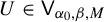 $U\in {{\mathsf V}}_{\alpha _0,\beta ,M}$
,
$U\in {{\mathsf V}}_{\alpha _0,\beta ,M}$
, $V: \mathbb {R} \to \mathbb {R}$
a compactly supported continuous function,
$V: \mathbb {R} \to \mathbb {R}$
a compactly supported continuous function, ${\overline {m}}\in \mathcal {M}_1(I)$
being absolutely continuous with respect to
${\overline {m}}\in \mathcal {M}_1(I)$
being absolutely continuous with respect to $\unicode{x3bb} _I$
, and
$\unicode{x3bb} _I$
, and $W \in L^1$
such that
$W \in L^1$
such that $(W \cdot {\overline {m}} ) \in {{\mathsf V}}_{\alpha _1,\beta ,M}^{\,\prime },$
we have
$(W \cdot {\overline {m}} ) \in {{\mathsf V}}_{\alpha _1,\beta ,M}^{\,\prime },$
we have
 $$ \begin{align} \lim_{n \to \infty} &\sup_{\ell \in \mathbb{R} }\bigg|\sigma\sqrt{2\pi n}\,{\mathbb{E}}_{{\overline{m}}}(U \circ \psi^n \,V(S_n(\overline\chi)-\ell)\, W)\nonumber\\&\qquad- e^{-{\ell^2}/{2n\sigma^2}} \,{\mathbb{E}}_{{\overline{m}}}(W)\,{\mathbb{E}}_\pi(U)\int V(x) \, {d}x \bigg|= 0. \end{align} $$
Remark 2.7. In particular, it is possible to choose ${\overline {m}}=\pi $
for all
${\overline {m}}=\pi $
for all $W\in L^{\bar M}$
, where
$W\in L^{\bar M}$
, where $M^{-1}+\bar M^{-1} = 1$
. In fact, under our assumptions, there exists
$M^{-1}+\bar M^{-1} = 1$
. In fact, under our assumptions, there exists $\rho \in {\operatorname {BV}}$
such that
$\rho \in {\operatorname {BV}}$
such that $\pi = \rho \unicode{x3bb} _I$
; see, for example, [Reference Liverani27]. Therefore,
$\pi = \rho \unicode{x3bb} _I$
; see, for example, [Reference Liverani27]. Therefore, $|W\cdot \pi (h)| = |\int (h W)\rho \, {d}\unicode{x3bb} _I |\leq \|\rho \|_{\infty } |Wh|_{L^1} \leq \|\rho \|_{\infty } \|W\|_{\bar M} \|h\|_{M} \leq C \|h\|_{\alpha _1, \beta , M}$
with
$|W\cdot \pi (h)| = |\int (h W)\rho \, {d}\unicode{x3bb} _I |\leq \|\rho \|_{\infty } |Wh|_{L^1} \leq \|\rho \|_{\infty } \|W\|_{\bar M} \|h\|_{M} \leq C \|h\|_{\alpha _1, \beta , M}$
with $C=\|\rho \|_{\infty } \|W\|_{\bar M}$
, and hence,
$C=\|\rho \|_{\infty } \|W\|_{\bar M}$
, and hence, $W\cdot \pi \in {{\mathsf V}}_{\alpha _1,\beta ,M}^{\,\prime }$
, as required.
$W\cdot \pi \in {{\mathsf V}}_{\alpha _1,\beta ,M}^{\,\prime }$
, as required.
Next, we discuss the first-order asymptotics of the CLT with no assumptions on the stationarity. In particular, under the conditions of the theorem, we have the CLT for initial measures that are not necessarily invariant.
Theorem 2.8. Suppose $\chi $
is continuous, and the right and left derivatives of
$\chi $
is continuous, and the right and left derivatives of $\chi $
exist on
$\chi $
exist on $\mathring {I}$
,
$\mathring {I}$
, $\chi $
is arithmetic, and there exist constants
$\chi $
is arithmetic, and there exist constants $a,b>0$
such that equations (2.6) and
$a,b>0$
such that equations (2.6) and
 $$ \begin{align} 3\min\{2a, \max\{a,a+b-2\}\}<\min\bigg\{\vartheta, \frac{1}{b},\frac{1}{2}\bigg\}\cdot\min\bigg\{1,\frac{\log\eta_+}{\log \eta_-}\bigg\} \end{align} $$
are true. Then, $S_n(\chi )$
satisfies the first-order Edgeworth expansion, that is, for all
$S_n(\chi )$
satisfies the first-order Edgeworth expansion, that is, for all ${{\overline {m}}\in \mathcal {M}_1(I)}$
being absolutely continuous with respect to
${{\overline {m}}\in \mathcal {M}_1(I)}$
being absolutely continuous with respect to $\unicode{x3bb} _I$
, there exists a quadratic polynomial P whose coefficients depend on the first three asymptotic moments of
$\unicode{x3bb} _I$
, there exists a quadratic polynomial P whose coefficients depend on the first three asymptotic moments of $S_n(\chi )$
, but not on n such that
$S_n(\chi )$
, but not on n such that
 $$ \begin{align*} \sup_{ x\in \mathbb{R}} \bigg|{\overline{m}}\bigg(\frac{S_n(\chi)-n\,\pi(\chi)}{\sigma\sqrt{n}} \leq x\bigg) - \mathfrak{N}(x) - \frac{P(x)}{\sqrt{n}}\mathfrak{n}(x)\bigg| = o(n^{-1/2})\quad\text{as}\; n\to \infty. \end{align*} $$
Remark 2.9. Note that from equations (2.10) and (2.6) with the corresponding choices of a and b, it follows that $\chi \in L^3$
. So,
$\chi \in L^3$
. So, ${\mathbb {E}}_{{\overline {m}}}(|S_n(\chi )|^3) < \infty $
for each n. Our proof shows that the third asymptotic moment
${\mathbb {E}}_{{\overline {m}}}(|S_n(\chi )|^3) < \infty $
for each n. Our proof shows that the third asymptotic moment
 $$ \begin{align*}\lim_{n\to \infty}{\mathbb{E}}_{{\overline{m}}}\bigg(\frac{S_n(\chi)-n \,\pi(\chi)}{\sqrt{n}}\bigg)^3\end{align*} $$
does, indeed, exist.
Finally, we provide a concrete example of a class of observables that satisfies our conditions.
Example 2.10. Let $\chi (x)=x^{-c}\sin (1/x)$
and define
$\chi (x)=x^{-c}\sin (1/x)$
and define $\tilde {\eta }=\min \{1,{\log \eta _-}/{\log \eta _+}\}$
.
$\tilde {\eta }=\min \{1,{\log \eta _-}/{\log \eta _+}\}$
.
-
(1) If
$0\leq c<\min \big \{\sqrt {1+\tilde {\eta }}-1, \vartheta \tilde {\eta }\big \}$
, then
$S_n(\chi )$
satisfies the CLT and MLCLT. -
(2) If
$0\leq c<\min \{\sqrt {1+\tilde {\eta }/6}-1,{\vartheta }\tilde {\eta }/6\}$
, then
$S_n(\chi )$
admits the first-order Edgeworth expansion.



If $\psi $
is the doubling map, that is,
$\psi $
is the doubling map, that is, $\psi (x)=2x\ \mod 1$
, then the conditions simplify in the following way.
$\psi (x)=2x\ \mod 1$
, then the conditions simplify in the following way.
-
(1a) If
$c<\sqrt {2}-1\,(\approx 0.414)$
, then
$S_n(\chi )$
satisfies the CLT and MLCLT. -
(2a) If
$c<\sqrt {7/6}-1\,(\approx 0.080)$
, then
$S_n(\chi )$
admits the first-order Edgeworth expansion.




2.5 The application to the Boolean-type transformation
For the following, we define the Boolean-type transformation $\phi \colon \mathbb {R}\to \mathbb {R}$
as
$\phi \colon \mathbb {R}\to \mathbb {R}$
as

and $\mu $
the
$\mu $
the $\phi $
-invariant probability measure absolutely continues with respect to Lebesgue and defined by
$\phi $
-invariant probability measure absolutely continues with respect to Lebesgue and defined by

We are interested in limit theorems for Birkhoffs sums $\widetilde {S}_n(h) :=S_n(h,\phi )$
, where
$\widetilde {S}_n(h) :=S_n(h,\phi )$
, where ${h: \mathbb {R}\to \mathbb {R}}$
. To study these systems, we go back to an easier system that fulfils all our properties of the last section.
${h: \mathbb {R}\to \mathbb {R}}$
. To study these systems, we go back to an easier system that fulfils all our properties of the last section.
Let $\psi \colon I\to I$
be given by
$\psi \colon I\to I$
be given by  and
and $\xi \colon I\to \mathbb {R}$
be given by
$\xi \colon I\to \mathbb {R}$
be given by  . Note that $\xi $
is almost surely bijective. An elementary calculation yields that the dynamical systems
$\xi $
is almost surely bijective. An elementary calculation yields that the dynamical systems $(\mathbb {R}, \mathcal {B}_{\mathbb {R}}, \mu , \phi )$
and
$(\mathbb {R}, \mathcal {B}_{\mathbb {R}}, \mu , \phi )$
and $(I, \mathcal {B}_{I}, \unicode{x3bb} _I, \psi )$
are isomorphic via
$(I, \mathcal {B}_{I}, \unicode{x3bb} _I, \psi )$
are isomorphic via $\xi $
, i.e.
$\xi $
, i.e.
 $$ \begin{align*} (\phi\circ\xi)(x)=(\xi\circ\psi)(x) \end{align*} $$
for all $x\in I$
, and additionally
$x\in I$
, and additionally $\xi $
and
$\xi $
and $\xi ^{-1}$
are measure preserving, i.e. for all
$\xi ^{-1}$
are measure preserving, i.e. for all $B\in \mathcal {B}_{\mathbb {R}}$
, it holds that
$B\in \mathcal {B}_{\mathbb {R}}$
, it holds that $\mu (B)=\unicode{x3bb} _I(\xi ^{-1} B)$
and for all
$\mu (B)=\unicode{x3bb} _I(\xi ^{-1} B)$
and for all $B\in \mathcal {B}_{I}$
, it holds that
$B\in \mathcal {B}_{I}$
, it holds that $\unicode{x3bb} _I(B)=\mu (\xi B)$
. To simplify the notation, we define
$\unicode{x3bb} _I(B)=\mu (\xi B)$
. To simplify the notation, we define $\widetilde {\sigma }^2:=\sigma ^2(h,\phi )$
.
$\widetilde {\sigma }^2:=\sigma ^2(h,\phi )$
.
Hence, instead of studying the Birkhoff sum $\sum _{n=0}^{N-1}(h\circ \phi ^n)(x)$
with
$\sum _{n=0}^{N-1}(h\circ \phi ^n)(x)$
with $x\in \mathbb {R}$
, we can study the sum
$x\in \mathbb {R}$
, we can study the sum $\sum _{n=0}^{N-1}(h\circ \xi \circ \psi ^n)(y)$
for
$\sum _{n=0}^{N-1}(h\circ \xi \circ \psi ^n)(y)$
for $y\in I$
. Since the transformations
$y\in I$
. Since the transformations $\phi $
and
$\phi $
and $\psi $
are isomorphic, we conclude that
$\psi $
are isomorphic, we conclude that
 $$ \begin{align} \mu\bigg(\sum_{n=0}^{N-1}(h\circ \phi^n)(x)\in B\bigg) =\unicode{x3bb}_I\bigg(\sum_{n=0}^{N-1}(h\circ \xi\circ\psi^n)(y)\in B\bigg) \end{align} $$
for all sets $B\in \mathcal {B}_{\mathbb {R}}$
. Formally, we define
$B\in \mathcal {B}_{\mathbb {R}}$
. Formally, we define $ \chi \colon I\to \mathbb {R}$
by
$ \chi \colon I\to \mathbb {R}$
by  and consider then the Birkhoff sum $S_n(\chi ).$
Then, our task reduces to transferring the conditions we have for
$S_n(\chi ).$
Then, our task reduces to transferring the conditions we have for $\chi $
to conditions for h.
$\chi $
to conditions for h.
Let $\mathfrak {F}$
be the class of functions
$\mathfrak {F}$
be the class of functions $h:\mathbb {R}\to \mathbb {R}$
such that the left and right derivatives exist, and there exist
$h:\mathbb {R}\to \mathbb {R}$
such that the left and right derivatives exist, and there exist $u,v \geq 0$
fulfilling
$u,v \geq 0$
fulfilling
 $$ \begin{align} h(x)&\lesssim |x|^{u}\quad\text{and}\quad \max\{|h'(x-)|, |h'(x+)|\}\lesssim |x|^{v} \end{align} $$
and $u(2+v)<1\,$
. Analogously to
$u(2+v)<1\,$
. Analogously to $\overline {f},$
we define
$\overline {f},$
we define $\overline {h}=h-\,\mu (h).$
Easy examples for functions
$\overline {h}=h-\,\mu (h).$
Easy examples for functions $h\in \mathfrak {F}$
are
$h\in \mathfrak {F}$
are $h(x)= x^{a}$
with
$h(x)= x^{a}$
with $0\leq a< (\sqrt {5}-1)/2$
or
$0\leq a< (\sqrt {5}-1)/2$
or $h(x)= x^{a} \sin (x^b)$
with
$h(x)= x^{a} \sin (x^b)$
with $a,b>0$
and
$a,b>0$
and $a(1+a+b)<1$
.
$a(1+a+b)<1$
.
Under the non-coboundary condition on $\phi $
, we have the CLT.
$\phi $
, we have the CLT.
Proposition 2.11. Suppose $h \in \mathfrak {F}$
is not
$h \in \mathfrak {F}$
is not $\phi $
-cohomologous to a constant. Then, the following CLT holds:
$\phi $
-cohomologous to a constant. Then, the following CLT holds:
 $$ \begin{align} \mu\bigg(\frac{\widetilde{S}_{n}(h) - n\,\mu(h)}{\widetilde{\sigma}\sqrt{n}} \leq x\bigg) - \mathfrak{N}(x)= o(1)\quad\text{for all } x \in \mathbb{R}\text{ as } n\to \infty\, \end{align} $$
with $\widetilde {\sigma }^2 \in (0,\infty )$
.
$\widetilde {\sigma }^2 \in (0,\infty )$
.
Under a non-arithmeticity condition on $\phi $
, we have the MLCLT.
$\phi $
, we have the MLCLT.
Proposition 2.12. Let $h\in \mathfrak {F}$
be non-arithmetic. Let
$h\in \mathfrak {F}$
be non-arithmetic. Let $0<\alpha _0<\alpha _1<\beta $
and
$0<\alpha _0<\alpha _1<\beta $
and $M\geq 1$
. Then, the following MLCLT holds: for
$M\geq 1$
. Then, the following MLCLT holds: for $V: \mathbb {R} \to \mathbb {R}$
compactly supported and continuous, U such that
$V: \mathbb {R} \to \mathbb {R}$
compactly supported and continuous, U such that $U \circ \xi \in {{\mathsf V}}_{\alpha _0,\beta ,M}$
, W such that
$U \circ \xi \in {{\mathsf V}}_{\alpha _0,\beta ,M}$
, W such that $W\circ \xi \in L^1$
for all
$W\circ \xi \in L^1$
for all ${\overline {m}}\in \mathcal {M}_1(\mathbb {R})$
being absolutely continuous with respect to
${\overline {m}}\in \mathcal {M}_1(\mathbb {R})$
being absolutely continuous with respect to $\unicode{x3bb} $
such that
$\unicode{x3bb} $
such that $(W\circ \xi \cdot \xi _*{\overline {m}}) \in {{\mathsf V}}_{\alpha _1,\beta ,M}^{\,\prime }\,,$
we have
$(W\circ \xi \cdot \xi _*{\overline {m}}) \in {{\mathsf V}}_{\alpha _1,\beta ,M}^{\,\prime }\,,$
we have
 $$ \begin{align} &\lim_{n \to \infty} \sup_{\ell \in \mathbb{R} }\bigg|\sigma\sqrt{2\pi n}\,{\mathbb{E}}_{{\overline{m}}}(U \circ \psi^n \,V(\widetilde S_n(\overline{h} )-\ell)\, W)\nonumber\\&\qquad\ \ \qquad- e^{-{\ell^2}/{2n\widetilde{\sigma}^2}} \,{\mathbb{E}}_{{\overline{m}}}(W)\,{\mathbb{E}}_{\mu}(U)\int V(x) \, {d}x \bigg|= 0. \end{align} $$
Finally, we state a set of sufficient conditions that implies the Edgeworth expansions for $\phi $
.
$\phi $
.
Proposition 2.13. Let $h:\mathbb {R}\to \mathbb {R}$
be such that the left and right derivatives exist, and there exist
$h:\mathbb {R}\to \mathbb {R}$
be such that the left and right derivatives exist, and there exist $u,v \geq 0$
fulfilling equations (2.14) and
$u,v \geq 0$
fulfilling equations (2.14) and
 $$ \begin{align} \min\{2u(2+v), (u+v)(2+v) \}<1/3, \end{align} $$
and h is not arithmetic. Then, there exists a quadratic polynomial P whose coefficients depend on the first three asymptotic moments of $\widetilde {S}_n(h)$
but not on n such that for all
$\widetilde {S}_n(h)$
but not on n such that for all ${\overline {m}}\in \mathcal {M}_1(\mathbb {R})$
being absolutely continuous with respect to
${\overline {m}}\in \mathcal {M}_1(\mathbb {R})$
being absolutely continuous with respect to $\unicode{x3bb} $
, we have
$\unicode{x3bb} $
, we have
 $$ \begin{align} \sup_{ x\in \mathbb{R}} \bigg|{\overline{m}}\bigg(\frac{ \widetilde{S}_n(h)-n\,\mu(h)}{\widetilde\sigma\sqrt{n}} \leq x\bigg) - \mathfrak{N}(x) - \frac{P(x)}{\sqrt{n}}\mathfrak{n}(x)\bigg| = o(n^{-1/2})\quad\text{as}\; n\to \infty. \end{align} $$
Remark 2.14. The condition in equation (2.17) forces that $0 \leq u < 1$
and
$0 \leq u < 1$
and $u < v$
.
$u < v$
.
2.6 Sampling the Lindelöf hypothesis
In this section, we apply the results from the last subsection to the context of sampling the Lindelöf hypothesis. Let $\zeta : \mathbb {C}\setminus \{1\} \to \mathbb {C}$
be the Riemann zeta function defined by
$\zeta : \mathbb {C}\setminus \{1\} \to \mathbb {C}$
be the Riemann zeta function defined by
 $$ \begin{align*}\zeta(s):=\sum_{n=1}^\infty n^{-s},\,\,\,\Re(s)>1\end{align*} $$
and by analytic continuation elsewhere except $s=1$
. The Lindelöf hypothesis states that the Riemann zeta function does not grow too quickly on the critical line
$s=1$
. The Lindelöf hypothesis states that the Riemann zeta function does not grow too quickly on the critical line $\Re z = 1/2$
. More precisely, it is conjectured that
$\Re z = 1/2$
. More precisely, it is conjectured that
 $$ \begin{align} \zeta_{1/2}(t):=\zeta(\tfrac{1}{2}+it) = \mathcal{O}(t^{{\varepsilon}}),\quad t\to{\pm} \infty \end{align} $$
for all ${\varepsilon }> 0,$
that is,
${\varepsilon }> 0,$
that is, $\lim _{t\to \pm \infty }|\zeta _{1/2}(t)|/t^{\varepsilon }<\infty $
. To date, the best estimates are due to Bourgain in [Reference Bourgain3], where it is proved that this is true for all
$\lim _{t\to \pm \infty }|\zeta _{1/2}(t)|/t^{\varepsilon }<\infty $
. To date, the best estimates are due to Bourgain in [Reference Bourgain3], where it is proved that this is true for all ${\varepsilon }> 13/84 \approx 0.154$
. It is worth noting that the Riemann hypothesis implies the Lindelöf hypothesis and the latter is a substitute for the former in some applications.
${\varepsilon }> 13/84 \approx 0.154$
. It is worth noting that the Riemann hypothesis implies the Lindelöf hypothesis and the latter is a substitute for the former in some applications.
The conjecture is related to the value distribution of $\zeta _{1/2}(t)$
as
$\zeta _{1/2}(t)$
as $t\to \pm \infty $
. To obtain more information about this tail behaviour, one can study ergodic averages of
$t\to \pm \infty $
. To obtain more information about this tail behaviour, one can study ergodic averages of $\zeta _{1/2}$
sampled over the orbits of heavy-tailed stochastic processes. This approach to Lindelöf hypothesis was initiated by Lifschitz and Weber in [Reference Lifshits and Weber26]. In particular, they prove that when
$\zeta _{1/2}$
sampled over the orbits of heavy-tailed stochastic processes. This approach to Lindelöf hypothesis was initiated by Lifschitz and Weber in [Reference Lifshits and Weber26]. In particular, they prove that when $\{Y_j\}_{j\geq 0}$
are independent Cauchy distributed random variables and
$\{Y_j\}_{j\geq 0}$
are independent Cauchy distributed random variables and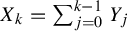 $X_k = \sum _{j=0}^{k-1} Y_j$
(the Cauchy random walk), then for all
$X_k = \sum _{j=0}^{k-1} Y_j$
(the Cauchy random walk), then for all $b>2$
,
$b>2$
,
 $$ \begin{align*}\frac{1}{n}\sum_{k=0}^{n-1}\zeta_{1/2}(X_k) = 1 + o\bigg(\frac{(\log n)^b}{\sqrt{n}}\bigg),\quad n \to \infty,\end{align*} $$
almost surely, where we denote $a_n=o(b_n)$
if
$a_n=o(b_n)$
if $\lim _{n\to \infty }|a_n|/b_n=0$
. This work was later generalized by Shirai, see [Reference Shirai37], where
$\lim _{n\to \infty }|a_n|/b_n=0$
. This work was later generalized by Shirai, see [Reference Shirai37], where $X_k$
was taken to be a symmetric
$X_k$
was taken to be a symmetric $\alpha $
-stable process with
$\alpha $
-stable process with $\alpha \in [1, 2)$
. Since
$\alpha \in [1, 2)$
. Since $X_k$
are heavy tailed, that is,
$X_k$
are heavy tailed, that is, ${\mathbb {E}}(|X_k|^p)=\infty $
when
${\mathbb {E}}(|X_k|^p)=\infty $
when $p = \lceil \alpha \rceil $
(including the Cauchy case
$p = \lceil \alpha \rceil $
(including the Cauchy case $\alpha =p=1$
), the
$\alpha =p=1$
), the $\alpha $
-stable process samples large values with high probability. So, this result illustrates that the values of
$\alpha $
-stable process samples large values with high probability. So, this result illustrates that the values of $\zeta _{1/2}(t)$
are small on average, even for large values of
$\zeta _{1/2}(t)$
are small on average, even for large values of $|t|$
.
$|t|$
.
Similarly, in the deterministic setting, the Birkhoff sums
 $$ \begin{align} \sum_{k=0}^{n-1}\zeta_{1/2}(\phi^kx), \end{align} $$
where $\phi :\mathbb {R} \to \mathbb {R}$
is the Boolean-type transformation given in equation (2.11), are studied in [Reference Steuding38]. Since
$\phi :\mathbb {R} \to \mathbb {R}$
is the Boolean-type transformation given in equation (2.11), are studied in [Reference Steuding38]. Since $\phi $
preserves the ergodic probability measure
$\phi $
preserves the ergodic probability measure $\mu $
given in equation (2.12) (the law of a standard Cauchy random variable) and
$\mu $
given in equation (2.12) (the law of a standard Cauchy random variable) and $\zeta _{1/2}$
is integrable with respect to
$\zeta _{1/2}$
is integrable with respect to $\mu $
, it follows from Birkhoff’s pointwise ergodic theorem that for almost every (a.e.)
$\mu $
, it follows from Birkhoff’s pointwise ergodic theorem that for almost every (a.e.) $x \in \mathbb {R}$
,
$x \in \mathbb {R}$
,
 $$ \begin{align} \lim_{n\to \infty}\frac{1}{n}\sum_{k=0}^{n-1}\zeta_{1/2}(\phi^kx) = \int \zeta_{1/2}(x) \frac{{d}x}{\pi(1+x^2)} = \zeta_{1/2}(3/2) - 8/3 \approx -0.054. \end{align} $$
This too illustrates that most of the values of $\zeta _{1/2}$
are not too large.
$\zeta _{1/2}$
are not too large.
Sampling the Lindelöf hypothesis has two other theoretical underpinnings. On the one hand, it is known that the Lindelöf hypothesis is true if and only if for all $m\in \mathbb {N}$
and for a.e.
$m\in \mathbb {N}$
and for a.e. $x\in \mathbb {R}$
, the following limit exists:
$x\in \mathbb {R}$
, the following limit exists:
 $$ \begin{align*} \lim_{n\to \infty}\frac{1}{n}\sum_{k=0}^{n-1}|\zeta_{1/2}(\phi^kx)|^{2m}=\int |\zeta_{1/2}(x)|^{2m} \frac{{d}x}{\pi(1+x^2)}. \end{align*} $$
On the other hand, the Riemann hypothesis is true if and only if for a.e. $x \in \mathbb {R}$
,
$x \in \mathbb {R}$
,
 $$ \begin{align*} \lim_{n\to \infty}\frac{1}{n}\sum_{k=0}^{n-1}{\log}|\zeta_{1/2}((\phi^kx)/2)| = 0. \end{align*} $$
In both cases, evidence can be gathered numerically, see [Reference Steuding38, Theorems 4.1 and 4.2] for details.
The results by Steuding have also been generalized, both by replacing $\zeta $
and replacing
$\zeta $
and replacing $\phi $
: in [Reference Elaissaoui and Guennoun9], Elaissaoui and Guennoun used
$\phi $
: in [Reference Elaissaoui and Guennoun9], Elaissaoui and Guennoun used $\log |\zeta |$
as the observable and a slight variation of
$\log |\zeta |$
as the observable and a slight variation of $\phi $
as the transformation, and in [Reference Lee and Suriajaya25], Lee and Suriajaya studied different classes of meromorphic functions such as Dirichlet L-functions or Dedekind
$\phi $
as the transformation, and in [Reference Lee and Suriajaya25], Lee and Suriajaya studied different classes of meromorphic functions such as Dirichlet L-functions or Dedekind $\zeta $
functions while taking
$\zeta $
functions while taking $\phi $
to be an affine version of the Boolean-type transformation. Maugmai and Srichan gave further generalizations of these results, see [Reference Maugmai and Srichan31]. It must also be mentioned that these transformations
$\phi $
to be an affine version of the Boolean-type transformation. Maugmai and Srichan gave further generalizations of these results, see [Reference Maugmai and Srichan31]. It must also be mentioned that these transformations $\phi $
have been studied earlier in a solely ergodic theoretic context by Ishitani(s) in [Reference Ishitani18, Reference Ishitani and Ishitani19].
$\phi $
have been studied earlier in a solely ergodic theoretic context by Ishitani(s) in [Reference Ishitani18, Reference Ishitani and Ishitani19].
In what follows, we will use the results of the last subsection to further understand the value distribution of the Birkhoff averages on the critical strip given by equation (2.20) around their asymptotic mean $A=\zeta _{1/2}(3/2) - 8/3$
and also study the Birkhoff averages of
$A=\zeta _{1/2}(3/2) - 8/3$
and also study the Birkhoff averages of $\zeta (s + i\,\cdot \,)$
for other values
$\zeta (s + i\,\cdot \,)$
for other values $s\in (0,1)$
of the critical strip. In particular, we will state a CLT and MLCLT for the above setting.
$s\in (0,1)$
of the critical strip. In particular, we will state a CLT and MLCLT for the above setting.
Recall $\mathfrak {F}$
the class of functions
$\mathfrak {F}$
the class of functions $h:\mathbb {R}\to \mathbb {R}$
such that the left and right derivatives exist and there exist
$h:\mathbb {R}\to \mathbb {R}$
such that the left and right derivatives exist and there exist $u,v \geq 0$
fulfilling
$u,v \geq 0$
fulfilling
 $$ \begin{align*} h(x)&\lesssim |x|^{u}\quad\text{and}\quad \max\{|h'(x-)|, |h'(x+)|\}\lesssim |x|^{v} \end{align*} $$
and $u(2+v)<1\,$
. Since
$u(2+v)<1\,$
. Since $|\Re \,\zeta { (s+i\,\cdot )}|^a, |\Im \,\zeta { (s+i\,\cdot )}|^a, |\zeta { (s+i\,\cdot )}|^a \in \mathfrak {F}$
, for some suitable choices of s and a, we obtain two corollaries that improve the existing results on sampling the Lindelöf hypothesis.
$|\Re \,\zeta { (s+i\,\cdot )}|^a, |\Im \,\zeta { (s+i\,\cdot )}|^a, |\zeta { (s+i\,\cdot )}|^a \in \mathfrak {F}$
, for some suitable choices of s and a, we obtain two corollaries that improve the existing results on sampling the Lindelöf hypothesis.
Corollary 2.15. Let $s \in (3 - 2 \sqrt {2}, 1)$
and define
$s \in (3 - 2 \sqrt {2}, 1)$
and define $h : \mathbb {R} \to \mathbb {R}$
as follows:
$h : \mathbb {R} \to \mathbb {R}$
as follows:
-
•
$h(x) = \Re \,\zeta (s+ix);$
-
•
$h(x) = \Im \,\zeta (s+ix); $
or -
•
$h(x) = |\zeta (s+ix)|$
.


If h is not $\phi $
-cohomologous to a constant, then the CLT, equation (2.15), holds. Moreover, if h is non-arithmetic, then the MLCLT, equation (2.16), holds.
$\phi $
-cohomologous to a constant, then the CLT, equation (2.15), holds. Moreover, if h is non-arithmetic, then the MLCLT, equation (2.16), holds.
Remark 2.16. See [Reference Schindler36, §2.5] for a discussion, where it is shown using numerics that for $\zeta _{1/2}$
, all of the above choices of h are not coboundaries. Similarly, for a fixed value of s, one can numerically check whether h is not a
$\zeta _{1/2}$
, all of the above choices of h are not coboundaries. Similarly, for a fixed value of s, one can numerically check whether h is not a $\psi $
-coboundary by calculating the sum of values of
$\psi $
-coboundary by calculating the sum of values of $\chi = h \circ \xi $
over some appropriate periodic orbit of the doubling map and showing that it is not equal to
$\chi = h \circ \xi $
over some appropriate periodic orbit of the doubling map and showing that it is not equal to $0$
.
$0$
.
Corollary 2.17. Let $h : \mathbb {R} \to \mathbb {R}$
be as follows:
$h : \mathbb {R} \to \mathbb {R}$
be as follows:
-
•
$h = |\mathfrak {R}\,\zeta _{1/2}|^a;$
-
•
$h = |\mathfrak {I}\,\zeta _{1/2}|^a; $
or -
•
$h = |\zeta _{1/2}|^a$
,


where $1 \leq a < 84/13(\sqrt {2}-1) \, (\approx 2.677) $
. If h is not
$1 \leq a < 84/13(\sqrt {2}-1) \, (\approx 2.677) $
. If h is not $\phi $
-cohomologous to a constant, then the CLT, equation (2.15), holds. Moreover, if h is non-arithmetic, then the MLCLT, equation (2.16), holds.
$\phi $
-cohomologous to a constant, then the CLT, equation (2.15), holds. Moreover, if h is non-arithmetic, then the MLCLT, equation (2.16), holds.
Remark 2.18. The best estimates in the literature for $\varepsilon $
in equation (2.19) (for example, [Reference Bourgain3]) are not sufficient to conclude that the Riemann zeta function, more precisely,
$\varepsilon $
in equation (2.19) (for example, [Reference Bourgain3]) are not sufficient to conclude that the Riemann zeta function, more precisely, $\Re \zeta _{1/2}$
,
$\Re \zeta _{1/2}$
, $\Im \zeta _{1/2}$
and
$\Im \zeta _{1/2}$
and $|\zeta _{1/2}|$
, satisfy the conditions of Proposition 2.13 on the existence of the first-order Edgeworth expansion, albeit a slight improvement of results in [Reference Bourgain3] will provide us with what is required. In fact, our theorem shows that if the Lindelöf hypothesis is true, then the first-order Edgeworth expansion has to hold.
$|\zeta _{1/2}|$
, satisfy the conditions of Proposition 2.13 on the existence of the first-order Edgeworth expansion, albeit a slight improvement of results in [Reference Bourgain3] will provide us with what is required. In fact, our theorem shows that if the Lindelöf hypothesis is true, then the first-order Edgeworth expansion has to hold.
Remark 2.19. On the one hand, the Lindelöf hypothesis states that $|\zeta _{1/2}(x)|\lesssim x^{{\varepsilon }}$
holds for all
$|\zeta _{1/2}(x)|\lesssim x^{{\varepsilon }}$
holds for all ${\varepsilon }>0$
, and hence, if it is true, the above statement of Corollary 2.17 has to hold for any
${\varepsilon }>0$
, and hence, if it is true, the above statement of Corollary 2.17 has to hold for any $a>0$
. On the other hand, sampling
$a>0$
. On the other hand, sampling $|\zeta (s+i\phi ^k(x))|^a$
with larger values of a and obtaining normally distributed samples provides further evidence that the Lindelöf hypothesis is indeed true. The same holds for the first-order Edgeworth expansion: under the condition that h is non-arithmetic with h as in Corollary 2.15 and assuming the Lindelöf hypothesis holds, also a first-order Edgeworth expansion has to hold. A numerical simulation is not part of this paper. However, observing convergence or not gives a further hint whether the Lindelöf hypothesis holds or not.
$|\zeta (s+i\phi ^k(x))|^a$
with larger values of a and obtaining normally distributed samples provides further evidence that the Lindelöf hypothesis is indeed true. The same holds for the first-order Edgeworth expansion: under the condition that h is non-arithmetic with h as in Corollary 2.15 and assuming the Lindelöf hypothesis holds, also a first-order Edgeworth expansion has to hold. A numerical simulation is not part of this paper. However, observing convergence or not gives a further hint whether the Lindelöf hypothesis holds or not.
3 Review of abstract results for limit theorems
One known technique used to establish limit theorems for ergodic sums with unbounded observables is a combination of the Keller–Liverani perturbation result (see [Reference Keller and Liverani22]) applied to a sequence of Banach spaces as in [Reference Fernando and Pène11, Reference Hervé and Pène16, Reference Pène33]. We have stated elementary criteria for the CLT and the MLCLT to exist below as propositions adapted from [Reference Hervé and Pène16, Corollary 2.1 and Theorem 5.1] to our setting.
Proposition 3.1. Let $T: X \to X$
be a dynamical system that has an ergodic invariant probability measure
$T: X \to X$
be a dynamical system that has an ergodic invariant probability measure $\widetilde m$
. Let
$\widetilde m$
. Let ${f} \in L^2(\widetilde m)$
be such that
${f} \in L^2(\widetilde m)$
be such that $\widetilde m({f})=0$
and
$\widetilde m({f})=0$
and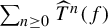 $\sum _{n\geq 0} \widehat { T}^n ({f}) $
converges in
$\sum _{n\geq 0} \widehat { T}^n ({f}) $
converges in $L^2(\widetilde m)$
. Then, we have the following CLT:
$L^2(\widetilde m)$
. Then, we have the following CLT:
 $$ \begin{align} \lim_{n\to\infty} \widetilde m\bigg(\frac{S_{n}({f})}{\sqrt{n}} \leq x\bigg) = \mathfrak{N}\bigg(\frac{x}{\sigma}\bigg)\quad\text{for all } x \in \mathbb{R} \text{ as } n\to \infty, \end{align} $$
where $\sigma ^2=\sigma ^2(f,T)$
can be written as
$\sigma ^2=\sigma ^2(f,T)$
can be written as
 $$ \begin{align*}\sigma^2 = {\mathbb{E}}_{\widetilde m}({f}^2)+ 2\sum_{k=1}^\infty {\mathbb{E}}_{\widetilde m}({f}\cdot {f}\circ { T}^k) \in [0,\infty).\end{align*} $$
Here, $\sigma = 0$
if and only if f is a T-coboundary and, in this case,
$\sigma = 0$
if and only if f is a T-coboundary and, in this case, $\mathfrak {N}(x/\sigma ):=\mathbf { 1}_{[0,\infty )}$
and
$\mathfrak {N}(x/\sigma ):=\mathbf { 1}_{[0,\infty )}$
and ${S_{n}({ f})}/{\sqrt {n}} \to \delta _0$
in distribution as
${S_{n}({ f})}/{\sqrt {n}} \to \delta _0$
in distribution as $n \to \infty $
.
$n \to \infty $
.
Proof. This follows due to Gordin [Reference Gordin12]. See [Reference Hervé and Pène16, Corollary 2.1 and Proposition 2.4] for details.
Proposition 3.2. Let $T: X\to X$
be a non-singular dynamical system with respect to a probability measure m. Suppose T has an ergodic invariant probability measure
$T: X\to X$
be a non-singular dynamical system with respect to a probability measure m. Suppose T has an ergodic invariant probability measure $\widetilde m$
absolutely continuous with respect to m and that there exist two, not necessarily distinct, Banach spaces
$\widetilde m$
absolutely continuous with respect to m and that there exist two, not necessarily distinct, Banach spaces $\mathcal {X}$
and
$\mathcal {X}$
and $\mathcal {X}^{(+)}$
such that
$\mathcal {X}^{(+)}$
such that
 $$ \begin{align} \mathcal{X}\hookrightarrow\mathcal{X}^{(+)}\hookrightarrow L^1(\pi) \end{align} $$
each containing $\mathbf {1}_X$
and satisfying the following.
$\mathbf {1}_X$
and satisfying the following.
-
(I) For all
$s \in \mathbb {R}$
,
${\widehat { T}}_{is} \in \mathcal {L}(\mathcal {X}) \cap \mathcal {L}(\mathcal {X}^{(+)}).$
-
(II) The map
$s \mapsto {\widehat { T}}_{is}\in \mathcal L(\mathcal {X},\mathcal {X}^{(+)})$
is continuous on
$\mathbb {R}.$
-
(III) Either
$\mathcal {X} = \mathcal {X}^{(+)}$
or there exist
$\kappa \in (0,1)$
and
$\delta>0$
such that for all and for all
$$ \begin{align*} z \in D_{\kappa}:=\{z \in \mathbb{C}||z|>\kappa,|z-1|>(1-\kappa)/2\}\end{align*} $$
$s \in (-\delta , \delta )$
, we have
$$ \begin{align*}(z\mathsf{Id}-{\widehat{ T}}_{is})^{-1} \in \mathcal{L}(\mathcal{X})\quad\text{and}\quad\sup_{|s|<\delta} \sup_{z \in D_\kappa} \|(z\mathsf{Id}-{\widehat{ T}}_{is})^{-1}\|_{\mathcal{X}\to \mathcal{X}}< \infty .\end{align*} $$
-
(IV)
$\lim _{n\to \infty }\|\widehat { T}^n(\cdot ) - \widetilde m(\cdot )\mathbf {1}_X\|_{\mathcal {X}_0 \to \mathcal {X}_0 } = 0.$
-
(V) The CLT, equation (3.1), holds with
$\sigma>0$
. -
(VI) For all
$s \neq 0$
, the spectrum of the operators
${\widehat { T}}_{is}$
acting on
$\mathcal {X}$
is contained in the open unit disc,
$\{z\in \mathbb {C}\ |\ |z|<1\}.$


Then, for all $U\in \mathcal {X}$
,
$U\in \mathcal {X}$
, $V: \mathbb {R} \to \mathbb {R}$
a compactly supported continuous function,
$V: \mathbb {R} \to \mathbb {R}$
a compactly supported continuous function, ${\overline {m}} \in \mathcal {M}_1(X)$
being absolutely continuous with respect to m and
${\overline {m}} \in \mathcal {M}_1(X)$
being absolutely continuous with respect to m and $W \in L^1$
such that
$W \in L^1$
such that $(W \cdot {\overline {m}} ) \in \mathcal {X}^{(+)}\,',$
we have
$(W \cdot {\overline {m}} ) \in \mathcal {X}^{(+)}\,',$
we have
 $$ \begin{align} &\lim_{n \to \infty} \sup_{\ell \in \mathbb{R} }\bigg|\sigma\sqrt{2\pi n}\,{\mathbb{E}}_{{\overline{m}}}(U \circ { T}^n \,V(S_n(\overline\chi)-\ell)\, W)\nonumber\\&\qquad\quad\qquad - e^{-{\ell^2}/{2n\sigma^2}} \,{\mathbb{E}}_{{\overline{m}}}(U)\,{\mathbb{E}}_{\widetilde m}(W)\int V(x) \, {d}x \bigg|= 0. \end{align} $$
Proof. This follows from a modified version of [Reference Hervé and Pène16, Theorem 5.1]. The condition (CLT) there is assumed here in assumption (V).
Also, the condition ( $\widetilde {K}$
) there follows from our assumptions (I)–(IV) because condition
$\widetilde {K}$
) there follows from our assumptions (I)–(IV) because condition $(K1)$
is assumption (IV), condition
$(K1)$
is assumption (IV), condition $(\widetilde {K1})$
is assumption (II), and finally, condition
$(\widetilde {K1})$
is assumption (II), and finally, condition $(\widetilde {K2})$
can be replaced by assumption (III) (see Remark 3.4).
$(\widetilde {K2})$
can be replaced by assumption (III) (see Remark 3.4).
Our assumptions (II) and (VI) yield that on any compact set $K \subset \mathbb {R}\setminus \{0\} $
, there exist
$K \subset \mathbb {R}\setminus \{0\} $
, there exist $\rho \in (0,1)$
and
$\rho \in (0,1)$
and $C_K>0$
such that
$C_K>0$
such that
 $$ \begin{align*}\sup_{s \in K} \|\widehat{ T}^n_{is}\|_{\mathcal{X} \to \mathcal{X}^+} \leq C_K \rho^n\end{align*} $$
for all $n \in \mathbb {N}$
(see, for example, [Reference Fernando and Pène11, Proposition 1.13] for a proof). This replaces the non-lattice condition
$n \in \mathbb {N}$
(see, for example, [Reference Fernando and Pène11, Proposition 1.13] for a proof). This replaces the non-lattice condition $(S)$
there.
$(S)$
there.
So, for all $U\in \mathcal {X}$
,
$U\in \mathcal {X}$
, $V: \mathbb {R} \to \mathbb {R}$
a compactly supported continuous function and
$V: \mathbb {R} \to \mathbb {R}$
a compactly supported continuous function and $W \in L^1$
such that
$W \in L^1$
such that $(W \cdot {\overline {m}}) \in \mathcal {X}^{(+)}\,',$
we have the MLCLT due to [Reference Hervé and Pène16, Theorem 5.1].
$(W \cdot {\overline {m}}) \in \mathcal {X}^{(+)}\,',$
we have the MLCLT due to [Reference Hervé and Pène16, Theorem 5.1].
Finally, we state a result that gives us sufficient conditions for the first-order Edgeworth expansion. It is adapted from [Reference Fernando and Pène11, Reference Hervé and Pène16] to our setting (compare with [Reference Hervé and Pène16, Propositions 7.1 and A.1] and [Reference Fernando and Pène11, Corollary 1.8 and Proposition 1.12]).
Proposition 3.3. Let $T: X \to X$
be a non-singular dynamical system with respect to a probability measure m. Suppose T has an ergodic invariant probability measure
$T: X \to X$
be a non-singular dynamical system with respect to a probability measure m. Suppose T has an ergodic invariant probability measure $\widetilde m$
absolutely continuous with respect to m and that there exists a sequence of, not necessarily distinct, Banach spaces
$\widetilde m$
absolutely continuous with respect to m and that there exists a sequence of, not necessarily distinct, Banach spaces
 $$ \begin{align} \mathcal{X}_0\hookrightarrow\mathcal{X}^{(+)}_0\hookrightarrow\mathcal{X}_1\hookrightarrow\mathcal{X}^{(+)}_1\hookrightarrow \mathcal{X}_{2}\hookrightarrow \mathcal{X}^{(+)}_{2} \hookrightarrow\mathcal X_{3}\hookrightarrow \mathcal{X}_{3}^{(+)} \end{align} $$
each containing $\mathbf {1}_X$
,
$\mathbf {1}_X$
,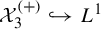 $\mathcal {X}_{3}^{(+)}\hookrightarrow L^1$
and satisfying the following.
$\mathcal {X}_{3}^{(+)}\hookrightarrow L^1$
and satisfying the following.
-
(I) For each space
$\mathcal {C}$
in equation (3.4),
$s \in \mathbb {R}$
,
${\widehat { T}}_{is} \in \mathcal {L}(\mathcal {C}).$
-
(II) For all
$a= 0,1,2,3$
, the map
$s \mapsto {\widehat { T}}_{is}\in \mathcal L(\mathcal {X}_a,\mathcal {X}_{a}^{(+)})$
is continuous on
$\mathbb {R}.$
-
(III) For all
$a= 0,1,2$
, the map
$s \mapsto {\widehat { T}}_{is}\in \mathcal L(\mathcal {X}_a^{(+)},\mathcal {X}_{a+1})$
is
$C^{1}$
on
$(-\delta ,\delta ).$
-
(IV) Either all spaces in equation (3.4) are equal, or there exist
$\kappa \in (0,1)$
and
$\delta>0$
such that for all for all
$$ \begin{align*} z \in D_{\kappa}:=\{z \in \mathbb{C}||z|>\kappa,|z-1|>(1-\kappa)/2\},\end{align*} $$
$s \in (-\delta , \delta )$
and for each space
$\mathcal {C}$
in equation (3.4),
$$ \begin{align*}(z\mathsf{Id}-{\widehat{ T}}_{is})^{-1} \in \mathcal{L}(\mathcal{C})\quad\text{and}\quad \sup_{|s|<\delta} \sup_{z \in D_\kappa} \|(z\mathsf{Id}-{\widehat{ T}}_{is})^{-1}\|_{\mathcal{C}\to \mathcal{C}}< \infty .\end{align*} $$
-
(V)
$\widehat { T}$
has a spectral gap of
$(1-\kappa )$
on each space
$\mathcal {C}$
in equation (3.4). -
(VI) For all
$s \neq 0$
, the spectrum of the operators
${\widehat { T}}_{is}$
acting on either
$\mathcal {X}_0$
or
$\mathcal {X}_0^{(+)}$
is contained in the open unit disc,
$\{z\in \mathbb {C}\ |\ |z|<1\}.$
-
(VII) The sequence
where
$$ \begin{align*}\bigg\{\sum_{k=0}^{n-1} {\overline{ f}} \circ { T}^k\bigg\}_{n \in \mathbb{N}},\end{align*} $$
$ \overline { f} := { f} - A$
has an
$L^2$
-weakly convergent subsequence.
-
(VIII) f is not T-cohomologous to a constant.





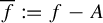

Then, for all ${\overline {m}} \in \mathcal {M}_1(X)$
being absolutely continuous with respect tp m, there exists a quadratic polynomial P whose coefficients depend on the first three asymptotic moments of
${\overline {m}} \in \mathcal {M}_1(X)$
being absolutely continuous with respect tp m, there exists a quadratic polynomial P whose coefficients depend on the first three asymptotic moments of $S_n(\chi )$
such that the following asymptotic expansion holds:
$S_n(\chi )$
such that the following asymptotic expansion holds:
 $$ \begin{align} \sup_{ x\in \mathbb{R}} \bigg|\widetilde m\bigg(\frac{S_{n}(\overline{ f})}{\sigma\sqrt{n}} \leq x\bigg) - \mathfrak{N}(x) - \frac{P(x)}{\sqrt{n}}\mathfrak{n}(x)\bigg| = o(n^{-1/2})\quad\text{as}\; n\to \infty. \end{align} $$
Remark 3.4. In [Reference Fernando and Pène11, Reference Hervé and Pène16], instead of the condition (IV) above, the following stronger condition of a uniform DFLY inequality is assumed.
Either all spaces in equation (3.4) are equal, or there exist $\widetilde C>0$
,
$\widetilde C>0$
, $\widetilde \kappa _1\in (0,1)$
and
$\widetilde \kappa _1\in (0,1)$
and $p_0 \geq 1$
such that, for every
$p_0 \geq 1$
such that, for every $\mathcal {C}$
in equation (3.4),
$\mathcal {C}$
in equation (3.4),
 $$ \begin{align} \text{ for all } h\in\mathcal{C},\quad \sup_{|s|<\delta}\Vert \widehat{ T}_{is}^nh\Vert_{\mathcal{C}}\le \widetilde C(\widetilde\kappa_1^n\Vert h\Vert_{\mathcal{C}}+\Vert h\Vert_{L^{p_0}(\bar\nu)}). \end{align} $$
However, the proof of the key theorem, [Reference Fernando and Pène11, Proposition 1.11], is based on [Reference Hervé and Pène16, Proposition A, Corollary 7.2], which use the hypothesis $\mathcal {D}(m)$
in [Reference Hervé and Pène16, Appendix A] that contains the much weaker condition (IV) instead of the condition in equation (3.6). Therefore, all the results in [Reference Fernando and Pène11] based on [Reference Fernando and Pène11, Proposition 1.11] including [Reference Fernando and Pène11, Proposition 1.12] remain true with this replacement. We refer the reader to [Reference Hervé and Pène16] for more details.
$\mathcal {D}(m)$
in [Reference Hervé and Pène16, Appendix A] that contains the much weaker condition (IV) instead of the condition in equation (3.6). Therefore, all the results in [Reference Fernando and Pène11] based on [Reference Fernando and Pène11, Proposition 1.11] including [Reference Fernando and Pène11, Proposition 1.12] remain true with this replacement. We refer the reader to [Reference Hervé and Pène16] for more details.
Remark 3.5. For an elementary illustration of the proof of the CLT based on the classical Nagaev–Guivarc’h approach, we refer the reader to [Reference Gouëzel13], where the $C^2$
regularity of
$C^2$
regularity of ${s \mapsto \widehat { T}_{is}}$
along with the spectral gap of
${s \mapsto \widehat { T}_{is}}$
along with the spectral gap of $\widehat { T}$
on a single Banach space (instead of a chain) is used. This corresponds to the
$\widehat { T}$
on a single Banach space (instead of a chain) is used. This corresponds to the $C^2$
regularity of the characteristic function in the IID case. When it comes to the MLCLT in the IID setting, a non-lattice assumption is necessary. In our case, the equivalent assumption is assumption (VI).
$C^2$
regularity of the characteristic function in the IID case. When it comes to the MLCLT in the IID setting, a non-lattice assumption is necessary. In our case, the equivalent assumption is assumption (VI).
Proof of Proposition 3.3
We apply results in [Reference Fernando and Pène11] restricted to a single dynamical system with $r=1$
there, that is, when [Reference Fernando and Pène11, §1.2, Assumptions (0) and (A)[1](1-2)]FP are trivially true. This case is, thus, similar to the
$r=1$
there, that is, when [Reference Fernando and Pène11, §1.2, Assumptions (0) and (A)[1](1-2)]FP are trivially true. This case is, thus, similar to the $r=1$
case of [Reference Fernando and Pène11, Proposition 1.12] which implies [Reference Fernando and Pène11, Corollary 1.8] which, in turn, gives the first-order Edgeworth expansion. This is because our assumptions above imply [Reference Fernando and Pène11, §1.2, Assumptions (A)[1] and (B)]FP, except for Assumption (A)[1](4) that is equivalent to equation (3.6). However, as discussed in Remark 3.4, [Reference Fernando and Pène11, Corollary 1.8] remains true because the key ingredient of the proof in [Reference Fernando and Pène11] is our assumption (IV) (implied by the much stronger Assumption (A)[1](4)).
$r=1$
case of [Reference Fernando and Pène11, Proposition 1.12] which implies [Reference Fernando and Pène11, Corollary 1.8] which, in turn, gives the first-order Edgeworth expansion. This is because our assumptions above imply [Reference Fernando and Pène11, §1.2, Assumptions (A)[1] and (B)]FP, except for Assumption (A)[1](4) that is equivalent to equation (3.6). However, as discussed in Remark 3.4, [Reference Fernando and Pène11, Corollary 1.8] remains true because the key ingredient of the proof in [Reference Fernando and Pène11] is our assumption (IV) (implied by the much stronger Assumption (A)[1](4)).
4 Twisted transfer operators
$\widehat {\psi }_{is}$

4.1 Properties of twisted transfer operators
We first prove $L^\gamma $
norm estimates for
$L^\gamma $
norm estimates for $\widehat {\psi }_{is}$
.
$\widehat {\psi }_{is}$
.
Lemma 4.1. For all $\gamma>1$
,
$\gamma>1$
, $s\in \mathbb {R}$
and
$s\in \mathbb {R}$
and $\varphi \in L^{\gamma }$
, there exists a constant
$\varphi \in L^{\gamma }$
, there exists a constant $C_{\gamma }> 1$
that depends only on
$C_{\gamma }> 1$
that depends only on $\psi $
and
$\psi $
and $\gamma $
such that
$\gamma $
such that
 $$ \begin{align*}\|\widehat{\psi}_{is} (\varphi)\|_1 \leq \|\widehat{\psi}_{is} (\varphi)\|_{\gamma} \leq C_\gamma \|\varphi\|_\gamma.\end{align*} $$
Proof. The first inequality follows from a direct application of Hölder’s inequality. The second one is a straightforward application of Minkowski’s inequality,
 $$ \begin{align*} \bigg(\int|{\widehat{\psi}}_{is}(\varphi)|^\gamma \, {d}\unicode{x3bb}_I\bigg)^{1/\gamma} &\leq \bigg(\int \widehat{\psi}(|\varphi|)^\gamma \, {d}\unicode{x3bb}_I\bigg)^{1/\gamma}\\&= \bigg(\int \bigg( \sum_{j=0}^{k-1} \frac{|\varphi|\circ \psi^{-1}_{j+1}}{|\psi'\circ \psi^{-1}_{j+1}|}\, \bigg)^{\gamma} {d}\unicode{x3bb}_I \bigg)^{1/\gamma} \\&\leq \sum_{j=0}^{k-1}\bigg( \int\bigg( \frac{|\varphi|\circ \psi^{-1}_{j+1}}{|\psi'\circ \psi^{-1}_{j+1}|}\bigg)^{\gamma}\, {d}\unicode{x3bb}_I \bigg)^{1/\gamma}\\&= \sum_{j=0}^{k-1} \bigg( \int\bigg(\frac{|\varphi|}{|\psi'|}\bigg)^{\gamma}\mathbf{1}_{[c_j,c_{j+1}]}|\psi'|\, {d}\unicode{x3bb}_I\bigg)^{1/\gamma} \\&\leq \frac{k}{\eta_{-}^{1-\gamma}}\bigg(\int |\varphi|^{\gamma}\,{d}\unicode{x3bb}_I\bigg)^{1/\gamma}. \end{align*} $$
Put $C_\gamma = k\cdot \eta _{-}^{\gamma -1}$
. Then,
$C_\gamma = k\cdot \eta _{-}^{\gamma -1}$
. Then,
 $$ \begin{align*}\|{\widehat{\psi}}_{is}(\varphi)\|_{\gamma} \leq C_\gamma \|\varphi\|_\gamma .\\[-33pt] \end{align*} $$
Next, we have the following result on the required regularity of the transfer operators.
Corollary 4.2. Let $0 \leq \alpha _0, \alpha ^{*}, \alpha ^{**},\beta \leq 1 $
and
$0 \leq \alpha _0, \alpha ^{*}, \alpha ^{**},\beta \leq 1 $
and $ \gamma _0, \gamma \geq 1$
. Put
$ \gamma _0, \gamma \geq 1$
. Put
 $$ \begin{align*} \alpha_1 &= \alpha_0+\alpha^{*} \alpha_2 =\alpha_1+\max\{\alpha^{**},\alpha^{*}\},\\ 1 &\leq \gamma_1 \leq \gamma_0 1 \leq \gamma_2 \leq (\gamma_1^{-1}+\gamma^{-1})^{-1} \end{align*} $$
and consider the chain of Banach spaces
 $$ \begin{align} {{\mathsf V}}_{ \alpha_0, \beta,\gamma_0}\hookrightarrow {{\mathsf V}}_{ \alpha_1, \beta,\gamma_1} \hookrightarrow {{\mathsf V}}_{ \alpha_2, \beta,\gamma_2}. \end{align} $$
Suppose that for all $s \in \mathbb {R}$
,
$s \in \mathbb {R}$
, $|e^{is\chi }|_{0, \beta } < \infty $
. Then:
$|e^{is\chi }|_{0, \beta } < \infty $
. Then:
-
(1) for
$s\in \mathbb {R}$
,
$\widehat {\psi }_{is}$
is a bounded linear operator on each of the Banach spaces in equation (4.1).


Suppose, in addition, that $\lim _{s \to 0}|{1-e^{is\chi }}|_{\alpha ^{*},\beta } = 0.$
Then:
$\lim _{s \to 0}|{1-e^{is\chi }}|_{\alpha ^{*},\beta } = 0.$
Then:
-
(2)
$s \mapsto \widehat {\psi }_{is}$
is continuous as a function from
$\mathbb {R}$
to
$\mathcal {L}({{\mathsf V}}_{ \alpha _0, \beta ,\gamma _0},{{\mathsf V}}_{ \alpha _1, \beta ,\gamma _1})$
.


Finally, suppose that
 $$ \begin{align*} \lim_{s \to 0}\bigg|\frac{e^{is\chi}-1-is\chi}{s}\bigg|_{\alpha^{**},\beta}=0\quad\text{and}\quad \|\chi\|_{\gamma} < \infty. \end{align*} $$
Then:
-
(3)
$s \mapsto \widehat {\psi }_{is}$
is continuously differentiable as a function from
$\mathbb {R}$
to
$\mathcal {L}({{\mathsf V}}_{ \alpha _1, \beta ,\gamma _1} , {{\mathsf V}}_{ \alpha _2, \beta ,\gamma _2})$
.


4.2 DFLY inequalities
In this section, we prove DFLY inequalities for the family $\widehat {\psi }_{is}$
. First, we state and prove two preparatory lemmas. Throughout this section, we assume that
$\widehat {\psi }_{is}$
. First, we state and prove two preparatory lemmas. Throughout this section, we assume that $\chi $
is continuous, and the right and left derivatives of
$\chi $
is continuous, and the right and left derivatives of $\chi $
exist on
$\chi $
exist on $\mathring {I}$
and that there exists a constant
$\mathring {I}$
and that there exists a constant $b>0$
such that
$b>0$
such that
 $$ \begin{align} \max\{|\chi'(x+)|, |\chi'(x-)|\}\lesssim x^{-b}(1-x)^{-b}. \end{align} $$
Lemma 4.3. Let $\alpha ,\beta \in (0,1)$
and let
$\alpha ,\beta \in (0,1)$
and let $\bar {\gamma } \in [ 1, 1/\alpha )$
. Suppose the constant
$\bar {\gamma } \in [ 1, 1/\alpha )$
. Suppose the constant $b>0$
in equation (4.2) is such that
$b>0$
in equation (4.2) is such that
 $$ \begin{align} \min\{\bar{\gamma}^{-1}+(\alpha-\beta)b,\, \bar{\gamma}^{-1}+\alpha -\beta b\}>0. \end{align} $$
Then, there exists $C_{{\varepsilon }_0}>0$
independent of
$C_{{\varepsilon }_0}>0$
independent of $\bar {\gamma }$
such that
$\bar {\gamma }$
such that
 $$ \begin{align} \sup_{{\varepsilon}\in (0,{\varepsilon}_0]}{\varepsilon}^{-\beta}\|R_{\alpha}\operatorname*{\mathrm{osc}}(e^{i s\chi}, B_{{\varepsilon}}(\cdot))\|_{\bar{\gamma}} \leq C_{{\varepsilon}_0} \end{align} $$
for all $s \in \mathbb {R}$
.
$s \in \mathbb {R}$
.
Remark 4.4. We note that if $b>1,$
then
$b>1,$
then $\bar {\gamma }^{-1}+\alpha -\beta b>0\implies \bar {\gamma }^{-1}+(\alpha -\beta )b>0$
and if
$\bar {\gamma }^{-1}+\alpha -\beta b>0\implies \bar {\gamma }^{-1}+(\alpha -\beta )b>0$
and if $b<1$
, then
$b<1$
, then $\bar {\gamma }^{-1}+(\alpha -\beta )b>0 \implies \bar {\gamma }^{-1}+\alpha -\beta b >0.$
Proof of Lemma 4.3
Since $e^{i s\chi }$
is
$e^{i s\chi }$
is $2\pi $
periodic in s, we will estimate
$2\pi $
periodic in s, we will estimate
 $$ \begin{align*}\sup_{s\in [0,2\pi]}\sup_{{\varepsilon}\in (0,{\varepsilon}_0]}{\varepsilon}^{-\beta}\|R_{\alpha}\operatorname*{\mathrm{osc}}(e^{i s\chi}, B_{{\varepsilon}}(\cdot))\|_{\bar{\gamma}} .\end{align*} $$
Note that
 $$ \begin{align*} &\sup_{{\varepsilon}\in (0,{\varepsilon}_0]}\|R_{\alpha}\operatorname*{\mathrm{osc}}(e^{i s\chi}, B_{{\varepsilon}}(\cdot))\|_{\bar{\gamma}}\cdot {\varepsilon}^{-\beta}\\ &\quad\leq \sup_{{\varepsilon}\in (0,{\varepsilon}_0]} \bigg(\int_0^{1/2} (R_{\alpha}\operatorname*{\mathrm{osc}}(e^{i s\chi}, B_{{\varepsilon}}(x)))^{\bar{\gamma}}\,{d}\unicode{x3bb}_I(x)\bigg)^{1/\bar{\gamma}}\cdot {\varepsilon}^{-\beta}\\ &\qquad+\sup_{{\varepsilon}\in (0,{\varepsilon}_0]} \bigg(\int_{1/2}^1 (R_{\alpha}\operatorname*{\mathrm{osc}}(e^{i s\chi}, B_{{\varepsilon}}(x)))^{\bar{\gamma}}\,{d}\unicode{x3bb}_I(x)\bigg)^{1/\bar{\gamma}}\cdot {\varepsilon}^{-\beta}. \end{align*} $$
We will only estimate the first summand as the estimation of the second follows analogously. Using the definition $\operatorname *{\mathrm {osc}}(h,A)=\operatorname *{\mathrm {osc}}(\Re h,A)+\operatorname *{\mathrm {osc}}(\Im h,A)$
and
$\operatorname *{\mathrm {osc}}(h,A)=\operatorname *{\mathrm {osc}}(\Re h,A)+\operatorname *{\mathrm {osc}}(\Im h,A)$
and $|e^{it_1}-e^{it_2}|\leq \min \{2,|t_1-t_2| \}$
, we note that for any measurable set A, we have
$|e^{it_1}-e^{it_2}|\leq \min \{2,|t_1-t_2| \}$
, we note that for any measurable set A, we have $\operatorname *{\mathrm {osc}}(e^{is\chi }, A)\leq \min \{4, 4s/\pi \operatorname *{\mathrm {osc}}(\chi , A)\}$
. Due to equation (4.2), there exists
$\operatorname *{\mathrm {osc}}(e^{is\chi }, A)\leq \min \{4, 4s/\pi \operatorname *{\mathrm {osc}}(\chi , A)\}$
. Due to equation (4.2), there exists $C>0$
such that for all
$C>0$
such that for all $s>0$
, for all
$s>0$
, for all ${\varepsilon }>0$
and all
${\varepsilon }>0$
and all $x\in [{\varepsilon },1/2]$
, we have
$x\in [{\varepsilon },1/2]$
, we have
 $$ \begin{align*} \operatorname*{\mathrm{osc}}(e^{i s\chi}, B_{{\varepsilon}}(x)) &\leq \frac{8|s|{\varepsilon}}{\pi}\sup_{y\in B_{{\varepsilon}}(x)}\max\{|\chi'(y+)|, |\chi'(y-)|\} \leq \frac{8C|s|{\varepsilon}}{\pi} (x-{\varepsilon})^{-b}. \end{align*} $$
We have that $8C|s|{\varepsilon } (x-{\varepsilon })^{-b} /\pi \leq 4$
if and only if
$8C|s|{\varepsilon } (x-{\varepsilon })^{-b} /\pi \leq 4$
if and only if
 $$ \begin{align*} x\geq \bigg(\frac{2C|s|{\varepsilon}}{\pi}\bigg)^{1/b}+{\varepsilon}=: K_{\varepsilon}> {\varepsilon}. \end{align*} $$
Since $K_{\varepsilon }> {\varepsilon }$
, on
$K_{\varepsilon }> {\varepsilon }$
, on $[K_{\varepsilon }, 1/2]$
, we use
$[K_{\varepsilon }, 1/2]$
, we use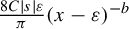 $\frac {8C|s|{\varepsilon }}{\pi } (x-{\varepsilon })^{-b}$
and on
$\frac {8C|s|{\varepsilon }}{\pi } (x-{\varepsilon })^{-b}$
and on $[0, K_{\varepsilon })$
, we use
$[0, K_{\varepsilon })$
, we use $4$
as upper bounds for
$4$
as upper bounds for $\operatorname *{\mathrm {osc}}(e^{i s\chi }, B_{{\varepsilon }}(x))$
, to obtain
$\operatorname *{\mathrm {osc}}(e^{i s\chi }, B_{{\varepsilon }}(x))$
, to obtain
 $$ \begin{align} \sup_{{\varepsilon}\in (0,{\varepsilon}_0]} \bigg(\int_0^{1/2} (R_{\alpha}\operatorname*{\mathrm{osc}}(e^{i s\chi}, B_{{\varepsilon}}(x)))^{\bar{\gamma}}\,{d}\unicode{x3bb}_I(x)\bigg)^{1/\bar{\gamma}}\cdot{\varepsilon}^{-\beta}\notag\\&\leq \sup_{{\varepsilon}\in (0,{\varepsilon}_0]} \bigg( 4{K_{\varepsilon}}\sup_{[0,K_{\varepsilon}]}R_\alpha\mathbf{1} \cdot {\varepsilon}^{-\beta}\nonumber\\&\qquad\quad\qquad+\bigg(\int_{K_{\varepsilon}}^{1/2} \bigg(\frac{8C|s|{\varepsilon}^{1-\beta}}{\pi} R_\alpha\mathbf{1} \cdot (x-{\varepsilon})^{-b}\bigg)^{\bar{\gamma}}{d}\unicode{x3bb}_{I}(x)\bigg)^{1/\bar{\gamma}}\bigg)\notag\\&\leq \sup_{{\varepsilon}\in (0,{\varepsilon}_0]} 4{K_{\varepsilon}}^{1+\alpha}{\varepsilon}^{-\beta}+\sup_{{\varepsilon}'\in (0,{\varepsilon}_0]}\frac{8C|s|{\varepsilon}^{1-\beta}}{\pi}\,\bigg(\int_{K_{\varepsilon}}^{1/2} ( x^{\alpha} (x-{\varepsilon})^{-b})^{\bar{\gamma}}{d}\unicode{x3bb}_{I}(x)\bigg)^{1/\bar{\gamma}}. \end{align} $$
For the first summand of equation (4.5), we have that there exists $\tilde C_{{\varepsilon }_0}>0$
such that
$\tilde C_{{\varepsilon }_0}>0$
such that
 $$ \begin{align*} \sup_{{\varepsilon}\in (0,{\varepsilon}_0]} 4{K_{\varepsilon}}^{1+\alpha}{\varepsilon}^{-\beta} &\leq 8\sup_{{\varepsilon}\in (0,{\varepsilon}_0]} \max\bigg\{\bigg(\frac{2C|s|}{\pi}\bigg)^{(1+\alpha)/b}{\varepsilon}^{(1+\alpha)/b-\beta},{\varepsilon}^{1+\alpha-\beta} \bigg\}\\ &\leq \tilde C_{{\varepsilon}_0}(1+|s|^{(1+\alpha)/b}) < \infty, \end{align*} $$
which follows from the fact that $\beta < (1/\bar {\gamma }+\alpha )/b < (1+\alpha )/b$
and
$\beta < (1/\bar {\gamma }+\alpha )/b < (1+\alpha )/b$
and $\beta \leq 1$
.
$\beta \leq 1$
.
For the second summand of equation (4.5), we use $\bar {\gamma } < 1/\alpha $
and
$\bar {\gamma } < 1/\alpha $
and $(x+{\varepsilon })^{\alpha \bar {\gamma }} \leq x^{\alpha \bar {\gamma }}+{\varepsilon }^{\alpha \bar {\gamma }}$
to compute
$(x+{\varepsilon })^{\alpha \bar {\gamma }} \leq x^{\alpha \bar {\gamma }}+{\varepsilon }^{\alpha \bar {\gamma }}$
to compute
 $$ \begin{align*} &\sup_{{\varepsilon}\in (0,{\varepsilon}_0]}\frac{8C|s|{\varepsilon}^{1-\beta}}{\pi}\,\bigg(\int_{K_{\varepsilon}}^{1/2} ( x^{\alpha} (x-{\varepsilon})^{-b})^{\bar{\gamma}}{d}\unicode{x3bb}_{I}(x)\bigg)^{1/\bar{\gamma}}\\&\quad\leq \frac{8C|s|}{\pi}\sup_{{\varepsilon}\in (0,{\varepsilon}_0]} {\varepsilon}^{1-\beta}\bigg(\int_{({2Cs{\varepsilon}}/{\pi})^{1/b}}^{1/2}(x+{\varepsilon})^{\alpha\bar{\gamma}} x^{-b\bar{\gamma}}{d}\unicode{x3bb}_{I}(x)\bigg)^{1/\bar{\gamma}}\\&\quad\leq \frac{8C|s|}{\pi}\sup_{{\varepsilon}\in (0,{\varepsilon}_0]} \bigg( {\varepsilon}^{1-\beta}\bigg(\int_{({2Cs{\varepsilon}}/{\pi})^{1/b}}^{1/2}x^{\bar{\gamma}(\alpha-b)}{d}\unicode{x3bb}_{I}(x)\bigg)^{1/\bar{\gamma}}\\&\qquad+{\varepsilon}^{1+\alpha-\beta}\bigg(\int_{({2Cs{\varepsilon}}/{\pi})^{1/b}}^{1/2}x^{-b\bar{\gamma}}{d}\unicode{x3bb}_{I}(x)\bigg)^{1/\bar{\gamma}}\bigg)\\&\quad\lesssim |s|\sup_{{\varepsilon}\in (0,{\varepsilon}_0]} \bigg( {\varepsilon}^{1-\beta} \max\bigg\{\frac{1}{2},\bigg(\frac{2Cs{\varepsilon}}{\pi}\bigg)^{1/b} \bigg\}^{1/\bar{\gamma}+\alpha-b}\\&\qquad+{\varepsilon}^{1+\alpha-\beta} \max\bigg\{\frac{1}{2},\bigg(\frac{2Cs{\varepsilon}}{\pi}\bigg)^{1/b} \bigg\}^{1/\bar{\gamma}-b}\bigg)\\&\quad\lesssim |s|\sup_{{\varepsilon}\in (0,{\varepsilon}_0]} (\max\{{\varepsilon}^{1-\beta},|s|^{1/(\bar{\gamma} b)+\alpha/b-1}{\varepsilon}^{1/(\bar{\gamma} b)+\alpha/b-\beta}\}\\&\qquad+\max\{{\varepsilon}^{1+\alpha-\beta},|s|^{1/(\bar{\gamma} b)-1}{\varepsilon}^{1/(\bar{\gamma} b)+\alpha-\beta}\} ) \\&\quad\leq \tilde{C}_{{\varepsilon}_0}|s|(1+|s|^{1/(\bar{\gamma} b)+\alpha/b-1}+|s|^{1/(\bar{\gamma} b)-1}) \end{align*} $$
for some constant $\tilde {C}_{{\varepsilon }_0}>0$
. This follows from the assumption that
$\tilde {C}_{{\varepsilon }_0}>0$
. This follows from the assumption that $1/(\bar {\gamma } b)+\alpha /b-\beta>0$
and
$1/(\bar {\gamma } b)+\alpha /b-\beta>0$
and $1/(\bar {\gamma } b)+\alpha -\beta>0$
.
$1/(\bar {\gamma } b)+\alpha -\beta>0$
.
Finally, combining this with the first step and using symmetry, we have that
 $$ \begin{align*} &\sup_{s\in [0,2\pi]}\sup_{{\varepsilon}\in (0,{\varepsilon}_0]}\|R_{\alpha}\operatorname*{\mathrm{osc}}(e^{i s\chi}, B_{{\varepsilon}}(\cdot))\|_{\bar{\gamma}}\cdot {\varepsilon}^{-\beta}\\&\quad\leq \tilde{C}_{{\varepsilon}_0} \sup_{s\in [0,2\pi]}(1+|s|+|s|^{1/(\bar{\gamma} b)+\alpha/b}+|s|^{1/(\bar{\gamma} b)}+|s|^{(1+\alpha)/b}) \\&\quad\leq C_{{\varepsilon}_0} \end{align*} $$
for some $C_{{\varepsilon }_0}>0$
that is independent of
$C_{{\varepsilon }_0}>0$
that is independent of $\bar {\gamma }\geq 1$
.
$\bar {\gamma }\geq 1$
.
For the following, for all $j=0, \ldots , k-1$
, let
$j=0, \ldots , k-1$
, let $ \bar R_{j+1}:[c_j,c_{j+1}] \to { \mathbb {R}}$
be given by
$ \bar R_{j+1}:[c_j,c_{j+1}] \to { \mathbb {R}}$
be given by
 $$ \begin{align*} \bar{R}_{j+1}=\frac{(R_\alpha\mathbf{1}) \circ \psi_{j+1}}{R_\alpha\mathbf{1}}\end{align*} $$
and the following lemma is independent of the choice of $\chi $
.
$\chi $
.
Lemma 4.5. $\bar R_{j+1}$
is bounded for all j. (In fact, they are
$\bar R_{j+1}$
is bounded for all j. (In fact, they are $\alpha $
-Hölder continuous. See Appendix B.) Further, let
$\alpha $
-Hölder continuous. See Appendix B.) Further, let $0<{\varepsilon }<\delta $
and
$0<{\varepsilon }<\delta $
and $\alpha \in (0,1)$
. Then, for all j, there is a constant C that is independent of
$\alpha \in (0,1)$
. Then, for all j, there is a constant C that is independent of ${\varepsilon }$
and
${\varepsilon }$
and $\delta $
such that
$\delta $
such that
 $$ \begin{align} \sup_{x \in [c_j+\delta+{\varepsilon}, c_{j+1}-\delta-{\varepsilon}]}\Big( (R_\alpha \mathbf{1})(x) \sup_{B_{{\varepsilon}}(x)}|\bar R^{\prime}_{j+1}|\Big) \leq C\cdot \delta^{\alpha-1}. \end{align} $$
Proof. First, we notice that for all j,
 $$ \begin{align} \bar R_{j+1}(x) &=\frac{\psi_{j+1}(x)^\alpha(1-\psi_{j+1}(x))^\alpha}{x^\alpha(1-x)^\alpha} \leq \max\bigg\{\frac{(\psi_{j+1}(x)-0)^\alpha}{x^\alpha}, \frac{(1-\psi_{j+1}(x))^\alpha}{(1-x)^\alpha}\bigg\}\notag\\ &\leq \max\bigg\{\frac{((x-0)\eta_+)^{\alpha}}{x^{\alpha}},\frac{((1-x)\eta_+)^{\alpha}}{(1-x)^{\alpha}}\bigg\} \leq \eta_+^\alpha, \end{align} $$
where the first inequality holds true, because at most one of the arguments in the maximum can be larger than $1$
. Hence, for all j,
$1$
. Hence, for all j, $\bar R_{j+1}$
is bounded.
$\bar R_{j+1}$
is bounded.
We know from part (1) in the proof of Lemma B.1 that $\bar {R}_{1}'$
is bounded at
$\bar {R}_{1}'$
is bounded at $0$
and
$0$
and $\bar {R}_{k-1}'$
is bounded at
$\bar {R}_{k-1}'$
is bounded at $1$
. We can infer from the representation in equation (B.2) that there exist
$1$
. We can infer from the representation in equation (B.2) that there exist $K_3',K_3>0$
such that
$K_3',K_3>0$
such that
 $$ \begin{align} |\bar{R}^{\prime}_{j+1}(x)|\leq \frac{K_3'}{(\psi_{j+1}(x) (1-\psi_{j+1}(x)))^{1-\alpha}} \leq \frac{K_3}{((x-c_j) (c_{j+1}-x))^{1-\alpha}} \end{align} $$
for all $j\in \{1,\ldots ,k-2\}$
. This can be deduced as follows: We assume we are in the interval
$j\in \{1,\ldots ,k-2\}$
. This can be deduced as follows: We assume we are in the interval $[\delta _0, 1-\delta _0]$
with
$[\delta _0, 1-\delta _0]$
with $\delta _0$
as in part (1) of the proof of Lemma B.1. Then, the subtrahend of equation (B.2) has to be bounded as it only has a pole at
$\delta _0$
as in part (1) of the proof of Lemma B.1. Then, the subtrahend of equation (B.2) has to be bounded as it only has a pole at $0$
and
$0$
and $1$
. Furthermore, considering the minuend, it is easy to notice that the factor
$1$
. Furthermore, considering the minuend, it is easy to notice that the factor $\alpha \psi _{j+1}^{\prime }(x)(1-2\psi _{j+1}(x))/(x(1-x))^{\alpha }$
has to be bounded on
$\alpha \psi _{j+1}^{\prime }(x)(1-2\psi _{j+1}(x))/(x(1-x))^{\alpha }$
has to be bounded on $[\delta _0, 1-\delta _0]$
as well. This leaves the remaining factor as in the middle term of equation (4.8).
$[\delta _0, 1-\delta _0]$
as well. This leaves the remaining factor as in the middle term of equation (4.8).
To verify the second inequality, we notice that $\psi _{j+1}(x)\in [\eta _-(x-c_j), \eta _+(x-c_j)]$
, which follows from the fact that
$\psi _{j+1}(x)\in [\eta _-(x-c_j), \eta _+(x-c_j)]$
, which follows from the fact that $\lim _{{\varepsilon }\to 0}\psi _{j+1}(c_j+{\varepsilon })=0$
and from the bound on the derivative. With a similar argumentation, using that
$\lim _{{\varepsilon }\to 0}\psi _{j+1}(c_j+{\varepsilon })=0$
and from the bound on the derivative. With a similar argumentation, using that $\lim _{{\varepsilon }\to 0}\psi _{j+1}(c_{j+1}-{\varepsilon })=1$
, we obtain
$\lim _{{\varepsilon }\to 0}\psi _{j+1}(c_{j+1}-{\varepsilon })=1$
, we obtain $1-\psi _{j+1}(x)\in [\eta _-(c_{j+1}-x), \eta _+(c_{j+1}-x)]$
.
$1-\psi _{j+1}(x)\in [\eta _-(c_{j+1}-x), \eta _+(c_{j+1}-x)]$
.
In addition, from the proof of Lemma B.1,
 $$ \begin{align*} |\bar{R}^{\prime}_{1}(x)|\leq \frac{K_3}{(c_{1}-x)^{1-\alpha}} \quad \text{and} \quad \bar{R}^{\prime}_{k}(x)\leq \frac{K_3}{(x-c_{k-1})^{1-\alpha}}. \end{align*} $$
Hence,
 $$ \begin{align} &\sup_{x \in [c_j+\delta+{\varepsilon}, c_{j+1}-\delta-{\varepsilon}]}{\Big(} (R_\alpha \mathbf{ 1})(x)\sup_{B_{{\varepsilon}}(x)}|\bar R^{\prime}_{j+1}| \Big)\nonumber\\&\quad\lesssim \begin{cases} \sup\dfrac{1}{[(x\pm \delta - c_j)(c_{j+1}-x\pm \delta)]^{1-\alpha}}, & j \notin\{ 0, k-1\},\\\sup\dfrac{1}{(c_{1}-x\pm \delta)^{1-\alpha}}, & j = 0, \\\sup\dfrac{1}{(x\pm \delta- c_{k-1})^{1-\alpha}}, & j = k-1, \end{cases} \,\\\nonumber &\quad\lesssim \delta^{\alpha-1}.\\[-37pt] \nonumber \end{align} $$
Now, we are ready to prove the main lemma.
Lemma 4.6. Let $0 \leq \alpha < \beta < \min \,\{1/2,{\vartheta }, 1/b\}$
be such that
$0 \leq \alpha < \beta < \min \,\{1/2,{\vartheta }, 1/b\}$
be such that
 $$ \begin{align*}\kappa:=\frac{\eta^{\alpha}_+}{\eta^{\beta}_-} < 1\quad \text{and}\quad \max\{|\chi'(x+)|, |\chi'(x-)|\}\lesssim x^{-b}(1-x)^{-b}. \end{align*} $$
Then, for all $1 \leq \gamma < 1/\alpha $
, there exist
$1 \leq \gamma < 1/\alpha $
, there exist $C, \widetilde {C}>0$
and
$C, \widetilde {C}>0$
and $\bar {\gamma }$
with
$\bar {\gamma }$
with $\gamma < \bar {\gamma } < 1/\alpha $
such that for all
$\gamma < \bar {\gamma } < 1/\alpha $
such that for all $s\in \mathbb {R}$
, we have that for all
$s\in \mathbb {R}$
, we have that for all $h\in {{\mathsf V}_{\alpha ,\beta ,\gamma }}$
and for all
$h\in {{\mathsf V}_{\alpha ,\beta ,\gamma }}$
and for all $n \in \mathbb {N},$
 $$ \begin{align} \Vert {\widehat{\psi}}^n_{is} h\Vert_{\alpha, \beta, \gamma} \le \widetilde{C} (\kappa^n\Vert h\Vert_{\alpha,\beta, \gamma}+ C^n\| h\|_{\bar{\gamma}}). \end{align} $$
Remark 4.7. In the linear expanding case, that is, $\eta _+=\eta _->1$
, the condition
$\eta _+=\eta _->1$
, the condition $\kappa < 1$
reduces to
$\kappa < 1$
reduces to $\beta>\alpha .$
Also, the constant C is independent of
$\beta>\alpha .$
Also, the constant C is independent of $\bar {\gamma }$
.
$\bar {\gamma }$
.
Remark 4.8. Restricting $\bar {\gamma }$
to
$\bar {\gamma }$
to $(\gamma , 1/\alpha )$
ensures that
$(\gamma , 1/\alpha )$
ensures that $h\in {{\mathsf V}_{\alpha ,\beta ,\gamma }}$
implies
$h\in {{\mathsf V}_{\alpha ,\beta ,\gamma }}$
implies $h\in L^{\bar {\gamma }}$
. To see this, observe that
$h\in L^{\bar {\gamma }}$
. To see this, observe that $|R_\alpha h| \lesssim \mathbf {1} $
, which yields that
$|R_\alpha h| \lesssim \mathbf {1} $
, which yields that $|h|^{\bar {\gamma }} \lesssim R_{-\alpha \bar {\gamma }} \mathbf {1} $
, and since
$|h|^{\bar {\gamma }} \lesssim R_{-\alpha \bar {\gamma }} \mathbf {1} $
, and since $\bar {\gamma } \alpha < 1$
,
$\bar {\gamma } \alpha < 1$
, $R_{-\alpha \bar {\gamma }} \mathbf {1}$
is integrable.
$R_{-\alpha \bar {\gamma }} \mathbf {1}$
is integrable.
Proof of Lemma 4.6
Let $s\in \mathbb {R}$
and
$s\in \mathbb {R}$
and $h \in {{\mathsf V}_{\alpha ,\beta ,\gamma }}$
be
$h \in {{\mathsf V}_{\alpha ,\beta ,\gamma }}$
be $\mathbb {R}$
-valued. We estimate
$\mathbb {R}$
-valued. We estimate $|{\widehat {\psi }}_{is} h|_{\alpha ,\beta }$
:
$|{\widehat {\psi }}_{is} h|_{\alpha ,\beta }$
:
 $$ \begin{align*} \operatorname*{\mathrm{osc}}\big(R_\alpha ({\widehat{\psi}}_{is} h), B_{\varepsilon}(x)\big) &= \operatorname*{\mathrm{osc}}\bigg( R_\alpha \sum_{j=0}^{k-1} \bigg(\frac{e^{is\chi}\cdot h }{|\psi'|} \bigg)\circ \psi^{-1}_{j+1}\mathbf{ 1}_{\psi[c_j,c_{j+1}]}, B_{\varepsilon}(x) \bigg) \\&\leq \sum_{j=0}^{k-1} \operatorname*{\mathrm{osc}}\bigg( R_\alpha \bigg(\frac{e^{is\chi}\cdot h }{|\psi'|} \bigg)\circ \psi^{-1}_{j+1} , B_{\varepsilon}(x) \bigg) \\&\leq \sum_{j=0}^{k-1} \operatorname*{\mathrm{osc}}\bigg( \frac{ R_\alpha \mathbf{1}\circ \psi_{j+1} }{ R_\alpha \mathbf{1}} \cdot R_\alpha\frac{e^{is\chi } \cdot h }{|\psi'|}, \psi^{-1}_{j+1} B_{{\varepsilon}}(x) \cap [c_j,c_{j+1}]\bigg) \\&\leq \sum_{j=0}^{k-1} \operatorname*{\mathrm{osc}}\bigg(\! \frac{ R_\alpha \mathbf{1}\circ \psi_{j+1} }{ R_\alpha \mathbf{1}} \cdot R_\alpha\frac{e^{is\chi } \cdot h }{|\psi'|}, B_{{\varepsilon}/\eta_{-}}(\psi^{-1}_{j+1}x) \cap [c_j,c_{j+1}]\!\bigg) \\&= \sum_{j=0}^{k-1} \operatorname*{\mathrm{osc}}\bigg( \bar{R}_{j+1}\cdot \frac{e^{is\chi}}{|\psi'|} \cdot R_\alpha h, D_{j+1}(x,{\varepsilon}/\eta_{-})\bigg), \end{align*} $$
where $D_{j+1}(x,{\varepsilon }):=B_{{\varepsilon }}(\psi ^{-1}_{j+1}x) \cap [c_j,c_{j+1}]$
. So, by [Reference Saussol35, Proposition 3.2 (iii)], there exists
$D_{j+1}(x,{\varepsilon }):=B_{{\varepsilon }}(\psi ^{-1}_{j+1}x) \cap [c_j,c_{j+1}]$
. So, by [Reference Saussol35, Proposition 3.2 (iii)], there exists $c>0$
such that
$c>0$
such that
 $$ \begin{align*} &\operatorname*{\mathrm{osc}}(R_\alpha ({\widehat{\psi}}_{is} h), B_{\varepsilon}(x))\\&\quad\leq \sum_{j=0}^{k-1} \operatorname*{\mathrm{osc}}( R_\alpha h, D_{j+1}(x,{\varepsilon}/\eta_{-})) \sup_{D_{j+1}(x,{\varepsilon}/\eta_{-})} \bigg|\bar{R}_{j+1}\cdot \frac{e^{is\chi}}{|\psi'|}\bigg| \\&\qquad+\sum_{j=0}^{k-1} \operatorname*{\mathrm{osc}}\bigg( \bigg|\bar{R}_{j+1}\cdot \frac{e^{is\chi}}{|\psi'|}\bigg| ,D_{j+1}(x,{\varepsilon}/\eta_{-})\bigg) \inf_{D_{j+1}(x,{\varepsilon}/\eta_{-})} |R_\alpha h|\\&\quad\leq (1+c({\varepsilon}\eta_{-}^{-1})^{\vartheta}) \sum_{j=0}^{k-1} \frac{\operatorname*{\mathrm{osc}}( R_\alpha h, B_{{\varepsilon}/\eta_{-}}(\psi^{-1}_{j+1}x))}{|\psi'|(\psi^{-1}_{j+1}x)} \sup_{D_{j+1}(x,{\varepsilon}/\eta_{-})} |\bar{R}_{j+1}| \\&\qquad+\sum_{j=0}^{k-1} \operatorname*{\mathrm{osc}}\bigg( \bigg|\bar{R}_{j+1}\cdot \frac{e^{is\chi}}{|\psi'|}\bigg|, D_{j+1}(x,{\varepsilon}/\eta_{-})\bigg) |R_\alpha h(\psi^{-1}_{j+1}x)|. \end{align*} $$
The last inequality follows from the fact that $\psi ^{-1}$
is
$\psi ^{-1}$
is $C^1$
and its derivative is uniformly
$C^1$
and its derivative is uniformly ${\vartheta }$
-Hölder.
${\vartheta }$
-Hölder.
Hence, using the upper bound in equation (4.7) and then using the definition of the transfer operator $\widehat {\psi }$
, we have
$\widehat {\psi }$
, we have
 $$ \begin{align} \operatorname*{\mathrm{osc}}(R_\alpha ({\widehat{\psi}}_{is} h), B_{\varepsilon}(x)) &\leq (1+c({\varepsilon}\eta_{-}^{-1})^{\vartheta}){\eta^{\alpha}_{+}}\widehat{\psi}(\operatorname*{\mathrm{osc}}(R_\alpha h, B_{{\varepsilon}/\eta_{-}}(\,\cdot\,)))(x) \nonumber\\&\quad+\sum_{j=0}^{k-1} |R_\alpha h(\psi^{-1}_{j+1}x)| \operatorname*{\mathrm{osc}}\bigg( \bigg|\bar{R}_{j+1}\cdot \frac{e^{is\chi}}{|\psi'|}\bigg|, D_{j+1}(x,{\varepsilon}/\eta_{-})\bigg). \end{align} $$
Taking the integral over the first term in equation (4.11) and multiplying by ${\varepsilon }^{-\beta }$
, we obtain
${\varepsilon }^{-\beta }$
, we obtain
 $$ \begin{align} {\varepsilon}^{-\beta}\int (1+c({\varepsilon}\eta_{-}^{-1})^{\vartheta}){\eta}^{ \alpha}_{+}\widehat{\psi}(\operatorname*{\mathrm{osc}}(R_\alpha h, B_{{\varepsilon}/\eta_{-}}(\,\cdot\,)))(x)\,{d}\unicode{x3bb}_I(x)\notag\\&\leq {\varepsilon}^{-\beta}(1+c({\varepsilon}\eta_{-}^{-1})^{\vartheta}){\eta}^{\alpha}_{+}\int \widehat{\psi}(\operatorname*{\mathrm{osc}}(R_\alpha h, B_{{\varepsilon} /\eta_{-}}(\,\cdot\,)))(x)\,{d}\unicode{x3bb}_I(x)\notag\\&= {\varepsilon}^{-\beta}(1+c({\varepsilon}\eta_{-}^{-1})^{\vartheta}){\eta}^{\alpha}_{+} \int \operatorname*{\mathrm{osc}}(R_\alpha h, B_{{\varepsilon}/\eta_{-}}(\,\cdot\,))(x)\,{d}\unicode{x3bb}_I(x)\notag\\&\leq(1+c({\varepsilon}\eta_{-}^{-1})^{\vartheta})\eta^{\alpha}_{+}\eta_-^{-\beta}|h|_{\alpha,\beta}\notag\\&\leq (1+c({\varepsilon}_0\eta_{-}^{-1})^{\vartheta})\kappa\|h\|_{\alpha,\beta,\gamma} \end{align} $$
for all $\gamma \geq 1$
. Next, we analyse the second term in equation (4.11). Again, by [Reference Saussol35, Proposition 3.2 (iii)], we have
$\gamma \geq 1$
. Next, we analyse the second term in equation (4.11). Again, by [Reference Saussol35, Proposition 3.2 (iii)], we have
 $$ \begin{align} &\operatorname*{\mathrm{osc}}\bigg( \bigg|\bar{R}_{j+1}\cdot \frac{e^{is\chi}}{|\psi'|}\bigg|, D_{j+1}(x,{\varepsilon}/\eta_{-})\bigg)\nonumber \\ &\quad\leq \operatorname*{\mathrm{osc}}\bigg( \frac{1}{|\psi'|}, B_{{\varepsilon}/\eta_{-}}(\psi^{-1}_{j+1}x)\bigg)\Big(\operatorname*{\mbox{ess sup}}_{B_{{\varepsilon}/\eta_{-}}(\psi^{-1}_{j+1}x)} |\Re\bar{R}_{j+1}e^{is\chi}|+ \operatorname*{\mbox{ess sup}}_{B_{{\varepsilon}/\eta_{-}}(\psi^{-1}_{j+1}x)} |\Im\bar{R}_{j+1}e^{is\chi}|\Big) \nonumber\\ &\qquad+\operatorname*{\mathrm{osc}}( \bar{R}_{j+1}e^{is\chi}, D_{j+1}(x,{\varepsilon}/\eta_{-}))\inf_{D_{j+1}(x,{\varepsilon}/\eta_{-})} \frac{1}{|\psi'|} \nonumber\\ &\quad\leq c({\varepsilon}\eta_{-}^{-1})^{\vartheta}\eta^{\alpha}_{+} \frac{1}{|\psi'|(\psi^{-1}_{j+1}x)}+(1+c({\varepsilon}\eta_{-}^{-1})^{\vartheta})\frac{\operatorname*{\mathrm{osc}}(\bar{R}_{j+1}e^{is\chi},D_{j+1}(x,{\varepsilon}/\eta_{-}))}{|\psi'|(\psi^{-1}_{j+1}x)}. \end{align} $$
Note that
 $$ \begin{align} {\varepsilon}^{-\beta}c({\varepsilon}\eta_{-}^{-1})^\eta\eta^{\alpha}_{+} \int \sum_{j=0}^{k-1} \frac{|R_\alpha h(\psi^{-1}_{j+1}x)|}{|\psi'|(\psi^{-1}_{j+1}x)}\, {d}\unicode{x3bb}_I(x) \nonumber &={\varepsilon}^{-\beta} c({\varepsilon}\eta_{-}^{-1})^{\vartheta}\eta^{\alpha}_{+} \int\widehat{\psi}(|R_\alpha h|)\, {d}\unicode{x3bb}_I(x) \\ &={\varepsilon}^{-\beta} c({\varepsilon}\eta_{-}^{-1})^{\vartheta}\eta^{\alpha}_{+} \int |R_\alpha h|\, {d}\unicode{x3bb}_I(x) \nonumber \\ &\leq K_1 {\varepsilon}^{{\vartheta} - \beta}\|R_\alpha\mathbf{ 1}\|_{\gamma_1}\|h\|_{\bar{\gamma}}, \end{align} $$
where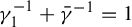 $\gamma ^{-1}_1+\bar {\gamma }^{-1}=1$
,
$\gamma ^{-1}_1+\bar {\gamma }^{-1}=1$
, $K_1:= c\eta _{-}^{-{\vartheta }}\eta ^{\alpha }_{+}\|R_\alpha \mathbf { 1}\|_{\bar {\gamma }}$
and
$K_1:= c\eta _{-}^{-{\vartheta }}\eta ^{\alpha }_{+}\|R_\alpha \mathbf { 1}\|_{\bar {\gamma }}$
and $\beta < {\vartheta }$
. So, the contribution from the first summand of equations (4.13)–(4.11) is under control.
$\beta < {\vartheta }$
. So, the contribution from the first summand of equations (4.13)–(4.11) is under control.
To estimate the contribution from the second summand of equations (4.13)–(4.11), we note that for all j and for all $A \subset [c_j,c_{j+1}]$
, we have
$A \subset [c_j,c_{j+1}]$
, we have
 $$ \begin{align*}\operatorname*{\mathrm{osc}}( \bar{R}_{j+1}e^{is\chi},A )= \operatorname*{\mathrm{osc}}\bigg( \sum_{j=0}^{k-1}\bar{R}_{j+1}e^{is\chi}\mathbf{ 1}_{[c_j,c_{j+1})},A\bigg), \end{align*} $$
and therefore, we can bound this contribution by
 $$ \begin{align} &(1+c({\varepsilon}\eta_{-}^{-1})^{\vartheta})\sum_{j=0}^{k-1} \frac{|R_\alpha h(\psi^{-1}_{j+1}x)|}{|\psi'|(\psi^{-1}_{j+1}x)}\operatorname*{\mathrm{osc}}( F,\, B_{{\varepsilon}/\eta_{-}}(\psi^{-1}_{j+1}x) )\nonumber \\ &\quad=(1+c({\varepsilon}\eta_{-}^{-1})^{\vartheta}) \widehat{\psi} (|R_\alpha h| \operatorname*{\mathrm{osc}}( F,\, B_{{\varepsilon}/\eta_{-}}(\,\cdot\,))), \end{align} $$
where
 $$ \begin{align*}F(x) = e^{is\chi(x)} \sum_{j=0}^{k-1} \bar R_{j+1}(x) \mathbf{ 1}_{[c_j,c_{j+1})}(x)=e^{is\chi(x)} \sum_{j=0}^{k-1} \frac{R_{\alpha } \mathbf{1} \circ \psi_{j+1}(x)}{R_{\alpha } \mathbf{1} (x)} \mathbf{1}_{[c_j,c_{j+1})}(x).\end{align*} $$
This is bounded by
 $$ \begin{align} & (1+c({\varepsilon}\eta_{-}^{-1})^{\vartheta}) \int \widehat{\psi} (|R_\alpha h| \operatorname*{\mathrm{osc}}( F,\, B_{{\varepsilon}/\eta_{-}}(\,\cdot\,)))(x)\, {d}\unicode{x3bb}_I(x) \nonumber \\ &\quad= (1+c({\varepsilon}\eta_{-}^{-1})^{\vartheta})\int|R_\alpha h|(x) \operatorname*{\mathrm{osc}}( F,\, B_{{\varepsilon}/\eta_{-}}(x))\, {d}\unicode{x3bb}_I(x) \nonumber\\ &\quad= (1+c({\varepsilon}\eta_{-}^{-1})^{\vartheta})\int|h (x)| \cdot (R_\alpha\operatorname*{\mathrm{osc}}( F,\, B_{{\varepsilon}/\eta_{-}}(x)))\, {d}\unicode{x3bb}_I(x). \end{align} $$
To estimate the integral, we split it as follows.
 $$ \begin{align*} &\int|h (x)| \cdot (R_\alpha\operatorname*{\mathrm{osc}}( F,\, B_{{\varepsilon}/\eta_{-}}(x)))\, {d}\unicode{x3bb}_I(x) \\ &\quad= \bigg( \sum_{ j=1}^{k-1} \int_{c_j-{\varepsilon}^\iota-{\varepsilon}}^{ c_j+{\varepsilon}^\iota+{\varepsilon}} + \sum_{ j=1}^{k} \int_{ c_{j-1}+{\varepsilon}^\iota+{\varepsilon}}^{c_{j}-{\varepsilon}-{\varepsilon}^\iota} + \int_{0}^{ {\varepsilon}+{\varepsilon}^\iota } + \int_{ 1-{\varepsilon}-{\varepsilon}^\iota}^{1}\bigg) |h (x)|\\ &\qquad\cdot (R_\alpha\operatorname*{\mathrm{osc}}( F,\, B_{{\varepsilon}/\eta_{-}}(x)))\, {d}\unicode{x3bb}_I(x), \end{align*} $$
where we choose for $\iota $
any number fulfilling
$\iota $
any number fulfilling
 $$ \begin{align} \frac{\beta}{1-\alpha}<\iota< \frac{1-\beta}{1-\alpha}. \end{align} $$
Because $\beta <1/2$
, such a choice is possible. Note that for
$\beta <1/2$
, such a choice is possible. Note that for $j=1,\ldots k-1$
,
$j=1,\ldots k-1$
, $x \in { [c_j-{\varepsilon }^\iota -{\varepsilon },c_j+{\varepsilon }^\iota +{\varepsilon }]},$
 $$ \begin{align*} \operatorname*{\mathrm{osc}}( F,\, B_{{\varepsilon}/\eta_{-}}(x)) \leq 2 (\sup \bar R_{j}+\sup \bar R_{j+1}) \leq 4K \end{align*} $$
and for $x \in { [0,{\varepsilon }+{\varepsilon }^\iota ) \cup (1-{\varepsilon }-{\varepsilon }^\iota , 1]},$
 $$ \begin{align*} \operatorname*{\mathrm{osc}}( F,\, B_{{\varepsilon}/\eta_{-}}(x)) \leq 2 (\sup \bar R_{0}+\sup \bar R_{ k})\, \leq 4K, \end{align*} $$
where $K:= \sup _j \sup R_{j+1} < \infty $
. So,
$K:= \sup _j \sup R_{j+1} < \infty $
. So,
 $$ \begin{align} &\sum_{j=0}^{k} \int_{ (c_j-{\varepsilon}^\iota-{\varepsilon}) \vee 0}^{ (c_j+{\varepsilon}^\iota+{\varepsilon}) \wedge 1 } |h (x)| \cdot (R_\alpha\operatorname*{\mathrm{osc}}( F,\, B_{{\varepsilon}/\eta_{-}}(x)))\, {d}\unicode{x3bb}_I(x) \notag\\ &\quad\leq \| h\|_{\bar{\gamma}}\sum_{j=0}^{k} \bigg(\int_{ (c_j-{\varepsilon}^\iota-{\varepsilon}) \vee 0}^{(c_j+{\varepsilon}^\iota+{\varepsilon}) \wedge 1 } (R_\alpha\operatorname*{\mathrm{osc}}( F,\, B_{{\varepsilon}/\eta_{-}}(x)))^{\gamma_1}\, {d}\unicode{x3bb}_I(x)\bigg)^{1/\gamma_1}\notag \\ &\quad\leq K_{\alpha}{\varepsilon}^{\iota/\gamma_1}\|h\|_{\bar{\gamma}}, \end{align} $$
where $\gamma ^{-1}_1+\bar {\gamma }^{-1}=1$
and
$\gamma ^{-1}_1+\bar {\gamma }^{-1}=1$
and $K_{\alpha }= 4^{\iota /\gamma _1}2^{-2\alpha }K$
. Here, we choose
$K_{\alpha }= 4^{\iota /\gamma _1}2^{-2\alpha }K$
. Here, we choose $\bar {\gamma }$
such that
$\bar {\gamma }$
such that
 $$ \begin{align} \max\bigg\{\gamma,\, \frac{\iota}{\iota-\beta},\, \frac{1}{1-b\beta+\alpha},\frac{1}{1-b(\beta-\alpha)} \bigg\}<\bar{\gamma}<\frac{1}{\alpha}. \end{align} $$
We will see later in the proof why these restrictions on $\bar {\gamma }$
are needed.
$\bar {\gamma }$
are needed.
Now, we show that such a choice is possible. Since we were assuming that $\iota>\beta /(1-\alpha )$
, we have
$\iota>\beta /(1-\alpha )$
, we have $\iota /(\iota -\beta )<1/\alpha $
. We note that when
$\iota /(\iota -\beta )<1/\alpha $
. We note that when $b \leq 1$
,
$b \leq 1$
, $1-b\beta +\alpha \geq 1-b(\beta -\alpha )$
, and it is enough to see whether
$1-b\beta +\alpha \geq 1-b(\beta -\alpha )$
, and it is enough to see whether $\alpha < 1-b(\beta -\alpha )$
. In fact, this is true because
$\alpha < 1-b(\beta -\alpha )$
. In fact, this is true because $b(\beta -\alpha )< \beta -\alpha < 1 - \alpha $
. In contrast, when
$b(\beta -\alpha )< \beta -\alpha < 1 - \alpha $
. In contrast, when $b> 1$
, we have
$b> 1$
, we have $1-b\beta +\alpha < 1-b(\beta -\alpha )$
, and it is enough to see whether
$1-b\beta +\alpha < 1-b(\beta -\alpha )$
, and it is enough to see whether $\alpha < 1-b\beta +\alpha $
. This is true because
$\alpha < 1-b\beta +\alpha $
. This is true because $\beta < 1/b$
.
$\beta < 1/b$
.
To estimate the remaining terms we note, using equation (4.7) and [Reference Saussol35, Proposition 3.2(iii)], that for all $j=0,\ldots , k-1,$
for all
$j=0,\ldots , k-1,$
for all $x \in [c_j+{\varepsilon }^\iota +{\varepsilon }, c_{j+1}-{\varepsilon }^\iota -{\varepsilon }]$
,
$x \in [c_j+{\varepsilon }^\iota +{\varepsilon }, c_{j+1}-{\varepsilon }^\iota -{\varepsilon }]$
,
 $$ \begin{align*} \operatorname*{\mathrm{osc}}( F,\, B_{{\varepsilon}/\eta_{-}}(x))\\ &= \operatorname*{\mathrm{osc}}( e^{is\chi}\bar R_{j+1},\, B_{{\varepsilon}/\eta_{-}}(x))\\ &\leq \sup_{B_{{\varepsilon}}(x)} (\Re |e^{is\chi}|+\Im |e^{is\chi}|) \operatorname*{\mathrm{osc}}(\bar R_{j+1},\, B_{{\varepsilon}/\eta_{-}}(x))\\ &\quad+ \operatorname*{\mathrm{osc}}( e^{is\chi},\, B_{{\varepsilon}/\eta_{-}}(x)) \inf_{B_{{\varepsilon}}(x)} \bar R_{j+1}\\ &\leq 2 \sup_{B_{{\varepsilon}}(x)}|\bar R^{\prime}_{j+1}|\, \frac{{\varepsilon}}{\eta_-} + \operatorname*{\mathrm{osc}}( e^{is\chi},\, B_{{\varepsilon}/\eta_{-}}(x))\, \eta_+^{\alpha}, \end{align*} $$
and thus,
 $$ \begin{align*} &\sum_{j=0}^{k-1}\int_{c_j+{\varepsilon}^\iota+{\varepsilon}}^{c_{j+1}-{\varepsilon}^\iota-{\varepsilon}} |h (x)| \cdot (R_\alpha\operatorname*{\mathrm{osc}}( F,\, B_{{\varepsilon}/\eta_{-}}(x)))\, {d}\unicode{x3bb}_I(x) \nonumber \\& \quad\leq \frac{2{\varepsilon}}{\eta_-}\bigg\||h| \sum_{j=0}^{k-1}\mathbf{ 1}_{[c_j+{\varepsilon}^\iota+{\varepsilon},c_{j+1}-{\varepsilon}^\iota-{\varepsilon}]}\bigg\|_{1} \sup_{x \in { [c_j+{\varepsilon}^\iota+{\varepsilon}, c_{j+1}-{\varepsilon}^\iota-{\varepsilon}]}}R_{\alpha}\sup_{B_{{\varepsilon}}(x)}|\bar R^{\prime}_{j+1}|\\&\qquad+\eta_+^{\alpha}\bigg\| \sum_{j=0}^{k-1}\mathbf{1}_{[c_j+{\varepsilon}^\iota+{\varepsilon}, c_{j+1}-{\varepsilon}-{\varepsilon}^\iota]}\cdot |h| (R_\alpha \operatorname*{\mathrm{osc}}( e^{is\chi},\, B_{{\varepsilon}/\eta_{-}}(\cdot)))\bigg\|_{1}\\&\quad\leq \frac{2{\varepsilon}}{\eta_-}\|h\|_{1} \sup_{x \in { [c_j+{\varepsilon}^\iota+{\varepsilon}, c_{j+1}-{\varepsilon}^\iota-{\varepsilon}]}}R_{\alpha}\sup_{B_{{\varepsilon}}(x)}|\bar R^{\prime}_{j+1}|+\eta_+^{\alpha}\|h\|_{\bar{\gamma}}\|R_\alpha \operatorname*{\mathrm{osc}}( e^{is\chi},\, B_{{\varepsilon}/\eta_{-}}(\cdot))\|_{\bar{\gamma}}. \end{align*} $$
Now, to estimate the first summand taking the maximum over j of the supremum in equation (4.6) above with $\delta ={\varepsilon }^\iota $
yields that the outer supremum above is bounded by
$\delta ={\varepsilon }^\iota $
yields that the outer supremum above is bounded by $C{\varepsilon }^{\iota (\alpha -1)}$
for some constant
$C{\varepsilon }^{\iota (\alpha -1)}$
for some constant $C>0$
. For the second summand, from equation (4.19), we have that
$C>0$
. For the second summand, from equation (4.19), we have that ${\bar {\gamma }}^{-1} < 1 - b\beta +\alpha $
, which implies that
${\bar {\gamma }}^{-1} < 1 - b\beta +\alpha $
, which implies that $b\beta < 1- {\bar {\gamma }}^{-1}+\alpha = \bar {\gamma }^{-1}+\alpha $
, and hence, when
$b\beta < 1- {\bar {\gamma }}^{-1}+\alpha = \bar {\gamma }^{-1}+\alpha $
, and hence, when $b>1$
, we have the condition in equation (4.3). Also from equation (4.19),
$b>1$
, we have the condition in equation (4.3). Also from equation (4.19), ${\bar {\gamma }}^{-1} < 1 - b(\beta -\alpha )$
, which implies that
${\bar {\gamma }}^{-1} < 1 - b(\beta -\alpha )$
, which implies that $b\beta < \bar {\gamma }^{-1}+b\alpha $
, and hence, when
$b\beta < \bar {\gamma }^{-1}+b\alpha $
, and hence, when $b \leq 1$
, we have equation (4.3). Therefore, we can apply Lemma 4.3 with
$b \leq 1$
, we have equation (4.3). Therefore, we can apply Lemma 4.3 with $\alpha $
,
$\alpha $
, $\beta $
, b,
$\beta $
, b, $\bar {\gamma }$
,
$\bar {\gamma }$
, ${\varepsilon }/\eta _{-}$
to conclude
${\varepsilon }/\eta _{-}$
to conclude
 $$ \begin{align*}\|R_\alpha \operatorname*{\mathrm{osc}}( e^{is\chi},\, B_{{\varepsilon}/\eta_{-}}(\cdot))\|_{\bar{\gamma}} \leq C_{{\varepsilon}_0} {\varepsilon}^\beta \eta^{-\beta}_{-},\end{align*} $$
where $C_{{\varepsilon }_0}$
is independent of
$C_{{\varepsilon }_0}$
is independent of $\bar {\gamma }$
. Therefore, for all
$\bar {\gamma }$
. Therefore, for all $s \neq 0$
,
$s \neq 0$
,
 $$ \begin{align} &\sum_{j=0}^{k-1} \int_{ c_j+{\varepsilon}^\iota+{\varepsilon}}^{ c_{j+1}-{\varepsilon}^\iota-{\varepsilon}} |h (x)| \cdot ({ R_{\alpha}}\operatorname*{\mathrm{osc}}( F,\, B_{{\varepsilon}/\eta_{-}}(x)))\, {d}\unicode{x3bb}_I(x)\notag\\ &\quad\leq \bar C_{{\varepsilon}_0} {\varepsilon}^{\min\{1-\iota(1-\alpha), \beta\}}\|h\|_{\bar{\gamma}}. \end{align} $$
Finally, combining equations (4.18) and (4.20), we estimate equation (4.16) multiplied by ${\varepsilon }^{-\beta }$
by
${\varepsilon }^{-\beta }$
by
 $$ \begin{align} &{\varepsilon}^{-\beta}(1+c({\varepsilon}\eta_{-}^{-1})^{\vartheta}) \int \widehat{\psi} (|R_\alpha h| \operatorname*{\mathrm{osc}}( F,\, B_{{\varepsilon}/\eta_{-}}(\,\cdot\,)))(x)\, {d}\unicode{x3bb}_I(x) \nonumber\\ &\quad\leq {\varepsilon}^{ (\iota /\bar{\gamma}\wedge (1-\iota (1-\alpha))\wedge \beta)-\beta}C_{{\varepsilon}_0} \|h\|_{\bar{\gamma}} \leq C_{{\varepsilon}_0} \|h\|_{\bar{\gamma}}. \end{align} $$
To justify the last inequality, we analyse the exponent of ${\varepsilon }$
. By equation (4.19) and the relation
${\varepsilon }$
. By equation (4.19) and the relation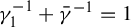 $\gamma _1^{-1}+\bar {\gamma }^{-1}=1$
, we have
$\gamma _1^{-1}+\bar {\gamma }^{-1}=1$
, we have $\iota /\gamma _1>\iota (1-{\bar {\gamma }}^{-1})>\iota (1-(\iota -\beta )/\iota ))=\beta $
. Furthermore, the second inequality of equation (4.17) implies that
$\iota /\gamma _1>\iota (1-{\bar {\gamma }}^{-1})>\iota (1-(\iota -\beta )/\iota ))=\beta $
. Furthermore, the second inequality of equation (4.17) implies that $1-\iota (1-\alpha )>\beta $
.
$1-\iota (1-\alpha )>\beta $
.
Combining equations (4.11), (4.12), (4.14) and (4.21), we have
 $$ \begin{align*} | {\widehat{\psi}}_{is} h|_{\alpha, \beta}&=\sup_{{\varepsilon}\in (0,{\varepsilon}_0)}\int \frac{\operatorname*{\mathrm{osc}}(R_\alpha ({\widehat{\psi}}_{is} h), B_{\varepsilon}(x))}{{\varepsilon}^{\beta}}\,{d}\unicode{x3bb}_I(x)\\ &\leq (1+c({\varepsilon}_0\eta_{-}^{-1})^{\vartheta})\kappa\|h\|_{\alpha,\beta,\gamma}+C_{{\varepsilon}_0}\|h\|_{\bar{\gamma}} \end{align*} $$
for all $\gamma \geq 1$
. Therefore, for all
$\gamma \geq 1$
. Therefore, for all $\bar {\gamma }$
chosen appropriately,
$\bar {\gamma }$
chosen appropriately,
 $$ \begin{align*} \| {\widehat{\psi}}_{is} h\|_{\alpha, \beta, \gamma} &= | {\widehat{\psi}}_{is} h|_{\alpha,\beta} + \|{\widehat{\psi}}_{is} h\|_{\gamma}\\ &\leq (1+c({\varepsilon}_0\eta_{-}^{-1})^{\vartheta})\kappa\|h\|_{\alpha,\beta,\gamma}+C_{{\varepsilon}_0}{\|h\|_{\bar{\gamma}}}+ C_\gamma \|h\|_\gamma\, \\ &\leq \bar\kappa\|h\|_{\alpha,\beta,\gamma}\bar C \|h\|_{\bar{\gamma}}, \end{align*} $$
where $\bar \kappa = (1+c({\varepsilon }_0\eta _{-}^{-1})^\eta )\kappa < 1$
for sufficiently small
$\bar \kappa = (1+c({\varepsilon }_0\eta _{-}^{-1})^\eta )\kappa < 1$
for sufficiently small ${\varepsilon }_0$
, and
${\varepsilon }_0$
, and $\bar C=C_{{\varepsilon }_0}+C_{\gamma }$
, where
$\bar C=C_{{\varepsilon }_0}+C_{\gamma }$
, where $C_{\gamma }$
is given in Lemma 4.1.
$C_{\gamma }$
is given in Lemma 4.1.
Iterating, we obtain the following DFLY inequality: for all $h\in {{\mathsf V}_{\alpha ,\beta ,\gamma }}$
,
$h\in {{\mathsf V}_{\alpha ,\beta ,\gamma }}$
,
 $$ \begin{align*} \sup_{s}\Vert {\widehat{\psi}}^n_{is} h\Vert_{\alpha,\beta,\gamma} &\leq \kappa\Vert {\widehat{\psi}}^{n-1}_{is}h\Vert_{\alpha,\beta,\gamma}+\bar C\| {\widehat{\psi}}^{n-1}_{is}h\|_{\bar{\gamma}}\,\\ &\leq \kappa^2\Vert {\widehat{\psi}}^{n-2}_{is}h\Vert_{\alpha,\beta,\gamma}+ \kappa \bar C\|{\widehat{\psi}}^{n-2}_{is}h\|_{\bar{\gamma}}+\bar C \bar C^{n-1}\| h\|_{\bar{\gamma}}\,\\ &\leq \kappa^n\Vert h\Vert_{\alpha,\beta,\gamma}+ \bar C \|h\|_{\bar{\gamma}} \sum_{j=0}^{n-1} \kappa^j \bar C^{n-1-j}\,\\ &\leq \kappa^n\Vert h\Vert_{\alpha,\beta,\gamma}+ C \bar C^{n+1} \|h\|_{\bar{\gamma}}\, \end{align*} $$
for some $C>0$
.
$C>0$
.
In the proof above, we assumed that h is $\mathbb {R}$
-valued. When
$\mathbb {R}$
-valued. When $h=h_1+ih_2$
, where
$h=h_1+ih_2$
, where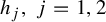 $h_j,\, j=1,2$
are
$h_j,\, j=1,2$
are $\mathbb {R}$
-valued, using linearity of the operator
$\mathbb {R}$
-valued, using linearity of the operator
 $$ \begin{align*}\|{\widehat{\psi}}_{is}^n h\|_{\alpha,\beta,\gamma} \leq \|{\widehat{\psi}^n}_{is} h_1\|_{\alpha,\beta,\gamma}+ \|{\widehat{\psi}^n}_{is} h_2\|_{\alpha,\beta,\gamma},\end{align*} $$
and also, $\| h_j\|_{\alpha ,\beta ,\gamma } \leq \| h\|_{\alpha ,\beta ,\gamma }$
and
$\| h_j\|_{\alpha ,\beta ,\gamma } \leq \| h\|_{\alpha ,\beta ,\gamma }$
and $\|h_j\|_{\bar {\gamma }} \leq \|h\|_{\bar {\gamma }}$
for all
$\|h_j\|_{\bar {\gamma }} \leq \|h\|_{\bar {\gamma }}$
for all $j=1,2$
. So, applying the DLFY inequality proven above in the
$j=1,2$
. So, applying the DLFY inequality proven above in the $\mathbb {R}$
-valued case to
$\mathbb {R}$
-valued case to $h_1$
and
$h_1$
and $h_2$
, we conclude that DFLY in the general case of h holds up to a constant multiple.
$h_2$
, we conclude that DFLY in the general case of h holds up to a constant multiple.
5 Proofs of the main theorems
Finally, we give the proofs of our main theorems. We start with the theorems from §2.4.
5.1 Proofs of limit theorems for expanding interval maps
Proof of Theorem 2.5
From equation (2.7), we obtain that there exist $\alpha , \beta $
fulfilling
$\alpha , \beta $
fulfilling
 $$ \begin{align} a&< \alpha < \beta \cdot \min\bigg\{1,\frac{\log\eta_-}{\log \eta_+}\bigg\}< \min\bigg\{\vartheta,\frac{1}{b},\frac{1}{2}\bigg\}\cdot \min\bigg\{1,\frac{\log\eta_-}{\log \eta_+}\bigg\}. \end{align} $$
Furthermore, since $\alpha>a$
, the inequality
$\alpha>a$
, the inequality $\beta <1/b$
, which we can deduce immediately from equation (5.1) that
$\beta <1/b$
, which we can deduce immediately from equation (5.1) that ${1}/{b}<{1}/({b-a})$
. So, by Lemma A.18, we obtain
${1}/{b}<{1}/({b-a})$
. So, by Lemma A.18, we obtain $|\chi |_{\alpha ,\beta }<\infty $
and also
$|\chi |_{\alpha ,\beta }<\infty $
and also $\chi \in {{\mathsf V}}_{\alpha ,\beta ,2} \hookrightarrow L^2$
. Furthermore, from the second inequality of equation (5.1), we obtain
$\chi \in {{\mathsf V}}_{\alpha ,\beta ,2} \hookrightarrow L^2$
. Furthermore, from the second inequality of equation (5.1), we obtain $\eta _+^{\alpha }/\eta _-^{\beta }< 1$
.
$\eta _+^{\alpha }/\eta _-^{\beta }< 1$
.
Since $\psi $
is a piecewise
$\psi $
is a piecewise $C^2$
uniformly expanding and covering map of the interval, it has a unique absolutely continuous invariant mixing probability (acip) with a bounded invariant density; see [Reference Liverani27]. Let us call this acip
$C^2$
uniformly expanding and covering map of the interval, it has a unique absolutely continuous invariant mixing probability (acip) with a bounded invariant density; see [Reference Liverani27]. Let us call this acip $\pi $
. Then,
$\pi $
. Then,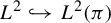 $L^2 \hookrightarrow L^2(\pi )$
because
$L^2 \hookrightarrow L^2(\pi )$
because
 $$ \begin{align*} \int |h|^2\, {d}\pi = \int |h|^2 \frac{{d}\pi}{{d}\unicode{x3bb}_I} \, {d}\unicode{x3bb}_I \leq \bigg\|\frac{{d}\pi}{{d}\unicode{x3bb}_I}\bigg\|_{\infty} \int |h|^2\, {d}\unicode{x3bb}_I.\end{align*} $$
We claim that $\widehat {\psi }$
has a spectral gap in
$\widehat {\psi }$
has a spectral gap in ${{\mathsf V}_{\alpha ,\beta ,\gamma }}$
with
${{\mathsf V}_{\alpha ,\beta ,\gamma }}$
with $\gamma =2$
. In Appendix A.2, we show that
$\gamma =2$
. In Appendix A.2, we show that ${{\mathsf V}}_{\alpha ,\beta ,2}$
is continuously embedded in
${{\mathsf V}}_{\alpha ,\beta ,2}$
is continuously embedded in $L^{\bar \gamma }$
, where
$L^{\bar \gamma }$
, where $\bar {\gamma } \in (2, 1/\alpha )$
, and that the unit ball of
$\bar {\gamma } \in (2, 1/\alpha )$
, and that the unit ball of ${{\mathsf V}}_{\alpha ,\beta ,2}$
is relatively compact in
${{\mathsf V}}_{\alpha ,\beta ,2}$
is relatively compact in $L^{\bar {\gamma }}$
. A suitable
$L^{\bar {\gamma }}$
. A suitable $\bar {\gamma }$
exists by the condition
$\bar {\gamma }$
exists by the condition $\alpha <1/2$
from equation (5.1). So, the claim follows from [Reference Demers, Kiamari and Liverani7, Lemma B.15] due to the DFLY inequality in equation (4.10) with
$\alpha <1/2$
from equation (5.1). So, the claim follows from [Reference Demers, Kiamari and Liverani7, Lemma B.15] due to the DFLY inequality in equation (4.10) with $s=0$
and Remark A.9.
$s=0$
and Remark A.9.
Now, the CLT (in the stationary case) follows directly from Proposition 3.1 applied to $\chi - \pi (\chi )$
. That is, from equation (3.1), we have
$\chi - \pi (\chi )$
. That is, from equation (3.1), we have
 $$ \begin{align*} {\mathbb{P}}_{\pi}\bigg(\frac{S_{n}(\chi) - n\, \pi(\chi)}{\sigma\sqrt{n}} \leq x\bigg) - \mathfrak{N}(x) = o(1)\quad\text{as}\; n\to \infty \end{align*} $$
with $\sigma ^2>0$
because
$\sigma ^2>0$
because $\chi $
is not a coboundary.
$\chi $
is not a coboundary.
Next, we will continue with the proof of Theorem 2.8 as the proof of Theorem 2.6 will need similar methods to those of Theorem 2.8.
Proof of Theorem 2.8
Equation (2.10) implies that there exist $\alpha , \beta $
such that
$\alpha , \beta $
such that $\alpha>a$
and
$\alpha>a$
and
 $$ \begin{align*} 3\bar{\alpha}:&=3\min\{2\alpha, \max\{\alpha,\alpha+b-2\}\}\\ &<\beta\cdot\min\bigg\{1,\frac{\log\eta_+}{\log \eta_-}\bigg\}< \min\bigg\{\vartheta, \frac{1}{b},\frac{1}{2}\bigg\}\cdot\min\bigg\{1,\frac{\log\eta_+}{\log \eta_-}\bigg\}. \end{align*} $$
Since either $b<a+1$
or
$b<a+1$
or $1/b<(1+\alpha -a)/(b-a)$
, we obtain by Lemma A.18 that
$1/b<(1+\alpha -a)/(b-a)$
, we obtain by Lemma A.18 that $|\chi |_{\alpha ,\beta }<\infty $
and additionally, we obtain by the last inequality that:
$|\chi |_{\alpha ,\beta }<\infty $
and additionally, we obtain by the last inequality that:
-
(a)
$0< 3\bar \alpha < \beta < \min \{{\vartheta },1/b, 1/2\};$
-
(b)
$\eta _+^{3\bar \alpha }<\eta _-^{\beta }$
.


Hence, under our assumptions, we have the following.
-
(1) The second inequality in equation (2.6) and
$|\chi |_{\alpha , \beta } < \infty $
imply that
$|e^{is\chi }|_{0,\beta }<\infty $
for all
$s>0$
(see Remark A.13). So, due to Corollary 4.2(1), we have
$\widehat {\psi }_{is} \in \mathcal {L}({{\mathsf V}}_{\tilde {\alpha },\beta ,\tilde {\gamma }})$
for all
$0<\tilde {\alpha }< \beta $
and
$\tilde {\gamma } \geq 1$
. -
(2) Since
$|\chi |_{\alpha ,\beta }<\infty $
, from Remark A.15, for all
$\alpha ^{*}>0\,$
close to
$0$
, Along with Corollary 4.2(2), this yields that for all
$$ \begin{align*}\lim_{s\to 0}|1-e^{is\chi}|_{\alpha^{*},\beta}=0.\end{align*} $$
$0 \leq \alpha _0 < \beta $
,
$\gamma _0 \geq 1$
, is continuous for
$$ \begin{align*}s \mapsto \widehat{\psi}_{is} \in \mathcal{L}({{\mathsf V}}_{\alpha_0,\beta,\gamma_0}, {{\mathsf V}}_{\alpha_1,\beta,\gamma_1})\end{align*} $$
$\alpha _1=\alpha ^{*}+\alpha _0$
and
$1 \leq \gamma _1\leq \gamma _0.$
-
(3) From the second inequality in equation (2.6) and
$|\chi |_{\alpha , \beta } < \infty $
, for all
$\alpha ^{**}>\min \{2\alpha , \max \{\alpha +b-2,\alpha \}\},$
due to Remark A.17. Then, we have that for all
$$ \begin{align*}\lim_{s\to 0}\bigg|\frac{e^{is\chi}-1-is\chi}{s}\bigg|_{\alpha^{**}, \beta}=0\,\end{align*} $$
$0 \leq \alpha _1 <\beta $
and
$\gamma _1 \geq 1,$
is continuously differentiable for all
$$ \begin{align*}s \mapsto \widehat{\psi}_{is} \in \mathcal{L}({{\mathsf V}}_{\alpha_1,\beta, \gamma_1},{{\mathsf V}}_{\alpha_2,\beta,\gamma_2} )\end{align*} $$
${\alpha _2 = \alpha ^{*}+\max \{\alpha ^{*},\alpha ^{**}\}+\alpha _1}$
and
$1 \leq \gamma _2 \leq (\gamma ^{-1}_1+\gamma ^{-1})^{-1}$
due to Corollary 4.2(2) and (3).


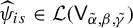



Next, we define the following chain of spaces to invoke Proposition 3.3 with $r=1$
:
$r=1$
:
 $$ \begin{align*} {{\mathsf V}}_{\alpha_0,\beta,\gamma_0 } &\hookrightarrow {{\mathsf V}}_{\alpha_1,\beta,\gamma_1} \hookrightarrow {{\mathsf V}}_{\alpha_2,\beta,\gamma_2} \hookrightarrow {{\mathsf V}}_{\alpha_3,\beta,\gamma_3} \hookrightarrow {{\mathsf V}}_{\alpha_4,\beta,\gamma_4}\\ &\quad\hookrightarrow{{\mathsf V}}_{\alpha_5,\beta,\gamma_5} \hookrightarrow{{\mathsf V}}_{\alpha_6,\beta,\gamma_6}\hookrightarrow{{\mathsf V}}_{\alpha_7,\beta,\gamma_7}, \end{align*} $$
where $\alpha _0=0$
,
$\alpha _0=0$
, $\alpha _{2j} - \alpha _{2j-1}\geq \min \{2\alpha , \max \{\alpha + b - 2, \alpha \}\}$
for
$\alpha _{2j} - \alpha _{2j-1}\geq \min \{2\alpha , \max \{\alpha + b - 2, \alpha \}\}$
for $j=1,2,3$
,
$j=1,2,3$
, $\alpha _{2j+1}> \alpha _{2j}$
for
$\alpha _{2j+1}> \alpha _{2j}$
for $j=0,1,2,3$
, and
$j=0,1,2,3$
, and $\alpha _7<\beta $
. By assumption (a), such a choice is possible. Furthermore, we assume that the
$\alpha _7<\beta $
. By assumption (a), such a choice is possible. Furthermore, we assume that the $\gamma _j$
values are chosen such that
$\gamma _j$
values are chosen such that $\gamma _0= M \gg 1$
sufficiently large,
$\gamma _0= M \gg 1$
sufficiently large, ${\gamma _{2j+1} = \gamma _{2j}}$
and
${\gamma _{2j+1} = \gamma _{2j}}$
and $\gamma _{2j}< (\alpha ^{-1}+\gamma _{2j-1}^{-1})^{-1}$
.
$\gamma _{2j}< (\alpha ^{-1}+\gamma _{2j-1}^{-1})^{-1}$
.
Now, to prove the theorem, we verify the conditions in Proposition 3.3 for the above sequence of Banach spaces. We notice that if for some observable $\varphi $
it holds that
$\varphi $
it holds that ${|\varphi |_{\alpha ,\beta }<\infty }$
, then
${|\varphi |_{\alpha ,\beta }<\infty }$
, then $\|\varphi \|_{\alpha ,\beta ,\gamma }<\infty $
as long as
$\|\varphi \|_{\alpha ,\beta ,\gamma }<\infty $
as long as $\gamma < 1/\alpha $
. We next verify that it is possible to construct valid spaces with the above choice of parameters. First, we notice that by assumption (a), it is possible to construct
$\gamma < 1/\alpha $
. We next verify that it is possible to construct valid spaces with the above choice of parameters. First, we notice that by assumption (a), it is possible to construct $\alpha _0\leq \cdots \leq \alpha _7$
with the above properties that
$\alpha _0\leq \cdots \leq \alpha _7$
with the above properties that $\alpha _7<\beta $
and thus
$\alpha _7<\beta $
and thus $\alpha _j<\beta $
for all j. Furthermore, by assumption (a), we have
$\alpha _j<\beta $
for all j. Furthermore, by assumption (a), we have $\alpha <1/3$
. Thus, it is possible that
$\alpha <1/3$
. Thus, it is possible that $1 \leq \gamma _{2j} \leq (\gamma ^{-1} + \gamma ^{-1}_{2j-1})$
holds together with
$1 \leq \gamma _{2j} \leq (\gamma ^{-1} + \gamma ^{-1}_{2j-1})$
holds together with $1/\gamma _j>\alpha _j$
. Moreover, under assumption (b), we have that
$1/\gamma _j>\alpha _j$
. Moreover, under assumption (b), we have that $\eta _+^{\alpha _j}/\eta _-^{\beta }<1$
holds for all j.
$\eta _+^{\alpha _j}/\eta _-^{\beta }<1$
holds for all j.
With that, it becomes immediate from applying the conditions of this theorem on the parameters in the Banach spaces and from the calculations in parts (1)–(3) applied to all indices j that conditions (I)–(III) of Proposition 3.3 are satisfied.
For each j, we apply Lemma 4.6 with $\gamma =\gamma _j$
and we choose
$\gamma =\gamma _j$
and we choose $\bar {\gamma } = \bar {\gamma }_j$
as in the proof of the lemma. In Appendix A.2, we show that
$\bar {\gamma } = \bar {\gamma }_j$
as in the proof of the lemma. In Appendix A.2, we show that ${{\mathsf V}}_{\alpha _j,\beta ,\gamma _j}$
is continuously embedded in
${{\mathsf V}}_{\alpha _j,\beta ,\gamma _j}$
is continuously embedded in $L^{\bar {\gamma }_j}$
and that the unit ball of
$L^{\bar {\gamma }_j}$
and that the unit ball of ${{\mathsf V}}_{\alpha _j,\beta ,\gamma _j}$
is relatively compact in
${{\mathsf V}}_{\alpha _j,\beta ,\gamma _j}$
is relatively compact in $L^{\bar {\gamma }_j}$
. Also, we recall from Lemma 4.1 that for all
$L^{\bar {\gamma }_j}$
. Also, we recall from Lemma 4.1 that for all $h \in L^{\bar {\gamma }_j}$
,
$h \in L^{\bar {\gamma }_j}$
, $\|\widehat {\psi }_{is} (h)\|_{\bar {\gamma }_j} \leq C_{\bar {\gamma }_j} \|h\|_{\bar {\gamma }_j}$
, where
$\|\widehat {\psi }_{is} (h)\|_{\bar {\gamma }_j} \leq C_{\bar {\gamma }_j} \|h\|_{\bar {\gamma }_j}$
, where $ C_{\bar {\gamma }_j}>1$
. Therefore,
$ C_{\bar {\gamma }_j}>1$
. Therefore, $\|\widehat {\psi }^n_{is} (h)\|_{\bar {\gamma }_j} \leq C_{\bar {\gamma }_j} \|\widehat {\psi }^{n-1}_{is} (h)\| \leq C_{\bar {\gamma }_j}^n \|h\|_{\bar {\gamma }_j}$
, which gives us
$\|\widehat {\psi }^n_{is} (h)\|_{\bar {\gamma }_j} \leq C_{\bar {\gamma }_j} \|\widehat {\psi }^{n-1}_{is} (h)\| \leq C_{\bar {\gamma }_j}^n \|h\|_{\bar {\gamma }_j}$
, which gives us $\|\widehat {\psi }^n_{is}\|_{L^{\bar {\gamma }_j} \to L^{\bar {\gamma }_j}} \leq C_{\bar {\gamma }_j}^n.$
Choose
$\|\widehat {\psi }^n_{is}\|_{L^{\bar {\gamma }_j} \to L^{\bar {\gamma }_j}} \leq C_{\bar {\gamma }_j}^n.$
Choose $\kappa = \max \limits _{0 \leq j \leq 7} \eta ^{\alpha _j}_+ \eta ^{-\beta }_{-} <1$
. Also, by our previous constructions, we have that
$\kappa = \max \limits _{0 \leq j \leq 7} \eta ^{\alpha _j}_+ \eta ^{-\beta }_{-} <1$
. Also, by our previous constructions, we have that $\gamma _j < 1/\alpha _j$
for all j. So, due to Lemma 4.6, we have the DFLY inequality: for all
$\gamma _j < 1/\alpha _j$
for all j. So, due to Lemma 4.6, we have the DFLY inequality: for all $h\in {{\mathsf V}}_{\alpha _j,\beta ,\gamma _j}$
,
$h\in {{\mathsf V}}_{\alpha _j,\beta ,\gamma _j}$
,
 $$ \begin{align*}\Vert {\widehat{\psi}^n}_{is} h\Vert_{\alpha_j,\beta,\gamma_j} \le \widetilde C (\kappa^n\Vert h\Vert_{\alpha_j,\beta,\gamma_j}+C^n\| h\|_{\bar{\gamma}_j})\, \end{align*} $$
for some $\gamma _j< \bar {\gamma }_j < 1/\alpha _j$
and C uniform in j and s. Therefore, we have the first conclusion, [Reference Keller and Liverani22, Theorem 1, equation (8)] uniformly over all spaces. That is, there exist v and w such that
$\gamma _j< \bar {\gamma }_j < 1/\alpha _j$
and C uniform in j and s. Therefore, we have the first conclusion, [Reference Keller and Liverani22, Theorem 1, equation (8)] uniformly over all spaces. That is, there exist v and w such that
 $$ \begin{align*}\sup_{z \in D_{\kappa}}\|(z\mathsf{Id} - \widehat{\psi}_{is})^{-1} h\|_{{{\mathsf V}}_{\alpha_j,\beta,\gamma_j} \to {{\mathsf V}}_{\alpha_j,\beta,\gamma_j}} \leq v\|h\|_{\alpha_j,\beta, \gamma_j} + w\|h\|_{\bar{\gamma}_j}\end{align*} $$
for all space pairs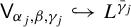 ${{\mathsf V}}_{\alpha _j,\beta ,\gamma _j} \hookrightarrow L^{\bar {\gamma }_j}$
and
${{\mathsf V}}_{\alpha _j,\beta ,\gamma _j} \hookrightarrow L^{\bar {\gamma }_j}$
and $s \in \mathbb {R}$
. This gives condition (IV) of Proposition 3.3.
$s \in \mathbb {R}$
. This gives condition (IV) of Proposition 3.3.
Conditions (V)–(VII) of Proposition 3.3 are equivalent to [Reference Fernando and Pène11, §I.1.2, Assumption (B)] for a single dynamical system, that is, when [Reference Fernando and Pène11, §I.1.2, Assumptions (0) and (A)(1)] are trivially true. Moreover, as discussed in [Reference Fernando and Pène11], [Reference Fernando and Pène11, Lemma 4.5] implies Assumption (B). Therefore, we verify the conditions (with a slight modification) in [Reference Fernando and Pène11, Lemma 4.5] to establish conditions (V)–(VII).
-
• We have assumed that
$\chi $
is non-arithmetic. -
• Due to Remark A.9 and the DFLY inequality in equation (4.10), we can apply [Reference Demers, Kiamari and Liverani7, Lemma B.15] to conclude that for all s, the essential spectral radius of
$\widehat {\psi }_{is}$
on
${{\mathsf V}}_{\alpha _j,\beta ,\gamma _j}$
is at most
$\kappa $
. This is precisely the conclusion of [Reference Fernando and Pène11, Proposition 4.3]. -
• We know that
${{\mathsf V}}_{\alpha _j,\beta ,\gamma _j}\hookrightarrow L^1$
for all j, and that
$\|\widehat {\psi }_{is} h\|_1 \leq \|\widehat {\psi } h \|_1 \leq \|h\|_1$
for all
${h\in L^1}$
. So, the spectral radius of
$\widehat {\psi }_{is}$
on
$L^1,$
and hence, on
${{\mathsf V}}_{\alpha _j,\beta ,\gamma _j}$
for all j, is at most
$1$
. -
• Since
$\psi $
is a uniformly expanding, piecewise
$C^2$
and a full branch map with finitely many branches,
$\psi $
is exact (cf. [Reference Hofbauer and Keller17, Theorem 3]) and
$\psi ^{-1}x$
is finite for all x. -
• [Reference Fernando and Pène11, Assumption (A)(1)] is trivially true because there is only a single dynamical system in [Reference Fernando and Pène11, Figure 2].


Hence, conditions (V) and (VI) are true due to the first part of [Reference Fernando and Pène11, Lemma 4.5]. To establish condition (VII), we need a slight modification of the second part of [Reference Fernando and Pène11, Lemma 4.5]. First, we note that $\chi \in {{\mathsf V}_{\alpha ,\beta ,\gamma }} \hookrightarrow L^2$
for
$\chi \in {{\mathsf V}_{\alpha ,\beta ,\gamma }} \hookrightarrow L^2$
for $\gamma \geq 3,$
and
$\gamma \geq 3,$
and $\widehat {\psi }$
has a spectral gap on
$\widehat {\psi }$
has a spectral gap on ${{\mathsf V}_{\alpha ,\beta ,\gamma }}$
. So, we can repeat the argument in the first part of the proof of [Reference Fernando and Pène11, Lemma 4.5] to conclude that
${{\mathsf V}_{\alpha ,\beta ,\gamma }}$
. So, we can repeat the argument in the first part of the proof of [Reference Fernando and Pène11, Lemma 4.5] to conclude that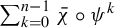 $\sum ^{n-1}_{k=0}\bar \chi \circ \psi ^k$
is
$\sum ^{n-1}_{k=0}\bar \chi \circ \psi ^k$
is $L^2$
-bounded. So, it has an
$L^2$
-bounded. So, it has an $L^2$
-weakly convergent subsequence. This establishes condition (VII).
$L^2$
-weakly convergent subsequence. This establishes condition (VII).
Finally, the non-arithmeticity of $\chi $
implies that
$\chi $
implies that $\chi $
is not cohomologous to a constant, and hence, we have condition (VIII) of Proposition 3.3.
$\chi $
is not cohomologous to a constant, and hence, we have condition (VIII) of Proposition 3.3.
Proof of Theorem 2.6
To prove this theorem, we use Proposition 3.2. By Theorem 2.5, we immediately obtain condition (V) of Proposition 3.2.
Next, we define the following chain of spaces:
 $$ \begin{align*} {{\mathsf V}}_{\alpha_0,\beta,M} &\hookrightarrow {{\mathsf V}}_{\alpha_1,\beta,M} \hookrightarrow L^p \hookrightarrow L^1(\pi) \end{align*} $$
with $p \leq M$
, where the choices correspond to
$p \leq M$
, where the choices correspond to $0\leq \alpha _0<\alpha _1<\beta $
and
$0\leq \alpha _0<\alpha _1<\beta $
and $\gamma _0=\gamma _1=M \geq 1$
in the proof of Theorem 2.8. Then, the conditions (I)–(IV) and (VI) of Proposition 3.2 follow as in the proof of Theorem 2.8 due to Corollary 4.2(2) and [Reference Fernando and Pène11, Lemma 4.5].
$\gamma _0=\gamma _1=M \geq 1$
in the proof of Theorem 2.8. Then, the conditions (I)–(IV) and (VI) of Proposition 3.2 follow as in the proof of Theorem 2.8 due to Corollary 4.2(2) and [Reference Fernando and Pène11, Lemma 4.5].
Proofs of the results in Example 2.10
We first note that
 $$ \begin{align*} |\chi'(x)|\lesssim x^{-c}(1-x)^{-c} \end{align*} $$
and
 $$ \begin{align*} |\chi'(x)| =\bigg|-cx^{-c-1}\sin\bigg(\frac{1}{x}\bigg)-x^{-c-2}\cos\bigg(\frac{1}{x}\bigg)\bigg| \lesssim x^{-c-2}(1-x)^{-c-2}. \end{align*} $$
So, we obtain $a=c$
and
$a=c$
and $b=c+2$
in the notation of Theorems 2.5, 2.6 and 2.8. To prove condition (1) we note that equation (2.7) then simplifies to
$b=c+2$
in the notation of Theorems 2.5, 2.6 and 2.8. To prove condition (1) we note that equation (2.7) then simplifies to
 $$ \begin{align*} c<\min\bigg\{\vartheta, \frac{1}{2+c}\bigg\}\min\bigg\{1, \frac{\log\eta_-}{\log \eta_+}\bigg\}. \end{align*} $$
So, on the one hand, we have the requirement $c<\vartheta \tilde {\eta }$
and, on the other hand, we have the condition
$c<\vartheta \tilde {\eta }$
and, on the other hand, we have the condition $c< \tilde {\eta }/(c+2)$
which, given that we assume
$c< \tilde {\eta }/(c+2)$
which, given that we assume $c\geq 0$
, is equivalent to
$c\geq 0$
, is equivalent to $c<\sqrt {1+\tilde {\eta }}-1$
giving condition (1). Furthermore, in the doubling map case, we have
$c<\sqrt {1+\tilde {\eta }}-1$
giving condition (1). Furthermore, in the doubling map case, we have $\vartheta =2$
and
$\vartheta =2$
and $\tilde {\eta }=1$
implying condition (1a).
$\tilde {\eta }=1$
implying condition (1a).
Next, we notice that equation (2.10) in our case simplifies to
 $$ \begin{align*} 3c<\min \bigg\{{\vartheta}, \frac{1}{2+c}\bigg\}\min\bigg\{1,\frac{\log\eta_+}{\log \eta_-}\bigg\}. \end{align*} $$
With a similar calculation as above, applying Theorem 2.8 gives condition (2) and, as above, we get condition (2a).
5.2 Proofs of limit theorems for the Boolean-type transformation
Now, we give the proofs from §2.5. We start with the following technical lemmas.
Lemma 5.1. For all $r\in \mathbb {N}$
, the rth asymptotic moments of both
$r\in \mathbb {N}$
, the rth asymptotic moments of both $S_n(\chi )$
and
$S_n(\chi )$
and $\widetilde {S}_n(h)$
are equal.
$\widetilde {S}_n(h)$
are equal.
Proof. It is enough to show that ${\mathbb {E}}_{\mu }(\widetilde S^{r}_n(h)) = {\mathbb {E}}_{\unicode{x3bb} _I}(S^{r}_n(\chi ))$
for all r. In fact, due to equation (2.13),
${\mathbb {E}}_{\mu }(\widetilde S^{r}_n(h)) = {\mathbb {E}}_{\unicode{x3bb} _I}(S^{r}_n(\chi ))$
for all r. In fact, due to equation (2.13),
 $$ \begin{align*} {\mathbb{E}}_{\mu}( h \circ \phi^{j_1}\, h \circ \phi^{j_2}\, \cdots \, h \circ \phi^{j_k}) &= {\mathbb{E}}_{\unicode{x3bb}_I}( h \circ \xi \circ \psi^{j_1}\, h \circ \xi \circ \psi^{j_2}\, \cdots \, h \circ \xi \circ \psi^{j_k}) \\ &={\mathbb{E}}_{\unicode{x3bb}_I}( \chi \circ \psi^{j_1}\, \chi \circ \psi^{j_2}\, \ldots \, \chi \circ \psi^{j_k}) \end{align*} $$
for all $j_1, \ldots , j_k \in \mathbb {N}_0$
such that
$j_1, \ldots , j_k \in \mathbb {N}_0$
such that $j_1+\cdots +j_k={r}$
.
$j_1+\cdots +j_k={r}$
.
Lemma 5.2. Let $h:\mathbb {R}\to \mathbb {R}$
be such that the left and right derivatives exist, and there exist
$h:\mathbb {R}\to \mathbb {R}$
be such that the left and right derivatives exist, and there exist $u,v \geq 0$
fulfilling
$u,v \geq 0$
fulfilling
 $$ \begin{align*} h(x)&\lesssim |x|^{u}\quad\text{and}\quad \max\{|h'(x-)|, |h'(x+)|\}\lesssim |x|^{v}, \end{align*} $$
and let $\chi :I\to \mathbb {R}$
be given by
$\chi :I\to \mathbb {R}$
be given by $\chi =h\circ \xi $
with
$\chi =h\circ \xi $
with $\xi (x) := \cot (\pi x)$
, then we have
$\xi (x) := \cot (\pi x)$
, then we have
 $$ \begin{align*}|\chi(x)|\lesssim x^{-u}(1-x)^{-u}\end{align*} $$
and
 $$ \begin{align*}\max\{|\chi'(x+)|, |\chi'(x-)|\}\lesssim x^{-b}(1-x)^{-b},\quad b=2+v.\end{align*} $$
Further, if
 $$ \begin{align} \alpha> u\,&,\nonumber\\ \beta < (1+ \alpha -u)/(2+v-u)\quad &\text{or}\quad 1+v<u \quad\text{and}\\ 1 \leq \gamma <\, &1/u ,\nonumber \end{align} $$
then $\|\chi \|_{\alpha ,\beta ,\gamma }<\infty .$
In particular, if
$\|\chi \|_{\alpha ,\beta ,\gamma }<\infty .$
In particular, if $u<1/(2+v-u)$
, then there exist
$u<1/(2+v-u)$
, then there exist $0<\alpha <\beta <1$
such that
$0<\alpha <\beta <1$
such that $|\chi |_{\alpha ,\beta }<\infty $
.
$|\chi |_{\alpha ,\beta }<\infty $
.
Proof. We will apply Lemma A.18. First, we note that
 $$ \begin{align*}\lim_{x\to 0}\xi(x)x=1/\pi\quad\text{and}\quad\lim_{x\to 1}\xi(x)(1-x)=1/\pi.\end{align*} $$
This and equation (2.14) imply
 $$ \begin{align} |\chi(x)|\lesssim x^{-u}(1-x)^{-u} \end{align} $$
and, in particular, $\chi \in L^\gamma $
with
$\chi \in L^\gamma $
with $1 \leq \gamma <1/u$
.
$1 \leq \gamma <1/u$
.
For simplicity, we assume $\chi $
is differentiable. Otherwise, at a point where
$\chi $
is differentiable. Otherwise, at a point where $\chi $
is not differentiable, both one-sided derivatives will exist and the following estimates do hold for them.
$\chi $
is not differentiable, both one-sided derivatives will exist and the following estimates do hold for them.
Note that we have $|{ h}'(\xi (x))|\lesssim x^{-v} (1-x)^{-v}$
. Using the chain rule,
$|{ h}'(\xi (x))|\lesssim x^{-v} (1-x)^{-v}$
. Using the chain rule, $|\chi '(x) |= |{ h}'(\xi (x))||\xi '(x)|.$
Since
$|\chi '(x) |= |{ h}'(\xi (x))||\xi '(x)|.$
Since $\xi '(x)=-\pi /\sin ^2(\pi x),$
we have that
$\xi '(x)=-\pi /\sin ^2(\pi x),$
we have that
 $$ \begin{align} |\chi'(x)|\lesssim x^{-2-v}(1-x)^{-2-v}. \end{align} $$
So, we have $ |\chi '(x)|\lesssim x^{-b}(1-x)^{-b}$
with
$ |\chi '(x)|\lesssim x^{-b}(1-x)^{-b}$
with $b=2+v> 2$
. The lemma then follows immediately by applying Lemma A.18.
$b=2+v> 2$
. The lemma then follows immediately by applying Lemma A.18.
With this, we are able to prove the results from §2.5.
Proof of Proposition 2.11
To prove the statement, it is enough to prove its counterpart for $S_n(\chi ,\psi )$
, where
$S_n(\chi ,\psi )$
, where $\chi = h\circ \xi $
and
$\chi = h\circ \xi $
and $\psi $
is the doubling map.
$\psi $
is the doubling map.
From Lemma 5.2, we have
 $$ \begin{align*} |\chi(x)|\lesssim x^{-u}(1-x)^{-u}\quad\!\text{and}\!\quad \max\{|\chi'(x+)|, |\chi'(x-)|\}\lesssim x^{-b}(1-x)^{-b},\quad b=2+v.\end{align*} $$
Now, we invoke Theorem 2.5 with $\psi $
,
$\psi $
, $\eta _+=\eta _-=2$
and
$\eta _+=\eta _-=2$
and $\log \eta _-/\log \eta _+ =1$
. Since
$\log \eta _-/\log \eta _+ =1$
. Since $\psi $
is linear,
$\psi $
is linear, $\vartheta =1$
. Hence, equation (2.7) simplifies to
$\vartheta =1$
. Hence, equation (2.7) simplifies to $u<1/(2+v)$
. Also, the assumption that h is not an
$u<1/(2+v)$
. Also, the assumption that h is not an $L^2(\mu )$
coboundary implies that
$L^2(\mu )$
coboundary implies that $\chi $
is not an
$\chi $
is not an $L^2(\unicode{x3bb} )$
coboundary.
$L^2(\unicode{x3bb} )$
coboundary.
Therefore, $\chi $
and
$\chi $
and $\psi $
satisfy the conditions of Theorem 2.5 and, hence, satisfy the CLT given by equation (2.8) with
$\psi $
satisfy the conditions of Theorem 2.5 and, hence, satisfy the CLT given by equation (2.8) with
 $$ \begin{align*}\sigma^2 ={\mathbb{E}}_{\unicode{x3bb}}(\chi^2)+ 2\sum_{k=1}^\infty {\mathbb{E}}_\unicode{x3bb}(\chi\cdot \chi\circ {\psi}^k) \in (0,\infty).\end{align*} $$
From Lemma 5.1, $\widetilde {\sigma }^2 = {\sigma }^2 $
and
$\widetilde {\sigma }^2 = {\sigma }^2 $
and ${\mathbb {E}}_{\mu }(h)={\mathbb {E}}_{\unicode{x3bb} _I}(\chi )$
. As a direct consequence of equation (2.13), we obtain the required CLT given by equation (2.15).
${\mathbb {E}}_{\mu }(h)={\mathbb {E}}_{\unicode{x3bb} _I}(\chi )$
. As a direct consequence of equation (2.13), we obtain the required CLT given by equation (2.15).
We next prove the MLCLT for a class of observables in $\mathfrak {F}$
.
$\mathfrak {F}$
.
Proof of Proposition 2.12
Our assumption allows us to apply Theorem 2.6 to the Birkhoff sum $S_n(\chi )=\sum _{k=0}^{n-1}\chi \circ \psi ^k$
with
$S_n(\chi )=\sum _{k=0}^{n-1}\chi \circ \psi ^k$
with $\chi = h\circ \xi $
and
$\chi = h\circ \xi $
and $\psi $
the doubling map, and conclude
$\psi $
the doubling map, and conclude
 $$ \begin{align*} &\sup_{\ell \in \mathbb{R} }\bigg|\sigma\sqrt{2\pi n}\,{\mathbb{E}}_{\xi_* {\overline{m}}}(U \circ \xi \circ \psi^n \,V(S_n(\overline\chi)-\ell)\, W \circ \xi)\\&\quad\qquad- e^{-{\ell^2}/{2n\sigma^2}} \,{\mathbb{E}}_\pi(U\circ \xi)\,{\mathbb{E}}_{\xi_* {\overline{m}} }(W \circ \xi )\int V(x) \, {d}x \bigg|= o(1). \end{align*} $$
From Lemma 5.1 and the fact that $\xi $
is a conjugacy, we have
$\xi $
is a conjugacy, we have
 $$ \begin{align*} &\sup_{\ell \in \mathbb{R} }\bigg|\widetilde\sigma\sqrt{2\pi n}\,{\mathbb{E}}_{{\overline{m}}}(U \circ \phi^n \,V(\widetilde S_n(\overline{h})-\ell)\, W )\\&\quad\qquad - e^{-{\ell^2}/{2n\widetilde \sigma^2}} \,{\mathbb{E}}_\mu(U)\,{\mathbb{E}}_{{\overline{m}}}(W )\int V(x) \, {d}x \bigg|= o(1). \end{align*} $$
This is because the two left-hand sides are exactly the same.
Now, we prove that corollaries that show the validity of the CLT and MLCLT for the real part, imaginary part and the absolute value of the Riemann zeta function when sampled over the trajectories of $\phi $
.
$\phi $
.
Proof of Corollary 2.15
To apply Proposition 2.11, we have to show the existence of $u,v$
as in equation (2.14). It is well known that for any
$u,v$
as in equation (2.14). It is well known that for any $s \in (0,1)$
, for any
$s \in (0,1)$
, for any $\delta> 0$
,
$\delta> 0$
,
 $$ \begin{align} \max\{|\zeta|(s+ix), |\zeta '|(s+ix)\}\lesssim |x|^{(1-s)/2 + \delta}; \end{align} $$
see, for example, [Reference Titchmarsh39].
So, we pick $u=v=(1-s)/2 + \delta $
and this is possible when
$u=v=(1-s)/2 + \delta $
and this is possible when $((1-s)/2 + \delta ) ((1-s)/ 2 + \delta +2) < 1$
and such
$((1-s)/2 + \delta ) ((1-s)/ 2 + \delta +2) < 1$
and such $\delta>0$
exists if and only if
$\delta>0$
exists if and only if $(1-s)(5-s)<4$
if and only if
$(1-s)(5-s)<4$
if and only if $s \in (3 - 2 \sqrt {2}, 1)$
. So, for such choices of s, we can apply Proposition 2.11 and obtain the CLT provided that h is not
$s \in (3 - 2 \sqrt {2}, 1)$
. So, for such choices of s, we can apply Proposition 2.11 and obtain the CLT provided that h is not $\phi $
-cohomologous to a constant. The MLCLT follows from Proposition 2.12 analogously, when
$\phi $
-cohomologous to a constant. The MLCLT follows from Proposition 2.12 analogously, when $\phi $
is non-arithmetic.
$\phi $
is non-arithmetic.
Proof of Corollary 2.17
To apply Proposition 2.11, we have to show the existence of $u,v$
as in equation (2.14). We assume
$u,v$
as in equation (2.14). We assume $a \geq 1$
and set
$a \geq 1$
and set $\tilde {h}(x)=h(x)^{1/a}$
. Note that
$\tilde {h}(x)=h(x)^{1/a}$
. Note that $h'(x) = a \tilde {h}(x)^{a-1} \tilde {h}'(x).$
Since we restrict ourselves to the critical line,
$h'(x) = a \tilde {h}(x)^{a-1} \tilde {h}'(x).$
Since we restrict ourselves to the critical line, $s=1/2$
,
$s=1/2$
, $|\tilde h(x) | \lesssim |x|^{13/84+\delta } $
and
$|\tilde h(x) | \lesssim |x|^{13/84+\delta } $
and $|\tilde h'(x) | \lesssim |x|^{13/84+\delta }$
for all
$|\tilde h'(x) | \lesssim |x|^{13/84+\delta }$
for all $\delta>0$
, due to equation (5.5). So, we can take
$\delta>0$
, due to equation (5.5). So, we can take $u=13a/84+\delta $
and
$u=13a/84+\delta $
and $v= 13(a-1)/84 + 13/84+ \delta = 13a/84 + \delta ,$
and the condition in Proposition 2.11 for
$v= 13(a-1)/84 + 13/84+ \delta = 13a/84 + \delta ,$
and the condition in Proposition 2.11 for $u,v$
reduces to
$u,v$
reduces to $(13a/84)(13a/84+2) < 1.$
This is equivalent to
$(13a/84)(13a/84+2) < 1.$
This is equivalent to $1 \leq a < 84/13 (\sqrt {2}-1)$
. So, for such choices of a, we can apply Proposition 2.11 and obtain the CLT provided that h is not
$1 \leq a < 84/13 (\sqrt {2}-1)$
. So, for such choices of a, we can apply Proposition 2.11 and obtain the CLT provided that h is not $\phi $
-cohomologous to a constant. The MLCLT follows from Proposition 2.12 analogously, when
$\phi $
-cohomologous to a constant. The MLCLT follows from Proposition 2.12 analogously, when $\phi $
is non-arithmetic.
$\phi $
is non-arithmetic.
Finally, we look at the proof for the first-order Edgeworth expansion for observables over the Boolean-type transformation.
Proof of Proposition 2.13
We follow the proof of Proposition 2.11 and invoke Theorem 2.8.
Consider $S_n(\chi ,\psi )$
, where
$S_n(\chi ,\psi )$
, where $\chi = \xi \circ h$
and
$\chi = \xi \circ h$
and $\psi $
is the doubling map. Remember that from Lemma 5.2, we have
$\psi $
is the doubling map. Remember that from Lemma 5.2, we have
 $$ \begin{align*} |\chi(x)|\lesssim x^{-u}(1-x)^{-u}\quad\!\text{and}\!\quad \max\{|\chi'(x+)|, |\chi'(x-)|\}\lesssim x^{-b}(1-x)^{-b},\quad b=2+v. \end{align*} $$
Next, to apply Theorem 2.8, we observe that $\eta _+=\eta _-=2$
and
$\eta _+=\eta _-=2$
and $\log \eta _-/\log \eta ^+=1$
and since
$\log \eta _-/\log \eta ^+=1$
and since $\psi $
is linear
$\psi $
is linear $\vartheta =1$
. Hence, equation (2.10) simplifies to equation (2.17). Also, the assumption that h is not an
$\vartheta =1$
. Hence, equation (2.10) simplifies to equation (2.17). Also, the assumption that h is not an $L^2(\mu )$
coboundary implies that
$L^2(\mu )$
coboundary implies that $\chi $
is not an
$\chi $
is not an $L^2(\unicode{x3bb} )$
coboundary.
$L^2(\unicode{x3bb} )$
coboundary.
Acknowledgements
T.S. was supported by the Austrian Science Fund FWF: P33943-N and by the MSCA Project ErgodicHyperbolic - p.n. 101151185. Furthermore, she acknowledges the support of the Università di Pisa through the ‘visiting fellows’ programme, as this work was partially done during her visit to the Dipartimento di Matematica, Università di Pisa. T.S. would like to thank the Centro De Giorgi, Scuola Normale Superiore di Pisa for their hospitality during various visits. K.F. was supported by the UniCredit Bank R&D group through the ‘Dynamics and Information Theory Institute’ at the Scuola Normale Superiore di Pisa. K.F. would like to thank the Centro De Giorgi for the excellent working conditions and research travel support, the Fields Institute and the Toronto Public Library System for letting him use their common spaces while visiting Toronto and the Universität Wien for the hospitality during research visits to meet T.S. Both authors would like to thank Carlangelo Liverani for useful discussions.
A Appendix. The Banach spaces
${{\mathsf V}_{\alpha ,\beta ,\gamma }}$

The spaces $\mathsf {V}_{\alpha ,\beta }$
with their particular norm considered in [Reference Schindler36] are not complete, and thus, are not Banach spaces. However, with the norm we introduce here, we can construct a family of Banach spaces
$\mathsf {V}_{\alpha ,\beta }$
with their particular norm considered in [Reference Schindler36] are not complete, and thus, are not Banach spaces. However, with the norm we introduce here, we can construct a family of Banach spaces ${{\mathsf V}_{\alpha ,\beta ,\gamma }}$
,
${{\mathsf V}_{\alpha ,\beta ,\gamma }}$
, $\alpha \in (0,1), \beta \in (0,1]$
and
$\alpha \in (0,1), \beta \in (0,1]$
and $\gamma \geq 1$
, and use it to correct the proofs in [Reference Schindler36], and even generalize the results appearing there.
$\gamma \geq 1$
, and use it to correct the proofs in [Reference Schindler36], and even generalize the results appearing there.
First, we show that $\|\cdot \|_{\alpha ,\beta ,\gamma }$
is indeed a norm.
$\|\cdot \|_{\alpha ,\beta ,\gamma }$
is indeed a norm.
Lemma A.1. For all $\alpha \in (0,1)$
,
$\alpha \in (0,1)$
, $\beta \in (0,1]$
and
$\beta \in (0,1]$
and $\gamma \geq 1$
, we have that
$\gamma \geq 1$
, we have that $\|\cdot \|_{\alpha ,\beta ,\gamma }$
is a norm.
$\|\cdot \|_{\alpha ,\beta ,\gamma }$
is a norm.
Proof. We have for $f,g\in \mathsf {V}_{\alpha ,\beta }$
that
$f,g\in \mathsf {V}_{\alpha ,\beta }$
that
 $$ \begin{align*} |f+g|_{\alpha,\beta} &=\sup_{{\varepsilon}\in (0,{\varepsilon}_0]} \int \frac{\operatorname*{\mathrm{osc}}(R_{\alpha}(f+g), B_{{\varepsilon}}(x))}{{\varepsilon}^{\beta}}{d}\unicode{x3bb}_I(x)\\ &=\sup_{{\varepsilon}\in(0,{\varepsilon}_0]} \int \frac{\operatorname*{\mathrm{osc}}(R_{\alpha}f+R_{\alpha}g, B_{{\varepsilon}}(x))}{{\varepsilon}^{\beta}}{d}\unicode{x3bb}_I(x)\\ &\leq \sup_{{\varepsilon}\in (0,{\varepsilon}_0]} \int \frac{\operatorname*{\mathrm{osc}}(R_{\alpha}f, B_{{\varepsilon}}(x))}{{\varepsilon}^{\beta}}{d}\unicode{x3bb}_I(x) +\sup_{{\varepsilon}\in(0,{\varepsilon}_0]} \int \frac{\operatorname*{\mathrm{osc}}(R_{\alpha}g, B_{{\varepsilon}}(x))}{{\varepsilon}^{\beta}}{d}\unicode{x3bb}_I(x)\\ &=|f|_{\alpha,\beta}+|g|_{\alpha,\beta} \end{align*} $$
and thus
 $$ \begin{align*} \|f+g\|_{\alpha,\beta,\gamma} &=\|f+g\|_{\gamma}+|f+g|_{\alpha,\beta}\\ & \leq \|f\|_{\gamma}+\|g\|_{\gamma}+|f|_{\alpha,\beta}+|g|_{\alpha,\beta} =\|f\|_{\alpha,\beta,\gamma}+\|g\|_{\alpha,\beta,\gamma}. \end{align*} $$
It is obviously true that $\|af\|_{\alpha ,\beta ,\gamma }=a\|f\|_{\alpha ,\beta ,\gamma }$
for any positive a. Since
$\|af\|_{\alpha ,\beta ,\gamma }=a\|f\|_{\alpha ,\beta ,\gamma }$
for any positive a. Since $\|\cdot \|_{\gamma }$
is already a norm and
$\|\cdot \|_{\gamma }$
is already a norm and $|f|_{\alpha ,\beta }=0$
if
$|f|_{\alpha ,\beta }=0$
if $f=0$
almost surely, we know that
$f=0$
almost surely, we know that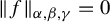 $\|f\|_{\alpha ,\beta ,\gamma }=0$
if and only if
$\|f\|_{\alpha ,\beta ,\gamma }=0$
if and only if $f=0$
almost surely.
$f=0$
almost surely.
A.1 Completeness
Here, we verify that $\mathsf {V}_{\alpha ,\beta ,\gamma }$
are, in fact, Banach spaces.
$\mathsf {V}_{\alpha ,\beta ,\gamma }$
are, in fact, Banach spaces.
Lemma A.2. For $\alpha \in (0,1), \beta \in (0,1]$
and
$\alpha \in (0,1), \beta \in (0,1]$
and $\gamma \geq 1$
,
$\gamma \geq 1$
, $\mathsf {V}_{\alpha ,\beta ,\gamma }$
is complete.
$\mathsf {V}_{\alpha ,\beta ,\gamma }$
is complete.
Proof. Let $(f_n)$
be a Cauchy sequence with respect to
$(f_n)$
be a Cauchy sequence with respect to $\|\cdot \|_{\alpha ,\beta ,\gamma }$
. Then, in particular,
$\|\cdot \|_{\alpha ,\beta ,\gamma }$
. Then, in particular, $(f_n)$
is also a Cauchy sequence with respect to
$(f_n)$
is also a Cauchy sequence with respect to $\|\cdot \|_{\gamma }$
, we set f as its limit. Also, there exists a subsequence, say
$\|\cdot \|_{\gamma }$
, we set f as its limit. Also, there exists a subsequence, say $(f_{n_r})$
, that converges to f pointwise almost everywhere.
$(f_{n_r})$
, that converges to f pointwise almost everywhere.
Since $(f_n)$
is a Cauchy sequence with respect to
$(f_n)$
is a Cauchy sequence with respect to $\|\cdot \|_{\alpha ,\beta ,\gamma }$
, for each
$\|\cdot \|_{\alpha ,\beta ,\gamma }$
, for each $\delta>0$
, we can choose
$\delta>0$
, we can choose $L>0$
such that
$L>0$
such that $\|f_{k}-f_{\ell }\|_{\alpha ,\beta ,\gamma }<\delta $
for all
$\|f_{k}-f_{\ell }\|_{\alpha ,\beta ,\gamma }<\delta $
for all $k,\ell>L$
. Let
$k,\ell>L$
. Let $\delta>0$
and choose
$\delta>0$
and choose $k,\ell $
sufficiently large so that
$k,\ell $
sufficiently large so that $n_k, n_\ell>L$
. Then,
$n_k, n_\ell>L$
. Then,
 $$ \begin{align*} \|f_{n_k}-f_{n_\ell}\|_{\alpha,\beta,\gamma}=\|f_{n_k}-f_{n_\ell}\|_{\gamma}+\sup_{{\varepsilon}\in(0,{\varepsilon}_0]}\frac{\int\operatorname*{\mathrm{osc}}(R_{\alpha}(f_{n_k}-f_{n_\ell}),B_{{\varepsilon}}(x))\;{d}\unicode{x3bb}_I(x)}{{\varepsilon}^{\beta}} < \delta. \end{align*} $$
Then, by Fatou’s lemma, $\|f_{n_k}-f\|_{\gamma } \leq \liminf _{\ell \to \infty }\|f_{n_k}-f_{n_\ell }\|_{\gamma }$
and
$\|f_{n_k}-f\|_{\gamma } \leq \liminf _{\ell \to \infty }\|f_{n_k}-f_{n_\ell }\|_{\gamma }$
and
 $$ \begin{align*} &\frac{\int \operatorname*{\mathrm{osc}}(R_{\alpha}(f_{n_k}-f),B_{{\varepsilon}}(x))\;{d}\unicode{x3bb}_I(x)}{{\varepsilon}^{\beta}}\\&\quad \leq \frac{\int\liminf_{\ell \to \infty}\operatorname*{\mathrm{osc}}(R_{\alpha}(f_{n_k}-f_{n_\ell}),B_{{\varepsilon}}(x))\;{d}\unicode{x3bb}_I(x)}{{\varepsilon}^{\beta}} \\[-14pt] \nonumber\\&\quad\leq \liminf_{\ell \to \infty}\frac{\int\operatorname*{\mathrm{osc}}(R_{\alpha}(f_{n_k}-f_{n_\ell}),B_{{\varepsilon}}(x))\;{d}\unicode{x3bb}_I(x)}{{\varepsilon}^{\beta}} \\&\quad\leq \liminf_{\ell \to \infty} \sup_{{\varepsilon}\in(0,{\varepsilon}_0]} \frac{\int\operatorname*{\mathrm{osc}}(R_{\alpha}(f_{n_k}-f_{n_\ell}),B_{{\varepsilon}}(x))\;{d}\unicode{x3bb}_I(x)}{{\varepsilon}^{\beta}}. \end{align*} $$
As a result, for all k sufficiently large so that $n_k>L$
,
$n_k>L$
,
 $$ \begin{align*} & \|f_{n_k}-f\|_{\alpha,\beta,\gamma}\\& \quad \leq\liminf_{\ell \to \infty}\|f_{n_k}-f_{n_\ell}\|_{\gamma}+\liminf_{\ell \to \infty} \sup_{{\varepsilon}\in(0,{\varepsilon}_0]}\frac{\int\operatorname*{\mathrm{osc}}(R_{\alpha}(f_{n_k}-f_{n_\ell}),B_{{\varepsilon}}(x))\;{d}\unicode{x3bb}_I(x)}{{\varepsilon}^{\beta}}\\& \quad \leq \liminf_{\ell \to \infty} \bigg(\|f_{n_k}-f_{n_\ell}\|_{\gamma} + \sup_{{\varepsilon}\in(0,{\varepsilon}_0]} \frac{\int\operatorname*{\mathrm{osc}}(R_{\alpha}(f_{n_k}-f_{n_\ell}),B_{{\varepsilon}}(x))\;{d}\unicode{x3bb}_I(x)}{{\varepsilon}^{\beta}}\bigg) \leq \delta. \end{align*} $$
Now, choose r sufficiently large so that $n_r>L$
and
$n_r>L$
and $k>L$
. Then,
$k>L$
. Then,
 $$ \begin{align*} \|f_{k}-f\|_{\alpha,\beta, \gamma} &\leq \|f_{k}-f_{n_r}\|_{\alpha,\beta, \gamma} + \|f_{n_r}-f\|_{\alpha,\beta, \gamma} < 2\delta. \end{align*} $$
Thus, $f\in \mathsf {V}_{\alpha ,\beta ,\gamma }$
and
$f\in \mathsf {V}_{\alpha ,\beta ,\gamma }$
and $(f_{n})$
converges to f with respect to
$(f_{n})$
converges to f with respect to $\|\cdot \|_{\alpha ,\beta , \gamma }$
giving completeness.
$\|\cdot \|_{\alpha ,\beta , \gamma }$
giving completeness.
Now, we discuss properties of ${{\mathsf V}_{\alpha ,\beta ,\gamma }}$
that are relevant for the application of Proposition 3.3 to our setting. First, we prove that constant functions belong to the spaces we consider.
${{\mathsf V}_{\alpha ,\beta ,\gamma }}$
that are relevant for the application of Proposition 3.3 to our setting. First, we prove that constant functions belong to the spaces we consider.
Lemma A.3. For $\alpha \in (0,1)$
,
$\alpha \in (0,1)$
, $\beta \in (0,1]$
and
$\beta \in (0,1]$
and $\gamma \geq 1,$
the constant function,
$\gamma \geq 1,$
the constant function, $\mathbf {1} \in {{\mathsf V}_{\alpha ,\beta ,\gamma }}$
.
$\mathbf {1} \in {{\mathsf V}_{\alpha ,\beta ,\gamma }}$
.
Proof. Since $\|\mathbf {1}\|_\gamma =1$
, we only have to show that
$\|\mathbf {1}\|_\gamma =1$
, we only have to show that $ |\mathbf {1}|_{\alpha ,\beta }<\infty $
. Observe that
$ |\mathbf {1}|_{\alpha ,\beta }<\infty $
. Observe that $R_\alpha \mathbf {1}$
is bounded by
$R_\alpha \mathbf {1}$
is bounded by $2^{-2\alpha }$
, symmetric about
$2^{-2\alpha }$
, symmetric about $x=1/2$
and strictly increasing on
$x=1/2$
and strictly increasing on $[0,1/2]$
with a strictly decreasing derivative. Hence, for any
$[0,1/2]$
with a strictly decreasing derivative. Hence, for any $0<{\varepsilon } \leq {\varepsilon }_0 <1/4 $
,
$0<{\varepsilon } \leq {\varepsilon }_0 <1/4 $
,
 $$ \begin{align*} \int\operatorname*{\mathrm{osc}}(R_{\alpha}\mathbf{1} , B_{\varepsilon}(x)) {d}\unicode{x3bb}_I(x) &\leq \int_{2{\varepsilon}}^{1-2{\varepsilon}}{\operatorname*{\mathrm{osc}}(R_{\alpha}\mathbf{1} , B_{\varepsilon}(x))}\, {d}\unicode{x3bb}_I(x)\\ &\quad+ 2^{-2\alpha} \bigg(\int_{0}^{2{\varepsilon}}{d}\unicode{x3bb}_I(x)+\int_{1-2{\varepsilon}}^1\, {d}\unicode{x3bb}_I(x)\bigg) \\ &\leq 4{\varepsilon} \int_{2{\varepsilon}}^{1/2} \max_{B_{\varepsilon}(x)} |(R_{\alpha}\mathbf{1})'| \, {d}\unicode{x3bb}_I(x) + 2^{2-2\alpha} {\varepsilon} \\ & = 4{\varepsilon} \int_{2{\varepsilon}}^{1/2} (R_{\alpha}\mathbf{1})'(x-{\varepsilon}) \, {d}\unicode{x3bb}_I(x) + 2^{2-2\alpha} {\varepsilon}\\ &= 4{\varepsilon}(R_{\alpha}\mathbf{1}(1/2-{\varepsilon}) - R_{\alpha}\mathbf{1}({\varepsilon})) + 2^{2-2\alpha} {\varepsilon} \leq 2^{3-2\alpha}{\varepsilon}. \end{align*} $$
This implies that $|\mathbf {1}|_{\alpha ,\beta }\leq 2^{3-2\alpha }{\varepsilon }^{1-\beta }_0$
.
$|\mathbf {1}|_{\alpha ,\beta }\leq 2^{3-2\alpha }{\varepsilon }^{1-\beta }_0$
.
Next, we state two lemmas about the inclusion properties of ${{\mathsf V}_{\alpha ,\beta ,\gamma }}$
.
${{\mathsf V}_{\alpha ,\beta ,\gamma }}$
.
Lemma A.4. For $\beta \in (0,1]$
and
$\beta \in (0,1]$
and $\gamma \geq 1,$
 $$ \begin{align*}{{\mathsf V}}_{0,\beta,\gamma}\hookrightarrow {{\mathsf V}}_{0,\beta,1} \hookrightarrow L^\infty.\end{align*} $$
Proof. This follows from [Reference Saussol35, Proposition 3.4] applied to the real and imaginary parts of functions in ${{\mathsf V}}_{0,\beta ,1}$
and the fact that
${{\mathsf V}}_{0,\beta ,1}$
and the fact that $ L^\gamma \hookrightarrow L^1$
.
$ L^\gamma \hookrightarrow L^1$
.
Remark A.5. Note that, if $f \in {{\mathsf V}_{\alpha ,\beta ,\gamma }}$
, then
$f \in {{\mathsf V}_{\alpha ,\beta ,\gamma }}$
, then $R_\alpha f \in {{\mathsf V}}_{0,\beta ,\gamma }$
. So,
$R_\alpha f \in {{\mathsf V}}_{0,\beta ,\gamma }$
. So, $\operatorname *{\mbox {ess sup}} R_\alpha f < \infty $
. This fact will be useful in proofs.
$\operatorname *{\mbox {ess sup}} R_\alpha f < \infty $
. This fact will be useful in proofs.
Lemma A.6. Suppose $0<\alpha _1\leq \alpha _2 < 1$
,
$0<\alpha _1\leq \alpha _2 < 1$
, $0<\beta _2 \leq \beta _1 \leq 1$
and
$0<\beta _2 \leq \beta _1 \leq 1$
and $1 \leq \gamma _2 \leq \gamma _1$
. Then,
$1 \leq \gamma _2 \leq \gamma _1$
. Then,
 $$ \begin{align*}{\mathsf V}_{\alpha_1,\beta_1, \gamma_1} \hookrightarrow {\mathsf V}_{\alpha_2,\beta_2, \gamma_2} \hookrightarrow L^1.\end{align*} $$
Proof. Since $\|f\|_{\gamma _2} \leq \|f\|_{\gamma _1}$
, it is enough to show that
$\|f\|_{\gamma _2} \leq \|f\|_{\gamma _1}$
, it is enough to show that $|f|_{\alpha _2,\beta _2} \lesssim \|f\|_{\alpha _{1},\beta _{1},\gamma _{1}}$
. By applying [Reference Saussol35, Proposition 3.2(iii)] to the real and imaginary parts of f, we have
$|f|_{\alpha _2,\beta _2} \lesssim \|f\|_{\alpha _{1},\beta _{1},\gamma _{1}}$
. By applying [Reference Saussol35, Proposition 3.2(iii)] to the real and imaginary parts of f, we have
 $$ \begin{align*} {\operatorname*{\mathrm{osc}}(R_{\alpha_2} f, B_{\varepsilon}(x))} &= {\operatorname*{\mathrm{osc}}(R_{\alpha_2-\alpha_1}\mathbf{1} \cdot R_{\alpha_1}f, B_{\varepsilon}(x))}\\ &\leq \operatorname*{\mbox{ess sup}} |R_{\alpha_1}f| \cdot \operatorname*{\mathrm{osc}}(R_{\alpha_2-\alpha_1}\mathbf{1},B_{\varepsilon}(x) )\\ &\quad+\operatorname*{\mathrm{osc}}(R_{\alpha_1}f, B_{\varepsilon}(x)) \cdot \sup_{B_{\varepsilon}(x)} R_{\alpha_2-\alpha_1}\mathbf{ 1} , \end{align*} $$
and due to Lemma A.4,
 $$ \begin{align*}\operatorname*{\mbox{ess sup}} |R_{\alpha_1}f| \lesssim |R_{\alpha_1}f|_{0,\beta_1} + \|R_{\alpha_1} f\|_{1} \leq |f|_{\alpha_{1},\beta_{1}} + \|R_{\alpha_1}{\mathbf{1}}\|_{\bar{\gamma}}\|f\|_{\gamma_1} \lesssim \|f\|_{\alpha_{1},\beta_{1},\gamma_{1}}\end{align*} $$
with $\bar {\gamma } = (1-\gamma ^{-1}_1)^{-1}$
. Therefore,
$\bar {\gamma } = (1-\gamma ^{-1}_1)^{-1}$
. Therefore,
 $$ \begin{align*} &{\varepsilon}^{-\beta_2}{\operatorname*{\mathrm{osc}}(R_{\alpha_2} f, B_{\varepsilon}(x))} \\&\quad\lesssim {\varepsilon}^{-\beta_1}{\operatorname*{\mathrm{osc}}(R_{\alpha_2-\alpha_1}\mathbf{1} , B_{\varepsilon}(x))}\|f\|_{\alpha_{1},\beta_{1},\gamma_{1}}+ \sup_{ B_{{\varepsilon}}(x)} R_{\alpha_2-\alpha_1}\mathbf{1} \cdot {\varepsilon}^{-\beta_1}{\operatorname*{\mathrm{osc}}(R_{\alpha_1}f, B_{\varepsilon}(x))}. \end{align*} $$
Integrating and taking the supremum over ${\varepsilon }$
,
${\varepsilon }$
,
 $$ \begin{align*}|f|_{\alpha_2,\beta_2} \lesssim \|f\|_{\alpha_{1},\beta_{1},\gamma_{1}},\end{align*} $$
and the inclusion follows.
A.2 Continuous inclusion and relative compactness
To apply Hennion–Nassbaum theory, see [Reference Demers, Kiamari and Liverani7, Reference Keller and Liverani22], we have to show that our weak spaces, $L^p$
, are continuously embedded in strong spaces,
$L^p$
, are continuously embedded in strong spaces, ${{\mathsf V}_{\alpha ,\beta ,\gamma }}$
, and that the closed bounded sets in strong spaces are compact with respect to weak norms.
${{\mathsf V}_{\alpha ,\beta ,\gamma }}$
, and that the closed bounded sets in strong spaces are compact with respect to weak norms.
Lemma A.7. Let $\alpha \in (0,1), \beta \in (0,1]$
and
$\alpha \in (0,1), \beta \in (0,1]$
and $\gamma \geq 1$
. Then, for all
$\gamma \geq 1$
. Then, for all $\bar {\gamma }$
such that
$\bar {\gamma }$
such that $\gamma < \bar {\gamma } < 1/\alpha $
,
$\gamma < \bar {\gamma } < 1/\alpha $
, $L^{\bar {\gamma }}$
is continuously embedded in
$L^{\bar {\gamma }}$
is continuously embedded in ${{\mathsf V}_{\alpha ,\beta ,\gamma }}$
.
${{\mathsf V}_{\alpha ,\beta ,\gamma }}$
.
Proof. Due to Remark 4.8 and the assumption $\bar {\gamma } < 1/\alpha $
, if
$\bar {\gamma } < 1/\alpha $
, if $h \in {{\mathsf V}_{\alpha ,\beta ,\gamma }},$
then
$h \in {{\mathsf V}_{\alpha ,\beta ,\gamma }},$
then $h \in L^{\bar {\gamma }}$
. So,
$h \in L^{\bar {\gamma }}$
. So,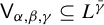 ${{\mathsf V}_{\alpha ,\beta ,\gamma }} \subseteq L^{\bar {\gamma }}$
. To show that this inclusion is continuous, we need to show that if
${{\mathsf V}_{\alpha ,\beta ,\gamma }} \subseteq L^{\bar {\gamma }}$
. To show that this inclusion is continuous, we need to show that if $f_n \to 0$
in
$f_n \to 0$
in ${{\mathsf V}_{\alpha ,\beta ,\gamma }}$
, then
${{\mathsf V}_{\alpha ,\beta ,\gamma }}$
, then $f_n \to 0$
in
$f_n \to 0$
in $L^{\bar {\gamma }}$
. Let
$L^{\bar {\gamma }}$
. Let $\|f_n\|_{\alpha ,\beta ,\gamma } \to 0$
. Then,
$\|f_n\|_{\alpha ,\beta ,\gamma } \to 0$
. Then, $|R_\alpha f_n| \in {{\mathsf V}}_{0,\beta ,1}$
and
$|R_\alpha f_n| \in {{\mathsf V}}_{0,\beta ,1}$
and $\|R_\alpha f_n\|_{0,\beta ,1}\to 0$
. However,
$\|R_\alpha f_n\|_{0,\beta ,1}\to 0$
. However, ${{\mathsf V}}_{0,\beta ,1} \hookrightarrow L^\infty $
. So,
${{\mathsf V}}_{0,\beta ,1} \hookrightarrow L^\infty $
. So, $\|R_\alpha f_n \|_{\infty } \to 0$
. Therefore,
$\|R_\alpha f_n \|_{\infty } \to 0$
. Therefore, $ \|f_n^{\bar {\gamma }}\|_1 \leq \|R_{-\alpha \bar {\gamma }}\mathbf {1}\|_1 \|R_\alpha f_n\|_\infty ^{\bar {\gamma }} \to 0 $
proving the claim.
$ \|f_n^{\bar {\gamma }}\|_1 \leq \|R_{-\alpha \bar {\gamma }}\mathbf {1}\|_1 \|R_\alpha f_n\|_\infty ^{\bar {\gamma }} \to 0 $
proving the claim.
Lemma A.8. Let $\alpha , \beta , \gamma $
and
$\alpha , \beta , \gamma $
and $\bar {\gamma }$
be as in the previous lemma. Then, the closed unit ball of
$\bar {\gamma }$
be as in the previous lemma. Then, the closed unit ball of ${{\mathsf V}_{\alpha ,\beta ,\gamma }}$
is compact in
${{\mathsf V}_{\alpha ,\beta ,\gamma }}$
is compact in $L^{\bar {\gamma }}$
.
$L^{\bar {\gamma }}$
.
Proof. Let $\{f_n\}$
be such that
$\{f_n\}$
be such that $\|f_n\|_{\alpha ,\beta ,\gamma } \leq 1$
. It is enough to show that there is
$\|f_n\|_{\alpha ,\beta ,\gamma } \leq 1$
. It is enough to show that there is $f \in {{\mathsf V}_{\alpha ,\beta ,\gamma }}$
such that
$f \in {{\mathsf V}_{\alpha ,\beta ,\gamma }}$
such that $\|f\|_{\alpha ,\beta ,\gamma } \leq 1$
and
$\|f\|_{\alpha ,\beta ,\gamma } \leq 1$
and $\{f_n\}$
converges to f in
$\{f_n\}$
converges to f in $L^{\bar {\gamma }}$
over a subsequence. To do this, we recall from [Reference Keller21, Theorem 1.13] that closed subsets of
$L^{\bar {\gamma }}$
over a subsequence. To do this, we recall from [Reference Keller21, Theorem 1.13] that closed subsets of ${{\mathsf V}}_{0,\beta ,\gamma }$
are compact in
${{\mathsf V}}_{0,\beta ,\gamma }$
are compact in $L^{\gamma }$
. Since
$L^{\gamma }$
. Since $\{R_\alpha f_n \} \subset {{\mathsf V}}_{0,\beta ,\gamma }$
is a bounded sequence, it has an
$\{R_\alpha f_n \} \subset {{\mathsf V}}_{0,\beta ,\gamma }$
is a bounded sequence, it has an $L^{\gamma }$
convergent subsequence, and in turn, it has a pointwise almost everywhere convergence subsequence. Let us call this subsequence
$L^{\gamma }$
convergent subsequence, and in turn, it has a pointwise almost everywhere convergence subsequence. Let us call this subsequence $\{R_\alpha f_{n_k}\}$
and its point-wise limit f.
$\{R_\alpha f_{n_k}\}$
and its point-wise limit f.
We claim $f_{n_k} \to R_{-\alpha } f$
in
$f_{n_k} \to R_{-\alpha } f$
in $L^{\bar {\gamma }}$
. Observe that
$L^{\bar {\gamma }}$
. Observe that $f_{n_k} \to R_{-\alpha } f $
point-wise almost everywhere, and since
$f_{n_k} \to R_{-\alpha } f $
point-wise almost everywhere, and since ${{\mathsf V}}_{0,\beta ,\gamma } \hookrightarrow L^{\infty }$
,
${{\mathsf V}}_{0,\beta ,\gamma } \hookrightarrow L^{\infty }$
, $|f_{n_k}| \leq |R_{-\alpha }\mathbf {1}| |R_\alpha f_{n_k}| \leq C |R_{-\alpha }\mathbf {1}| \in L^{\bar {\gamma }}.$
So,
$|f_{n_k}| \leq |R_{-\alpha }\mathbf {1}| |R_\alpha f_{n_k}| \leq C |R_{-\alpha }\mathbf {1}| \in L^{\bar {\gamma }}.$
So, $f_{n_{k}}\to R_{-\alpha }f$
in
$f_{n_{k}}\to R_{-\alpha }f$
in $L^{\bar {\gamma }}$
if
$L^{\bar {\gamma }}$
if $\alpha \bar {\gamma } < 1.$
Moreover, we claim
$\alpha \bar {\gamma } < 1.$
Moreover, we claim $\|R_{-\alpha }f\|_{\alpha ,\beta ,\gamma } \leq 1$
. To see this, observe that since
$\|R_{-\alpha }f\|_{\alpha ,\beta ,\gamma } \leq 1$
. To see this, observe that since $L^{\bar {\gamma }}$
convergence implies
$L^{\bar {\gamma }}$
convergence implies $L^\gamma $
convergence, we apply [Reference Keller21, Lemma 1.12] to conclude that
$L^\gamma $
convergence, we apply [Reference Keller21, Lemma 1.12] to conclude that $\liminf _{k}| f_{n_k}|_{\alpha ,\beta } = \liminf _{k}|R_\alpha f_{n_k} |_{0,\beta } \geq |f|_{0,\beta } = |R_{-\alpha }f|_{\alpha , \beta }$
. Since strong convergence implies weak convergence, we have
$\liminf _{k}| f_{n_k}|_{\alpha ,\beta } = \liminf _{k}|R_\alpha f_{n_k} |_{0,\beta } \geq |f|_{0,\beta } = |R_{-\alpha }f|_{\alpha , \beta }$
. Since strong convergence implies weak convergence, we have $\liminf _{k} \|f_{n_k}\|_{\gamma } \geq \|R_{-\alpha }f\|_{\gamma },$
and finally,
$\liminf _{k} \|f_{n_k}\|_{\gamma } \geq \|R_{-\alpha }f\|_{\gamma },$
and finally,
 $$ \begin{align*} &\|R_{-\alpha}f\|_{\alpha,\beta,\gamma} = |R_{-\alpha}f|_{\alpha,\beta} + \|R_{-\alpha}f\|_{\gamma}\\ &\quad\leq \liminf_{k}| f_{n_k}|_{\alpha,\beta} + \liminf_{k} \|f_{n_k}\|_{\gamma} \\ &\quad\leq \liminf_{k} (| f_{n_k}|_{\alpha,\beta}+ \|f_{n_k}\|_{\gamma})= \liminf_{k} \|f_{n_k}\|_{\alpha,\beta,\gamma} \leq 1,\end{align*} $$
as claimed.
Remark A.9. In particular, the above implies that $\|\cdot \|_{\alpha ,\beta ,\gamma }$
-bounded sequences have
$\|\cdot \|_{\alpha ,\beta ,\gamma }$
-bounded sequences have $\|\cdot \|_{\bar {\gamma }}$
-Cauchy subsequences.
$\|\cdot \|_{\bar {\gamma }}$
-Cauchy subsequences.
A.3 Multiplication in
${{\mathsf V}_{\alpha ,\beta ,\gamma }}$

A.3.1 Multiplication by
$e^{is\chi }$

In this section, we prove some properties of multiplication by $e^{is\chi }$
in
$e^{is\chi }$
in ${{\mathsf V}_{\alpha ,\beta ,\gamma }}$
that are necessary for our proofs.
${{\mathsf V}_{\alpha ,\beta ,\gamma }}$
that are necessary for our proofs.
Observe that the spaces ${{\mathsf V}_{\alpha ,\beta ,\gamma }}$
, as opposed to spaces usually used in ergodic theory such as
${{\mathsf V}_{\alpha ,\beta ,\gamma }}$
, as opposed to spaces usually used in ergodic theory such as $L^\infty $
,
$L^\infty $
, ${\operatorname {BV}}[0,1]$
or
${\operatorname {BV}}[0,1]$
or $C^1[0,1]$
, are not Banach algebras. Hence,
$C^1[0,1]$
, are not Banach algebras. Hence, $s \mapsto \widehat {\psi }_{is} \in \mathcal {L}({{\mathsf V}_{\alpha ,\beta ,\gamma }})$
may not be continuous. The following lemma will allow us to establish its continuity as a function from
$s \mapsto \widehat {\psi }_{is} \in \mathcal {L}({{\mathsf V}_{\alpha ,\beta ,\gamma }})$
may not be continuous. The following lemma will allow us to establish its continuity as a function from $\mathbb {R}$
to
$\mathbb {R}$
to $\mathcal {L}({\mathsf V}_{\alpha _1,\beta _1, \gamma _1},{\mathsf V}_{\alpha _2,\beta _2, \gamma _2})$
for some good choices of indices.
$\mathcal {L}({\mathsf V}_{\alpha _1,\beta _1, \gamma _1},{\mathsf V}_{\alpha _2,\beta _2, \gamma _2})$
for some good choices of indices.
Lemma A.10. Suppose $g {\kern-1pt}\in{\kern-1pt} {\mathsf V}_{\alpha _1,\beta _1, \gamma _1}$
,
$g {\kern-1pt}\in{\kern-1pt} {\mathsf V}_{\alpha _1,\beta _1, \gamma _1}$
, $h {\kern-1pt}\in{\kern-1pt} {\mathsf V}_{\alpha _2,\beta _2, \gamma _2}$
, and
$h {\kern-1pt}\in{\kern-1pt} {\mathsf V}_{\alpha _2,\beta _2, \gamma _2}$
, and $\alpha _3=\alpha _1+\alpha _2$
,
$\alpha _3=\alpha _1+\alpha _2$
, $\beta _3 \leq \,\min \{\beta _1,\,\beta _2\}$
and
$\beta _3 \leq \,\min \{\beta _1,\,\beta _2\}$
and $\gamma _3 \leq (\gamma _1^{-1}+\gamma _2^{-1})^{-1}$
. Then,
$\gamma _3 \leq (\gamma _1^{-1}+\gamma _2^{-1})^{-1}$
. Then,
 $$ \begin{align*} \|gh\|_{\alpha_{3},\beta_{3},\gamma_{3}} \lesssim \|g\|_{\alpha_{1},\beta_{1},\gamma_{1}}\|h\|_{\alpha_{2},\beta_{2},\gamma_{2}}\,\end{align*} $$
with the proportionality constant independent of g and h, but dependent on $\alpha _j, \beta _j,\gamma _j, j =1,2,3$
.
$\alpha _j, \beta _j,\gamma _j, j =1,2,3$
.
Proof. First, suppose g and h are real valued. Then,
 $$ \begin{align} \operatorname*{\mathrm{osc}}(R_{\alpha}u, B_{{\varepsilon}}(x))=\operatorname*{\mathrm{osc}}(R_{\alpha}u_-, B_{{\varepsilon}}(x))+\operatorname*{\mathrm{osc}}(R_{\alpha}u_+, B_{{\varepsilon}}(x)). \end{align} $$
By applying [Reference Saussol35, Proposition 3.2(iii)] to the positive and negative parts of g,
 $$ \begin{align*} &\operatorname*{\mathrm{osc}}(R_{ \alpha_3} (gh),B_{\varepsilon}(x))\\ &\quad=\operatorname*{\mathrm{osc}}(R_{ \alpha_3} (g_+-g_-)h,B_{\varepsilon}(x)) \\ &\quad= \operatorname*{\mathrm{osc}}(R_{\alpha_{1}}(g_+-g_-) \cdot R_{\alpha_{2}}h, B_{\varepsilon}(x)) \\ &\quad\leq \operatorname*{\mathrm{osc}}(R_{\alpha_{1}}g_+ \cdot R_{\alpha_{2}}h, B_{\varepsilon}(x))+\operatorname*{\mathrm{osc}}(R_{\alpha_{1}}g_- \cdot R_{\alpha_{2}}h, B_{\varepsilon}(x))\\ &\quad\leq \sum_{r = \pm } (\operatorname*{\mathrm{osc}}(R_{\alpha_{1}}g_r, B_{\varepsilon}(x))\cdot \operatorname*{\mbox{ess sup}} |R_{\alpha_{2}}h| + \operatorname*{\mathrm{osc}}(R_{\alpha_{2}}h, B_{\varepsilon}(x))\cdot \operatorname*{\mbox{ess sup}} |R_{\alpha_{1}}g_r |) \\ &\quad\leq \operatorname*{\mathrm{osc}}(R_{\alpha_{1}}g, B_{\varepsilon}(x))\operatorname*{\mbox{ess sup}} |R_{\alpha_{2}}h|+ 2 \cdot \operatorname*{\mathrm{osc}}(R_{\alpha_{2}}h, B_{\varepsilon}(x))\operatorname*{\mbox{ess sup}} |R_{\alpha_{1}}g |. \end{align*} $$
If g is complex valued, using the definition of $\operatorname *{\mathrm {osc}}$
, we have
$\operatorname *{\mathrm {osc}}$
, we have
 $$ \begin{align*} &\operatorname*{\mathrm{osc}}(R_{\alpha_3} (gh),B_{\varepsilon}(x)) \\ &\quad\leq \operatorname*{\mathrm{osc}}(R_{\alpha_{1}}g, B_{\varepsilon}(x))\operatorname*{\mbox{ess sup}} |R_{\alpha_{2}}h|\\ &\qquad+ 2 \cdot \operatorname*{\mathrm{osc}}(R_{\alpha_{2}}h, B_{\varepsilon}(x))(\operatorname*{\mbox{ess sup}} |R_{\alpha_{1}}\Re g |+\operatorname*{\mbox{ess sup}} |R_{\alpha_{1}}\Im g |),\\ &\quad\leq \operatorname*{\mathrm{osc}}(R_{\alpha_{1}}g, B_{\varepsilon}(x))\operatorname*{\mbox{ess sup}} |R_{\alpha_{2}}h|+ 2 \sqrt{2}\cdot \operatorname*{\mathrm{osc}}(R_{\alpha_{2}}h, B_{\varepsilon}(x)) \operatorname*{\mbox{ess sup}} |R_{\alpha_{1}} g |. \end{align*} $$
If h is not real valued, repeating the argument for the real and imaginary parts of h, we obtain
 $$ \begin{align*} &\operatorname*{\mathrm{osc}}(R_{\alpha_3} (gh),B_{\varepsilon}(x)) \\ &\quad\leq 2\sqrt{2} \cdot \operatorname*{\mathrm{osc}}(R_{\alpha_{1}}g, B_{\varepsilon}(x))\operatorname*{\mbox{ess sup}} |R_{\alpha_{2}}h|+ 2 \sqrt{2}\cdot \operatorname*{\mathrm{osc}}(R_{\alpha_{2}}h, B_{\varepsilon}(x)) \operatorname*{\mbox{ess sup}} |R_{\alpha_{1}} g |. \end{align*} $$
Now, we use the inclusion of $L^{\infty }$
in
$L^{\infty }$
in $\textsf {V}_{0,\beta _r,1}$
, where
$\textsf {V}_{0,\beta _r,1}$
, where $r=1,2$
, to conclude that
$r=1,2$
, to conclude that
 $$ \begin{align*} &\int \operatorname*{\mathrm{osc}}(R_{\alpha_3}(gh),B_{\varepsilon}(x)) \, {d}\unicode{x3bb}_I(x) \\ &\quad\lesssim \int \operatorname*{\mathrm{osc}}(R_{\alpha_{1}}g, B_{\varepsilon}(x))\, {d}\unicode{x3bb}_I(x)\cdot \|R_{\alpha_2} h\|_{0,\beta_2,1}\\&\qquad+ \int \operatorname*{\mathrm{osc}}(R_{\alpha_{2}}h, B_{\varepsilon}(x)) \,{d}\unicode{x3bb}_I(x) \cdot \|R_{\alpha_1} g\|_{0,\beta_1,1} \\ &\quad\lesssim {\varepsilon}^{\beta_1}|g|_{\alpha_1,\beta_1} (|h|_{\alpha_2,\beta_2}+\|R_{\alpha_{2}}h\|_{1} )+ {\varepsilon}^{\beta_2}|h|_{\alpha_2,\beta_2} (|g|_{\alpha_1,\beta_1}+\|R_{\alpha_{1}}g\|_{1} ). \end{align*} $$
This gives us that for all ${\varepsilon } \in (0,1]$
,
${\varepsilon } \in (0,1]$
,
 $$ \begin{align*} &{\varepsilon}^{-\beta_3}\int \operatorname*{\mathrm{osc}}(R_{\alpha_3}(gh),B_{\varepsilon}(x)) \, {d}\unicode{x3bb}_I(x) \\&\quad\lesssim |g|_{\alpha_1,\beta_1}|h|_{\alpha_2,\beta_2}+|g|_{\alpha_1,\beta_1}\|h\|_{\gamma_2}+|h|_{\alpha_2,\beta_2} |g|_{\alpha_1,\beta_1}+|h|_{\alpha_2,\beta_2} \|g\|_{\gamma_1}. \end{align*} $$
Taking the supremum over ${\varepsilon }$
and combining with
${\varepsilon }$
and combining with $\|gh\|_{ \gamma _3} \leq \|g\|_{\gamma _1} \|h\|_{\gamma _2}$
implies the result.
$\|gh\|_{ \gamma _3} \leq \|g\|_{\gamma _1} \|h\|_{\gamma _2}$
implies the result.
Due to the linearity of the operator $\widehat {\psi }$
, to show regularity of
$\widehat {\psi }$
, to show regularity of $s \mapsto \widehat {\psi }_{is}= \psi (e^{is\chi } \times \cdot \, )$
, it is enough to show the regularity of the one-parameter group of multiplication operators
$s \mapsto \widehat {\psi }_{is}= \psi (e^{is\chi } \times \cdot \, )$
, it is enough to show the regularity of the one-parameter group of multiplication operators $s \mapsto e^{is\chi } \times \cdot \,$
. Our next lemma provides general conditions that guarantees this.
$s \mapsto e^{is\chi } \times \cdot \,$
. Our next lemma provides general conditions that guarantees this.
Lemma A.11. Let $0 \leq \alpha _0, \beta \leq 1 $
and
$0 \leq \alpha _0, \beta \leq 1 $
and $\gamma _0 \geq 1$
. For each
$\gamma _0 \geq 1$
. For each $s \in \mathbb {R}$
, consider the multiplication operator,
$s \in \mathbb {R}$
, consider the multiplication operator, $H_s(\cdot ) = e^{is\chi }\times \cdot ,$
on
$H_s(\cdot ) = e^{is\chi }\times \cdot ,$
on ${{\mathsf V}}_{\alpha _0,\beta ,\gamma _0}$
.
${{\mathsf V}}_{\alpha _0,\beta ,\gamma _0}$
.
-
(1) Suppose there is
$\bar {\beta } \geq \beta $
such that, for all
$s \in \mathbb {R}$
,
$|e^{is\chi }|_{0 ,\bar {\beta }} < \infty $
. Then, for all
$s \in \mathbb {R}$
,
$H_s \in \mathcal {L}({{\mathsf V}}_{\alpha _0,\beta ,\gamma _0})$
. -
(2) Suppose, in addition to the conditions in part
$(1),$
there exists
$0<\alpha ^{*}< \beta $
such that (A.2)Put
$$ \begin{align} \lim_{s \to 0}|1-e^{is\chi}|_{\alpha^{*},\beta} = 0. \end{align} $$
$ \alpha _1 = \alpha _0+\alpha ^{*}$
and
$\gamma _1 \leq \gamma _0$
. Then,
$s \mapsto H_s \in \mathcal {L}({{\mathsf V}}_{\alpha _0, \beta ,\gamma _0}, {{\mathsf V}}_{ \alpha _1, \beta ,\gamma _1})$
is continuous.
-
(3) Suppose, in addition to the conditions in parts
$(1)$
and
$(2)$
, there exist
$ 0<\alpha ^{**}<\beta $
and
$\gamma \geq 1$
such that (A.3)Put
$$ \begin{align} \lim_{s \to 0}\bigg|\frac{e^{is\chi}-1-is\chi}{s}\bigg|_{\alpha^{**},\beta}=0\,\quad\text{and}\quad \|\chi\|_{\gamma}<\infty. \end{align} $$
$\alpha _2=\alpha _0+\max \{\alpha ^{*}, \alpha ^{**}\}$
and
$\gamma _2 \leq (\gamma _1^{-1}+\gamma ^{-1})^{-1}$
. Then, the function
$s \mapsto H_s \in \mathcal {L}({{\mathsf V}}_{\alpha _0,\beta ,\gamma _0},{{\mathsf V}}_{\alpha _2,\beta ,\gamma _2})$
is differentiable with the derivative
$$ \begin{align*}H^\prime_s (\cdot) = (i\chi)e^{is\chi}\,\times \,\cdot\,\,.\end{align*} $$
-
(4) Suppose, the conditions in parts
$(1), (2)$
and
$(3)$
are true. Put
$\alpha _3=\alpha _2+\alpha ^{*}$
and
$\gamma _3 \leq \gamma _2$
. Then,
$s \mapsto H_s \in \mathcal {L}({{\mathsf V}}_{\alpha _0, \beta ,\gamma _0}, {{\mathsf V}}_{\alpha _3, \beta ,\gamma _3})$
is continuously differentiable.


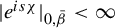




















Remark A.12. It would be possible to have some more flexibility on the parameter $\beta $
and change it for different spaces. However, we only use the version of the lemma as stated that also keeps a simpler notation.
$\beta $
and change it for different spaces. However, we only use the version of the lemma as stated that also keeps a simpler notation.
Proof of Lemma A.11
Proof of part $(1)$
. We note that for all
$(1)$
. We note that for all $g \in {{\mathsf V}}_{\alpha _0,\beta ,\gamma _0}$
,
$g \in {{\mathsf V}}_{\alpha _0,\beta ,\gamma _0}$
, $\|H_s(g)\|_{\gamma _0} = \|g\|_{\gamma _0}$
and due to [Reference Saussol35, Proposition 3.2(iii)],
$\|H_s(g)\|_{\gamma _0} = \|g\|_{\gamma _0}$
and due to [Reference Saussol35, Proposition 3.2(iii)],
 $$ \begin{align*} \operatorname*{\mathrm{osc}}(R_{\alpha_0}(e^{is\chi}g), B_{\varepsilon}(x)) &\leq \operatorname*{\mathrm{osc}}(R_{\alpha_0}(e^{is\chi}g_+), B_{\varepsilon}(x))+\operatorname*{\mathrm{osc}}(R_{\alpha_0}(e^{is\chi}g_-), B_{\varepsilon}(x))\\ &\lesssim \operatorname*{\mathrm{osc}}(R_{\alpha_{0}}g, B_{\varepsilon}(x))+ \operatorname*{\mathrm{osc}}(e^{is\chi}, B_{\varepsilon}(x))\cdot \operatorname*{\mbox{ess sup}} (|R_{\alpha_{0}}g|)\\ &\lesssim \operatorname*{\mathrm{osc}}(R_{\alpha_{0}}g, B_{\varepsilon}(x))+ \operatorname*{\mathrm{osc}}(e^{is\chi}, B_{\varepsilon}(x)) \|g\|_{\alpha_0,\beta,\gamma_0} \text{ and } \\ {\varepsilon}^{-\beta}\operatorname*{\mathrm{osc}}(R_{\alpha_0}(e^{is\chi}g), B_{\varepsilon}(x)) &\lesssim {\varepsilon}^{-\beta}\operatorname*{\mathrm{osc}}(R_{\alpha_{0}}g, B_{\varepsilon}(x))+ {\varepsilon}^{- \beta} \operatorname*{\mathrm{osc}}(e^{is\chi}, B_{\varepsilon}(x))\|g\|_{\alpha_0,\beta,\gamma_0}. \end{align*} $$
The first $\lesssim $
is due to adding up the positive and negative part of g, the second is due to the inclusion
$\lesssim $
is due to adding up the positive and negative part of g, the second is due to the inclusion ${{\mathsf V}}_{0,\beta ,\gamma _0} \hookrightarrow L^\infty $
. Integrating and taking the supremum over
${{\mathsf V}}_{0,\beta ,\gamma _0} \hookrightarrow L^\infty $
. Integrating and taking the supremum over ${\varepsilon }$
, we have
${\varepsilon }$
, we have
 $$ \begin{align*} |H_s(g)|_{\alpha_0,\beta} \lesssim |g|_{\alpha_0,\beta}+|e^{is\chi}|_{0,\beta} \|g\|_{\alpha_0,\beta,\gamma_0}, \end{align*} $$
which gives
 $$ \begin{align} \|H_s(g)\|_{\alpha_0,\beta,\gamma_0} \leq (1+|e^{is\chi}|_{0, \beta}) \|g\|_{\alpha_0,\beta,\gamma_0}. \end{align} $$
Therefore, for all s, $H_s$
maps
$H_s$
maps ${{\mathsf V}}_{\alpha _0,\beta ,\gamma _0}$
to itself and is a bounded linear operator on
${{\mathsf V}}_{\alpha _0,\beta ,\gamma _0}$
to itself and is a bounded linear operator on ${{\mathsf V}}_{\alpha _0,\beta ,\gamma _0}$
.
${{\mathsf V}}_{\alpha _0,\beta ,\gamma _0}$
.
Proof of part $(2)$
. We note that
$(2)$
. We note that $ H_t g - H_s g = (\mathsf {Id}-H_{s-t}) H_t g$
and if
$ H_t g - H_s g = (\mathsf {Id}-H_{s-t}) H_t g$
and if $g\in {{\mathsf V}}_{\alpha _0,\beta ,\gamma _0}$
, then
$g\in {{\mathsf V}}_{\alpha _0,\beta ,\gamma _0}$
, then $H_tg \in {{\mathsf V}}_{\alpha _0,\beta ,\gamma _0}$
. Hence, due to Lemma A.10, it is enough to prove that
$H_tg \in {{\mathsf V}}_{\alpha _0,\beta ,\gamma _0}$
. Hence, due to Lemma A.10, it is enough to prove that
 $$ \begin{align*}\lim_{s \to 0}\|\mathsf{Id}-H_{s}\|_{{{\mathsf V}}_{\alpha_0,\beta,\gamma_0}\to {{\mathsf V}}_{\alpha_1, \beta,\gamma_1}} = 0.\end{align*} $$
To this end, let $g \in {{\mathsf V}}_{\alpha _0,\beta ,\gamma _0}$
be such that
$g \in {{\mathsf V}}_{\alpha _0,\beta ,\gamma _0}$
be such that $\|g\|_{\alpha _0,\beta ,\gamma _0}\leq 1$
. Then,
$\|g\|_{\alpha _0,\beta ,\gamma _0}\leq 1$
. Then,
 $$ \begin{align*}\lim_{s\to 0}\|(\mathsf{Id}-H_{s})g\|^{\gamma_1}_{\gamma_1}=\lim_{s\to 0}\int |(1-e^{is\chi})g|^{\gamma_1}\, \, {d}\unicode{x3bb}_I= 0 \end{align*} $$
by the dominated convergence theorem. Moreover, by [Reference Saussol35, Proposition 3.2 (iii)],
 $$ \begin{align*} &\operatorname*{\mathrm{osc}}( R_{\alpha_1}(\mathsf{Id}-H_{s})g, B_{\varepsilon}(x) ) \\&\quad= \operatorname*{\mathrm{osc}}(R_{\alpha^{*}}(1-e^{is\chi})R_{\alpha_0} g, B_{\varepsilon}(x) ) \\ &\quad \lesssim \operatorname*{\mathrm{osc}}(R_{\alpha_0} g, B_{\varepsilon}(x) ) \cdot \operatorname*{\mbox{ess sup}} |R_{\alpha^{*}}(1-e^{is\chi})|\\&\qquad + \operatorname*{\mathrm{osc}}(R_{\alpha^{*}}(1-e^{is\chi}), B_{\varepsilon}(x) ) \cdot \operatorname*{\mbox{ess sup}} |R_{\alpha_0} g|, \end{align*} $$
where $\lesssim $
is due to the fact that we have to consider the positive and negative part of g separately. Because
$\lesssim $
is due to the fact that we have to consider the positive and negative part of g separately. Because ${{\mathsf V}}_{0,\beta ,1} \hookrightarrow L^\infty $
, we have
${{\mathsf V}}_{0,\beta ,1} \hookrightarrow L^\infty $
, we have
 $$ \begin{align*} &{\varepsilon}^{-\beta}\operatorname*{\mathrm{osc}}( R_{\alpha_1}(\mathsf{Id}-H_{s})g, B_{\varepsilon}(x) )\\ &\quad\lesssim {\varepsilon}^{-\beta}\operatorname*{\mathrm{osc}}(R_{\alpha_0} g, B_{\varepsilon}(x) ) (|1-e^{is\chi}|_{\alpha^{*},\beta}+\| R_{\alpha^{*}}(1-e^{is\chi})\|_1)\\ &\qquad+{\varepsilon}^{-\beta} \operatorname*{\mathrm{osc}}(R_{\alpha^{*}}(1-e^{is\chi}), B_{\varepsilon}(x) )\|g\|_{\alpha_0,\beta,\gamma_0}. \end{align*} $$
Integrating, taking the sup over ${\varepsilon }$
and, finally, using
${\varepsilon }$
and, finally, using $\|g\|_{\alpha _0,\beta ,\gamma _0} \leq 1$
, we get
$\|g\|_{\alpha _0,\beta ,\gamma _0} \leq 1$
, we get
 $$ \begin{align*} |(\mathsf{Id}-H_{s})g|_{\alpha_1,\beta}&\lesssim |1-e^{is\chi}|_{\alpha^{*},\beta}+\|R_{ \alpha^{*}}(1-e^{is\chi})\|_1. \end{align*} $$
By the bounded convergence theorem, $\lim _{s \to 0}\|R_{\alpha ^{*}}(1-e^{is\chi })\|_1=0$
. Therefore,
$\lim _{s \to 0}\|R_{\alpha ^{*}}(1-e^{is\chi })\|_1=0$
. Therefore,
 $$ \begin{align*} \lim_{s \to 0}|(\mathsf{Id}-H_{s})g|_{\alpha_1,\beta} = 0.\end{align*} $$
Hence, we have the continuity of $s \mapsto H_s$
.
$s \mapsto H_s$
.
Proof of part $(3)$
. First, we show that for all
$(3)$
. First, we show that for all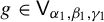 $g \in {\mathsf V}_{\alpha _1,\beta _1, \gamma _1}$
such that
$g \in {\mathsf V}_{\alpha _1,\beta _1, \gamma _1}$
such that $ \|g\|_{\alpha _{1},\beta _{1},\gamma _{1}} \leq 1$
,
$ \|g\|_{\alpha _{1},\beta _{1},\gamma _{1}} \leq 1$
,
 $$ \begin{align*}\lim_{h \to 0}\bigg\|\bigg(\frac{H_{s+h}-H_s-H^\prime_s h}{h}\bigg)g\bigg\|_{\alpha_2, \beta, \gamma_2} = \lim_{h \to 0}\bigg\|\bigg(\frac{H_{h}-\mathsf{Id}-i\chi h}{h}\bigg)H_sg\bigg\|_{\alpha_2, \beta, \gamma_2} = 0.\end{align*} $$
Due to Lemma A.10, it is enough to show that
 $$ \begin{align*}\lim_{h \to 0}\bigg\|\bigg(\frac{H_{h}-\mathsf{Id}-i\chi h}{h}\bigg)\mathbf{ 1}\bigg\|_{\alpha^{**}, \beta, \gamma} = \lim_{h \to 0}\bigg\|\frac{e^{ih\chi}-1-i\chi h}{h}\bigg\|_{\alpha^{**}, \beta, \gamma} =0.\end{align*} $$
From the dominated convergence theorem, we have
 $$ \begin{align*}\lim_{h \to 0}\bigg\|\frac{e^{ih\chi}-1-i\chi h}{h}\bigg\|_{\gamma} =0.\end{align*} $$
The assumption in equation (A.3) completes the proof of differentiability.
Finally, picking $h\neq 0$
sufficiently close to 0, applying the estimate in part (1), part (2) with
$h\neq 0$
sufficiently close to 0, applying the estimate in part (1), part (2) with $\gamma _1=\gamma _0$
, and Lemma A.10, we note that for all
$\gamma _1=\gamma _0$
, and Lemma A.10, we note that for all $g \in {{\mathsf V}}_{\alpha _1,\beta ,\gamma _1}$
and for all
$g \in {{\mathsf V}}_{\alpha _1,\beta ,\gamma _1}$
and for all $s,$
$s,$
 $$ \begin{align*} &\|H^{\prime}_s(g)\|_{\alpha_2,\beta, \gamma_2}\\ &\quad=\bigg\|\frac{e^{ih\chi}-1-ih\chi}{h} e^{is\chi}g +\frac{1}{h}(1-e^{ih\chi})e^{is\chi}g\bigg\|_{\alpha_2,\beta, \gamma_2}\\ &\quad\leq \bigg\|\frac{e^{ih\chi}-1-ih\chi}{h} e^{is\chi}g \bigg\|_{\alpha_2,\beta,\gamma_2}+\frac{1}{h}\|(1-e^{ih\chi})e^{is\chi}g\|_{\alpha_2,\beta,\gamma_2} \\ &\quad\leq \bigg\|\frac{e^{ih\chi}-1-ih\chi}{h}\bigg\|_{\alpha^{**},\beta,\gamma}\| H_s(g)\|_{\alpha_0,\beta,\gamma_0} + \frac{1}{h}\|(1-e^{ih\chi})\|_{\alpha^{*},\beta,\gamma}\|H_s(g)\|_{\alpha_0,\beta,\gamma_0}\\ &\quad \lesssim \bigg(\bigg\|\frac{e^{ih\chi}-1-ih\chi}{h}\bigg\|_{\alpha^{**},\beta,\gamma}+ \|(1-e^{ih\chi})\|_{\alpha^{*},\beta,\gamma}\bigg)(1+|e^{is\chi}|_{0,\beta})\|g\|_{\alpha_0,\beta,\gamma_0}. \end{align*} $$
So, $H^\prime _s$
is, in fact, a bounded linear operator in
$H^\prime _s$
is, in fact, a bounded linear operator in $ \mathcal {L}({{\mathsf V}}_{\alpha _0,\beta ,\gamma _0},{{\mathsf V}}_{\alpha _2,\beta ,\gamma _2})$
.
$ \mathcal {L}({{\mathsf V}}_{\alpha _0,\beta ,\gamma _0},{{\mathsf V}}_{\alpha _2,\beta ,\gamma _2})$
.
Proof of part $(4)$
. Since
$(4)$
. Since ${{\mathsf V}}_{\alpha _2,\beta ,\gamma _2} \kern1.5pt{\hookrightarrow}\kern1.5pt {{\mathsf V}}_{\alpha _3, \beta ,\gamma _3}$
, we have that
${{\mathsf V}}_{\alpha _2,\beta ,\gamma _2} \kern1.5pt{\hookrightarrow}\kern1.5pt {{\mathsf V}}_{\alpha _3, \beta ,\gamma _3}$
, we have that $s\kern1.7pt{\to}\kern1.7pt H_s \kern1.5pt{\in}\kern1.5pt \mathcal {L}({{\mathsf V}}_{\alpha _0,\beta ,\gamma _0},{{\mathsf V}}_{\alpha _3,\beta ,\gamma _3})$
is differentiable. So, we need to check whether
$s\kern1.7pt{\to}\kern1.7pt H_s \kern1.5pt{\in}\kern1.5pt \mathcal {L}({{\mathsf V}}_{\alpha _0,\beta ,\gamma _0},{{\mathsf V}}_{\alpha _3,\beta ,\gamma _3})$
is differentiable. So, we need to check whether $s \to H^{\prime }_s$
is continuous. Note that for all
$s \to H^{\prime }_s$
is continuous. Note that for all $g \in {{\mathsf V}}_{\alpha _0, \beta ,\gamma _0}$
and for all
$g \in {{\mathsf V}}_{\alpha _0, \beta ,\gamma _0}$
and for all $s>0$
,
$s>0$
, $H^{\prime }_s(g) \in {{\mathsf V}}_{\alpha _2, \beta ,\gamma _2}$
, and for all
$H^{\prime }_s(g) \in {{\mathsf V}}_{\alpha _2, \beta ,\gamma _2}$
, and for all $h>0$
,
$h>0$
,
 $$ \begin{align*} \|(H^{\prime}_{s+h}-H^{\prime}_s)g\|_{\alpha_3,\beta,\gamma_3} &=\|(e^{ih\chi}-1)H^{\prime}_s(g)\|_{\alpha_3,\beta,\gamma_3}\\ & \lesssim \|(H_h-H_0)\mathbf{1}\|_{\alpha^{*},\beta,\gamma_0}\|H^{\prime}_s(g)\|_{\alpha_2,\beta,\gamma_2} \to 0, \end{align*} $$
as $h \to 0$
due to part (2). Hence, we have the continuity of the derivative.
$h \to 0$
due to part (2). Hence, we have the continuity of the derivative.
A.3.2 Sufficient conditions for Lemma A.11
We limit our scope by providing sufficient conditions for the assumptions in Lemma A.11.
Lemma A.13. Let $\bar {\beta }>0$
. Suppose
$\bar {\beta }>0$
. Suppose $\chi $
is continuous, and the right and left derivatives of
$\chi $
is continuous, and the right and left derivatives of $\chi $
exist on
$\chi $
exist on $\mathring {I}$
. If there exists a constant
$\mathring {I}$
. If there exists a constant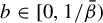 $b\in [0, 1/\bar {\beta })$
such that
$b\in [0, 1/\bar {\beta })$
such that
 $$ \begin{align} \max\{|\chi'(x+)|, |\chi'(x-)|\}\lesssim x^{-b}(1-x)^{-b}, \end{align} $$
then
 $$ \begin{align*}|e^{is\chi}|_{0,\bar{\beta}}<\infty\end{align*} $$
holds for all $s>0$
.
$s>0$
.
Proof. We have
 $$ \begin{align*} |e^{i s\chi}|_{0,\bar{\beta}} &\leq \sup_{{\varepsilon}\in (0,{\varepsilon}_0]} \int_0^{1/2}\frac{ \mathrm{osc}(e^{i s\chi}, B_{{\varepsilon}}(x))}{{\varepsilon}^{\bar{\beta}}}\,{d}\unicode{x3bb}_I(x)\\ &\quad+\sup_{{\varepsilon}'\in (0,{\varepsilon}_0]} \int_{1/2}^1\frac{\mathrm{osc}(e^{i s\chi}, B_{{\varepsilon}'}(x))}{{\varepsilon}'^{\bar{\beta}}}\,{d}\unicode{x3bb}_I(x). \end{align*} $$
We will only estimate the first summand as the estimation of the second follows analogously. Using the definition $\operatorname *{\mathrm {osc}}(h,A)=\operatorname *{\mathrm {osc}}(\Re h,A)+\operatorname *{\mathrm {osc}}(\Im h,A)$
, we note that for any measurable set A, we have
$\operatorname *{\mathrm {osc}}(h,A)=\operatorname *{\mathrm {osc}}(\Re h,A)+\operatorname *{\mathrm {osc}}(\Im h,A)$
, we note that for any measurable set A, we have
 $$ \begin{align} \operatorname*{\mathrm{osc}}(e^{is\chi}, A)\leq \min\{4, 4s/\pi \operatorname*{\mathrm{osc}}(\chi, A)\}. \end{align} $$
By equation (A.5), there exists $C>0$
such that for all
$C>0$
such that for all ${\varepsilon }>0$
and all
${\varepsilon }>0$
and all $x\in [{\varepsilon },1/2]$
, we have
$x\in [{\varepsilon },1/2]$
, we have
 $$ \begin{align*} \operatorname*{\mathrm{osc}}(e^{i s\chi}, B_{{\varepsilon}}(x)) &\leq \frac{8|s|{\varepsilon}}{\pi}\sup_{y\in B_{{\varepsilon}}(x)}\max\{|\chi'(y+)|, |\chi'(y-)|\} \leq \frac{8C|s|{\varepsilon}}{\pi} (x-{\varepsilon})^{-b}. \end{align*} $$
We have that $8C|s|{\varepsilon }/\pi (x-{\varepsilon })^{-b}\leq 4$
if and only if
$8C|s|{\varepsilon }/\pi (x-{\varepsilon })^{-b}\leq 4$
if and only if
 $$ \begin{align*} x\leq \bigg(\frac{2C|s|{\varepsilon}}{\pi}\bigg)^{1/b}+{\varepsilon}=: K_{\varepsilon}. \end{align*} $$
Hence, we split the integral on $[0,1/2]$
into two, one on
$[0,1/2]$
into two, one on $[0,K_{\varepsilon }]$
and the other on
$[0,K_{\varepsilon }]$
and the other on $[K_{\varepsilon },1/2]$
. For the first range, we use the first bound in equation (A.6) and for the second range, we use the second bound. Then,
$[K_{\varepsilon },1/2]$
. For the first range, we use the first bound in equation (A.6) and for the second range, we use the second bound. Then,
 $$ \begin{align} &\sup_{{\varepsilon}\in (0,{\varepsilon}_0]} \int_0^{1/2}\frac{ \operatorname*{\mathrm{osc}}(e^{i s\chi}, B_{{\varepsilon}}(x))}{{\varepsilon}^{\bar{\beta}}}\,{d}\unicode{x3bb}_I(x)\notag\\ &\quad\leq \sup_{{\varepsilon}\in (0,{\varepsilon}_0]} \bigg( 4{K_{\varepsilon}}{\varepsilon}^{-\bar{\beta}}+\int_{K_{\varepsilon}}^{1/2} \frac{8C|s|{\varepsilon}^{1-\bar{\beta}}}{\pi} (x-{\varepsilon})^{-b}{d}\unicode{x3bb}_{I}(x)\bigg)\notag\\ &\quad\leq \sup_{{\varepsilon}\in (0,{\varepsilon}_0]} 4{K_{\varepsilon}}{\varepsilon}^{-\bar{\beta}}+\sup_{{\varepsilon}\in (0,{\varepsilon}_0]}\int_{K_{\varepsilon}}^{1/2} \frac{8C|s|{\varepsilon}^{1-\bar{\beta}}}{\pi} (x-{\varepsilon})^{-b}{d}\unicode{x3bb}_{I}(x). \end{align} $$
For the first summand, we have
 $$ \begin{align*} \sup_{{\varepsilon}\in (0,{\varepsilon}_0]} 4{K_{\varepsilon}}{\varepsilon}^{-\bar{\beta}} &\leq 8\sup_{{\varepsilon}\in (0,{\varepsilon}_0]} \max\bigg\{\bigg(\frac{2C|s|}{\pi}\bigg)^{1/b}{{\varepsilon}}^{1/b-\bar{\beta}},{{\varepsilon}}^{1-\bar{\beta}} \bigg\}<\infty, \end{align*} $$
which follows from the fact that $b<1/\bar {\beta }$
and
$b<1/\bar {\beta }$
and $\bar {\beta }\leq 1$
. For the second summand of equation (A.7), we have
$\bar {\beta }\leq 1$
. For the second summand of equation (A.7), we have
 $$ \begin{align*} &\sup_{{\varepsilon}\in (0,{\varepsilon}_0]}\int_{K_{\varepsilon}}^{1/2} \dfrac{8C|s|{\varepsilon}^{1-\bar{\beta}}}{\pi} (x-{\varepsilon})^{-b}{d}\unicode{x3bb}_{I}(x)\\&\quad\leq \dfrac{8C|s|}{\pi}\sup_{{\varepsilon}\in (0,{\varepsilon}_0]} {\varepsilon}^{1-\bar{\beta}}\int_{({2Cs{\varepsilon}}/{\pi})^{1/b}}^{1/2} x^{-b}{d}\unicode{x3bb}_{I}(x)\\&\quad\leq \begin{cases}\displaystyle \dfrac{8C|s|}{\pi}\sup_{{\varepsilon}\in (0,{\varepsilon}_0]} \dfrac{{\varepsilon}^{1-\bar{\beta}}}{|1-b|} \max\bigg\{\dfrac{1}{2},\bigg(\dfrac{2C|s|{\varepsilon}}{\pi}\bigg)^{1/b} \bigg\}^{1-b}, & b \neq 1, \\\displaystyle\dfrac{8C|s|}{\pi}\sup_{{\varepsilon}\in (0,{\varepsilon}_0]} {\varepsilon}^{1-\bar{\beta}} \log \bigg(\dfrac{\pi}{2C|s|{\varepsilon}} \bigg), & b = 1, \end{cases} \\&\quad= \dfrac{8C|s|}{\pi}\max\bigg\{\dfrac{{\varepsilon}_0^{1-\bar{\beta}}}{2^{1-b}|1-b|},\bigg(\dfrac{2C|s|}{\pi}\bigg)^{ 1/b-1}\dfrac{{\varepsilon}_0^{1/b-\bar{\beta}}}{|1-b|}, {\varepsilon}_0^{1-\bar{\beta}} \log\bigg(\dfrac{\pi}{2C|s|{\varepsilon}_0} \bigg)\bigg\}<\infty, \end{align*} $$
which again follows from the fact that $\bar {\beta }\leq 1$
and
$\bar {\beta }\leq 1$
and $b<1/\bar {\beta }$
.
$b<1/\bar {\beta }$
.
Remark A.14. The above lemma combined with Corollary 4.2 gives a sufficient condition on $\chi $
for the operator
$\chi $
for the operator $H_s$
, and hence,
$H_s$
, and hence, $\widehat {\psi }_{is}$
to be a bounded linear operator on
$\widehat {\psi }_{is}$
to be a bounded linear operator on $V_{\alpha ,\beta ,\gamma }$
for all
$V_{\alpha ,\beta ,\gamma }$
for all $\alpha \geq 0$
,
$\alpha \geq 0$
, $\beta \leq \bar {\beta }$
and
$\beta \leq \bar {\beta }$
and $\gamma \geq 1$
.
$\gamma \geq 1$
.
Next, we state a lemma that gives sufficient condition on $\chi $
for the operator valued function
$\chi $
for the operator valued function $s \mapsto H_s$
, and hence,
$s \mapsto H_s$
, and hence, $s \mapsto \widehat {\psi }_{is}$
to be continuous.
$s \mapsto \widehat {\psi }_{is}$
to be continuous.
Lemma A.15. Suppose $|\chi |_{\alpha ,\beta }<\infty $
with
$|\chi |_{\alpha ,\beta }<\infty $
with $0 \leq \alpha \leq \beta < 1/(1+\alpha )$
and there exists
$0 \leq \alpha \leq \beta < 1/(1+\alpha )$
and there exists $b\in [0,1/\beta )$
such that equation (A.5) holds. Then, for all
$b\in [0,1/\beta )$
such that equation (A.5) holds. Then, for all $\alpha ^{*}\in (0,1)$
,
$\alpha ^{*}\in (0,1)$
,
 $$ \begin{align*}\lim_{s\to 0}|1-e^{is\chi}|_{\alpha^{*},\beta}=0.\end{align*} $$
Proof. We will do the calculation only for the real part $\Re (1-e^{is\chi })=1-\cos (s\chi )$
and the calculations for the imaginary part
$\Re (1-e^{is\chi })=1-\cos (s\chi )$
and the calculations for the imaginary part $\Im (1-e^{is\chi })= -\sin (s\chi )$
follow analogously, and we mention these estimates briefly. Furthermore, we use the splitting of the positive and negative part as in equation (A.1). Also, since
$\Im (1-e^{is\chi })= -\sin (s\chi )$
follow analogously, and we mention these estimates briefly. Furthermore, we use the splitting of the positive and negative part as in equation (A.1). Also, since $\Re (1-e^{is\chi })_{-}=0,$
it does not contribute to the estimates.
$\Re (1-e^{is\chi })_{-}=0,$
it does not contribute to the estimates.
For $\delta \in (0,{\varepsilon }_0)$
, to be specified later depending on
$\delta \in (0,{\varepsilon }_0)$
, to be specified later depending on ${\varepsilon }$
and s, we have
${\varepsilon }$
and s, we have
 $$ \begin{align} |\Re(1-e^{is\chi})_{+}|_{\alpha^{*},\beta} &=\sup_{{\varepsilon}\leq {\varepsilon}_0}\frac{\int \operatorname*{\mathrm{osc}}(R_{\alpha^{*}}\Re(1-e^{is\chi})_{+}, B_{{\varepsilon}}(x))\,{d}\unicode{x3bb}_I(x)}{{\varepsilon}^{\beta}}\notag \\&\leq \sup_{{\varepsilon}\leq {\varepsilon}_0}\frac{\int \operatorname*{\mathrm{osc}}(R_{\alpha^{*}}\Re(1-e^{is\chi})_{+}\mathbf{ 1}_{[0,\delta+{\varepsilon}]}, B_{{\varepsilon}}(x))\,{d}\unicode{x3bb}_I(x)}{{\varepsilon}^{\beta}} \end{align} $$
 $$ \begin{align} &\quad + \sup_{{\varepsilon}\leq {\varepsilon}_0}\frac{\int \operatorname*{\mathrm{osc}}(R_{\alpha^{*}}\Re(1-e^{is\chi})_{+}\mathbf{ 1}_{(\delta+{\varepsilon},1-\delta-{\varepsilon})}, B_{{\varepsilon}}(x))\,{d}\unicode{x3bb}_I(x)}{{\varepsilon}^{\beta}} \end{align} $$
 $$ \begin{align} &\quad+\sup_{{\varepsilon}\leq {\varepsilon}_0}\frac{\int \operatorname*{\mathrm{osc}}(R_{\alpha^{*}}\Re(1-e^{is\chi})_{+}\mathbf{ 1}_{[1-\delta-{\varepsilon},1]}, B_{{\varepsilon}}(x))\,{d}\unicode{x3bb}_I(x)}{{\varepsilon}^{\beta}}, \end{align} $$
where we assume that s and ${\varepsilon }_0$
are so small that
${\varepsilon }_0$
are so small that $\delta +{\varepsilon }<1-\delta -{\varepsilon }$
.
$\delta +{\varepsilon }<1-\delta -{\varepsilon }$
.
We start by estimating that the middle summand in equation (A.9) [Reference Saussol35, Proposition 3.2(ii)] yields
 $$ \begin{align} &\operatorname*{\mathrm{osc}}(R_{\alpha^{*}}\Re(1-e^{is\chi})_{+}\mathbf{ 1}_{(\delta+{\varepsilon},1-\delta-{\varepsilon})},B_{{\varepsilon}}(x))\notag\\ &\quad\leq \operatorname*{\mathrm{osc}}(R_{\alpha^{*}}\Re(1-e^{is\chi})_{+}, (\delta+{\varepsilon},1-\delta-{\varepsilon})\cap B_{{\varepsilon}}(x))\mathbf{1}_{(\delta+{\varepsilon},1-\delta-{\varepsilon})}(x) \notag\\ &\qquad+2 \Big[\operatorname*{\mbox{ess sup}}_{(\delta+{\varepsilon},1-\delta-{\varepsilon})\cap B_{{\varepsilon}}(x)}R_{\alpha^{*}}\Re(1-e^{is\chi})_{+}\Big]\mathbf{ 1}_{B_{{\varepsilon}}((\delta+{\varepsilon},1-\delta-{\varepsilon}))\cap B_{{\varepsilon}}((\delta+{\varepsilon},1-\delta-{\varepsilon})^c)}(x). \end{align} $$
We first investigate the first summand of equation (A.11). For the following, we set
 $$ \begin{align} D(\delta,{\varepsilon},x):=(\delta+{\varepsilon},1-\delta-{\varepsilon})\cap B_{{\varepsilon}}(x). \end{align} $$
For $x\in (\delta +{\varepsilon }, 1-\delta -{\varepsilon })$
,
$x\in (\delta +{\varepsilon }, 1-\delta -{\varepsilon })$
,
 $$ \begin{align} &\operatorname*{\mathrm{osc}}( R_{\alpha^{*}}(1-\cos(s\chi)),D(\delta,{\varepsilon},x)) \leq 2 {\varepsilon} \sup_{D(\delta,{\varepsilon},x)} [R_{\alpha^{*}}(1-\cos(s\chi))]'\notag\\ &\quad\leq 2 {\varepsilon} \Big[\sup_{D(\delta,{\varepsilon},x)} |(R_{\alpha^{*}}\mathbf{ 1})'|\,(1-\cos(s\chi))+\sup_{D(\delta,{\varepsilon},x)} (R_{\alpha^{*}}\mathbf{1})\, |(1-\cos(s\chi))'|\Big]. \end{align} $$
Both of the above calculations follow analogously for the imaginary part with $|\!\sin (s\chi )|$
instead of
$|\!\sin (s\chi )|$
instead of $1-\cos (s\chi )$
.
$1-\cos (s\chi )$
.
We set $\delta =\delta ({\varepsilon },s)= {\varepsilon }^{\kappa }\cdot |s|^\iota $
with
$\delta =\delta ({\varepsilon },s)= {\varepsilon }^{\kappa }\cdot |s|^\iota $
with $\kappa \in (0,1)$
and
$\kappa \in (0,1)$
and $\iota>0$
to be specified later. Since
$\iota>0$
to be specified later. Since $|\chi |_{\alpha ,\beta }<\infty $
implies that
$|\chi |_{\alpha ,\beta }<\infty $
implies that $R_{\alpha }\chi $
is essentially bounded, we can conclude that there exists
$R_{\alpha }\chi $
is essentially bounded, we can conclude that there exists $K(\chi )\in (0,\infty )$
such that
$K(\chi )\in (0,\infty )$
such that $|\chi (x)|\leq K(\chi )\cdot x^{-\alpha }(1-x)^{-\alpha }$
almost everywhere. Recall that there is
$|\chi (x)|\leq K(\chi )\cdot x^{-\alpha }(1-x)^{-\alpha }$
almost everywhere. Recall that there is $C>0$
such that
$C>0$
such that $\max \{|1- \cos (x)\}|, |\!\sin (x)|\} \leq C|x|.$
Combining this with
$\max \{|1- \cos (x)\}|, |\!\sin (x)|\} \leq C|x|.$
Combining this with $(R_{\alpha ^{*}}\mathbf {1})' = \alpha ^{*}( x^{\alpha ^{*}-1}(1-x)^{\alpha ^{*}}+ x^{\alpha ^{*}}(1-x)^{\alpha ^{*}-1}),$
we have
$(R_{\alpha ^{*}}\mathbf {1})' = \alpha ^{*}( x^{\alpha ^{*}-1}(1-x)^{\alpha ^{*}}+ x^{\alpha ^{*}}(1-x)^{\alpha ^{*}-1}),$
we have
 $$ \begin{align} \sup_{D(\delta,{\varepsilon},x)} |(R_{\alpha^{*}}\mathbf{1})'|\max\{1-\cos(s\chi),|\!\sin (s\chi)|\}\, \lesssim \frac{|s|}{ (x-{\varepsilon})^{1+\alpha - \alpha^{*}}} , \end{align} $$
when $x \leq 1/2$
. The estimates for
$x \leq 1/2$
. The estimates for $x\geq 1/2$
follow from replacing
$x\geq 1/2$
follow from replacing $(x-{\varepsilon })$
by
$(x-{\varepsilon })$
by $(1-x+{\varepsilon })$
, and the final estimates remain unchanged. So, we restrict our attention to the former case.
$(1-x+{\varepsilon })$
, and the final estimates remain unchanged. So, we restrict our attention to the former case.
It follows that
 $$ \begin{align} &\lim_{s\to0}\sup_{{\varepsilon}\in (0,{\varepsilon}_0]}\frac{1}{{\varepsilon}^\beta} \int_{\delta+{\varepsilon}}^{1/2} 2{\varepsilon}\sup_{D(\delta,{\varepsilon},x)} (|(R_{\alpha^{*}}\mathbf{ 1})'|(1-\cos(s\chi)) )\mathbf{1}_{(\delta,1-\delta)}(x)\,{d}\unicode{x3bb}_I(x)\notag\\&\quad \lesssim \lim_{s\to0}|s|\sup_{{\varepsilon}\in (0,{\varepsilon}_0]}{\varepsilon}^{1-\beta} \int_{\delta+{\varepsilon}}^{1/2} (x-{\varepsilon})^{\alpha^{*}-1-\alpha}\, {d}\unicode{x3bb}_I(x) \notag\\&\quad \lesssim \lim_{s\to0}|s|\sup_{{\varepsilon}\in (0,{\varepsilon}_0]}{\varepsilon}^{1-\beta} \int_{\delta}^{1/2-{\varepsilon}} x^{\alpha^{*}-1-\alpha}\, {d}\unicode{x3bb}_I(x) \notag\\&\quad \lesssim \begin{cases}\displaystyle \lim_{s\to0} {\varepsilon}_0^{1-\beta+\kappa(\alpha^{*}-\alpha)}\lim_{s\to0}|s|^{1+\iota(\alpha^{*}-\alpha)}, & \alpha^{*} < \alpha, \\\displaystyle{\varepsilon}_0^{1-\beta}(|\!\log(1/2-{\varepsilon}_0)|+ \kappa |\!\log({\varepsilon}_0)|) \lim_{s\to0} |s| + \iota{\varepsilon}_0^{1-\beta}\lim_{s\to0} |s|\, |\!\log|s||, &\alpha^{*}=\alpha,\\\displaystyle {\varepsilon}_0^{1-\beta} \lim_{s\to 0}|s|, & \alpha^{*}>\alpha, \end{cases}\notag\\&\quad =0\, \end{align} $$
provided that under the condition $\alpha ^{*}<\alpha $
, we have
$\alpha ^{*}<\alpha $
, we have
 $$ \begin{align} \begin{aligned} 1-\beta+\kappa(\alpha^{*}-\alpha)>0 &\iff\kappa < (1-\beta)/(\alpha- \alpha^{*}), \\ \iota(\alpha^{*}-\alpha)+1>0 &\iff \iota < 1/(\alpha - \alpha^{*}). \end{aligned} \end{align} $$
Analogously, under the same conditions,
 $$ \begin{align*} \lim_{s\to0}\sup_{{\varepsilon}\in (0,{\varepsilon}_0]}\frac{1 }{{\varepsilon}^\beta}\int 2{\varepsilon} \sup_{D(\delta,{\varepsilon},x)} (|(R_{\alpha^{*}}\mathbf{1})'|(\sin (s\chi))_{\pm})\mathbf{ 1}_{(\delta+{\varepsilon},1-\delta-{\varepsilon})}(x)\,{d}\unicode{x3bb}_I(x) = 0. \end{align*} $$
To estimate the second summand of equation (A.13), we use $(1-\cos (s\chi ))' = \sin (s \chi ) \cdot s \chi '$
,
$(1-\cos (s\chi ))' = \sin (s \chi ) \cdot s \chi '$
, $(\sin (s\chi ))' = \cos (s \chi ) \cdot s \chi '$
,
$(\sin (s\chi ))' = \cos (s \chi ) \cdot s \chi '$
, $|\!\cos (s\chi )|\leq 1$
,
$|\!\cos (s\chi )|\leq 1$
, $|\!\sin (s\chi )| \leq 1 $
and our assumption about
$|\!\sin (s\chi )| \leq 1 $
and our assumption about $\chi '$
. Then, we have
$\chi '$
. Then, we have
 $$ \begin{align*} &\sup_{D(\delta,{\varepsilon},x)} \max\{(R_{\alpha^{*}}\mathbf{1}) \,|(1-\cos(s\chi))'|,(R_{\alpha^{*}}\mathbf{1}) |(\sin(s\chi)^\pm)'|\}\\&\quad \lesssim \begin{cases} |s|(x-{\varepsilon})^{\alpha^{*}-b}, & \alpha^{*}<b, \\|s| \cdot 1, & \alpha^{*}\geq b \end{cases} \end{align*} $$
for $x \leq 1/2$
. Also, note that for
$x \leq 1/2$
. Also, note that for $x \leq 1/2$
and the estimate for
$x \leq 1/2$
and the estimate for $x \geq 1/2$
is the same with
$x \geq 1/2$
is the same with $(x-{\varepsilon })$
replaced by
$(x-{\varepsilon })$
replaced by $(1-x+{\varepsilon })$
. Thus, if
$(1-x+{\varepsilon })$
. Thus, if $\alpha ^{*}< b$
,
$\alpha ^{*}< b$
,
 $$ \begin{align} &\lim_{s\to0}\sup_{{\varepsilon}\in (0,{\varepsilon}_0]}\frac{1}{{\varepsilon}^\beta}\int_{\delta+{\varepsilon}}^{1/2} 2{\varepsilon} \sup_{D(\delta,{\varepsilon},x)} ((R_{\alpha^{*}}\mathbf{1} ) \, |(1-\cos(s\chi))'|)\mathbf{ 1}_{(\delta+{\varepsilon},1-\delta-{\varepsilon})}(x)\,{d}\unicode{x3bb}_I(x) \notag\\&\quad\lesssim \lim_{s\to 0}\sup_{{\varepsilon}\in (0,{\varepsilon}_0]} {\varepsilon}^{1-\beta }|s|\int_{\delta}^{1/2-{\varepsilon}} {x^{\alpha^{*}-b}} d\unicode{x3bb}_I(x) \notag \\&\quad\lesssim \begin{cases}\displaystyle {\varepsilon}_0^{1-\beta+\kappa(1+\alpha^{*}-b)}\lim_{s\to0} |s|^{1+\iota(1+\alpha^{*}-b)}, & b> 1+\alpha^{*}, \\\displaystyle{\varepsilon}_0^{1-\beta}(|\!\log(1/2-{\varepsilon}_0)|+\kappa|\!\log({\varepsilon}_0)|)\,\lim_{s\to 0}|s|\\\displaystyle\qquad+ \iota {\varepsilon}_0^{1-\beta}\lim_{s\to 0} |s|\, |\!\log |s||, & b=1+\alpha^{*},\\\displaystyle{\varepsilon}_0^{1-\beta}\,\lim_{s\to0} |s|, & b < 1+\alpha^{*}, \end{cases}\notag\\&\quad= 0,\end{align} $$
where, in the case of $b>1+\alpha ^{*}$
, we have assumed that
$b>1+\alpha ^{*}$
, we have assumed that
 $$ \begin{align} \begin{aligned} 1-\beta+\kappa(1+\alpha^{*}-b)>0 &\iff\kappa <(1-\beta)/(b-1-\alpha^{*}), \\ 1+\iota(1+\alpha^{*}-b)>0 &\iff \iota < 1/(b-1-\alpha^{*}). \end{aligned} \end{align} $$
The $\alpha ^{*} \geq b$
case is similar to the
$\alpha ^{*} \geq b$
case is similar to the $b < 1+ \alpha ^{*}$
case above. Analogously, under the same assumptions on
$b < 1+ \alpha ^{*}$
case above. Analogously, under the same assumptions on $\kappa $
and
$\kappa $
and $\iota $
, we obtain
$\iota $
, we obtain
 $$ \begin{align*} \lim_{s\to0}\sup_{{\varepsilon}\in (0,{\varepsilon}_0]}\frac{1 }{{\varepsilon}^\beta} \int 2{\varepsilon} \sup_{D(\delta,{\varepsilon},x)} (R_{\alpha^{*}}\mathbf{1}\, |(\sin(s\chi)_{\pm})'|) \mathbf{1}_{(\delta+{\varepsilon},1-\delta-{\varepsilon})}(x)\,{d}\unicode{x3bb}_I(x) = 0. \end{align*} $$
Hence, combining equations (A.15) and (A.17), we can conclude
 $$ \begin{align} \lim_{s\to0}\sup_{{\varepsilon}\in (0,{\varepsilon}_0]}\frac{1 }{{\varepsilon}^\beta}\int \operatorname*{\mathrm{osc}}(R_{\alpha^{*}}\Re (1-e^{is\chi})_{ +}, D(\delta,{\varepsilon},x))\mathbf{ 1}_{(\delta,1-\delta)}(x)\,{d}\unicode{x3bb}_I(x)=0. \end{align} $$
Also, the analogous result for the imaginary part, $\Im (1-e^{is\chi })_{\pm },$
follows.
$\Im (1-e^{is\chi })_{\pm },$
follows.
Next, we will estimate the second summand in equation (A.11). We note that
 $$ \begin{align*} B_{{\varepsilon}}((\delta+{\varepsilon},1-\delta-{\varepsilon}))\cap B_{{\varepsilon}}((\delta+{\varepsilon},1-\delta-{\varepsilon})^c)=B_{{\varepsilon}}(\delta+{\varepsilon})\cup B_{{\varepsilon}}(1-\delta-{\varepsilon})\, \end{align*} $$
and, hence,
 $$ \begin{align} \mathbf{1}_{ B_{{\varepsilon}}((\delta+{\varepsilon},1-\delta-{\varepsilon}))\cap B_{{\varepsilon}}((\delta+{\varepsilon},1-\delta-{\varepsilon})^c)} = \mathbf{1}_{ B_{{\varepsilon}}(\delta+{\varepsilon})\cup B_{{\varepsilon}}(1-\delta-{\varepsilon})}. \end{align} $$
It follows that
 $$ \begin{align} \sup_{D(\delta,{\varepsilon},x)}R_{\alpha^{*}}(1-\cos(s\chi)) \lesssim \begin{cases} |s|(x-{\varepsilon})^{\alpha^{*}-\alpha},&\alpha^{*}<\alpha,\\|s|(x+{\varepsilon})^{\alpha^{*}-\alpha}, &\alpha^{*}\geq \alpha. \end{cases} \end{align} $$
Due to the symmetry around $x=1/2$
, we obtain
$x=1/2$
, we obtain
 $$ \begin{align} &\lim_{s\to0}\sup_{{\varepsilon}\in (0,{\varepsilon}_0]}\frac{1 }{{\varepsilon}^\beta} \int \sup_{D(\delta,{\varepsilon},x)}R_{\alpha^{*}}\Re(1-e^{is\chi})_{ +}\nonumber\\&\qquad\cdot\mathbf{1}_{ B_{{\varepsilon}}((\delta+{\varepsilon},1-\delta-{\varepsilon}))\cap B_{{\varepsilon}}((\delta+{\varepsilon},1-\delta-{\varepsilon})^c)}{(x)}\,{d}\unicode{x3bb}_I(x) \notag\\&\quad = \lim_{s\to0}\sup_{{\varepsilon}\in (0,{\varepsilon}_0]}\frac{ 1}{{\varepsilon}^\beta} \bigg( \int_{\delta}^{\delta+2{\varepsilon}} +\int_{1-\delta-2{\varepsilon}}^{1-\delta}\bigg)\sup_{D(\delta,{\varepsilon},x)}R_{\alpha^{*}}(1-\cos(s\chi))\,{d}\unicode{x3bb}_I(x)\notag \notag\\&\quad\lesssim \lim_{s\to0}\sup_{{\varepsilon}\in (0,{\varepsilon}_0]} |s|{\varepsilon}^{-\beta} \int_{\delta}^{\delta+2{\varepsilon}} \max\{(\delta+{\varepsilon})^{\alpha^{*}-\alpha}, (\delta+2{\varepsilon})^{\alpha^{*}-\alpha}\} \,{d}\unicode{x3bb}_I(x)\notag\\&\quad\lesssim\begin{cases}\displaystyle \lim_{s\to0} {\varepsilon}_0^{1-\beta-\kappa(\alpha-\alpha^{*})}|s|^{1-\iota(\alpha-\alpha^{*})}, & \alpha^{*} < \alpha,\\\displaystyle\lim_{s\to0} {\varepsilon}_0^{1-\beta}|s|, & \alpha^{*} \geq \alpha, \end{cases} \nonumber\\&\quad=0 \end{align} $$
where, in the case of $\alpha ^{*} < \alpha $
, we assume that
$\alpha ^{*} < \alpha $
, we assume that
 $$ \begin{align} \begin{aligned} 1-\beta-\kappa(\alpha-\alpha^{*})>0 &\iff \kappa < (1-\beta)/(\alpha-\alpha^{*}) ,\\ 1-\iota(\alpha-\alpha^{*})>0 &\iff \iota < 1/(\alpha-\alpha^{*}). \end{aligned} \end{align} $$
Combining this with equations (A.11) and (A.19) yields that the summand in equation (A.9) tends to zero for $s\to 0$
and the same is true for the imaginary part,
$s\to 0$
and the same is true for the imaginary part, $\Im (1-e^{is\chi })_\pm ,$
because the same assumptions on
$\Im (1-e^{is\chi })_\pm ,$
because the same assumptions on $\kappa $
and
$\kappa $
and $\iota $
along with
$\iota $
along with $|\!\sin (x)|\lesssim |x|$
and equation (A.21) yield
$|\!\sin (x)|\lesssim |x|$
and equation (A.21) yield
 $$ \begin{align*} \lim_{s\to0}\sup_{{\varepsilon}\in (0,{\varepsilon}_0]}\frac{1 }{{\varepsilon}^\beta}\int \operatorname*{\mathrm{osc}}( (\sin(s\chi))_{\pm}, D(\delta,{\varepsilon},x)) \mathbf{ 1}_{(\delta+{\varepsilon},1-\delta-{\varepsilon})}(x)\,{d}\unicode{x3bb}_I(x)=0,\end{align*} $$
 $$ \begin{align*}&\lim_{s\to0}\sup_{{\varepsilon}\in (0,{\varepsilon}_0]}\frac{1 }{{\varepsilon}^\beta} \int \sup_{D(\delta,{\varepsilon},x)}R_{\alpha^{*}}(\sin(s\chi))_{\pm}\\ &\quad\cdot\mathbf{1}_{B_{{\varepsilon}}((\delta+{\varepsilon},1-\delta-{\varepsilon}))\cap B_{{\varepsilon}}((\delta+{\varepsilon},1-\delta-{\varepsilon})^c)}\,{d}\unicode{x3bb}_I(x) = 0.\end{align*} $$
Finally, we investigate into the first summand in equation (A.8). As the calculation for the summand in equation (A.10) is very similar, we will only give the details for equation (A.8). We split the integral into
 $$ \begin{align} &\lim_{s\to 0}\sup_{{\varepsilon}\leq {\varepsilon}_0}\frac{1}{{\varepsilon}^{\beta}}\int \operatorname*{\mathrm{osc}}(R_{\alpha^{*}}\Re(1-e^{is\chi})\mathbf{ 1}_{[0,{\delta+{\varepsilon}}]},B_{{\varepsilon}}(x))\,{d}\unicode{x3bb}_I(x)\notag\\ &\quad=\lim_{s\to 0}\sup_{{\varepsilon}\leq {\varepsilon}_0}\frac{1}{{\varepsilon}^{\beta}}\bigg(\int_{{[0,\delta)}}+ \int_{[{\delta,\delta+2{\varepsilon}}]}\bigg)\operatorname*{\mathrm{osc}}(R_{\alpha^{*}}(1-\cos(s\chi))\mathbf{ 1}_{[0,{\delta+{\varepsilon}}]},B_{{\varepsilon}}(x))\,{d}\unicode{x3bb}_I(x). \end{align} $$
For the first summand of equation (A.24), we write
 $$ \begin{align} \bar D(\delta,{\varepsilon},x):=[0,\delta+{\varepsilon}]\cap B_{{\varepsilon}}(x), \end{align} $$
and we note that $\Re (1-e^{is\chi })\in (0,2)$
and
$\Re (1-e^{is\chi })\in (0,2)$
and
 $$ \begin{align} &\operatorname*{\mathrm{osc}}(R_{\alpha^{*}}{ (1-\cos(s\chi))}\mathbf{1}_{[0,\delta+{\varepsilon}]}, B_{{\varepsilon}}(x))\nonumber\\ &\quad\leq 2 \cdot {\sup}_{\bar D(\delta,{\varepsilon},x)}R_{\alpha^{*}}\mathbf{1} \leq 2R_{\alpha^{*}}\mathbf{1}(x+{\varepsilon}) \leq 2 (x+{\varepsilon})^{\alpha^{*}}. \end{align} $$
Now, we have
 $$ \begin{align} \lim_{s\to 0}\sup_{{\varepsilon}\leq {\varepsilon}_0}\frac{1}{{\varepsilon}^{\beta}}\int_{0}^{\delta} \operatorname*{\mathrm{osc}}(R_{\alpha^{*}}{(1-\cos(s\chi))}\mathbf{ 1}_{[0,\delta+{\varepsilon}]}, B_{\varepsilon}(x))\,{d}\unicode{x3bb}_I(x)=0 \end{align} $$
under the condition
 $$ \begin{align} \iota>0\quad\text{and}\quad \kappa>\frac{\beta}{1+\alpha^{*}}\end{align} $$
due to the following sub-lemma.
Sub-lemma A.16. Define
 $$ \begin{align*} \Theta_1 &:= \lim_{s\to 0}\sup_{{\varepsilon}\leq {\varepsilon}_0}\frac{1}{{\varepsilon}^{\beta}}\int_0^\delta \operatorname*{\mathrm{osc}}(R_{\alpha^{*}}\Re(1-e^{is\chi})_{+}, \bar D(\delta,{\varepsilon},x)) \,{d}\unicode{x3bb}_I(x) \end{align*} $$
and
 $$ \begin{align*} \Theta_2 &:= \lim_{s\to 0}\sup_{{\varepsilon}\leq {\varepsilon}_0}\frac{1}{s{\varepsilon}^{\beta}}\int_0^\delta\operatorname*{\mathrm{osc}}(R_{\alpha^{*}}\Re(1-e^{is\chi})_{+}, \bar D(\delta,{\varepsilon},x)) \,{d}\unicode{x3bb}_I(x) \end{align*} $$
with $\alpha ^{*}\geq 0$
,
$\alpha ^{*}\geq 0$
, $\delta =\delta ({\varepsilon },s) = {\varepsilon }^{\kappa } s^\iota $
, where
$\delta =\delta ({\varepsilon },s) = {\varepsilon }^{\kappa } s^\iota $
, where $\iota ,\kappa>0$
and with
$\iota ,\kappa>0$
and with $\bar D$
as in equation (A.25). Suppose
$\bar D$
as in equation (A.25). Suppose $|\chi |_{\alpha , \beta }<\infty $
with
$|\chi |_{\alpha , \beta }<\infty $
with $0\leq \alpha <\beta \leq 1$
.
$0\leq \alpha <\beta \leq 1$
.
-
(1) If
(A.29)then
$$ \begin{align} \iota>0\quad\text{and}\quad \kappa \geq \frac{\beta}{\alpha^{*}+1}, \end{align} $$
$\Theta _1=0.$
-
(2) If
(A.30)then
$$ \begin{align} \iota>1\quad\text{and}\quad \kappa \geq \frac{\beta}{\alpha^{*}+1}, \end{align} $$
$\Theta _2=0.$


Proof of Sub-Lemma A.16
Without loss of generality, we assume that $s>0$
. Note that due to equation (A.26), we have
$s>0$
. Note that due to equation (A.26), we have
 $$ \begin{align*} \Theta_1 &\leq \lim_{s\to 0}\sup_{{\varepsilon}\leq {\varepsilon}_0}\frac{\int_0^{\delta} 2 (x+{\varepsilon})^{\alpha^{*}}\,{d}\unicode{x3bb}_I(x)}{{\varepsilon}^{\beta}}\notag\\ &= \lim_{s\to 0}\sup_{{\varepsilon}\leq {\varepsilon}_0}\frac{2 (({ \delta}+{\varepsilon})^{\alpha^{*}+1}- {\varepsilon}^{\alpha^{*}+1})}{(\alpha^{*}+1){\varepsilon}^{\beta}}= \lim_{s\to 0} L(s,{\varepsilon}_0), \end{align*} $$
where
 $$ \begin{align*} L(s,{\varepsilon}_0)&:=\frac{2}{(\alpha^{*}+1)}\sup_{{\varepsilon}\leq {\varepsilon}_0} J(s,{\varepsilon}) \end{align*} $$
and
 $$ \begin{align*} J(s,{\varepsilon}) :=\frac{ ({ \delta}+{\varepsilon})^{\alpha^{*}+1}- {\varepsilon}^{\alpha^{*}+1}}{{\varepsilon}^{\beta}} = ({\varepsilon}^{\kappa} s^\iota+{\varepsilon})^{\alpha^{*}+1}{\varepsilon}^{-\beta}-{\varepsilon}^{\alpha^{*}+1-\beta}. \end{align*} $$
First, we note that
 $$ \begin{align} ({\varepsilon}^{\kappa} s^\iota+{\varepsilon})^{\alpha^{*}+1}{\varepsilon}^{-\beta}= ({\varepsilon}^{\kappa-\beta/(\alpha^{*}+1)}s^{\iota}+{\varepsilon}^{1-\beta/(\alpha^{*}+1)})^{\alpha^{*}+1}, \end{align} $$
and hence, for $J(s,{\varepsilon })$
to not blow up near
$J(s,{\varepsilon })$
to not blow up near ${\varepsilon }=0$
, we should have equation (A.29). Due to the first inequality in equations (A.29) and (A.31), we have for given
${\varepsilon }=0$
, we should have equation (A.29). Due to the first inequality in equations (A.29) and (A.31), we have for given $s>0$
that
$s>0$
that $\sup _{{\varepsilon }\leq {\varepsilon }_0} J(s,{\varepsilon })= J(s, {\varepsilon }_0)$
and thus
$\sup _{{\varepsilon }\leq {\varepsilon }_0} J(s,{\varepsilon })= J(s, {\varepsilon }_0)$
and thus $J(0,{\varepsilon }):=\lim _{s\to 0}J(s,{\varepsilon })=0$
for all
$J(0,{\varepsilon }):=\lim _{s\to 0}J(s,{\varepsilon })=0$
for all ${\varepsilon }$
. Therefore, under the assumption in equation (A.29),
${\varepsilon }$
. Therefore, under the assumption in equation (A.29), $\Theta _1 = 0$
as claimed because
$\Theta _1 = 0$
as claimed because
 $$ \begin{align*} \Theta_1 \leq \lim_{s\to 0} L(s,{\varepsilon}_0) = \frac{2}{\alpha^{*}+1} \lim_{s\to 0} J(s,{\varepsilon}_0) = 0.\end{align*} $$
Now, using equation (A.26) and l’Hôpital’s rule, we obtain
 $$ \begin{align*} \Theta_2 &= \lim_{s\to 0}\sup_{{\varepsilon}\leq {\varepsilon}_0}\frac{\int \operatorname*{\mathrm{osc}}(R_{\alpha}\Re(1-e^{is\chi})_{+}, \bar D(\delta,{\varepsilon},x))\mathbf{ 1}_{[0,\delta]}(x)\,{d}\unicode{x3bb}_I(x)}{s{\varepsilon}^{\beta}}\notag\\ &\leq \lim_{s\to 0}\frac{1}{s}\sup_{{\varepsilon}\leq {\varepsilon}_0}\frac{2 (({ \delta}+{\varepsilon})^{\alpha^{*}+1}- {\varepsilon}^{\alpha^{*}+1})}{(\alpha^{*}+1){\varepsilon}^{\beta}}= \frac{{d}}{{d}s} L(s,{\varepsilon}_0) \bigg|_{s=0}. \end{align*} $$
We note that the last equality follows by the above calculation, namely that $\sup _{{\varepsilon }\leq {\varepsilon }_0} J(s,{\varepsilon })= J(s, {\varepsilon }_0)$
holds because of
$\sup _{{\varepsilon }\leq {\varepsilon }_0} J(s,{\varepsilon })= J(s, {\varepsilon }_0)$
holds because of $1+\alpha ^{*}>\beta $
, and the additional conditions
$1+\alpha ^{*}>\beta $
, and the additional conditions $\iota>0$
and
$\iota>0$
and $\kappa \geq \beta /(\alpha ^{*}+1)$
.
$\kappa \geq \beta /(\alpha ^{*}+1)$
.
Next, taking the derivative of L with respect to s, we obtain
 $$ \begin{align*} \frac{d}{ds} L(s,{\varepsilon}_0) = \frac{2}{\alpha^{*}+1}\frac{d}{ds}({\varepsilon}_0^{\kappa} s^\iota+{\varepsilon}_0)^{\alpha^{*}+1}{\varepsilon}_0^{-\beta} = 2\iota({\varepsilon}^{\kappa}_0s^\iota+{\varepsilon}_0)^{\alpha^{*}}{\varepsilon}^{-\beta}_0{\varepsilon}^{\kappa}_0 s^{\iota-1}. \end{align*} $$
Note that for $\Theta _2 = 0$
, we should have
$\Theta _2 = 0$
, we should have $\frac {d}{ds} L(s,{\varepsilon }_0)\big |_{s=0} = 0$
and this is true, if
$\frac {d}{ds} L(s,{\varepsilon }_0)\big |_{s=0} = 0$
and this is true, if $\iota> 1$
. Therefore, under equation (A.30), we have that
$\iota> 1$
. Therefore, under equation (A.30), we have that $\Theta _2 = 0$
, as claimed.
$\Theta _2 = 0$
, as claimed.
Next, to estimate the second summand of equation (A.24), we first note that for $x \in [\delta ,\delta +2{\varepsilon }],$
 $$ \begin{align} &\sup_{\bar D(\delta,{\varepsilon},x)} R_{\alpha^{*}}(1-\cos (s\chi))\mathbf{ 1}_{[\delta,\delta+{\varepsilon}]}\nonumber\\&\quad\lesssim |s|\sup_{y \in \bar D(\delta,{\varepsilon},x)\cap [\delta, \delta+2{\varepsilon}]} y^{\alpha^{*}-\alpha}\leq \begin{cases} |s|, & \alpha^{*} \geq \alpha, \\|s|\cdot \delta^{\alpha^{*}-\alpha}, & \alpha^{*} < \alpha. \end{cases} \end{align} $$
Hence,
 $$ \begin{align} &\lim_{s\to 0}\sup_{{\varepsilon}\leq {\varepsilon}_0}\frac{1}{{\varepsilon}^{\beta}} \int_{[{\delta,\delta+2{\varepsilon}}]}\operatorname*{\mathrm{osc}}(R_{\alpha^{*}}(1-\cos(s\chi))\mathbf{ 1}_{[\delta,\delta+{\varepsilon}]},B_{{\varepsilon}}(x))\,{d}\unicode{x3bb}_I(x)\notag\\&\quad\lesssim\lim_{s\to 0}\sup_{{\varepsilon}\leq {\varepsilon}_0}\frac{1}{{\varepsilon}^{\beta}} \int_{[\delta,\delta+2{\varepsilon}]} \sup_{\bar D(\delta,{\varepsilon},x)} (R_{\alpha^{*}}(1-\cos (s\chi))\mathbf{1}_{[\delta,\delta+{\varepsilon}]})\,{d}\unicode{x3bb}_I(x) \notag\\&\quad\lesssim \begin{cases}\displaystyle {\varepsilon}_0^{1-\beta}\lim_{s\to 0} |s|, &\quad\alpha^{*} \geq \alpha,\\\displaystyle{\varepsilon}_0^{1-\beta+\kappa(\alpha^{*}-\alpha)}\lim_{s\to 0}|s|^{1+\iota(\alpha-\alpha^{*})}, &\quad\alpha^{*}< \alpha,\end{cases}\notag\\&\quad=0 \end{align} $$
provided that, in the case of $\alpha ^{*}< \alpha ,$
 $$ \begin{align} \begin{aligned} 1-\beta+\kappa(\alpha^{*}- \alpha)>0 &\iff\kappa < (1-\beta)/(\alpha-\alpha^{*}), \\ 1+\iota(\alpha^{*}- \alpha)>0&\iff \iota< 1/(\alpha-\alpha^{*}). \end{aligned} \end{align} $$
Next, by [Reference Saussol35, Proposition 3.2(ii)], we have for $x\in (\delta , \delta + 2{\varepsilon }]$
,
$x\in (\delta , \delta + 2{\varepsilon }]$
,
 $$ \begin{align*} &\operatorname*{\mathrm{osc}}(R_{\alpha^{*}}(1-\cos(s\chi))\mathbf{1}_{[0,\delta]},B_{{\varepsilon}}(x))\\ &\quad\leq \operatorname*{\mathrm{osc}}(R_{\alpha^{*}}(1-\cos(s\chi)),B_{{\varepsilon}}(x)\cap [0,\delta])\mathbf{1}_{[0,\delta]}(x)\\ &\qquad+2\operatorname*{\mbox{ess sup}}_{B_{{\varepsilon}}(x)\cap [0,\delta]} R_{\alpha^{*}}(1-\cos(s\chi))\mathbf{1}_{ [\delta-{\varepsilon} \vee 0, \delta+{\varepsilon}]}(x)\\ &\quad \leq 0+2\operatorname*{\mbox{ess sup}}_{[\delta-{\varepsilon} \vee 0,\delta]} R_{\alpha^{*}}\mathbf{1} \leq 2 \delta^{\alpha^{*}}. \end{align*} $$
Hence,
 $$ \begin{align*} \lim_{s\to 0}\sup_{{\varepsilon}\leq {\varepsilon}_0}\frac{1}{{\varepsilon}^{\beta}} \int_{[{\delta,\delta+2{\varepsilon}}]}\operatorname*{\mathrm{osc}}(R_{\alpha^{*}}(1-\cos(s\chi))\mathbf{ 1}_{[0,\delta]},B_{{\varepsilon}}(x))\,{d}\unicode{x3bb}_I(x)\notag\\ &\lesssim \lim_{s\to 0}\sup_{{\varepsilon}\leq {\varepsilon}_0}\frac{1}{{\varepsilon}^{\beta}} \int_{[{\delta,\delta+2{\varepsilon}}]}\delta^{\alpha^{*}}\,{d}\unicode{x3bb}_I(x) \lesssim \lim_{s\to 0}\sup_{{\varepsilon}\leq {\varepsilon}_0} {\varepsilon}^{1-\beta+\kappa\alpha^{*}}s^{\iota\alpha^{*}}=0 \end{align*} $$
under equation (A.28). This together with equation (A.33) imply
 $$ \begin{align*} \lim_{s\to 0}\sup_{{\varepsilon}\leq {\varepsilon}_0}\frac{1}{{\varepsilon}^{\beta}} \int_{[{\delta,\delta+2{\varepsilon}}]}\operatorname*{\mathrm{osc}}(R_{\alpha^{*}}(1-\cos(s\chi))\mathbf{ 1}_{[0,\delta+2{\varepsilon}]},B_{{\varepsilon}}(x))\,{d}\unicode{x3bb}_I(x)=0. \end{align*} $$
Combining this with equations (A.24) and (A.27) implies that equation (A.8) tends to zero for s tending to zero. The same is true for the imaginary part, $\Im (1-e^{is\chi })_{\pm },$
as
$\Im (1-e^{is\chi })_{\pm },$
as $\Im (1-e^{is\chi })_{\pm } \leq 1.$
Finally, we discuss here possible values of $\alpha ^{*}$
and the implicit requirements on b that ensure the existence of
$\alpha ^{*}$
and the implicit requirements on b that ensure the existence of $\iota>0$
and
$\iota>0$
and $\kappa>0$
used in the proof. There are four cases.
$\kappa>0$
used in the proof. There are four cases.
Note that in the case of $\alpha ^{*}< \alpha $
and
$\alpha ^{*}< \alpha $
and $b>1+\alpha ^{*},$
under equations (A.16), (A.18), (A.23), (A.28) and (A.34), we have
$b>1+\alpha ^{*},$
under equations (A.16), (A.18), (A.23), (A.28) and (A.34), we have
 $$ \begin{align*} \begin{aligned} \frac{\beta}{\alpha^{*}+1} <\, &\kappa < \min\bigg\{{\frac{1-\beta}{\alpha-\alpha^{*}}, \frac{1-\beta}{b-1-\alpha^{*}}, 1}\bigg\}, \\ 0 <\, &\iota < \min\bigg\{{\frac{1}{\alpha-\alpha^{*}}, \frac{1}{b-1-\alpha^{*}}}\bigg\}. \end{aligned} \end{align*} $$
First, we see that the conditions on $\iota $
are always fulfilled, because
$\iota $
are always fulfilled, because
 $$ \begin{align*}0<\frac{1}{\alpha-\alpha^{*}} \quad\text{and}\quad 0<\frac{1}{b-1-\alpha^{*}}.\end{align*} $$
Similarly, considering the inequalities that guarantee the existence of $\kappa $
, we have
$\kappa $
, we have
 $$ \begin{align*}\alpha> \alpha^{*} > \max\{\alpha\beta+\beta-1, \beta b -1\}\end{align*} $$
is necessary and sufficient. Note that due to $\beta <\min \{ 1/b,1/(\alpha +1)\}$
, we have
$\beta <\min \{ 1/b,1/(\alpha +1)\}$
, we have $\alpha \beta +\beta -1 < 0$
and also
$\alpha \beta +\beta -1 < 0$
and also ${\beta b -1}< 0.$
So,
${\beta b -1}< 0.$
So, $0 < \alpha ^{*} <\min \{\alpha , b-1\}$
, which is equivalent to
$0 < \alpha ^{*} <\min \{\alpha , b-1\}$
, which is equivalent to $\alpha ^{*}<\alpha $
and
$\alpha ^{*}<\alpha $
and $b>1+\alpha ^{*}$
.
$b>1+\alpha ^{*}$
.
In the case of $ \alpha ^{*} < \alpha $
and
$ \alpha ^{*} < \alpha $
and $b \leq 1+\alpha ^{*},$
equation (A.18) poses no restrictions. So, under equations (A.16), (A.23), (A.28) and (A.34), we have
$b \leq 1+\alpha ^{*},$
equation (A.18) poses no restrictions. So, under equations (A.16), (A.23), (A.28) and (A.34), we have $b-1 < \alpha ^{*} < \alpha $
and
$b-1 < \alpha ^{*} < \alpha $
and $b \leq 1+\alpha $
, which is equivalent to our assumptions
$b \leq 1+\alpha $
, which is equivalent to our assumptions $\alpha ^{*} < \alpha $
and
$\alpha ^{*} < \alpha $
and $b \leq 1+\alpha ^{*}$
.
$b \leq 1+\alpha ^{*}$
.
In the case of $ \alpha ^{*} \geq \alpha ,$
equations (A.16), (A.23) and (A.34) pose no restrictions. So, when
$ \alpha ^{*} \geq \alpha ,$
equations (A.16), (A.23) and (A.34) pose no restrictions. So, when $b<1+\alpha ^{*},$
we have
$b<1+\alpha ^{*},$
we have $ \alpha ^{*}> \max \{\alpha , b-1 \}$
and when
$ \alpha ^{*}> \max \{\alpha , b-1 \}$
and when $b>1+\alpha ^{*}$
, we have
$b>1+\alpha ^{*}$
, we have ${\alpha < \alpha ^{*} < b-1}$
and
${\alpha < \alpha ^{*} < b-1}$
and $b>1+\alpha $
, and we do not obtain any additional restrictions either.
$b>1+\alpha $
, and we do not obtain any additional restrictions either.
The next lemma of this section gives a sufficient condition on $\chi $
for the operator valued function
$\chi $
for the operator valued function $s \mapsto H_s$
and, hence,
$s \mapsto H_s$
and, hence, $s \mapsto \widehat {\psi }_{is}$
to be differentiable.
$s \mapsto \widehat {\psi }_{is}$
to be differentiable.
Lemma A.17. Suppose $|\chi |_{\alpha ,\beta }<\infty $
with
$|\chi |_{\alpha ,\beta }<\infty $
with $0\leq \alpha \leq \beta < 1/(1+\alpha )$
and there exists
$0\leq \alpha \leq \beta < 1/(1+\alpha )$
and there exists ${b\in [0,1/\beta )}$
such that equation (A.5) holds. Then, for all
${b\in [0,1/\beta )}$
such that equation (A.5) holds. Then, for all $\alpha ^{*}> \min \{2\alpha , \max \{\alpha , \alpha +b-2\}\}$
, we have
$\alpha ^{*}> \min \{2\alpha , \max \{\alpha , \alpha +b-2\}\}$
, we have
 $$ \begin{align*}\lim_{s\to 0}\bigg|\frac{e^{is\chi}-1-is\chi}{s}\bigg|_{\alpha^{*}, \beta}=0.\end{align*} $$
Proof. The proof follows very similarly to the proof of the previous lemma and we will stick to the same notation. Again, we will do the calculations only for the non-negative real part, only noting some differences for the imaginary part. We have
 $$ \begin{align*} \operatorname*{\mathrm{osc}}\bigg(R_{\alpha^{*}} \Re \bigg(\frac{e^{is\chi}-1-is\chi}{s}\bigg),B_{{\varepsilon}}(x)\bigg) &=\frac{1}{s}\operatorname*{\mathrm{osc}}(R_{\alpha^{*}}(1-\cos(s\chi)),B_{{\varepsilon}}(x)) \end{align*} $$
and
 $$ \begin{align*} \operatorname*{\mathrm{osc}}\bigg(R_{\alpha^{*}}\Im \bigg(\frac{e^{is\chi}-1-is\chi}{s}\bigg),B_{{\varepsilon}}(x)\bigg) &=\frac{1}{s}\operatorname*{\mathrm{osc}}(R_{\alpha^{*}}(\sin(s\chi)-s\chi),B_{{\varepsilon}}(x)). \end{align*} $$
As in equations (A.8)–(A.10), we have for $\delta \in (0,{\varepsilon }_0)$
(to be specified later and depending on s and
$\delta \in (0,{\varepsilon }_0)$
(to be specified later and depending on s and ${\varepsilon }$
) that
${\varepsilon }$
) that
 $$ \begin{align} |\Re(e^{is\chi}-1-is\chi)|_{\alpha^{*},\beta} &=\sup_{{\varepsilon}\leq {\varepsilon}_0}\frac{\int \operatorname*{\mathrm{osc}}(R_{\alpha^{*}}(1-\cos(s\chi)),B_{{\varepsilon}}(x))\,{d}\unicode{x3bb}_I(x)}{s{\varepsilon}^{\beta}}\notag \\&\leq \sup_{{\varepsilon}\leq {\varepsilon}_0}\frac{\int \operatorname*{\mathrm{osc}}(R_{\alpha^{*}}(1-\cos(s\chi))\mathbf{ 1}_{[0,\delta+{\varepsilon}]}, B_{{\varepsilon}}(x))\,{d}\unicode{x3bb}_I(x)}{s{\varepsilon}^{\beta}} \end{align} $$
 $$ \begin{align} &\quad + \sup_{{\varepsilon}\leq {\varepsilon}_0}\frac{\int \operatorname*{\mathrm{osc}}(R_{\alpha^{*}}(1-\cos(s\chi))\mathbf{ 1}_{(\delta+{\varepsilon},1-\delta-{\varepsilon})}, B_{{\varepsilon}}(x))\,{d}\unicode{x3bb}_I(x)}{s{\varepsilon}^{\beta}} \end{align} $$
 $$ \begin{align} &\quad+\sup_{{\varepsilon}\leq {\varepsilon}_0}\frac{\int \operatorname*{\mathrm{osc}}(R_{\alpha^{*}}(1-\cos(s\chi))\mathbf{ 1}_{[1-\delta-{\varepsilon},1]},B_{{\varepsilon}}(x))\,{d}\unicode{x3bb}_I(x)}{s{\varepsilon}^{\beta}}, \end{align} $$
and similarly, for the imaginary part.
Now, we start by estimating the middle term in equation (A.36), and as in equation (A.11), we use [Reference Saussol35, Proposition 3.2(ii)] to obtain
 $$ \begin{align} &\operatorname*{\mathrm{osc}}(R_{\alpha^{*}}(1-\cos(s\chi))\mathbf{ 1}_{(\delta+{\varepsilon},1-\delta-{\varepsilon})},B_{{\varepsilon}}(x))\notag\\&\quad\leq \operatorname*{\mathrm{osc}}(R_{\alpha^{*}}(1-\cos(s\chi)), D(\delta,{\varepsilon},x))\mathbf{ 1}_{(\delta+{\varepsilon},1-\delta-{\varepsilon})}(x) \notag\\&\qquad+2 \Big[\sup_{D(\delta,{\varepsilon},x)}R_{\alpha^{*}}(1-\cos(s\chi))\Big]\mathbf{ 1}_{B_{{\varepsilon}}((\delta+{\varepsilon},1-\delta-{\varepsilon}))\cap B_{{\varepsilon}}((\delta+{\varepsilon},1-\delta-{\varepsilon})^c)}(x). \end{align} $$
For $x\in (\delta +{\varepsilon }, 1-\delta -{\varepsilon })$
,
$x\in (\delta +{\varepsilon }, 1-\delta -{\varepsilon })$
,
 $$ \begin{align} &\operatorname*{\mathrm{osc}}( R_{\alpha^{*}}(1-\cos(s\chi)),D(\delta,{\varepsilon},x)) \leq 2 {\varepsilon} \sup_{D(\delta,{\varepsilon},x)} |[R_{\alpha^{*}}(1-\cos(s\chi))]'|\notag\\ &\quad\leq 2 {\varepsilon} \Big[\sup_{D(\delta,{\varepsilon},x)} |(R_{\alpha^{*}}\mathbf{ 1})'|\,(1-\cos(s\chi))+\sup_{D(\delta,{\varepsilon},x)} (R_{\alpha^{*}}\mathbf{1}) |(1-\cos(s\chi))'|\Big]. \end{align} $$
Both of the above calculations follow analogously for the imaginary part.
For the following, as in the previous proof, we set $\delta =\delta ({\varepsilon },s)={\varepsilon }^{\kappa }\cdot |s|^\iota $
with
$\delta =\delta ({\varepsilon },s)={\varepsilon }^{\kappa }\cdot |s|^\iota $
with $\kappa \in (0,1)$
,
$\kappa \in (0,1)$
, $\iota>0$
and recall that there is
$\iota>0$
and recall that there is $C>0$
such that
$C>0$
such that $\max \{|1- \cos (x)|, |\!\sin (x) - x|\} \leq C|x|^2$
. The latter fact and
$\max \{|1- \cos (x)|, |\!\sin (x) - x|\} \leq C|x|^2$
. The latter fact and $(R_{\alpha ^{*}}\mathbf {1})' = \alpha ^{*}( x^{\alpha ^{*}-1}(1-x)^{\alpha ^{*}}+ x^{\alpha ^{*}}(1-x)^{\alpha ^{*}-1}),$
imply that
$(R_{\alpha ^{*}}\mathbf {1})' = \alpha ^{*}( x^{\alpha ^{*}-1}(1-x)^{\alpha ^{*}}+ x^{\alpha ^{*}}(1-x)^{\alpha ^{*}-1}),$
imply that
 $$ \begin{align} \sup_{D(\delta,{\varepsilon},x)} |(R_{\alpha^{*}}\mathbf{1})'|\cdot\max\{1-\cos(s\chi),|\!\sin (s\chi)-(s\chi)|\}\, \lesssim \frac{|s|^2}{ (x-{\varepsilon})^{1+2\alpha - \alpha^{*}} } , \end{align} $$
when $x \leq 1/2$
. The estimates for
$x \leq 1/2$
. The estimates for $x\geq 1/2$
follow from replacing
$x\geq 1/2$
follow from replacing $(x-{\varepsilon })$
by
$(x-{\varepsilon })$
by $(1-x+{\varepsilon })$
, and the final estimates remain unchanged. So, we restrict our attention to the former case.
$(1-x+{\varepsilon })$
, and the final estimates remain unchanged. So, we restrict our attention to the former case.
This implies that the contribution of the first term in equation (A.39) is
 $$ \begin{align*} &\lim_{s\to0}\sup_{{\varepsilon}\in (0,{\varepsilon}_0]} \frac{1}{|s|{\varepsilon}^\beta} {\int_{\delta+{\varepsilon}}^{1/2} 2{\varepsilon}{ \sup_{D(\delta,{\varepsilon},x)} |(R_{\alpha^{*}}\mathbf{ 1})'|\,(1-\cos (s\chi))}\mathbf{ 1}_{(\delta+{\varepsilon},1-\delta-{\varepsilon})}(x)\,{d}\unicode{x3bb}_I(x)}\notag\\&\quad \lesssim \lim_{s\to0} |s| \sup_{{\varepsilon}\in (0,{\varepsilon}_0]}{\varepsilon}^{1-\beta}\int_{\delta}^{1/2-{\varepsilon}} {x^{\alpha^{*}-1-2\alpha}}\,{d}\unicode{x3bb}_I(x)\notag\\&\quad \lesssim \begin{cases} \displaystyle {\varepsilon}_0^{1-\beta+\kappa(\alpha^{*}-2\alpha)}\lim_{s\to0}|s|^{1+\iota(\alpha^{*}-2\alpha)} =0,& \alpha^{*} < 2\alpha, \\\displaystyle{\varepsilon}_0^{1-\beta}(|\!\log(1/2-{\varepsilon}_0)|+ \kappa |\!\log({\varepsilon}_0)|) \lim_{s\to0} |s| + \iota{\varepsilon}_0^{1-\beta}\lim_{s\to0} |s|\, |\!\log|s||, & \alpha^{*} = 2\alpha, \\\displaystyle{\varepsilon}_0^{1-\beta} \lim_{s\to 0}|s|, & \alpha^{*}> 2\alpha, \end{cases}\\&\quad =0\, \end{align*} $$
provided that, in the $\alpha ^{*}<2\alpha $
case,
$\alpha ^{*}<2\alpha $
case,
 $$ \begin{align} \begin{aligned} 1-\beta+\kappa(\alpha^{*}-2\alpha)>0 &\iff \kappa< (1-\beta)/(2\alpha-\alpha^{*}),\\1+\iota(\alpha^{*}-2\alpha)>0 &\iff \iota< 1/(2\alpha -\alpha^{*}) \end{aligned}\, \end{align} $$
and, similarly,
 $$ \begin{align*} \lim_{s\to0}\sup_{{\varepsilon}\in (0,{\varepsilon}_0]}\frac{1}{s{\varepsilon}^\beta}\int 2{\varepsilon} \sup_{D(\delta,{\varepsilon},x)} {|(R_{\alpha^{*}}\mathbf{1})'|\,}(\sin (s\chi)-s\chi)_{\pm}\mathbf{1}_{(\delta+{\varepsilon},1-\delta-{\varepsilon})}(x)\,{d}\unicode{x3bb}_I(x) = 0. \end{align*} $$
Next, we estimate the second summand of equation (A.39). Using $(1-\cos (s\chi ))' = \sin (s \chi ) \cdot s \chi '$
,
$(1-\cos (s\chi ))' = \sin (s \chi ) \cdot s \chi '$
, $|\!\sin (s\chi )| \leq |s\chi |$
, and our assumption about
$|\!\sin (s\chi )| \leq |s\chi |$
, and our assumption about $\chi $
and
$\chi $
and $\chi '$
, we have
$\chi '$
, we have
 $$ \begin{align*} \sup_{D(\delta,{\varepsilon},x)} (R_{\alpha^{*}}\mathbf{1})\,| (1-\cos(s\chi))'| & \lesssim \begin{cases} |s|^2 (x-{\varepsilon})^{\alpha^{*}-(\alpha+b)}, & \alpha^{*}<\alpha+b, \\|s|^2 \cdot 1, & \alpha^{*}\geq \alpha+b. \end{cases} \end{align*} $$
Also note that the estimate for $x \leq 1/2$
and for
$x \leq 1/2$
and for $x \geq 1/2$
are the same with
$x \geq 1/2$
are the same with $(x-{\varepsilon })$
replaced by
$(x-{\varepsilon })$
replaced by $(1-x+{\varepsilon })$
. Thus, when
$(1-x+{\varepsilon })$
. Thus, when $\alpha ^{*}<\alpha +b$
,
$\alpha ^{*}<\alpha +b$
,
 $$ \begin{align*} &\lim_{s\to0}\sup_{{\varepsilon}\in (0,{\varepsilon}_0]}\frac{{\varepsilon}}{s{\varepsilon}^\beta}\int_{\delta+{\varepsilon}}^{1/2} \sup_{D(\delta,{\varepsilon},x)} (R_{\alpha^{*}}\mathbf{1})\,| (1-\cos(s\chi))'|\mathbf{ 1}_{(\delta+{\varepsilon},1-\delta-{\varepsilon})}(x)\,{d}\unicode{x3bb}_I(x) \notag\\&\quad\lesssim \lim_{s\to0}\sup_{{\varepsilon}\in (0,{\varepsilon}_0]} {\varepsilon}^{1-\beta}|s|\int_{\delta}^{1/2-{\varepsilon}} {x^{\alpha^{*}-(\alpha+b)}} d\unicode{x3bb}_I(x) \notag \\&\quad\lesssim\begin{cases}\displaystyle {\varepsilon}_0^{1-\beta+\kappa(1+\alpha^{*}-\alpha-b)}\lim_{s\to0} |s|^{1+\iota(1+\alpha^{*}-\alpha-b)}, & \alpha+b> 1+\alpha^{*}, \\\displaystyle {\varepsilon}_0^{1-\beta}(|\!\log(1/2-{\varepsilon}_0)|+ \kappa |\!\log({\varepsilon}_0)|) \lim_{s\to0} |s|\\\displaystyle\qquad+ \iota{\varepsilon}_0^{1-\beta}\lim_{s\to0} |s|\, |\!\log|s||, & \alpha+b = 1+\alpha^{*} ,\\\displaystyle{\varepsilon}_0^{1-\beta}\lim_{s\to0} |s|, & \alpha+b < 1+\alpha^{*}, \end{cases}\\ &\quad= 0.\end{align*} $$
where, in the case of $\alpha + b> 1 + \alpha ^{*}$
, we have assumed that
$\alpha + b> 1 + \alpha ^{*}$
, we have assumed that
 $$ \begin{align} \begin{aligned} 1-\beta+\kappa(1+\alpha^{*}-\alpha-b)>0 &\iff\kappa <(1-\beta)/(\alpha+b-1-\alpha^{*}), \\ 1+\iota(1+\alpha^{*}-\alpha-b)>0 &\iff \iota < 1/(\alpha+b-1-\alpha^{*}). \end{aligned} \end{align} $$
Analogously, under the same assumptions on $\kappa $
and
$\kappa $
and $\iota $
, we obtain
$\iota $
, we obtain
 $$ \begin{align*} \lim_{s\to0}\sup_{{\varepsilon}\in (0,{\varepsilon}_0]}\frac{{\varepsilon} }{s{\varepsilon}^\beta} \int {\sup_{D(\delta,{\varepsilon},x)}R_{\alpha^{*}}\mathbf{1}(x) |((\sin(s\chi)-s\chi)_{\pm})'|} \mathbf{1}_{(\delta+{\varepsilon},1-\delta-{\varepsilon})}(x)\,{d}\unicode{x3bb}_I(x) = 0\, \end{align*} $$
because $|(\sin (s\chi )-s\chi )'|= |\!\cos (s \chi ) - 1| \cdot |s \chi '|\,$
and
$|(\sin (s\chi )-s\chi )'|= |\!\cos (s \chi ) - 1| \cdot |s \chi '|\,$
and $|\!\cos (s \chi ) - 1| \leq |s\chi |$
.
$|\!\cos (s \chi ) - 1| \leq |s\chi |$
.
Next, we look at the second summand of equation (A.38). Using equation (A.20), our assumption about $\chi $
and the symmetry around
$\chi $
and the symmetry around $x=1/2$
, the corresponding integral over the second summand is dominated by
$x=1/2$
, the corresponding integral over the second summand is dominated by
 $$ \begin{align*} \lim_{s\to0}\sup_{{\varepsilon}\in (0,{\varepsilon}_0]}\frac{ 2}{s{\varepsilon}^\beta} { \bigg( \int_{\delta}^{\delta+2{\varepsilon}}+\int_{1-\delta-2{\varepsilon}}^{1-\delta}\bigg)} \sup_{D(\delta,{\varepsilon},x)}R_{\alpha^{*}}(1-\cos(s\chi)) \,{d}\unicode{x3bb}_I(x)\notag\\&\lesssim \lim_{s\to0}\sup_{{\varepsilon}\in (0,{\varepsilon}_0]} |s|{\varepsilon}^{-\beta} \int_{\delta}^{\delta+2{\varepsilon}} \max\{ (\delta+{\varepsilon})^{\alpha^{*} - 2\alpha}, (\delta+3{\varepsilon})^{\alpha^{*} - 2\alpha}\} \,{d}\unicode{x3bb}_I(x)\notag\\&\lesssim|s|^{1-\iota(2\alpha-\alpha^{*})} \lim_{s\to0} {\varepsilon}_0^{1-\beta}|s| \\&=0. \end{align*} $$
Here, in the case of $\alpha ^{*}<2\alpha $
, we have to assume additionally that
$\alpha ^{*}<2\alpha $
, we have to assume additionally that
 $$ \begin{align} \begin{aligned} 1-\beta-\kappa(2\alpha-\alpha^{*})>0 &\iff\kappa <(1-\beta)/(2\alpha-\alpha^{*}), \\ 1-\iota(2\alpha-\alpha^{*})>0 &\iff \iota < 1/(2\alpha-\alpha^{*}). \end{aligned} \end{align} $$
Analogously, under the same assumptions on $\kappa $
and
$\kappa $
and $\iota $
, using our assumption about
$\iota $
, using our assumption about $\chi $
, we have
$\chi $
, we have
 $$ \begin{align*} \lim_{s\to0}\sup_{{\varepsilon}\in (0,{\varepsilon}_0]}\frac{ 2 }{s{\varepsilon}^\beta} {\bigg(\int_{\delta}^{\delta+2{\varepsilon}}+\int_{1-\delta-2{\varepsilon}}^{1-\delta}\bigg)} \sup_{D(\delta,{\varepsilon},x)}R_{\alpha^{*}}(\sin(s\chi)-s\chi)_{ \pm}\,{d}\unicode{x3bb}_I(x) =0. \end{align*} $$
Finally, we investigate equation (A.35). The estimations for equation (A.37) then follow analogously. We split the integral as in equation (A.24).
For the first integral, due to Sub-Lemma A.16, we have
 $$ \begin{align} \lim_{s\to 0}\sup_{{\varepsilon}\leq {\varepsilon}_0}\frac{1}{s{\varepsilon}^{\beta}}\int_{{[0,\delta)}}\operatorname*{\mathrm{osc}}(R_{\alpha^{*}}(1-\cos(s\chi))\mathbf{ 1}_{[0,{\delta+{\varepsilon}}]},B_{{\varepsilon}}(x))\,{d}\unicode{x3bb}_I(x)=0 \end{align} $$
provided that
 $$ \begin{align} \begin{aligned} \kappa(1+\alpha^{*})-\beta>0&\iff \kappa>\beta/(1+\alpha^{*}),\\ \iota-1>0&\iff \iota>1. \end{aligned} \end{align} $$
For the imaginary part, since we assumed $\alpha ^{*} \geq \alpha ,$
we can use the following estimate:
$\alpha ^{*} \geq \alpha ,$
we can use the following estimate:
 $$ \begin{align*} &{\sup}_{\bar D(\delta,{\varepsilon},x)}|R_{\alpha^{*}}(\sin(s\chi)-s\chi) \mathbf{ 1}_{[0,{\delta+{\varepsilon}}]}|\\ &\quad\lesssim |s| {\sup}_{\bar D(\delta,{\varepsilon},x)}|R_{\alpha^{*}}\chi \mathbf{1}_{[0,{\delta+{\varepsilon}}]}| \\ &\quad\lesssim |s| \, {\sup}_{\bar D(\delta,{\varepsilon},x)} R_{\alpha^{*}-\alpha}\mathbf{1}_{[0,{\delta+{\varepsilon}}]} \lesssim |s|\, (x+{\varepsilon})^{\alpha^{*}-\alpha}. \end{align*} $$
Then, repeating the argument leading to equation (A.30) with $\alpha ^{*}-\alpha $
replacing
$\alpha ^{*}-\alpha $
replacing $\alpha ^{*}$
, we have that
$\alpha ^{*}$
, we have that
 $$ \begin{align*} \lim_{s\to 0}\sup_{{\varepsilon}\leq {\varepsilon}_0}\frac{1}{s{\varepsilon}^{\beta}}\int_{{[0,\delta)}}\operatorname*{\mathrm{osc}}(R_{\alpha^{*}}(\sin(s\chi)-s\chi)\mathbf{ 1}_{[0,{\delta+{\varepsilon}}]}, B_{{\varepsilon}}(x))\,{d}\unicode{x3bb}_I(x) = 0 \notag \end{align*} $$
provided that
 $$ \begin{align} \begin{aligned} \kappa(1+\alpha^{*}-\alpha)-\beta>0&\iff \kappa>\beta/(1+\alpha^{*}-\alpha),\\ \iota-1>0&\iff \iota>1. \end{aligned} \end{align} $$
For the second integral, as in equation (A.32) but using equation (A.40) instead, we obtain for all $x \in (\delta , \delta +2{\varepsilon }]$
,
$x \in (\delta , \delta +2{\varepsilon }]$
,
 $$ \begin{align*} &\sup_{\bar D(\delta,{\varepsilon},x)} R_{\alpha^{*}}(1-\cos (s\chi))\mathbf{ 1}_{[\delta,\delta+{\varepsilon}]}\\&\quad\lesssim s^2\sup_{y \in \bar D(\delta,{\varepsilon},x) \cap (\delta, \delta+2{\varepsilon}]} y^{\alpha^{*}-2\alpha} \leq \begin{cases} s^2, & \alpha^{*} \geq 2\alpha, \\s^2\cdot \delta^{\alpha^{*}-2\alpha}, & \alpha^{*} < 2\alpha. \end{cases} \end{align*} $$
Therefore,
 $$ \begin{align*} &\lim_{s\to 0}\sup_{{\varepsilon}\leq {\varepsilon}_0}\frac{1}{s{\varepsilon}^{\beta}}\int_{{(\delta,\delta+2{\varepsilon}]}}\operatorname*{\mathrm{osc}}(R_{\alpha^{*}}(1-\cos(s\chi))\mathbf{ 1}_{[\delta,\delta+{\varepsilon}]},B_{{\varepsilon}}(x))\,{d}\unicode{x3bb}_I(x)\notag\\&\quad\lesssim \begin{cases}\displaystyle {\varepsilon}_0^{1-\beta}\lim_{s\to 0} |s|, &\alpha^{*} \geq 2\alpha,\\\displaystyle{\varepsilon}_0^{1-\beta+\kappa(\alpha^{*}-2\alpha)}\lim_{s\to 0}|s|^{1+\iota(\alpha-2\alpha^{*})}, &\alpha^{*}< 2\alpha,\end{cases}\notag\\&\quad=0 \end{align*} $$
provided that, in the case of $\alpha ^{*}< 2\alpha ,$
 $$ \begin{align} \begin{aligned} 1-\beta+\kappa(\alpha^{*}-2\alpha)>0 &\iff\kappa < (1-\beta)/(2\alpha-\alpha^{*}), \\ 1+\iota(\alpha^{*}-2\alpha)>0&\iff \iota< 1/(2\alpha-\alpha^{*}). \end{aligned} \end{align} $$
Due to [Reference Saussol35, Proposition 3.2(ii)] and our assumption that $\alpha ^{*}> \alpha $
, we have for
$\alpha ^{*}> \alpha $
, we have for ${x\in (\delta , \delta + 2{\varepsilon }]}$
,
${x\in (\delta , \delta + 2{\varepsilon }]}$
,
 $$ \begin{align*} &\operatorname*{\mathrm{osc}}(R_{\alpha^{*}}(1-\cos(s\chi))\mathbf{1}_{[0,\delta]},B_{{\varepsilon}}(x))\\ &\quad\leq \operatorname*{\mathrm{osc}}(R_{\alpha^{*}}(1-\cos(s\chi)),B_{{\varepsilon}}(x)\cap [0,\delta])\mathbf{1}_{[0,\delta]}(x)\\ &\qquad+2\operatorname*{\mbox{ess sup}}_{B_{{\varepsilon}}(x)\cap [0,\delta]} R_{\alpha^{*}}(1-\cos(s\chi))\mathbf{1}_{ [\delta-{\varepsilon} \vee 0, \delta+{\varepsilon}]}(x)\\ &\quad \leq 0+2|s|\operatorname*{\mbox{ess sup}}_{[\delta-{\varepsilon} \vee 0,\delta]} R_{\alpha^{*}}\chi \leq 2|s| \delta^{\alpha^{*}-\alpha}. \end{align*} $$
So,
 $$ \begin{align*} \lim_{s\to 0}\sup_{{\varepsilon}\leq {\varepsilon}_0}\frac{1}{s{\varepsilon}^{\beta}} \int_{({\delta,\delta+2{\varepsilon}}]}\operatorname*{\mathrm{osc}}(R_{\alpha^{*}}(1-\cos(s\chi))\mathbf{ 1}_{[0,\delta]},B_{{\varepsilon}}(x))\,{d}\unicode{x3bb}_I(x)\notag\\ &\lesssim \lim_{s\to 0}\sup_{{\varepsilon}\leq {\varepsilon}_0}\frac{1}{{\varepsilon}^{\beta}} \int_{({\delta,\delta+2{\varepsilon}}]}\delta^{\alpha^{*}-\alpha}\,{d}\unicode{x3bb}_I(x) \lesssim \lim_{s\to 0} {\varepsilon}_0^{1-\beta+\kappa\alpha^{*}}s^{\iota(\alpha^{*}-\alpha)}=0 \end{align*} $$
under equation (A.45). So, we have
 $$ \begin{align*} \lim_{s\to 0}\sup_{s{\varepsilon}\leq {\varepsilon}_0}\frac{1}{{\varepsilon}^{\beta}} \int_{[{\delta,\delta+2{\varepsilon}}]}\operatorname*{\mathrm{osc}}(R_{\alpha^{*}}(1-\cos(s\chi))\mathbf{ 1}_{[0,\delta+2{\varepsilon}]},B_{{\varepsilon}}(x))\,{d}\unicode{x3bb}_I(x)=0. \end{align*} $$
Finally, we discuss here values of $\alpha ^{*}$
and implicit restrictions on b that ensure the existence of
$\alpha ^{*}$
and implicit restrictions on b that ensure the existence of $\iota>0$
and
$\iota>0$
and $\kappa \in (0,1)$
used in the proof. There are four key cases to consider.
$\kappa \in (0,1)$
used in the proof. There are four key cases to consider.
(1) $\alpha < \alpha ^{*} < 2\alpha $
and
$\alpha < \alpha ^{*} < 2\alpha $
and $\alpha +b>1+\alpha ^{*}$
: under equations (A.41), (A.42), (A.43), (A.45), (A.46) and (A.47), we have
$\alpha +b>1+\alpha ^{*}$
: under equations (A.41), (A.42), (A.43), (A.45), (A.46) and (A.47), we have
 $$ \begin{align*} \begin{aligned} \frac{\beta}{\alpha^{*}-\alpha+1} <\, &\kappa < \min\bigg\{\frac{1-\beta}{2\alpha-\alpha^{*}}, \frac{1-\beta}{\alpha+b-1-\alpha^{*}}\bigg\}, \\ 1 <\, &\iota < \min\bigg\{\frac{1}{2\alpha-\alpha^{*}}, \frac{1}{\alpha+b-1-\alpha^{*}}\bigg\}. \end{aligned} \end{align*} $$
Considering the conditions for $\iota $
, we have
$\iota $
, we have $\alpha ^{*}>2\alpha -1$
and
$\alpha ^{*}>2\alpha -1$
and $ \alpha ^{*}> \alpha +b-2$
. Since
$ \alpha ^{*}> \alpha +b-2$
. Since $\alpha>2\alpha -1$
, the former is automatic. Next, considering each of the two inequalities that guarantee the existence of
$\alpha>2\alpha -1$
, the former is automatic. Next, considering each of the two inequalities that guarantee the existence of $\kappa $
, we obtain that
$\kappa $
, we obtain that
 $$ \begin{align*} \alpha^{*}> \max\{\beta-1 + \beta\alpha +\alpha,\,\beta b+\alpha-1 \} = \alpha + \max\{\beta-1 + \beta\alpha ,\,\beta b -1 \} \end{align*} $$
is necessary. Note that $\beta -1 + \beta \alpha < 0 $
and
$\beta -1 + \beta \alpha < 0 $
and $\beta b-1 < 0$
because
$\beta b-1 < 0$
because $\beta <\min \{1/b,1/ (1+\alpha )\}$
. So
$\beta <\min \{1/b,1/ (1+\alpha )\}$
. So $\alpha ^{*}> \alpha $
is a sufficient choice. Combining everything, we have that
$\alpha ^{*}> \alpha $
is a sufficient choice. Combining everything, we have that
 $$ \begin{align*}\max\{\alpha+b - 2, \alpha\} < \alpha^{*} < \min\{\alpha +b -1, 2\alpha\}\end{align*} $$
is sufficient.
(2) $\alpha < \alpha ^{*} < 2\alpha $
and
$\alpha < \alpha ^{*} < 2\alpha $
and $\alpha +b < 1+\alpha ^{*}$
: equation (A.42) poses no extra restriction. So, under equations (A.41), (A.43), (A.45), (A.46) and (A.47), we have
$\alpha +b < 1+\alpha ^{*}$
: equation (A.42) poses no extra restriction. So, under equations (A.41), (A.43), (A.45), (A.46) and (A.47), we have $\alpha ^{*}> \alpha $
as before. Hence,
$\alpha ^{*}> \alpha $
as before. Hence,
 $$ \begin{align*}\max\{\alpha+b-1,\alpha\} < \alpha^{*}< 2\alpha\end{align*} $$
is sufficient.
(3) $\alpha ^{*}> 2\alpha $
and
$\alpha ^{*}> 2\alpha $
and $\alpha +b> 1+\alpha ^{*}$
: equations (A.41), (A.43) and (A.47) pose no extra restrictions. Under equations (A.42), (A.45) and (A.46), we have
$\alpha +b> 1+\alpha ^{*}$
: equations (A.41), (A.43) and (A.47) pose no extra restrictions. Under equations (A.42), (A.45) and (A.46), we have $\alpha ^{*} < \alpha +b-1$
and
$\alpha ^{*} < \alpha +b-1$
and $\alpha ^{*}> \beta b+\alpha -1$
. Since
$\alpha ^{*}> \beta b+\alpha -1$
. Since $\beta b+\alpha -1 < \alpha < 2\alpha $
, the latter is true. So,
$\beta b+\alpha -1 < \alpha < 2\alpha $
, the latter is true. So,
 $$ \begin{align*} 2\alpha< \alpha^{*} < \alpha+b-1\end{align*} $$
is sufficient.
(4) $\alpha ^{*}> 2\alpha $
and
$\alpha ^{*}> 2\alpha $
and $\alpha +b < 1+\alpha ^{*}$
: equation (A.42) is not relevant, and both equations (A.45) and (A.46) pose no extra restrictions. Hence,
$\alpha +b < 1+\alpha ^{*}$
: equation (A.42) is not relevant, and both equations (A.45) and (A.46) pose no extra restrictions. Hence,
 $$ \begin{align*}\max\{2\alpha,\alpha+b-1\} < \alpha^{*}\end{align*} $$
is sufficient.
We obtain from (1) and (2) that $\max \{\alpha +b-2,\alpha \}<\alpha ^{*}$
is sufficient if
$\max \{\alpha +b-2,\alpha \}<\alpha ^{*}$
is sufficient if ${\alpha ^{*} <2\alpha }$
. From (3) and (4), we obtain that
${\alpha ^{*} <2\alpha }$
. From (3) and (4), we obtain that $\alpha ^{*}> 2\alpha $
is sufficient if
$\alpha ^{*}> 2\alpha $
is sufficient if $\alpha ^{*}> 2\alpha $
. So,
$\alpha ^{*}> 2\alpha $
. So,
 $$ \begin{align*} \alpha^{*}> \min\{2\alpha, \max\{\alpha, \alpha+b-2\}\} \end{align*} $$
is sufficient.
Lemma A.18. Assume $\chi $
is continuous, the right and left derivatives of
$\chi $
is continuous, the right and left derivatives of $\chi $
exist on
$\chi $
exist on $\mathring {I}$
, and there exist
$\mathring {I}$
, and there exist $a\geq 0,b>0$
such that
$a\geq 0,b>0$
such that
 $$ \begin{align} |\chi(x)|\lesssim x^{-a}(1-x)^{-a} \quad\text{and}\quad \max\{|\chi'(x+)|, |\chi'(x-)|\}\lesssim x^{-b}(1-x)^{-b}, \end{align} $$
then $\|\chi \|_{\alpha ,\beta ,\gamma }<\infty $
if
$\|\chi \|_{\alpha ,\beta ,\gamma }<\infty $
if
 $$ \begin{align} \alpha &> a,\nonumber\\ \beta < (1+ \alpha -a)/(b-a)\quad &\text{or}\quad b<a+1 \quad\text{and}\\ 1 \leq \gamma &< 1/a .\nonumber \end{align} $$
Proof. The first inequality of equation (A.48) implies $\chi \in L^\gamma $
with
$\chi \in L^\gamma $
with $1 \leq \gamma <1/a$
.
$1 \leq \gamma <1/a$
.
For simplicity, we assume $\chi $
is differentiable. Otherwise, at a point where
$\chi $
is differentiable. Otherwise, at a point where $\chi $
is not differentiable, both one-sided derivatives will exist and the following estimates do hold for them.
$\chi $
is not differentiable, both one-sided derivatives will exist and the following estimates do hold for them.
Now, we proceed as in the proof of Remark A.15; however, with $\delta = {\varepsilon }^{\kappa }$
to find the minimal
$\delta = {\varepsilon }^{\kappa }$
to find the minimal $\alpha $
and maximal
$\alpha $
and maximal $\beta $
such that
$\beta $
such that $|R_\alpha \chi |_{0,\beta }<\infty $
. Set
$|R_\alpha \chi |_{0,\beta }<\infty $
. Set  , then
 $$ \begin{align*} g'(x)= \alpha(1-2x)R_{\alpha-1} \chi(x)+ R_\alpha\chi'(x). \end{align*} $$
Choose ${\varepsilon }$
sufficiently small and split the domain into three parts,
${\varepsilon }$
sufficiently small and split the domain into three parts, $[0,{\varepsilon }^{\kappa }+{\varepsilon }), ({\varepsilon }^{\kappa }+{\varepsilon }, 1-{\varepsilon }-{\varepsilon }^{\kappa })$
and
$[0,{\varepsilon }^{\kappa }+{\varepsilon }), ({\varepsilon }^{\kappa }+{\varepsilon }, 1-{\varepsilon }-{\varepsilon }^{\kappa })$
and $(1-{\varepsilon }-{\varepsilon }^{\kappa },1]$
. Due to the symmetry of the bounds, we only focus on
$(1-{\varepsilon }-{\varepsilon }^{\kappa },1]$
. Due to the symmetry of the bounds, we only focus on $[0,1/2]$
.
$[0,1/2]$
.
On $({\varepsilon }^{\kappa }+{\varepsilon },1-{\varepsilon }-{\varepsilon }^{\kappa }),$
we use [Reference Saussol35, Proposition 3.2(ii)] implying
$({\varepsilon }^{\kappa }+{\varepsilon },1-{\varepsilon }-{\varepsilon }^{\kappa }),$
we use [Reference Saussol35, Proposition 3.2(ii)] implying
 $$ \begin{align} &\operatorname*{\mathrm{osc}}(g\,\mathbf{ 1}_{({\varepsilon}^{\kappa}+{\varepsilon},1-{\varepsilon}^{\kappa}-{\varepsilon})},B_{{\varepsilon}}(x))\nonumber\\ &\quad\leq \operatorname*{\mathrm{osc}}(g, D({\varepsilon}^{\kappa},{\varepsilon},x))\mathbf{ 1}_{({\varepsilon}^{\kappa}+{\varepsilon},1-{\varepsilon}^{\kappa}-{\varepsilon})}(x)\nonumber\\ &\qquad+\,2 \Big(\sup_{D({\varepsilon}^{\kappa},{\varepsilon},x)} g \Big)(\mathbf{ 1}_{B_{{\varepsilon}}({\varepsilon}^{\kappa}+{\varepsilon}) \cup B_{{\varepsilon}}(1- {\varepsilon}^{\kappa}-{\varepsilon}) }(x)) \end{align} $$
with D as in equation (A.12).
For the following, we set $\tilde {\alpha } = \min \{\alpha -b+1, \alpha -a\}$
. Then, the contribution from the first term to
$\tilde {\alpha } = \min \{\alpha -b+1, \alpha -a\}$
. Then, the contribution from the first term to $|R_\alpha \chi |_{0,\beta }$
is (up to a constant) bounded by
$|R_\alpha \chi |_{0,\beta }$
is (up to a constant) bounded by
 $$ \begin{align*} &\sup_{0 < {\varepsilon} \leq {\varepsilon}_0}{\varepsilon}^{1-\beta}\int_{{\varepsilon}^{\kappa}+{\varepsilon}}^{1/2}\sup_{D({\varepsilon}^{\kappa},{\varepsilon},x)} g'\,{d}\unicode{x3bb}_I(x)\\&\quad\lesssim \sup_{0 < {\varepsilon} \leq {\varepsilon}_0}{\varepsilon}^{1-\beta}\int_{{\varepsilon}^{\kappa}+ {\varepsilon}}^{1/2}(x-{\varepsilon})^{-a+\alpha-1} +(x-{\varepsilon})^{-b+\alpha}\,{d}\unicode{x3bb}_I(x)\\&\quad\lesssim \sup_{0 < {\varepsilon} \leq {\varepsilon}_0}{\varepsilon}^{1-\beta}\int_{{\varepsilon}^{\kappa}}^{1/2}x^{\bar\alpha-1}\,{d}\unicode{x3bb}_I(x)\\ &\quad\lesssim \begin{cases}\displaystyle \sup_{0 < {\varepsilon} \leq {\varepsilon}_0}{\varepsilon}^{1-\beta+\kappa\bar \alpha}, & \tilde{\alpha} < 1,\\ \displaystyle\sup_{0 < {\varepsilon} \leq {\varepsilon}_0}{\varepsilon}^{1-\beta}(\log(1/2)-\kappa\log({\varepsilon})), & \bar \alpha=1,\\ {\varepsilon}_0^{1-\beta}, & \tilde{\alpha}> 1. \end{cases} \end{align*} $$
In the $\tilde {\alpha } \leq 1$
case, we require that
$\tilde {\alpha } \leq 1$
case, we require that
 $$ \begin{align} 1-\beta+\kappa\tilde \alpha>0 \iff (\kappa < (1-\beta)/(b-\alpha-1)\,\text{ or }b<\alpha+1), \end{align} $$
where we have made use of the fact $\alpha> a$
. However, equation (A.51) is automatically fulfilled if
$\alpha> a$
. However, equation (A.51) is automatically fulfilled if $\tilde {\alpha }> 1$
, so we do not have to distinguish the cases any longer.
$\tilde {\alpha }> 1$
, so we do not have to distinguish the cases any longer.
Since $\alpha> a$
, the contribution from the second term in equation (A.50) is bounded by
$\alpha> a$
, the contribution from the second term in equation (A.50) is bounded by
 $$ \begin{align*} &\sup_{{\varepsilon}\in (0,{\varepsilon}_0]}\frac{1}{{\varepsilon}^\beta} \int_{{\varepsilon}^{\kappa}}^{{\varepsilon}^{\kappa}+2{\varepsilon}} \sup_{D({\varepsilon}^{\kappa},{\varepsilon},x)}g \,{d}\unicode{x3bb}_I(x)\lesssim\sup_{{\varepsilon}\in (0,{\varepsilon}_0]} {\varepsilon}^{-\beta} \int_{{\varepsilon}^{\kappa}}^{{\varepsilon}^{\kappa}+2{\varepsilon}} 1\,\, \,{d}\unicode{x3bb}_I(x)\lesssim {\varepsilon}_0^{1-\beta}. \end{align*} $$
Now, for $x \in [0,{\varepsilon }^{\kappa })$
, we use the following estimate:
$x \in [0,{\varepsilon }^{\kappa })$
, we use the following estimate:
 $$ \begin{align*} {\sup}_{\bar D({\varepsilon}^{\kappa},{\varepsilon},x)}|g| &\lesssim {\sup}_{\bar D({\varepsilon}^{\kappa},{\varepsilon},x)}|R_{\alpha-a}\mathbf{1}_{[0,{{\varepsilon}^{\kappa}+{\varepsilon}}]}| \lesssim (x+{\varepsilon})^{\alpha- a} \end{align*} $$
with $\bar D$
as in equation (A.25). Following the argument in Sub-Lemma A.16 with
$\bar D$
as in equation (A.25). Following the argument in Sub-Lemma A.16 with $\alpha - a$
replacing
$\alpha - a$
replacing $\alpha ^{*}$
and without the
$\alpha ^{*}$
and without the $s \to 0$
limit but fixing
$s \to 0$
limit but fixing $s=1$
, we have, since
$s=1$
, we have, since $\alpha -a+1>\beta $
automatically holds, that
$\alpha -a+1>\beta $
automatically holds, that
 $$ \begin{align*} \sup_{{\varepsilon}\leq {\varepsilon}_0}\frac{1}{{\varepsilon}^{\beta}}\int_{{[0,\delta)}}\operatorname*{\mathrm{osc}}(g,B_{{\varepsilon}}(x))\,{d}\unicode{x3bb}_I(x) &\lesssim \sup_{{\varepsilon}\leq {\varepsilon}_0}\frac{2 (({\varepsilon}^{\kappa}+{\varepsilon})^{{\alpha - a}+1}- {\varepsilon}^{{\alpha - a}+1})}{({\alpha - a}+1){\varepsilon}^{\beta}} \\ &= \frac{2 (({\varepsilon}_0^{\kappa}+{\varepsilon}_0)^{{\alpha - a}+1}- {\varepsilon}_0^{\alpha - a+1})}{(\alpha - a+1){\varepsilon}_0^{\beta}} \end{align*} $$
provided that
 $$ \begin{align*} \kappa(1+{\alpha - a})-\beta>0 \iff \kappa>\frac{\beta}{1+\alpha - a}. \end{align*} $$
So, together with equation (A.51), we require that there exists $\kappa $
such that
$\kappa $
such that
 $$ \begin{align*} \frac{\beta}{1+{\alpha - a}} < \kappa < \frac{1-\beta}{b-\alpha-1}\quad\text{or}\quad b<\alpha+1.\end{align*} $$
This is true if and only if
 $$ \begin{align*}(b-a)\beta < 1+ \alpha -a \quad\text{or}\quad b<\alpha+1.\\[-37pt] \end{align*} $$
B Appendix. Hölder continuity of
$\bar {R}_{j+1}$

Lemma B.1. For all $j=0, \ldots , k-1$
, let
$j=0, \ldots , k-1$
, let $\bar R_{j+1}:[c_j,c_{j+1}] \to \mathbb {R}$
be given by
$\bar R_{j+1}:[c_j,c_{j+1}] \to \mathbb {R}$
be given by
 $$ \begin{align*} \bar{R}_{j+1}=\frac{(R_\alpha\mathbf{1}) \circ \psi_{j+1}}{R_\alpha\mathbf{1}}. \end{align*} $$
Then, $\bar { R}_{j+1}$
is bounded and
$\bar { R}_{j+1}$
is bounded and $\alpha $
-Hölder continuous for all j.
$\alpha $
-Hölder continuous for all j.
Proof. Our strategy is to prove the following two steps.
-
(1) There exists
$\delta _0>0$
such that
$\bar R_1^{\prime }$
is bounded on the interval
$[0,c_1-\delta _0)$
,
$\bar R_{k+1}'$
is bounded on the interval
$(c_{k}+\delta _0,1]$
and
$\bar R_{j+1}^{\prime }$
,
$j=1,\ldots , k-1$
is bounded on the interval
$(c_{j}+\delta _0,c_{j+1}-\delta _0)$
. -
(2) Since
$ \bar R_{j+1}(c_j)=\bar R_{j+1}(c_{j+1})=0$
for
$j=1,\ldots ,k-1$
, it is enough to show that there exists
$C>0$
such that
$\bar R_{j+1}(c_{j}+{\varepsilon })\leq C{\varepsilon }^{\alpha }$
and
$\bar R_{j+1}(c_{j+1}-{\varepsilon })\leq C{\varepsilon }^{\alpha }$
, for all
${\varepsilon }>0$
.










We have
 $$ \begin{align} \bar R_{j+1}^{\prime}(x) =\alpha \cdot\frac{\psi_{j+1}^{\prime}(x)(1-2\psi_{j+1}(x))x(1-x)-\psi_{j+1}(x)(1-\psi_{j+1}(x))(1-2x)}{(\psi_{j+1}(x)(1-\psi_{j+1}(x)))^{1-\alpha}(x(1-x))^{1+\alpha}}. \end{align} $$
The numerator is bounded and for $j=1,\ldots , k-2$
, the denominator has zeros only at
$j=1,\ldots , k-2$
, the denominator has zeros only at $c_{j}$
and
$c_{j}$
and $c_{j+1}$
. So, we immediately get that
$c_{j+1}$
. So, we immediately get that $ \bar R_{j+1}^{\prime }$
is bounded on
$ \bar R_{j+1}^{\prime }$
is bounded on $(c_{j}+\delta _0,c_{j+1}-\delta _0)$
.
$(c_{j}+\delta _0,c_{j+1}-\delta _0)$
.
We only have to further consider the cases $j=0$
and
$j=0$
and $j=k-1$
. We have to show that
$j=k-1$
. We have to show that $\bar R_1^{\prime }(x)$
is bounded in a neighbourhood of
$\bar R_1^{\prime }(x)$
is bounded in a neighbourhood of $0$
. Since
$0$
. Since $\psi _1$
has a bounded second derivative, we can write
$\psi _1$
has a bounded second derivative, we can write $\psi _1(x)=\psi _1(0)+\psi ^{\prime }_1(0)x+\mathcal {O}(x^2)=\psi ^{\prime }_1(0)x+\mathcal {O}(x^2)$
. This yields
$\psi _1(x)=\psi _1(0)+\psi ^{\prime }_1(0)x+\mathcal {O}(x^2)=\psi ^{\prime }_1(0)x+\mathcal {O}(x^2)$
. This yields $(\psi _1(x)(1-\psi _1(x)))^{1-\alpha }(x(1-x))^{1+\alpha }=\Omega (x^2).$
(
$(\psi _1(x)(1-\psi _1(x)))^{1-\alpha }(x(1-x))^{1+\alpha }=\Omega (x^2).$
( $f(x)=\Omega (g(x))$
as
$f(x)=\Omega (g(x))$
as $x\to 0$
if
$x\to 0$
if $\liminf _{x\to 0}|f(x)|/g(x)>0.$
) However, by simply multiplying out, we obtain
$\liminf _{x\to 0}|f(x)|/g(x)>0.$
) However, by simply multiplying out, we obtain
 $$ \begin{align*} \psi_1^{\prime}(x)(1-2\psi_1(x))x(1-x)-\psi_1(x)(1-\psi_1(x))(1-2x) &=\mathcal{O}(x^2) \end{align*} $$
implying that $\lim _{x\to 0}\bar R_1(x)<\infty $
. The calculation for
$\lim _{x\to 0}\bar R_1(x)<\infty $
. The calculation for $\lim _{x\to 1} \bar R_k(x)$
follows analogously.
$\lim _{x\to 1} \bar R_k(x)$
follows analogously.
To analyse the behaviour for $x\to c_{j}$
and
$x\to c_{j}$
and $x\to c_{j+1}$
with x starting from
$x\to c_{j+1}$
with x starting from $[c_j,c_{j+1}]$
, we note that
$[c_j,c_{j+1}]$
, we note that $\bar R_{j+1}^{\prime }$
can be written as
$\bar R_{j+1}^{\prime }$
can be written as
 $$ \begin{align} \bar R_{j+1}^{\prime}(x) &=\alpha \cdot\frac{\psi_{j+1}^{\prime}(x)(1-2\psi_{j+1}(x))}{(\psi_{j+1} (x)(1-\psi_{j+1}(x)))^{1-\alpha}(x(1-x))^{\alpha}}\nonumber\\ &\quad-\alpha \cdot\frac{(\psi_{j+1}(x)(1-\psi_{j+1}(x)))^{\alpha}(1-2x)}{(x(1-x))^{1+\alpha}}. \end{align} $$
The minuend tends to $\infty $
for
$\infty $
for $x\to c_{j}$
and to
$x\to c_{j}$
and to $-\infty $
for
$-\infty $
for $x\to c_{j+1}$
since
$x\to c_{j+1}$
since $\psi _{j+1}(x)$
and
$\psi _{j+1}(x)$
and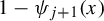 ${1-\psi _{j+1}(x)}$
tend to zero, respectively, and the numerator remains bounded and is positive near
${1-\psi _{j+1}(x)}$
tend to zero, respectively, and the numerator remains bounded and is positive near $c_j$
and negative near
$c_j$
and negative near $c_{j+1}$
. The subtrahend is bounded on an interval
$c_{j+1}$
. The subtrahend is bounded on an interval $[\delta _0, 1-\delta _0]$
. Thus,
$[\delta _0, 1-\delta _0]$
. Thus, $\bar R_{j+1}^{\prime }(x)$
tends to
$\bar R_{j+1}^{\prime }(x)$
tends to $\infty $
for
$\infty $
for $x\to c_{j}$
and to
$x\to c_{j}$
and to $-\infty $
for
$-\infty $
for $x\to c_{j+1}$
except if
$x\to c_{j+1}$
except if $c_{j}=0$
or
$c_{j}=0$
or $c_{j+1}=1$
.
$c_{j+1}=1$
.
Hence, we can conclude that $|\bar R_{j+1}(x)-\bar R_{j+1}(y)|\leq \bar R_{j+1}(c_{j}+|x-y|)-\bar R_{j+1}(c_{j})=\bar R_{j+1}(c_{j}+|x-y|)$
for
$|\bar R_{j+1}(x)-\bar R_{j+1}(y)|\leq \bar R_{j+1}(c_{j}+|x-y|)-\bar R_{j+1}(c_{j})=\bar R_{j+1}(c_{j}+|x-y|)$
for $x,y\in [c_{j}, c_{j}+\delta _0]$
and
$x,y\in [c_{j}, c_{j}+\delta _0]$
and $\delta _0>0 $
sufficiently small. Similarly, we have
$\delta _0>0 $
sufficiently small. Similarly, we have $|\bar R_{j+1}(x)-\bar R_{j+1}(y)|\leq \bar R_{j+1}(c_{j+1}-|x-y|)-\bar R_{j+1}(c_{j+1})=\bar R_{j+1}(c_{j+1}-|x-y|)$
for
$|\bar R_{j+1}(x)-\bar R_{j+1}(y)|\leq \bar R_{j+1}(c_{j+1}-|x-y|)-\bar R_{j+1}(c_{j+1})=\bar R_{j+1}(c_{j+1}-|x-y|)$
for $x,y\in [c_{j+1}-\delta _0,c_{j+1}]$
and
$x,y\in [c_{j+1}-\delta _0,c_{j+1}]$
and $\delta _0>0$
sufficiently small. However, we have
$\delta _0>0$
sufficiently small. However, we have
 $$ \begin{align*} \bar R_{j+1}(c_j-{\varepsilon}) &=\bigg(\frac{\psi_{j+1}(c_j-{\varepsilon}) (1-\psi_{j+1}(c_j-{\varepsilon}))}{(c_j-{\varepsilon})(1-c_j+{\varepsilon})}\bigg)^{\alpha}. \end{align*} $$
There exists $C_{j,\delta _0}>0$
such that
$C_{j,\delta _0}>0$
such that
 $$ \begin{align*} \bigg(\frac{\psi_{j+1}(c_j-{\varepsilon})}{(c_j-{\varepsilon}) (1-c_j+{\varepsilon})}\bigg)^{\alpha}<C_{j,\delta_0} \end{align*} $$
uniformly for all ${\varepsilon }\in (0,\delta _0)$
and thus,
${\varepsilon }\in (0,\delta _0)$
and thus,
 $$ \begin{align*} \bar R_{j+1}(c_j-{\varepsilon})&\leq C_{j,\delta_0}(\eta_+{\varepsilon})^{\alpha}. \end{align*} $$
Similarly, we have
 $$ \begin{align*} \bar R_{j+1}(c_{j-1}+{\varepsilon}) &=\bigg(\frac{\psi_{j+1}(c_{j-1}+{\varepsilon}) (1-\psi_{j+1}(c_{j-1}+{\varepsilon}))}{(c_{j-1}+{\varepsilon})(1-c_{j-1}-{\varepsilon})}\bigg)^{\alpha} \end{align*} $$
and there exists $\bar C_{j,\delta _0}>0$
such that
$\bar C_{j,\delta _0}>0$
such that
 $$ \begin{align*} \bigg(\frac{1-\psi_{j+1}(c_{j-1}+{\varepsilon})}{(c_{j-1}+ {\varepsilon})(1-c_{j-1}+{\varepsilon})}\bigg)^{\alpha}<\bar C_{j,\delta_0} \end{align*} $$
uniformly for all ${\varepsilon }\in (0,\delta _0)$
and thus,
${\varepsilon }\in (0,\delta _0)$
and thus,
 $$ \begin{align*} \bar R_{j+1}(c_j-{\varepsilon})&\leq \bar C_{j,\delta_0}(\eta_+{\varepsilon})^{\alpha}. \end{align*} $$
Setting $C=\max _j\max \{C_{\delta _0,j}, \bar {C}_{\delta _0,j}\}$
concludes the proof of the lemma.
$C=\max _j\max \{C_{\delta _0,j}, \bar {C}_{\delta _0,j}\}$
concludes the proof of the lemma.

 Open access

