

INTRODUCTION
Gender gaps in political participation are ubiquitous in democracies around the world (Coffe and Bolzendahl Reference Coffe and Bolzendahl2011; Isaksson, Kotsadam, and Nerman Reference Isaksson, Kotsadam and Nerman2014; Prillaman Reference Prillaman2021). In Pakistan, 11 million fewer women than men voted in the 2018 national election. These gaps undermine the democratic principle of participation equality (Dahl Reference Dahl1973) and preclude responsiveness to women’s distinctive preferences (Chattopadhyay and Duflo Reference Chattopadhyay and Duflo2004; Gottlieb, Grossman, and Robinson Reference Gottlieb2018; Khan Reference Khan2020). Closing gender gaps in turnout is normatively important and can potentially produce welfare gains for women, as evinced by the experience of suffrage extension (Carruthers and Wanamaker Reference Carruthers and Wanamaker2015; Lott and Kenny Reference Lott and Kenny1999; Miller Reference Miller2008; Morgan-Collins Reference Morgan-Collins2021). What works to increase women’s turnout where such gaps persist?
Classic theories of participation point to gender gaps in resources and political engagement and women’s exclusion from political networks as explanations for women’s lower participation rates (Baxter and Lansing Reference Baxter and Lansing1983; Brady, Verba, and Schlozman Reference Brady, Verba and Schlozman1995; Verba, Burns, and Schlozman Reference Verba, Burns and Schlozman1997). Policy interventions targeting women build on these theories, as they seek to increase participation through improving information, interest, civic skills, and self-efficacy among women (Galston Reference Galston2001). However, evidence of the influence of such efforts in developing countries is mixed. Giné and Mansuri (Reference Giné and Mansuri2018) find that an informational campaign targeting women in rural Pakistan increased women’s turnout. Gottlieb (Reference Gottlieb2016) finds that a civic education campaign lowered women’s political participation in Mali. Ichino and Nathan (Reference Ichino and Nathan2017) find null effects of a civic education intervention on women’s grassroots political participation in Ghana.
Interventions targeting women implicitly assume that the decision to participate in politics is one that women can make, and act on, independently. However, this may not generalize to patriarchal settings where men act as “gatekeepers” within households and women’s public engagement is subject to these men’s attitudes and behaviors. At its extreme this may be codified in de jure restrictions: in 2015, adult women in 18 countries required a male guardian’s permission to take a job (Thomson Reference Thomson2015). More common are the informal de facto restrictions on women’s movement and mobility, rooted in concerns about “safety and purity” (Becker Reference Becker2019; Jayachandran Reference Jayachandran2015; Pande Reference Pande2015). Finally, women’s public engagement may depend on men even in the absence of explicit restrictions. Across the developing world, men are more likely to control critical resources, like cellphones or means of transport, which mediate access to public life (Rosenbloom and Plessis-Fraissard Reference Rosenbloom and Plessis-Fraissard2009; Rowentree and Shanahan Reference Rowentree and Shanahan2020). Women’s participation may thus depend on men’s willingness to share such resources. Women also often depend on male accompaniment in public spaces to ensure safety of movement (Jayachandran Reference Jayachandran2015). We argue that when women’s participation is subject to male gatekeeping, which may range from direct restrictions to indirect control, engaging men is imperative to achieving gains. We provide a theoretical framework that suggests that short-term interventions may be effective when prevailing attitudes and norms are permissive of women’s participation, but women nevertheless depend on men to enable participation.
We provide causal evidence for this claim from a field experiment that studies the effects of a nonpartisan canvassing campaign conducted by local civil society organizations (CSOs) to increase women’s turnout in the 2018 national elections in Pakistan. In total, 2,500 households in our study are randomly assigned to one of four experimental conditions: a canvassing visit by a female canvasser targeted at women (T1 only), a visit by a male canvasser targeted at men (T2 only), two separate visits by female and male canvassers targeted at women and men, respectively (T1 + T2), or no visit (control). The random variation allows us to identify the causal effects of targeting canvassing efforts to women, men, or both on women voters’ turnout.
First, we measure turnout by visually verifying indelible ink marks placed on voters’ thumbs in the 2018 election. We find that targeting only women with a canvassing campaign (T1 only) is ineffective at improving women’s turnout. However, women’s turnout increases by 5.4 percentage points (p < 0.10) in households where men were canvassed (T2 only) and by 8.0 percentage points (p < 0.05) in households where both men and women were canvassed (T1 + T2). These are substantively large effects: the national gender gap in turnout in the 2018 elections was 9.1 percentage points.
Second, we document lasting changes in men’s willingness to take actions to support women’s participation using a costly behavioral measure. Two months after the election, we offer men in study households the option to post a publicly visible sticker on the entryway of their residence. We cross-randomize whether men are offered a sticker with a generic message of support for democracy or a sticker with a message of support for women’s role in democracy, which allows us to interpret difference in take-up of the two stickers as men’s willingness to publicly endorse women’s political participation. We find that men in households where both men and women are canvassed (T1 + T2) are significantly more likely to express support for women’s role in democracy than are men in control households.
Third, in an endline survey we find no evidence of lasting effects of canvassing on women’s political knowledge, interest in politics, or sense of political self-efficacy. However, in households where canvassing is targeted at both men and women, respondents are significantly more likely to report discussing politics with each other. Respondents in these households also report that men actively enabled women’s participation on election day by organizing transport and waiting for women at the polling station. We do not see evidence of such effects when only women or only men in a household are canvassed. Canvassing both men and women thus shifts outcomes beyond turnout at the household level.
Our study contributes to a rich literature on gender gaps in political participation and the “private roots of public action” (Burns, Schlozman, and Verba Reference Burns, Schlozman and Verba2001). We highlight how men within the home—generally considered the “private sphere”— shape women’s political participation. This has clear relevance for contexts where patriarchal gender norms designate male family members as gatekeepers of women’s presence in public lives. The term “gatekeeper” has been commonly used in the gender and politics literature to describe pivotal political elites who exercise decision-making power over women’s access to political office or claim of rights (Brulé Reference Brulé2020; Cheng and Tavits Reference Cheng and Tavits2011; Crowder-Meyer Reference Crowder-Meyer2013; Fox and Lawless Reference Fox and Lawless2010; Kunovich and Paxton Reference Kunovich and Paxton2005; Luhiste Reference Luhiste2015). By characterizing men within the home as gatekeepers, we join a long tradition of feminist scholarship in asserting that the private sphere has deep implications for politics.
We also contribute to an extensive field experimental literature on the effectiveness of get-out-the-vote (GOTV) campaigns in mobilizing turnout. Many studies explore the effectiveness of different modes of voter contact or of different messages delivered to voters (Green and Gerber Reference Green and Gerber2016). Although keeping the mode of contact (in-person) and message constant across treatment arms, our experiment tests the effectiveness of different targets of canvassing within households. Existing studies examining spillover effects of mobilization efforts from targeted individuals to other household members elucidate the intrahousehold dynamics of voter mobilization (Bhatti, Fieldhouse, and Hansen Reference Bhatti, Fieldhouse and Hansen2018; Foos and De Rooij Reference Foos and De Rooij2017; Nickerson Reference Nickerson2008). Our findings demonstrate the gendered nature of these household dynamics in patriarchal settings.
Our findings also provide policy lessons for closing gender gaps in participation in settings where we might think change is especially difficult. Recent studies identify the potential of targeting male decision makers in households with interventions to achieve improvements in women’s labor market participation in other patriarchal settings: India (Bernhardt et al. Reference Bernhardt, Field, Pande, Rigol, Schaner and Troyer-Moore2018) and Saudi Arabia (Bursztyn, González, and Yanagizawa-Drott Reference Bursztyn, González and Yanagizawa-Drott2020). We demonstrate that this is also a promising strategy for improving women’s political participation. A well-targeted intervention achieves substantial gains in women’s turnout, lasting changes in men’s supportive behavior toward women’s participation, increases in within-household political discussion, and sharing of resources on election day.
The remainder of the paper proceeds as follows. The following section describes our theoretical framework. Next, we provide relevant background about our study context of Lahore, Pakistan. Following this, we describe the intervention, experimental design, and data. We then present findings on women’s turnout, men’s supportive actions, and a set of secondary outcomes. We conclude with a discussion of the generalizability and scope conditions of our findings.
GENDER GAPS IN POLITICAL PARTICIPATION: THEORY AND PROSPECTS FOR CHANGE
Resources, Engagement, Mobilization
Classic models of political participation emphasize the importance of individual-level resources to explain the gender gap in participation (Brady, Verba, and Schlozman Reference Brady, Verba and Schlozman1995). Insofar as these resources are unequally distributed across men and women, the resource gap may explain observed gender gaps in participation. Moreover, the resource gap may be particularly pronounced in developing countries, where women have lower levels of education and labor force participation, and a higher burden of household responsibilities (Pande Reference Pande2011; Robinson and Gottlieb Reference Robinson and Gottlieb2021).
However, empirical evidence for purely resource-based explanations is limited (Atkeson and Rapoport Reference Atkeson and Rapoport2003; Isaksson, Kotsadam, and Nerman Reference Isaksson, Kotsadam and Nerman2014; Verba, Burns, and Schlozman Reference Verba, Burns and Schlozman1997). Several scholars instead draw attention to the gender gaps in political interest, engagement, and efficacy (Preece Reference Preece2016; Verba, Burns, and Schlozman Reference Verba, Burns and Schlozman1997). Brady, Verba, and Schlozman (Reference Brady, Verba and Schlozman1995) point to “isolation from the recruitment networks through which citizens are mobilized to politics” as an explanation for lower participation by women. Within South Asia, Prillaman (Reference Prillaman2021), Goyal (Reference Goyal2019), and Liaqat, Cheema, and Mohmand (Reference Liaqat, Cheema, Mohmand, Mufti, Shafqat and Siddiqui2020) document stark gender gaps in partisan mobilization in India and Pakistan. Khan (Reference Khan2020) shows that the gap extends beyond partisan mobilization: women in Pakistan are also less likely to be encouraged to vote by friends and family.
Taken together, this work suggests that mobilization campaigns that target women and seek to close gaps in resources and political engagement through providing information and motivational messaging ought to be effective in increasing women’s participation (Chong et al. Reference Chong, Gianmarco, Roza, Valdivia and Vega2018; Giné and Mansuri Reference Giné and Mansuri2018; Roza et al. Reference Chong, Gianmarco, Roza, Valdivia and Vega2018). However, the efficacy of this approach depends on the assumption that once gaps in resources, engagement, and mobilization are narrowed, women can autonomously decide to participate and independently act on this decision. What happens when this is not the case?
Male Gatekeeping
A rich literature demonstrates how patriarchal norms shape gender gaps in political participation across contexts (Bleck and Michelitch Reference Bleck and Michelitch2018; Brulé and Gaikwad Reference Brulé and Gaikwad2021; Chhibber Reference Chhibber2002; Robinson and Gottlieb Reference Robinson and Gottlieb2021). For our purposes, a primary implication of such norms is that they often designate male household members as gatekeepers who exercise varying levels of control over women’s participation in the public sphere. We argue that gatekeeping may manifest as direct control over women’s participation through explicit formal or informal restrictions or indirect control, whereby women depend on men to enable their participation.
Overt restrictions on women’s freedom of movement and mobility are common in many developing countries. Hanmer and Klugman (Reference Hanmer and Klugman2016) document that 31% of married women across 29 developing countries report their movement being restricted by their husbands: these restrictions encompass not being permitted to meet female friends, restrictions on contact with family, and their spouse insisting on knowing whereabouts at all times. In our urban study sample in Lahore, 60% of surveyed adult women (compared with 16% of adult men) report having to seek permission to leave the house. Male family members are thus routinely in the position to grant or deny women permission to leave the home. As Jayachandran (Reference Jayachandran2015, 78) notes, restrictions on mobility are “a proximate cause of reduced female schooling and career opportunities.” It is plausible that such restrictions would similarly constrain women’s political participation.
Even absent restrictions, women are often dependent on men to actively enable their political participation. Men control the primary resources required for participation, such as transport, physical accompaniment, and time, which can make women’s participation conditional on men making these available. For voting, a crucial resource is transport to the polling place. Although most households in our study sample own a motorbike, women rarely own or drive these and rely on male household members for everyday mobility. Moreover, street harassment and the resulting sense of feeling unsafe are common experiences for women navigating urban spaces across the world, and women often depend on male family members for accompaniment to ensure safe mobility while walking or using public transport (Borker Reference Borker2021; Bowman Reference Bowman1993; Phadke, Khan, and Ranade Reference Phadke, Khan and Ranade2011). In a conjoint survey experiment conducted in Lahore, Rahman and Thompson (Reference Rahman and Thompson2021) find that women report a higher likelihood of voting if accompanied by friends or family to the polling place, but that accompaniment does not affect men’s likelihood of voting. Finally, another relevant resource that male gatekeepers may control is time. Voting can be time consuming, and women’s participation may be restricted if men are unwilling to renegotiate household responsibilities on election day to free up women’s time to vote.
Although resource-based explanations of participation generally consider gaps in individual-level resources, our account of gatekeeping suggests a reconceptualization. Certain political resources such as transport, accompaniment, and time are necessarily shared among household members and are thus subject to intrahousehold bargaining in which men enjoy greater bargaining power over their allocation (Agarwal Reference Agarwal1997; Iversen and Rosenbluth Reference Iversen and Rosenbluth2006). This suggests the need to account for intrahousehold dynamics when designing interventions to improve women’s participation.
Male gatekeeping is likely to be most salient in “classic patriarchal” settingsFootnote 1 such as ours. However, such contexts are not monolithic: “few cultures operate with starkly dichotomous distributions of power with men making all the decisions and women making none” (Kabeer Reference Kabeer1999, 446). Some forms of women’s political participation may be subject to less restrictive forms of male gatekeeping than others. In our context, when it comes to voting, prevailing attitudes are not restrictive: in our study sample, fewer than 10% of men think it is inappropriate for women to vote and over 90% of women expect that they would have permission to vote. Attitudes are more restrictive for more involved forms of participation: only a third of men consider it appropriate for women to attend political meetings or stand for office.
Implications for Change
When can we expect short-term interventions to increase women’s political participation? In a review of gender experiments in comparative politics, Clayton and Anderson-Nilsson (Reference Clayton, Anderson-Nilsson, Druckman and Green2021, 495) note that “beliefs about gender roles tend to move slowly and are unlikely to respond to experimental interventions in the short-term.” However, canvassing campaigns, such as the one we study, seek to change political behavior in the immediate lead-up to an election. We propose a simple framework (summarized in Table 1) for thinking about the implications for change from short-term interventions under different conditions.
Expectations of Change in Women’s Political Participation from Short-Term Interventions

We characterize contexts, or forms of participation, as unconstrained by male gatekeeping when men’s attitudes and norms toward women’s participation are not restrictive and women are not dependent on men to enable participation (Cell A). In these situations, engaging men directly is unnecessary to improve levels of women’s participation and interventions can focus on women alone. Conversely, in situations where attitudes and norms toward women’s participation are prohibitive or restrictive, a short-term intervention, regardless of its target, is unlikely to produce change (Cell C).
Situations where prevailing attitudes and norms are permissive of women’s participation but where women depend on men to enable participation for the reasons discussed above provide a window of opportunity for effecting change in the short-term (Cell B). Here, interventions that encourage men to take enabling actions may be successful in improving women’s participation. Moreover, as women’s participation depends on such actions, interventions that leave men out are likely to be unsuccessful. We believe the case of women voters’ turnout in our study context falls into this category of situations.
The canvassing campaign we study involves delivering practical information on voting and motivational messaging that emphasizes the importance and benefits of women’s political participation. If individual-level informational (resource-based) or motivational (engagement-based) factors are constraining women’s participation, we would expect women’s turnout to increase when they are targeted directly by the intervention. However, our framework suggests that if women’s participation is constrained by male gatekeeping, it will be necessary to engage men to see change. Therefore, we expect that treating women alone will not result in an increase in women’s turnout, nor will it affect men’s supportive behavior.
H1: Targeting women with a nonpartisan canvassing campaign about women’s political participation will not increase women’s turnout or men’s supportive behavior.
Our framework suggests that when male gatekeeping is a constraint, efforts to improve women’s participation ought to target men within the household. With a short-term intervention, we would not expect men’s attitudes or beliefs to change but would be optimistic about men being encouraged to take enabling actions in support of women’s participation. Although we cannot directly observe actions taken between the delivery of the intervention and collection of outcome data, we test the following observable implication of our theory:
H2: Targeting men with a nonpartisan canvassing campaign about women’s political participation will increase women’s turnout and men’s supportive behavior.
Treating men and women in the same household may produce additional gains that are not realized if only men or women are treated through several possible pathways. For instance, canvassed women may become more interested and informed about the election. Because politics is generally considered a male domain, these women may not feel comfortable initiating political discussions, but they may feel more confident participating in such discussions if men initiate them after having been canvassed themselves. Increased intrahousehold political discussion may thus be more likely if both men and women are canvassed. Discussions could boost women’s turnout through reinforcement, persuasion, or information exchange (Foos and De Rooij Reference Foos and De Rooij2017) or the creation of common knowledge of household members’ permissive attitudes toward women’s voting. Another possibility is that women become more likely to ask male household members to facilitate their participation if canvassed and that men become more responsive to such requests if they have also been canvassed. Because we do not directly observe households between the intervention and the election, we cannot adjudicate between these possibilities, but we test the following observable implication:
H3: Targeting both women and men with a nonpartisan canvassing campaign will increase women’s turnout and men’s supportive behavior more than when men or women are targeted alone.
CONTEXT
Our study was conducted around the 2018 national elections in Lahore, Pakistan’s second largest city, which had a population of 11.1 million in 2017. Pakistan is a federal parliamentary democracy and has witnessed multiple cycles of authoritarian and democratic rule since independence in 1947. The 2018 elections represented the second consecutive transfer of power from one elected civilian government to another in Pakistan’s history. Adult women have had equal voting rights since independence, but severe gender inequalities in electoral participation persist. Reducing gender gaps in voter registration and turnout was a priority for the state in the lead-up to the 2018 elections.Footnote 2 Nevertheless, 11 million fewer women than men voted in the 2018 election, contributing to a 9.1 percentage-point gender gap in national-level turnout.
To understand the landscape of women’s political participation in Lahore, we draw on existing studies and a baseline survey conducted with men and women in 2,500 study households in Lahore in June 2018 prior to the roll-out of the intervention.Footnote 3
Table 2a presents baseline summary statistics on gender gaps in political resources, engagement, and mobilization in our sample. Women in our sample are less likely to have completed secondary education and report lower access to cell phones than men, which is important for access to political information. We document gender gaps in levels of political knowledge as measured through a set of questions about the 2018 election. We also observe gender gaps in political interest and efficacy and find that women in our sample are less likely to have experienced political contact from parties and representatives than men.
Baseline Summary Statistics: Resources, Engagement, and Mobilization
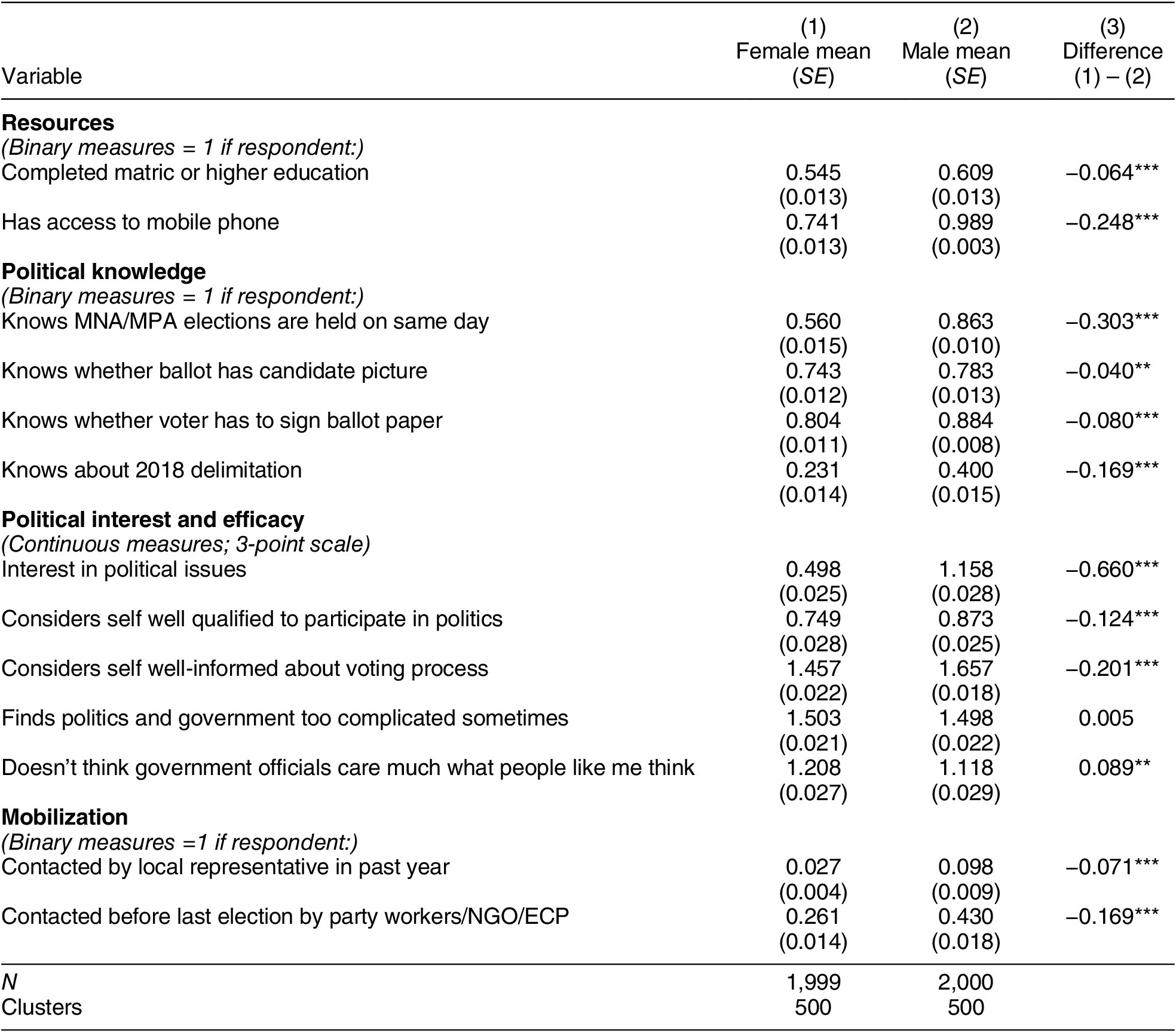
Note: The values displayed in column 3 are the differences in the means across the groups. Standard errors are clustered at the ward level. Block (Union Council) fixed effects are included in all estimation regressions. All missing values in the balance variables are replaced with the group mean. *p < 0.10, **p < 0.05, ***p < 0.01.
How prevalent is male gatekeeping in our context? Existing empirical scholarship demonstrates how gendered norms constrain women’s participation in economic and political spheres in Pakistan (Khan Reference Khan2007; Mumtaz and Shaheed Reference Mumtaz and Shaheed1987; Naqvi and Shahnaz Reference Naqvi and Shahnaz2002; Rouse Reference Rouse2004). We assess how this manifests in our sample households by examining household decision-making, mobility and attitudes toward women’s political participation (Table 2b).
Baseline Summary Statistics: Male Gatekeeping
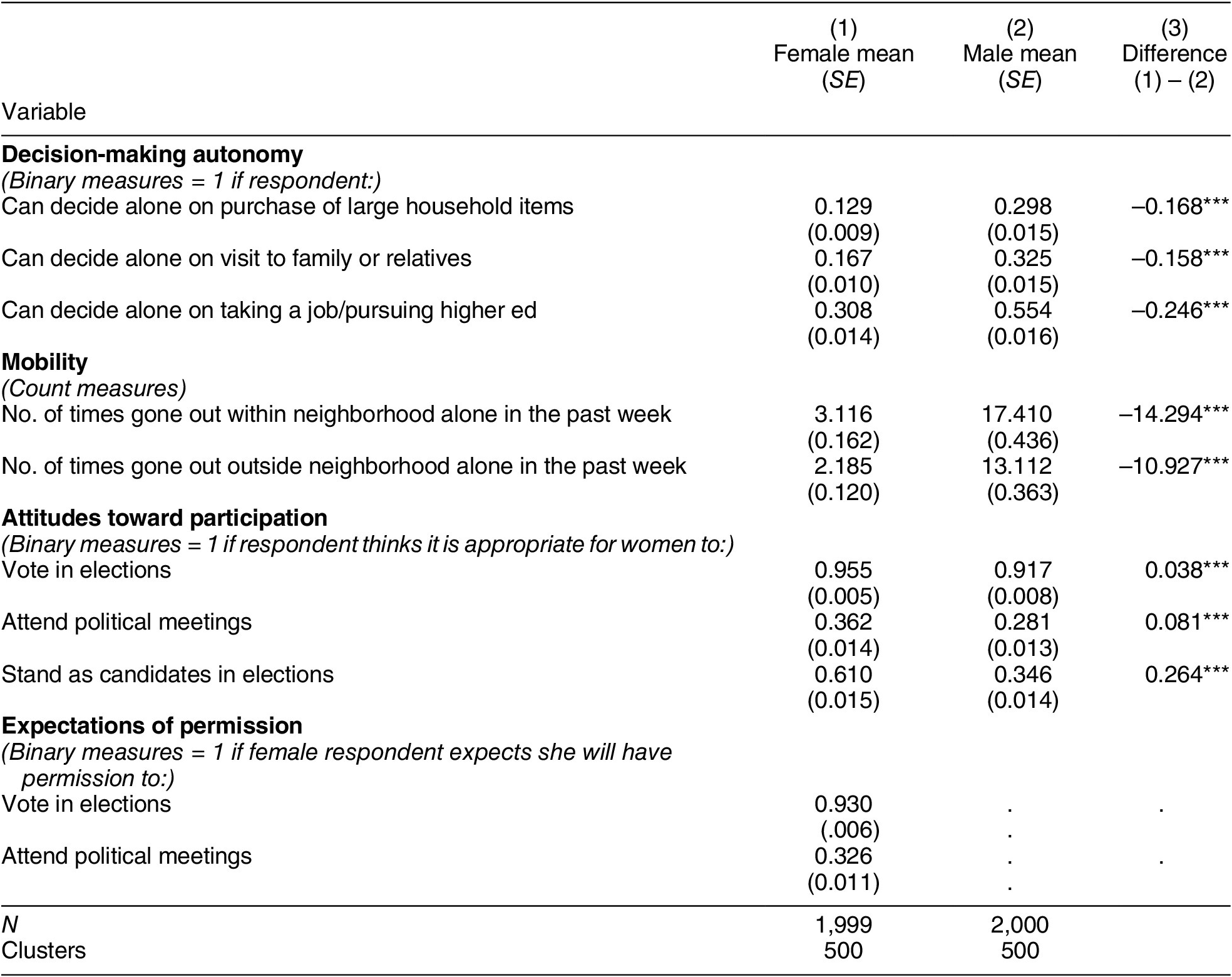
Note: The values displayed in column 3 are the differences in the means across the groups. Standard errors are clustered at the ward level. Block (Union Council) fixed effects are included in all estimation regressions. All missing values in the balance variables are replaced with the group mean. *p < 0.10, **p < 0.05, ***p < 0.01.
We find that women are systematically less likely than men to report making independent decisions about household purchases, visits to family, and pursuing employment or higher education, indicative of limited decision-making autonomy across several domains. Freedom of movement and mobility is highly gendered, as demonstrated by large differences in men and women’s frequency of travel both within and outside their neighborhoods. Furthermore, Sajjad et al. (Reference Sajjad, Anjum, Field and Vyborny2017) document that 40% of women in Lahore feel unsafe walking in their own neighborhood. Although 92% of households in our sample own a motorbike, vehicle ownership data from Lahore shows that 99% of motorbikes and 89.5% of cars in the city were owned by men in 2019.Footnote 4 In ethnographic work, Masood (Reference Masood2018) documents how women in middle- and upper-class households in Lahore are also far less likely to own a car or learn to drive.
Attitudes toward women’s political participation are not uniformly restrictive; they vary by the form of participation. Although more than 90% of men and women agree that it is appropriate for women to vote, the perceived appropriateness of women participating in political meetings or standing for political office is far lower. Furthermore, there is substantial divergence between men and women’s views on the appropriateness of these more intensive forms of participation. As described earlier, adult women report needing permission to leave their homes. Although women’s expectations of permission for voting are high, they are far more pessimistic about permission for attending political meetings.
On the one hand, observed gaps in resources, engagement, and mobilization suggest the potential efficacy of interventions that directly mobilize women into participation by providing information and motivational messaging. However, we also document that male gatekeeping is ubiquitous. Although men’s attitudes toward women’s voting are not restrictive, given the overall limitations on women’s autonomy and movement, women still depend on men to facilitate participation. This suggests that targeting men with messaging about the importance of women’s participation may encourage them to play an enabling role and is also unlikely to lead to backlash.
CANVASSING INTERVENTION
The intervention was a nonpartisan, door-to-door voter canvassing campaign directed at increasing women’s turnout in Pakistan’s 2018 national election. The campaign was conducted in July 2018 leading up to election day on July 25. It entailed a 20-minute visit by canvassers to a total of 1,500 treatment households, and was implemented by two prominent local CSOs: Aurat Foundation and South Asia Partnership-Pakistan.
The intervention comprised two types of household canvassing visits: a visit targeted at women conducted by a female canvasser or a visit targeted at men conducted by a male canvasser. A third of all treatment households received the first type of visit (T1 only), another third received the second type (T2 only), and the remaining third received both (T1 + T2). The CSOs used male (female) canvassers to target men (women) due to norms of gender segregation in the Pakistani context that limit contact between women and men. Following these norms, and to avoid introducing confounders from a joint visit, households in the T1 + T2 condition received two separate visits from female and male canvassers, who separately delivered the treatment to women and men, respectively, in the household.
To minimize systematic differences in how male and female canvassers conduct the visit, all canvassers were trained together in joint sessions and the content of the intervention was scripted. The intervention design draws on previous campaigns conducted by the CSOs and on observations from focus group discussions and interviews conducted by the authors in Lahore in early 2018.
The intervention worked as follows. Male (female) canvassers visited treatment households unannounced and requested to speak with all available adult men (women) in the household for 20 minutes about women’s participation in the upcoming election. The canvasser began with an introduction that emphasized their nonpartisan affiliation and then used a handheld tablet to show household members a 5-minute video. The video follows the narrative of a young woman facing issues of poor service delivery in her neighborhood who decides that the way to have her voice heard on these issues is to cast her vote in the upcoming election. Importantly, her brother is shown in an enabling role: he encourages her to take action and also agrees to help women in his family get to the polling station on election day on his motorbike. After showing the video, the canvasser shared procedural and practical information about the election and voting process through informational leaflets and demonstrated how to cast a ballot using props. Further details of each component are provided in Appendices A.4 and A.5.
The content delivered in the intervention bundles together motivational and informational messaging. Although a class of GOTV studies is designed to test the effect of different messaging strategies on turnout, the goal of this study is to test the effect of different targeting strategies, without varying the content that is delivered.
Ethical Considerations
In this section we discuss important ethical issues and the design choices we made to minimize risk to participants while preserving the integrity of the research.
Participant consent is the cornerstone of ethical research. For this study, participants provided oral consent to survey data collection and to participation in a research study. Participants who were assigned to the treatment conditions separately consented to receiving the intervention (Appendix A.6 includes the information scripts used). However, participants were not informed of (and thus did not explicitly consent to) being randomly assigned to a treatment or control condition or the link between the canvassing visit and the research study. These omissions were deemed necessary to avoid the possibility of participants’ behavior and responses being driven by experimenter demand effects, which would threaten the validity of causal inference.
As Clayton and Anderson-Nilsson (Reference Clayton, Anderson-Nilsson, Druckman and Green2021) note, gender-related interventions pose specific ethical challenges, including the risk of backlash in the short-term. However, they also note that this may be mitigated by taking “pre-existing household and community gendered power structures into account” (499). We may expect a heightened risk of backlash or conflict if an intervention encourages women to participate in actions that are perceived as inappropriate. To understand prevailing social norms, we conducted focus group discussions with women and interviews with men in out-of-sample localities in Lahore during the design phase of our study in early 2018. We did not find evidence of explicit prohibition, disapproval, or perceived inappropriateness of women voting. This was also echoed in our baseline survey data findings. Thus, we feel that the risk of backlash or increased intrahousehold conflict from a short-term intervention encouraging women to vote was low. Furthermore, to ensure that the intervention did not violate norms of social interaction between men and women, the CSOs used male canvassers to target men and female canvassers to target women in treatment households.
In order to undertake research involving an electoral intervention with the requisite level of legitimacy, we worked with local CSOs who had conducted voter education campaigns in past elections as implementing partners. Furthermore, the intervention was approved by the Election Commission of Pakistan (ECP), the statutory body responsible for the conduct of elections in Pakistan. Since the ECP is a nonpartisan body, the intervention too had to be nonpartisan: canvassers were trained not to disclose personal partisan preferences and to introduce themselves as nonpartisan. Officials from the ECP attended the canvassing training and reviewed and signed off on intervention materials, and each canvasser was issued ECP affiliation letters that they carried in the field.
Another consideration for an electoral intervention is the potential for effects on the electoral outcome (Desposato Reference Desposato2018). To address this, we ensured at the design stage that the intervention was “not done at a scale liable to alter electoral outcomes,” in line with APSA 2020 guidelines for “minimal social risk.” We describe this design process in Appendix A.6.
EXPERIMENTAL DESIGN AND DATA
In this section we describe the study sample and timeline, the randomization scheme, and our sources of outcome data.Footnote 5
Sample and Timeline
The sample for this study consists of 2,500 households randomly drawn from 500 wards in the city of Lahore. Within each sample household, enumerators conducted a baseline survey in June 2018 with a randomly selected man and a randomly selected woman for a total survey sample of 5,000 individuals and later recontacted sample households in an endline survey in October 2018. The surveys with men and women were conducted by male and female enumerators, respectively. After the baseline survey, we assigned study households to one of four experimental conditions. The intervention was conducted in July 2018 ahead of the general election on July 25. We measured turnout using a thumb ink verification exercise on July 26 and 27. We provide details on the study timeline in Appendix A.1 and on the sampling strategy in Appendix A.2.
Random Assignment
We use a two-stage randomization design in which clusters (wards) are first assigned to a treatment status and then a subset of households within a cluster are randomly assigned to receive treatment. The primary randomization unit is thus the ward, the lowest electoral unit of local government. We chose this as an appropriate unit due to its political significance: it is the lowest electoral constituency in local governments and parties and CSOs typically organize campaign activities at the ward level.
The experimental design is a 2 × 2 factorial producing four possible experimental conditions. These include (i) targeting women only (T1 only), (ii) targeting men only (T2 only), (iii) targeting both women and men in separate visits (T1 + T2), and (iv) control. We assign each of the 500 clusters (wards) to one of these four conditions, blocking on the union council (the lowest administrative unit in which wards are nested).
Within each cluster, we randomly assign four out of five study households to treatment and the remaining household to control. We use this “partial population design” (Baird et al. Reference Baird, Bohren, McIntosh and Özler2018) to account for the possibility of within-cluster spillovers among households in the same cluster.Footnote 6 Table 3 shows the factorial design, with sample sizes at the ward and household level.
Randomization Scheme

Statistical Balance between Treatment and Control Groups

Note: The value displayed for t tests are the p-values for differences in means across groups. Standard errors are clustered at the ward level. Block (Union Council) fixed effects are included in all estimation regressions. All missing values in the balance variables are replaced with the group mean. *p < 0.10, **p < 0.05, ***p < 0.01.
Our experimental design is powered to detect a minimum effect of a 0.067 difference in proportions for main effects of each of the two treatment arms and a 0.09 difference in proportions for comparisons of any one treatment condition to control.Footnote 7 Details of the power calculations are in Appendix A.3.
Table 4 shows that randomization achieved balance on the primary variables. We report the means and standard errors for 10 variables (measured at baseline) in each experimental condition. We also report the p values from t tests of the difference in means between the control and each of the three treatment conditions, and F statistics from tests of joint significance. We observe imbalance at the 10% level on 1 out of 30 tests, and at the 1% level on 1 test, which is roughly what would be expected by chance. We report the results on our main outcome of turnout that adjust for a set of household-level controls including these variables.
Results: Women’s Turnout (ITT)

Note: All specifications show the results using ordinary least squares estimation, including block (Union Council) fixed effects and control for individual-level randomizations. Standard errors in parentheses are clustered at the ward level. The outcome variable is women’s turnout at the household level i.e. the number of women who voted (as verified by thumb ink marks) as a proportion of women who have an identity card and are therefore eligible to vote. This table shows unadjusted results. The results from models that include a set of household-level baseline controls are reported in Appendix D.1. *p < 0.10, **p < 0.05, ***p < 0.01.
We account for the possibility that the baseline survey, which asks questions about past political participation, political preferences and attitudes, and the upcoming elections, could have served as a treatment in and of itself by raising the salience of the election. This may be of particular concern if women are systematically less likely to discuss politics (as our baseline data shows). To account for this, at the baseline stage, we randomized 20% of our sample into receiving a “no-politics” survey that only collects demographic information. This allows us to assess the causal effect of answering political questions in a survey on turnout.
Outcome Data
We draw on three sources of outcome data. First, we measure turnout using a thumb ink verification exercise conducted on July 26 and 27, 2018, starting the morning after election day. Second, we measure men’s willingness to express support for women’s role in democracy using a costly behavioral measure embedded in an endline survey conducted in October 2018. In the same endline survey, we measure self-reported outcomes related to political attitudes, knowledge, and behaviors.
Turnout
Most GOTV studies conducted in the United States rely on publicly accessible voter records to verify turnout. Such administrative records are not available in our context. We measure turnout by leveraging an aspect of the electoral process: the marking of voters’ thumbs with indelible ink by polling officers.Footnote 8 Measuring turnout by directly observing indelible ink on voters’ thumbs requires considerable effort, not least because the ink is clearly visible during the first two to three days after being applied but begins to fade quickly after that. This is especially true for women who are responsible for washing clothes and dishes. We conducted a turnout verification exercise in which a team of 50 enumerators visited all 2,500 study households in the two days immediately following the election and visually verified turnout among household members by observing the indelible ink marks on voters’ thumbs
Enumerators attempted to verify the turnout of both men and women in study households. However, because the verification exercise had to be conducted over only two days in order to reach study participants across 2,500 households before ink marks faded, only 1 verification visit per household was possible. Because women’s turnout is our primary outcome of interest, enumerators visited households during daytime when women were most likely to be available to speak to them. This differed from the process of contacting households for the baseline and endline surveys, where the time constraint for completion was less strict and enumerators could make up to three visits, to accommodate men and women’s different schedules. Because men in our sample are more likely to be employed, far fewer men per household could be reached to verify turnout than women. Therefore, we focus on women’s turnout as our main outcome.
We define our primary outcome measure as the number of women in each household who voted (as verified by thumb ink marks) as a proportion of the total number of women in the household who have an identity card and are therefore eligible to vote. We are able to verify women’s turnout in 86% of our sample households. With this measure, we overcome the challenge of measuring turnout reliably using self-reported measures of voting, which are notoriously prone to overreporting (Adida et al. Reference Adida, Gottlieb, Kramon and McClendon2019; Dahlgaard et al. Reference Dahlgaard, Hansen, Hansen and Bhatti2019). Although researchers have explored methods to decrease overreporting in a survey (e.g., Morin-Chassé et al. Reference Morin-Chassé, Bol, Stephenson and St-Vincent2017), in our case the intervention itself could affect individuals’ desire to report that they voted, making self-reported measures particularly unreliable.
Men’s Lasting Support for Women’s Participation
We use a behavioral measure to ascertain whether the intervention increased men’s willingness to support women’s political participation. At the end of our follow-up survey in October 2018, in which we were able to recontact 97% of the original study households, the enumerators asked male respondents whether they would like to place a sticker on the entryway to their residence. Half of the male respondents in each treatment condition were randomly assigned to being offered a sticker with a message of generic support for democracy, whereas the other half were randomized to being offered a sticker with a message of support for women’s role in democracy. The Urdu text on the generic support sticker translates to “Strong Democracy, Strong Pakistan,” printed twice on the sticker. The women’s support sticker includes the above message once, with the second iteration replaced by “Democracy is incomplete without the inclusion of women.” Images of the stickers are reproduced in Appendix B.1. Assignment to sticker type was cross-randomized across treatment groups as shown in Figure 1. If the respondent accepted the sticker, the enumerator placed it on the entryway to the respondent’s residence immediately.
Randomization Scheme for Behavioral Outcome Measure

Because urban Lahore is extremely denseFootnote 9 and residence entryways open directly on to streets, a sticker posted on an entryway is visible to many pedestrians including neighbors. Furthermore, stickers placed on entryways, similar to lawn signs in the United States context, are a common way to indicate support for parties or candidates. Therefore, we interpret a respondent’s decision to accept a sticker as a costly measure of their willingness to express support.
Randomizing the choice of sticker offered allows us to isolate men’s endorsement of the sticker message as the reason behind any differences in take-up of the two stickers in a relatively unobtrusive way. Differences in the relative take-up of the stickers between the control and treatment conditions can be interpreted as the causal effect of treatment on men’s willingness to publicly express support for women’s role in democracy. In using an experimental outcome measure, we follow a tradition within experimental economics and political science of using randomized choices (including recently Bursztyn et al. Reference Bursztyn, González and Yanagizawa-Drott2020) when offering a full set of options would confound interpretation.
Self-Reported Survey Data
We collect endline data from our 2,500 study households to measure effects on self-reported attitudes and behavior. We conducted this survey in October 2018 and were able to reach 97% of the original study households from baseline. We use this survey to investigate whether the intervention had lasting effects on knowledge, attitudes, and self-reported behavior relevant to political participation. We thematically group survey questions into six indices: (i) political knowledge, (ii) interest in politics, (iii) self-efficacy, (iv) attitudes toward men imposing restrictions on women’s voting, (v) election day help from men, and (vi) political discussion between household members. The supplementary materials include the text of the survey questions that were used to construct these indices.
RESULTS
Compliance and Recall
We measure compliance with treatment using information recorded by canvassers in a checklist for each treatment household. A household is considered a complier if the canvasser could successfully deliver the intervention within three attempts. If the canvasser was unable to deliver the intervention after the third attempt at contact, we consider the household to be a noncomplier. Households that were assigned to T1 + T2 (2 separate visits targeted at women and men, respectively) are considered compliers if both visits could be successfully conducted within three attempts. Compliance rates are 96.6% in T1 only, 96.4% in T2 only, and 94.8% in T1 + T2. The rate is slightly lower in T1 + T2 due to the higher bar for compliance (completion of two successful visits targeted at women and men, respectively). As a manipulation check, in the follow-up survey we ask study participants whether they recall the canvassing visit. Recall of the canvassing visit is overall low (at most 25% among respondents from targeted households), but it is significantly higher in all treatment conditions relative to the control (Figure 2). Low recall may be due to the two-month gap between the intervention and the endline survey or because the intervention happened during a time of general high volume of campaign activities in the lead-up to the election. Overall, 13%–14% of respondents in the control condition recall receiving a visit, which may be due to exposure to informational campaigns being conducted by the Pakistan Election Commission during this period.
Visit Recall, by Treatment Group and Respondent Gender
Note: The bars depict the proportion of respondents who answered yes to the question “Did representatives from Aurat Foundation, SAP-PK, or ECP visit your household in the days leading up to the election?” The error bars represent the 95% confidence interval.

We also find that men in households assigned to receive a visit targeted only to women (T1 only) are as likely as the targeted women to recall the visit. However, women in households assigned to receive a visit targeted only to men (T2 only) are no more likely than women in the control group to recall the visit. This gender disparity in recall is consistent with canvassers’ field experiences: male canvassers reported that they would often speak with men outside the home and were not invited inside; conversely female canvassers were usually invited inside the home to speak with women. This explains why women who may have been inside the home may not recall visits by male canvassers in the T2 condition. It also underscores the gendered challenges associated with voter mobilization in Pakistan and the need to use female canvassers to interact directly with women in this study.
Women’s Turnout
Does the intervention achieve its intended goal of increasing women’s participation as voters in the 2018 election? We test this by estimating the household-level intent-to-treat (ITT) effect of being randomly assigned to receive each type of canvassing visit: targeted only at women (T1 only), targeted only at men (T2 only), or both visits (T1 + T2) on the proportion of women who turnout to vote in each household. Additionally, leveraging our full-factorial design, we measure the overall effects of canvassing visits targeted at women (T1) or men (T2) and the interactive effect of these factors.
Effects of Canvassing Only Women, Only Men, and Both
In Table 5, column 1, we estimate the ITT effect of canvassing visits targeted at just women, just men, and both men and women by comparing households in each treatment category to households in the control condition.
 $$ {Y}_i={\displaystyle \begin{array}{l}{\beta}_1T1{Only}_i+{\beta}_2T2{Only}_i+{\beta}_3{\left(T1+T2\right)}_i\\ {}+\hskip2px {\beta}_4{Within}_i+{\delta}_i+{\gamma}_s,\end{array}} $$
where T1Onlyi, T1Onlyi and (T1 + T2) i are indicators for whether the household i received only a canvassing visit targeted at women, only a visit targeted at men, or both types of visits. Withini is an indicator for whether household i was a control household within a treatment cluster, δi controls for cross-randomized individual-level treatments,Footnote 10 and γs are block (union council) fixed effects. Yi denotes the proportion of women who turn out at the household level, measured by verified thumb ink impressions as described in the previous section. Standard errors are clustered at the ward level, which is the level of randomization.
Effect of Canvassing Women or Men
In Table 5, columns 2 and 3, we estimate the ITT effect of canvassing visits targeted at women or men, respectively, by pooling together households that were assigned to receive a canvassing visit targeted at women (men) only or men and women both and comparing them to the households in the control condition or households assigned to receive a canvassing visit targeted only at men (women).
 $$ {Y}_i={\beta}_1{Treatment}_i+{\beta}_2{Within}_i+{\delta}_i+{\gamma}_s, $$
where Treatmenti is an indicator for whether the household i received a canvassing visit targeted at women (men).
Interaction Effect
In Table 5, column 4, we estimate the ITT interaction effect of the two factors in our design using the following specification:
 $$ {Y}_i={\beta}_1T{1}_i+{\beta}_2T{2}_i+{\beta}_3{\left(T1\ast T2\right)}_i+{\beta}_4{Within}_i+{\delta}_i+{\gamma}_s, $$
where (T1*T2) i is an indicator for the interaction between T1 and T2.
Testing the effects of the three treatment types separately using specification 1 (column 1, Table 5, and Figure 3), we find no evidence of effects on women’s turnout in households where only women were canvassed (T1 only). We find that canvassing only men (T2 only) and canvassing both men and women (T1 + T2) increases women’s turnout. In households where just men were targeted with a canvassing visit, the proportion of women turning out increases by 5.4 percentage points (significant at the 10% level). In households that receive two canvassing visits—one targeted at women (T1) and one at men (T2)—the proportion of women turning out increases by 8.0 percentage points (significant at the 5% level). The overall effect of canvassing women on women’s turnout is insignificant (column 2); however, the overall effect of canvassing men has a positive effect on women’s turnout, increasing the proportion of women turning out by 6.1 percentage points (significant at the 5% level) as shown in column 3, Table 5.
Women’s Turnout at the Household Level, ITT by Treatment Category
Note: Ordinary least squares coefficients from Table 5, Column 1. The thin and thick error bars represent the 90% and 95% confidence interval around the estimate, respectively.

The interaction term in column 4 is positive but insignificant. This is because although the additional positive effect of canvassing men beyond canvassing women (T1 + T2 vs. T1) is significant at the 5% level (p = 0.03), the additional effect of canvassing women beyond canvassing men (T1 + T2 vs. T2) is not significant (p = 0.33).
Across specifications, we do not observe any effects on individuals in control households within treatment wards, suggesting that there are no discernible spillover effects of the treatments on nearby households. We also test whether these spillovers differ for within-treatment control households in each of the three treatment conditions and do not find evidence of such differences (Appendix D.3).
Taken together, the results suggest that targeting women with a canvassing campaign is insufficient to increase women’s turnout. On the other hand, we find strong evidence that canvassing men is necessary to improve the turnout of women in their households, in line with our expectations for effecting change in situations where male gatekeeping is a constraint. Although we see the largest positive effects on women’s turnout in the condition where both men and women are targeted with the intervention, we cannot reject the equivalence of T2 only (canvassing just men) and T1 + T2 (canvassing both men and women) from our data.
Robustness and Additional Analysis
Because we could not reach some of our original study households in the turnout verification exercise, we address possible threats to inference from attrition. Regressing an indicator for attrition on indicators for the three treatment conditions and testing for the difference of coefficients in this model, we find no evidence of differential attrition between treatment and control or between different treatment conditions (Appendix Table D.6). Nevertheless, we estimate Lee trimming bounds on the treatment effects in Appendix Table D.7 (Lee Reference Lee2009). The upper and lower bounds of the treatment effects for T2 and T1 + T2 are minimally different in magnitude and remain statistically significant in both cases.Footnote 11 Thus, we conclude that it is unlikely that our main results are biased by attrition.
In addition to the ITT effects on women’s turnout, we also estimate the complier average causal effects (CACE; Appendix D.4). We record high rates of compliance and do not observe any substantive differences in the size of coefficients.
We also account for the possibility that discussing politics in the baseline survey could have served as a treatment in and of itself. We estimate our preferred specification including an indicator for whether a respondent was randomly assigned to answer a version of the baseline survey that included political content. We do not find any evidence that answering questions about politics at baseline affects women’s turnout (Appendix D.6).
We address the possibility that the effects of canvassing both men and women could be driven by the fact that a larger number of household members are canvassed in this treatment condition (Appendix D.7). We test for heterogeneity in each treatment category by the level of treatment “dosage” (measured as the number of individuals canvassed according to canvasser checklists). We find no effects of treating additional household members on turnout within any of the treatment conditions. This suggests that the effects of the T1 + T2 treatment are not driven by the larger number of individuals canvassed in this condition.
Men’s Lasting Support for Women’s Participation
Does the intervention make men more willing to take actions in support of women’s participation two months after the election? Our theory of male gatekeeping suggests that men’s support is an important outcome of interest. We use a behavioral measure of such support by assessing the willingness of men in each experimental condition to accept a sticker with a message supporting women’s role in democracy (relative to a generic sticker supporting democracy).
In order to estimate the effect of treatment on men’s expression of support, we use a set of difference-in-difference estimates comparing the relative take-up of the two stickers in each of the three experimental conditions to the relative take-up in the control condition. Table 6 shows the difference in take-up between the two stickers within each treatment condition (columns 1 and 2), and the difference in this difference between each of the treatment conditions and control (columns 3 and 4).
Results: Men’s Support for Women’s Role in Democracy

Note: This table shows the effects of the three treatment conditions on the relative take-up of the two stickers by men. Column 1 shows the point estimate of difference in take-up between the two stickers for each treatment group, with negative values indicating that the take-up of the sticker supporting women’s role in democracy was lower than that of the generic sticker. Robust standard errors for this difference clustered at the ward level are shown in parentheses below. Column 2 shows the p values for the difference in take-up of the two stickers within each group. Column 3 shows the point estimate of the difference in this difference between each of the treatment groups and the control group. Robust standard errors for this difference-in-difference estimate clustered at the ward level are shown in parentheses below. Finally, column 4 shows the p values for the difference-in-difference estimates.
We find that men in the control condition are 4.1 percentage points less likely to accept the sticker with a message of support for women’s role in democracy than to accept the generic sticker. Men in T1 only are 4.8 percentage points less likely to accept the women’s support sticker. This preference for the generic sticker in both the control and T1-only group is significant at the 5% level. As shown in Table 6 column 3, the difference in the relative take-up is not significantly different between the control condition and T1 or between the control condition and T2. Men in the T1 + T2 condition, on the other hand, are 2.1 percentage points more likely to accept the women’s support sticker. The difference in relative take-up of the two stickers between T1 + T2 and the control is 6.2 percentage points with p = 0.012 (Table 6, columns 3 and 4).
Thus, there is strong evidence that canvassing both men and women had a lasting positive effect on men’s willingness to take supportive action, an effect not seen when only men or only women are canvassed. Moreover, unlike results on turnout where the effects of canvassing both men and women are indistinguishable from canvassing just men, Appendix D.8 shows that the effect of T1 + T2 on men’s supportive behavior is significantly higher than the effect of T1 at the 1% level and T2 at the 10% level. We interpret this as suggestive evidence of additive effects of canvassing both men and women.
Political Knowledge, Attitudes, and Behaviors
We use questions asked during an endline survey to investigate whether the canvassing intervention affected index measures of (i) political knowledge, (ii) interest in politics, (iii) self-efficacy, (iv) attitudes toward men imposing restrictions on women’s voting, (v) election day help from men, and (vi) political discussion between household members. The results are shown in Figure 4. Appendix C.1 shows the corresponding regression table, and Appendix C.3 shows results on the individual components of index-based measures.
Knowledge, Attitudes, and Behavior ITT by Respondent Gender and Treatment Category
Note: Estimates are coefficients from ordinary least squares models that include block (Union Council) fixed effects and indicators for within treatment controls and control for individual-level randomizations. The thin and thick error bars represent the 90% and 95% confidence interval around the estimate, respectively.

We find no evidence that canvassing—regardless of whether it is targeted at women, men, or both—has an effect on political knowledge, stated level of interest in politics, or sense of self-efficacy. We also do not find any effects on attitudes about the appropriateness of men restricting women’s ability to vote under a set of different conditions. This is in line with our expectations that achieving attitudinal change on gender attitudes and norms in the short-term is difficult.
However, we do find effects of the canvassing treatment when it is targeted at both men and women on two types of self-reported behaviors. First, in households where the canvassing was targeted at both men and women, women are more likely to report that men provided help to them in voting on election day. The index measure of such help includes sharing household chores, organizing transport to the polling station, and waiting for women at the polling station. This is corroborated by men’s responses: male respondents in these households are more likely to say that they personally took these actions. Second, women (men) in these households are about 6 (8) percentage points more likely to report that they discussed politics with other men (women) in their household. This indicates that there is more political discussion between men and women in households where both were canvassed. We do not see these effects in households where only women or only men were canvassed, adding to the evidence that canvassing both women and men has additive effects.Footnote 12
To account for multiple comparisons, we run our analysis pooling male and female respondents in the sample and report adjusted test statistics using the Bonferroni correction, the Benjamini–Hochberg procedure, and sharpened false discovery rate (FDR) q values (Anderson Reference Anderson2008). These results are reported in Appendix C.2. We find that the results on men’s help on election day remain significant at the 10% level with all three approaches; the results on political discussion remain significant at the 10% level under the Benjamini–Hochberg correction procedure and the sharpened false discovery rate approach.Footnote 13
Autonomous Participation
A strategy that relies on canvassing men may have pernicious implications for women’s participation if it leads men to coerce women into voting a particular way. Do the improvements that are achieved in women’s turnout through this intervention come at the cost of women’s autonomy, defined as “the control women have over their own lives” (Jejeebhoy and Sathar Reference Jejeebhoy and Sathar2001, 688)? We answer this question focusing on women’s control over the voting decision.
Autonomy is challenging to measure; many empirical studies measure either its “proxies” or enabling conditions (Agarwala and Lynch Reference Agarwala and Lynch2006; Seymour and Peterman Reference Seymour and Peterman2018). We draw on the relative autonomy index developed by psychologists (Ryan and Deci Reference Ryan and Deci2000), which assesses “to what extent the motivation behind actions is driven by an individual’s own goals, or externally regulated through internalized social pressure or coercion” (Donald et al. Reference Donald, Koolwal, Annan, Falb and Goldstein2020, 204). The measure has been adopted in international development research and validated in various cultural contexts (Gram et al. Reference Gram, Morrison, Sharma, Shrestha, Manandhar, Costello, Saville and Skordis-Worrall2017; Vaz, Pratley, and Alkire Reference Vaz, Pratley and Alkire2016). An adaptation involves presenting respondents with vignettes that correspond to different motivations for a particular action. We adapt these vignettes to voting as follows and ask respondents which vignette they most closely identify with:Footnote 14
-
1. Coercion: Asma supports a candidate because her spouse or another person or group in her community tells her this is the person to support. She does what they tell her and doesn’t feel that she can do differently.
-
2. Social Pressure: Salma supports the candidate that most people in her family or community expect. No one tells her what to do, but she knows who others support and supports that person. She wants them to approve of her making the right decision.
-
3. Autonomy: Zakia supports the candidate she personally likes and thinks is going to perform well. If she changes her mind, she could support someone else.
Using a multinomial logit model regressing women’s choice of vignette on treatment conditions, with “Autonomy” as the base choice, we do not find evidence of significant changes in women’s self-identification with other vignettes under any treatment condition (Table 7). However, the consistent direction away from identification with the “Autonomy” vignette under T1 does raise the possibility that encouraging women to participate in an action without changing the enabling environment could heighten their sense of lacking autonomy.
Results: Autonomy Vignettes, ITT Survey Measure Among Women Respondents

Note: Results from multinomial logit specification. Standard errors in parentheses are clustered at the ward level. Coefficients can be interpreted as the change in multinomial log odds of choosing a vignette relative to the base choice (autonomy vignette). *p < 0.10, **p < 0.05, ***p < 0.01.
DISCUSSION
In patriarchal settings, gender gaps in political participation are often undergirded by deep intrahousehold inequalities that make women’s participation contingent on male household members’ attitudes and behavior. Our findings demonstrate the potential for short-term change in contexts of “classic patriarchy,” without having to fundamentally alter the status quo of gender relations.
We expect our findings to generalize to contexts where women’s ability to independently make and act on decisions about their economic, social, and political participation is limited and subject to gatekeeping by men in their households. Pakistan is one of several developing countries where adult women continue to require de facto permissions from male household members to take up jobs, vote, engage in public action, and continue with education and face restrictions on freedom of movement (Hanmer and Klugman Reference Hanmer and Klugman2016; Jayachandran Reference Jayachandran2015). Thus, the evidence of gains from a short-term intervention is promising and suggests optimism for broader applicability to other settings where gender gaps in participation persist alongside patriarchal norms.
Relevant scope conditions to consider are the form of participation and the nature of male gatekeeping. We expect short-term interventions to be effective for public actions not deemed inappropriate for women but which nevertheless register gender gaps in participation. These may include voting in similar contexts but also certain types of labour force participation, participation in neighbourhood associations, and maybe even secondary and higher education.
We would be cautious about the potential for short-term interventions to change women’s participation in actions prohibited or restricted under prevailing social norms, for instance standing for office. Here, longer term engagement to shift attitudes would be necessary. A caveat is that individuals may overestimate just how restrictive attitudes and norms toward women’s participation truly are. Gulzar, Khan, and Sonnet (Reference Gulzar, Khan and Sonnet2020) demonstrate that this is the case for beliefs around women’s participation in the Khyber Pakhtunkhwa province of Pakistan. Such cases provide a window of opportunity: short informational interventions to correct misperceptions can be effective in achieving change. For instance, Bursztyn et al. (Reference Bursztyn, Callen, Ferman, Gulzar, Hasanain and Yuchtman2020) find positive effects of an informational intervention correcting men’s beliefs about other men’s actual levels of support for women’s labor force participation in Saudi Arabia.
How do our findings comport with the existing literature? First, we believe our theoretical framework provides a useful way to understand the null and negative findings of interventions in other developing countries targeted primarily at women to improve their political participation (Gottlieb Reference Gottlieb2016; Ichino and Nathan Reference Ichino and Nathan2018). However, Giné and Mansuri (Reference Giné and Mansuri2018) document positive effects of targeting women with an informational campaign in the 2008 election in Pakistan. Importantly, their study setting is rural Sindh, rather than an urban metropolis. This is an important difference, with implications for the extent to which women depend on men to enable participation. Various scholars have documented that women in rural areas of Pakistan enjoy relative freedom of movement within their villages and that their mobility is constrained when crossing village boundaries (Cheema et al. Reference Cheema, Khwaja, Naseer and Shapiro2020; Gazdar Reference Gazdar2003; Jacoby and Mansuri Reference Jacoby and Mansuri2015; Mumtaz and Salway Reference Mumtaz and Salway2009). As polling stations in the Giné and Mansuri (Reference Giné and Mansuri2018) study tend to be located within village boundaries, women are less likely to depend on men to enable participation through sharing transport and accompaniment than the women in our urban setting.Footnote 15 Moreover, the women in the Giné and Mansuri (Reference Giné and Mansuri2018) study had especially low resources—only 18% of the women in their sample have any formal schooling (compared with 54% of women having completed secondary schooling in our sample). This raises an important question for future research: might purely resource-based interventions targeted at women be effective when baseline levels of resources are especially low?
How does our intervention address the existing landscape of political mobilization in Pakistan and similar contexts? Political parties already tend to target male heads of households under an equilibrium of family-centered clientelism (Prillaman Reference Prillaman2021). Moreover, they are limited in their ability to directly target women due to a largely male pool of party brokers (Goyal Reference Goyal2019; Liaqat Reference Liaqat2020). If, as we demonstrate, canvassing men works to improve women’s turnout, why do gender gaps persist? A possible reason is that partisan messaging does not focus on women’s participation regardless of its target. This differs from the messaging in our intervention, which explicitly centers on the importance of women’s participation and encourages men to support it. Whether more gender-inclusive partisan messaging can improve women’s turnout is a fruitful question for future inquiry.
Finally, our study shows how to achieve change in the short-term within a status quo that designates men as gatekeepers. However, as Moeller (Reference Moeller2019) writes, “we also need interventions to transform the patriarchal relations between men and women that enable these statistics to be true.” We agree and would add that the findings of our study may be interpreted as a call for transformative change to the fundamentally unequal status quo that makes women’s participation conditional on male gatekeepers in the first place.
Supplementary Materials
To view supplementary material for this article, please visit http://doi.org/10.1017/S0003055422000375.
DATA AVAILABILITY STATEMENT
Research documentation and data that support the findings of this study are openly available at the American Political Science Review Dataverse: https://doi.org/10.7910/DVN/OMPDH0.
FUNDING STATEMENT
This research was conducted as part of the Action for Empowerment and Accountability (A4EA) Research Programme (PO 7239), funded by the UK Foreign, Commonwealth and Development Office (FCDO - formerly DFID) based at the Institute of Development Studies, University of Sussex. We also acknowledge funding from the United States Institute of Peace (USIP) Pakistan Peace Fund.
ACKNOWLEDGMENTS
We are indebted to Aurat Foundation and South Asia Partnership–Pakistan, in particular Mumtaz Mughal and Mohammad Tahseen, and a team of dedicated canvassers for conducting the intervention. We thank the Election Commision of Pakistan (Punjab), the National Commission on the Status of Women in Pakistan, the Action for Empowerment and Accountability (A4EA) Research Programme team, especially Jenny Edwards, at the Institute of Development Studies (University of Sussex), and Sajid Maruf Khan and Basma Masud at the Institute of Development and Economic Alternatives (IDEAS) for supporting this study. We thank Bilal Sami for producing the short film “Vote” for the intervention and the enumerator team at the IDEAS Survey Wing, led by Mohammad Malick and Ahsan Tariq for expert data collection. Ahsan Zia Farooqi, Anam Kuraishi, Wardah Wasim Mirza, Fatiq Nadeem, Deepika Padmanabhan, Shanze Fatima Rauf and Sherazam Tiwana provided excellent research assistance. For valuable feedback we are grateful to Sam Asher, Colin Anderson, Faisal Bari, Rachel Brule, Nikhar Gaikwad, John Gaventa, John Huber, Macartan Humphreys, Mala Htun, Torben Iversen, Anuradha Joshi, Ayesha Khan, Asim Ijaz Khwaja, Rabea Malik, Ghazala Mansuri, Khawar Mumtaz, Sohela Nazneen, Vincent Pons, Gautam Rao, and Dawn Teele, as well as participants at the NEWEPS, MIT Political Behavior of Development, SAIS-Carnegie South Asia Political Economy, PacDev, NYU CESS Experimental Political Science, APSA and MPSA conferences/workshops, and the following seminar audiences: the Lahore University of Management Sciences, IDS Sussex, London School of Economics, UC Berkeley, University of Michigan, University of Wisconsin-Madison, Boston University, Harvard University, and Yale University. Finally, we thank the APSR editorial team and four anonymous reviewers for their comments.
CONFLICT OF INTEREST
The authors declare no ethical issues or conflicts of interest in this research.
ETHICAL STANDARDS
The authors declare the human subjects research in this article was reviewed and approved by the Harvard University IRB and Columbia University IRB and certificate numbers are provided in the supplementary materials. The authors affirm that this article adheres to APSA’s Principles and Guidance on Human Subject Research.


 Open access


Comments
No Comments have been published for this article.