




The succession at Andrarum, southern Sweden is of critical importance for elucidating Cambrian geology and palaeontology. Euan N. K. Clarkson (1937–2024), an outstanding geologist and palaeontologist, perhaps best known for his seminal research on trilobites and his benchmark text-book on invertebrate palaeontology and evolution, engaged in studies of this key locality over many years. Already in the early 1970s, Euan became interested in olenid trilobites from the Cambrian Alum Shales of Scandinavia, and in 1973 he published on the morphology and evolution of the eyes of these trilobites (Clarkson Reference Clarkson1973). Following a three-month sabbatical at Lund University in 1993, Euan’s interest and research on the ontogeny, evolution, functional morphology and life habits of the olenids developed rapidly. He became a frequent guest at the Department of Geology in Lund, pursuing extensive field work and studying the ontogenetic stages and evolution of various olenid species in the Furongian (‘upper’ Cambrian). This research was largely carried out in collaboration with Per Ahlberg, Kristina Månsson, Cecilia M. Taylor and the late John ‘Jompa’ Ahlgren (1934–2025). One of the key sites for his research was the old quarries at Andrarum in eastern Scania (Skåne), southernmost Sweden (Fig. 1); this research generated a series of seminal papers on the Alum Shales together with its olenid trilobites. The present paper describes the Alum Shales and the old alum shale workings at the classical locality of Andrarum, highlighting Euan Clarkson’s contributions to the study of olenid trilobites and faunal dynamics in the Furongian.
Location of Andrarum and distribution of the Alum Shales, modified from Ahlberg et al. (Reference Ahlberg, Axheimer, Babcock, Eriksson, Schmitz and Terfelt2009, fig. 1): (a) map showing the distribution of Cambrian deposits in Scandinavia; (b) outcrop areas of the Alum Shale Formation (in black) in the province of Scania (Skåne), Sweden, and the location of Andrarum; (c) the old quarries at Andrarum and the location of the drill site for the Andrarum-1 and Andrarum-3 boreholes. The Andrarum-2 borehole is outside the map area, ca. 500 m SE of Christinehof Castle.

1. The Scandinavian Alum Shales
The upper Miaolingian (‘middle’ Cambrian) through lower Tremadocian (Lower Ordovician) Alum Shale Formation of Scandinavia consists predominantly of dark grey to black, siliciclastic mudstones and shales with generally subordinate limestone beds and concretionary lenses, referred to as orsten or stinkstone (for general reviews, see Martinsson Reference Martinsson and Holland1974; Bergström & Gee Reference Bergström, Gee, Gee and Sturt1985; Andersson et al. Reference Andersson, Dahlman, Gee and Snäll1985; Maas et al. Reference Maas, Braun, Dong, Donoghue, Müller, Olempska, Repetski, Siveter, Stein and Waloszek2006; Eriksson & Waloszek Reference Eriksson and Waloszek2016). It was deposited in an extensive, sediment-starved and poorly-oxygenated epicontinental sea that covered most of Scandinavia and surrounding areas (e.g., Thickpenny Reference Thickpenny, Stow and Piper1984, Reference Thickpenny, Leggett and Zuffa1987; Clarkson & Taylor Reference Clarkson and Taylor1995a; Egenhoff et al. Reference Egenhoff, Fishman, Ahlberg, Maletz, Jackson, Kolte, Lowers, Mackie, Newby and Petrowsky2015; Nielsen & Schovsbo Reference Nielsen and Schovsbo2015; Schovsbo et al. Reference Schovsbo, Nielsen, Harstad and Bruton2018). It is therefore rich in organic matter (up to 25 wt. % total organic carbon, TOC) and also enriched in trace elements, such as uranium (U), vanadium (V) and molybdenum (Mo) (Buchardt et al. Reference Buchardt, Nielsen and Schovsbo1997; Schovsbo Reference Schovsbo2001, Reference Schovsbo2002).
Anoxic and perhaps even euxinic bottom-water conditions prevailed during much of its deposition, but these were interrupted by brief oxygenation events of 600–3000 years duration (Dahl et al. Reference Dahl, Siggaard-Andersen, Schovsbo, Persson, Husted, Hougård, Dickson, Kjær and Nielsen2019). As evidenced by the TOC and the occurrence of redox sensitive trace elements, such as U and Mo, oxygen depletion reached its highest levels during the Furongian Epoch (e.g., Andersson et al. Reference Andersson, Dahlman, Gee and Snäll1985; Bian et al. Reference Bian, Schovsbo, Chappaz, Zheng, Nielsen, Ulrich, Wang, Dai, Galloway, Malachowska, Xu and Sanei2021). The globally significant Steptoean Positive Carbon Isotope Excursion (SPICE) has been recognized in the lower–middle Paibian Stage of the Alum Shale Formation (Ahlberg et al. Reference Ahlberg, Lundberg, Erlström, Calner, Lindskog, Dahlqvist and Joachimski2019, Reference Ahlberg, Axheimer, Babcock, Eriksson, Schmitz and Terfelt2009; Hammer & Svensen Reference Hammer and Svensen2017; Zhao et al. Reference Zhao, Ahlberg, Thibault, Dahl, Schovsbo and Nielsen2022). This positive δ13Corg shift of up to ∼3.0 ‰ in shale sequences in Baltica is coincident with a global anoxic episode associated with enhanced burial of organic carbon and pyrite (Saltzman et al. Reference Saltzman, Ripperdan, Brasier, Lohmann, Robison, Chang, Peng, Ergaliev and Runnegar2000; Gill et al. Reference Gill, Lyons, Young, Kump, Knoll and Saltzman2011; LeRoy & Gill Reference LeRoy and Gill2019; see Pulsipher et al. Reference Pulsipher, Schiffbauer, Jeffrey, Huntley, Fike and Shelton2021 for a general review). Based on the presence of bioturbation in shales throughout the SPICE interval at Andrarum, Egenhoff et al. (Reference Egenhoff, Fishman, Ahlberg, Maletz, Jackson, Kolte, Lowers, Mackie, Newby and Petrowsky2015), however, argued for intermittently dysoxic conditions during deposition through the SPICE event.
The thickest and stratigraphically most complete successions of the Alum Shale Formation are in Scania and in the Oslo Region of Norway (Buchardt et al. Reference Buchardt, Nielsen and Schovsbo1997, fig. 2; Schultz et al. Reference Schultz, Biermann, van Berk, Krüger, Straaten, Bechtel, Wirth, Lüders, Schovsbo and Crabtree2015). In these areas the alum shales were largely deposited in outer-shelf settings, and are up to approximately 100 m thick. In other parts of southern Scandinavia, the Alum Shale Formation is considerably thinner and several stratigraphical gaps of various magnitudes occur within the succession (Martinsson Reference Martinsson and Holland1974; Schovsbo et al. Reference Schovsbo, Nielsen, Harstad and Bruton2018; Nielsen et al. Reference Nielsen, Høyberget and Ahlberg2020).
Views of the abandoned alum industry at Andrarum: (a) heaps with burnt Alum Shale at Andrarum; (b) the ruined boiler house (pannhuset) at the southeastern end of the South Quarry in Andrarum where the leachate was boiled and then left to cool until alum crystals precipitated. Both photos by Per Ahlberg 2010.

In Sweden, exploitation of the Alum Shale has periodically occurred since the 1600s. The rock has been utilized in calcination, for alum production, for oil extraction, as a raw material in the production of lightweight concrete (aerated concrete or “blue concrete”), and most recently (1965–1969) for uranium extraction (for brief reviews, see Andersson et al. Reference Andersson, Dahlman, Gee and Snäll1985; Ladenberger et al. Reference Ladenberger, Blomskog, Morris, Camitz and Pitcairn2024). The production of lightweight concrete ceased in 1975 when the construction industry had become sufficiently aware of the risks associated with radiation, but houses built of blue concrete were still appearing until 1980.
2. The alum industry of Andrarum
Along the Verkeån rivulet, about 10 km from the east coast of Scania and 800–900 m east of Christinehof Castle, lie the remains of the old alum works at Andrarum (Figs 1, 2), which in the 18th century were the leading alum producers in the Nordic region and the largest industrial site in Scania. Here, an archive from a long-gone era is preserved—breaking the black shales apart is like flipping through a diary nearly 500 million years old. The old alum works are protected, not only because they are located within the Verkeån Nature Reserve, the largest nature reserve in Scania, but also because they constitute a historical monument—here, cultural history and natural science are combined in spectacular fashion.
Large brick-red waste heaps with crushed and burnt shale (Swedish rödfyr; Fig. 2a), a grand, whitewashed warehouse building from the 1740s and a few picturesque, often thatched half-timbered houses are today the only tangible evidence that a significant chemical-technical industrial operation once dominated the region. The foundation of the operation was the black shale, which was mined from the mid-17th century until the early 20th century. The shale is called alum shale because it was quarried for the extraction of alum (potassium aluminium sulphate), a salt that was used as a mordant in dyeing yarn, for tanning leather, production of paper and varnishes, and to fire-proof paper and cloth. In medicine, alum acted as a styptic (to staunch bleeding) and disinfecting agent. It has also been widely used for preserving and bleaching flour.
2.1. Alum and alum production
Alum was known already in ancient times (Stoltz Reference Stoltz1932; Levey Reference Levey1958); the Romans referred to this salt as alumen. It was initially extracted mainly from the mineral alunite, which is common in some volcanic regions and was roasted in furnaces, resulting in alum that could be leached from the burnt mass with water (Andersson Reference Andersson1974). The leachate produced alum crystals after boiling. Eventually, it was discovered that alum could also be extracted by heating black shales that were crushed and then leached (Stoltz Reference Stoltz1932; Millard Reference Millard1999).
The alum shale of Scandinavia was mined in opencast mines and then burned for as long as organic material remained in the shale (up to three months). High temperatures (∼700°C) resulted in oxidation of the pyrite and the formation of sulphuric acid and iron oxide. During this process, the acid reacted with the silicate minerals and alum salt was formed (e.g., Falk et al. Reference Falk, Lavergren and Bergbäck2006). The burnt shale was then leached with water, and after boiling the leachate was left to cool until alum crystals were precipitated. At the Andrarum works, barrels of alum were then transported by horse and cart to the ports in Åhus and Kivik at the east coast and for a period, also to a private port at the mouth of the Verkeån rivulet (Stoltz Reference Stoltz1932). When the operations at the works were at their most intense, the yellowish-white, sulphur-smelling smoke hung heavily over large parts of the area (Andersson Reference Andersson1974).
2.2. History of exploitation
The alum industry at Andrarum was founded by a Danish nobleman, Jochum Beck (1604–1682), who understood that the production of alum from alum shale could yield greater returns than using the shale for lime burning (Stoltz Reference Stoltz1932; Carlsson Reference Carlsson1996). In 1637, he received the Danish King Christian IV’s charter to establish the alum works at Andrarum. However, the production of alum was delayed for a couple of years after diligent experimentation of the processes, but by the early 1640s, the operation had started (Stoltz Reference Stoltz1932). Jochum Beck, however, encountered significant technical problems, and the industry suffered during the Danish-Swedish War of 1643–1645.
The alum industry was rebuilt after the war, and production of alum could once again commence, and production was gradually stabilized. However, Beck had large debts and was in the hands of several creditors. After much struggle, this once wealthy man (“Rich Beck”) died disappointed and impoverished in 1682. Despite the complicated ownership relations of the operation with several co-owners, both during and after Beck’s lifetime, alum production steadily increased during the final decades of the 17th century (Stoltz Reference Stoltz1932).
The alum industry had its heyday during the 18th century when it was owned by Christina Piper (née Törne; 1673–1752; Fig. 3). This successful entrepreneur and business-minded woman was married to Count Carl Piper, one of the most favoured advisors of the Swedish monarch Charles XII, and brought a very substantial fortune as her dowry (Norrhem Reference Norrhem2010). In 1710, she began purchasing shares in the Andrarum alum works, and by 1725, she was the sole owner of the works. Under her leadership, there was a community of around 900 people, a school, a hospital, a retirement home, a prison, and its own mint—the coins/currency were only valid within the works (Andersson Reference Andersson1974; Carlsson Reference Carlsson1996). Andrarum gradually developed into a self-sufficient state within the state, with its own craftsmen and its own laws. However, during the 19th century, the shortage of forests and firewood became increasingly evident, and by the end of the century, competition from industrially produced alum became increasingly cut-throat, while other chemical products gradually began to replace alum (Andersson Reference Andersson1974). The operations therefore decreased, and the production of alum completely ceased in 1912. However, as late as the 1930s, red paint, a by-product of alum production, was still being produced. Another important by-product was iron vitriol (iron sulphate). More importantly, however, the industry exposed a unique Cambrian succession.
Portrait of Christina Piper in 1715. Photo Jens Mohr, The Royal Armoury (Livrustkammaren) and National Historical Museums, Sweden.

3. Early explorations of the Alum Shale at Andrarum
The Forsemölla-Andrarum district is a classical area for Cambrian rocks in Baltoscandia. Material representing the species Olenus truncatus was described and illustrated already by Bromell (Reference Bromell1729). Two decades later, Andrarum was visited by Carl von Linné in 1749, and both the operation in the alum works and the shale were briefly described in his “Skånska resa” (Journey through Skåne) from 1751. However, it was not until the second half of the 19th century that a relatively good understanding of the stratigraphy and the fossil content began to emerge, primarily through the pioneering works of Alfred Gabriel Nathorst (1850–1921; Fig. 4a), Gustaf Linnarsson (1841–1881), and Sven Axel Tullberg (1852–1886; Fig. 4b).
Early explorers of the Alum Shale at Andrarum: (a) already as a student at Lund University and only 19 years old, Alfred G. Nathorst described the Cambrian succession at Andrarum. Photo A. Dahllöf 1903; (b) Sven Axel Tullberg first studied botany but later specialised in geology and palaeontology. One of his first works in the latter field was on agnostoids from the Cambrian succession at Andrarum. From Svenskt Porträttgalleri.

Already when a student at Lund University, Nathorst was inspired by Nils Peter Angelin (“Sten-Petter”; 1805–1876; Tersmeden Reference Tersmeden2018) to study the Cambrian deposits in Skåne. They travelled together through the province in the summer of 1868, during which Nathorst had the opportunity to examine the stratigraphy at Andrarum for an extended period. The year after, he published his first scientific paper in which he subdivided the succession into different biozones and established the relative age relationships of the strata (Nathorst Reference Nathorst1869). Eight years later (1877), he provided a more detailed description of the stratigraphy, following a trip to Andrarum in the summer of 1876 in the company of the Norwegian geologist Waldemar Christofer Brøgger (1851–1940). Nathorst later became a prominent and internationally recognized geologist, palaeobotanist, and polar researcher, serving as a professor at the Swedish Museum of Natural History in Stockholm.
Nathorst’s fundamental works were in the 1870s and 1880s followed by more detailed studies by Linnarsson (Reference Linnarsson1875, Reference Linnarsson1880, 1883) and Tullberg (Reference Tullberg1880). Gustaf Linnarsson was an eminent palaeontologist at the Geological Survey of Sweden and one of the most original and successful geologists of the 19th century (Lapworth Reference Lapworth1882). He authored a large number of publications on the Cambrian–Silurian succession of Sweden, but unfortunately his life was cut short at the age of 39 years by pulmonary tuberculosis. The Lund geologist, palaeontologist, and botanist Sven Axel Tullberg has been described as a highly gifted and passionate scholar, and was obsessively interested in women (Hadding Reference Hadding1942; Henriksson Reference Henriksson1994). Despite passing away at a young age and being affected by a serious illness towards the end of his life, he published several influential papers. In his classic graduate thesis (Tullberg Reference Tullberg1880) on Cambrian agnostoids from Andrarum, he described some ten new species and provided a detailed account of the succession. The thesis included a map of the quarries and the location of important sections. This map has been reproduced in, or served as a basis for, many later works on the Alum Shales at Andrarum, for example in Westergård’s (1922) comprehensive and classical monograph on the upper Cambrian of Sweden.
4. Succession and fossil content
4.1. Succession and quarries
Although largely covered by scree and vegetation, the undeformed and continuous Miaolingian through Furongian succession is still partially exposed in the old quarries at Andrarum. Sections and localities were described in detail by Tullberg (Reference Tullberg1880), Moberg (Reference Moberg1910) and Westergård (Reference Westergård1922). The succession predominantly consists of alum shales interbedded with subordinate concretionary limestone lenses and a couple of prominent limestone beds (Fig. 5), including the Wuliuan Forsemölla and Exsulans Limestone beds, the upper Drumian and/or the lower Guzhangian Hyolithes Limestone Bed, the Guzhangian Andrarum Limestone Bed, and thin equivalents to the upper Guzhangian–lower Paibian Kakeled Limestone Bed. The three main alum shale quarries are: (1) The Deep, in Swedish Djupet, (2) the Great Quarry, and (3) the South or Small Quarry, in Swedish Södra or Lilla brottet (Fig. 1c). These lie in a north-west to south-east sequence parallel to the Verkeån rivulet, and because the strata dip gently towards the south-east, virtually the entire Miaolingian through Furongian succession is present within the quarries (cf. Moberg Reference Moberg1910). Large parts of the quarries are, however, now filled with water and most of the succession is covered by scree and soil, or is overgrown, especially in The Deep and in the South Quarry near the ruined boiler house (Pannhuset; Figs 1, 2b).
(a) Overview of a section through the uppermost Miaolingian–lower Furongian Alum Shales in the northern part of the Great Quarry at Andrarum. Photo Per Ahlberg 2012; (b) limestone concretion (stinkstone) embedded in alum shale in the northern part of the Great Quarry at Andrarum. The lens is ca 0.7 m in diameter. Photo Per Ahlberg 2010.

Two core drillings (Andrarum-1 and Andrarum-2) carried out in 1941–42 have shown that the Alum Shale Formation in the Forsemölla-Andrarum district has a thickness of at least 76 m (Westergård Reference Westergård1942, Reference Westergård1944). Within this succession, approximately 24–25 m belongs to the Miaolingian, 44 m to the Furongian, and more than 8 m to the Tremadocian portion of the Alum Shale Formation (‘Dictyonema shale’). Cambrian Series 2 and lower Miaolingian strata are exposed at Forsemölla, north of Andrarum (e.g., Bergström & Ahlberg Reference Bergström and Ahlberg1981; Cederström et al. Reference Cederström, Geyer, Ahlberg, Nilsson and Ahlgren2022). The exposed succession in the central quarry (the Great Quarry) spans the upper Guzhangian Agnostus pisiformis Zone through the Paibian Olenus scanicus Zone. Some of the higher zones in the Furongian were locally exposed in the South Quarry (Westergård Reference Westergård1922; Ahlberg et al. Reference Ahlberg, Månsson, Clarkson and Taylor2006).
The best exposures are in the north-central part of the Great Quarry (Fig. 5). In the northernmost end of the quarry, the shales yield abundant flattened olenid trilobites and agnostoids, as well as numerous three-dimensionally preserved specimens in the stinkstones. Here, the lower 7 m comprises the uppermost zone in the Miaolingian, i.e. the Agnostus pisiformis Zone, and the upper 3 m represent the lower Furongian Olenus gibbosus–O. dentatus zones (Westergård Reference Westergård1922, fig. 4). In addition to Olenus species, the upper zones generally yield Agnostus (Homagnostus) obesus in abundance. In the global agnostoid zonation, the Olenus zones are equivalent to the Glyptagnostus reticulatus Zone (Ahlberg & Terfelt Reference Ahlberg and Terfelt2012; Nielsen et al. Reference Nielsen, Høyberget and Ahlberg2020).
4.2. Fossil content and faunal diversity
The Alum Shales at Andrarum are generally richly fossiliferous and, collectively, a large biota has been recorded. The fauna is dominated by trilobites and agnostoids, which form the basis for a detailed biostratigraphical framework that to a large extent has been applied also in Poland, England, Wales and eastern Canada. Trilobites and agnostoids are generally confined to the stinkstones; the intervening shales can be largely unfossiliferous. In parts of the succession, however, well-preserved though flattened trilobites and agnostoids are present in vast numbers in the shales. In addition to trilobites and agnostoids, brachiopods, hyoliths, phosphatocopines and conodonts (including proto- and paraconodonts) may also be common in certain intervals, particularly in the stinkstones. Noteworthy among the brachiopods is a mass occurrence of the benthic orthide Orusia lenticularis in stinkstones of the Furongian Parabolina spinulosa Zone in the northwestern end of the South Quarry (Westergård Reference Westergård1922). Its opportunistic occurrence most likely represents intervals when the sea floor was more oxygenated than usual and firm enough to allow colonisation by sessile organisms.
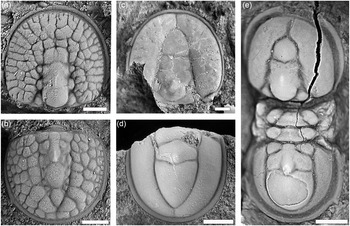
Approximately 190 trilobite and agnostoid species are known from the Cambrian at Andrarum. Of these, at least 110 are from the Miaolingian succession and the remaining (∼80 species) from the Furongian. Andrarum is also the type locality for numerous species. Amongst these, can be noted two agnostoids having a wide geographical and nearly global distribution: Ptychagnostus atavus (Tullberg, Reference Tullberg1880) (Fig. 6c, d) and Glyptagnostus reticulatus (Angelin, Reference Angelin1851) (Fig. 6a, b), both of which have been used for defining Cambrian stages. Thus, the Global boundary Stratotype Section and Point GSSP for the base of the Drumian Stage, the middle stage of the Miaolingian Series, coincides with the First Appearance Datum (FAD) of P. atavus, and the base of the Paibian Stage, the basal stage of the Furongian Series, coincides with the FAD of G. reticulatus (Peng et al. Reference Peng, Babcock, Robison, Lin, Rees and Saltzman2004; Babcock et al. Reference Babcock, Robison, Rees, Peng and Saltzman2007). The highest faunal diversity (more than 30 species of trilobites and agnostoids) has been recorded in the Miaolingian Andrarum Limestone (Westergård Reference Westergård1946, Reference Westergård1953).
Agnostoids are important for global correlations and chronostratgraphical subdivision of Cambrian strata. All specimens except (e) are deposited in the type collections at the Department of Geology, Lund University (LO). (a) Glyptagnostus reticulatus, cephalon from Krokagården, Kinnekulle, south-central Sweden, original of Ahlberg & Ahlgren (Reference Ahlberg and Ahlgren1996, fig. 4I), LO 7333t; (b) Glyptagnostus reticulatus, pygidium from Krokagården, Kinnekulle, south-central Sweden, original of Ahlberg & Ahlgren (Reference Ahlberg and Ahlgren1996, fig. 4M), LO 7337t; (c) Ptychagnostus atavus, cephalon from a loose stinkstone at Forsemölla near Andrarum, original of Tullberg (Reference Tullberg1880, pl. 1, fig. 1a, c) and Westergård (Reference Westergård1946, pl. 11, fig. 8), lectotype, LO 354T; (d) Ptychagnostus atavus, pygidium from a loose stinkstone at Forsemölla near Andrarum, original of Tullberg (Reference Tullberg1880, pl. 1, fig. 1b, d) and Westergård (Reference Westergård1946, pl. 11, fig. 10), syntype, LO355T; (e) Agnostus (Homagnostus) obesus, nearly complete specimen from the Olenus wahlenbergi Zone at Andrarum, original of Westergård (Reference Westergård1922, pl. 1, fig. 4a, b) and Ahlberg & Ahlgren (Reference Ahlberg and Ahlgren1996, fig. 3G), Swedish Geological Survey (SGU) Type 122a. Scale bars represent 1.0 mm.

5. A renaissance in the 1990s and 2000s
In the decades around the turn of the 21st century, Euan Clarkson (Fig. 7) initiated a number of projects on the ontogeny, evolution, functional morphology and lifestyles of olenid trilobites from the Furongian at Andrarum and elsewhere in southern Sweden. These projects were largely conducted in collaboration with researchers from Lund University, and the results of the investigations have been elegantly summarised in Clarkson (Reference Clarkson2011).
Euan Clarkson and Niklas Axheimer at the northwestern end of the South Quarry, Andrarum. Photo Fredrik Terfelt 2004.

In addition to these projects, geochemical and sedimentological evidence along with biofacies analyses in the Furongian of Andrarum have been used in an attempt to build up a more coherent picture of the Alum Shale environment and its inhabitants (Eriksson & Terfelt Reference Eriksson and Terfelt2007; Ahlberg et al. Reference Ahlberg, Axheimer, Babcock, Eriksson, Schmitz and Terfelt2009; Gill et al. Reference Gill, Lyons, Young, Kump, Knoll and Saltzman2011; Egenhoff et al. Reference Egenhoff, Fishman, Ahlberg, Maletz, Jackson, Kolte, Lowers, Mackie, Newby and Petrowsky2015; Rooney et al. Reference Rooney, Millikin and Ahlberg2022). A drill core (Andrarum-3) was carried out in the north-western end of the South Quarry in late September–early October 2004, just northeast of locality 5 of Westergård (Reference Westergård1922, fig. 3; Fig. 1c herein). It reached a depth of 31.30 m and penetrated the Parabolina spinulosa Zone (Jiangshanian Stage) down into the Ptychagnostus atavus Zone (Drumian Stage). A δ13Corg curve from the core revealed the presence of the prominent and globally recognised Steptoean Positive Carbon Isotope Excursion (SPICE) in the Paibian Stage, beginning near the FAD of Glyptagnostus reticulatus and extending upwards into the lower Olenus scanicus Zone (Ahlberg et al. Reference Ahlberg, Axheimer, Babcock, Eriksson, Schmitz and Terfelt2009).
The Furongian Alum Shale is dominated by polymerid trilobites of the Family Olenidae. They occur in immense numbers from the basal zone, i.e. the Olenus gibbosus Zone, and onwards to the top of the Cambrian. They are generally most common in the limestone concretions and beds, where they are usually found as disarticulated specimens. In some parts of the succession, however, notably in Scania, they are also present in the shales and here they are often found complete or near-intact. Usually only one species belonging to a single genus, and very rarely more than three genera, are present at each level (e.g., Clarkson & Taylor Reference Clarkson and Taylor1995b; Clarkson Reference Clarkson2011). Since the species turnover rate was very high, a very precise biostratigraphy based on successive olenid species was established by Westergård (Reference Westergård1922, Reference Westergård1947) and Henningsmoen (Reference Henningsmoen1957). Their zonations have subsequently been revised (Terfelt et al. Reference Terfelt, Eriksson, Ahlberg and Babcock2008; Nielsen et al. Reference Nielsen, Weidner, Terfelt and Høyberget2014) and currently 23 biozones, allocated to six superzones and linked to four agnostoid zones, are recognised (Nielsen et al. Reference Nielsen, Høyberget and Ahlberg2020).
5.1. Olenid ontogenies
Since olenids often are represented at all growth stages in the material from Andrarum, the ontogenies of successive species and genera can be described in detail, allowing assessment of the role of heterochrony in their evolution. Euan Clarkson realised the potential of the Alum Shales for such studies and published a series of papers on the ontogeny of the olenids between 1995 and 2016 (Clarkson & Taylor Reference Clarkson and Taylor1995a; Clarkson & Ahlberg Reference Clarkson and Ahlberg2002; Bird & Clarkson Reference Bird and Clarkson2003; Clarkson et al. Reference Clarkson, Taylor and Ahlberg1997, Reference Clarkson, Ahlgren and Taylor2003, Reference Clarkson, Ahlgren and Taylor2004; Månsson & Clarkson Reference Månsson and Clarkson2012, Reference Månsson and Clarkson2016). On the basis of excellently-preserved material in stinkstone slabs from Andrarum, the ontogeny of the following species was described in three separate papers: Olenus wahlenbergi Westergård, Reference Westergård1922 (Fig. 8), Parabolina spinulosa (Wahlenberg, Reference Wahlenberg1818) and Protopeltura aciculata (Angelin, Reference Angelin1854).
Nearly complete specimen of Olenus cf. wahlenbergi from the Great Quarry at Andrarum. Department of Geology, Lund University, No. LO 12537t. Photo Per Ahlberg 2011. Scale bar represents 10 mm.

All growth stages in O. wahlenbergi, from the anaprotaspis and onwards, were elucidated in a comprehensive paper by Clarkson & Taylor (Reference Clarkson and Taylor1995a). In that paper, SEM photographs were used for reconstructions of all smaller stages and for describing cuticular structures, such as tubercles, granules, pits, cell polygons and anastomosing caeca. For the first time, Clarkson & Taylor (Reference Clarkson and Taylor1995a) also described a structured median occipital organ in a Cambrian trilobite.
Because Olenus is one of the earliest olenid genera and Parabolina occurs next in the succession, Clarkson et al. (Reference Clarkson, Taylor and Ahlberg1997) undertook an equivalent study on the ontogeny of the latter genus. The ontogeny of the type species of the genus, P. spinulosa, was described, largely on the basis of old collections from the northwestern end of the South Quarry. Protaspides are rare, but the surface of one stinkstone slab is covered with immature specimens including complete specimens ranging from early meraspides to young holaspides. Parabolina is considered to have evolved from the earlier genus Olenus (Westergård Reference Westergård1922; Henningsmoen Reference Henningsmoen1957) and, as described by Clarkson et al. (Reference Clarkson, Taylor and Ahlberg1997), their ontogenies are broadly similar. On the basis of comparative ontogeny, they also showed that many, though not all, features of Parabolina appear to be of paedomorphic origin and the evolution of the genus is best considered in terms of a mosaic paedomorphocline (Clarkson et al. Reference Clarkson, Taylor and Ahlberg1997).
The ontogeny of Protopeltura aciculata, the earliest known pelturine olenid, was described in the third paper (Månsson & Clarkson Reference Månsson and Clarkson2012). A large proportion of the material was collected in 2008 by the authors at the northwestern end of the South Quarry. Månsson & Clarkson (Reference Månsson and Clarkson2012) concluded that P. aciculata shows major intraspecific variations throughout development, especially regarding the pygidium where variation is much less constrained than in many other olenids. This high developmental plasticity may have been a survival strategy for a trilobite living in a stressed environment with low oxygen levels (Månsson & Clarkson Reference Månsson and Clarkson2012).
5.2. Microevolution and faunal dynamics
A critical review of microevolutionary transformations and the origin of marine invertebrate species was published by Clarkson (Reference Clarkson1988). In that paper he emphasised that the most reliable data are based on microstratographic sampling through unbroken sedimentary sequences and on a finely resolved biostratigraphy with precise stratigraphical control; a bed-by-bed field strategy adopted by Charles Lapworth for his ground-breaking research on the graptolites of the Southern Uplands of Scotland (Lapworth Reference Lapworth1879–1880). Since the Alum Shale Formation at Andrarum is generally richly fossiliferous, condensed and virtually complete, the succession is ideal for testing processes and patterns in microevolution. Kaufmann (Reference Kaufmann1933) collected through a 2.5-m-thick section in the Great Quarry and recorded four successive lineages of Olenus, each of them showing a narrowing and lengthening of the pygidium. This has been regarded as a classic example of iterative evolution where similar trends arise in successive stocks from a more or less unchanging ancestral stock. However, Hoffmann & Reif (Reference Hoffmann and Reif1994) have shown that the Kauffman’s data do not unequivocally support Kaufmann’s interpretation of iterative evolution, largely because the number of specimens measured was too small, the species lack clear autapomorphic characters and their interrelationship and lateral distribution is unknown (see also Lauridsen & Nielsen Reference Lauridsen and Nielsen2005).
In 1993, Euan Clarkson and co-workers sampled and examined a 1.8-m-thick section near the northern end of the Great Quarry in order to establish how trilobite populations fluctuated through time. The section is still accessible and extends from the top of the Olenus truncatus Zone upwards into the lower O. attenuatus Zone. Successive bedding planes were examined, at 1-cm intervals where possible, and for each surface all trilobite sclerites, and a few near-intact specimens, were counted within a 5×5 cm quadrat. The shale sequence is lithologically variable suggesting an environment that fluctuated within relatively narrow limits (Clarkson et al. Reference Clarkson, Ahlberg and Taylor1998). It was shown that Olenus spp. and Agnostus (Homagnostus) obesus (Fig. 6e) are very common, but their abundances fluctuate dramatically and in the lower–middle part of the sequence they are almost mutually exclusive (Clarkson et al. Reference Clarkson, Ahlberg and Taylor1998; cf. Schovsbo Reference Schovsbo2000; Fig. 9 herein). It was also observed that Glyptagnostus reticulatus and the phosphatocopine arthropod Cyclotron sp. are rare and confined to particular levels. Clarkson et al. (Reference Clarkson, Ahlberg and Taylor1998) postulated that Cyclotron seems to have lived in conditions which no other, or very few, preservable invertebrates could tolerate, perhaps very low oxygen levels. Geochemical evidence suggests, however, that some trilobite- and agnostoid-barren intervals might be the result from an excess in oxygen remobilising the unconsolidated mud and dissolving the calcareous-shelled fossils (Schovsbo Reference Schovsbo2000, Reference Schovsbo2001; see also Eriksson & Terfelt Reference Eriksson and Terfelt2007).
Log showing relative abundance of fossil genera at different levels in a 1.8-m-thick measured section near the north end of the Great Quarry at Andrarum. The lengths of the coloured horizontal scale bars indicate the abundance of individuals for each level, at 1-cm intervals where possible. For each surface trilobite exuviae, and rare complete specimens, were counted within a 5×5 cm quadrat. The counting units and the coloured key are as follows: For Agnostus (Homagnostus) obesus, A = complete individual (3 units), B = cephalon (1 unit), C = pygidium (1 unit), D = isolated thoracic tergite (1/2 unit). For Olenus, A = complete individual (6 units), C = intact thorax (1 unit), D = cranidium (1 unit), E = pygidium (1 unit), F = isolated thoracic tergite (1/15 unit), G = hypostome (1 unit), H = isolated librigena (1/2 unit). The vertical scale is in centimetres counted below and above the 1-cm-thick Main Clay Horizon. The horizontal scale represents numbers of specimens counted at each level. For fuller explanation, see Clarkson et al. (Reference Clarkson, Ahlberg and Taylor1998). Figure redrawn and slightly amended from Clarkson et al. (Reference Clarkson, Ahlberg and Taylor1998, fig. 2, in Faunal dynamics and microevolutionary investigations in the Upper Cambrian Olenus Zone at Andrarum, Skåne, Sweden. GFF 120, 257–267, copyright © 1998 Geologiska Föreningen, reprinted by permission of Informa UK Limited, trading Taylor & Francis Group, https://www.tandfonline.com on behalf of Geologiska Föreningen).

Fortey (Reference Fortey2000) showed that there is a correlation between the presence and abundance of pyrite and the abundance of Olenus truncatus and O. wahlenbergi in the section measured by Clarkson et al. (Reference Clarkson, Ahlberg and Taylor1998), and also that Cyclotron appears and olenids disappear completely when there is no pyrite. This prompted Fortey (Reference Fortey2000) to suggest that at least some olenid trilobites were chemoautotrophic symbionts adapted to low-oxygen, sulphur-rich sea-floor conditions.
Another very detailed bed-by-bed study in the Leptoplastus Superzone (Jiangshanian Stage) in the western part of the South Quarry (at ‘rännil b’ of Persson Reference Persson1904; locality 6 of Westergård Reference Westergård1922, fig. 3) showed that particular faunal associations are often confined to discrete sedimentary packages, or arise after an unfossiliferous interval though some species may range through several sedimentary changes (Ahlberg et al. Reference Ahlberg, Månsson, Clarkson and Taylor2006). Thus, the incoming of new genera or species within this succession is apparently linked to abrupt sedimentary changes or follows an unfossiliferous interval. In the lower two zones, the olenid assemblages are monospecific, but at the base of the overlying Leptoplastus crassicornis–L. angustatus Zone more than one species is present and new morphotypes with long genal spines appear for the first time (Ahlberg et al. Reference Ahlberg, Månsson, Clarkson and Taylor2006). As noted by Clarkson in Ahlberg et al. (Reference Ahlberg, Månsson, Clarkson and Taylor2006), this morphological innovation presaged the even more dramatic modifications seen in later leptoplastine genera, such as Ctenopyge and Sphaerophthalmus.
6. Concluding remarks
Geological research in the Forsemölla-Andrarum district dates back as far as the mid-1800s and investigations by many generations of geologists have made it a classical area for Cambrian stratigraphy and palaeontology in Baltoscandia. A particularly active period of research occurred during the last two decades of the 19th century and the early 20th century. Subsequent geological studies in the early–mid 1900s include detailed investigations of both outcrops and drill cores (Westergård Reference Westergård1922, Reference Westergård1942, Reference Westergård1944). Since then, the objective of the research has been to clarify as much as possible about the Alum Shale environment and its faunas. Several of these projects were initiated by Euan Clarkson and focused on studying evolutionary processes and patterns in the olenids, and on faunal dynamics and their relations with environmental fluctuations in the Furongian.
The Cambrian succession at Andrarum is condensed but remarkably complete stratigraphically and not affected by faulting or folding. It was deposited in an outer shelf setting and is dominated by black shales and siliciclastic mudstones. Because there was generally a high rate of faunal turnover and most trilobites and agnostoid species have short ranges, the succession at Andrarum largely forms the basis for the detailed ‘middle’ and ‘upper’ Cambrian (Miaolingian–Furongian) biostratigraphy of Scandinavia as outlined by Westergård (Reference Westergård1946, Reference Westergård1947, Reference Westergård1953) and revised by Terfelt et al. (Reference Terfelt, Eriksson, Ahlberg and Babcock2008), Weidner & Nielsen (Reference Weidner and Nielsen2014), Nielsen et al. (Reference Nielsen, Weidner, Terfelt and Høyberget2014, Reference Nielsen, Høyberget and Ahlberg2020) and Weidner et al. (Reference Weidner, Nielsen and Ebbestad2023). Furthermore, the succession has been the subject of a great deal of palaeontological research since the pioneering work of Angelin (Reference Angelin1851, Reference Angelin1854), and Andrarum is the type locality for numerous trilobites and agnostoids, several of which have utility for intercontinental correlations. Also, the last four decades have witnessed major efforts to increase our knowledge of the stratigraphy, sedimentology, palaeontology and geochemistry of the Alum Shale, and the Andrarum section is significant in understanding the Cambrian world.
Acknowledgements
We are indebted to Niklas Axheimer for redrawing figure 2 in Clarkson et al. (Reference Clarkson, Ahlberg and Taylor1998, fig. 2), Fig. 9 herein. We are greatly indebted to Alan W. Owen and the journal reviewers Jan Ove R. Ebbestad and Arne T. Nielsen for critically reading and improving the manuscript.
Competing interests
The authors declare no competing interests.




 Open access

