


This paper argues that generalizations concerning the cross-linguistic distribution of fine-grained (and possibly abstract) properties of syntactic structure have an important role to play in the quantitative study of morphosyntactic change. It is well documented that the study of differences in grammaticality contrasts across the world's languages has implications for the synchronic study of preferential/frequency contrasts within a single language (see, e.g., the discussion in Bresnan [Reference Bresnan2007]; Bresnan and Ford [Reference Bresnan and Ford2010]). Our paper extends this observation, arguing that the cross-linguistic study of both grammaticality and frequency contrasts can be crucial to the proper characterization of patterns of diachronic change. As an illustration of this proposal, we investigate patterns of synchronic and diachronic variation in the use of postverbal negative quantifiers (Neg-Qs; e.g., nothing, nobody, no book, etc. (1a)) versus negative polarity items under negation (NPIs; e.g., not … anything, not … anybody, not … any book, etc. (1b)) in English. We show how a detailed comparison with similar patterns found elsewhere in closely related languages can give us a better understanding of which linguistic factors condition the use of these different kinds of indefinites in Modern Spoken English and a new perspective on a well-studied proposed change in progress in the English quantificational system.
- (1)
a. I know nothing. Neg-Q
b. I don't know anything. NPI
While Old and Middle English were predominantly negative concord languages (2) (Jack, Reference Jack1978; Jespersen, Reference Jespersen[1940] 2013; Traugott, Reference Traugott1972; among others), the use of any indefinites within the scope of negation developed in the early Modern English period (Barber, Reference Barber1976; Fischer, Reference Fischer and Blake1992; Jack, Reference Jack1978; Nevalainen, Reference Nevalainen, Fisiak and Krygier1998; Tottie, Reference Tottie and Kastovsky1991a; and others).
(2) for þam þe þa Iudeiscan noldon naefre brucan nanes þinges mid þam haeþnum
because the Jews not.would never share no thing with the heathens
‘Because the Jews would never share any food with the heathens.’
(AElfric, Homilies 5.124, cited in Tottie, Reference Tottie and Kastovsky1991a:453)
According to many authors (Childs, Harvey, Corrigan, & Tagliamonte, Reference Childs, Harvey, Corrigan and Tagliamonte2015, Reference Christensenforthcoming; Mitchell, Reference Mitchell1985; Nevalainen, Reference Nevalainen, Fisiak and Krygier1998, Reference Nevalainen, van Kemenade and Los2009; Smith, Reference Smith2001; Tottie, Reference Tottie and Kastovsky1991a, Reference Tottie1991b; Varela Perez, Reference Varela Pérez2014; among many others), the newer NPI variants are in the process of replacing the older Neg-Q variants in the language. In support of this proposal, these authors argued that no/not … any variation in a number of modern and historical varieties of English is primarily conditioned by verb/construction frequency, with the most frequent verbal constructions favoring the use of the older form no and the least frequent constructions favoring the use of the innovative form not … any. Thus, from the perspective of quantitative patterns of variation, the proposed replacement of no by not … any appears to show the hallmark signs of lexical diffusion, and this phenomenon has been taken (by, e.g., Bybee, Reference Bybee2010:69–71; Bybee & McClelland, Reference Bybee and McClelland2005) to constitute one of the principle sources of evidence that syntactic change can proceed by analogical diffusion, along the same lines as some other phonological and lexical changes.
In this paper, we argue that, despite its prima facie appeal, a frequency-based diffusion analysis of no/not … any variation makes inaccurate predictions when it comes to the shape of the variation actually observed both synchronically and diachronically. Instead, we propose that, since the beginning of the Modern English period, variation between Neg-Qs and NPIs has been/is primarily conditioned by the particular structural position that the Neg-Q/NPI occupies, a property that has been independently shown to play an important role in the grammaticality patterns in many languages. In particular, we argue, following Kayne (Reference Kayne1998/2000), that the syntactic positions occupied by object Neg-Qs in English differ according to the syntactic properties of the other morphosyntactic material that the indefinite combines with. For example, in some verbal constructions, such as existentials (3a), the direct object nothing has undergone a negative quantifier shift to a higher syntactic position than it occupies when it appears in a structure with a lexical verb (3b) or a participle (3c).
- (3)
a. There's nothing.
b. John owns nothing.
c. He was eating nothing.
To support this explanation, we conduct a new quantitative study of no/not … any variation in the Toronto English Archive (TEA; Tagliamonte, Reference Tagliamonte2010–2013), and we show that taking into account structure-based conditioning factors provides better statistical models for our data than taking into account only the verbal construction. Thus, we conclude that, although there may be empirical arguments in favor of diffusion as a driving force in the syntactic change of other phenomena, the case of no/not … any variation in the history of English does not constitute one of them. Since our structure-based analysis of the observed quantitative patterns of variation is motivated both by theoretical (formal) syntax and by comparisons between English and other languages, the results of our study are a testament to the importance of both cross-linguistic comparative work in the field of language variation and change and greater synthesis between variationist research and theoretical syntax and semantics.
The paper is organized as follows: in the next section, we present the observation (originally due to Tottie [Reference Tottie and Kastovsky1991a, Reference Tottie1991b]) that the use of a negative quantifier versus a negative polarity item is significantly conditioned by the verbal construction in which the quantifier/polarity item appears. We describe Tottie's influential proposal that this distribution exemplifies an instance of lexical diffusion determined by construction frequency. While Tottie's empirical observations are robust, we will argue that there are reasons to be suspicious of an interpretation of this pattern as diffusion mediated by frequency. We then present an alternative to the diffusion analysis, one in which the variation observed is due not to frequency effects associated with particular lexical items, but rather to grammatical constraints on the particular abstract syntactic configurations in which the negative quantifiers and polarity items can appear in the language. We provide evidence for this claim via a new quantitative study of no/not … any variation in the TEA (Tagliamonte, Reference Tagliamonte2010–2013), a corpus in which a construction frequency effect had been previously observed (Childs et al., Reference Childs, Harvey, Corrigan and Tagliamonte2015). Building on the literature on the fine-grained syntax of negative quantifiers and polarity items cross-linguistically, we argue that the contrasts that we see in the English data correspond to more general grammatical constraints that have been shown to govern the distribution of negative indefinites across Germanic and in many Indo-European languages. Finally, we conclude and make some remarks concerning directions for future work and the place of cross-linguistic comparison in quantitative studies of synchronic and diachronic variation.
LEXICAL DIFFUSION AND THE EMERGENCE OF ANY POLARITY ITEMS
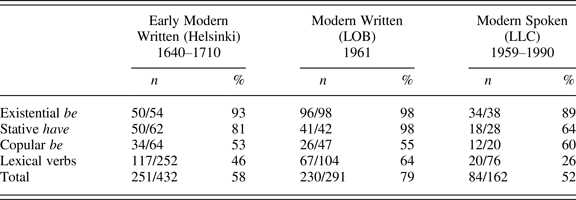
In a study of three corpora, one historical and two modern, Tottie (Reference Tottie and Kastovsky1991a, Reference Tottie1991b) showed that variation in the use of a negative quantifier (e.g., nobody) or a negative polarity item (e.g., anybody) is significantly conditioned by the particular construction in which the indefinite appears. For example, in the Early Modern English (1640–1710) sample of the Helsinki Corpus, Tottie found that polarity items (compared to negative quantifiers) are most commonly used with lexical verbs (46% Neg-Q) and copular be (53% Neg-Q), whereas have and existential be strongly prefer no negation (81% and 93% Neg-Q, respectively). Furthermore, as shown in Table 1 (reproduced from Tottie [Reference Tottie and Kastovsky1991a:447, Table 3, 462, Table 9]), the patterns that Tottie found for Early Modern English also hold in modern English speech and writing, which she observed from a study of the London-Lund Corpus of Spoken English (ca. 1959–1990), and the Lancaster-Oslo/Bergen Corpus of Written English (ca. 1961).
Use of Neg-Q (vs. Neg-NPI) in (Early) Modern English
LLC, London-Lund Corpus of Spoken English; LOB, Lancaster-Oslo/Bergen Corpus of Written English.
Source: Tottie (Reference Tottie and Kastovsky1991a).
Tottie's analysis of the patterns shown in Table 1 involves two distinct propositions. The first proposal, which is shared implicitly or explicitly by most works on the emergence of any indefinites in the history of English, is that the newer polarity item form (any) is in the process of replacing the older negative quantifier form (no) in all postverbal syntactic positions (Childs et al., Reference Childs, Harvey, Corrigan and Tagliamonte2015, Reference Childs, Corrigan, Harvey and Tagliamonteforthcoming; Mitchell, Reference Mitchell1985; Nevalainen, Reference Nevalainen, Fisiak and Krygier1998, Reference Nevalainen, van Kemenade and Los2009; Smith, Reference Smith2001; Varela Perez, Reference Varela Pérez2014; among many others). Under this assumption, the results in Table 1 appear to show that the change is diffusing across individual lexical items/constructions, being closer to completion with lexical verbs than with existential constructions. Tottie's second proposal, in line with work in usage-based approaches to linguistic change (e.g., Bybee, Reference Bybee1985, Reference Bybee2010; Bybee & Hopper, Reference Bybee and Hopper2001; Hopper, Reference Hopper1987; among others), is that the particular hierarchy of verbs/constructions shown in Table 1 is the result of differences in frequency between them, with the high frequency of existential constructions making them resistant to change (and so favoring the no form) and the low frequency of regular lexical verbs making these environments favorable to innovation. In this way, Tottie (Reference Tottie and Kastovsky1991a:440) concluded that “(morpho)syntactic change does proceed gradually across the lexicon, and … the frequency of a lexical item or construction may act as a powerful determinant of linguistic conservatism, i.e. the more frequent a construction is, the more likely it is to be retained in its older form for a longer period of time.”
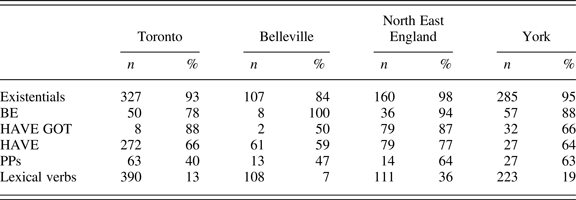
This explanation has had a noteworthy impact on both subsequent research into the evolution of negative/polarity indefinites in the history of English and on the development of theories of morphosyntactic change. The lexical effect reported by Tottie (Reference Tottie and Kastovsky1991a) has been replicated in diverse datasets of English (Childs et al., Reference Childs, Harvey, Corrigan and Tagliamonte2015, Reference Childs, Corrigan, Harvey and Tagliamonteforthcoming; Varela Pérez, Reference Varela Pérez2014). For example, in the comparative study of English spoken in Canada, including Toronto (using the TEA), Belleville (Tagliamonte, Reference Tagliamonte2003–2006), the United Kingdom (using the York English Corpus [Tagliamonte, Reference Tagliamonte1998] and North East England [Corrigan, Buchstaller, Mearns, & Hermann, Reference Corrigan, Buchstaller, Mearns and Hermann2010–2012; Tagliamonte, Reference Tagliamonte1998, Reference Tagliamonte2003–2006]), Childs et al. (Reference Childs, Harvey, Corrigan and Tagliamonte2015, Reference Childs, Corrigan, Harvey and Tagliamonteforthcoming) reproduced the same lexical effects and roughly the same construction hierarchy as Tottie, as in Table 2.Footnote 1
Use of Neg-Q (vs. Neg-NPI) across 4 varieties of English
PP, prepositional phrase.
Source: Reproduced from Childs et al. (Reference Childs, Harvey, Corrigan and Tagliamonte2015:24, Table 1).
Furthermore, many researchers have adopted the frequency-based analysis proposed by Tottie as a clear case of syntactic change proceeding through frequency-conditioned diffusion (see discussions and citations of these studies in Bybee [Reference Bybee2010]; Bybee and McClelland [Reference Bybee and McClelland2005]; Clark [Reference Clark2009]; and Moore [Reference Moore2007]; among others). This explanation of syntactic change stands in stark contrast to other cases of syntactic change that have been proposed to proceed via grammatical competition of abstract syntactic structure (e.g., Kroch, Reference Kroch1989; Lightfoot, Reference Lightfoot1979; Pintzuk, Reference Pintzuk1991; and much subsequent work in generative approaches to diachronic syntax). Thus, the analysis of patterns such as those shown in Tables 1 and 2 bears directly on the more general question of the role of syntactic structure in language change.
Questions for the diffusion analysis
The frequency-based diffusion analysis is elegant and appears to be consistent with previous research on the role of frequency in linguistic change; however, we argue that there are reasons to be skeptical of this explanation for the observed lexical effects in Neg-Q/NPI variation in the history of English.
For example, the most frequent construction, existential be, favors the older Neg-Q variant in all datasets previously studied, and lexical verbs consistently show the lowest rate of the Neg-Q variant. However, in some datasets, the particular “diffusional” hierarchy that is found does not actually correspond to the expected hierarchy if this pattern were uniquely the result of frequency. Indeed, Tottie observed that in the Modern Written English data, the highly frequent copular be construction actually shows a lower rate of the Neg-Q variant than the lexical verbs do. As shown in Table 1, the no variant appears 55% of the time in copular constructions in the Lancaster-Oslo/Bergen Corpus of Written English, but this variant appears with lexical verbs in 64% of the studied cases in this corpus. As Tottie (Reference Tottie and Kastovsky1991a:448) stated, “copular be sentences were a maverick category which, in spite of their high frequency of occurrence, had a high incidence of not-negation and which thus constituted an exception to the rule that frequency of occurrence would trigger no-negation, something which would have to be explained.” Given this pattern in the data, a frequency analysis requires additional stipulation to explain why copula constructions do not always show the predicted behavior.
Furthermore, even if the construction hierarchy observed across datasets consistently corresponded to frequency, we suggest that this pattern is not necessarily what we would expect in a situation of change. Although analogical syntactic change has been claimed to affect lower frequency items first (Bybee, Reference Bybee2002), in studies of reductive phonetic, phonological, and morphological change, it is commonly observed that change proceeds faster (rather than slower) in high frequency expressions (see Bybee, Reference Bybee, Barlow and Kemmer2000; Phillips, Reference Phillips1984; Pierrehumbert, Reference Pierrehumbert, Gussenhoven and Warner2002; and many others).
Indeed, this is what we find if we look at a very similar syntactic change in the history of French: the development of negative quantifiers from negative polarity items. Like many Romance languages (see Martins, Reference Martins, Pintzuk, Tsoulas and Warner2000), the system of negative and polarity indefinites in the French language appears to have undergone a change that is essentially the mirror image of the change observed in English: in 15th- and 16th-century French (Fr), indefinites such as personne (< Old Fr. person) and rien (< Old Fr. thing) were negative polarity items, meaning something along the lines of ‘anyone’ and ‘anything’, respectively. In addition to appearing within the scope of sentential negation, these elements could appear with a non-negative interpretation in comparative constructions (4), in the antecedent of a conditional statement (5), or in other so-called weak NPI environments.
(4) Adieu beaulté … Adieu qui mieulx s'en coiffe que personne.
Farewell beauty … Farewell who better refl.gen wear than personne
‘Farewell beauty, who wears [sweet grace] better than anyone.’
(1526-Marot, Les Epistres, p. 44, cited in Labelle & Espinal, Reference Labelle and Espinal2014:212)
(5) Toutesfois, pour tant que messire Jehan Pare demandoit partout se personne avoit
nevertheless, for so that master Jehan Pare asked everywhere if personne had
veu sa geline …
heen his hen
‘Nevertheless, even though Master Jehan Pare asked everywhere whether anybody had seen his hen … ’
(1515, Philippe de Vigneulles, Les Cent Nouvelles nouvelles: Nouvelle 5.23, cited in Labell & Espinal, Reference Labelle and Espinal2014:212)
Starting in the 16th century,Footnote 2 these negative polarity items began to be replaced by Neg-Q versions of these elements (see, among others, Déprez, Reference Déprez, Larrivée and Ingham2011; Déprez & Martineau, Reference Déprez, Martineau, Auger, Clements and Vance2004; Eckardt, Reference Eckardt2006; Labelle & Espinal, Reference Labelle and Espinal2014). This gave rise to a period of variation, in which the NPI variant “is attested and competes with the n-wordFootnote 3 variant until the 19th c.” (Labelle & Espinal, Reference Labelle and Espinal2014:213).
Although in some dialects of European French, this change has reached completion, with Neg-Q personne completely replacing NPI personne, Footnote 4 as observed by Burnett, Tremblay, and Blondeau (Reference Burnett, Tremblay and Blondeau2015), Daoust-Blais (Reference Daoust-Blais1975), Déprez & Martineau (Reference Déprez, Martineau, Auger, Clements and Vance2004), Lemieux (Reference Lemieux, Lemieux and Cedegren1985), among others, this change has not yet been completed in other varieties, for example, in the French spoken in Québec. In this dialect, there is still variation in the grammars of individual speakers between the older NPI variant and the newer Neg-Q variant, as shown by the examples in (6) from the Montréal 84 corpus of spoken Montréal French (Thibault & Vincent, Reference Thibault and Vincent1990).
- (6)
a. La loi cent un moi j'ai rien contre ça. Neg-Q
The bill 101 me I'have nothing against that
‘I have nothing against Bill 101.' (27 213)
b. C'est pour ça que j'ai pas rien contre la loi cent un. NPI
It's for that that I'have not nothing against the bill 101
‘This is why I have nothing against Bill 101.' (27 221)
(Cited from Burnett et al. Reference Burnett, Tremblay and Blondeau2015:11)
In a quantitative study of variation between constructions in (6a) and (6b) in the Montréal 84 corpus, Burnett et al. (Reference Burnett, Tremblay and Blondeau2015) found a higher rate of use of the newer form with determiner phrase (DP) indefinites (bare personne, rien, or aucun) in highly frequent existential constructions than in other kinds of constructions (see Table 3).
Use of Neg-Q with DPs in Montréal 84

Source: Based on Burnett et al. (Reference Burnett, Tremblay and Blondeau2015).
Therefore, a frequency-based analysis of changes for negative indefinites would also have to be supplemented with some explanation for why frequency appears to retard change in the history English but speed it up in the history of French.
Given these considerations, we propose to investigate alternative explanations for the observed patterns of Neg-Q/NPI variation in English (and, indeed, French). As we will argue, an ideal source of evidence comes from the nonvariable syntax of negative quantifiers and polarity indefinites across the world's languages.
SOFT SYNTAX AND CROSS-LINGUISTIC VARIATION
Although the fields of formal syntax and language variation and change have historically had modest interaction (see, e.g., Cornips & Corrigan, Reference Cornips and Corrigan2005; Mufwene, Reference Mufwene, Beals, Denton, Knippen, Melnar, Suzuki and Zeinfeld1994), recent quantitative research into patterns of syntactic variation has suggested that there are critical connections between the syntactic structure of complex expressions in a language and the way in which they are used by speakers of that language. Indeed, there is a growing body of research showing that the structural properties that create grammaticality contrasts (which, following Bresnan, Dingare, and Manning [Reference Bresnan, Dingare, Manning, Butt and King2001] we will call hard contrasts) in some languages determine preferential (i.e., soft) contrasts in other languages (see Bresnan, Reference Bresnan2007; Bresnan, Cueni, Nikitina, & Baayen, Reference Bresnan, Cueni, Nikitina, Baayen, Boume, Kraemer and Zwarts2007; Burnett et al., Reference Burnett, Tremblay and Blondeau2015; Cornips & Corrigan, Reference Cornips and Corrigan2005; Givón, Reference Givón1979; Keenan & Comrie, Reference Keenan and Comrie1977; Keenan & Hawkins, Reference Keenan, Hawkins and Keenan1987; Rosenbach, Reference Rosenbach2002, Reference Rosenbach2005; Tagliamonte, Reference Tagliamonte and Siemund2011; Thullier, Reference Thullier2012; among very many others).
A classic example of the hard syntactic patterns in one language being realized in the soft syntax of other languages comes from Bresnan et al.’s (Reference Bresnan, Dingare, Manning, Butt and King2001) comparison between person hierarchy effects and grammatical voice in Lummi, a Salish language, and English. As observed by Jelinek and Demers (Reference Jelinek and Demers1983) (discussed in Bresnan et al., Reference Bresnan, Dingare, Manning, Butt and King2001), in Lummi, transitive predicates that have third person actors and first or second person patients must appear in the passive voice; that is, in this language, it is impossible to say (the Lummi equivalent) of The man knows me, rather one must say I am known by the man, as in (7a). However, if the agent is first or second person and the patient is third person, then the active voice is obligatory, I know the man, as in (7b); that is, one cannot say the equivalent of The man is known by me first person agent/third person patient.
- (7)
a. xči-t-ŋ =sən ə cə swəyɁqɁ
know-tr-pass =1.sing.nom by the man
‘I am known by the man.’
b. xči-t =sən cə swəyɁqəɁ
know-tr =1.sing.nom the man
‘I know the man.’ (From Bresnan et al., Reference Bresnan, Dingare, Manning, Butt and King2001:1)
In English, a third person agentive subject with a first person object is perfectly grammatical, and English speakers have the option of using either The man knows me or I am known by the man. However, as Bresnan et al. (Reference Bresnan, Dingare, Manning, Butt and King2001) demonstrated through a quantitative study of the Switchboard corpus of spoken English (Godfrey, Holliman, & McDaniel, Reference Godfrey, Holliman and McDaniel1992), when first and second person actors act on third person patients, the action is uniformly expressed using the active voice (0 of 6246 occurrences). On the other hand, when third person actors act on first or second person patients, the action is expressed using the passive voice in 2.9% of the cases (14 of 486 occurrences), a small but significant difference.
Negative and polarity indefinite distribution cross-linguistically
We may similarly ask of other alternations: To what extent do the apparently variable English patterns have correspondences with invariant syntactic patterns in other languages? In the case at hand, we ask whether there are hard patterns in the variation between negative quantifiers and non-negative indefinite constructions cross-linguistically that may present as soft patterns in English.
Negative indefinites in Scandinavian
Since we know that closely related languages often share syntactic properties, it makes sense to start by considering the English system in light of the negation and quantification systems of other Germanic languages, in particular of the Scandinavian languages. Indeed, within the theoretical syntax literature, Kayne (Reference Kayne1998/2000) argued that the restricted distribution of negative indefinites in Norwegian provides important clues as to the factors that regulate the syntactic distribution of negative indefinites in English. Kayne started from the observation, originally due to K. K. Christensen (Reference Christensen, Dahl and Holmberg1986), that in Norwegian, negative indefinites, such as ingen ‘no’, mark sentential negation and can appear as direct objects following a simple tensed lexical verb, as shown in (8).
(8) Jon leser ingen romaner. Neg-Q
Jon reads no novel
‘Jon reads no novels.’
However, if the verb appears in a perfect construction, such as (9a), Neg-Qs can no longer be used; rather to communicate the same idea, speakers of Norwegian use the NPI variant (9b).
- (9)
a. *Jon har lest ingen romaner. *Neg-Q
Jon has read no novel
Intended: ‘Jon has read no novels.’
b. Jon har ikke lest noen romaner. NPI
Jon has not read any novels
‘Jon hasn't read any novels.’
Christensen (Reference Christensen, Dahl and Holmberg1986) argued that the contrast in (9) and the contrast between (8a) and (9a) are the result of constraints on the syntactic distribution of negative indefinites. In particular, she proposed that negative indefinites must mark the sentence as negative and that this is possible only if the verb has undergone verb second (appears in second position). This is widely analyzed as a requirement that negative indefinites raise out of the verb phrase (VP). Thus, in (8), ingen romaner ‘no novel’ (along with the finite verb leser ‘reads’) has raised out of the VP (which is why the sentence is grammatical), while ingen romaner in (9a) would remain within the VP, violating this “negative marking” constraint. Not being negative, NPIs are not subject to this constraint, and so noen romaner is free to stay within the VP in (9b). This style of analysis, positing different structural relations between Neg-Q direct objects and NPI direct objects, has been proposed in many different syntactic frameworks (see Svenonius [Reference Svenonius2000, Reference Svenonius2002] for minimalist syntax, Engels and Vikner [Reference Engels, Vikner, Broekhuis and Vogel2006] for optimality theoretic syntax, and Sells [Reference Sells2000] for lexical functional grammar, as well as in semantic frameworks such as Zeijlstra [Reference Zeijlstra2011] and Penka [Reference Penka2011]).
This particular pattern holds across the Scandinavian family. In fact, the ungrammaticality of negative indefinites under participles (i.e., (9a)) has also been observed in Swedish (Sells, Reference Sells2000), Icelandic (Jonsson, Reference Jonsson1996; Rögnvaldsson, Reference Rögnvaldsson, Allan and Barnes1987), Danish and Faroese (Christensen, Reference Christensen2005; Engels, Reference Engels2012; Lockwood, Reference Lockwood2002), as shown in (10) (reproduced from Penka, Reference Penka2011:175).
- (10)
a. *Jag har sett ingenting. Swedish
I have seen nothing
b. *Jeg har laest ingen bøger. Danish
I have read no books
c. *Jon hefur lesið engar baekur. Icelandic
Jon has read no books (Rögnvaldsson, Reference Rögnvaldsson, Allan and Barnes1987:31)
d. *Eg havi saeð ongan. Faroese
I have seen no one (Christensen, Reference Christensen2005:125)
The question is what is the key evidence for arguing that ingen romaner (and its cognates) has raised in (8), unlike noen romaner in (9b).
Before we return to the distribution of negative indefinites, we must gain a general understanding of the syntactic structure and patterns that underlie the linear order of expressions with finite verbs in Scandinavian.
Consider first a simple paradigm of negative sentences with ikke ‘not’. This will reveal how the linear orders follow from an invariant syntactic substructure and a general rule of verb placement. Norwegian, like the other Germanic languages (except for English), is a (general) verb second language. A finite verb form occurs in second position in root (main) clauses. The form of the negative sentences depends on whether there is a simple verb or a complex verb structure. The sentential negation ikke follows a (simple) tensed lexical verb and sentential adverbs and precedes the direct object of the verb, as in (11):
(11) Jon leser kanskje ikke disse romanene.
Jon reads maybe not these novels.DEF
‘Jon maybe doesn't read these novels.’
If the verb occurs in the perfect construction, the finite auxiliary occurs in the second position. Negation precedes the participle, which no longer precedes the adverb, but finds itself now adjacent to its direct object (12), a position where we expect to find it.
(12) Jon har sikkert ikke lest disse romanene.
Jon has certainly not read these novels.DEF
‘Jon has certainly not read these novels.’
Further embedding the perfect construction under a modal leads to the finite modal in second position, with the auxiliary and participle following negation, as in (13).
(13) Jon vil sikkert ikke ha lest disse romanene.
Jon will certainly not have read these novels.DEF
‘Jon certainly will not have read these novels.’
These examples reveal a common invariant hierarchical syntactic structure for those sentences, with negation always preceding the verb field. A general rule of verb placement fronts the finite verb, always the structurally highest verb, and is responsible for the pronunciation of the finite verb in second position. Embedding simple VPs under auxiliaries or modals will undo the effects of verb movement. This is shown in (14), with the traces of the moved verb in light fonts:
(14) DPsubject Vread Adv ikke tread DPobject
DPsubject Vhave Adv ikke thave Vparticiple DPobject
DPsubject Vwill Adv ikke twill have Vparticiple DPobject
As the verb second rule applies in root/main clauses but not in nonroot/subordinate clauses, such as relative clauses, we see the relative order of negation and the finite verb in these contexts. Controlling for verb second (15) reveals that the finite verb always follows negation, regardless of whether it is a main verb (15a), an auxiliary (15b), or a modal embedding a perfect (15c).
- (15)
a. Dette er en student som sikkert ikke leser disse romanene.
this is a student that certainly not reads these novels.DEF
b. Dette er en student som sikkert ikke har lest disse romanene.
this is a student that certainly not has read these novels.DEF
c. Dette er en student som sikkert ikke vil ha lest disse romanene.
this is a student that certainly not will have read these novels.
Because the negation ikke precedes all VPs, it now becomes possible to distinguish between elements that precede negation, and so are outside the VP, and elements that follow negation as potentially inside the VP. These two domains play an important role for English, as we will see in the next section. Furthermore, the distinction between the two domains explains the distribution of negative indefinites in Norwegian (Christensen, Reference Christensen, Dahl and Holmberg1986): negative indefinites in this language always appear in a position outside the VP, while NPIs appear within the VP c-commanded by ikke. Thus, even though the negative expression in (8a) (repeated as (16)) follows the verb, it is outside the VP because the verb has moved to second position.Footnote 5
(16) [Jon [ leser [ ingen romaner [ tleser tingen-romaner ] ] ] ]
‘Jon reads no novels.’
Furthermore, there are varieties in which object shift is not dependent on verb movement; that is, we can directly see the raising of negative quantifiers: in varieties of Insular Scandinavian (e.g., Icelandic and Faroese [Engels, Reference Engels2008; Rögnvaldsson, Reference Rögnvaldsson, Allan and Barnes1987] (17)), as in more “literary” registers of Norwegian (Christensen, Reference Christensen, Dahl and Holmberg1986; Engels, Reference Engels2008; Svenonius, Reference Svenonius2000, Reference Svenonius2002 (18)), Swedish (Holmes & Hinchliffe, Reference Holmes and Hinchliffe2003) and Danish (Christensen, Reference Christensen2005), a negative indefinite object can appear between an auxiliary and a participle; however, NPIs cannot occupy this position in these dialects.
- (17)
a. Ég hef engan séð. Icelandic
I have nobody seen (Rögnvaldsson, Reference Rögnvaldsson, Allan and Barnes1987:37)
b. Í dag heveur Petur einki sagt. Faroese
Today has Peter nothing said (Engels, Reference Engels2008:3)
(18) Han har ingen penger fått. Formal/Literary Norwegian
He has no money received
‘He has received no money.’
From Norwegian and Scandinavian to English
Kayne (Reference Kayne1998/2000) argued that English is just like Norwegian in that negative quantifiers shift to the region for sentential negation as well. His proposal is based on the presence of some asymmetries in the distribution of English Neg-Qs that look eerily similar to the patterns described in the preceding section. For example, as shown in (19) and (20), the verbal copula be appears in a position that is higher than negation (19b)/(20b). Correspondingly, negative indefinites are grammatical (19a)/(20a).
- (19)
a. There's nothing.
b. There isn't anything.
- (20)
a. John was no Einstein.
b. John wasn't an Einstein.
However, with lexical verbs such as become, which stay within the VP (*John becomen't an Einstein) and lower than negation (21b), negative indefinites are ungrammatical (21a). This is what we would expect if Neg-Qs were blocked from the VP, as in Norwegian.
- (21)
a. ?*John became no Einstein. (Kayne Reference Kayne1998:132)
b. John didn't become an Einstein.
This being said, English is not exactly like Scandinavian, because both the pairs in (22) are grammatical (at least for many speakers).
- (22)
a. John reads no novels.
b. John has read no novels. (Kayne, Reference Kayne1998:132)
Thus, even if Kayne is correct that there are fundamental similarities between the syntactic patterns associated with Neg-Qs in English and their counterparts in Scandinavian, the constraint that prohibits postverbal Neg-Qs in Norwegian from following unmoved lexical verbs does not appear to be categorical in English.
However, Kayne's hypothesis that English Neg-Qs, unlike NPIs, raise out of the VP makes an important prediction for quantitative patterns of Neg-Q/NPI variation in this language:
(23) Prediction of (Soft) Negative Object Shift Analysis:
We should find a significantly higher rate of Neg-Qs in utterances that could be parsed as having the negative indefinite appear higher than the VP than in those utterances in which the indefinite clearly remains within the VP.
Next, we test the prediction of the soft negative object shift analysis and then we compare the results to the frequency-based diffusion analysis.
SOFT SYNTACTIC DISTINCTIONS IN ENGLISH
This section presents a case study of the distribution of no Neg-Qs and any NPIs in the TEA.
Variable context
Following previous studies, we extracted from the TEA all the occurrences of negative or polarity indefinites that showed some alternation.
(24) Negative Quantifiers Extracted
nobody, no one, nothing, none, no, (never)
(25) Polarity Indefinites Extracted
anybody, anyone, anything, any, (ever)
As is common in variationist studies of indefinite choice, we set aside the occurrences of (n)ever, because ever under negation is extremely rare. For example, as observed by Childs et al. (Reference Childs, Harvey, Corrigan and Tagliamonte2015), not … ever appears only four times in the Toronto data.
Following variationist methodology (see Tagliamonte, Reference Tagliamonte2012, for a recent introduction), we excluded the occurrences of Neg-Qs in preverbal position (26), because they do not alternate with NPIs in the dialects that we are studying.
- (26)
a. Nobody arrived.
b. *Anybody didn't arrive. (also ?Not anybody arrived.)
Consistent with Childs et al. (Reference Childs, Harvey, Corrigan and Tagliamonte2015), we excluded utterances with more than one tensed clause in them, because this class of sentences has an “extra” variant with negation appearing in the higher clause (27a).
- (27)
a. I don't think that I could change anything.
b. I think that I wouldn't change anything.
c. I think that I would change nothing.
(All cited from Childs et al., Reference Childs, Harvey, Corrigan and Tagliamonte2015:23)
Furthermore, because of their low frequency in the data, we excluded sentences where not co-occurs with a Neg-Q and creates a single negation interpretation: so-called negative concord sentences (28).
(28) So you 'd go- you 'd go like up to three and it 'd be ninety-percent of the volume and you 'd go,
“Oh! This thing is so loud. I can 't go any louder, right?” You 'd go up to four, “Oh four, man!” Of course, after four- four, it didn't do nothing, right? (Toronto, M/62)
Although concord is a robust phenomenon in many varieties of English,Footnote 6 as Childs et al. (Reference Childs, Harvey, Corrigan and Tagliamonte2015) observed, such sentences constitute only 1.6% of utterances containing negative or polarity indefinites in the TEA. We also excluded examples with the preposition without, because the most natural interpretation of (29b) is not the single negation interpretation of (29a), but rather a double negation interpretation.
- (29)
a. … and without saying anything to each other. (Toronto, F/19)
b. … and without saying nothing to each other.
With these exclusions, the final dataset for our study contains 1154 utterances from the speech of 88 speakers.
Coding
With the predictions of the soft negative object shift analysis in (23) in mind, we coded for which syntactic domain (above VP or below VP) the indefinite could appear in. Utterances with direct object indefinites that are not embedded under any other predicates are coded as having the indefinite in the domain higher than VP (30).
(30) Higher than VP
a. There were no jobs to be had. (Toronto, F/43)
b. There weren't any great places to eat. (Toronto, F/83)
c. It was nothing like that. (Toronto, F/74)
d. He wasn't anything like me. (Toronto, F/62)
Utterances in which the Neg-Q or the NPI is embedded under some other verbal predicate (31a–c), a nonfinite verb (31d, e), a prepositional phrase (31f) or under some other phrase, were coded as having the indefinite in the domain lower than VP.
(31) Lower than VP
a. I can't have any form of gluten. (Toronto, F/52)
b. I've got nothing for them. (Toronto, F/73)
c. I don't envy any of them. (Toronto, F/75)
d. … write my music and not need any influence … (Toronto, M/24)
e. They were worried there were going to be no French Catholics left. (Toronto F/19)
f. We're under no obligation. (Toronto, F/29)
Another characterizing property of the negative quantifier/negative polarity alternation in English is the pragmatic widening property of any NPIs. Although they can be synonymous in many contexts (see Rullman [Reference Rullmann1996], for discussion), any DPs can be used to make stronger, more emphatic statements than simple bare plurals or singular indefinites, particularly if any is stressed. An example of an emphatic use of any is shown in the dialogue in (33) from Kadmon and Landman (Reference Kadmon and Landman1993), where any potatoes contrasts with the simple bare plural indefinite potatoes.
(32) I don't have any potatoes. ≈ I don't have potatoes.
(33) A: Will there be French fries tonight?
B: No, I don't have potatoes.
A: Not even just a couple of potatoes that I can fry in my room?
B: Sorry, I don't have ANY potatoes.
Following Kadmon and Landman (Reference Kadmon and Landman1993), it is common to say that, under certain contextual and accentual conditions, this expression can be used to widen the domain of quantification of these indefinites, taking into account pragmatic alternatives that otherwise would not matter in the context. In the dialog in (33), B uses any to communicate that they have no potatoes at all. There are many different theories of the nature of this widening and how it arises in the literature (see also Chierchia, Reference Chierchia2004, Reference Chierchia2013; Dayal, Reference Dayal1998, Reference Dayal2005; Giannakidou, Reference Giannakidou1998; Krifka, Reference Krifka1995; among many others); however, what is relevant to our analysis is that any can have a particular pragmatic function (domain widening) that is much less available with regular indefinites (i.e., a potato, potatoes). It is well known that particular semantic and/or pragmatic interpretations assigned to a DP can have an effect on its syntactic distribution (Beghelli & Stowell, Reference Beghelli, Stowell and Szabolsci1997; Diesing, Reference Diesing1992; Hallman, Reference Hallman2004; Ioup, Reference Ioup1977; among others), thus it is important to determine whether pragmatic widening plays a role in creating the quantitative patterns of Neg-Q/NPI alternation that we observe in synchronic and diachronic corpora.
How can we code for pragmatic widening in a vernacular spoken corpus such as the TEA? This task is extremely tricky, and determining with exact certainty when any appears with a particularly widened domain in a single utterance is most likely impossible. However, given a recorded conversation, we can find many clues to the particular interpretation of any phrases in the lexical material that it appears with. In particular, modification of any DPs by means of what Israel (Reference Israel1996) and others called emphatic polarity items such as at all (34) and understating modifiers such as really (within the scope of negation (35)) or just (36) signal that the domain has been widened to include even unlikely alternatives, which is what licenses the presence of these modifiers.
(34) Your grandfather was busy earning a living and our first child was on the way and you, we were sort of consumed with that and staining our own furniture which we bought unfinished 'cause we didn't have anything at all when we were first married. (Toronto, F/75)
(35) I 'd been gone for two weeks. I hadn't really seen any news, and um- and literally turned it on, you know, ten min– five minutes after the second plane got into it. (Toronto, M/40)
(36) If there was a girl who came that I thought was fairly attractive or-whatever, I wouldn't have her as a roommate. I just didn't want- I just didn't want any of that. (Toronto, M/35)
Modifiers such as really or at all can also apply to Neg-Qs (36), where they again signal that the domain of quantification of the negative quantifier has been widened to include unlikely alternatives.
- (37)
a. It's a 5 minute walk which is really nothing. (Toronto, M/19)
b. Over there there's no lights at all. (Toronto, M/85)
Therefore, we distinguished cases where there was lexical evidence that the domain of any or no has been pragmatically widening and cases where it is possible that the domain has not been pragmatically widened.
Finally, we investigated the effect of external sociolinguistic factors such as age (as a continuous factor), gender (male, female), and education (as a binary factor: with(out) postsecondary education). Thus, we investigated the role of five factors, as in (38) and (39) in the TEA.
(38) Grammatical factors
1. Structural position: Higher than VP versus lower than VP
2. Pragmatic widening: Widened versus possibly not widened
(39) Social factors
1. Gender: Male versus female
2. Age: Continuous factor over exact ages.
3. Education: Postsecondary versus no postsecondary
RESULTS
The main empirical result of this paper is that structural position plays a determining role in the distribution of Neg-Qs and NPIs in the TEA. To begin, let us probe the distribution of forms when the earlier categorization schema of construction type is examined in relation to syntactic domain, as in Table 4.
Neg-Q/NPI variation in the TEA by syntactic position

Table 4 shows that while No and Not … any appear close to the same frequency in the corpus (Neg-Q, n = 603; NPI, n = 553), the variants are almost categorically associated with different syntactic positions: no appears in the higher syntactic domain 95.3% of the time, while any appears in the higher syntactic domain at most 6.3% of the time. Moreover, it now becomes clear that the lexical constructions that have been considered a defining condition on No/Not … any variation are an epiphenomenon of the underlying syntactic domain. Indeed, for the verb have and lexical verbs (shaded in the table) the contrast is virtually categorical. If these frequent contexts were included in the quantitative analysis of variation, they would strongly skew the results.
Once the verb have and other verbal constructions are excluded (because they are categorical, see Table 4), we find additional divides in the data. Table 5 displays the interaction between syntactic domain and pragmatic widening.
Neg-Q/NPI variation in the TEA by syntactic position and pragmatic widening
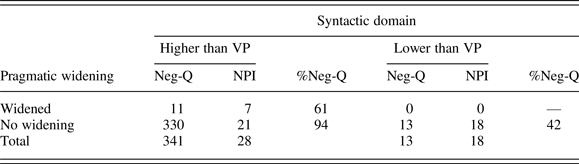
Table 5 reveals that the only locus of pragmatic widening is in higher than VP domains and these cases are quite rare (n = 18). To model this interaction, we created a three-way predictor: widened contexts, higher than VP contexts (not widened), and lower than VP contexts.
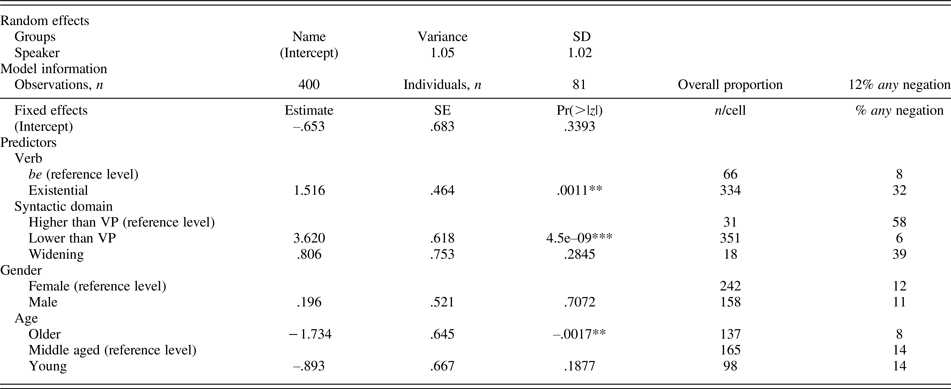
We then constructed a binomial mixed-effect regression model using the lme4 package in R (Bates, Mächler, Bolker, & Walker, Reference Bates, Mächler, Bolker and Walker2015; R Core Team, 2016). We included speaker as a random effect, and as fixed effects the three-way predictor for syntactic domain, verb, as well as two sociolinguistic factors (age and gender).Footnote 7 The dataset is now much abridged from what is typically presented in analyses of No/Not … any in the literature, because it excludes the verb have and other verbal constructions (because they are categorical, see Table 4). This ensures that the data are carefully circumscribed to contexts of optionality in the grammar, that is, where variation between no/any is possible and employs a categorization schema suited to the variation (see Table 5). The analysis, shown in Table 6, is based on 400 observations from 81 individuals. Note that the model predicts any (rather than no), which has an overall frequency of 12%.Footnote 8
Binomial mixed-effect regression model predicting “any” negation
AIC: 215
BIC: 2476
Log likelihood: –100
Deviance: 199
df: 392
Note: Significance codes: *p < .01; **p < .001; ***p < .0001. AIC, Akaike information criterion; BIC, Bayesian information criterion.
Table 6 confirms the enormous effect of the syntactic position of the indefinite, even in the small area of the grammar where optionality reigns. Speaker gender does not significantly condition Neg-Q/NPI variation; however, it is now apparent that the middle-aged individuals have a heightened use of Neg-Q.
The predictions of the soft negative object shift analysis for English are borne out. We therefore conclude that an analysis based on abstract hierarchical structure, grounded in typological observations, does a better job at explaining the patterns of syntactic variation that we find in Toronto English and, most likely, the patterns that have also been found in other dialects. Now we must also explain its ostensible apparent time development.
Let us turn to the genuine cases of Neg-Q appearing below (or following) VP in the corpus (some examples in (40)). Examining 35 examples of negative quantifiers below VP more closely suggests that we may not be dealing with true optionality. For example, there are a few utterances, such as those in (40) in which the Neg-Q does not express sentential negation: (40a) describes an event of telling (rather than the nonexistence of such an event); (40b) describes an event of sitting, with nothing in the adjunct gerund, etc.
- (40)
a. I told her for no reason. (Toronto, F/24)
b. and they're sitting here doing nothing. (Toronto, F/83)
c. … that we're just keeping alive for no reason. (Toronto, F/19)
In some analyses, the non-negative interpretation utterances such as those in (40) would reflect the fact that the negative adjuncts are merged higher than the core VP arguments are (Nissenbaum, Reference Nissenbaum2000; Ochi, Reference Ochi1999). Thus, such examples may not count as true examples of Neg-Qs remaining within the VP.
The small number of Neg-Qs lower than VP is expected under the soft negative object shift analysis; however, what is not yet explicitly predicted is the small number of any NPIs above VP. If the only grammatical factor conditioning Neg-Q/NPI variation were the position of Neg-Qs, we would not necessarily expect the near-complementary distribution pattern that we find in Table 4. Furthermore, there are reasons to believe that there are (soft) pragmatic restrictions on the distribution of any NPIs. As we have shown, there is a significant effect of a lexical signal of pragmatic widening. As shown in Table 5, while utterances without pragmatic modification contain any and no at almost equal rates, only 26.5 % of the utterances with such modifiers are with no. In other words, the vast majority of utterances where there are signals of pragmatic widening involve any NPIs.
Based on these results, we might hypothesize that being in a higher syntactic position favors emphatic interpretations of negative and polarity indefinites in Toronto English. This is not entirely unexpected because, as we have mentioned, higher syntactic positions are typical locations for marking emphasis, focus, or other pragmatically marked interpretations (Benincà & Poletto, Reference Benincà, Poletto and Rizzi2004; Rizzi Reference Rizzi and Haegeman1997; among many others). This result further suggests that the space of “true” (i.e., nondiscourse-related) optionality in the use of any versus no is far more restricted than it originally appears. Because we are dealing with corpus data, the pattern that we have indirectly observed through the distribution of modifiers can only be suggestive of a relation between syntactic position and pragmatic interpretation. Although these connections may become clearer if we look at more corpus data, in order to prove with certainty that this explanation is correct, we would need to expand our investigation beyond production data to include interpretation/perception data of the kind studied in psycholinguistic experiments.
CONCLUSION
We presented a new quantitative analysis of Neg-Q/NPI variation in a variety of North American English (Toronto, Canada) examples. Questioning earlier explanations of this variation, we undertook a cross-linguistic exploration of similar patterns in other languages. We observed that the soft syntax of English indefinites and negative objects lines up with the hard syntax of these expressions in other closely related languages. In testing these effects in the data, we demonstrated that the syntactic position (higher vs. lower domain) almost categorically determines whether a negative quantifier or a polarity item is used over and above the superficial effect of verb or construction type.
We also showed that an analysis focused on syntactic position analysis made better predictions for Neg-Q/NPI variation than the alternative frequency-driven diffusion analysis. Therefore, our analysis offers a novel interpretation of the time course of the emergence of any NPIs in the history of English. Rather than a slow change in progress, where any is gradually replacing no in all postverbal positions, we can observe that any NPIs are only replacing Neg-Qs in the lower syntactic domain in the verb be and that there was a shift from the oldest generation in our sample to the younger generations. All these findings suggest that the English negation and polarity system is moving toward an asymmetric system similar to systems found in some Scandinavian languages, rather than the symmetric system that is usually assumed to be endpoint of the change. In fact, given the near-categorical nature of the patterns observed in the TEA, we suggest that this change is largely completed, at least in Toronto.Footnote 9 Neither quantitative analysis nor qualitative syntactic analysis alone would have led us to this explanation. Our study therefore shows how quantitative studies of syntactic variation can shed light on the abstract morphosyntactic relationships that exist between different languages, relationships that are hidden if we only look at qualitative patterns of grammaticality. Furthermore, our results highlight the importance of grounding explanations of patterns of language variation and change within a broader understanding of the range of the morphosyntactic systems found across the world's languages and that quantitative research undertaken within the variationist paradigm has an important role to play in comparative theoretical syntax.



