


Malnutrition in all its forms is a growing threat to global health. While stunting is slowly declining in children aged under 5 years in many places in the world, there was an increase in the percentage of people in the world having insufficient dietary energy consumption in 2017. The share of undernourished people has increased for 2 years in a row after a 15-year decline, and has reached about 11 % in 2017. Simultaneously, many populations are experiencing a rise of the prevalence of overweight and obesity, including in low- and middle-income countries (LMIC)(1, Reference Demaio and Branca2). Low-quality diets, deficient in essential nutrients, are the major contributors to health problems worldwide and have impacts on people's well-being, from conception to the older age(3, 4).
Aside from its role in nourishing, food also needs to be safe for human consumption to convey its intended nutritional benefits. For food to be safe, the health risks from chemical as well as microbiological agents have to be kept at suitably low levels(5). Food safety is an indispensable prerequisite for sustainable development and the awareness about its importance is progressively growing, including in LMIC. Safer food contributes to better public health, and hence to improved livelihood, increased productivity and can be a critical component to alleviate poverty. The World Bank has estimated that food-borne illnesses cost US$110 billion per year in LMIC(Reference Jaffee, Henson and Unnevehr6). Yet despite the critical role of food safety for public health and trade, it is frequently not possible to estimate with the desired confidence the overall impact of all food safety hazards in LMIC as no good quality data are available. The WHO estimated that the global burden of foodborne diseases resulting from thirty-one foodborne hazards caused 600 million foodborne illnesses, 420 000 deaths and 33 million disability-adjusted life years in 2010. Children carry about 40 % of the foodborne disease burden(7). Other researchers estimated for LMIC an annual loss of 18 million disability-adjusted life years due to microbial pathogens, an additional loss of 18 million disability-adjusted life years due to foodborne parasites and a further loss of 1–2 million disability-adjusted life years due to aflatoxins(Reference Grace8). Another group estimated that an additional 70 000 cases annually of bladder, lung and skin cancer in LMIC are due to arsenic exposure through diet(Reference Oberoi, Barchowsky and Wu9). Food safety is an obligatory precondition to achieve healthy nutrition and food security. If it is not safe, it is not food! Poor nutrition and foodborne diseases combine readily to a vicious cycle of worsening health, particularly in settings with marginal public health and food security. It is thus imperative to systematically integrate food safety into policies and interventions to improve nutrition and food security in LMIC.
A third essential aspect of diets is their environmental impact and the subsequent need to make diets sustainable. In particular, the most recent report from the Intergovernmental Panel on Climate Change stresses the need for urgent actions to mitigate greenhouse gas emissions to avoid a climate change catastrophe(10). A significant reduction of food systems’ carbon, water and land footprint at global level could be obtained by shifting food consumption patterns towards more environmentally friendly ones.
Data needs for tackling malnutrition
Malnutrition can be tackled in different ways. For individual micronutrient deficiencies, the provision of supplements can be the fastest way to improve the micronutrient status of a selected population group. Conversely, food fortification and biofortification are potentially more cost-effective interventions to improve the status of a population for some micronutrients(11). However, the promotion of healthy and diversified diets based on local and biodiverse foods is the preferred and most sustainable way to improve the intake of essential nutrients and to address the multiple burdens of malnutrition(3, 11).
Provision of supplements requires health-based indicators, which are derived from age and sex disaggregated data collected through anthropometry and the use of biomarkers of nutritional status of individuals. While anthropometric indicators allow assessing in a fairly easy way the prevalence and severity of undernutrition and obesity in the population(12), biomarkers allow estimating the prevalence and severity of deficiencies of particular micronutrients(Reference Kuhnle13). The combination of those two types of indicators allows taking a decision on the level and coverage of the dietary supplement intervention in specific age and sex population groups.
Health-based indicators can be a stand-alone source of information to support provision of supplements. However, if a food-based approach is to be implemented, data on food consumption is necessary.
In some countries, the only dietary information available is the overall national availability of food expressed as commodities, i.e. food balance sheets (FBS). In other countries, data on the availability of food at household level can be derived from nationwide Household Consumption and Expenditure Surveys (HCES).
FBS are compiled by FAO, by subtracting utilisation (quantity exported, fed to livestock, used for seed, manufactured for food and non-food uses, storage and transportation-related losses) from the total supply (quantity imported and produced, with adjustments for changes in stocks) and dividing it by the population size of a given nation to provide an estimate of the per capita availability of food(14, 15). FBS are one of the most basic sources of data on food availability for human consumption. They provide useful geographical and historical trends but summarise food groups with limited accuracy and there is an intrinsic high uncertainty in estimating nutrient intakes based on this typology of data since they do not account for any variability of the food availability within the nation(Reference Huybrechts, Aglago and Mullee16, Reference Del Gobbo, Khatibzadeh and Imamura17).
HCES are an assortment of multipurpose surveys, including Household Budget Surveys, Living Standards Measurement Surveys, Household Income and Expenditure Surveys and Integrated Household Surveys. HCES aim at collecting information on food availability at the level of the household(Reference Fiedler, Lividini and Bermudez18). The average food availability per person daily can be calculated by dividing the household availability of the product of the reference time period and the mean household size(Reference Trichopoulou, Naska and Oikonomou19); however inter-household variability of food consumption can typically not be assessed. Combined with other tools, HCES can be used to approximate the prevalence of inadequacies and to assess the quality diversity of diet at national and subnational levels.
Notwithstanding the importance of these sources of information, they are insufficient for the task ahead. Even with these two tools, decision makers still lack access to suitable data and indicators to assess the quality of diets in age and sex disaggregated population groups(3, 20), making it difficult to develop and implement evidence-based policies that shape food systems towards healthy dietary patterns(Reference Haddad, Hawkes and Webb21, 22). Individual quantitative food consumption (IQFC) data, combined with the local food composition data, are needed to assess the actual nutrient intake of individuals and to derive suitable and effective policies aimed at improving the diet(Reference Del Gobbo, Khatibzadeh and Imamura17).
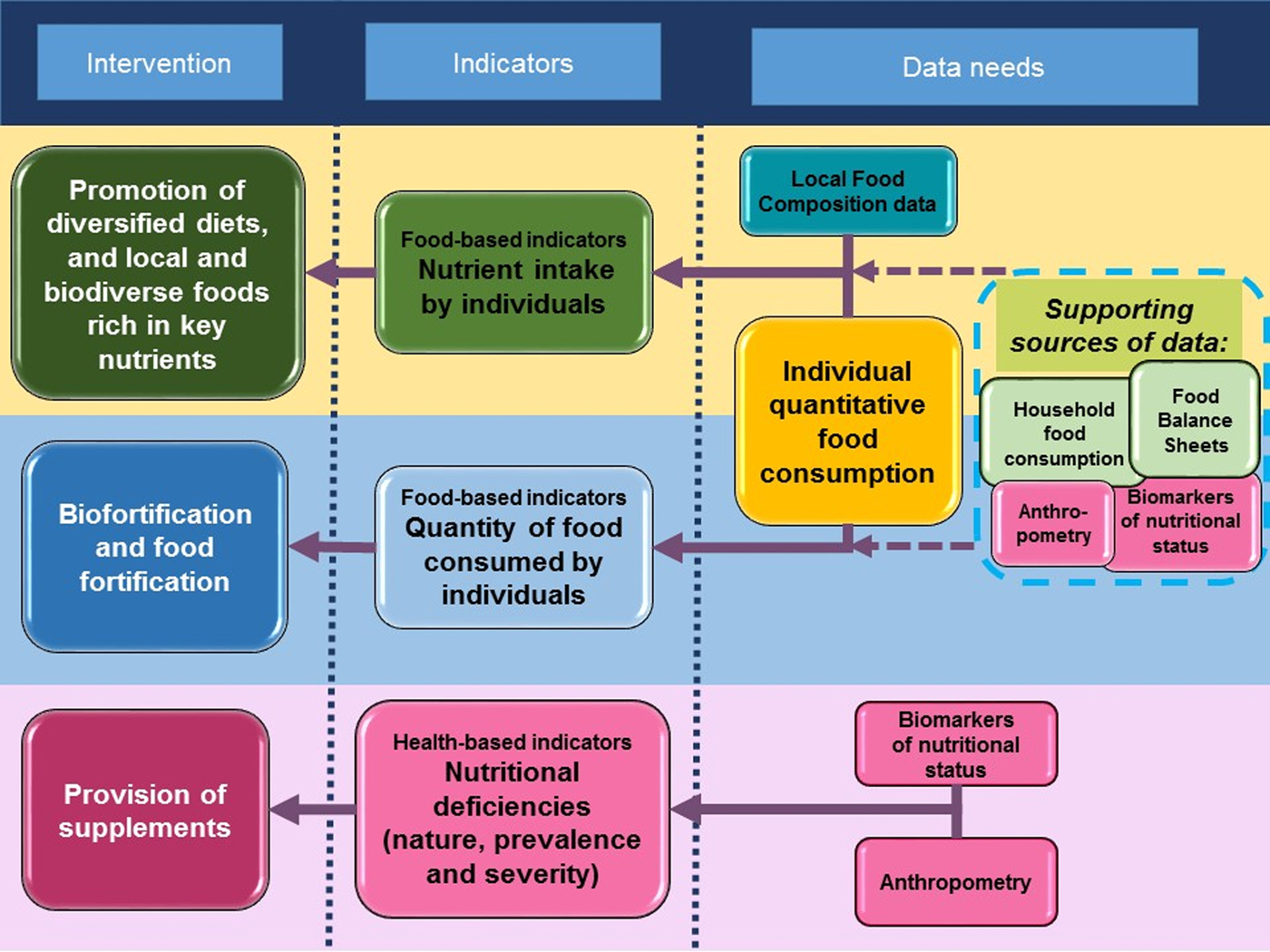
It is important to note how the different types of data listed complement each other to eventually enable decision makers to apply the most holistic approaches in tackling malnutrition. Health-based indicators are very helpful to complement the information provided by food-based indicators, both in the case of interventions based on fortification and on promotion of diversified diets. Similarly, data coming from FBS and HCES can bring in important information about the problem extent in terms of food availability, and allow the observation of temporal trends since they are more regularly collected than IQFC and since they are usually nationwide and covering all seasons. Fig. 1 shows the relations between different types of data to inform food-based approaches.
(Colour online) How data availability can determine the approach that can be taken to micronutrient deficiencies. A theory of change is illustrated, showing how depending on the availability of data some approaches can or cannot be taken to tackle malnutrition and, in particular, micronutrient deficiencies. Individual quantitative food consumption (IQFC) data and local food composition data are essential to promote diversified diets based on local and biodiverse foods. IQFC data are needed to develop food-based indicators and to implement approaches based on fortification or biofortification. If only health-based indicators are available, the approach is likely to be that of supplementation.
Individual quantitative food consumption data
Harmonised IQFC data generates significant evidence necessary to address the challenges of malnutrition and hunger, under the global collective commitments proclaimed by the UN Decade of Action on Nutrition (2016–2025)(23), and to achieve the Sustainable Development Goals of the 2030 Agenda for Sustainable Development(24).
IQFC data have the unique benefit to provide all the information needed to compute food-based indicators that are suitably disaggregated to address the needs of all population sub-groups, which in turn inform agricultural and food policies and programmes at global, national and sub-national level. For example, local foods rich in key nutrients might exist in a given area of the world but not be consumed in sufficient amounts by some population sub-groups. Information on the consumption of these foods, disaggregated by age and sex, and on their food composition is essential to promote both their production and consumption in order to tackle nutrient deficiencies in a highly sustainable way, through diversified diets based on local and biodiverse foods. Other possible uses of IQFC data are the implementation and evaluation of food fortification or bio-fortification policies. For example, in an area where women of reproductive age and children have high anaemia rates, knowing how much flour is consumed by each of these population sub-groups is important to implement flour fortification with iron at an appropriate level. Similarly, knowing the IQFC data of different staple crops is crucial for promoting bio-fortified varieties of those crops.
IQFC data are also essential in the area of food safety. Risk assessments follow a four-step method: hazard identification, hazard characterisation, exposure assessment and risk characterisation(25). To-date a limited set of databases provide data that are useful for this purpose and with a global geographic coverage. The GEMS Food database(26) collects levels and trends of contaminants and pesticide residues. The WHO GEMS Cluster Diets consists of national dietary patterns grouped by similarities, based on the analysis of per capita supply available from FAO FBS(Reference Héraud, Barraj, Moy, Moy and Vannoort27). FAO and WHO have also developed the FAO/WHO Chronic Individual Food Consumption – Summary Statistics (CIFOCOss) database(28), which shares summary statistics related to individual food consumption. All these databases are hosted by WHO and allow scientific committees such as JECFA (Joint FAO and WHO Expert Committee on Food Additives) and JMPR (Joint FAO/WHO Meeting on Pesticides Residues) of the Codex Alimentarius to perform dietary exposure assessments that are suitably inclusive to cover the global population.
IQFC microdata are necessary to perform the most refined dietary exposure assessment. In other words, only the use of IQFC microdata lead to exposure assessments that are neither unnecessarily conservative, thus leading to overly restrictive limits, nor leading to exposure assessment that put sensitive sub-population groups unduly at risk. IQFC microdata are necessary to improve the consistency and reliability of dietary exposure assessments(29). Indeed, IQFC data inform the person-to-person variation of food consumption and allow to reliably estimate not only the risk from average exposure, but also the risk that may result from habitual or temporal food consumption that exceeds the numerical average, i.e. the risk for the so-called high consumers.
IQFC data can also be combined with databases of foods’ carbon-, water- and land-footprint in order to assess the environmental impact of diets(Reference Perignon, Vieux and Soler30). The availability of age and sex disaggregated food consumption data allows assessing current food consumption patterns and proposing alternative patterns targeted at different population groups, for example, through Food Based Dietary Guidelines(Reference Reynolds, Buckley and Weinstein31, Reference Gonzalez Fischer and Garnett32).
IQFC data are being collected in many countries, including low-income countries. However, these data are often collected through small-scale surveys. In addition, they are largely underutilised due to poor dissemination and lack of harmonisation that does not allow comparisons across time periods, seasons and geographical locations(Reference Micha, Coates and Leclercq33, Reference Coates, Colaiezzi and Bell34).The world needs harmonised IQFC data to address the growing challenges of malnutrition and food safety efficiently and to deal with the environmental impact of diets. It is necessary to ensure that IQFC data fulfil the following conditions, so they can be used to their full potential in informing actions to improve nutrition, food safety and environmental protection for all: (1) publicly available and accessible for decision makers to use them; (2) provided at the lowest disaggregation level, in order to understand the differences between different dietary patterns of various population sub-groups; (3) harmonised to allow comparisons between datasets from different surveys; (4) presented in an easy-to-understand format to ensure that users with low scientific literacy can also benefit from the data; (5) assessed for quality to indicate the limitations of the data and to avoid misleading users and misinterpretations.
The objective of this article is to present the FAO/WHO Global Individual Food consumption data Tool (GIFT) as a tool to better inform evidence-based policies for nutrition and food safety especially in LMIC.
FAO/WHO Global Individual Food consumption data Tool
In order to address the lack of harmonised IQFC data from different countries, FAO and WHO have developed FAO/WHO GIFT(35). The FAO/WHO GIFT platform, hosted by FAO and supported by WHO, aims to fill a major gap regarding what people are consuming around the world, and to use these data to better inform evidence-based policies and guidelines on healthy diets. FAO/WHO GIFT collates, harmonises and disseminates existing IQFC data from different countries.
FAO/WHO GIFT focuses on data collected through 24 h dietary recalls or records, which are tools describing in detail all foods and beverages consumed by individuals and in which quantities(Reference Gibson36, Reference Baranowski and Willett37). This type of dietary data provides important information on the quantity of all foods consumed by the different age and sex sub-groups of a population, allowing for a better understanding of the distribution of foods within the household(Reference Del Gobbo, Khatibzadeh and Imamura17, Reference Coates, Rogers and Blau38).
Creating a database hosting a number of surveys, and automatizing the processes to create indicators from this database, requires all datasets to follow a certain format. Therefore, to be inserted in the FAO/WHO GIFT platform, datasets have to undergo a harmonisation process, which goes from using the same variables to reporting food amount and recipe information in the same way. In the present paper, the word ‘harmonisation’ refers to applying standard procedures to the datasets in order to have them in the same format, and in particular to ensure that food items from different surveys are described and classified in the same way. In particular, one key step of this process is the use of the FoodEx2 system to classify and describe the foods reported as consumed in the different datasets. FoodEx2 is a food description and classification system developed by the European Food Safety Authority (EFSA), which consists of a vocabulary of foods with assigned codes structured in a hierarchical manner(39).
Based on harmonised IQFC data, the FAO/WHO GIFT platform currently computes ready-to-use food-based indicators in three areas: food consumption, nutrition and food safety. The FAO/WHO GIFT indicators present the information as infographics in an easy-to-interpret way to ensure that users with low scientific literacy can also benefit from the data. The platform is intended for use by both experts and the broader audience, in particular policymakers and governmental institutions.
History of the FAO/WHO Global Individual Food consumption data Tool
FAO/WHO GIFT's development started back in 2014 with the aim of creating an open access online platform for collation and dissemination of harmonised IQFC data.
Harmonisation of IQFC data collected in different countries had already been pioneered at the European Union level. In 2011, EFSA released the EFSA Comprehensive European Food Consumption Database(29, 40), providing European Union-wide harmonised food consumption data. This database provided for the first time a comprehensive picture of food consumption in the European Union, significantly increasing the reliability of the decisions made to fight malnutrition and to reduce food safety risk.
One of the main challenges of food consumption data harmonisation is the harmonisation of the coding of consumed food items. Foods vary between countries and regions in terms of form, varieties, preparation methods and many other characteristics, and it is important to maintain comparability while not losing detailed information about what has been consumed. The harmonisation of European Union food consumption data was based on FoodEx2. The classification and description of foods reported as consumed with the FoodEx2 system eases the comparability of data from different data sources, and the matching of food intake data with food composition data(39, Reference Roe, Bell and Oseredczuk41).
The FoodEx2 system was first developed to harmonise IQFC from European countries for both food safety and nutrition purposes, but with more attention to food safety needs. Therefore, in order to use this system in the harmonisation process of IQFC data collected outside Europe and with equal attention to the nutrition area of work, FAO and WHO worked with EFSA at scaling up FoodEx2 to the global level. New codes for foods that are not consumed in Europe were added to the system to enable the description and classification of food items such as insects, flowers and wild foods consumed in other regions of the world.
The FoodEx2 system is a powerful and comprehensive tool, which requires training on its use. Since the harmonisation process of IQFC data should preferably be applied by the institution responsible for collecting the food consumption data, FAO and EFSA have co-organised several trainings for data managers from institutions owning IQFC data. Thereby, professionals working with datasets collected by Bioversity, Dhaka University and several ASEAN (Association of Southeast Asian Nations) countries benefitted from a training on FoodEx2 in 2016. Thereafter, a 1 d training for twenty-two data managers from institutions in seventeen countries was organised at the margins of the twenty-first IUNS Nutrition Congress of the International Union of Nutritional Sciences in Buenos Aires in October 2017. Currently, FAO provides ad hoc trainings for data owners interested to share their data through FAO/WHO GIFT, while EFSA holds regular trainings for data managers contributing to the EFSA Comprehensive European Food Consumption Database. On September 2018, EFSA also provided a two-session webinar on FoodEx2, which was recorded and shared publicly with the goal of facilitating the introduction to the system and its use(42, 43). Through these efforts, EFSA and FAO/WHO GIFT have leveraged and expanded the use of FoodEx2 as a harmonisation tool for data collected worldwide.
The decisions taken throughout the development of the FAO/WHO GIFT platform were based on the needs of various stakeholders working in the field of nutrition, agriculture and food safety at country, regional and global level. Consultations through webinars with key informants in these areas were organised to ensure that the final product would meet the needs of end-users and would achieve its objectives. Through two series of webinars organised in 2015 and in 2016/17, 175 stakeholders provided feedback on the platform's development. The feedback gathered from these consultations led to the development of the pilot version of FAO/WHO GIFT, which was shared with partners in 2016. The pilot version of FAO/WHO GIFT was well-received in the nutrition and food safety community, and was cited as a useful tool to increase the availability of dietary data(3, Reference Haddad, Hawkes and Webb21).
In November 2017, FAO/WHO GIFT was officially launched as an open-access platform. At the end of 2017 and in early 2018, the platform was introduced to the wider public through a webinar to the Accelerated Reduction Effort on Anemia community of practice on anaemia(44), and through three webinars organised by the UN Network for Scaling Up Nutrition which were recorded and are publicly available(45–47).
The FAO/WHO Global Individual Food consumption data Tool platform features
The FAO/WHO GIFT platform provides three main outputs: (1) an inventory of existing data on IQFC; (2) ready-to-use indicators in the form of infographic for users with low scientific literacy; (3) free download of microdata for further analysis.
One important piece of feedback received from the participants of the first webinars was the urgent need for data users to be aware of existing datasets particularly in LMIC. Based on this feedback, an inventory was created, displaying detailed information on existing IQFC data worldwide while the FAO/WHO GIFT platform is being filled with datasets. The inventory is presented in the form of a map, which shows the existing IQFC surveys identified per country. Each dataset is documented through a metadata report providing a comprehensive and standardised description of the survey (e.g. title, objective of the data collection, methods used to design the survey, to collect data, to estimate portion sizes, etc.).
In the first phase of development of the inventory map, priority was given exclusively to IQFC data available in low- and lower-middle income countries. Currently, the map is being further implemented with information on surveys from upper-middle and high-income countries. The surveys are identified through literature review, Internet searches and information provided by key informants, such as the Global Dietary Database (GDD) and the Nutrition and Metabolism Section of the International Agency for Research on Cancer, building on their previous work(Reference Huybrechts, Aglago and Mullee16, Reference Imamura, Micha and Khatibzadeh48, Reference Pisa, Landais and Margetts49). To date, the inventory map contains detailed information on 188 surveys conducted in seventy-two countries. From these, ninety-one surveys are from twenty-nine countries in Africa (Fig. 2).
(Colour online) Results of the FAO/WHO Global Individual Food consumption data Tool (GIFT) inventory of existing individual quantitative food consumption data and planned surveys presented on an interactive map in the web-dissemination platform. (Source: Snapshot from the FAO/WHO GIFT platform).
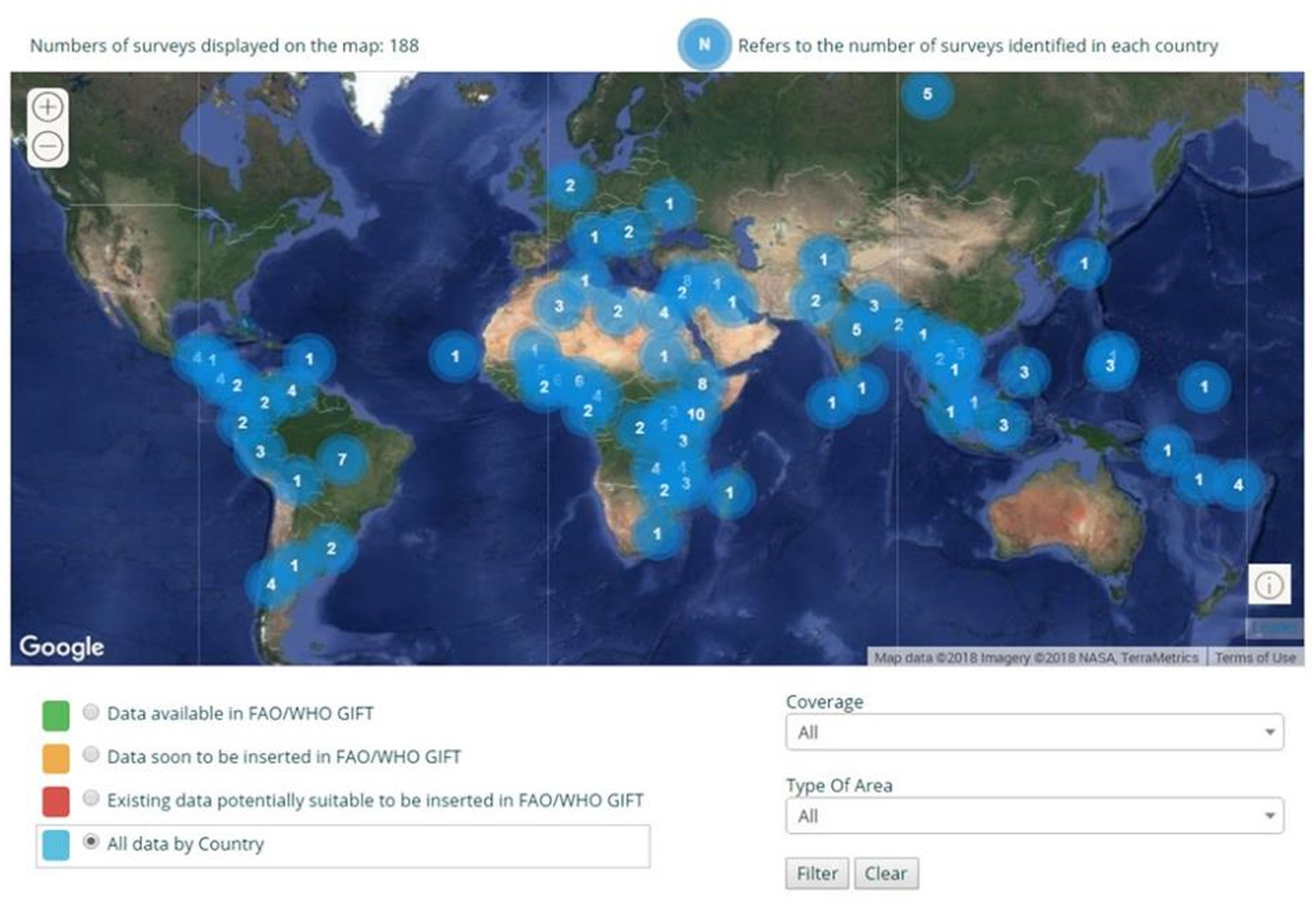
The FAO/WHO GIFT inventory shows that IQFC data exist in many LMIC. The aim of FAO/WHO GIFT is to make more and more of these dietary data available as microdata and as ready-to use indicators through the platform.
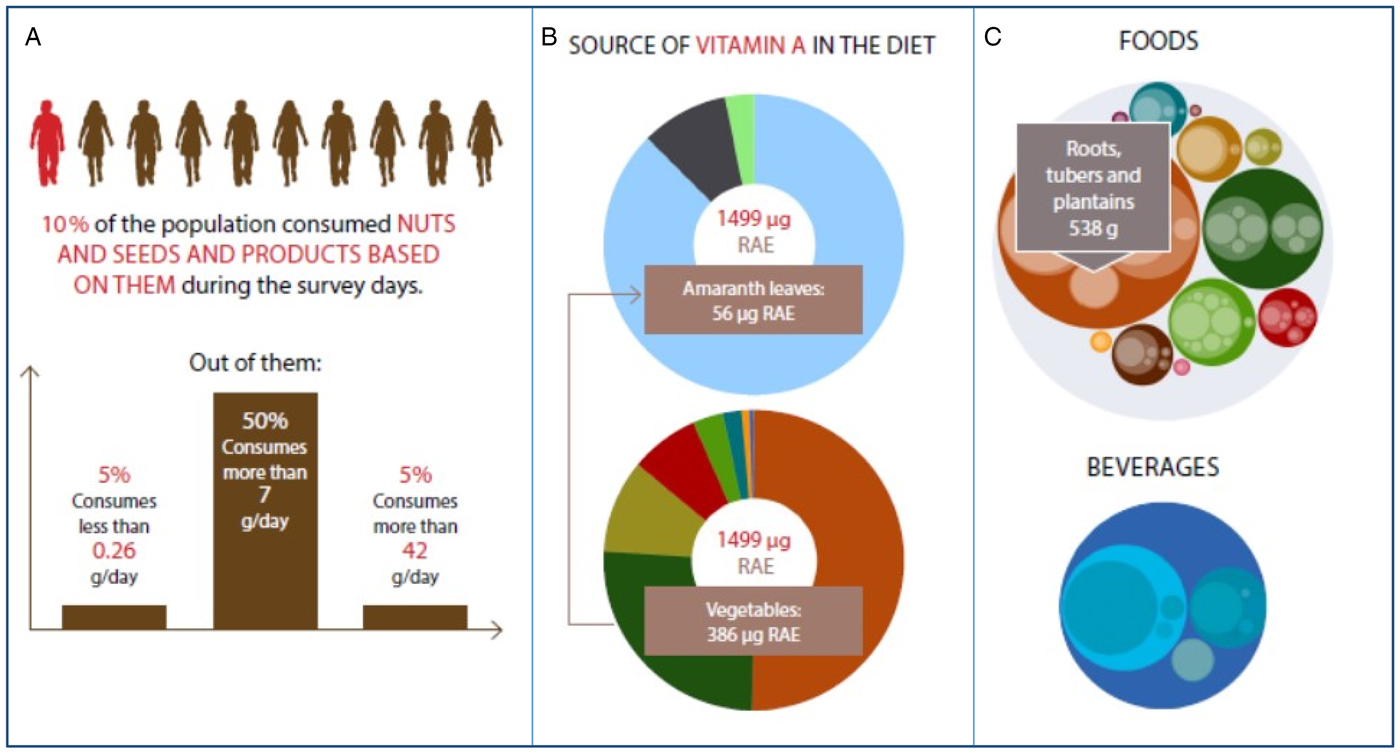
The choice of creating simple and easy-to-use indicators for the FAO/WHO GIFT platform was also an outcome of the consultations held in the first phase of the platform's development. Stakeholders clearly expressed the need for indicators which could be understood by decision makers with low scientific literacy. Currently, the FAO/WHO GIFT provides indicators in the areas of food consumption, food safety and nutrition. The food consumption indicators present the general dietary pattern by foods and food groups together with the contribution of these different foods and food groups to the average energy intake of a given population. The food safety indicator, conversely, presents the percentage of individuals in the population who consumed the foods or food groups of interest during the days of the survey and the observed high levels of consumption. Other nutrition indicators generated by the platform include estimates of micronutrient inadequacy, the sources of nutrients in the diet and the macronutrient contribution to the total energy intake in relation to recommended intake (Fig. 3).
(Colour online) Examples of food-based indicators presented in infographics in the FAO/WHO Global Individual Food consumption data Tool (GIFT) platform. The FAO/WHO GIFT platform provides tailored answers for different needs of users from different sectors: (A) For decision makers looking for dietary data for food safety purposes, data are presented on the percentage of consumers and on the consumption level of foods among high consumers in different population groups. (B) For decision makers looking for dietary data for nutrition purposes, data are presented on the sources of nutrients in the diets. (C) For decision makers looking for dietary data for agriculture purposes, data are presented on the level of consumption of different food groups and crops.
While the FAO/WHO GIFT indicators can be a useful and easy-to-interpret instrument for end-users with low scientific literacy, other IQFC data end-users, such as food safety, agriculture and nutrition experts, need access to the full dataset of food consumption in order to perform more specific data analysis. For these users, the platform allows to download the full datasets in the form of microdata (data at the most disaggregated level, i.e. the food and nutrient intake for each eating occasion, on each survey day and for each individual).
To date, FAO/WHO GIFT contains five datasets of microdata, which are all from LMIC. The sharing of these datasets was an outcome of the collaboration between FAO/WHO GIFT and data owners, in particular the Consultative Group for International Agricultural Research. In the platform's first phase of development, three datasets related to small-scale surveys from Bangladesh, Burkina Faso and Uganda provided by HarvestPlus(50–Reference Arsenault, Nikiema and Allemand52), and another dataset related to a nationwide survey from The Philippines provided by the Food and Nutrition Research Institute(53) were harmonised and inserted in the platform. These four datasets were used to build the pilot version of the platform and its ready-to-use indicators. In 2017, a nationwide survey from the Lao People's Democratic Republic, conducted by the Lao Tropical and Public Health Institute with technical support from the Institute of Nutrition at Mahidol University (Thailand) was uploaded for the computation of indicators, whereas the download of microdata will be available as soon as the final survey report is published.
An additional eleven datasets are currently in the pipeline for dissemination. Among these, a nationwide survey from Brazil, conducted by the Brazilian Nutrition Association(54, Reference Galante, Gaglianone and Stedefeldt55), a small-scale survey from Bolivia conducted by the Lund University (Sweden)(Reference Lazarte, Soto and Alvarez56), and a nationwide survey from Italy, conducted by CREA (Consiglio per la ricerca in agricoltura e l'analisi dell'economia agraria)(Reference Sette, Le Donne and Piccinelli57–59), are in the last steps of the data sharing process. While the work towards the sharing of these datasets move forward, other data owners are being contacted for collaboration.
Next steps for FAO/WHO Global Individual Food consumption data Tool
While the first years of the FAO/WHO GIFT initiative were focused on the conceptualisation and development of the web platform and the underlying data harmonisation process, the next steps for FAO/WHO GIFT are to populate the database with a large number of datasets and to foster its use among different stakeholders.
By 2022, FAO/WHO GIFT aims to provide indicators and microdata for an additional fifty datasets from countries around the world, in particular from LMIC. As a large number of datasets which are potentially suitable to be included in the platform had been already identified by FAO/WHO GIFT's inventory, the work in the next years will be focused on working with data owners to harmonise and share their datasets through FAO/WHO GIFT.
In terms of the FAO/WHO GIFT platform's development, a submission module will be enabled for data owners to submit their data and to communicate with FAO directly through the platform. In the ready-to-use indicator section, new indicators will be developed for food safety, dietary patterns, diet quality, environmental impact and nutrition recommendations, and already existing indicators will be refined according to the feedback provided by users.
Efforts will also be concentrated in further enhancing the harmonisation tools and the procedures and protocols for data validation and analysis. One key step will be to work further on the treatment of recipe information. In collaboration with the International Network of Food Data Systems (INFOODS) network and the Italian institute CREA, protocols will be created to develop tables of yield factors (which translate quantities of raw food into quantities of food ‘as consumed’) and of nutrient retention factors (which allow to estimate the nutrient content of foods ‘as consumed’) in order to provide food quantities and nutrient contents ‘as consumed’ through FAO/WHO GIFT. Moreover, protocols on how to deal with outliers in the datasets, and to estimate the usual level of consumption from short-term surveys will be developed. All this work will be done to improve the quality and level of harmonisation of datasets.
As part of the harmonisation process, one important element for the sustainability of the FAO/WHO GIFT initiative is to ensure that country institutional homes of data further develop their capacities towards data harmonisation, management and processing. This would enable institutions to conduct future IQFC surveys of increased quality and in a more harmonised way, allowing for comparison across surveys and countries. Therefore, data managers from eight institutions from LMIC will be invited to FAO Headquarters for long-term hands-on training in data harmonisation. The objective of such training will be to enhance the knowledge to data managers on some very technical aspects which are key for the collection, analysis and use of IQFC data.
The sustainability and use of the platform will be at the centre of its next phase of development. Two types of activities are foreseen: (1) to increase communication on FAO/WHO GIFT and to encourage the sharing of data to populate the platform; and (2) to ensure that the platform is useful and meets the needs of policymakers and their advisors. Three entry points for this process were identified and will be explored: (1) workshops with policymakers; (2) capacity building within the institutional homes where the country IQFC data are collected; and (3) support to the development or revision of Food Based Dietary Guidelines. A regional approach will be taken for these activities, but some of the outputs will be country-specific, and will target a limited number of LMIC fulfilling certain requirements related to the data availability, interest in taking part in the proposed activities and ongoing projects through which the proposed activities can be implemented.
The synergy between FAO/WHO Global Individual Food consumption data Tool and other initiatives on dietary intake and dietary exposure
The FAO/WHO GIFT initiative is the result of a close collaboration between FAO, WHO and other key partners in the area of collation, harmonisation and dissemination of IQFC data. The main institutions and initiatives which synergise with FAO/WHO GIFT are listed underneath.
FAO/WHO Chronic Individual Food Consumption – Summary Statistics and Global platform for food safety data and information
FAO and WHO collaborate in the development of both CIFOCOss and FAO/WHO GIFT. The CIFOCOss database has been incorporated in FAO/WHO Chronic Individual Food Consumption - Summary Statistics and Global platform for food safety data and information (FOSCOLLAB), a WHO tool which integrates multiple sources of reliable data to support food safety professionals as well as the FAO/WHO risk assessment process, e.g. JECFA and JMPR. The chemical occurrence data that are shared through FOSCOLLAB are also mapped with the FoodEx2 system. This way, experts interested to perform a dietary exposure assessment based on percentiles not available in CIFOCOss or to use a probabilistic or deterministic model for which microdata are needed, can easily combine the chemical occurrence data available on FOSCOLLAB with the microdata on dietary intakes shared through the FAO/WHO GIFT platform.
International Agency for Research on Cancer – Globodiet
FAO/WHO GIFT have collaborated with the Nutrition and Metabolism Section of the IARC (International Agency for Research on Cancer) by exchanging methodologies, contacts and information on existing IQFC surveys worldwide. Besides, FAO/WHO GIFT liaises with IARC and with the Department of Nutrition for Health and Development at WHO for the further development of Globodiet as a dietary assessment tool(Reference Aglago, Landais and Nicolas60).
European Food Safety Authority
FAO/WHO GIFT builds on EFSA experience of collating and harmonising IQFC data from different countries, and has adopted the food classification and description system developed by EFSA (FoodEx2). FAO and WHO have collaborated with EFSA to upgrade the FoodEx2 system at global level, including codes for foods that are usually not consumed in Europe but are consumed in other regions of the world. Besides, FAO and EFSA organise joint trainings on FoodEx2 for data managers interested in sharing their data through the FAO/WHO GIFT platform. This way, FAO and EFSA work together to promote the correct use of FoodEx2 worldwide.
International Dietary Data Expansion Project
The International Dietary Data Expansion Project (INDDEX), implemented by the Tufts University Gerald J. and Dorothy R. Friedman School of Nutrition Science and Policy with funding from the Bill & Melinda Gates Foundation, is an initiative aimed at facilitating the collection and use of high-quality food consumption data by countries. FAO/WHO GIFT's first phase of development was financially supported by the INDDEX project, comprising the development of the pilot dissemination platform, the definition of the platform's first set of indicators and outputs, the identification and harmonization of the four pilot datasets and the extension of the FoodEx2 system for global use. FAO also provides inputs for the development of the INDDEX24 application, a tool being designed for the collection and processing of dietary intake data in LMIC(Reference Coates, Colaiezzi and Bell34). FAO and INDDEX are working to align the data collected with INDDEX24 to easily feed the FAO/WHO GIFT platform.
Global Dietary Database
FAO/WHO GIFT collaborates with the GDD, a global initiative based at the Friedman School of Nutrition Science and Policy at Tufts University. Funded by the Bill & Melinda Gates Foundation, GDD aims to tackle the global scarcity of dietary data by characterising dietary intakes for sixty-one dietary factors in all countries worldwide and publicly disseminating those for use by a range of stakeholders in public health and global nutrition. The overall goal of GDD is to perform novel research and translation on global dietary intakes, diet-related disease burdens and evidence-based policy actions to create a healthier, equitable and more sustainable food supply. In 2016, FAO and the Friedman School of Nutrition Science and Policy signed an Exchange of Letters establishing the framework of collaboration, focusing on methods and approaches for harmonising individual-level dietary data using international standards (FoodEx2 developed by EFSA) and together disseminating harmonised dietary data compiled by GDD or FAO to the wider global community. The collaboration is essential to facilitate incorporation and harmonisation of dietary datasets within both databases, and promote global collaboration and capacity development with dietary data owners worldwide.
Institute of Health Metrics and Evaluation
FAO/WHO GIFT also collaborates with the Institute of Health Metrics and Evaluation for the identification of existing IQFC surveys worldwide. Lists of existing IQFC surveys identified by each initiative have been shared in order to complement the information available in the FAO/WHO GIFT inventory and in the Institute of Health Metrics and Evaluation database.
Intake – Center for Dietary Assessment
Another important FAO/WHO GIFT partner is Intake – Center for Dietary Assessment at FHI 360, funded by the Bill & Melinda Gates Foundation. Intake provides technical support to LMIC in the area of dietary assessment and has supported FAO/WHO GIFT in the harmonisation and inclusion of specific LMIC datasets on the FAO/WHO GIFT platform.
International Network of Food Data Systems
FAO/WHO GIFT is also working in synergy with INFOODS, which is a worldwide network of food composition experts aiming to improve the quality, availability, reliability and use of food composition data. Food composition is key for assessing nutrient intake and FAO/WHO GIFT benefits from the INFOODS work on publishing relevant food composition data at national and regional level. In addition, the work on methodologies to treat recipe information is being done based on INFOODS guidelines and on feedback provided by its experts.
Global Open Data for Agriculture and Nutrition
FAO/WHO GIFT collaborates also with the Global Open Data for Agriculture and Nutrition (GODAN). GODAN supports the proactive sharing of open data to make information about agriculture and nutrition available, accessible and usable to deal with the urgent challenge of ensuring world food security. Therefore, GODAN has been supporting the FAO/WHO GIFT work in different ways.
In 2017, GODAN provided support for three data owners from Costa Rica, Chile and Brazil to participate to the FoodEx2 training held by FAO and EFSA at the margins of the twenty-first IUNS Nutrition Congress of the International Union of Nutritional Sciences. The training allowed participants to learn the system and start the harmonization of their dataset for sharing through the FAO/WHO GIFT platform.
In December 2017, GODAN launched a working group on food classifications proposed by UC Davis under the International Center for Food Ontology, Operability, Data and Semantics project. FAO/WHO GIFT joined the working group as a member, together with other important partners, such as the Statistics Division of FAO, EFSA, International Food Policy Research Institute, Tufts University, United States Department of Agriculture, UK Food Safety Agency and Ghent University with the objective of bringing together the key domain authorities managing food classifications and achieving a higher level of alignment and interoperability. In particular, from the FAO point of view, it aims at achieving the development of the computer-readable version of FoodEx2 initiated by the UK Food Safety Agency, allowing the integration and continuous update of FoodEx2 in applications such as FAO/WHO GIFT or INDDEX24.
Conclusion
FAO/WHO GIFT is the first global database allowing users to download harmonised IQFC data in the form of microdata for free. The initiative therefore supports open data policies and provides visibility to the entities who have already shared their data. By doing so, FAO/WHO GIFT aims at creating a ‘snowball effect’, encouraging a broader group of data owners to share datasets containing key information for the prevention of malnutrition, the reduction of the health risk from food hazards and of the environmental impact of diets.
Moreover, the presentation of indicators under the form of infographics, which are easy to understand by policy makers with low scientific literacy, could be used in other areas related to public health to streamline the path from data to action.
Acknowledgements
The authors would like to acknowledge Ashkan Afshin, Davide Arcella, Mary Arimond, Ruth Charrondière, Jennifer Coates, Megan Deitchler, Lawrence Haddad, Inge Huybrechts, Sofia Ioannidou, Gina Kennedy, Andre Laperrière, Renata Micha, Valeria Pesce, Nadia Slimani and our colleagues from the Statistics Division and the Information Technology Division of FAO for their key inputs and support for the development of FAO/WHO GIFT platform. The following institutions have already agreed to enrich the FAO/WHO GIFT platform with their data: HaverstPlus (International Food Policy Research Institute), the Department of Science and Technology of the Food and Nutrition Research Institute (The Philippines), Lao Tropical and Public Health Institute, Consiglio per la ricerca in agricoltura e l'analisi dell'economia agraria – Centro di Ricerca Alimenti e Nutrizione (CREA, Italy), Lund University (Sweden) and Associacao Brasileira de Nutricao (Brazil). We are particularly thankful to Daovieng Douangvichit, Andrea Polo Galante, Claudia Lazarte, Mourad Moursi, Stefania Sette, Latsamy Siengsounthone, Jacqueline Tereza da Silva and Aida Turrini for facilitating the process of data sharing. Finally, we thank the FAO/WHO GIFT interns, namely Andrea Zuleta Perez for the organisation of the first FAO/WHO GIFT webinars, and Artur Aghajanyan and Tamari Dakhundaridze for the support in the development of the inventory map.
Financial Support
This work is supported by the FAO and the INDDEX project, implemented by Tufts University and supported by the Bill & Melinda Gates Foundation. GODAN provided support for capacity building activities related to data harmonisation.
Conflict of Interest
None.
Authorship
The authors had joint responsibility for all aspects of preparation of this paper.
Disclaimer
The views expressed in this publication are those of the authors and do not necessarily reflect the views or policies of the FAO and/or of the WHO.


 Open access

