




In Italy, in 2023, over two million families were in poverty: 8.4% of total resident families, against 6.2% in 2014, with a higher incidence among families with minors (12.4%) and immigrant families (35.1%). In 2024, over two million minors were living in poverty (26.7% of the 0–15 age population), the highest proportion since 2014 (Istat, 2025). These data have raised concerns since poverty impacts children’s language development, education, and well-being. Income – alone or combined with parental education – is one of the most common indicators of socioeconomic status (SES) in developmental research (Antonoplis, Reference Antonoplis2023). There is well-established evidence of SES-related differences in children’s language processes and products (Hoff, Reference Hoff2013; Pace et al., Reference Pace, Luo, Hirsh-Pasek and Golinkoff2017) and in structure and function in brain regions that support language (for a review, see Ellwood-Lowe et al., Reference Ellwood-Lowe, Sacchet and Gotlib2016). Therefore, SES disparities are related to individual differences in early childhood language skills that, in turn, are associated with school readiness, academic success, job placement, and healthcare outcomes (Golinkoff et al., Reference Golinkoff, Hoff, Rowe, Tamis-LeMonda and Hirsh-Pasek2019; Hoff, Reference Hoff2013).
International studies of how SES inequities affect language development (Fernald et al., Reference Fernald, Marchman and Weisleder2013; Hart & Risley, Reference Hart and Risley1995; Huttenlocher et al., Reference Huttenlocher, Waterfall, Vasilyeva, Vevea and Hedges2010; Justice et al., Reference Justice, Jiang, Bates and Koury2020; Levine et al., Reference Levine, Pace, Luo, Hirsh-Pasek, Michnick Golinkoff, de Villiers, Iglesias and Sweig Wilson2020) have shown a pervasive SES-related vocabulary gap from the second year of life and suggested that the implications of family SES extend to age 6. Analysing the vocabulary developmental trajectories of low SES children is crucial to understand the developmental trend and the magnitude of this gap over time, and to allow more solid analyses of related factors and inform timely interventions. However, existing longitudinal studies considering vocabulary development in children from low-income families are quite limited in number (Becker, Reference Becker2011; Fernald et al., Reference Fernald, Marchman and Weisleder2013; Justice et al., Reference Justice, Jiang, Bates and Koury2020; Lonigan et al., Reference Lonigan, Farver, Nakamoto and Eppe2013; Pan et al., Reference Pan, Rowe, Singer and Snow2005; Rodriguez et al., Reference Rodriguez, Tamis-LeMonda, Spellmann, Pan, Raikes, Lugo-Gil and Luze2009; Song et al., Reference Song, Tamis-LeMonda, Yoshikawa, Kahana-Kalman and Wu2012) and were conducted primarily in the United States.
Moreover, even within low SES populations, there is wide variability in children’s vocabulary acquisition and development (Dore et al., Reference Dore, Liu, Chaparro-Moreno and Justice2022; Justice et al., Reference Justice, Jiang, Bates and Koury2020; Pan et al., Reference Pan, Rowe, Singer and Snow2005; Song et al., Reference Song, Spier and Tamis-LeMonda2014), related to child characteristics and environmental factors (Paradis, Reference Paradis2023). Since immigrant families are consistently at high risk of poverty (Acevedo-Garcia et al., Reference Acevedo-Garcia, Joshi, Ruskin, Walters, Sofer and Guevara2021; Istat, 2025), a critical source of variability is whether the child is raised in a monolingual or bilingual immigrant environment (i.e., the child’s exposure to only the majority or societal language or also to a minority language as a first language). Nevertheless, because immigrant background condition covaries with income status (Pace et al., Reference Pace, Luo, Hirsh-Pasek and Golinkoff2017), the effects of dual language exposure and SES on language development in language-minority immigrant families can be easily confounded. Therefore, understanding the independent impact of immigrant background conditions on the vocabulary development of children from low-income families is a matter of particular importance. To date, evidence of the effects of being reared in low-income monolingual or equivalent-SES bilingual immigrant families on early vocabulary development mainly applies to monolingual English-speaking (Becker, Reference Becker2011; Fernald et al., Reference Fernald, Marchman and Weisleder2013; Pan et al., Reference Pan, Rowe, Singer and Snow2005) or predominantly English-speaking environments (Justice et al., Reference Justice, Jiang, Bates and Koury2020; Rodriguez et al., Reference Rodriguez, Tamis-LeMonda, Spellmann, Pan, Raikes, Lugo-Gil and Luze2009), and bilingual immigrant families where Spanish, as the heritage language, is widely spoken and strongly present in the community (Lonigan et al., Reference Lonigan, Farver, Nakamoto and Eppe2013; Song et al., Reference Song, Tamis-LeMonda, Yoshikawa, Kahana-Kalman and Wu2012).
Differences in language combinations and culturally embedded caregiver–child interaction styles may influence vocabulary development in distinct ways (Tamis-LeMonda & Song, Reference Tamis-LeMonda, Song, Lerner, Easterbrooks, Mistry and Weiner2013). Therefore, investigating vocabulary trajectories in linguistically and culturally diverse contexts can contribute to a more nuanced understanding of early bilingual development in children from low-income minority-language families.
Compared to minority-language families in other countries, such as the United States, immigrant families in Italy are from a wide variety of linguistically and culturally diverse backgrounds. Then, the linguistic profiles of bilingual children from these families are highly heterogeneous (Bello et al., Reference Bello, Ferraresi, Pallini, Perucchini and Lonigro2024), with very different heritage languages that are less commonly represented in the broader society compared to Spanish as a heritage language in the United States. Furthermore, immigration in Italy is a relatively recent phenomenon. As a result, societal language development faces emerging challenges that have significant implications for educational equity and social inclusion of children from bilingual immigrant families (Cavicchiolo et al., Reference Cavicchiolo, Manganelli, Bianchi, Biasi, Lucidi, Girelli and Alivernini2023; Persici et al., Reference Persici, Majorano, Bastianello and Hoff2022).
The present study in the Italian context extends existing knowledge on the development of the SES-related vocabulary gap in monolingual and bilingual children from minority-language families. It contributes to disentangling the impacts of immigrant background and low-SES status by analysing vocabulary trajectories in Italian in toddlers from equivalent low-income monolingual and bilingual immigrant families, from 18 to 36 months, and crucial environmental factors that may account for variability in vocabulary development. Being raised in monolingual or bilingual families was examined as the main predictor (Hoff, Reference Hoff2018), along with secondary factors (maternal education, home language activities in Italian, and childcare attendance). We focussed on environmental factors because, at this early stage of development, the strength of the potential influence of the environment on early language development is boosted by the high degree of brain plasticity (Huttenlocher, Reference Huttenlocher2009). Moreover, malleable environmental factors can be addressed by early intervention programmes and policymakers (Højen et al., Reference Højen, Hoff, Bleses and Dale2021). The following paragraphs review the literature on the early vocabulary development of children from low-income families and relevant environmental factors, highlighting the main controversies and gaps that the present study aimed to address.
1. SES inequalities and vocabulary development
Since the seminal work of Hart and Risley (Reference Hart and Risley1995), several studies have replicated and analysed the course of the SES gap in children’s vocabulary acquisition over time, using various measures. Infants from highly educated families produced more vocalization, collected using the Language Environment Analysis (LENA), than infants from low-educated families at 18 months, but not at 12 months (Brushe et al., Reference Brushe, Lynch, Reilly, Melhuish, Mittinty and Brinkman2021). In line with these data, an SES gap was evident at 18 months when comparing the expressive vocabularies of children from high- and low-SES families through the MacArthur–Bates Communicative Development Inventory (CDI; Fernald et al., Reference Fernald, Marchman and Weisleder2013). The SES gap was found to widen by 24 months (Fernald et al., Reference Fernald, Marchman and Weisleder2013) and still between 24 and 36 months (Hart & Risley, Reference Hart and Risley1995). However, these results are in contrast with those of other longitudinal studies that indicated stability in the gap. For instance, Huttenlocher et al. (Reference Huttenlocher, Waterfall, Vasilyeva, Vevea and Hedges2010) found that the SES gap in lexical diversity (assessed using at-home recordings of parent and child speech) was constant from 26 to 46 months in parent–child pairs of diverse SES. To date, the issue of the developmental trend and magnitude of the SES-related vocabulary gap, especially over the third year of life, is still controversial and needs further investigation.
2. Variability in vocabulary development in low-SES children and environmental factors
2.1. Monolingual or bilingual immigrant environment
The effects of dual language exposure and SES on language development are difficult to separate, especially when considering children from low-income, language-minority immigrant families (Pace et al., Reference Pace, Luo, Hirsh-Pasek and Golinkoff2017). However, there is evidence that dual language exposure and SES have independent effects on vocabulary development (Hoff et al., Reference Hoff, Core, Place, Rumiche, Señor and Parra2012, Reference Hoff, Rumiche, Burridge, Ribot and Welsh2014; Lonigan et al., Reference Lonigan, Farver, Nakamoto and Eppe2013). Hoff et al. (Reference Hoff, Core, Place, Rumiche, Señor and Parra2012, Reference Hoff, Rumiche, Burridge, Ribot and Welsh2014) showed that children from high SES bilingual (Spanish-English) immigrant families lagged behind children from equivalent high SES monolingual (English) families in English vocabulary development, but not in total English plus Spanish vocabulary, from 22 to 48 months. This was because bilingual children’s language experience was divided between two languages.
Lonigan et al. (Reference Lonigan, Farver, Nakamoto and Eppe2013) found that 4-year-olds from low-SES bilingual language-minority (Spanish-English) and monolingual families (African American English-speaking) started the preschool year with English language skills (i.e., expressive vocabulary and grammar) below the age-norm expected level. However, when controlling for SES variability within groups, the bilingual group’s oral language skills were lower than those of the monolingual group. During the preschool year, the bilinguals’ English language skills improved faster than the monolinguals’; nevertheless, bilingual children still ended the preschool year with lower English language skills. A similar pattern of acceleration in English (the societal language) but not in the heritage language was documented in a longitudinal study on the productive vocabulary skills of Spanish-English bilinguals from 18 to 30 months (Gámez et al., Reference Gámez, Galindo and Jáuregui2024).
In sum, being reared in bilingual immigrant families is a critical risk factor for vocabulary acquisition, even within SES strata. Therefore, a bilingual immigrant environment requires additional study as an independent predictor of vocabulary development of children from low-income families, particularly in the first years of life.
Furthermore, the vocabulary composition of bilingual children is shaped not only by the linguistic properties of the acquired language (Conboy & Thal, Reference Conboy and Thal2006) but also by the specific context of language exposure, particularly the home and educational environments (Bialystok et al., Reference Bialystok, Luk, Peets and Yang2010). Since for bilingual children from language-minority immigrant families the educational environment represents the main source of input in the societal language, it would be interesting to investigate whether the bilingual immigrant environment (as opposed to a monolingual one in equivalent low-income populations) influences the acquisition trajectories of specific lexical categories, such as nouns and verbs, in the societal language.
2.2. Maternal formal education
The educational level attained by the children’s primary caregivers, usually the mother, is highly predictive of language development. More highly educated mothers are likely to provide their children with more words and conversational turns (Brushe et al., Reference Brushe, Lynch, Reilly, Melhuish, Mittinty and Brinkman2021), and contingent utterances and linguistic diversity (Hoff et al., Reference Hoff, Trecca, Højen, Laursen and Bleses2024). This enriched linguistic input affects children’s language development (Hoff, Reference Hoff2013; Rowe, Reference Rowe2018).
The language input experienced by children varies across and within SES groups (Fernald et al., Reference Fernald, Marchman and Weisleder2013; Justice et al., Reference Justice, Jiang, Bates and Koury2020), and maternal education affects the child’s language acquisition even within low-income families. Maternal education and maternal language and literacy were significant predictors of English expressive vocabulary growth in 1- to 3-year-olds from low-income families using English as the home language in 99% of cases (Pan et al., Reference Pan, Rowe, Singer and Snow2005). Maternal education and maternal language and literacy appeared collinear in the analysis, suggesting that the former is an indicator of the quality of the children’s language learning proximal environment. Observational longitudinal data also showed that children from low-income families had significantly better English receptive language skills (i.e., composite scores of pre-verbal behaviour, vocabulary, and morphological skills) from 15 to 36 months if their mother had a college education compared to not, even when controlling for the effect of the home language (Justice et al., Reference Justice, Jiang, Bates and Koury2020). Since these studies focussed on an almost monolingual English-speaking sample, the relationship between maternal education and expressive vocabulary development in monolingual versus bilingual children in disadvantaged conditions requires further exploration.
2.3. Home language activities
The frequency of parent–child language activities, like shared book reading, oral storytelling, and singing, has been used as a measure of the quality of the home language environment that supports children’s language acquisition (Rowe & Snow, Reference Rowe and Snow2020). However, in toddlers from low-income families who are also exposed to a minority language, findings are mixed concerning the relation between home language activities (HLA) and vocabulary development in the societal language.
The frequency of HLA in low-income U.S. families was uniquely related to children’s expressive and receptive vocabulary in English (societal language) at 14, 24, and 36 months, over and above child and family characteristics (Rodriguez et al., Reference Rodriguez, Tamis-LeMonda, Spellmann, Pan, Raikes, Lugo-Gil and Luze2009). Shared book reading in low-income U.S. families was associated with expressive and receptive vocabulary at 14 months, expressive vocabulary at 24 months, and receptive vocabulary at 36 months in English-speaking children, but only with receptive vocabulary at 36 months in Spanish-speaking children. These results suggest different patterns of relations between early HLA and vocabulary development for children from minority-language families (Raikes et al., Reference Raikes, Pan, Luze, Tamis-LeMonda, Brooks-Gunn, Constantine, Tarullo, Raikes and Rodriguez2006). In low-income Latino families in the United States, children engaging in HLA (i.e., singing songs, reading books, and storytelling) at 14 and 24 months were positively associated with expressive vocabulary in the same language (Spanish, which was the dominant language for most of the infants, or English, which was the societal language) at both ages (Song et al., Reference Song, Tamis-LeMonda, Yoshikawa, Kahana-Kalman and Wu2012). Finally, in bilingual children from low-income language-minority families in Italy, expressive vocabulary in the societal language at 30 months was accounted for by the frequency of HLA, over and above expressive vocabulary at 24 months (Florit et al., Reference Florit, Barachetti, Majorano and Lavelli2021). Given the mixed set of results on the relation between HLA and societal language expressive vocabulary development in bilingual toddlers from low-income language-minority families, this relation merits further investigation.
2.4. Childcare attendance
Childcare centres are another language learning environment for children’s language development (NICHD, 2000). Across SES, early regular attendance at childcare centres contributes to better language abilities at the preschool age, compared to non-attendance (Lim et al., Reference Lim, Levickis and Eadie2022) and to attendance for only a few hours (Lekhal et al., Reference Lekhal, Zachrisson, Wang, Schjølberg and von Soest2010). Specifically, childcare attendance may have positive or even compensatory effects on language development in children from disadvantaged families, in particular when parenting stress is high (Dore et al., Reference Dore, Purtell, Chen and Justice2023).
Children from low-income families may experience more high-quality conversation in childcare centres than at home. Both the age of entry (at ages 1–3 or 3–4) and the time spent in high-quality early education and care settings were positively associated with the receptive vocabulary in English of monolingual and English-Spanish bilingual children (from birth to 5) from low-income families, with stronger effects on bilinguals than on monolinguals (Yazejian et al., Reference Yazejian, Bryant, Freel and Burchinal2015). These results suggested a favourable effect of childcare on the societal language skills of bilinguals. Coherently, childcare teachers’ communicative modalities and language scaffolding strategies in the majority language at 18 months were associated with expressive vocabulary in the majority language at 30 months in equivalent low-income bilinguals and monolinguals (Florit et al., Reference Florit, Barachetti, Majorano and Lavelli2024b). Moreover, for bilinguals from immigrant families, the child-directed speech provided in childcare by adults proficient in the societal language may contribute to a richer database for language acquisition (Hoff et al., Reference Hoff, Core and Shanks2020). In sum, attending childcare centres in the early years may be a protective factor for vocabulary development in the majority language in children from low-income families.
3. The present study
The present longitudinal study focussed on early expressive vocabulary trajectories in Italian (the majority or societal language) in toddlers from monolingual and bilingual immigrant low-income families, all attending Italian childcare centres. Furthermore, it investigated environmental factors that may account for vocabulary development in this at-risk population. The study addressed issues that remain controversial or unexplored in the literature reviewed above, with two main aims:
1. To compare the expressive vocabulary trajectories in Italian, in children from equivalent low-income families, with normative data at 18, 24, 30, and 36 months, to assess the presence, developmental trend, and magnitude of a SES-related vocabulary gap. Based on the international literature, we expected to find a gap at 18 months between the expressive vocabulary of toddlers from low-income families and the expressive vocabulary normative data (Fernald et al., Reference Fernald, Marchman and Weisleder2013). Considering the developmental trend of the gap, we could expect this gap to widen or remain stable at 24, 30, and 36 months (Fernald et al., Reference Fernald, Marchman and Weisleder2013; Hart & Risley, Reference Hart and Risley1995; Huttenlocher et al., Reference Huttenlocher, Waterfall, Vasilyeva, Vevea and Hedges2010), although a possible reduction of the gap with the children’s increasing experience in Italian-speaking environments (the childcare centres) seemed to be plausible.
2. To identify primary and secondary environmental predictors of expressive vocabulary development in Italian from 18 to 36 months in children from low-income families. In particular:
2a. To investigate whether being raised in a bilingual immigrant (versus monolingual) environment is an independent predictor of early vocabulary development in children from equivalent low-income families. The bilingual immigrant versus monolingual environment was included as the main predictor of individual differences (Hoff, Reference Hoff2018). Based on the existing literature that focussed on high-SES groups, we expected the bilingual immigrant group to lag behind the monolingual group in the societal language from 18 to 36 months (Hoff et al., Reference Hoff, Core, Place, Rumiche, Señor and Parra2012, Reference Hoff, Rumiche, Burridge, Ribot and Welsh2014).
2b. To investigate whether being raised in a bilingual immigrant (versus monolingual) environment affects the acquisition trajectories of specific lexical categories (i.e., nouns and verbs) differently in the age range considered, and how.
2c. To identify which other environmental factors – besides the bilingual immigrant (versus monolingual) environment – contribute to predicting early expressive vocabulary development in children from low-income families. Mothers’ formal education, HLA in Italian, and daily hours at childcare were analysed as additional secondary predictors. The age of entry to childcare was considered a potential confounding variable and thus controlled in the analyses since two cohorts of children, followed from 18 or 24 months of age, were considered in the present study (see the Participants section). The role of the secondary predictors was tested by considering the contribution of the primary predictor. Based on the literature, we expected the low-income toddlers’ vocabulary skills to be affected by maternal education (Justice et al., Reference Justice, Jiang, Bates and Koury2020), childcare attendance (daily hours; Lekhal et al., Reference Lekhal, Zachrisson, Wang, Schjølberg and von Soest2010), and HLA in Italian. The last expectation was proposed despite the mixed findings on the role of HLA; it was based on the socio-pragmatic and socio-cultural perspectives according to which language acquisition is embedded in social interactions (Rowe & Snow, Reference Rowe and Snow2020).
4. Method
4.1. Participants
Eighty-three toddlers regularly attending five public childcare centres in a northeastern province of Italy participated in the study. The children were in two cohorts. The first cohort was followed longitudinally from age 18 months to age 30 months (N = 30) or 36 months (N = 25); the second (N = 28) was followed from age 24 months to age 36 months.
For the first time of assessment, the first cohort was involved from November 2016 to July 2017, and the second cohort was involved from January to July 2017. It was necessary to include the second cohort because 30 children of the first cohort, who were 18 months of age from March to July 2017, could not be followed up until 36 months. These children would have been 3 years old in the Autumn of 2018, when they would, in the Italian system, have already started attending preschool. The two cohorts are shown in Figure 1.
Number of children in the first cohort (18 months–30/36 months) and in the second cohort (24 months–36 months) of the present study. Note: Data for two participants of the first cohort (18–30 months) were missing at 24 months because of their absence from school on the assessment days.

The participants were recruited for a more comprehensive longitudinal study on the lexical trajectories of toddlers from low-income families. Only low-income families – identified as those paying the lowest rate for their children’s nursery schools (≤ €130 per month) – were selected for participation in the project. All the children were born healthy, in Italy, within 2 weeks of their due date, with normal hearing. Children with certified disabilities or developmental disorders were excluded from the sample.
Fifty-five children (49% females) of the 83 were from bilingual immigrant families, and 28 (50% females) were from monolingual families. The children from bilingual immigrant families were mainly exposed to Italian and Romanian (32 children; 58%) or to Italian and Nigerian English (11 children; 20%), and the remaining children to Italian and Arabic (4), Sinhalese (4), Spanish (2), Polish (1), and Portuguese (1). The distribution of immigrant families is consistent with the demographic population of the province. None of the bilingual children had an Italian parent. The monolingual children were exposed only to Italian; all their parents were native Italian speakers.
The parents (usually mothers) gave information on the family’s demographic characteristics, language exposure, and expressive vocabulary in the heritage language (L1) when their children were 24 and 30 months old (see the Procedure and Measures sections). Based on the parents’ reports, all the bilingual children were exposed to L1 (native language) and L2 (Italian) every day from birth or sometime later (M for L2 = from 5 months after birth). Available data showed that the estimated exposure time to L2 (Italian) was, on average, about 59% of weekly waking time (range 28%–89%). To get the weekly total amount of exposure to Italian, we added the hours of exposure to Italian at childcare (i.e., the hours of weekly attendance at childcare minus two daily hours of afternoon sleep) to the hours of exposure to Italian at home. Then, the total amount of exposure to Italian was expressed as a percentage of a typical number of weekly waking hours (84; Onofrio et al., Reference Onofrio, Rinaldi and Pettenati2012). The socio-demographic characteristics of the children and their mothers are reported in Table 1. No significant differences (adjusted p-values after Bonferroni correction) were found between the bilingual and monolingual groups.
Children’s and Mothers’ socio-demographic characteristics

Note: aTwo missing data in each group. bTwo missing data in the monolingual group and one in the bilingual group. cOne missing data in the bilingual group. dAdjusted p-value after Bonferroni correction = .008.
All participating childcare centres were state-regulated and funded. All children aged 18–36 months were cared for in a group of up to eight children. Twenty childcare teachers, all female and native Italian speakers, were primarily responsible for the participating children. The study was approved by the host University’s Ethics Committee (ethical approval code: VOCALIF, Cod. 2018_5).
4.2. Procedure
A three-wave longitudinal design, spanning 18 months, was adopted. At the beginning of the study, parents and teachers completed a consent form. Parents also completed a demographic questionnaire about their families and took part in a semi-structured interview on the frequency of HLA. With immigrant families, the interview was also intended to collect information about the hours that parents (or others in regular contact with the child) use L1 (heritage language) and L2 (Italian) with the child on typical weekdays and weekends. The questionnaire and semi-structured interview were administered by trained researchers with monolingual parents at the child’s home and with the bilingual children’s parents in a quiet room at childcare. The interviews were conducted in Italian and, when necessary, with the help of a cultural mediator in the language of the parents’ choice.
When the children were 18, 24, 30, and 36 months old, trained researchers collected data on their expressive vocabulary. Teachers were involved as informants and completed the age-appropriate short form of the Italian version of the CDI (Caselli et al., Reference Caselli, Bello, Rinaldi, Stefanini and Pasqualetti2015; Rinaldi et al., Reference Rinaldi, Pasqualetti, Stefanini, Bello and Caselli2019). All teachers participated in 2 hours of ad hoc training before starting the evaluation of children’s vocabulary. In addition, at 24 and 30 months, immigrant mothers were involved as informants on their children’s heritage language vocabulary by completing the CDI-short form translated into their L1.
4.3. Measures
4.3.1. Demographic questionnaire
The demographic information relevant to the present study concerned (a) children’s age in months at the beginning of the study, gender, and birth order; (b) children’s age of entry to childcare in months and daily hours spent at the childcare; (c) mother’s formal education in years and age in years.
4.3.2. Semi-structured interview: Home language activities in Italian
The semi-structured interview on HLA was based on the instruments devised by Onofrio et al. (Reference Onofrio, Rinaldi and Pettenati2012) to analyse the linguistic profile of bilingual children and by Vander Woude and Barton (Reference Vander Woude and Barton2001) to analyse shared book reading activities. The parents were asked about the frequency of HLA during the month preceding the interview. Relevant questions asked for the frequency of activities implying interaction with an adult, such as shared book-reading, oral storytelling, and singing in the heritage and majority language. Four-point Likert scales were used as answer formats (0 = never, 1 = twice a month, 2 = twice a week, 3 = every day).
4.3.3. Expressive vocabulary in Italian
Expressive vocabulary in the majority language was assessed using the Italian version of the CDI (Primo Vocabolario del Bambino-PVB; Caselli et al., Reference Caselli, Bello, Rinaldi, Stefanini and Pasqualetti2015; Rinaldi et al., Reference Rinaldi, Pasqualetti, Stefanini, Bello and Caselli2019), Gesti e Parole, forma breve (Gestures and Words short form) at 18 months and Parole e Frasi, forma breve (Words and Sentences short form) at 24, 30, and 36 months. Both versions include a 100-word expressive vocabulary checklist with several lexical categories, such as nouns (animals, toys, food, people), verbs, adjectives, adverbs, and closed-class words. The teachers reported the number of words the children could produce from the 100-item list, excluding imitations and elicited repetitions, which yielded the children’s expressive vocabulary score in Italian. In addition, we counted the number of nouns and verbs in the child’s expressive vocabulary at each time point.
4.3.4. Expressive vocabulary in the heritage language
The adaptations of the CDI in the heritage languages of the bilingual children participating in the study (except for the Spanish version) were not available. Therefore, the L1 vocabulary skills of these children were assessed using the CDI-short form, which was translated into L1 by cultural mediators who were native speakers of the respective L1, in collaboration with a language development researcher (see Barachetti et al., Reference Barachetti, Majorano, Rossi, Antolini, Zerbato and Lavelli2022, for more detailed information on the Romanian and Nigerian English adaptations). The average number of words produced in the L1 was 16.63 (SD = 18.73) at 24 months and 30.38 (SD = 27.41) at 30 months.
4.4. Data analysis
We report how we determined our sample size, all data exclusions, and all measures in the study. Data and analysis code are available on an online repository (Florit et al., Reference Florit, Barachetti, De Carli, Majorano and Lavelli2024a). This study’s design and its analyses were not preregistered.
First, we explored the distribution of the sample in relation to the normative data of expressive vocabulary in Italian described by the CDI-Gestures and Words short form (Caselli et al., Reference Caselli, Bello, Rinaldi, Stefanini and Pasqualetti2015) and the CDI-Sentences and Words short form (Rinaldi et al., Reference Rinaldi, Pasqualetti, Stefanini, Bello and Caselli2019). Figure 2 shows the distribution of the participants’ scores in relation to the developmental trends of the normative sample (i.e., the temporal linear trend of the 5th, 10th, 25th, 50th, 75th, 90th, and 95th percentiles). Figure 2, panel A, shows the global sample, and Figure 2, panel B, shows the Monolingual and Bilingual Groups. Since the parameters of the normative sample distribution were available only in the form of percentile scores (personal communication of the authors of the Italian versions of the CDI), a simulation approach was implemented to determine a good enough estimation of the mean and standard deviation of the normative data. We simulated 100,000 potential samples based on the premise that the test scores can vary from 0 to 100, with a different probability of being sampled based on the known percentile of the normative distribution. We computed the mean and standard deviation for each potential sample and then computed the average scores. These pooled parameters were used to test for differences between the normative data and our participants’ data. For more details and the ad hoc R script, see the online repository (Florit et al., Reference Florit, Barachetti, De Carli, Majorano and Lavelli2024a).
The distribution of children’s expressive vocabulary size over time for the normative data and the global sample of children from low-income families (a) and the sample separated into monolingual and bilingual children (b).

Second, we provided descriptive statistics (means and standard deviations) for the frequency of shared book reading, oral storytelling, and singing at home in Italian. Z-scores were derived for each variable, and a composite score of HLA in Italian was calculated and used in the analyses. Then, to test the potential predictive role of the main predictors (i.e., the developmental trend [age in months as a continuous variable], group [monolingual versus bilingual] and their interaction) and secondary predictors (i.e., mother’s formal education, HLA in Italian, daily hours at childcare, and the interaction of each predictor with age) for expressive vocabulary acquisition in Italian (Aim 2), we computed a series of generalized linear mixed models based on the negative binomial distribution (Man & Harring, Reference Man and Harring2019). In this way, we could consider the discrete nature of the data and their skewed distribution, allowing for the over-dispersion of the data. Generalized linear mixed models allowed us to consider the nested structure of the data and the dependent variable (i.e., the expressive vocabulary size of each child). Observations (i.e., the expressive vocabulary size of a child at each time of assessment) were nested in individuals, who are nested in childcare centres. Estimation problems prevented the fit of planned models with both random intercepts and slopes. As suggested by Barr et al. (Reference Barr, Levy, Scheepers and Tily2013), non-converging models were dealt with by progressively simplifying the random effects structure until convergence was reached. This resulted in our case in a random-intercept-only model. Firstly, we tested our hypothesized model comprising the main effects of our main predictors (i.e., age in months [centred] and monolingual/bilingual groups), their interaction, and the potential confounder of the age of entry to childcare. The significant interaction effect was explored using simple slope analysis and the Wilcoxon signed rank test to test for the differences between the Bilingual and Monolingual groups at each time point. The Wilcoxon signed rank test was also used to further compare monolingual and bilingual groups using total vocabulary (L1 + L2) for bilingual children at 24 and 30 months. As an additional control, the first model testing the potential predictive role of the main predictors was replicated by including additional potential confounders (i.e., child sex and birth order), using linear mixed models, and with fully imputed data. For the latter, we imputed the missing data for the expressive vocabulary size of a child for each assessment time by considering the longitudinal nature of the data with observations nested in participants and childcare centres. The imputed data produced five datasets, and after analysing each of these datasets, we pooled the results (Honaker et al., Reference Honaker, King and Blackwell2011). We also computed two generalized mixed linear models aimed at testing the developmental trends in children’s production of nouns and verbs, the effect of the monolingual/bilingual group, and their interaction. Finally, we used three additional generalized linear models based on the negative binomial distribution to test the potential role of each secondary predictor (mother’s formal education, HLA in Italian, and daily hours at childcare) and its interaction with age in months, over and above the role of the main predictors.
All the analyses were performed with R (R Development Core Team, Reference Team2023). The generalized linear mixed-effects models (GLMM) for the negative binomial family were computed with the lme4 package (Bates et al., Reference Bates, Mächler, Bolker and Walker2015) and the MASS package (Venables & Ripley, Reference Venables and Ripley2002). The simple slope analysis effects were computed with the package effects (Fox, Reference Fox2003). Plots were built with the ggplot2 package (Wickham, Reference Wickham2009). The missing values computations were implemented by using the Amelia package.
5. Results
5.1. Expressive vocabulary trajectories in Italian in toddlers from low-income families relative to normative data (Aim 1)
Figure 2a shows the distribution over time of the expressive vocabulary scores of the normative sample and the global sample of participating low-income children. A qualitative analysis of the plot for the global sample suggests that variability in the distribution of children’s expressive vocabulary increases from 24 months. The plot also showed that three-quarters of the participants obtained scores below the 25th percentile at 18 months and below the 50th percentile at 24, 30, and 36 months. The median scores were at or below the 10th percentile at 18 and 24 months, between the 10th and 25th percentile at 30 months, and at the 25th percentile at 36 months. Results of the comparisons between the expressive vocabulary size of our participants and the estimation of mean and standard deviation of the normative data obtained by using the simulation approach show significant differences at each time point: 18 months (t[240.04] = 12.91, p < .001), 24 months (t[167.60] = 8.57, p < .001), 30 months (t[131.45] = 8.19, p < .001), and 36 months (t[68.75] = 4.31, p < .001).
5.2. Environmental predictors of expressive vocabulary trajectories in Italian in toddlers from low-income families (Aim 2)
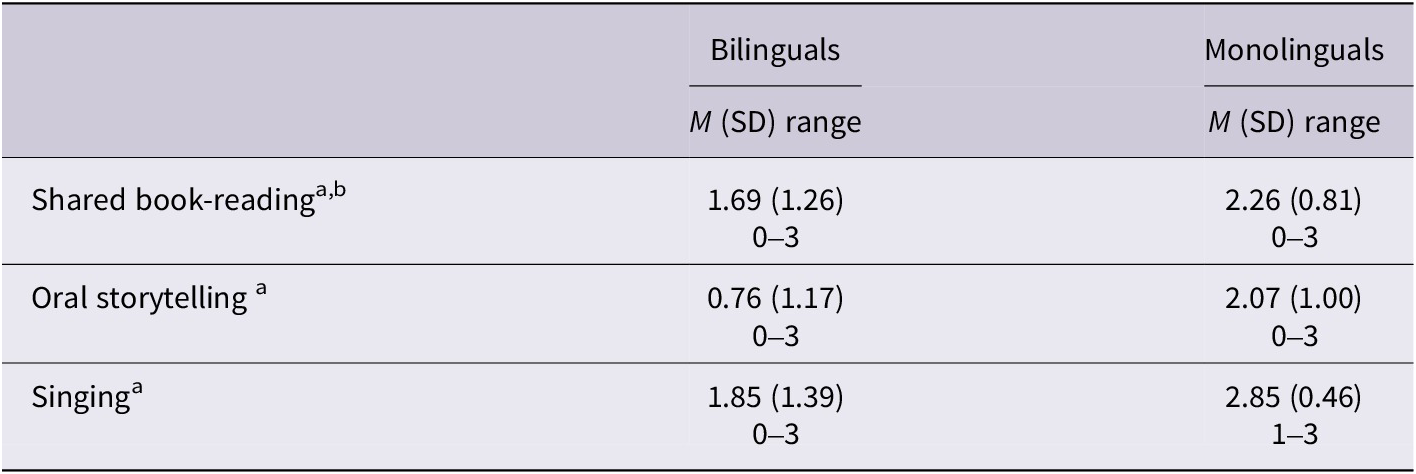
The descriptive statistics for the frequency of shared book-reading, oral storytelling, and singing in Italian are presented in Table 2 (for the descriptive statistics of mothers’ formal education and daily hours at childcare, see Table 1).
Descriptive statistics for frequency of home language activities in Italian

Note: a0 = never, 1 = twice a month, 2 = twice a week, 3 = every day; bOne missing data in the monolingual group.
The distribution of children’s expressive vocabulary size (dependent variable) is shown in Figure S1 in the Supplementary Materials. The skewed nature of the distribution supports the use of a binomial distribution in the generalized mixed linear models aimed at testing the developmental trends, the effect of the monolingual/bilingual group, and their interaction.
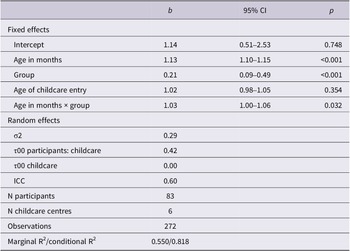
Table 3 presents the model’s parameters of potential main predictors with the significant effect of age in months and group (Aim 2a). This shows that, in general, word production increases over time and that, on average, monolinguals produce more words than bilinguals when only the majority language is considered for the latter. In addition, we found a significant interaction between age and group, meaning that the effect of time is different for the two groups. In fact, the simple slope analysis shows that the rate of increase in vocabulary size is positive and significant in both groups, but it is more positive for the bilingual group (b = 1.16, 95% CI [1.14–1.18], p < .001) than for the monolingual group (b = 1.13, 95% CI [1.10–1.15], p < .001).
Parameters of the primary predictors model with children’s number of words as dependent variable

Note: σ2 = variance of residuals; τ00 Participants: Childcare = between-child random intercept variance; τ00 Childcare = between-childcare random intercept variance; ICC = Intra-class correlation.
Figure 3 shows the simple slope analysis of the interaction between age in months and group. The two groups increase their expressive vocabulary size at different rates from 18 to 36 months of age, suggesting that the difference between monolingual and bilingual groups at 18, 24, and 30 months cannot be detected at 36 months. This interpretation is supported by the descriptive data reported in Figure 2b and the results of the Wilcoxon signed-rank test. Figure 2b shows that at 18 months, the median scores of both the monolingual and bilingual groups were extremely low, with the monolinguals consistently below the 25th percentile of the normative sample and the bilinguals consistently below the 10th percentile. At 24 months, the monolinguals’ median was between the 25th and the 50th percentile, while the bilinguals showed very low scores, with a median score below the 5th percentile. At 30 months, the monolinguals’ median was close to the 50th percentile, while the bilinguals’ median remained below the 10th. Finally, at 36 months, the monolinguals’ median was perfectly in line with the normative sample; meanwhile, the bilinguals’ scores, although considerably improved, remained low, with the median below the 25th percentile. The results of the Wilcoxon signed-rank test showed a significant difference between the monolingual and bilingual groups at 18 months (W = 303, p = .01), 24 months (W = 5342, p < .001), and 30 months (W = 4053.5, p < .001), but not at 36 months (W = 1397, p = .64). Results of additional analyses considering total vocabulary (L1 + L2) for bilingual children at 24 and 30 months, indicated no significant difference between the monolingual and bilingual groups at the two time points (24 months: W = 865, p = .064; 30 months: W = 610.5, p = .79).
Simple slope analysis for the significant interaction between age in months and group on the number of words produced by children.

As supplementary analyses, we replicated the model of primary predictors; we found that the results remained essentially unchanged when adding children’s gender and birth order as potential confounders (Table S2 in the Supplementary Materials), using a linear mixed model (Table S3 in the Supplementary Materials) and with a fully imputed set of datasets (Table S4 in the Supplementary Materials).
A more detailed analysis (Tables S5–S7 in the Supplemental Materials) showed that noun and verb production increased over time, and monolingual children produced more nouns and verbs than bilinguals (Aim 2b). In addition, we found a significant interaction between age and group for verbs, meaning that the effect of time is different for the two groups. Similar to what we found considering the whole vocabulary in Italian (Table 3), the rate of increase in verbs is more positive for the bilingual group.
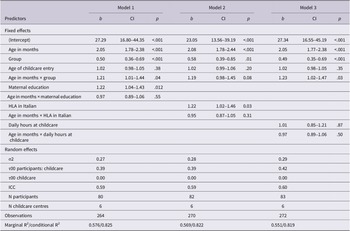
Table 4 presents the three additional generalized linear models to test the role of each potential secondary predictor (maternal formal education, HLA in Italian, daily hours at childcare; Aim 2c). The results show that maternal formal education and HLA in Italian have a significant positive main effect on the Italian vocabulary size of children from low-income families. Interactions between each secondary predictor and age were not significant.
Parameters of the secondary predictors models with children’s number of words as dependent variable

Note: HLA in Italian = Home language activities in Italian (composite score). σ2 = variance of residuals; τ00 Participants: Childcare = between-child random intercept variance; τ00 Childcare = between-childcare random intercept variance; ICC = Intra-class correlation.
6. Discussion
Low-income status has been widely associated with reduced vocabulary size as early as the second year of life. However, there is considerable variability in developmental trajectories, even within SES strata. Particularly, low-income status and immigrant background often overlap, making it difficult to isolate the independent effect of each factor. Few longitudinal studies have attempted to separate these effects by controlling for children’s home language (e.g., Justice et al., Reference Justice, Jiang, Bates and Koury2020) and have primarily focussed on bilingual English-Spanish children (Lonigan et al., Reference Lonigan, Farver, Nakamoto and Eppe2013). The present study extends the literature by documenting expressive vocabulary trajectories in Italian in monolingual and bilingual toddlers from equivalent-low-income families relative to normative data from 18 to 36 months. We also documented the crucial environmental factors that may account for variability in early vocabulary trajectories within this at-risk population. First, the homogeneous income sample allowed us to disentangle the roles of low-income and bilingual immigrant conditions by considering the effect of being raised in monolingual or bilingual immigrant families as the main predictor. Second, we tested the role of maternal education, HLA in Italian, and hours of childcare attendance as additional relevant predictors, over and above the main predictor.
6.1. Toddlers from low-income families showed a vocabulary gap (with a decreasing developmental trend) compared to normative data in Italian
As hypothesized, toddlers living in poverty showed a gap in expressive vocabulary in Italian relative to normative data. Although children’s vocabulary increased from 18 to 36 months, their median vocabulary scores were significantly lower than the normative data from the CDI at each assessment time. These findings extend evidence from other countries – mostly English-speaking – to the Italian context, documenting that the negative impact of economic disadvantage on vocabulary development in Italian is already evident in the second year of life. Furthermore, our data add new, unexpected results on the developmental trend of the SES-related vocabulary gap to the contrasting findings from previous longitudinal research documenting that this gap widens or remains stable over time (Fernald et al., Reference Fernald, Marchman and Weisleder2013; Huttenlocher et al., Reference Huttenlocher, Waterfall, Vasilyeva, Vevea and Hedges2010). Indeed, in our sample, the vocabulary gap decreased from 18 to 36 months. Considering the whole group, the gap decreased with most scores below the 25th percentile at 18 months and the 50th percentile from 24 months onwards, with a progressive improvement in median scores over the third year. The gap decrease documented in our study could be interpreted in light of the childcare experience. Although the daily hours of attendance and the age of entry were not associated with individual differences in expressive vocabulary size (see below), we hypothesized that attending childcare centres may have supported the difficult acquisition of the societal language. The children listened to and interacted with Italian native-speaking teachers at childcare daily. There, bilingual children from immigrant families experienced the first immersive context in L2, and both the bilingual and monolingual children were provided with a higher quantity and, probably, quality of child-directed speech, shared language activities, and many learning resources. However, only a future study with a control group of non-attending children from equivalent low-income families will allow us to investigate the role of childcare centres in the lexical development of this population.
Finally, variability in expressive vocabulary size in Italian increased from 24 months. Across languages, large individual differences in vocabulary size emerge during the second year of life, when most children accelerate their acquisition of new words (Frank et al., Reference Frank, Braginsky, Yurovsky and Marchman2021). More specifically, the increased variability in expressive vocabulary size in Italian in toddlers from families with various SES has been documented from 16 to 20 months (Caselli et al., Reference Caselli, Bello, Rinaldi, Stefanini and Pasqualetti2015; D’Odorico et al., Reference D’Odorico, Carubbi, Salerni and Calvo2001). Our findings indicate that this pattern appears later in children from low-income families, probably due to their still tiny vocabulary size in the second year.
However, when interpreting these findings, some limitations regarding the sample and the language measures used in the present study should be considered. First, the involvement of two cohorts with missing data at 18 and 36 months. However, this was intrinsically related to the children’s age at the time of recruitment and to the norms of the Italian educational system. In mitigation, adopting general linear mixed models allowed for the proper handling of missing data in estimating model parameters, as suggested by the results of the additional model with fully imputed data. Second, regarding the measures, the Italian age-appropriate versions of the CDI to assess expressive vocabulary in the majority language were completed by the childcare teachers, while the normative data are based on reports completed by parents. We used teacher reports since they may provide a more complete picture of children’s developing Italian vocabulary knowledge. In fact, teachers observe and interact with children in different activities in Italian more often than many parents from immigrant families. Previous studies also showed good agreement between parent and teacher ratings of the CDI for assessing language skills in toddlers with typical development (De Houwer et al., Reference De Houwer, Bornstein and Leach2005). In addition, we focussed on the children’s expressive vocabulary and assessed it with a single instrument (the CDI). Future studies should consider a broader range of measures of children’s expressive and receptive language.
6.2. Low-income monolingual or bilingual conditions account for variability in lexical developmental trajectories
Our data from low-income-equivalent monolingual and bilingual children from immigrant families in Italy help us to unravel the effects of SES and bilingualism on early expressive vocabulary development. Therefore, this investigation adds to existing studies that mainly considered anglophone low-income environments and the home language as a control variable (e.g., Justice et al., Reference Justice, Jiang, Bates and Koury2020; Pan et al., Reference Pan, Rowe, Singer and Snow2005). Specifically, being reared in bilingual immigrant families resulted in an additional risk factor for vocabulary development in Italian (the societal language) in toddlers from disadvantaged families. Indeed, bilingual children showed lower vocabulary skills in Italian than monolinguals from 18 to 30 months, despite the equal status of children from low-income families. Therefore, bilingual toddlers’ lower-than-expected Italian vocabulary size was not solely a function of poverty-related conditions. These findings are consistent with those that emerged with high-SES (Spanish-English) bilingual children from immigrant families, who lagged behind monolingual children from equivalent-SES families in English (but not in total English plus Spanish) vocabulary development from 22 to 48 months (Hoff et al., Reference Hoff, Core, Place, Rumiche, Señor and Parra2012, Reference Hoff, Rumiche, Burridge, Ribot and Welsh2014). In line with these studies, we also found that the total vocabulary size (L1 + L2) of children exposed to two languages was comparable with that of their monolingual peers at 24 and 30 months. Taken together, our results expand the understanding of early bilingual development, including children from low-income families in linguistically and culturally diverse settings. However, due to the focus on the Italian language as the societal language, we did not collect the vocabulary skills in the heritage language at all the time points. Therefore, to better understand lexical developmental trajectories and individual differences among children from language-minority homes, future research should address bilingual children’s total linguistic knowledge across both heritage and majority languages.
The monolingual-bilingual gap found when considering only the societal language may reflect the nature of children’s language experience, such as the quantity and quality of input in Italian. Because bilingual children’s language exposure is divided across two languages, they have less experience with each language than children who receive all the input in just one language (Hoff, Reference Hoff2018). Moreover, children from immigrant families receive input at home from non-native speakers who have often limited language proficiency in the societal language, factors that are negative predictors of children’s language skills (Hoff et al., Reference Hoff, Core and Shanks2020). Regarding this point, a limitation of the present study is that we have not assessed the parents’ (or older siblings’) proficiency in the majority language, which was shown to be a predictor of children’s vocabulary in the same language when parents are non-native speakers (Hoff et al., Reference Hoff, Core and Shanks2020).
Interestingly, at 36 months, there were no significant differences in the size of Italian expressive vocabulary between monolingual and bilingual groups. We could interpret this result in light of the slight growth advantage shown by bilingual children. Indeed, Italian language skills increased faster in bilinguals than monolinguals, consistent with results that emerged in older English-speaking children (Lonigan et al., Reference Lonigan, Farver, Nakamoto and Eppe2013). Similarly, the productive vocabulary growth rates in English (the societal language) of bilingual toddlers from Latino backgrounds show a significant acceleration from 18 to 30 months (Gámez et al., Reference Gámez, Galindo and Jáuregui2024). Acceleration in the rates of language development in bilinguals could be attributed to a “booster effect” in the simultaneous acquisition of two language systems. According to this effect, cross-linguistic influence allows knowledge in one language to facilitate the acquisition of the other at phonological, lexical, and grammatical levels (Kupisch, Reference Kupisch, Gaerts and Jacobs2005; Siow et al., Reference Siow, Lepadatu, Gillen and Plunkett2025). Since a similar acceleration was observed in the developmental trajectories of verb production, but not in noun production, verbs may be the lexical category that benefits from dual language development and drives the observed boost in vocabulary production when Italian is the societal language. Despite an overall noun bias in vocabulary composition, consistent with the acquisition of a noun-oriented language such as Italian (Tardif et al., Reference Tardif, Shatz and Naigles1997), bilingual children showed a more positive rate of increase in verbs than their monolingual peers. Bilingual children from minority-language immigrant families are mainly exposed to Italian in childcare rather than at home, whereas monolingual children are exposed to Italian in all interaction contexts. Therefore, we speculate that childcare educators’ input could be verb-rich – for instance, when proposing activities and regulating behaviours – and that this context-specific exposure may have boosted verb learning relative to nouns (Bialystok et al., Reference Bialystok, Luk, Peets and Yang2010).
Nevertheless, there is variability in the time it takes bilinguals to catch up to monolinguals across languages (Hoff et al., Reference Hoff, Core, Place, Rumiche, Señor and Parra2012, Reference Hoff, Rumiche, Burridge, Ribot and Welsh2014). Particularly, it has been shown that phonological distance between L1 and L2 influences societal language vocabulary acquisition in bilingual children (Barachetti et al., Reference Barachetti, Majorano, Rossi, Antolini, Zerbato and Lavelli2022; Tan et al., Reference Tan, Marchman and Frank2024). In this regard, a limitation of the present study is that bilingual children were considered a single group in the analyses, despite having heritage languages with different phonological distances from Italian. This methodological choice was required by the small size and the high heterogeneity of our sample, which does not allow us to consider single linguistic groups separately. Findings showed that bilingual children as a whole took a year and a half to catch up to monolingual children in the same disadvantaged conditions in acquiring Italian as a societal language. Future studies with larger samples should differentiate between the main linguistic immigrant communities living in Italy.
6.3. Maternal education and HLA account for variability in vocabulary development of children from low-income families
As expected, maternal education predicted vocabulary developmental trajectories from 18 to 36 months over and above being raised in monolingual or bilingual disadvantaged environments. This finding indicates that higher maternal education promotes higher children’s vocabulary skills across the considered age range, even within an exclusively low-income sample. Our data are consistent with findings on the development of vocabulary skills in English (Justice et al., Reference Justice, Jiang, Bates and Koury2020; Pan et al., Reference Pan, Rowe, Singer and Snow2005). They also extend to toddlers from disadvantaged families in Italy the evidence that disparities in early language trajectories as a function of maternal education persist from the second year throughout the third year, independently of the effect of the home language (Justice et al., Reference Justice, Jiang, Bates and Koury2020). The positive influence of maternal education on expressive vocabulary growth could be explained by the effect of the higher-quality language input (lexical diversity, frequency of labelling and open questions, cognitive-verbally stimulating input) and the linguistic contingency provided during parent–child interaction by more educated speakers independently of SES (Hoff et al., Reference Hoff, Trecca, Højen, Laursen and Bleses2024; Rowe, Reference Rowe2018). In particular, HLA represents an ideal context where parents may provide high-quality input supporting children’s vocabulary acquisition (Rowe & Snow, Reference Rowe and Snow2020).
The frequency of HLA, such as singing, reading books, and telling stories in Italian, predicted children’s expressive vocabulary skills at all ages of assessment, explaining part of the variability of the lexical trajectories in Italian of both monolingual and bilingual toddlers from low-income families. This result, in line with findings from previous studies with families from ethnically diverse backgrounds in the U.S. (Raikes et al., Reference Raikes, Pan, Luze, Tamis-LeMonda, Brooks-Gunn, Constantine, Tarullo, Raikes and Rodriguez2006; Rodriguez et al., Reference Rodriguez, Tamis-LeMonda, Spellmann, Pan, Raikes, Lugo-Gil and Luze2009; Song et al., Reference Song, Tamis-LeMonda, Yoshikawa, Kahana-Kalman and Wu2012), shows that HLA represent a critical environmental factor in children’s vocabulary acquisition in disadvantaged income conditions in Italy. This is an important result because the communicative setting of book reading has been found to promote a more complex interactive speech than other settings of parent–child interaction, thus moderating the size of the SES differences in the quality of parents’ child-directed speech (Hoff-Ginsberg, Reference Hoff-Ginsberg1991). The present study included bilingual children from immigrant families, showing that recurring language practices at home in Italian (the societal language) foster vocabulary acquisition in the same language, in line with other studies with English as the societal language (Rodriguez et al., Reference Rodriguez, Tamis-LeMonda, Spellmann, Pan, Raikes, Lugo-Gil and Luze2009; Song et al., Reference Song, Tamis-LeMonda, Yoshikawa, Kahana-Kalman and Wu2012).
In contrast with our expectation, daily hours of childcare attendance did not predict vocabulary skills in either monolingual or bilingual children from low-income families, at any age. There are at least three possible interpretations of these results. First, differences in the hours of daily attendance at the childcare could be less relevant, despite the wide range found (3–9 hours), because the children who stayed at childcare for only 3 hours or 9 hours are relatively few. The primary difference is between children who attended the centre for around 5 hours (with return home after lunch) and the majority who, instead, stayed the whole day (8 hours) but with a 2-hour afternoon sleep. Second, the positive effects of the time spent in childcare on language skills might be detected later, in preschool or kindergarten age (Lim et al., Reference Lim, Levickis and Eadie2022; Yazejian et al., Reference Yazejian, Bryant, Freel and Burchinal2015). Third, a positive relationship between childcare attendance and children’s language development might be evident only under certain circumstances (e.g., high parenting stress; Dore et al., Reference Dore, Purtell, Chen and Justice2023), which were not the focus of the present investigation.
When interpreting these findings on maternal formal education and HLA (but not daily hours at childcare) as predictors of vocabulary developmental trajectories, it should be noted that their contribution was tested in three separate models rather than a single model with all the predictors at once, due to convergence issues. Although this forced choice reduced the risk of Type I error and was more consistent with the number of participants involved in the study, it limited the possibility of achieving a more comprehensive understanding of the role of the predictors and their potential interactions.
7. Conclusions
Despite the limitations discussed above, this study adds to the literature on early lexical development in disadvantaged conditions in several ways. First, it makes a new contribution by extending existing research to an underrepresented population in the research record. It is the first study to track the lexical developmental trajectories of toddlers from low-income families speaking Italian as their societal language; it documents a significant gap from the normative data that persists across the second and third years of life, although it progressively decreases during the third year. Second, this study helps identify crucial environmental factors that account for variability in early vocabulary trajectories, disentangling the role of bilingual immigrant condition from that of low-SES, and highlighting the role of malleable (i.e., potentially improvable) factors. Third, the analysis of the lexical trajectories in Italian of monolingual and bilingual children, as well as separate analyses for noun and verb production, sheds light on the differences in vocabulary growth rates between the two groups of children. Then, at a methodological level, our work shows the importance of addressing this complexity for a more nuanced understanding of the lexical trajectories in the societal language of bilingual children from low-income, minority-language backgrounds compared to equivalently low-income monolingual peers.
This study has important practical implications for dealing with social inequities more effectively. Our findings call for early interventions to address the gap in vocabulary development among toddlers from low-income families and potential cascading effects on other language domains, school readiness, and academic success. Notably, the results on the crucial role of maternal education and HLA for vocabulary acquisition in disadvantaged families may inform policies and programmes to support mothers in completing or advancing their studies through affordable and flexible learning resources and opportunities, and train parents to increase the frequency of HLA with their children and the quality of their child-directed speech.
Finally, the findings concerning the composite measure of multiple language activities point to the importance of activities other than shared book reading (telling stories, singing) in promoting vocabulary acquisition in disadvantaged environments. This has important implications for intervention programmes with language-minority families because parents across cultures may be more inclined to share or read books with their children, depending on the availability and accessibility of books and on their proficiency in the written majority language.
Supplementary material
The supplementary material for this article can be found at http://doi.org/10.1017/S030500092610052X.
Acknowledgements
The authors are grateful to Rosanna Zerbato and Elena Antolini (Pedagogical Coordinators of the nursery schools and preschools of the Municipality of Verona during the implementation of the project). We also thank the children and the nursery teachers for taking part in the study.
Competing interests
The authors declare none.





 Open access

