





1. Introduction
Designing (or design practice) refers to the activity of devising ways to improve upon the current situation (Simon Reference Simon2019). Design research concerns with the activity of understanding and explaining the process of designing, as well as with devising ways to enhance design practice (Fujii, Nakashima & Suwa Reference Fujii, Nakashima and Suwa2013). Design Computing encompasses both practice and research activities. Design computing practice (also “computational design”) refers to the activity of using computational frameworks/systems/tools/models for designing, while design computing research refers to the production of knowledge regarding the development of these. This article deals with design computing research activity.
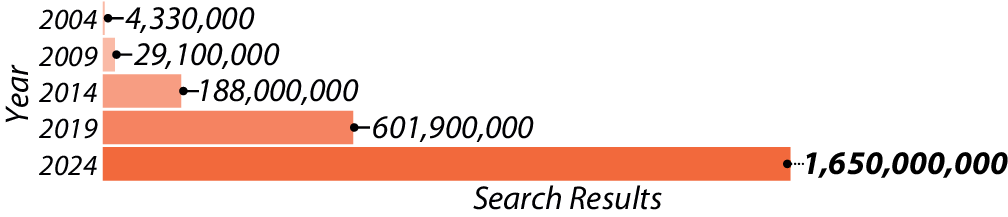
As computer tools become tightly integrated with design practice, the need for design computing research is constantly on the rise. Figure 1 illustrates the rapid growth of design computing research, reflected in the total number of webpages indexed by Google under this topic, which have reached a staggering count of 1.65 billion in December 2024.
Growing interest in design computing research as reflected in Google search results (2004–2024).
The significant growth of design computing research poses various challenges for researchers in the field. Primarily, it has become difficult to see the “bigger picture” and thus to navigate through these tremendous amounts of information. As a strategy for mitigating these challenges, we survey existing literature using an integrative approach and search for common themes underlying the richness and diversity of past work. Since research is fundamentally driven by research questions that we aim to answer, this first attempt to systematically map the field focuses on the following questions: (RQ1) What research questions are explored by design computing researchers? and (RQ2) how are researchers exploring them?
To answer our research questions, we surveyed the complete proceedings of a prominent international conference in the field (Design Computing and Cognition, DCC), which has produced over 400 publications in the past two decades. The result of this study is an initial map that captures some of the essential aspects of the activity in design computing research. This map can be used by researchers, educators and learners to gain insight into the structure of design computing research activity. Furthermore, it can serve as the basis for automation of literature reviews in the field, which is becoming important as the number of publications continues to grow to new dimensions.
2. Background
2.1. What is design computing?
The term “design computing” can be traced back to the work done at the Key Centre of Design Computing and Cognition – a teaching and research facility at the University of Sydney, Australia (established in 1968; currently “Design Lab”). Design computing encompasses both practice and research activities. Design computing practice has two main facets:
-
• Employing a computational approach for designing. Here, designers bring structure to their design process by regarding it as a form of computation. Interestingly, this does not necessitate the actual use of a computer. A striking example for this is Gaudí’s design process, which resulted in the Basílica de la Sagrada Família. By suspending chains from the ceiling, Gaudí was able to “compute” elegant catenary curves, relaying the computational task of form finding to gravity. These curves (turned upside down) served as the basis for designing the iconic form of the church, which embodies a set of desired structural properties (Huerta Reference Huerta2006).
-
• Employing a computational tool for designing. In this case, designers utilize the benefits of digital tools and their computational power to enhance their ability to design. This category encompasses a broad range of scenarios, from the mere usage of a standard CAD program to store one’s drawings digitally and share them with others, and up to utilizing state-of-the-art automation tools for generating/evaluating designs, etc.
These two facets of design computing practice thus form the context for design computing research, which aims to develop frameworks/models/tools for designing (or for teaching design), as explained hereafter.
2.2. Goals in design computing research
Gero and Maher (past co-directors of the research center mentioned above) proposed a framework for design computing research, which serves as a conceptual foundation for our investigation (Gero & Maher Reference Gero, Maher, Martens, Linzer and Voigt1997). In this framework, three main goals pursued by design computing researchers were identified:
(G1) Develop theories/models/methods of design processes.
(G2) Utilize the output of G1 for developing tools for design-related activity.
(G3) Utilize the output of G1 for the purpose of design education.
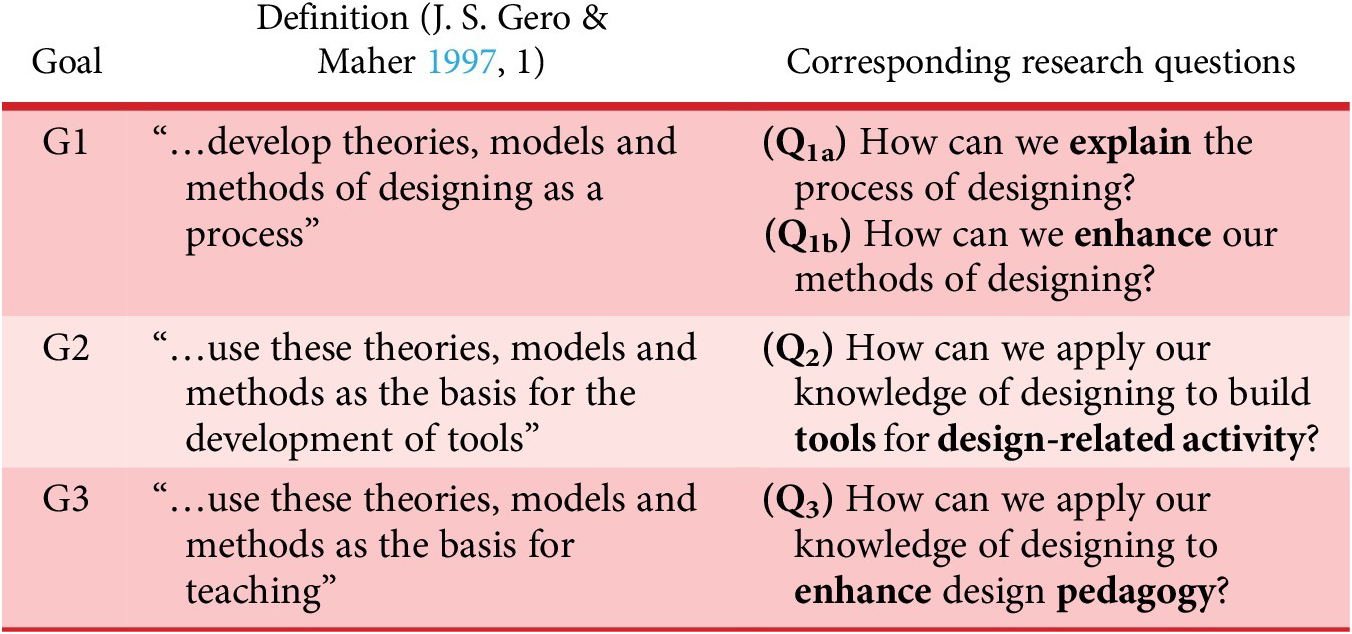
The framework is useful since it draws fundamental distinctions between the main goals and thus the foci of researchers in the field. As we are concerned with the identification of research questions, we matched each of these goals with a research question that reflects the researchers’ main concern (Table 1). Note that G1 was matched with two questions (Q1a, Q1b) to reflect the fact that researchers pursuing it may engage in the descriptive activity of explaining designing (developing theories, etc.) or the normative activity of suggesting ways to enhance designing (developing methods, etc.), accordingly. The four questions in Table 1, derived from Gero and Maher’s three goals, can serve as a solid ground for identifying the various sub-questions explored by researchers and learning about the clusters of activity in the field.
Overarching goals and their corresponding research questions
3. Aim and significance
The primary aim of our work is to help navigate the research in design computing by providing an overview of the field. Aspiring researchers in design computing can use our findings to learn about (1) the research questions pursued by others in the field and (2) the various approaches that can be taken in accordance with one’s question. Relatedly, experienced researchers may use our findings for (1) positioning their work within a broader context of research activity and (2) exploring opportunities for collaboration. Finally, educators can use our findings for (1) exposing learners to the fundamental structure of the field and (2) designing curricula.
4. Method
This article reports on a PRISMA-style review of research work in the field of design computing. PRISMA is a widely used approach for conducting systematic literature reviews and meta-analyses (Page et al. Reference Page, McKenzie, Bossuyt, Boutron, Hoffmann, Mulrow, Shamseer, Tetzlaff, Akl, Brennan, Chou, Glanville, Grimshaw, Hróbjartsson, Lalu, Li, Loder, Mayo-Wilson, McDonald, McGuinness, Stewart, Thomas, Tricco, Welch, Whiting and Moher2021). This approach guides researchers by providing a protocol, which includes key items for reporting, thereby bringing structure and cohesion to academic literature reviews.
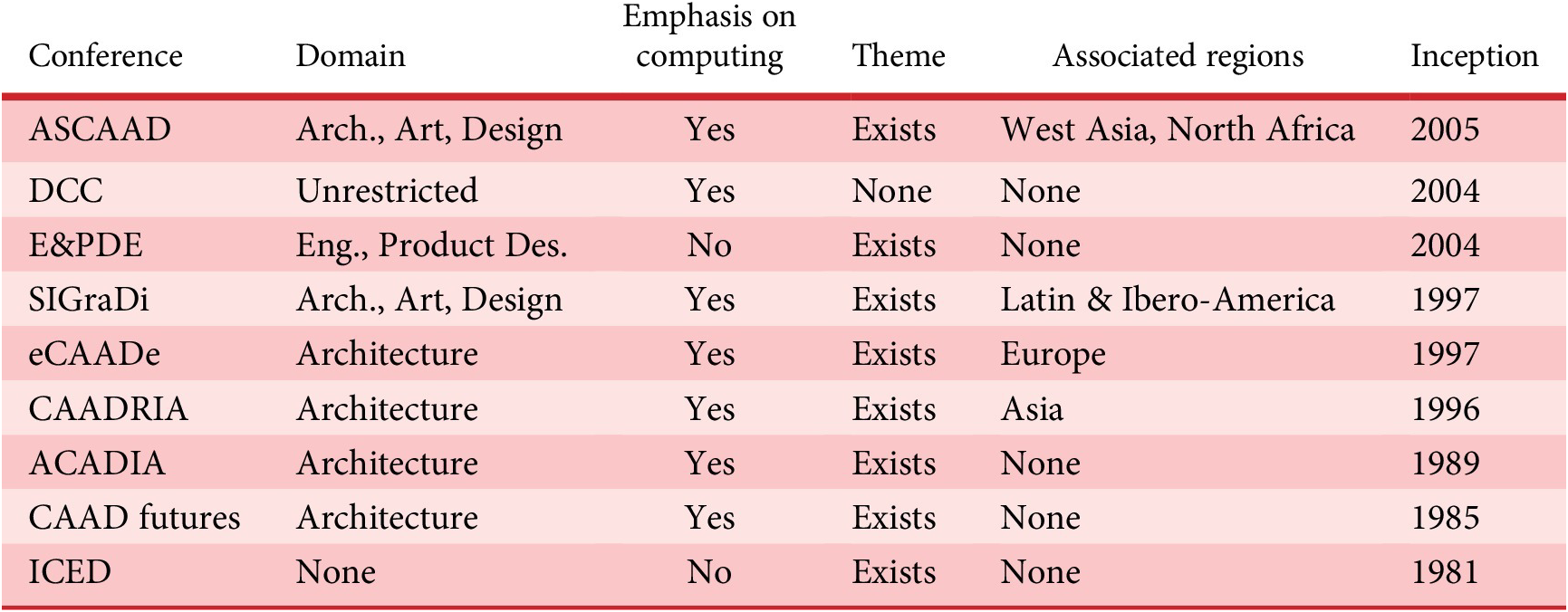
Our PRISMA-style review has focused on a long-standing international conference (Design Computing and Cognition, DCC). While prominent journals (e.g., AIEDAM, IJAC, Automation in Construction) can serve as an excellent source for learning about design computing, conference proceedings provide us with access to a multitude of projects that have yet to mature and thus offer considerable diversity in terms of the approaches taken by researchers. Furthermore, as seen in Table 2, DCC is one of the few relevant conferences that is neither associated with any specific design domain nor with any world region, does not specify an annual theme and places emphasis on computing. In fact, to the best of the author’s knowledge, DCC is the only international conference that explicitly uses the term “design computing” in its title. Finally, the interdisciplinary nature of the conference further contributes to a diversity of perspectives and projects in the proceedings. These characteristics align with our intention to produce a map that is representative of the activity in the field and is as inclusive as possible. Note that the authors acknowledge and discuss the shortcomings of DCC as representative of the activity in the field under Limitations and Future Work (6.2).
Comparison of relevant well-known international conferences
This study addresses two research questions, which are restated here for the reader’s convenience: (RQ1) What research questions are explored by design computing researchers? and (RQ2) How are researchers exploring them? To answer these questions, we proceeded in two steps of (1) paper selection and (2) classification and synthesis. We elaborate on each of these in the following subsections.
4.1. Paper selection
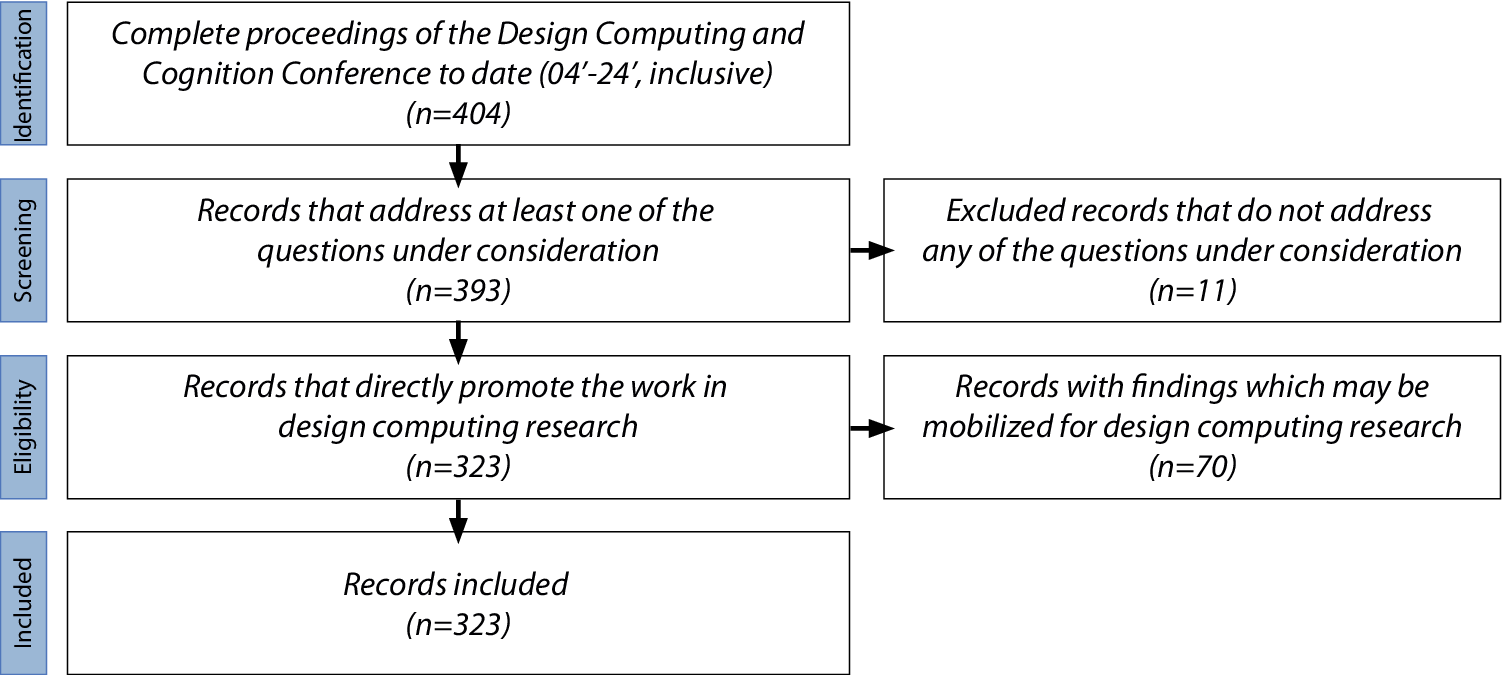
The complete set of proceedings of DCC to date (2004–2024) consists of 404 papers in total. First, we screened all papers based on the relevance of each to design computing research, using the following criterion – does the paper address at least one of the main research questions under consideration? (as specified in Table 1). This resulted in the exclusion of a small set of papers (N = 11) that did not address any of these questions.
Next, eligibility was determined based on the contribution of the paper to design computing research. Contributions were classified as direct/indirect, and the latter were excluded from the review. We defined a direct contribution as follows: the authors created/elaborated/extended/applied a computational framework/model/tool in the context of any design-related activity. This definition was formulated to maximize diversity, while excluding those papers that require knowledge mobilization to contribute to design computing research and thus may be surveyed elsewhere. For example, papers that focus purely on design cognition and did not use any computational frameworks/tools, etc., were excluded from this study. By contrast, papers focusing on design cognition that did make use of a computational tool/framework, etc., such as (Ruckpaul, Fürstenhöfer & Matthiesen Reference Ruckpaul, Fürstenhöfer, Matthiesen, Gero and Hanna2015), who studied design cognition using eye tracking, were included. Based on the latter criterion, 70 papers were excluded from the review. Note that, while these papers were excluded from the main review activity reported in the Results section of this article, the authors acknowledge their importance as a source of knowledge and inspiration to promote design computing research. Therefore, we have devoted a subsection in the Discussion section of this article to examining their benefit to researchers in the field.
Finally, throughout the selection process, exclusion was done by first examining each paper based on its title and abstract, and then searching for evidence to support the decision in the full text of the paper (or alter it, if needed). The complete process of paper selection described above is summarized in Figure 2.
Information flow in paper selection.
4.2. Classification and synthesis
The 323 papers included in our review were classified via an iterative content analysis in four phases: (A) extraction of the specific research question pursued in each paper, (B) grouping of papers by shared research questions, (C) matching of shared questions with Q1a/Q1b/Q2/Q3 and (D) extraction of approaches for exploring the shared questions. Each of these phases is elaborated below. Throughout the classification and synthesis process, cases that required arbitration were decided following a discussion between the authors in a synchronous setting. The authors are both researchers and practitioners, with a combined experience of over 40 years in design computing.
The goal of step A was to extract the specific research question addressed by each paper. This step enabled us to learn about the diversity of questions pursued by researchers in the field. We first searched for an explicit expression of the research question pursued in the paper. In the absence of an explicit statement concerning the question pursued, we searched for the claimed goal or aim and derived the question from these. In cases where neither the question nor the aim of the work was explicitly stated, we derived the question from the full text of the paper, based on the main thrust of the work and its reported contribution. In all cases, extracted (or derived) research questions were validated by reading the paper and confirming coherency between the question and the body of the paper. In cases of discrepancy, we prioritized the body of the paper as the primary source for our decision. The outcome of this phase was the assignment of one or more questions to each paper.
The goal of step B was to identify research questions shared by multiple studies from the above data. As research questions frame the knowledge which the researchers expect to develop, we searched for commonalities across papers in terms of the knowledge produced by the work. In this, papers were grouped by capturing shared questions in brief statements formulated at a higher level of abstraction. For example, the following question of “How can we automatically identify cognitive processes in protocols?” (Becattini, Cascini & Rotini Reference Becattini, Cascini, Rotini, Gero and Hanna2015) and “How can we automatically extract design rationale from design documentation?” (Rogers et al. Reference Rogers, Qiao, Gung, Mathur, Burge, Gero and Hanna2015) indicated that the researchers wish to automate the analysis of design documentation. Accordingly, these studies were grouped under the more general question of “how can we automate the analysis of design documentation?” Through multiple iterations across the paper population, this step resulted in a compact set of questions explored by researchers in the field.
The goal of step C was to match the questions produced in step B with the fundamental questions explored in the field, as specified in Table 1 (Q1a, Q1b, Q2, Q3). For example, the questions of “How can we develop frameworks for understanding designing?” and “How can we use computer tools to test hypotheses regarding designing?” identified in step B were both found to be sub-questions of Q1a. The outcome of this step was an elaboration of each of the fundamental research questions in Table 1 into a set of sub-questions pursued by researchers.
The goal of step D was to identify the approaches by which researchers attempted to answer each sub-question, to link the questions pursued with the ways in which we can pursue them. We assumed that most research questions can be approached in multiple ways. To extract these ways, we read each paper and searched for the type of contribution made to the field that provides an answer to the research question. For example, the study by Singh et al. reported on the construction of a model for simulating the phenomena of influencers in designing, as well as on the results of experimenting with this model, which have shed light on this phenomenon (Singh, McComb & Cascini Reference Singh, McComb, Cascini and Gero2022). As the researchers approached question Q1a (How can we explain designing?) by constructing a simulation model for testing their hypotheses, their approach was classified under the category of “using computational tools for testing hypotheses.” “Approach” here should be understood as a general way of setting out to answer the question under investigation, which is independent from any specific method or technique. Note that extracting the approaches of researchers is advantageous over the extraction of methods in the context of this investigation, as approaches are more general and thus helpful for gaining an overview, as well as less likely to change or become outdated in the long term. Following the extraction of approaches from all contributions, papers employing similar approaches were identified and grouped, and the description of the approach was rephrased accordingly.
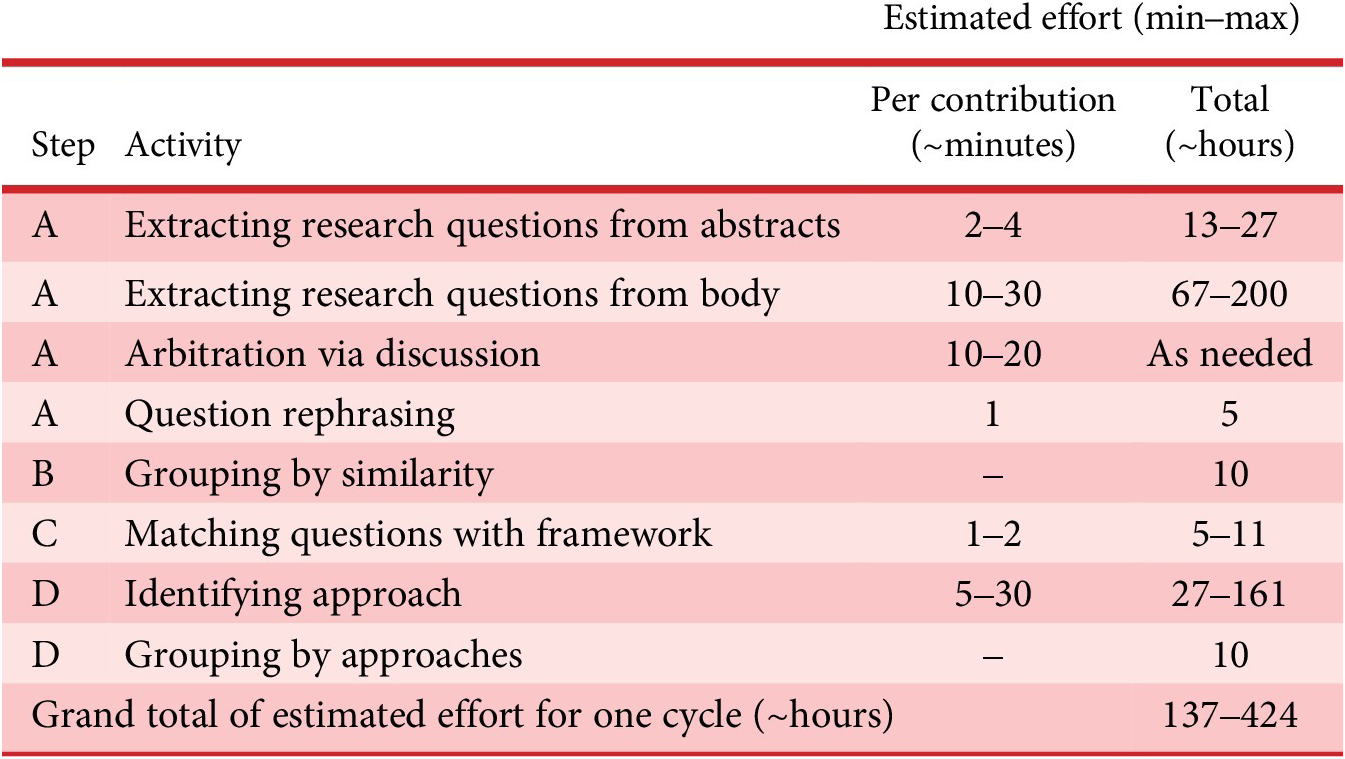
For researchers who wish to conduct a similar study, we provide a breakdown of the effort associated with each of the above steps (Table 3). As the time required varies with each individual contribution, we included the minimal and maximal values for each task. The reader should further consider that, due to the iterative nature of this process, tasks are typically repeated several times. Thus, the values in the table reflect a single cycle of the classification and synthesis process, which captures the minimal effort required overall. Also note that, as papers are often re-classified during the process, the tasks of screening and determining eligibility run continuously in parallel to all other tasks. Finally, this calculation does not include other essential activities such as study design, manuscript writing, etc.
Estimated effort for executing a single cycle of analysis for an expert researcher
5. Results
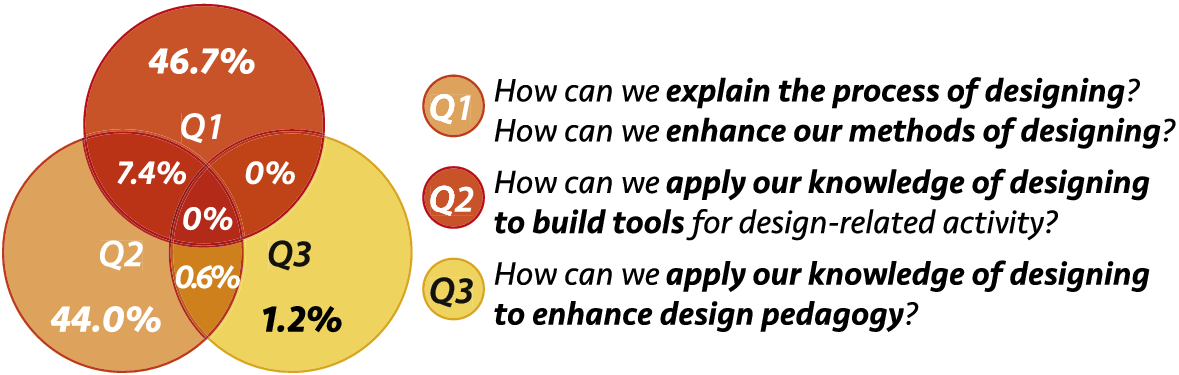
The general distribution of papers by goals is given in Figure 3. Evidently, papers exclusively exploring Q1 (Q1a, Q1b) composed the largest class of the selected papers (46.7%), followed by those exclusively exploring Q2 (44.0%), then by those exploring Q1 and Q2 in parallel (7.4%), and finally by those exclusively exploring Q3 (1.2%). Other classes did not exceed 1.0%.
Distribution of papers by the overarching question explored.
The following subsections focus on papers exploring each of the above questions (Q1, Q2, Q3). In this, we elaborate the question into its various sub-questions addressed by researchers, as well as match these with the approaches used to pursue them. To help readers relate to the categories identified, specific examples for papers from the proceedings are given throughout.
5.1. Papers exploring Q1
This category focused on papers promoting G1 by addressing Q1, which corresponds with two broad research questions (Q1a, Q1b; see Table 1). Both questions are the topic of this subsection.
With respect to papers addressing Q1a, five major subcategories were identified. These subcategories are given in Table 4, which also includes a brief explanation of the knowledge that will be developed by pursuing each sub-question. Finally, the main approaches used to explore the questions in each subcategory are listed as well. We describe each subcategory in some detail, provide concrete examples for works exploring it and highlight the ways in which they do so. The text is ordered according to Table 4.
Sub-questions explored by researchers focusing on Q1a and approaches taken
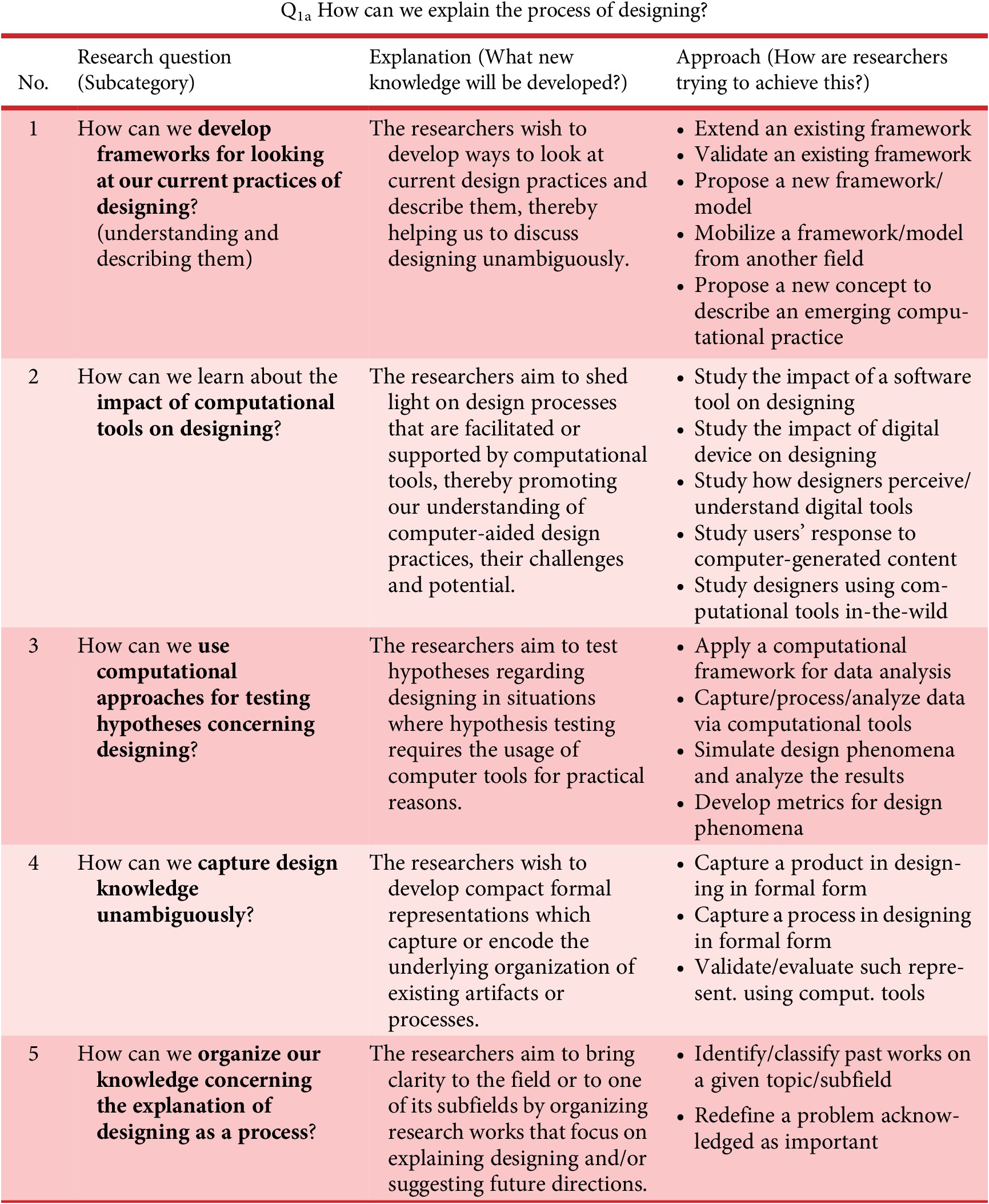
The first subcategory concerns with papers that aim to enhance our ability to look at designing by improving upon our current conceptual frameworks/models or by proposing new ones. As explained by Akin & Moustapha (Reference Akin, Moustapha and Gero2004), such work helps us discuss design unambiguously. Researchers exploring this subcategory help to enrich our language for viewing, describing, and understanding designing by employing the following approaches:
-
• Extend an existing framework/model which helps us look at designing from a computational perspective, by adding variables or processes. For example, (Cascini et al. Reference Cascini, Del Frate, Fantoni, Montagna and Gero2011) proposed to extend the FBS framework (Gero Reference Gero1990) to include user-centered information. Similarly, (Uflacker & Zeier Reference Uflacker, Zeier, Gero and Goel2008) proposed to extend the situated FBS framework (Gero & Kannengiesser Reference Gero and Kannengiesser2004) to consider used needs.
-
• Validate an existing framework by applying it to design activity:
-
○ Apply it to represent a segment of a design process. For example, (Bokil & Ranade Reference Bokil, Ranade and Gero2014) have applied the FBS framework (Gero Reference Gero1990) to graphic design activity, thereby examining its ability to describe design practices.
-
○ Apply it along with another framework and compare the results. Jiang and Gero, for example, have proposed a framework for studying communication in design teams, and compared it with the FBS framework in terms of their ability to support such an analysis (Jiang & Gero Reference Jiang and Gero2017). By doing so, they found that content-based analysis could only be achieved using the FBS framework, thereby expanding our understanding of the original framework proposed by Gero.
-
-
• Propose a new framework/model for understanding designing from a computational viewpoint. For example, Kannengiesser & Gero (Reference Kannengiesser, Gero and Gero2011) proposed a model for design rationale which regards it as a forward moving process, as well as a framework for describing ekphrasis in design (Kannengiesser & Gero Reference Kannengiesser, Gero and Gero2019). Additionally, Chen & Stouffs (Reference Chen, Stouffs and Gero2023) proposed a new model for explaining the way in which designers explore design spaces, which is grounded in computing and cognition. Furthermore, Smith and Gero have proposed a formalism for constructing design agents that can interact with the environment flexibly and are thereby more in accord with what we know about human designing (Smith & Gero Reference Smith, Gero and Gero2004).
-
• Mobilize a framework/model from another field and adapt it to explain/describe design activity. For example McCall & Burge (Reference McCall and Burge2022) mobilized and extended Pearl’s causal networks (Pearl Reference Pearl1995) to model decision making in design.
-
• Propose a new concept which has become relevant due to technological development of computational systems. For example, Mahdavi has discussed the concept of “sentient buildings” which refers to the application of ubiquitous computing in the domain of architectural design (Mahdavi Reference Mahdavi and Gero2004).
The second subcategory concerns with papers that aim to develop our knowledge of design processes in situations where designing is facilitated by computer technology. This portion is included within the studies of design cognition that are directly related to design computing and are thus surveyed here. Researchers have employed the following approaches in exploring this subcategory:
-
• Study the impact of a software tool on designing. Studies in this category often focus on evaluating the impact of a computational tool on task performance. For example, Glier et al. evaluated methods for generating concepts via biomimicry through case studies, one of which involved the usage of a bio-keyword search tool (Glier et al. Reference Glier, Tsenn, McAdams, Linsey and Gero2014). Additionally, Altintas et al. reported on the effects of parametric tools on serendipitous discoveries in architectural design (Altintas, Kasali & Dogan Reference Altintas, Kasali, Dogan and Gero2022). Such studies do not necessarily require implementing the digital tool under consideration, as is evident in works employing the “Wizard of Oz” technique (Kelley Reference Kelley2018), e.g. Baudoux & Leclercq (Reference Baudoux and Leclercq2023). Rather than focusing on task performance, certain works in this category study communication and collaboration among designers in technology-facilitated scenarios. Collaboration may be studied in co-located settings where a digital collaborative environment is used, or in remote settings (or both). As an example of the former, Gao & Kvan (Reference Gao and Kvan2004) observed the activity of problem framing in designing in an online setting and compared it with an “offline” co-located one. As an example of the latter, Maher, Bilda & Gül (Reference Maher, Bilda, Gül and Gero2006) analyzed the behavior of designers in virtual environments using an existing 3D application (“active worlds”). In certain cases, software tools are not employed within the study. For example, Al-Sayed examined the hypothesis that knowledge of space syntax supports designing, yet the participants in the study relied on past knowledge and did not have access to computer tools during the experiment (Al-Sayed, Dalton & Hölscher Reference Al-Sayed, Dalton, Hölscher, Gero and Goel2008).
-
• Evaluate the impact of a digital hardware device on designing. For example, Kozhevnikov et al. (Reference Kozhevnikov, Royan, Blazhenkova, Gorbunov, Gero and Goel2008) examined the effectiveness of 3D displays in supporting learning and task performance in designing.
-
• Study the ways in which designers perceive or understand digital tools. For example, in Rao, Kwon & Goucher-Lambert (Reference Rao, Kwon, Goucher-Lambert and Gero2023), learner participants employed an AI-enabled tool for designing and their mental model of the tool was analyzed. Relatedly, Bunt, Berdanier & Brown (Reference Bunt, Berdanier, Brown and Gero2025) studied how designers think when using computational tools for supporting optimization. In some cases, the focus is on the relationship between human input and the output of the system (D’souza & Dastmalchi Reference D’souza, Dastmalchi and Gero2025).
-
• Study users’ response to virtual or computer-generated content, to shed light about its impact on users (compared with a “traditional” counterpart). For example, Tenneti & Duffy (Reference Tenneti, Duffy and Gero2006) studied the impact of rendering on users’ emotional response using Kansei engineering (Nagamachi Reference Nagamachi2016). Furthermore, focusing on an immersive setting, Kim and Gero examined the effect of biophilic design of virtual classrooms on learner’s attention (Kim & Gero Reference Kim and Gero2025).
-
• Observe designers “in-the-wild” as they use computational tools. For example, Elsen et al. have observed the use and misuse of CAD tools by architects at their professional practice (Elsen, Darses & Leclercq Reference Elsen, Darses, Leclercq and Gero2011).
The third subcategory concerns with papers that utilize computational tools for the purpose of testing hypotheses regarding designing. As with the previous subcategory, this portion is also included within the studies of design cognition that are directly related to design computing and are thus surveyed here. Researchers have employed the following approaches in exploring this subcategory:
-
• Apply a computational framework for analyzing empirical data. For example, Prats and Earl have attempted to trace the source of designs by observing designers and analyzing their design process using a computational framework, focusing on shape generation and manipulation (Prats & Earl Reference Prats, Earl and Gero2006). Further, Neramballi et al. studied the design of product-service systems (Neramballi, Sakao & Gero Reference Neramballi, Sakao, Gero and Gero2019) and concluded that professionals expended the largest amount of cognitive effort on “behavior” and “evaluation” in Gero’s FBS ontology (Gero Reference Gero1990).
-
• Capture, process or analyze large/complex data using computational tools. For example, Goel et al. have used a database of design case studies to examine the assumption that biologically inspired design processes are domain independent (Goel et al. Reference Goel, Tuchez, Hancock, Frazer and Gero2017). Relatedly, Galil et al. used a smart pen for capturing the order of lines drawn when sketching designs. As their temporal analysis exposed dense line clusters, they concluded that the designer perceived the design in small chunks (Galil, Martusevich & Sen Reference Galil, Martusevich, Sen and Gero2017). In a more recent study, Hu et al. examined the construction of concept maps by human subjects, measured their neurocognitive behavior and analyzed the results using computational tools (Hu et al. Reference Hu, Shealy, Gero, Milovanovic, Ignacio and Gero2023). Finally, Becattini et al. have attempted to automate the identification of cognitive processes in design protocols (Becattini, Cascini & Rotini Reference Becattini, Cascini, Rotini, Gero and Hanna2015).
-
• Construct simulation models for phenomena of interest in designing. For example, McComb et al. have examined how designers sequence operations in a design task by modeling the process using Markov chains and then implemented their insights into a simulation model for testing their hypotheses (McComb, Cagan & Kotovsky Reference McComb, Cagan, Kotovsky and Gero2017). Relatedly, Liu and Liu have constructed an agent-based model for validating the results of an empirical study by comparing predictions produced by the model with those from experiments conducted with human subjects (Liu & Liu Reference Liu, Liu and Gero2023). Furthermore, Yaner and Goel have explored the human ability to construct descriptive models from external representations by implementing a set of hypotheses within an analogy-based system that translates design drawings into formal representations of design features (Yaner & Goel Reference Yaner, Goel and Gero2006).
-
• Develop ways to measure design phenomena quantitatively (metrics) or mobilize these from another field. Zimmerer et al. have used eye tracking for studying cognitive load during design to clarify whether eye tracking can be used to measure cognitive load (Zimmerer, Nelius & Matthiesen Reference Zimmerer, Nelius, Matthiesen and Gero2023). Additionally, Hwang and Wood have developed an approach for assessing novelty, by using a crowdsourcing system that utilizes perceptual kernels as a metric (Hwang & Wood Reference Hwang, Wood and Gero2022). In another study, Wang et. al have proposed inter-brain synchrony as a neurocognitive indicator to study the interaction among collaborators in designing (Wang et al. Reference Wang, Wong, Chang, Yuan, Shih and Gero2025). Moreover, Moreno et al. have provided useful metrics for studying fixation (Moreno et al. Reference Moreno, Yang, Hernández, Linsey, Wood, Gero and Hanna2015). Finally, Laskari et al. have attempted to capture certain subjective aspects of spatial experience within quantifiable attributes by using spectral graphs (Laskari, Hanna & Derix Reference Laskari, Hanna, Derix, Gero and Goel2008).
The fourth subcategory concerns with papers that encode knowledge regarding existing artifacts or processes in formal form, which can then be used for various purposes. Among these are digital archival (for further study/preservation), generating alternatives in design using computational tools and more. Researchers have employed the following approaches in exploring this subcategory:
-
• Capture a product in formal form. Two common approaches for formal representation are production rules or mathematical descriptions. As an example of the former, a shape grammar for reconstructing Roman and Greek libraries was developed in (Mamoli Reference Mamoli and Gero2019). Relatedly, Benrós et al. have developed a generic grammar that can generate buildings in several different styles (Benrós, Hanna & Duarte Reference Benrós, Hanna, Duarte and Gero2014). As an example of the latter, Sarkar used spectral graphs for describing the typology of cities. In this case, a street network was represented using eigenvalue decompositions (Sarkar Reference Sarkar, Gero and Hanna2015).
-
• Capture a process in formal form. For example, Eloy and Duarte formulated rules that govern the process of adapting current houses to new requirements, then applied them to houses that require rehabilitation. The rules were extracted from observing architects and learners by letting them transform existing houses on the basis of requirements from inhabitants (Eloy & Duarte Reference Eloy, Duarte and Gero2014). In another study, Dinar et al. observed designers as they formulated problems then captured their behavior patterns using a framework that builds upon the FBS ontology (Gero Reference Gero1990). Since their framework encodes knowledge in Prolog, it can be queried automatically, thereby facilitating analysis as well (Dinar et al. Reference Dinar, Maclellan, Danielescu, Shah, Langley and Gero2014).
-
• Use a computational tool to study the validity/usefulness of such formal representations. For instance, the study by Eloy and Duarte mentioned above not only included the extraction of rules governing design practice from observation but also the implementation of these in a computational system to examine the effectiveness of the rules extracted (Eloy & Duarte Reference Eloy, Duarte and Gero2014). Similarly, the graph-based representation of street networks developed by Sarkar was also used to generate new networks by mathematical variation (Sarkar Reference Sarkar, Gero and Hanna2015).
The fifth subcategory concerns with papers that aim to bring clarity to the field by organizing our body of knowledge regarding the description/explanation of designing and suggesting future directions. Researchers have employed the following approaches in exploring this subcategory:
-
• Identify and classify past works on a given topic to expose trends within the field. Ohashi et al. conducted a systematic review of design neurocognition studies in 2022 and concluded that recent studies focused on specific design activities, as opposed to earlier works, which mainly focused on studying specific cognitive tasks, thereby exposing a shift in the field (Ohashi et al. Reference Ohashi, Auernhammer, Liu, Pan, Leifer and Gero2022). Relatedly, Bordas et al. have surveyed various computational approaches in generative AI to clarify what content can be generated by these (Bordas et al. Reference Bordas, Le Masson, Thomas, Weil and Gero2025). Additionally, Garcia has classified shape grammars into types and provided definitions that help distinguish among them (Garcia Reference Garcia and Gero2017). Further, Lawrie et al. reviewed the literature on product design to classify the cognitive processes studied in conceptual design cognition research and the methods employed for this purpose (Lawrie, Hay & Wodehouse Reference Lawrie, Hay, Wodehouse and Gero2023).
-
• Propose to redefine a problem which is acknowledged as important. In attempt to find unity in the diverse literature on design fixation, Youmans and Arciszewski proposed to distinguish between three types of fixation in design (Youmans & Arciszewski Reference Youmans, Arciszewski and Gero2014). In another study, Brown has proposed to redirect our inquiry into computational creativity by suggesting important problems that lie ahead (Brown Reference Brown and Gero2011). Finally, Piasecki and Hanna have attempted to redefine a well-known problem in consumer behavior (the paradox of choice; Schwartz Reference Schwartz2004), which has some implications for design, and envisioned a future recommender system that can help deal with it by suggesting meaningful choices (Piasecki & Hanna Reference Piasecki, Hanna and Gero2011).
Concerning papers addressing Q1b, their relatively small number (N = 5) allowed for the extraction of two subcategories (Table 5).
Sub-questions explored by researchers focusing on Q1b and approaches taken
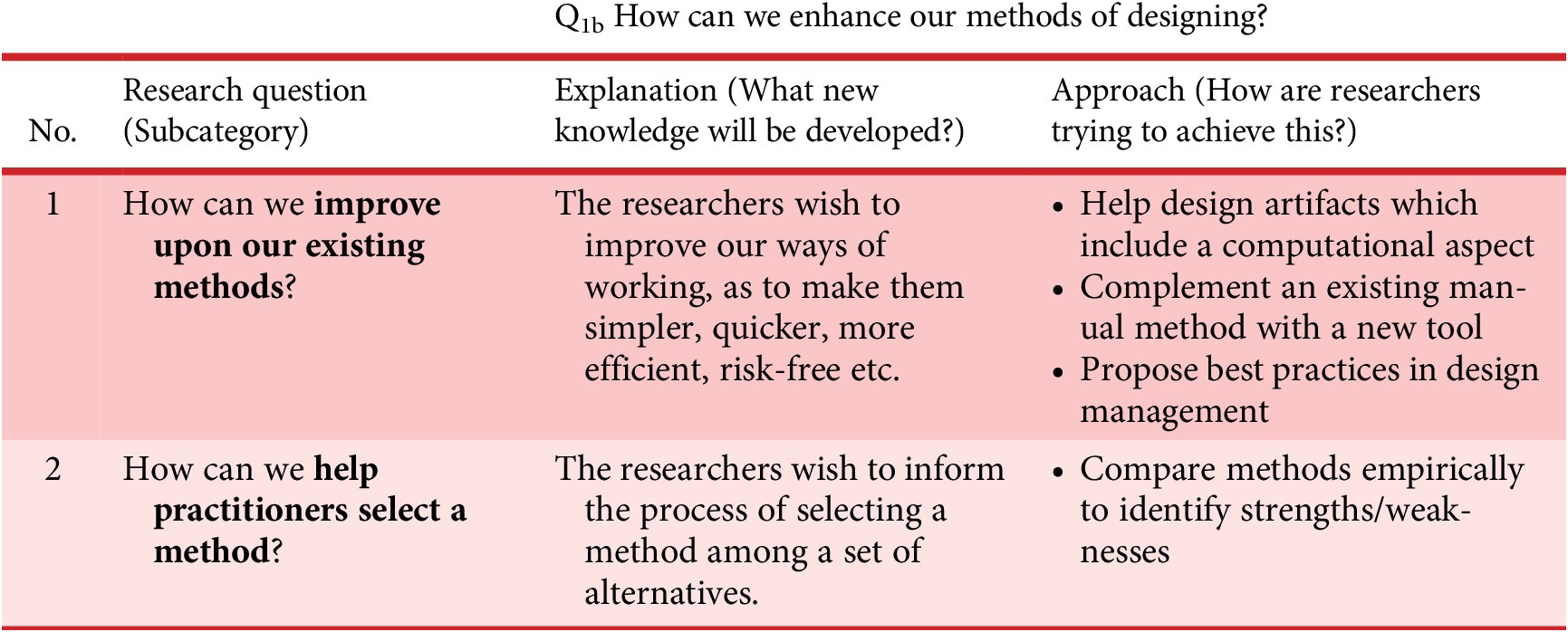
The first subcategory of works exploring Q1b concerns with papers that aim to make our design processes more efficient, risk free, etc. by improving upon our current methods. The following approaches were taken in exploring this subcategory:
-
• Propose ways to design artifacts which include a computational aspect. For example, Jeng has explored the issues in creating ubiquitous smart spaces, which integrate physical space with digital technology, and suggested ways to cope with them (Jeng Reference Jeng2004).
-
• Complement an existing manual method with a new tool. For example, Walker et al. have reported on a study in which neurofeedback (feedback given based on brain activity) was used to enhance ideation (Walker et al., Reference Walker, Shealy, Gero and Gero2025), and thus may serve as complementary or even as an alternative to traditional methods. Relatedly, Wang proposed a way to combine neurocognitive measurement with AI to access the mental image a user may have of a brand, thereby supporting traditional methods of design verification, such as user interviews etc. (Wang et al. Reference Wang, Peng, Yu, Wu, Wang, Childs, Guo and Li2022).
-
• Propose best practices in design management. For example, Kerley and Holden have proposed an approach for reducing risk in managing software design projects, through a shift to a knowledge-based perspective (Kerley & Holden Reference Kerley, Holden and Gero2006). Additionally, Jordan et al. identified issues with applying a specific ISO standard (ISO15926) for design data documentation and exchange in large organizations and proposed an ontology to overcome these (Jordan et al. Reference Jordan, Selway, Grossmann, Mayer, Stumptner, Gero and Hanna2015).
The second subcategory concerns with papers which aim to inform the process of selecting a method that is suitable for the task at hand. The following approach was taken in exploring this direction:
-
• Compare methods empirically to identify their strength/weakness. Real et al. have compared 24 methods for prototype evaluation, based on human feedback regarding the perceived value of each method. This included the comparison of physical and digital methods (Real et al. Reference Real, Snider, Goudswaard, Hicks and Gero2023).
5.2. Papers exploring Q2
This subsection focuses on papers promoting G2 by addressing Q2 – How can we apply our knowledge of designing to build tools for design-related activities? The phrase “design-related activities” was deemed suitable in this context as researchers are not only developing tools for designing but also for other related activities as well (which support designing indirectly). Examples for such tools include those for design marketing, design education, and more. The papers exploring Q2 were classified into six subcategories, given in Table 6.
Exploring Q2 – How can we use our understanding of designing to build tools for design-related activities?
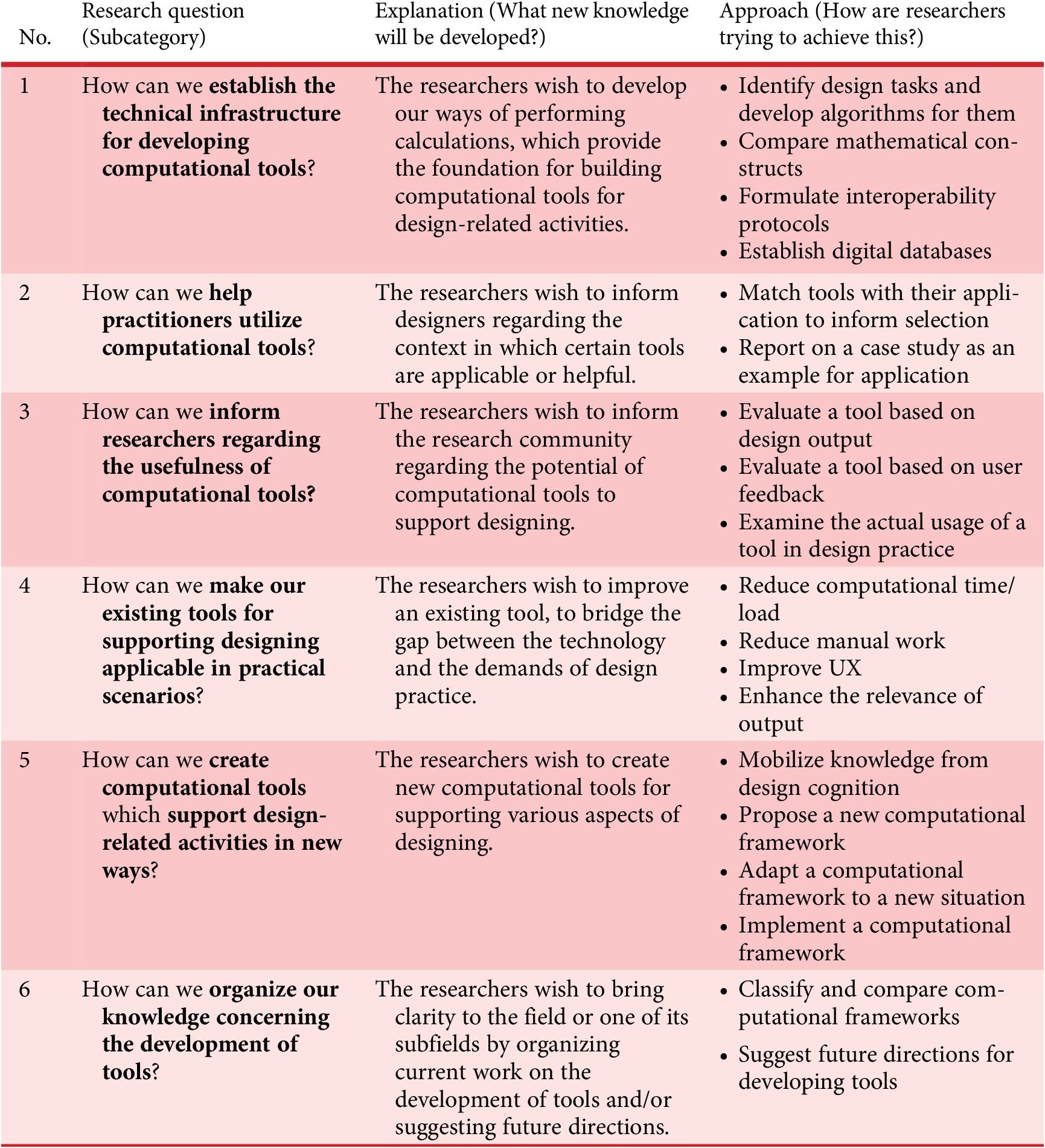
The first subcategory concerns with establishing the mathematical foundation for conducting calculations that are important for design computing systems. Researchers have employed the following approaches in exploring this subcategory:
-
• Identify tasks in design-related activity that can be automated and develop algorithms for them, as a basis for a computational tool. For example, Economou and Grasel have proposed an algorithm for generating the complete set of partial lattices of 3D shapes in a certain symmetry group (Economou & Grasl Reference Economou, Grasl, Gero and Goel2008).
-
• Compare alternative computational constructs and help select a suitable one. For example, in the context of shape computation, Krstic has discussed several types of algebras in shape grammar and the ways in which they compute differently, thereby improving our understanding of shape algebras (Krstic Reference Krstic and Gero2014). Relatedly, the same author has argued for using typologies over hierarchies in shape approximation (Krstic Reference Krstic, Gero and Goel2008). In another work, Matthews has proposed to replace probability distribution functions with credal sets when constructing knowledge-based decision support systems, as credal sets align better with processes of domain knowledge extraction, which are essential to these systems (Matthews Reference Matthews and Gero2011). Additionally, Milette and Brown have compared two types of function representations in terms of their usefulness in analogical mapping (Milette & Brown Reference Milette, Brown and Gero2006).
-
• Establish interoperability protocols to streamline data exchange across platforms and environments. For example, Mora et al. have proposed an information exchange model for integrating two systems for architectural design, one concerned with interpreting sketches and the other with structural design (Mora et al. Reference Mora, Rivard, Juchmes, Leclercq and Gero2006). Additionally, Janssen et al. have proposed a way to overcome the lack of a shared file format among software in the architecture, engineering and construction (AEC) sector, by using property graphs as the basis for data exchange (Janssen et al. Reference Janssen, Stouffs, Chaszar, Boeykens, Toth, Gero and Hanna2015).
-
• Establish digital databases containing design knowledge. The operation of certain types of computational systems requires a knowledge base that contains knowledge relevant to designing. For example, the interactive tool for learning about biologically inspired design developed by Goel et al. (Reference Goel, Zhang, Wiltgen, Zhang, Vattam, Yen, Gero and Hanna2015) required the research team to establish a database that contains relevant cases that designers (or design learners) can explore and draw upon.
The second subcategory concerns with informing design practitioners regarding the usefulness of computational tools in supporting specific design tasks. In exploring this subcategory, researchers have employed the following approaches:
-
• Match tools with their application to inform tool selection. For example, to help preserve the design intent throughout a project, Mengoni and Germani have examined the usefulness of various computational systems for certain tasks, thereby enabling us to choose a suitable tool for the task at hand (Mengoni & Germani Reference Mengoni and Germani2008).
-
• Report on a case study. Koltsova et al. have applied parametric design tools for urban design and reported on multiple case studies which demonstrate their applicability for this purpose (Koltsova et al. Reference Koltsova, Schmitt, Schumacher, Sudo, Narang, Chen and Gero2011). Additionally, Bandini et al. have reported on a case study of creating a reactive architectural environment in which they worked with an artist and embodied their idea in the form of a system for lighting customization (Bandini et al. Reference Bandini, Bonomi, Vizzari, Acconci and Gero2011).
The third subcategory concerns with informing researchers regarding the usefulness of computational tools for specific design tasks. In exploring this subcategory, researchers have employed the following approaches:
-
• Evaluate a tool based on design output. For instance, de Timary and Hanna have examined the impact of human input on the performance of a form optimization system (de Timary & Hanna Reference de Timary, Hanna and Gero2014).
-
• Evaluate a tool based on user feedback. For example, Darses et al. reported on their evaluation of a sketching environment for architects, with emphasis on its usability (Darses et al. Reference Darses, Mayeur, Elsen, Leclercq, Gero and Goel2008). Relatedly, a small-scale user study was reported in (Nordin et al. Reference Nordin, Motte, Hopf, Bjärnemo, Eckhardt and Gero2011).
-
• Examine the actual usage of a tool in design practice. Elsen et al. have observed how digital tools are used by design practitioners in a real work setting (“in the wild”), to learn about usage patterns and inform the future development of such tools (Elsen et al. Reference Elsen, Darses, Leclercq and Gero2011).
The fourth subcategory concerns with the technical endeavor of improving our current computational tools. In exploring this subcategory, researchers have employed the following approaches:
-
• Reduce computational time/load. For example, Gu et al. have proposed a way to improve selection processes in interactive evolutionary algorithms for aesthetic generation, by integrating an artificial neural network which learns from the designer’s input and shortens the time taken to find a satisfactory solution (Gu, Tang & Frazer Reference Gu, Tang, Frazer and Gero2004). Additionally, Hanna and Mahdavi have proposed an approach for reducing the computational load when conducting structural optimization by using a support vector machine (Hanna & Mahdavi Reference Hanna, Mahdavi and Gero2006). Furthermore, Dabbeeru and Mukerjee have proposed a way to narrow down the search space by discovering implicit constrains and then feeding them back into the search process (Dabbeeru & Mukerjee Reference Dabbeeru, Mukerjee, Gero and Goel2008). More recently, Netwon and Economou have proposed a way to increase the computational efficiency of shape grammar interpreters (Newton & Economou Reference Newton, Economou and Gero2024). Relatedly, Kumar et al. have proposed a search algorithm which is well-suited for working with grammars and can help reduce the search cost (Kumar et al. Reference Kumar, Campbell, Königseder, Shea and Gero2014).
-
• Propose ways to reduce manual work when using a tool. For example, in the context of shape grammar, Orsborn et al. have proposed a way to ease the burden of manual rule formulation by automating the derivation of rules (Orsborn, Cagan & Boatwright Reference Orsborn, Cagan, Boatwright, Gero and Goel2008). Additionally, in case-based reasoning, Helms and Goel have demonstrated the possibility of automatically deriving cases, which typically requires to employ a significant amount of human resources (Helms & Goel Reference Helms, Goel, Gero and Goel2008).
-
• Propose ways to improve the users’ experience (UX) when using a tool. For instance, Dabbeeru and Mukerjee have developed a system which can learn to relate linguistics terms with design states, which is useful in bridging the gap between the human ability to use natural language intuitively and the need to employ formal representations in computational systems (Dabbeeru & Mukerjee Reference Dabbeeru, Mukerjee and Gero2011).
-
• Enhance the relevance of a tool’s output. For example, Lim et al. have proposed a way to automate the classification of outputs from shape grammar systems, as to produce designs that are preferrable from the user’s perspective (Lim et al. Reference Lim, Prats, Chase, Garner, Gero and Goel2008).
The fifth subcategory concerns with creating computational tools for supporting design-related activities in new ways. Researchers have employed the following approaches in exploring this subcategory:
-
• Mobilize knowledge from design cognition for the constructions of tools. For example, Janssen has proposed to consider the existence of preconceptions among designers when constructing generative systems (Janssen Reference Janssen and Gero2006). A related example exists in Vattam et al., who studied biologically inspired design to transfer insights regarding the human ability to work with compound analogical solutions into case-based systems (Vattam, Helms & Goel Reference Vattam, Helms, Goel, Gero and Goel2008). As with the previous subcategory, some cases involve the observation of designers “in the wild,” to learn how computational tools are used in practice as a basis for future development (Elsen et al. Reference Elsen, Darses, Leclercq and Gero2011). Finally, some studies involve the derivation of rules from empirical observation of designers, as a basis for a computer implementation that can conduct similar operations automatically (Jaafar et al. Reference Jaafar, McKay, de Pennington, Chau and Gero2011).
-
• Propose a new computational framework which is theoretically implementable. For example, Schneider et al. have suggested to reconsider the ways in which we automate layout design, and proposed to implement a system with greater levels of adaptability by storing representations at multiple levels of abstraction (Schneider, Fischer & König Reference Schneider, Fischer, König and Gero2011). Additionally, Gross and Do have proposed a three-tiered framework which captures many of the essential aspects of digital sketching, thereby helping to develop such systems (Gross & Do Reference Gross, Do and Gero2004). Finally, computational frameworks have also been proposed through the integration of several existing ones. For example. Deak et al. have proposed to integrate shape grammar with graph grammar to develop support systems which draw on the advantages of both (Deak, Rowe & Reed Reference Deak, Rowe, Reed and Gero2007). Relatedly, Cardoso and Sass have proposed to combine generative design and digital fabrication within a single framework that can help streamline the process of fabricating grammar-based geometries (Cardoso & Sass Reference Cardoso, Sass, Gero and Goel2008).
-
• Adapt an existing computational framework to a new situation. For example, Krstic has explored the possibility of adapting the shape-centered framework of shape grammar so that is can deal with “things,” that is objects, in design (Krstic Reference Krstic and Gero2019).
-
• Use a computational framework to implement a tool for supporting various design-related activities. As this subcategory is highly diverse, we have further elaborated it by enumerating the main types of tools which are being developed, by the activity which they support. The tools surveyed support:
-
○ Design generation. For example, Hanna proposed a system for synthesizing designs in a style, based on an archetype which is used for design generation (Hanna Reference Hanna and Gero2006). Additionally, Duarte et al. have developed a system for generation of urban form which captures some of the aspects of Marrakesh (Duarte et al. Reference Duarte, Ducla-Soares, Caldas, Rocha and Gero2006). Moreover, Chen et al. have proposed a system for synthesizing designs based on a set of desired functions (Chen, Liu & Xie Reference Chen, Liu and Xie2011)
-
○ Design evaluation. For example, Schwede has proposed a system for simulating the thermal behavior of building components, thereby supporting the evaluation of design alternatives. (Schwede Reference Schwede and Gero2006). Additionally, Yan and Kalay have developed a system for predicting the interaction between users and their environments using the artificial life approach (Yan & Kalay Reference Yan, Kalay and Gero2006). Furthermore, Burge has proposed a system for using design rationale for design evaluation (Burge et al. Reference Burge, Cross, Kiper, Pedrito, Stephan and Gero2006). In certain cases, evaluation focuses on the validity of design solutions – for example, Rudolph has proposed a way to check the output of shape grammars for semantic correctness (Rudolph Reference Rudolph and Gero2006). Finally, some systems were proposed to help select among design alternatives, which can also be seen as a form of evaluation support (Sri Ram Mohinder, Gill & Summers Reference Sri Ram Mohinder, Gill, Summers and Gero2017).
-
○ Multiple design subprocesses. For example, Ang et al. have combined shape grammar with evolutionary algorithms, to construct a system which supports generation using the former and evaluation using the latter (Ang et al. Reference Ang, Chau, Mckay, Pennington and Gero2006). Similarly, Grobler et al. have integrated a knowledge-based system with a shape grammar interpreter (Grobler et al. Reference Grobler, Aksamija, Kim, Krishnamurti, Yue, Hickerson, Gero and Goel2008). Additionally, Bitterman has developed a system for supporting architectural design which considers multiple criteria, including ones that involve linguistic descriptions (Bittermann Reference Bittermann and Gero2011). Furthermore, Radhakrishnan and Campbell have proposed a system for both generation and evaluation of planar mechanisms in mechanical engineering design tasks (Radhakrishnan & Campbell Reference Radhakrishnan, Campbell and Gero2011).
-
○ Design fabrication. Oh et al. have developed a tool for supporting novice designers in rapid prototyping processes (Oh et al. Reference Oh, Johnson, Gross, Do and Gero2006). Furthermore, Bandini and Sartori have proposed a knowledge-based system for supporting the manufacturing of complex mechanical objects (Bandini & Sartori Reference Bandini, Sartori and Gero2006).
-
○ Search through solutions spaces. For example, Matthews has proposed a system for effectively searching through a space of design solutions using Bayesian belief networks (Matthews Reference Matthews and Gero2006). Additionally, Kumar and Campbell have developed a system for searching through a design space of grammar-generated alternatives via clustering (Kumar & Campbell Reference Kumar, Campbell and Gero2011). In certain cases, search is done through a space of existing solutions. For example, Sicilia et al. have developed a system for retrieving data of housing units from a pre-existing online database (Sicilia, Madrazo & González Reference Sicilia, Madrazo, González and Gero2011).
-
○ Problem formulation. For example, Sarkar et al. have developed a tool for deriving semantic descriptions from syntactical examples of problem formulation using an unsupervised learning algorithm (Sarkar, Dong & Gero Reference Sarkar, Dong, Gero, Gero and Goel2008).
-
○ Design process visualization. In the context of product design, Jarrat et al. have developed a system for providing designers with an overview of their design process, by visualizing linkages between components and predicting the global effects of local changes (Jarratt et al. Reference Jarratt, Eckert, Clarkson, Stacey and Gero2004). A related example exists in Keller, Eckert & Clarkson (Reference Keller, Eckert, Clarkson and Gero2006).
-
○ Design documentation and its analysis. For example, Burge and Kiper have developed a system for automating certain aspects of capturing design rationale, which can serve as a means for reflecting on the design process (J. E. Burge & Kiper Reference Burge, Kiper, Gero and Goel2008). Furthermore, Wang and Dong have demonstrated the possibility of extracting information regarding designers’ attitudes from text documentation, thereby providing insight into uncertainty or risk in the design process, which may reflect on the design product (Wang & Dong Reference Wang, Dong, Gero and Goel2008). Additionally, Kelly et al. have demonstrated the possibility of automating the process of mapping relationships between designers’ concepts to shed light on framing activity in designing (Kelly et al. Reference Kelly, Greentree, Sosa, Evans and Gero2024).
-
○ Stimulating creative processes. For example, Nagel and Stone have proposed a system for identifying relevant references from the domain of Biology, to stimulate one’s design process (Nagel & Stone Reference Nagel, Stone and Gero2011). Furthermore, Walker et al. attempted to use neuro-feedback (feedback given to designers based on brain activity) to enhance ideation (Walker et al., 2025).
-
○ Team collaboration. For example, Varejão et al. have proposed an architecture for a distributed system that facilitates conflict mitigation among designers (Varejão et al. Reference Varejão, Guimarães, Braun, Gama and Gero2004). Additionally, Haymaker has developed a prototype system for improving the integration of knowledge of professionals from multiple disciplines, based on observations on the communication among architects (Haymaker Reference Haymaker and Gero2006). Furthermore, Rosenman et al. have developed a platform for remote collaboration in a virtual environment that is augmented by software agents (Rosenman et al. Reference Rosenman, Merrick, Maher, Marchant and Gero2006). Also, Oren and Gilbert have developed an aid for enhancing affinity among group members, which then contributes to collaboration (Oren & Gilbert Reference Oren, Gilbert and Gero2011).
-
○ Design education. For example, the research by Goel et al. mentioned earlier has resulted in an interactive tool that enables design learners to explore cases of biologically inspired design as a source of knowledge about this practice (Goel et al. Reference Goel, Zhang, Wiltgen, Zhang, Vattam, Yen, Gero and Hanna2015).
-
The sixth subcategory concerns with papers which aim to bring clarity to the field by examining our existing body of knowledge concerning tools and suggesting future directions. Researchers have employed the following approaches in exploring this subcategory:
-
• Classify and compare computational frameworks which serve as the basis for implementing tools. For example, Garcia has compared 44 types of grammars on the basis of various features, including the type of representation used, rule ordering and more (Garcia Reference Garcia and Gero2017).
-
• Suggest future directions for developing tools. For example, Brown has discussed the challenges in computationally producing creative output and suggested promising directions for the subfield of computational creativity (Brown Reference Brown and Gero2011).
5.3. Papers exploring Q3
This subsection focuses on papers promoting G3 by addressing Q3 – How can we apply our knowledge of designing for enhancing design pedagogy? The relatively small portion of papers exploring this question (N = 8) allowed for the extraction of two subcategories (Table 7).
Exploring Q3 – How can we apply our knowledge of designing for enhancing design pedagogy?
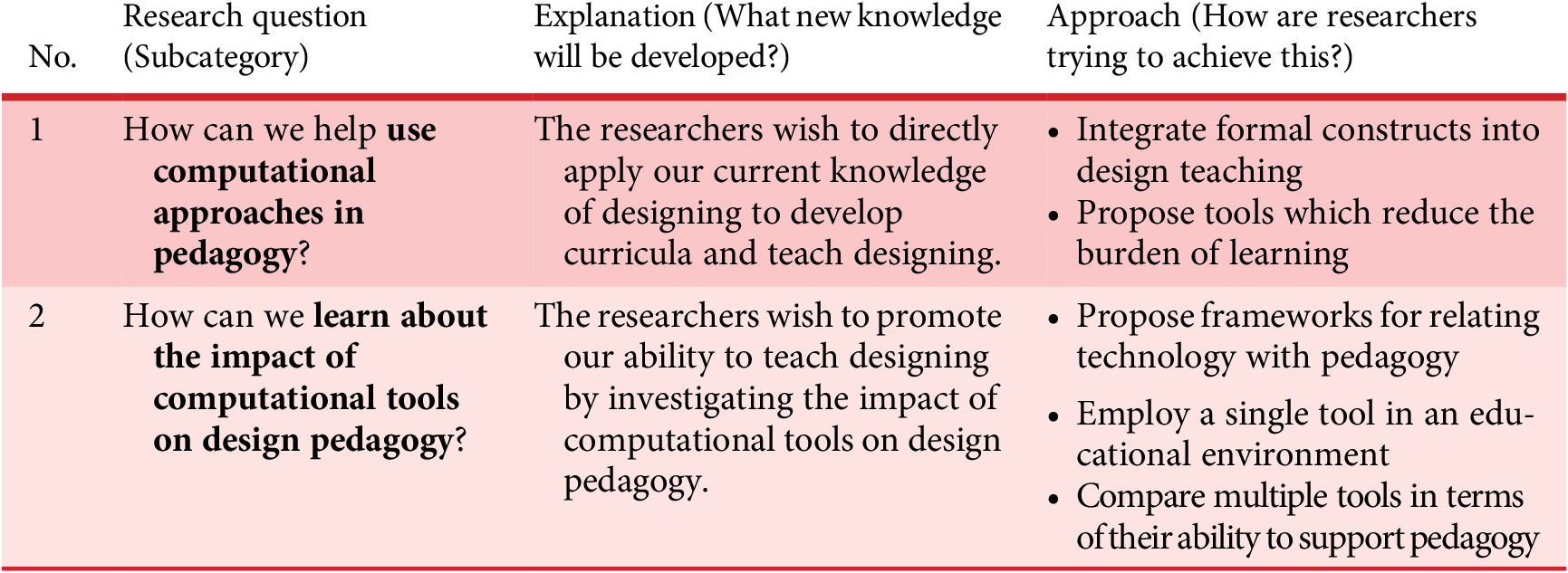
The first subcategory concerns with promoting/easing the use of computational approaches in design pedagogy. Researchers have employed the following approaches in exploring this subcategory:
-
• Integrate formal constructs into design teaching. For example, Li employed shape grammar to teach style recognition by having learners produce a range of designs using a given grammar, exploring the results and eliminating outliers which violate the general style (Li Reference Li and Gero2004).
-
• Propose tools which reduce the burden of learning. Leitão and Garcia have reported on a study of reverse algorithmic design – a computational technique which automatically infers parametric models, thereby mitigating the difficulties of learning to use parametric tools and shortening the learning curve (Leitão & Garcia Reference Leitão, Garcia and Gero2022).
The second subcategory concerns with promoting our ability to teach design by building our body of knowledge regarding the impact of computational tools on design pedagogy. Researchers have employed the following approaches in exploring this subcategory:
-
• Propose frameworks for relating technology with pedagogy. For instance, Chen and Wang have proposed a framework for relating tangible augmented reality (AR) systems with design pedagogy. Their framework helps to evaluate the value of such technologies for learning (Chen & Wang Reference Chen, Wang, Gero and Goel2008).
-
• Employ a single computational tool in an educational environment and examine its impact. For instance, Dissaux and Jancart have observed students who are novice users of a parametric design tool, to learn about patterns of knowledge retrieval and their impact on the design process (Dissaux & Jancart Reference Dissaux, Jancart and Gero2023). Additionally, the interactive knowledge base developed by Goel et al. (mentioned earlier) provides learners with a range of case studies in biologically inspired design. Their pilot study has shown that such a tool can support learners in design via analogical transfer (Goel et al. Reference Goel, Zhang, Wiltgen, Zhang, Vattam, Yen, Gero and Hanna2015).
-
• Employ multiple tools and compare them in their ability to support design pedagogy. For example, Milovanovic and Gero have explored the impact of two digital tools on design critiques, compared them with a “traditional” setting in which no tools were used and identified behavioral trends among learners (Milovanovic & Gero Reference Milovanovic, Gero and Gero2022).
5.4 An initial map for design computing research
To help researchers and educators obtain an overview of design computing research, a map that organizes the complete set of research questions pursued by researchers is given in Figure 4, which describes the activity in the field using five clusters of questions (A,B,C,D,E). The map was synthesized from our findings reported above (5.1–5.3). Two points regarding the process of synthesis are mentioned below.
Clusters of activity in design computing research as reflected in the research questions pursued.
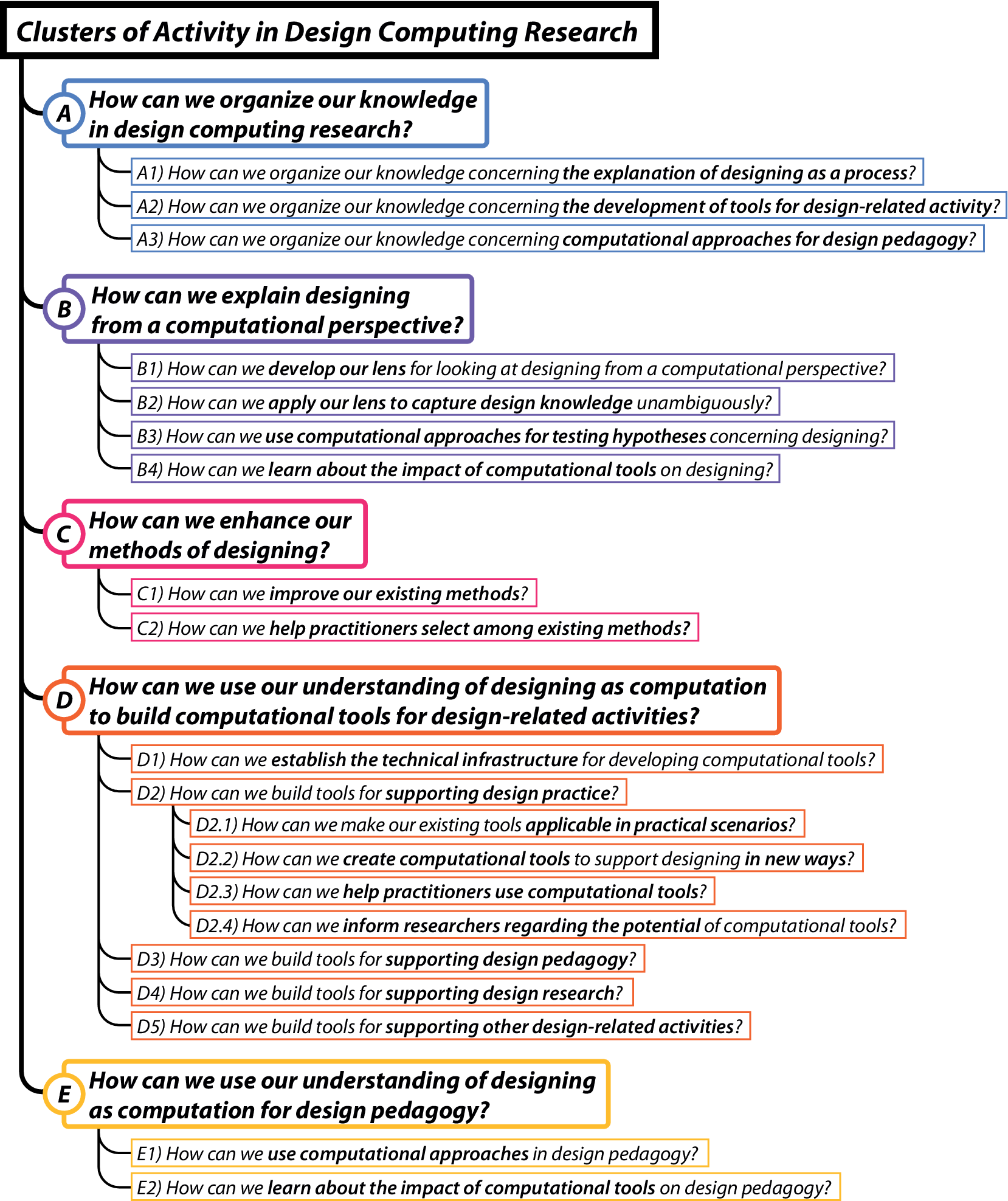
First, notice that the question of “How can we organize our research activity?” occurred in two different clusters, one focusing on organizing our knowledge of designing (Q1) and the other regarding tools (Q2). Given that the paper population is sufficiently large, similar papers which focus on organizing our knowledge concerning design pedagogy (Q3) are expected to be found as well. Based on this, we have formed a cluster that focuses on the efforts to organize our knowledge on a meta-level, which has three sub-questions, each corresponding to one of the above questions (Figure 4, Cluster A). Second, the fourth cluster, which concerns with the construction of tools, was reorganized in a manner that separates the tools under consideration from the context in which they are to be used (design practice, design pedagogy, etc.; Figure 4, Cluster D). The first question in this cluster concerning the creation of the infrastructure for building computational tools reflected a shared concern among all contexts and was thus placed on the same level as the other three questions (instead of nesting it within each).
6. Discussion
6.1 Implications
By translating the fundamental goals of Gero & Maher (Reference Gero, Maher, Martens, Linzer and Voigt1997) into research questions, we were able to extract various questions that are explored by researchers, as well as the approaches by which they are explored. The result is an initial map for the activity in design computing research, which articulates the field into five clusters of research questions (Figure 4) and approaches for addressing them (Table 8). The implications of these are now discussed from two different perspectives – that of researchers and that of educators in the field.
Summary of approaches for addressing research questions by clusters (including example papers)
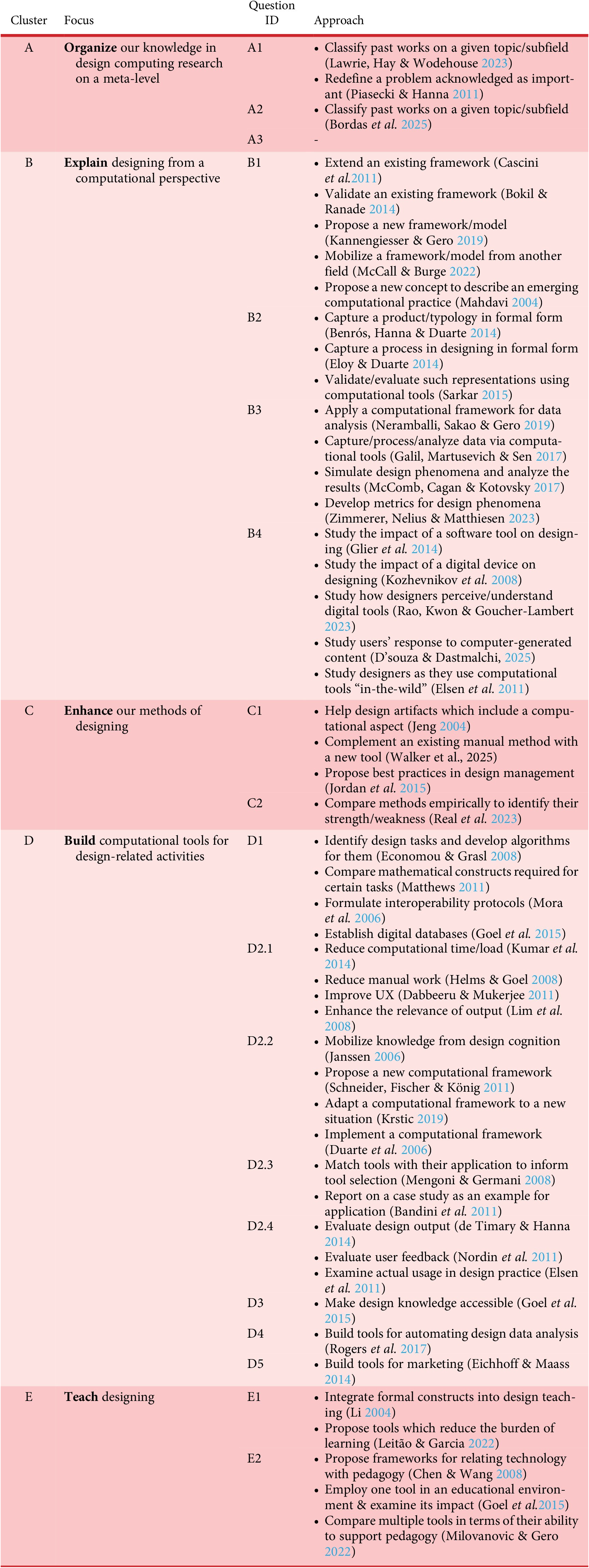
From the viewpoint of researchers, the proposed map enables to learn about the questions pursued by others, examine the activity in the field as a whole, and consider potential future directions. Researchers interested in a specific cluster in Figure 4 are invited to find the set of sub-questions included under it. Given an interest in a specific sub-question, the approaches by which the question was pursued thus far can be found in Table 8, which also serves as an index for retrieving past studies as concrete examples. Such examples can be instructive in various ways, e.g. in informing the design of one’s study, and so forth. Furthermore, by localizing our work within Figure 4, we can become aware of related questions and approaches within our cluster. For instance, researchers who wish to further our ability to test hypotheses in designing can locate their work within cluster B under sub-question B3, which reveals that hypothesis testing using computational means can be done by applying computational frameworks for data analysis, by constructing simulation models, and more. This can help to consider alternative approaches for exploring one’s question of interest or even stimulate an examination of related questions.
From the viewpoint of educators, the map may be used to introduce the field as a collection of clusters of activity. This can help learners make fundamental distinctions between types of research works in the field, regardless of a specific design domain. Moreover, the map can help educators shape their curriculum by choosing a specific cluster as the focus of their teaching, then locating the important questions within that cluster and the approaches by which they have been pursued. The index in Table 8 can be further used to suggest readings to learners, where the corresponding research question can scaffold the reading process and serve as a framework for interpreting the details of a given study.
6.2 Relevance of “pure” design cognition papers to design computing research
As explained in the Method section, design cognition papers that did not include reference to or usage of a computational framework/model/system were classified as indirect contributions and can thus be surveyed elsewhere. This, however, does not reduce their importance as sources of knowledge and inspiration for design computing researchers. In fact, many “pure” design cognition studies can be mobilized for the benefit of design computing research. We point out several classes of such papers and the proposed ways in which we can bridge the gap between the work reported in them and the work in design computing research.
First, some researchers propose frameworks for observing and quantifying cognitive phenomena in designing. For example, Milojevic and Jin have proposed a framework that enables to measure self-efficacy among engineering designers (Milojevic & Jin Reference Milojevic, Jin and Gero2019). Metrics put forward by such studies can be used as the basis for implementing computational tools for automated evaluation of designer’s cognition/behavior, as was done in (Dong Reference Dong and Gero2004) in the context of estimating the coherence of team conversation in designing.
Second, some studies examine the behavior of designers as they employ specific techniques, such as functional modeling (Thiagarajan et al. Reference Thiagarajan, Patel, O’Shields, Summers and Gero2017), thereby contributing to our understanding of the applicability of such methods. Relatedly, methods are occasionally verified via comparison with alternative ones in terms of their ability to produce the desired results. For example, Starkey et al. have compared product dissection methods, and have found virtual dissection to be superior to physical dissection, to a certain extent (Starkey et al. Reference Starkey, McKay, Hunter, Miller and Gero2017). Such information regarding the usefulness/effectiveness of methods can be important when choosing a method to serve as the basis for constructing a computational tool to support designing. Therefore, it is important that researchers engaging in tool creation be aware of our body of knowledge regarding method validation, even in cases where the method does not employ any computational tools at present.
Third, design cognition papers can further our understanding of design activity by observing diverse populations as they engage in designing, including visually impaired individuals, neurodivergent individuals and non-designers. For example, Dong and Heylighen have examined designing among Autistic individuals (Dong and Heylighen, Reference Dong, Heylighen and Gero2017). Under the assumption that everyone designs (Simon Reference Simon2019), such studies are valuable for researchers in design computing as sources of knowledge regarding cognitive processes in designing and may enlighten us to new ways in which design processes can be computed.
Finally, the opposite path of mobilizing knowledge from design computing to design cognition can be fruitful as well. Certain design cognition studies report on observation of important phenomena in designing but do not employ a specific framework for systematically classifying the observations made. For example, Inoue et al. (Reference Inoue, Rodgers, Tennant and Spencer2017) examined visual reasoning among designers and non-designers and its relationship with information reduction. Such studies can employ frameworks from design computing, e.g. Gero’s FBS framework (Gero Reference Gero1990), to examine the processes being studied as a form of computation. This will not only deepen our understanding of design cognition but may also help to raise hypotheses regarding the ability of computer systems to engage in such processes.
6.3 Limitations and future work
We point out three main limitations concerning sampling, resources and scope, then suggest directions for future work to address these.
First, with respect to sampling, the conference chosen as the basis for this project provided a highly diverse set of papers and thus enabled us to explore a broad range of questions and approaches. However, the relatively small number of papers concerning the pedagogical aspect of design computing must be acknowledged. Therefore, to further elaborate Q3 into sub-questions, future research would do well to examine a dataset which contains enough publications focusing on pedagogy. Several conferences and journals that specifically focus on issues at the intersection of pedagogy and design computing do exist and can serve as the source for such a survey. This applies to the papers exploring Q1b as well.
Second, with respect to the resources available for conducting broad reviews, the abundance of publications in the field places clear limitations on the human ability to manually survey existing work (and to do so with minimal bias/error). Therefore, to comprehensively review and map large portions of the research in design computing, we can consider employing methods for automation of such surveys (e.g., bibliometric analysis). Two approaches for automation are suggested: (a) apply the proposed categorization for classifying additional papers manually, then use the data for training AI models via supervised learning techniques or (b) attempt to cluster existing work via unsupervised learning techniques, and then check for agreement between the clusters of work identified here and those detected by the model. Approach (a) was recently effectively employed, to a certain extent, within the subfield of computer-aided architectural design research (Kahlon, McComb & Fujii Reference Kahlon, McComb and Fujii2025). However, establishing the database required for supervised learning is both time consuming and cognitively tasking for human annotators. Moreover, as scientific fields evolve over time, the database would require updating and the model would need to be retrained. Additionally, as this approach relies on human judgment, bias may be introduced into the data and should be mitigated. Approach (b) may help to validate the relevance of our proposed categorization, as well as to discover additional clusters of activity, to elaborate our map. Yet, misalignments between our current understanding of the field and the results of automated clustering would demand interpretation and resolution, a complex and challenging task.
Finally, while this article provides insight into questions and approaches in design computing research, our analysis lacks a temporal dimension, which can be highly informative. Future work should attempt to explain the emergence/evolution of concepts, which is essential for strengthening our understanding of the disciplines from a historical perspective, as well as for trend identification and prediction. Considering the immense amounts of information available in the field, we may need to capitalize on AI for executing a detailed temporal survey. Such a survey can potentially draw on bibliometric methods, mentioned above, to deepen our understanding of the field.
7. Conclusion
A PRISMA-style review of the proceedings of a long-standing conference has yielded an initial map for design computing research. The map articulates the field into five major clusters of activity by the overarching questions which drive research work: (A) How can we organize our knowledge in design computing research? (B) How can we explain designing from a computational perspective? (C) How can we enhance our design methods? (D) How can we build computational tools for design-related activity? (E) How can we use our computational understanding of designing for teaching design?
For each of these clusters, we have identified a list of sub-questions pursued by researchers, as well as various approaches by which they are pursued. The map thus provides an overview of the activity in the field and an index for identifying past works addressing specific questions.
The findings are valuable from the perspective of researchers and educators alike. From the viewpoint of researchers, the proposed map (1) supports the selection of research questions, by elaborating the questions pursued by other researchers; (2) provides an index for identifying works addressing specific questions, based on the approach taken and (3) helps to consider alternative approaches for addressing one’s research question. From the viewpoint of educators, the proposed map (1) helps learners to make fundamental distinctions regarding the activity in the field and (2) serves as a resource for curriculum development.
Finally, to help create a comprehensive map for design computing research, we suggest that future research address the following points: (1) enlarging the paper population under consideration, potentially by employing AI, to capture the richness and diversity in the field, as reflected in other prominent conferences and journals; (2) specifically, a sufficiently large number of papers concerning computational approaches in design pedagogy should be surveyed, to help articulate cluster E and (3) in addition to identifying research questions and approaches, researchers may consider the relationships between these (i.e., the manners in which contributions in one cluster affect others).
Financial support
This research received no specific grant from any funding agency, commercial or not-for-profit sectors.
Competing interest
The authors declare none.


 Open access

