


Statement of Research Significance
Research Question(s) or Topic(s): In this study, we sought to investigate (1) racial differences in collegiate athlete performance on cognitive tests and (2) if these differences would still exist after accounting for education quality. Education quality is an important contextual variable because people of color tend to have access to lower quality education than their White counterparts due to practices like residential segregation and public school zoning. Main Findings: We found racial differences in cognitive test performance among collegiate athletes. However, after controlling for education quality as assessed by a word-reading test, all racial differences either no longer existed or became less prominent. Study Contributions: Our findings emphasize the importance of considering sociocultural context and systemic factors like education quality when assessing racially diverse collegiate athletes and the need to continue integrating these factors into sport concussion research and clinical practice.
Introduction
Due to growing concerns about athlete safety and long-term outcomes after sustaining multiple sport-related concussions (SRCs), proper assessment and management of SRCs are major public health priorities (Manley et al., Reference Manley, Gardner, Schneider, Guskiewicz, Bailes, Cantuk and Iverson2017; NCAA Sport Science Institute, 2023; Parsons, Reference Parsons2014; Patricios et al., Reference Patricios, Schneider, Dvorak, Hassan Ahmed, Blauwet, Cantu and Meeuwisse2023). Determining when an athlete can return to sport settings after sustaining an SRC is a crucial safety decision, and many governing bodies in SRC recommend the use of multimodal baseline assessments that include a neuropsychological component to inform such decisions (Broglio et al., Reference Broglio, Cantu, Gioia, Guskiewicz, Kutcher, Palm and Valovich McLeod2014; Parsons, Reference Parsons2014; Patricios et al., Reference Patricios, Schneider, Dvorak, Hassan Ahmed, Blauwet, Cantu and Meeuwisse2023). However, it has been reported that only 15% of neuropsychologists who conduct SRC evaluations collect baseline data as part of their clinical procedures, and 92% of these practitioners evaluate athletes post-concussion without baseline data (LeMonda et al., Reference LeMonda, Tam, Barr and Rabin2017). When a concussed athlete does not have available baseline neuropsychological data, their cognitive test performance is compared to normative data (Echemendia et al., Reference Echemendia, Bruce, Bailey, Forrest Sanders, Arnett and Vargas2012; LeMonda et al., Reference LeMonda, Tam, Barr and Rabin2017). Normative data for neurocognitive tests tend to be based on predominantly non-Hispanic White samples, and applying these non-representative norms to individuals from racial/ethnic minority groups can yield false-positive diagnoses and unnecessarily prolonged removal from play (Byrd & Rivera Mindt, Reference Byrd and Rivera Mindt2022; Manly & Echemendia, Reference Manly and Echemendia2007; Wallace et al., Reference Wallace, Beidler, Covassin, Hibbler and Schatz2023). This is particularly concerning because approximately 38% of athletes participating in the National Collegiate Athletics Association (NCAA) identify as people of color, and this percentage has steadily increased over the past decade (NCAA, 2023). Given the heightened attention to the use of race-based normative data in sport settings as well as calls for the field of clinical neuropsychology to further integrate health equity and social justice into research and practice, there is an urgent need to empirically investigate the relationship between racial identity and neurocognitive test performance at baseline assessment to further inform evidence-based SRC management that reflects the experiences of all collegiate athletes (Byrd & Rivera Mindt, Reference Byrd and Rivera Mindt2022; Jo et al., Reference Jo, Williams, Wallace, Anand, Anesi and Yengo-Kahn2024; Rivera Mindt et al., Reference Rivera Mindt, Byrd, Saez and Manly2010).
It is critical to consider both the construct of race and the role of structural racism in explaining racial differences in baseline neuropsychological test performance. Although any scientific backing to race as a biological category has long been debunked, race remains relevant as a proxy variable because it continues to represent advantageous social capital for members of the dominant racial group (i.e., White individuals) and inequitable access to essential resources for members of nondominant racial groups (Manly & Echemendia, Reference Manly and Echemendia2007; Williams, Reference Williams1997). Structural racism is defined as the interactions between racism and economic, political, and social institutions to maintain racial hierarchies (Bonilla-Silva, Reference Bonilla-Silva1997). As such, structural racism plays an essential role in sustaining contemporary race-based inequity by systemically denying members of nondominant racial groups access to quality education, employment, healthcare, housing, and wealth formation through institutional practices such as residential segregation, policing, incarceration, and discriminatory legislation (Bailey et al., Reference Bailey, Krieger, Agénor, Graves, Linos and Bassett2017; Bonilla-Silva, Reference Bonilla-Silva1997; Williams & Mohammed, Reference Williams and Mohammed2013; Williams et al., Reference Williams, Lawrence and Davis2019). Structural racism has been extensively linked to detrimental physical and mental health outcomes in people of color and may explain racial differences on neurocognitive test performance through disparities in education quality maintained through practices like residential segregation and public school zoning (Bailey et al., Reference Bailey, Krieger, Agénor, Graves, Linos and Bassett2017; Manly & Echemendia, Reference Manly and Echemendia2007; Manly et al., Reference Manly, Jacobs, Touradji, Small and Stern2002; Orfield et al., Reference Orfield, Frankenberg and Garces2008; Shim, Reference Shim2021; Shim et al., Reference Shim, Koplan, Langheim, Manseau, Powers and Compton2014; Williams & Collins, Reference Williams and Collins2001; Williams et al., Reference Williams, Lawrence and Davis2019). Residential segregation remains prominent, particularly for Black and Hispanic individuals, and schools in residentially segregated neighborhoods frequently report fewer resources and qualified teachers as well as lower standardized test scores and graduation rates, which in turn lead to lower rates of higher education (Orfield et al., Reference Orfield, Frankenberg and Garces2008; Williams & Collins, Reference Williams and Collins2001). Indeed, discussions on upstream factors explaining racial differences on neurocognitive test performance are often centered around education level, quality of education, and premorbid abilities such as word reading level (Byrd et al., Reference Byrd, Touradji, Tang and Manly2004; Byrd & Rivera Mindt, Reference Byrd and Rivera Mindt2022; Manly & Echemendia, Reference Manly and Echemendia2007; Manly et al., Reference Manly, Jacobs, Touradji, Small and Stern2002; Rosselli & Ardila, Reference Rosselli and Ardila2003; Wallace et al., Reference Wallace, Beidler, Covassin, Hibbler and Schatz2023).
Compared to other well-studied factors that can influence performance on baseline assessment of athletes (e.g., gender, presence of attention-deficit/hyperactivity disorder, sleep quality, total number of past SRCs, etc.), relatively few studies have examined the role of racial identity in this context. To our knowledge, most published studies to date have assessed neurocognitive functioning using the Immediate Post-Concussion Assessment and Cognitive Testing measure (ImPACT). Most studies found racial differences in at least one cognitive domain assessed by the ImPACT (i.e., verbal memory, visual memory, visual motor speed, reaction time, and impulse control) at baseline assessment (Houck et al., Reference Houck, Asken, Clugston, Perlstein and Bauer2018; Houck et al., Reference Houck, Asken, Bauer, Caccese, Buckley and McCrea2020; Moody et al., Reference Moody, Hayes, Buckley, Schmidt, Broglio and McAllister2022; Tsushima et al., Reference Tsushima, Tsushima and Murata2020; Wallace et al., Reference Wallace, Covassin, Moran and McAllister Deitrick2018; Wallace et al., Reference Wallace, Beidler, Covassin, Hibbler and Schatz2023). Generally, these studies concluded that athletes of color scored lower in at least one ImPACT cognitive domain compared to their White counterparts. In contrast, Kontos and colleagues (2010) examined differences in ImPACT scores between 48 Black athletes and 48 White athletes and found no significant baseline differences between racial groups. Notably, the majority of these studies assessed racial differences between only two groups: Black and White athletes (Houck et al., Reference Houck, Asken, Clugston, Perlstein and Bauer2018; Moody et al., Reference Moody, Hayes, Buckley, Schmidt, Broglio and McAllister2022; Wallace et al., Reference Wallace, Covassin, Moran and McAllister Deitrick2018, Reference Wallace, Beidler, Covassin, Hibbler and Schatz2023). Houck and colleagues (Reference Houck, Asken, Bauer, Caccese, Buckley and McCrea2020) used three race categories (Another Race, Black, and White), Houck and colleagues (Reference Houck, Asken, Clugston, Perlstein and Bauer2018) used the three aforementioned race categories and three ethnicity categories (Hispanic, non-Hispanic, and Unknown), and Tsushima and colleagues (Reference Tsushima, Tsushima and Murata2020) compared Asian, Multiracial, and Native Hawaiian athletes. Further study of additional racial/ethnic groups of athletes is urgently needed due to the sizable and growing number of students of color participating in collegiate athletics (NCAA, 2023).
Although most existing studies suggest that there are racial differences in baseline neurocognitive test performance as measured by the ImPACT, there is a need to examine performance on measures beyond the ImPACT and to make comparisons with a greater number of racial groups to optimize evidence-based SRC management of athletes of color. Moreover, there is evidence that racial differences in neurocognitive test performance are confounded by differences in education quality experienced by various racial groups (i.e., White individuals are more likely to go to higher quality schools than individuals from racial minority groups due to structural factors like residential segregation and wealth distribution); however, these differences can be accounted for, in part, by controlling for education quality as assessed by tests of word reading (Byrd et al., Reference Byrd, Touradji, Tang and Manly2004; Manly et al., Reference Manly, Jacobs, Touradji, Small and Stern2002; Ryan et al., Reference Ryan, Baird, Mindt, Byrd and Monzones2005; Silverberg et al., Reference Silverberg, Hanks and Tompkins2013). Previous studies in TBI, healthy aging, and HIV populations have used performance on word-reading tests as a proxy variable for education quality and have found that this variable, as opposed to years of education, is significantly related to neuropsychological test performance in racially minoritized groups (Byrd et al., Reference Byrd, Touradji, Tang and Manly2004; Manly et al., Reference Manly, Jacobs, Touradji, Small and Stern2002; Ryan et al., Reference Ryan, Baird, Mindt, Byrd and Monzones2005; Silverberg et al., Reference Silverberg, Hanks and Tompkins2013). As such, studies have called for more research to further understand the role of education quality in racial differences in the context of baseline neurocognitive test performance. Only one recently published study has accounted for education quality in the context of racial differences in baseline assessment of athletes (Houck et al., Reference Houck, Asken, Bauer, Caccese, Buckley and McCrea2020). Houck and colleagues (Reference Houck, Asken, Bauer, Caccese, Buckley and McCrea2020) adjusted for participants’ SAT or ACT scores as a proxy for education quality and found that SAT or ACT scores partially mediated the effect of racial identity on ImPACT performance.
Further elucidating the relationship between racial identity and baseline neurocognitive test performance is imperative and can contribute to our knowledge of important factors to consider both during baseline assessment of racially diverse athletes and when a concussed athlete does not have baseline assessment data. Accordingly, the present study aimed to examine the relationship between racial identity and baseline neuropsychological test performance using a comprehensive neuropsychological battery that included the ImPACT and eight additional neuropsychological tests across three racial groups. The purpose of this study was twofold: (1) to extend our understanding of the relationship between racial identity and neurocognitive performance at baseline to measures beyond the ImPACT; and (2) to address gaps in existing literature by assessing how education quality (as assessed by a word-reading test) influences racial differences in performance-based cognitive functioning. We hypothesized that (1) there will be racial differences on neurocognitive domains as assessed by a comprehensive neuropsychological battery; and (2) controlling for education quality as assessed by a word-reading test will reduce racial differences in neuropsychological test performance at baseline assessment.
Materials and methods
Participants and procedures
Participants in this observational cross-sectional study included 875 NCAA Division I collegiate athletes enrolled in a concussion management program through their university. Athletes were referred to this program by athletic trainers or team physicians. Upon consenting to participate, all athletes completed a pre-season baseline assessment which included sociodemographic and self-reported psychosocial questionnaires and a comprehensive neuropsychological assessment. Trained graduate or undergraduate students administered all study measures under the supervision of a clinical neuropsychologist. Data were collected from 2002 to 2019. Study procedures were approved by the Pennsylvania State University Institutional Review Board and were developed in accordance with the latest version of the Declaration of Helsinki.
Athletes were eligible for the current study if they (1) had complete data on self-reported racial identity; (2) spoke English as a first language or reported their country of origin as the United States of America; (3) had complete data on a test of word reading and were missing no more than 30% of indices from the neuropsychological battery; and (4) passed an embedded performance validity test. The final sample included 875 athletes (225 females, 650 males) from the following NCAA Division sports teams: football, soccer, lacrosse, ice hockey, basketball, baseball, soccer, rugby, crew, and volleyball.
Measures
Racial identity
Racial identity was gathered from an open-ended question asking athletes to self-report their race. Responses were then collapsed into the following racial/ethnic groups: White (n = 661), Black (n = 165), Hispanic or Latino/a (n = 10; henceforth Hispanic), Asian American (n = 8), Pacific Islander (n = 1), Biracial or Multiracial (n = 27), and Another Race (n = 3). For sufficient power and cell size when running statistical analyses with this sample, participants were grouped into the following three racial groups: White (n = 661), Black (n = 165), and Another Race (n = 49).
Neuropsychological assessment
Participants completed a comprehensive neuropsychological battery that was comprised of both computerized and paper-and-pencil measures. Computerized measures included the ImPACT (Lovell et al., Reference Lovell, Collins, Podell, Podell and Maroon2000) and the Vigil/W Continuous Performance Test (Vigil; Cegalis & Cegalis, Reference Cegalis and Cegalis1994). Paper-and-pencil measures consisted of the Brief-Visuospatial Memory Test-Revised (BVMT-R; Benedict, Reference Benedict1997); the Comprehensive Trail-Making Test (CTMT; Reynolds, Reference Reynolds2002); a version of the Digit Span Test that was modified for the concussion management program (Wechsler, Reference Wechsler1997); the Hopkins Verbal Learning Test-Revised (HVLT-R; Brandt & Benedict, Reference Brandt and Benedict2001); the Pennsylvania State University Cancellation Test (PSU Cancellation; Echemendia et al., Reference Echemendia, Putukian, Mackin, Julian and Shoss2001); the Stroop Color-Word Interference Test (Stroop; Trenerry et al., Reference Trenerry, Crosson, DeBoe and Leber1989); and the Symbol-Digit Modalities Test (SDMT; Smith, Reference Smith1991). Performance validity was evaluated using the ImPACT Impulse Control Composite (ICC). A raw score greater than 30 is considered an indicator of suboptimal effort, and participants who scored above 30 on the ImPACT ICC were not included in the current study (ImPACT Applications, 2021).
Cognitive composite scores for global cognition, attention/processing speed, and memory were created using 16 indices derived from the neuropsychological battery. The attention/processing speed composite score included 10 indices: ImPACT Visual Motor Speed, Vigil Average Delay, SDMT Total, Stroop 1, Stroop 2, PSU Cancellation Test, Digit Span Forward, Digit Span Backward, CTMT Simple, and CTMT Executive. The memory composite score consisted of six indices: ImPACT Verbal Memory, ImPACT Visual Memory, BVMT-R Immediate Total Recall, BVMT-R Delayed Recall, HVLT-R Immediate Total Recall, and HVLT-R Delayed Recall. The global cognitive composite score was generated from all sixteen indices. To calculate composite scores, raw scores were first converted into z-scores using published baseline, sex-based norms (see Merritt et al., Reference Merritt, Meyer, Cadden, Román, Ukueberuwa, Shapiro and Arnett2017). Higher scores indicated better performance. We then averaged z-scores, and missing indices were accounted for with prorating. Intra-individual variability (IIV) was also calculated for the global, attention/processing speed, and memory domains. IIV was determined by averaging the z-scores of (1) the difference between the highest and lowest z-score of each cognitive domain for each athlete, and (2) the average of the standard deviations of the z-scores of all indices in each cognitive domain (see Merritt et al., Reference Merritt, Greenberg, Guty, Bradson, Rabinowitz and Arnett2019). Higher IIV scores were indicative of elevated cognitive variability.
Wechsler Test of Adult Reading
The Wechsler Test of Adult Reading (WTAR) was used to assess education quality (Wechsler, Reference Wechsler2001). The WTAR is an untimed word reading test in which participants are asked to read 50 irregularly spelled words aloud. The test is scored based on whether participants correctly pronounce each word with a maximum raw score of 50. Scores are then standardized using normative data adjusting for participant age. Standard scores range from 50 to 134, with higher scores indicating better performance. The WTAR is regarded as a valid measure of full-scale IQ in individuals with a history of traumatic brain injury (TBI; Green et al., Reference Green, Melo, Christensen, Ngo, Monette and Bradbury2008).
Data analysis
Descriptive statistics were used to characterize sociodemographic variables for the overall sample, and analyses of variance (ANOVAs) and chi-square tests were used to compare the three racial groups across sociodemographic variables. ANOVAs were used to examine racial group differences across all six cognitive domains (i.e., global composite score, attention/processing speed composite score, memory composite score, global IIV, attention/processing speed IIV, and memory IIV). Afterwards, analyses of covariance (ANCOVAs) were used to evaluate the relationships between racial groups and the six cognitive domains while controlling for WTAR scores. Cohen’s f was used to measure effect sizes for ANOVAs and ANCOVAs using three racial groups. Tukey’s Honestly Significant Difference tests were used to examine group differences using pairwise comparisons. To further understand group differences, Cohen’s d effect sizes were calculated to compare performance on each cognitive domain across individual racial groups (e.g., Another Race vs. Black) both before and after controlling for education quality as assessed by the WTAR. The Statistical Package for Social Science, Version 29 was used to conduct all analyses, and statistical significance was set at p < .05.
Results
Sample characteristics
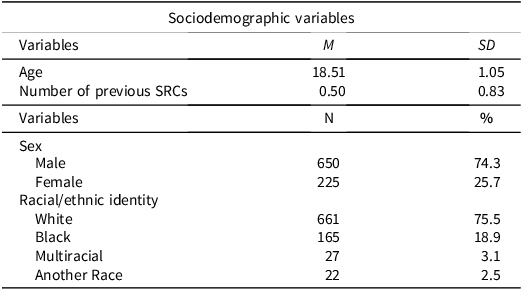
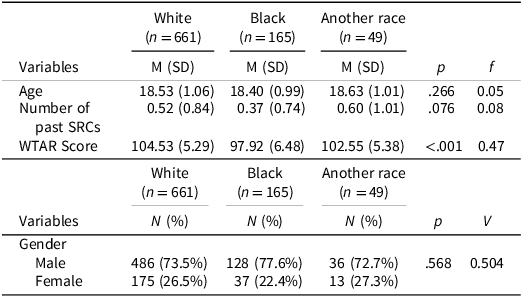
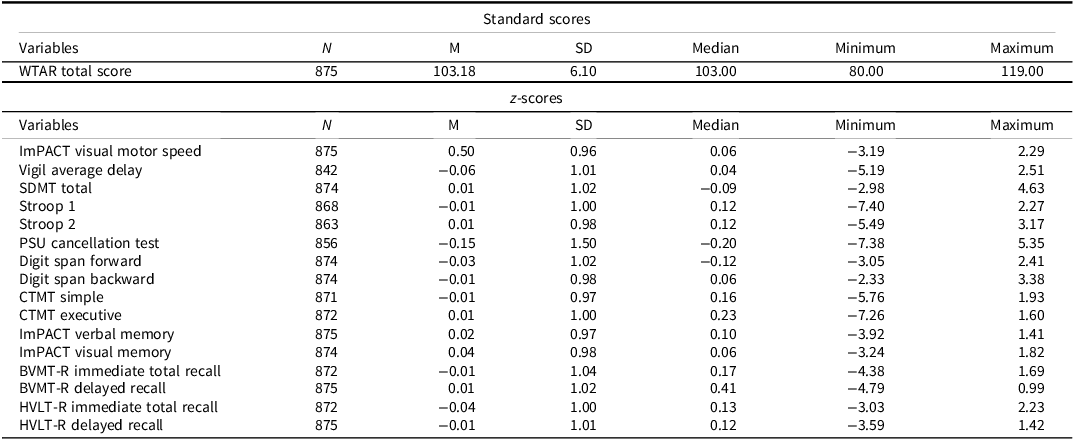
Participant sociodemographic characteristics are displayed in Table 1. As shown, a majority of athletes identified as White, with the second highest proportion identifying as Black. Regarding gender, approximately three-fourths of athletes identified as male and about one-fourth as female. On average, athletes were a little over 18 years old at the time of assessment and had sustained less than one previous SRC. Table 2 depicts participant characteristics by racial group. There were no significant racial group differences related to age at time of assessment, number of previous SRCs, or gender identity, and all participants had complete sociodemographic data. Table 3 displays neuropsychological test performance data. A Little’s Missing Completely at Random test for missing neuropsychological variables was nonsignificant, indicating that data were missing at random (χ2 = 177.21, p = .904).
Participant characteristics

Abbreviations: SRCs = Sport-Related Concussions.
Participant characteristics by racial/ethnic group

Abbreviations: SD = Standard Deviation; SRCs = Sport-Related Concussions; WTAR = Wechsler Test of Adult Reading; f = Cohen’s f; V = Cramer’s V.
Note: Cohen’s f effect size interpretation: small = 0.10, medium = 0.25, large = 0.40. Cramer’s V effect size interpretation: weak < 0.00, moderate < 0.10, strong < 0.15, very strong > 0.25.
Neuropsychological test scores

Abbreviations: SD = Standard Deviation; WTAR = Wechsler Test of Adult Reading.
Note: For standard scores and z-scores, higher scores indicate better performance.
Racial group differences in neuropsychological test performance
Table 4 displays racial group differences in performance across each cognitive domain, and Table 5 depicts pairwise comparisons across racial groups. Significant racial group differences were found for each cognitive composite score. First, groups differed significantly across the attention/processing speed composite, F(2, 872) = 13.81, p < .001, f = 0.17. Pairwise comparisons revealed that Black athletes scored significantly lower than White athletes on measures of attention/processing speed (p < .001), but there were no significant differences when comparing athletes who identified as Another Race to Black athletes (p = .251) or to White athletes (p = .386). Similarly, there were significant racial group differences across the memory composite, F(2, 872) = 12.60, p < .001, f = 0.16, and pairwise comparisons indicated that Black athletes had significantly lower memory composite scores than White athletes (p < .001); no significant differences were found between athletes who identified as Another Race compared to Black athletes (p = .179) or to White athletes (p = .583). There were also significant group differences across the global cognitive composite, F(2, 872) = 19.17, p < .001, f = 0.20. Specifically, pairwise comparisons showed that Black athletes had significantly lower global composite scores compared to White athletes (p < .001); however, there were no significant differences when comparing athletes who identified as Another Race to Black athletes (p = .113) or to White athletes (p = .331). Because the number of previous SRCs based on racial identity was marginally significant (p = .076), analyses on racial differences in neuropsychological test performance were re-run while controlling for previous number of SRCs, and results were analogous.
ANOVAs on racial/ethnic differences on cognitive test performance

Abbreviations: ANOVAs = Analyses of Variance; f = Cohen’s f; SD = Standard Deviation; A/PS = Attention/Processing Speed; IIV = Intra-Individual Variability.
Note: All scores are z-scores. For composite scores, higher scores indicate better performance. For IIV scores, higher scores indicate increased variability. Cohen’s f effect size interpretation: small = 0.10, medium = 0.25, large = 0.40.
Pairwise comparisons on racial/ethnic differences in cognitive test performance

Abbreviations: MD = Mean Difference; IIV = Intra-Individual Variability.
Note: All scores are z-scores. For composite scores, higher scores indicate better performance. For IIV scores, higher scores indicate increased variability.
Similar patterns were found for attention/processing speed and global IIV. Of note, the attention/processing speed IIV variable displayed elevated kurtosis. However, this variable was normally distributed with acceptable skewness and kurtosis when it was logarithmically transformed. We ran analyses on both the untransformed and transformed variables and found similar results, and findings from the untransformed variables are reported here. Racial groups differed significantly on attention/processing speed IIV, F(2, 872) = 7.12, p < .001, f = 0.12. Compared to White athletes, Black athletes displayed more variability across tests of attention/processing speed (p = .001), but there were no significant differences when comparing athletes who identified as Another Race to Black athletes (p = .984) or to White athletes (p = .148). Similar racial differences were observed for global IIV, F(2, 872) = 6.02, p = .003, f = 0.11. While Black athletes displayed more global variability than White athletes (p = .005), there were no significant group differences when comparing athletes who identified as Another Race to Black athletes (p = 1.00) or to White athletes (p = .155). No significant racial group differences were observed for memory IIV, F(2, 872) = 0.03, p = .967, f = 0.00.
Racial group differences in neuropsychological test performance when controlling for education quality as assessed by the WTAR
As shown in Table 6, after controlling for education quality as measured by WTAR scores, there were no significant racial differences across the attention/processing composite (F(3, 871) = 0.64, p = .530, f = 0.00), memory composite (F(3, 871) = 1.70, p = .183, f = 0.05), global composite (F(3, 871) = 1.48, p = .229, f = 0.04), memory IIV (F(3, 871) = 0.67, p = .513, f = 0.00), and global IIV scores (F(3, 871) = 2.68, p = .069, f = 0.08). Significant racial group differences remained for attention/processing speed IIV, F(3, 871) = 4.26, p = .014, f = 0.11, although the effect size for this difference was small.
ANCOVAS on racial/ethnic differences on cognitive test performance after controlling for WTAR score

Abbreviations: ANCOVAs = Analyses of Covariance; WTAR = Wechsler Test of Adult Reading; f = Cohen’s f; SE = Standard Error; A/PS = Attention/Processing Speed; IIV = Intra-Individual Variability.
Note: All scores are z-scores. For composite scores, higher scores indicate better performance. For IIV scores, higher scores indicate increased variability. Cohen’s f effect size interpretation: small = 0.10, medium = 0.25, large = 0.40.
Table 7 depicts effect sizes for pairwise comparisons of racial group differences in each cognitive domain before and after controlling for WTAR scores. As seen in the table, effect sizes of racial group comparisons consistently decreased across composite scores after controlling for WTAR scores. However, this pattern was not observed for memory IIV and global IIV, and only minimal decreases were observed for attention/processing speed IIV.
Cohen’s d for racial/ethnic differences on cognitive test performance before and after controlling for WTAR score

Abbreviations: WTAR = Wechsler Test of Adult Reading; SE = Standard Error; A/PS = Attention/Processing Speed; IIV = Intra-Individual Variability.
Note: Cohen’s d effect size interpretation: small = 0.2, medium = 0.5, large = 0.8.
Discussion
The purpose of this study was to further understand and contextualize racial group differences in neuropsychological test performance as measured by mean composite scores and IIV among collegiate athletes at baseline assessment. We found significant group differences in performance on a comprehensive neuropsychological battery between collegiate athletes who identified as White, Black, and Another Race that were primarily driven by differences between Black and White athletes. However, after controlling for education quality as assessed by the WTAR, most racial differences on neurocognitive test performance became nonsignificant, and pairwise differences demonstrated reduced effect sizes.
Before controlling for education quality as assessed by the WTAR, we observed significant racial group differences in attention/processing speed, memory, and global composite scores as well as attention/processing speed IIV and global IIV. Generally, our results were consistent with existing literature, as all but one previous study found significant racial differences in performance-based cognitive functioning as measured by the ImPACT (Houck et al., Reference Houck, Asken, Clugston, Perlstein and Bauer2018; Houck et al., Reference Houck, Asken, Bauer, Caccese, Buckley and McCrea2020; Kontos et al., Reference Kontos, Elbin, Covassin and Larson2010; Moody et al., Reference Moody, Hayes, Buckley, Schmidt, Broglio and McAllister2022; Tsushima et al., Reference Tsushima, Tsushima and Murata2020; Wallace et al., Reference Wallace, Covassin, Moran and McAllister Deitrick2018; Wallace et al., Reference Wallace, Beidler, Covassin, Hibbler and Schatz2023). However, most studies evaluated racial differences by solely examining the ImPACT. In contrast, we combined sixteen indices from the ImPACT and eight additional neurocognitive tests to create three cognitive domains: attention/processing speed (ten indices), memory (six indices), and global cognition (all sixteen indices). Only one published study by Houck and colleagues (Reference Houck, Asken, Clugston, Perlstein and Bauer2018) examined cognitive domains as opposed to individual indices. The authors assessed racial differences in a speed composite (i.e., the ImPACT visual motor speed and reaction time indices) and a memory composite (i.e., the ImPACT verbal and visual memory indices) among athletes who identified as White, Black, and Another Race (Houck et al., Reference Houck, Asken, Clugston, Perlstein and Bauer2018). Consistent with the findings of the current study, Houck and colleagues (Reference Houck, Asken, Clugston, Perlstein and Bauer2018) found that Black athletes had lower composite scores in both cognitive domains when compared to athletes who identified as White or Another Race. In summary, the racial differences we found before controlling for education quality as assessed by the WTAR resembled the majority of existing studies and extended the current body of literature by examining racial differences in neurocognitive tests beyond the ImPACT and in IIV.
To our knowledge, ours is the first study to control for education quality as assessed by a word reading test when examining racial differences in neurocognitive test performance at baseline assessment in collegiate athletes. After controlling for education quality as assessed by the WTAR, most racial differences on performance-based cognitive functioning became nonsignificant (i.e., the attention/processing speed composite, memory composite, global composite and global IIV). While attention/processing speed IIV remained significant, the effect size was small. It is possible that racial differences remained significant on attention/processing speed IIV because there was a wider range of potential variability across indices comprising the attention/processing speed domain compared to the memory domain and thus more room for individual differences to be expressed. For example, multiple attention/processing speed tests were timed, while none of the memory tests were timed, and there is evidence that cultural differences in the perception of time and timed tests may influence neuropsychological test performance (Agranovich et al., Reference Agranovich, Panter, Puente and Touradji2011). It is also possible that other factors related to cultural, and structural racism that have been related to neuropsychological test performance, such as racial discrimination, stereotype threat, racial identity of the examiner, and disparities in additional measures of education quality (e.g., literacy, student-to-teacher ratio, level of educational segregation), could explain why racial differences in attention/processing speed IIV remained significant (Glei et al., Reference Glei, Lee and Weinstein2022; Lawrence et al., Reference Lawrence, Hsu, Cory and Kawachi2024; Sisco et al., Reference Sisco, Gross, Shih, Sachs, Glymour and Manly2013; Thames et al., Reference Thames, Hinkin, Byrd, Bilder, Duff, Rivera Mindt and Streiff2013). Although there have been calls to prioritize research on diversity, equity, and inclusion in clinical neuropsychology and to contextualize such research in systemic and structural factors like education quality for over two decades (Manly et al., Reference Manly, Jacobs, Touradji, Small and Stern2002, Reference Manly and Echemendia2007; Rivera Mindt et al., Reference Rivera Mindt, Byrd, Saez and Manly2010; Silverberg et al., Reference Silverberg, Hanks and Tompkins2013), only one published study has examined such factors in the context of racial differences in baseline assessment of athletes (Houck et al., Reference Houck, Asken, Bauer, Caccese, Buckley and McCrea2020). Despite different sample sizes, operational definitions of education quality, and methods used to examine racial differences on test performance (i.e., evaluating individual indices versus composite scores and IIV), findings from Houck and colleagues (Reference Houck, Asken, Bauer, Caccese, Buckley and McCrea2020) were very similar to those presented in the current study. In the broader TBI literature, Silverberg and colleagues (Reference Silverberg, Hanks and Tompkins2013) also examined racial differences on a comprehensive neuropsychological battery while using a word reading test as a proxy variable for education quality in 50 individuals with a history of moderate/severe TBI. They found that education quality accounted for greater variance on neuropsychological test performance than race and education combined, which was consistent with our results (Silverberg et al., Reference Silverberg, Hanks and Tompkins2013).
We assessed education quality through a word reading test based on previous studies in TBI, healthy aging, and HIV populations that operationalized education quality as performance on a word-reading test (Byrd et al., Reference Byrd, Touradji, Tang and Manly2004; Manly et al., Reference Manly, Jacobs, Touradji, Small and Stern2002; Ryan et al., Reference Ryan, Baird, Mindt, Byrd and Monzones2005; Silverberg et al., Reference Silverberg, Hanks and Tompkins2013). A well-established body of literature considers education quality to be both (1) a critical social determinant of health linked to physical and mental health as well as quality of life, and (2) a product of structural racism. Regarding the latter, there is an extensive history of systemically denying students of color, particularly Black students, access to high-quality education since the inception of the United States through historical practices such as segregated schools and current practices like redlining, residential segregation, and public school zoning (Bailey et al., Reference Bailey, Krieger, Agénor, Graves, Linos and Bassett2017; Orfield et al., Reference Orfield, Frankenberg and Garces2008; Shim, Reference Shim2021; Shim et al., Reference Shim, Koplan, Langheim, Manseau, Powers and Compton2014; Williams & Collins, Reference Williams and Collins2001). When comparing racial differences before controlling for education quality as assessed by the WTAR, we found that differences were largely driven by significant disparities between Black and White athletes and that these differences were minimal once we controlled for word reading ability as a proxy of education quality. Overall, our results were consistent with the limited SRC and TBI studies that contextualize racial differences in neurocognitive test performance and further underscore the critical need to evaluate factors related to structural racism when conducting neuropsychological research on racial differences and when assessing athletes of color.
Limitations and future directions
As one of the first studies to consider structural factors in the context of racial differences in neuropsychological test performance in baseline assessment of collegiate athletes, we found that most racial differences in test performance become nonsignificant when controlling for education quality as assessed by the WTAR. However, the present study has some limitations that should be addressed. First, this study examined racial differences using three groups: White, Black, and Another Race. The group of athletes who identified as Another Race was the smallest group, which limited our statistical power. Moreover, this group was racially/ethnically heterogenous, which speaks to a broader issue of “lumping,” or grouping participants with discrete racial/ethnic identities into an “Another Race” group for adequate group sizes and statistical power (Schwabisch & Feng, Reference Schwabisch and Feng2021). Although it is important to emphasize that broad racial/ethnic labels can neglect important within-group racial/ethnic heterogeneity, future studies should replicate these results in data with sufficient sample sizes to include historically underrepresented groups in SRC research into analyses such as Asian, Native Hawaiian/Pacific Islander, Native American/Alaska Native, Middle Eastern and North African, and Multiracial athletes.
Additionally, this study did not collect or examine other important dimensions of individual intersectionality like gender identity beyond binary categories, sexuality, and acculturation, or other structural/systemic factors like family income, parental education level, neighborhood disadvantage, and school resources. Before controlling for education quality as assessed by the WTAR, the effect sizes of racial differences in neuropsychological test performance were small. To respond to calls for further research on social determinants of health in the context of SRC, future studies should also examine how these constructs interplay with racial identity and relate not only to neuropsychological test performance but to other important SRC outcomes such as post-concussion symptom endorsement and how long it takes athletes to return to sport and academic settings after sustaining an SRC (Charleston & Posas, Reference Charleston and Posas2024). While the current study used the WTAR as a proxy for education quality, there are numerous other ways to operationalize education quality, including ratios of teachers to students, standardized test scores, and percentage of graduates who pursue higher education. Future SRC studies should collect and analyze these data in the context of racial differences in neuropsychological test performance. Restricted range on participant WTAR scores could also have affected results, especially because collegiate athletes tend to receive academic support that is not always available to students who do not participate in athletes. Of note, this support is disproportionately available to non-Hispanic White athletes with high socioeconomic status (Hextrum, Reference Hextrum2021; Jayakumar & Page, Reference Jayakumar and Page2021). Lastly, there are limitations to the current study’s generalizability to other samples of athletes. Our sample was recruited from athletes participating in NCAA Division I athletics at a large, public land-grant university in a rural setting that is considered a predominantly White institution. It will be important to also examine these constructs in athletes participating at other levels of sport (e.g., high school, community college, etc.) and in other settings (e.g., private universities, historically Black colleges and universities, universities located in urban settings, etc.).
Clinical implications and conclusions
While further research is needed, our findings on how racial differences in neuropsychological test performance at baseline assessment decrease in significance after controlling for education quality as assessed by the WTAR carry important implications for SRC assessment and management, particularly for athletes of color. Although it is recommended that athletes receive pre-season baseline assessments as individualized metrics to guide return-to-play decisions after sustaining an SRC, a study on the use of baseline assessment among clinical neuropsychologists found that 92% of clinicians evaluated concussed athletes without baseline data (Le Monda et al., Reference LeMonda, Tam, Barr and Rabin2017). When baseline data is unavailable, athletes’ performance-based cognitive functioning is compared to normative data to inform SRC management. Based on the present study’s findings, this practice could be problematic when assessing athletes of color, as comparing their neurocognitive test performance to normative data based on predominantly non-Hispanic White individuals may result in over-pathologizing athletes of color and unnecessarily withholding them from play (Byrd & Rivera Mindt, Reference Byrd and Rivera Mindt2022; Manly & Echemendia, Reference Manly and Echemendia2007; Wallace et al., Reference Wallace, Beidler, Covassin, Hibbler and Schatz2023). It is possible that accounting for education quality using word-reading tests when interpreting performance-based cognition could also have clinical relevance in assessing athletes of color who have sustained an SRC and do not have available data from baseline assessments. Measures like the WTAR are relatively quick to administer, and a previous SRC study provided a clinical algorithm based on education quality that could be used to make more precise return-to-play decisions (Guty et al., Reference Guty, Thomas, Riegler, Bradson and Arnett2023).
Our findings on contextualizing racial differences in neurocognitive test performance at baseline assessment in collegiate athletes are particularly salient given the growing movement to prioritize brain health equity and social determinants of health in clinical neuropsychology (Byrd & Rivera Mindt, Reference Byrd and Rivera Mindt2022; Charleston & Posas, Reference Charleston and Posas2024). Our findings echo calls to extend research on racial differences in performance-based cognitive functioning to account for systemic and structural inequities that explain why such differences exist. It will also be critical for future studies to examine how these inequities impact the assessment and clinical care that athletes of color receive after sustaining SRCs and how both researchers and clinicians can refine existing guidelines and practice to better account for structural racism and thus promote health equity for all athletes.
Funding statement
The authors declare no sources of funding related to this manuscript.
Competing interests
The authors declare no conflicts of interest.





 Open access

