
Skip to main content Accessibility help
×
  • Cited by 2
    • Show more authors
    • You may already have access via personal or institutional login
    • Select format
    • Publisher:
      Cambridge University Press
      Publication date:
      18 September 2020
      01 October 2020
      ISBN:
      9781108783491
      9781108479394
      9781108742696
      Dimensions:
      (228 x 152 mm)
      Weight & Pages:
      0.72kg, 396 Pages
      Dimensions:
      (229 x 152 mm)
      Weight & Pages:
      0.58kg, 396 Pages
    You may already have access via personal or institutional login
  • Selected: Digital
    Add to cart View cart Buy from Cambridge.org

    Book description

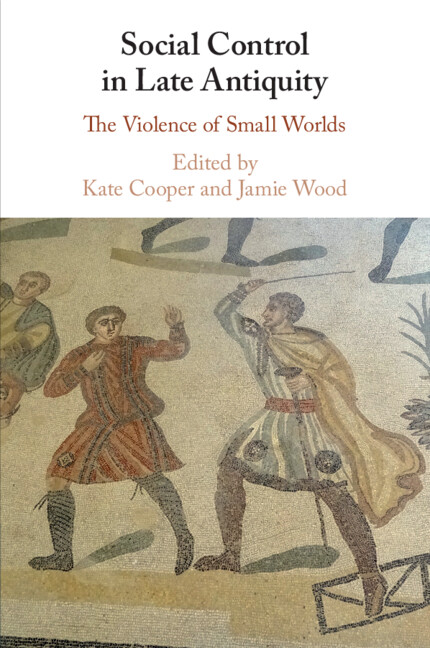
    Social Control in Late Antiquity: The Violence of Small Worlds explores the small-scale communities of late antiquity – households, monasteries, and schools – where power was a question of personal relationships. When fathers, husbands, teachers, abbots, and slave-owners asserted their own will, they saw themselves as maintaining the social order, and expected law and government to reinforce their rule. Naturally, the members of these communities had their own ideas, and teaching them to 'obey their betters' was not always a straightforward business. Drawing on a wide variety of sources from across the late Roman Mediterranean, from law codes and inscriptions to monastic rules and hagiography, the book considers the sometimes conflicting identities of women, slaves, and children, and documents how they found opportunities for agency and recognition within a system built on the unremitting assertion of the rights of the powerful.

    Reviews

    ‘… scholars with a robust background in late antiquity, early Christian monasticism, Church fathers, inter alia, will find much to appreciate in its pages.’

    Sarah Rollens Source: Bryn Mawr Classical Review

    ‘Social Control in Late Antiquity offers a number of truly excellent and thought-provoking contributions to the still highly relevant project of studying the role of power relations in the formation of early Christian identity and institutions.’

    Kristina Sessa Source: Journal of Early Christian Studies

    ‘[The book] is rich in content and covers an impressive variety of late antique authors and writings; the volume offers nuanced perspectives on violence and engages the modern sociological concepts of Pierre Bourdieu and Michel Foucault. Fascinating to read are not only the discussions of lesser-known late antique writings but also the alternative perspectives on well-known Christian authors and their texts. With its broad range of topics related to the 'violence of small worlds', this book is highly relevant and warmly recommended for anyone interested in historical, sociological, educational, Christian-theological, and literary studies of late antiquity.’

    Christina M. Kreinecke Source: Augustiniana

    Refine List

    Actions for selected content:

    Select all | Deselect all
    • View selected items
    • Export citations
    • Download PDF (zip)
    • Save to Kindle
    • Save to Dropbox
    • Save to Google Drive

    Save Search

    You can save your searches here and later view and run them again in "My saved searches".

    Please provide a title, maximum of 40 characters.
    ×

    Contents

    Metrics

    Altmetric attention score

    Full text views

    Total number of HTML views: 0
    Total number of PDF views: 0 *
    Loading metrics...

    Book summary page views

    Total views: 0 *
    Loading metrics...

    * Views captured on Cambridge Core between #date#. This data will be updated every 24 hours.

    Usage data cannot currently be displayed.

    Accessibility standard: Unknown

    Why this information is here

    This section outlines the accessibility features of this content - including support for screen readers, full keyboard navigation and high-contrast display options. This may not be relevant for you.

    Accessibility Information

    Accessibility compliance for the PDF of this book is currently unknown and may be updated in the future.
