




Introduction
Government institutions promoted a new conception of landscapes through exhibitions and publications throughout the 1930s in Turkey.Footnote 1 This was strongly influenced by the reform in agricultural policies that changed the meaning of land in the aftermath of the Great Depression of 1929 under an economic program entitled statism. Official organizations such as the National Economy and Savings Association (Milli İktisat ve Tasarruf Cemiyeti) (NESA) and the Public Press Directorate (Matbuat Umum Müdürlüğü) (PPD) utilized visual materials to become the first organizations that promoted a new conception of landscapes while publishing propaganda materials on the meaning and aims of agriculture in the 1930s.
The Homeland Tours (Yurt Gezileri), as experienced and documented by painters, is a subject that has been covered in the literature regarding this era, but there has been little discussion regarding their approach to landscape paintings. The tours were announced by the Republican People’s Party (Cumhuriyet Halk Partisi; CHP) General Secretariat as follows:
We decided to have our painters travel around the country and work there to enable them to see and get to know every corner of the country and to create their works, thus enabling the national artistic spirit within them to develop more realistically (Republican Archives [RA], 490-1-00/2013-8-1 [April 29, 1938–March 6, 1940]).
Painters were selected to travel to a province for at least a month and paint there. The tours took place between 1938 and 1943. Various authors have written on artists after the Great Depression (Yasa Yaman Reference Yasa Yaman1996), the paintings made during the program (Ural Reference Ural and Edgü1998a, b), government patronage, and the influential principle of populism (Öndin Reference Öndin2003). Aydın Dikmen also explains how propaganda and patronage were settled during the Republican era and how this affected the tours. None explains how the program emerged and its impact on landscape painting.
This paper argues that between 1929 and 1950 a new way of conceiving landscapes was introduced in Turkey. Homelands Tours (1938–1943), the Turkey with Pictures (1937) album, and the “Türkiye, Tarih, Güzellik ve İş Memleketi” (“Turkey, Land of History, Beauty and Work”; TLHBW) exhibition of 1936 all played a role in articulating this new conception. They were also rooted in the economic policies of the period.
The analysis in this article mainly relies on an undated file titled “Photographs of Various Paintings” (RA, 490-1-00/1088-1149-1 [undated]) in the Republic of Turkey State Archives, which comprises 379 photographs of paintings. It covers paintings that were executed between 1938 and 1941. Of the photographs, 287 were identified as Homeland Tours paintings and 155 are unpublished. Unfortunately, the paintings themselves are intact only up to 1940. The article discusses the ways in which they reflect a change in the conception of the landscape. Tours were aimed at enabling the painters to create their art as they bore witness to every corner of the country, got to know it, and hence developed the national artistic spirit within them realistically. Reality was not an indication of style but the proof of the condition of the homeland as universally valid and ethically true. One of many tools that the statist economic institutions devised was agricultural statistics. The comparison between the paintings from the tours of 1938, 1939, and 1940 and actual land-use statistics demonstrates that the artists collectively followed the statist economic agenda.
A new way of looking at landscape painting
Denis Cosgrove, who introduced the notion of productive landscapes, suggests that “Landscape is not merely the world we see, it is a construction, a composition of that world. Landscape is a way of seeing the world.” He states that “landscape denotes the external world mediated through subjective human experience in a way neither region nor area immediately suggest” (Cosgrove Reference Cosgrove1984, 13–14). As a result, the constructed way of seeing the actual landscape is an idea. Cosgrove argues that the actual landscape is already involved with social relations and politics but a representation of it through any medium should be considered on its own, too. For painting, the determinant characteristic is perspective, which rationalizes the space, enabling a domination over the land visually and intellectually (Cosgrove Reference Cosgrove1985, 46–49). Hence, there is a synchronicity between economic and political choices regarding land, production, and cultural productions such as paintings. Industrialization during the nineteenth century altered landscape painting. This change occurred as the relationship between humans and nature changed, resulting in a massive change in the culture and morality of production (Cosgrove Reference Cosgrove1984, 270).
These changes took place through different processes in Europe, Britain, the United States (Cosgrove Reference Cosgrove1984, 262–263), and Turkey between 1929 and 1950. Turkey of the 1930s is an advantageous case to analyze using Cosgrove’s ideas because local industrialism was only beginning to emerge. Additionally, the first Geography Congress was held in 1941, and it was at this gathering that much of the geographical terminology was decided upon. There, it was proposed to divide the country into seven geographical regions.
Following Cosgrove, historians have also conceptualized space as historiographical discourse. For example, Angelo Torre claimed that flora, culture, society, and law should be considered together to understand the formation of localities (Torre Reference Torre2008). Torre was influenced by Cosgrove but also criticized his approach (Torre Reference Torre2019, 5). According to him, Cosgrove suggested what locality was, but he did not develop it; on the contrary he stuck with the reductive symbolic reading. Torre objects to the visual definitions given to landscape, such as a way of seeing. He examined practices of law, commerce, and religion as means of offering insights into the formation of territory (Rau Reference Rau2019, 74). However, Cosgrove is singular for describing landscapes as a social production and relating that notion with painting.
Ottoman painting, so-called miniatures, had different roots compared to European painting, but from the beginning of the eighteenth century landscape painting in the Ottoman Empire started to mimic European traditions. During the nineteenth century, İstanbul was the sole artistic center of the Empire. Landscape painting on canvas was the most productive painting genre; to be more precise, the İstanbul landscape was the most produced subject in painting as well as in literature (Öndin Reference Öndin2011). First in miniatures and frescoes and then on canvas, the landscape and the beauty of İstanbul were repeatedly reconstructed (Yasa Yaman Reference Yasa Yaman2003, 218, 223). The beauty consisted of the ecosystem of the sea, architecture, and the sovereignty of the Empire. According to the art historian Semra Germaner, “Turkish painting since the Abdülmecid era until the proclamation of the Republic had been related to İstanbul society’s taste and choices” (Germaner Reference Germaner and Rona1993, 69–70, 72–73).
Turkish art terminology and education were also evolving accordingly in this era. In the first compilation of plastic art terms, just before World War I, Celal Esad Arseven chose the word manzara for landscape, a word which derives from the Arabic root menazır, meaning perspective. Esad defined this as, “Village, forest, rural and wilderness so that in the paintings people and animal forms are secondary” (Yazıcı Reference Yazıcı2012, 203). This definition, which excluded any social relations or political implications, prevailed in Turkish art until the 1960s. As mentioned before, Ottoman painting concentrated on the urban landscape, a mode that was more frequently used after the Tanzimat Fermanı (The Imperial Edict of Gülhane) in 1839 during the era of Abdülmecid I. Until 1883 and the establishment of the Sanayi-i Nefise Mektebi (Fine Arts Academy), the most widespread art education was held in military schools whose curriculum had an emphasis on perspective, mainly to produce technical drawings relevant for military use. Although the Empire largely had a rural economy during the Tanzimat era and the following decades (Toprak Reference Toprak2023, 242, 245), agriculture or rural themes did not emerge as a widespread subject in painting during this period.
Even with the emphasis on perspective, Cosgrove’s theory does not fit this period of Turkish art history. An explanation lies in the organization of production during this era. Between the second half of the fifteenth and the nineteenth centuries, Ottoman economic policies were not about land-based aristocracy but rather the state that was based on the private ownership of the land and the bureaucracy that concentrated on urban subsistence (Hamadeh Reference Hamadeh2002, 124–126, 135, 141, 143; Pamuk Reference Pamuk2007, 20–22). In this sense, economics and art history are aligned with Cosgrove’s theory.
Official comprehension of the new landscape conception and Vedat Nedim Tör
The Empire gradually changed its economic policies in the nineteenth century, emphasizing free trade and, later, in the first decade of the twentieth century, proposing a form of national economics (milli iktisat) that would later be used during the early Republican era. After the Balkan Wars (1912–1913), the Union and Progress (İttihad ve Terakki) government sought to mobilize trade through merchants in Anatolia (Toprak Reference Toprak2023, XVII, 11–13). Thus, agricultural production gradually came to be an asset for the rulers.
During World War I and the Independence War, photogravures involving agriculture and production appeared. One of the most striking examples was published in the newspaper Dersaadet on August 12, 1920 which was used as a letterhead logo for the İzmir Congress of Economics in 1923 and later was printed on 1 TL banknotes in 1927 (Hafızoğulları Reference Hafızoğulları1999, 289–311). The image in Dersaadet depicts a young boy and an elderly man plowing a field; the elderly man, with the young boy at his side, points towards the sun. The details of the composition changed from 1920 to 1927. The 1927 banknote depicts a teenage farmer working in the field alone (Akder Reference Akder, Yenişehirlioğlu and Çerçioğlu Yücel2018, 152).
A key element of statism was self-sufficiency. The Great Depression had a larger impact on rural production than on urban agricultural production (Tekeli and İlkin Reference Tekeli and İlkin2009, 186). To ease the impact of the crisis, new institutions were established such as the NESA, and the first Agricultural and Industrial Congresses took place in 1930 and 1931. CHP regulations conceptualized statism with direct attributions within the economic field (Koçak Reference Koçak2015, 30–34). The CHP Directory of 1931 stated:
While regarding the effort and the activities of individuals as the main component, in order to ensure the people’s welfare and make the country prosperous as soon as possible, in the works required by the public’s general and great interests – especially in the field of economy – obtaining the state’s active engagement is one of our critical principles (RA, 490-1-00/212-840-2 [December 26, 1938], document 222).
One of the driving forces behind these booklets, catalogs, and exhibitions was Vedat Nedim Tör, with a PhD in economics, who took his first official post at the NESA as general director (Tör Reference Tör2010, 22). Throughout the 1930s he took part in exhibitions such as the TLHBW exhibition and Homeland Tours (1938–1943), which were a source for the propagation of the new conception of landscapes while he was the director of the PPD (Tör Reference Tör2010, 40).
The main purpose of NESA propaganda was to encourage the population to save and use local products. The Association published a journal titled İktisat ve Tasarruf (Economy and Savings), which in its first issue set the motto: “The first target was the Mediterranean … The second target is the economy.”Footnote 2 This motto positions the economy as another sphere in Turkey’s war for national liberation (Tekeli and İlkin Reference Tekeli and İlkin2009, 94). Hence, the self-sufficient economy was related to a sense of security.
The Association also published booklets in 1934 introducing the seven regions of production within the country. The booklets were to be published as part of the Week of Local Products, each introducing a distinct region.Footnote 3 The introduction of the booklets intended to explain the region’s history and sociocultural structure.Footnote 4
Interior Minister Şükrü Kaya and Tör worked closely between 1933 and 1937 during Tör’s directorship of the PPD (Tör Reference Tör2010, 40). In 1934, propaganda became a task of the PPD, established through a law imposed on the press (Matbuat umum müdürlüğü teşkilatına ve vazifelerine dair kanun 1934, article 2). Along with his engagement in bureaucracy, he was a founder and writer of Kadro, a journal that sought to promote ideas such as Kemalism and statism in the economy. By 1934, Tör already believed that propaganda was an important tool for the economy, which should be run on statist lines (Tör Reference Tör1932a, 7; Tör Reference Tör1932b, 9; Tör Reference Tör1932c, 17). Tör commented in his memoir that “Photographs, paintings, graphics, and booklets became handy in introducing Atatürk’s Turkey, they had a broad impact” (Tör Reference Tör2010, 18).
Art was taken as a subject by Yakup Kadri Karaosmanoğlu and Burhan Asaf Belge. They were also working in the PPD. Both declared that the arts should concentrate on social reality. According to Belge, “Arts should resonate with the new ideology and communicate the social reality.” This does not mean that Belge sought realistic paintings for their style. According to his descriptions, art should renew itself using form, medium, and subject according to the changing social reality. Hence the arts are one of the most influential tools to realize changes in a post-revolutionary environment (Belge Reference Belge1934, 24, 30). The PPD utilized visual materials including artistic objects. They were supposed to deliver an ideology of freedom via a self-sufficient economy. Statism grew stronger during World War II (Pamuk Reference Pamuk, Pamuk and Toprak1998, 91).
Ambivalent moralities and conceptions of landscape
The second type of landscape painting, following İstanbul landscapes, that began to emerge during the Republican era was agricultural scenography. This would lead to a moralistic construction of the landscape and deeper engagement with statist politics. This type of construction of the landscape became evident in landscape paintings and photographs.
Along with exhibitions, the NESA also published a booklet titled, “Get to Know Your Homeland, Love Your Homeland, To Love It You Should Know It” (Tör Reference Tör2010, 20). Booklets and exhibitions of this period presented a method for engaging with land to citizens that had already been used by politicians, namely travel. Yaşar Nabi Nayır advised artists to travel:
I could provide many examples where travel can create tremendous change in an artist whether a painter, author or a composer when they get to know their country; their ways of conceiving and sensing life of the homeland is profoundly reformed (Nayır Reference Nayır1938, 7).
The institutionalization of this method was carried out as an act of propaganda. On May 5, 1938, as the CHP was on the verge of organizational changes, a new set of directions was agreed upon that had the same wording as Nayır’s article. According to this document, one of the responsibilities of the Propaganda and Publishing branch was to organize tours for artists to get to know the country, so they would love it. In the CHP general executive board division of labor, the virtues of traveling were described:
… Since traveling has become easier today, organized tours from the center to the periphery and from the periphery to the center would be beneficial. For example, painters, musicians, authors, and poets are accused of being artless, whereas these artists’ source of inspiration is the country and the nation. Most of them are not able to realize this financially. These tours could be organized (RA, 490-1-00/229-904-3 [May 31, 1938]).
Traveling in the country was seen as an intellectual resource and an inspiration for nationalism. The press encouraged citizens to travel. In 1938, traveling was also promoted in art programs. Nayır announced the Homeland Tours in July 1938. The news bulletin commented that painters would create beautiful pieces of art as they traveled in the country. On July 27, 1938, the general board of the CHP decided to organize an artistic tour all around the country to document its many beauties. The painters chosen by the Academy would travel to their appointed town (Sanat hayatımız için müsbet kararlar alındı 1938, 1). For the painters and the cities where they traveled, see Tables 1, 2, and 3. This event was commented on twice in the Ulus newspaper in the following weeks by Ferit Celal Güven and Nasuhi Baydar, in favorable terms, and the details of the tour was provided (Baydar Reference Baydar1938, 1; Güven Reference Güven1938, 6).
Landscapes of Homeland Tours and the actual land division in 1938

Table 1 Long description
The table presents data on land use and painting locations across various provinces in Turkey in 1938. It includes columns for industry, agriculture, meadows, orchards and gardens, forests, non-productive land, and the total surface area of each province. The table also lists the file numbers of paintings according to landscape symbols. The provinces included are Malatya, Edirne, Antalya, Gaziantep, Erzurum, Bursa, Trabzon, Konya, Izmir, and Rize. Each province's land use is broken down into hectares and percentages. The painters associated with each province are also listed, along with the file numbers of their paintings. Notable trends include the varying distribution of land use across provinces, with some provinces having larger areas of non-productive land or forests. The table provides a comprehensive overview of the relationship between land use and artistic representation in 1938.
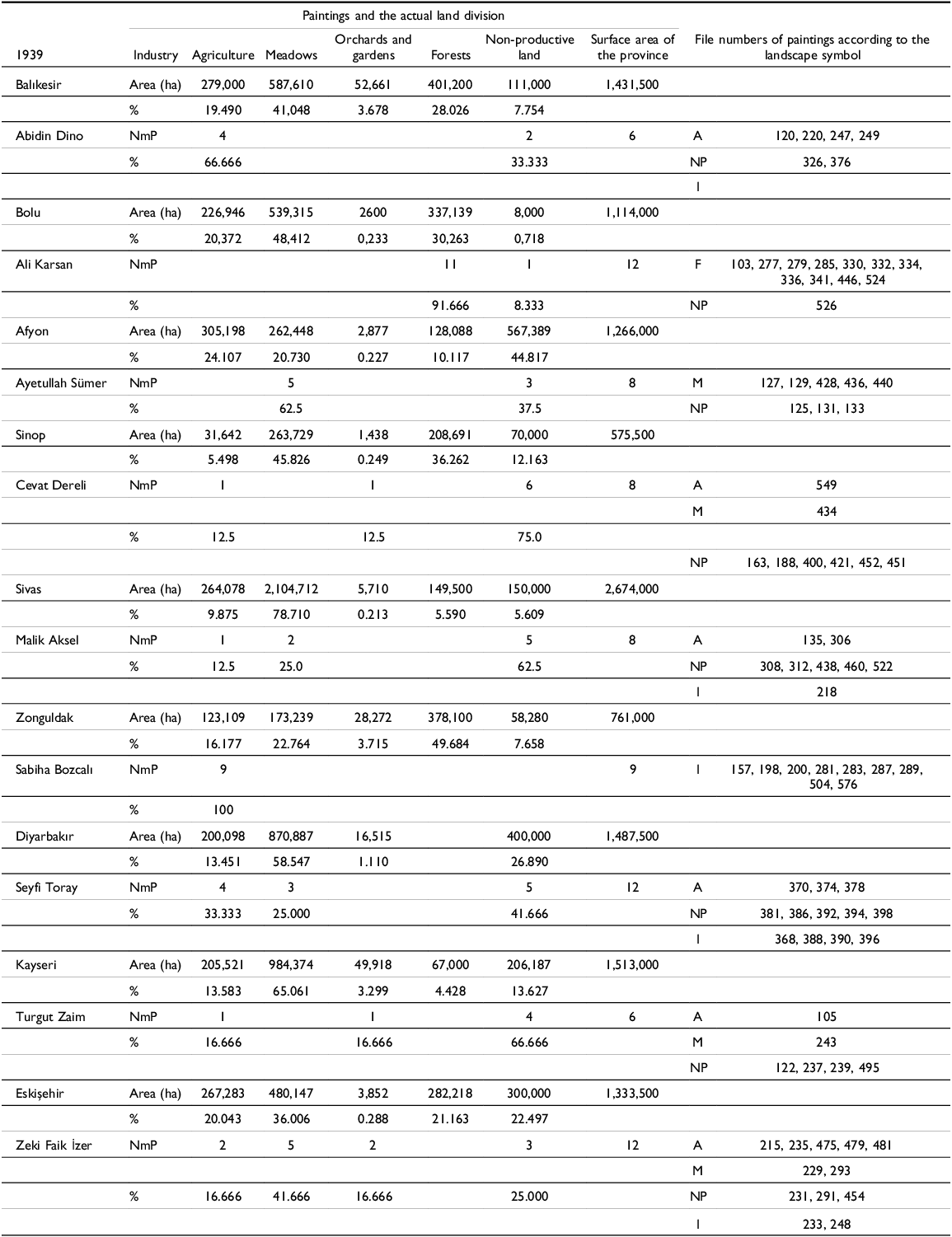
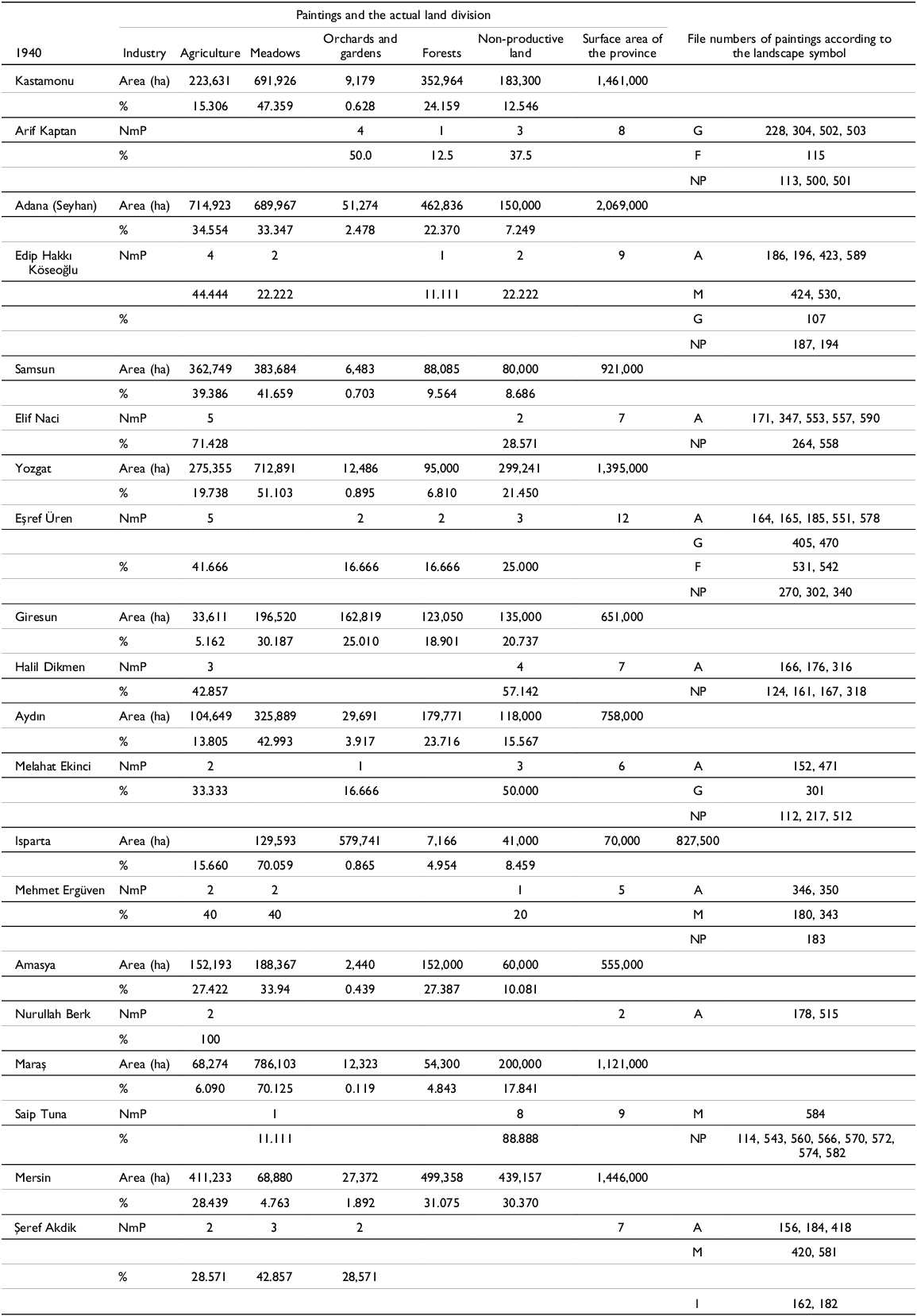
Source: The agriculture, meadows, orchards, and gardens columns are aggregated data from national Agricultural Statistics (Başbakanlık İstatistik Genel Direktörlüğü 1937). Percentages in the tables are my own calculations. The last column presents the image numbers from the album (RA, 490/1-00/1088-1149-1 [undated]) according to their landscape category: agriculture (A); meadows (M); orchards (O); gardens (G); non-productive (NP); industrial (I). NmP represents the number of paintings.
Landscapes of Homeland Tours and the actual land division in 1939

Table 2 Long description
The table presents data on land division and paintings in 1939 across various regions in Turkey. It includes columns for industry, agriculture, meadows, orchards and gardens, forests, non-productive land, and surface area of the province. Each region is listed with specific areas in hectares and percentages for each category. The table also includes file numbers of paintings according to the landscape symbol. Notable regions include Balikesir, Abidin Dino, Bolu, Ali Karsan, Afyon, Ayetullah Sümer, Sinop, Cevat Dereli, Sivas, Malik Aksel, Zonguldak, Sabiha Bozcali, Diyarbakir, Seyfi Toray, Kayseri, Turgut Zaim, Eskisehir, and Zelk Failk Izer. The data highlights the distribution of land use and the corresponding artistic documentation through paintings.
Source: The agriculture, meadows, orchards, and gardens columns are aggregated data from national Agricultural Statistics (Başbakanlık İstatistik Genel Direktörlüğü 1937). Percentages in the tables are my own calculations. The last column presents the image numbers from the album (RA, 490/1-00/1088-1149-1 [undated]) according to their landscape category: agriculture (A); meadows (M); orchards (O); gardens (G); non-productive (NP); industrial (I). NmP represents the number of paintings.
Landscapes of Homeland Tours and the actual land division in 1940

Table 3 Long description
The table presents data on land division and paintings in 1940 across various provinces in Turkey. It includes columns for industry, agriculture, meadows, orchards and gardens, forests, non-productive land, surface area of the province, and file numbers of paintings according to the landscape symbol. The table has 14 rows, each representing a different province, and 9 columns detailing various land use categories and their respective areas in hectares. Notable provinces include Kastamonu, Adana, Samsun, Yozgat, Giresun, Aydin, Isparta, Amasya, Maras, Mersin, and others. Each row provides the area in hectares for different land uses and the corresponding percentage of the total surface area. Additionally, the table lists the file numbers of paintings associated with each province, categorized by landscape symbols such as A, F, G, M, and NP.
Source: The agriculture, meadows, orchards, and gardens columns are aggregated data from national Agricultural Statistics (Başbakanlık İstatistik Genel Direktörlüğü 1937). Percentages in the tables are my own calculations. The last column presents the image numbers from the album (RA, 490/1-00/1088-1149-1 [undated]) according to their landscape category: agriculture (A); meadows (M); orchards (O); gardens (G); non-productive (NP); industrial (I). NmP represents the number of paintings.
This was a serious commitment as it is repeated in the official documents drafted by the general secretariat of the CHP, that the consecutive tours were founded on this decision (RA, 490-1-00/2015-17-2 [August 4, 1942]). Journals, newspapers, and official documents repeatedly pointed out that the tour aims to “enable the painters to create as they see every corner of the country, get to know it, hence evolve the national artistic spirit within them more realistically” (Sanat hayatımız için müsbet kararlar alındı 1938, 1). Consequently, tours were organized until 1943.
Cosgrove states that experiencing the land by traveling or painting creates a different moral agenda compared to cultivating it (Cosgrove Reference Cosgrove1984, 231–232). The traveler would be an observer, a kind of outsider. The Homeland Tours were the most ambitious implementation of this in the Turkish context. The moral objective of the tours was initially to foster good citizenship, as the painter traveled and learned about his or her country. This was a responsibility emphasizing the discovery of different characteristics of the regions and towns but not nature itself. As a result, as in the case of other tours for authors, composers, and scientists, the painters would discover and observe the landscape so that it would serve the country. The institutions organizing the Homeland Tours also provided content for it, emphasizing self-sufficiency in the economy.
Historical, beautiful, and productive landscapes
The TLHBW exhibition in 1936, organized by the PPD, presented the first official categorization of productive landscapes. Its aim was to introduce the history and beauty of production in the homeland. A cultural–geographic landscape photography exhibition opened in Ankara Sergievi (Ankara Exhibition House) on February 29, 1936 (Fotoğraf sergisi: bugün sergievinde Celal Bayar tarafından açılıyor 1936, 2). Belge’s article in Ulus emphasized that these photographs documented the changes of the Republican era, as compared with other photographs of the country from an earlier era (Belge Reference Belge1936, 2).
The sections of the exhibition articulate the categories of the new concept of landscapes. The first theme, history, depicted Turkey as the heir of unique artifacts of various mighty civilizations. History was a determining element in the 1931 CHP Directory within the definition of the homeland. Homeland was defined as “the country within our current political borders where the Turkish nation lives with its ancient and glorious history and works of art that have preserved their existence in the depths of their lands” (RA, 490-1-00/212-840-2 [December 26, 1938], document 223). This would be an idea set forward by the Turkish History Congress and would be exhibited on its own in the Second Turkish History Congress Exhibition in 1937 (Özkılıç Reference Özkılıç2016, 117).
The second theme, beauty, which was not defined clearly, included several aspects. The photographs of picturesque village houses and villagers were presented under this category. The third theme, İstanbul landscapes, was compiled as a single unit before the fourth theme, “Waters in Turkey,” including rivers, waterfalls, lakes, sea, and people making their livelihood from them. The fifth theme was the “Forests of Turkey.” Forests and waters of Turkey were also mentioned as separate articles in the CHP Directory in 1931 (RA, 490-1-00/212-840-2 [December 26, 1938], documents 224, 225).
Then, a viewer would see the cityscapes as the sixth theme. In the middle of the gallery, the photographs of Ankara, the new capital, appear as the seventh theme. The eighth theme, work, was a composition of agricultural and industrial production of cities all over the country (Fotoğraf Sergisi: Bugün Sergievinde Celal Bayar tarafından açılıyor 1936, 6).
One of the outcomes of the exhibition was the photograph album printed in 1937, Turkey with Pictures (RA, 30-18-1-2/79-81-9 [September 20, 1937]). The album includes six sections titled Ankara, Towns and Landscapes, Archeology and Art, Economy and Constructive Work, and Man and Civilization (Matbuat Umum Müdürlüğü 1937). Most of the photographs belonged to the landscape genre. But what is definitive in the edition is the economic emphasis on industry and agricultural production.
In the E Section, Economy and Constructive Work, following the photographs of the Zonguldak-Bartın Road and railroads over bridges, the first agricultural product is tobacco. The choice of cities and products is not random at all. The selection of the images reflects the economic data of industry and agricultural production of the era (Matbuat Umum Müdürlüğü 1937). Olives, sugar, rice, pistachios, grapes (sultanas), oranges, hazelnuts, figs, peaches, bananas, and melons are photographed. These products were favored as they were common in Anatolia (Tekeli and İlkin Reference Tekeli, İlkin, Pamuk and Toprak1998, 40). Of the cultivated areas, 86 percent was reserved for wheat production (Tekeli and İlkin Reference Tekeli and İlkin2009, 38). However, this crop does not appear in the E Section. There are only two photographs related to it. The first one is in the A Section, Ankara, titled The Corn Silo (Figure 1).Footnote 5
Othmar Pherchy (1937) The Corn Silo. Black and white photography.
Source: Turkey with Pictures, E Section

Figure 1 Long description
The black and white photograph captures a large industrial building with a prominent clock tower, identified as The Corn Silo in Ankara, Turkey. The building has a rectangular shape with multiple windows and a flat roof. In the foreground, there is a railway track with gravel and wooden sleepers. To the right of the image, part of a large truck or trailer is visible, suggesting industrial activity. The sky above is partly cloudy, and the overall scene conveys a sense of historical industrial architecture.
However, most of the products had a location as their focus. The photographs of cotton workshops in Kayseri and Adana, silk mills in Bursa, the sugar refinery in Eskişehir, and rose oil in Isparta allude to the promoted agricultural products listed at the first Agricultural Congress so that the Turkish economy would become self-sufficient. The cultivation of these products would provide the industries that the country needs with raw materials (Tekeli and İlkin Reference Tekeli and İlkin2009, 194–195). Semi-coke works in Zonguldak, Engine Repair Shops in Eskişehir, and Glass Works (Paşabahçe, İstanbul) were the industrial structures themselves.
The crucial thing about these photographs is that they reflect the production and offer a new way of looking at the land, not merely documenting it, and therefore they realized a new conception for the representation of landscapes. These photographs were used in other publications such as the Ulus newspaper. Ulus published at least 251 photographs between November 3, 1937 and August 28, 1939 entitled homeland photographs.
What does the collection of Homeland Tour landscapes present?
The most comprehensive program after the 1936 exhibition was the Homeland Tours on landscapes. The outcome of the tours, although the exact number is debated, was the creation of over 700 paintings, comprised mostly of landscapes. After the opening of the first Homeland Tour exhibition, Ulus published an essay comparing the 1936 photography exhibition with the tours. The anonymous author of the essay emphasized the words of a teacher who visited the exhibition:
I grieve for my days that came to pass without traveling after I saw some areas of the homeland over photograph paper. A machine and a chemical paper took these … What couldn’t the brush of a national artist create on these sites? (Yurt Köşesi sanatkar fırçasında nasıl canlanır? 1939, 2).
Unfortunately, 675 paintings were missing by 1998 (Ural Reference Ural and Edgü1998b, 64). This has been a major problem for academic studies on Homeland Tours. Ural (Reference Ural and Edgü1998a, Reference Ural and Edgü1998b) mainly deals with the relationship between the tours and the government. Researchers overlooked what the paintings from the tours collectively presented. The RA, 490-1-00/1088-1149-1 album provides photographs of the paintings produced between 1938 and 1940.
The assembly of the album was simultaneous with the tours. The earliest records regarding the “Photographs of various paintings” album date to March 23, 1940. The CHP General Secretariat (CHPGS) asked painters who joined the tours in 1938 and 1939 to send a biography and photographs of their paintings that would be printed in an album (RA, 490-1-00/2014-11-2 [March 23, 1941]). The album commission of the CHPGS gave directions on how the 204 paintings, twenty drawings, short explanations about the paintings, and biographies of the artists would be printed (RA, 490-1-00/2014-11-1 [April 25, 1940]). The paintings from tours were kept in the Ankara People’s House building (RA, 490-1-00/2014-11-2 [September 3, 1941]). Arkitekt journal requested that the photographs of the paintings from the tour be preserved in 1940 (RA, 490-1-00/2014-13-1 [January 5, 1941]). The CHPGS said that eighty-seven paintings were photographed; however, they were the only copies. And it added that they must preserve these copies for the album they wanted to print (RA, 490-1-00/2014-13-1 [November 18, 1941]). In 1942, the CHPGS issued a request to the Ministry of Education asking to use their printing house for the album. This letter reports 450 images, of which 393 are paintings (RA, 490-1-00/2015-15-1 [June 22, 1942]). Minister of Education Hasan Ali Yücel informed the CHPGS that the permission to utilize the printing house for “various artists’ paintings album” would be a pleasure. But the printing house needed zinc, and if procured, the album would be printed (RA, 490-1-00/2015-15-1 [July 10, 1942]). This is the first incident where the “Photographs of various paintings” (RA, 490-1-00/1088-1149-1 [undated]), i.e. the photographic album’s name, appears in the official documents. The album was printed in 1944 (Ural 1998, 49).
Efforts to print the album expanded over the years. The effects of World War II including the lack of zinc proved an obstacle. However, the CHPGS did not give up easily on this album project. The paintings were kept in the Ankara People’s House building; they were photographed, and a few missing paintings were discovered and investigated (RA, 490-1-00/2014-11-2 [August 1, 1940–September 3, 1942]).
These efforts could reflect the intention of building a collection and executing “a way for the mature and lively society’s codification of the new esthetics, and principles of reality” (Belge Reference Belge1934, 28). The reality of the land, as the subject of this collection, according to the program, was to be viewed and recorded by the artists. The role of the artists as individuals in the program had always been passive (see Aydın Dikmen Reference Aydın Dikmen2023). They were introduced as a community with extraordinary capabilities, specifically those that could be beneficial for the homeland. According to Yakup Kadri, “Works of the higher arts formulate and bring consciousness into society’s scattered yet quiet emotions, ambitions, and ideals. In this way, the artist communicates with society in a passive manner” (Karaosmanoğlu Reference Karaosmanoğlu1934, 25–27).
Cosgrove also argues in a similar fashion to Karaosmanoğlu, claiming that the reality of the landscape is ideological. According to Cosgrove, a claim towards reality in the scope of a landscape offers a view of the world directed at the experience of one individual at a given moment in time in which the arrangement of the constituent forms is pleasing, uplifting, or in some other way linked to the observer’s psychological state. It then represents this view as universally valid by claiming for it the status of reality (Cosgrove Reference Cosgrove1984, 26). The quest for “enabling the national artistic spirit within the artists to develop more realistically” (RA, 490-1-00/2013-8-1 [April 29, 1938–March 6, 1940]) is the ideological component of the album and the tours. The paintings’ claim to reality through the method of traveling would be to visualize the new Turkish Republic and its economic and cultural endeavors as universally and ethically true.
The paintings from the tours, as well as the photographs from the 1936 exhibition focused on images of the early years of the Republic between 1931 when the CHP Directory defined the homeland and 1941 when the homeland was defined in scientific terms by the First Geography Congress. Therefore, the album and the collection itself were products of a politically revolutionist and culturally conservative reflex which is similar to Belge’s opinions on the arts (Belge Reference Belge1934, 28). Moreover, socially, the album signifies the introduction of the overlooked rural landscape into the “high” arts.
This album is a set of documents that is the next best thing to the original paintings. We should also have a look at agricultural statistics to make more sense of the productive character of the landscape paintings. The Prime Ministerial Statistics General Directory published Agricultural Statistics (AS) in 1937 for the first time, as a compilation of data for the period between 1928 and 1936. This work showed Turkey’s landscape as divided into categories according to their function. In 1934, meadows constituted 58 percent, unproductive lands 15 percent, cultivated lands 14 percent, forests 12 percent, and gardens, olive orchards, vegetable gardens, and orchards constituted 1 percent of the total land use (Başbakanlık İstatistik Genel Direktörlüğü 1937). AS also provides the land-use categories according to province. This is a numerical landscape.
By comparing these data sets, it is possible to understand how the artists perceived “reality.” Tables 1, 2, and 3 present the data comparison between the AS and the tours. In the tables, the actual landscapes (meadows, cultivated land, etc.) and landscape paintings are paired.Footnote 6 The shares of land-use categories are listed in the tables. What we are looking for is the frequency of the painter’s choice concerning each category as a subject for his or her work. If its distribution is different from the actual distribution of land-use categories this difference requires an explanation as it indicates the preference of the painter. Column headings of the tables are the categories within AS, except for industry. Industry is not measured by surface area but by production. The columns headed “Paintings and the actual land division” presents which land-use category defined in the AS is in the composition of the painting. The last column presents the image number from the album (RA, 490-1-00/1088-1149-1 [undated]).
The tables show that the artists did not document the actual distribution of the landscapes but merely emphasized some of them. The tables could be used to evaluate whether painters had a collective preference towards some features in the landscape and, if so, what were the characteristics of their choice. This preference was interpreted by Belge as the ideology of the arts, as he argues that the arts exemplify a conviction (akiyde). Belge emphasizes that “the conviction in the arts is the political agenda of societies through a certain period” and that “an artist is able to construct himself or herself with an ideology” (Belge Reference Belge1934, 30). Karaosmanoğlu states that a “true” artist is able to reveal the dynamics of the period (Karaosmanoğlu Reference Karaosmanoğlu1934, 27).
The comparison between the frequency of the land-use categories in the paintings and the AS shows what was statistically documented and the preferences of the artists during the tours.
The percentage of agricultural and non-productive land was almost equal, as the agricultural land took up 13 percent and the latter was 15 percent in 1934 (Başbakanlık İstatistik Genel Direktörlüğü 1937, graphic titled Türkiye topraklarının sureti inkisamı). In 1938 compositions of non-productive landscapes, such as urban landscapes consisting of religious architecture or modern parks, were more representative, but in 1939 and 1940 elements of the productive landscape increased.
The percentage of forested area in Turkey was estimated as 12 percent, which is more than the total of agriculture, orchards, and gardens. Only Ali Karsan (Figure 2), Şeref Akdik, and Cevat Dereli depicted forests.Footnote 7 Consequently, we may say that most of the artists preferred not to picture or ignored forests, whereas depictions of agricultural land and orchards increased in the paintings. The productive lands were the areas where intensive labor took place. Cemal Tollu’s A Road with Young Trees from Akköprü Agriculture Station (Akköprü Ziraat İstasyonu’na Giden Fidanlı Yol) from 1938 is an example of modern agricultural areas (Figure 3). Between 1923 and 1938 eight seed breeding and experiment stations were established in Turkey. One of them was the Antalya Warm-Climate Plants Station (Antalya Sıcak İklim Bitkileri İstasyonu) (Çetin Reference Çetin2012, 61–62).Footnote 8 Though depicted rarely during the tours, waterfalls and forests signified a value that exists outside of production. Considering the influences of the statist economic program, the data also shows that the artists preferred to paint in a way that constructed the landscape over purely documenting territory.
Ali Karsan (1939) Forest.
Source: RA, 490-1-00/1088-1149-1 (undated) document 330

Figure 2 Long description
The painting features a dark, shadowy interior with two figures partially visible. One figure is on the left side, partially obscured by a tall column, while the other figure is on the right side, also near a column. The background includes more columns and a sense of depth, with light and dark contrasts creating a dramatic atmosphere. The painting is executed in a loose, expressive style, emphasizing the interplay of light and shadow.
Cemal Tollu (1938) A Road with Young Trees from Akköprü Agriculture Station.
Source: RA, 490-1-00/1088-1149-1 (undated) document 251

Figure 3 Long description
The painting depicts a road flanked by young trees, leading towards a distant landscape with mountains. The sky above is filled with dynamic, cloud formations, creating a sense of depth and atmosphere. The use of light and shadow emphasizes the natural elements and the path ahead.
Painters preferred to paint scenes that depicted labor-intensive industrialism. Although compositions of this kind were more frequent than actual landscapes, other features were also depicted, including architecture. The paintings regarding the urban often depict Islamic architectural history. In the paintings dated until 1943 there are forty-three mosques, the majority of which have structures originating in the nineteenth century. Eşref Üren and Bedri Rahmi Eyüboğlu also depicted clock towers, reminiscent of the Abdülhamid II era.
A limited number of these paintings focus on urban development. There are also paintings of Republican modernization in Anatolia, including city parks. Elif Naci’s Samsun from 1940 (Figure 4) and Mahmut Cuda’s Trabzon Park in 1938 (Figure 5) are the best examples.Footnote 9 The idea of planning the landscape was frequent in the West as in Turkey. Parks in city centers were a part of this planning, especially in Ankara, the new modern capital. In Turkey in Pictures, Ankara was represented by these parks, new boulevards, and modern buildings. Within the tours, urban examples from Anatolia were from Trabzon and Samsun.
Elif Naci (1940) Samsun.
Source: RA, 490-1-00/1088-1149-1 (undated) document 264

Figure 4 Long description
The painting depicts a street scene in Samsun, with a large, multi-story building prominently featured in the background. The building has arched windows and a flag flying on top. The street is lined with trees and people walking, and there are several other buildings visible in the distance. The sky is cloudy, adding a dramatic effect to the scene.
Mahmud Cuda (1938) Trabzon Park.
Source: RA, 490-1-00/1088-1149-1 (undated) document 491

Figure 5 Long description
The painting depicts a park scene with several people engaged in various activities. In the foreground, there is a circular fountain with a small plant in the center. To the left, a person sits on a chair, while another person stands nearby. In the middle ground, a group of people, including a child, are gathered near a tent. The background features more tents, trees, and a building with a white facade. The sky is partly cloudy, and the overall atmosphere is serene and peaceful.
İstanbul and Ankara, the former and new capitals, had a greater capacity both for industry and agriculture (Ardel Reference Ardel1943, 325, map VII). During the tours, İbrahim Çallı painted the Princes’ Islands in İstanbul, while Refik Epikman painted the Kızılcahamam district in Ankara. Unfortunately, these paintings are missing from the collections and the archive. These districts were neither industrial nor agricultural. It is interesting that both painters, who had close connections to politicians, chose not to depict the progress in agriculture or industry in either city. Although Turkey in Pictures consisted of some images of both cities and their factories, they were placed in the E Section. The Ankara sections involved photographs of the garden city ideal and new official buildings.Footnote 10 The İstanbul section was another appropriation of the old landscape conception of İstanbul in which the new Republic emphasized its perspective on the nation’s history. There is no evidence that the painters were given specific directions.Footnote 11 The industrial features of Ankara and İstanbul were excluded from the paintings. Painters preferred to depict the scenes revealing aspects of the Anatolian economy such as its industry.
Another characteristic of the “reality” depicted in the tours was the type of crops. The most cultivated crop was wheat between 1928 and 1936. However, paintings related to wheat only increased after 1942.Footnote 12 During World War II this was a sensitive subject, as bread was rationed. Paintings related to wheat production increased according to the rationing of the era. Special agricultural products mentioned before, such as figs, tobacco, pistachio trees, etc. were painted although their production was relatively low (Figure 6).Footnote 13
Feyhaman Duran (1938) Pistachio Trees on Nizip Road.
Source: RA, 490-1-00/1088-1149-1 (undated) document 364

Figure 6 Long description
The painting depicts a serene landscape featuring pistachio trees along a road. The trees are prominently positioned in the foreground, with their dense foliage and twisted trunks creating a sense of depth. The background reveals a vast, open landscape with rolling hills and a clear sky. The use of light and shadow adds dimension to the scene, highlighting the natural beauty of the environment. The painting captures the essence of rural life and the tranquility of the countryside.
The main economic aim of this era was to support industrial development. During the 1930s and 1940s Turkey was earning the largest share of her national income from agriculture (Tekeli and İlkin Reference Tekeli, İlkin, Pamuk and Toprak1998, 37). There have been some overlaps, such as the sugar industry, where governments decided to support agriculture in search of raw materials for the desired industry (Tekeli and İlkin Reference Tekeli, İlkin, Pamuk and Toprak1998, 127–129). The industrialization of Turkey had been in the economic program of Turkish governments shortly before the tours began. The consequences of this process were unlikely to be projected onto paintings. This does not mean industrial iconography was non-existent. On the contrary, one may observe the contradictions between the push for industrial progress and the Anatolian reality.
Sabiha Bozcalı and Zeki Faik İzer depicted what could be criticized later as the effects of industrial capitalism. Sabiha Bozcalı painted only the coal industry in Zonguldak. Coal made Zonguldak a significant area for the economy during the Republican era as it was during the Empire (Namal and Çağlar Reference Namal and Çağlar2022, 25).Footnote 14
İzer’s Sugar Factory Engine Room (Şeker fabrikası makine dairesi) (RA, 490-1-00/1088-1149-1 [undated]) (Figure 7) is a profound example of this choice and was similar to Bozcalı’s works (Figure 8). It is a painting of the interior of a factory. Although the emphasis on progress and industry is inarguable in the painting, sugar production was exceptionally symbolic for Turkey. The sugar factories were the pioneers of the total progression of the country, and beet farming was a part of it. The factory building’s position was also taken into consideration as it was close to the railroad and the sight of it was thought to be a provident source for raising morale (Önder and Oğur Reference Önder and Oğur2019, 25, 35).Footnote 15
Zeki Faik İzer (1939) Sugar Factory Engine Room.
Source: RA, 490-1-00/1088-1149-1 (undated) document 448

Figure 7 Long description
The painting depicts an industrial engine room filled with large cylindrical tanks and an intricate network of pipes. A worker is seen on a platform, and another is visible in the lower right corner. The room is dimly lit, with light sources highlighting the metallic surfaces of the machinery. The painting captures the industrial atmosphere with detailed shading and texture.
Sabiha Bozcalı (1939) Skip Installations İhsaniye.
Source: RA, 490-1-00/1088-1149-1 (undated) document 281

Figure 8 Long description
The illustration depicts a sugar factory engine room, featuring various industrial structures and machinery. The scene includes a large headframe, likely used for mining or processing, and several smaller buildings. The factory is situated in a mountainous area, with winding roads and a river in the foreground. The overall setting suggests an industrial environment integrated into a natural landscape.
İzer’s Brick Factories (Tuğla Fabrikaları) (RA, 490-1-00/1088-1149-1 [undated], document 233) (Figure 9) and Beet Field (Pancar Tarlası) (RA, 490-1-00/1088-1149-1 [undated], document 510), both in Eskişehir, are also reminiscent of the industry. The Beet Field is a composition depicting a harvest scene, calm and serene, realizing the harmonious unity of the land and farmers. However, the composition of Brick Factories made use of another landscape conception. The factory building depicted is most likely the Kurt (Başkurt) Tile and Brick Factory established in 1928 (Sadioğlu and Yürük Reference Sadioğlu and Yürük2020, 1056). In the case of Brick Factories, buildings with smoke coming from their chimneys signify work while farmers harvest wheat from the surrounding fields. The straw piled on the farm carriages suggests bread. The symbols of the statist economy, such as progress, labor, and self-sufficiency are depicted harmoniously. The painting conveys the symbols of the landscape not as directly as the engine room of the sugar factory but in a subtler sense. The factory belongs to the industrialist who resonates with the state and will bring peace and prosperity to the land. The industrial features in other paintings during the period were more traditional ways of production, which were depicted and glorified as such. On the other hand, the Industrial Congress described weaving, including carpet production, mills, and fishing, as industrial acts, however in a motorized fashion (Fazlı Reference Fazlı1930, 4–5; Vasıf 1930, 28–38).
Zeki Faik İzer (1939) Brick Factories.
Source: RA, 490-1-00/1088-1149-1 (undated) document 233

Figure 9 Long description
The painting showcases an industrial scene with brick factories in the background, each with tall chimneys releasing smoke into a cloudy sky. In the foreground, there are several mounds of bricks and two carts loaded with bricks, suggesting ongoing production and transportation activities. The overall atmosphere is somber, with a muted color palette dominated by shades of gray and black.
Meadows were the actual landscape’s most widespread feature, but they never became popular. The meadows are present but on the sidelines of the compositions. Rural and non-productive land were the least painted. Cevat Dereli’s Kumtepe of 1939 (Figure 10) is the only such example in the collection that we can observe today.Footnote 16 Belge’s discussion on reality presents itself once again.
Cevat Dereli (1939) Kumtepe.
Source: RA, 490-1-00/1088-1149-1 (undated) document 434

Figure 10 Long description
The painting depicts a serene landscape with rolling hills and a winding road that curves through the scene. The sky is filled with soft, wispy clouds, and the overall mood is calm and peaceful. The artist uses a muted color palette, predominantly in shades of gray, to create a sense of tranquility. The landscape is sparsely populated with a few trees and structures in the distance, emphasizing the natural beauty of the scene.
Figure 11 is the pie chart of the total percentages of each category per year. It depicts agriculture as a distinctive feature of the landscape, which became more popular than other characteristics. This chart excludes the specific choices of the artist; however, it projects the general tendency. According to this chart, the labor-intensive areas were the main objective of the discourse. Paintings such as Zeki Kocamemi’s Tea Agriculture (Çay Ziraatı) (Figure 12),Footnote 17 İzer’s Beet Field, and Cemal Tollu’s seed production plantations are good examples of this main category. Unlike the romantic, old industrial scenes, these were considered to be contemporary and effective production categories.
Total percentages of each land division category per year in paintings. NP, non-productive.
Source: The data was gathered from the images in RA, 490/100/108811491 (undated)

Figure 11 Long description
The image contains three pie charts representing the total percentages of each land division category per year in paintings. The categories include Agriculture, Meadows, Gardens, Forests, NP (non-productive), and Industry. The first pie chart is labeled 1938 and shows a large portion dedicated to Industry, with smaller sections for Agriculture, Meadows, Gardens, Forests, and NP. The second pie chart, labeled 1939, displays a more balanced distribution among the categories, with noticeable sections for Agriculture, Meadows, Gardens, Forests, NP, and Industry. The third pie chart, labeled 1940, shows a significant increase in the Agriculture category, with reduced sections for Meadows, Gardens, Forests, NP, and Industry. The data for these charts was gathered from images in RA, 490/100/108811491 (undated).
Zeki Kocamemi (1939) Tea Agriculture.
Source: RA, 490-1-00/1088-1149-1 (undated) document 593

Figure 12 Long description
The painting depicts a landscape dominated by tea agriculture, featuring rolling hills and scattered lights that suggest human habitation. The scene is rendered in a monochromatic palette, emphasizing the contours of the land and the pattern of cultivation. The artist's signature and the year 1939 are visible in the lower left corner.
The decline of productive landscapes
Literature on the tours describes them as unchanging and belonging to the İsmet İnönü period (1938–1950) and dismisses similar projects at the beginning of the 1930s, such as statism. Definitive moments during the tours came during the summer and autumn of 1938. The emphasis on traveling was present prior to 1938. The decision to hold the tours was not a radical, novel, or instantaneous thought, but a process that began in the early 1930s closely related to a self-sufficient economy, especially in terms of agriculture and industry. In other words, they were prompted by the devastating effects of the Great Depression in 1929.
Also, the bureaucrats who started the programs were frequently replaced. It is documented that “the tours started in 1938 when İncedayı was the publishing bureau chief” (RA, 490-1-00/2015-17-2 [February 14, 1943–June 28, 1944]). The crucial change is that tours started in the branch of propaganda and publishing. The CHP general management board labor division documents from 1938 show that the tours were under the authority of the publishing and propaganda branch in February 1938 before the announcement to the public.
The shift in the tour’s organization is probably related to the removal of Şükrü Kaya, the interior minister and the general secretary of the party and the chief of the People Houses for the better part of 1938. Kaya’s open opposition against İnönü led to his dismissal from his official duties after İnönü was elected president (Koçak Reference Koçak2015, 66, 147–152).
We could explain the survival of the tours with İnönü’s preference for statism. He was also attentive to creating projects for the provinces, the most famous example of which is the Village Institutes project. Second, the discourse of the program acknowledging the economy as the forefront of a war must have connected with the increasing need to feel secure and own the land without conflict. This also coincides with İnönü’s formulation of Turkey’s relation with World War II, which was “not neutral but noncombatant” (Koçak Reference Koçak2015, 312). Tours were focused on the microcosmos of the self-sufficient economy, which started in the aftermath of the Great Depression and prevailed during the war period.
Although there are several documents in the archive, artists applied on several occasions to attend the tours between 1938 and 1943. The only artists who continued to paint productive landscapes were Edip Hakkı Köseoğlu, Cemal Tollu, Cevat Dereli, and Şeref Akdik during the 1950s.
Conclusion
Landscape photographs and paintings gained new significance after the Great Depression, resulting in several artistic and cultural programs. The photographs of these paintings reflect a change in the conception of landscapes, a vision of territory prevalent in Turkey. During this period, governmental institutions such as the NESA and the PPD utilized booklets, images, and paintings to propagate the economic precautions taken in response to the Great Depression and to consolidate statism. These emphasized the ideology of a self-sufficient economy as warfare, and the bureaucrats who supported these ideas believed that conception of reality in the arts relies on the ability of the ideology’s effectiveness to communicate the social reality. These institutions also constructed a method for citizens and artists to realize how to concentrate on social issues. The chosen method was to travel. The travelers’ moral agenda was to become good citizens while determining the visible elements of the material culture and communicating this to the public within the context of economics.
The paintings of the Homelands Tours, along with the exhibition of 1936 and Turkey in Pictures (1937) reflected the new approach towards the land. They were not documentation endeavors. Comparison with the AS of the period demonstrates that, similar to the TLHBW exhibition and Turkey in Pictures, Homeland Tour paintings communicated the statist economy’s arguments that were framed in the aftermath of the Great Depression and World War II.
The collection of the paintings also showcases the government’s industrialization efforts, as well as old and glorified mills and carpet looms, as an early criticism of mechanization. Labor-intensive agricultural areas were almost equal to urban areas, mainly represented by Islamic architectural features. This was also similar to the percentages of annually planted areas and the non-productive areas of the country. In this way, the social reality was reflected in the programming. Most of the annually planted areas were composed of meadows. However, these were not painted by the artists. As a result, the productivity of the land was constructed in terms of agricultural scenes. Rural development was depicted, however in small numbers, and the biggest industrial towns of the period, İstanbul and Ankara, were not depicted with this characteristic. The least painted scenes were rural, non-productive lands.
The most complex and comprehensive artistic program active during World War II was the Homeland Tours. The productive landscapes crystallized within this program as many artists depicted them. The claim of reality of the landscape after the Great Depression was ideological. This claim offered painters a view of the homeland directed by the statist economic program through the experience of the tour. Paintings then represented these views as universally valid by asserting them as reality. Tör’s, Belge’s, and Karaosmanoğlu’s views on art, propaganda, and economics carried a similar perspective and merged with the government’s principles during this era. Thus, a new template for landscapes was created and the Homeland Tours were politically revolutionary as they created a new vision for the land. Socially, they introduced the rural sector into the high arts. However, outside the program, this concept of landscapes had an inferior standing. As the statist economic programs declined, the era’s conception landscape transformed into a preference for abstract landscapes.
The collection of landscape photographs and paintings between 1929 and 1950 demonstrates a change in the meaning of land and the way of looking at it during one of the most critical periods of the twentieth century. The collection shows that the artists became sensitive to the social reality of economics. These presented a new conception of landscape and thus this period belongs to the productive landscapes as they were a means of non-combatant warfare, owning the land, loving it, learning from it, and traveling through it.
Competing interests
There are no competing interests.



 Open access

