


Introduction
The Chinese giant salamander Andrias davidianus, the largest amphibian, is categorized as Critically Endangered on the IUCN Red List (IUCN, 2012) and has been listed in Appendix I of CITES since 1975 (CITES, 2014). In 1988 it was designated a State 2 protected species in China. The Chinese giant salamander is one of only three extant species of cryptobranchid salamanders (the others being the Japanese giant salamander Andrias japonicus and the hellbender Cryptobranchus alleganiensis), which have evolved as a distinct lineage over > 170 million years. For this reason and because of its Critically Endangered status and an apparent lack of recovery in the wild (Wang et al., Reference Wang, Zhang, Wang, Ding, Wu and Huang2004) the Chinese giant salamander has been identified by the EDGE of Existence programme of the Zoological Society of London (ZSL) as the amphibian species most in need of conservation action (Isaac et al., Reference Isaac, Redding, Meredith and Safi2012).
Endemic to China and occupying a range that encompasses mountain tributaries of the Pearl, Yellow and Yangtze Rivers across 17 provinces, wild Chinese giant salamanders have experienced a severe range-wide decline since the 1950s (Wang et al., Reference Wang, Zhang, Wang, Ding, Wu and Huang2004), being threatened primarily by overexploitation for food, habitat loss and pollution (Wang et al., Reference Wang, Zhang, Wang, Ding, Wu and Huang2004; IUCN, 2012). As it is found at high altitudes this species is potentially also vulnerable to climate change (IUCN, 2012). An additional potential threat is the Chinese giant salamander farming industry, with the combined pressures of overexploitation (Wang et al., Reference Wang, Zhang, Wang, Ding, Wu and Huang2004), infectious disease (Geng et al., Reference Geng, Wang, Zhou, Li, Wang and He2011) and loss of genetic integrity (Murphy et al., Reference Murphy, Fu, Upton, De Lema and Zhao2000). However, the status of populations of the species across China, and the threats facing them, have been the focus of few studies to date (Wang et al., Reference Wang, Zhang, Wang, Ding, Wu and Huang2004; Pierson et al., Reference Pierson, Yan, Wang and Papenfuss2014; Tapley et al., in press), making it difficult to identify priority conservation management actions.
In 2010 ZSL and Shaanxi Normal University convened the International Conservation Workshop for the Chinese Giant Salamander. In addition to an international contingent this workshop was attended by > 50 Chinese stakeholders representing Chinese government, research, conservation, communication, education and farming interests. During the workshop it became clear that farming of Chinese giant salamanders is a young but rapidly growing industry, and little was known about this industry by the conservation community (Meredith, Reference Meredith2011). In China this industry is particularly extensive and well-established within the Qinling Mountain range in southern Shaanxi Province, which is within the natural range of the species and where large tracts of suitable habitat remain, but where the population status of wild Chinese giant salamanders is unknown. Although farms need to be licensed by the relevant provincial government's fisheries office to hold and breed Chinese giant salamanders in captivity and to sell their products legally, the size and structure of the industry is largely unknown. Further to the workshop we collated data held by the Shaanxi Provincial Fisheries Office and conducted a series of field investigations to understand the development and structure of the farming industry better and to gauge the threats to conservation, and potential conservation benefits, of this industry. Here we report the outcomes of these investigations.
Methods
Interview survey and focus group methods followed ZSL's guidelines for ensuring appropriate ethical standards in projects involving data collection from people for research purposes. The study was approved by ZSL's Ethics Committee (human impacts; project reference WLE/0569). All informants were told about the aims of the survey and were assured that data would be analysed anonymously. Interviews were only conducted following verbal consent and approval by participants, and their cooperation in completing an interview questionnaire represents our record of their verbal consent. Written consent was not requested on account of cultural sensitivities and to avoid distinguishing between literate and illiterate participants. Information was recorded using standardized, anonymized answer sheets before being entered into an electronic database accessible only to project staff.
Initially, information about the farming industry was obtained from unpublished records held by the Shaanxi Provincial Fisheries Office, the government authority in charge of regulating and policing all matters relating to wild and captive Chinese giant salamanders in Shaanxi Province. These records include industry statistics presented in proposals submitted by farms to the Shaanxi Provincial Fisheries Office to obtain a licence to breed Chinese giant salamanders, which also allows the trading of salamanders between farms within Shaanxi Province and the sale of animals to restaurants within the province. Data in these proposals have been verified by the Shaanxi Provincial Fisheries Office (e.g. by independent site visits). This information was used to identify the main breeding farms in the Qinling region, and we visited as many of these farms as possible. Given the existence of numerous unlicensed farms and possible inaccurate reporting, province-level data are likely to represent minimum estimates rather than robust figures.
Within Chinese provinces, administrative areas are delineated by cities, which in turn are subdivided into counties. Each county and each city are administered by their own tier of local government. Additional information about the farming industry was obtained for the counties of Lueyang, Liuba and Mian and for the cities of Hanzhong and Baoji from the local government and local fisheries offices for each of these administrative areas.
Identified breeding farms were visited during May 2010–October 2011 by the authors from Shaanxi Normal University, and a standard series of questions was asked (Supplementary Material 1) using a targeted sampling strategy (Newing, Reference Newing2011). To build trust between researchers and farmers, to identify the most knowledgeable people to interview and to maximize the quality of information obtained, a series of visits was made to each farm prior to the questionnaire interview. The following additional information about each farm visited was obtained from the records of the Shaanxi Provincial Fisheries Office: set-up costs, number of staff employed, and whether or not the farm had a licence to breed Chinese giant salamanders.
In December 2010 MW convened and ran three 2-day training courses on the biology and captive husbandry of Chinese giant salamanders (two in Feng county and one in Liuba county), in partnership with the local fisheries offices. Each course was attended by c. 60 salamander farmers, primarily smallholders (see below) but also by those running large farms. Following each training course an informal focus group was convened, with c. 20 participants per group, all of whom were local residents of the Qinling Mountain area of Shaanxi Province. The use of course participants ensured the focus groups comprised local people who were familiar with the Chinese giant salamander. Five additional informal focus groups (two in Liuba county, two in Chenggu county and one in Hantai county) were held with the assistance of the main farming companies. Each of these groups also comprised c. 20 participants, primarily smallholder salamander farmers. During these focus groups a series of questions (Supplementary Material 2) were asked to prompt and guide discussion to obtain local knowledge about the Chinese giant salamander and farming of the species in the region.
Visits to 14 farms coincided with outbreaks of fatal epidemic disease. When such disease outbreaks were encountered, clinical signs were assessed and swabs were taken from skin and oral lesions from sick and dead salamanders (n = 60). One individual showing signs of the commonest disease syndrome encountered, and in extremis, was euthanized and examined post mortem. Fresh tissues, including liver, kidney and spleen, were obtained from this animal for diagnostic investigation. DNA was extracted from tissue and swab samples using a commercially available DNA extraction kit (TIANamp Genomic DNA Kit, Tiangen Biotech (Beijing) Co. Ltd., Beijing, China), following the manufacturer's instructions for DNA extraction from tissue. The extracted DNA was analysed for the presence of ranavirus DNA, using commercially obtained primers (BGI, B-6, Beijing Airport Industrial Zone, Beijing, China) and polymerase chain reaction to detect a 466 base-pair region of the ranavirus genome coding for the C-terminal 163 amino acids of the major capsid protein, as described by Hyatt et al. (Reference Hyatt, Gould, Zupanovic, Cunningham, Hengstberger and Whittington2000).
Results
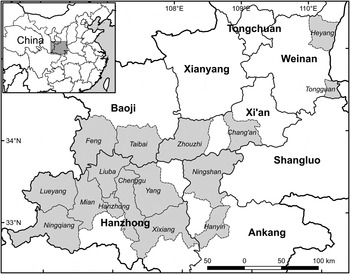
Records held by the Shaanxi Provincial Fisheries Office showed most of the licensed Chinese giant salamander farms in Shaanxi Province (n = 124) were in cities in the south of the province: Hanzhong (67 farms), Shangluo (20), Ankang (13), Baoji (13) and Xi'an (11). Of these, 43 farms were surveyed across Hanzhong, Ankang, Baoji and Xi'an (Fig. 1; Table 1). The mean number of salamanders per farm was 8,354 ± SD 11,066 (range 135–53,200). The mean number of breeding individuals per farm was 458 ± SD 730 (range 25–3,600). Of these 43 farms, 38 produced larvae in 2010 (latest available data); the mean number of offspring produced per breeding farm was 10,309 ± SD 9,691 (range 861–49,600). This is considerably higher than in other Chinese provinces for which industry statistics are available. For example, Guizhou Province had > 110 licensed Chinese giant salamander farms in 2011 but only 44 had breeding stock of > 500 animals and only five produced larvae in 2011 (Ministry of Agriculture and Fisheries, 2011).
Locations of cities and counties in Shaanxi Province where surveys were carried out (shaded areas) on Chinese giant salamander Andrias davidianus farms. The rectangle on the inset shows the location of the main map in China.
Results of the questionnaire survey conducted on Chinese giant salamander Andrias davidianus farms in Shaanxi Province, China (Fig. 1), in order of completion.

* Recognized by Shaanxi Province Fisheries Office as technically competent to farm Chinese giant salamanders
Background to the development of Chinese giant salamander farming in Shaanxi Province
According to the focus groups the Chinese giant salamander was abundant throughout the Qinling Mountains until the mid-to-late 1970s. Residents older than c. 35 years recalled the species being common and one of only a few wild animal species not eaten in the area. This was because it was considered to be ‘dirty’ and because, when caught, it emitted a sound like a human baby's cry. Touching a Chinese giant salamander was considered to bring bad luck.
We consistently found that workshop participants and surveyed farmers were unaware of the species’ taxonomic status and did not recognize the term 大鲵 (da ni), the standard Chinese name for the Chinese giant salamander. It was generally considered to be a type of fish and was widely known as 娃娃鱼 (wawayu), baby fish, because of its vocalization when caught. In Feng County the species was also known as 猪不吃 (zhu bu chi), which translates as ‘pig doesn't eat’. This name arose during the Cultural Revolution, when food shortages led to pigs being fed Chinese giant salamanders but they refused to eat them.
According to focus group participants, following the freeing of the movement of people in China in 1978, southern Chinese migrants, who had traditionally eaten salamander, arrived in the Qinling Mountain region, found an abundant supply of Chinese giant salamanders and harvested them for sale in south China. Participants stated that local people then started to eat and trade the salamanders, selling them to local traders for CNY 0.9 per kg. As the trade developed this rose to c. CNY 1.5 per kg. The animals were mostly sold to Guangdong and Fujian provinces in the south, and across international borders to other Asian countries.
According to the informal focus groups, in the 1980s 30–70 kg of Chinese giant salamander could be caught per person per day. In the late 1980s the free market replaced government trading posts, leading to a rapid increase in the price to c. CNY 15–20 per kg. This led to a change in the way the species was harvested, from manual catching and trapping to the use of poison. The synthetic pyrethroid insecticide fenpropathrin was favoured as it immobilized the animals without immediately killing them; thus they could be kept alive (and fresh) throughout the length of the commodity chain. According to discussions with farmers, fenpropathrin was used to harvest Chinese giant salamanders in Shaanxi Province during 1992–1998. The use of poison stopped when the local population abundance of the salamander became too low to make this activity worthwhile. It was reported that most other aquatic life had also disappeared from the rivers by this time; pyrethroids are also toxic to fish and aquatic invertebrates (Smith & Stratton, Reference Smith and Stratton1986; Mian & Mulla, Reference Mian and Mulla1992). To maintain livelihoods, attempts at farming the Chinese giant salamander were initiated.
Development and growth of the farming industry in Shaanxi Province
Until 2004 the number of Chinese giant salamander farms was small and farms were stocked only with wild-caught animals, which were purposely caught for farming or had been confiscated from the illegal trade. Under the 1998 Chinese Wild Animal Protection law licences are required to farm Chinese giant salamanders and additional licences are required to sell the species. A system of farm certification was introduced, managed by the provincial fisheries offices. Restaurants also are required to have a licence to sell Chinese giant salamander.
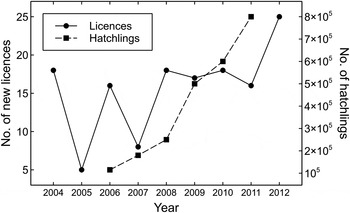
The first farm was licensed to breed Chinese giant salamanders in Shaanxi Province in 2004, and since then the industry has grown rapidly in the province (Fig. 2). During January 2004–June 2012 141 farms were licensed (although not all are still in operation) but a much larger number of unlicensed farms are also known to exist (see below). In line with the year-on-year growth in the number of farms, output increased annually (Fig. 2). A 2011 census of the licensed farms in Shaanxi Province by the Shaanxi Provincial Fisheries Office showed they housed 2.6 million salamanders (including hatchlings, juveniles and adults). Of these, c. 402,000 were young adults being raised as breeding stock and 15,357 were breeding adults. Most breeding individuals are F1 or wild-caught, even though it is illegal to catch Chinese giant salamanders from the wild. This appears to be attributable to the nascent state of the farming industry and an apparent inability of many farms to successfully breed from F2 animals, possibly as a result of inappropriate husbandry. Whilst it is not possible to ascertain the number of farms directly involved in extraction of Chinese giant salamanders from the wild, focus group responses generally indicated a continued demand for wild-caught individuals to populate breeding farms.
Numbers of newly licensed Chinese giant salamander farms and of salamander offspring produced in Shaanxi Province (Fig. 1) during 2004–2012. No data were available for hatchling production in 2004, 2005 or 2012; data for licences issued in 2012 include to the end of June only. All data were supplied by the Shaanxi Provincial Fisheries Office.
Shaanxi Provincial Fisheries Office records indicate that by the end of 2009 farm output in Shaanxi Province was c. 500 t, worth c. CNY 1 billion, and by 2010 up to 60% of families took part in Chinese giant salamander farming in some counties in the province. In Mian County in 2010 > 6,000 families were rearing Chinese giant salamanders in smallholdings, and 78 breeding farms produced 120,000 offspring. In Liuba County > 700 breeding farms yielded an overall profit of c. CNY 120 million (c. CNY 1,500 per county resident) in 2010, making Chinese giant salamander farming the main economic industry of this county. In 2012 the Shaanxi Provincial Fisheries Office estimated that the Qinling Mountain region produced c. 70% of the total output of farmed Chinese giant salamanders in China.
The growth of the industry in the Qinling region has been encouraged and facilitated by local (city and county) governments, which have subsidized the setting up of farms. In many counties government officials have personally invested money in the industry.
Structure of the farming industry in Shaanxi Province
There are two main models for Chinese giant salamander farms: the company model and the company-plus-smallholders model. The company model comprises one or more large, self-contained farms under the name of a single company. In these farms the salamanders are usually held in the dark in windowless buildings, often underground. In the company-plus-smallholders model the company disperses a large proportion of the salamander offspring it produces to smallholders (individual households in villages) for rearing. Generally 20–50 smallholders per company rear up to c. 500 individuals each.
The company-plus-smallholders model is largely run using one of two business models. One involves the company paying for the construction of smallholders’ rearing facilities (usually via the conversion of one or two rooms in their house). Juvenile Chinese giant salamanders and a monthly wage are provided to the smallholder, who is contracted to purchase all food for the animals from the company and to sell the reared animals (at c. 3–4 years of age) back to the company. In the other business model the smallholders build the rearing facilities themselves, purchase juvenile Chinese giant salamanders from the company and rear the animals in the absence of a contractual tie-in, but also in the absence of a regular wage.
A third business model is that of breeding cooperatives. These cooperatives train their members in Chinese giant salamander husbandry and breeding techniques and provide them with marketing information and legal support. In this way they can expand the scale of production while having greater economic protection from catastrophes, such as epidemic disease. In Liuba County there are two such cooperatives, comprising > 300 members working on > 200 farms with a total stock of c. 4,000 breeding adults.
Most of the smallholder participants reported using air conditioning during the summer and heating during the colder months to maximize growth rates. Some companies reported buying salamanders from farms across north and central China and transferring them to south China, where it is warm year-round. Adult salamanders from the south are commonly sold to farms in north and central China. Another practice widely used to speed up growth rates is the force-feeding of fish to salamanders. This is mainly carried out on smallholdings, where the farmer : salamander ratio is sufficiently high to make this labour-intensive technique feasible. In most cases salamanders are fed farmed fish but the use of farmed frogs was also reported.
Disease investigations
The clinical signs of epidemic disease included swelling and bleeding of the head (known locally as big head disease) or feet (big foot disease), necrosis and bleeding of the oral mucosa (bad mouth disease) or tail (bad tail disease), and skin bleeding. Not all animals developed all forms of the disease but, taken together, these signs are indicative of ranavirus infection, which is known to cause disease in captive and wild amphibians elsewhere; lethal outbreaks have been reported from Chinese giant salamander farms in Sichuan Province (Geng et al., Reference Geng, Wang, Zhou, Li, Wang and He2011). One farm also reported the occurrence of fungal growth on the skin.
Amplicons of the expected size for ranavirus were obtained from the liver, kidney and spleen of the euthanized salamander examined post mortem, and from 39 of 60 swabs (representing 11 of the 14 farms sampled) taken from skin ulcers and oral lesions from sick individuals. When sequenced, these amplicons were found to be identical to each other and to sequence data reported for ranavirus major capsid protein from farmed Chinese giant salamanders (GenBank ref. KF512820) and farmed pig frogs Rana grylio (GenBank ref. AY294406) in China (Supplementary Material 3).
Various signs of disease among Chinese giant salamander stock were reported from nearly all of the farms surveyed (39 of 43), usually occurring during the summer months. Three of the four farms that did not report diseased salamanders held stock of only c. 3,000 or fewer individuals, far lower than the mean number of individuals per farm in Shaanxi Province. A generalized linear model with Poisson errors, and a log-link in R v. 3.0.2 (R Development Core Team, 2013) showed no statistical relationship between the number of different clinical signs reported per farm and the total number of salamanders per farm (P = 0.195), the number of breeding salamanders per farm (P = 0.353) or the number of offspring produced per farm (P = 0.421), possibly because of the relatively high numbers of different clinical signs reported in most farms.
Discussion
Through analysis of records held by the Shaanxi Provincial Fisheries Office and a series of farm visits, questionnaires and focus groups we documented a large and growing Chinese giant salamander farming industry in Shaanxi Province and identified a range of farming practices and conservation threats. Although still in its infancy the farming industry has become an important way for local governments in Shaanxi Province to help improve the economic conditions and livelihoods of residents, particularly the rural poor. Across the Qinling Mountain region, farming of Chinese giant salamanders is now one of the three most important economic activities (along with herb and mushroom farming) and tens of thousands of families in the region rely on the farming industry for their income.
In addition to licensing and developing the Chinese giant salamander farming industry, provincial fisheries offices are responsible for the conservation of the species. Since 2008, farms that are licensed to breed Chinese giant salamanders must provide 13% of their stock each year to the Shaanxi Provincial Fisheries Office for release into the wild as a conservation measure. This condition, however, is rarely upheld and has been largely superseded by a national requirement: each year, the Chinese Ministry of Agriculture selects 28 licensed breeding companies across China to release 13% of their captive-bred offspring. Only individuals > 21 cm in length are released. The farms are paid compensation, with 85% of the cost coming from the national government and 15% from the provincial government; however, this amounts to c. CNY 800–900 per salamander released, which is less than the market price of c. CNY 1,500–2,000 per individual. During 2008–2010 4,950 farmed Chinese giant salamanders were released in Shaanxi Province by the Fisheries Office, whereas in 2011 8,000 farmed individuals were released in the province.
The focus groups reported some apparent recent increases in abundance of wild Chinese giant salamanders, with anecdotal reports of sightings in areas from which the species was extirpated in the 1980s and 1990s. It is not clear if these apparent increases, if genuine, are a result of the release of farmed individuals, the recovery of wild stock following protection measures, or a combination of the two. We consider natural recovery of wild populations unlikely even at local scales given the continuing intensive and widespread extraction pressure from the farming industry.
It is not uncommon for the Shaanxi Provincial Fisheries Office to seize illegally caught salamanders from farmers or local people. When they do so, however, the seized animals are passed on to licensed farms for rearing rather than being released back into the wild. Poachers are reportedly unpunished (Wang et al., Reference Wang, Zhang, Wang, Ding, Wu and Huang2004; Pan et al., Reference Pan, Wei, Cunningham, Li, Chen, Milner-Gulland and Turvey2015) and some reports indicate that poachers receive compensation for confiscated animals. This appears to be driven by the need for wild animals as breeding stock to maintain the viability of the industry, and the level of government investment in this industry. Thus, the incentive is to catch rather than protect wild Chinese giant salamanders. A similar conservation threat from turtle farming in China was reported by Shi et al. (Reference Shi, Parham, Lau and Chen2007).
During visits to farms in areas of high farm density we noted a problem with the provision of an adequate fresh water supply. In these areas water is recirculated amongst enclosures within farms and is also piped between farms, potentially spreading disease agents. On all 43 farms visited, untreated wastewater was eventually discharged directly into rivers or streams, with no biosecurity provisions in place to prevent disease agents entering or leaving the farms.
Since its emergence in 2009 epidemic disease consistent with ranavirus infection has occurred most years on Chinese giant salamander farms in Shaanxi Province, and we confirmed the presence of ranavirus infection in salamanders. Such epidemic disease has resulted in major economic losses in Shaanxi Province. That such outbreaks occur is unsurprising; industrial-scale farming, high population densities (Plate 1), and trade in animals between farms across China in the absence of biosecurity measures increase the likelihood of the spread of infectious disease. Although our relatively limited study did not demonstrate a statistical correlation between occurrence of disease and stocking levels, future analyses of a larger number of farms and of industry practice parameters could be useful for indicating possible control measures.
Typical Chinese giant salamander farm, with rearing pens for young animals. The inset is a close-up view of a rearing pen, showing the high stocking density.

In all cases the ranavirus we identified using the major capsid protein polymerase chain reaction was indistinguishable from ranavirus previously isolated from Chinese giant salamanders and pig frogs in China. Our results are consistent with those of Zhou et al. (Reference Zhou, Geng, Liu, Ren, Zhou and Wang2013), who characterized ranavirus from Chinese giant salamanders in Sichuan Province and showed it to be closely related to ranavirus in pig frogs. This raises the possibility that ranavirus from pig frogs, a North American anuran, has spread to farmed salamanders, possibly through the feeding of farmed frogs to salamanders. Further work is required to clarify this possibility, such as sequencing other areas of the Chinese giant salamander ranavirus genome. Whether or not the ranavirus originated from salamanders, pig frogs or some other source, there is a danger that this virus (and probably other infectious disease agents) threatens wild Chinese giant salamanders (and possibly other wild fauna) through the discharge of contaminated wastewater from farms or the release of infected individuals to the wild.
When salamanders are released from farms there is no pre-release assessment of their health or origin, of habitat suitability at the release site or of the presence or absence of native populations, nor is any post-release monitoring conducted. The trade in salamanders between farms across China, and their release from farms, poses the additional threat of genetic pollution. Murphy et al. (Reference Murphy, Fu, Upton, De Lema and Zhao2000) failed to show genetic differentiation between populations of Chinese giant salamander from various major watersheds in China, and speculated that this was because human-assisted animal relocations had obscured underlying phylogeographical patterns.
Although the Chinese government sponsors the release of farmed salamanders as a conservation measure, in addition to the specific reasons identified above, commercially farmed animals generally are not good subjects for conservation releases. Whilst conservation breeding entails careful genetic management and, as far as possible, maintenance of natural behaviours, salamander farms undertake no genetic management of their stock and, if anything, select for captive-adapted animals and other traits (e.g. rapid growth rates) that will maximize profit. Thus, far from assisting conservation of the Chinese giant salamander, the release of individuals from farms is more likely to be a threat to the conservation of the species than a benefit.
Although apparently profitable, the future of the farming industry must be in some doubt as current economic activity is almost entirely based on a pyramid-style selling scheme. As a result of local government policies to encourage the growth of the farming industry almost all salamanders produced by farms are sold to the growing number of start-up farms; only an estimated c. 3% of the tonnage of Chinese giant salamanders sold by farms each year is bought by the restaurant trade. As breeding animals are worth more than those for food, most of the salamanders sold to restaurants are individuals that cannot be bred (e.g. F2 and diseased animals).
The unsustainable nature of the market structure for Chinese giant salamanders has led the farming industry to seek ways of developing the restaurant trade and other markets for their products. The protected status of the species is considered the main hurdle to a profitable future. Few restaurants, for example, have applied for and been granted licences to sell Chinese giant salamander, and therefore the current market is not sufficiently large for the number of salamanders being reared on farms. In response, several local county and city governments (e.g. Hanzhong, Ankang and Xi'an) have joined farming companies to lobby the Shaanxi provincial government and the Central Chinese government to remove the protected status of the species and to relax licensing restrictions for the sale of Chinese giant salamanders and their products.
In summary, the structure and management of the farming industry, along with annual government-sponsored releases of farmed individuals to the wild, present potential threats to wild Chinese giant salamanders through continued overexploitation, genetic pollution, and the introduction and spread of infectious disease. We therefore recommend a complete separation of farmed and wild populations, supported by the enforcement of existing legislation to stop the continued capture of wild individuals. Research to improve the reproduction of captive-bred salamanders should be prioritized to remove the reliance of the farming industry on wild individuals. We also recommend improved management of farms, such as the quarantining of new stock and the disinfection of wastewater, to reduce disease risks to both farmed and wild salamanders.
Acknowledgements
We are grateful to the farm owners and their staff for generously providing their time and for cooperating fully with this study. We also thank the staff and students of Shaanxi Normal University who helped to organize and support the 2010 International Conservation Workshop for the Chinese Giant Salamander, and Chen Shu (ZSL) for creating Fig. 1. Funding was provided by the Ocean Park Conservation Foundation, Hong Kong, the U.S. Fish and Wildlife Service, Kadoorie Farm and Botanic Garden, the Mohamed bin Zayed Species Conservation Fund, Synchronicity Earth and the Darwin Initiative (Project No. 19-003).
Biographical sketches
Andrew Cunningham is a wildlife epidemiologist working on a range of threatened taxa. Samuel Turvey works on conservation study systems in China and South-east Asia, utilizing local ecological knowledge to strengthen the conservation evidence-base. Feng Zhou is a ZSL EDGE Fellow investigating diseases of wild and farmed giant salamanders. Helen Meredith is researching the effectiveness of amphibian conservation programmes. Wei Guan is Head of the Shaanxi Provincial Fisheries Office. Xinglian Liu pioneered giant salamander farming techniques. Changming Sun directs surveys of giant salamanders for the Shaanxi Provincial Fisheries Office. Zhongqian Wang is in charge of certification of giant salamander farms in Shaanxi Province. Minyao Wu is a member of giant salamander farming advisory committees at provincial and national level.


 Open access

