




Introduction
Though often considered a distinct discipline, Egyptology offers substantial contributions to broader archaeological discussions, perhaps most significantly on the reuse of mortuary spaces and individual or communal relationships with ancestors (Hill & Hageman Reference Hill and Hageman2016; Déderix et al. Reference Déderix, Schmitt, Crevecoeur, Schmitt, Déderix and Crevecoeur2018; Parker Pearson & Regnier Reference Parker Pearson, Regnier, Schmitt, Déderix and Crevecoeur2018). The emphasis on Egyptian religion as a form of ancestral cult has drawn parallels with other cultural contexts, especially in Africa (Nyord Reference Nyord2018). Consideration of tomb reuse can help inform to these wider discussions, offering the opportunity to explore individual and community engagement with burial spaces across generations and in a context where maintaining individual memory seems to have been key to widespread concepts of the afterlife, at least among the elite members of society (Nyord Reference Nyord, Willerslev and Christensen2013).
Tomb reuse was a major structuring phenomenon of cemeteries across Egypt. New Kingdom (1550–1069 BC) tombs at Saqqara and Thebes typically contain artefacts from multiple centuries or millennia (Lacher-Raschdorff Reference Lacher-Raschdorff, Bárta, Coppens and Krejčí2011; Kaczanowicz Reference Kaczanowicz2020; Staring Reference Staring2022). The reuse of space, both in antiquity and more modern times, is a major factor in the formation of the archaeological records of elite rock-cut tombs, and the processes of fragmentation and reassembly can confound efforts to reconstruct specific tomb groups (Näser Reference Näser, Tarlow and Stutz2013; Lemos et al. Reference Lemos, von Seehausen, di Giovanni, Giobbe, Menozzi and Brancaglion2017). Fragmentation of the archaeological record occurs through tomb robbery and the plundering and burning of ancient remains, while reassembly includes the regrouping and reorganising of previously scattered remains in specially prepared spaces—for example, in expanded chambers inside Theban tombs (Schreiber & Vasáros Reference Schreiber and Vasáros2005; Strudwick Reference Strudwick2010).
Fragmented material culture and human remains from contexts in elite rock-cut Theban tombs provide evidence for the extensive disturbance of original burial assemblages. Based on the commingled nature of the archaeological evidence, it remains extremely difficult to establish a succession of events. Object typologies are, in most cases, the only source of chronological information (Schreiber Reference Schreiber, Bechtold, Gulyás and Hasznos2011; Makowska Reference Makowska2015; Carniel & Lemos Reference Carniel and Lemos2021; cf. Kaczanowicz Reference Kaczanowicz2020), but textual sources can help us understand key events and social phenomena that contributed to the extensive fragmentation of burial assemblages. The tomb robbery papyri of the Twentieth Dynasty (1186–1069 BC) describe the actions of men engaged in the systematic plunder of royal and private tombs at Thebes. These men were essentially workers—fishermen, quarrymen and coppersmiths (Näser Reference Näser, Kümmel, Schweizer and Veit2008: 454–55; Strudwick Reference Strudwick, Geisen, Li, Shubert and Yamamoto2021: 115; Antoine Reference Antoine2023)—and their testimonies recount smashing mummies, burning coffins and stealing gold and silver objects that were later melted and divided among the thieves (Peet Reference Peet1930; Gasse Reference Gasse2001).
Yet the papyri also attest to a sense of respect towards the dead and their possessions by those engaged in looting. For instance, papyrus EA10054 (held at the British Museum) mentions the theft of four silver ox amulets that were replaced by wooden replicas (Peet Reference Peet1930: 62). The same text describes the looting of the tomb of a third prophet of Amun, whose body was carefully removed from its inner coffin and placed in a corner of the tomb, while coffins and other objects were burnt somewhere else (Peet Reference Peet1930: 60–61). Other Ramesside Period (1295–1069 BC) texts reveal a general sense of respect and veneration towards the dead. A ghost story from this period describes the interactions of a high priest of Amun called Khonsuemhab with the spirit of a man called Nebusemekh, a former overseer of the treasury under Mentuhotep II. The spirit inspires the high priest to rebuild his lost tomb to preserve his memory for the afterlife (Wente Reference Wente and Simpson2003: 112–15). Respect for the dead might have arisen from fear of harm inflicted by them on the living (Wente Reference Wente1990: 216–17), but it also stemmed from shared conceptions of morality and a sense of duty (Baines & Lacovara Reference Baines and Lacovara2002: 23; Cooney Reference Cooney, Jasnow and Cooney2015).
The construction of new tombs and the extensive reuse of earlier tombs from the end of the New Kingdom and the beginning of the Third Intermediate Period (1069–664 BC) also contributed to the fragmentation of original burial contexts at Thebes (Näser Reference Näser, Tarlow and Stutz2013: 650–52). The el-Khokha area of the Theban necropolis contains a high density of tombs dating from the Old Kingdom (2686–2160 BC) to the late New Kingdom (Kampp Reference Kampp1996; Slinger Reference Slinger2022), with occasional independent chambers cut during the Third Intermediate Period (Schreiber & Vasáros Reference Schreiber and Vasáros2005). New Kingdom tombs in the area were also heavily adapted and architecturally expanded in the Third Intermediate Period, resulting in a complex series of interconnecting chambers (Schreiber Reference Schreiber and el-Shakawy2009, Reference Schreiber, Bechtold, Gulyás and Hasznos2011; Betrò & Miniaci Reference Betrò, Miniaci, Taylor and Vandenbeusch2018; Kaczanowicz Reference Kaczanowicz2020). This is the case in Theban Tomb (TT) 362, where the funerary chamber was expanded in the Third Intermediate Period to house additional burials (Pereyra et al. Reference Pereyra, Di Antonio, Carniel and Menozzi2015; Menozzi Reference Menozzi2021).
In a context of fragmentation resulting from robbery, architectural interventions and later depositions, evidence for the reorganisation of burial assemblages following plundering suggests that respect also played a role in shaping final deposition contexts in the Theban necropolis, which is consistent with available textual references. In this context, the royal cache of Deir el-Bahari, the place where Third Intermediate Period priests reburied earlier kings and other members of the royal family as a result of widespread tomb robbery, would be the most significant example of respectful depositions (Niwiński Reference Niwiński, Mynárová and Onverka2007). Examples from private elite tombs are rarely discussed in academic literature.
This article discusses a recently excavated ritual structure found inside the Third Intermediate Period expansion of the funerary chamber of TT362, which was built in the Nineteenth Dynasty (1295–1186 BC) in the courtyard of the late Eighteenth Dynasty (1550–1295 BC) tomb of Neferhotep (TT49) at el-Khokha (Pereyra et al. Reference Pereyra, Di Antonio, Carniel and Menozzi2015: 46; Menozzi Reference Menozzi2021: 13–14). The use of this rare ritual structure sheds light on the preparation and expansion of plundered tombs as renovated elite burial grounds, and thus on social processes taking place at Thebes from the end of the New Kingdom through the Third Intermediate Period. Exploring the nature and use of the excavated structure permits reconsideration of the apparently contradictory relationship between fragmentation, reorganisation and respect. Understanding fragmentation and reorganisation as opposed binaries limits the potential of the available evidence; by emphasising a false contradiction between plundering and secondary deposition on the one hand, and reorganisation of burial contexts on the other hand, analyses of tomb reuse risk masking key elements of respect in such practices (cf. Baines & Lacovara Reference Baines and Lacovara2002).
Reusing earlier tombs
The study of reuse—of tombs, temples or material culture—is gradually unveiling more of complex dynamics of ancient Egyptian society, including changing social relations and the impact of economy on cultural practices and religious conceptions (Cooney Reference Cooney2011, Reference Cooney2021a; Schreiber Reference Schreiber, Taylor and Vandenbeusch2018a; Miniaci Reference Miniaci2019; Kaczanowicz Reference Kaczanowicz2020; Silva Reference Silva2023). The extensive reuse of tombs from the end of the New Kingdom into the Third Intermediate Period has typically been viewed through the lens of decentralisation and economic crisis towards the end of the New Kingdom. This reflects a broader focus in Egyptology on centralisation and state control as the driving forces of society, at the expense of individual and communal agency (Bussmann Reference Bussmann2023). For example, Dodson and Ikram (Reference Dodson and Ikram2008: 270) attribute the lack of monumentality in Third Intermediate Period funerary landscapes to a lack of centralisation. In general, twentieth-century scholarship continues to subscribe to top-down interpretations of tomb reuse, accepting that a reduction in the number of monumental projects directly stems from economic crisis (Miniaci Reference Miniaci2019: 289; cf. Kaczanowicz Reference Kaczanowicz2020: 221).
From a bottom-up perspective, exploring the reuse of tombs allows us to highlight the agency of non-royal individuals and communities, which for most of Egyptian history remained constrained by the state (Morris Reference Morris, Mohr and Thompson2023). Times of crisis, such as the transition from the New Kingdom to the Third Intermediate Period, produce opportunities for previously controlled agency to manifest. At the same time, crisis produces ‘elite anxiety’, which drives those at the top of society to react (Morris Reference Morris, Averbeck and Younger2020). Acknowledging crisis as an opportunity for the emergence of suppressed agency allows us to identify aspects of human experience in ancient Egypt that are still poorly understood (Lemos Reference Lemos, Maynart, Velloza and Lemos2018; Miniaci Reference Miniaci, Candelora, Ben-Marzouk and Cooney2022; Bussmann Reference Bussmann2023). Thus, understanding the lack of monumentality and the widespread reuse of tombs in the transition from the New Kingdom to the Third Intermediate Period opens space for the recognition of aspects of non-royal agency, such as individual choice and preferences in burial equipment, the deliberate establishment of connections with specific individuals or groups, and different modes of engaging with previous occupants and their belongings in reused environments.
The tomb MMA59 in the Deir el-Bahari area provides a demonstrative example (Kaczanowicz Reference Kaczanowicz2020: 204). The unembalmed, wrapped body of Henettawy was placed, under a mummy board, in two highly elaborate coffins in an earlier, reused tomb that probably belonged to Hatshepsut's official, Minmose (Shirley Reference Shirley, Galán, Bryan and Dorman2014: 222–23). Despite the rarity of jewellery in Third Intermediate Period burials (Kaczanowicz Reference Kaczanowicz2020: 223), the body was adorned with three necklaces, a total of nine bracelets on both arms and two golden finger rings (Aston Reference Aston2009: 198–99). Upon excavation, the burial was described as “hastily done” (Winlock Reference Winlock1924: 24), but it seems to express the high degree of choice and experimentation available to individuals—in terms of what to emphasise in their burial assemblages—in a context of major changes in funerary practices that probably resulted from these experimentations (Cooney Reference Cooney2011).
Top-down perspectives on tomb reuse as a reaction to the absence of the ‘provider state’ (Kemp Reference Kemp2018) also seem to disregard other reasons for reusing earlier funerary spaces. The reuse of Middle Kingdom (2055–1650 BC) saff tombs in the early Eighteenth Dynasty is attested in the Theban necropolis (Dziobek Reference Dziobek, Assmann, Burkard and Davies1987: 76–77). Rather than a reaction to crisis, such reuse reveals exploration in the development of the typical architectural shape of New Kingdom Theban tombs. In New Kingdom Nubia, virtually all elite Egyptian tombs at some sites were reused (Steindorff Reference Steindorff1937; Schiff Giorgini Reference Schiff Giorgini1971; Minault-Gout & Thill Reference Minault-Gout and Thill2012). The Eighteenth Dynasty tomb of Djehutyhotep at Debeira (Thabit Reference Thabit1957) originally dates from the reigns of Hatshepsut and Thutmose III, but the decorated wooden coffins found inside date from the Ramesside Period (Taylor Reference Taylor, Spencer, Stevens and Binder2017). The later occupants of the tomb of Djehutyhotep were likely family members or close associates connected to the Egyptian administration of Nubia (Lemos Reference Lemos, Ashby and Brody2024).
The (re)use of spaces in the Theban necropolis might also point to tomb groupings that reflect associations between individuals and families occupying the same hierarchy (Schreiber Reference Schreiber, Bechtold, Gulyás and Hasznos2011, Reference Schreiber, Pischikova, Budka and Griffin2018b). The disposition of later tombs around the courtyard of TT49 also point to the existence of an intergenerational network of temple personnel, including wab-priests (TT187 and TT362) and a chief musician of the Domain of Amun (TT363) (Kampp Reference Kampp1996; Carniel & Lemos Reference Carniel and Lemos2021).
A non-funerary perspective on tomb reuse also offers grounds to overcome a reactionary perspective to crisis. The reuse of architectural features of older monuments in later monumental projects, including funerary monuments and building activity at settlements, reveals pragmatic and ideological aspects of reuse more broadly (Gilli Reference Gilli and Affanni2015; Silva Reference Silva2023). Moreover, the self-sufficiency of Third Intermediate Period settlements is evidenced in the occupation of previously restricted areas for the development of various economic activities (Bennett Reference Bennett2019: 196–97). The reuse of New Kingdom temples as burial grounds in the Third Intermediate Period further adds to the complexity of major transformations of the social landscape of this period (Brand Reference Brand2010). Establishing connections with illustrious ancestors, including the king and members of the elite, seems to have been important in reusing earlier significant spaces (Cooney Reference Cooney2021b).
Materialising tomb reuse in the Theban necropolis: el-Khokha
In the context of tomb reuse as an opportunity for agency to emerge, the materialisation of reuse serves as a basis for the recognition of different aspects of human agency, including intentionality and creativity. Consideration of the various ways in which reuse is materialised in the Theban necropolis therefore provides a means of unveiling the creative strategies, limitations, possibilities and intentions behind the modification and occupation of earlier burial places.
In the Theban necropolis, the reuse of tombs is materialised through architectural and/or decorative changes to original tombs or textual inclusions (e.g. graffiti) (Kampp Reference Kampp1996: 123–29). These may involve minor additions to the original decoration and architecture or the complete revision of earlier monuments, for example the alteration of the owner's names in inscriptions (Kaczanowicz Reference Kaczanowicz2020: 171). Archaeologically, these forms of reuse result in a high degree of fragmentation and produced extremely mixed deposits containing evidence from multiple periods of occupation (Lemos et al. Reference Lemos, von Seehausen, di Giovanni, Giobbe, Menozzi and Brancaglion2017).
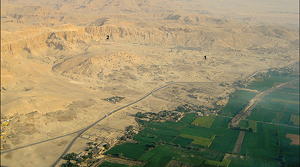
Elite tombs in el-Khokha (Figure 1) were cut into the underlying rock from the Old Kingdom to the late New Kingdom (Kampp Reference Kampp1996; Slinger Reference Slinger2022), but burial activity in the area continued into later periods. Mummy boards and shabtis from the late New Kingdom to Third Intermediate Period transition (Pereyra et al. Reference Pereyra, Di Antonio, Carniel and Menozzi2015; Schreiber Reference Schreiber, Taylor and Vandenbeusch2018a; Carniel & Lemos Reference Carniel and Lemos2021; Menozzi Reference Menozzi2021) and Kushite- and Saite-period (747–525 BC) coffins are found within earlier tombs (Schreiber Reference Schreiber, Pischikova, Budka and Griffin2014, Reference Schreiber, Pischikova, Budka and Griffin2018b). Late Period (664–332 BC) assemblages are rare in comparison to material dating from other periods, but fragments of coffins and, potentially, canopic jars have been retrieved inside reused tombs in el-Khokha (Fabián & Schreiber Reference Fabián, Schreiber, Bács, Fabián, Schreiber and Török2007). Ptolemaic and Roman (332 BC–AD 395) burial assemblages, however, are abundant and include coffin and cartonnage fragments, textiles, amulets and pottery (Schreiber et al. Reference Schreiber, Vasáros and Almásy2013; Menozzi Reference Menozzi2021: 32).
View of the Theban necropolis showing the location of el-Khokha (1) in relation to Deir el-Bahari (2) (CC-BY 3.0; photograph by S. Cameron).

The addition of later burial assemblages in el-Khokha tombs usually followed heavy architectural intervention in the Third Intermediate Period. These interventions included the opening of new pits and the connecting of neighbouring tombs, which resulted in completely altered layouts and disassembled tomb groups (Schreiber & Vasáros Reference Schreiber and Vasáros2005; Schreiber Reference Schreiber and el-Shakawy2009, Reference Schreiber, Pischikova, Budka and Griffin2014, Reference Schreiber, Taylor and Vandenbeusch2018a & b; Pereyra et al. Reference Pereyra, Di Antonio, Carniel and Menozzi2015; Kaczanowicz Reference Kaczanowicz2020; Menozzi Reference Menozzi2021).
The tomb of Neferhotep, scribe ‘great of Amun’ (TT49), dates to the reign of Ay (1327–1323 BC) (Davies Reference Davies1933). The tomb became the focal point of what later became a mortuary complex, including the construction of tombs in the Nineteenth and Twentieth Dynasties (Figure 2; Lemos et al. Reference Lemos, von Seehausen, di Giovanni, Giobbe, Menozzi and Brancaglion2017: 182). All the tombs in the mortuary complex display heavy signs of reuse.
Plan of the mortuary complex of Neferhotep (TT49), including TT187 (Pakhihat), TT362 (Paemuaset), TT363 (Paraemhab), -347- (anonymous) and -348- (anonymous) (drawing by B. de Almeida Newton).

The tomb of Neferhotep was reused as a burial place in the Nineteenth Dynasty and a secondary burial place was opened from the north wall of the chapel (Figure 3). Later decorative elements mimicking ritual scenes in the chapel were added to the entrance of the new burial place, including a representation of the ‘new’ owner worshipping Osiris (Figure 4). Textual interventions are also apparent on a jamb of the inner passage from the antechamber to the chapel (Davies Reference Davies1933: 53).
Reuse as architectural intervention. Additional chambers (top left of image in light brown) open from the north wall of the chapel in TT49 and contain the burial of a Nineteenth Dynasty individual whose presence left marks in the tomb's original decoration and burial assemblages (adapted from Pereyra et al. Reference Pereyra, Di Antonio, Carniel and Menozzi2015: 30, CC-BY 3.0).

Reuse as alteration to original decorative scheme. The additional scene, painted in black (in evidence) over the opening in the north wall of the chapel in TT49, likely shows the owner of the secondary burial place worshipping Osiris (adapted from Pereyra et al. Reference Pereyra, Di Antonio, Carniel and Menozzi2015: 33, CC-BY 3.0).

During the Nineteenth/Twentieth Dynasty, the tomb of wab-priest Pakhihat (TT187; Figure 2) was cut into the rock from the north side of the courtyard. The archaeological record in this tomb is extremely fragmented due to heavy reuse but architectural modifications offer glimpses of later adaptations to its original plan to accommodate further burials (Lemos et al. Reference Lemos, von Seehausen, di Giovanni, Giobbe, Menozzi and Brancaglion2017; Di Giovanni et al. Reference Di Giovanni, Santarelli, Lemos and Antonelli2022). Two shafts were also opened in the antechamber of the tomb; the western shaft contained several fragments of mummified human remains and more-modern pottery (Figure 5), while the eastern shaft connects TT187 to a neighbouring tomb (-348-).
The western shaft in the antechamber of TT187 during excavation (adapted from Lemos et al. Reference Lemos, von Seehausen, di Giovanni, Giobbe, Menozzi and Brancaglion2017: 188, courtesy of the Neferhotep Project).

The reorganisation of earlier burial spaces to accommodate new burials also included the expansion of rooms. This is a key feature of Third Intermediate Period reuse inside TT362, where the original funerary chamber was enlarged; similar modifications in other tombs indicate that this was a trend in the Theban necropolis in this period. In the process of enlarging the funerary chamber, builders encountered two funerary chambers (Figure 2) belonging to a cluster of Old Kingdom tombs in el-Khokha (Saleh Reference Saleh1977; Fabián Reference Fabián and Bechtold2011; Menozzi Reference Menozzi2021).
Digging new shafts and expanding rooms in earlier tombs usually ended up connecting tombs from different periods. The result is a complex set of interconnected tombs that form large burial complexes. Heavy interventions resulting in extensive architectural modifications to original tomb plans have traditionally been interpreted through the lens of usurpation and disregard for earlier property (e.g. Davies Reference Davies1933: 4; cf. Eaton Krauss Reference Eaton-Krauss, Jasnow and Cooney2015; Silva Reference Silva2023). Such views emerge from a reactionary framework that considers reuse only as the action of opportunistic individuals trying to take advantage of decentralisation. However, architectural changes did not necessarily mean later disregard for earlier monuments and the materiality of tomb reuse can reveal complex aspects of agency in the past beyond fragmentation and opportunism.
Respectful alterations
Tombs were places for the enactment of rituals in honour of the deceased; these rituals, which included offerings of food and drink and the burning of incense (as depicted on tomb walls), would be carried out in the courtyard and chapel, the public parts of the tomb associated with the realm of the living. The descending corridor leading to the funerary chamber represented the passage from this world to the afterlife, and these spaces would have remained private, comprising the realm of the dead (Assmann Reference Assmann, Strudwick and Taylor2003).
Inside the Third Intermediate Period expansion of the funerary chamber of TT362, excavations revealed a rectangular structure made of mud-bricks and plaster (Figure 6). One of the bricks was stamped with a now unreadable cartouche. Based on established cartouche typologies, the brick probably dates from the New Kingdom (Madej Reference Madej2018). The use of an earlier object as part of the structure further suggests its ritual significance. Under the stamped brick, a Twentieth Dynasty shabti belonging to a wab-priest named Any was deposited (Figure 7). The deliberate deposition of an earlier shabti suggests its reuse as a votive offering within the Third Intermediate Period ritual structure. Two other shabtis of the same type were found in the expanded funerary chamber (Carniel & Lemos Reference Carniel and Lemos2021), they were commingled with other funerary material dating from the Third Intermediate Period, suggesting their reuse as grave goods. Careful deposition of an earlier shabti in a ritual context within the private arena of the burial chamber suggests an attempt to make a previously plundered space sacred again by connecting, through earlier material culture, the newly expanded chamber with the tomb's ancestral history.
An altar or offering table built inside the extended funerary chamber of TT362 in the Third Intermediate Period. The added red arrow indicates the position of the stamped brick under which a Twentieth Dynasty shabti was deposited as a votive offering (adapted from Pereyra et al. Reference Pereyra, Di Antonio, Carniel and Menozzi2015: 46; Menozzi Reference Menozzi2021: 33, CC-BY 3.0).

The Twentieth Dynasty shabti of wab-priest Any, found within the Third Intermediate Period ritual structure in TT362 (adapted from Menozzi Reference Menozzi2021: 32, CC-BY 3.0). Shabtis of the same type are commonly found in el-Khokha, suggesting the existence of a burial community in the area (Näser Reference Näser, Spencer, Stevens and Binder2017; Schreiber Reference Schreiber, Taylor and Vandenbeusch2018a; Carniel & Lemos Reference Carniel and Lemos2021).

The ritual structure in the expanded funerary chamber of TT362 likely worked as an offering table or altar; plant material and animal bones found near the structure may be the remains of offerings (Menozzi Reference Menozzi2021: 13–14). Other artefacts from the chamber are predominantly Third Intermediate Period coffin fragments and the aforementioned shabtis (Carniel & Lemos Reference Carniel and Lemos2021). The shabti from the ritual structure is consistent with other Twentieth Dynasty shabtis found in the mortuary complex, which, taken together, indicate a major (re)use phase (Carniel & Lemos Reference Carniel and Lemos2021). The fact that a shabti belonging to a potential previous occupant of the mortuary complex was incorporated into an altar or offering table built during the reorganisation and expansion of burial spaces in Third Intermediate Period Thebes reveals an intention to preserve the memory of such ancestors and incorporate their essence into newly re-established monuments. This demonstrates that respect was a driving force of agency in tomb reuse from the late New Kingdom into the Third Intermediate Period.
Late New Kingdom papyri, including the tomb robbery texts, support an interpretation of the unusual ritual structure inside TT362 as a materialisation of respect. The sense of respect and moral duty described in these texts reveals the cultural ideals that were in vogue when they were produced and that guided agency in processes of tomb reuse. The need to restore what had been fragmented to appease the ancestors (Cooney Reference Cooney, Jasnow and Cooney2015), together with the opportunity to innovate in a context of necessary tomb reuse, resulted in novel ritual practices in mortuary settings. At the same time as reuse was stimulating new funerary practices in the transition from the New Kingdom to the Third Intermediate Period, agency producing innovation was also grounded in deep-rooted cultural ideals.
Ritual structures such as the one excavated in the funerary chamber of TT362 are rare but other examples do exist. A rectangular platform in the tomb of Pashedu at Deir el-Medina (TT 3) probably held the coffin; alternatively, it consists of the remains of a fixed sarcophagus (Zivie Reference Zivie1979: 77–78). Given the smaller size and associated finds, it is unlikely that the structure inside TT362 served the same purpose. Rather, it demonstrates ritual practices taking place inside burial chambers that produced respectful innovation in a context of widespread new possibilities in the Third Intermediate Period.
Conclusion
The unusual ritual structure in the expanded funerary chamber of TT362 in el-Khokha provides additional archaeological evidence for Third Intermediate Period reuse and architectural intervention in Theban tombs. Such reuse offers insights into the sociocultural dynamics guiding agency in a period when creative solutions were sought to guarantee a suitable afterlife for members of the Theban elite. Interpreted as an altar or offering table, the structure inside TT362 further permits exploration of aspects of non-royal individual and/or communal agency during a period of wider cultural change and of the complex interactions between the living and the ancestors, grounding our understanding of ancestral cults in Egyptian mortuary religion more broadly. Respect was a key element guiding reuse practices in the Theban necropolis, which reflects the elite moral ideals regarding the preservation of life after death that were in vogue in the Third Intermediate Period. Creative engagements with the material culture of death in reused mortuary contexts at Thebes further reveal specific aspects of the reorganisation of fragmented spaces that sought to accommodate new materialities of death.
Acknowledgements
I am grateful to Violeta Pereyra for inviting me to participate in the Neferhotep Project from 2014–2018.
Funding statement
Work was funded by the University of Cambridge Fieldwork Fund.


 Open access

