


Elections are pivotal moments that can redefine a nation’s collective identity (Ansolabehere et al. Reference Ansolabehere, Puy, Puy and Fabrega2022). They invite promise and peril: hope in one’s preferred candidate and apprehension about the alternative. In this way, the time leading up to elections may be positioned as institutionalized episodes of collective discontinuity, periods when a group’s sense of connection between its past, present, and future may be disrupted by election outcomes (Sani et al. Reference Sani, Bowe and Herrera2007; Jetten and Wohl Reference Jetten and Wohl2012; Syfers et al. Reference Syfers, Rast and Gaffney2021). Leadership may change hands, policies can be reimagined, and the social contract could be renegotiated. Such discontinuity is particularly salient during times of polarization or populist upheaval, when elections are framed as existential threats to national values – as in the 2024 US federal election.
During these moments of instability, citizens debate not only what lies ahead but also what has been lost (Goidel et al. Reference Goidel, Goidel and Kellstedtin press). Campaigns thus become contests over memory as much as over policy – struggles to define which version of the past represents the nation’s true identity (Wohl et al. Reference Wohl, Stefaniak and Smeekes2023). In uncertain times, people often reach backward to move forward, seeking in their collective past a sense of moral and cultural orientation (Smeekes Reference Smeekes2015; Smeekes et al. Reference Smeekes, Wildschut and Sedikides2021). This process evokes what social psychologists have termed collective nostalgia (i.e. a sentimental longing for the way things used to be for one’s group; Wildschut et al. Reference Wildschut, Bruder, Robertson, van Tilburg and Sedikides2014). Unlike personal nostalgia, which comforts the self, collective nostalgia reaffirms who we are, what we value, and what we should strive to be again (Wohl et al. Reference Wohl, Stefaniak and Smeekes2020a, Reference Wohl, Stefaniak and Smeekes2023).
Of note, nostalgia has also been theorized across disciplines as a historically situated and multifaceted phenomenon. For example, Keightley and Pickering (Reference Keightley and Pickering2006) argued that nostalgia encompasses multiple ‘modalities’, including melancholic retreat as well as more aspirational or future-oriented engagements with the past. Although we acknowledge this broader interdisciplinary perspective, the present research adopts the social psychological approach advanced by Sedikides and Wildschut and colleagues, which conceptualizes nostalgia as a measurable emotional experience with motivational consequences for attitudes and behaviour.
Although nostalgia can take multiple forms, a growing body of empirical research suggests that its political consequences depend on its content (e.g. Wohl et al. Reference Wohl, Stefaniak and Smeekes2020a, Reference Wohl, Stefaniak, Ungson and Packerin press; Stefaniak et al. Reference Stefaniak, Wohl, Smeekes, Sedikides and Wildschut2021). That is, collective nostalgia’s predictive utility lies not merely in whether citizens feel nostalgic, but in what they long for (Wohl et al. Reference Wohl, Stefaniak and Smeekes2020b). Two distinct forms are especially relevant during elections. Civic-focused nostalgia reflects yearning for a time when institutions were trusted, norms of fairness were respected, and citizens engaged constructively across political divides. Homogeneity-focused nostalgia, in contrast, romanticizes a past when society was more culturally, ethnically, or religiously uniform – a time imagined as harmonious because ‘everyone shared the same values’. Both are backward-looking, but they orient the collective towards different futures: civic nostalgia envisions renewal through cooperation and inclusion, whereas homogeneity nostalgia seeks restoration through conformity and exclusion.
When the future feels uncertain, nostalgia offers stability and meaning – but it often arises alongside another emotion: collective angst, a forward-looking concern that the group’s vitality is in jeopardy (Wohl and Branscombe Reference Wohl and Branscombe2009; Tabri et al. Reference Tabri, Wohl and Caouette2018; Porat et al. Reference Porat, Halperin and Wohl2019). Together, these emotions can shape key election-related outcomes. Namely, these emotions should shape support for strong leadership, voting intentions, and voting behaviour. Nostalgia provides the narrative lens through which existential anxiety is interpreted; angst supplies the motivational urgency to act on it. People’s memories of ‘what was’ guide their sense of ‘what must be done’, channelling their concern about the group’s future into specific political preferences and leadership ideals (Wohl et al. Reference Wohl, Stefaniak and Smeekes2020a).
In the present research, we examined whether collective nostalgia experienced prior to the 2024 US federal election is associated with support for strong leadership, voting intentions, and actual voting behaviour, and whether these relationships were moderated by collective angst. We expected that homogeneity-focused collective nostalgia would be associated with greater support for strong leadership and a higher likelihood of supporting Donald Trump, given its emphasis on restoring a culturally uniform past. In contrast, civic-focused collective nostalgia was expected to orient citizens towards more inclusive and cooperative political preferences, including support for Kamala Harris. Collective angst was expected to heighten a desire for protection from an uncertain future, which would manifest as support for strong leaders. Beyond these main effects, we also explored whether collective angst amplifies the influence of collective nostalgia, shaping how people translate memories of the past into political choices. Specifically, we examined whether collective nostalgia’s content (civic versus homogeneous) would interact with collective angst to predict leadership preferences and voting behaviour. In doing so, our goal was to clarify how citizens’ emotional orientations towards their nation’s past and future jointly shape strong leadership preferences and voting.
Despite growing interest in the political consequences of nostalgia and anxiety, these emotional processes have largely been examined in isolation. Prior work shows that collective nostalgia shapes political attitudes and intergroup orientations, while separate literatures demonstrate that collective threat and anxiety heighten support for strong leadership. What remains underexplored is how emotionally laden orientations towards the past and future jointly shape political judgment in real-world electoral contexts. The present research addresses this gap by integrating collective nostalgia and collective angst within a single model to examine their combined influence on strong leader support, voting intentions, and actual voting behaviour surrounding a national election. Conceptually, this approach highlights how nostalgic content conditions the political consequences of future-oriented anxiety; empirically, it extends prior work by linking these emotional configurations to observed electoral behaviour using a two-wave pre- and post-election design.
This article also contributes to the broader conversation advanced in this Memory and Anxiety collection in Memory, Mind & Media, which emphasizes the sociocultural entanglement of remembering and feeling (Batiashvili et al. Reference Batiashvili, Topçu and Wertsch2025). Although we do not approach nostalgia from a cognitive memory-processing perspective, our findings illuminate how collective remembering (specifically, nostalgic representations of the national past) shapes and regulates political anxiety in the present. By distinguishing between civic-focused and homogeneity-focused nostalgia, we show that not all forms of collective memory relate to anxiety in the same way. Instead, the content of what is remembered determines whether anxiety is channelled towards unifying versus authoritarian political preferences. In this way, our work advances a sociocultural account of how memory can organize and direct collective anxiety in consequential political directions.
Herein, we use ‘collective memory’ in the social psychological sense of socially shared representations of the past that are transmitted and negotiated within groups. These collective memories often provide the descriptive background for group identity and intergroup attitudes (Liu and Hilton Reference Liu and Hilton2005). Importantly, Liu and Hilton argue that groups sometimes elaborate these shared representations into historical ‘charters’ that are more than memory per se because they prescribe roles and legitimize collective action (Liu and Hilton Reference Liu and Hilton2005; see also Hilton and Liu Reference Hilton and Liu2017). Collective nostalgia is distinct from collective memory in that it is an emotion: a sentimental longing for the group’s past that draws on remembered representations but adds affective meaning and motivational force (Wildschut et al. Reference Wildschut, Bruder, Robertson, van Tilburg and Sedikides2014). In the present paper, we therefore treat collective memory as the content and narrative resources available to the group, and collective nostalgia as the affective orientation towards that content.
Collective nostalgia: Longing and its relation to leader support
Elections are institutionalized tests of continuity, moments when citizens recognize that the nation’s future is uncertain and potentially in flux. Under such conditions, the desire for strong leadership (i.e. a belief that a decisive figure is needed to restore order and direction) may intensify, because uncertainty heightens people’s motivation to seek leaders who project stability and preserve the nation’s identity (Kakkar and Sivanathan Reference Kakkar and Sivanathan2017). Collective nostalgia likely plays an emotional role in how citizens make sense of such moments. Defined as a sentimental longing for the way things used to be for one’s group, collective nostalgia reaffirms belonging, shared values, and continuity with the group’s past (Wildschut et al. Reference Wildschut, Bruder, Robertson, van Tilburg and Sedikides2014; Sedikides and Wildschut Reference Sedikides and Wildschut2019). When social or political change threatens that sense of coherence, nostalgia offers psychological stability. It reminds people who they were and, by implication, who they feel the group ought to be again (Smeekes Reference Smeekes2015). Importantly, recent research shows that nostalgia’s content (i.e. what people long for) shapes its political consequences (Wohl et al. Reference Wohl, Stefaniak and Smeekes2020a, Reference Wohl, Stefaniak and Smeekes2020b).
We contend that two forms of nostalgia may be particularly relevant in modern democracies in general and during an election cycle in particular. The first, homogeneity-focused nostalgia, idealizes a past when society was more culturally, ethnically, or religiously uniform (i.e. a time imagined as cohesive because ‘everyone shared the same values’; Wohl et al. Reference Wohl, Stefaniak and Smeekes2020b). Although homogeneity-focused nostalgia centres on themes that overlap with conservative ideology, such as preference for tradition and resistance to social change, we conceptualize it as a group-based emotional response rather than an ideological orientation. Political ideology reflects relatively stable belief systems about social order and governance, whereas collective nostalgia captures an affective longing for a collectively remembered past that becomes salient under conditions of perceived discontinuity. Prior work demonstrates that while ideological orientation may shape which nostalgic narratives resonate with individuals, collective nostalgia operates as an emotional mechanism that translates ideological orientations into politically meaningful attitudes and action tendencies (Stefaniak et al. Reference Stefaniak, Wohl, Smeekes, Sedikides and Wildschut2021). From this perspective, homogeneity-focused nostalgia does not merely reflect conservative ideology but represents an emotionally charged way of interpreting social change through the lens of group continuity and loss. Importantly for the current research, this form of nostalgia has been consistently linked to exclusionary attitudes, support for populism, and endorsement of authoritarian leaders who promise to protect and return to a time imagined as cohesive (see Smeekes Reference Smeekes2015; Mols and Jetten Reference Mols and Jetten2017; Wohl et al. Reference Wohl, Stefaniak and Smeekes2020b).
Indeed, classic theories (Fromm Reference Fromm1941; Adorno et al. Reference Adorno, Frenkel-Brunswik, Levinson and Sanford1950) described attraction to strong leaders as a psychological defence mechanism against the potential loss of group identity. Contemporary research extends this view, conceptualizing strong leader support as a motivated response to the perceived erosion of national identity and status (see Ionescu et al. Reference Ionescu, Mols, Álvarez, Selvanathan, Crimston and Jetten2024). Elections, with their inherent uncertainty and heightened sense of collective stakes, are ideal contexts for these dynamics to unfold. Empirical evidence supports this connection. When individuals sense that society is breaking down, they tend to endorse leaders who promise decisiveness and protection, even if such leaders challenge democratic norms (see Sprong et al. Reference Sprong, Jetten, Wang, Peters, Mols and Verkuyten2019; Roccato et al. Reference Roccato, Cavazza, Colloca and Russo2020; Neerdaels et al. Reference Neerdaels, Teymoori, Tröster and Van Quaquebekein press). In a 28-country study, Sprong et al. (Reference Sprong, Jetten, Wang, Peters, Mols and Verkuyten2019) found that perceived inequality increased support for strong leaders through heightened anomie – the sense that society lacks order and capable leadership. Similarly, Crimston et al. (Reference Crimston, Selvanathan and Jetten2022) found that moral decline predicted support for authoritarian leaders, whereas disillusionment with institutional legitimacy predicted support for progressive strong leaders. Together, these findings indicate that the appeal of strong leadership is not inherently authoritarian but rather reflects a context-dependent protective impulse, one that intensifies when the continuity of the group feels threatened.
However, we also posit the existence of another form of collective nostalgia: civic-focused. This type of nostalgizing reflects yearning for a time when citizens treated one another with respect, trusted institutions, and engaged across political divides. Although civic-focused nostalgia centres on abstract collective objects such as democratic norms and institutional trust, it is best understood as a group-based emotion rather than a purely cognitive or ideological orientation. Prior work demonstrates that collective nostalgia is affectively experienced, empirically distinguishable from related evaluative states, and predictive of motivation and behaviour through emotional pathways (Wildschut et al. Reference Wildschut, Bruder, Robertson, van Tilburg and Sedikides2014). From this perspective, civic-focused nostalgia reflects not a judgment about democratic decline, but an emotionally laden longing for a collectively remembered civic past that becomes psychologically salient when continuity is perceived to be under threat.
Longing for an era of civic cooperation could lead some citizens to refrain from endorsing leadership that symbolizes control. During moments of potential discontinuity, nostalgia offers the interpretive framework that gives meaning to instability. When citizens look backward with homogeneity-focused nostalgia, they are likely to interpret change as decay and seek strength through restoration and control. When they look backward with civic-focused nostalgia, they may instead interpret change as an opportunity for renewal and call for strength expressed through unity and trust.
Importantly, in the current research, civic-focused and homogeneity-focused nostalgia are assessed using separate multi-item scales that capture distinct thematic content rather than opposite poles of a single dimension. Whereas homogeneity-focused nostalgia includes items referring to cultural uniformity and shared traditional values, civic-focused nostalgia includes items referring to institutional trust, fairness, and respectful civic engagement. Prior research demonstrates that these scales are empirically distinguishable and differentially predictive of political attitudes and leadership preferences (Wohl et al. Reference Wohl, Stefaniak, Ungson and Packerin press). Because elections make questions of continuity so salient, they provide an ideal setting for testing how these distinct contents of collective nostalgia shape political behaviour. Citizens high in homogeneity-focused nostalgia may be especially drawn to strong leadership as a means of recovering perceived national cohesion, whereas those higher in civic nostalgia may feel less need for concentrated power, viewing institutional resilience as strength in itself.
Voting intentions and voting behaviour
These same emotional processes extend beyond attitudes towards leadership to shape voting intentions and voting behaviour. Nostalgic appeals are ubiquitous in electoral campaigns because they anchor abstract promises in emotionally resonant narratives. Populist movements across Western democracies have repeatedly invoked national nostalgia to frame elections as opportunities to reclaim a lost greatness: from ‘Make America Great Again’ in the United States to ‘Take Back Control’ in the United Kingdom (Smeekes and Verkuyten Reference Smeekes and Verkuyten2015; Mols and Jetten Reference Mols and Jetten2017). Such rhetoric transforms policy debates into moral restoration projects, offering simple, emotionally satisfying answers to complex social challenges.
Empirical evidence demonstrates how nostalgia translates into electoral outcomes. Wohl et al. (Reference Wohl, Stefaniak and Smeekes2020a) found that individuals nostalgic for a more homogeneous past were more supportive of exclusionary policies and nationalist parties, whereas those nostalgic for civic virtues supported pluralism and cooperation. Ionescu et al. (Reference Ionescu, Mols, Álvarez, Selvanathan, Crimston and Jetten2024) showed that national nostalgia predicted preference for strong leaders through perceived status decline and that nostalgic content differentiated voting intentions for authoritarian versus progressive candidates. These findings suggest that nostalgia primarily functions as an interpretive lens: it provides a narrative about what the nation once was and ought to be again, which then channels citizens’ responses to political uncertainty.
In the 2024 US federal election, we hypothesized that these psychological dynamics would be particularly evident. We expected that voters nostalgic for civic ideals would be drawn towards Kamala Harris, whose campaign emphasized institutional trust and unity, whereas those nostalgic for homogeneity and order would gravitate towards Donald Trump, whose message centred on protection, restoration, and control. Thus, nostalgia’s content provides a psychological key for understanding not just leader preferences, but the choices citizens make at the ballot box.
Collective angst: Anxiety for the group’s future
If nostalgia gives shape to the past, collective angst gives urgency to the future. Collective angst is a forward-looking concern that one’s group is under existential threat (i.e. its values eroding, its distinctiveness fading, or its vitality declining). In line with prior theoretical and empirical work by Wohl and colleagues (see Wohl et al. Reference Wohl, Branscombe and Reysen2010; Wohl et al., Reference Wohl, Giguère, Branscombe and McVicar2011; Tabri et al. Reference Tabri, Wohl and Caouette2018; Orazani and Wohl Reference Orazani, Wohl and Miller2022), we conceptualize collective angst as a future-oriented, group-based articulation of anxiety. Specifically, collective angst is a group-based emotion that reflects concern about the future vitality of the in-group, characterized by uncertainty regarding whether and when harm to the group may occur (Wohl et al. Reference Wohl, Branscombe and Reysen2010; Tabri et al. Reference Tabri, Wohl and Caouette2018). Importantly, empirical work has demonstrated that collective angst is empirically distinguishable from related affective states, including fear and anger, and reflects an anticipatory orientation towards possible future loss rather than an immediate or concrete threat. In this respect, collective angst aligns with classic accounts of anxiety as an anticipatory emotional state, while remaining analytically distinct in its collective focus (Barlow Reference Barlow1991; Lazarus Reference Lazarus1991).
At the same time, collective angst is not separate from anxiety writ large. Rather, it represents a context-specific manifestation of collective anxiety that becomes salient when groups perceive threats to their continuity. Whereas sociocultural approaches often emphasize anxiety as an implicit and ambient condition of collective life that shapes identity instability and political subjectivity, collective angst captures moments when such anxiety becomes cognitively registered and explicitly articulated as concern for the group’s future. Elections are precisely such moments. They render background uncertainty visible by foregrounding questions about who ‘we’ are, where ‘we’ are headed, and whether the group will endure. In this sense, collective angst functions as a psychological mechanism through which diffuse collective anxiety becomes actionable, interacting with collective memory to shape leadership preferences and voting behaviour.
In terms of the outcome of this group-based emotion, research has shown that collective angst is inherently protective. It motivates citizens to defend their group’s continuity, sometimes through constructive action (i.e. supporting reconciliation when it promises long-term harmony; Halperin et al. Reference Halperin, Porat and Wohl2013) and other times through defensive exclusion, such as opposing immigration when outsiders are perceived as threats (Lucas et al. Reference Lucas, Rudolph, Zhdanova, Barkho and Weidner2014). Elections amplify these feelings of vulnerability by highlighting potential ruptures in national direction.
However, collective angst alone cannot determine the form that protection takes. We contend, like others (Wohl et al. Reference Wohl, Stefaniak and Smeekes2020a), that it likely interacts with collective nostalgia. Under high collective angst, homogeneity-focused nostalgia should magnify the appeal of strong leadership and reinforce voting for candidates promising control and restoration. In contrast, civic-focused nostalgia may blunt this effect by channelling anxiety towards inclusion and institutional solutions. In this way, collective angst may operate as a moderator, amplifying or dampening the influence of nostalgia depending on which vision of the past dominates citizens’ collective imagination.
The present research
The present research investigated whether collective nostalgia and collective angst individually as well as jointly shaped political attitudes and behaviour during the 2024 US federal election. We focused on three interrelated outcomes: support for strong leadership, voting intentions, and actual voting behaviour.
We examined whether homogeneity-focused nostalgia, but not civic-focused nostalgia, would be associated with greater support for strong leadership, defined here as a broad preference for decisive, protective leadership often expressed during periods of uncertainty (Fromm Reference Fromm1941; Sprong et al. Reference Sprong, Jetten, Wang, Peters, Mols and Verkuyten2019). We further explored whether collective angst would independently be associated with support for strong leadership and whether it would condition the effects of collective nostalgia. We expected support for strong leadership to be highest when homogeneity-focused nostalgia and collective angst were both high, reflecting an amplified motivation to restore cohesion and control. We also anticipated that strong leader support would increase when civic nostalgia was low and collective angst was high, reflecting a protective impulse untempered by inclusive civic ideals.
We extended these analyses to voting intentions and actual voting behaviour. Given that Harris’s campaign emphasized institutional renewal and inclusivity, whereas Trump’s campaign emphasized restoration of traditional order and national strength, we examined whether homogeneity-focused nostalgia, particularly when paired with high collective angst, would be associated with intentions and votes for Trump. Conversely, lower homogeneity nostalgia or higher civic-focused nostalgia was expected to correspond with greater support for Harris.
To test these expectations, we surveyed American participants before and after the 2024 US federal election, allowing us to examine both cross-sectional and longitudinal associations among collective emotions, leadership preferences, and voting outcomes. This design captures real-time emotional responses to political discontinuity and offers insight into how orientations towards the past and future shape democratic decision-making.
All materials, analysis code, and anonymized data are available on the Open Science Framework (OSF): https://osf.io/tw8s4.
Method
Participants and procedure
The study employed a two-wave longitudinal design, with data collected shortly before the 2024 US federal election (November 1–2, 2024) and after the election results were announced (November 6–13, 2024). Given budget constraints, we set a recruitment target of approximately 450 participants for Time 1, anticipating an attrition rate of around 35 per cent between waves. Participants were recruited through Prolific and pre-screened to ensure they were US citizens who self-identified as either Democrats or Republicans.
A total of 459 individuals accessed the pre-election survey. One duplicate Prolific ID was detected, and only the first entry from that participant was retained, resulting in a sample of 458 valid responses. All participants who completed the pre-election survey were subsequently invited to complete the post-election survey. In total, 331 participants (72.3%) completed the post-election survey.
Of the participants who completed the pre-election survey, 18 failed one attention check in the pre-election survey and 12 failed the attention check in the post-election survey, one completed less than half of the post-election survey, and 21 did not disclose their voting behaviour. These participants were excluded from all analyses, leaving a final sample of 282 participants. They ranged in age from 18 to 81 years (M = 43.75, SD = 13.63); 98 (34.8%) identified as male, 182 (64.5%) as female, and 2 (0.7%) as non-binary.
There were no statistically significant differences between participants with complete data (n = 282) and those with incomplete data (n = 126) on homogeneity-focused nostalgia (p = .075), civic nostalgia (p = .487), collective angst (p = .937), or strong leader support (p = .197). Participants with incomplete data were, however, more likely to be younger (p < .001) and male (p = .010) compared with those with complete data. Taken together, these patterns are consistent with a missing at random (MAR) mechanism underlying the incomplete responses.
Measures
Participants completed a questionnaire battery prior to the election of which the following were examined in the current research. Unless otherwise indicated the measures used a 1 (Strongly disagree) to 5 (Strongly agree) answer scale.
Pre-election collective angst
Participants completed a five-item scale assessing anxiety about the future vitality of the United States (adapted from Wohl and Branscombe Reference Wohl and Branscombe2009). These items were: ‘I feel anxious about the future of the United States’, ‘I am worried about the future existence of the United States’, ‘I feel the future of the United States is secure (reverse-coded)’, ‘I feel that the United States will always thrive’ (reverse-coded), and ‘I am concerned that the future vitality of the United States is in jeopardy’. Responses were averaged with higher scores indicating greater collective angst (α = .83).
Pre-election civic-focused collective nostalgia
Longing for a past era of civic cooperation and respect for democratic institutions was measured with five items used in prior research (adapted from Wohl et al., Reference Wohl, Stefaniak and Smeekes2020a). These items were: ‘I feel nostalgic for when there was greater civility in American politics’, ‘I long for a time when Americans placed greater value on democracy’, ‘I long for when American political institutions were held in higher regard’, ‘I am nostalgic for when America was less polarized’, and ‘I long for a time when Americans with different political opinions were more willing to discuss their differences with each other’. Responses were averaged with higher scores indicating greater civic-focused nostalgia (α = .84).
Pre-election homogeneity-focused collective nostalgia
Longing for a time when America was more culturally and ethnically uniform was measured with two items (Wohl et al., Reference Wohl, Stefaniak and Smeekes2020a). These items were: ‘I feel nostalgic for a time when Americans were more similar to each other culturally and religiously’ and ‘I long for a time when Americans were more similar to each other in terms of their culture and religion’. The two items were highly correlated (r = .89, p < .01), and so responses were averaged with higher scores indicating greater homogeneity-focused nostalgia.
Pre-election strong leader support
To capture general endorsement of strong leadership, we used a single item asking whether ‘Our country needs a strong leader right now’ (adapted from Sprong et al. Reference Sprong, Jetten, Wang, Peters, Mols and Verkuyten2019). This item is commonly used to assess desire for decisive leadership under conditions of uncertainty and does not distinguish between authoritarian and democratically constrained forms of leadership.
Pre-election voting intentions
Participants were asked ‘In the 2024 Presidential election, I plan to vote for:’ and selected one of the following response options: ‘Donald Trump’, ‘Kamala Harris’, ‘Another candidate’, ‘I do not plan to cast a vote in the 2024 Presidential Election’, and ‘I prefer not to say’.
Post-election voting behaviour
Participants were asked ‘In the 2024 Presidential election, I voted for’ and selected one of the following response options: ‘Donald Trump’, ‘Kamala Harris’, ‘Another candidate’, ‘I did not cast a vote in the 2024 Presidential Election’, and ‘I prefer not to say’.
Pre-election political party affiliation
Participants were asked ‘What political party do you most strongly affiliate with?’ and responded using one of the following options: ‘Republican’, ‘Democratic’, ‘Neither’, and ‘Prefer not to say’.
Data analytic plan
Three multiple regression analyses were conducted to examine whether civic nostalgia and collective angst jointly moderate the effect of homogeneity nostalgia on three political outcome variables: (1) pre-election support for a strong leader, (2) pre-election voting intentions (Trump versus Harris), and (3) post-election voting behaviour (Trump versus Harris). All predictor variables (homogeneity nostalgia, civic nostalgia, and collective angst) were grand-mean centred prior to computing the two-way and three-way interaction terms. For each outcome, the regression model included all main effects, all two-way interaction terms (homogeneity nostalgia × civic nostalgia, homogeneity nostalgia × collective angst, civic nostalgia × collective angst), and the three-way interaction term (homogeneity nostalgia × civic nostalgia × collective angst). Statistically significant interactions were probed using simple slopes analyses (i.e. +/−1 SD above and below the level of the moderators). Strong leader support was examined as an ordered categorical outcome, using an ordered logistic regression, whereas pre-election voting intentions (1 = Trump versus 2 = Harris) and post-election voting behaviour (1 = Trump versus 2 = Harris) were examined as binary outcomes, using binary logistic regressions. The maximum likelihood method of estimation was used in the analyses, which were conducted in Mplus 8.2 (Muthén and Muthén Reference Muthén and Muthén2018).
Results
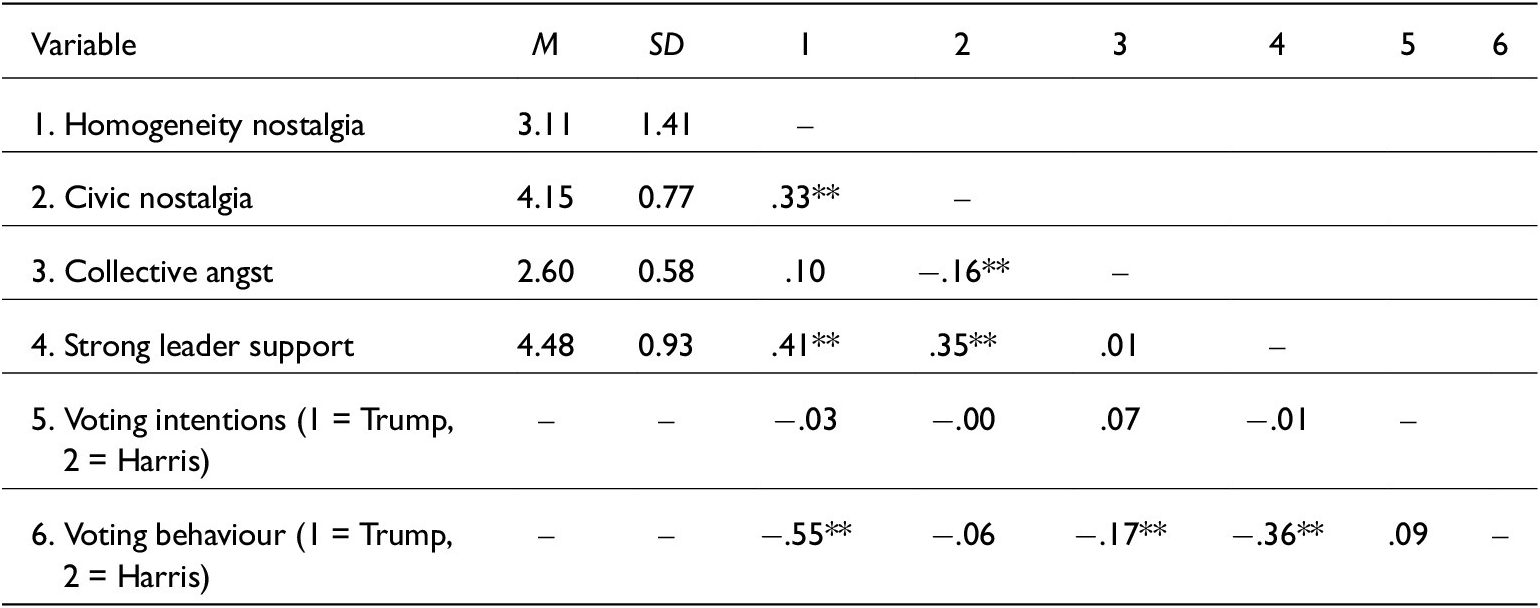
Means, standard deviation, and correlations between measured variables are reported in Table 1.
Descriptive statistics and correlations between all measured variables
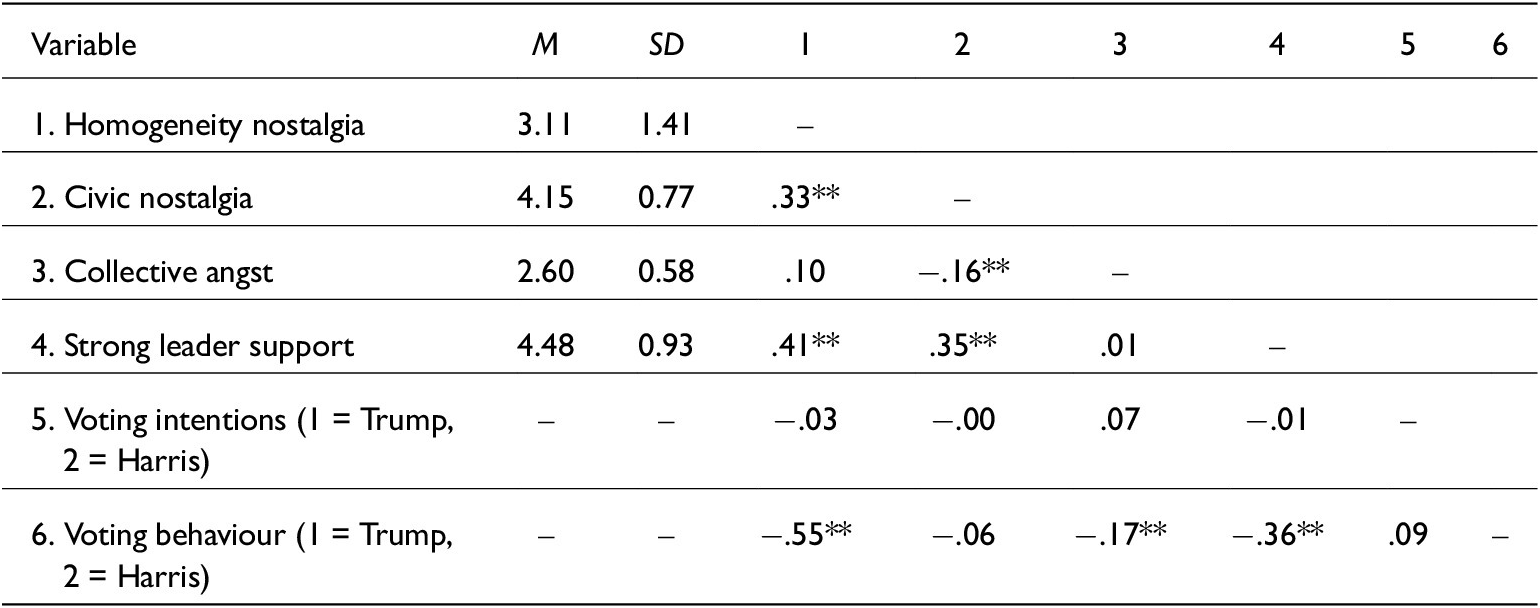
*p < .05; **p < .01. N = 282.
Pre-election strong leader support
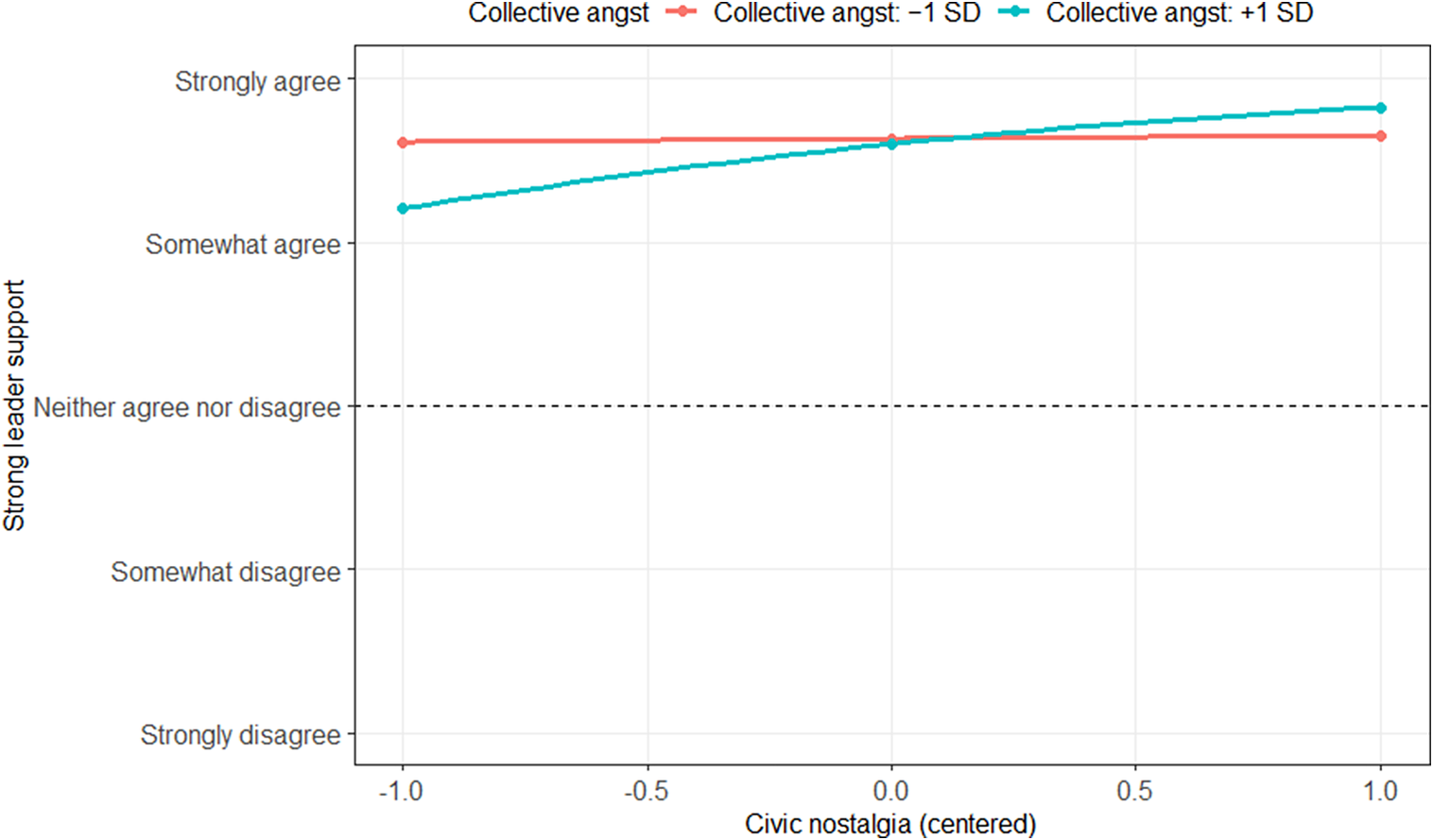
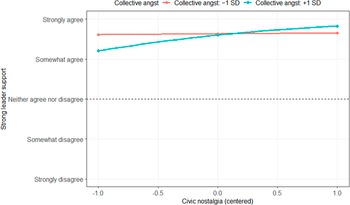
Results for the regression analysis are shown in Table 2. There were main effects for homogeneity nostalgia (odds ratio = 1.98) and civic nostalgia (odds ratio = 1.69), in which each was associated with increased strong leader support. The magnitude of the effects was small. There was no main effect for collective angst. All interaction effects were not statistically significant except for the two-way interaction between civic nostalgia and collective angst, which qualified the main effect of civic nostalgia on strong leader support (see Figure 1). Simple slopes analyses indicated that civic nostalgia was associated with greater strong leader support when collective angst was high (B = 0.98, SE = .29, p = .001) but not when collective angst was low (B = 0.07, SE = .32, p = .83). The magnitude of the effect was small-to-moderate in size (odds ratio = 2.66).
Results of moderated regression analysis predicting pre-election strong leader support
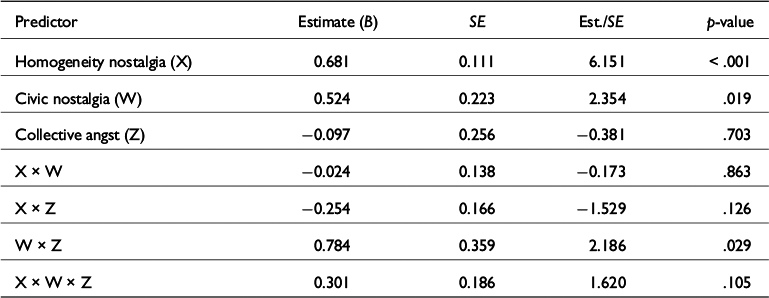
Note: Regression coefficients are unstandardized. N = 282.
Simple slopes displaying two-way interaction for predicted strong leader support. Note: Expected level of agreement with the statement ‘Our country needs a strong leader right now’ as a function of civic nostalgia at low (−1 SD) and high (+1 SD) levels of collective angst. Values represent the expected response on a five-point scale ranging from strongly disagree (1) to strongly agree (5). The dashed horizontal line marks the neutral midpoint of the scale.
We repeated these analyses with political affiliation as a covariate. Of the 282 participants, 140 affiliated with the Republican Party, 139 affiliated with the Democratic Party, and three with neither. For this analysis, we excluded the three participants who indicated neither. Critically, the results of the analysis remained virtually the same (see Table S1 on OSF).
Pre-election voting intentions
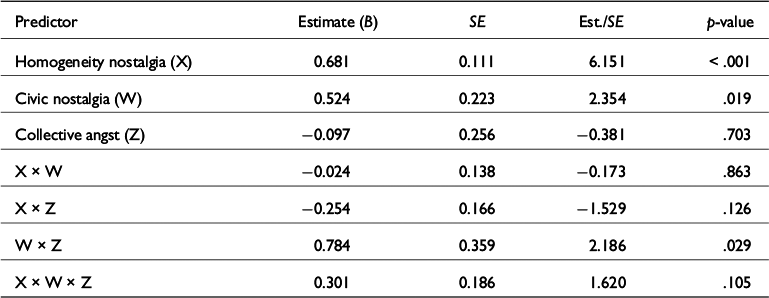
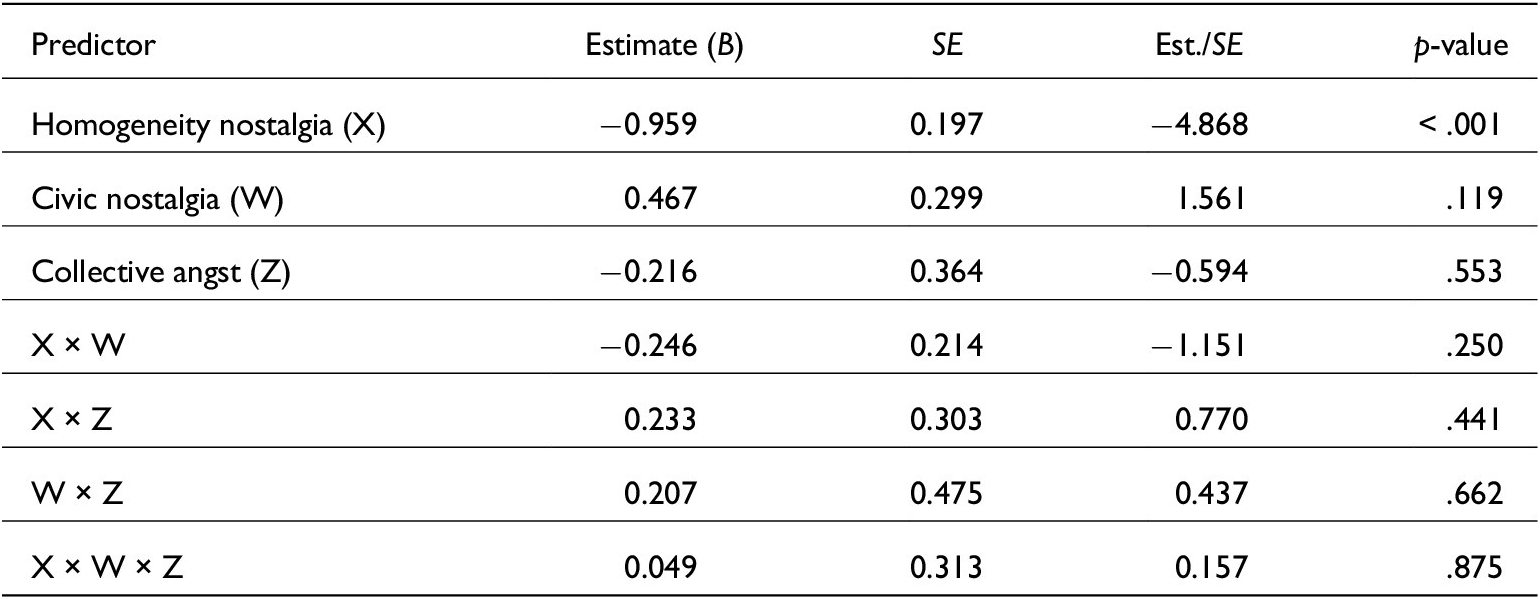
A subset of the total sample (n = 117) did not pre-vote (e.g. mail in their ballot prior to election day) and so were included in the regression analysis examining pre-election voting intentions (1 = Trump, 2 = Harris). Of these participants, 69 intended to vote for Trump and 48 intended to vote for Harris. The regression results are presented in Table 3. All main effects and interaction effects were not statistically significant except for the main effect of homogeneity nostalgia. That is, greater homogeneity nostalgia was linked to greater support for Trump relative to Harris. The magnitude of the effect was small-to-moderate in size (odds ratio = 0.38).
Results of moderated regression analysis predicting pre-election voting intentions
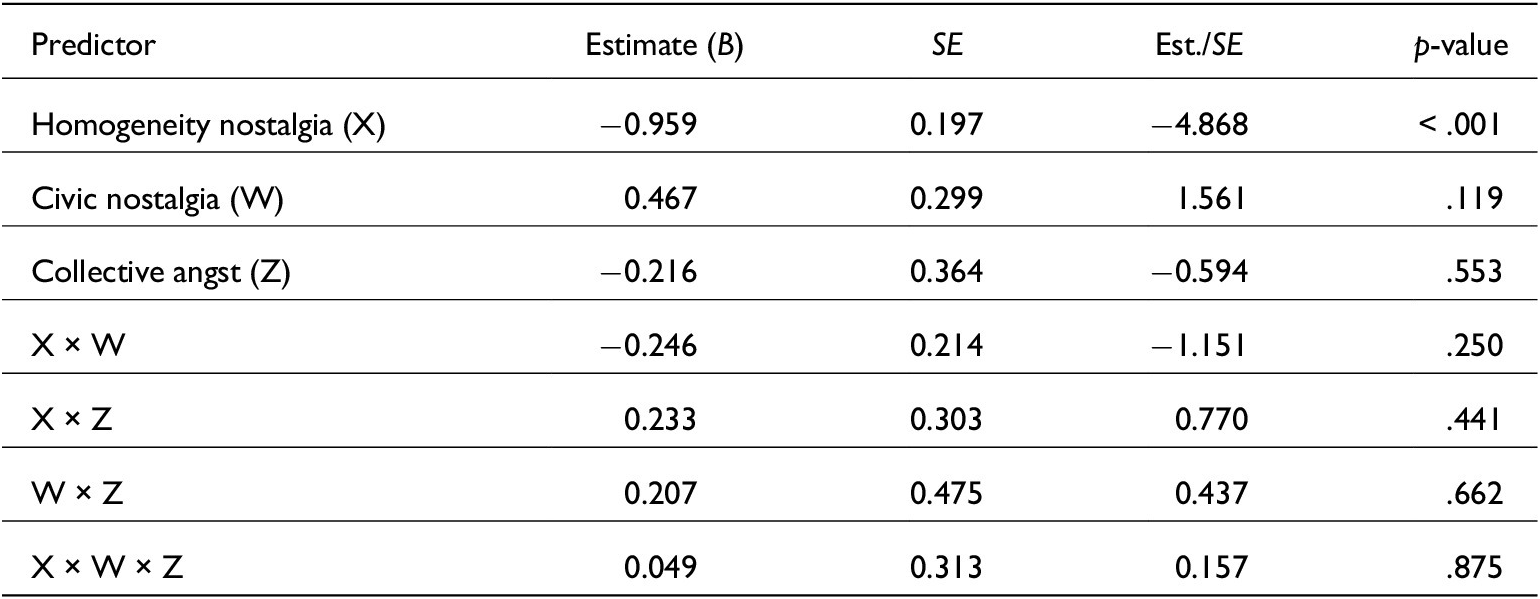
Note: Regression coefficients are unstandardized. N = 117.
Voting behaviour
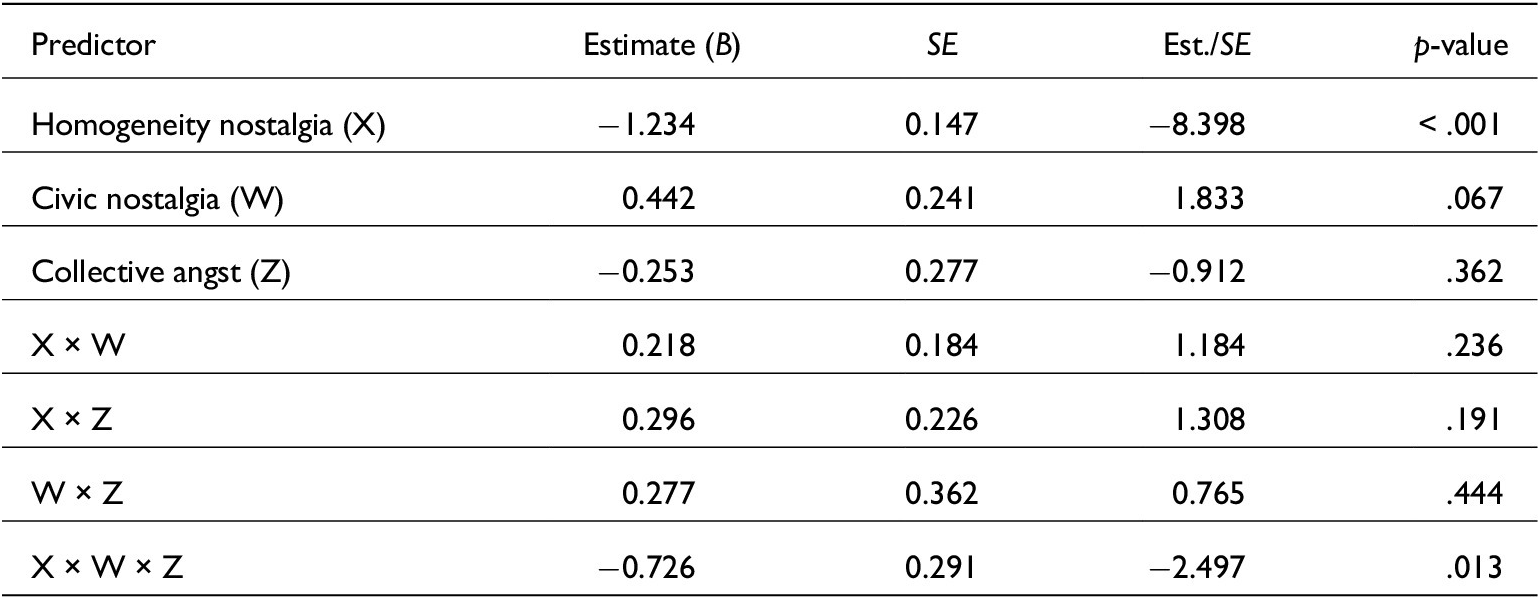
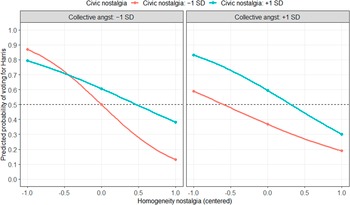
Results for the regression analysis examining post-election voting (1 = Trump, 2 = Harris) are shown in Table 4. There was an even split between participants who voted for Trump (n = 141) and those who voted for Harris (n = 141). All main effects were not statistically significant except for the main effect of homogeneity nostalgia. That is, greater homogeneity nostalgia related to greater support for Trump relative to Harris, and the magnitude of this effect was moderate (odds ratio = 0.29). All two-way interactions were not statistically significant, but the three-way interaction was statistically significant, which qualified the main effect of homogeneity nostalgia on voting behaviour. Importantly, the three-way interaction does not reflect qualitatively different effects of homogeneity nostalgia across all emotional configurations. Rather, homogeneity nostalgia was associated with voting for Trump across most combinations of civic nostalgia and collective angst, with one theoretically meaningful exception that qualified the strength of this association. The interaction effect is illustrated in Figure 2.
Results of moderated regression analysis predicting post-election voting behaviour
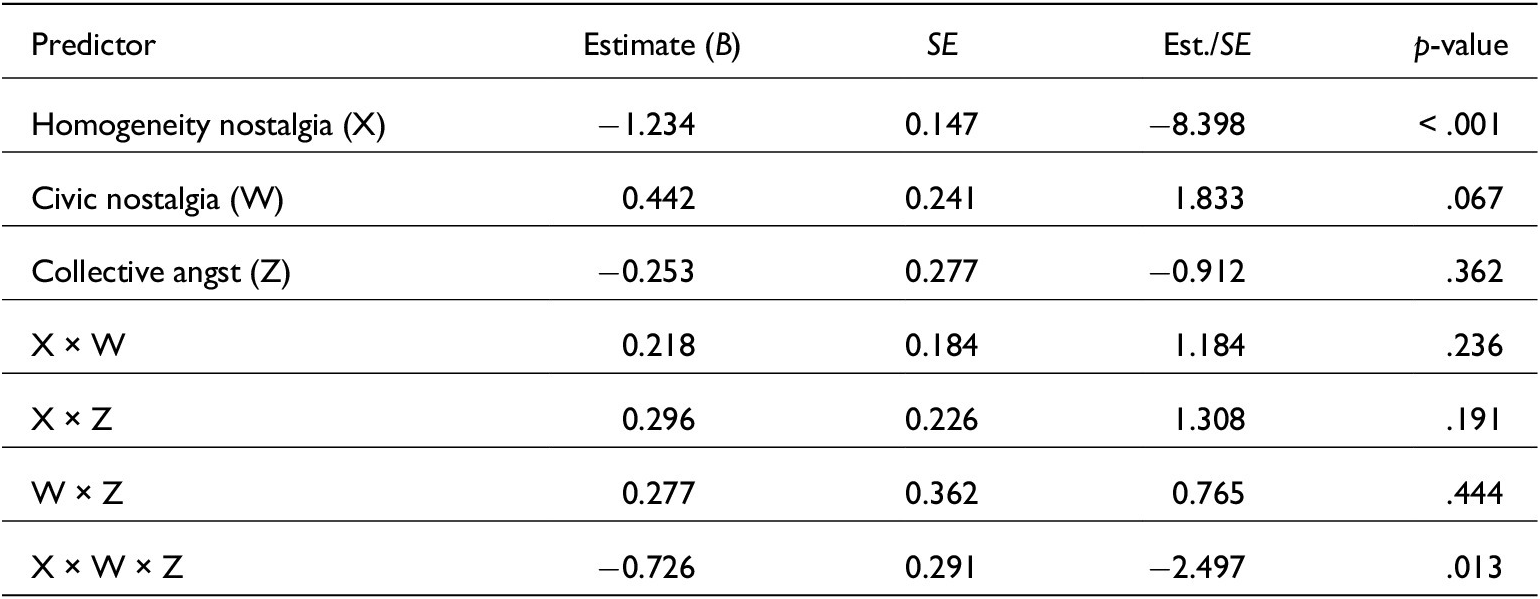
Note: Regression coefficients are unstandardized. N = 282.
Simple slopes displaying three-way interaction for predicted voting behaviour. Note: For this regression, a predicted probability of 0 = a vote for Trump, while a predicted probability of 1 = a vote for Harris.
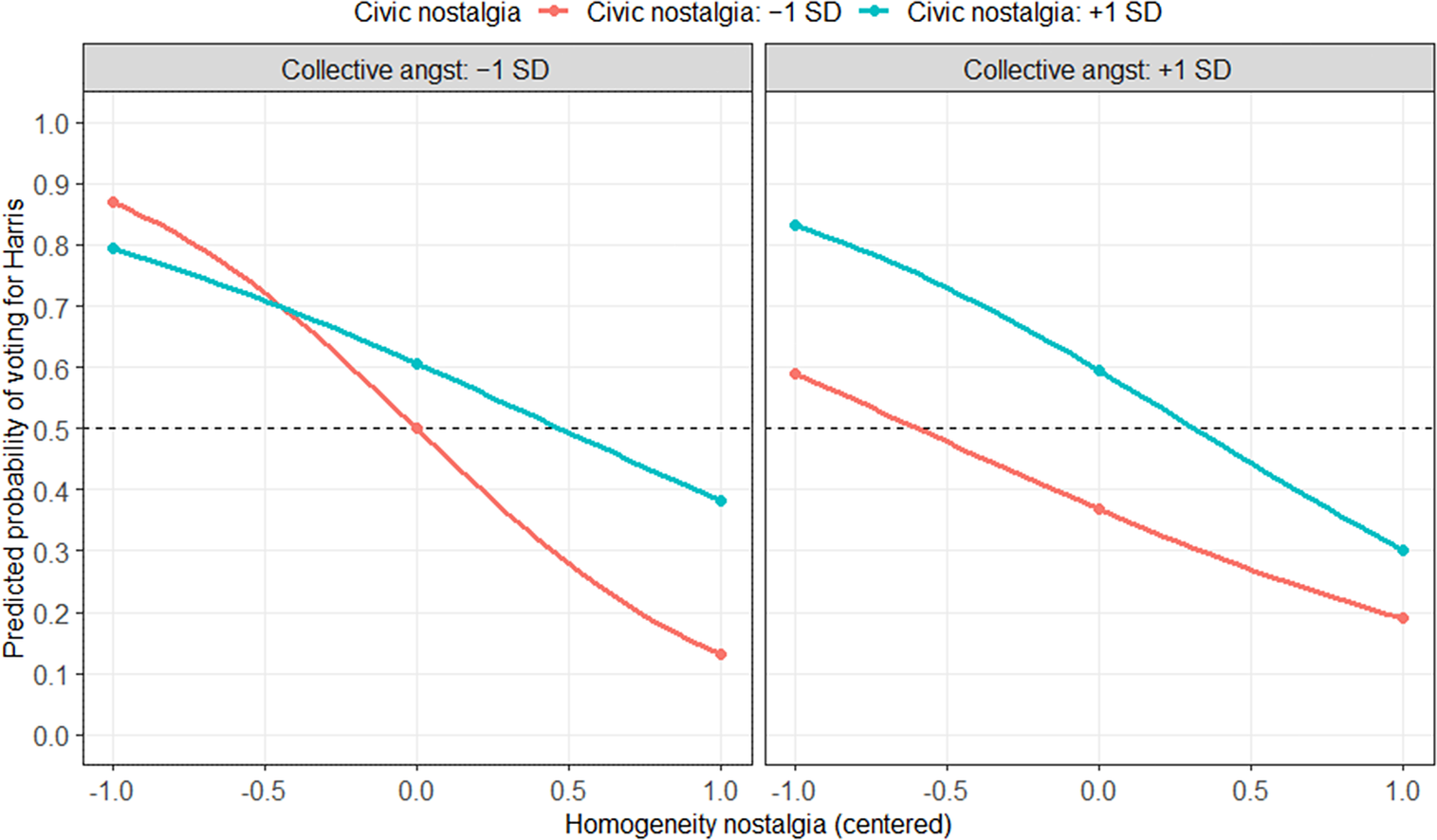
The effect of homogeneity nostalgia on support for Trump (relative to Harris) was generally consistent across combinations of high and low levels of civic nostalgia and collective angst, with one theoretically meaningful exception. When both civic nostalgia and collective angst were low, the effect of homogeneity nostalgia on having voted for Trump (relative to Harris) was strongest. This pattern suggests that longing for a culturally homogeneous past was associated with having voted for Trump, particularly among individuals who feel little collective angst and minimal longing for civic ideals. In other words, homogeneity-focused nostalgia exerted its strongest influence on voting behaviour when neither an inclusive orientation towards the past nor concern about the nation’s future was salient.
The effect of homogeneity nostalgia was similar across high and low levels of civic nostalgia and collective angst, except when civic nostalgia and collective angst were both low. In this case, the effect of homogeneity nostalgia was larger in size (odds ratio = 0.15).
In sum, the results showed a consistent role for collective nostalgia in shaping political preferences across outcomes, with important differences by the content of collective nostalgia and emotional context. Homogeneity-focused nostalgia was the most reliable predictor of voting intentions and behaviour, whereas both forms of collective nostalgia were associated with greater endorsement of strong leadership. Collective angst did not exert a direct effect but qualified the influence of civic-focused collective nostalgia on strong leader support and, in combination with nostalgic content, shaped voting behaviour. Notably, more complex interaction effects emerged only for reported voting behaviour, underscoring the importance of distinguishing between attitudes, intentions, and enacted political choice.
Discussion
The present research examined whether citizens’ emotional orientations towards their nation’s past and future were associated with political preferences during a pivotal national moment – a federal election. Specifically, in the days before and after the 2024 US federal election, we assessed whether two forms of collective nostalgia (civic-focused and homogeneity-focused) and collective angst (i.e. anxiety about the group’s future) shaped support for strong leadership, voting intentions, and actual voting behaviour. We tested the idea that homogeneity-focused nostalgia, but not civic-focused nostalgia, would be linked to pre-election support for strong leadership and greater likelihood of supporting Donald Trump, whose campaign emphasized national restoration and cultural uniformity. In contrast, we examined whether civic-focused nostalgia orients citizens towards cooperative and institutional ideals embodied in Kamala Harris’ campaign. We further explored collective angst as an agent that strengthens these relationships by amplifying the desire for protection and order among those nostalgic for a homogeneous past. Our longitudinal design, which included pre- and post-election measurement, allowed us to assess how these emotional orientations translated into both intentions and real voting behaviour. In line with the sociocultural approach to memory and anxiety articulated in the editorial introduction to this collection (Batiashvili et al. Reference Batiashvili, Topçu and Wertsch2025), our findings suggest that collective memories are not merely retrospective representations of the past but active meaning-making tools that structure present emotional climates.
A first core finding concerns how collective nostalgia relates to support for strong leadership. We found that both civic and homogeneity nostalgia independently were associated with stronger endorsement of the belief that ‘our country needs a strong leader right now’. This pattern suggests that nostalgia, regardless of its content (and above and beyond political orientation), may heighten citizens’ appetite for decisive leadership when continuity feels threatened, consistent with the idea that nostalgia restores meaning and coherence during times of instability (Sedikides and Wildschut Reference Sedikides and Wildschut2019). However, this general pattern was qualified by a significant interaction between civic nostalgia and collective angst. Specifically, civic nostalgia was associated with stronger support for strong leadership only when collective angst was high, but not when it was low. This finding implies that citizens who long for a civic, inclusive past are more likely to desire strong leadership when they also feel anxious about their nation’s future. In the absence of such anxiety, civic nostalgia alone does not translate into heightened strong leader support. This pattern suggests that angst serves as an activator: when people are both nostalgically civic-minded and collectively worried, they may seek leadership strength as a stabilizing force grounded in shared values rather than authoritarian control.
These results refine existing theories linking threat, nostalgia, and leadership preferences. Specifically, these findings align with motivational theories linking threat and leadership preference. Periods of uncertainty or societal decline are known to foster support for strong or authoritarian leaders who promise stability and restoration (Fromm Reference Fromm1941; Sprong et al. Reference Sprong, Jetten, Wang, Peters, Mols and Verkuyten2019). The present results refine this understanding by showing that collective angst intensifies the effect of civic nostalgia on leader support (not homogeneity nostalgia as predicted), suggesting that even inclusive nostalgic sentiments can heighten preference for strong leadership when anxiety about the group’s continuity is salient. At the same time, the positive main effect of civic nostalgia on support for strong leadership may appear counterintuitive. However, because the measure captured a general preference for decisiveness rather than authoritarianism, civic nostalgia may have heightened endorsement of strength understood as principled, moral, and institutionally anchored leadership. Thus, both nostalgic orientations may foster a desire for strong leadership, but for distinct reasons: homogeneity nostalgia seeks strength through control and restoration, whereas civic nostalgia seeks strength through integrity and renewal.
The analysis of voting intentions, albeit based on a smaller sample, revealed that homogeneity nostalgia was the only significant predictor, such that higher nostalgia for cultural sameness was associated with a greater likelihood of intending to vote for Trump rather than Harris. This finding supports the argument that nostalgia for a culturally uniform past motivates citizens to favour candidates who promise restoration and protection of traditional values (Smeekes Reference Smeekes2015; Mols and Jetten Reference Mols and Jetten2017; Wohl et al. Reference Wohl, Stefaniak and Smeekes2023). Although underpowered, this result suggests that the emotional pull of homogeneity nostalgia manifests early, shaping voting preferences even before ballots are cast.
The most nuanced findings concern actual voting behaviour, where emotional configurations jointly shaped electoral choice. The pattern for actual voting behaviour mirrored and extended these effects, with homogeneity nostalgia again relating to a greater likelihood of voting for Trump relative to Harris. This effect, however, was qualified by a three-way interaction among homogeneity nostalgia, civic nostalgia, and collective angst. There are two plausible ways to interpret this pattern. One interpretation is that homogeneity nostalgia functions as a baseline restoration-oriented preference, most strongly associated with Trump support when both civic nostalgia and collective angst are low. From this viewpoint, longing for a culturally homogeneous past exerts its greatest influence when neither an inclusive orientation to the past nor concern about the country’s future is salient. A second, equally viable interpretation centres on the role of civic nostalgia. When individuals are high in either homogeneity nostalgia or collective angst or both, higher civic nostalgia consistently shifts voting intentions towards Harris. In this reading, civic nostalgia acts as a counterweight. It tempers the electoral pull of homogeneity nostalgia precisely when future-focused anxiety and homogeneous longing would otherwise align towards a more authoritarian choice. Notably, civic nostalgia does not differentiate voting behaviour when both homogeneity nostalgia and angst are low, indicating that its influence emerges primarily when political threat or exclusionary longing is activated. These interpretations highlight that civic and homogeneity nostalgia are not simply competing sentiments about the past; their meaning and impact depend on citizens’ emotional orientation towards the future.
These voting patterns diverge subtly but importantly from the pre-election results. Before the election, collective angst amplified the effect of civic nostalgia on support for strong leaders; in contrast, in the actual voting data, angst did not strengthen the influence of homogeneity nostalgia. Instead, homogeneity nostalgia was associated with Trump voting most strongly when both civic nostalgia and collective angst were low. That is, when neither an inclusive vision of the past nor concern about the nation’s future was salient. This asymmetry suggests that the effect of collective nostalgia depends jointly on temporal orientation (past- versus future-focused group-based emotion) and content (inclusive versus exclusionary memories): civic nostalgia becomes consequential under threat, whereas homogeneity nostalgia exerts its strongest influence when competing emotional considerations are absent.
One way to understand this pattern is to conceptualize low levels of both collective nostalgia and collective angst as an emotionally unactivated state. When neither longing for the past nor concern about the group’s future is salient, political decision-making may rely less on affectively charged interpretations of continuity or threat and more on default identity-based orientations. From this perspective, homogeneity-focused nostalgia functions as a baseline restoration-oriented lens that exerts its strongest influence on behaviour precisely when it is not counterbalanced by either an inclusive nostalgic orientation or heightened anxiety about the nation’s future. This framing also helps explain why the effect emerges for reported voting behaviour but not for strong leader support or voting intentions. Voting represents a moment of behavioural commitment, in which abstract attitudes and intentions are translated into concrete choice, allowing default orientations to assert themselves most clearly. It is important to note, however, that these higher-order interaction effects are context-dependent and should be interpreted with caution, particularly given differences in statistical power across outcomes and the smaller sample size for voting intentions.
These findings dovetail with a growing literature demonstrating that the content of nostalgia provides the interpretive framework through which collective threat and anxiety are processed (Wohl et al. Reference Wohl, Stefaniak and Smeekes2020b). They also fit within the broader theoretical model of collective angst, which holds that perceived threats to a group’s continuity evoke protective motivations that can be directed towards either prosocial or exclusionary outcomes (Wohl et al. Reference Wohl, Branscombe and Reysen2010; Porat et al. Reference Porat, Halperin and Wohl2019). Our results extend this framework by revealing that collective angst can either potentiate or attenuate the political consequences of nostalgia depending on which version of the past citizens draw upon. The combination of these emotions (i.e. how the remembered past interacts with imagined futures) reveals the dual potential of nostalgia to either sustain or destabilize democratic life.
Political judgment is rarely dispassionate; it is saturated with shared affect circulating through social and institutional channels (Hoggett and Thompson Reference Hoggett and Thompson2012). Work in narrative psychology underscores how collective remembrance organizes present motivations and future-directed agency (László Reference László2014). The present findings echo scholarship on the political use of the past, showing how nostalgic appeals to national identity are mobilized through campaign rhetoric and social movements (Bonnett Reference Bonnett2010; Duyvendak Reference Duyvendak2011). The findings also resonate with ‘mediatized memory’ frameworks that emphasize how digital and media ecologies curate which versions of the past feel actionable in the present (Hoskins Reference Hoskins2018). The way collective angst adheres to different nostalgic contents is also consistent with affective economy theory (Ahmed Reference Ahmed2004), which proposes that emotions ‘stick’ to particular signs and narratives, guiding collective attention and behaviour. Across these literatures, the current findings converge on a central insight: which past citizens long for determines how anxiety about the group’s future is politically converted – towards democratic renewal or defensive restoration.
Implications
The present findings carry important implications for understanding how group-based emotions that link collective memory and imagined futures shape political life. At their core, both collective nostalgia and collective angst are temporal emotions – they bind group members to a shared narrative of ‘who we were’ and ‘what we might become’. By showing that these emotions are jointly linked to preferences for strong leadership and actual voting behaviour, the present research extends work in both political psychology and memory studies that emphasizes the political power of group-based emotions (Hoggett and Thompson Reference Hoggett and Thompson2012; László Reference László2014).
From a theoretical standpoint, our results illuminate how collective memory operates as a motivational system. Memory is not merely retrospective; it organizes affective meaning and mobilizes collective action in the present (László Reference László2014; Wohl et al. Reference Wohl, Stefaniak and Smeekes2023). The pre-election results indicate that civic nostalgia can translate into greater desire for strong leadership, but only when citizens simultaneously feel collective angst about the group’s future. This suggests that inclusive, civically oriented memories may not inoculate against threat sensitivity; rather, they can heighten motivation for strong (though not necessarily authoritarian) leadership when future-oriented anxiety is salient. Conversely, the post-election findings show that nostalgia for cultural homogeneity was associated with voting for a restorationist candidate (Trump), particularly when civic nostalgia and collective angst are both low. When citizens neither long for civic ideals nor feel collectively anxious, homogeneity nostalgia appears to dominate the motivational landscape, directing political behaviour towards exclusionary restoration rather than inclusive renewal.
These findings reveal that nostalgia’s political consequences hinge on its emotional context: civic nostalgia under threat can mobilize protective but potentially constructive engagement, whereas homogeneity nostalgia absent threat channels memory towards defensive and exclusionary ends. Thus, the content of collective nostalgia provides the interpretive script that guides how citizens emotionally navigate moments of political discontinuity. Elections, in this sense, serve as public rituals of remembrance that crystallize competing affective narratives – one looking backward to a mythic, unified past, and another invoking the past as a moral compass for pluralistic renewal.
Our findings also carry implications for theories of media, communication, and emotional mobilization. Political campaigns and news media routinely activate nostalgic imagery to frame political choices (through slogans, visual symbolism, and selective storytelling; Bonnett Reference Bonnett2010; Duyvendak Reference Duyvendak2011). Our data suggest that the emotional resonance of such appeals depends not only on which past is evoked (civic versus homogeneous) but also on citizens’ prevailing sense of collective security. Campaigns that evoke civic nostalgia (i.e. longing for fairness, respect, and institutional trust) may mobilize participation without triggering the defensive dynamics of exclusion, especially when they acknowledge rather than exploit collective angst. In contrast, appeals to homogeneity can be most effective when citizens feel calm rather than threatened, as they reframe nostalgia as restoration without necessarily invoking fear or loss.
This distinction underscores the need to understand how collective memory circulates affectively through media ecologies. Group-based emotions such as collective nostalgia and collective angst do not arise in a vacuum; they are mediated by communicative environments that frame which versions of the past are remembered and which futures feel possible (Hoskins Reference Hoskins2018). The present findings thus invite integration between political psychology and media-memory studies: understanding political emotion requires not only measuring psychological states but also analysing the mediated narratives that sustain them.
Practically, these insights have implications for democratic resilience and civic communication. As misinformation and affective polarization erode public trust, fostering emotionally constructive forms of memory becomes vital. Public discourse that celebrates shared civic achievements (i.e. moments of cooperation, democratic reform, and collective progress) may activate nostalgia in ways that strengthen inclusive civic identity rather than nostalgic nationalism. Yet, our results also caution that civic nostalgia alone is not a panacea: under conditions of collective anxiety, even inclusive longing for the past can translate into support for stronger, more controlling leadership. Similarly, civic education and public memory initiatives (e.g. museums, commemorations, documentaries) can emphasize continuity grounded in pluralism rather than sameness. When the collective past is framed as shared but diverse, collective nostalgia can serve as a bridge across difference rather than a boundary marker of exclusion.
At the same time, recognizing the emotional potency of both collective nostalgia and collective angst can inform interventions aimed at reducing susceptibility to populist and authoritarian appeals. Media literacy initiatives, for instance, could highlight how nostalgic narratives often simplify history and obscure whose past is being remembered (Bonnett Reference Bonnett2010). Political communication that makes citizens aware of these emotional manipulations may help recalibrate nostalgia’s motivational force, from restoration of sameness to renewal of shared purpose.
More broadly, these findings contribute to emerging interdisciplinary conversations about the emotional infrastructures of democracy (i.e. how feelings of belonging, loss, and fear are socially produced and politically mobilized; Ahmed Reference Ahmed2004; László Reference László2014). By mapping how collective nostalgia and collective angst interact to shape real political choices, this research helps explain why appeals to the past are so enduringly persuasive in democratic societies. The key insight is that nostalgia’s democratic or anti-democratic consequences depend on both its content and the emotional climate in which it is activated. Emotions connecting memory and threat can either fortify democracy through shared meaning or corrode it through exclusionary longing. The challenge for scholars, communicators, and policymakers alike is to understand and guide these emotional dynamics in ways that sustain democratic continuity.
Limitations and future directions
Despite our study’s strengths, several limitations warrant caution. First, although the study employed a longitudinal design spanning the 2024 US election, causality cannot be fully inferred. Emotions such as nostalgia and angst may fluctuate dynamically in response to political campaigns or news events, and reciprocal effects are possible (e.g. voting intentions may reinforce emotional states). Future research could use experimental manipulations of collective nostalgia content to clarify causal pathways. Second, the measure of strong leadership captured a general preference for decisiveness rather than differentiating between authoritarian and democratic strength. This conceptual breadth may explain why both forms of nostalgia were linked to stronger leader support. Subsequent work should employ multidimensional measures that distinguish between coercive and integrative forms of leadership endorsement (Crimston et al. Reference Crimston, Selvanathan and Jetten2022). Third, although our sample was diverse, it was not nationally representative. Cultural, regional, or demographic variations may influence how nostalgia and angst manifest politically. Moreover, while our coding of voting behaviour as a binary (Trump versus Harris) captures the dominant electoral division, it does not account for third-party voters or abstainers. Future studies could use multinomial or continuous measures of political orientation to assess whether these emotional patterns generalize beyond binary partisanship.
Fourth, strong leader support was assessed using a single, broad item that does not distinguish between authoritarian and democratically constrained leadership. Although prior research suggests that such items often capture a desire for decisiveness under uncertainty, future work should employ more fine-grained measures to differentiate preferences for leadership strength from preferences for authoritarian governance.
Fifth, interpretation of differences across outcomes should be made with appropriate caution. The analysis of voting intentions was based on a smaller subsample, limiting statistical power and making null effects difficult to interpret. As such, apparent differences between voting intentions and reported voting behaviour may reflect methodological constraints rather than substantive psychological divergence. Moreover, although the pre- and post-election design strengthens confidence in temporal ordering, collective nostalgia and collective angst were assessed only prior to the election. Consequently, the present findings speak to associations between pre-election emotional orientations and subsequent political behaviour, but cannot rule out reciprocal or dynamic processes in which political engagement or emerging preferences also shape emotional experience over time.
Finally, civic nostalgia remains a relatively novel construct. Although our findings support its potential to predict both inclusive and protective political orientations depending on context, further validation across settings is essential. Researchers should examine whether civic nostalgia’s interaction with collective angst replicates across different types of perceived threat (economic, cultural, environmental) and whether its motivational consequences differ across political systems. Similarly, additional work should clarify whether the buffering effect of civic nostalgia and angst on homogeneity-driven voting behaviour generalizes beyond the US electoral context.
Conclusion
Elections are more than political events; they are emotional crucibles that expose how citizens imagine their nation’s past and fear for its future. The present study demonstrates that collective nostalgia and collective angst (emotions that link time, identity, and meaning) interact to link how people think, feel, and vote. Before the election, civic nostalgia was associated with stronger support for strong leadership only when citizens felt collective angst, suggesting that inclusive memories can heighten the desire for stability under perceived threat. After the election, nostalgia for a homogeneous past was associated with voting for Trump, especially among those low in both civic nostalgia and collective angst, indicating that exclusionary memories can guide political choice even in the absence of threat.
In an era of rapid social change and growing polarization, understanding these emotional undercurrents is crucial for maintaining democratic resilience. As nations continue to grapple with questions of who ‘we’ are and what ‘we’ stand for, the stories citizens tell about their past and the concerns they hold for their future will remain powerful predictors of the leaders they choose to follow. The challenge lies in cultivating forms of nostalgia that evoke shared civic pride rather than exclusionary longing, and in transforming collective angst into democratic vigilance rather than retreat.
Supplementary Material
To view supplementary material for this article, please visit http://doi.org/10.1017/mem.2026.10031.
Acknowledgements
Preparation of this article was supported by a Social Sciences and Humanities Research Council of Canada Insight Grant to Wohl, Packer, and Stefaniak and a Sabbatical Support Grant from the Institute for Humane Studies to Wohl.
Competing interests
The authors declare that there are no potential conflicts of interest with respect to authorship and/or publication of this article.
Research Ethics Board approvals
Carleton University Research Ethics Board-B (#121264).
Dr. Michael Wohl is a Professor of Psychology at Carleton University and the Director of the Conflict Resolution Laboratory. His research examines harmdoing, forgiveness, and reconciliation, with a focus on how nostalgia shapes social bonds, polarization, and support for strong leaders. He has published over 200 papers and secured over eight million dollars in research funding.
Dr. Nassim Tabri is an Associate Professor in the Department of Psychology at Carleton University. He studies why people engage in health-compromising behaviours and how group membership shapes mental health and influences intergroup behaviour.
Dr. Anna Stefaniak is a Lecturer in the School of Psychology and Neuroscience at the University of St Andrews and an adjunct research professor in the Department of Psychology at Carleton University. She studies people’s attitudes and emotions related to the history of their social groups and methods for reducing intergroup bias.
Dr. Nick Ungson is an Assistant Professor of Psychology at Susquehanna University. His research investigates how shared identities make groups open to criticism, diversity, and cooperation, and when they instead reinforce conformity, hierarchy, and exclusion.
Dr. Dominic Packer is a Professor of Psychology, Vice Provost for Educational Innovation and Assessment, and Senior Advisor to the Vice Provost for Research at Lehigh University. His research investigates how social identities affect relations between groups, as well as conformity and dissent within them.


 Open access

