



In the context of a global obesity epidemic, concerns have been raised about the marketing of unhealthy foods to children on television( Reference Hastings, Stead and McDermott 1 – Reference Story and French 5 ). A large-scale systematic review by Hastings et al. ( Reference Hastings, Stead and McDermott 1 ) has stated that the emphasis on the promotion of high-fat, sugar and/or salt (HFSS) foods on television constitutes a major barrier to instilling healthy food choices in children. In support of this, an increasing body of scientific evidence exists to demonstrate the direct causal effects of exposure to food advertising on food preferences( Reference Boyland, Harrold and Kirkham 6 , Reference Halford, Boyland and Cooper 7 ), brand preferences( Reference Borzekowski and Robinson 8 ), product requests( Reference Buijzen and Valkenburg 9 ), snack food consumption( Reference Halford, Gillespie and Brown 10 , Reference Halford, Boyland and Hughes 11 ) and overall energy intake( Reference Epstein, Roemmich and Robinson 12 ) in children, with data also showing that it leads to a reduced intake of fruits and vegetables longitudinally( Reference Barr-Anderson, Larson and Nelson 13 ).
In particular, fast food advertising has been shown to be highly prevalent on television( Reference Boyland, Harrold and Kirkham 14 , Reference Kelly, Halford and Boyland 15 ) and has not only been associated with normalising and increasing fast food consumption( Reference Grier, Mensinger and Huang 16 ) but has also been associated with increasing body fat( Reference Grossman, Tekin and Wada 17 ), BMI( Reference Andreyeva, Kelly and Harris 18 ) and rates of obesity( Reference Chou, Rashad and Grossman 19 ) in youth, particularly in those who are receptive to its promotional messages( Reference McClure, Tanski and Gilbert-Diamond 20 ). To increase this receptivity in the profitable youth market( Reference McNeal 21 ), fast food advertising often directly targets young audience with techniques of particular appeal to that age group such as the inclusion of premiums (such as toy giveaways) and movie tie-ins( Reference Sahud, Binns and Meadow 22 , Reference Bernhardt, Wilking and Adachi-Mejia 23 ), and strong brand imagery. These elements are far less apparent when the companies are advertising to adults( Reference Bernhardt, Wilking and Adachi-Mejia 23 ). It is notable that in the last few decades, levels of fast food consumption in childhood have increased substantially( Reference St-Onge, Keller and Heymsfield 24 , Reference Bauer, Larson and Nelson 25 ), consistent with rising saturation of restaurants( Reference Newman, Howlett and Burton 26 ), and in parallel with rising prevalence of paediatric obesity. In the UK alone, the fast food and takeaway market was estimated to be worth £8·9 billion in 2005, a figure that was predicted to rise by 5 % each year( Reference Patterson, Risby and Chan 27 ).
Regulations were introduced in the UK in 2007 to govern the promotion of HFSS foods in and around television programming deemed to be ‘of particular appeal to children’( 28 ). These regulations use a nutrient profiling scheme to determine those foods (and beverages) that should (or should not) be advertised to children( 28 , Reference Rayner, Scarborough and Stockley 29 ), such that the promotion of healthy items is not restricted.
As a result of these rules, although fast food advertising on television has not reduced( Reference Boyland, Harrold and Kirkham 14 , Reference Galbraith-Emami and Lobstein 30 ), it now increasingly depicts healthier items (e.g. fruit and water along with the main item, instead of fries and a soft drink; E. J. Boyland, unpublished results) that ‘pass’ the nutrient profiling thresholds and, therefore, can be advertised to children. A similar trend has been observed in the USA in response to food industry self-regulatory pledges( Reference Bernhardt, Wilking and Gottlieb 31 ). Importantly, the effects of this type of advertising on eating behaviours of children are so far unknown.
Given the financial power of the food industry relative to the public health sector, combining the known appeal of highly familiar( Reference Arredondo, Castaneda and Elder 32 ), liked brands and their persuasive marketing techniques for healthier foods has often been suggested as a potentially promising public health approach( Reference Gunnarsdottir and Thorsdottir 33 – Reference Kirkpatrick, Reedy and Kahle 37 ). However, a recent study by Bernhardt et al. ( Reference Bernhardt, Wilking and Gottlieb 31 ) has found that when healthy foods are depicted in fast food advertising, the items are often not recognised by children, or the manner of their presentation caused confusion (e.g. apple pieces in the shape of French fries). Understanding how factors such as food advertising affect food choices in children is crucial, as even young children are often somewhat autonomous in their diet-related decision making, and parental intervention alone is seemingly not sufficient to ensure that healthy choices will be made( Reference Wellard, Chapman and Wolfenden 38 ).
One factor that may influence dietary selections in children is nutritional knowledge. Although some studies have not shown an association between good nutritional knowledge and healthy food choices in children( Reference Murphy, Youatt and Hoerr 39 , Reference Gibson, Wardle and Watts 40 ), others have found a positive relationship( Reference Pirouznia 41 ). Furthermore, exposure to nutrition education campaigns has been demonstrated to positively influence the selection of healthy snack foods in children( Reference Bannon and Schwartz 42 ). Similarly, researchers exploring the effects of television advertising for healthy foods found that this can promote positive attitudes and beliefs about these foods( Reference Dixon, Scully and Wakefield 43 , Reference Beaudoin, Fernandez and Wall 44 ), and even alter food choices in some children, although this led to a reduction in the consumption of unhealthy foods rather than increasing the intake of healthier options( Reference Dovey, Taylor and Stow 45 ).
The present study is the first to experimentally test the impact of fast food advertising where healthier items are depicted (hereafter ‘healthy’ fast food advertising) as fast food liking and choice in children with varying levels of nutritional knowledge.
Methods
Participants
Of the 59 children, 48 (thirty-seven males and eleven overweight or obese) aged 7–10 years (8·8 (sd 0·9) years) took part in the present study between March and May 2014. Participants were recruited from three primary schools in northwest England using opportunistic sampling. Information sheets and consent forms were sent by the schools to parents with children in the desired age range, a range similar to that indicated in previously published studies, demonstrating the impact of television food advertising on food choices and intake in children( Reference Boyland, Harrold and Kirkham 6 , Reference Halford, Boyland and Hughes 11 ). No incentive for participation was offered. Due to the novel nature of the study, equivalent data were not available for a power analysis. Therefore, the sample size was based on a similar published study of food marketing effects on children( Reference Halford, Boyland and Hughes 11 ).
The present study was conducted according to the guidelines laid down in the Declaration of Helsinki, and all procedures involving human subjects were approved by the Institute of Psychology, Health and Society Research Ethics Committee at the University of Liverpool under a generic approval for studies of this nature provided by the University's Research Ethics Sub-committee for Non-invasive Procedures. Written informed consent was obtained from all gatekeepers (school head teachers and parents). Children whose parents had provided consent for participation were given child-appropriate study information to read; this information was also read out loudly to the group by the researcher. Children were given the opportunity to ask questions about the study in private, after which a verbal consent from children was witnessed and formally recorded by the researcher or class teacher.
Design
The present study was a within-participant, counterbalanced design with two conditions: control (exposure to ten toy advertisements (adverts)) across two breaks of five adverts each) and experimental (the middle advert in each break replaced with an advert for a McDonald's Happy Meal® (a fast food meal bundle aimed at children), depicting the meal bundle as consisting of fish fingers, a fruit bag and a bottle of mineral water). The toy adverts promoted an approximately equal mix of female- and male-targeted items, and all advert breaks were of similar duration (approximately 3·5 min). Adverts were embedded within the same episode of an age-appropriate, sex-neutral cartoon (Phineas and Ferb), which included no reference to or depiction of food or eating. At least a week interval between conditions was enforced to minimise the likelihood that children would recall responses from the previous session.
All television adverts and cartoon were recorded from children and family programming broadcast on popular UK channels during 2012, three years after the full implementation of the Ofcom regulations( 28 ). McDonalds adverts were chosen because McDonalds have the largest UK market share with over one-third of the fast food sales in 2012( Reference King 46 ), and a Happy Meal advert was selected due to the child-targeted nature of this product. The adverts used were shown during children's peak viewing hours (after school period).
Procedure
On test days, children were shown a digital versatile disc (control or experimental, in accordance with a randomisation schedule prepared via http://www.randomizer.org) in small groups of six in a private room within the school. Following viewing, children completed some paper-based measures (detailed below). On the second (final) study day only, height of the participants was measured to the nearest 0·1 cm using a stadiometer (SECA Leicester Portable Height Measure), and weight was measured using recently calibrated weighing scales (SECA 770) to the nearest 0·1 kg in light clothing with no shoes. Testing was carried out at the same time of day on both occasions to minimise variation in levels of hunger between the two conditions.
Measures
Meal bundle food and drink item selection (hereafter ‘food selection’)
Children were presented with labelled colour images (all equally sized) of all choices of ‘main’ foods (cheeseburger, Chicken McNuggets, fish fingers and hamburger) on a single sheet of paper. The images used were obtained from the official McDonald's web site and appeared in the same order as they appear online at the time of testing. Participants were asked to circle or mark the one item they would choose if they were constructing a McDonald's Happy Meal® at that moment. This was then repeated for ‘side’ items (carrot sticks, fruit bag and French fries) and beverages (Fruitizz, Robinsons Fruit Shoot, organic milk, Buxton Mineral Water, Tropicana orange juice, Diet Coke, Fanta Orange, Sprite Zero, Coca-Cola and milkshakes in four possible flavours – banana, vanilla, chocolate and strawberry). A similar ‘hypothetical menu’ approach has been used successfully in a recently published study( Reference Dodds, Wolfenden and Chapman 47 ).
Hunger and fast food liking
Further five-point Likert scales were used to assess hunger, liking for the food at McDonalds and liking for fast food in general (1 = ‘not at all’, 5 = ‘very much’).
Nutritional knowledge
A measure of nutritional knowledge in children was taken( Reference Gibson, Wardle and Watts 40 ). This checklist assesses knowledge of the nutrient content of fifteen common foods and drinks (such as whole milk, skimmed milk, apples and chocolate) by asking children to ‘tick which of the following describes each food: has lots of sugar; has lots of fat; has lots of fibre’. Correct selection of a food high in nutrient content is scored 1, while incorrect selection of foods that are not high in nutrient content is scored − 1, summed for a total score that, theoretically, could range from − 16 to +16.
Statistical analysis
BMI was calculated as weight (kg)/height (m2). Using internationally recognised criteria for children( Reference Cole, Bellizi and Flegal 48 ), healthy weight, overweight and obesity were defined based on age- and sex-specific BMI cut-off points equivalent to adult BMI of 25–30 kg/m2, respectively. BMI z scores adjusted for age and sex were calculated using WHO AnthroPlus software (accessible at http://www.who.int/growthref/tools/en).
Nutritional information from the McDonald's web site was used to calculate energy (kJ) and fat, carbohydrate, sugars and salt contents (g) of all individual items and meal bundles overall in each condition. A mean nutritional knowledge score was generated from the scores in both conditions, and a median split was used to categorise children as having low (score < 8, n 31) or high (score>8, n 28) nutritional knowledge.
Data met the assumptions for parametric analysis, and so t tests and bivariate Pearson's correlations were used. All comparisons were two-tailed, and significance was taken at P< 0·05, with Bonferroni adjustments for multiple comparisons. Analyses were completed using IBM SPSS Statistics version 20.0 for Windows (IBM Corporation). Results are presented as means and standard deviations.
Results
Of the total participants, forty-eight were healthy weight (81·4 %, thirty-one males), six were overweight (10·2 %, three males) and five were obese (8·5 %, three males). Of children in this sample, 18·7 % were overweight or obese; this indicates a lower prevalence of overweight and obesity than the national average of 28 % in children aged 2–15 years( Reference Craig and Mindell 49 ), although it must be taken into account that the Health Survey for England used different reference standards than the present study. Self-reported hunger was not significantly different between the two conditions (t(58) = 0·194, P= 0·846). There were no differences between girls and boys on any food selection outcome in either conditions (results not reported). Therefore, analyses are based on the entire sample unless otherwise stated.
Food selection
There was no significant difference between the two advert exposure conditions (control v. experimental) on the content of the meal bundle selected in terms of energy, fat, carbohydrate, sugars or salt (see Table 1, all comparisons P>0·05). χ2 analyses indicated no difference in the frequency of selection of any items in the main (χ2(3, n 113) = 0·294, P= 0·961), side (χ2(2, n 118) = 1·043, P= 0·593) or drink (χ2(11, n 118) = 4·391, P= 0·957) categories across the two conditions.
Nutritional contents of hypothetical meal selection in each condition (entire sample, n 58) (Mean values and standard deviations)

CHO, carbohydrate.
There were significant, but very weak, positive correlations between BMI z scores and total grams of sugar content in the meal bundles chosen in the control (r 0·286, P= 0·028) and experimental conditions (r 0·258, P= 0·048); however, r 2 values indicate that BMI only explains 0·07 and 0·08 % of variance in this relationship.
Nutritional knowledge and food selection
The mean score for nutritional knowledge across the sample was 7·68 (sd 2·9). The low (n 31) and high (n 28) nutritional knowledge groups did not differ significantly on mean BMI z scores (low 0·772 (sd 1·2) v. high 0·838 (sd 1·1); t(57) = 0·211, P= 0·834) or sex distribution (low: eighteen males, thirteen females; high: nineteen males, nine females; χ2(1, n 59) = 0·603, P= 0·591).
Independent t tests showed no difference between high and low nutritional knowledge groups on total energy content of meal bundle in the control condition (see Table 2, P= 0·150). A significant difference was found after viewing the food adverts, whereby children with low nutritional knowledge selected a meal bundle with a significantly greater energy content than those with higher nutritional knowledge (P= 0·016). This was driven largely by the greater fat content of the meal bundle selected by the children with low (v. high) nutritional knowledge after seeing the food adverts (P= 0·045) as significant differences were not seen for carbohydrate (P= 0·132), sugars (P= 0·0661) or salt (P= 0·271). However, when the energy content of the meal bundle selected in the experimental condition was baseline-adjusted (control condition value subtracted from that of the selection following food adverts), there was no significant difference between the two nutritional knowledge groups (t(57) = 0·829, P =0·136).
Nutritional contents of hypothetical meal selection in each condition by nutritional knowledge (NK) groups (Mean values and standard deviations)
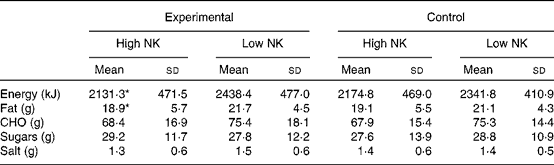
CHO, carbohydrate.
* Mean value was significantly different from that of the low NK group in same condition (P< 0·05).
Fast food liking
There was no significant difference between the children's rating of liking for McDonald's food between the control and experimental conditions, with mean scores equally high (4·3 (sd 1·0) v. 4·3 (sd 1·1); t(58) = 0·000, P>0·999). However, after viewing the food adverts, children reported a greater liking for fast food, in general, relative to after the control adverts (4·2 (sd 1·1) v. 3·8 (sd 1·2); t(57) = 2·962, P= 0·004).
Discussion
The present study is the first to demonstrate the impact of exposure to ‘healthy’ fast food advertising on children's hypothetical food selection. Following exposure to television adverts for McDonald's Happy Meals® in which healthier options were depicted, children did not select a significantly healthier meal bundle for themselves from a hypothetical menu relative to their choices after viewing control adverts. In addition, after seeing the McDonald's adverts, children's reported liking for fast food increased. Therefore, this kind of food promotion, which is permitted on television within the current regulatory regime in the UK and in many other territories, seemingly does not drive healthier food choices, but simply promotes a liking for fast food more generally.
These findings are a concern as although there is always a clear and strong argument for the role of parental responsibility in determining the diets of children, Wellard et al. ( Reference Wellard, Chapman and Wolfenden 38 ) found that, in reality, a majority of parents (60 %) reported sharing responsibility for fast food meal selection with their children. In 27 % of cases, the child was said to be solely responsible for the choice, and for children older than 5 years, only 7 % of parents fully dictated to the selection of meals. Crucially, when children chose their own meals, the energy content of the meals was significantly higher than when their parents chose, however, when responsibility was shared, the energy content of the meal was not significantly lower than that chosen by children alone( Reference Wellard, Chapman and Wolfenden 38 ). A further study has suggested that parents do not choose healthier fast food meal bundles for their children even when menu labelling is provided( Reference Dodds, Wolfenden and Chapman 47 ). Therefore, it is not sufficient to assume that parental involvement will ensure healthy choices are made, and it is clear that factors influencing food choices in children are likely to be important determinants of their actual intake.
Although the present study is novel with no directly comparable data available, these findings are also broadly consistent with those of Dovey et al. ( Reference Dovey, Taylor and Stow 45 ), in which many children failed to respond to the specific content of food advertising (i.e. whether the foods represented were healthy or not), instead had a similar appetitive response to both healthy and unhealthy food adverts. These findings also concur with the assertion of Hastings et al. ( Reference Hastings, Stead and McDermott 1 ) that food promotion works at a category level (driving liking for a food type), although interestingly in the present study, this difference in liking was also not shown at a brand level as would be anticipated. It is probable that this was due to a ceiling effect, as liking for McDonald's food was particularly high across the sample (mean of 4·3 on a scale with a maximum of 5) regardless of condition. This universal liking is not unexpected, given that this brand's advertising was chosen for use in the present study because of its familiarity and popularity with the UK market( Reference King 46 ). Given the inter-play between hedonic liking and motivational wanting in our reward responses to food( Reference Berridge 50 ), these adverts could act as a reminder to children that they like the foods represented, which may also trigger wanting and actual choice of those items in the real-world food environment.
Although these findings are limited by the scale of the study and the use of hypothetical food selection rather than a real-world eating opportunity, there are some potential implications for the debate about food marketing regulation and the proposed use of well-known brands to promote healthier food choices in children( Reference Gunnarsdottir and Thorsdottir 33 – Reference Kirkpatrick, Reedy and Kahle 37 ).
First, these findings provide initial empirical evidence that policies which permit highly familiar fast food brands to continue to advertise their products to children on television provided that they depict a healthier profile of foods, and beverages are potentially detrimental to child health as they act to increase liking for fast food and do not improve food choices. Research also suggests that children are often confused by this type of marketing( Reference Bernhardt, Wilking and Gottlieb 31 ). Similar questions must be raised about the advertising of diet versions of carbonated beverages, also permitted within the UK regulatory approach and that of most countries. More studies are needed to explore whether this type of marketing actually promotes consumption of the diet version or whether it is in line with the findings of the present study in that it drives liking for the carbonated beverage category, with consumers often continuing to select the full sugar version. Further confusion for consumers, particularly children and specifically those with lower nutritional knowledge, may also result from some foods (such as sandwiches and salads) being considered as, and often advertised as, ‘healthy options’ but containing similar levels of sugar, Na and saturated fat as the traditional menu items such as burgers( Reference Dunford, Webster and Barzi 51 ).
In addition, with regard to fast food brands, as well as amendments to policies to restrict their marketing more comprehensively (including brand advertising where no food is shown at all, just powerful food brand imagery which alters taste preferences( Reference Robinson, Borzekowski and Matheson 52 ) and has even been shown to affect children at a neurological level( Reference Bruce, Bruce and Black 53 )), other useful avenues for policy deliberation would enforce changes to the default meal bundle offered. In US restaurants, this has been shown to reduce the amount of energy content purchased( Reference Wansink and Hanks 54 ); however, to the authors' knowledge, this change has not yet occurred in UK outlets, and it is also not yet clear whether this is sufficient to affect actual consumption.
As mentioned previously, there are limitations to the present study, which must be taken into account when interpreting the findings. The sample size was relatively small; nevertheless, the study was sufficiently powered to detect this effect, and the number of participants (n 59) was consistent with that of other published studies of food marketing effects on children( Reference Halford, Boyland and Hughes 11 ). The lower-than-anticipated rate of overweight and obesity in this sample may have affected the results. The use of a hypothetical menu task rather than providing an actual eating opportunity is another limitation, as is the lack of data on the participants' exposure to advertising for this brand and its products outside of the testing sessions. Future studies should seek to improve upon the external validity of the experiment, perhaps by incorporating a visit to an actual fast food outlet after the advert exposure. It should also be taken into consideration that these effects were found after exposure to only two McDonald's adverts; therefore, given the known high prevalence of fast food advertising on television( Reference Boyland, Harrold and Kirkham 14 , Reference Galbraith-Emami and Lobstein 30 ), the present study may actually underestimate the impact of this exposure on selection of foods in children.
Conclusion
Food advertising on television has been demonstrated as one of the key factors contributing to unhealthy diets and over-consumption in children( Reference Hastings, Stead and McDermott 1 – Reference Story and French 5 ). Recent regulatory changes in the UK have sought to reduce children's exposure to promotions for unhealthy foods; however, some of the consequences of these rules have raised further questions. The present study has shown that there is cause for concern over the practise of fast food brands continuing to market to children on television, albeit showing foods with a healthier profile, as this increases children's liking for fast food and does not lead to healthier choices being made. Given that levels of paediatric obesity remain critically high, particularly in low socio-economic status groups, further efforts should be made to ensure that elements within our obesogenic environment that do not enhance, and may even hinder, children's likelihood of making healthy dietary choices are adequately tackled. Food advertising is one such element. Parental responsibility alone cannot be expected to override the power of ubiquitous food industry marketing and hedonic preferences of children for HFSS foods, and policymakers should strongly consider strengthening regulations to address the issues raised here.
Acknowledgements
The present study received no specific grant from any funding agency, commercial or not-for-profit sectors.
J. C. G. H., Professor, Halford's research, was funded through grants by MRC, EUFW7, BBSRC, ERSC, California Prune Board and Ingredion. The University is paid for consultancy on health, weight management and appetite control expertise by the food and beverage, pharmaceutical, commercial weight management and ingredient sectors. No personal consultancies are taken. The laboratory has studentships funded through BBSRC and ESRC with Unilever, Coca-Cola and Tate and Lyle. Those related to eating behaviour focus on the potential benefits of dietary fibre in appetite and weight control. There has been and is no industry involvement in any of the public health-related research the laboratory has conducted over the past 12 years.
The authors' contributions are as follows: E. J. B. formulated the research question, designed the study, analysed the data, wrote the article and had primary responsibility for the final manuscript; M. K.-S. carried out the study, assisted with data analysis and reviewed the article drafts; J. C. G. H. advised on THE study design and contributed to the writing of the article.
E. J. B. and M. K.-S. declare that they have no conflicts of interest.



