

Hostname: page-component-6766d58669-bkrcr Total loading time: 0 Render date: 2026-05-20T11:45:26.877Z Has data issue: false hasContentIssue false

Heat transport and flow structure in thermal convection with two liquid layers

Published online by Cambridge University Press:  27 December 2023

Mu Wang
Affiliation:
School of Aerospace Engineering and Applied Mechanics, Tongji University, Shanghai 200092, PR China
Xin-Yu Chen
Affiliation:
School of Aerospace Engineering and Applied Mechanics, Tongji University, Shanghai 200092, PR China
Wei Wang
Affiliation:
School of Aerospace Engineering and Applied Mechanics, Tongji University, Shanghai 200092, PR China
Ping Wei*
Affiliation:
School of Aerospace Engineering and Applied Mechanics, Tongji University, Shanghai 200092, PR China Shanghai Key Lab of Vehicle Aerodynamics and Vehicle Thermal Management Systems, Shanghai 201804, PR China
*
Email address for correspondence: ping.wei@tongji.edu.cn

Abstract

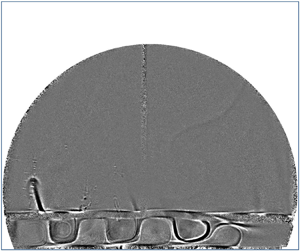
We report an experimental investigation of the heat transport and flow field in a rectangular Rayleigh–Bénard convection (RBC) cell with two immiscible fluids: silicone oil and glycerol. The global heat transport of the system is divided into three ranges corresponding to the different flow structures formed in the glycerol layer. In range I, the glycerol layer is dominated by conduction, and no plume is formed over the interface. In range II, cellular rolls are formed in the glycerol layer and the horizontal motion of rolls causes an oscillation of temperature in the interface. In range III, the cellular pattern is time-independent, and the interface forms a group of wavelets with wave numbers consistent with the mode of the cellular pattern. In lower-thin glycerol, the Nusselt (Nu) grows from conduction to convection through an oscillating subcritical bifurcation at critical Rayleigh number $Ra_c$. The value of $Ra_c$ in the present work is smaller than the theoretical prediction of both-rigid boundaries and greater than the prediction of one-rigid and one-free boundaries. In the upper-thick silicone oil layer, $Nu$ increases with increasing $Ra$, but it is smaller than that of traditional RBC. For the silicone oil layer in two-layer RBC, the hot plumes emitting over the liquid–liquid interface showed different shape and different velocity from cold plumes emitting from the top rigid plate. This implies that the velocity boundary condition strongly influences the flow structure in turbulent convection.

Information

Type
JFM Papers
Copyright
© The Author(s), 2023. Published by Cambridge University Press

Access options

Get access to the full version of this content by using one of the access options below. (Log in options will check for institutional or personal access. Content may require purchase if you do not have access.)

Article purchase

Temporarily unavailable

Supplementary material: File

Wang et al. supplementary movie 1

The shadowgraph result above the bottom plate for run E1
Download Wang et al. supplementary movie 1(File)
File 8.3 MB
Supplementary material: File

Wang et al. supplementary movie 2

The shadowgraph result below the top plate for run E1
Download Wang et al. supplementary movie 2(File)
File 9.3 MB
Supplementary material: File

Wang et al. supplementary movie 3

The shadowgraph result above the bottom plate for run E2
Download Wang et al. supplementary movie 3(File)
File 8.1 MB
Supplementary material: File

Wang et al. supplementary movie 4

The shadowgraph result below the top plate for run E2
Download Wang et al. supplementary movie 4(File)
File 10 MB
Supplementary material: File

Wang et al. supplementary movie 5

The shadowgraph result above the bottom plate for run E3
Download Wang et al. supplementary movie 5(File)
File 7.6 MB
Supplementary material: File

Wang et al. supplementary movie 6

The shadowgraph result below the top plate for run E3
Download Wang et al. supplementary movie 6(File)
File 5.8 MB