




1. Introduction
Product engineering has evolved into a highly distributed activity. While it once involved teams working together at a single location, today, it is common for teams to collaborate globally (Zukunftsinstitut GmbH 2023). This shift has led to greater integration of diverse cultures, presenting both opportunities and challenges (Bouncken, Brem, & Kraus Reference Bouncken, Brem and Kraus2016). Different languages, problem-solving approaches, and work ethics can negatively impact collaboration and productivity, while diverse opinions and heterogeneity can lead to improved outcomes (Anderson et al. Reference Anderson, Chandrasekaran, Davis-Blake and Parker2018). In distributed work settings, tasks requiring creativity are particularly challenging due to the absence of indirect communication signals (Stempfle & Badke-Schaub Reference Stempfle and Badke-Schaub2002; Kuster et al. Reference Kuster, Huber, Lippmann, Schmid, Schneider, Witschi and Wüst2008).
To address these challenges and leverage the potential of cultural diversity, the cultural synergy spectrum (CSS) method has been developed (Bastian et al. Reference Bastian, Cadavid Restrepo, Grau and Albers2024; Bastian et al. Reference Bastian, Cadavid Restrepo, Willerscheid and Albers2025, accepted for publication). This method aims to enhance intercultural teamwork while supporting creative processes in a manner that is appropriate for the situation and team. By increasing mutual understanding and promoting effective collaboration, the CSS seeks to overcome cultural barriers, thereby driving creativity and improving outcomes in distributed product engineering teams (Bastian et al. Reference Bastian, Cadavid Restrepo, Willerscheid and Albers2025, accepted for publication).
To validate the effectiveness of the CSS method and identify areas for improvement, multiple validation iterations have been carried out. The CSS was applied in a distributed project team with team members from various European countries (Bastian et al. Reference Bastian, Cadavid Restrepo, Willerscheid and Albers2025, accepted for publication) and two times in student engineering teams engaged in a project with a creative problem-solving task at the University of Applied Sciences in Karlsruhe (Bastian, Deisenrieder, & Albers Reference Bastian, Deisenrieder and Albers2025, accepted for publication). Two rounds of application were conducted fully distributed, and one was conducted on-site, providing an initial level of validity for on-site and fully distributed teams, but not yet for hybrid or partially distributed teams. Between iterations, no major differences were observed in the successful application of the method between experienced and non-experienced product engineers. The tasks carried out in the creativity session of the CSS varied since the method is designed to be applied to actual problem-solving situations. This contribution aims at validating the method’s successful application in a partially distributed setting to ensure all levels of distribution (on-site, partially distributed, and distributed) have been used to have data on the application in various settings. The participants in this validation iteration are mainly from mainland China, and the on-site participants are located in China at the School of Mechanical Engineering of Shanghai Jiao Tong University. The team also has international participants, but in a minority. This setting was selected to ensure cultural backgrounds that have been underrepresented in previous studies are also included. The evaluation included both observations and pre- and post-application questionnaires to assess changes in the participants’ understanding of their teammates’ cultural backgrounds. Furthermore, the output of the methods’ creative problem-solving phase is taken into consideration for the evaluation.
2. Theoretical background
2.1. Creativity in (distributed) product engineering
Creativity is essential for the development of ideas with high innovative potential and is therefore a central element for development activities in product engineering (Alahuhta et al. Reference Alahuhta, Nordbäck, Sivunen and Surakka2014; Wang et al. Reference Wang, Cheng, Tingting and Leung2019). Creativity and collaboration are key for team success, particularly in distributed settings where unique challenges arise (Stempfle & Badke-Schaub Reference Stempfle and Badke-Schaub2002). Research shows that collaboration is more effective when teams are physically together compared to virtual environments, where creative processes often encounter difficulties (Silvia & Iryna Reference Silvia and Iryna2012; Alahuhta et al. Reference Alahuhta, Nordbäck, Sivunen and Surakka2014). Physical face-to-face interactions enhance idea generation, although the quality of ideas and their selection may not depend on the level of distribution (Brucks & Levav Reference Brucks and Levav2022). Additionally, virtual settings can hinder creativity due to limited information transmission and solely visual focus (Brucks & Levav Reference Brucks and Levav2022). Supporting creativity in distributed teams is crucial and requires tailored support (Duehr Reference Duehr2023).
Stein (Reference Stein1953) provided a widely used definition of creativity, describing it as the generation of something new that is recognized as useful by a group. Novelty is defined as something that has not previously existed in the same form, often emerging from the recombination of existing knowledge with new elements. It is characterized by out-of-the-box thinking without following clear structures (Peale Reference Peale1969; Ocker Reference Ocker2005; Elliot & Nakata Reference Elliot and Nakata2013; Alahuhta et al. Reference Alahuhta, Nordbäck, Sivunen and Surakka2014). Creativity is one of the tasks in which human outperforms artificial intelligence (Lockhart Reference Lockhart2024). Large language models like ChatGPT can recombine existing knowledge but generate something new out of it in the sense of Stein’s (1953) definition, which is skill specific to humans.
When looking at the bigger picture, creativity also helps promote social progress and prosperity (Deigendesch Reference Deigendesch2009) and is influenced by cultural contexts (Kwan, Leung, & Liou Reference Kwan, Letty, Leung and Liou2018). It is recognized as relevant societal development and progress, for instance, the European Union designated 2009 as the European Year of Creativity and Innovation to enhance creativity and innovative capacity on a broad scale (European Parliament and Council of the European Union 2008). The early rise of concepts like the creative economy and creative society shows the early recognition and its importance for knowledge advancement (Rhodes Reference Rhodes1961). Creativity is a psychological construct with various factettes that can be interpreted in multiple ways, encompassing the four Ps: Product, People, Process and Press (environment) (Rhodes Reference Rhodes1961). In this contribution, the creative process aims to highlight the approach to developing a creative product (Deigendesch Reference Deigendesch2009). Creativity can be categorized into individual and group creativity. Individual creativity is influenced by cognitive abilities such as fluency, flexibility, originality and elaboration, as well as personality traits. Factors that enhance individual creativity include autonomy, self-confidence and intellectual honesty, along with intrinsic motivation. The creative capacity of a group is influenced by the individual creativity of its members, as well as factors such as group composition, characteristics, processes and contextual influences. Generally, teams have a higher potential for idea generation compared to individuals (Ocker Reference Ocker2005; Chamakiotis, Dekoninck, & Panteli Reference Chamakiotis, Dekoninck and Panteli2010; Alahuhta et al. Reference Alahuhta, Nordbäck, Sivunen and Surakka2014). Within this contribution, the team’s output is analyzed and not the individual’s contributions to creative problem-solving.
In design literature, creativity is linked to outcomes (the creative product), individuals (the designer) and processes (the creative process) (Chamakiotis et al. Reference Chamakiotis, Dekoninck and Panteli2010). It is also a critical component of engineering development (Howard, Culley, & Dekoninck Reference Howard, Culley and Dekoninck2008). The integrated product engineering model (iPeM) describes product engineering as a complex endeavor that integrates multiple disciplines and interfaces with operational and knowledge management processes (Albers et al. Reference Albers, Reiss, Bursac and Richter2016). Product engineering teams must consider various requirements and constraints, often implicit in the system of objectives (Deigendesch Reference Deigendesch2009). Creative engineering teams generate new ideas and solutions, offering new products and services to their markets. Solutions often arise from integrating existing products and processes, characterizing the engineering process as a problem-solving process (Albers, Saak, & Burkardt Reference Albers, Saak and Burkardt2002; Ehrlenspiel Reference Ehrlenspiel2003; Albers, Burkardt, & Meboldt Reference Albers, Burkardt and Meboldt2006) characterized by iterative steps leading to alternative solutions. Thus, product engineering is a creative endeavor leading to the production of products with high innovative potential (Deigendesch Reference Deigendesch2009).
A creative result in general within this contribution is understood according to Stein (Reference Stein1953) as “A creative work is a novel work that is accepted as tenable or useful or satisfying by a group at some point in time” (Stein Reference Stein1953, pp. 311–316). Furthermore, he adds that the creative result stems from reintegrating existing elements so that the output can be considered to contain new elements (Stein Reference Stein1953).
In the context of product engineering, it is technical creativity that is in the focus. Here, aspects are included that are specific to the technical context. Technical creativity is targeted and used in analyzing and synthesizing processes or systems. When a team is technically creative, something novel is created and the creative process pursues a specific goal. Motivation, imagination, experience and expertise are prerequisites for technical creativity. Technical creativity is not specific to product engineering but can be applied in all technical fields (Albers et al. Reference Albers, Bastian, Düser, Völk and Kübler2025, Submitted for Publication).
A methodological and targeted approach helps to set up an environment suitable for creative thinking. Consequently, various methods have been developed to enhance creativity (Albers & Schweinberger Reference Albers, Schweinberger and Spath2001). Research in cognitive science indicates that employing creativity techniques can assist creative performance by stimulating the ideation process (Glück Reference Glück2022). Creativity techniques can be categorized into intuitive and discursive methods or a combination of both. Intuitive methods help with associations and idea generation through stimuli, resulting in high output. Brainstorming and the Gallery Method are examples of intuitive creativity techniques. In contrast, discursive methods produce fewer but more comprehensive ideas, employing a more analytical and strategic approach, e.g., with the SCAMPER method. Combining intuitive and discursive elements is useful for shifting perspectives (Glück Reference Glück2022). Notable examples include the TRIZ-Box, De Bono’s Six Thinking Hats and the Nominal Group Technique (NGT) (Delbecq & van de Ven Reference Delbecq and van de Ven1971; Albers, Deigendesch, & Schmalenbach Reference Albers, Deigendesch and Schmalenbach2009; de Bono Reference de Bono2016; Glück Reference Glück2022). Creativity techniques vary in their complexity, and the prerequisites for their application vary with different levels of prior knowledge needed for successful application (Ritter & Mostert Reference Ritter and Mostert2017).
Research in this area also includes the adaptation of existing methods for specific application scenarios such as distributed settings (Walter, Rapp, & Albers Reference Walter, Rapp and Albers2016). The amount of available techniques makes selecting the appropriate method for the development team challenging (Gerst Reference Gerst2003). The idea generation is particularly difficult in distributed settings (Brucks & Levav Reference Brucks and Levav2022). Creativity techniques adapted for virtual environments show varying results, highlighting the need for techniques suitable for these settings (Birkhofer, Jaensch, & Kloberdanz Reference Birkhofer, Jaensch and Kloberdanz2005; Walter et al. Reference Walter, Rapp and Albers2016). For methods to be successful in virtual applications, requirements need to be met (Taplick & Gräßler Reference Taplick, Gräßler, Krause, Paetzold and Wartzack2018). This is often not the case by purely transferring existing methods into a virtual setting (Walter et al. Reference Walter, Klippert, Kunz, Albers, Reiß, Köhler, Brökel, Scharr, Grote, Stelzer, Rieg, Feldhusen, Müller and Lohnrengel2017). Therefore, creativity techniques need to be adapted to ensure that they meet the requirements for virtual applications (Rice et al. Reference Rice, Davidson, Dannenhoffer and Gay2007; Walter et al. Reference Walter, Klippert, Kunz, Albers, Reiß, Köhler, Brökel, Scharr, Grote, Stelzer, Rieg, Feldhusen, Müller and Lohnrengel2017; Taplick & Gräßler Reference Taplick, Gräßler, Krause, Paetzold and Wartzack2018). Especially with nowadays intercultural teams that need to successfully solve product engineering problems for the fast-changing markets, targeted, easy-to-apply, and easy-to-learn methods are still needed (Bastian et al. Reference Bastian, Kassem, Kempf and Albers2023; Bastian, Wasserbäch, & Albers Reference Bastian, Wasserbäch and Albers2023).
Within this contribution, the nominal group technique and De Bono’s Six Thinking Hats build the basis for the CSS method. A full explanation of the inclusion of these methods can be found in previous publications (Albers, Bastian, & Melanie Reference Albers, Bastian and Melanie2024, submitted for publication; Bastian et al. Reference Bastian, Cadavid Restrepo, Willerscheid and Albers2025, accepted for publication). In the following, the stimulus picture method is explained in more detail as the participants used this method in the creativity session, the fourth phase of the CSS application. The stimulus picture method, an intuitive creativity technique, assists in the generation of associations through pictures (Hwang & Lin Reference Hwang and Lin1987; Brunner Reference Brunner2009). In its simplified form which is suitable for solving the problem at hand, participants are presented with 106 stimulus images and are encouraged to select those that resonate with them. They can adapt and adjust the images in any way they choose – using, drawing on, moving, cropping, or other forms of altering them – to articulate or develop their ideas.
2.2. Cultural influences on creativity in product engineering
Culture significantly influences creativity, shaping the way ideas are generated. This influence stems from culture’s impact on how individuals perceive and approach situations (Dubina & Ramos Reference Dubina, Ramos, Dubina and Carayannis2016; Tang & Werner Reference Tang and Werner2017).
Culturally diverse teams bring various perspectives and problem-solving approaches, which can enhance creativity, which is important in product engineering. However, these differences also introduce challenges such as communication barriers (Plucker, Beghetto, & Dow Reference Plucker, Beghetto and Dow2004). While several models, including the process model by Chiu and Kwan (Reference Chiu, Kwan and Letty2010) and the findings by Shao et al. (Reference Shao, Zhang, Zhou, Gu and Yuan2019), examine the relationship between culture and creativity, engineers still require support in this area, specifically support that is easy to apply and integrate into daily activities. Research shows that cultural backgrounds affect creative processes, with some cultures producing a high volume of ideas and others focusing on fewer, more refined concepts (Shao et al. Reference Shao, Zhang, Zhou, Gu and Yuan2019). Understanding and leveraging these cultural differences is crucial for fostering creativity in diverse teams (Albers et al. Reference Albers, Bastian and Melanie2024, submitted for publication; Tang & Werner Reference Tang and Werner2017).
In this contribution, Geert Hofstede’s cultural dimensions (Hofstede & Bond Reference Hofstede and Bond1984; Hofstede, Hofstede, & Minkov Reference Hofstede, Hofstede and Minkov2010; Hofstede Reference Hofstede2011) build the basis for the CSS method. Although other frameworks like Hall’s Cultural Theory (Hall Reference Hall1977, Reference Hall1980; Hall & Hall Reference Hall and Hall2014) and Koeppel’s MIPO model (Köppel Reference Köppel2007) exist, Hofstede’s dimensions are widely accepted due to their extensive data basis (Utler Reference Utler, Ringeisen, Genkova and Leong2020).
Hofstede’s model identifies five cultural dimensions: power distance, individualism versus collectivism, masculinity versus femininity, uncertainty avoidance, and long-term versus short-term orientation (Hofstede et al. Reference Hofstede, Hofstede and Minkov2010). A sixth dimension, indulgence versus restraint, was later introduced (Hofstede Reference Hofstede2011). This theoretical framework helps to understand cultural differences, improve intercultural communication, and develop tailored communication strategies suitable for all cultural backgrounds.
Expanding on Hofstede’s model, each dimension provides insights into specific aspects of a culture’s value system. The Power Distance Index measures the extent to which members on lower hierarchical levels of organizations accept and expect unequal power distribution, affecting hierarchical dynamics and authority structures within an organization (Kang Kai Siang et al. Reference Kang Kai Siang, Chia, Koronis and Silva2018). Individualism versus collectivism indicates whether individuals prefer a social framework with loose connections, where they are expected to look after themselves and their immediate family, or a framework with tight connections, where they can rely on their relatives or in-group members for support (Holden Reference Holden2014). Masculinity versus femininity examines gender roles within a culture, with masculine societies driven by competition, achievement, and success, while feminine societies prioritize caring for others and quality of life. The uncertainty avoidance index assesses tolerance for uncertainty and ambiguity, indicating comfort levels in situations that are defined by uncertainty. Long-term versus short-term orientation describes whether the focus is on future benefits (long-term) or values the present and past (short-term). Finally, indulgence versus restraint measures the extent to which a society allows free gratification of basic and natural human desires related to enjoying life and having fun, as opposed to having strict social norms that restrict open enjoyment (Hofstede et al. Reference Hofstede, Hofstede and Minkov2010; Hofstede Reference Hofstede2011).
These dimensions build the basis for the model applied within this contribution and are explained in the following sections.
2.3. The cultural synergy spectrum method
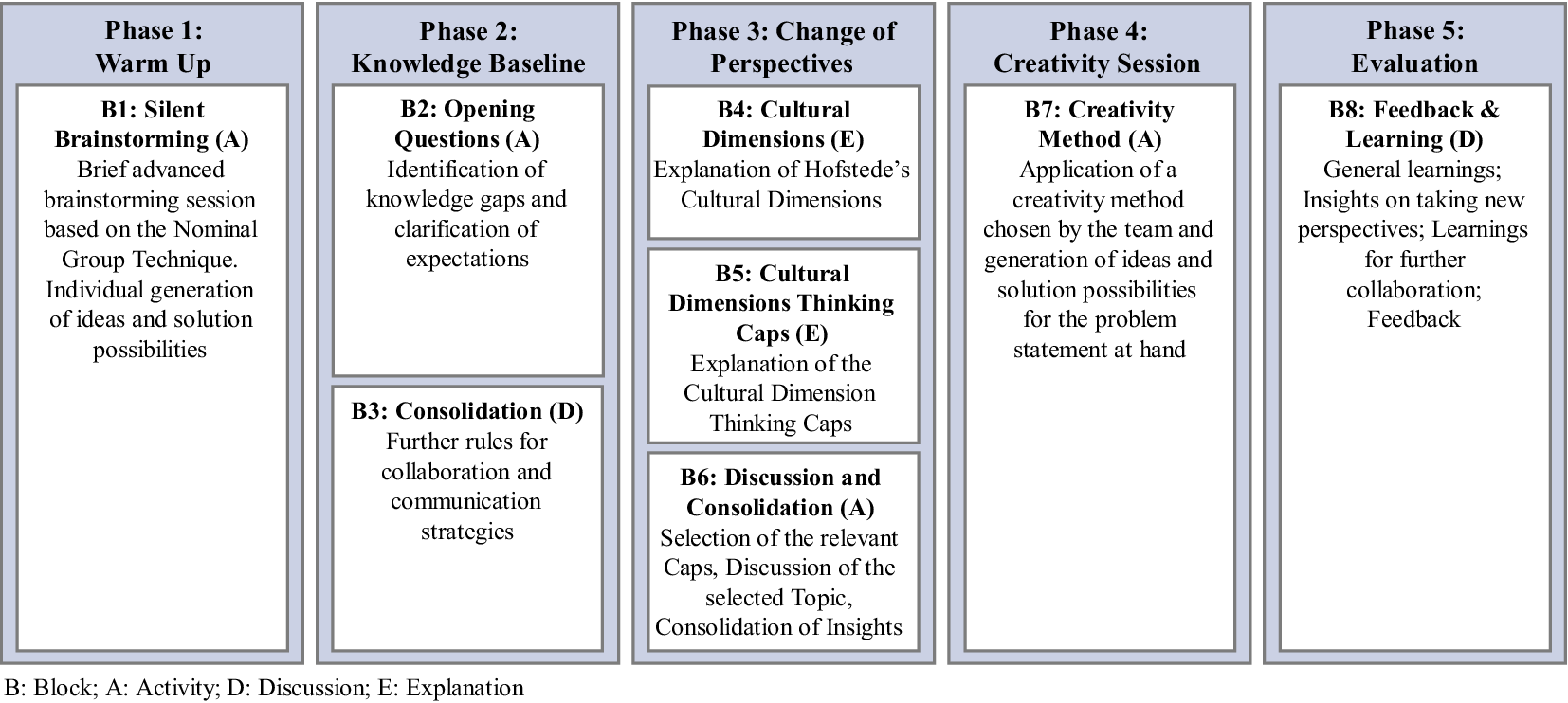
The CSS method is designed to support creativity in distributed product engineering teams in a culturally sensitive way. It achieves this by promoting cultural success factors and mitigating cultural barriers through improved mutual understanding and learning in the team. By incorporating a variety of cultural perspectives, the method creates an environment where diverse viewpoints are effectively utilized for collaborative idea generation and problem-solving (Bastian et al. Reference Bastian, Cadavid Restrepo, Willerscheid and Albers2025, accepted for publication). The CSS starts with a warm-up followed by building a knowledge baseline in phase 2. The cultural dimensions identified by Geert Hofstede (Hofstede & Bond Reference Hofstede and Bond1984; Hofstede et al. Reference Hofstede, Hofstede and Minkov2010; Hofstede Reference Hofstede2011) and discussed in Section 2.2 form the basis for cultural learning within this method. They build the baseline in phase 3 of the CSS, especially in activities B4 and B5 (see Figure 1). Additionally, the Six Thinking Hats (de Bono Reference de Bono2016) as the basis for the cultural dimensions thinking caps (Bastian et al. Reference Bastian, Cadavid Restrepo, Grau and Albers2024) in B5 and the nominal group technique (Delbecq & van de Ven Reference Delbecq and van de Ven1971) introduced in Section 2.1 provide the foundation for creative support. The nominal group technique is the basis for the style of providing answers in all phases, giving the opportunity to silently contribute before discussions. The participants are introduced to the cultural dimensions, and they learn how to switch into different cultural perspectives with the cultural dimensions thinking caps to improve cultural sensitivity. The fourth phase of the method allows for the incorporation of any creativity technique that suits the team’s specific problem-solving needs, in this application, the stimulus picture method has been used and was therefore introduced in Section 2.1. The fourth phase is the creativity session. Here, the team is supposed to solve a problem creatively that they would have to solve anyway. The CSS is built in a modular way to be implemented around a creativity session to enhance creative problem-solving in real-case scenarios. The final phase is designed for reflection and feedback to ensure the learnings from phase 3 are reflected once more with the team to increase the probability of them being taken further than just the single application in the creativity session. The five phases of the CSS are depicted in Figure 1.
The phases of the CSS content of (Bastian et al. Reference Bastian, Cadavid Restrepo, Grau and Albers2024) graphical representation from (Bastian et al. Reference Bastian, Deisenrieder and Albers2025, accepted for publication).
The CSS method was initially evaluated within the EU.FFICIENT project, which involved collaborative tasks among participants from 15 institutions across various European countries. The results demonstrated that the method effectively fosters intercultural synergies, enhancing understanding and reflection on cultural perspectives (Bastian et al. Reference Bastian, Cadavid Restrepo, Willerscheid and Albers2025, accepted for publication). This, in turn, contributes to improved idea generation. Furthermore, the CSS was applied twice in intercultural student teams. Once on-site and once fully distributed (Bastian et al. Reference Bastian, Deisenrieder and Albers2025, accepted for publication). Therefore, this contribution fulfills the need to complete the application and validation in a partially distributed setting and with participants whose cultural background has been less of the focus so far.
3. Research design
3.1. Research aim and questions
Validating the CSS method’s effectiveness through its application within an intercultural team of master’s and PhD students in China is the aim of this contribution. It is not only aimed at demonstrating the method’s success but also to ensure the method’s continuous and iterative improvement. The method’s main goal is to enhance the creativity of distributed product engineering teams in a manner sensitive to cultural differences. This round of application is carried out in a partially distributed setting to enable the observation and validation in a setting often occurring in product engineering practice.
To achieve the aim of this contribution, the following research questions are addressed:
-
1. How should the CSS method be applied in partially distributed teams so the CSS method can be validated in terms of its applicability and contribution to success?
-
2. What is the measurable added value created through the application of the CSS method regarding the improvement of culture-sensitive creative problem-solving for the team?
-
3. What are the major differences between the application on-site, in a partially distributed setting, and in a distributed setting?
-
4. Which conclusions can be drawn for the methods’ improvement based on the team’s primary Chinese cultural backgrounds?
3.2. Research approach and environment
3.2.1 Questionnaires
A questionnaire was designed to evaluate the suitability of the participants for the application of the workshop. The questionnaire was distributed to the 30 individuals who are part of the research group, either as master’s students, as PhD students, or as postdocs. Twenty-five questionnaires were filled out and returned. This questionnaire was not anonymous because it was needed to invite the participants to the test and control group. The first question asked if the participants worked together with others in a team. This initial criterion that a participant needs to be involved in team processes was fulfilled by all respondents. The following selection criterion was the participants’ participation in creative problem-solving tasks in their everyday work. Two participants’ answers were not taken into consideration any further because they stated that they were not engaged in any problem-solving activities. To make sure this question is understood correctly and the participants understand which kinds of daily tasks are considered problem-solving in the sense of this research, a second question has been asked as a test question. This test question clarified whether the participants always had a task description to follow step by step. Participants were only excluded if they stated that they did not have to solve problems and that they always had a clear task description. The remaining 23 participants were divided into a test group and a control group. The test group will apply the CSS, while the control group will not have any specific training or workshop. The criteria for dividing the group and designing two groups that are as similar as possible are presented in the following.
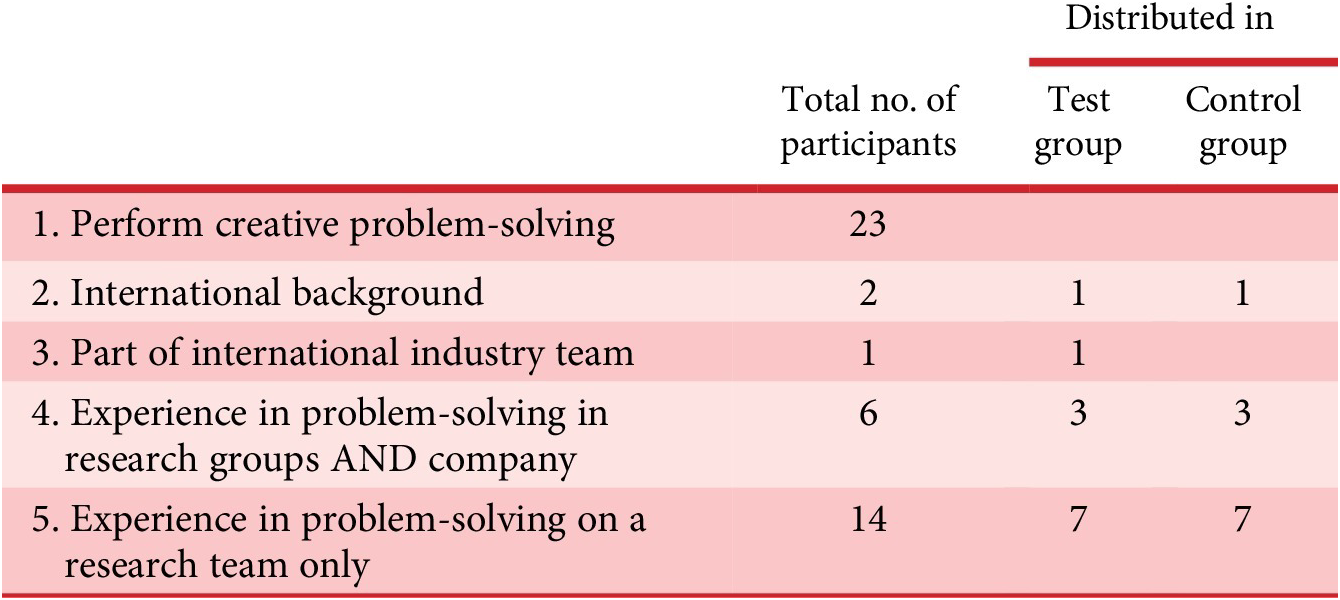
Because the majority of team members are Chinese, the participants with an intercultural influence were equally distributed first. This step is taken to ensure that both teams are set up as intercultural teams to improve comparability and ensure that the prerequisites for applying the CSS are met. The second criterion for forming the two groups also concerns cultural influences. Team members with intercultural teams in their company projects were also equally divided into the test and control groups. Division criterion three was the experience with creative problem-solving in both the research team and a company project team to balance the two groups in terms of experience. The participants with experience in creative problem-solving only within the research team and no specific intercultural background or experience were also equally distributed between the two groups. Different criteria were considered one by one. If a participant has already been grouped because of criterion 1, he was not considered again for criterion 4. The order of the criteria was set to ensure comparability between the groups, especially because of only a few international team members, it needed to be ensured, they were equally distributed. The list of the criteria and the distribution made according to them are displayed in Table 1.
Criteria to design test and control group
This initial questionnaire also included questions on intercultural experiences and expectations. The results of these questions are evaluated in Section 4.1 in comparison to the results of the second round of questionnaires to see improvements in cultural understanding.
A second questionnaire was sent to the test group after the method application, including the questions on intercultural experiences and expectations again. Furthermore, self-evaluation questions on improved cultural understanding and creativity, and feedback questions for evaluating the method were included. The control group only received the questionnaire with questions regarding intercultural experiences and expectations. The second round of questionnaires was anonymous to ensure that participants provided their honest answers and feedback.
The questionnaires are evaluated, and the before and after results are compared. Additionally, the results of the test and control groups are compared to evaluate the success of the application.
A limitation of the test and control group design applied in this research lies in the use of participants from one research group. It was a goal of this study to work with teams that actually solve problems together, but the criteria used to design the test and the control group as similar as possible led to people working together in the CSS application who do not work together a lot in daily life problem-solving. Within the research group, not all members work on the same projects at all times, and not all project teams are constituted of only members from the research group but include members from industry or other research institutions. This is a deviation from the target group of applicants of the CSS, which are predicted to be teams working together closely on a daily basis.
3.2.2 Observational study
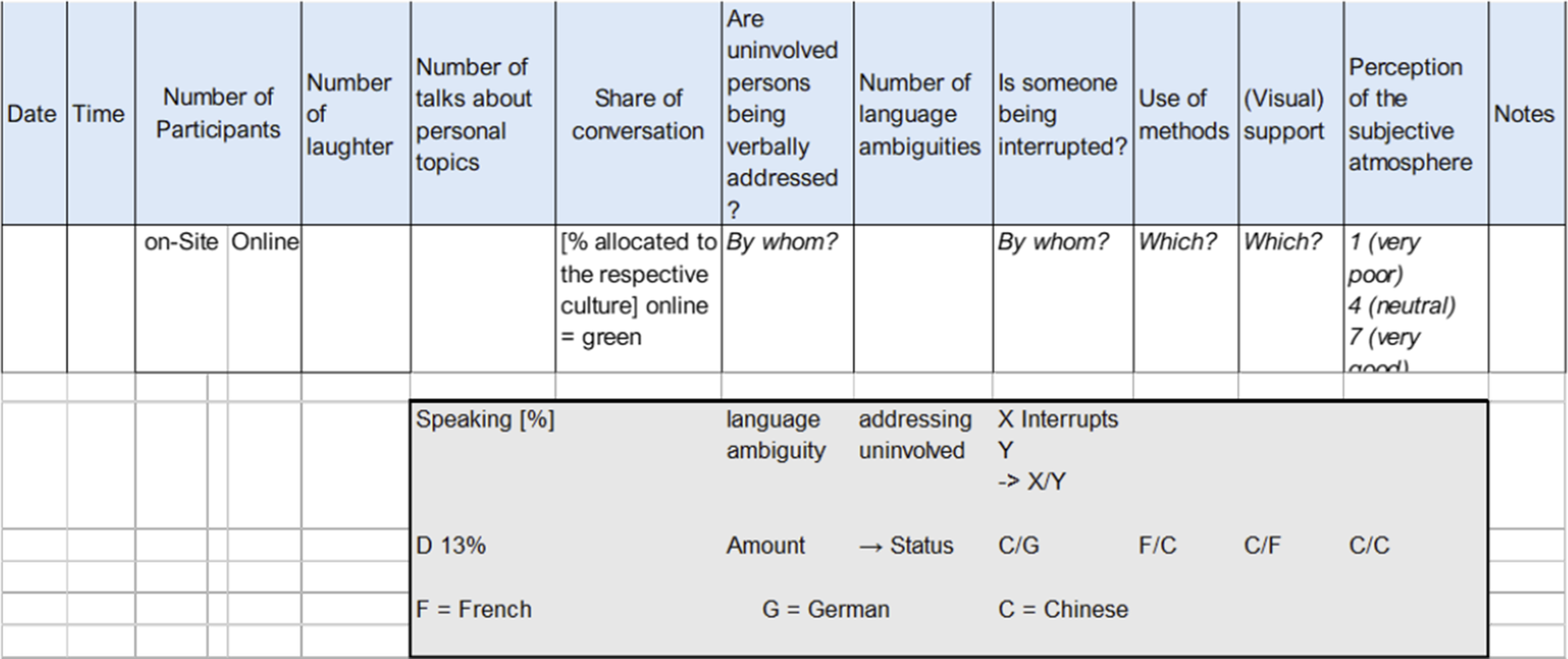
During the method application, the test group was divided into two sub-groups for the problem-solving activity. Not only to have results to compare but also to have small group sizes appropriate for intensive problem-solving as a team. The sub-groups have been observed using an observation template, as shown in Figure 2. The template includes the number of laughs to trace the atmosphere and emotion. The number of personal talks is tracked to check which natural communication is coming up and to observe if the team is productive. The share of communication helps to track the participation of all team members to see the involvement of different individuals and their cultural backgrounds. Tracking if uninvolved people are addressed helps draw conclusions about the team dynamics. For each interaction, the culture is tracked to see the potential implications of the interactions with the cultural backgrounds. Language ambiguities are traced as well as interruptions. Methods and tools used for support are also noted. Furthermore, the atmosphere is subjectively evaluated by the observer, and notes on the interaction are taken.
Observation template for the method application.
The results are evaluated and compared to previous rounds of the CSS methods’ application.
3.2.3 Evaluation of the participants’ creative results of the method application
Within the method application, the participants were asked further questions in the initial phase of the CSS as well as in the feedback phase. The results generated are evaluated. Furthermore, the participants’ results within the third phase of the CSS when performing the cultural dimensions thinking hats (Bastian et al. Reference Bastian, Cadavid Restrepo, Grau and Albers2024) are taken into consideration. During the creativity session a practice problem needed to be solved by the two sub-groups. The creative output is also evaluated and taken into consideration for defining the method applications’ success. The output by the participants is compared to the output generated by ChatGPT. Because artificial intelligence can combine existing elements but without generating something new out of them, this comparison is used as a measurement for the creative output.
3.2.4 Research environment
The research was conducted within a mechanical engineering research group that is working in the field of predictive maintenance in the product engineering context at Shanghai Jiao Tong University. One of the authors served as the moderator for the method application, which was scheduled for 2 hours. All participants are either master’s students, PhD students, or post-doctoral fellows within the field of mechanical engineering. The method application was performed in English while sub-group discussions were in Chinese since all participants understood Chinese to an extent to allow for this setting. The participants were given the choice of whether they wanted to participate on-site or virtually, leading to each sub-group having one participant online and the rest on-site. The method application occurred 3 months after the moderator from Germany moved to China and got to know the team members and the group environment. The intercultural team consists of a majority of Chinese nationals, and the participants who meet on-site are located in China as well. Furthermore, the participants have less intercultural experience because they are not an intercultural team working together in a foreign country as in the two previous applications. The location was chosen in a meeting room with one big table, providing a screen to show the collaborative environment to everybody at the same time. Furthermore, each participant used a laptop or tablet to participate in Miro (2024) as a collaborative tool to show the process and provide space for the results and design process. The online participants were included in a Microsoft Teams (2024) call for the part of the session that took place with the entire group. While the group was split into two sub-groups the online participants participated via WeChat (2024). The entire time, the room and participants were visible to the online participants via Microsoft Teams (2024).
The sample size for this study is limited to the members of the research group. Therefore, generalizing the findings to larger populations is difficult. In small sample sizes, the data variance is often higher. Identifying patterns becomes, therefore, more difficult, which can lead to false assumptions. Furthermore, the results may have varied with different individuals, since personal aspects can also influence behavior in a way that might be associated with cultural aspects. The diversity of participants from different cultural backgrounds was limited because we worked with the actual members of the research group rather than composing teams artificially for our research. This also restricted the number of potential participants. We faced a trade-off between expanding the pool of potential participants and ensuring they can actually be considered a team that engages in problem-solving activities on a daily basis. Even with the research group, we needed to clarify that not all members work on the same projects at all times.
4. Results and discussion
The method was fully implemented, with participants progressing through all five phases of the CSS method in a hybrid session of 2 hours. The initial two phases were carried out with the entire test group. Participants started by answering the questions individually and quietly, then discussed their responses with the group if they wished, adhering to the NGT guidelines (Delbecq & van de Ven Reference Delbecq and van de Ven1971). The warm-up phase (phase 1) aimed to break the ice and collect initial thoughts on the problem to be tackled in the fourth phase. This approach ensures that ideas generated using creativity support can be compared to initial thoughts before applying the method. The second phase ended with the group setting non-negotiables for their collaboration and teamwork. Participants could add cards quietly or discuss them, but before moving to the third phase, everyone had to agree on the complete set of non-negotiables.
The third phase was carried out with the entire group as well without using sub-groups in this round of application. This has been done differently in comparison to previous rounds of application. The reason for this was to reduce the time needed for the third phase, to comply with the set timeframe of 2 hours. During the third phase, participants were introduced to Hofstede’s cultural dimensions (Hofstede et al. Reference Hofstede, Hofstede and Minkov2010) and the cultural thinking caps (Bastian et al. Reference Bastian, Cadavid Restrepo, Grau and Albers2024). When introducing the cultural dimensions, examples were given of how people would react to daily life situations in the workplace if they feel assimilated with one or the other extreme of each cultural dimension. The examples were used to demonstrate to the participants how different the perspectives can be. Afterward, within the application of the cultural perspective thinking caps, the participants practiced switching perspectives themselves. Again, first with the option to quietly not ideas and then sharing their learnings with the entire group if they wanted. In the fourth phase, participants were reminded of the problem to be solved and introduced to the stimulus picture method. The stimulus picture method was chosen by the moderator for the test group because it is suitable for first-time applicants, fits into the time frame and is suitable for solving the practice problem. This method is suitable for distributed execution and easy to learn for first-time users. Furthermore, the stimulus picture method ensures that more quiet participants can express their ideas through drawing, sketching, writing and clustering objects to ensure their ideas do not get lost in a discussion-based approach. The final phase involved all participants and included collecting feedback and learning. The moderator facilitated the participants throughout the process and built another culturally different discussion partner.
Three selected test group participants did not participate in the workshop. Therefore, nine of the 12 selected participants were part of the workshop and are taken into consideration in the evaluation for the test group. The questionnaires from the no-shows prior to the method application are therefore not taken into consideration. In the control group, only nine of the 12 participants returned the questionnaires. Because the second round of questionnaires was anonymous to give the participants the possibility, to be honest and also give negative feedback openly, it is unclear who filled out the first but not the second questionnaire. Therefore, the 12 initial questionnaire results (or the average scores calculated from the answers) are taken and compared to the nine questionnaire results in the late round of questionnaires (or the average scores calculated from the answers).
4.1. Results of the questionnaires
The group had to rate their knowledge of their fellow team members’ cultural backgrounds on a scale from one to five. The average value increased for the test group from 3.56 to 4. For the control group, it increased from 3.83 to 3.88. One participant in the test group answered with a value that is not in the range of possible answers. Therefore, it has been excluded for this question, leaving this question’s average being calculated based on the 8 remaining values. The question regarding the perceived number of nationalities within the team increased in the control group from an average of 1.56 to 2.44 and in the control group from 1.33 to 1.44. Nationalities have been used not as a synonym for culture but as one aspect of culture that can be distinguished more easily and more explicitly than culture. Demonstrating that the awareness for the other cultures within the team only increased in the test group. The actual number of cultures within the team is four and no participant included the answer correctly in any of the questionnaires.
Responses to the question about the major cultural differences between the team members were fewer in the first questionnaire. The answers to this question are displayed in Table 2. The table is split into two parts. The first part in gray shows the answers of the test group that were mentioned in both questionnaires. The second part in white shows the results that were mentioned only in one of the two questionnaires to differentiate new aspects. Each part is organized by the frequency in which the answers were mentioned.
Answers by the test group to the question: what is the main (cultural) difference between you and your fellow team members?
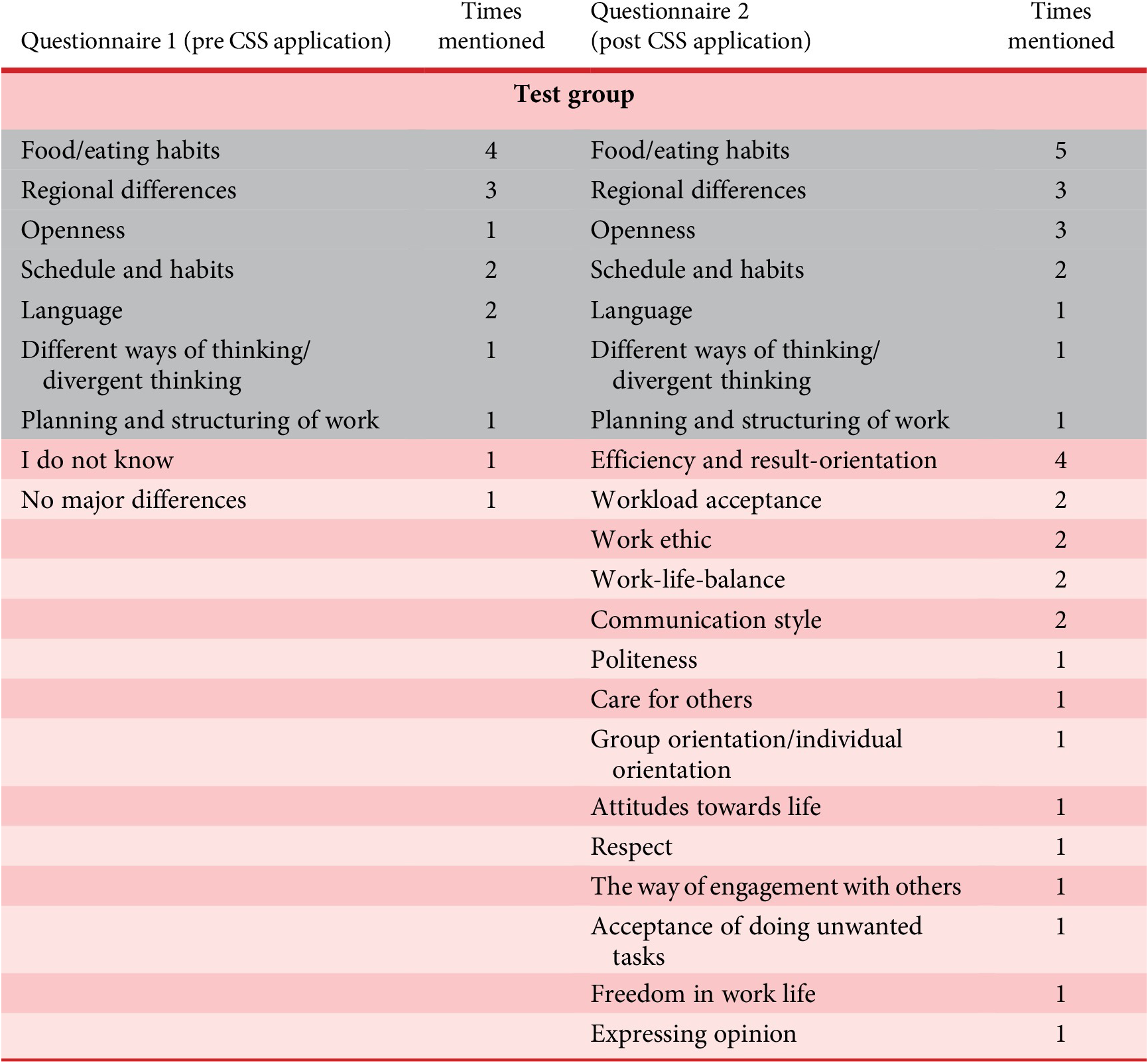
The frequency with which food or eating habits were identified as the primary cultural difference increased, from four to five participants. Food and eating habits were some of the casual discussion points that were mentioned in small talk by the team members during the method application. In the first questionnaire, one participant of the test group mentioned not knowing major cultural differences, and another mentioned no major differences. These answers are not present in the second questionnaire. In the second questionnaire, more problem-solving and work-related answers like efficiency and result-orientation, or workload acceptance were given. Openness was mentioned once in the first questionnaire and was mentioned three times in the second questionnaire.
The answers by the control group to the same question on the major cultural difference are displayed in Table 3. The table is designed in the same way as Table 2 and is split into two parts. The first part in grey shows the answers of the control group that were mentioned in both questionnaires. The second part in white shows the results that were mentioned only in one of the two questionnaires. Each part is organized by the frequency in which the answers were mentioned.
Answers by the control group to the question: what is the main (cultural) difference between you and your fellow team members?
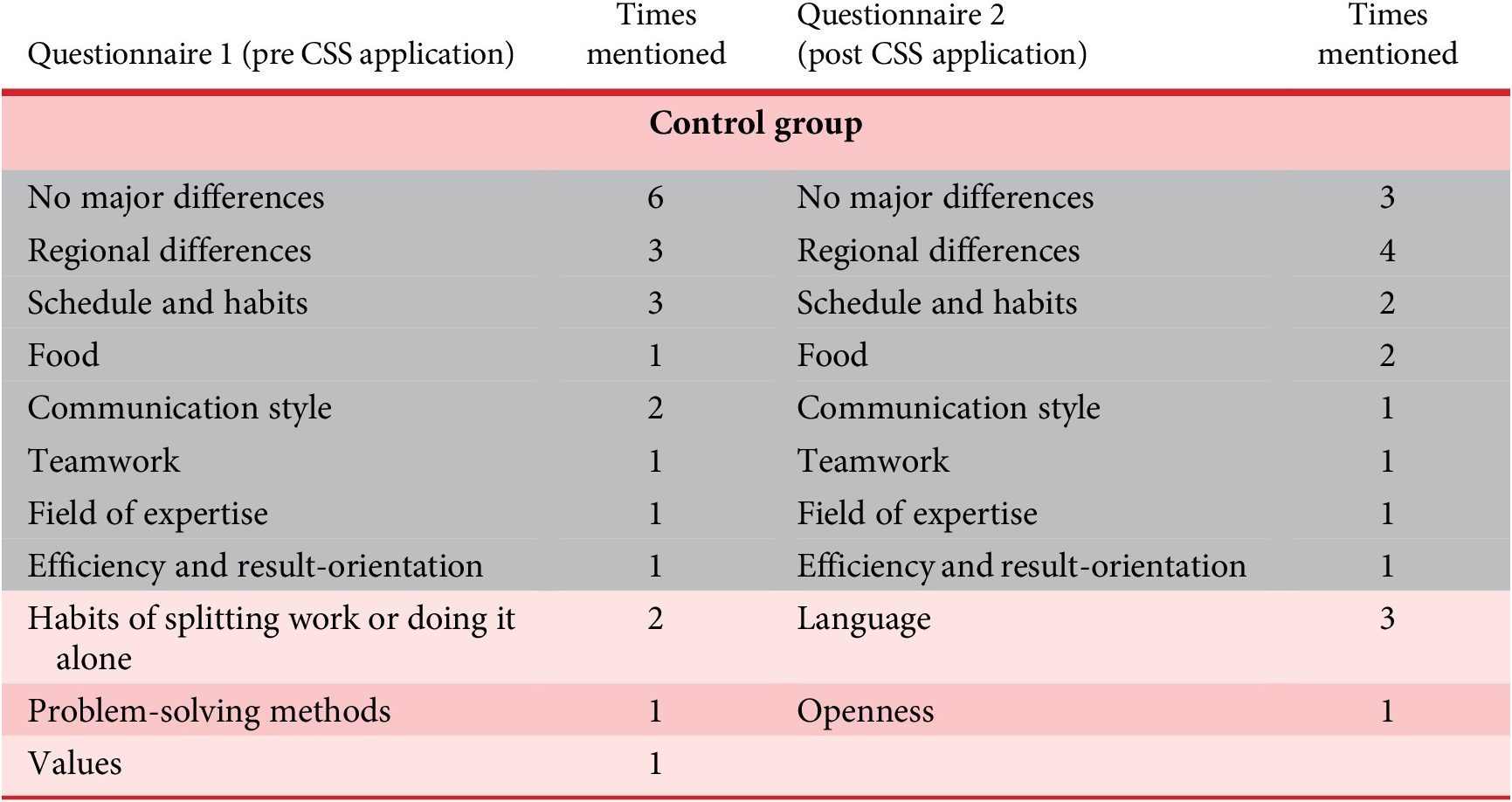
The results of the control group show no major changes in the answers. Most aspects have been mentioned in both questionnaires and a lot of the participants do not see any major differences. In the first questionnaire, 11 differences were named in the second questionnaire 10.
The next question was on participants’ knowledge of the nationalities represented in the team. Table 4 shows the answers from the test group in the first and in the second questionnaire.
Answers by the test group to the question: what do you know about the other nationalities represented in your team?
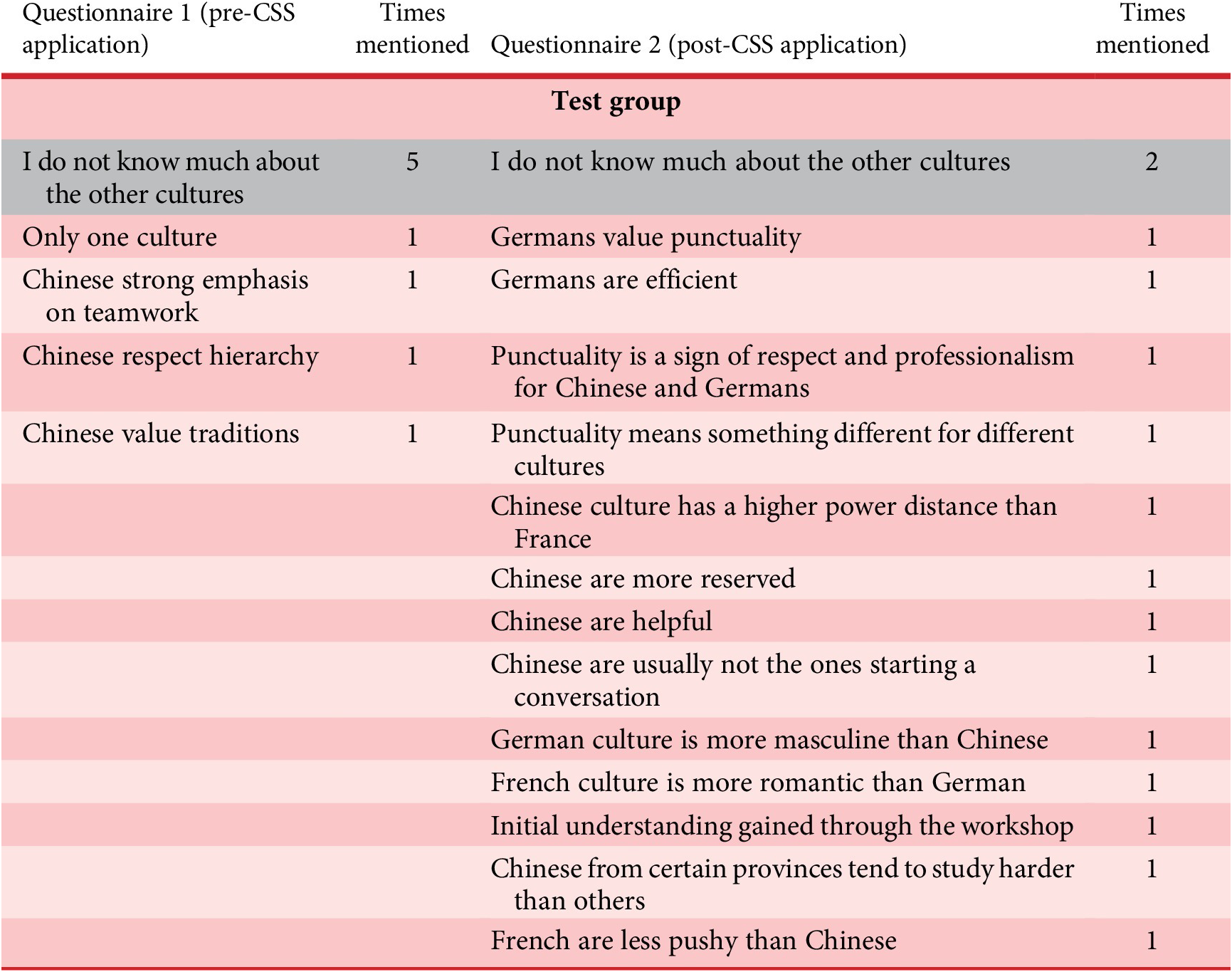
Two participants still stated in the second questionnaire that they do not know much about the other cultures. In the first questionnaire, five participants answered that.
Table 5 shows the results of the control group to the question of what they know about the cultures represented in their team.
Answers by the control group to the question: what do you know about the other nationalities represented in your team?
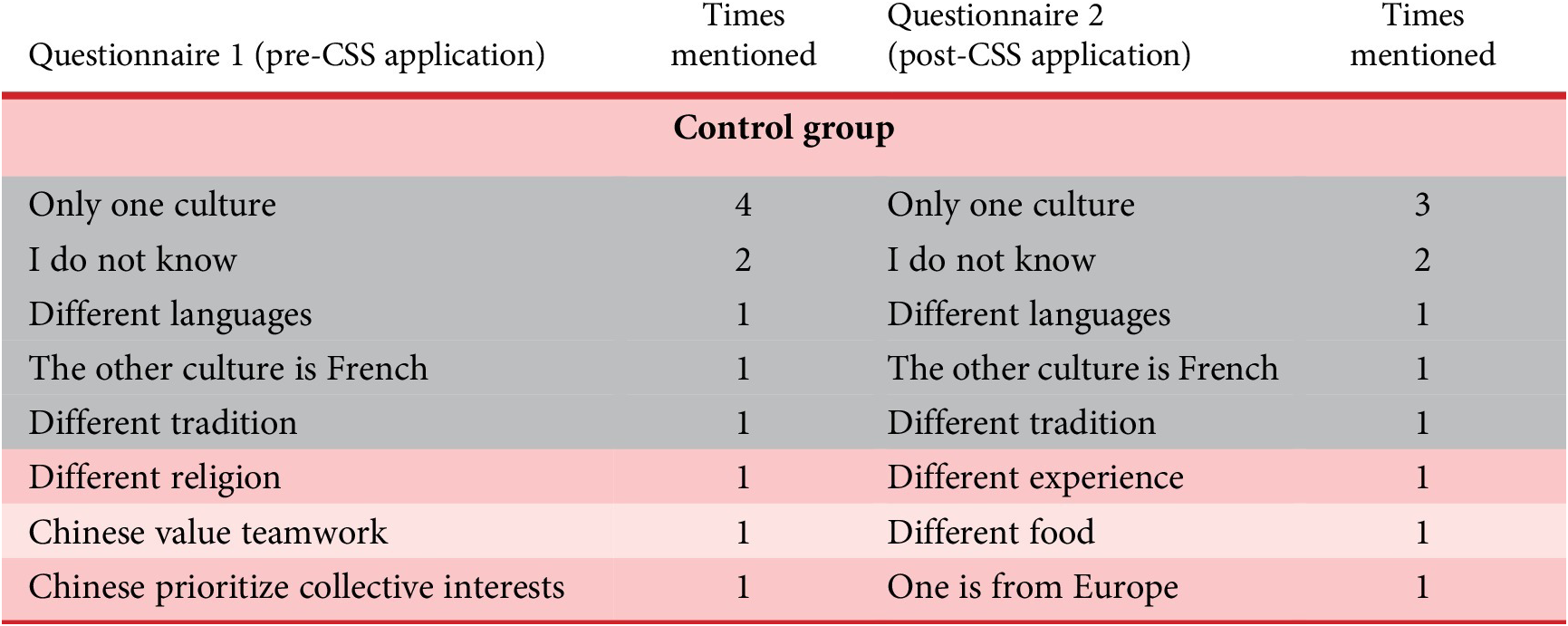
In the first questionnaire, four participants stated that there is only one culture represented. In the second questionnaire, it is three participants giving this answer. In the first and the second questionnaires, two participants replied that they do not know. The number of answers provided in the second questionnaire is not greater and is very similar to the answers provided in the second questionnaire.
Table 6 presents the responses of the test group to the question about expectations for the teams’ collaboration and their work ethics. The answers are again divided into two sections: the first section, highlighted in gray, includes responses that appear in both questionnaires, while the second section, in white, contains responses unique to one of the questionnaires. Each section is organized by the frequency of the responses.
Answers by the test group to the question: what are your expectations regarding the collaboration and work ethics of your team?
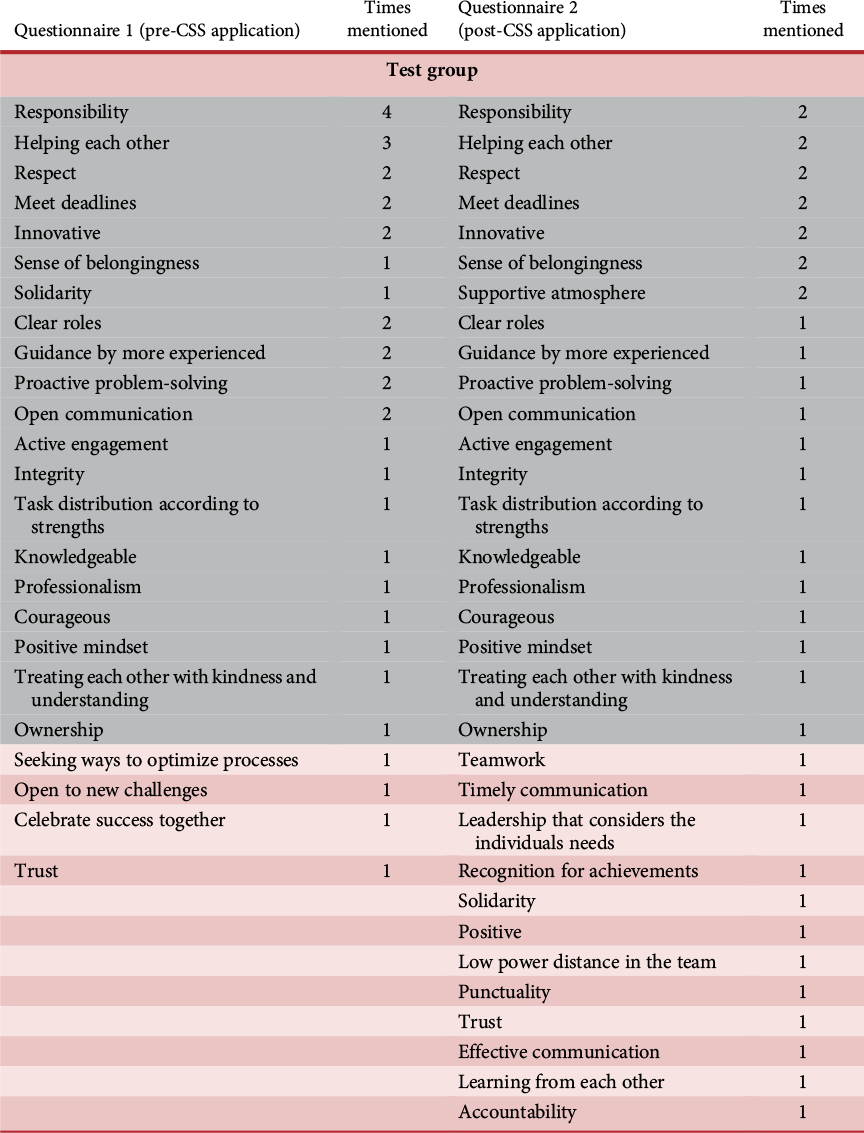
A lot of responses stayed the same in both questionnaires. Expectations regarding teamwork are not necessarily dependent on culture at all, and this question was placed in the questionnaire to see if the method application leads to increased thinking about the personal expectations for teamwork. In the first questionnaire, only one aspect concerning communication was mentioned. In the second questionnaire, open communication, timely communication and effective communication were mentioned by the participants, emphasizing the relevance of communication for successful teamwork.
Table 7 shows the answers from the control group to the question about the expectations regarding collaboration and works ethics of the team. The table is organized in the same way as the previous tables.
Answers by the control group to the question: what are your expectations regarding the collaboration and work ethics of your team?
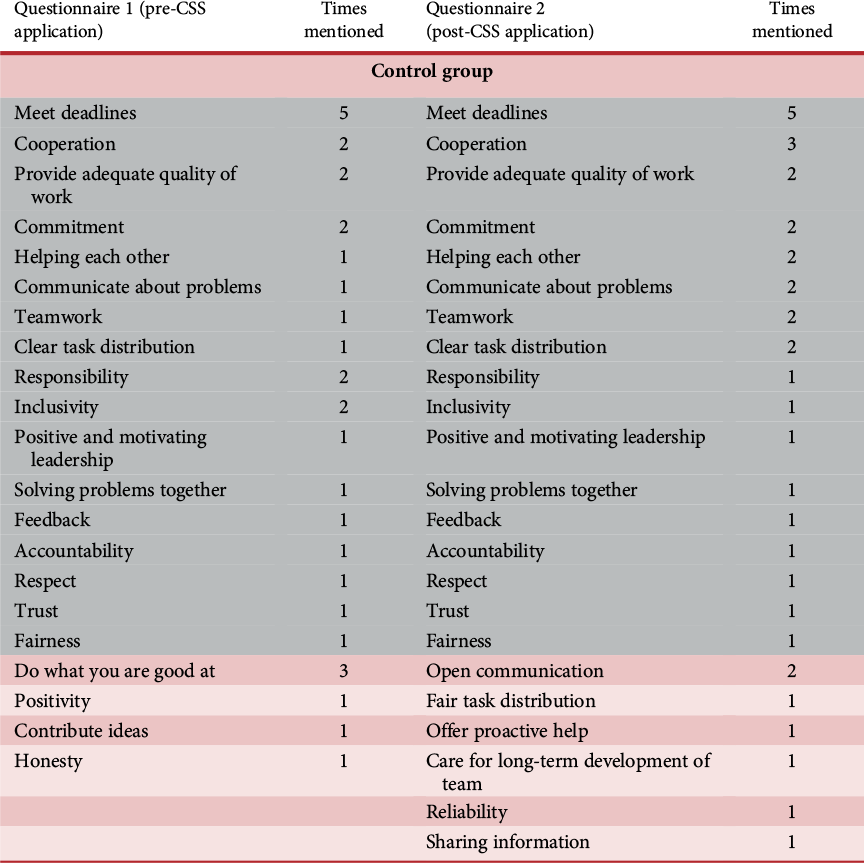
Meeting deadlines was mentioned most frequently with five times in both questionnaires. It is worth noting again that the second questionnaire was returned by only nine participants, whereas the first questionnaire in the control group received responses from 12 participants. Even though fewer participants answered the second questionnaire in the control group, the number of answers still increased from 22 to 24.
Non-negotiables were the core of the next question. This question was also part of the second phase of the CSS and the non-negotiables needed to be agreed on before the next phase was started. Table 8 shows the answers from the test group in the same representation as previously. The first part in gray shows answers that are part of both questionnaires, and the second part in white shows answers that were only part of one questionnaire. The answers are sorted by frequency in each part. For this question, some examples of non-negotiables were given. It was decided that examples for non-negotiables are needed, to ensure that the participants are not too shy to answer due to the uncertainty about the wording. Giving examples can always lead to biased answers and is taken into consideration in the discussion. The examples given are as follows: “everybody needs to be on time for meetings,” “no yelling” and “if somebody is not able to contribute the part he promised, he needs to tell the others as soon as possible.”
Answers by the test group to the question: which aspects are non-negotiable for you in terms of work ethics and collaboration with others?
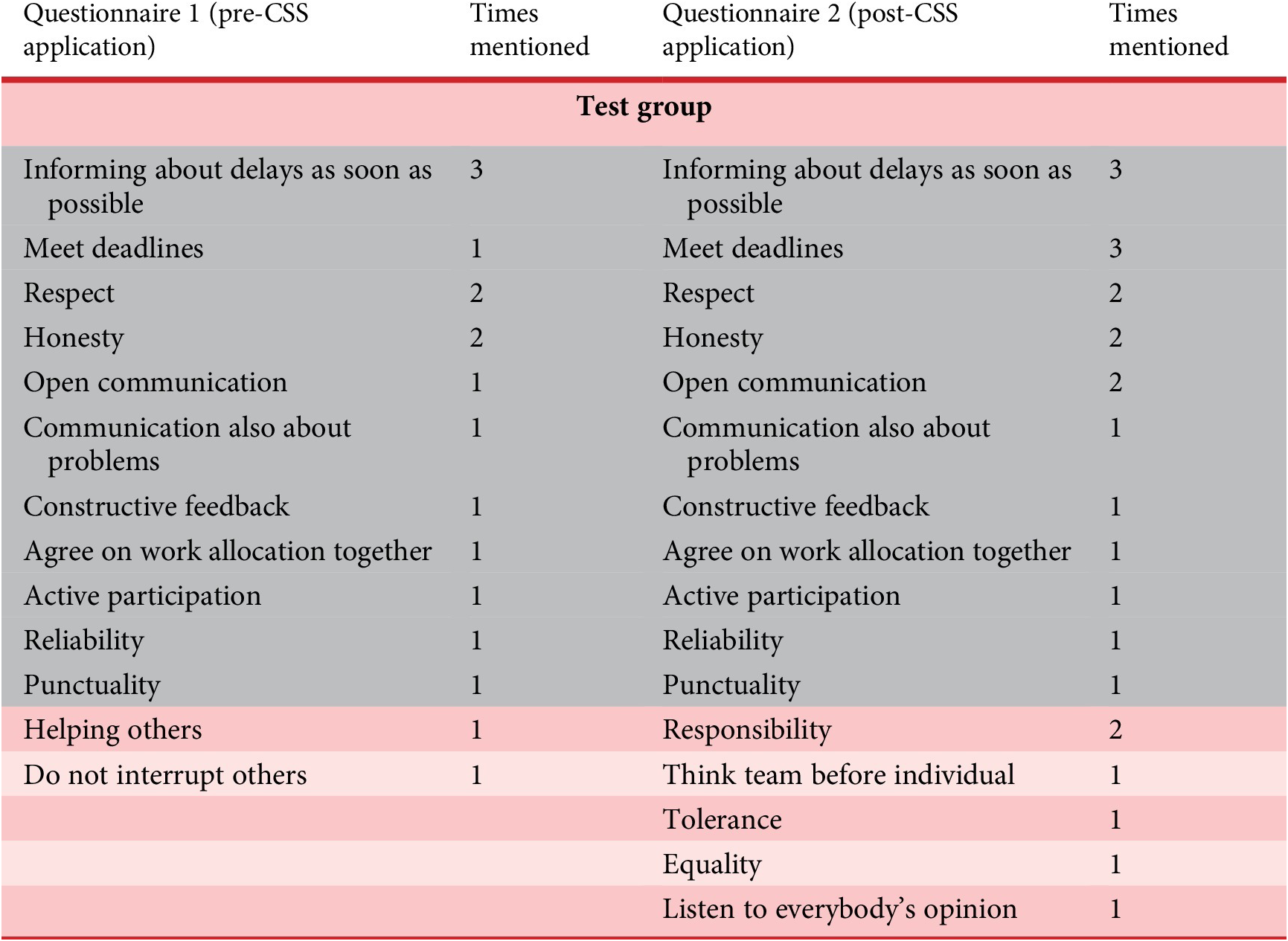
The results to this final question in this category show that the basic non-negotiables stayed the same for the team. A few additional answers are included in the second questionnaire on a level of general values like tolerance and equality.
Table 9 shows the answers of the control group for the question on non-negotiables within the team. The control group saw the same examples of non-negotiables.
Answers by the control group to the question: which aspects are non-negotiable for you in terms of work ethics and collaboration with others?
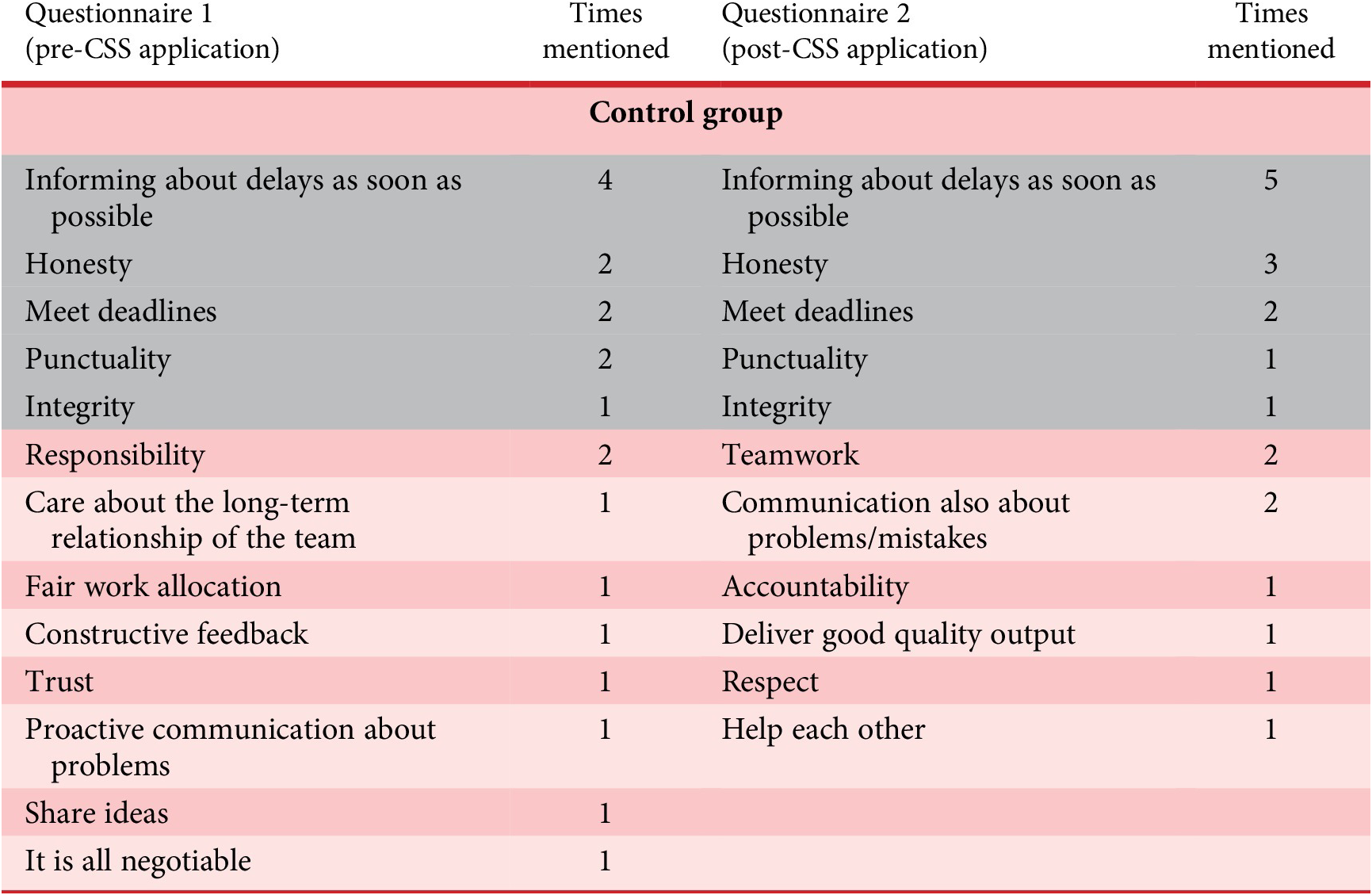
Within the control group, five answers are the same in the first and in the second questionnaire. In the test group, this is the case for 11 answers. The control group had no designated workshop in which non-negotiables were discussed and agreed on while this was part of the CSS application for the test group. Informing about delays as soon as possible was the most mentioned answer with four mentions in the first questionnaire and five in the second. It needs to be taken into consideration in the discussion that this non-negotiable was one of the examples provided.
4.2. Discussion of the questionnaires’ results
The average value for the knowledge of the team members’ cultural backgrounds increased for the test group from 3.56 to 4. For the control group, it stayed at the same level (3.83–3.88). This is the first finding showing that the method application led to increased cultural understanding. The use of the average needs to be critically reflected at this point since there is no measurable distance between the five points on the Likert scale. When taking the median instead of the average, the median for the test group stays at 4 and the median of the control group increases from 3,5 to 4. Because using the average can be seen as critical, the evaluation of this item should only be looked at as one of the aspects under consideration and not as the only proof of successful application.
A very interesting finding is that a majority of the control group noted that there is only one culture represented within their team. The absence of their knowledge about the other cultures, which are a minority but still exist within their team, is one explanation for the high scores for the control group concerning the knowledge of the cultures represented within the team. The test group participants were more aware of the fact that there is more than one culture represented within the team. Participants of the method application became more aware of the cultural diversity within the team. It is critical to mention that no participant noted the number of cultures, which is four, correctly. The participants became aware of the different cultures represented in the workshop, but did not learn more about the participants of the control group who had a different cultural background. Talking about other cultures represented in the team but not present within the method application might be an option. The method was initially designed to be applied with the entire team targeted at teams of less than 20 which is typical for engineering teams. With bigger teams a solution should be found to ensure a more comprehensive cultural learning. Multiple workshops in different settings might help. An alternative is including elements from the other cultures in the team within phase 3 of the CSS through the moderator.
The question on cultural differences in the test group showed more problem-solving and work-related answers like efficiency and result-orientation, or workload acceptance in the second questionnaire. These answers show that the team members gained a better understanding of what the differences mean in everyday work. Openness was mentioned once in the first questionnaire and was mentioned three times in the second questionnaire. The amount openness is mentioned also shows that the team members see communication differences now as an aspect affecting their collaboration and maybe also one, which needs to be paid attention to if mentioned as the major difference. For the control group the answers to this question in the first and second questionnaires almost stayed the same. The fact that the frequency of no major differences has decreased from six to three might be due to their increased knowledge about this research due to the questionnaires, and therefore, a though process about cultural differences has started for them as well.
The question on the main cultural differences got a very high number of answers by the test group in the second questionnaire, and the answers were very reflected and highly elaborated. The results make it clear that the participants are aware of the other cultures now, learned about them and reflect on their own culture more in the second questionnaire. This did not happen for the control group.
The amount of answers to the question what they know about the different cultures represented within the team also proves increased knowledge on the other cultures.
As stated above, expectations regarding teamwork are not necessarily dependent on culture. This question was placed in the questionnaire to see if the method application leads to increased thinking about the personal expectations for the teamwork. The list of replies got longer, indicating the participants were motivated by the workshop to think about their expectations and might get them clearer for themselves. Only if the expectations are known, they can be shared with the others to form consent or discuss common grounds. Aspects including communication were mentioned more frequently in the second questionnaire, showcasing that the importance of communication became clear in the workshop. Communication is the key to successfully improving cultural sensitivity which is why this development for the test group is valuable. The control group also showed two more replies in the second questionnaire. Even though the participants were not part of the workshop, the entire topic of cultural awareness was still discussed more in the entire team, which might have led to the other group members thinking about the topic and what is relevant to them more. This could be seen as in contrast to the lack of knowledge on cultural differences. The team members that were not part of the workshop might not have engaged with the intercultural participants more during the time between the two workshops but discussed certain aspects of the workshop with Chinese colleagues. Another possible reason for more answers by less participants to this question could be that workshop participants discussed their expectations more with the team after the workshop.
The basic non-negotiables stayed the same for the test group. Three aspects on the level of general values were added. The number of replies by the control group was lower in the second questionnaire. The test group had a lot more common answers in the first and second questionnaires which could be due to the active discussion of these values together in the team during the method application. It is critical to note that for this question examples of non-negotiables were given. This was due to the learnings of a prior discussion that showed, that the term might not be clear to everybody. The examples have been repeated by both, the test and the control group, but more frequently by the control group. An alternative would have been to describe the term in more detail. We decided against this option, to keep the questions as short as possible, to try to increase the probability for people to answer. For the participants of the control group that did not work with these values in more detail and that did not have to think about them except when answering the questionnaire, it might have been more obvious to choose one of the examples for answering the question. The participants in the test group, who had to think about these elements, discuss them and agree on them, formed their own opinions and already found out what is relevant for them for successful teamwork.
The method application was focused on culture and learning about cultural differences to facilitate learning about other team members. However, understanding is an ongoing process, and intercultural learning extends beyond a single event. The comparison between the test and the control groups shows that the cultural sensitivity of the test group has increased and therefore the method applications success in this aspect.
It is noteworthy that most participants have little experience in intercultural contexts, working in a research team and also in company teams that are mainly Chinese. There are some team members from other cultures now and a discussion with the professor responsible for the team shows that there are programs for exchange and that the group is working on additional programs to increase the number of intercultural team members. The outcomes differ to some extend with participants with more intercultural experience, and this aspect will be discussed in the comparison to previous rounds of application in Section 4.7.
4.3. Results of the creativity session on Miro
Both sub-groups successfully completed the development task of designing a new generation of an apple peeler. A video of the peeler, as it is in its current generation, was shown to the participants to make sure that the understanding of the product to be developed further is the same for everybody. Before starting the task, the participants were introduced to the results that ChatGPT (Introducing ChatGPT 2024) can provide for the problem. Figure 3 shows the results and a picture of the apple peeler as reference.
ChatGPTs’ result to the creative problem-solving task and the reference apple peeler.
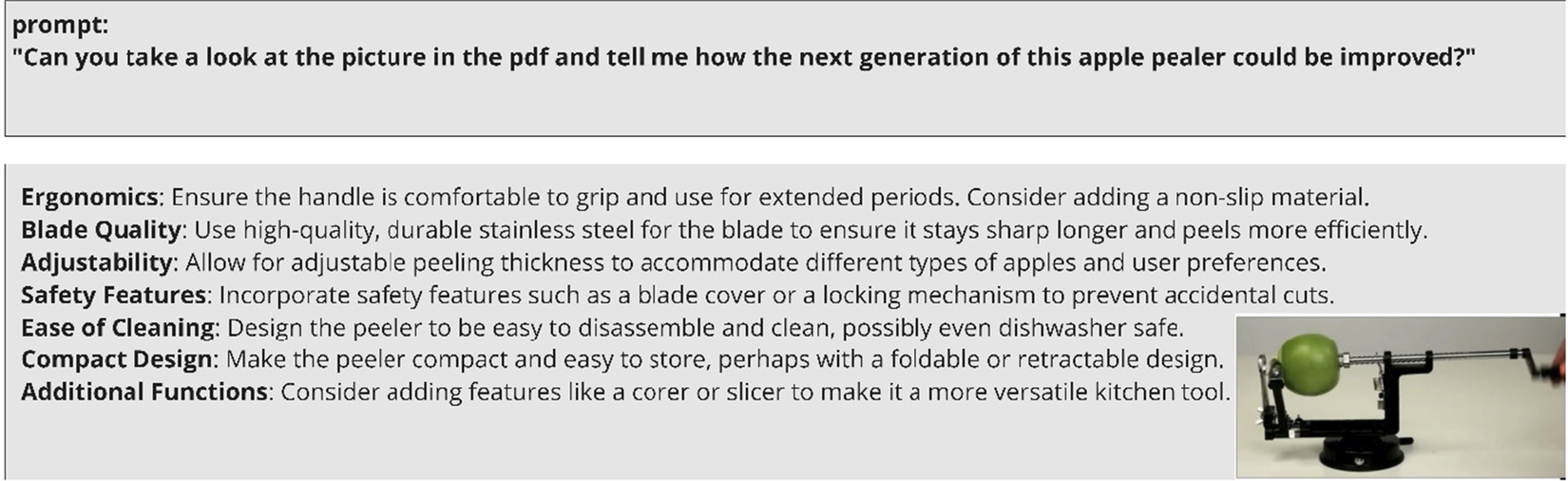
This was done to ensure that the task was carried out by the sub-groups without just using artificial intelligence for help. The instructions were as follows: please use the current apple peeler as a reference and generate a new product generation to improve the product. The stimulus picture method should be applied to kick-start your idea flow. The pictures can be found on the Miro (2024), and there is a designated space for each group. Please start by thinking about potential solutions with the help of the pictures. You can grab and use or manipulate any of the pictures. After the initial phase to collect your ideas individually please discuss with your group and come to a shared understanding of a new generation of the apple peeler that you can present to the group. The solution should be also visible on your Miro board. If needed you can add text to explain your solution.
Figure 4 shows the pictures chosen and the features generated through them in the stimulus picture method by sub-group 1.
Features of the new generation of apple peeler generated with the stimulus picture method by sub-group 1.
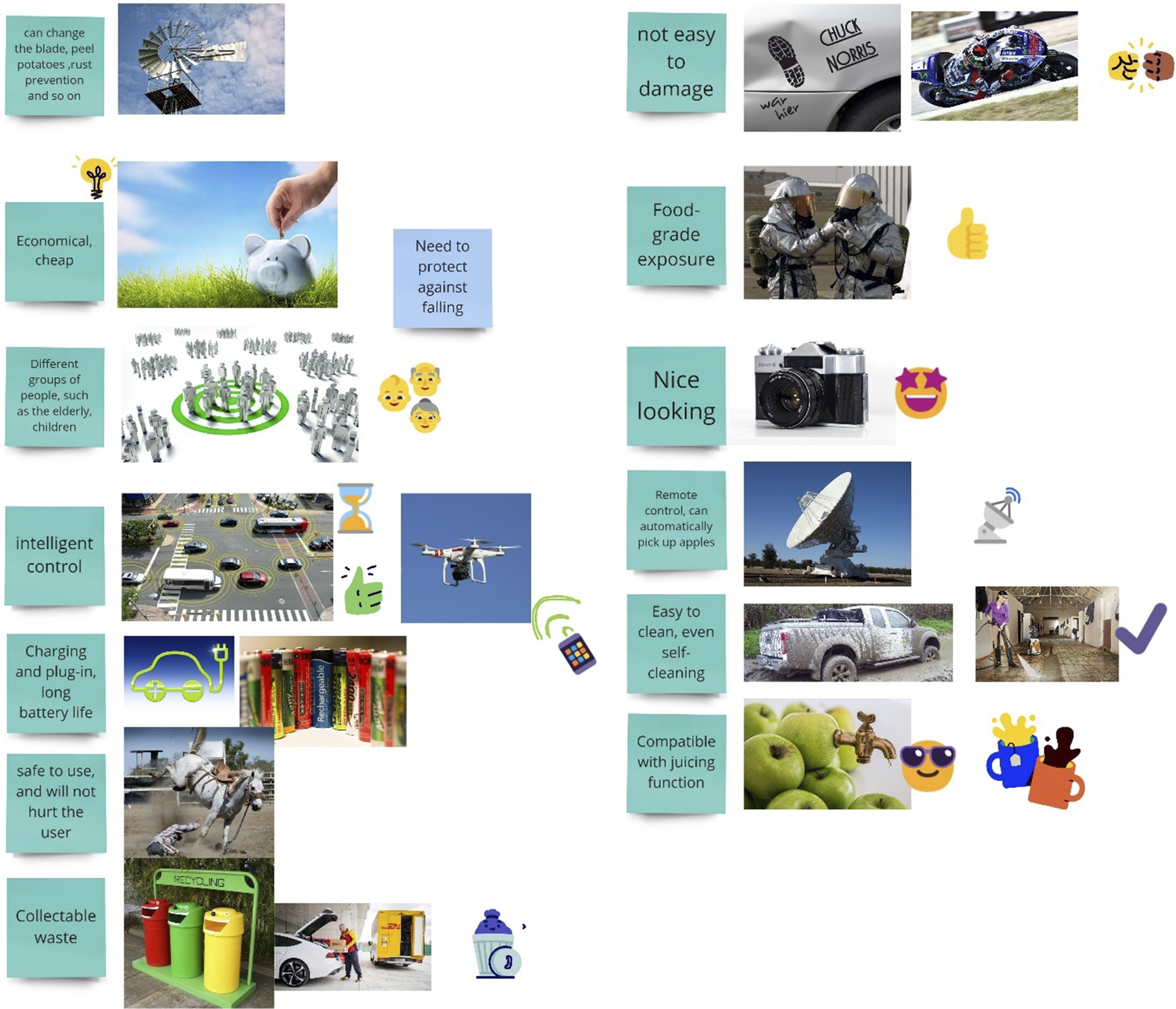
Eighteen pictures have been selected to generate 15 features (the card feature includes 3 features). The team chose to additionally include emoticons for each feature. Sub-group 1 also chose to design a graphical representation of their solution that can be seen in Figure 5.
Graphical representation of the solution generated by sub-group 1.
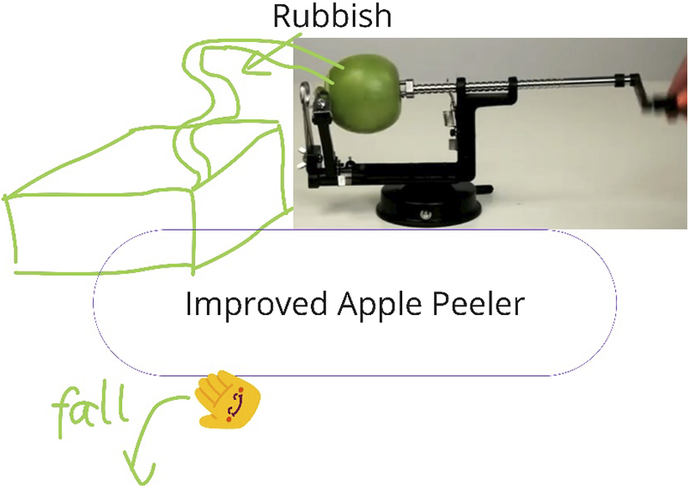
Sub-group 2 also chose a variety of images during the application of the stimulus picture method which can be seen in Figure 6.
Features of the new generation of apple peeler generated with the stimulus picture method by sub-group 2.
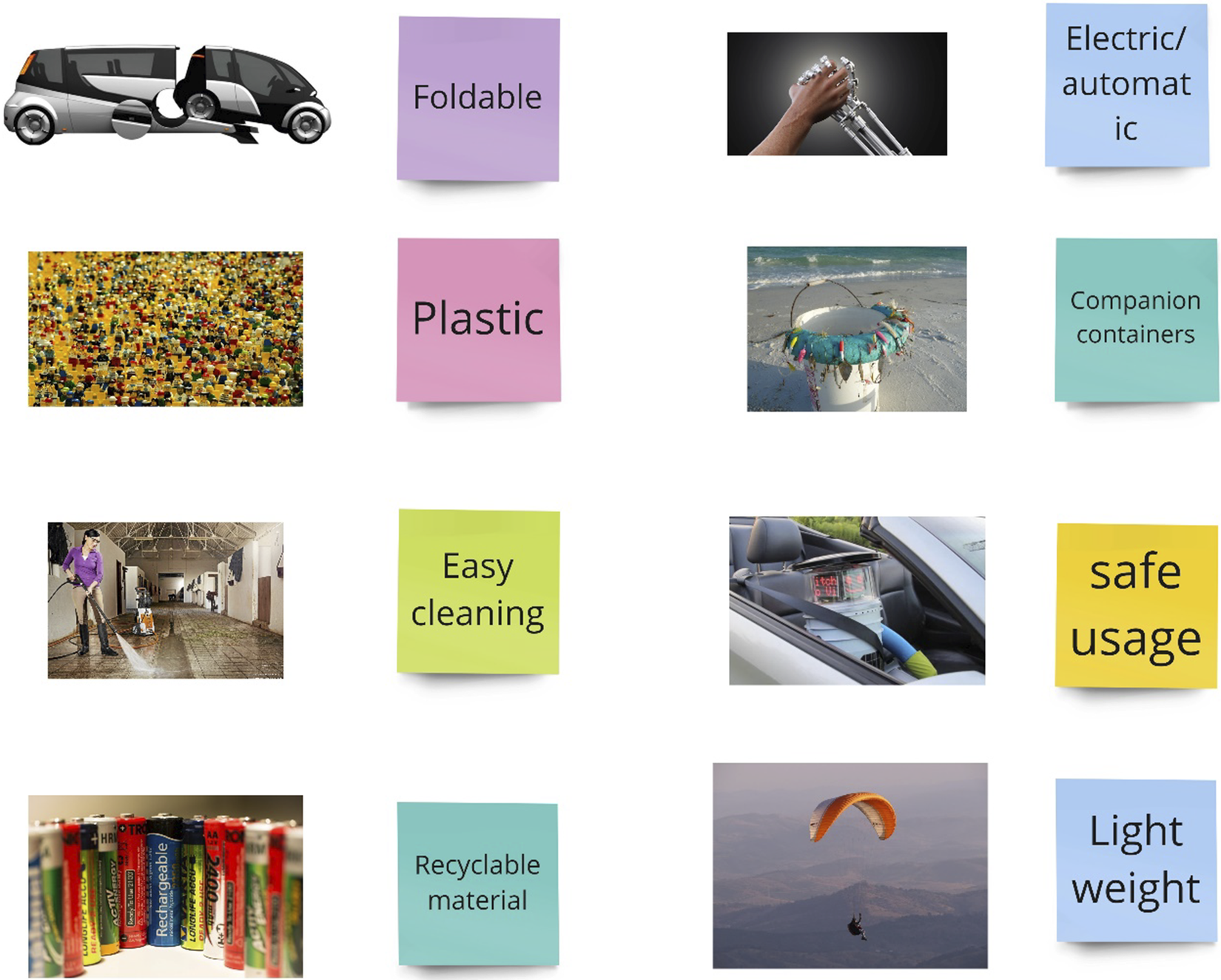
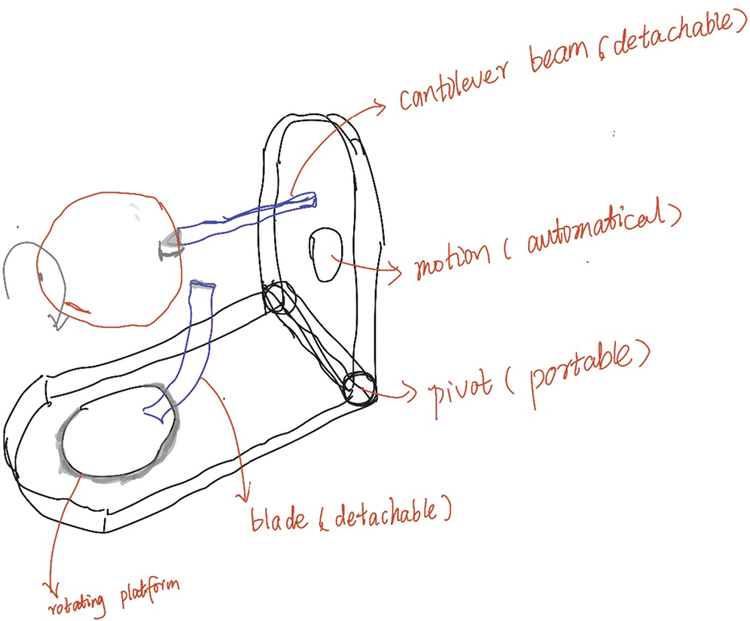
Eight pictures have been selected to generate eight features. This team also chose to graphically represent the solution, but without using the reference product as a basis (Figure 7).
Graphical representation of the solution generated by sub-group 2.
4.4. Discussion of the creativity session on Miro
All proposed solutions were appropriate for the problem statement and exhibited varying levels of complexity and differentiation. Sub-group 1 designed 13 features, and sub-group 2 designed only eight features. To assess the creativity the features are compared to not only the previous generation but also the solution found by ChatGPT additionally to evaluating the number of features. For a feature ChatGPT mentioned in the same way the sub-group used it, 0 points are assigned, for a feature mentioned but redesigned 1 point is assigned, and for a feature not mentioned at all, 2 points are assigned.
Points assigned for the ideas generated by the two sub-groups
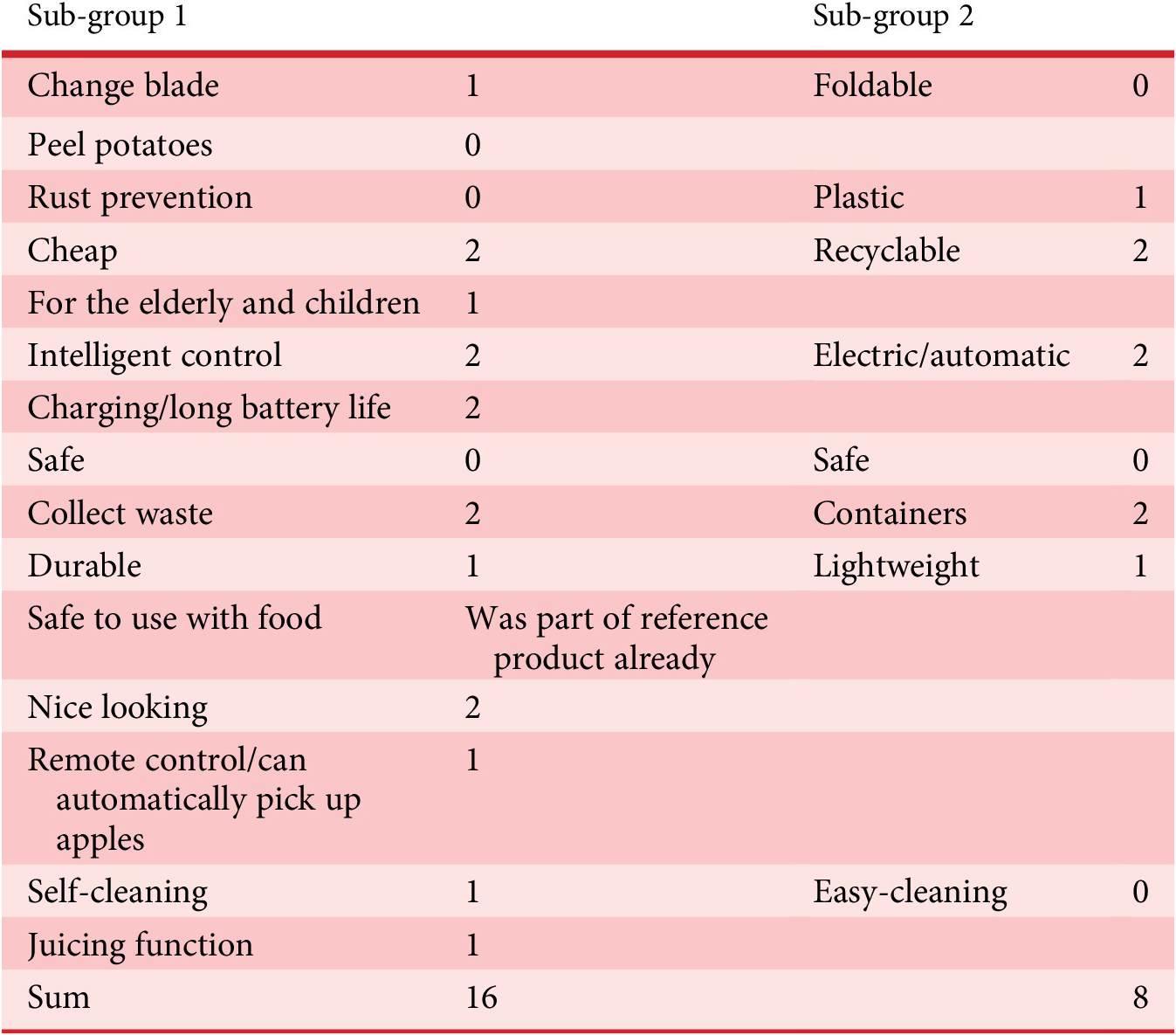
Sub-group 1 scored 16 points and sub-group 2 8 points in the creativity ranking of the solution generated. Both sub-groups successfully applied the stimulus picture method and successfully solved the problem, generating not only a new generation of apple peelers but also a generation more elaborated than ChatGPTs’ results.
4.5. Results of the observational study
Analysis of the observation templates of the two sub-groups in the creativity session (fourth phase) of the CSS method reveals each group had one person who took up a relatively large share of the speech (39% approx. 16 min in sub-group 1 and 37% approximately 18 minutes in sub-group 2). The lowest speaking shares in this group amounted to 12%–15% (approx. 5–6 min in sub-group 1 and 16% approx. 8 min in sub-group 2). The total of minutes spoked differ in the two sub-groups, which is why the percentages stand for different amounts of minutes. In each group, the individual with the largest share of speech was from China. The participants from different cultures also had a fair share of minutes of speech (9 min) and were fully integrated into the discussion. The Miro board shows that early on multiple ideas have been collected by each team member individually. These ideas have been later integrated into the common solution. There was not one idea that was discussed a lot more than the others. The number of digressions on personal topics is very low (three for sub-group 1 and 4 for sub-group 2), which indicates a productive working atmosphere. The personal topics were the way the board moved if an object was touched by two members, the food for lunch, and the snacks provided. The mood was perceived very positively with more insecurity at the beginning of the task and a more comfortable atmosphere after the first 10 min. Interruptions of other participants were seldom. If somebody was interrupted, it was to help him or her progress with the formulation of the idea or to help find a good formulation. Participants who did not speak much were sometimes engaged to participate actively but only when decisions needed to be taken together, e.g., how an idea should be incorporated. This active engagement was mainly initiated by team members with the largest share of speech. The French team member was addressed twice with a specific culture-related question in a very polite manner. The online participants were asked for confirmation and their participation in Miro, as well as in the call was not lower than the participation of on-site participants. Two rounds of laughter were shared by both groups on the occasion that the Miro board was completely covered with an image for a few seconds and when the moderator called to finish in 5 min and the team called to hurry up at the same time.
4.6. Discussion of the observational study
Even though both sub-groups developed a leader of speech, everybody contributed to the creative problem-solving process, which is a positive sign for the team development. Having somebody leading the discussion might have taken some pressure off the members who are not so outgoing. Even though it was not part of the task to involve everyone, all teams decided to ask for the consent of all participants multiple times. All teams started shy in the sense of quiet, with little discussions and with breaks between the direct interactions, but seemed to be motivated and encouraged to discuss ideas by the stimulus picture method. The positive perception of the mood is another indicator of the method’s successful application. The international participants were included well, and the participation rate did not come in lower than the rest. The French participant was addressed on two occasions, especially about culture-related questions, which is good since the previous phase got the participants thinking about the cultural aspects discussed. It is to mention that the observations were performed only by one person, the moderator. A second or third opinion would have made a more objective evaluation possible.
4.7. Results and discussion of the comparison to the applications
Comparing the outcomes of the previous CSS application with the latest one is challenging due to the unique characteristics of each team. The participants from the previous rounds of application had diverse cultural backgrounds, experiences, and knowledge, making it difficult to directly compare the results. This round’s focus was validating in a mainly Chinese cultural environment and validating the application in a partially distributed setting.
The partially distributed communication took place with the help of Microsoft Teams (2024) and WeChat (2024). These channels were tested beforehand. Furthermore, the Miro board was at all times accessible for all the participants to share ideas and included a tutorial for Miro. Each sub-group had their designated space on Miro during activities that were carried out not within the entire team. It was an additional option to use the commenting and tagging functionalities on Miro, but because the participants are very used to WeChat, this was the main communication channel between online and offline participants. The Miro board that was used for the stimulus picture method showed the images for the method. Additionally, sticky notes, space for free drawing, and for uploading material to show and discuss with the group were included. The moderator monitored the changes on the Miro board and answered questions for both sub-groups.
In each validation iteration of the CSS, the problem statement was successfully addressed and a variety of suitable solutions was created collaboratively. No level of distribution of the participants showed results that seemed to be lower in quality or creativity. Here it is note critically that a more thorough evaluation of the creativity of the solutions could have been carried out with one of many options to measure creativity. Because in three out of four application rounds only example problems were solved, this has not been done yet but is planned for the future. Additionally, the results regarding improved cultural understanding, as measured by the questionnaire, were similar. The major difference in the round of application presented in this contribution is that not all group members were aware of the cultural diversity within the team. In previous rounds of application, the teams chosen were a lot more diverse. Even though this round of application was not within a completely diverse team, cultural understanding still improved and the method proved to get the participants thinking and in a good place for creative problem-solving. That aspects of culture have specifically been discussed in the problem-solving phase, is an additional sign for the success of the application because the participants continued to discuss this topic even though it was not directly part of the task anymore. Consequently, the team developed a stronger mutual understanding in this partially distributed setting just as seen in previous rounds of application.
This iteration was done with participants with less intercultural experience than the previous teams (Bastian et al. Reference Bastian, Cadavid Restrepo, Willerscheid and Albers2025, accepted for publication; Bastian et al. Reference Bastian, Deisenrieder and Albers2025, accepted for publication). All three teams in the previous validation iterations either work in a different country than they consider their cultural origin or they have multiple years of experience in working in intercultural teams. The team in this iteration has little international experience as described in Chapter 3.2.1 when the design of the test and control group were explained. The application of the CSS was also successful in this less experienced team but when starting phase three concerning the cultural dimensions, more time was needed to explain the way cultural differences can influence one’s behavior or way of thinking and the way the cultural dimensions can capture these differences.
Comparing the different settings, on-site, partially distributed, and distributed with the same group of participants would enhance comparability, but applying the CSS again for the same participants alters the knowledge baseline, making it an unsuitable comparison. This round of applications had two goals: testing the application of the CSS in a partially distributed setting and testing the application in a primarily Chinese team (a team with a majority of participants from the same culture). Both goals have been reached successfully. The next steps should include applying CSS to a real-world problem again and include a thorough evaluation of the creative output.
4.8. Results and discussion of the personal assessment and feedback by the test group
The test groups’ second questionnaire included a section to provide feedback on the method and suggest potential improvements for the future. Furthermore, this section included questions where the participants could evaluate themselves if their understanding of culture has improved and if their creativity was triggered. This was the reason the second questionnaire was anonymous and nobody needed to include hints on his or her identity. Out of the nine participants, seven felt that their understanding of the team members was improved. Furthermore, five felt that their understanding of different cultures was improved. Concerning creativity seven participants stated that their creativity was triggered through the workshop and that the creativity methods applied supported the creativity. Also, seven participants indicated that they felt comfortable during the method application. These results are visualized in Figure 8.
Personal assessment by the test group concerning improved cultural understanding and creativity.
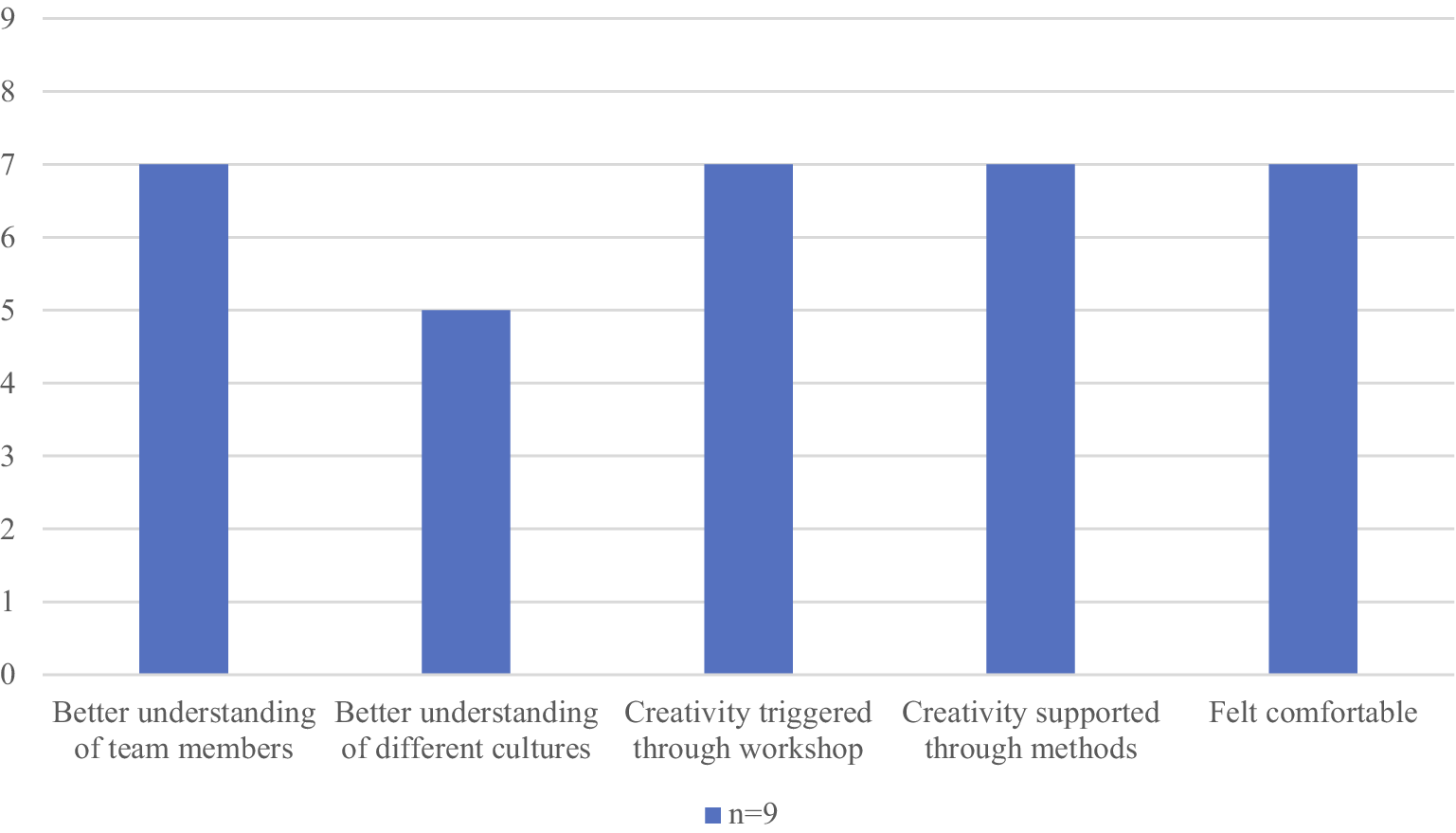
It is to mention that self-assessment especially on personal topics may lead to biased answers. The participants might answer what they think is socially acceptable and therefore not give the true answers. The results here show the success of the method once more but should be considered with the knowledge of potential bias.
The participants also had the chance to answer what surprised them most. Here the learnings include amongst others, the cultural differences concerning power distance, the harmonious communication atmosphere, everyone’s participation, the fact that the learnings can be useful for one’s own research, and the new experience through switching perspectives. One participant mentioned that the cultural tag we assign to somebody might not at all be the way he or she is actually shaped by their culture. The wish to learn more about other cultures and the team being open to more intercultural members was also mentioned.
The feedback for improvement of the method included a more thorough warm-up activity and the organization of the cultural dimensions thinking caps in a role-play setting. Both options can be considered for further applications of the CSS but especially the teams’ openness to the role-play activity needs to be evaluated prior to a test run.
The final phase of the CSS also included giving feedback in the categories of general learnings, what should we apply from now on, how did taking on a new perspective feel, and feedback in general. The learning shows various cards reflecting cultural sensitivity, like willingness to adapt oneself, thinking with another’s mindset, or the understanding that somebody else might think in a totally different way. Thirteen of the 14 cards in the general learnings section contain aspects related to culture. The answers to what we should apply from now on contain four cards related to improved communication and five cards related to culture. The answers to how the participants felt when taking on a new perspective can be found in Figure 9.
Answers in CSS phase 5 to: how did you feel taking on a new perspective?
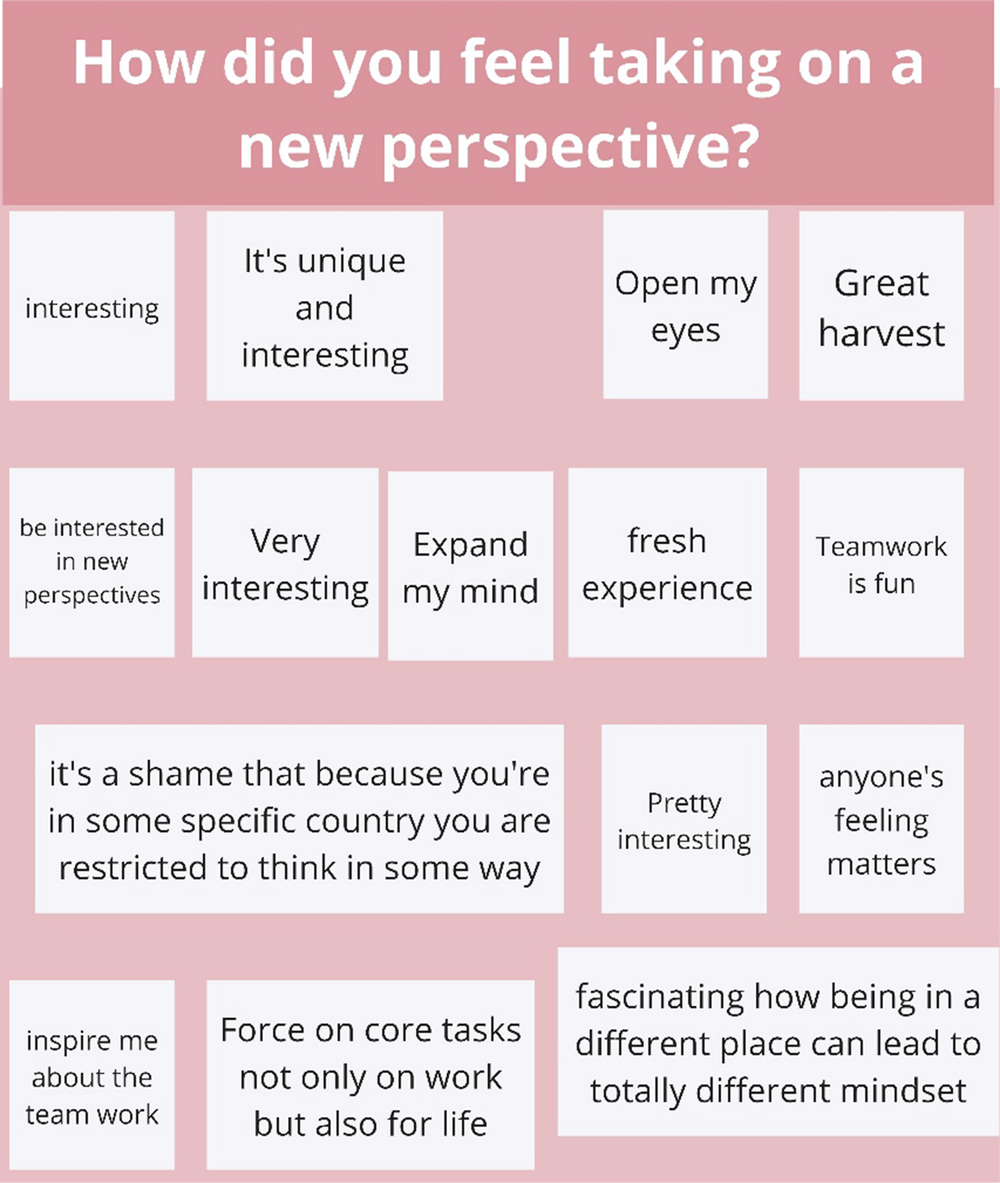
The feedback was very similar to the feedback provided within the questionnaire and included again that the participants found the workshop very interesting. These results show that the participants really started thinking about cultural aspects and that these were still in their minds during and after the creative problem-solving, proving that cultural sensitivity was taken into the problem-solving process.
5. Conclusion
The application of the CSS Method in a primarily Chinese team to validate the method in terms of its applicability and contribution to success was described in Section 4, answering research question one. The partially distributed application worked smoothly because the method was designed with a virtual setting in mind. Communication channels, idea-sharing spaces, and tool assistance were provided, such as a Teams call, the Miro board and tutorial, and the option to include further tools like WeChat in this case. All tools were accessible to all participants throughout the method application. In this application, the freedom to include further tools was crucial to the success of the application. Without the option to do so, the creative process might have been hindered by the learning process of using new tools appropriately. Monitoring the process for the evaluation was easier than in fully distributed settings since listening to the teams with their online members was possible on-site. This was more challenging in previous online validation iterations since jumping through the Microsoft Teams break-out rooms was needed, which caused an interruption for the teams. There was no difference in the on-site validation iteration except for the need to check and provide the tools for distributed communication. With one person per team to monitor the team processes, more detailed documentation on the process, especially the communication processes, could have been collected to enhance the available data. In this round of application only one person monitored the teams. Furthermore, documentation personnel external to the team that designed the method could improve objectivity.
The measurable added value of the methods in enhancing culture-sensitive creative problem-solving for the team is evident on multiple levels, addressing the second research question. First, the improvement in cultural understanding was demonstrated through the questionnaire results presented in Section 4. Second, the support for creative problem-solving was shown by the outcomes of the sub-groups during the fourth phase of the CSS method application. This phase included a more sophisticated assessment of creativity by comparing the features of the solutions to those generated by ChatGPT and previous product iterations, a process not implemented in earlier rounds of application. The first sub-group presented their solution, including 15 features generated with 18 images in the stimulus picture method. The second sub-group presented eight features and used eight images in the stimulus picture method. One major difference between the solutions was that the second sub-group designed the image of their solution entirely without using other pictures, while the first sub-group included the initial apple peeler and added onto it. The second sub-group used their creative ability therefore also for the design of the basic peeler itself, while the first sub-group focused on the features. Seeing these two different approaches shows that even though it was not a rule that checking on the others’ solution is not allowed, the sub-groups still made it their competition and kept their process secret. Additionally, future applications should involve real-world problems to validate the method’s applicability, as initially confirmed in the initial CSS application in a project team of an EU-funded research project, together with industry. In this round, the apple peeler served as the practice problem, which brought the advantage of making it possible to work with the participants from the research group who do not all share the same project and therefore do not all work on the same problems. Using the practice problem allowed for fast introduction, but brings the deviation from real-world application of not being an actual problem that the team needs to solve to progress. This could have a negative influence on motivation and creativity.
The third research question, asking for the main differences between the on-site, the distributed setting, and the partially distributed setting, finds its answer in the communication channels. The communication takes place in different ways, but there does not seem to be a difference in the output due to the various stages of distribution. Furthermore, monitoring the sub-groups is easiest in on-site and partially distributed settings and poses more of a challenge in the distributed setting, since jumping between the break-out rooms interrupts the teams. The general application in the partially distributed setting worked without major differences from the on-site setting and the distributed setting. Since the method was designed to include all necessary elements for a successful, fully distributed application, the partially distributed application did not pose difficulties. What is important to note here is that the freedom to include further tools was very relevant in this round of application. Giving the participants the option to use WeChat, which they are very used to, sped up the process and made communication smoother for all participants.
The final research question addresses the conclusions drawn for improving the CSS method based on the team’s predominantly Chinese cultural backgrounds. It was found that no specific improvements are necessary due to the primary Chinese background. However, general enhancements, such as a more comprehensive warm-up and the inclusion of a role-play activity for the cultural dimensions thinking hats in phase three, were identified. These improvements do not appear to be related to the team’s cultural background but are general enhancements to the method. The absence of additional culture-based improvements confirms the method’s successful design in a culture-sensitive manner, including options for quiet idea sharing and the flexibility to not have to discuss ideas with the entire group. Individuals who prefer not to be identified as the ideas’ author can remain anonymous on Miro, ensuring that all ideas are collected without requiring participants to speak in front of the group.
The next steps for validating the CSS additionally include applying it to real-world problems, again with the improvements made and conclusions drawn. The limitations in the evaluation due to just a single person documenting the observations should be overcome by using additional observation personnel without interfering with the team process too much.


 Open access

