




Introduction
Musculoskeletal disorders encompass a wide spectrum of aetiologies, ranging from infectious, inflammatory, neoplastic, vascular and degenerative conditions to traumatic, developmental and toxic origins. In 2021, an estimated 1,686 billion prevalent cases of musculoskeletal disorders were recorded worldwide(Reference Liu, Rong, An, Li, Min and Yuan1). Globally, these disorders represent leading causes of disability and reduced quality of life, being often associated with pain and movement limitations of varying degrees, with a proportional reduction in autonomy(Reference Briggs, Cross, Hoy, Sànchez-Riera, Blyth and Woolf2–4).
In this context, nutrition plays an increasingly investigated and potentially modifiable role in the prevention and treatment of these conditions(Reference Calvo-Lobo, Becerro-de-Bengoa-Vallejo, Losa-Iglesias, Rodriguez-Sanz, Lopez-Lopez and San-Antolin5–Reference Dominguez, Veronese, Smith, Ragusa, Di Bella and Battaglia7). Recent studies have highlighted how a balanced diet and the intake of specific nutrients can have variable and sometimes inconsistent effects in the prevention and treatment of these conditions(Reference Hernandez-Duarte8,Reference Rizzoli, Biver and Brennan-Speranza9) . Among these, proteins, vitamins, minerals and essential fatty acids play a key role in musculoskeletal health by influencing collagen synthesis, bone metabolism and muscle function, not only reducing the risk of developing musculoskeletal disorders, but also affecting positively recovery and pain management in patients already suffering from such disorders(Reference Li, Sheng, Cao and Rui10–Reference Pereira, Shoemaker, Gawel, Davis, Luo and Mustad12). In this sense, vitamin D and calcium are recognised as essential nutrients for maintaining bone health, helping to regulate bone metabolism and preventing conditions such as osteoporosis(Reference Voulgaridou, Papadopoulou, Detopoulou, Tsoumana, Giaginis and Kondyli13,Reference Bischoff-Ferrari, Dawson-Hughes, Staehelin, Orav, Stuck and Theiler14) . Similarly, omega-3 fatty acids, found in foods such as fish and nuts, have been shown to have anti-inflammatory effects that can reduce joint pain and improve function in patients with rheumatoid arthritis(Reference Gabay, McInnes, Kavanaugh, Tuckwell, Klearman and Pulley15). Proteins, especially those with high biological value, are crucial for muscle and bone homeostasis, being directly involved in preventing muscle mass loss and bone density in the elderly, conditions that increase the risk of falls and fractures(Reference Phillips, Chevalier and Leidy16,Reference Bauer, Biolo, Cederholm, Cesari, Cruz-Jentoft and Morley17) . Vitamin C functions as a powerful antioxidant and an essential cofactor of collagen synthesis, a structural protein critical for the integrity and function of muscles, joints and bones(Reference Aghajanian, Hall, Wongworawat and Mohan18).
This umbrella review aimed to systematically collect and synthesise the major scientific evidence in the literature on the primary prevention of musculoskeletal disorders through the intake of specific nutrients or supplements. By synthesising evidence from systematic reviews and meta-analyses and applying the Grading of Recommendations Assessment, Development and Evaluation (GRADE) framework, it also sought to identify potential protective associations and to highlight areas of limited, inconsistent or low-certainty evidence, thereby clarifying current knowledge gaps in how targeted nutritional strategies can prevent or mitigate musculoskeletal disorders.
Materials and methods
Study design
This umbrella review was conducted by the National Working Group on ‘Preventive Nutrition’ operating under the Medical Residents’ Council of the Italian Society of Hygiene, Preventive Medicine and Public Health (S.It.I.) in the academic year 2024/25.(Reference Vecchietti, Strano, Minutolo, Grieco, Cappuccio and Granvillano19,Reference Granvillano, Mercogliano, Vecchietti, Minutolo, Lugli and Strano20) The group followed the Preferred Reporting Items for Systematic Reviews and Meta-Analyses (PRISMA) guidelines and the Joanna Briggs Institute (JBI) guidelines for umbrella reviews(Reference Aromataris, Fernandez, Godfrey, Holly, Khalil and Tungpunkom21). The protocol for this review was registered in PROSPERO (registration number: CRD42024544780).
Search strategy
The chosen review question was: ‘Which specific foods, nutrients, beverages or dietary supplements can prevent musculoskeletal diseases?’
The search was conducted using four databases – PubMed, Web of Science, Embase and Cochrane – and was performed focusing on the keywords ‘musculoskeletal diseases’, ‘nutrients’, and ‘prevention’. The last database search was conducted on 20 July 2025.
Studies were eligible if published in English or Italian, with no limitations on publication date. A comprehensive explanation of the search strategy is provided in supplementary Table 1.
Eligibility criteria
The inclusion criteria encompassed studies exclusively investigating primary musculoskeletal diseases, targeting individuals of all age groups without clinically diagnosed pre-existing musculoskeletal conditions. Eligible interventions involved the consumption of protective foods or dietary supplements aimed at supporting musculoskeletal health. Additionally, only systematic reviews and meta-analyses of both observational and interventional studies were considered for inclusion in this review. Individual randomised controlled trial (RCT) studies not included in systematic reviews and/or meta-analyses were excluded. Other exclusion criteria were the following: studies conducted in vitro or on animal models; studies focusing exclusively on individuals with clinically diagnosed musculoskeletal diseases at baseline or on populations selected on the basis of specific pathological conditions, as well as pregnant women; studies investigating specific diets, allergies or adverse drug reactions; studies including populations with musculoskeletal disorders present as comorbidities; studies not published in English or Italian, grey literature and articles from non-indexed or non-peer-reviewed journals.
Study screening process
All identified studies were imported into the Rayyan platform for screening titles, abstracts, full-text reviews and to exclude duplicates. The research team was divided into three groups and the blinding process was implemented using the online Rayyan tool. Subsequently, the automatic duplicate detection function was executed, and all identified duplicates were independently evaluated by Group 1 and Group 2. These groups were asked to categorise each duplicate as confirmed, rejected or classified as ‘potential’. Upon completion of this stage, the blinding was removed and Group 3 was assigned to solve discrepancies between Group 1 and Group 2 and to review all cases marked as ‘potential duplicates’. Group 3 was also permitted to engage the entire research team for in-depth discussions when necessary. This procedure was systematically repeated for the title and abstract screening, followed by the full-text screening, strictly adhering to the predefined eligibility criteria.
The synthesis considered the characteristics of the studies in terms of population, including the total number of participants, stratification by sex, age, country and other relevant demographics. Study design, including type and duration, exposure assessment, including mode and level of exposure, outcome assessment, including type and methods of evaluation, and statistical analysis, including models used and adjustment factors, were also examined. The quality of the studies was evaluated using the JBI appraisal checklist in order to facilitate the critical appraisal of research evidence and to determine the extent to which each study minimised the possibility of bias(Reference Munn, Stone, Aromataris, Klugar, Sears and Leonardi-Bee22).
Data extraction
The data extraction process was performed systematically and rigorously to ensure the accuracy and completeness of the collected information. EndNote software was used to download studies from PubMed, Embase and Web of Science. The entire bibliography was subsequently uploaded to Rayyan to facilitate the screening and selection process.
A standardised data extraction form was developed based on the PRISMA guidelines for umbrella reviews(Reference Page, McKenzie, Bossuyt, Boutron, Hoffmann and Mulrow23). This form was tested on a sample of included studies and refined to enhance its adequacy and applicability.
The key variables extracted from each study included:
-
Study characteristics: authors, year of publication, study design, number of primary studies included.
-
Population characteristics: sample size, age range, country/region, baseline health status.
-
Intervention details: type of nutritional intervention (e.g., fortification, supplementation), specific nutrients involved, dosage and duration of the intervention.
-
Outcomes: primary and secondary outcomes, measurement methods, follow-up periods.
-
Results: effect estimates, e.g., hazard ratio (HR), odds ratio (OR), mean differences (MD) or standardised MD (SMD), confidence intervals and p values.
-
Quality assessment: tools used, assigned scores, risk of bias evaluation.
-
Heterogeneity and subgroup analysis: heterogeneity statistics (I 2 or Q-statistic), results of any meta-regressions.
Data extraction was conducted by two independent groups of reviewers using the standardised form. Any discrepancies were solved through discussion and, if necessary, with the involvement of a third reviewer (SUV Group). In case of incomplete studies or unclear data, the original authors were contacted for clarification or additional information. To assess the level of agreement between the two reviewers, the Cohen’s kappa coefficient was considered, with an indicative value of 0.9, corresponding to a 90% agreement level.
The extracted data were then organised into a structured database using Microsoft Excel, facilitating systematic data management, comparative analysis across studies and the identification of patterns or trends in the results.
Quality assessment
Evidence quality for each systematic review was assessed using the GRADE framework(Reference Guyatt, Oxman, Vist, Kunz, Falck-Ytter and Alonso-Coello24). In accordance with GRADE principles, RCTs were assigned an initial high-quality rating, whilst observational studies commenced at low quality. Evidence was downgraded across five domains: risk of bias, inconsistency, indirectness, imprecision and publication bias. Each domain could result in downgrading by one level (serious limitation) or two levels (very serious limitation). Conversely, evidence quality could be upgraded for large magnitude of effect, dose–response gradient or plausible residual confounding. The risk of bias of included systematic reviews and meta-analyses was assessed using the JBI critical appraisal checklist(Reference Munn, Stone, Aromataris, Klugar, Sears and Leonardi-Bee22).
Data analysis
A mixed-methods approach was employed to synthesise the data, integrating both quantitative and qualitative methods to provide a comprehensive overview of the available evidence.
Descriptive analysis
Initially, a descriptive analysis of the included studies was conducted, summarising key characteristics in tabular format and allowing for a structured comparison of study designs and findings across different contexts.
Narrative synthesis
For outcomes and interventions, a structured narrative synthesis was performed, following the guidelines proposed by Popay et al.(Reference Popay, Roberts, Sowden, Petticrew, Arai and Rodgers25) and ensuring that qualitative patterns and trends were adequately captured.
Results
Study screening
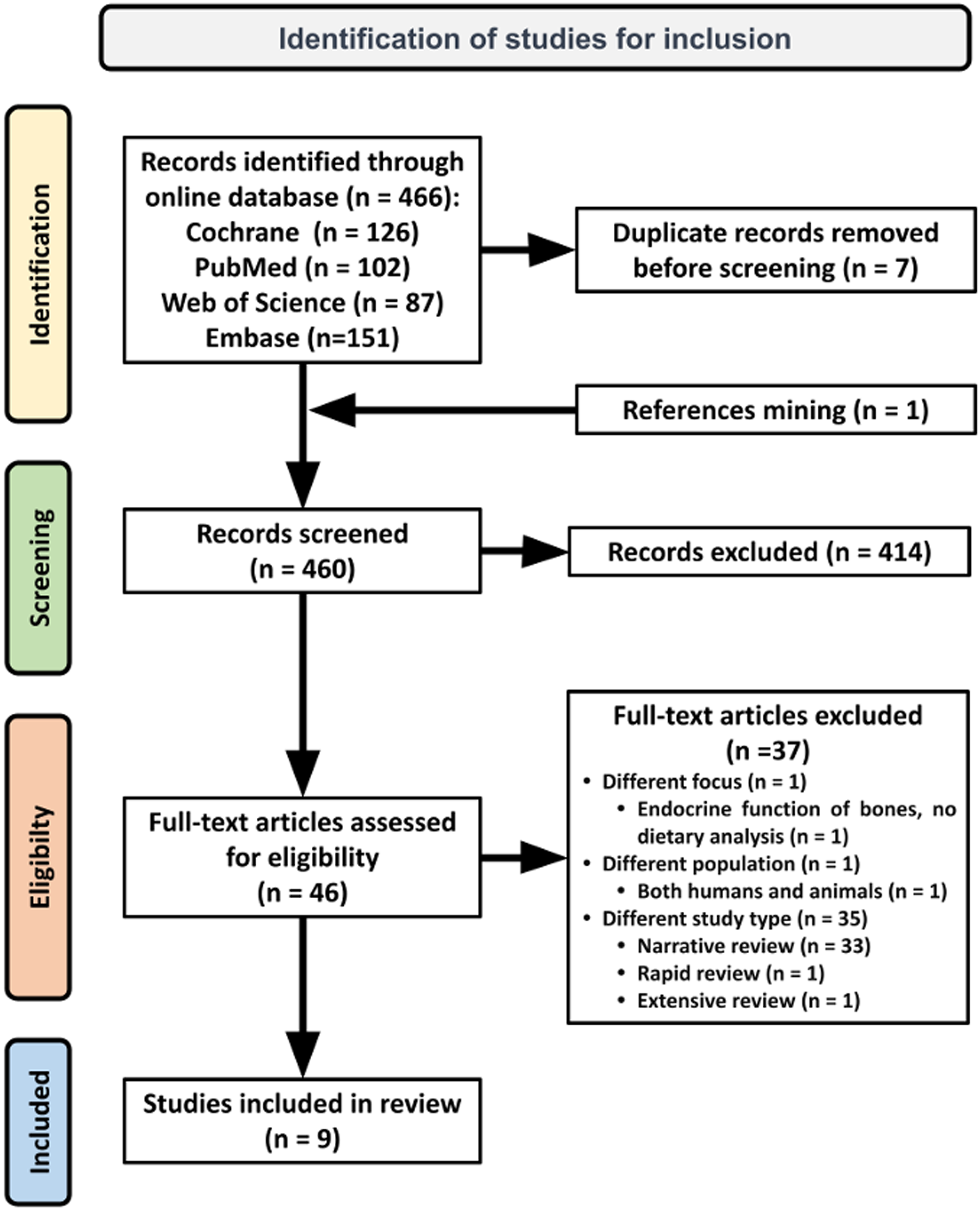
As shown in Fig. 1, a total of 466 records were retrieved from the four online databases. At the end of the screening phase, 46 full texts were analysed, leading to nine manuscripts finally being included in the review. A list of full-text articles that were analysed but excluded is reported in supplementary Table 2.
PRISMA flow diagram of the inclusion process of the manuscripts in this umbrella review, detailed on literature search, abstract screening, full article assessment and reasons for exclusion.

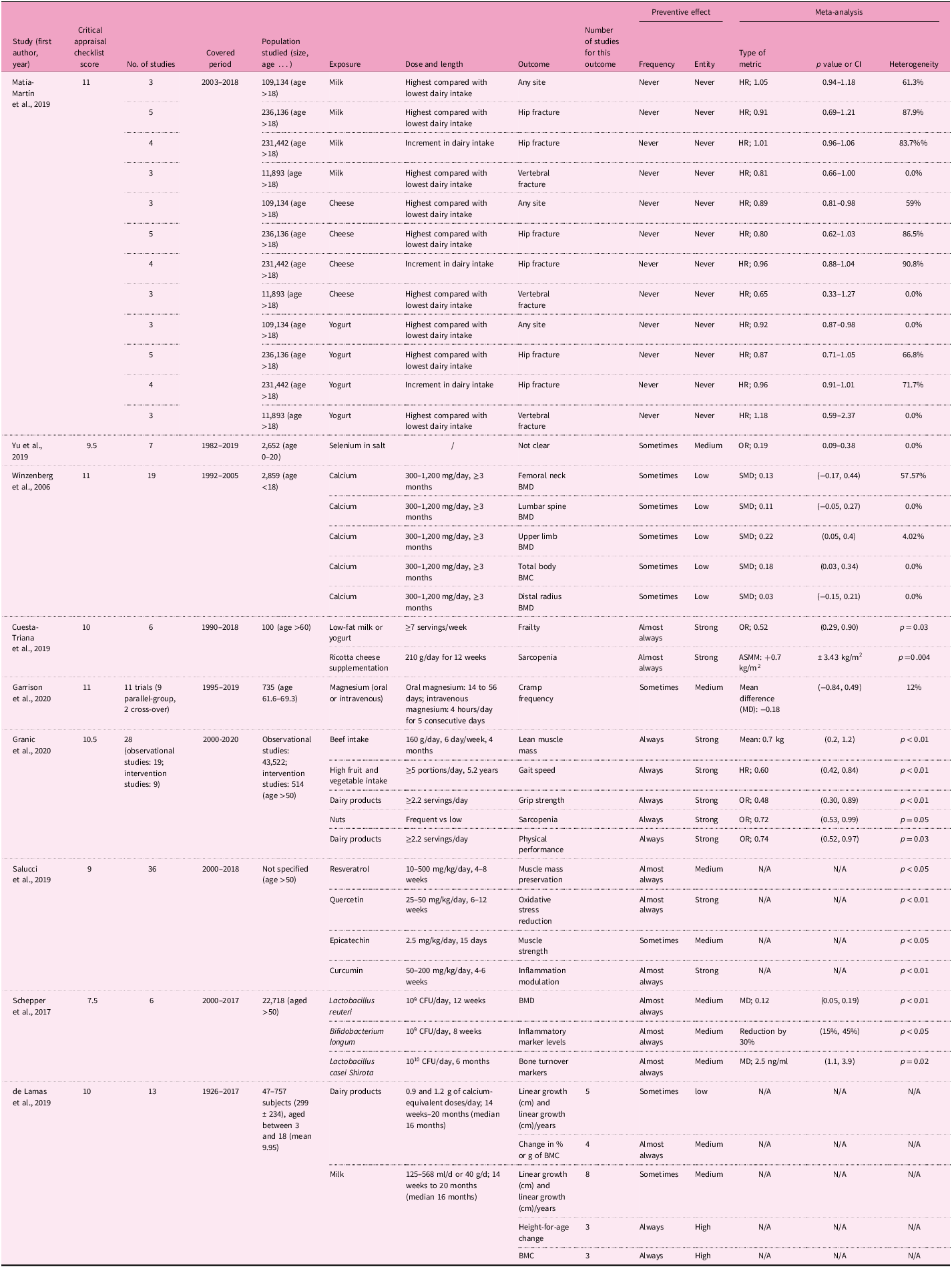
The main characteristics of the included manuscripts are summarised in Table 1. Six systematic reviews and three meta-analyses were included. The publication year of the studies ranged from 2006 to 2020, of which the most were published in 2019 (n = 4). The whole period of study encompassed the years 1982 to 2020; the longest study period (1982–2019) was found in the meta-analysis by Yu et al. published in 2019(Reference Yu, Qi, Shang, Ping and Guo26). Of the studies included, two synthesised evidence from RCTs(Reference Winzenberg, Shaw, Fryer and Jones27,Reference Garrison, Korownyk, Kolber, Allan, Musini and Sekhon28) . The musculoskeletal disorder outcomes considered included fractures (any site, hip and vertebral), bone mineral density (BMD) and bone mineral content (BMC) measures (e.g., femoral neck, lumbar spine, distal radius, total body BMD/BMC), sarcopenia and frailty, muscle mass and strength indicators (lean mass, grip strength), physical performance outcomes (gait speed), as well as biomarkers related to bone turnover, inflammation and oxidative stress.
Characteristics of the included studies

Characteristics of the included studies
The total number of studies included in the systematic reviews and meta-analyses retrieved was 128, of which 36 were evaluated by Salucci and Falcieri(Reference Salucci and Falcieri29). A total of 661,705 subjects were assessed. The largest sample size was described by Matía-Martín et al. in their meta-analysis published in 2019 reporting a total of 588,605 individuals, of which 236,136 were recruited by five studies(Reference Matía-Martín, Torrego-Ellacuría, Larrad-Sainz, Fernández-Pérez, Cuesta-Triana and Rubio-Herrera30). Most of the manuscripts assessed subjects aged over 50 years old (n = 3), followed by those under 20 years old (n = 3) and over 60 years old (n = 2).
The most frequent exposures were milk and dairy products and mineral salts. In detail, three studies focused on the effects of dairy products: one study reported the intake of milk, cheese and yogurt, another study evaluated the effects of ricotta cheese intake, while another assessed the intake of low-fat milk or yogurt. Mineral salts were assessed by three studies, of which one evaluated selenium intake, one calcium and one magnesium. Dietary supplements, constituted by officinal plant extractions or other plants (resveratrol, quercetin, epicatechin, curcumin) were reported by one study. Another study assessed the effects of fruits (also including nuts) and vegetables, as well as meat (in detail, beef). Prebiotics and probiotics (including Lactobacillus reuteri, Bifidobacterium longum and Lactobacillus casei Shirota) were evaluated by one study.
The dose of these food and dietary supplementations ranged from 2.5 mg/kg/day (epicatechin) to 300–1,200 mg/day (calcium). As regards prebiotics and probiotics, the dose varies based on the species (109 colony-forming unit (CFU)/day for Lactobacillus reuteri and Bifidobacterium longum, 1010 CFU/day for Lactobacillus casei Shirota). Other studies did not report a specific dose of the evaluated food or dietary supplements (n = 3). The duration of food/dietary supplements intake changed based on the specific substances, with the lowest at 15 days (epicatechin) and the highest over three months (calcium).
The most assessed outcomes were fractures (in particular, hip, vertebral and spine, femoral neck, distal radius), frailty, sarcopenia, muscle mass and strength, walking speed, inflammation, bone mineral density and turnover markers. The frequency of the preventive effects was ‘always’ by five studies, whereas the entity was ‘medium to strong’ by six studies. The most represented type of metrics for measuring the association strength was OR (n = 3), followed by HR (n = 2). Other metrics used in the studies were SMD, mean and MD, or percentage reduction.
The heterogeneity ranged from 0.0% to 90.8%. Only four studies reported a heterogeneity with a p value below 0.05. Cochrane Risk of Bias Tool (n = 5) and Newcastle-Ottawa Scale (NOS) for observational studies (n = 3) were the most frequent type of risk of bias (ROB) or appraisal used in the included studies. The ROB rating was at moderate risk for more than half of the included studies.
Summary of study results
Milk and dairy products
Matía-Martín et al.(Reference Matía-Martín, Torrego-Ellacuría, Larrad-Sainz, Fernández-Pérez, Cuesta-Triana and Rubio-Herrera30) selected nine manuscripts published between 2003 and 2018, evaluating a total of 588,605 subjects aged over 18 years old. The preventive role of milk, cheese and yogurt in bone fractures (any site, hip and vertebra) was assessed. It emerged that high quantities of these products did not have a preventive effect for most of the results. However, high quantities of cheese and yogurt might have a preventive effect reducing fractures of any site by 8–11% (respectively, HR = 0.89, 95% CI = 0.81–0.98 and HR = 0.92, 95% CI = 0.87–0.98). The heterogeneity ranged from 0.0% to 90.8%(Reference Matía-Martín, Torrego-Ellacuría, Larrad-Sainz, Fernández-Pérez, Cuesta-Triana and Rubio-Herrera30).
Cuesta-Triana et al.(Reference Cuesta-Triana, Verdejo-Bravo, Fernández-Pérez and Martín-Sánchez31) evaluated the preventive effect of some dairy products on frailty and sarcopenia among 100 subjects aged over 60 years old. Data were extracted from six studies published between 1990 and 2018, finding that the preventive effect was almost always strong. In more detail, low-fat milk or yogurt (≥7 servings/week) reduced significantly frailty by 48% (OR = 0.52, 95% CI = 0.29, 0.90), whereas ricotta cheese supplementation (210 g/day for 12 weeks) had a non-significant effect on sarcopenia (appendicular skeletal muscle mass (ASMM) = +0.7 kg/m2, ± 3.43 kg/m2). The heterogeneity was statistically significant(Reference Cuesta-Triana, Verdejo-Bravo, Fernández-Pérez and Martín-Sánchez31).
The preventive effect of dairy products (≥2.2 servings/day) was assessed among 44,036 subjects aged over 50 years old, of which 43,522 were from 19 observational studies and 514 from 9 intervention studies performed between 2000 and 2020. According to Granic et al., dairy products had a strong preventive effect on grip strength (OR = 0.48, 95% CI = 0.30, 0.89) and physical performance (OR = 0.74, 95% CI = 0.52, 0.97), which was always detected. This systematic review reported a significant heterogeneity (p < 0.01 for grip strength, p = 0.03 for physical performance)(Reference Granic, Dismore, Hurst, Robinson and Sayer32).
The role of milk and dairy products was assessed by de Lamas et al.(Reference de Lamas, de Castro, Gil-Campos, Gil, Couce and Leis33), collecting data of 47,757 subjects (age range 3–18 years old) from 13 studies, which were published between 1926 and 2017. They underscored that milk (125–568 ml/d or 40 g/d per 14 weeks to 20 months) had a medium preventive effect on linear growth (cm) and linear growth (cm)/years sometimes, whilst the effect was always high on height-for-age change and BMC. Dairy products (0.9 g and 1.2 g of calcium-equivalent doses/day per 14 weeks to 20 months) sometimes had a low preventive effect on linear growth (cm) and linear growth (cm)/years, whereas they had a medium preventive effect on change in percentage or grams of BMC almost always. No type of metrics nor heterogeneity was reported(Reference de Lamas, de Castro, Gil-Campos, Gil, Couce and Leis33).
Mineral salts
Yu et al.(Reference Yu, Qi, Shang, Ping and Guo26) assessed 2,652 individuals aged under 20 years old from seven studies published in the period 1982–2019. The preventive effect of selenium in salt was evaluated, but doses and outcomes were unclear. Despite this, the effect was observed sometimes, and it was considered to be of medium entity, reducing the negative musculoskeletal outcomes by 81% (OR = 0.19, 95% CI = 0.09–0.38). No heterogeneity among studies was detected(Reference Yu, Qi, Shang, Ping and Guo26).
Calcium intake at the dose of 300–1,200 mg/day for at least three months was assessed by Winzenberg et al. in 2006. Collecting a total of 2,859 subjects under 18 years old from 19 studies published during the period 1992–2005, the authors detected that the preventive effect of such calcium doses was low and observed sometimes on both BMC of total body and BMD of femoral neck, lumbar spine, upper limb and distal radius. The SMD between prescribed calcium doses per day and the free per day was statistically significant only for upper limb BMD (SMD = 0.22, 95% CI = 0.05, 0.4) and total body BMC (SMD = 0.18, 95% CI = 0.03, 0.34). The heterogeneity ranged from 0.0% to 57.57%(Reference Winzenberg, Shaw, Fryer and Jones27).
Magnesium effect on cramps frequency was studied among 735 subjects aged 61.6 to 69.3 years old. Extracting data from 11 trials, of which nine were parallel-groups and two cross-over, Garrison et al.(Reference Garrison, Korownyk, Kolber, Allan, Musini and Sekhon28) assessed the preventive effect of magnesium (oral intake: 14 to 56 days; intravenous: 4 hours/day for five consecutive days). The effect was sometimes medium, with a mean difference of −0.18 (95% CI = −0.84, 0.49). The heterogeneity among studies was 12%(Reference Garrison, Korownyk, Kolber, Allan, Musini and Sekhon28).
Fruits and vegetables
The role of fruit and vegetables in the primary prevention of gait speed was assessed among 44,036 subjects aged over 50 years old (43,522 from 19 observational studies and 514 from 9 intervention studies in the period 2000–2020). Granic et al. reported that fruits and vegetables had a strong and highly frequent (always) preventive effect (HR = 0.60, 95% CI = 0.42, 0.84). Moreover, they evaluated that nut intake had a strong preventive effect on sarcopenia (HR = 0.60, 95% CI = 0.42, 0.84). The heterogeneity among studies was statistically significant (p < 0.01)(Reference Granic, Dismore, Hurst, Robinson and Sayer32).
Meat
The role of beef intake (160g/day, 6 day/week, 4 months) on lean muscle mass was evaluated by Granic et al., underscoring always a strong preventive effect (mean: 0.7 kg, 95% CI = 0.2, 1.2) among 44,036 subjects aged over 50 years old, through 19 observational studies and 9 intervention studies. The heterogeneity was statistically significant (p < 0.01)(Reference Granic, Dismore, Hurst, Robinson and Sayer32).
Plant extracts
Resveratrol (10–500 mg/kg/day, 4–8 weeks), quercetin (25–50 mg/kg/day, 6–12 weeks), epicatechin (2.5 mg/kg/day, 15 days) and curcumin (50–200 mg/kg/day, 4–6 weeks) are plant extracts which can have potential preventive effects on musculoskeletal outcomes depending on whether they are taken in a certain dose. Salucci and Falcieri(Reference Salucci and Falcieri29) evaluated the effects of these plant extracts from collected data of subjects aged over 50 years old from 36 studies published in the years 2000–2018. The findings suggested that resveratrol had a medium preventive effect on muscle mass preservation almost always, whereas epicatechin had the same preventive effect on muscle strength sometimes. Quercetin and curcumin had a strong preventive effect on oxidative stress reduction and inflammation modulation, respectively. No type of metrics was reported. The heterogeneity was statistically significant (p < 0.01–0.05)(Reference Salucci and Falcieri29).
Probiotics
Schepper et al.(Reference Schepper, Irwin, Kang, Dagenais, Lemon, Shinouskis, McCabe and Parameswaran34) assessed the preventive effects of probiotics among 22,718 subjects aged over 50 years old. Extracting data from six studies published from 2000 to 2017, they showed that probiotics had a medium preventive effect almost always. More in detail, Lactobacillus reuteri (109 CFU/day, 12 weeks) have a preventive effect on BMD (MD = 0.12, 95% CI = 0.05, 0.19), Bifidobacterium longum (109 CFU/day, 8 weeks) on inflammatory marker levels (reduction by 30%, 95% CI = 15%, 45%), and Lactobacillus casei Shirota (1010 CFU/day, 6 months) on bone turnover markers (MD = 2.5 ng/ml, 95% CI = 1.1, 3.9). The heterogeneity ranged from p = 0.02 to p < 0.01–0.05(Reference Schepper, Irwin, Kang, Dagenais, Lemon, Shinouskis, McCabe and Parameswaran34).
Risk of bias and quality assessment
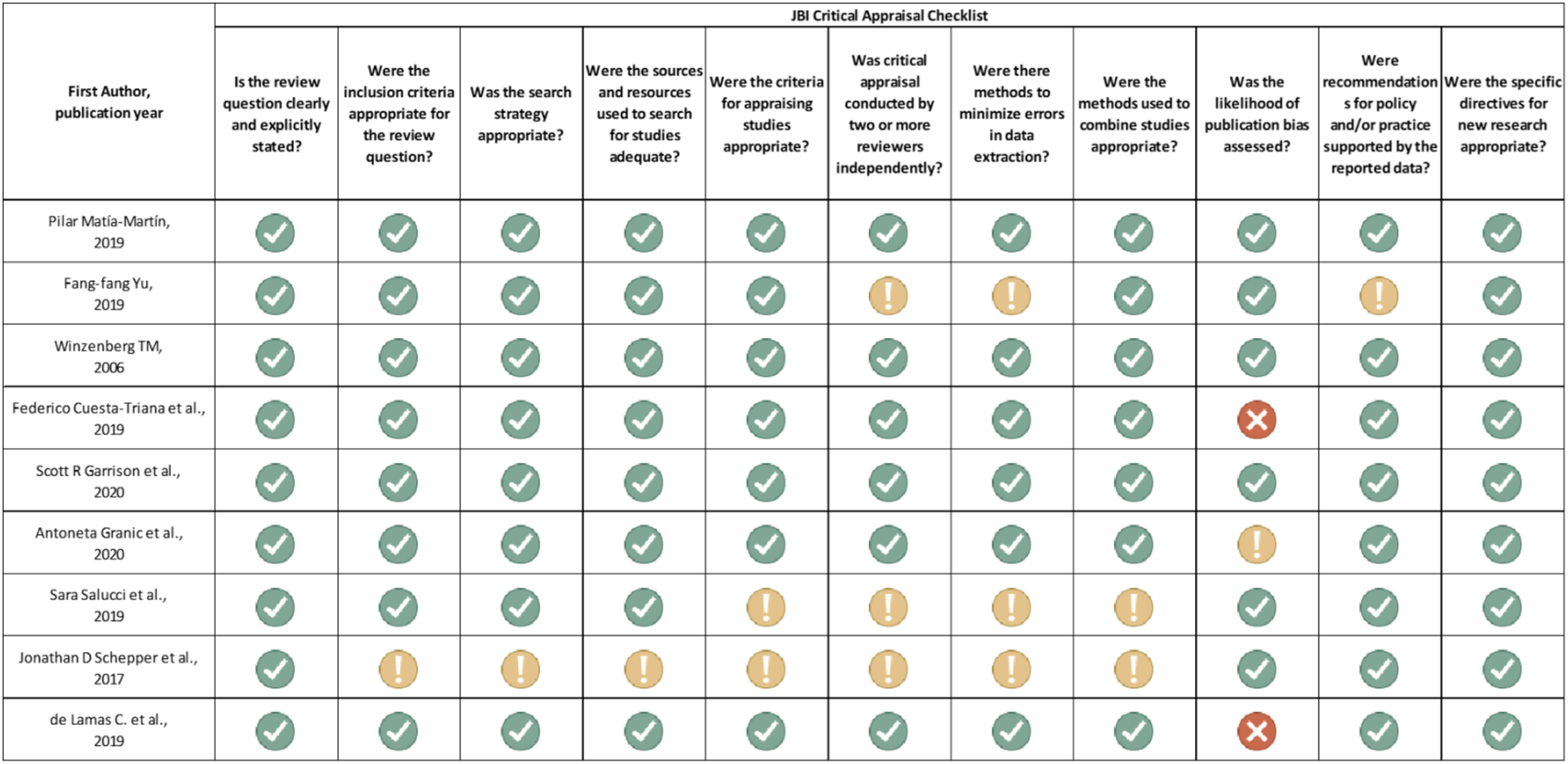
According to the JBI critical appraisal checklist(Reference Aromataris, Fernandez, Godfrey, Holly, Khalil and Tungpunkom21), the overall quality of evidence ranged from 7.5 to 11 (supplementary Table 3). In detail, three (42.8%) studies met all the quality criteria(Reference Winzenberg, Shaw, Fryer and Jones27,Reference Garrison, Korownyk, Kolber, Allan, Musini and Sekhon28,Reference Matía-Martín, Torrego-Ellacuría, Larrad-Sainz, Fernández-Pérez, Cuesta-Triana and Rubio-Herrera30) , whilst one (14.3%) study had unclear compliance with the appraisal for 7 out of 11 criteria(Reference Schepper, Irwin, Kang, Dagenais, Lemon, Shinouskis, McCabe and Parameswaran34), one (14.3%) study for 4 out 11(Reference Salucci and Falcieri29) and one (14.3%) study for 3 out of 11(Reference Yu, Qi, Shang, Ping and Guo26). Only one (14.3%) study had unclear compliance with the criterion ‘Was the likelihood of publication bias assessed?’(Reference Granic, Dismore, Hurst, Robinson and Sayer32). Only two (28.6%) studies did not assess publication bias(Reference Cuesta-Triana, Verdejo-Bravo, Fernández-Pérez and Martín-Sánchez31).
Study compliance with each criterion by the JBI critical appraisal checklist was expressed as a percentage(Reference Aromataris, Fernandez, Godfrey, Holly, Khalil and Tungpunkom21), as depicted in Fig. 2 and supplementary Figure 1. Only 2 out of 11 criteria (review question and directives for new research) were completely met by the included studies, whereas the compliance with 9 out of 11 criteria was uncertain for a percentage ranging from 11.1% to 33.3% of the included studies. Publication bias was the criterion not met for 22% of the studies.
The quality of the included studies in this umbrella review according to the JBI critical appraisal checklist. Each response was represented by the green icon for ‘yes’, the yellow for ‘uncertain’ and the red for ‘no’.

GRADE results
The analysis of the evidence highlighted that calcium is among the nutrients with robust scientific support. In particular, the meta-analysis conducted by Winzenberg et al. was awarded a moderate–high GRADE, indicating a significant positive effect of calcium on BMD in children. The study included trials of varying risk of bias (low: 2; moderate: 12; high: 5) but overall supported a moderate-quality body of evidence; the large sample size and statistical robustness of data rendered these findings reliable(Reference Winzenberg, Shaw, Fryer and Jones27).
The study on the impact of protein and fruit consumption on sarcopenia, discussed in the systematic review by Granic et al., achieved a low GRADE, combining observational and RCT data. The evidence suggested a beneficial effect of protein intake and certain bioactive compounds in the prevention of sarcopenia. However, the presence of methodological bias and the limited sample size in some studies called for caution in interpreting the results(Reference Granic, Dismore, Hurst, Robinson and Sayer32). Heterogeneity and imprecision resulted in low certainty, enhancing the limitations in study design and reporting.
An intermediate level of evidence quality was attributed to studies examining the role of dairy products in bone and muscle health. Matía-Martín’s 2019 systematic review analysed the association between dairy consumption and osteoporosis/fractures, attaining a moderate GRADE(Reference Matía-Martín, Torrego-Ellacuría, Larrad-Sainz, Fernández-Pérez, Cuesta-Triana and Rubio-Herrera30). It demonstrated a strong evidence base, supported by a large population and consistent findings. Egger’s test indicated potential publication bias (p < 0.05), yet overall risk of bias assessments was favourable. This evidence was graded as moderate certainty, consistent with the robust meta-analytic methodology. Similarly, Cuesta-Triana et al. evaluated the impact of dairy intake on frailty in the elderly, reaching comparable conclusions(Reference Cuesta-Triana, Verdejo-Bravo, Fernández-Pérez and Martín-Sánchez31). These studies suggested that dairy products may have a beneficial effect on bone health; however, the results were not entirely consistent. The variability in responses could be influenced by factors such as overall protein and calcium intake, participants’ age and other confounding variables, including physical activity levels. Furthermore, potential publication bias diminished the robustness of the available evidence. The study was largely observational, with NOS scores averaging 7.2/9 and Modified Jadad 5.5/8 for RCTs, yielding a moderate certainty rating. Despite generally favourable methodological quality, the observational nature of most studies limits the certainty per GRADE guidance.
Another area of research concerns the relationship between dairy consumption and growth in children, as examined by De Lamas et al. Here, the low GRADE reflected the presence of suggestive but not definitive evidence, owing to methodological heterogeneity across the studies included in the systematic review(Reference de Lamas, de Castro, Gil-Campos, Gil, Couce and Leis33). Risk of bias ranged from low to high across included studies, and incomplete reporting and inconsistency resulted in a low certainty rating.
Garrison et al., reporting a low–moderate GRADE, evaluated the role of magnesium in muscle cramps; however, the conclusions remained contentious due to conflicting findings and a high degree of imprecision(Reference Garrison, Korownyk, Kolber, Allan, Musini and Sekhon28). The review showed moderate risk of bias and substantial imprecision in effect estimates, supporting low–moderate certainty. A similar assessment was noted in the review by Salucci et al. on polyphenols and muscle atrophy, which highlighted a moderate risk of bias and considerable imprecision, suggesting that, while the data are promising, their robustness remains limited(Reference Salucci and Falcieri29). The same low–moderate GRADE was assigned to Schepper et al. with a study on the effects of probiotics on bone health, where significant heterogeneity in results and a high likelihood of publication bias were identified(Reference Schepper, Irwin, Kang, Dagenais, Lemon, Shinouskis, McCabe and Parameswaran34).
The meta-analysis on selenium and Kashin–Beck disease in children conducted by Yu et al.(Reference Yu, Qi, Shang, Ping and Guo26) received a low–moderate GRADE, showing internal consistency but lacking methodological clarity in some domains (unclear risk of bias in a few items), resulting in low-to-moderate certainty. Begg’s test suggested minimal publication bias (Z = 0.10, p = 0.92). The findings indicate a protective effect of selenium; however, their applicability is restricted, as the studies were conducted in specific high-risk populations (e.g., children in disease-endemic regions)(Reference Yu, Qi, Shang, Ping and Guo26). The analysis also underscored that calcium was the nutrient with the strongest evidence supporting its role in bone health. Nevertheless, other nutrients, such as dairy products, proteins and polyphenols, may also play significant roles, though the supporting evidence is of moderate to moderate–high quality. Other nutrients, such as magnesium, polyphenols and probiotics, exhibited a lower level of scientific evidence, often due to inconsistencies across studies and limited sample sizes.
Overall, the evidence landscape is heterogeneous, with only a minority of topics supported by moderate-certainty evidence. Most findings remain constrained by methodological limitations, imprecision or reliance on observational studies. The lack of transparent reporting on how GRADE judgements were applied in several reviews limits reproducibility and confidence in the results. A full description of the GRADE results is reported in supplementary Table 4.
Discussion
Recent advances in nutritional science have underscored the pivotal role of diet in mitigating age-related diseases, particularly those affecting the musculoskeletal system. Notably, approximately 10% of individuals over the age of 65 develop musculoskeletal conditions. The most common ones examined in this review are sarcopenia, osteoporosis and muscle atrophy. Sarcopenia, characterised by progressive loss of skeletal muscle mass and functional strength, is associated with increased risks of falls, fractures, hospitalisation, disability and mortality, all of which contribute to substantial healthcare expenditures. According to Cruz-Jentoft et al., the prevalence of sarcopenia rises markedly with age, affecting about 10% of individuals over 65 and nearly 50% of those over 80(Reference Cruz-Jentoft, Bahat, Bauer, Boirie, Bruyère and Cederholm35). The annual economic burden in the United States was estimated to be approximately $18.5 billion(Reference Bruyère, Beaudart, Ethgen, Reginster and Locquet36).
Given this public health challenge, targeted nutritional interventions are emerging as cost-effective strategies to attenuate musculoskeletal decline. Protein supplementation, particularly when integrated with resistance exercise, has demonstrated efficacy in enhancing muscle mass, strength and function across both younger and older adults(Reference Morton, Murphy, McKellar, Schoenfeld, Henselmans and Helms37). The optimal intake for mitigating age-related muscle deterioration is estimated at 25–30 grams of high-quality protein per meal(Reference Bonjour38).
Our findings indicated that dairy consumption, particularly yogurt and cheese, is associated with a reduced risk of fractures at any site. The certainty of this evidence ranged from moderate to high, strengthening confidence in the observed association. This protective effect may stem from the high bioavailability of calcium, quality protein content and the presence of bioactive peptides unique to these dairy products. These observations are consistent with a previous meta-analysis supporting that dairy intake was linked to a 5% reduction in fracture risk for every 200 g/day increase in milk consumption(Reference Laird, Molloy, McNulty, Ward, McCarroll and Hoey39). Similarly, the Nurses’ Health Study found that women consuming yogurt at least twice per week had a 30% lower risk of hip fracture compared to those with lower intake(Reference Feskanich, Meyer, Fung, Bischoff-Ferrari and Willett40). Expanding on this, Granic et al. suggested that the synergistic interplay of leucine-rich proteins, calcium and vitamin D in milk may support both bone and muscle health in older adults(Reference Granic, Hurst, Dismore, Aspray, Stevenson and Witham41). In addition, our results showed that consumption of low-fat milk or yogurt (≥7 servings/week) was associated with a 48% reduction in frailty risk, indicating that dairy’s nutritional profile offers broader benefits beyond bone health alone. This aligns with findings from Lana et al., who reported a 47% lower risk of incident frailty in older adults with the highest dairy consumption over a 3.5-year follow-up period(Reference Lana, Rodriguez-Artalejo and Lopez-Garcia42).
Age-related reductions in BMD and increased skeletal fragility heighten the risk of osteoporosis, which remains a leading cause of fractures particularly of the hip, vertebrae and wrist, with over two million cases annually. While numerous studies have investigated the influence of dietary calcium, vitamin D and protein on fracture risk, the evidence surrounding dairy intake remains inconclusive. Specifically, three meta-analyses reported no consistent reduction in osteoporotic fracture risk associated with total dairy intake, whereas cheese and yogurt consumption were associated with a lower risk of hip fractures, suggesting that the type of dairy product may be an important determinant of skeletal outcomes. This ambiguity was previously found in a study reporting that calcium supplementation yielded only modest improvements in BMD without a corresponding reduction in fracture risk(Reference Bolland, Leung, Tai, Bastin, Gamble and Grey43). Contrastingly, another study found that high milk consumption was associated with increased fracture incidence, possibly due to pro-inflammatory effects of D-galactose(Reference Michaelsson, Wolk, Langenskiold, Basu, Warensjo Lemming and Melhus44). A more nuanced view was subsequently provided, suggesting that the efficacy of calcium depends on baseline levels: individuals with calcium deficiency benefit most, while those with sufficient intake may see only limited additional effects(Reference Zhu and Prince45). Despite these insights, RCTs evaluating the impact of unfortified dairy products on osteoporotic fracture prevention remain lacking. However, cross-sectional studies and meta-analyses suggest that calcium derived from fortified dairy products may enhance BMD. The effectiveness of dairy intake probably varies according to individual factors such as baseline calcium and vitamin D status, genetic predisposition and habitual physical activity. As outlined by Weaver et al., optimal skeletal health across the lifespan requires both calcium (1,000–1,200 mg/day) and vitamin D (600–800 IU/day)(Reference Weaver, Alexander, Boushey, Dawson-Hughes, Lappe and LeBoff46). Additionally, Cashman in 2007 already emphasised the importance of timing nutritional interventions, noting that adolescence is especially critical for maximising benefits of calcium and vitamin D(Reference Cashman47).
The meta-analysis by Yu et al. (2019) suggests a protective role of selenium in Kashin–Beck disease among children, with low-to-moderate certainty of evidence (GRADE) due to some methodological limitations. Although publication bias was not evident, the applicability of these findings is limited to selenium-deficient, high-risk populations in endemic areas. Selenium is a widely discussed trace element, with a narrow safe range of intake and for which both deficiency and excess have been linked to several health outcomes(Reference Urbano, Wise, Fiore, Vinceti and Filippini48,Reference Urbano, Filippini, Malavolti, Fustinoni, Michalke and Wise49) .
Emerging evidence suggested that probiotics may also contribute to musculoskeletal health. Supplementation with Lactobacillus reuteri (109 CFU/day for 12 weeks) was shown to moderately improve BMD, while Bifidobacterium longum (10⁹ CFU/day for eight weeks) reduced inflammatory markers by approximately 30%(Reference Schepper, Irwin, Kang, Dagenais, Lemon, Shinouskis, McCabe and Parameswaran34). These findings support the concept that the gut microbiota plays a role in bone–muscle homeostasis through immunomodulation and nutrient absorption. Nilsson et al. further confirmed these results, showing that Lactobacillus reuteri supplementation reduced bone loss in older women with low BMD in a RCT(Reference Nilsson, Sundh, Bäckhed and Lorentzon50). Similarly, Collins et al. posited that the gut–bone axis represents a promising therapeutic target, wherein probiotics may improve bone health via enhanced calcium uptake, inflammation control and immune regulation(Reference Collins, Rios-Arce, Schepper, Parameswaran and McCabe51). Overall, the certainty of the evidence was rated as low to moderate according to GRADE, indicating that these findings should be interpreted cautiously and warrant confirmation in larger, long-term trials.
In the context of skeletal muscle atrophy, dietary antioxidants appeared promising. Muscle atrophy is often linked to chronic inflammation and arises from ageing, immobilisation, starvation or neurological trauma. Among plant-derived bioactives, resveratrol (10–500 mg/kg/day for 4–8 weeks) demonstrated moderate efficacy in preserving muscle mass, while quercetin (25–50 mg/kg/day for 6–12 weeks) and curcumin (50–200 mg/kg/day for 4–6 weeks) were particularly effective in reducing oxidative stress and modulating inflammation. Consolidating evidence from human trials suggested that polyphenol supplementation reduces pro-inflammatory cytokines and oxidative markers in skeletal muscle(Reference Salucci and Falcieri29). Hewlings and Kalman in 2017 reported that curcumin (400–600 mg/day) decreased inflammatory markers in adults with chronic conditions, thereby supporting muscle preservation(Reference Hewlings and Kalman52). Also, quercetin supplementation (1,000 mg/day for 2 weeks) enhanced mitochondrial biogenesis and exercise performance(Reference Davis, Carlstedt, Chen, Carmichael and Murphy53). Furthermore, vitamin C (500–1,000 mg/day) mitigated post-exercise muscle damage and promoted collagen synthesis in human subjects(Reference Hart, Cota, Makhdom and Harvey54).
Among the limitations of our umbrella review there is the inclusion of multiple systematic reviews and meta-analyses addressing the same exposure–outcome associations. This approach may result in partial overlap of primary studies across reviews, potentially leading to indirect double counting of evidence. Another limitation of this is that it relied on pooled estimates reported in existing systematic reviews and meta-analyses. When an overall meta-analytic estimate was null, potentially protective associations reported in individual primary studies may not have been reflected in our synthesis. Therefore, some emerging or context-specific preventive effects could have been underrepresented.
Conclusions
Our systematic umbrella review summarises current evidence on the potential role of selected nutrients in the primary prevention of musculoskeletal disorders. Calcium and certain dairy products were associated with improved bone outcomes, while higher fruit and vegetable intake was linked to better physical performance. Some plant-derived compounds showed possible benefits for muscle health, although evidence remains limited. Overall, the findings may inform public health nutrition strategies, but further high-quality research is needed to expand the evidence base and clarify preventive effects across a wider range of nutrients and musculoskeletal outcomes.
Supplementary material
The supplementary material for this article can be found at https://doi.org/10.1017/S0954422426100365.
Acknowledgements
We would like to sincerely thank Marta Caminiti for her valuable support in launching the working group. Fully open access was granted by the agreement between University of Modena and Reggio Emilia and Cambridge University Press.
Financial support
This research received no specific grant from any funding agency, commercial or not-for-profit sectors.
Competing interests
The authors declare none.
Authorship
M.P.: conceptualisation, investigation, formal analysis, data interpretation, writing – original draft; A.V.: conceptualisation, investigation, data interpretation, search protocol implementation, formal analysis, manuscript writing – draft; G.L.B., G.G., C.L., E.R., G.S., C.N., M.M., P.S., G.C., G.M.: investigation, data interpretation, writing – review and editing; T.U.: investigation, study protocol implementation, data interpretation, corresponding, writing – draft; A.L.: conceptualisation, search protocol supervision, data interpretation, manuscript review and editing. All authors have read and agreed to this version of manuscript.


 Open access

