




From dust to ash: A history of the miniscule
Among the incredible number of scientific objects that has attracted the interest of scholars over the centuries, those connected with the world of microscopic studies deserve a special place. The difficulty of analyzing these objects closely has made them an infinite source of mystery, curiosity, and often fear. Even today, the “invisible” objects associated with topics like radioactivity or environmental pollution still inspire fear. In general, each epoch has had its hyper-small object of fear, and in the past, “dust” was the preferred term to indicate this kind of danger. At the same time, dust was, because of its nature in the form of particles, also a common measure of “smallness.”Footnote 2 Consequently, anything little enough could be defined as dust without necessarily having a negative connotation. This is the reason why “star dust” can be considered an evocative, poetic image, while volcanic dust, in contrast, provokes terror. Dust has another interesting characteristic: there is no way to contain it, and it respects no boundaries (Ogden Reference Ogden1911, 377-381). This characteristic is linked with its nature as a particulate, a characteristic it shares with ash.
In periods when the “limits” of scientific instrumentation meant that a particle of dust was categorized as a no-longer divisible object its as-yet hidden chemical nature gave rise to a commonly made association of dust with the beginning and the end of life. Thus, for instance, the biblical notion that from dust we are born and to dust we return (Genesis 2:7)—and the phrase from the Church of England’s Book of Common Prayer “ashes to ashes, dust to dust”—are still widely familiar throughout the Western world and beyond. In addition, dust has been considered an element in itself, as it always accompanies the traditional elements of fire, earth, air, and water in their transformations (Amato Reference Amato2000, 17). In nature, there is one instance in which this peculiarity of dust as the final product of all the elements involved in a natural transformation is particularly evident: a volcanic eruption.
This paper will investigate, by means of a variety of narratives about rains of volcanic ash in the South of Italy, not only the social meaning of volcanic ash, but also the scientific importance of analyzing it chemically and, above all, of doing so in a specific historical moment. The moment in question is the second half of the eighteenth century—a crucial moment in the history of science, in the history of chemistry and in the history of studies about Mount Vesuvius, as many examples in this text will demonstrate. Without this unique intersection, I will argue, the topic of volcanic ash would not have been so different from the topic of controlling dust at home or industrial dust in cities, or the fall of radioactive dust from Chernobyl all over Europe (Fine 2003). However, this special kind of dust, which arrives during and after eruptive phenomena, required, in order to be better known, (a) a scientific interest in microscopic things and (b) some “new” chemical tools and theories.
Both elements arrived in the last decades of the eighteenth century: “from the 1770s, the microscopic research was developed enough to become a new branch of natural history” (Ratcliff Reference Ratcliff2012, 431) and the nouvelle chimie offered a new nomenclature, and a new system, in which the chemical operations of analysis and synthesis of the substances gained a primary importance. Chemistry was the only way to discover more about the rains of ash, as geology and volcanology were still nonexistent disciplines, and in any case, both required chemistry. From a macroscopic point of view, volcanic eruptions were not considered an ordinary phenomenon, but an aberration—something that deviated from the “genuine” path of nature’s development. Near the end of the century, however, James Hutton’s (1726-1797) vision of igneous global dynamics led him to posit that volcanoes were part of the operation of nature after all (Taylor Reference Taylor, Wolf Mayer, Clary, Salomé Mota and Wołkowicz2016, 117). After the notion was introduced, it was a while longer before volcanoes eventually began to occupy a place in a comprehensive geological theory, linked to the ongoing evolution of theories of ignition. Volcanologists date the actual foundation of their professional branch to the twentieth century, when chemistry and mineralogy were applied routinely to the study of the variegated composition of volcanic rocks and of the production of magma (Taylor Reference Taylor, Wolf Mayer, Clary, Salomé Mota and Wołkowicz2016, 121; Sigurdsson Reference Sigurdsson1999). If we agree with this reasoning, the extensive use of chemistry at the end of the eighteenth century in Naples to study Vesuvian ash becomes much more interesting in the construction of a global history of the discipline.
By comparison with microscopic marine zoology, the objects of which were small enough to require the lens or the microscope, but not so small as to be completely invisible to the naked eye (Ratcliff Reference Ratcliff2012, 430), volcanology required more exacting tools. One can see volcanic ash, and even taste the different textures, but—and this is the fundamental point—one cannot know the inner nature of ash without a microscope and chemical reagents. In the last decades of the eighteenth century, scholars working on Mount Vesuvius witnessed the consolidation of the microscopic practice, and the introduction of new ideas in modern chemistry, focused on determining the ultimate components of substances. And these scientists had a lot of ash to work with, as the Neapolitan volcano was very active in these incredible last decades of that century. What was inaccessible shortly before an eruption suddenly appeared, with frightening proximity, right in people’s faces. This combination of scientific innovation and volcanic activity explains how the study of the life of the scientific object “Vesuvian ash” could be so prolific in this period, despite the lack of a specific discipline in which to do so. The appeal of the minuscule nature of dust was not enough; scholars needed a revolution in chemistry and a continuous production of volcanic material in order to analyze the ash on the slopes of Vesuvius.
In the context of a volcanic landscape, ash went under the generic name of volcanic dust, a quite common product of volcanic activity because it can cover an enormous surface area—not just around the volcano, but also hundreds of kilometers away, blown by the winds. Today we know that such dust consists, broadly speaking, of glass, minerals and rocks. In past centuries, the lack of specific tools and chemical knowledge left this typical volcanic product under a neutral definition with terms like “dust,” “sand,” or quite often just “ash.” It is of particular interest to note that the differences between the terms dust/sand/ash were very hazy, because behind the decision to use each name was a different interpretation of the phenomenon. Of course, to label something you could breathe as “ash” is not a neutral choice, carrying with it some suggestion of danger that the words “dust” or “sand” do not imply at first. Moreover, this selection of terms is directly linked with the evolution of the scientific insight on volcanoes. In fact, seventeenth-century reports show a wider range of related terms for the stuff of eruptions. This progressive reduction of terms towards a more precise definition of things and words depends on the fact that the language of volcanology is a result of the evolution of Latin into Italian and it is worth a short digression.
As we can easily verify, many terms of volcanology today come from Italian, or rather from Neapolitan, since the emergence of such terms belongs to time-specific events located in the South of Italy: the huge eruptions of Etna or Mongibello in 1536, the birth of Monte Nuovo in 1538 in Pozzuoli, but above all the famous eruption of Mount Vesuvius in 1631. The awakening of Vesuvius triggered a search for new technical terminology, because the set of terms inherited from the Aristotelian and Scholastic tradition did not mesh with observations in the field (Casapullo Reference Casapullo, Casapullo and Gianfrancesco2014, 15). This is the reason why we find scholarly terms that come straight from the Latin and Greek of scientific books alongside newer, more colloquial words, like “lava,”Footnote 3 that were drawn specifically from that popular tradition of Naples. Once again, the last decades of the eighteenth century mark a rupture, this time in lexicon, which becomes closer to naturalist observations than classical philosophical treatises or erudite literature (ibid., 20).Footnote 4 The process of progressive specialization of terminology began when some terms, which were almost metaphor or words borrowed from ordinary discourse, were explained by definitions or equivalencies (this is the case, for instance, of sand = dust (arene = polvere: ibid., 48-49)) and finally we find terms coined for explicit purposes (Rappaport Reference Rappaport1982, 27).
Mount Vesuvius, the famous and very active volcano in the South of Italy, is best known for its eruption in 79 A.D., immortalized in the iconography of Pompeii and Herculaneum. The two ancient towns buried under the volcanic ash are the most common mentions of Vesuvius in fine arts as well as in novels (Gautier Reference Gautier1852). By contrast with this horrifying catastrophe, being dusted with a layer of Vesuvian ash is a historically frequent condition for the town of Naples—even some popular films testify to the fact. For example, the brothers Lumière arrived in Italy at the very beginning of their cinematographic adventure and the first town they filmed was Naples. They were lucky enough to reach the town during an important phase of activity for Mount Vesuvius and, eventually, they made not only the first film of an Italian town, but also the first film of a volcano in action in history (this was during the eruptive cycle that closed on September 7, 1899). Much better known is a film made after World War II, kept at the Museo dell’Osservatorio Vesuviano-INGV, Museum of the National Institute of Geophysics and Volcanology. The U.S. Army was able to save the images of this eruption of Mount Vesuvius, where we see people unconcernedly going about their business amidst the drifting volcanic ash. They seem to be shoveling it as calmly as people in Sweden shovel snow in front of their doors. This Vesuvian ash seems something integrated in the general landscape of the surroundings of Naples, although the situation described was anything but routine.
The curious aspect of this story, which deserves an attentive historical examination, is that ash from Vesuvius was not only an episodic feature of everyday life, but also a target of intensive laboratory analysis—by local scholars as well as by foreign chemists. This race for the definitive analysis gave Vesuvian ash an independent life as an object of scientific investigation. A review of the chemical analyses of Mount Vesuvius ash that were printed in the second half of the eighteenth century, however, reveals that its life in the scientific literature followed two separate paths, one of which portrayed it as a terrifying poison and the other as a cheap fertilizer.
Together with this duality in the life of the scientific object of Vesuvian ash, we should also mention the question of this object’s death. In this case, we have some options to discuss. In fact, volcanic ash is intrinsically ephemeral in nature; it quickly dies in the sense that it can only be studied during and in the immediate aftermath of an eruption. More precisely, each phase of the eruption offers different kinds of ash and each eruption offers different combinations of ash because its composition depends on a very delicate equilibrium between components and temperature, which is difficult to foresee or to totally describe. This is the reason why each eruption required its own chemical analysis of ash. It did not work to speak about chemical analysis of Vesuvius’ ash in general; rather, it made sense to compare a large number of contemporary chemical analyses carried out very quickly after “the dark rain.” Of course, a second point to discuss about the “death” question is whether Vesuvius’ ash was considered a cause of death (as poison) or of life (as fertilizer), or both at the same time, a hypothesis of a double life suggested before. Finally, either with two separate lives or with a unique double life, is Mount Vesuvius’ ash still alive as scientific object? All these topics take us, furthermore, on a journey towards a better understanding of the scientific development of the South of Italy where Mount Vesuvius is situated, which has a close relationship with the study of volcanic material.
The double life of Mount Vesuvius ash as reflected in the writings of chemists
Frightful events, such as powerful volcanic eruptions, had the immediate effect of giving a strong impetus to debate among chemists. In fact, almost all pamphlets about volcanic phenomena have in common the reference to chemistry as the scientific substratum of the recounted events. In this framework, Vesuvian ash became the most widespread object of chemical analysis all over the Kingdom of Naples. The rain of ash was one of the most common effects of Mount Vesuvius’ volcanic activity. It is clearly a very impressive phenomenon, and during huge eruptions the falling ash obscured the sky. To comprehend how shocking this phenomenon could be, it is worth remembering that the inhabitants of Sumbawa Island gave a name to the enormous 1815 Tambora volcanic eruption: the Time of the Ash Rain—and that this eruption’s erasure of the sun inspired Byron’s poem Darkness (D’Arcy Wood Reference D’Arcy Wood2014, 24, 67).
Historical accounts of eruptions show that ash rains frequently terrified the population that lived on the slopes of Mount Vesuvius. The ash not only obscured the sky, which traditionally suggested an apocalyptic catastrophe, but also left the entire region sprinkled with ash, which frightened the Neapolitan people considerably. Amidst these negative, fearful reactions, interest in volcanic ash as a scientific object (perhaps it would be better to define ash as a “chemical object”) was the exception. Analysis by the tools of chemistry of the time gave ash a kind of double existence: from a certain point of view it was analyzed as a poison, and from the other point of view it was analyzed as a fertilizer. Of course, that charming dichotomy poison/fertilizer here carries with it the classical reference to the pharmakós (from the Greek: φαρμακóς), which in ancient times referred to the poison as well as the remedy. It could also be perceived as a Renaissance revival of the ambiguity of poisons’ use in magia naturalis (natural magic). In my opinion, however, the duality that emerged in Naples at this time reflects a different approach to the topic. Importantly, in the process of filtering sources, it is very rare to find a chemical analysis, or a volcanic eruption report, which refers to both understandings of Vesuvian ash—to a poison that can be a fertilizer and vice versa.
Perhaps, to start our study, we must take into account the power of fear. Wherever you look in the red zone of the Campania Region, there are traces of the destruction that often did more than simply threaten the cities and people there. The symbols of many towns around the slopes of Mount Vesuvius contain the phoenix’s motto Post fata resurgo—I revive after death. The mythic phoenix, of course, is reborn from its ashes, as was, for example, Torre del Greco—a small city which, in 1794, faced an eruption powerful enough to destroy the whole town. In nearby Portici, there is a large “admonishment”—a warning monument made of engraved marble and volcanic rock—created after the eruption of 1631, which is considered one of the largest in Vesuvius’s history. This eruption is, in fact, linked to the very start of the worship of Saint Januarius (Tortora Reference Tortora2019). Because its ash drifted very far from the crater, there are many witness accounts of the great fear generated by a rain of ash that reached as far as Serbia a few days after the Neapolitan eruption (Mrgić Reference Mrgić2004). The fear of living in high eruption risk areas was not enough, however, to keep people away: at the slopes of Mount Vesuvius “the population may be perhaps more numerous than that of any spot of a like extent in Europe, in spite of the variety of dangers attending such a situation” (Hamilton Reference Hamilton1795, 112-113). This persistent high population density, especially in the Campania plains, which has lasted in the range of 8,000 to 9,000 years, has been due above all to material resources—the fertility of the soil, the abundance of water, and in particular mineral waters used for medicinal purposes, and the availability of raw materials used in construction (tuff, pozzolana, etc.)—all of which were themselves a gift from centuries of falling ash. Moreover, the region’s geographical position in relation to commerce was of great significance in the eighteenth century, higher than it had yet been since Roman times.
At this point it will not be surprising that in the Vesuvian Collection of the Mineralogical Museum “Antonio Parascandola” Footnote 5 of the Faculty of Agricultural Studies of the University of Naples “Federico II,” situated in the Portici Royal Palace, the display for each eruption can contain ash along with samples of burned seeds, evidently collected on the same occasion. This is also true of the Vesuvian samples kept in the Minerals Gallery of the Natural History Museum of London (Thackray Reference Thackray and Press2001), especially if we consider the ones not shown to the public, where different typologies of ash and seeds collected at the same site are often classified in the same drawer according to the year of the eruption. The Natural History Museum has an entire section dedicated to the so-called eight super volcanoes, currently active and quiescent all over the planet. Among them, of course, are the Phlegraean Fields (which means burning fields). The definition of a “supervolcano” comes from the extent of its eruption, and also from the potential impact of that eruption on the provisions of water and food (De Boer Reference Boer, Zeilinga and Theodore Sanders2002, xii).
There are many descriptions of the eruptions of Vesuvius, and that is in part because there were many different types of intellectuals who have taken an interest in them: chemists, university professors, doctors, naturalists, foreign travelers, and the simply curious, etc. Only a few of these descriptions, however, were published as papers after a series of consecutive eruptions that were witnessed by the authors. Among these were the observations of Gaetano De Bottis (1721-1790), a professor at the University of Naples, who published his Ragionamenti (Reasoning) from 1761 to 1786 (in that span he took into account five eruptions: 1761, 1768, 1776, 1779, 1786), providing us with naturalistic descriptions imbued with socio-anthropological reflections and accompanied by strikingly beautiful and extremely moving engravings. In addition, De Bottis was originally from Torre del Greco, one of the towns that has the phoenix as its symbol. The inhabitants of Torre del Greco were aware of the danger and the duration of the eruptions’ secondary phenomena. De Bottis reported, however, that the falling ash obscured the sky, and a grim silence fell upon the people, replacing the prevailing chaotic atmosphere, when they cried about the ash that had fallen upon them and had caused them such sadness:
And even though it was daytime, here the sky was so dark that it seemed like the darkest night and the fear it provoked caused the people to abandon the countryside and to come out of the hills with torches in hand, to see where they should place their steps. In this gloomy and horrid scene, the people of that town grew even more frightened until everyone saw everyone else as pensive and destitute, so that no one thought of running away and no one had the courage to speak because the great terror that oppressed their spirit was everywhere like a heavy and dark silence. (De Bottis 1768, XXV)
Nevertheless, in the evening, there was a change in the dominant emotion; in fact, elderly people began to celebrate, because they saw in the new, lighter ash, the signs of the end of the eruption, which they recognized because of their memories of past eruptions.
As seen by the people living in the shadow of Vesuvius, the same object, volcanic ash, could announce death or life depending on its color. Such empirical assumptions needed scholarly consideration. These strange rains of volcanic matter sometimes reached places quite far from Vesuvius, since their direction and journey depended on winds and the specific weight of the components. Their duration and chemical composition were difficult to determine too, as they depended on the kind of eruption and on so many unforeseeable factors. The ashen rain is among the most impressive events during the development of a volcanic eruption, since for a while, as said before, the sky can be darkened by the clouds of ash. Furthermore, the act of breathing, an essential and perpetual function of our bodies, can become difficult and painful, and this naturally was terrifying. A suddenly darkened sky, combined with the sense of impending suffocation, immediately imparted the idea of the very end of the world. But only when a large city like Naples was involved were chemists compelled to undertake an analysis. The concern was that falling ash might poison water and food. Naples was one of the most populated towns in Europe, comparable to London or Paris, and it was simply not acceptable to spread the idea that its well water and vegetables, contaminated by ash, were not edible.
An episode that epitomizes the situation concerns the eruption of 1794. This blast resulted in a rain of ash that lasted for several days throughout the Kingdom of Naples. Chemists were divided over how dangerous this was. During this episode, there were notices called “Avvisi al pubblico” (Public Service Announcements), written and printed to inform the population that the Vesuvian ash was harmless. One of these mentioned, however, that in June 1794 an academician had written a chemical study of ash that had already been publicly printed and distributed, and did not follow the general consensus that ash was not dangerous. The authorities were obliged to carry out a new test, because someone in the city had declared that it was dangerous to eat fruit and vegetables and to drink water from wells that had been contaminated by volcanic ash.
The man responsible for spreading this panic was described in the announcement as “not an expert at chemistry.”Footnote 6 I suggest that he was a young chemist from the Kingdom of Naples named Antonio Pitaro (1767 – 1832), who later gained some notoriety in 1809, because of his controversial chemical interpretations that were debated in the famous French journal Annales de chimie (Guerra Reference Guerra2009).
In 1794, Antonio Pitaro published a booklet about volcanic ash titled Esposizione delle sostanze costituenti la cenere vulcanica caduta in questa ultima eruzione de’ 16 del prossimo passato Giugno (Presentation of volcanic ash and its substances during the last eruption on June sixteenth). Although the issue under debate was very complicated, Pitaro pointed out the most important methodological issue, namely that volcanic eruptions gave scientists a great opportunity to compare and contrast their chemical analyses. According to Pitaro, many aspects, such as temperature, atmospheric pressure and “electric fire” changed all the time and, in addition to these large unknown parameters, scholars were also ignorant of the nature of the volcanic phenomenon itself.
The chemist Pitaro was surely aware that he was writing against the official view. In fact, he asked Gaetano Maria La Pira—another professor of chemistry at the Military Academy, to whom this text was dedicated—to defend his theories, because other scientists had also joined the same argument with different conclusions. Footnote 7 Pitaro’s conclusion underlines his opposition to the public announcement that advised people not to be worried about Vesuvian ash. He added that during that period there were several cases of digestive pains, and that a large quantity of ash in the atmosphere made it unfit for breathing, and it could affect the functioning of the lungs and kill the population (Pitaro Reference Pitaro1794, 20).
Michele Ferrara (1763-1817), an expert in pharmacologic chemistry, also became involved in the debate after the reading of an anonymous manifesto describing the results of an analysis declaring that the ashes were not only harmless, but even beneficial (Ferrara Reference Ferrara1794, 4). Ferrara, like Pitaro, had obtained results that opposed the conclusion of that optimistic manifesto. He therefore decided to repeat the whole analysis one more time, even though he was above all a bit dubious about the method adopted by the manifesto’s author. This observation links the study of Mount Vesuvius’ ash with the birth of modern chemistry, as we will see in the next section with the exploitation of the Neapolitan volcano as testing site for local scholars. Finally, not satisfied by two wet chemical analyses, Ferrara tried a dry analysis and, directly addressing the author of the manifesto, he highlighted the fact that the other chemist had confused a mica of iron, that is a martial mica, with a volcanic glass. The reasoning made by the author is interesting: he reports the results of the experiments, conducted by the Duke d’AyenFootnote 8 (1739 – 1824) and presented at the Parisian Academy of Science, regarding the effects of the combinations of acids with metallic matter (Macquer Reference Macquer1778, 468-471). The Duke d’Ayen had gotten the same level of brightness of mica from iron in combination with marine acid after a violent dry action,Footnote 9 and this iron from the ashes was bright after undergoing the same operation “Done by nature with the hell of the volcano” (Ferrara Reference Ferrara1794, 12). This is a clear declaration that Vesuvian ash is being addressed as a specific scientific object, not totally explicable by traditional laboratory techniques.
A curious fact about this 1794 eruption is that, coinciding with the eruptive phenomena occurring around Naples, there was a “rain of stones” of an unspecified nature in Tuscany. Numerous people thought that this phenomenon had come directly from Vesuvius, transforming the favorite object of chemical enquiry of the Neapolitan scholars into a major object of debate outside the Kingdom. Domenico Tata (1723-1800) offered a series of arguments to explain that the stones could not have been thrown from Vesuvius, nor could they be made of its merged ash, and he attributed the event to an electrical phenomenon or to “another agent, still unknown to the chemists” (Tata Reference Tata1794b, 41). William Hamilton (1730-1803) was not a Neapolitan chemist, but he directly witnessed and recorded his observations of these rains of dust (Jenkins Reference Jenkins and Sloan1996). In his An account of the late eruption of Mount Vesuvius, published in January 1795 in the Philosophical Transactions by the Royal Society of London, he promised his readers that he would summarize all the Neapolitan publications about this eruption. This eruption was so important, in his opinion, because it was the most violent after the two famous episodes of 79 A.D. and 1631, and it was characterized by a powerful phenomenon: “the sky, from a bright full moon and star-light, began to be obscured; the moon had presently the appearance of being in an eclipse, and soon after was totally lost in obscurity” (Hamilton Reference Hamilton1795, 79).
Depending on when and where ash was collected, it revealed different aspects and characteristics, but more important for him was that the falling ash was accompanied by intense rains of water, as a result of the union of two elements (inflammable air and dephlogisticated air, according to the old chemical nomenclature) as demonstrated by the experiments of Joseph Priestley (1733-1804) and Antoine L. Lavoisier (Abbri Reference Abbri, Tagliagambe and Di Meo1980) and as supposed by the Neapolitan physician Emanuele Scotti Footnote 10 (Hamilton Reference Hamilton1795, 84-85). He reported that this combination of both types of precipitation constituted a big problem: he recounted torrents of ash mixed with water that, like a natural mortar, covered many hundreds of acres of cultivated land, ruining “for the present” thousands of rich vineyards. Hamilton expanded on his “for the present” as he reported this general assumption:
I say for the present, as I imagine that hereafter the soil may be greatly improved by the quantity of saline particles that the ashes from this eruption evidently contain. A gentleman of the British factory at Naples, having filled a plate with the ashes that had fallen on his balcony during the eruption, and sowed some pease [sic] in them, assured me that they came up the third day, and that they continue to grow much faster than is usual in the best common garden soil. (ibid., 94)
In contrast to this, “the leaves of all the vines were burnt by the ashes that had fallen on them, and many of the vines themselves were buried under the ashes, and great branches of the trees that supported them had been torn off by their weight. In short, nothing but ruin and desolation was to be seen” (ibid., 95).
In order to quantify the components of these ashes, the abbot Domenico Tata (1723-1800), the same chemist involved in the dispute over the rain of stones in Tuscany, weighed the branch of a fig tree (Tata Reference Tata1794c). This branch had only six leaves and two little unripe figs, and its weight was 31 ounces. After having cleaned off all the volcanic material on it, however, the branch weighed only 3 ounces. Nonetheless, Tata avoided any strictly chemical comment on the effect of rains of ash on cultivated fields—in fact, he was impatient to read the account on that topic written by Scipione Breislak Footnote 11 (1748-1826) (Tata Reference Tata1794a, 22).
Breislak thought that ashes were very dangerous, but only for mechanical reasons. He asserted that the ashes destroyed vegetation because they compressed the branches with their weight and formed a plaster, keeping in the heat and suffocating the leaves. On the other hand, ash enriched the soil for the future, meaning that from a chemical point of view he did not find any element unfavorable to vegetation. A “weak electricity” sometimes present in these ashes, in Breislak’s opinion, was quite advantageous for plants:
Experience teaches us that rains of ash by volcanoes continuing for a while, are very dangerous for plants, and a sad observation on produced effects by last eruption ash on the fertile soils of Ottaiano, of Somma, and del Mauro unfortunately confirms this truth. It is true, that the same experience recalls us a consoling flattery in the future, since volcanic ash is an excellent fattening of soils, however, we cannot fail to be sensitive to the current loss of fruit, and grapes. Rich plains, which a few days before had a laughing aspect, and were vaguely adorned with all sorts of fruits, now appear, as if they were in the harshest winter. In the ashes there is no principle contrary to vegetation. Weak electricity, which they sometimes present, far from impairing, is more advantageous to plants. So, what source do their bad effects depend on? To explain this, it is better to reflect that the ash, especially mixed with the rain water, as happened in this circumstance, collected in notable quantities on the branches of the plants, destroys their the most tender organs with its weight and compresses the branches, which either curve or break, according to the nature of their fibers. In addition, it forms a plaster on the surface of the leaves and fruits, which absorbs a more intense degree of heat, and retains it longer; from which it follows that the leaves themselves are seen folded in the manner of convolute, and appear as if they had been burned. From this folding and contraction of the leaves, there is yet another harmful effect, and is that their lower surface, in which the organs of respiration are located, also becomes exposed to being covered by ash, which greatly contributes to destroying the economy of plants. (Breislak Reference Breislak and Winspeare1794, 35-35)
Finally, Breislak added that he used the word “ash”, just to be consistent with the prevalent language in the current debate, but he said that according to what he had observed of the aspect and composition, the best definition of this stuff would have been “volcanic sands” (Breislak 1794, 37).
Already in 1779, Ferdinando Galiani (1728-1787) had written that “the notorious ashes of Vesuvius,” combined with water, transformed themselves into a sort of caustic mortar, because during violent rains the ash became sticky instead of simply falling to the ground, so animals would eat it with the grass and then die (Galiani Reference Galiani1779, 78). Tata, together with other scholars, also invoked the analysis by the royal demonstrator of experimental physics Ferdinando Viscardi, to show, without any doubts, the nature of this ash and its eventual harmfulness. In November 1794, Viscardi published a short reply to the letter by the abbot Tata entitled Breve risposta alla lettera del signor abate Tata, where he called Mount Vesuvius “the field exterminator,” but did not provide a list of substances (Viscardi Reference Viscardi1794). This reply was sent only to Giovanni Vivenzio Footnote 12 (1737-1819), Protomedico of the Kingdom, who, technically speaking, had ordered the chemical analysis. Viscardi was able to communicate only one result: to have isolated in the “Vesuvian sands” some iron in a metallic state. Viscardi also confessed that he was sure to be the owner of this chemical discovery, but glad to share it with his interlocutor Tata (Viscardi Reference Viscardi1794, 11). Finding metallic iron tended to support the argument for the dangerousness of ash, because before scholars had considered iron just in the state of calx (now known as oxide), following the classic “proof of the magnet,” and Viscardi added that he had discussed it with Pitaro. By this method, the iron mixed in the dusty rain was easily separated from the other components of the ash by bringing a magnet near a very fine layer of volcanic ash put on the glass of a clock. If nothing was attracted by the magnet, iron was not pure but in the state of calx. As for plants, in Viscardi’s opinion ash did not present a major issue, as he was convinced that, during an eruption, heat in the soil eliminated any trace of liquid material that could feed them by the “communicating vessels” running through the plant structure. This, he wrote, was the same situation as that of babies without breasts (Viscardi Reference Viscardi1794, 14-15).
To tell the truth, the “party” arguing the dangerousness of ash was not without valid reasons. Later, with the historic eruption of the volcano Tambora in Indonesia, the global impact of that event was due precisely to the plumes of Tambora ash travelling all over the world for years by means of winds and the great energy of the explosion (Wilkening Reference Wilkening2011). This ash, which obscured the sun and polluted the atmosphere, caused the “year without Summer,” destroying the rice crop and plunging the region into famine (Pineiro Vaquero Reference Pineiro Vaquero2015, 11). As we have already noted, the people of Sumbawa Island remember the Tambora disaster as “the Time of the Ash Rain” (D’Arcy Wood Reference D’Arcy Wood2014, 24). That eruption is sometimes referred to as “the Pompeii of the East,” reviving once again the strong image of towns completely buried by the ash (D’Arcy Wood Reference D’Arcy Wood2014; Fornasin Reference Fornasin, Breschi and Manfredini2015). A huge volcanic eruption with ash rains has a series of long-lasting effects on people’s lives, touching upon an immense number of interdependent factors: the effects of dust on sunlight, the effects of sunlight on photosynthesis, the effects of photosynthesis on the lifecycle of plants, the role of plants in the nutrition of animals, and so on. After the Tambora event, its telltale signs (e.g., the darkening sky and dust the obscured the sun) transformed Tambora’s eruption into a model in Historiography for the effects of this kind of natural disaster.
On the other side of the debate, most of the iconographic images of Mount Vesuvius give us the portrait of a mountain covered by rich vegetation and rows of vineyards as far as the eye can see. Lavas and volcanic ash, indeed, carry minerals (like potassium) that fertilize the soil and even help the production of wine (Frankel Reference Frankel2014). The link between Mount Vesuvius and cultivation is reflected, for instance, in the botanical-archeological studies led by the Laboratorio di Ricerche Applicate della Soprintendenza Speciale per i Beni Archeologici di Napoli e Pompei. Since 1994, they have re-planted the vineyards of Pompeii according to the practices codified in frescos dating back to the eruption, in the same spaces and using the same type of grapes. Footnote 13 Their experience underlines how volcanism is not only a destructive natural phenomenon, but also the manifestation on the surface of a living Earth and thriving vineyards (De Boer Reference Boer, Zeilinga and Theodore Sanders2002, 13). This is the reason why we can find declarations like that of Olivieri, who described these ashes as beneficial for the fields made sterile by uninterrupted cultivation (Olivieri Reference Olivieri1794, 10-11).
To close our quick survey, a Neapolitan lawyer Michele D’Urso wrote to one of his brothers living outside the town that official chemical analysis did not find anything really dangerous in the ashes, but he felt nauseous after constantly hearing his friends laughing at the common fear, as if men could not be afraid of nature in the enlightened eighteenth century (D’Urso 1794, 13-14).
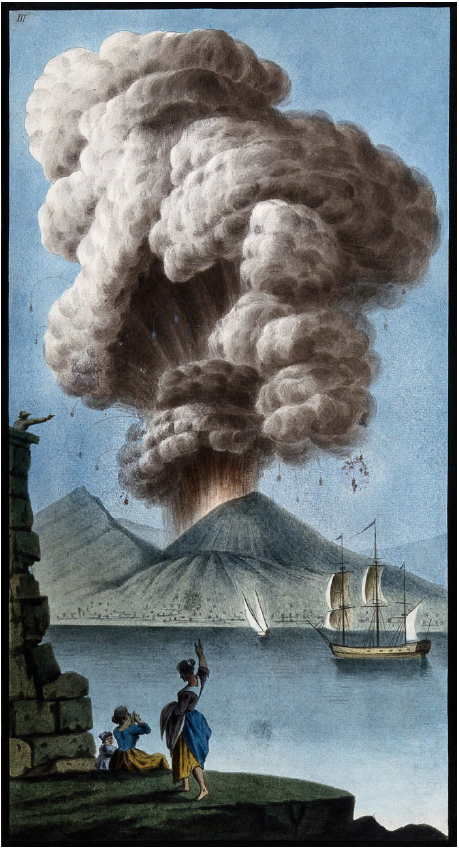
It is quite interesting to note the frequent reference made by eighteenth-century authors to the gap they perceived between them and scholars of the previous century, who had also faced an active Vesuvius, erupting less often but in similarly dramatic fashion. Although the content of many seventeenth-century reports sounds quite similar to those of the following century, there nevertheless are a few crucial differences. In the seventeenth century, much material about eruptions comes from classic literature and personal experience, with naturalistic observations occupying far less space. Descriptions of volcanic products were limited to their physical macroscopic characteristics, and chemical inquiry had very little in common with the chemical analysis made in laboratories at the end of eighteenth century. After the introduction of the ideas of new chemistry, scholars were no longer looking for vague alchemical principles in the ash, but for its elementary substances, those they could separate and then melt. This was one reason why they also paid such close attention to the ashes’ relative weights. They had inherited this concern from the nouvelle chimie, although in their writings it is melded together with the old tradition of Neapolitan natural philosophy (fig. 1).
Mount Vesuvius emitting a column of smoke after its eruption on 8 August 1779. Colored etching by Pietro Fabris, 1779. Wellcome Collection. Attribution 4.0 International (CC BY 4.0).
Vesuvius ash: The scientific object of a volcanic studies laboratory
During the eighteenth-century, Naples did not have university laboratories, nor the same quality of scientific tools as did France, where in those years chemistry was held in high esteem. In the South of Italy, chemistry was mostly cultivated in private laboratories in scholars’ homes or in some apothecary shops, neither of which provided the best conditions for developing chemical studies. Nevertheless, Neapolitan chemists were very up-to-date with European chemical research. The debate on such a delicate scientific object as volcanic ash was quite exemplary in this sense. The double scientific life of ash produced by Mount Vesuvius was a difficult subject to analyze, even with the best practices and tools. The difficulty lay in that not only did volcanic ash need to be analyzed well (because it apparently could be responsible both for people’s deaths and for the rejuvenation of agricultural fields), but that it also needed to be analyzed rapidly—in order to make public decisions of life or death in the midst of a crisis, as we have already seen. The laboratory of the Royal Academy of Science, to which the cited Avviso al pubblico belonged, was created only in 1786, and in the meantime many eruptive phenomena had taken place. How could Neapolitan chemists scientifically interpret these huge phenomena without the right scientific instruments? I propose that Mount Vesuvius was the most important chemical laboratory for scholars working in the Kingdom of Naples. With its high temperatures, its richness of substances, thermal waters and caves with mephitic vapors, it was a permanent and tempting invitation to enter the inner secrets of material transformation.
In addition to these considerations, Neapolitan chemists understood very well that they were working with a peculiar scientific object, so they felt it was their duty to justify the inconsistent results that were obtained after chemical assays of ash. Francesco Semmola, for instance, in his introduction of another analysis commissioned by land agents, warned readers that:
We need to have a lot of that equipment, as much as we might require, and of all those reagents that Art has been able to analyze so far. The erudite Mr. Bergman, the valorous Fourcroy, the famous Lavoisier, and many more, whose names are written in the temple of Immortality, would have been lost to posterity if they had not had all that equipment demanded by modern chemistry. (Semmola Reference Semmola1794, 3)
The importance of the right equipment was also mentioned in a pamphlet where an anonymous author wrote a Reasoned letter to a friend, where he indicated that those whose analyses produced alarming results clearly did not have good burners for chemical assay (Anonymous 1794, 11).
The attention paid to the quality of laboratory instruments is a direct result of the introduction, among the community of the Kingdom’s scholars, of new ideas about chemistry. Lavoisier (1743-1794), one of the main characters of the French chemical revolution, attributed an important role to instruments (Beretta and Brenni Reference Beretta and Brenni2022). They were important enough to deserve to be drawn in a very detailed manner in his seminal textbook the Traité élémentaire de chimie, published in Paris in 1789 and translated into Italian in Naples in 1791 (Guerra Reference Guerra2018). This situates our discussion on the analysis of Vesuvian ash in the context of the internal crisis of chemistry as a discipline, with the transition from the theory of phlogiston to the nouvelle chimie. Without a doubt, chemistry played a key role in the birth of geology and volcanology; as outlined before, the case of volcanic ash at the end of eighteenth century could be one of the best examples of this role.
That said, it is not surprising that in Naples the aforementioned Ferrara reproduced, with Antonio BarbaFootnote 14 (1751-1827), the crucial experiment by which Lavoisier showed that water was the result of a composition of two gases, one of the bases of his new system. As a consequence, in his text Ferrara explained that the only way to know if ash was dangerous would be to analyze its chemical components, as dealt with in Principles contained by ashes, but he added that it was curious to find the term “principle” as it had been eliminated by scholars (Ferrara Reference Ferrara1794, 6), making a clear reference to the new chemistry.
The chemists’ discussions of ash in Naples corresponded with the discussion about the adoption of new chemical theories, since the different results of ash compound analysis could be explained by the different theoretical systems adopted by the chemists. One of the central assumptions of the new chemistry was the capital importance of associating the chemical analysis (separation of elements of a compound) with the correspondent synthesis (to create a compound by combining its elements): another topic quite frequent in the Neapolitan reports on Mount Vesuvius ash. Whereas the harmlessness of ash rains was accepted or rejected after several analyses, the rains of water were interpreted as a synthesis of volcanic hydrogen with atmospheric oxygen in the big laboratory of the Vesuvius crater at the disposal of Neapolitan chemists. Although some scholars were trying to establish whether ash could cause death in individuals and others whether ash could revitalize agriculture, in both cases they exploited chemical analysis. In the end, the results of their analyses were their only support for either proving edibility or arguing against it: one more reason to repeat and continue to improve the accuracy of these analyses. Still, one century after the episodes cited at the Royal Academy of Science in Naples, the debate about the production of the fine Vesuvian powder was considered a good opportunity for discussion among naturalists, although they preferred the terms “sand” and “dust” (Scacchi Reference Scacchi1872, 180, 185 187, 189).
The death of Mount Vesuvius ash as scientific object per se
As shown, chemists spent a lot of energy trying to better understand the danger represented by the rains of ash from Mount Vesuvius that periodically covered the Neapolitan landscape. On the other hand, no less energy was spent by other chemists who were trying to demonstrate the advantage of these coatings of ash as fertilizer. All this strong scientific engagement was surely energized by fascination with a subject that combines two mysterious natural phenomena: dust and volcanoes. In the eighteenth century dusty rains had a huge capacity to create fear because of their impalpable and contradictory nature, invisible and yet capable of turning off the sun. The dusty nature of Vesuvian ash made it a difficult scientific object to examine. Until the tools of analysis became more precise, which was not until the development of general geological theories and above all the birth of seismology as a separate discipline, it remained a continuous a source of lively debate.
As we can see by these short references to some eighteenth-century reports, from a chemical point of view, Vesuvian ash lived two different lives as a scientific object. When individual chemists decided to study it, they generally studied it as a fertilizer or as a poison, with no way to discuss ash in both senses at the same time. As recently argued by Jardine, Kowal and Banham (Reference Jardine, Kowal and Bangham2019), scientific collections can end with erosion, loss and decay, and the same can be said for scientific objects, whether they had been a source of fear or a cheap fertilizer. Today, in my opinion, the two ancient aspects of the scholarly enquiry labelled “ash of Mount Vesuvius” are dead, according to all the different shades of meaning by which we can use the verb “to die” when applied to collections of instruments, specimens, samples and objects kept in laboratories and museums (Jardine, Kowal and Bangham Reference Jardine, Kowal and Bangham2019). Alternatively, in the case of Mount Vesuvius ash, we can perhaps speak of death by murder, because accepting ash as a good fertilizer meant, from a certain point of view, killing its alter-ego as a potential poison for population. Whatever death version we decide upon, the eighteenth-century scientific object no longer exists. Today volcanic ash is still often studied, and we have classified many types according to their composition, but the main focus of scientists is now on how ash can affect air traffic (Suipizio Reference Suipizio, Arnau Folch, Scaini and Dellino2012), with no attention to its potential life as the toxic substance, which had so captivated eighteenth-century Neapolitan scholars. Although the chemical components of ash still remain a potential health menace (Horwell Reference Horwell, Stannett, Andronico, Bertagnini, Fenoglio, Fubini, Le Blond and Williamson2010), we now perceive the concentration of single elements as dangerous, rather than the object “Vesuvian ash” per se.
Today we know the reasons why volcanic ash could be simultaneously both harmless and dangerous, and it is not so embarrassing to consider these two effects as part of a single scientific object. The situation was different in the eighteenth century, when ash seemed to have two separate scientific lives—one that fostered new life and the other that hastened death. However, the two scientific objects ceased to exist once the problem was moved to another level of analysis, which meant considering the potential bronchial danger that comes from the physical side of the phenomenon on the one hand, and the more chemical side of the volcanic eruption’s potential danger, linked to the presence of silicates. Thus, the object’s existence now depends mainly on the instruments of the analysis that are applied to it. The scientific object is no longer dust, but more or less its toxic components, the size of dust corpuscles, the presence of abrasive powder Footnote 15 and its physical behavior. On the other hand, the link with the richness of soil has also ceased to be a focus in the Campania Region, where cultivation has been affected by other environmental issues, and, in any case, a natural high productivity is no longer a central issue for scientists involved in the chemical analysis of volcanic ash (Carra Reference Carra and Fronte2009; Armiero Reference Armiero2021).
It was substantially different for eighteenth-century scholars, as this was the period when the advancements in chemistry were being harnessed for the beginning of agriculture as a science. This was very clear in Naples, where the first chair of agricultural studies was occupied in 1777 by Nicola Andria (1748-1814), a chemist very fond of the analysis of mineral waters (Andria, Reference Andria1775, Reference Andria1783 II). Another chemist, Vincenzo Comi (1765-1835) founded a journalFootnote 16 with the aim to communicate, beyond the university, chemical discoveries that could be applied to agriculture in the Kingdom of Naples. In conclusion, there are few things more frightening than a huge rain of volcanic ash, and there are few subjects more appealing than a luxuriant, cultivated area of volcanic origin.
Acknowledgements
The author is deeply grateful to Jaume Navarro and Yossef Schwartz for keeping her in this amazing publishing project, to the two anonymous referees for their so enriching remarks, to Chris Welsch for his careful English editing on the first version of the paper, and the copy-editor Thom Rofé for her effort to make my final text clearer.
Corinna Guerra is Assistant Professor in History of Science and Technology at the Ca’ Foscari University of Venice, where she teaches Philosophy and Politics of Life and Environment. Her research focus on the chemistry of the eighteenth century, its application to the study of volcanoes and natural disasters. Previously, she had been postdoctoral researcher in Naples at the Istituto Italiano per gli Studi Storici, the Società Napoletana di Storia Patria and in Paris at the École des Hautes Études en Sciences Sociales. Her first book Lavoisier e Parthenope. Contributo ad una storia della chimica del Regno di Napoli (2017) was awarded the Prize for Young Historians by the International Academy of the History of Science.


 Open access

