


Assessments of the distribution of a species are important for understanding ecological preferences and are fundamentally important for conservation management (Fajardo et al., Reference Fajardo, Lessmann, Bonaccorso, Devenish and Muñoz2014). Understanding the distribution of carnivores, which usually compete with people for space and food, is necessary to reduce negative human–carnivore interactions (Inskip & Zimmermann, Reference Inskip and Zimmermann2009) but our knowledge of carnivore distribution is incomplete. Specifically, the distribution of small felids, and their interactions with people in the Neotropics, has been assessed only in a few regions, (Lucherini et al., Reference Lucherini, Eizirik, de Oliveira, Pereira and Williams2016), and such information is scarce for South American arid ecosystems.
The Pampas cat Leopardus colocolo is distributed from northern Ecuador to southern Argentina, in diverse habitats at 0–5,704 m altitude (Lucherini et al., Reference Lucherini, Eizirik, de Oliveira, Pereira and Williams2016). Across its distribution range it faces habitat loss, hunting, and the presence of feral dogs and livestock (Lucherini et al., Reference Lucherini, Eizirik, de Oliveira, Pereira and Williams2016). The species is categorized as Near Threatened on the IUCN Red List (Lucherini et al., Reference Lucherini, Eizirik, de Oliveira, Pereira and Williams2016), Data Deficient in Peru (MINAGRI, 2014) and Vulnerable in Ecuador (Tirira, Reference Tirira2011), but distributional and ecological research has focused on the Andean and Cerrado populations, excluding desert and dry forest populations almost entirely (Lucherini et al., Reference Lucherini, Eizirik, de Oliveira, Pereira and Williams2016). Therefore, our aims were to determine the presence of the Pampas cat in the Sechura Desert and seasonally dry forest of north-western Peru and south-western Ecuador, and identify threats to the species, and how people perceive it.
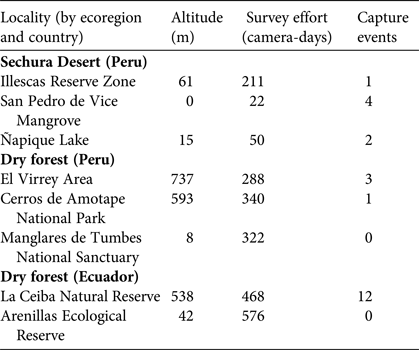
During April 2015–July 2016 we surveyed eight localities of the northern Peruvian and southern Ecuadorian coastline ecosystems, in the Sechura Desert and seasonally dry forest (Table 1). These arid ecosystems are among the Global 200 priority ecoregions for global conservation (Olson & Dinerstein, Reference Olson and Dinerstein2002; for detailed descriptions see Brack-Egg, Reference Brack-Egg1986, and Linares-Palomino et al., Reference Linares-Palomino, Kvist, Aguirre-Mendoza and Gonzales-Inca2010). Each locality was surveyed using 32 camera-trap stations (10 Illuminator cameras, Covert Scouting Cameras, Lewisburg, USA; 22 Trophy Cam HD cameras, Bushnell, Overland Park, USA). Stations were at least 300 m apart, and each station consisted of a single camera trap, set at a mean height of 30 cm and programmed to take three photographs per second for each detection. As felids primarily use trails and water sources in arid ecosystems (Edwards et al., Reference Edwards, Gange and Wiesel2016), cameras were positioned mostly on trails but also near water sources, and to increase the detection rate, compact disks were used as a visual attractor. The cameras were left at each locality until the Pampas cat's presence was confirmed, or for a maximum survey period of 18 nights. We calculated sampling effort as the number of camera traps multiplied by the number of active days per camera, and latency to initial detection, defined as the effort needed (camera-days) to obtain the first record of a Pampas cat in each locality.
Survey localities in the Sechura Desert and in the seasonal dry forest of north-western Peru and south-western Ecuador (Fig. 1).
Additionally, we compiled non-published but confirmed records (based on photographs) of the Pampas cat in the Sechura Desert and dry forest. We also conducted standardized semi-structured interviews with local people selected randomly from houses near field sites and door-to-door canvassing in 10 localities, to assess their knowledge about the Pampas cat and identify potential conflicts with people. This was authorized by Servicio Nacional de Áreas Naturales Protegidas (023-2015-SERNANP-DGANP), Servicio Nacional Forestal y de Fauna Silvestre (0299-2015-SERFOR-DFFSPFFS), and the Ecuadorian Environment Ministry (002-IC-FLO-DP-AEO-MAE). Each interview consisted of nine questions and included photographs of carnivores that are potentially distributed in the surveyed locality (Supplementary Material 1). We categorized interviews as No ID when the interviewee was unable to identify the Pampas cat in photographs, and ID when the interviewee successfully identified the species. Within the ID category we summarized people's perceptions as positive, negative or neutral.
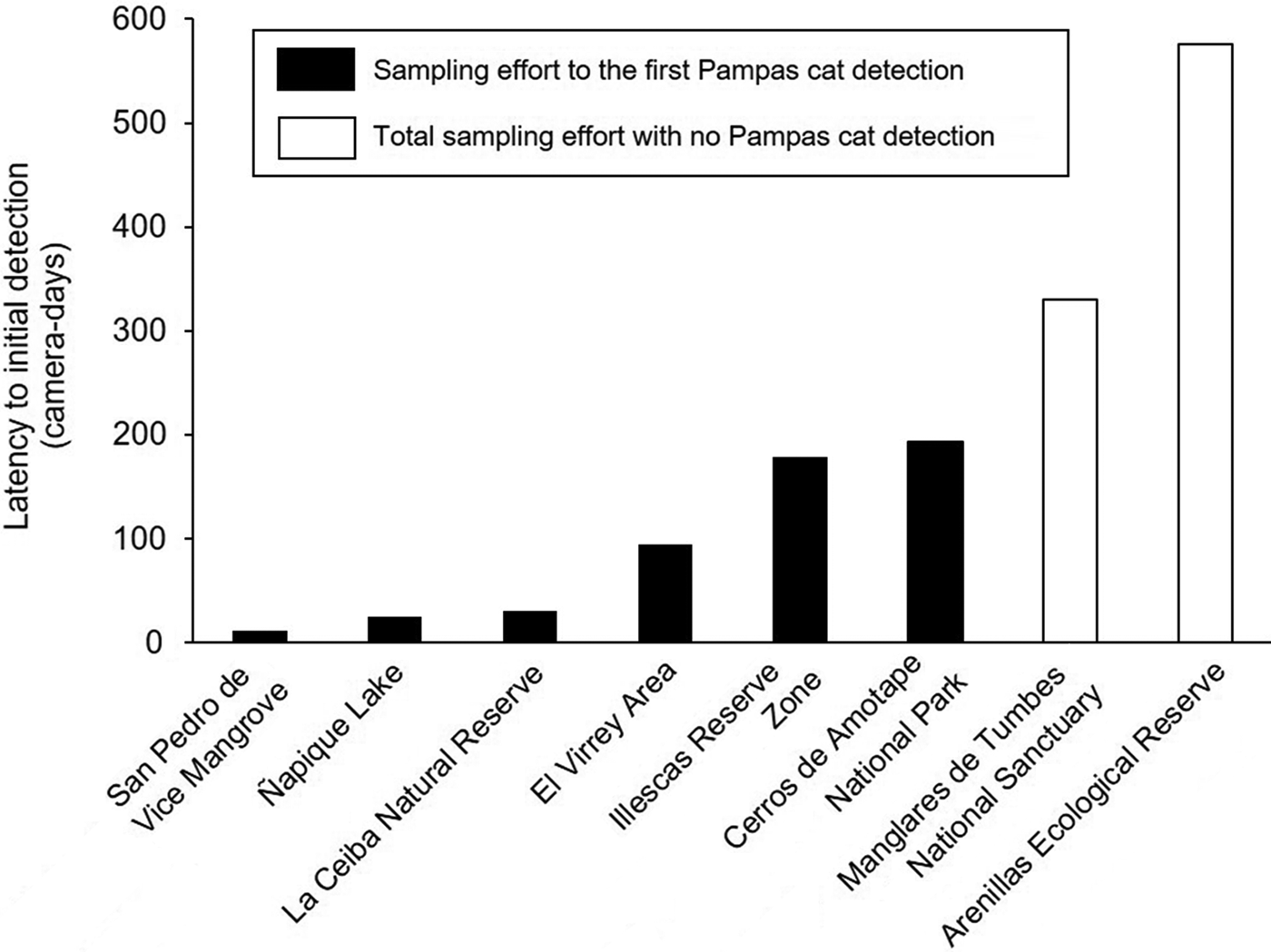
During 2,277 camera-days we obtained 23 records of the Pampas cat, in six of the eight surveyed localities (Fig. 1; Plate 1). We also found one captured individual in Chapangos town, and interviews confirmed the species’ presence in Yacila de Zamba Private Conservation Area. Additionally, we compiled five records from other researchers (E. Edavaly, P. Vásquez, K. Herrera, D. Tirira and M. Gómez; Fig. 1). Our updated distribution map includes 12 new records of the species: three in the Sechura Desert and nine in the dry forest. The lowest altitude at which the species was detected was 0 m, in San Pedro de Vice Mangrove, and the highest altitude was near Kuelap Arqueological Site, at 2,210 m. San Pedro de Vice Mangrove was the location with the lowest latency to initial detection (11 camera-days), followed by Ñapique Lake (25 camera-days); Cerros de Amotape National Park had the highest latency to initial detection (193 camera-days; Fig. 2).
Records of the Pampas cat Leopardus colocolo in the Sechura Desert, Peru, and seasonally dry forest of Peru and Ecuador.

Latency to initial detection in the localities surveyed for the Pampas cat in the Sechura Desert, Peru, and seasonally dry forest of Peru and Ecuador (Fig. 1).
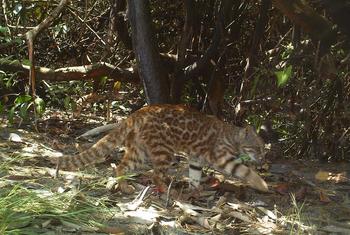
Pampas cat Leopardus colocolo in San Pedro de Vice Mangrove, Peru.
We identified several threats to the Pampas cat. In the Sechura Desert the cat lives among feral mammals (dogs, cats, donkeys, goats and pigs), which can be direct competitors, and may serve as vectors for disease transmission (Doherty et al., Reference Doherty, Glen, Nimmo, Ritchie and Dickman2016). Habitat loss in San Pedro de Vice Mangrove is driven by wildfires set deliberately and repeatedly by local people to facilitate hunting of feral pigs, and habitat degradation in Cerros de Amotape National Park and La Ceiba Natural Reserve is caused by free-ranging livestock (cattle and goats). The only reported capture of a Pampas cat involved an opportunistic event in which local people tried to obtain income from selling a juvenile as a pet, in Chapangos town.
We interviewed 56 people (44 in Peru and 12 in Ecuador) from 10 settlements. The interviewees were farmers, fishers, park guards, housewives and school children. Among these, 23.2% (13) were familiar with the Pampas cat, of which 23.1% (3) had a positive perception of the species, 61.5% (8) were neutral to its presence, and 15.4% (2) had a negative perception. Park guards had a positive perception of the species, whereas fishers had a neutral perception. Only farmers perceived the Pampas cat negatively, on the basis that it preyed upon their young goats and poultry.
Most previous records of this species in Peru and Ecuador were concentrated in the Andes (Lucherini et al., Reference Lucherini, Eizirik, de Oliveira, Pereira and Williams2016), despite assessments of mammal diversity having been carried out in the dry forests of both countries (Espinosa et al., Reference Espinosa, Jara-Guerrero, Cisceros, Sotomayor and Escribano-Ávila2016). We found evidence of the species at La Ceiba Natural Reserve (this research) and Jorupe Reserve (Tirira, Reference Tirira2017), which are the first known localities of the Pampas cat in the Ecuadorian dry forest. Our findings extend the known distribution of the species c. 180 km north to Cerros Amotape National Park, which may be the northern limit of its distribution in the dry forest ecosystem.
The differences in latency to initial detection in the Sechura Desert localities may be attributed to lower cat density because of prey availability and weather constraints in the Illescas Reserve Zone, compared to both wetlands in the same ecoregion. The higher latency to initial detection in Cerros Amotape National Park compared to the Sechura Desert wetland localities may be explained by the presence of three other small cat species: Leopardus pardalis, Leopardus wiedii and Puma yagouaroundi (Hurtado & Pacheco, Reference Hurtado and Pacheco2015). High interspecific competition among these species could constrain the Pampas cat, which does not usually occur in forested ecosystems (Lucherini et al., Reference Lucherini, Eizirik, de Oliveira, Pereira and Williams2016), and may also explain the lack of records of the species in the Arenillas Ecological Reserve, where L. pardalis and P. yagouaroundi coexist (Espinosa et al., Reference Espinosa, Jara-Guerrero, Cisceros, Sotomayor and Escribano-Ávila2016). We found no evidence of the Pampas cat in surveys of various dry forest patches near the Manglares de Tumbes National Sanctuary, possibly as a result of long-term flooding of this forest, which makes it unsuitable for this species (Lucherini et al., Reference Lucherini, Eizirik, de Oliveira, Pereira and Williams2016).
Most local people are not familiar with the Pampas cat, and conflict with the species appears to be rare in the surveyed localities. The interviewees who had a negative perception of the Pampas cat mentioned that it preys on poultry and young goats, although there is no evidence of this. Predation of young goats is usually attributed to the puma Puma concolor (Inskip & Zimmermann, Reference Inskip and Zimmermann2009), whereas poultry is a preferred prey of the Sechuran fox Lycalopex sechurae (Cossíos Meza, Reference Cossíos Meza2004). Thus, we recommend that future environmental workshops and talks be customized and targeted towards people unfamiliar with the species and towards farmers who may erroneously believe the Pampas cat is preying on their animals.
Our findings show that Pampas cat populations are widely distributed in arid ecosystems, tolerating some degree of disturbance and the presence of other small felid species at low densities. This information may be used as a baseline for future research. Additionally, given people's neutral perception of the Pampas cat, there is potential for educational programmes to increase awareness of the species and highlight the importance of protecting the Sechura Desert and dry forest.
Acknowledgements
Funding was provided by the Mohamed bin Zayed Species Conservation Fund, Small Wild Cat Conservation Foundation, and San Diego Zoo Global. We thank Servicio Nacional de Áreas Naturales Protegidas (023-2015-SERNANP-DGANP), Servicio Nacional Forestal y de Fauna Silvestre (0299-2015-SERFOR-DFFSPFFS), Jaime Salas, and the Ecuadorian Environment Ministry (002-IC-FLO-DP-AEO-MAE) for research authorizations. We are grateful for the support of Jim Sanderson and volunteers: Jorge Novoa, Diego García, Elio Nuñez, Luiggi Quevedo, Ivan Wong, Kárlom Herrera, Zoila Vega, J.L. Troncos, J.P. Castro, Darwin Martínez, Cristian Barros, Pablo Martínez, Carlos Pingo, Yufani Olaya, Edgar Espinoza, Omar Aguilar and Felipe Sánchez. We also thank Diego Tirira, Pedro Vásquez, Elberth Edevaly, Marlo Gómez and Russ Van Horn for helping improve this article.
Author contributions
AGO and CMH designed the study and collected and analyzed the data. AGO wrote the article and CMH provided relevant comments and revisions.
Biographical sketches
Alvaro García-Olaechea and Cindy Hurtado are interested in the ecology and conservation of medium- to large-sized mammals. Both work mainly on the mammals of Peruvian tropical forests. Alvaro's experience includes bird monitoring, and Cindy has conducted research on reintroduced peccaries in Argentina.



