


Introduction
The study of dental calculus from past human and hominin populations is a promising field of investigation, especially for accessing information on plant use in pre-agricultural and non-sedentary populations where other lines of evidence can be poor. Dental calculus is a mineralised deposit of calcium phosphate that adheres to tooth enamel. It is formed by the activity of bacteria, which are energised by salivary sugars to form plaque. If this is not removed, it can calcify in as little as two weeks (Lieverse Reference Lieverse1999). This formation process ceases at death because it requires minerals present in the saliva (MacPhee & Cowley Reference MacPhee and Cowley1975). Once plaque has calcified, it can survive for extended periods. It is found on teeth in most ancient human populations, and has even been identified on Miocene apes that lived between 8 and 12 million years ago (Hershkovitz et al. Reference Hershkovitz, Kelly, Latimer, Rothschild, Simpson, Polak and Rosenberg1997). Analyses of material found embedded in ancient dental calculus in human and hominin populations have provided direct evidence of a variety of debris, including human cells and mineralised bacterial structures (Hardy et al. Reference Hardy, Buckley, Collins, Estalrrich, Brothwell, Copeland, García-Tabernero, García-Vargas, de la Rasilla, Lalueza-Fox, Huguet, Bastir, Santamaría, Madella, Wilson, Cortés and Rosas2012, in press; Buckley et al. Reference Buckley, Usai, Jakob, Radini and Hardy2014; Warinner et al. Reference Warinner, Rodrigues, Vyas, Trachsel, Shved, Grossmann, Radini, Hancock, Tito, Fiddyment, Speller, Hendy, Charlton, Luder, Salazar-García, Eppler, Seiler, Hansen, Castruita, Barkow-Osterreicher, Teoh, Kelstrup, Olsen, Nanni, Kawai, Willerslev, von Mering, Lewis, Collins, Gilbert, Rühli and Cappellini2014).
Previous studies have mainly focused on dietary reconstruction, and the majority of the finds have been interpreted as the remains of the deliberate consumption of plant-derived food (Henry & Piperno Reference Henry and Piperno2008; Piperno & Dillehay Reference Piperno and Dillehay2008; Hardy et al. Reference Hardy, Blakeney, Copeland, Kirkham, Wrangham and Collins2009; Li et al. Reference Li, Yang, Wang, Wang, Jia and Ge2010; Weslowski et al. Reference Weslowski, de Souza, Reinhard and Ceccantini2010; Henry et al. Reference Henry, Ungar, Passey, Sponheimer, Rossouw, Bamford, Deruiter and Berger2012, Reference Henry, Brooks and Piperno2014; Mickleburgh & Pagán-Jiménez Reference Mickleburgh and Pagán-Jiménez2012). Several studies have, however, highlighted non-nutritional information from dental calculus, including evidence for both non-masticatory use of the teeth and the presence of inhaled or unconsciously ingested material (Blondiaux & Charlier Reference Blondiaux and Charlier2008; Blatt et al. Reference Blatt, Redmond, Cassman and Sciulli2011; Hardy et al. Reference Hardy, Buckley, Collins, Estalrrich, Brothwell, Copeland, García-Tabernero, García-Vargas, de la Rasilla, Lalueza-Fox, Huguet, Bastir, Santamaría, Madella, Wilson, Cortés and Rosas2012, in press; Buckley et al. Reference Buckley, Usai, Jakob, Radini and Hardy2014; although see Weslowski et al. Reference Weslowski, de Souza, Reinhard and Ceccantini2010 for an alternative interpretation). Here, we present evidence in the form of chemical compounds and non-dietary debris from non-edible material recovered in the dental calculus of the Neanderthal population at El Sidrón, northern Spain. An earlier study of this material revealed evidence for consumption of cooked starchy plant food, exposure to wood smoke, the presence of bitumen and the use of two non-nutritional plants; due to their medicinal qualities, ingestion of these plants was interpreted as evidence for self-medication (Hardy et al. Reference Hardy, Buckley, Collins, Estalrrich, Brothwell, Copeland, García-Tabernero, García-Vargas, de la Rasilla, Lalueza-Fox, Huguet, Bastir, Santamaría, Madella, Wilson, Cortés and Rosas2012, Reference Hardy, Buckley and Huffman2013).
Materials and methods
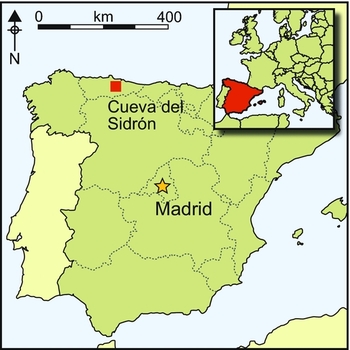
The Neanderthal fossil assemblage from El Sidrón is dated to approximately 49 kya (Wood et al. Reference Wood, Higham, de Torres, Tisnérat-Laborde, Valladas, Ortiz, Lalueza-Fox, Sánchez-Moral, Cañaveras, Rosas, Santamaría and de la Rasilla2013). The minimum number of individuals identified at the site is currently 13 (Rosas et al. Reference Rosas, Estalrrich, García-Vargas, García-Tabernero, Huguet, Lalueza-Fox and de la Rasilla2013), including seven adults (three female, three male, one unidentified), three adolescents (two male, one possible female), two juveniles (one male) and one infant (Lalueza-Fox et al. Reference Lalueza-Fox, Rosas, Estalrrich, Gigli, García-Tabernero, García-Vargas, Sánchez-Quinto, Ramírez, Civit, Bastir, Huguet, Santamaría and de la Rasilla2011; Rosas et al. Reference Rosas, Estalrrich, García-Tabernero, Bastir, García-Vargas, Sánchez-Meseguer, Huguet, Lalueza-Fox, Peña-Melián, Kranioti, Santamaría, de la Rasilla and Fortea2012, Reference Rosas, Estalrrich, García-Vargas, García-Tabernero, Huguet, Lalueza-Fox and de la Rasilla2013). The analysis of non-masticatory dental wear has revealed that all individuals were right-handed (Estalrrich & Rosas Reference Estalrrich and Rosas2013) and all used their mouth as a third hand (Estalrrich & Rosas Reference Estalrrich and Rosas2015).
Dental calculus was extracted from five adult individuals, and the samples were degraded and examined for their surviving content. Optical microscopy was used for the microfossil material, and the samples were also analysed using sequential thermal desorption-gas chromatography-mass spectrometry (TD-GC-MS) and pyrolysis-gas chromatography mass spectrometry (Py-GC-MS) (Hardy et al. Reference Hardy, Buckley, Collins, Estalrrich, Brothwell, Copeland, García-Tabernero, García-Vargas, de la Rasilla, Lalueza-Fox, Huguet, Bastir, Santamaría, Madella, Wilson, Cortés and Rosas2012). A second study, focused on the evidence for non-edible material, was conducted using a Zeiss compound microscope with magnifications up to ×800, at the Ancient Starch Laboratory, University of Leicester, using the original mounted microscope slides.
Results
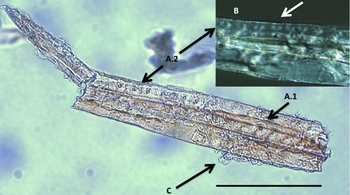
A fragment of non-edible conifer wood tissue with a small fleck of dental calculus still attached to it (Figure 1B) was identified from the material extracted from the lower left first molar (LLM1) of sample 1327h (adult 5), a right-handed (Estalrrich & Rosas Reference Estalrrich and Rosas2013) adult female (Lalueza-Fox et al. Reference Lalueza-Fox, Rosas, Estalrrich, Gigli, García-Tabernero, García-Vargas, Sánchez-Quinto, Ramírez, Civit, Bastir, Huguet, Santamaría and de la Rasilla2011; Rosas et al. Reference Rosas, Estalrrich, García-Tabernero, Bastir, García-Vargas, Sánchez-Meseguer, Huguet, Lalueza-Fox, Peña-Melián, Kranioti, Santamaría, de la Rasilla and Fortea2012, Reference Rosas, Estalrrich, García-Vargas, García-Tabernero, Huguet, Lalueza-Fox and de la Rasilla2013). The fragment of un-charred conifer wood measures 285μm in length and is 40μm at its widest point, which makes it relatively large compared with other debris retrieved from this and other studies (e.g. Hardy et al. Reference Hardy, Buckley, Collins, Estalrrich, Brothwell, Copeland, García-Tabernero, García-Vargas, de la Rasilla, Lalueza-Fox, Huguet, Bastir, Santamaría, Madella, Wilson, Cortés and Rosas2012, in press; Buckley et al. Reference Buckley, Usai, Jakob, Radini and Hardy2014; Warinner et al. Reference Warinner, Rodrigues, Vyas, Trachsel, Shved, Grossmann, Radini, Hancock, Tito, Fiddyment, Speller, Hendy, Charlton, Luder, Salazar-García, Eppler, Seiler, Hansen, Castruita, Barkow-Osterreicher, Teoh, Kelstrup, Olsen, Nanni, Kawai, Willerslev, von Mering, Lewis, Collins, Gilbert, Rühli and Cappellini2014). Identifying features include the visible remains of xylem, which consist of tracheids (tubular cells) with parallel lines of small, regular, circular bordered pits that often display a ‘cross’ feature in cross polarised light. These are present along the length of the fibrous material, and are consistent with conifer ‘soft wood’ (Gerola Reference Gerola1988) (Figure 1). The sample cannot therefore be confused with other (edible) parts, or other species of conifer trees, and its ingestion is thus not related to diet. Other non-starchy debris observed in samples from all of the individuals studied include non-diagnostic plant remains comprising long fibres similar to those found in plant stems, mineral grit and soil flecks, all still partially embedded in the calculus matrix. This suite of remains is similar to those found in other studies (Buckley et al. Reference Buckley, Usai, Jakob, Radini and Hardy2014; Warinner et al. Reference Warinner, Rodrigues, Vyas, Trachsel, Shved, Grossmann, Radini, Hancock, Tito, Fiddyment, Speller, Hendy, Charlton, Luder, Salazar-García, Eppler, Seiler, Hansen, Castruita, Barkow-Osterreicher, Teoh, Kelstrup, Olsen, Nanni, Kawai, Willerslev, von Mering, Lewis, Collins, Gilbert, Rühli and Cappellini2014).
Physical evidence: fragment of wood tissue, consisting of lines of tracheids with lines of bordered pits (A.1 and A.2); the ‘cross’ feature is visible under cross polarised light (B), and small flecks of calculus are still attached (C); scale bar = 100μm.
The chemical results indicated that conifer wood occurred in all three of the samples examined by TD-GC-MS and Py-GC-MS. Samples SD1604 (adult 4, right-handed, young adult female) and SDR007 (adult 2, right-handed, young male) had tentative evidence for dehydroabietic acid and 7-oxo-dehydroabietic acid, two specific markers for conifers. Identifications were based on both the retention times and mass spectra when compared to reference samples containing these two diterpenoids under identical analytical conditions. A tentative identification of retene from the Py-GC-MS may suggest heated conifer resin in sample SDR007. Sample SD1217 (adult 3, right-handed, female) had very tentative evidence for dehydroabietic acid and 7-oxo-dehydroabietic acid, although no conifer markers indicative of heating were present. Biomolecular studies of dental calculus are highly challenging as the entrapped organic material is variable and the quantities are often small, yet despite this, while all these conifer markers are tentative, they occur in all three samples, and, taken together, present a solid case for the presence of conifer.
Discussion: contextualising the results
Accidental ingestion and extra-masticatory uses of teeth
The most common ways in which material can enter the mouth and become embedded in dental calculus are: food and drink, inhalation, use of the mouth as a third hand, oral hygiene activities or direct contamination from hand to mouth. Particles of up to 70μm (microns) in size are inhaled through the mouth in most circumstances, while larger particles can also be inhaled in certain conditions (Se et al. Reference Se, Mei, Inthavong and Tu2010). Pollen, phytoliths, transient starch granules, microcharcoal, soot, grit and dust are all airborne particles that fall within this size range and can be inhaled (Schäppi et al. Reference Schäppi, Taylor, Staff, Rolland and Suphioglu1999; Laurence et al. Reference Laurence, Thoms, Bryant and McDonough2011).
The most common evidence for the non-masticatory use of teeth in archaeological samples is based on tooth wear and attrition. This type of evidence is widespread and can be found across the geographic and temporal spectra (Hinton Reference Hinton1981; Ryan & Johansen 1989; Bonfiglioli et al. Reference Bonfiglioli, Mariotti, Facchini, Belcastro and Condemi2004; Eshed et al. Reference Eshed, Gopher and Hershkovitz2006; Lozano et al. Reference Lozano, Mosquera, de Castro, Arsuaga and Carbonell2009; Volpato et al. Reference Volpato, Macchiarelli, Guatelli-Steinberg, Fiore, Bondioli and Frayer2012). Ethnographic evidence for the use of teeth for non-masticatory purposes is also very common. Kreuger and Ungar (2012) provide a summary of recorded uses of anterior teeth among North American and Arctic populations, including chewing raw materials such as leather, wood and root fibres, as well as grasping or holding materials as they are being worked. In Papua New Guinea, plant fibres were sometimes chewed to soften them before making string (MacKenzie Reference MacKenzie1991).
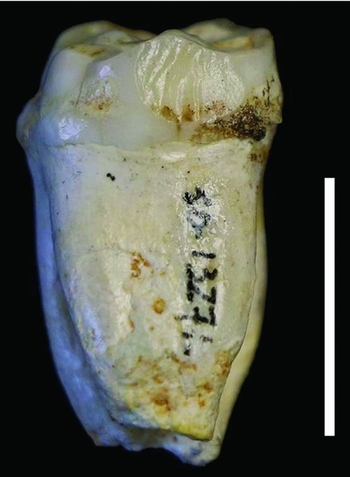
Non-masticatory tooth wear has been found widely in many Neanderthal populations (Clement et al. Reference Clement, Hillson and Aiello2012), including El Sidrón (Estalrrich & Rosas Reference Estalrrich and Rosas2013, Reference Estalrrich and Rosas2015). Most of the heavy wear thought to result from using the teeth as a third hand is found on the anterior teeth, with little evidence for this on teeth behind the canines (Clement et al. Reference Clement, Hillson and Aiello2012). Fiorenza et al. (Reference Fiorenza, Benazzi and Kullmer2011) differentiate between anterior teeth, used principally as a third hand for holding, and posterior teeth used for conducting tasks. Lozano et al. (Reference Lozano, Bermúdez de Castro, Carbonell and Arsuaga2008) also identify evidence for holding, pulling or handling on anterior teeth from Sima de los Huesos, Atapuerca, and note less evidence for non-masticatory wear on canines and pre-molars. In several cases, the distribution of the microwear (in this case, labial scratches) has demonstrated the handedness of the individuals. The proportions of right- to left-handedness correspond with that found today, as is seen on a contemporary basis (Estalrrich & Rosas Reference Estalrrich and Rosas2013; Lozano et al. Reference Lozano, Subirà, Aparicio, Lorenzo and Gómez-Merino2013), and also with a gendered division of labour among individuals from the same group (Estalrrich & Rosas Reference Estalrrich and Rosas2015). This study has revealed that while all individuals have cultural striations, those detected on adult female teeth were longer than those found on adult male teeth. The differences detected on the overall activity-related dental wear pattern suggest a division of labour by age and sex in Neanderthals for use of the mouth as a third hand (Estalrrich & Rosas Reference Estalrrich and Rosas2015). Finally, and potentially relevant in the context of the current findings, interproximal grooves are very common in prehistoric populations, and have been found on teeth from Homo habilis and all subsequent hominin species (Puech & Gianfarani Reference Puech and Gianfarani1988), including Neanderthals from many different sites (Frayer & Russell Reference Frayer and Russell1987; Formicola Reference Formicola1988; Smith et al. Reference Smith, Smith, Schmitz and Schmitz2006; Urbanowski et al. Reference Urbanowski, Socha, Dąbrowski, Nowaczewska, Sadakierska-Chudy, Dobosz, Stefaniak and Nadachowski2010; Rosas et al. Reference Rosas, Estalrrich, García-Vargas, García-Tabernero, Bastir, Huguet, Peña-Melian, de la Rasilla, Rosas, Cañaveras and Lalueza-Fox2011; Lozano et al. Reference Lozano, Subirà, Aparicio, Lorenzo and Gómez-Merino2013). They are thought to be the result of oral hygiene activities (Brothwell Reference Brothwell and Brothwell1963), possibly a result of tooth picking (Ungar et al. Reference Ungar, Grine, Teaford and Pérez-Pérez2001), as is common today among traditional communities, who use a wide range of plant materials for this purpose. Some higher primate groups have also been observed using items to pick or rub their teeth. The chewing of resin has been recorded ethnographically, and lumps of birch bark and pine resin have been found on some Scandinavian Mesolithic sites (Hardy in press). Materials suggested for use as tooth picks include wood, bone, sinew and grass (Eckhardt & Piermarini Reference Eckhardt and Piermarini1988; Brown & Molnar Reference Brown and Molnar1990; Hlusko Reference Hlusko2003). A small number of the El Sidrón teeth had interproximal or tooth-pick grooves, including tooth SD 1327i (LM2), which is adjacent to SD 1327h (LM1) in adult 5 (Rosas et al. Reference Rosas, Estalrrich, García-Vargas, García-Tabernero, Bastir, Huguet, Peña-Melian, de la Rasilla, Rosas, Cañaveras and Lalueza-Fox2011; Figures 2 & 3), from which the wood fragment was recovered.
Interproximal groove on the distal side from LLM1 SD-1327i belonging to an El Sidrón individual, adult 5; although the groove is not well developed, numerous fine and parallel micro scratches are observable on the surface.

Photographic image of the interproximal side with the incipient groove (polished area on the enamel-dentine junction) of SD-1327h (LLM1) from El Sidrón adult 5; scale bar = 1cm.
Neanderthals and trees
Gymnosperms, in particular conifers, are very widespread and occur in temperate regions across the world, where they are frequently the dominant species. Conifer wood is useful as firewood; it is easy to light due to its abundant resin, although the wood tends to spark and burn quite fast. The inner bark can also be used to make cordage. Most conifer trees have several parts that are edible, including the needles, nuts and inner bark, while the resins can be medicinal. There is abundant ethnographic evidence to demonstrate the use of the inner bark of Scots pine (Pinus sylvestris L.) among the Saami people in northern Sweden, as food (Niklasson et al. Reference Niklasson, Zackrisson and Östlund1994) and raw materials (Zackrisson et al. Reference Zackrisson, Östlund, Korhonen and Bergman2000). As well as being edible, the resins have adhesive qualities and can be used in the preparation of pitch. Conifer wood is today used mostly as a raw material and as fuel. Many conifer resins have medicinal and antibacterial qualities that may have been appreciated by Neanderthal populations (Hardy et al. Reference Hardy, Buckley, Collins, Estalrrich, Brothwell, Copeland, García-Tabernero, García-Vargas, de la Rasilla, Lalueza-Fox, Huguet, Bastir, Santamaría, Madella, Wilson, Cortés and Rosas2012, Reference Hardy, Buckley and Huffman2013). A small number of conifer trees, most notably from the Taxaceae or yew family, are poisonous, although these also have medicinal qualities. Among the many conifers native to Spain, the silver fir (Abies alba Mill.) has edible inner bark with antiseptic qualities, and the dark mountain pine (Pinus mugus Turra) has an antiseptic resin.
The most abundant evidence for use of wood by Neanderthals is in the form ofcharcoal remains from hearths, and there is extensive evidence for this across a broad area (e.g. Roebroeks & Villa Reference Roebroeks and Villa2011; Albert et al. Reference Albert, Berna and Goldberg2012; Aldeias et al. Reference Aldeias, Goldberg, Sandgathe, Berna, Dibble, McPherron, Turq and Rezek2012). Evidence is also abundant in Iberia, including at Bolomor Cave, which has some of the earliest hearths in southern Europe (Fernández Peris et al. Reference Fernández Peris, González, Blasco, Cuartero, Fluck, Sañudo and Verdasco2012), and at Abri Romani, where pine charcoal (Burjachs et al. Reference Burjachs, López-García, Allué, Blain, Rivals, Bennàsar and Expósito2011) and complex and sophisticated fire-making techniques (Courty et al. Reference Courty, Carbonell, Vallverdú Poch and Banerjee2012) have been identified. Pine charcoal has been identified at Gorham's Cave, Gibraltar, dated to around 44 000 BP (Finlayson et al. Reference Finlayson, Barton and Stringer2001), while Badal et al. (Reference Badal, Villaverde and Zilhão2011) have identified conifers, principally pine and juniper, in charcoal from three Iberian Neanderthal sites. Charred pine seeds from a Neanderthal context were found at Gorham's Cave, Gibraltar (Barton Reference Barton, Stringer, Barton and Finlayson2000), and may have been collected and roasted as food, while Sandgathe and Hayden (Reference Sandgathe and Hayden2003) suggest that pointed artefacts found on several Neanderthal sites may have been used to obtain edible inner bark.
There is evidence that Neanderthals also manufactured pitch. Pitch can be obtained from a range of trees including conifers, yet its manufacture is a relatively complex technological process that requires an understanding of the raw material properties of trees. The earliest evidence for the use of resin-based pitch is from a Mid-Pleistocene site in Italy (Mazza et al. Reference Mazza, Martini, Sala, Magi, Colombini, Giachi, Landucci, Lemorini, Modugno and Ribechini2006) where chemical evidence for resins of Betulaceae origin was found on a series of flakes. Birch-bark pitch was also identified at Konigsaue, Germany, dating to 43 000–48 500 BP (Grünberg Reference Grünberg2002). Bitumen, an analogous and alternative product to tree-based pitch, which was found to have been highly heated, has been found adhered to stone tools at Umm el Tlel, dated to around 40 kya (Boëda et al. Reference Boëda, Connan, Dessort, Muhesen, Mercier, Valladas and Tisnérat1996).
Early evidence for wood as a raw material includes one artefact that may have been modified from the 790 kya site of Gesher Benot Ya'aqov in Israel (Goren-Inbar et al. Reference Goren-Inbar, Werker and Feibel2002). A spear tip made of yew found in Clacton-on-Sea, England, has been dated to 450 kya (Oakley et al. Reference Oakley, Andrews, Keeley and Clark1977). Three spears made of wood from the conifer species Abies alba (common silver fir) were found at Schöningen, Germany, and date to around 400 kya (Thieme Reference Thieme1997), although a re-evaluation of these dates is currently underway (Balter Reference Balter2014). The earliest wooden artefact attributed to Neanderthals is a spear point from Lehringen dating to between 120 and 125 kya (Langley et al. Reference Langley, Clarkson and Ulm2008). This combined evidence for woodworking, together with the use-wear on stone tools (Rots Reference Rots2013), and the increasing number of sites where the use of bitumen or pitch for hafting has been identified, suggests Neanderthals had a detailed applied knowledge of trees and wood.
Chemical evidence from the dental calculus of sample SDR-007c (adult 2, young male) from El Sidrón indicates the presence of both bitumen and conifer ‘resin’. The bitumen (natural petroleum/oil) was identified by the presence of characteristic hopanes (Hardy et al. Reference Hardy, Buckley, Collins, Estalrrich, Brothwell, Copeland, García-Tabernero, García-Vargas, de la Rasilla, Lalueza-Fox, Huguet, Bastir, Santamaría, Madella, Wilson, Cortés and Rosas2012). The conifer tree ‘resin’ that is also present is shown by the diagnostic diterpenoids dehydroabietic acid and 7-oxo-dehydroabietic acid, which confirm a conifer source: either the tree resin exudate or, perhaps more probable given the conifer wood fibre identified, conifer wood or bark, which also contain these diterpenoid components. This sample also has activity-related dental wear that is unusual within this population with an elevated incidence of chipped enamel. This has been considered to indicate an exceptionally specialised behaviour (Estalrrich & Rosas Reference Estalrrich and Rosas2015); the chemical evidence for bitumen and resin reinforces this uniqueness.
The presence of minerals and soil flecks suggests dirt. The conifer fragment and the chemical markers for conifer, as well as the items suggestive of dirt, could have reached the mouth and become embedded in the dental calculus through a variety of non-dietary pathways, including inhalation, dirty food, raw material processing, oral hygiene activities, or simply via dirty hands or material placed in the mouth. Dust generated by woodworking could have entered the mouth during oral breathing, and during eating as settled dust on food items. The processing of plants as raw materials can comprise various stages, including holding the plant material by the teeth and/or chewing it for splitting and softening; any of these activities can potentially leave material traces in the dental calculus.
Conclusions
Dental calculus studies are becoming increasingly important in archaeology, although there is a tendency to focus on the dietary evidence (Blondiaux & Charlier Reference Blondiaux and Charlier2008). Non-dietary pathways to the inclusion of the micro-debris in calculus are, however, equally plausible (Radini et al. Reference Radini, Nikita, Shillito, Jervis, Broderick and Grau-Sologestoa2016). In this study, we have combined the evidence from microscopy and chemical analysis to demonstrate the presence of non-edible conifer wood within the mouth. The dental wear, in particular in the case of adult 2 (young male; SDR-007c), confirms the use of the teeth for non-diet related activities. Taken together, the evidence for conifer wood and the other small debris extracted highlight the need to consider a wide range of potential pathways, unrelated to food, through which material can become embedded in dental calculus. This is particularly significant where there is persistent evidence of non-dietary uses of teeth, as is the case among Neanderthals. Likewise, evidence for oral hygiene activities is widespread, and there is physical evidence, in the form of interproximal grooves, that suggests Neanderthals habitually rubbed material between their teeth.
We believe that these results represent the first physical evidence for non-edible debris found ‘in the mouth’ of a Neanderthal individual. Although we cannot be certain whether the material represents oral hygiene activity or use of the mouth as a third hand or indeed accidental inhalation or ingestion, its presence confirms that material unrelated to diet can be found in dental calculus. A broad approach to entrapped material, which incorporates this perspective, offers an opportunity to explore a wide range of hitherto unimagined biographical detail related to past human and hominin populations.
Acknowledgements
Research and fieldwork at the El Sidrón site is funded by the Principado de Asturias and the Spanish Government (Project CGL2012-36682). The chemical analysis was conducted at Pharos Research, UK. Efthymia Nikita and Hayley McParland are also thanked.



