





The influence of food companies on our diets – what we eat, where we eat, and how we eat – is undeniable. Around the globe, diet-related risk factors are contributing to growing burdens of disease(Reference Afshin, Sur and Fay1). This is partly due to excess consumption of nutrients of concern such as trans fatty acids (TFAs), salt and sugar.
These challenges, while well known, are not insurmountable. In fact, food companies, often seen as part of the problem, can be encouraged or forced to be part of the solution – particularly through food reformulation. According to the World Health Organisation, food reformulation is the process of altering the processing or composition of a food or drink product, to improve its nutritional profile or to reduce its content of ingredients or nutrients of concern(2). For the purpose of this review, the focus was on policies that aimed to reduce nutrients of concern – such as TFAs, salt, and sugar – through either mandatory or voluntary approaches. This can occur directly, through policies designed specifically to prompt reformulation, or indirectly, as a byproduct of other policies. Consequently, the latter may not have been evaluated for its impact on food reformulation, which can result in underestimating its effect, but this has started to change, as suggested in recent reviews(Reference Packer, Michalopoulou and Cruz3,Reference Gressier, Frost and Hill4) . This review further builds on existing evidence to better compartmentalise reformulation into policies designed to directly drive reformulation and those where reformulation has occurred indirectly in response to other regulations, to draw a more nuanced understanding of food reformulation given the multiple examples available from around the globe. The majority of reformulation policies have focused on two nutrients of concern – TFAs and salt, but more recently sugar has been added to the mix, to allow for an improved understanding of policies that led or could lead to reformulation for food system change.
Reducing TFAs: mandatory vs voluntary
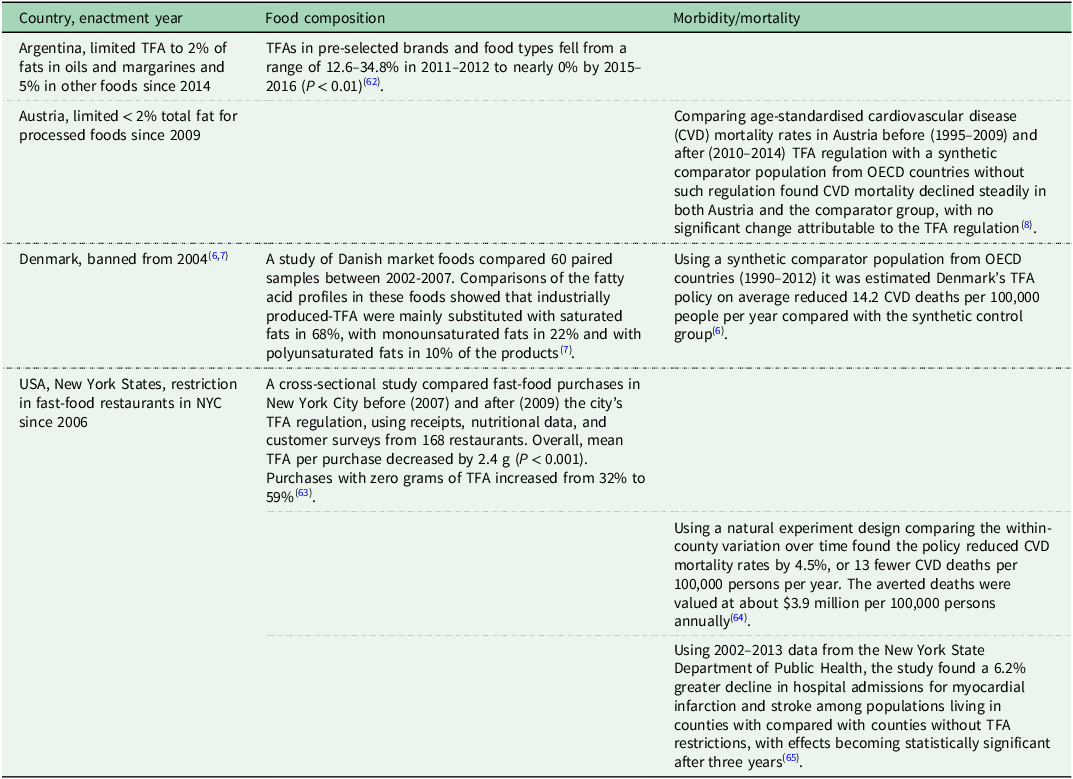
TFAs are linked to cardiovascular disease (CVD) and(Reference Afshin, Sur and Fay1) in 2010, TFA intake was estimated to cause >500,000 coronary heart disease deaths globally each year(Reference Steele, Drummond and Nishida5). There have been two primary reformulation approaches to limit TFA in food, either using mandatory or voluntary limits. Among those evaluated recently in the literature, four countries have introduced mandatory TFA limits (Table 1) and have had evaluations of their potential impact(Reference Gressier, Frost and Hill4). Denmark saw a reduction in TFA composition of food and this resulted in a significant reduction in morbidity and mortality(Reference Bysted, Mikkelsen and Leth6,Reference Restrepo and Rieger7) . Austria, on the other hand, did not experience the same benefit, likely due to concurrent increases in smoking rates that masked the impact of TFA reduction(Reference Grabovac, Hochfellner and Rieger8).
Mandatory limits for TFAs in countries with evidence of impact on food composition and morbidity and mortality

Voluntary TFA limits have also proven effective in certain contexts. In Costa Rica and the UK, voluntary reformulation led to lower TFA intakes among the population(Reference Monge-Rojas, Aragón and Chinnock13,Reference Hutchinson, Rippin and Jewell14) . In Costa Rica, adolescents surveyed in 2006 reported a significantly lower TFA compared with the 1996 cohort(Reference Monge-Rojas, Aragón and Chinnock13). In the UK, the 2000/01 National Diet and Nutrition Survey showed 57% of adults exceeded the WHO limit whereas 2010/11–2011/12 surveys, post-reformulation to remove TFAs, only 2.5% of adults exceeded the WHO limit(Reference Hutchinson, Rippin and Jewell14).
Reducing salt: mandatory vs voluntary
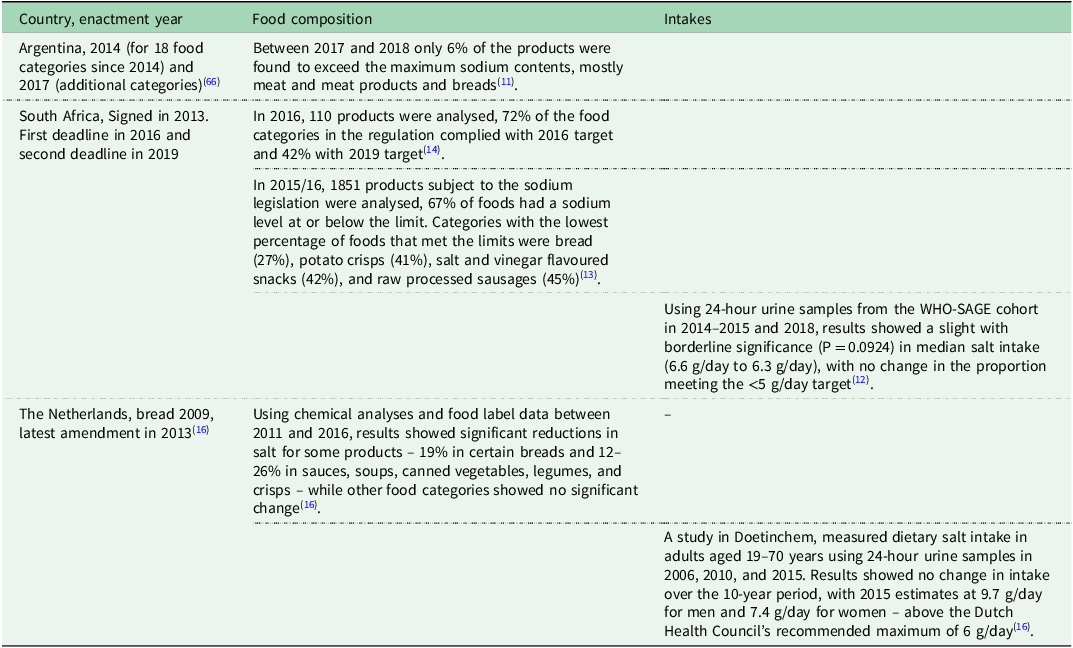
Excess salt is another major dietary concern, particularly due to its role in raising blood pressure and increasing the risk of cardiovascular disease(Reference Afshin, Sur and Fay1). Mandatory and voluntary limits on salt are the most common policies around the globe and have been far more evaluated compared with other nutrients of concern (Table 2)(Reference Packer, Michalopoulou and Cruz3,Reference Gressier, Frost and Hill4) . However, very few countries have implemented mandatory salt limits, often focused on bread – a key contributor to salt intake due to consumption of high quantities. For example, Argentina initially introduced voluntary salt limits, which later became mandatory(Reference Allemandi, Tiscornia and Guarnieri15). Although results were mixed across food categories, the mandatory approach has been promising.
Mandatory limits for salt in countries with evidence of impact on food composition and population intake

South Africa’s approach is often cited as a model approach for setting mandatory limits to encourage reformulation. The country set mandatory limits across various food categories, with multiple evaluations confirming its effectiveness(Reference Swanepoel, Malan and Myburgh17–Reference Charlton, Kowal and Ware19,Reference Strauss-Kruger, Wentzel-Viljoen and Ware21) . In the Netherlands, mandatory limits were set only for bread, with other food categories regulated voluntarily. While salt content in bread did decline, overall salt intake did not, a likely result of the limited scope of mandatory limits(Reference Temme, Hendriksen and Milder20,Reference McLaren, Sumar and Barberio22) .
Voluntary approaches have been adopted by over 40 countries, often as part of broader public health approaches(Reference Gressier, Frost and Hill4). Most countries have seen reductions in salt content or intake. Systematic reviews show that one of the most evaluated approaches is that adopted in the UK. There are many studies that have shown changes in the salt content of foods(Reference Eyles, Webster and Jebb23), from ready meals particularly in its early years(Reference He, Brinsden and MacGregor24), to breakfast cereals(Reference Pombo-Rodrigues, Hashem and He25) and sauces(Reference Tan, He and Ding26), which is often the first indicator if a policy is having its desired effect. The UK has seen sustained(Reference He, Pombo-Rodrigues and MacGregor27), though recently plateauing(Reference Song, Tan and Wang28), success with its voluntary salt reduction programme, on intake and morbidity and mortality in place for over two decades(Reference McLaren, Sumar and Barberio22,Reference Griffith, O’Connell and Smith29,Reference Millett, Laverty and Stylianou30) .
Reducing sugar: voluntary vs mandatory
While the recent reviews did not include many examples of efforts to encourage reformulation to reduce sugar(Reference Packer, Michalopoulou and Cruz3,Reference Gressier, Frost and Hill4) , the UK offers a useful case study(Reference Gressier, Frost and Hill4). In 2016, the UK government launched several public health policies to target the major contributors to children’s sugar intake(31,32) . A voluntary target was set for a 20% reduction by 2020, achievable through reformulation, reducing portion, or shifting sales toward lower-sugar products(33).
Although the programme only achieved a 3.5% reduction overall, the picture is more nuanced(Reference Moore, Sutton and Hancock34). Some categories, like breakfast cereals and yogurts(35), saw significant reductions(Reference Moore, Sutton and Hancock34). Others, particularly chocolate, lagged behind(Reference Moore, Sutton and Hancock34), despite some evidence suggesting there is scope for companies to go further on reformulation even for challenging categories such as chocolate confectionery, biscuits and cakes(Reference Hashem, He and Alderton36,Reference Hashem, He and Alderton37) . These mixed results highlight the complexity of voluntary reformulation and the importance of targeted incentives(Reference Hashem, Burt and Brown38).
On the topic of targeted incentives, the UK also experimented with this. For the first time, a country introduced a tax that explicitly encouraged reformulation(39). One could argue it enforced reformulation, showing the ‘mandatory’ approach to reformulation, can be imposed through taxes. The UK’s Soft Drinks Industry Levy (SDIL) is a tiered tax which penalises drinks with high sugar content while exempting those below a certain threshold(40). The early signs signalled that the SDIL was shifting the sugar content of soft drinks quicker than expected(Reference Hashem, He and MacGregor41,Reference Hashem, He and MacGregor42) . The results, published recently showed a sharp increase in lower-sugar drinks (drinks that incurred no levy increased from 67% in 2015 to 91% in 2024) and a 47.4% drop in total sugars consumed from soft drinks, despite overall sales growing between 2015 and 2024(43). Preliminary findings indicate early signs of improved health outcomes(Reference Rogers, Cummins and Forde44–Reference Cobiac, Rogers and Adams46).
Given this success, the UK government has now lowered the sugar threshold and expanded the levy to other product categories such as milk-based drinks to push further reformulation(47,48) .
The UK is not the only country to have introduced policies to limit sugars in products and encourage reformulation, there are other examples of regulations introduced, but they were not policies designed to explicitly encourage reformulation, as will be discussed later. However, in the literature there is one other country with an evaluated example of a government-initiated approach. In 2015, the Slovenian Ministry of Health wanted to lower population sugar intake by decreasing the amount of sugar in pre-packaged products(Reference Zupanič, Hribar and Fidler Mis49). During this the government attempted to introduce a tax on soft drinks, which was strongly opposed by the soft drinks industry, as a result the government introduced voluntary limits to reduce sugar content(Reference Zupanič, Hribar and Fidler Mis49). A study monitoring the progress in practice between 2015 and 2017 showed the proportion of soft drinks with zero sugar increased slightly, but their sales fell by almost half, representing 10% of all soft drinks sold on the market. Instead, flavoured waters and other soft drinks with low sugar content (from 3 to 5 g of sugar/100 ml) increased by two-fold(Reference Zupanič, Hribar and Fidler Mis49).
Reformulation as an unintended positive consequence
Food reformulation doesn’t always result from direct programmes with targets or guidelines or limits, whatever a country chooses to describe them by, whether they are mandatory or voluntary. Increasingly reformulation has been triggered indirectly as a result of other policies, which were not necessarily initially introduced to do this. But could be the reason they have not been evaluated for their reformulation impact.
Labelling as a driver for reformulation
Many policies aimed at consumers are often evaluated for their impact on consumer behaviour and are rarely evaluated on indirectly also prompted reformulation(Reference Packer, Michalopoulou and Cruz3,Reference Gressier, Frost and Hill4) . Labelling requirements have led companies to reduce levels of nutrients of concern to avoid negative/warning labels on products and this has started to be recognised and acknowledged in the literature(Reference Vandevijvere and Vanderlee50).
Mandatory labelling requirements seem to have instigated quite a change in food composition as well as population intake, particularly when it comes to TFA (Table 3). While reformulation to reduce TFA has been widely acknowledged, it is critical to recognise the countries that did this not via mandatory limits but through mandatory labelling, which is a subtle but critical to distinguish, which could predict possible impact of mandatory warning-like labelling for other nutrients of concern.
Countries with mandatory labelling of TFA contents with evidence of impact on product composition and population intake

Furthermore, there have been examples of countries who have introduced mandatory labelling requirements, on other nutrients of concern, as well as TFAs. Some of those countries have focused on only introducing labelling requirements, which allows for possibly isolating the impact of this from other public health approaches that may have also indirectly encouraged reformulation.
In 2013, the Peruvian Congress passed a law which established the mandatory use of front-of-pack (FOP) warning labels for packaged processed foods and drinks that exceed nutrient of concern thresholds, in the form of black octagons indicating the products are ‘high in’ sugars, saturated fats, sodium or TFAs(Reference Saavedra-Garcia, Meza-Hernández and Diez-Canseco59). The policy was implemented in two phases (the first starting in June 2019 and the second in September 2021), with thresholds tightening in the second phase. A study of 94 top-selling foods and drinks assessed three months before, four months after, and two years after the policy was implemented and found a significant reduction in the median sugar content of drinks (from 9.0 to 5.9 g/100 ml, p = 0.005)(Reference Saavedra-Garcia, Meza-Hernández and Diez-Canseco59). The proportion of drinks requiring warning labels fell from 59% to 31% (p = 0.011), while the share of foods requiring a warning labels also declined, from 82% to 62% (p < 0.001)(Reference Saavedra-Garcia, Meza-Hernández and Diez-Canseco59).
Similarly in Mexico, Salgado et al.(Reference Salgado, Pedraza and Contreras-Manzano60) analysed approximately 1000 top-selling packaged foods and non-alcoholic drinks before (2016–17), after the announcement (2020) and implementation (2021) of the FOP warning labels. All food groups showed reductions in at least one type of warning label, most commonly ’high in’ sodium and saturated fat. Comparisons with 2016–2017 data suggest some anticipatory reformulation before the policy, but reductions were greater and more frequent afterwards. The use of non-caloric sweeteners declined in Mexico following the policy, in contrast to Peru, where their use increased since the warning labels there do not target these additives.
Although these are all relatively new examples of labelling policies which encouraged reformulation, recent reviews have not included one of the earliest labelling examples of public health nutrition policies to reduce salt intake, that is in Finland. This is likely due to limiting the reviews to studies published in the last 10 years or so. In 1993, salt-labelling legislation was implemented in Finland(Reference Pietinen, Valsta and Hirvonen61). The labelling strategy had three components: the percentage of salt was required to be displayed on the package, a ‘high salt’ warning label was required on foods with salt content above a maximum level, and a ‘low salt’ label was permitted on foods with salt content below a specified level(Reference Pietinen, Valsta and Hirvonen61). In an analysis of urinary sodium excretion in the adult population, it was estimated the average salt intake in Finland reduced by about 15% between 1979 and 2007 as a result of the labelling regulations(Reference Laatikainen, Pietinen and Valsta62).
Voluntary front of pack labelling systems
Some voluntary labelling policies have also influenced reformulation. In the Netherlands, Vyth et al. analysed 821 Dutch products carrying the voluntary Choices FOP logo and found that its use was linked to healthier reformulation and product development, including lower salt, saturated fat, and added sugar(Reference Vyth, Steenhuis and Roodenburg63). The study was based on self-reported data from 47 manufacturers(Reference Vyth, Steenhuis and Roodenburg63).
More recent studies assessed more products (n = 4343) over a longer period of time, between 2006 and 2016 and found sodium and TFA contents reduced significantly in 10 and 11 product categories, respectively(Reference van der Bend, Jansen and van der Velde64). Energy, saturated and added sugar decreased significantly whilst fibre increased in 4–6 product categories. Overall, labelled products had healthier compositions and more favourable trends in nutrient content compared with products on the Dutch market(Reference van der Bend, Jansen and van der Velde64).
In 2018, the Minister of Health in Belgium recommended the voluntary FOP Nutri-Score label, with implementation from April 2019. A cross-sectional study of 275 breakfast cereals (2017–2018) found products sold in 2018 had significantly lower sugar and salt, and higher fibre and protein, than in 2017(Reference Vermote, Bonnewyn and Matthys65). The share of products rated Nutri-Score A or B increased (34.5% to 37.1%), while those rated D or E decreased (22.2% to 19.6%), showing a statistically significant shift toward healthier profiles(Reference Vermote, Bonnewyn and Matthys65).
Similarly, a quasi-experiment on the 2006 voluntary FOP nutrition labelling in the UK found that labelled store-brand foods (e.g., ready meals, sausages, pies) saw reduced purchases and improved nutritional composition, including monthly decreases of 588 kcal, 13.7 g saturated fat, 6.9 g sugar, and 0.8 mg sodium – equivalent to a 9–14% reduction in nutrients from these foods(Reference Vermote, Bonnewyn and Matthys65). Improvements were also observed in some unlabelled categories, such as cakes, desserts, and cookies, suggesting a potential wider impact of the labelling system(Reference Fichera and von Hinke66).
School food standards as small-scale reformulation drivers
Standards on access to smaller markets can also trigger reformulation, such as when companies need to abide by stricter foods standards to be able to supply food at schools. In the U.S., school food standards have pushed suppliers to improve nutrient content of their products(Reference Perlman, Nonas and Lindstrom67). In Massachusetts, the Healthy Hunger-Free Kids Act of 2010, which includes standards on school food, resulted in reformulation of 17% of branded foods during a 2-year period after enactment of the law in 2012(Reference Jahn, Cohen and Gorski-Findling68). There are likely to be more reformulation due to introduction of school food standards, but these have not been widely studied. Little research is available, but regular conversations with food manufacturers suggest reduction in portion sizes as well as reformulation of products in order to continue supplying schools in England following the introduction of the UK school food standards(69).
Towards a nuanced and varied understanding of the full potential of reformulation
The landscape of food reformulation is more complex than simply labelling it as voluntary or mandatory, with recent systematic and rapid reviews sometimes including fiscal policies within mandatory approaches(Reference Gressier, Frost and Hill4) and sometimes not(Reference Packer, Michalopoulou and Cruz3). Within both approaches, enforcement remains an area of critical importance, which is less studied and can be very country specific. The early stages of the salt reduction programme in the UK were highly impactful, despite being voluntary. While the comparison between the UK’s voluntary sugar reduction programme and the SDIL, shows a new lens of how to encourage and enforce quicker reformulation via taxes as the mandatory lever(Reference Hashem, Burt and Brown38).
The multi-pronged approach
A recent systematic review found that the multi-pronged interventions (14/18, 78%) led to improvements in the nutritional quality of products(Reference Packer, Michalopoulou and Cruz3). However, when countries have more and more regulations coming into play, which can directly or indirectly result in reformulation, it becomes less possible to pin one policy to individual reformulation effects on the market.
One primary example of this multi-pronged approach is that in Chile. In June 2016, Chile combined three policies to shift the food system into a healthier direction(Reference Corvalán, Reyes and Garmendia70), which included laws on food labelling, advertising and school food. The labelling requirements were to include the use of black octagonal warning labels similar to Peru. The advertising restrictions were seeking to decrease the exposure of the marketing of unhealthy foods for children under 14 years. The school food policy included restrictions on the sale, promotion and distribution of free unhealthy food and drink products in school environments(Reference Corvalán, Reyes and Garmendia70). The regulation was implemented in three phases, the limits for the nutrients of concern on FOP warning labels were tightened over four years.
Rebolledo et al. conducted a repeated cross-sectional analysis of the best-selling packaged foods and drinks in Chile from 2015 to 2020, spanning three phases of the law. The authors used the final-phase nutrient thresholds to classify products as ‘high in’ sugar, sodium, saturated fat or energy(Reference Rebolledo, Ferrer-Rosende and Reyes71). They found the share of products ‘high in’ nutrients of concern decreased from 70.8% before the law to 52.5% after (p < 0.001). The largest reductions occurred in high sugar sweet products (e.g. sweet spreads and breakfast cereals) and high sodium savoury foods (e.g. savoury baked goods and non-sausage meats)(Reference Rebolledo, Ferrer-Rosende and Reyes71). Decreases in saturated fat and energy were less consistent but evident in specific categories like snacks and savoury spreads. Nutrient distributions shifted leftward across most categories, indicating lower average content as regulation tightened over time.
Over the past decade, the UK has announced several additional policies with the potential to drive further reformulation, including regulations on price and place promotions and advertising. Although evaluations of the reformulation impact of place promotion regulations on foods high in fat, salt and sugar (HFSS), as well as the price and advertising regulations, are still emerging. One surprising area is how the SDIL has interacted with newer regulations on HFSS, encouraging even greater shifts in product composition, even beyond the thresholds set in the levy(47).
Most recently, the UK government announced a world first new ‘healthy food standards’, which requires large companies in the food sector to report the healthfulness of their food sales, where they are ‘given the freedom to meet the standard in whichever way works best for them, whether that’s reformulating products and tweaking recipes, changing shop layouts, offering discounts on healthy foods, or changing loyalty schemes to promote healthier options’(72). While the details of how stringent these ‘standards’ remains to be seen, they hold promise of yet another lever to encourage the food industry to reformulate for better public health outcomes, creating a natural experiment for another mandatory reformulation approach, which hopefully will not be replacing the policies of the last decade. These measures collectively show that the whole is greater than the sum of its parts. Addressing the growing burden of disease from unhealthy foods cannot be achieved through a single policy; it requires a coordinated mix of policies that work together to encourage reformulation and reshape the food system to reduce consumption of nutrients of concern.
One area glaringly missing in the UK are restrictions on the use of cartoon characters on HFSS foods and drinks or foods and drinks targeted at children(Reference Pombo-Rodrigues, Hashem and Tan73). We found 51% of 532 products with animations on packaging were classified as HFSS, while products featuring unlicensed characters were significantly more likely to be deemed HFSS than those with licensed characters, which calls for the UK to consider how to expand currrent policies to ensure products for children, do not contain high levels of nutrients of concern. Countries such as Chile, reported to have slayed cartoon characters on unhealthy products, such as Tony the Tiger, have been leading the world in such restrictions since 2016.
In similar vein, Colombia has introduced a host of public health nutrition regulations around food over the last 10 years, including FOP warning labels and a phased tax on ultra-processed foods enacted from November 2023 onward(Reference Cadena, Gallo and Soto74). A recent repeated cross-sectional study of Colombia’s top ultra-processed food products before and after the regulations found median sugar in drinks fell from about 8.9 g in 2015 to 4.8 g per 100 ml in 2024, and median sodium in foods dropped from around 400 mg to 296 mg per 100 g respectively, while energy density declined in drinks and processed meats. Saturated fat saw minimal changes, and some subcategories (such as carbonated drinks) even increased in sodium(Reference Cadena, Gallo and Soto74).
Most of the reported studies are real-world studies, which effectively make it difficult to draw causation, but given the context, the evidence suggests that mandatory and voluntary limits as well as nutrient-base taxes result in direct reformulation, while nutrient-based labelling requirements whether mandatory or voluntary and school food or nutrient standards indirectly result in reformulation (Figure 1). However, the rise of multi-pronged approaches as seen in Chile, Colombia and the UK appear more effective at driving reformulation but require more evidence (Figure 1)(Reference Packer, Michalopoulou and Cruz3).
Policies that directly or indirectly lead to food and drink reformulation.

However, ultimately in complex food systems, most foods and drinks that can be reformulated are often contributing to our intake of nutrients of concern, so at a population level, reformulation is not the be all and end all, reformulation will only go so far, populations need to be encouraged to consume less of those products too.
Conclusion
The landscape of food reformulation is more complex than simply labelling it as voluntary or mandatory. Within the broad distinction of mandatory approaches, many other policies can be grouped without appreciating the nuance that some of those policies were designed to incentivise reformulation such as UK’s SDIL, while others were not, but have driven reformulation as a positive unintended consequence. Those include various forms of FOP labelling of products, particularly warning labels, as well as school food standards, and restrictions on advertising and promotions. Those policies are not always evaluated for incentivising food reformulation, possibly reducing their overall impact. There is emerging evidence to suggest a mix of policies are essential for ensuring wider reformulation to bring about meaningful food system change.
Acknowledgements
KH would like to thank Dr Christian Reynolds for being one of the mentors on the NIHR Advanced Fellowship and providing advice and support during the preparation of the conference presentation.
Author contributions
KH presented at the Nutrition Society Conference, drafted the manuscript and is responsible for the content.
Financial support
This work was supported by National Institute for Health Care Research (grant number NIHR303600).
Competing interests
KH was previously funded in her roles through grants from charities and foundations such as Consensus Action on Salt, Sugar and Health, Esmee Fairburn Foundation and Impact on Urban Health.



 Open access

