




On 24 February 1918, thousands lined the route between the Villa Borghese and the Victor Emmanuel Monument in Rome. The spectators were gathered to watch a parade by the Allied military bands from Britain, France, the United States, and Italy. The enthusiastic crowds were so thick that the police struggled to hold the line, making it difficult for the musicians to play. The two-mile parade ended up taking two hours as the bands had to ‘fight their way the whole distance through the streets’.Footnote 1 Although the planning could have been better, reaching the masses was exactly what the organizers had intended. This was no ordinary concert tour. This was a propaganda mission.
This article focuses on the diplomatic usage of British military bands from the second half of the nineteenth century up to the end of the First World War. These bands were ubiquitous in the era of spectacle and public display that defined the mass market entertainment of la belle époque. At home, their music could be heard at events of varying scale, from royal coronations to weekend concerts in parks and seaside piers. The bandstand was often the busiest attraction on the grounds of the international exhibitions that were held ad nauseam in the latter decades of the nineteenth century. The style, presentation, and low cost of these performances meant they were especially popular amongst working-class audiences for whom orchestral concerts were inaccessible. This association with the masses invited criticism from high-brows who viewed popular music as evidence of cultural degradation. However, these denunciations were overcome with the recognition that bands were an effective and profitable way for event organizers to increase attendance.Footnote 2
Through participation in exhibitions and festivals abroad, this influence extended overseas. With the reorientation of British foreign policy after the South African War (1899–1902), British army bands were sent abroad with the explicit objective of strengthening diplomatic ties.Footnote 3 Through the first decade of the twentieth century, military musicians assumed the role of cultural envoys of the state. When the band of the Coldstream Guards visited Canada in 1903, their objective was to inspire imperial unity and kinship with the mother country. However, it is in the years following the signing of the Anglo-French entente cordiale that the diplomatic function of military bands became most overt.Footnote 4 This period witnessed a bourgeoning relationship between the bands of the Coldstream Guards and Garde Républicaine that led to cross-channel collaboration. The organization of these exchanges shows they were not the initiative of senior government officials. Rather, the impetus for them almost exclusively came from below, initiated by municipal officials and local societies. This does not mean, however, that these were isolated or naïve displays of musical co-operation. Correspondence between the Palace and the British Foreign Office suggests that the diplomatic nature of these activities was monitored and their consequences on foreign policy scrutinized.
In approaching this topic, it is crucial to apply a wider definition of what is meant by diplomacy. As Jessica C. E. Gienow-Hecht writes in her international history of music prior to the First World War, musicians and other cultural agents advanced their state’s interests even if not on the government payroll, and in many ways, their efforts ‘proved much more intense and enduring than political ties’.Footnote 5 The same assessment applies to British military musicians with one major caveat: as soldiers clad in scarlet tunics and bearskin caps, they were not just musicians, but conveyers of both the sound and appearance of coercive state power.
In wartime, the mass appeal of military music was harnessed for political purposes both at home and abroad. By 1915, the British government adopted a policy of ‘aggressive open-air propaganda’.Footnote 6 In the face of growing war weariness, patriotic pageants featuring military bands were organized across the country to drive recruitment. Abroad, band tours to Paris (1917) and Italy (1918) explicitly referred to as ‘the great musical propagandist journeys’, were intended to raise money for war-related charities. Unlike the activities of the preceding decades, which relied primarily on the co-ordination of civil society, these wartime performances were organized by government propaganda departments. These elaborate tours, which featured both open-air and sit-down concerts, were designed to influence civilians and encourage support for the Allied war effort.
While the literature on the political function of British military bands in this period is scant, a recent exception to this is British army music in the interwar period (2020) by David Hammond which contains a chapter on the deployment of bands to Shanghai (1927) and Southern Africa (1931). By presenting these visits through the lens of ‘soft power’, Hammond contends that staging British military spectacles overseas provided Whitehall with a cost-efficient, yet highly symbolic demonstration of military power in the wake of a reduced defence budget and heightened imperial administrative burden.Footnote 7
While not concerned with music specifically, Jan Rüger’s The great naval game (2007) investigates the pageantry and stagecraft that accompanied the Anglo-German naval race before the First World War. Its discussion on the meaning and mass appeal of military performance and ritual is particularly relevant for understanding how international relations and imperial rivalry played out in public display. Importantly, Rüger’s objective to ‘discover the cultural in politics and the political in culture’ is a sentiment from which this project draws inspiration.Footnote 8
One of the primary objectives of this article is to show the importance of military music to a broad audience. While British and French newspapers have been crucial in assessing rhetoric and public opinion, they must be treated cautiously when not used in conjunction with other material. This research has made extensive use of Foreign Office records and the private papers of important figures involved in the organization of British military band tours. This material has been supplemented by various biographies and memoirs, not just of musicians, but of bureaucrats, senior officers, and ambassadors. By consulting a diversity of sources, it is hoped that this work can contribute to a wider scholarship and show the relevance of military music to political, military, and cultural historians alike.
I
‘The World’s Peace Jubilee and International Musical Festival’ was held in the fledgling Back Bay neighbourhood of Boston from 17 June to 4 July 1872. The event was the brainchild of the American bandmaster and concert promoter, Patrick Sarsfield Gilmore, who travelled to Europe to secure the participation of the ‘Waltz King’, Johann Strauss, along with three premiere military bands: the Grenadier Guards (Britain), Garde Républicaine (France), and Kaiser Franz Grenadiers (Germany).Footnote 9 Building off of the success of a similar venture held in 1869 to mark the end of the US Civil War, the 1872 festival was intended for ‘the promotion of peace and good will among all nations and all people’ in the aftermath of the Franco-Prussian War.Footnote 10 That the event was more than a ‘mere exhibition of startling artistic effects’ was evident from the start.Footnote 11 At the opening address by the Civil War general and Massachusetts congressman Nathaniel Banks, the Jubilee’s ‘higher uses’ were declared.Footnote 12
General Banks began his speech by alluding to ‘the complications of diplomatic and political controversy, the struggles for bread, the aspirations for wealth and contests for power which agitate and disturb the world’.Footnote 13 Indeed, the Jubilee came at a tense time in international politics. While the press coverage in the US emphasized the amicable nature of the event, the scars of the Franco-Prussian War and its turbulent aftermath were omnipresent. When thanked by the mayor of Boston for their participation, the bandmaster of the Kaiser Franz Grenadiers, who himself had been awarded an Iron Cross during the recent conflict, replied: ‘We have with pleasure followed the call to this country and to the peace festival. Though we have come clad in the garb of war.’Footnote 14
Diplomatic calculation led the French to participate. President Adolphe Thiers was concerned with recovering Franco-American co-operation in the wake of Napoleon III’s intervention in Mexico.Footnote 15 Although the welcome of the Garde Républicaine was cordial at the festival, their initial greeting in New York was not hospitable. After disembarking at the transatlantic wharf, the band was attacked by ‘communists’ in a demonstration against the French army’s bloody suppression of the Paris Commune. Fortunately for Gilmore, the musicians did not suffer any injuries and the perpetrators were arrested.Footnote 16
As for the British, the decision to send the Grenadier Guards was not made without political consideration. On 3 June 1872, the day before the band was set to depart from Liverpool, the issue was raised in parliament. The marquess of Hertford asked the undersecretary of state for war, the marquess of Landsdowne, about the War Office’s arrangements. He for one was concerned that Her Majesty’s approval had not been granted for the band to participate. Worse still, that an enterprising festival was going to profit off a state band was an ‘unheard-of outrage’.Footnote 17 Ultimately, the earl of Granville, defending the War Office’s decision, argued that the Jubilee could generate goodwill between the participating nations and that it was not the time ‘for the House of Lords to show any grudging ill-will towards a country [the USA] with which we might at present have some difference, but in relation to which we were desirous of standing on the best and most friendly footing’.Footnote 18
Indeed, the Jubilee came at a challenging time for Anglo-American relations. Recent tensions over Manifest Destiny, Britain’s position in the US civil war, disputes over the Canadian border, the Fenian raids, and illegal fishing had culminated in the 1871 treaty of Washington.Footnote 19 The opening of the Jubilee also had historical significance as it was held on the anniversary of the battle of Bunker Hill (17 June 1775). None of this was lost on General Banks who declared the treaty between the two countries united by their ‘one origin’ as the ‘first grand practical illustration of peaceful international arbitration as a substitute for fratricide and bloody war’.Footnote 20
The scale of the World’s Peace Jubilee proved too ambitious to be considered a financial success. The building of a ‘highly ornamental’ coliseum capable of holding over 20,000 performers proved not enough to reverse poor attendance figures.Footnote 21 Despite this, it was considered to have fulfilled its ultimate objective of exposing audiences to high-quality European musical talent.Footnote 22 It also provided a forum for military musicians to socialize and share ideas in a way that had never been possible before. An account in Frank Leslie’s Illustrated Newspaper describes this: ‘A pleasing feature of the festival is the harmony that prevails among the foreign bands. The French, German, English and American musicians mingle freely together, listless of wars and rumors of wars.’Footnote 23
The tour of the Grenadier Guards band to Boston highlights several important themes that converged in the second half of the nineteenth century. In this period, appearance became a dominant feature of the army’s identity. Drill, dress, and deportment were so vital that it could be deemed to have ‘superseded the fundamental task of wielding armed force’.Footnote 24 By the 1850s, military spectacles, including parades and public performances, became captivating forms of public entertainment. Beyond the visual stimulation offered by watching synchronized troop formations was the sound of the music that accompanied them.Footnote 25 The second half of the century witnessed the emergence of British military band performances in their own right. The first large-scale concert took place at the Royal Hospital in Chelsea in June 1851 and featured seven combined bands totalling 350 musicians.Footnote 26 This was accompanied by other high-profile performances around London including at the opening of the ‘Great Exhibition’ held at the Crystal Palace in May 1851 and the funeral of the duke of Wellington in November 1852.Footnote 27
In the decades following, military music became a regular feature of state ceremonies. Trevor Herbert and Helen Barlow have referred to this usage of military music as ‘strategic’. Drawing on the influential work of David Cannadine in the Invention of tradition, they argue that military musicians became fixtures at the public rituals that allowed the monarchy to be ‘aggrandised’, even as its constitutional authority declined. Consequently, military music became ‘dignified’ and its performance a patriotic act.Footnote 28 This close association between military music and the monarchy was emphasized when bands were used as a form of touring diplomacy.
The Great Exhibitions and their numerous smaller counterparts provided a natural stage for military bands to perform. These events were costly endeavours meant to showcase the technological and social advancements of empire. Gradually, however, their initial objective of educating the masses was overtaken by entertainment.Footnote 29 Underlying this tilt was a peculiar blend of private finance and government directed ideology which gave rise to enterprising business ventures. In Britain, both military and civilian bands were used by organizers to draw crowds and reverse declining profits. The frequency of these performances led to what Sarah Kirby has described as a ‘relatively codified repertoire’, comprising operatic overtures, selections from orchestral works, waltzes, and marches. Despite criticism in the musical press for their association with the working-class, it is nevertheless clear that organizers recognized the popularity of military bands as a means of appealing to a wide audience.Footnote 30 These developments paved the way for military music to become an effective instrument of state propaganda. Thirty years after the Peace Jubilee, the band of the Coldstream Guards was sent to Canada. On this occasion, world peace did not serve as the theme. Rather, its aim was to invoke a sense of imperial solidarity with the mother country and heal political divisions following the South African War.
II
The passengers aboard the Parisian were surely delighted to have their long journey across the Atlantic livened up by daily concerts given on-deck by one of the British army’s finest bands, the Coldstream Guards. On 27 August 1903, forty-five musicians under the command of their conductor, John Mackenzie-Rogan, set sail for Montreal from Liverpool. The band was travelling to Canada to give performances at the Dominion Exhibition in Toronto. Upon arrival in the city, the band paraded through streets lined with such fervent crowds, Mackenzie-Rogan thought their reception compared to the ‘Royal processions in which we ourselves had taken part in London’.Footnote 31 In England, the press reported on these ‘most hearty receptions’ and estimated that 80,000 people had watched the spectacle.Footnote 32
Much like the invitation to attend the Peace Jubilee in 1872, the request to bring the band to Canada relied on both private and government support. The president of the exhibition committee submitted a request to the Canadian minister of militia with the hope that Ottawa would liaise with the appropriate authorities in London. On 25 July, an order-in-council was issued, seeking permission from the Colonial Office for the band to travel across the Atlantic. It stated that: ‘the presence in Canada of the Coldstream Guard’s Band would give the utmost pleasure and gratification to the people of this country, and would still further arouse feelings of affection and loyalty for the mother country’.Footnote 33 After securing the endorsement of the colonial secretary, Joseph Chamberlain, the request was forwarded to King Edward VII for royal approval.Footnote 34
By all accounts, the tour was very successful. The first concert given at the Massey Hall in Toronto sold out so fast that many people had to be turned away.Footnote 35 Even before the tour started, it was hoped that as many Canadians as possible would be given the opportunity to attend concerts. The matter was even put to the prime minister, Sir Wilfred Laurier: ‘has it been arranged that other metropolitan centres…shall have the opportunity of hearing this world-renowned musical organization?’Footnote 36 After successful performances in Ontario, King Edward gave permission to extend the tour to Quebec and the Maritime provinces. In all, the band gave about ‘seventy concerts during which we played the National Anthem 150 times, “The Maple Leaf [Forever]” 120 times, and “Rule Britannia” 126 times’.Footnote 37 Mackenzie-Rogan observed that: ‘in Canada we realized what “patriotic” music, so often spoken of with contempt by the high-brows in our own country, meant to those to whom this little island of ours is the greatest place on earth’.Footnote 38
The arrangements and high-level approval for the band’s visit to Canada must be viewed in broader context. The tour was held about a year and a half after the South African War – Canada’s first overseas engagement. The decision to send Dominion troops to fight in an imperial conflict had generated significant controversy. Not only was the war deeply unpopular in French-speaking Quebec, it also inspired considerable opposition in English Canada where loyalty to Britain had long been considered indubitable.Footnote 39
In light of this, we may see King Edward’s consent as more than just a formality. Mackenzie-Rogan describes how the king ‘listened with interest and unmistakable pleasure’ to descriptions of the ‘fervent demonstrations of loyalty which our music had evoked’.Footnote 40 The tour was framed as a ‘thank you’ for Canada ‘having sent its best sons to the South African war’.Footnote 41 Imperial unity was its central theme. At a banquet for the band in Ottawa, a toast was given ‘to keep the Union Jack afloat as long as there is a man of us left to do it’.Footnote 42
The 500,000 Canadians that were estimated to have heard the band in concert and on parade were subjected to an overt display of imperial pride.Footnote 43 The patriotic music, bearskin caps, and scarlet coats of the Coldstream Guards were unambiguous symbols of British military power. This effect was proudly observed by Mackenzie-Rogan: ‘Blood is thicker than water; to the people of the Dominion we represented, not the Coldstream Guards alone, but the British Army, with whom Canadians had been in proud comradeship throughout the long struggle in South Africa.’Footnote 44
After the 1903 tour, visits to Canada by high-quality British army bands became regular occurrences. Canada’s future prime minister during the Second World War, William Lyon Mackenzie King, attended a performance by the Grenadier Guards in Ottawa which he declared to be ‘the finest concert I have ever listened to’.Footnote 45 While band tours to Canada worked to shore up colonial support, their occurrence in France in the wake of the entente cordiale represented something quite different. Proponents of closer Anglo-French relations were confronted with a central problem: how to turn the page on hundreds of years of rivalry and cultivate a new friendship. It is in this context that the usage of military music was taken to the next level.
By 1902, it had become clear that Britain’s international reputation had been severely damaged by the South African War, including in France where the Boers enjoyed popular support in light of British military blunders. Relations were still bitter from memories of the recent Anglo-French war scare in Fashoda. In 1898, the French had sent a military expedition across Africa with the objective of reaching the Nile and cutting off British access to Sudan. Unfortunately for the French, the plan was marred with problems and was rendered completely ineffective once the expedition arrived to find a much larger British force under the command of General Kitchener waiting for them. What followed was a heavily publicized standoff, with both countries’ largest newspapers upping the ante with bellicose language.Footnote 46
Though the flashpoint in Fashoda did not lead to war, it did underline what had been a nagging source of acrimony in the relationship: the two countries’ colonial interests in North Africa. The basis of the entente cordiale of 8 April 1904 saw the resolution of these tensions, along with other colonial disputes between the two powers elsewhere around the world. Britain would recognize the French claim to Morocco in exchange for Egypt remaining in the British sphere of influence.Footnote 47 This rapprochement was the culmination of calculated thinking on both sides of the Channel. For Whitehall, the agreement with France (and Japan in 1902) marked a retreat from the policy of ‘splendid isolation’, which had been undermined by the South African War. Although the entente was ostensibly a colonial treaty, it had broader significance in Europe because it seemed to confirm Berlin’s fears of diplomatic encirclement, thus leading to a deterioration of Anglo-German relations.Footnote 48
Beyond diplomatic conciliation in the colonial sphere, the entente cordiale was quickly followed by efforts to promote friendship in the two countries through cultural exchange. A peculiar aspect of these activities was that they were typically initiated by local government, private societies, and prominent men in the community. The impetus for them did not come from Whitehall or the Quai d’Orsay. In fact, amongst diplomats, there was considerable apprehension over what exactly the entente cordiale should become. Until 1914, there remained little support to turn it into a formal Anglo-French alliance.Footnote 49 Yet, that is not the impression one would get from reading contemporary newspapers with headings such as ‘entente municipale’ and ‘entente commerciale’, which reported on the latest developments between the two countries. Musical exchanges emerged out of this trend, under the auspices of ‘entente musicale’. In January 1906, the London Symphony Orchestra, accompanied by the Leeds Choir, travelled to Paris to perform concerts. The Daily Telegraph began its coverage with: ‘Art makes all the world kin, but English musical art owes its tardy recognition in France to the entente cordiale.’Footnote 50 The article describes the performance at the Théâtre du Châtelet as a resounding success and a ‘revelation…to the Parisian public of English musical art’. Ironically, of the pieces performed on a night to celebrate Anglo-French ‘musical understanding’, the most well received were composed by Germans: Richard Strauss’s ‘Don Juan’ and Richard Wagner’s ‘Meistersinger Overture’.Footnote 51
The Daily Telegraph’s description of the concert’s reception was no doubt exaggerated or worse yet, completely fabricated. After the Courrièrs mine disaster of March 1906 in which over a thousand miners were killed in the Pas-de-Calais region, the War Office considered a request to send the band of the East Surrey Regiment to France to provide charitable concerts. This idea was met with considerable trepidation because ‘the Leeds Chorus & [London Symphony Orchestra] at the Chatelet [sic] last January did not evoke much enthusiasm on the part of the French’.Footnote 52 Hedging their bets, it was determined that the approval of the ambassador in Paris, Sir Francis Bertie, and the foreign secretary, Sir Edward Grey, were needed. Both men consented after the French interior minister had affirmed that any contribution was welcome.Footnote 53 This instance shows that such cultural exchanges were regarded as more than just benign gestures of goodwill; poor-quality music could negatively affect the French public’s view of their new friends.
Of course, the ‘entente musicale’ ran both ways. Efforts to convince the British public that France was no longer its hated rival required a considerable degree of clever public relations work. Military music benefited from two aspects of this co-operation: civilian musical exchange and military co-ordination. In February 1906, the Garde Républicaine band was invited to perform a series of concerts at the Royal Opera House in Convent Garden. The request was initiated by the chairman of the London County Council, who had recently returned from Paris with the objective of advancing the ‘entente municipale’ between the two capitals. The visit by the French band was framed as the army’s turn to celebrate the entente after the previous summer had witnessed large-scale displays by the countries’ navies in Brest and Portsmouth.Footnote 54
The visit marked the beginning of an important relationship between French and British military music. In addition to performing concerts, the eighty musicians under the command of their chef de musique Gabriel Pares had the opportunity to socialize with their English counterparts in the Coldstream Guards. Much like the activities that surrounded the naval celebrations of the preceding summer, there were gatherings meant to foster friendship between servicemen.Footnote 55 At a dinner at the Trocadero Restaurant on Shaftesbury Avenue, where the musicians sat side-by-side, The Daily Telegraph remarked on the ‘surprising number of our Guardsmen [who] showed some knowledge of French’.Footnote 56 Although these activities were for public consumption, a genuine kinship developed between the musicians. This is illustrated by a sad incident. While in London, the band secretary of the Garde Républicaine died of pre-existing medical conditions. As a gesture of condolence, the Coldstream and Grenadier Guards held a service for him in Leicester Square, followed by a special concert to raise funds for his widow.Footnote 57
Notwithstanding this friendship, the political significance of these meetings was not lost on the musicians. In July 1907, alongside their French counterparts, the Coldstream Guards performed at a music festival in Boulogne-sur-Mer; an event which, in Mackenzie-Rogan’s view, ‘did much towards strengthening the entente cordiale between France and Great Britain’.Footnote 58 Billed as ‘an outcome of the comradeship established between the two bands’ the previous year in London, the festival was organized by the municipal government and the Fédération des sociétés musicales du Nord et du Pas-de-Calais. Footnote 59 Over a sunny weekend in July, the bands paraded together through streets ‘decked with a profusion of British and French flags’, before performing a ‘Grand Concert de l’Entente Cordiale’ in the casino gardens.
Newspaper coverage of these tours consistently emphasized King Edward’s role in warming Anglo-French relations. Long considered a francophile, The Daily Telegraph declared that ‘King Edward VII was the tried and steadfast friend of France, and that it was in no small measure due to his personal efforts that the misty misunderstanding of the past had been cleared away.’Footnote 60 As his assistant private secretary, Sir Frederick Ponsonby, later recalled: ‘In foreign affairs he was…always interested. He read all the blue-prints and never failed to put his finger on any weak-spot there may have been.’Footnote 61 Although the traditional history of the entente cordiale minimized this angle, Roderick McLean has shown that ‘[when] a wider definition of diplomacy is applied, Edward VII appears as a more important figure’.Footnote 62 Although as a constitutional monarch his direct authority was checked, he nevertheless ‘retained powers in several areas which allowed him to influence the course of British foreign policy and to play a positive role in the cultivation of Britain’s relations with other European powers’.Footnote 63 As evidence of this influence, McLean points to political appointments, state visits, and familial connections with Europe’s other leading dynasties.Footnote 64 Military spectacle and music deserve to be added to this list. As colonel-in-chief of the Brigade of Guards, King Edward exercised a high degree of personal power over ceremonial activities, both domestically and overseas.
The extent of King Edward’s involvement in organizing the visit to Boulogne is shown through correspondence with the commanding officer of the Coldstream Guards, Colonel Ivor Maxse, who accompanied the band. The king personally reviewed the draft of a speech that was to be delivered by Maxse in Boulogne and was kept informed of visit’s progress through regular updates.Footnote 65 After the tour, Ponsonby informed Maxse that ‘His Majesty was much gratified to hear of the enthusiastic reception accorded to the Band of one of His Regiments of Guards.’Footnote 66
In all cases, the approval of these visits followed a similar format. A request to have an army band perform would be initiated by either local organizations or the municipal government, or both. It would then make its way up through the War Office to eventually be considered by the monarch. This peculiar arrangement, which saw royalty and local community organizers brought into indirect contact, had a number of strange outcomes. For one, it led to a fair share of swelled and bruised egos. It was common knowledge amongst the king’s contemporaries that he had a penchant for orders and decorations. Perhaps this was also known by the self-impressed mayor of Boulogne Charles Peron who, a month before the music festival even started, pushed hard to receive recognition for ‘whatever I have done hitherto to promote…true and sincere friendship between our two countries’. He added, superciliously, that he would gratefully accept any distinction, ‘especially if given to me by His Majesty in person’.Footnote 67 Sadly for Monsieur Peron, the king declined the request, as ‘the interchange of international courtesies, both military and municipal, are now of frequent occurrence’, it was not possible to issue decorations in every case.Footnote 68
Later in 1907, concerns over the political meaning of these musical exchanges caused an escalation of tempers between King Edward, his palace staff, and senior figures in Whitehall. In September, the War Office received communication from the German embassy that the municipal government of Mainz, Germany, wanted the band of the Coldstream Guards to give a series of performances the following October. The request was clearly serious, as the organizers assured the War Office that the British musicians would be treated to ‘1st class passage on board ship’ and were ‘eagerly awaiting news’ of whether the offer would be approved.Footnote 69
Since the ascendancy of the Liberal government in 1905, there was some hope of conciliation with Germany. In the cabinet, the man most associated with Anglo-German détente was the war minister, Richard Haldane. His efforts to court better relations with Germany contrasted with the thinking of the foreign minister, Sir Edward Grey. For Grey, such conciliatory gestures towards Berlin, in the form of state visits or cultural exchange, had to be considered through the prism of the entente cordiale. Above all, Grey feared that anything that gave the appearance of a new Anglo-German understanding might endanger relations with France.Footnote 70 These fears continued to brew under the surface as Anglo-German relations warmed in the summer of 1907. Such a friendly atmosphere was the consequence of highly publicized exchanges with Germany, including the visit of King Edward in August. This dichotomy between ‘public détente’ and internal suspicion is what led to the controversy surrounding the band tour.Footnote 71
Over 13 and 14 September 1907, Captain W. F. Reichwald, a British army officer attached to the General Staff, met with the secretary of the German embassy, Prince Wilhelm zu Stolberg-Wernigerode. Acting on orders from his superiors, Reichwald told Stolberg that, as the request to bring the band to Germany was unlikely to be approved, it was best to avoid any involvement by the Foreign Office. Unfortunately, this advice was received too late, as Stolberg had already sent a letter to the Foreign Office. Although seemingly innocuous, Reichwald found Stolberg’s behaviour to be suspicious:
I have reported the above as it struck me that Prince Stolberg’s real attitude in this affair was not quite as unofficial as was the manner in which he had chosen to conduct the negotiations…if he was, in this instance, really acting as an entirely disinterested mediator between the British authorities and the ‘committee at Mainz’.Footnote 72
The Foreign Office concurred with these observations, believing they showed the ‘extraordinarily tortuous methods of German Diplomacy’.Footnote 73 They believed the invitation was another attempt to rupture Anglo-French solidarity as the ‘exchange of bands between Great Britain and France is one of the marks of the Entente Cordiale’.Footnote 74
Two weeks later, the matter re-emerged when King Edward, as colonel-in-chief, approved the visit. If the testimony of the under-secretary of foreign affairs Charles Hardinge is to be believed, though his account contains some factual errors, Grey was not properly informed of this development.Footnote 75 While visiting the king at Balmoral, Richard Haldane sent a series of telegrams to Sir Edward Grey to say that such musical exchanges were ‘an ordinary regimental affair’, and that he could not see how authorizing it could cause any ‘misapprehension’ since the ‘the band has gone very recently on exactly the same footing to Boulgone, the United States, and Canada’.Footnote 76
King Edward became very angry with efforts by the Foreign Office to block the trip, even exclaiming to guests at Balmoral: ‘Am I King or am I not!’Footnote 77 But Grey remained steadfast. In light of relations with France, he wrote to the king’s secretary, Francis Knollys: ‘it is impossible for an English Military Band to go to Germany now without giving great offence’.Footnote 78 The king was baffled: ‘H.M. says the “Entente” must rest on a foundation so slender as to make it but little practical value’ if sending a band to Germany could upset France.Footnote 79 The whole incident was especially embarrassing for the king because of the upcoming visit of his nephew, Kaiser Wilhelm II: ‘when the German Emperor hears of what has taken place, as he probably will, it will sound extraordinary to him that the Sovereign of this country, supported by the Secretary of state for War, cannot even send a Military Band abroad without the approval of the FO.’Footnote 80 Even for Grey, the escalation of tempers over something as benign as a band tour was unexpected. He viewed it as more proof of German duplicity. As he explained to Knollys: ‘Even I do not know exactly what has happened; but it appears that somehow the War Office has been manoeuvred, I suppose, by the German Embassy.’Footnote 81 Eventually cooler heads prevailed, and Grey apologized for the ‘annoyance and embarrassment which has been caused to His Majesty’.Footnote 82 Nevertheless, the objections of Grey and Hardinge won out, and the band never did go to Mainz.
While this episode has been referenced in notable studies of pre-1914 British foreign policy, it has only ever been considered as evidence of the sensitivity of Grey’s thinking.Footnote 83 Roderick McLean illustrates this well, when he refers to it as demonstrating ‘new heights of preposterousness’.Footnote 84 This attitude is unfortunate, since it relegates cultural exchange to a subordinate level. Jan Rüger is entirely correct to say that in light of all these examples of public display, one gets ‘the impression that the Entente was constructed culturally in more substantial ways than it was built diplomatically’.Footnote 85 But this does not mean that diplomats were naïve to the effects that military spectacle and cultural exchange could have on foreign policy. If anything, the fallout surrounding the invitation of the Coldstream Guards to Mainz shows that they were quite aware of these activities and recognized that they could impact foreign relations. The next section carries this forward into wartime, when their value as propaganda was fully realized by government.
III
Lieutenant-General Sir Francis Lloyd was not looking forward to having a tooth pulled before his departure for France the next day. As commander of London District, Lloyd was to accompany Mackenzie-Rogan and the massed bands of the Brigade of Guards to Paris. In light of the long day of travel ahead of him it was probably wise that his dentist decided to cancel the procedure, even if it meant delaying it a couple of weeks. Lloyd and the musicians of the Guards were not going on holiday. They were going to Paris to perform a propaganda mission. On 22 May 1917, four Royal Navy destroyers escorted the musicians across the Channel from Folkestone to Boulogne. From there, they boarded a special train bound for Paris via Amiens, where they were joined by thirty-two musicians of the Grenadier Guards who were coming from the Western Front. As their train steamed into Gare du Nord, Lloyd and 250 musicians were greeted by dignitaries, the Garde Républicaine band, and an ‘enormous crowd’ of spectators.Footnote 86
While military celebrations in the decade preceding the July Crisis were primarily the initiative of local organizations and municipal government, this changed with the coming of war when their value as propaganda was put to official use by bureaucrats. The tour to Paris in May 1917 was the first of what was referred to as the ‘great musical propagandist journeys’.Footnote 87 As guests of the French government, the British musicians performed alongside the English soprano, Carrie Tubb, before a variety of audiences around Paris – from President Poincaré to munition factory workers and invalids. At this stage of the war, the British and French governments turned to propaganda to boost civilian morale. Organic patriotism was no longer sufficient in the face of rising casualty figures, battlefield fatigue, and food shortages.Footnote 88
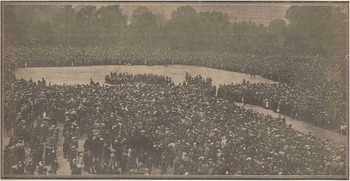
The Paris tour came after a similar visit to London by the Garde Républicaine in autumn 1916 when both armies were embroiled at the Somme and Verdun. Although not officially referred to as propaganda, the French press termed it a ‘manifestation francophile’, while the British described it as a ‘great national demonstration in favour of our French allies’.Footnote 89 In addition to performances at Windsor Castle and Royal Albert Hall, the band played for a massive crowd in the Horse Guards Parade. Although estimates of 100,000 spectators should be treated cautiously, photographs in the Daily Mirror show the expansive scale of the performance (Figure 1).
The Garde Républicaine performs for a massive crowd in the Horse Guards Parade while both the British and French armies are fighting at the Somme and Verdun respectively. ‘100,000 Londoners try to hear the Republican Guards’, Daily Mirror, 2 Oct. 1916, p. 7. Courtesy of the Mirror Historical Archive.

Assessing how audiences received this propaganda is difficult. Newspaper accounts, while detailed, tended to be excessively positive in their descriptions. Published criticism was limited to music. A letter writer to the Bystander who watched the concert at the Royal Albert Hall complained about the quality of the French musicians and thought that the British who accompanied them were ‘manifestly handicapped’ by not being allowed to perform music by ‘Beethoven, Mendelssohn, Schubert, Wagner, and the rest of the Huns’.Footnote 90 But this was the exception. Far more common were exaggerated statements like: ‘But there is a deeper symbolism in their visit, and we all know it…the hundreds of thousands who filled the streets on Saturday to salute the Band of the Garde Républicaine saluted in them all France.’Footnote 91
The timing of the tour to France was not coincidental. The Anglo-French Nivelle offensive, launched in the spring of 1917, was designed to render a quick end to the war. Its failure precipitated political instability in France and led to troop mutinies. In London, officials were concerned by the rise of anti-British sentiment in the French press, who blamed the prolongation of the war on British industry.Footnote 92 As high-quality entertainment, performances by military bands hoped to inspire patriotism and generate support amongst the masses for the Allied war effort at a time when, beneath flowery press coverage, serious discontent was brewing.
The Paris tour had an expansive reach. For the masses, its climax came with two public concerts over consecutive days at the Jardin des Tuileries. If we are to believe Mackenzie-Rogan, 200,000 people attended these events.Footnote 93 These were joined by other performances at theatres and opera houses. Proceeds from these concerts went to support displaced civilians in war-torn areas liberated by the British army. Celebrating British victories on French territory was a major theme of the propaganda campaign. Georges Drouilly in Le Gaulois commended ‘l’aristocratique élégance’ of these charitable deeds.Footnote 94 These appeals paid off. After attending the performance at the Palais Trocadero, Lloyd wrote in his diary: ‘The Concert was an enormous success, both from the point of view of money and enthusiasm. The place was absolutely full, there being between six and seven thousand people there.’Footnote 95
However, watching men parade in garish uniforms during a period when millions of their comrades were fighting in trenches was not always well received. Paris in the spring of 1917 was a turbulent place. On their first full day in the French capital, the British Guardsmen were supposed to parade down the Champs-Élysées, but the French interior minister feared that a ‘triumphal march by the troops of a Monarchy’ could risk hostile demonstrations.Footnote 96 The tour took place while Paris was gripped by waves of strikes, particularly by female workers in the garment industry. The British ambassador, Sir Francis Bertie, recalls this decision: ‘[The police] said that by the end of the march the gentlemen in scarlet and gold lace would not have a rag to their backs. The women of Paris would cut off everything as souvenirs even to their trouser buttons.’ He goes on to remark, wryly, that the French must have feared ‘a demonstration, I suppose, of a pro-British character’.Footnote 97
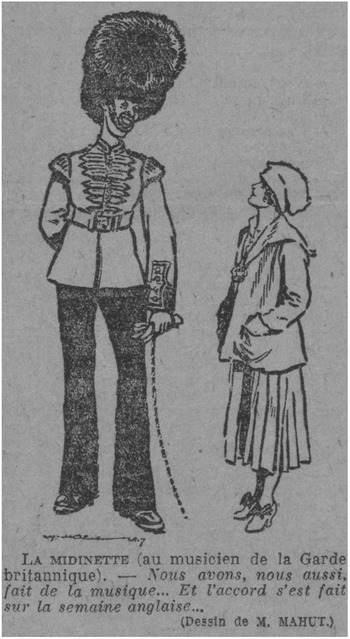
This supposed pro-British character of the strikes was taken up by some in the press on both sides of the Channel. As Roger Magraw has shown, by 1917 journalists celebrated the labour of Parisian women as the ‘imperatives of war production changed official priorities’.Footnote 98 Even Bertie viewed their strike as ‘in some respects justified’, as long as it did not lead to similar actions by men.Footnote 99 The pro-labour Manchester Guardian thought the demands for a Saturday ‘half holiday’ were inspired by la semaine anglaise enjoyed by their English counterparts: ‘This extension of the British working week to the most famous body of French work-women is a pleasant fruit of the Entente.’Footnote 100 The arrival of the Brigade of Guards fitted within this narrative. Proclaiming the success of the strikes, Le Journal published a cartoon of a midinette and a Guardsman with the caption: ‘Nous avons, nous aussi, fait de la musique. Et l’accord s’est fait sur la semaine anglaise’ (We too have made music. And the agreement was made on the English week) (Figure 2).Footnote 101 The symbolism was unmistakable. The image of a soldier wearing a scarlet coat and a bearskin cap was a recognizable emblem of the British army – perfect for propaganda consumption. When the bands returned to London, Lloyd was summoned to Buckingham Palace for an audience with King George. ‘His Majesty wanted to hear all about the Bands in Paris and what we had done’, wrote Lloyd in his diary. A couple of days later, Lloyd published the following order to the Brigade: ‘His Majesty hears with pleasure that the visit has been an unqualified success, and thinks that it will assist in no small way to cement the Entente Cordiale.’Footnote 102 The Paris visit proved to be a model for future tours as the value of propaganda increased in the final year of the war.
A Guardsman in a scarlet coat and a bearskin cap: an instantly recognizable image of the British army. Le Journal, 31 May 1917, p. 1. Courtesy of the newspaper archive at the Bibliothèque nationale de France.

Only seven months later, a similar request from the Italian government was received by the British ambassador in Rome, Sir Rennell Rodd. The Italian propaganda ministry, under the leadership of Romeo Gallenga Stuart, proposed that a British army band take part in an inter-Allied military music tour around the country alongside their counterparts from France, the US, and Italy.Footnote 103 Rodd was certainly warm to the idea, writing to the foreign secretary, Arthur Balfour: ‘in view of the good effect which I think such concerts are likely to produce I venture to hope that His Majesty’s Government will be able to give the assurance desired’.Footnote 104
For European governments, the Russian Revolution exposed the dangers of low morale and civilian discontent. The threat of communism was particularly strong in Italy which, like Russia, was suffering from poor military and economic performance. Despite this, there was little political will to address the root causes of this dissatisfaction. However, this changed after the Austro-Hungarian offensive at Caporetto in October 1917 resulted in a decisive defeat for the Italians. The fallout from this disastrous battle cannot be understated as it brought Italian society to the brink. In the wake of this nadir, the possibility of communist revolution was at its highest. Reckoning with their losses, the Italian government turned to propaganda to buttress public support. Alongside their own domestic campaigns, the Italians were the target of co-ordinated Allied propaganda.Footnote 105
On 19 February 1918, with approval granted, 250 musicians of the Brigade of Guards, joined by 80 of their counterparts in the Garde Républicaine, boarded an overnight train from Gare du Lyon bound for Italy. In the middle of the night, they were joined by more musicians from the 18th Regiment, American Expeditionary Force. Much like the visit to Paris, the tour featured both sit-down concerts and public performances geared for the masses. One of the challenges that the propagandists confronted was the high rate of illiteracy in the country. Therefore, entertainment was seen as much more effective than pamphlets. Evidence of this can be seen by the extraordinary number of performances for Italian soldiers. Between January and June 1918, nearly 16,000 concerts were held by the YMCA.Footnote 106 Furthermore, the programmes of the inter-Allied tour show that the musical selections were geared for popular consumption. The famous British troop song ‘Tipperary’ was frequently played, as well as the Italian patriotic ‘Garibaldi Hymn’ which Mackenzie-Rogan describes as ‘having won the hearts of the people’.Footnote 107
Ultimately, the tour was considered another success, both financially and from the perspective of propaganda.Footnote 108 For Rodd, the highlight was watching the British bands march through Rome. ‘The stately march, the perfect alignment and the fine physique of that splendid body of guardsmen seemed to the spectators typical of the discipline and stability of their new ally.’Footnote 109 For the inspiring effect he claimed it had on the Italian people, Rodd told Mackenzie-Rogan that he considered the inter-Allied band tour to be the most effective propaganda campaign undertaken in Italy throughout the war.
IV
John Mackenzie-Rogan’s career spanned fifty-three years (1867–1920) – much of the time covered by this article. When he joined as a band boy, concerts by British army musicians had only recently emerged as a popular form of public entertainment. This growth was a consequence of multiple cultural, military, and technological developments which allowed for greater reach. One of the most important factors was the rise of the exhibition. At these elaborate events, military music became popular and was accessible to audiences that were typically excluded from concert halls.
The reorientation of Britain’s foreign policy following the South African War saw the first examples of military bands being sent abroad for diplomatic purposes. The 1903 tour to Canada by the band of the Coldstream Guards invoked imperial kinship with the mother country following fears that the relationship had been strained. Patriotic music proved an especially effective way of demonstrating affection and loyalty to the empire.
All through the decade preceding the outbreak of war in 1914, the Foreign Office remained wary of turning the Anglo-French entente cordiale into a formal alliance. Efforts to turn the nascent colonial agreement into something more primarily came from below. Studying the organization of exchanges between the bands of the Coldstream Guards and Garde Républicaine reveals that the ‘entente musicale’ rested on a negotiation between enthusiasts, municipal officials, and the military. These activities, although steeped in political symbolism, were not the initiative of bureaucrats in Whitehall. However, the 1907 proposed visit to Mainz shows that Sir Edward Grey’s Foreign Office was very sensitive to the implications these types of cultural exchanges could have.
The Mainz controversy underpins another important element of military band tours: monarchical influence. As commander-in-chief of the Brigade of Guards, King Edward took a keen interest in military music tours. The escalation of tempers between the Foreign Office and the Palace shows that in the king’s view, it was his decision where his bands were sent. In this way, military bands acted as highly symbolic representatives of the crown abroad. This was a dimension which was consistently emphasized in the press when tours were reported on.
Music and politics combined officially in the ‘great musical propagandist journeys’ to Paris (1917) and Italy (1918). Conscious of a changing international context and dwindling morale, professional propagandists turned to the mass appeal of military music. While it is hard to assess how audiences received this propaganda, contemporary accounts suggest that these missions achieved their objective of presenting a unified Allied war effort.
The link between propaganda and military music did not end in 1918. Rather, these missions served as a model for future tours in the interwar period. The deployment of musicians in these years is the basis of David Hammond’s analysis. At a time when resources were stretched thin, imperial administrators continued to send British military bands to inspire imperial unity and project force overseas.Footnote 110
Researching the uses of military music from the second half of the nineteenth century to the end of the First World War forces us to reconsider the juxtaposition between the academic boundaries of military, political, and cultural history. As the largest employer of musicians in Britain, the military played a substantial role in shaping the musical culture.Footnote 111 Yet, as soldiers, their impact cannot be adequately compared to civilian orchestras. Performances by the Guards bands both domestically and abroad, with their scarlet tunics and bearskin caps, were highly visual displays of British state projection. Analysing their international tours before and during the First World War shows how military music reacted to and was informed by political calculations in a changing international arena.
Acknowledgements
I would like to thank Dr David Motadel at the London School of Economics for his mentorship and guidance throughout this project. I am also grateful to Dr Geoffrey Bird for encouraging me to believe that military music is indeed a subject worthy of serious academic attention. Lastly, I must acknowledge my parents who nurtured my interests in history and music from a very early age.

 Open access

