





There is currently, according to the World Food Programme, a global food crisis of unprecedented proportions, driven by a combination of conflict, economic shocks and climate extremes(1). Globally, 2·3 billion people are estimated to be food insecure – without physical, social and economic access to sufficient, safe and nutritious food that meets their dietary needs and food preferences for an active and healthy life. In the UK, an estimated 9·3 million adults (17·7 % households) reported experiencing food insecurity in early 2023(2), with recent large-scale disruptions such as Brexit, the coronavirus disease 2019 (COVID-19) pandemic and the war in Ukraine having driven record levels of food price inflation and disrupting ‘just in time’ food supply chains. This review focuses on a potential contributor to food security – urban agriculture. It will discuss the contribution of urban agriculture to food security and how this might be achieved by reviewing empirical evidence for urban agriculture’s impact on food security, presenting opportunities for future related research and identifying suggestions for policy implementation that would enhance urban agriculture’s contribution to food security.
Food security refers to ‘a situation that exists when all people, at all times, have physical, social, and economic access to sufficient, safe and nutritious food that meets their dietary needs and food preferences for an active and healthy life’(3). Conceptualisations of food security refer to this being underpinned by four ‘pillars’: the availability, accessibility, utilisation and stability of food(4,5) Achieving and maintaining food security for all people has been identified by the FAO of the United Nations as a global target to support population health(5). The negative impacts of food insecurity are well-documented; it is associated with poorer diet and physical ill health, such as diabetes, CVD and obesity(Reference Essien, Shahid and Berkowitz6–Reference Ranjit, Macias and Hoelscher9). There is also a robust relationship between food insecurity and mental ill health, with reports of associations between food insecurity and psychological distress(Reference Myers10), anxiety and depression(Reference Arenas, Thomas and Wang11). These exacerbate existing health inequalities and reduce quality of life, pressurising already stretched health and social care systems. Tackling food insecurity is therefore a key challenge for ensuring the health of the population as well as for planetary health by addressing the unsustainable environmental impact of food production(5).
Increasing consumption of fruit and vegetables is key to achieving planetary and human health, as outlined by the EAT-Lancet report(Reference Willett, Rockström and Loken12). However, this may not be achievable for those experiencing food insecurity: evidence suggests that households experiencing food insecurity are purchasing fewer fruit and vegetables and more processed foods during the UK’s cost of living crisis(13). Furthermore, healthier foods may be more expensive than some less healthy foods, and people’s access to healthy foods may be restricted due to living in ‘food deserts’ where the availability of fresh food is limited due to a lack of food stores or purchasing opportunities(Reference Corfe14). Demand for nutritious food in urban areas is growing, with estimates suggesting that 68 % of the global population will reside in urban areas by 2050(15). Urban agriculture, the production of fruit and vegetables in urban areas, may have benefits for diet quality, health and sustainability by increasing the availability of and accessibility to fresh produce in population centres(Reference Kourmpetli, Falagán and Hardman16,Reference Mead, Christiansen and Davies17) , ultimately benefitting food security. This might be through increasing the amount of food grown by individual households (availability) or increasing food grown at a community level that could then be distributed through sales, food pantries or food aid programmes (accessibility). Reducing reliance on imported fruit and vegetables through increasing domestic production could also protect against shortages during food system shocks (stability)(Reference Kourmpetli, Falagán and Hardman16). Therefore, efforts to increase fruit and vegetable production in towns and cities warrant further attention as a potential means of addressing this.
The idea of producing food in towns and cities to support food security is not new. Historically, urban agriculture has been relied upon to bolster food security during times of political crisis, as seen through the proliferation of Victory Gardens during the Second World War and the rise in urban farming in Cuba during the collapse of the Soviet Union(Reference Mok, Williamson and Grove18). Such forms of urban agriculture typically consisted of small-scale, soil-based farming. More recent estimates of the prevalence of urban agriculture suggest it is still practised by 25–30 % of urban-dwelling citizens(Reference Orsini, Kahane and Nono-Womdim19). Urban agriculture encompasses a variety of forms and scales, from small-scale and/or soil-based food production in private gardens, allotments and community gardens to technology-driven farming, such as vertical farming, hydroponics, aquaponics and aeroponics production systems in ground or roof-based facilities(Reference Mok, Williamson and Grove18). For the purposes of this review, all aforementioned forms of food production are included in the definition of urban agriculture. The productive potential of such types of urban agriculture in the UK will now be discussed; before empirical evidence on the contributions urban agriculture could make to food security, some opportunities for research in this field and avenues for related policy implementation to capitalise on the benefits of urban agriculture for food security in the UK are reviewed.
The productive potential of urban agriculture
The productive potential of urban agriculture is often cited as evidence for its potential to contribute to the ‘availability’ pillar of food security by increasing the availability of fresh produce in urban areas. For example, a number of studies have sought to demonstrate the potential yield capacities of types of urban agriculture. In a study of small-scale urban food growing in the Brighton and Hove area of the UK, Nichols and colleagues reported that such spaces could produce annual harvests that equated to a monetary saving of £550 a year for fruit and vegetables for growers(Reference Nicholls, Ely and Birkin20). Complementary findings have been reported by a study of UK home and allotment growers, which indicated that such activities supply half of household fruit and vegetable supplies and 20 % of potato supplies annually(Reference Gulyas and Edmondson21). Others have studied the productive potential of types of urban agriculture for specific UK cities. In their estimation of the productive potential of allotments in the UK city of Leicester, Edmondson and colleagues(Reference Edmondson, Childs and Dobson22) highlighted that small-scale growers could achieve fruit and vegetable yields comparable to commercial horticultural growers. They also reported that the city’s current allotments could feed up to 8500 people (2·6 % of the local population), highlighting the contribution that urban food growing could make to the diets of the urban population(Reference Edmondson, Childs and Dobson22).
Broader-scale analyses of the productive potential of urban agriculture provide complementary evidence. A recent global meta-analysis by Payen and colleagues(Reference Payen, Evans and Falagán23) compared yields of fruit and vegetables from urban agricultural production methods to those of conventional agriculture. This showed that, for some foods (e.g. tomatoes, cucumbers and gherkins), urban agriculture production methods produced greater yields than conventional farming methods. The authors also concluded that urban spaces had high suitability for crop production. This assertion is supported by Walsh et al. (Reference Walsh, Mead and Hardman24), who analysed the productive potential of urban spaces in the UK. Results showed that, at their upper limit, the UK’s urban spaces could produce up to eight times the amount of fruit and vegetables currently produced domestically, providing all five of the recommended daily portions of fruit and vegetable intake in some areas(Reference Walsh, Mead and Hardman24). Taken together, evidence for the productive potential of urban agriculture demonstrates that it could provide significant amounts of fruit and vegetables for urban populations. Considering that the UK imports nearly 50 % of its produce and is therefore vulnerable to supply disruptions(25), increasing domestic production in this way could support the ‘stability’ pillar of food security by bolstering domestic supplies of fruit and vegetables. However, it is important to acknowledge that this would be dependent on suitable growing conditions and appropriate weather in the UK, so some reliance on imports would likely be needed. Furthermore, an additional understanding of how the productive potential of urban agriculture translates to effects on established indicators of food security (e.g. food security questionnaires) is still needed. The following section summarises findings from a number of reviews and empirical studies that provide this.
Urban agriculture and food security
The rationale behind urban agriculture’s contributions to food security can be understood through the proposition that, for practitioners (those engaged in urban agriculture via some form of food growing), urban agriculture could provide food, produce income through the sale of produce, or release household funds spent on fresh produce. For non-practitioners (those not engaged in any form of urban agriculture or food growing), it would enable greater availability of fresh food, which may be more accessible to urban populations. Evidence suggests that self-growing fruit and vegetables can directly improve household food security by providing households with fresh produce and reducing household expenditure on such foods(Reference Algert, Diekmann and Renvall26–Reference Corrigan28). Community-based initiatives and small enterprises can increase the availability and access to fresh produce for practitioners and non-practitioners(Reference Alaimo, Packnett and Miles29–Reference Schoen, Blythe and Caputo31). This may be of particular significance in areas termed as ‘food deserts’, where fresh produce is hard to access(Reference Corfe14). Additionally, urban agriculture may contribute to food security, and overall dietary quality, via a more indirect route. It has been suggested that people experiencing food insecurity make fewer food shopping trips and purchase fewer fresh fruits and vegetables due to their shorter shelf life and greater opportunity for spoilage. However, producing fruit and vegetables closer to population centres reduces the time between harvesting and consumption, which reduces the opportunity for quality loss seen as food travels through long, often costly, supply chains(Reference Coelho, Coelho and Egerer32). Increasing the availability of fresh fruit and vegetables by producing them in urban areas may therefore make them more accessible to food insecure urban households because individuals may be less concerned about the risk of spoilage and resulting loss of money if the fruit and vegetables available are likely to stay fresher and usable for longer. Evidence of this can be seen in work that has reviewed urban agriculture’s association with or contributions to food security in reviews of the literature, which are considered here.
Evidence reviews assessing the impact of urban agriculture on food security at a national level have yielded mixed results, particularly those focused on low- and middle-income countries. Poulsen et al. (Reference Poulsen, McNab and Clayton33) found that the contribution urban food growing makes to food security in low- and middle-income countries is low and concluded that whilst there is potential for urban agriculture to contribute to food security, this is hampered by limitations to implementation at the policy level, for example, limits in access to urban agricultural land and the cost of resources needed for food production. Similarly, in their critical review of the impact of urban agriculture on food security, Badami and Ramankutty(Reference Badami and Ramankutty34) distinguished between low- and high-income countries and found that whilst the potential contribution of urban agriculture to food security is feasible in high-income countries, this is not the case for low-income countries, especially for those who may have the greatest need for such interventions, and this may be due to a lack of land access for food production.
Inconclusive results were reported by Korth and colleagues(Reference Korth, Stewart and Langer35), who attempted to assess the direct impacts of engaging in urban agriculture (compared with not engaging) on food security in low- and middle-income countries and found a lack of studies that detailed clear impact evaluations. Instead, they found an abundance of cross-sectional, associative studies that did not meet their review criteria, leading them to inconclusive findings. Likewise, a lack of focus on the direct impacts of urban agriculture on food security was highlighted by Siegner et al. (Reference Siegner, Sowerwine and Acey36) They found that much of the literature was theoretical and focused on the productive potential of urban agriculture, rather than direct assessments of its impact on food security. However, like Poulsen and colleagues(Reference Poulsen, McNab and Clayton33), they also noted that policy implementation to support urban agriculture is needed to maximise its benefits, particularly for social cohesion, education and economic opportunities.
In contrast, some reviews report modest positive impacts of urban agriculture on food security at the household level. In a literature review of the impact of home gardening on food security, Galhena et al. (Reference Galhena, Freed and Maredia37) found that home food gardening (both rural and urban) can contribute to food security through the addition of fruit and vegetables to household food supplies. The authors interpret this as evidence that home food gardening directly supports food security by enabling the availability, accessibility and utilisation of food, therefore supporting the corresponding pillars of food security. They also recommend that resources for adopting home food growing need to be more widely promoted in order to achieve maximal impact. Similar, positive (although modest) results come from a systematic review of the impact of urban agriculture on food security in developing and transitional economies by Warren et al. (Reference Warren, Hawkesworth and Knai38) They identified mostly positive evidence for an impact of urban agriculture on food security, although the authors note that their review included a number of studies reporting mixed or negative associations and the quality of studies included in their evidence was often low. A positive impact of urban agriculture on food security was also identified in 75 % of studies in a large-scale review of over 100 studies by Audate and colleagues(Reference Audate, Fernandez and Cloutier39); however, they note that such findings should be interpreted with caution due to an over-abundance of cross-sectional, associative studies reviewed.
Although findings are mixed, the literature reviewed above indicates the need for more rigorous, broad-scale assessments of the impact of urban agriculture on food security. Most of the reviews above noted weaknesses in the quality of evidence studied, from overreliance on theoretical (as opposed to empirical) assertions(Reference Siegner, Sowerwine and Acey36) to poor quality study designs, such as lack of clarity on methods, analyses or rationale for designs used, limiting evidence quality(Reference Warren, Hawkesworth and Knai38,Reference Audate, Fernandez and Cloutier39) , or lack of rigorous, direct assessment of the impact of urban agriculture on food security(Reference Korth, Stewart and Langer35). The reviews themselves may also be limited by their lack of global focus or rigorous, systematic search and assessment strategies. Several of the reviews discussed do not employ systematic searches of the literature. Further, the distinction noted by Badami and Ramankutty(Reference Badami and Ramankutty34) between high- and low-income countries in the impact of urban agriculture on food security suggests that reviews attempting to synthesise such data that focus on only high- or low-income settings or do not adopt broad location criteria in their literature searches may be skewing the overall assessment of how urban agriculture impacts food security. Although it should be noted that county-specific research is valuable for successful policy development, forming an evidence base that includes both high- and low-income settings is needed for a complete picture of the impact of urban agriculture on food security.
In an effort to address shortcomings identified by previous reviews around a lack of global focus, non-systematic search strategies or overreliance on theoretical literature, Mead(Reference Mead40) reviewed empirical studies that directly assessed associations or impacts of urban agriculture and food security in a rapid evidence review with the aim of establishing whether a link exists between urban agriculture and food security and to determine if urban agriculture could have potential benefits for UK food security. Inclusion criteria for this review included a clear, operationally defined assessment of urban agriculture and food security, with a focus on findings that directly assessed the relationship (impact or association) between the two. Theoretical literature, studies with unclear definitions of urban agriculture or food security or studies employing indirect or interpretive measures of food security were excluded(Reference Mead40). Results from the systematic literature search yielded 28 included studies dated 2000–2020 and indicated that most studies (17/28) reported positive associations between urban agriculture and food security, with the majority of these focusing on the impacts on food security at the community and household level. The results suggested that urban agriculture contributed to both empirical measures of food security (e.g. such as questionnaire measures of household food security status) and individuals perceived own food security (e.g. responses to questions asking about concern over own access to food) by improving the availability and accessibility of fresh fruit and vegetables. Although this work was only a rapid evidence review, and therefore did not include as thorough a quality assessment of the evidence as a systematic review would, the findings cover studies that examined both associations between, and direct impacts of urban agriculture on food security. Therefore, this suggests a potential positive contribution of urban agriculture to food security, particularly at the household or community level.
Considered together, the reviews above paint a rather mixed picture of the impact of urban agriculture on food security. However, much of the literature on urban agriculture posits that urban growing may be of particular benefit to food security during times of food system shocks. Whilst evidence suggests that such shocks (such as the COVID-19 pandemic) exacerbate food insecurity(Reference Loopstra41), the benefit of urban-grown food in these contexts was typically not assessed in the studies reviewed(Reference Galhena, Freed and Maredia37). However, the limited research that has explored this paints a more positive picture. Lal(Reference Lal42) theorised that urban agriculture could support food security (and benefit ecosystem services, environmental quality and provide economic benefits) during the pandemic by providing healthy, nutritious food to growing urban populations. This is supported by findings of a review by Khan and colleagues(Reference Khan, Akram and Janke43), who considered the role of urban agriculture in supporting food security during and beyond the pandemic. They concluded that it can improve food security by providing food to local populations and mitigating the impact of disruptions to mass market food supplies(Reference Khan, Akram and Janke43). Similar conclusions were drawn by Murdad and colleagues in their review of urban farming’s role in food security in Malaysia during the pandemic(Reference Murdad, Muhiddin and Osman44). Individual studies focusing on UK and US populations further support these conclusions. Community and allotment gardens were found to have supported food security during the pandemic through the provision and distribution of food to those in need(Reference Schanbacher and Cavendish30,Reference Schoen, Blythe and Caputo31) . A sense of reassurance and security around the availability of food (at a time when supermarket food supplies were disrupted) has also been proposed amongst home growers(Reference Mead, Davies and Falagán45). Therefore, it appears that urban agriculture’s contributions to food security may be most evident when assessed in the face of food system shocks and that food produced by urban agriculture may help to mitigate supply disruptions by supporting the availability of and access to fresh fruit and vegetables. This is particularly relevant in the face of predicted food system challenges relating to political and climate uncertainty that are likely to impact food supplies and food security, which will require innovations in food production and distribution strategies to mitigate their effect on household food supplies(46).
Ongoing relevant research
As described previously, much of the literature on urban agriculture and food security may be limited by poor evidence quality(Reference Warren, Hawkesworth and Knai38). This is often due to inconsistent definitions and measurements of ‘urban agriculture’ and ‘food security’ or an overreliance on small-scale, low-technology food growing activities in the supporting literature(Reference Mead40). For the purposes of this review, a broad definition of ‘urban agriculture’ and a widely used FAO definition of food security have been used. Here, some ongoing relevant research that may address these issues through an examination of technologically driven food production and the lived experiences of food security/insecurity is described.
The Transforming UK Food Systems for Healthy People and a Healthy Environment Strategic Priorities Fund (TUKFS-SPF) is supported by UK Research and Innovation’s (UKRI) strategic priorities fund (2020–2026), in partnership with the Global Food Security Programme, Biotechnology and Biological Sciences Research Council (BBSRC), Economic and Social Research Council (ESRC), Medical Research Council (MRC), Natural Environment Research Council (NERC), Defra, Department of Health and Social Care (DHSC), Office for Health Improvement and Disparities (OHID), Innovate UK and Food Standards Agency (FSA). The programme seeks to explore opportunities for food system transformation with people and planet at their heart(47). Through a series of large-scale research consortia and smaller research projects, the programme is developing innovative food systems solutions to tackle food system challenges, including food security. This includes the study of technologically driven food production methods, which may have benefits for maintaining food supply in the face of challenges such as post-Brexit labour shortages in the horticulture industry(46). In particular, the use of technology-driven hydroponic urban farming techniques for increasing year-round food provision and the development of hybrid farming business models are being explored by the Healthy Soil, Healthy Food, Healthy People (H3) project(Reference Jackson, Cameron and Rolfe48). Likewise, the FixOurFood project(49) is exploring how urban vertical farming can aid food system transformation to create regenerative, sustainable food systems in Yorkshire. Through a vertical farm in a community space in York, UK, this work aims to understand how urban vertical farming hybrid business models that prioritise social and environmental outcomes and provide hyperlocal food to businesses can contribute to food system change(49). Furthermore, work being conducted by TUKFS-SPF and the FSA is exploring consumer and stakeholder perceptions of urban food production(Reference Mead50). This work has identified that stakeholders require reassurance about the business potential, supply capacities, safety and quality of produce from urban agriculture, all of which could be addressed through improved dialogues between food system actors(Reference Mead and Gillespie51). Taken together, the outcomes of these research projects could guide the effective implementation of urban agriculture projects or business opportunities that may be effective in addressing food security.
Other projects within the TUKFS-SPF network are exploring the experience of food insecurity and co-developing interventions for addressing this with citizens within the current food system. The Food Systems Equality Project (FoodSEqual) is working with disadvantaged communities to understand their experiences of the food system and co-develop novel foods and supply chains that address local food system priorities(52). Similarly, the Food Insecurity in People Living with Obesity (FIO-Food) project is exploring the lived experiences of people living with obesity and food insecurity to co-develop retail interventions to promote healthier, more sustainable food choices(Reference Lonnie, Hunter and Stone53). This work is relevant in the current context because it aims to deepen our understanding of the lived experience of food insecurity and involve those with relevant experiences in the co-design of interventions, which is key for ensuring effectiveness and acceptability to those receiving them. For urban agriculture, increasing understanding about the experiences of food insecurity could guide the design of urban agricultural interventions that are targeted for particular communities or are effective in tackling key elements of the experience of food insecurity.
Recommendations for research in this field
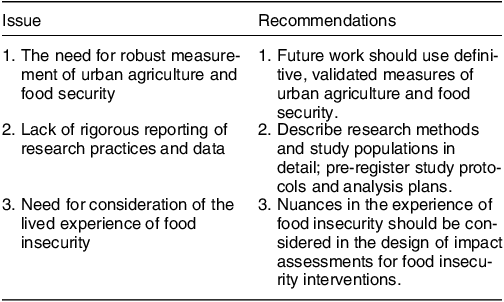
Having reviewed existing evidence on the impact of urban agriculture on food security and relevant ongoing research in this field, a set of recommendations to inform future research direction has been identified. These are described in detail below and presented in brief in Table 1.
-
1. The need for robust measurement of urban agriculture and food security – A common criticism of some of the work reviewed previously was a lack of robust measurement of urban agriculture and food security, with an overreliance on theoretical assertions and indirect and interpretive measures. This lack of clarity and consistency may be contributing to the mixed findings in research in this area. When evidence is reviewed using stringent assessment criteria for the measurement of these factors, the findings indicate a more positive impact(Reference Mead40). Therefore, it is recommended that future research examining the contribution of urban agriculture to food security considers employing definitive, validated measures of such constructs. This may be through a clear, detailed description of what is being interpreted as urban agriculture and the use of clear or validated measures of food security, such as questionnaires.
-
2. Rigorous reporting of research practices and data – Warren and colleagues(Reference Warren, Hawkesworth and Knai38) noted a lack of detailed description of research practices and reporting in the data they reviewed. This was also noted as hampering their ability to assess the quality of available evidence by Mead(Reference Mead40) in their assessment of urban agriculture’s contribution to food security. It is therefore recommended that investigations of urban agriculture and food security are reported in detail with a thorough description of research methods and study populations, to increase confidence in this evidence. Transparent, accessible research practices, such as pre-registration of study protocols and data analysis plans on open science repositories such as the Open Science Framework(54), will benefit this.
-
3. Consideration of the lived experience of food insecurity – Research has shown that urban agriculture may impact both objective measures and people’s own feelings of food security(Reference Mead40,Reference Mead, Davies and Falagán45) . This suggests there may be nuances in the way urban citizens experience food security that previous research has not addressed. Ongoing work detailed previously is exploring this and may have implications for this field. There may be cultural and socioeconomic differences in the way people experience food security, which future research may need to be mindful of when designing their assessment of the impact of interventions on this.
Recommendations for research in this field

Opportunities for policy implementation
The application of urban agriculture for food system transformation has been identified in policy briefs that address food system challenges and opportunities and a recent parliamentary evidence submission by the TUKFS-SPF programme(55). For example, procurement from urban and peri-urban food producers to shorten food supply chains could provide fresh, nutritious fruit and vegetables to populations(Reference Caleffi, Hawkes and Walton56). Community food growing has also been suggested as a strategy to reduce food insecurity and increase access to fresh fruit and vegetables(55). Others have identified the development of urban agriculture as a means to provide training and nutrition to communities, increasing healthy food intake amongst community members and providing them with skills to produce their own food(Reference Hawkes, Walton and Haddad57). Considering that the provision of fresh fruit and vegetables to urban populations is a mechanism through which urban agriculture could benefit food security, the adoption of such recommendations in food system transformation efforts may have multifaceted benefits for supply chains, nutrition and food security.
There is modest, yet positive, evidence that engaging in urban agriculture has benefits for health, well-being and food security(Reference Mead, Davies and Falagán45,Reference Howarth, Brettle and Hardman58,Reference Egerer, Lin and Kingsley59) . Policy development that supports interested citizens to grow their own fruit and vegetables will likely capitalise on such benefits. A key barrier to doing so, however, is access to land on which to grow crops(Reference Poulsen, McNab and Clayton33). Vacant land in urban areas may often be hard to access or used for commercial or residential purposes. In the UK, a community-based food growing organisation called ‘Incredible Edible’(60) is campaigning for citizens to have access to this land for food growing. The ‘Right to Grow’ campaign would require councils to publish inventories of vacant land suitable for food growing and allow community groups access to lawfully produce food in such areas(60). If passed into law, campaigns such as this would address the often-cited barrier to urban agriculture that relates to access to growing spaces for the cultivation of food(Reference Poulsen, McNab and Clayton33).
The cost of resources required to support urban agriculture has also been cited as a barrier to its potential impact on food security(Reference Poulsen, McNab and Clayton33,Reference Galhena, Freed and Maredia37) . This may be the financial cost of equipment, seeds, water access or fertilisers, the financial cost of upscaling food production operations or also the cost of time needed to develop growing skills and suitable growing spaces. Many urban agricultural associations rely on funding from charities or grants to support their work(Reference Hardman, Clark and Sherriff61). Subsidising equipment costs and promoting seed sharing in collaboration with existing urban growing organisations may be an avenue for reducing this barrier and enabling more communities to engage in urban food growing for food security. Likewise, the skills needed for food growing and the running of urban food growing spaces are typically lacking in many urban residents(Reference Lovell62). Development of skill-sharing or education opportunities in collaboration with existing food growing groups may be an opportunity to address this, although it should be noted that such groups and initiatives are often restricted by funding constraints, so this would require outside investment to support such development(55). Local policymakers may wish to work with existing community organisations to provide these at local levels. There may already be existing networks of food growing spaces in urban areas that could facilitate this. For example, in the UK, the Liverpool Food Growers Network seeks to amplify the voices of food growers and increase the amount of fruit and vegetables grown in the region to promote sustainability and tackle food insecurity(63). Local policymakers have opportunities to work with community organisations such as this to deliver training and skill-sharing opportunities to urban residents interested in urban agriculture.
Conclusion
Through consideration of the productive potential of urban agriculture and previous findings from international research relating to urban agriculture and its impact on food security, it can be concluded that urban agriculture likely does make a modest, yet positive, contribution to food security. This is evident through urban agriculture’s contributions to the ‘availability’, ‘accessibility’ and ‘stability’ pillars of food security. Although mixed, the evidence suggests that there may be a positive association between urban agriculture and food security, such that the potentially substantial amounts of food that can be produced in urban areas can benefit food security by increasing the availability of and access to fruit and vegetables in such settings. However, limited evidence quality and an overreliance on theoretical literature or interpretive measures of food security hamper the strength of the conclusions that can be made. Future research should address these methodological challenges and consider the lived experience of food security/food insecurity to ensure urban agricultural interventions are effective and acceptable to their recipients. Finally, opportunities for policy interventions to increase the positive impact of urban agriculture’s contribution to food security are identified, namely, by increasing access to land for food growing, reducing resource costs and working in collaboration with existing community groups to share skills and expertise. Tackling these issues may amplify the positive impact urban agriculture could have on food security, providing fresh fruit and vegetables to food insecure communities.
Acknowledgements
No Acknowledgements to make.
Financial support
BRM is funded by the FSA-UKRI TUKFS-SPF (grant ref: FS900096).
Author contributions
All authors contributed to the scope of this review. B.R.M. wrote the manuscript with input from all authors. All authors reviewed the manuscript and approved the final version submitted for publication.
Competing interests
Bethan R. Mead has received funding and hospitality to their institution from WW (formerly Weight Watchers International) for their PhD studentship outside of the submitted manuscript. Charlotte A. Hardman has received research funding to their institution from the American Beverage Association and honoraria from the International Sweeteners Association and International Food Information Council for work outside of the submitted manuscript. Views expressed in this paper are the authors’ own and do not represent the views of their organisation.
Data availability statement
No data were collected to produce this review.

 Open access

