




Introduction
There has been a growing interest in examining the effect of study abroad on second language acquisition (Kinginger, Reference Kinginger2009; Pérez-Vidal, Reference Pérez-Vidal2014; Regan et al., Reference Regan, Howard and Lemée2009; Sanz & Morales-Front, Reference Sanz and Morales-Front2018). The fundamental question underlying this research is if the study abroad (henceforth SA) immersion context provides greater benefits to acquiring a second language than traditional classroom learning at home (henceforth AH) (Díaz-Campos, Reference Díaz-Campos2004; Lafford & Collentine, Reference Lafford, Collentine, Salaberry and Lafford2006; Segalowitz & Freed, Reference Segalowitz and Freed2004). While studies have investigated the acquisition of morphology, syntax, lexicon, pragmatics, and fluency, there is a relative paucity of studies analyzing phonetic and phonological acquisition in the SA context (Bongiovanni et al., Reference Bongiovanni, Long, Megan and Willis2015, p. 244; Solon & Long, Reference Solon, Long, Sanz and Morales-Front2018, p. 71). Recently there has been an increase in studies of phonetic acquisition during SA, but the role of linguistic proficiency remains understudied (Solon & Long, Reference Solon, Long, Sanz and Morales-Front2018, p. 75). Furthermore, there lack studies that include heritage speakers in the SA context (Pozzi et al., Reference Pozzi, Quan and Escalante2021).
Building on previous studies, this study addresses these gaps utilizing the experimental methods of laboratory phonology and the statistical practices of variationist sociolinguistics. The aims were twofold: (1) to examine the effect of a short-term SA in Sevilla, Spain by L2 and heritage Spanish speakers on acquiring language-specific [ð] and/or dialect-specific [∅] for intervocalic /d/; and, (2) to analyze how this varies by proficiency level and other individual factors.
Background
Acquisition of language-specific phonemes/allophones during SA
Overall studies have shown benefits for L2 speakers’ production of language-specific phones in the SA context. For example, several studies have demonstrated more targetlike production of vowels during SA by L2 German (L1 English) speakers (O’Brien, Reference O’Brien2003) and L2 Spanish (L1 English) speakers (Stevens, Reference Stevens2011), although Avello and Lara (Reference Avello, Lara and Pérez-Vidal2014) found no gains among L2 English (L1 Spanish-Catalan) speakers. Studies on rhotics among L2 Spanish (L1 English) speakers reported more gains for SA than AH students in the production of /r/ (Detrixhe, Reference Detrixhe2015) and /ɾ/ (Bongiovanni et al., Reference Bongiovanni, Long, Megan and Willis2015).
Several studies, however, have demonstrated contrasting findings, such as in the production of intervocalic /b, d, g/, realized as stop [b, d, g] in English and approximant [β, ð, ɣ] in Spanish, by L2 Spanish (L1 English) speakers. Specifically, Lord (Reference Lord2010) found more approximant realizations for /b, d, g/, Bongiovanni et al. (Reference Bongiovanni, Long, Megan and Willis2015) only found gains for /d/, and Díaz-Campos (Reference Díaz-Campos2004) found no gains over time for any segment. For word-initial /p, t, k/, realized as [p, t, k] in Spanish and [ph, th, kh] in English, among L2 Spanish (L1 English) speakers, Díaz-Campos (Reference Díaz-Campos2004) found that speakers reduced their voice onset time (VOT)Footnote 1, while Bongiovanni et al. (Reference Bongiovanni, Long, Megan and Willis2015) only found gains for /p/ and /k/. Neither study found significant differences between the SA and AH groups. However, Llanes et al. (Reference Llanes, Mora and Serrano2017) found that L2 English (L1 Spanish-Catalan) speakers in the SA context increased their VOT (more English-like [ph, th, kh]) than AH speakers. Contrasting findings may be due to methodological differences between studies (i.e., number of participants, tasks, number of tokens, acoustic vs. auditory analysis). These differences notwithstanding, studies generally show more benefits of learning an L2 phone in SA than AH contexts or overall benefits of learning an L2 phone in SA contexts (without AH comparisons).
Acquisition of dialect-specific phonemes/allophones during SA
There has been an emergent body of literature interested in the acquisition of dialect-specific phonesFootnote 2 during SA. Although it depends on a variety of individual factors, in general studies have found that some dialect features are more acquired than others. For example, studies have shown low production of the Castilian Spanish voiceless interdental fricative /θ/ (George, Reference George2014; Knouse, Reference Knouse2012; Ringer-Hilfinger, Reference Ringer-Hilfinger2012) and the Castilian Spanish voiceless uvular fricative [χ] (George, Reference George2014) by L2 Spanish (L1 English) speakers in central Spain. Another variable that demonstrates relatively low rates of acquisition is French /l/ deletion in third-person subject clitic pronouns, specifically “il” (i.e., il fait beau ‘it’s beautiful outside’ [il.fɛ.bo] vs. [i.fɛ.bo]), produced by L2 French (L1 English) speakers in France (Howard et al., Reference Howard, Lemée and Regan2006; Kennedy Terry, Reference Kennedy Terry2017). However, studies reveal high production of the Argentine Spanish voiced and voiceless palatal fricatives [ʒ]/[ʃ] by L2 Spanish (L1 English) speakers in Buenos Aires (Hoffman-González, Reference Hoffman-González2015; Pozzi & Bayley, Reference Pozzi and Bayley2020; Schmidt, Reference Schmidt2020). Similarly, L2 Arabic (L1 English) speakers in Cairo produced high rates of the Cairene/Egyptian Arabic variant [g] for /j/, which is realized as [ʒ], [d͡ʒ], or [j] in Modern Standard Arabic (MSA) (Raish, Reference Raish2015). Regarding individual differences, studies have found that L2 speakers of higher proficiencyFootnote 3 (Geeslin & Gudmestad, Reference Geeslin and Gudmestad2011; George, Reference George2014), those with positive attitudes toward the local dialect (George, Reference George2014; Schmidt, Reference Schmidt2020), and those with stronger social networks with locals (Kennedy Terry, Reference Kennedy Terry2017) were more likely to acquire dialect-specific phones.
The differences in acquisition rate between variables is noteworthy. Pozzi and Bayley (Reference Pozzi and Bayley2020, p. 18) attribute the high acquisition of L2 Spanish [ʒ]/[ʃ] to the salience of the variants. Given its salience, proficiency and social network were not significant in their study. Whereas French /l/ elision, a less salient feature, demonstrated a significant effect of social network (Kennedy Terry, Reference Kennedy Terry2017, p. 566). In addition to salience, it is important to note grapheme-to-phone correlations, in which a one-to-one correspondence results in increased acquisition. For example, L2 Spanish speakers in Buenos Aires have a one-to-one substitution of [ʒ]/[ʃ] for [ʝ] for <y> and <ll> (Pozzi & Bayley, Reference Pozzi and Bayley2020, p. 16) and L2 Arabic speakers in Cairo have a one-to-one substitution of [g] for [ʒ]/[d͡ʒ]/[j] for the Arabic character <ج>. However, acquiring Castilian Spanish /θ/ requires that L2 speakers, who generally produce /s/ for <s, z, ci, ce>, learn a phonemic split to acquire the distinction between /s/ for <s> and /θ/ for <z, ci, ce> (Knouse, Reference Knouse2012, p. 531). French /l/ elision (Kennedy Terry, Reference Kennedy Terry2017) and Spanish coda /s/ elision/aspiration (Geeslin & Gudmestad, Reference Geeslin and Gudmestad2011; Linford et al., Reference Linford, Harley and Brown2021; Schmidt, Reference Schmidt2020) also provide challenges for L2 speakers as these allophonic realizations present a grapheme-to-phone mismatch and subsequently are only favored by those with more dense and multiplex social networks with locals (Kennedy Terry, Reference Kennedy Terry2017) or with higher proficiency (Geeslin & Gudmestad, Reference Geeslin and Gudmestad2011).
Acquisition of heritage language phonemes/allophones in SA settings
A heritage Spanish speaker in the United States is an individual who grew up speaking or hearing Spanish at home and received their schooling in English (Valdés, Reference Valdés2000). Until recently there has lacked studies examining the sound system of heritage speakers (Rao & Amengual, Reference Rao, Amengual, Pascual y Cabo and Torres2021), and even fewer in the SA context. In general, studies have found that heritage speakers maintain phonological contrasts in their two languages in which they produce sounds closer to monolingual speaker norms than L2 speakers (Amengual, Reference Amengual2018, Reference Amengual2019; Chang et al., Reference Chang, Yao, Haynes and Rhodes2011), but also exhibit phonological transfer from the community language (Ronquest, Reference Ronquest2012; Shea, Reference Shea2019). However, due to heterogenous experiences with the heritage language, there exists intragroup variation among heritage speakers.
The few previous studies of heritage speakers in the SA context indicate that one’s heritage language variety may play a significant role in the acquisition of dialect-specific phones. For example, Raish (Reference Raish2015) found that two Egyptian–Arabic heritage speakers favored the local Cairene allophone more than one Levantine and one Palestinian heritage speaker who favored supralocal MSA allophones. Similarly, Escalante (Reference Escalante2018), examining the acquisition of coda /s/ aspiration in coastal Ecuador (where coda /s/ aspiration is the norm) found that one Ecuadorian Spanish heritage speaker acquired the aspirated variant while one Colombian Spanish heritage speaker and one Mexican Spanish heritage speaker did not. However, George and Hoffman-González (Reference George and Hoffman-González2019) indicate that heritage speakers may adopt features from outside of their heritage variety. Specifically, they found that two Mexican Spanish heritage speakers in Argentina frequently produced [ʒ] and/or [ʃ] and one of two Mexican Spanish heritage speakers in Spain frequently produced [θ]. Thus, to better understand the effect of one’s heritage language variety on the production of dialect-specific phones, it is essential to include heritage speakers in the SA context.
The phonetic variable: Intervocalic /d/
The target feature of the present study is Spanish intervocalic /d/, which provides difficulties to L2 Spanish (L1 English) speakers as it presents an allophone that is not associated with this phoneme in their L1. In monolingual Spanish, the phonemes /b, d, g/ in syllable-initial position varyFootnote 4 between voiced stops [b, d, g] and voiced approximants [β, ð, ɣ] depending upon the phonetic context. Specifically, for /d/, voiced dental stop [d] tends to be realized after a pause (#día ‘day’ [ˈdi.a]), a nasal consonant (Andalucía [an̪.da.lu.ˈs̪i.a]/[an̪.da.lu.ˈθi.a]), or a lateral (aldea ‘small village’ [al̪.ˈde.a]) (Hualde, Reference Hualde2005, p. 139). In all other positions, /d/ undergoes spirantization and tends to be realized as approximant [ð] such as in intervocalic position (Granada [ɡɾa.ˈna.ða]) or after nonnasal and nonlateral consonants (Córdoba [ˈkoɾ.ðo.βa]) (Hualde, Reference Hualde2005, p. 139). Several varieties also present an elided allophone [∅] in intervocalic position (Hualde, Reference Hualde2005, pp. 21–29).
In monolingual English, syllable-initial /d/ in word-initial position is realized as either voiced [d] or devoiced [d̥] alveolar stop (Hualde, Reference Hualde2005, p. 149). However, in American English, /d/ (and /t/) in syllable-initial intervocalic position may also be realized as a flap, similar to Spanish [ɾ] (Hualde, Reference Hualde2005, p. 150; Ladefoged & Johnson, Reference Ladefoged and Johnson2014, p. 68). Different from Spanish, in English /ð/ exists as a phoneme associated with <th> so that /d/ and /ð/ form minimal pairs (i.e., dough-though) (Ladefoged & Johnson, Reference Ladefoged and Johnson2014, p. 70). In addition, [ð] is an approximant in Spanish, whereas it is a fricative in English (Hualde, Reference Hualde2005; Martínez Celdrán, Reference Martínez-Celdrán1991). Thus, although English speakers have [ð] in their phonological inventory, it is not associated with intervocalic /d/ in their L1. Consequently, L2 Spanish speakers must learn to acquire the context-specific variable realizations of [d] and [ð] for /d/.
Intervocalic /d/ among L2 and heritage Spanish speakers
Overall, studies examining L2 Spanish (L1 English) speakers’ acquisition of intervocalic /d/ have found that speakers with higher L2 proficiency produce more [ð] than those with lower proficiency who produce more [d] (Alvord & Christiansen, Reference Alvord and Christiansen2012; Face & Menke, Reference Face, Menke, Collentine, García, Lafford and Marcos Marín2009; González-Bueno, Reference González-Bueno1995; Rogers & Alvord, Reference Rogers and Alvord2014; Zampini Reference Zampini1994), particularly highly proficient speakers who have lived abroad for extended stays (Alvord & Christiansen, Reference Alvord and Christiansen2012; Rogers & Alvord, Reference Rogers and Alvord2014). In comparing advanced L2 Spanish speakers to L1 Spanish speakers, Solon et al. (Reference Solon, Linford and Geeslin2018) found that advanced L2 speakers produced relatively high levels of spirantization and elision, but less than L1 speakers. Additionally, [∅] realizations were most influenced by lexical frequency, while [ð] realizations were most influenced by phonetic context and stress, indicating that the predictive factors for L2 speakers were different than those for L1 speakers.
In the SA context, Díaz-Campos (Reference Díaz-Campos2004) found no increase in [ð] realizations over a 10-week period, neither among SA students in Alicante nor among AH students. However, approximants were favored in informal conversations as compared to a reading task (Díaz-Campos, Reference Díaz-Campos, Klee and Face2006), but only for the AH students. In an 8-week SA program in Mexico, Lord (Reference Lord2010) found that all students increased [ð] realizations, with greater gains among those with previous phonetic instruction. Finally, Bongiovanni et al. (Reference Bongiovanni, Long, Megan and Willis2015) found more gains in [ð] realizations over 4 weeks among SA students in the Dominican Republic than AH students.
Regarding intervocalic /d/ realizations by heritage Spanish speakers, Rao (Reference Rao2015) found that heritage speakers who reported more regular use of Spanish produced more approximants than those who reported less language use. Additionally, Amengual (Reference Amengual2019) found that both sequential and simultaneous bilingual Spanish heritage speakers produced more lenited [ð] than L2 Spanish speakers.
Intervocalic /d/ in Andalusian Spanish
Although intervocalic /d/ elision is not unique to Andalusian Spanish nor a recent development (Moreno-Fernández, Reference Moreno-Fernández and Cano2004, p. 999), it is frequent in Andalusian Spanish (Narbona et al., Reference Narbona, Cano and Morillo1998, p. 93). Sociolinguists have analyzed intervocalic /d/ throughout Andalucía finding overall elision rates between 23–36% in Córdoba, Granada, and Málaga (Uruburu, Reference Uruburu1996; Moya-Corral & García-Wiedemann, Reference Moya-Corral and García-Wiedemann2009; Villena-Ponsoda, Reference Villena-Ponsoda, Álvaro, Mendívil, Horno, Ibarretxe-Antuñano, Hijazo, Simón and Solano2012; Villena-Ponsoda & Moya-Corral, Reference Villena-Ponsoda and Moya-Corral2016) with rates as high as 68% in Jerez (Harjus, Reference Harjus2018). These studies found social patterns in which younger generations, men, those with less educational attainment, and more informal speech styles most favored elision. Several linguistic factors also govern this realization in which atonic syllables, posttonic syllables, and priming effects of prior /d/ elisions favor [∅]. The strongest linguistic predictor, however, is grammatical category in which the past participle morpheme /ado/ (exagerado ‘exaggerated’) most favors elision, followed by other morphemes such as /ada/ (relejada ‘relaxed’) or /ido/ (salido ‘left’/‘exited’), while root morphemesFootnote 5 (cada ‘each’) are more likely to favor retention (Moya-Corral & García-Wiedemann, Reference Moya-Corral and García-Wiedemann2009; Villena-Ponsoda, Reference Villena-Ponsoda, Álvaro, Mendívil, Horno, Ibarretxe-Antuñano, Hijazo, Simón and Solano2012; Villena-Ponsoda & Moya-Corral, Reference Villena-Ponsoda and Moya-Corral2016). When only considering the /ado/ context, elision rates rise to 86.3% in Granada and 85.7% in Málaga (Villena-Ponsoda & Moya-Corral, Reference Villena-Ponsoda and Moya-Corral2016). Thus, although intervocalic /d/ elision is common in Andalusian Spanish, the /ado/ context provides an even higher frequency of elision. When /d/ is elided in the /ado/ context, it is phonetically realized as [ˈa.o] or [ˈau̯] (Moreno-Fernández, Reference Moreno-Fernández and Cano2004, p. 999; Penny, Reference Penny2000, p. 133).
Not all varieties of Spanish demonstrate elided [∅] for /d/. For example, the elision of intervocalic /d/ generally does not occur in Mexican Spanish (Moreno-Fernández, Reference Moreno-Fernández and Cano2004, p. 999; Penny, Reference Penny2000, p. 133). Thus, for L2 and heritage Spanish speakers who are exposed to Texas and/or Mexican Spanish, the elision of /d/ likely presents a new allophone. Another dialectal difference is that the present perfect in Peninsular Spanish has become the “default exponent of past perfective tense/aspect” meaning that the present perfect is being used in contexts previously reserved for the preterit whereas Mexican Spanish continues with the default of preterit (Schwenter & Torres Cacoullos, Reference Schwenter and Torres Cacoullos2008, p. 33). This indicates that intervocalic /d/, due to high use of the present perfect with past participle /ado/, is more frequent in Peninsular Spanish. Therefore, intervocalic /d/ in Andalusian Spanish provides the opportunity for exposure to language-specific [ð] and dialect-specific [∅].
Although previous literature has examined the acquisition of language-specific /d/ by L2 Spanish speakers in the SA context, these studies have not accounted for the role of proficiency in the SA context. Furthermore, there are no previous studies of heritage Spanish speakers in the SA context focusing on language-specific or dialect-specific allophonic variation of /d/.
Research questions
Based on the SA literature, this study sought to answer four research questions.
RQ1: What is the effect of short-term SA on the production of language-specific allophone [ð] for intervocalic /d/?
H1: Based on Bongiovanni et al. (Reference Bongiovanni, Long, Megan and Willis2015) and Lord (Reference Lord2010), it was hypothesized that there would be an overall increase of approximant-like [ð] at the end of the SA program.
RQ2: How does the production of language-specific allophone [ð] vary by proficiency level (L2-intermediate, L2-advanced, Heritage-advanced)?
H2: Based on previous L2 intervocalic /d/ studies (Alvord & Christiansen, Reference Alvord and Christiansen2012; Face & Menke, Reference Face, Menke, Collentine, García, Lafford and Marcos Marín2009; González-Bueno, Reference González-Bueno1995; Rogers & Alvord, Reference Rogers and Alvord2014; Solon et al., Reference Solon, Linford and Geeslin2018; Zampini, Reference Zampini1994), it was hypothesized that L2-advanced speakers would begin with more approximant-like [ð] and also show more gains over time than L2-intermediate speakers. Based on Amengual (Reference Amengual2019), it was hypothesized that Heritage-advanced speakers would produce more approximant-like [ð] at Time 1 compared to L2-advanced speakers, but as there are no previous studies of heritage Spanish speakers for intervocalic /d/ in the SA context, there was no formal hypothesis for Heritage-advanced speakers over time.
RQ3: What is the effect of proficiency level on the production of dialect-specific allophone [∅] for intervocalic /d/?
H3: Based on previous findings of more proficient L2 speakers being more likely to acquire regional phones (Geeslin & Gudmestad, Reference Geeslin and Gudmestad2011) and of more proficient L2 speakers being more likely to produce [∅] for intervocalic /d/ (Face & Menke, Reference Face, Menke, Collentine, García, Lafford and Marcos Marín2009; Rogers & Alvord, Reference Rogers and Alvord2014; Solon et al. Reference Solon, Linford and Geeslin2018), it was hypothesized that L2-advanced speakers would produce more [∅] than L2-intermediate speakers. Based on the findings that heritage speakers tend to acquire dialect-specific phones from their own heritage language variety (Escalante, Reference Escalante2018; Raish, Reference Raish2015), it was hypothesized that the Heritage-advanced speakers would not produce the elided variant as none were Andalusian Spanish heritage speakers.
RQ4: How does the production of language-specific and dialect-specific allophones vary by other individual factors (attitudes, input)?
H4: Based on Elliot (Reference Elliott1995), it was hypothesized that students who wanted to sound more native/Andalusian-like, would produce more approximant-like [ð] and/or elision. Based on Kennedy Terry’s (Reference Kennedy Terry2017) social network finding, it was hypothesized that students who reported more hours speaking Spanish with sevillano/as outside of the classroom would demonstrate more approximant-like [ð] and/or elision over time. Based upon George (Reference George2014) and Schmidt (Reference Schmidt2020), it was hypothesized that those with positive attitudes toward Sevilla Spanish would produce more [∅].
Methods
Participants
Forty undergraduate studentsFootnote 6 (31 women, 9 men) from a large southwestern public university, ranging in age from 19–22 years (M: 20.45; SD: 0.99) participated in a 5.5-week SA program in Sevilla, Spain during summer 2018. These students included 30 L2 and 10 heritage Spanish speakers. Heritage Spanish speakers were identified as students who reported speaking Spanish with family members (siblings, parents, grandparents, caretakers). Twenty-one students (20 L2, 1 heritage) enrolled in six-credits of a fourth semester intermediate Spanish language course and 19 students (10 L2, 9 heritage) enrolled in six-credits of advanced senior seminar culture and grammar courses. The intermediate-level course was taught by a native Spanish instructor who speaks northern Mexican Spanish and the advanced courses were taught by a near-native Spanish instructor whose speech closely resembles AndalusianFootnote 7 Spanish. Students stayed in pairs with host families. Courses met Monday through Friday for 4 hours per day. Twice a week for 45 minutes, Andalusian university students entered each class and spoke with the students in small groups about cultural topics. One evening a week for 2 hours, small groups of 2–3 students met with Andalusian university students for informal cultural conversations while exploring the city.
For proficiency level (Table 1), students were grouped according to their course level (intermediate, advanced), with a distinction made among the advanced levelFootnote 8 between L2-advanced and Heritage-advanced as previous studies found differences between advanced L2 and heritage speakers for /d/ (Amengual, Reference Amengual2019). Students were asked to self-rateFootnote 9 their Spanish level in a preprogram questionnaire (Schmidt, Reference Schmidt2020): beginner (1), lower-intermediate (2), intermediate (3), high-intermediate (4), advanced (5), high-advanced (6), near-native (7), and native (8). The one heritage speaker in the intermediate course self-rated her Spanish in line with the other heritage speakers and was therefore placed into the Heritage-advanced group. A one-way ANOVA, F(2,37) = 79.93, p < 0.0001, indicated a main effect of group on self-rated Spanish level. A Tukey Post hoc indicated that the Heritage-advanced group had a higher self-rating than the L2-intermediate (p < 0.0001) and the L2-advanced groups (p < 0.0001), and that the L2-advanced group had a higher self-rating than the L2-intermediate group (p < 0.01). Additionally, a one-way ANOVA, F(2,37) = 4.66, p < 0.05, demonstrated a main effect of group for the language questionnaire. This questionnaire, discussed in the following section, indicates that those with higher scores wanted to sound more native/Andalusian-like. A Tukey Post hoc indicated that the L2-intermediate group had a higher score than the Heritage-advanced group (p < 0.05). No other comparisons were significant. Finally, there were no significant differences between groups for average hours spoken per week with sevillano/as, F(2,37) = 0.74, p = 0.49.
Proficiency level group demographics

Although the heritage speakers were placed into one group, it is a fairly heterogenous group. Following Silva-Corvalán’s (Reference Silva-Corvalán1994) sociolinguistic generation (G) categorization, the heritage group was comprised of one G0.5 speaker, one G1.5 speaker, six G2 speakers, and two G3 speakers. The G0.5 speaker arrived in the United States at age 4 and the G1.5 speaker at age 12 (her father is a L1 English speaker). The G2 speakers were born in the United States with at least one parent born in a Spanish-speaking country (meaning countries where Spanish is the majority language) while the G3 speakers and their parents were born in the United States with their grandparents born in a Spanish-speaking country. There were eight heritage speakers of Mexican Spanish, one of Salvadoran Spanish, and one of Ecuadorian Spanish.
Materials and procedure
Two days after arriving to Sevilla (the day before classes began), students met individually with the author for the first session of the study. Students completed six tasks (in this order): 5-minute semidirected conversation about studying in Sevilla, passage reading, carrier phrase reading, preprogram questionnaire, and language questionnaire. Only the carrier phrases and the questionnaires are analyzed here.
The carrier phrases consisted of “Yo puedo decir targetword quillo” “I can say targetword dude/bro/bruh.” The rationale for the inclusion of quillo after the targetword was twofold. First, following Gerfen’s (Reference Gerfen2002, p. 249) use of tío ‘dude’ in a carrier phrase, it was designed to be informal and put the participants in Andalusian Spanish mode. Prior to the reading, the author explained what quillo/a meant and how it is used, providing students with colloquial terminology to use with sevillano/as their age. For reference, quillo in Andalusian Spanish is a common way to refer to a male friend as it is the shortened version of chiquillo. Secondly, as L1 English speakers produce more creak in phrase-final position, the inclusion of an additional word was to avoid creak during the targetword, which would prevent an accurate acoustic measurement.
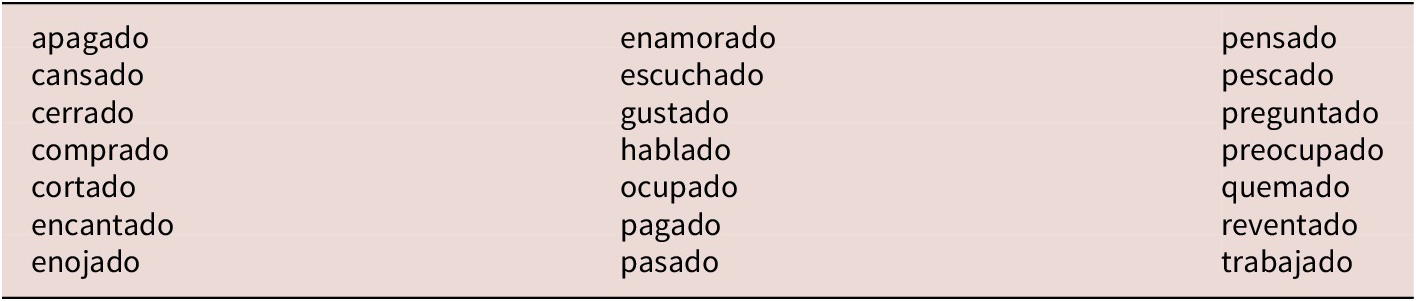
There were 21 past participle /ado/ words (i.e., cansado ‘tired’) included (Appendix A), controlling for syllabic stress (atonic) and phonetic context (preceded by /a/, followed by /o/) as previous studies found adjacent vowel effects for spirantization (Colantoni & Marinescu, Reference Colantoni, Marinescu and Ortega-Llebaria2010; Simonet et al., Reference Simonet, Hualde and Nadeu2012; Solon et al., Reference Solon, Linford and Geeslin2018). Each word was repeated twice for a total of 42 /ado/ realizations per session. There were also 92 distractors, resulting in 134 sentences per session. All words were presented in the carrier phrase in randomized order. Each participant, sitting comfortably at a desk in a quiet office, read the carrier phrases from a timed Microsoft PowerPoint on a laptop. The carrier phrases were timed at 5 seconds per slide to encourage a similar interspeaker speech rate. This allowed speakers to focus on the screen without having to press continue and thus discouraged them from reading each slide too fast. Speakers were recorded with a Marantz PMD660 solid-sate digital recorder wearing a Shure WH20XLR Headworn Dynamic Microphone with a sampling rate of 44.1kHz (16-bit digitization).
The study solely examined the /ado/ context as it is highly frequent in Spanish, particularly in Peninsular Spanish where the present perfect has expanded into the domain of the preterit (Schwenter & Torres Cacoullos, Reference Schwenter and Torres Cacoullos2008). From a usage-based (Bybee, Reference Bybee2001) and exemplar theory framework (Pierrehumbert, Reference Pierrehumbert, Bybee and Hopper2001), the /ado/ context is ideal to examine the acquisition of allophonic variation due to its high frequency with many exemplars in the immersion context, providing speakers the opportunity to demonstrate subtle gains during a short-term SA. This does not allow us to overgeneralize the acquisition of intervocalic /d/ in all contexts, but at least in a frequent morphophonological context.
The preprogram questionnaire was based on Schmidt (Reference Schmidt2020) (also Bedinghaus, Reference Bedinghaus2015; Linford, Reference Linford2016) and revised for the Sevilla context. The questionnaire consisted of three sections: demographic information, linguistic history, and varieties of Spanish. The language questionnaire was a modified version of Elliot’s (1995) Pronunciation Attitude Inventory (online Appendix B). Modifications were made so that instead of asking about speaking general Spanish, it was specifically framed about one’s attitudes toward sounding Andalusian. Scores ranged from 12 to 60, with higher numbers indicating more of a preference to sound native/Andalusian-like.
Students filled out weekly questionnaires to document how many hours of Spanish they were speaking with sevillano/as outside of class each week. The weekly questionnaires were averaged to provide one score per student.
On the last day of class, 4.5 weeks after the initial recording, students met individually with the author for the second session. They completed the same three verbal-recording tasks from the first session and a postprogram questionnaire. The postprogram questionnaire, based on Schmidt (Reference Schmidt2020), was modified for the Sevilla context and consisted of SA experience, dialects of Spanish, and motivations for studying Spanish.
Acoustic measure
A textgrid was created for each recording by a research assistant, segmenting each word in Tier 2 and each /d/ and following /o/ in Tier 1 in Praat (Boersma & Weenink, Reference Boersma and Weenink2019). Each segmented /d/ and /o/ were then manually checked by the author. Upon completion of the textgrids, two acoustic measures were taken for each /ado/ token. First, the minimum intensity (dB) of /d/ was obtained by highlighting the /d/ segment and clicking intensity > get minimum intensity. Second, the maximum intensity (dB) of the following /o/ was obtained by highlighting the /o/ segment and clicking intensity > get maximum intensity. These measures were used to create the dependent measure: intensity difference (henceforth IntDiff). IntDiff “is the difference between the intensity minimum during the consonant and the intensity maximum in the following tautosyllabic vowel” (Hualde et al., Reference Hualde, Simonet and Nadeu2011, p. 309). IntDiff provides a relative degree of spirantization or lenition (Colantoni & Marinescu, Reference Colantoni, Marinescu and Ortega-Llebaria2010; Hualde et al., Reference Hualde, Simonet and Nadeu2011). A larger IntDiff indicates a more stop-like realization (Figure 1) while a smaller IntDiff indicates a more approximant-like realization (Figure 2). Thus, IntDiff provides a gradient measure, different from a segmental analysis ([d], [ð], [∅]). IntDiff has been shown to be a useful parameter for /d/ realizations for L2 and heritage Spanish speakers (Amengual, Reference Amengual2019; Bongiovanni et al., Reference Bongiovanni, Long, Megan and Willis2015; Rogers & Alvord, Reference Rogers and Alvord2014; Solon et al., Reference Solon, Linford and Geeslin2018). In the case of elided tokens where there was no consonant to be segmented (Figure 3), following Rogers and Alvord (Reference Rogers and Alvord2014, p. 412), these tokens were classified as having an IntDiff of 0 dB as elision is “one extreme of the gradient scale of spirantization just as an occlusion is the opposite extreme.” Finally, tokens identified as flap [ɾ] (Figure 4) were removed from statistical analyses of the acoustic data as these are not part of the spiritanization continuum.
Waveform, spectrogram with intensity line (dB), and textgrid of stop [d] in comprado ‘purchased’ produced by a L2-intermediate speaker.

Waveform, spectrogram with intensity line (dB), and textgrid of approximant [ð] in reventado ‘burst’/‘exhausted’ produced by a Heritage-advanced speaker.

Waveform, spectrogram with intensity line (dB), and textgrid of elision [∅] in cortado ‘cut’/‘macchiato coffee’ produced by a L2-advanced speaker.

Waveform, spectrogram with intensity line (dB), and textgrid of flap [ɾ] in pensado ‘thought’/‘considered’ produced by a L2-intermediate speaker.

Following the experimental design there were 3,360 possible tokens (21 words × 2 repetitions × 40 speakers × 2 sessions). However, 192 tokens were discarded from the analysis due to speakers producing a different word from the one presented or the presence of creak that prevented an accurate measure of intensity (dB).
Independent variables
There were eight independent variables included in the analysis: time (Time 1 [T1], Time 2 [T2]); language questionnaire score; proficiency level (L2-intermediate, L2-advanced, Heritage-advanced); average hours per week outside of class speaking in Spanish with sevillano/as; preferred variety to emulate (Mexican/Texas Spanish, Peninsular Spanish, other); gender (male, female); knowledge of a third-language (yes, no); and whether one likes Sevilla Spanish (yes, neutral/disagree). Preferred variety to emulate was an open-ended question in the preprogram questionnaire that was coded into the three categories mentioned previously. The postprogram questionnaire had several attitude questions including “I like how Spanish is spoken in Sevilla” with the answers agree, neutral, or disagree. This was a coded as a binary agree versus neutral/disagree. Speaker and word were included as random factors.
Statistical analysis
For the segmental analysis, chi-square tests and a mixed-effects logistic regression were conducted in R (R Core Team, 2020). Then for the acoustic analysis, following Tagliamonte and Baayen (Reference Tagliamonte and Baayen2012), a random forest was calculated using the cforest function in the party package (Hothorn et al., Reference Hothorn, Hornik, Strobl and Zeileis2020) in R to determine the importance of each variable. The random forest results are essential prior to regression modeling as it determines the order of the independent variables from most to least important. These variables were placed in this order in regression modeling as the order can affect the output of the models. Mixed-effects linear regression models using treatment contrast were fitted using the lmer function (Bates et al., Reference Bates, Maechler, Bolker and Walker2015) and lmerTest (Kuznetsova et al., Reference Kuznetsova, Brockhoff and Christensen2014) in R with the eight independent variables and the random factors of speaker and word. Time was put in interaction with all other factors and several three-way interactions were tested. Nonsignificant main effects and interactions were then discarded from each subsequent model. Models were compared using ANOVA testing and the model with the lowest AIC was chosen for the final analysis. Post-hoc analyses were computed using estimated marginal means (Lenth et al., Reference Lenth, Singmann, Love, Buerkner and Herve2018) for categorical predictors with more than two levels. Additionally, paired Welch two sample t-tests were used to determine statistical differences between Time 1 and Time 2 for each individual speaker. Figures were created with ggplot2 (Wickham, Reference Wickham2013).
Results
Segmental analysis
The 3,168 /d/ tokens were segmentally coded by examining the spectrogram and the waveform of each textgrided segment, resulting in 925 [d], 1,535 [ð], 18 [∅], and 690 [ɾ] realizations. These allophonic realizations varied per proficiency level and time as seen in Table 2 and Figure 5.
Allophonic realizations of intervocalic /d/ per proficiency level by time

Allophonic realizations of intervocalic /d/ per proficiency level by time.

A chi-square test found that the distribution of segmental allophonic variants for /d/ was significantly different between proficiency groups, χ2(6) = 842.24, p < 0.0001. Neither the L2-advanced group (χ2(3) = 6.35, p = 0.10) nor the Heritage-advanced group (χ2(2) = 3.86, p = 0.15) demonstrated significant changes in allophonic variants over time. The L2-intermediate group, however, demonstrated significant changes in variants over time (χ2(2) = 15.57, p < 0.001); specifically, a reduction in [d] (χ2(1) = 5.0, p < 0.05), an increase in [ð] (χ2(1) = 10.47, p < 0.01), and no change in [ɾ] realizations (χ2(1) = 0.50, p = 0.48). To solely compare [d] and [ð] realizations, a mixed-effects logistic regression using treatment contrast was conducted with time and proficiency level as fixed factors and speaker and word as random factors. The model (R2m: 0.35; R2c: 0.75) found a main effect for proficiency in which L2-advanced (β = 2.46, SE = 0.95, z = 2.58, p < 0.01) and Heritage-advanced (β = 5.21, SE = 0.98, z = 5.33, p < 0.001) produced more [ð] than L2-intermediate speakers. A main effect for time (β = 0.71, SE = 0.17, z = 4.2, p < 0.001) indicated that for all speakers together Time 2 had more [ð] than Time 1. Finally, there was a significant interaction between time and proficiency level. Post-hoc pairwise comparisons indicated that only the L2-intermediate group demonstrated a significant increase in [ð] realizations (p < 0.001). For Time 1, Heritage-advanced (p < 0.001) and L2-intermediate (p < 0.05) had significantly more [ð] realizations than L2-intermediate. Heritage-advanced (p < 0.001) also had significantly more [ð] realizations than L2-intermediate. For Time 2, Heritage-advanced had significantly more [ð] realizations than L2-intermediate (p < 0.001) and L2-advanced (p < 0.05). No other comparisons were significant.
Acoustic analysis
There was a relatively high occurrence of flaps [ɾ] for intervocalic /d/, particularly among the L2-intermediate group. Following previous acoustic studies (Bongiovanni et al. Reference Bongiovanni, Long, Megan and Willis2015; Solon et al., Reference Solon, Linford and Geeslin2018), all [ɾ] realizations were removed from further analysis. Additionally, two L2-intermediate speakers (B10: 92.2% [ɾ]; B20: 90% [ɾ]) and one L2-advanced speaker (A10: 92% [ɾ]) who demonstrated nearly categorical flaps were removed from the analysis. Finally, there were 58 [ð] tokens with negative IntDiff, meaning that although the approximant was present, the following /o/ was significantly reduced (i.e., atonic schwa-like vowel). As this value gives the false impression of an elision, these tokens were discarded from further analyses. After removing these tokens, the remaining data consisted of 2,400 tokens.
The random forest (Figure 6) indicated that the most important predictor of IntDiff is speaker, followed by language questionnaire, proficiency level, whether one likes Sevilla Spanish, word, time, average hours per week speaking Spanish with sevillano/as, gender, preferred variety to emulate, and L3. Given language questionnaire and LikeSevillaSpanish demonstrated high degrees of collinearity, they were not placed into the same regression model, but rather substituted for one another in different models. As the models with language questionnaire demonstrated a better fit for the data with a lower AIC score as well as higher variable importance in the random forest, the final regression model opted for language questionnaire.
Random forest with all predictors of IntDiff.

The best-fit mixed-effects linear regression is seen in Table 3. The model failed to converge with word as a random factor,Footnote 10 and thus the final model only included speaker as a random factor. The table presents the estimate, standard error (SE), t-value, and p-value. Larger estimates in either direction from zero indicate a stronger main effect or interaction. Positive estimates indicate that the listed level has a higher IntDiff than the reference level and vice versa for lower estimates. Marginal R-squared (R2m) and conditional R-squared (R2c) values are provided to show the goodness-of-fit of the variation (Nakagawa & Schielzeth, Reference Nakagawa and Schielzeth2013).
Summary of mixed-effects linear regression model for IntDiff, speaker as random factor, n = 2,400 (R2m: 0.23, R2c: 0.49), note: “Ref” = reference level

* p < 0.05; ** p < 0.01; *** p < 0.001.
The main effect for time indicated that Time 1 (EMM: 10.84dB, SE: 0.63) had a significantly higher IntDiff than Time 2 (EMM: 9.44dB, SE: 0.63) (p < 0.001). The interaction between language questionnaire and time indicates that those with higher questionnaire scores lowered their IntDiff from Time 1 to Time 2 (Figure 7). As one observes, however, those with less desire to sound native/Andalusian (lower scores) started with a low IntDiff and did not demonstrate change over time while those with more desire to sound native/Andalusian (higher scores) generally started in Time 1 with a high IntDiff, but lowered IntDiff by Time 2. The time by proficiency level interaction and post-hoc pairwise comparisonsFootnote 11 revealed that L2-advanced had a higher IntDiff in Time 1 (EMM: 10.68 dB, SE: 1.24) than in Time 2 (EMM: 9.52 dB, SE: 1.24) (p < 0.01), Heritage-advanced had a higher IntDiff in Time 1 (EMM: 9.54 dB, SE: 1.23) than in Time 2 (EMM: 6.91 dB, SE: 1.23) (p < 0.001), but that L2-intermediate did not demonstrate a significant difference between Time 1 (EMM: 12.3 dB, SE: 0.94) and Time 2 (EMM: 11.88 dB, SE: 0.94) (p = 0.21) (Figure 7). The interaction indicates that Heritage-advanced had the largest reduction in IntDiff over time.
Left: Language questionnaire by time interaction for IntDiff; Right: Time by proficiency level interaction for IntDiff.

The three-way interaction between time, proficiency level, and average hours speaking with sevillano/as indicates that only the Heritage-advanced group was significantly different from the L2-intermediate group reference level (Figure 8). That is, both the L2-intermediate and L2-advanced groups followed the same pattern in which those with more hours reduced IntDiff from Time 1 to Time 2. On the contrary, for the Heritage-advanced group, those with fewer hours with sevillano/as demonstrated IntDiff reduction over time while those with more hours demonstrated little to no IntDiff reduction.
Time by proficiency level by average hours speaking with sevillano/as interaction for IntDiff.

To further explore the relationship between the independent variables in the regression model, a conditional inference tree using the cforest function in the party package (Hothorn et al., Reference Hothorn, Hornik, Strobl and Zeileis2020) was conducted. In plotting a conditional inference tree with language questionnaire, it splitFootnote 12 into many trees each with few nodes. Thus, as there was a high degree of collinearity between language questionnaire and LikeSevillaSpanish, the conditional inference tree opted for LikeSevillaSpanish. The conditional inference tree in Figure 9 indicates that the most important predictor is proficiency level, separating L2 and heritage speakers. For both L2-advanced and Heritage-advanced speakers, those who liked Sevilla Spanish reduced their IntDiff over time, whereas those who did not like Sevilla Spanish did not reduce their IntDiff. For L2-intermediate speakers, attitudes toward Sevilla Spanish had no effect on IntDiff over time.
Conditional inference tree of proficiency level, time, and LikeSevillaSpanish for IntDiff.

Given the linguistic diversity of the Heritage-advanced group, a few follow-up analyses were conducted to examine intragroup variation. Of interest was that G2 and G3 had overall lower IntDiff values than G0.5 and G1.5. However, as there was only one G0.5 and one G1.5 speaker, this should be taken with caution. Pearson correlations were conducted to assess the relationship between IntDiff change (μTime1 - μTime2) and language questionnaire (n = 10, df = 8, r = 0.58, R2 = 0.34, p = 0.078), between IntDiff change (μTime1 - μTime2) and hours per week spoken with sevillano/as (n = 10, df = 8, r = –0.49, R2 = 0.24, p = 0.147), and between language questionnaire and average hours per week spoken with sevillano/as (n = 10, df = 8, r = –0.12, R2 = 0.01, p = 0.743), but none were significant. A two-way (time, LikeSevillaSpanish) repeated measures ANOVA found a significant main effect for time (F(1,720) = 36.6, p < 0.0001) and a significant time by LikeSevillaSpanish interaction (F(1,720) = 6.85, p < 0.01). This indicates that heritage speakers who liked Sevilla Spanish (T1 M: 9.4 dB, SD: 6.1; T2 M: 6.8 dB, SD: 5.5) had a significantly greater IntDiff reduction over time compared to those who felt neutral/disliked Sevilla Spanish (T1 M: 6.2 dB, SD: 7.1; T2 M: 5.0 dB, SD: 5.6) (Figure 10). Furthermore, heritage speakers who liked Sevilla Spanish spent less hours per week speaking with sevillano/as (M: 4.8 hrs, SD: 1.8) than those who felt neutral/disliked Sevilla Spanish (M: 13.8 hrs, SD: 7.0), t(4.53) = –2.78, p < 0.05 (Figure 10).
Left: LikeSevillaSpanish by time interaction for IntDiff for Heritage-advanced speakers; Right: LikeSevillaSpanish by average hours per week speaking with sevillano/as for Heritage-advanced speakers.

Individual speaker analysis
Paired Welch two-sample t-tests were conducted to analyze each individual speaker’s IntDiff over time. Twelve of the 40 participants demonstrated statistically significant reduction in IntDiff over time. Specifically, 3 of 20 L2-intermediate speakers (online Appendix C: B5, B6, B12), 4 of 10 L2-advanced speakers (online Appendix D: A5, A9, A14, A16), and 5 of 10 Heritage-advanced speakers (online Appendix E: A1, A6, A12, A21, B7) demonstrated statistically significant reduction in IntDiff.
Regarding the production of dialect-specific [∅], overall there were 18 elisions: 0 L2-intermediate, 9 L2-advanced, 9 Heritage-advanced. Two individuals accounted for most of these tokens: LuisFootnote 13 (A20) a Heritage-advanced speaker who produced five elisions (T1: 2, T2: 3), and Nancy (A14), a L2-advanced speaker who produced seven elisions (T1: 0, T2: 7). Luis, who grew up speaking Spanish at home in El Paso, had a low IntDiff at Time 1 and did not change over time. Of note, for preferred variety to emulate, Luis wrote “I don’t prefer to sound like a specific dialect.” During the semidirected conversation in Time 1, Luis said he was studying abroad in Sevilla because he likes “to explore different cultures and travel” (my translation) and to improve his Spanish. Of note, however, is that Luis is a highly proficient native speaker of Spanish (and English). Luis mentioned already feeling comfortable in Sevilla two days after arrival due to cultural similarities stating, “La cultura mexicana y la cultural española son casi igual. La gente son muy amable y muy este- respetuosa” “The Mexican culture and the Spanish culture are almost the same. The people are very friendly and very eh- respectful.” Similarly, in the postprogram open-comment Luis wrote, “It was a great experience and I love the culture here a lot. I hope to come and visit and maybe come and live in Spain one day.” Although he did not lower his IntDiff values over time as he already produced [ð] upon arrival, from a social psychology perspective (Giles et al., Reference Giles, Taylor and Bourhis1973), the few elided tokens could be linguistic accommodation as he was interested in learning new vocabulary and felt welcomed by sevillano/as.
Nancy, a L2-advanced speaker from the Dallas/Fort Worth area, significantly reduced her IntDiff as her Time 1 IntDiff was quite high. At the end of the program, she exhibited metalinguistic awareness of the elided variant as pertaining to the speech of Sevilla. She produced four [∅] tokens in spontaneous speech in addition to her seven tokens from the carrier phrases. Nancy’s acquisition, however, cannot be described as [d] to [ð] to [∅] as she began the program alternating between [d] and [ɾ] and finished the program alternating between [ɾ] and [∅]. During the semidirected conversation in Time 2, the author (A) was conversing with Nancy (N) about her SA experience. She explained how she and her roommate Laura, a Heritage-advanced speaker in the program, had the best host family of all the students: two young parents and two daughters. In this exchange (Excerpt 1), Nancy stated that her 37-year-old host mother’s “cumple” was last week (line 1). As cumple is a colloquial shortening for cumpleaños “birthday,” the author was impressed and asked her what else she had learned in Sevilla (lines 2 and 4).
(1)
1 N: Treinta y siete. Su cumple fue la semana pasada.
2 A: ¿Cumple? Es decir, cumpleaños, eso es muy coloquial.
3 N: (Risa)
4 A: Has aprendido, has aprendido algo, ¡eh! (entonación de broma)
5 N: Sí, Laura me dijo que yo he aprendido mucho de español aquí. Y ella no porque ya habla español
6 de toda su vida. Pero yo, he aprendido mucho de aquí. No sé.
7 A: ¿Y que has aprendido tú de aquí?
8 N: Mucho. Cumple, anoche cuando estábamos estudiando, yo dije [pa.ˈsau̯], no [pa.ˈsa.ɾo], [pa.ˈsau̯] (risa).
9 A: ¿Sí?
10 N: Sí (risa), por accidente. No estaba pensando en eso, pero yo dije [pen.ˈsau̯], [pa.ˈsau̯].
11 A: Muy bien. Entonces, ¿Dónde aprendiste todo eso?
12 N: En mi familia, en mi casa.
13 A: Estás presentando mucha atención, ¿no?
14 N: Sí, sí, porque hablamos mucho con la familia. Cenamos juntos, todos juntos y almorzamos todos juntos.
15 Entonces, hablamos mucho con la familia.
16 A: Así se aprende.
17 N: Sí.
18 A: En la clase podemos aprender muchas cosas, pero=
19 N: =en la casa, y también con las niñas, es más fácil para practicar porque no tengo vergüenza con las niñas.
20 A: ¡Verdad!
21 N: Sí, es menos vergüenza con las niñas. Y la niña de seis años es muy mandona y (risa)
22 ella siempre quiere jugar con yo y Laura y siempre está hablando con nosotros,
23 y “chicas, siéntate aquí y escúchate” (imita la voz de la niña) (risa).
1 N: Thirty-seven. Her cumple was last week.
2 A: Cumple? That is, birthday, that’s really colloquial.
3 N: (Laughter)
4 A: You’ve learned, you’ve learned something, eh! (joking intonation)
5 N: Yes, Laura told me that I learned a lot of Spanish from here. And she not so much because she
6 already speaks Spanish all her life. But I’ve learned a lot from here. I don’t know.
7 A: And what have you learned from here?
8 N: A lot. Cumple, last night when we were studying, I said [pa.ˈsau̯], not [pa.ˈsa.ɾo], [pa.ˈsau̯] (laughter).
9 A: Oh yeah?
10 N: Yes (laughter), by accident. I wasn’t thinking about it, but I said [pen.ˈsau̯], [pa.ˈsau̯].
11 A: Very good. So, where did you learn all that?
12 N: In my family, in my house.
13 A: You’re paying a lot of attention, eh?
14 N: Yes, yes, because we talk a lot with the family. We all eat dinner together, we all eat lunch together.
15 So we talk a lot with the family.
16 A: That’s how one learns.
17 N: Yes.
18 A: In class we can learn a lot of things, but=
19 N: =at home, and also with the daughters, it’s easier to practice because I’m not embarrassed with them.
20 A: Right!?
21 N: Yes, it’s less embarrassment with the daughters. And the daughter of 6 years is very bossy and (laughter)
22 she always wants to play with I and Laura and is always talking with us,
23 and “girls, sit here and listen” (imitates the voice of the daughter) (laughter).
In line 5 she mentions that her roommate Laura had commented that Nancy has picked up a great deal of local forms of speech. In line 8 Nancy explains that last night when they were studying she said pasado as [pa.ˈsau̯] (Figure 11), then contrasts that with pasado as [pa.ˈsa.ɾo], followed by another elided example. Of note here is that she produces the diphthong [au̯] common in Andalusian Spanish when the /d/ in /ado/ is elided (Moreno-Fernández, Reference Moreno-Fernández and Cano2004, p. 999). Nancy explains that she was not intentionally thinking about it, but rather it simply came out. She then produces two more elided examples (line 10). When asked where she learned this, Nancy states that she learned that pronunciation from her host family in her house (line 12), expressing that she and Laura spend a great deal of time, particularly during meals, speaking with their host family (lines 14 and 15). In addition to the direct input from her host parents, Nancy indicates that she was also able to practice her Spanish with the two daughters without worrying about mistakes (lines 19–23). The connection to her host family was quite strong as she later stated, “And I want to return to visit my family” (my translation) and in the open-comment section she wrote, “My experience would not have been near as amazing without my host family. They helped me learn and practice, and treated as one of their own! I love the culture of Sevilla.” Notably, for preferred variety to emulated in the preprogram questionnaire she wrote “informal Spanish,” while in in the postprogram questionnaire she wrote, “During my time I started to emulate a Sevilla accent, not because I wanted to, but just because of so much exposure.” Thus, this could also be a case of linguistic accommodation (Giles et al., Reference Giles, Taylor and Bourhis1973), due to favorable opinions of her host family. Consequently, due to a combination of input and positive attitudes toward the local variety, Nancy used local colloquial lexicon and pronunciation, as well as demonstrated metalinguistic awareness of dialect-specific [∅] in /ado/.
Waveform, spectrogram, and textgrid of [pa.ˈsau̯] produced by L2-advanced speaker Nancy.

Discussion
Revisiting the research questions
RQ1: What is the effect of short-term SA on the production of language-specific allophone [ð] for intervocalic /d/? The findings support Bongiovanni et al. (Reference Bongiovanni, Long, Megan and Willis2015) and Lord (Reference Lord2010) in which as an entire group, students produced more approximant-like [ð] over time in the segmental and acoustic analyses. Additionally, 12 individual speakers demonstrated significant reductions in IntDiff over time.
RQ2: How does the production of language-specific allophone [ð] vary by proficiency level? The findings that only L2-advanced and Heritage-advanced groups reduced their IntDiff over time, supports previous studies that spirantization is difficult for beginner/intermediate L2 Spanish speakers and appears to be acquired in more advanced proficiency levels (Alvord & Christiansen, Reference Alvord and Christiansen2012; Face & Menke, Reference Face, Menke, Collentine, García, Lafford and Marcos Marín2009; González-Bueno, Reference González-Bueno1995; Rogers & Alvord, Reference Rogers and Alvord2014; Solon et al. Reference Solon, Linford and Geeslin2018; Zampini, Reference Zampini1994). Furthermore, Heritage-advanced speakers had the overall lowest IntDiff and demonstrated more IntDiff reduction than the L2-advanced speakers, supporting Amengual (Reference Amengual2019). This does not imply that the L2-advanced students have not acquired [ð], but rather that Heritage-advanced speakers demonstrate a more lenited approximant, similar to Amengual (Reference Amengual2019). These findings do not suggest that L2-intermediate speakers do not exhibit gains over time as there were three individuals who demonstrated a reduction in IntDiff. Moreover, for the segmental analysis, only the L2-advanced group increased [ð] realizations over time. The differences between the segmental and acoustic analyses indicate that L2-advanced and Heritage-advanced speakers may have already acquired the categorical difference between [ð] and [d] and thus demonstrated more gradient changes over time. However, the L2-intermediate group only demonstrated categorical gains in more [ð] production over time, but the acoustic analysis suggests that their [ð] is less approximant-like than the advanced groups.
RQ3: What is the effect of proficiency level on the production of dialect-specific allophone [∅] for intervocalic /d/? All 18 [∅] tokens were produced by advanced (L2 and heritage) speakers, supporting previous findings that more proficient speakers are more likely than beginner/intermediate speakers to produce dialect-specific phones (Geeslin & Gudmestad, Reference Geeslin and Gudmestad2011). Although the [∅] realizations were few in number, the results demonstrate that even in a short-term SA program speakers are capable of producing dialect-specific phones, supporting previous studies (Knouse, Reference Knouse2012; Schmidt, Reference Schmidt2020).
Although one Heritage-advanced speaker, Luis, produced five [∅] tokens, it cannot be definitively attributed to his immersion in Sevilla as he produced two tokens in Time 1. These five tokens notwithstanding, overall, the heritage group demonstrated a lack of production of a dialect-phone from outside of their heritage language variety, supporting previous studies (Escalante, Reference Escalante2018; Raish, Reference Raish2015).
One L2-advanced student, Nancy, produced dialect-specific [∅] and displayed metalinguistic awareness of the feature supporting previous studies that /d/ elision is more common among L2-advanced than L2-intermediate speakers (Face & Menke, Reference Face, Menke, Collentine, García, Lafford and Marcos Marín2009; Rogers & Alvord, Reference Rogers and Alvord2014; Solon et al. Reference Solon, Linford and Geeslin2018). However, given her few [∅] tokens, this appears to be more of an acquisition of highly frequent words that have been lexicalized with the elision (i.e., pasado, pagado, cortado), than a full acquisition of /d/ elision in all /ado/ contexts. Nancy attributed her use of this feature to her host family input. It could be argued that if she heard these words with the [au̯] diphthong from her host family, they were stored as exemplars (Pierrehumbert, Reference Pierrehumbert, Bybee and Hopper2001). This would support Solon et al.’s (Reference Solon, Linford and Geeslin2018) findings on L2 speakers acquiring intervocalic /d/ elision in highly frequent words. Additionally, as Nancy demonstrated a change from [d]/[ɾ] to [∅] as opposed to [d]/[ɾ] to [ð], this also supports Solon et al.’s (Reference Solon, Linford and Geeslin2018) claim that the acquisition of spirantization and elision may involve different processes for L2 speakers.
RQ4: How does the production of language-specific and dialect-specific allophones vary by other individual factors (attitudes, input)? The findings suggest that both attitudes and input impact speakers’ IntDiff over time. In terms of input, the average hours per week spoken with sevillano/as varied by proficiency level in which L2-intermediate and L2-advanced speakers with more hours demonstrated a reduced IntDiff over time, loosely supporting Kennedy Terry’s (Reference Kennedy Terry2017) findings that those with more input from locals were better able to acquire local features. The Heritage-advanced speakers, however, demonstrated the opposite pattern, in which those with fewer hours speaking with sevillano/as reduced their IntDiff whereas those with more hours did not. Notably, Heritage-advanced speakers with more hours started with low IntDiff, indicating that these speakers had already acquired language-specific [ð] in the /ado/ context.
Regarding attitudes, speakers with more desire to sound native/Andalusian demonstrated more IntDiff reduction than those with less desire to sound native/Andalusian, supporting Elliot (Reference Elliott1995). However, those with less desire to sound native/Andalusian already had quite low IntDiff at Time 1 while those with more desire to sound native/Andalusian began with high IntDiff. Thus, speakers with lower language questionnaire scores may have already acquired the language-specific allophone and thus did not feel a desire to sound native/Andalusian. Additionally, liking Sevilla Spanish only demonstrated reduction in IntDiff for L2-advanced and Heritage-advanced groups, whereas there were no differences in IntDiff over time for L2-intermediate speakers based on attitudes toward Sevilla Spanish. As noted previously, Heritage speakers who felt neutral/disliked Sevilla Spanish spent more hours speaking with sevillano/as than those who reported liking Sevilla Spanish. The interpretation that we posit here, is that given heritage speakers who felt neutral/disliked Sevilla Spanish had very low IntDiff values in Time 1, they may have had a higher proficiency and thus already produced a more approximant-like [ð] as compared to their heritage peers who spent fewer hours speaking with sevillano/as. Thus, attitudes toward a particular variety (Dörnyei et al., Reference Dörnyei, Csizér and Németh2006; Elliot, Reference Elliott1995; Gardner & Lambert, Reference Gardner and Lambert1972; Schmidt, Reference Schmidt2020) influence acquisition.
Proficiency
The role of proficiency in the acquisition of language-specific or dialect-specific phones has been understudied. In large part this is due to practical difficulties of the SA context. Principally, the number of speakers is generally limited in any given proficiency group, which reduces the statistical power of group comparisons.
The results on whether higher proficiency levels provide the opportunity for more gains during SA demonstrate mixed reviews (Issa & Zalbidea, Reference Issa, Zalbidea, Sanz and Morales-Front2018). Some studies analyzing oral proficiency (Davidson, Reference Davidson2010; Leonard & Shea, Reference Leonard and Shea2017), pragmatics (Li, Reference Li2014), and grammatical gender (Faretta-Stutenberg & Morgan-Short, Reference Faretta-Stutenberg, Morgan-Short, Sanz and Morales-Front2018) have found that more proficient L2 learners demonstrated more gains than beginner or intermediate L2 learners over time. The current findings suggest that L2-advanced and Heritage-advanced speakers are better positioned to have more language-specific allophonic gains during a short-term SA program than L2-intermediate speakers. Thus, the current study in tandem with previous studies lend support to Lafford and Collentine’s (Reference Lafford, Collentine, Salaberry and Lafford2006) claim that L2 speakers with higher linguistic proficiency, may have more cognitive resources to notice linguistic variation as compared to lower proficiency L2 speakers whose cognitive energies are focused on communication (see also Shea, Reference Shea, Menke and Malovrth2021). However, the current study demonstrates that proficiency level interacts with individual input and attitudes.
Dialect-specific phones
The low production of intervocalic /d/ elision furthers the notion that certain dialect-specific phones are more acquirable than others. Intervocalic /d/ elision is similar to French /l/ elision in third person singular pronouns (Howard et al., Reference Howard, Lemée and Regan2006; Kennedy Terry, Reference Kennedy Terry2017) and Spanish coda /s/ aspiration/elision (Linford et al., Reference Linford, Harley and Brown2021; Schmidt, Reference Schmidt2020) in which there is a grapheme-to-phone mismatch, thus less acquirable than a one-to-one grapheme-to-phone correspondence such as [ʒ]/[ʃ] for <y> and <ll> in Argentine Spanish (Hoffman-González, Reference Hoffman-González2015; Pozzi & Bayley, Reference Pozzi and Bayley2020; Schmidt, Reference Schmidt2020) or Cairene Arabic [g] for the Arabic character < ج> (Raish, Reference Raish2015). Moreover, the elision of intervocalic /d/ may be less salient than other dialectal features. However, higher salience does not guarantee a higher acquisition. For example, /θ/ is quite salient for L2 Spanish speakers (Ringer-Hilfinger, Reference Ringer-Hilfinger2012), but demonstrates little overall acquisition as it requires speakers to learn a phonemic split (George, Reference George2014; Knouse, Reference Knouse2012; Ringer-Hilfinger, Reference Ringer-Hilfinger2012).
Only one Heritage-advanced student produced more than one elided variant, although only five tokens. It could be that Luis, not unlike a few heritage speakers in George and Hoffman-González (Reference George and Hoffman-González2019), was producing a dialect-specific phone from outside of his heritage language variety, but with so few tokens, it remains unknown. As one’s identity is tied to one’s heritage language variety, it is perhaps not surprising that these speakers did not adopt the elided variant from outside of their heritage variety, similar to previous studies (Escalante, Reference Escalante2018; Raish, Reference Raish2015). None of the heritage speakers stated Peninsular Spanish as their preferred variety to emulate, but rather seven reported Mexican/Texas Spanish, two speakers reported no preference, and one Central American/U.S. Spanish (online Appendix E). Future studies should examine heritage language proficiency as higher proficient heritage speakers may demonstrate stronger affiliation to their heritage language variety and thus be less likely to produce dialect-specific features from outside of their variety.
The notion of identity and language variety could also be explored with L2 speakers. Within the U.S. context, L2 speakers who live in bilingual regions such as Texas and are exposed to Texas and Mexican Spanish, may have a stronger connection to Mexican Spanish than L2 speakers from other regions such as the Midwest who may be more open to emulating other varieties of Spanish. For example, of the 10 L2-advanced speakers, 5 reported Mexican/Texas Spanish as their preferred variety to emulate, 1 Latin American Spanish, 3 none, and 1 Peninsular Spanish (online Appendix D). However, one’s L2 dialectal preference may vary by proficiency as among the 20 L2-intermediate speakers 13 stated no preferred variety to emulate, 5 Mexican/Texas Spanish, and 2 Peninsular Spanish (online Appendix C). This may vary by phonetic features as well. For example, the dialect-specific [∅] for intervocalic /d/ can allow a L2 Spanish speaker to sound sevillano/a without sounding completely Peninsular by producing a variant such as [θ], which is likely much more linked to Peninsular Spanish. However, as Geeslin and Schmidt (Reference Geeslin, Schmidt, Sanz and Morales-Front2018) indicate, we know quite little about L2 and heritage Spanish speakers’ attitudes toward dialect-specific phones, thus future social perception studies can provide insights into why some variables are more acquired than others.
Consequently, it is suggested that the acquisition of dialect-specific phones is dependent upon a combination of interacting factors: relative sociolinguistic salience (Pozzi & Bayley, Reference Pozzi and Bayley2020); grapheme-to-phone correspondences (Knouse, Reference Knouse2012); social evaluations (Geeslin & Schmidt, Reference Geeslin, Schmidt, Sanz and Morales-Front2018); and in the case of heritage speakers, one’s heritage language variety (Escalante, Reference Escalante2018; Raish, Reference Raish2015). These factors, however, also interact with proficiency level.
Methodological considerations
It is possible that contrasting findings between studies are due to different lengths of stay and/or methodological differences. Thus, in short-term SA programs, the role of frequency, must be considered. The current study intentionally focused only on the /ado/ context as it is a highly frequent context in Peninsular Spanish as the present perfect has expanded into the domain of the preterit (Schwenter & Torres Cacoullos, Reference Schwenter and Torres Cacoullos2008). Given short-term SA programs range from 4 to 6 weeks, researchers should think carefully not only about which feature to study but also the specific phonetic context to provide students the best opportunity to demonstrate subtle gains. Experiments that only examine large gains in language-specific or dialect-specific phones lend to the unhelpful dichotomy of native versus nonnative speaker (Birdsong & Gertken, Reference Birdsong and Gertken2013), going against the “bilingual turn” in SLA (Ortega, Reference Ortega2009). Thus, focusing on features in the SA context that students will receive frequent input would follow Ortega’s (Reference Ortega and May2014) proposal for a usage-based approach to SLA.
Additionally, some studies have utilized a segmental analysis (Díaz-Campos, Reference Díaz-Campos2004; Lord, Reference Lord2010) while others an acoustic analysis (Bongiovanni et al., Reference Bongiovanni, Long, Megan and Willis2015) for intervocalic /d/ in the SA context. As demonstrated in the current study, an acoustic analysis versus a segmental analysis may yield different results and insights into the data. Thus, in light of these findings, and similar to those of Solon et al. (Reference Solon, Linford and Geeslin2018), a combination of segmental and acoustic analyses is warranted to examine both categorical and gradient phonetic changes over time.
Limitations and future studies
Proficiency, as measured by a self-reported 8-point Likert-scale, is a limitation in the study. Future studies may consider having students take an ACTFL OPI. Additionally, given the diverse range of linguistic input Spanish heritage speakers receive, it would be advisable to have students complete the Bilingual Language Profile (Birdsong et al., Reference Birdsong, Gertken and Amengual2012) to analyze heritage, as well as L2, speakers on a continuous bilingual measure. Also, although IntDiff is useful for demonstrating degrees of spirantization, it does not account for the possibility that some L1 English speakers may produce fricative [ð] instead of approximant [ð] (Ladefoged & Johnson, Reference Ladefoged and Johnson2014; Martínez-Celdrán, Reference Martínez-Celdrán1991), which could potentially result in a higher IntDiff. Future studies should examine the overall acquisition of intervocalic /d/ in all intervocalic contexts. If speakers were to demonstrate more gains with /ado/ than other contexts, this would provide support for usage-based (Bybee, Reference Bybee2001) and exemplary theory (Pierrehumbert, Reference Pierrehumbert, Bybee and Hopper2001) evidence for L2 acquisition. Future studies should also examine intervocalic /d/ over a longer semester to see if more speakers demonstrate more IntDiff reduction as well as produce more dialect-specific [∅]. Following Díaz-Campos (Reference Díaz-Campos, Klee and Face2006), studies should compare spontaneous and read speech to explore stylistic differences. Finally, more work is needed to further examine the role of one’s heritage language variety on the acquisition of dialect-specific phones.
Conclusion
This study examined the role of language proficiency and other individual factors (attitudes, input) in the acquisition of language-specific [ð] and dialect-specific [∅] allophones of Spanish intervocalic /d/ in the /ado/ context by L2 and heritage Spanish speakers during a short-term study abroad in Sevilla, Spain. Overall, there was little production of the dialect-specific allophone, with a few exceptions such as an L2-advanced speaker producing [∅] with a high degree of metalinguistic awareness. The low acquisition of the elided variant is likely due to its low salience and its grapheme-to-phone mismatch, and in the case of heritage speakers, that it is not present in their heritage language variety. Regarding language-specific [ð], the findings imply that advanced (L2 and heritage) speakers with favorable attitudes toward the local variety are most likely to demonstrate gradient allophonic changes during a short-term SA program.
Acknowledgement
I am truly indebted to research assistant Lily Lemus in the Texas Tech Sociolinguistics & Bilingualism Research Lab for outstanding textgrid phonetic segmentation, to Mark Amengual for insights into the experimental design and acoustic analysis, to Lauren Schmidt for sharing materials for preprogram and postprogram questionnaires, to Sara Pink, Myriam Rubio Hernández, Lorum Stratton, and Isabel Ojeda at the Texas Tech University Center in Sevilla for their support, to audience members at LSRL 50 for insightful feedback, and to two anonymous reviewers for brilliant suggestions. Finally, thanks to the wonderful students for participating. All errors remain my own.
Supplementary Materials
To view supplementary material for this article, please visit http://doi.org/10.1017/S027226312200002X.
Data Availability Statement
The experiment in this article earned Open Materials and Open Data badges for transparent practices. The materials and data are available at https://osf.io/7tgrj/.
Appendix A
Stimuli list


 Open access

