


Introduction
Generative AI (GenAI), which emerged prominently in 2023, marked an important turning point in industrial development by accelerating the move toward deeper human–machine collaboration (Passalacqua et al., Reference Passalacqua, Pellerin, Magnani, Doyon-Poulin, Del-Aguila, Boasen and Léger2025). As AI tools increasingly augment workforce capabilities rather than replace them, the principles of Industry 5.0, particularly the synergy between human creativity and intelligent systems, have become increasingly important for modern business (Xu, Dainoff, Ge & Gao, Reference Xu, Dainoff, Ge and Gao2023; Yan et al., Reference Yan, Liu, Leng and Zhao2025). While Industry 4.0 was largely technology-centered, Industry 5.0 reflects a value-driven paradigm that prioritizes human needs while using advanced technologies to support organizational transformation (Scuotto, Tzanidis, Usai & Quaglia, Reference Scuotto, Tzanidis, Usai and Quaglia2023). Organizational transformation, defined here as the fundamental reconfiguration of organizational structures, processes, and strategies in response to emerging socio-technical paradigms (Vial, Reference Vial2019; Warner & Wäger, Reference Warner and Wäger2019), extends beyond digital transformation by incorporating human-centric and sustainability dimensions. This perspective supports organizations that are not only technologically advanced but also more human-centric, sustainable, and resilient (Frederico, Reference Frederico2021; Scuotto et al., Reference Scuotto, Tzanidis, Usai and Quaglia2023; Sindhwani et al., Reference Sindhwani, Afridi, Kumar, Banaitis, Luthra and Singh2022). Given the growing uncertainty and dynamism of the business environment, these principles are likely to become even more important for industrial organizations over the next decade (van Erp et al., Reference van Erp, Carvalho, Gerolamo, Gonçalves, Rytter and Gladysz2024).
Since 2023, a growing number of Industry 5.0 studies, particularly review articles, have appeared in reputable outlets. For example, Ghobakhloo et al. (Reference Ghobakhloo, Iranmanesh, Foroughi, Tirkolaee, Asadi and Amran2023) synthesized the literature into an architectural design that includes technologies, principles, components, and values, while Ghobakhloo, Fathi, Okwir, Al-Emran and Ivanov (Reference Ghobakhloo, Fathi, Okwir, Al-Emran and Ivanov2025) later examined the sustainability implications of these technologies across economic, social, and environmental dimensions. Kumar et al. (Reference Kumar, Kaswan, Kumar, Chaudhary, Garza-Reyes, Rathi and Joshi2024) classified key technologies, adoption barriers, and implementation status across sectors and countries. Rame, Purwanto and Sudarno (Reference Rame, Purwanto and Sudarno2024) provided a bibliometric overview linking Industry 5.0 and sustainability trends, whereas Ali, Nguyen and Oh (Reference Ali, Nguyen and Oh2025) offered a systematic review with a conceptual framework and future research directions for the Asia Pacific. Although these studies have contributed significantly to defining the scope and implications of Industry 5.0, they also share an important limitation. Most treat Industry 5.0 as a taxonomy problem by identifying its pillars, technologies, and values, rather than as a systems problem that explains how these elements interact dynamically and why organizations are pushed to transition from Industry 4.0 to Industry 5.0. Existing reviews pay limited attention to the feedback processes through which inputs generate sustainability outcomes, and they do not sufficiently explain whether human-centricity should be treated as one pillar among others or as the governing force of the system.
In response, this study develops an integrative model that conceptualizes Industry 5.0 as a self-regulating socio-technical system with an input-throughput-output structure, an internal reinforcing feedback loop between technological and human inputs, and an external balancing feedback loop through which institutional legitimacy connects sustainability outcomes back to the system’s core drivers. By doing so, the study moves the literature from describing what Industry 5.0 consists of explaining how and why it operates as a system. This distinction is important for both management theory and organizational practice.
Furthermore, there remains a notable gap in the definition of Industry 5.0, especially in organizational contexts (Ali et al., Reference Ali, Nguyen and Oh2025; Enang, Bashiri & Jarvis, Reference Enang, Bashiri and Jarvis2023; Ivanov, Reference Ivanov2023). Defining a phenomenon’s characteristics and identifying its theoretical lens are essential for building a unified perspective, supporting cumulative research, and reducing the risk of misinterpretation (Gamberini & Pluchino, Reference Gamberini and Pluchino2024). Theoretical lenses clarify what characteristics are involved in a phenomenon, how they influence one another, and why they are connected (Busse, Kach & Wagner, Reference Busse, Kach and Wagner2017).
Current literature generally identifies three core pillars of Industry 5.0: resilience, sustainability, and human-centricity (Maddikunta et al., Reference Maddikunta, Pham, Prabadevi, Deepa, Dev, Gadekallu and Liyanage2022; Thakur & Sehgal, Reference Thakur and Sehgal2021). Resilience refers to the ability of organizations to anticipate, absorb, and adapt to disruptions while maintaining continuity of core functions (Ivanov, Reference Ivanov2023; van Erp et al., Reference van Erp, Carvalho, Gerolamo, Gonçalves, Rytter and Gladysz2024). Sustainability refers to the integration of economic, environmental, and social considerations into organizational practice in ways that meet present needs without compromising future generations (Breque, De Nul & Petridis, Reference Breque, De Nul and Petridis2021; Elkington, Reference Elkington2006). Human-centricity refers to prioritizing human needs, capabilities, agency, and well-being as the central organizing principle of industrial systems (Breque et al., Reference Breque, De Nul and Petridis2021; Huang et al., Reference Huang, Wang, Li, Zheng, Mourtzis and Wang2022). While these pillars identify the key concerns of Industry 5.0, we argue that they should be understood as part of an interconnected system rather than as separate elements.
To develop this perspective, we draw on systems theory and legitimacy theory. Systems theory views a system as a whole, consistent with the principle of holism (Jackson, Reference Jackson2006; Suseno & Standing, Reference Suseno and Standing2018). From this perspective, system behavior emerges from the relationships and interactions among components, reflecting the principle of interconnectedness (Arnold & Wade, Reference Arnold and Wade2015; Pham & Li, Reference Pham and Li2025). Systems also involve feedback mechanisms in which outputs influence other parts of the system, creating loops that either reinforce change or stabilize it (Arnold & Wade, Reference Arnold and Wade2015). We extend this view through ecological systems theory (Bronfenbrenner, Reference Bronfenbrenner1979, Reference Bronfenbrenner2000), which adds a multi-level understanding of how phenomena operate across nested but interacting contexts, from the microsystem to the mesosystem, exosystem, macrosystem, and chronosystem (Tudge, Mokrova, Hatfield & Karnik, Reference Tudge, Mokrova, Hatfield and Karnik2009). Following Neal and Neal (Reference Neal and Neal2013), we adopt a networked rather than strictly nested interpretation, recognizing that these levels interact through both lateral feedback and hierarchical influence. This ecological perspective helps explain not only that Industry 5.0 components are interconnected, but also where these dynamics occur: the human–machine interface at the microsystem, organizational transformation processes at the mesosystem, Environmental, Social, and Governance (ESG) regulation and institutional legitimacy pressures at the exosystem, and broader societal values, including the Sustainable Development Goals (SDGs), at the macrosystem. Within this structure, legitimacy theory (Suchman, Reference Suchman1995) helps explain how exosystem and macrosystem pressures encourage organizations to move from symbolic compliance to deeper alignment with sustainability imperatives.
This systems view is especially important because the relationship among resilience, sustainability, and human-centricity must be examined to understand whether these elements act as drivers, processes, or outcomes within organizational transformation. A more integrated perspective can reduce the fragmentation that currently characterizes the literature and clarify the link between Industry 5.0 and broader work on digital and organizational transformation (Busse et al., Reference Busse, Kach and Wagner2017; Enang et al., Reference Enang, Bashiri and Jarvis2023; Erro-Garcés & Aramendia-Muneta, Reference Erro-Garcés and Aramendia-Muneta2023). It also responds to calls within management research to align technological change with human-centered priorities and sustainability goals, particularly in light of the United Nations SDGs (Berrone, Rousseau, Ricart, Brito & Giuliodori, Reference Berrone, Rousseau, Ricart, Brito and Giuliodori2023; Czvetkó, Sebestyén & Abonyi, Reference Czvetkó, Sebestyén and Abonyi2025; Ratten, Reference Ratten2025).
This issue is also highly relevant in practice. In recent years, firms around the world have increasingly incorporated ESG considerations into strategic decision-making, partly in response to stronger regulations in regions such as Europe and Oceania (Atif, Reference Atif2023). These developments have increased pressure on organizations to integrate social and environmental concerns into their operations. We argue that Industry 5.0 provides a useful framework for achieving these goals by aligning technological development with human-centricity (Huang et al., Reference Huang, Wang, Li, Zheng, Mourtzis and Wang2022). In doing so, it supports the transition to sustainable business models, defined as organizational configurations that create, deliver, and capture value while addressing economic viability, environmental stewardship, and social equity (Bocken, Short, Rana & Evans, Reference Bocken, Short, Rana and Evans2014; Geissdoerfer, Vladimirova & Evans, Reference Geissdoerfer, Vladimirova and Evans2018). In the context of Industry 5.0, these models rely on human–machine collaboration and advanced technologies to promote circular production, green manufacturing, and socially inclusive practices aligned with ESG priorities and the wider sustainability agenda (Atif, Reference Atif2023; Breque et al., Reference Breque, De Nul and Petridis2021; Frederico, Reference Frederico2021; Renda et al., Reference Renda, Schwaag, Tataj, Morlet, Isaksson, Martins and Giovannini2022; van Erp et al., Reference van Erp, Carvalho, Gerolamo, Gonçalves, Rytter and Gladysz2024). In this way, Industry 5.0 offers a structure through which firms can pursue ESG compliance while advancing broader organizational transformation. It also contributes directly to key SDGs, especially SDG 8, SDG 9, and SDG 12 (Ávila-Gutiérrez, Suarez-fernandez de Miranda & Aguayo-González, Reference Ávila-Gutiérrez, Suarez-fernandez de Miranda and Aguayo-González2022; Berrone et al., Reference Berrone, Rousseau, Ricart, Brito and Giuliodori2023; Ratten, Reference Ratten2024).
To address these issues, we adopt a two-stage research design. First, we conduct a bibliometric analysis to map the current state of Industry 5.0 research. Second, we undertake a systematic literature review to examine the key characteristics of Industry 5.0 and how they are interconnected through systems thinking. Guided by this design, the study addresses two research questions: (1) What are the main characteristics of Industry 5.0? and (2) How are these characteristics interconnected based on systems thinking? Through this approach, we aim to provide scholars and practitioners with a clearer and more integrated understanding of Industry 5.0 and its potential as a transformative driver of organizational change in pursuit of sustainable objectives.
Methodology
This study employed a two-stage analysis of the current literature to answer the posed research questions and derive the integrative model of Industry 5.0. The first analysis involved a bibliometric review of a considerable part of Industry 5.0 literature to derive the broad research directions of Industry 5.0 research. An overarching unbiased bibliometric content overview provides a systems perspective of the research landscape, identifying key themes and interconnections between themes, thus scoping a topic through a holistic and emergent systems approach (Jiang, Gai, Zhao, Chaudhry & Chaudhry, Reference Jiang, Gai, Zhao, Chaudhry and Chaudhry2022; Nazarov & Klarin, Reference Nazarov and Klarin2020). Furthermore, it helps to avoid bias by ensuring that the review considers all relevant studies, not just those that support a particular viewpoint or outcome (Klarin, Reference Klarin2024). This is particularly important in designing a conceptual framework, as it ensures that the framework is grounded in a balanced and comprehensive understanding of the existing research.
The second analysis stage involved a deep-dive systematic literature review to derive an integrative model of Industry 5.0 inputs and outputs. The systematic review identifies key elements and relationships that have been previously established, which are then used as a basis for the conceptual model, providing a systems perspective of elements and their interrelationships. Furthermore, it ensures that the model is grounded in state-of-the-art research and empirical evidence, thus highlighting gaps or a lack of connections in the current understanding of the emergent Industry 5.0 scholarship.
In conducting both stages, we followed established review guidelines in management research, including Rousseau (Reference Rousseau2024) on developing trustworthy syntheses, Kunisch, Denyer, Bartunek, Menz and Cardinal (Reference Kunisch, Denyer, Bartunek, Menz and Cardinal2023) on review research as scientific inquiry, Aguinis, Ramani and Alabduljader (Reference Aguinis, Ramani and Alabduljader2023) on best-practice recommendations for methodological literature reviews, and Simsek, Fox and Heavey (Reference Simsek, Fox and Heavey2023) on systematicity in organizational research reviews. Following these guidelines, we developed a model that adopts a macro-to-micro perspective, integrating the various inputs and outputs identified in the literature into a coherent and consolidated framework.
Bibliometric analysis to gain a systems overview of Industry 5.0 research
We followed Klarin’s (Reference Klarin2024) recommendations when conducting our bibliometric analysis, which involved a systematic and detailed process to ensure a comprehensive and reliable review of the literature on Industry 5.0. The process included six key steps: (i) identification of the research domain and research question, (ii) identification of the review scope, (iii) setting search criteria and extracting data, (iv) data set screening for inclusion, (v) data analysis and interpretation, and (vi) reporting the results.
In the first step, we began by defining our research domain and framing the research question. Recognizing the rapidly growing importance of the fifth industrial revolution, we posed the question introduced earlier in this paper: outlining the scope of research on Industry 5.0 and identifying its implications for business and society. This step is crucial as it sets the foundation for the entire bibliometric process, ensuring the focus remains aligned with the study’s objectives.
The second step involved identifying the review scope. Our study aimed to present a broad and overarching perspective of Industry 5.0 by drawing from various publications, including journals, conference proceedings, and books. We chose to work with the Scopus database, one of the largest structured and extractable academic databases, providing a wide range of relevant sources (Harzing & Alakangas, Reference Harzing and Alakangas2016; Martín-Martín, Thelwall, Orduna-Malea & Delgado López-Cózar, Reference Martín-Martín, Thelwall, Orduna-Malea and Delgado López-Cózar2021). By selecting this platform, we ensured access to high-quality, peer-reviewed literature.
In the third step, we set specific search criteria to extract relevant data from Scopus. We used the keywords ‘Industry 5.0’, ‘Fifth Industrial Revolution’, and ‘5th Industrial Revolution’ to gather all relevant publications as of 25th December 2025. This step was crucial in gathering a comprehensive data set, ensuring we captured all potentially relevant studies on Industry 5.0. These keywords allowed us to focus on research explicitly tied to the core topic.
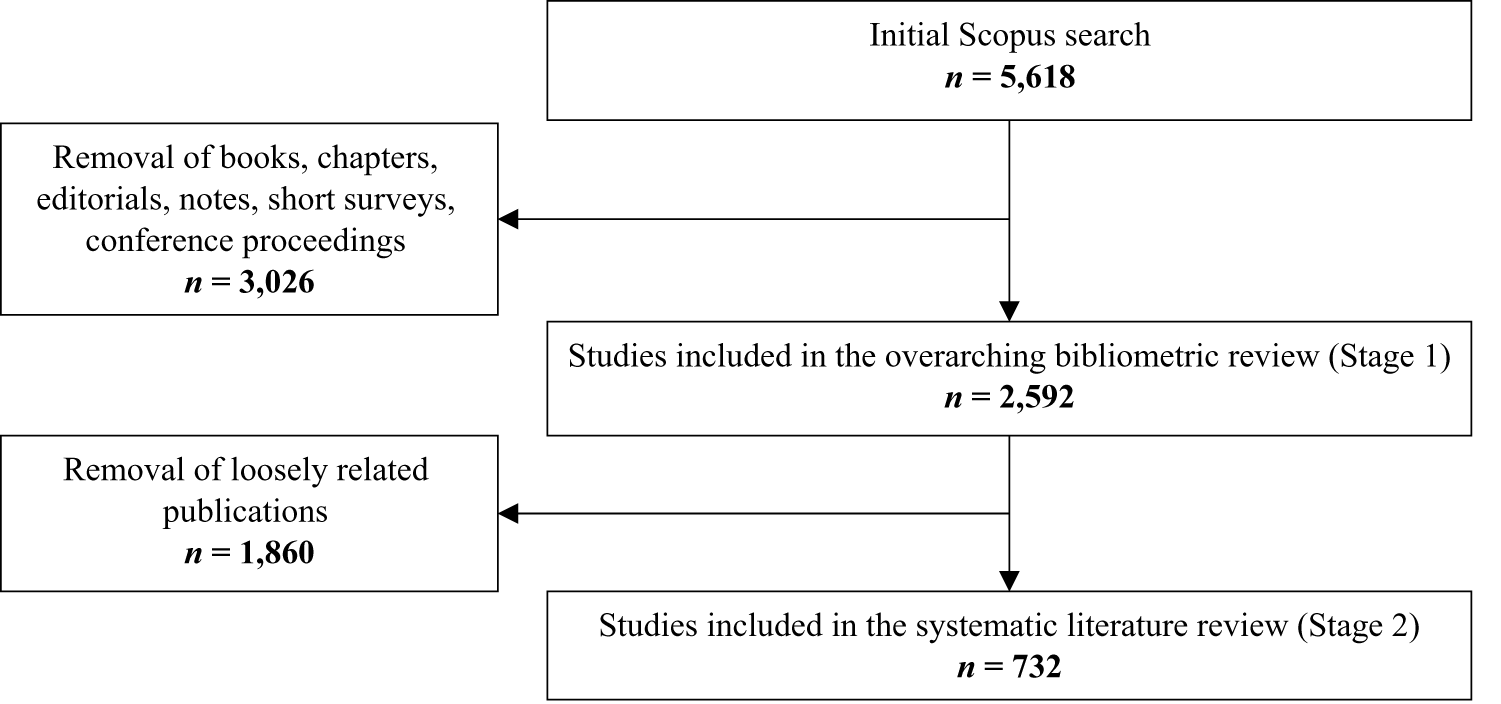
The fourth step involved screening the extracted data set for inclusion. Initially, we collected 5,618 studies from Scopus across various disciplines. The first exclusion criterion resulted in removing books, chapters, editorials, notes, short surveys, and conference proceedings. We opted for journal articles that had been thoroughly peer-reviewed before publication, as book chapters, books, editorials, notes, letters, and some conference publications do not follow the same robust peer-review processes as journal articles, thus deleting 3,026 publications from the list, leaving us with 2,592 articles.
In the fifth step, we conducted the data analysis using VOSviewer, a software tool for bibliometric mapping and visualization. VOSviewer creates visual maps based on distance-based clustering, where items with higher similarity are positioned closer to each other on the map (van Eck & Waltman, Reference van Eck and Waltman2010). This clustering technique allows us to identify groups of related publications and terms. For this study, we focused on analyzing the co-occurrence of key terms and themes in the data set, which were grouped into clusters. Each cluster was analyzed in terms of its frequently occurring terms, which matched the topic areas of the publications in that cluster. This step allowed us to clearly understand the major research themes and subfields within Industry 5.0 research.
Finally, in the sixth step, we reported our findings by interpreting the clusters identified in the VOSviewer analysis and organizing them into a taxonomy. This involved selecting the most relevant and highly cited publications within each cluster to represent key research areas (Klarin, Reference Klarin2024). We then analyzed and discussed these clusters, offering insights into the state of Industry 5.0 research and its implications for future studies. The final taxonomy offers a structured understanding of the existing academic landscape surrounding Industry 5.0 and provides a roadmap for future research endeavors. The full findings of the bibliometric review are presented in the third section of this paper.
The bibliometric stage provided a macro-level overview of the Industry 5.0 research landscape by analyzing 2,592 Scopus-indexed journal articles. This analysis identified five dominant thematic clusters, allowing us to map the main contours of the field and detect key themes, relationships, and emerging trends that guided the subsequent in-depth analysis. The five clusters centered on technological foundations, human-centricity, and the three dimensions of sustainability. Together, these clusters provided the structural foundation for the integrative model developed in the second stage of the study.
Systematic literature review
For the second stage, we adopted the systematic review methodology proposed by Tranfield, Denyer and Smart (Reference Tranfield, Denyer and Smart2003), following three steps: study selection, quality assessment, and synthesis. This structured approach reduces reviewer bias and ensures that conclusions are grounded in a comprehensive evidence base (Tranfield et al., Reference Tranfield, Denyer and Smart2003). The first step applies clear inclusion and exclusion criteria to define the scope of the review. The second step evaluates the methodological quality of studies to ensure that the synthesis relies on rigorous, peer-reviewed evidence (Tranfield et al., Reference Tranfield, Denyer and Smart2003). The final step synthesizes findings across studies through meta-triangulation, allowing patterns, relationships, and emerging themes to be identified rather than merely summarizing individual papers.
This systematic review used the same data set of 2,592 journal articles identified during the bibliometric stage. Maintaining a common data set ensured analytical consistency across both stages: the bibliometric analysis provided a macro-level overview of the Industry 5.0 research landscape, while the systematic review examined the relationships and dynamics among elements identified at that macro level. Using the same body of evidence strengthens the coherence between the two analytical stages and ensures that the integrative model is grounded in the literature that informed the thematic clusters.
The 2,592 articles were imported into Covidence for screening. Covidence is a web-based platform designed to support systematic reviews by facilitating citation screening and full-text assessment while reducing bias through collaborative review. Two independent reviewers screened abstracts, with disagreements resolved through discussion. Articles were included if they substantively examined Industry 5.0 elements and their interrelationships. Studies that only briefly mentioned Industry 5.0 while primarily focusing on other technologies or loosely related topics were excluded. This process removed 1,860 articles, resulting in a final data set of 732 articles for analysis. We acknowledge that relying on a single Scopus data set may exclude relevant studies indexed in other databases such as Web of Science or Google Scholar; this limitation is discussed later in the paper.
The selected articles were analyzed using content analysis, which identifies patterns and insights from textual data. Full texts were systematically coded to classify attributes related to Industry 5.0 inputs and outputs. This analysis enabled the identification of key input–output relationships, feedback mechanisms, and transformation processes that form the empirical basis of the integrative model.
In summary, the systematic review provided a micro-level analysis of 732 studies and identified two primary input categories, technological adaptation and human-centricity, and three sustainability outputs, economic, environmental, and social. These elements are connected through a socio-technical transformation process. Together with the macro-level insights from the bibliometric stage, these findings form the empirical basis of the integrative Input–output model presented in the following section. Both stages of the research process are illustrated in Figure 1.
Results of the search and study selection criteria for the integrative review.
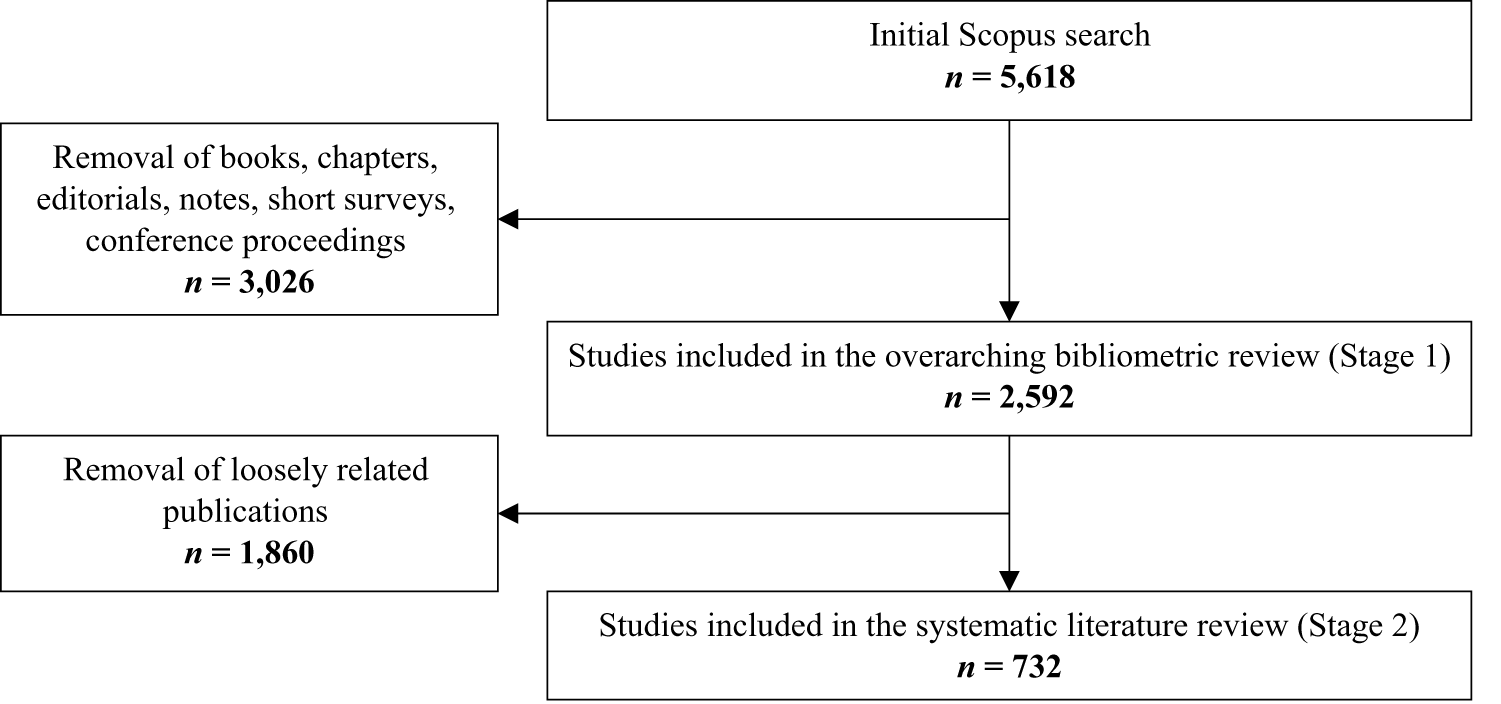
Figure 1 Long description
The flowchart begins with an 'Initial Scopus search' resulting in 5,618 entries. The first removal step eliminates books, chapters, editorials, notes, short surveys and conference proceedings, reducing the count by 3,026. This leads to 'Studies included in the overarching bibliometric review (Stage 1)' with 2,592 studies. The next removal step targets loosely related publications, removing 1,860 entries. Finally, 'Studies included in the systematic literature review (Stage 2)' are narrowed down to 732 studies. Arrows indicate the flow from one stage to the next, showing the progression and filtering of studies through the review process.
Findings
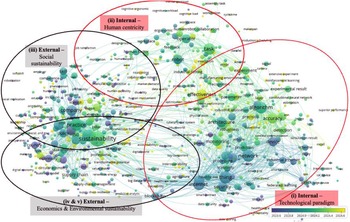
The bibliometric analysis of Industry 5.0 research using VOSviewer identified five dominant research clusters that collectively reflect the systemic architecture of the Industry 5.0 paradigm. From a systems thinking perspective, these clusters do not represent isolated thematic silos, but rather interdependent subsystems that co-evolve through feedback loops, non-linear interactions, and emergent outcomes. The largest cluster centers on technological foundations, followed by a human-centric cluster, while the remaining three clusters capture social, environmental, and economic sustainability as interconnected system-level outputs. As illustrated in Figure 2, brighter-colored nodes represent more recent research streams, indicating a temporal shift toward integrative, value-oriented, and socio-technical concerns. Rather than reflecting fragmentation, the distribution of clusters signals a maturing research field increasingly aligned with holistic and systemic thinking. To avoid redundancy across analytical stages, the bibliometric overview provides a macro-level mapping of the Industry 5.0 knowledge system, while the subsequent systematic review and integrative model unpack the causal and relational dynamics between inputs and outputs.
Industry 5.0 research on one map.
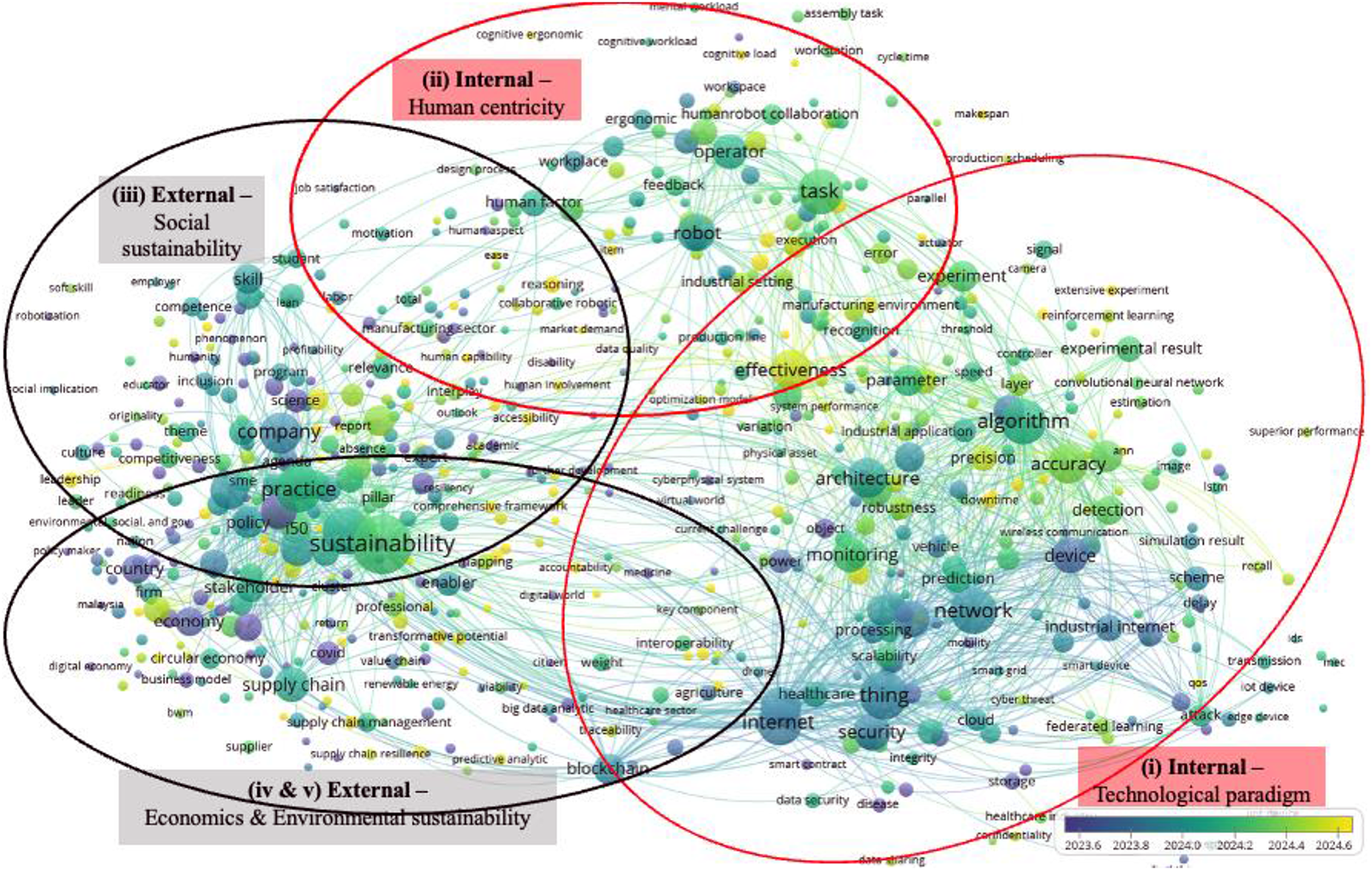
Figure 2 Long description
The image displays a bibliometric map of Industry 5.0 research, highlighting five distinct clusters. Cluster (i) is labeled 'Internal – Human centricity,' focusing on human-centered aspects. Cluster (ii) is labeled 'Internal – Technological paradigm,' emphasizing technological foundations. Cluster (iii) is labeled 'External – Social sustainability,' addressing social sustainability themes. Clusters (iv) and (v) are labeled 'External – Economics & Environmental sustainability,' capturing economic and environmental sustainability. The map includes numerous nodes connected by lines, representing research streams and their interconnections. Each cluster is enclosed within an oval, indicating its thematic focus and systemic architecture within the Industry 5.0 paradigm.
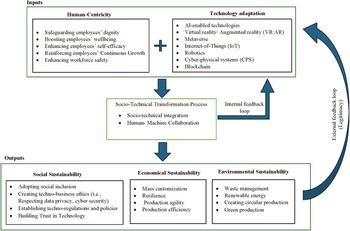
The systematic literature review addresses the second research question, ‘How are these characteristics interconnected based on system thinking?’, by explicitly revealing the structural logic of Industry 5.0 as a socio-technical system. As shown in Figure 3, the literature consistently positions technological adaptation and human-centricity as foundational inputs that interact dynamically rather than sequentially. This interaction reflects a paradigmatic shift away from Industry 4.0’s efficiency-dominated logic toward a value-oriented system in which technological advancement is contingent upon human, social, and ethical considerations (Negri, Cagno, Colicchia & Sarkis, Reference Negri, Cagno, Colicchia and Sarkis2021; Piccarozzi, Silvestri, Silvestri & Ruggieri, Reference Piccarozzi, Silvestri, Silvestri and Ruggieri2024). From a systems thinking lens, these inputs function as enabling conditions that generate reinforcing feedback loops, producing three interrelated outputs: economic, environmental, and social sustainability. These outputs are not end-state outcomes but emergent properties of the system, continuously shaped by reciprocal interactions between technological capabilities, human agency, and institutional contexts (Sindhwani et al., Reference Sindhwani, Afridi, Kumar, Banaitis, Luthra and Singh2022).
The Industry 5.0 input–output model.
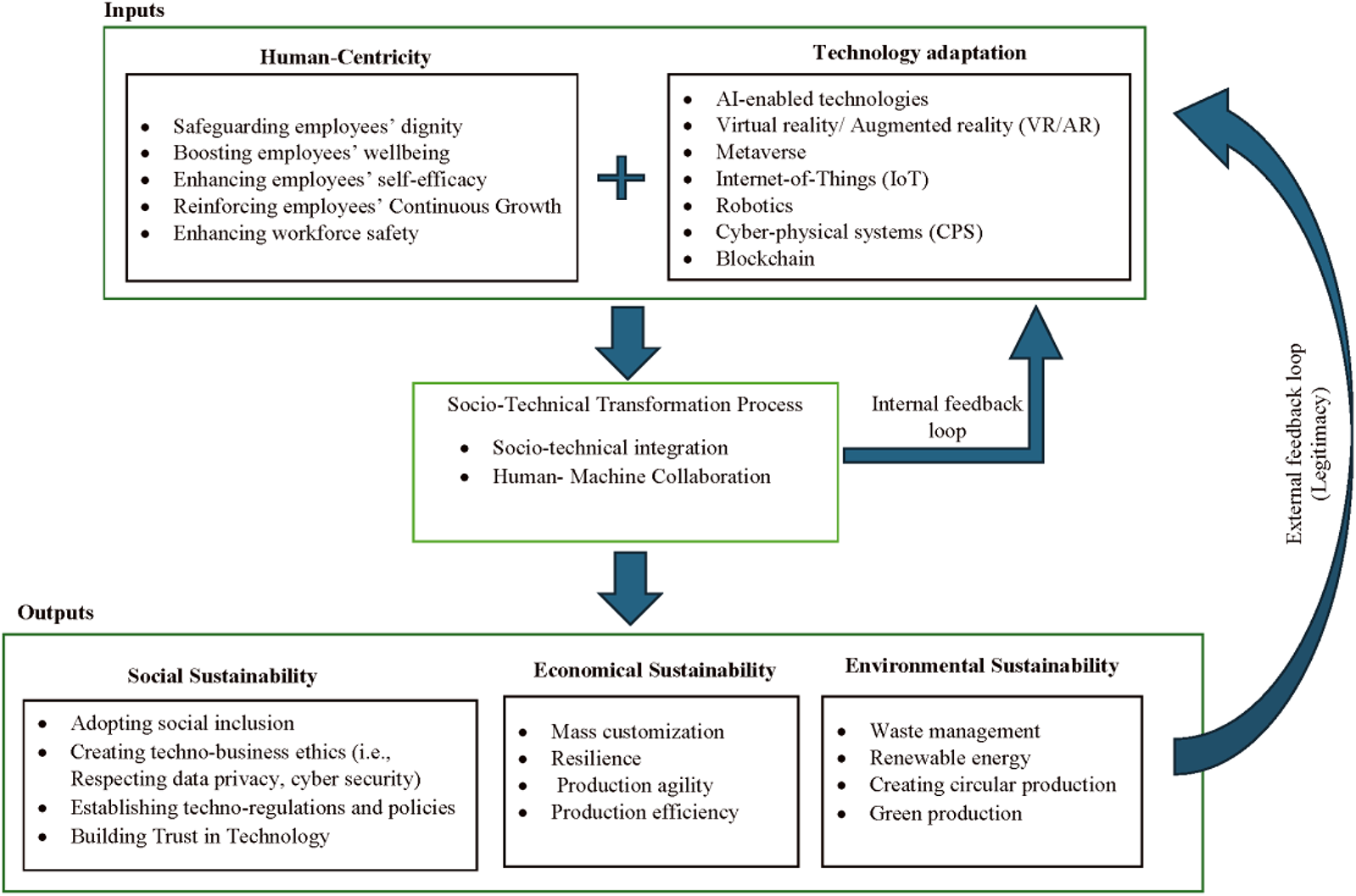
Figure 3 Long description
The diagram shows the Industry 5.0 input-output model. Inputs are divided into two categories: Human-Centricity and Technology Adaptation. Human-Centricity includes safeguarding employees' dignity, enhancing employees' wellbeing, boosting employees' creativity, facilitating employees' continuous growth and enhancing workforce safety. Technology Adaptation includes AI-enabled technologies, virtual reality/augmented reality (VR/AR), sensors, Internet of Things (IoT), robotics, cyber-physical systems (CPS) and blockchain. These inputs lead to the Socio-Technical Transformation Process, which involves socio-technical integration and human-machine collaboration. An internal feedback loop is indicated. Outputs are categorized into Social Sustainability, Economic Sustainability and Environmental Sustainability. Social Sustainability includes adapting social inclusion, creating new business models, enhancing employees' creativity, establishing new standards and policies and building trust in technology. Economic Sustainability includes mass customization, production agility and production efficiency. Environmental Sustainability includes waste management, recycling, sustainable energy production and green production. An external feedback loop is also indicated.
The growing presence of GenAI within Industry 5.0 intensifies these systemic dynamics. GenAI does not merely automate processes; it reshapes decision-making structures, redistributes cognitive labor, and alters human–machine interactions across the system. As such, GenAI acts as both a technological catalyst and a systemic amplifier, accelerating feedback loops between inputs and outputs while raising new governance, ethical, and human-centric challenges.
Throughput: Socio-technical transformation process
Within this systemic framework, the transition from inputs to outputs does not occur instantly. Instead, it takes place through a process stage, often referred to as throughput, where inputs are transformed into outcomes. In the context of Industry 5.0, this stage represents the integration of human capabilities and technological tools into operational practices. Research on human-centric production systems emphasizes that technologies should support human decision-making rather than replace it, highlighting the continued importance of human agency in industrial environments (Breque et al., Reference Breque, De Nul and Petridis2021; Xu, Lu, Vogel-Heuser & Wang, Reference Xu, Lu, Vogel-Heuser and Wang2021).
During this stage, human–machine interaction is characterized by adaptive integration, where technologies complement human expertise rather than operate through rigid instructions. This integration depends on continuous data interpretation, decentralized intelligence, and flexible adjustment of workflows within production systems (Tao, Zhang, Liu & Nee, Reference Tao, Zhang, Liu and Nee2019; Xu et al., Reference Xu, Lu, Vogel-Heuser and Wang2021). Such capabilities enable organizations to respond more effectively to complex and rapidly changing industrial environments.
Recognizing throughput as a distinct stage clarifies how sustainability outcomes emerge. These outcomes do not result solely from technological adoption but from how human actors interpret and apply technological capabilities within organizational processes. In Industry 5.0 environments, advanced tools such as artificial intelligence and GenAI enhance analytical capabilities and decision support, while human judgment remains central to guiding system behavior and aligning operations with organizational and societal objectives (Breque et al., Reference Breque, De Nul and Petridis2021; Ivanov, Reference Ivanov2023). As a result, the technical efficiency of industrial systems is filtered through human-centric decision-making and organizational values.
The throughput stage is also where the socio-technical integration that distinguishes Industry 5.0 from earlier industrial paradigms becomes visible. The literature highlights three recurring patterns. First, cognitive redistribution occurs as technologies such as GenAI handle routine data processing while human actors focus on judgment, creativity, and ethical oversight (Bamdad, Reference Bamdad2025; Passalacqua et al., Reference Passalacqua, Pellerin, Magnani, Doyon-Poulin, Del-Aguila, Boasen and Léger2025). This represents a shift from Industry 4.0, where automation is often aimed at reducing human involvement (Nazarov & Klarin, Reference Nazarov and Klarin2020). Second, the literature points to adaptive co-evolution, where the process evolves through continuous interaction: human insights reshape technological configurations, while technological capabilities expand the scope of human decision-making (Coronado et al., Reference Coronado, Kiyokawa, Ricardez, Ramirez-Alpizar, Venture and Yamanobe2022; Wang et al., Reference Wang, Zhou, Li, Yang, Zheng, Song, Yuan, Wuest, Yang and Wang2024). Third, value filtering occurs as technological outputs are evaluated through human-centric criteria before becoming system outcomes. For example, efficiency gains that undermine worker well-being may be reconsidered or redirected within the process rather than accepted as final outputs (Davila-Gonzalez & Martin, Reference Davila-Gonzalez and Martin2024; Horvat, Jäger & Lerch, Reference Horvat, Jäger and Lerch2025).
These patterns indicate that throughput is not simply a conduit between inputs and outputs but an active governance layer within the system. At this stage, the model’s non-linear dynamics become evident, as similar technological inputs can generate different sustainability outcomes depending on how effectively human-centric mediation operates within the process (Callari, Curzi & Lohse, Reference Callari, Curzi and Lohse2025; Farivar, Eshraghian, Hafezieh & Cheng, Reference Farivar, Eshraghian, Hafezieh and Cheng2024). This insight has important implications for management. It suggests that investments in the throughput stage, such as employee training, governance mechanisms, and collaborative workflows, may produce greater organizational benefits than investments focused solely on technological inputs.
Systemic feedback and regulatory dynamics
To maintain system stability, the model distinguishes the transformation process from the feedback mechanisms that regulate it. Systems theory suggests that complex socio-technical systems remain viable through feedback structures that continuously adjust internal processes in response to changing conditions (Arnold & Wade, Reference Arnold and Wade2015; Meadows, Reference Meadows2008). In this context, the findings indicate that the Industry 5.0 system operates through two primary layers of feedback. The first layer is an internal reinforcing feedback loop between technological and human inputs. As technological adaptation introduces more advanced tools, analytics, and digital capabilities, it strengthens human skills, learning, and self-efficacy. At the same time, human values, creativity, and contextual judgment influence how technologies are designed, implemented, and improved (Breque et al., Reference Breque, De Nul and Petridis2021; Xu et al., Reference Xu, Lu, Vogel-Heuser and Wang2021). This reciprocal relationship reflects the socio-technical logic of Industry 5.0, where technologies develop alongside human capabilities rather than replacing them. Through this reinforcing loop, the system’s core components co-evolve while maintaining a focus on human dignity, well-being, and agency (Breque et al., Reference Breque, De Nul and Petridis2021).
The second layer is an external balancing feedback loop that links the system’s outputs, economic, environmental, and social sustainability, back to the input stage. Balancing feedback mechanisms regulate system behavior by correcting deviations between intended and actual outcomes (Meadows, Reference Meadows2008). We suggest that, in Industry 5.0 environments, this mechanism operates through institutional legitimacy. When organizations generate sustainable outcomes, they receive positive signals from stakeholders, regulators, and society, reinforcing their strategic direction. When sustainability expectations are not met, external pressures encourage organizations to reconsider their technological strategies or the extent to which human-centric principles guide decision-making (van Erp et al., Reference van Erp, Carvalho, Gerolamo, Gonçalves, Rytter and Gladysz2024).
These feedback mechanisms show that Industry 5.0 operates as a self-regulating socio-technical system. Organizations maintain legitimacy and long-term viability by continuously adjusting internal processes in response to evolving expectations around sustainability and responsible technology use (Geissdoerfer et al., Reference Geissdoerfer, Vladimirova and Evans2018; van Erp et al., Reference van Erp, Carvalho, Gerolamo, Gonçalves, Rytter and Gladysz2024). In this way, technological innovation, human values, and institutional pressures are integrated into an adaptive system capable of sustaining both organizational performance and societal trust.
In addition, the two feedback layers interact to produce broader system-level dynamics. When the internal reinforcing loop is strong, meaning technology and human-centric practices are closely aligned and mutually supportive, the system generates sustainability outcomes that satisfy external legitimacy demands. Institutional validation then reinforces managerial confidence in the human-centric approach, creating a virtuous cycle in which legitimacy strengthens the inputs that produced it (Renda et al., Reference Renda, Schwaag, Tataj, Morlet, Isaksson, Martins and Giovannini2022; Suchman, Reference Suchman1995).
By contrast, when the internal loop is weak, for example, when technologies are implemented without sufficient human-centric governance, the resulting outcomes may fail to meet societal expectations. In such situations, the external balancing loop generates corrective pressures that destabilize the current configuration. These pressures may appear as regulatory intervention, reputational damage, or resistance from employees and other stakeholders, requiring organizations to recalibrate their strategies (Gölzer & Fritzsche, Reference Gölzer and Fritzsche2017; Hahn & Lülfs, Reference Hahn and Lülfs2014).
Key inputs of Industry 5.0
Consistent with systems thinking, Industry 5.0 inputs operate as interdependent subsystems whose interactions give rise to emergent outcomes. Literature positions technological adaptation and human-centricity as mutually reinforcing inputs rather than independent drivers. This interaction reflects a systemic rebalancing in which technological progress is constrained, shaped, and legitimized by human values, social norms, and institutional expectations. Industry 5.0 thus reasserts human agency as a core organizing principle of industrial systems, challenging the techno-deterministic orientation of Industry 4.0 (Callari et al., Reference Callari, Curzi and Lohse2025; Müller, Veile & Voigt, Reference Müller, Veile and Voigt2020; Renda et al., Reference Renda, Schwaag, Tataj, Morlet, Isaksson, Martins and Giovannini2022).
Technology as an input
As with prior industrial revolutions, Industry 5.0 is grounded in technological transformation. However, the technological cluster identified in the bibliometric analysis reflects a qualitatively different configuration. Rather than emphasizing cyber-physical connectivity alone, Industry 5.0 research focuses on diverse technologies, including machine learning, deep learning, federated learning, big data analytics, blockchain, 5G and 6G networks, cloud-edge-fog computing, additive manufacturing, and AI, within complex socio-technical systems. IoT serves as the connective tissue that enables real-time data flows, interoperability, and adaptive responses across system components, while security, privacy, and data integrity emerge as critical system constraints (Shruti, Srivastava & Srivastava, Reference Shruti and Srivastava2024; Sizan, Dey, Layek, Uddin & Huh, Reference Sizan, Dey, Layek, Uddin and Huh2025).
From a systems thinking perspective, these technologies function as sensing, processing, and actuation mechanisms that enable feedback-driven adaptation. GenAI, in particular, introduces a qualitative shift by enabling generative, predictive, and interpretive capabilities that extend beyond rule-based automation (Bamdad, Reference Bamdad2025). This allows organizations to simulate scenarios, personalize interactions, and support human decision-making in real time (Bamdad, Reference Bamdad2025; Xian et al., Reference Xian, Yu, Han, Fang, He and Han2024). The application of these technologies across healthcare (Wazid, Singh, Das & Rodrigues, Reference Wazid, Singh, Das and Rodrigues2024), transportation (Du et al., Reference Du, He, Cao, Garg, Kaddoum and Hassan2023; Sarkar, Sharma & Shardeo, Reference Sarkar, Sharma and Shardeo2025), and agriculture (Bissadu, Sonko & Hossain, Reference Bissadu, Sonko and Hossain2025; Victor et al., Reference Victor, Maddikunta, Mary, Murugan, Chengoden, Gadekallu, Rakesh, Zhu and Paek2024) illustrates how Industry 5.0 technologies reconfigure sectoral systems rather than merely optimizing isolated processes.
While Industry 4.0 emphasized cyber-physical systems and IoT-enabled efficiency (Kagermann, Wahlster & Helbig, Reference Kagermann, Wahlster and Helbig2013; Nazarov & Klarin, Reference Nazarov and Klarin2020), Industry 5.0 research expands this technological base to include GenAI-driven cognition, decentralized intelligence, and ethical infrastructures (Maddikunta et al., Reference Maddikunta, Pham, Prabadevi, Deepa, Dev, Gadekallu and Liyanage2022; Rijwani et al., Reference Rijwani, Kumari, Srinivas, Abhishek, Iyer, Vara and Gupta2025). These technological inputs are deeply entangled with human-centric considerations, which include shaping and being shaped by social, environmental, and economic system dynamics.
Human-centricity as an input
Human-centricity represents the normative core of Industry 5.0 and functions as a critical balancing mechanism within the system. Rather than treating humans as passive operators or mere extensions of the machine, Industry 5.0 conceptualizes workers as adaptive agents whose creativity, judgment, and values are indispensable to system performance (Breque et al., Reference Breque, De Nul and Petridis2021; Callari et al., Reference Callari, Curzi and Lohse2025). This orientation reflects systems thinking’s emphasis on purposeful human actors and highlights the limitations of purely technology-driven optimization, which often overlooks the social subsystem in favor of cold algorithmic efficiency.
Central to this human-centric shift is the concept of human agency. Human agency is not a static trait but a dynamic behavior through which individuals navigate and manage their boundaries in an increasingly digitalized environment (Farivar et al., Reference Farivar, Eshraghian, Hafezieh and Cheng2024). In the context of our Industry 5.0 framework, human agency is the mechanism that allows workers to act as system governors (Singh and Cohen, Reference Singh and Cohen2025). Instead of being overwhelmed by the pervasive constant connectivity and automation of Industry 4.0, workers in a 5.0 system exercise agency to negotiate how, when, and why they interact with technology (Farivar et al., Reference Farivar, Eshraghian, Hafezieh and Cheng2024). This concern is well-founded; for example, Brougham and Haar (Reference Brougham and Haar2018) demonstrated that employees’ awareness of smart technology, AI, robotics, and algorithms replacing their roles negatively affects organizational commitment and career satisfaction, underscoring why human agency must be actively protected rather than assumed in technology-intensive environments.
This link is vital: if Industry 5.0 is to be truly human-centric, it must move beyond providing ergonomic tools to actively fostering an environment where human agency can flourish. In our model, this manifests as an internal feedback loop; when the system respects and enhances human agency, workers are better equipped to perform complex boundary management, which in turn reduces burnout and increases the system’s overall resilience. This aligns with the interconnectedness principle of systems theory, suggesting that the health of the industrial ecosystem is directly proportional to the agency afforded to its human components. By positioning agency as a foundational driver (input), we argue that the human-centricity in Figure 3 is not just a passive value, but an active, agentic force that shapes the ethical and sustainable trajectory of the entire organization.
The literature emphasizes enhanced employment quality, autonomy, dignity, and job satisfaction as defining characteristics of human-centric systems (Horvat et al., Reference Horvat, Jäger and Lerch2025; Huang et al., Reference Huang, Wang, Li, Zheng, Mourtzis and Wang2022). Smart devices capable of monitoring physiological and psychological states enable early interventions and adaptive workload management, creating feedback loops that support worker well-being (Davila-Gonzalez & Martin, Reference Davila-Gonzalez and Martin2024). GenAI further amplifies these dynamics by enabling personalized training, decision support, and real-time risk mitigation, although challenges related to transparency, standardization, and privacy persist (Wang et al., Reference Wang, Zhou, Li, Yang, Zheng, Song, Yuan, Wuest, Yang and Wang2024).
Human–robot collaboration emerges as a critical subsystem within the human-centric cluster. Research highlights safety, ergonomics, and experiential quality as key design criteria, with AI enhancing situational awareness and adaptive behavior (Panagou, Neumann & Fruggiero, Reference Panagou, Neumann and Fruggiero2024; Xu, Ji, Zheng & Wang, Reference Xu, Ji, Zheng and Wang2026). Simulation technologies and feedback mechanisms further strengthen system learning and resilience (Coronado et al., Reference Coronado, Kiyokawa, Ricardez, Ramirez-Alpizar, Venture and Yamanobe2022). Across manufacturing contexts, these technologies support mass customization and workflow optimization while foregrounding human factors such as stress, safety, and well-being (Horvat et al., Reference Horvat, Jäger and Lerch2025; Ivanov, Reference Ivanov2023; Langås, Zafar & Sanfilippo, Reference Langås, Zafar and Sanfilippo2025).
Cross-cutting synthesis: Patterns across the system
Reading across the inputs, throughput, feedback, and output components of the model, four cross-cutting patterns emerge that advance collective understanding beyond the descriptive mapping of prior reviews. First, human-centricity is not a parallel pillar but a governing variable. Across every component of the model, from the technology input (where human values shape which technologies are adopted and how), through the throughput (where human agency acts as the value filter), to the feedback loops (where human-centric outcomes determine institutional legitimacy), the literature consistently positions human-centricity as the variable that governs the system’s trajectory (Breque et al., Reference Breque, De Nul and Petridis2021; Callari et al., Reference Callari, Curzi and Lohse2025; Renda et al., Reference Renda, Schwaag, Tataj, Morlet, Isaksson, Martins and Giovannini2022). This challenges the prevailing three-pillar framing (resilience, sustainability, and human-centricity) (Maddikunta et al., Reference Maddikunta, Pham, Prabadevi, Deepa, Dev, Gadekallu and Liyanage2022; Xu et al., Reference Xu, Lu, Vogel-Heuser and Wang2021) by revealing an asymmetry: human-centricity is not co-equal with resilience and sustainability but is the mechanism through which resilience and sustainability are produced (Farivar et al., Reference Farivar, Eshraghian, Hafezieh and Cheng2024; Huang et al., Reference Huang, Wang, Li, Zheng, Mourtzis and Wang2022).
Second, the system exhibits non-linear amplification. The model reveals that GenAI does not merely add capability but amplifies whatever signal is strongest in the system (Passalacqua et al., Reference Passalacqua, Pellerin, Magnani, Doyon-Poulin, Del-Aguila, Boasen and Léger2025; Sai, Sai & Chamola, Reference Sai, Sai and Chamola2025). Where human-centricity is robust, GenAI amplifies positive outcomes through enhanced decision-making, personalized well-being support, and adaptive workflows. Where human-centricity is weak, GenAI amplifies dysfunction in automation bias, social alienation, and convergent logic at the expense of divergent human potential. This non-linearity means that Industry 5.0 is inherently unstable at the margins: the system tends toward either a virtuous cycle of socio-technical integration or a vicious cycle of techno-deterministic drift (Lozano-Paredes, Reference Lozano-Paredes2025; Tabata, Wildermuth, Bottomley & Jenkins, Reference Tabata, Wildermuth, Bottomley and Jenkins2025), with the throughput stage serving as the critical tipping point.
Third, legitimacy is the systemic driver of transition, not merely its justification. Prior reviews have treated the Industry 4.0 to 5.0 shift as technologically motivated (Ghobakhloo et al., Reference Ghobakhloo, Iranmanesh, Foroughi, Tirkolaee, Asadi and Amran2023; Kumar et al., Reference Kumar, Kaswan, Kumar, Chaudhary, Garza-Reyes, Rathi and Joshi2024). Our model reveals that the transition is driven by legitimacy deficits: Industry 4.0’s reliance on strategic legitimacy (e.g., potentials on superficial compliance or greenwashing) created a growing gap between organizational rhetoric and societal expectations (Gölzer & Fritzsche, Reference Gölzer and Fritzsche2017; Hahn & Lülfs, Reference Hahn and Lülfs2014; Suchman, Reference Suchman1995). The external feedback loop in our model captures this dynamic: the failure to achieve genuine sustainability outputs triggers corrective pressure that compels a structural shift toward institutional legitimacy (March & Olsen, Reference March, Olsen, Goodin, Moran and Rein2009; Meyer & Rowan, Reference Meyer and Rowan1977), which in turn requires the deep socio-technical integration that defines Industry 5.0.
Fourth, sustainability outputs are emergent properties, not engineered endpoints. The three output categories (economic, environmental, and social sustainability) do not result from separate, targeted interventions but emerge from the quality of interaction between inputs within the throughput, moderated by feedback dynamics (Arnold & Wade, Reference Arnold and Wade2015; Katz & Kahn, Reference Katz and Kahn1978). This means that organizations cannot optimize for one sustainability dimension in isolation (Frederico, Reference Frederico2021; Sindhwani et al., Reference Sindhwani, Afridi, Kumar, Banaitis, Luthra and Singh2022). Attempts to maximize economic efficiency without attending to social and environmental dimensions will be corrected by the external feedback loop, while holistic investments in socio-technical integration tend to produce compounding gains across all three dimensions (Piccarozzi et al., Reference Piccarozzi, Silvestri, Silvestri and Ruggieri2024; van Erp et al., Reference van Erp, Carvalho, Gerolamo, Gonçalves, Rytter and Gladysz2024). This pattern of emergence is precisely what distinguishes a systems model from the taxonomic approaches of prior reviews, and it opens new avenues for future research on the conditions under which such emergence occurs most effectively.
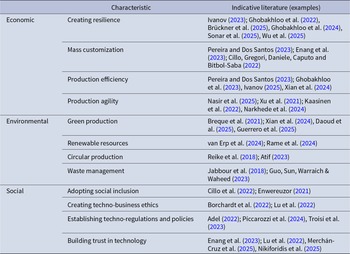
Table 1 presents the specific characteristics and indicative literature for each sustainability output dimension, organized across economic (resilience, mass customization, production efficiency, production agility), environmental (green production, renewable resources, circular production, waste management), and social (social inclusion, techno business ethics, techno regulations, trust in technology) categories.
Characteristics and attributes of Industry 5.0 outputs
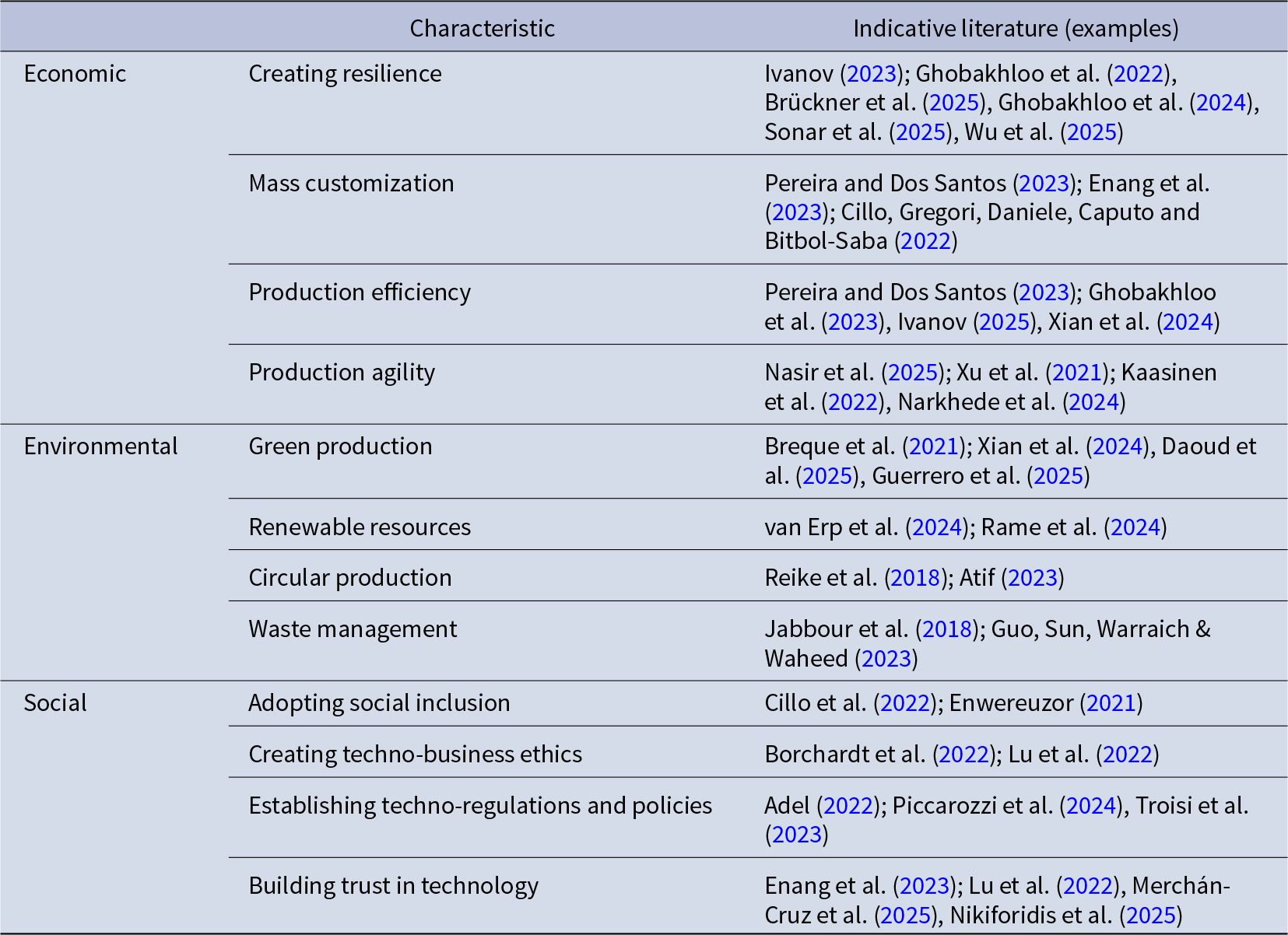
Table 1 Long description
The table groups Industry 5.0 output characteristics into three domains and lists indicative literature examples for each characteristic. Economic outputs include creating resilience, mass customization, production efficiency, and production agility, each supported by multiple cited studies. Environmental outputs cover green production, renewable resources, circular production, and waste management, with references spanning earlier and more recent work. Social outputs include adopting social inclusion, creating techno-business ethics, establishing techno-regulations and policies, and building trust in technology, again illustrated with example citations. Across domains, several characteristics cite multiple sources, suggesting broad scholarly attention rather than a single definitive viewpoint. The table functions as a mapping of themes to representative literature and does not quantify effect sizes, prevalence, or strength of evidence.
Discussion
This study advances the understanding of Industry 5.0 by reframing it not merely as an extension of Industry 4.0, but as a complex socio-technical system driven by interdependent feedback loops. While prior research has largely examined the transition to Industry 5.0 through isolated pillars, sustainability, human-centricity, and resilience, our findings, visualized in the bibliometric analysis and the systemic framework, reveal a more dynamic architecture. We demonstrate that Industry 5.0 operates as a holistic ecosystem where technological adaptation and human-centricity function as critical inputs that collectively generate economic, environmental, and social sustainability as emergent outputs. This distinction is crucial; rather than viewing human values as optional add-ons to technological progress, our framework positions human-centricity as a foundational driver that actively shapes how technologies are deployed to achieve systemic resilience.
Systems theory and the architecture of Industry 5.0
This research makes several theoretical contributions. Through the lens of systems theory, we expand the Industry 5.0 literature by conceptualizing this phenomenon as an interconnected whole. To the best of our knowledge, existing literature has predominantly focused on the transition from Industry 4.0 to a value-centric Industry 5.0 (Madhavan, Wangtueai, Sharafuddin & Chaichana, Reference Madhavan, Wangtueai, Sharafuddin and Chaichana2022; Zizic, Mladineo, Gjeldum & Celent, Reference Zizic, Mladineo, Gjeldum and Celent2022) or its application within specific organizational settings (Mylonas et al., Reference Mylonas, Kalogeras, Kalogeras, Anagnostopoulos, Alexakos and Muñoz2021). Our input–output framework (Figure 3) advances this by illustrating that the behavior of the Industry 5.0 system is non-linear; changes in technological inputs do not automatically lead to sustainable outcomes without the mediating influence of human-centric values. This aligns with the interconnectedness principle of systems theory, suggesting that the resilience of an industrial system depends on the quality of the coupling between its technical and social subsystems. By identifying human-centricity as a governing input, we argue that it acts as a stabilizing feedback mechanism, preventing the system from drifting toward purely efficiency-driven but socially fragile outcomes typical of rigid Industry 4.0 implementation.
Applying systems theory further allows us to understand the entropy that occurs when industrial systems ignore the social subsystem. In Industry 4.0, the technical aspect of transformation dominated the social aspect of it. This leads to a decrease in worker engagement and societal trust. Systems theory suggests that for a system to reach a steady state, it must process information from its environment and adjust its internal settings (Katz & Kahn, Reference Katz and Kahn1978). Industry 5.0 serves as this steady-state configuration. By processing technological adaptation and human-centricity as a unified socio-technical process, the system moves toward negentropy, a state of increasing order and resilience. The non-linearity identified in our model suggests that small improvements in human-centric governance can lead to exponentially better sustainability outputs, a phenomenon known in systems thinking as equifinality, where different initial conditions can lead to the same successful state of sustainability through various systemic paths (Katz & Kahn, Reference Katz and Kahn1978).
These systems insights gain additional explanatory power when viewed through ecological systems theory (Bronfenbrenner, Reference Bronfenbrenner1979, Reference Bronfenbrenner2000). The architecture of our model aligns with Bronfenbrenner’s ecological levels and clarifies where different dynamics operate within the socio-technical environment. The microsystem reflects the immediate human–machine interface, including worker–technology interactions, human–robot collaboration, and the exercise of human agency in daily work. The mesosystem corresponds to the throughput stage, where organizational processes integrate these interactions across functions, departments, and workflows into operational practices. The exosystem represents the external feedback loop, encompassing institutional and regulatory influences such as ESG frameworks, industry standards, and legitimacy pressures that shape organizational behavior indirectly. The macrosystem reflects broader societal values, including the SDGs and normative expectations that define organizational legitimacy. Finally, the chronosystem captures the temporal dimension of the transition from Industry 4.0 to Industry 5.0, including the accelerating role of GenAI as a catalyst of cross-level change.
Following Neal and Neal (Reference Neal and Neal2013), we view these levels as networked rather than simply nested, meaning that feedback loops operate across levels. For example, macrosystem-level regulatory signals can influence microsystem-level technology design, while worker experiences at the microsystem level can shape exosystem expectations. This ecological perspective helps explain why Industry 5.0 cannot be fully understood by examining a single level in isolation, a limitation that characterizes many pillar-based approaches in previous reviews (Tudge et al., Reference Tudge, Mokrova, Hatfield and Karnik2009).
Legitimacy theory and the driver of transition
In addition to system theory, we integrate legitimacy theory to explain the strategic necessity of the system’s outputs. We propose that the shift from Industry 4.0 to Industry 5.0 is driven by the need for organizational legitimacy. As noted in our findings, the outputs of economic, social, and environmental sustainability are not just operational goals but critical resources for survival. This can be explained by Suchman’s (Reference Suchman1995) framework. In his framework, Suchman (Reference Suchman1995) defines legitimacy as a generalized perception or assumption that the actions of an entity are desirable, proper, or appropriate within some socially constructed system of norms, values, beliefs, and definitions. The first pillar, strategic legitimacy, adopts an inside-out perspective where managers view legitimacy as an operational resource (Ashforth & Gibbs, Reference Ashforth and Gibbs1990). In this instrumental view, legitimacy is something the organization extracts from its environment through calculated actions, such as symbolic disclosures or targeted public relations campaigns. This approach is highly intentional and often transactional; the organization seeks to manipulate symbols to appear congruent with social values without necessarily altering its core technical processes (Dowling & Pfeffer, Reference Dowling and Pfeffer1975).
In the context of Industry 4.0, strategic legitimacy often manifested as ‘greenwashing’ or superficial human-resource policies designed to stave off regulatory pressure while maintaining a primary focus on cold machine efficiency (Hahn & Lülfs, Reference Hahn and Lülfs2014). This phenomenon represents a decoupling where the organization’s symbolic commitment to sustainability remains disconnected from its actual technical and operational core (Gölzer & Fritzsche, Reference Gölzer and Fritzsche2017). Conversely, the second pillar, institutional legitimacy, adopts an outside-in perspective that is far more profound and structural (Meyer & Rowan, Reference Meyer and Rowan1977). Here, legitimacy is not a tool to be used, but a set of cultural constraints that the organization must internalize to be seen as logical or natural. It is not about doing good for a specific strategic gain, but about adopting a logic of appropriateness (March & Olsen, Reference March, Olsen, Goodin, Moran and Rein2009) where the organization’s very identity is built upon socially accepted roles and behaviors. While strategic legitimacy relies on pragmatic concerns such as whether the organization is meeting the immediate interests of its constituents, institutional legitimacy rests on moral and cognitive foundations (Suchman, Reference Suchman1995). Moral legitimacy involves a normative evaluation of whether the organization’s activities are the right thing to do based on the welfare of the entire social system, while cognitive legitimacy occurs when the organization’s practices become so taken-for-granted that they are no longer questioned.
For Industry 5.0, this distinction is transformative and directly informs our external feedback loop (Figure 3). A company cannot achieve a true socio-technical steady state through strategic legitimacy alone (Suchman, Reference Suchman1995). Instead, it must move toward institutional legitimacy, where human-centricity and environmental stewardship are not elective programs but are constitutive of the industrial system itself (Renda et al., Reference Renda, Schwaag, Tataj, Morlet, Isaksson, Martins and Giovannini2022). By shifting from a strategic to an institutional stance, an organization moves from merely managing its image to fundamentally aligning its internal socio-technical architecture with the evolving social contract of the 21st century (Silva, Reference Silva2021). In our model, this transition is the reinforcement that turns sustainability outputs into a self-sustaining feedback signal, ensuring the system’s long-term survival in a value-conscious global market.
Viewed through the ecological lens introduced earlier, legitimacy theory operates specifically at the exosystem and macrosystem levels of the Industry 5.0 ecosystem. The exosystem (including ESG reporting frameworks, industry regulations, supply chain standards) generates the immediate institutional pressures that organizations experience as demands for compliance and accountability. These exosystem pressures are themselves shaped by macrosystem-level forces: the cultural shift toward sustainability as a societal value, the normative weight of the SDGs, and the growing expectation that industrial activity should serve human well-being rather than merely economic efficiency. In ecological terms, the legitimacy deficit that drives the Industry 4.0 to 5.0 transition arises because macrosystem values have evolved faster than most organizations’ internal socio-technical architectures. Industry 4.0 organizations that relied on strategic legitimacy were adapted to an earlier macrosystem configuration; when macrosystem expectations shifted, their superficial compliance was exposed, triggering the corrective feedback dynamic captured in our external loop. Industry 5.0, by contrast, represents a structural alignment between the microsystem (where human–machine collaboration occurs), the mesosystem (where organizational processes integrate these interactions), and the exosystem/macrosystem (where legitimacy is conferred). This cross-level alignment is what Suchman (Reference Suchman1995) describes as cognitive legitimacy: when an organization’s practices become so deeply integrated with societal expectations that they are no longer questioned. Achieving this state requires far more than adopting new technologies; it requires reconfiguring the entire socio-technical system so that human-centricity and sustainability are constitutive of the organization’s identity at every ecological level.
AI-enabled technologies as a systemic amplifier
Our review highlights the transformative role of AI, especially GenAI, as a systemic amplifier (Passalacqua et al., Reference Passalacqua, Pellerin, Magnani, Doyon-Poulin, Del-Aguila, Boasen and Léger2025). Unlike traditional automation, GenAI accelerates the feedback loops between human inputs and sustainable outputs by enhancing decision-making capabilities and enabling real-time adaptability (Sai et al., Reference Sai, Sai and Chamola2025). However, this creates new systemic risks. Krakowski (Reference Krakowski2025) argued that GenAI represents a fundamental shift from predictive to generative agency, which necessitates a reassessment of human-AI collaboration. If the human-centric input is weak, the system risks falling into a convergent logic characterized by a narrow focus on efficiency and accuracy at the expense of divergent human potential. Without robust oversight, GenAI could destabilize the system by prioritizing algorithmic efficiency over social welfare, a risk exacerbated by automation bias, where humans prematurely trust AI outputs and cease critical intervention.
Within the systems framework, GenAI acts as a catalytic converter of data into wisdom. While traditional AI optimized the technical subsystem, GenAI has the unique ability to interface with the social subsystem through natural language, facilitating a tighter socio-technical integration (Lozano-Paredes, Reference Lozano-Paredes2025; Tabata et al., Reference Tabata, Wildermuth, Bottomley and Jenkins2025). However, any amplifier also amplifies existing errors. If the input signal of human-centricity is distorted, the resulting outputs will be unsustainable. This creates a reinforcing feedback loop of risk: poor human-centricity leads to biased AI, which leads to social alienation. Conversely, a strong human-centric foundation allows GenAI to amplify positive emergence, ensuring that technology adapts to people rather than forcing people to adapt to technology (Yadav et al., Reference Yadav, Samadhiya, Kumar, Luthra and Pandey2025). Therefore, our framework theoretically situates GenAI not as a standalone solution, but as a powerful variable that intensifies the need for robust human-centric governance to ensure the system remains in equilibrium. This highlights the argument that human-centricity is not merely a component but a driving force (input) that shapes the implementation of sustainable practices in an organizational context (Renda et al., Reference Renda, Schwaag, Tataj, Morlet, Isaksson, Martins and Giovannini2022).
Implications for management research and practice
The systems and ecological structure of our model offer several implications for management research and practice. First, it provides a multi-level analytical framework that moves beyond single-level studies of Industry 5.0. By mapping the phenomenon across ecological levels, microsystem, mesosystem, exosystem, macrosystem, and chronosystem, researchers can examine how human–technology interactions at the micro level both shape and are shaped by organizational strategies, institutional pressures, and societal expectations. This perspective responds to calls in management research for more integrative and systemic frameworks (Kunisch et al., Reference Kunisch, Denyer, Bartunek, Menz and Cardinal2023; Rousseau, Reference Rousseau2024) and aligns with key research priorities related to technology management, sustainability, artificial intelligence, and the SDGs (Ratten, Reference Ratten2024, Reference Ratten2025). Recent reflections on the future of management scholarship also highlight the need to ensure that technological progress does not undermine human well-being or fairness and to integrate sustainable management with broader socio-technical thinking (Ratten et al., Reference Ratten, Newman, Palacios-Marqués, McKeown, Casais, Prentice, Nuñez-Sánchez, Liñán, Stanton, Le, Aseri and Walton2026). Our ecological framework directly addresses these concerns.
Second, the framework emphasizes human agency as the central governance mechanism across all ecological levels. This provides a theoretical response to growing managerial concerns about balancing technological advancement with human well-being. For practitioners, this implies that Industry 5.0 strategies should begin with microsystem-level investments in human capability and agency, including training, participatory design, and collaborative governance, rather than treating human considerations as secondary to technology implementation. The throughput patterns identified in our findings – cognitive redistribution, adaptive co-evolution, and value filtering – offer practical guidance for designing socio-technical integration processes that support effective human-centered decision-making.
Third, integrating legitimacy theory into the ecological framework clarifies why the transition to Industry 5.0 is strategically necessary rather than optional. Increasing pressure from institutional and societal actors means that organizations must achieve genuine socio-technical integration to maintain their legitimacy. Our feedback analysis shows that failures are penalized more quickly than improvements are rewarded. As a result, ignoring the human-centered dimension creates significant strategic risk, as legitimacy deficits can quickly escalate through regulatory action, reputational damage, or workforce disengagement. As noted by Ratten (Reference Ratten2024), the growing intersection between artificial intelligence and sustainability is reshaping management practice and requires organizations to adopt new approaches that balance technological capability with human and social considerations.
Finally, the manufacturing sector provides a key context for applying this framework. Industry 5.0 is reshaping manufacturing through increased human–robot collaboration (Ivanov, Reference Ivanov2023; Zhang et al., Reference Zhang, Lv, Li, Bao, Zheng and Peng2022), mass customization that combines human insight with technological efficiency (Wong & Chui, Reference Wong and Chui2022), and rising skill requirements as production systems become increasingly augmented by AI and robotics (Langås et al., Reference Langås, Zafar and Sanfilippo2025; Yanytska, Reference Yanytska2025). Our framework explains these changes through cross-level feedback: investments in worker capability at the microsystem improve human–machine collaboration at the mesosystem, which strengthens sustainability outcomes that meet institutional and societal expectations. For managers, this highlights that workforce development should be viewed not as a cost but as a strategic investment that supports the long-term stability and legitimacy of the system.
Limitations and future research directions
Several limitations should be acknowledged. First, our review is based exclusively on the Scopus database. While Scopus provides extensive coverage of peer-reviewed literature, the exclusion of other databases such as Web of Science and Google Scholar may have omitted relevant studies, particularly from emerging or interdisciplinary journals not indexed in Scopus. Future reviews should consider multi-database approaches to enhance comprehensiveness. Furthermore, our analysis is limited to English-language publications, which may exclude relevant contributions published in other languages. Second, the proposed framework is primarily developed with larger corporate organizations in mind. Small and medium enterprises face distinct challenges in Industry 5.0 adoption, including limited resources, constrained access to advanced technologies, and different organizational dynamics that may alter the input–output relationships identified in our model. Third, the conceptual nature of the framework means that the proposed relationships between inputs, throughputs, and outputs have not yet been empirically validated, and the generalizability of the model across different sectors and geographies remains to be tested.
A primary direction for future research is the empirical validation of the proposed framework. Case study methodologies, survey-based approaches, or mixed-methods designs could be employed to test the relationships between inputs, throughputs, and outputs across different organizational and sectoral contexts. Longitudinal studies would be particularly valuable for capturing the dynamic feedback mechanisms central to our model. Additionally, comparative studies between corporate and small and medium enterprise implementations of Industry 5.0 would illuminate how organizational size, resource availability, and institutional context moderate the framework’s dynamics. Research examining how leadership styles, organizational culture, and governance structures influence the adoption of Industry 5.0 principles would enrich the management literature on socio-technical transitions. Finally, the intersection of Industry 5.0 with the SDGs warrants deeper investigation, particularly regarding how the framework’s sustainability outputs can be measured and aligned with specific SDG targets across different regional and regulatory contexts.
Conclusion
As organizations transition from Industry 4.0 to Industry 5.0, they must balance technological progress with human well-being and environmental sustainability. Understanding this shift through a clear theoretical lens helps identify the key mechanisms and characteristics that shape the phenomenon and supports its effective integration into organizational practice. The framework developed in this study provides both a conceptual foundation for future research and practical guidance for organizations seeking to navigate this transition.
While this study advances the understanding of Industry 5.0, several areas require further research. Future studies could examine how leadership, organizational structure, and organizational culture influence the adoption of Industry 5.0 principles, particularly in supporting effective human–machine collaboration. Comparative studies across industries and organizational contexts may also help identify best practices and critical factors that enable successful implementation.
Overall, this research makes both theoretical and methodological contributions. Theoretically, it conceptualizes Industry 5.0 as an interconnected socio-technical system through the combined lenses of systems theory and legitimacy theory, positioning human-centricity as a governing input rather than a passive pillar. The model highlights the role of internal reinforcing and external balancing feedback loops in maintaining system equilibrium and incorporates ecological systems theory to explain cross-level relationships within the Industry 5.0 ecosystem. Methodologically, the study demonstrates the value of a two-stage research design that combines bibliometric analysis with a systematic literature review, following established review guidelines to ensure rigor and reliability.
Conflict(s) of interest
We have no known conflict of interest to declare.
GenAI acknowledgement
GenAI (Gemini 3) was used for proofreading in this manuscript.
Dr. Farveh Farivar is a Senior Lecturer in Strategy and Innovation at Curtin University, School of Management and Marketing. Her expertise in contemporary research methods, including fuzzy-set techniques and machine learning algorithms, enables her to explore the strategic and behavioral aspects of workplace digitalization. Her research outcomes have been published in top-tier academic journals such as Human Resource Management Journal, International Journal of Human Resource Management, New Technology, Work and Employment, and Journal of Vocational Behavior.
Anton Klarin is an Associate Professor in Innovation, Entrepreneurship, Strategy, and International Business at Curtin University, School of Management and Marketing. His research encompasses and has been published on the topics of technology and innovation impact on business and society (publications in Journal of Business Research, Technological Forecasting and Social Change, IEEE Transactions on Engineering Management, and more), firm strategic choices and sensemaking (e.g., in Journal of Management Inquiry and Journal of World Business), and interdisciplinary research using informetrics.
Dr. Venus Kanani-Moghadam is a Senior Lecturer in Strategy and International Business at RMIT, having earned her PhD in International Business Management from the University of Newcastle. Her research lies at the intersection of strategic management, innovation management, and international business, addressing critical strategic questions that enable companies to grow, adapt, and consistently outperform competitors. Before her current role, Dr. Kanani-Moghadam was a Strategy and International Business Lecturer at the Australian National University (ANU). Dr. Kanani-Moghadam’s primary research interests include how multinational companies strategically navigate decision-making processes in response to emerging technologies. Her research emphasizes the complex interplay between human centricity, dynamic capabilities, and sustainability, contributing valuable insights into the strategic management field.

 Open access

