


Stroke is a leading cause of disability globally, but it affects males and females differently; females have worse functional outcomes than males.Reference Rexrode, Madsen, Yu, Carcel, Lichtman and Miller1,2 Although many of the sex differences in stroke functional outcomes may be attributed to females being older at the time of stroke, having more severe strokes and being more dependent pre-stroke, these factors do not fully account for the disparity in outcomes.Reference Rexrode, Madsen, Yu, Carcel, Lichtman and Miller1,Reference Phan, Blizzard and Reeves3 Therefore, it is important to identify any potentially modifiable factors that may contribute to females’ worse functional outcomes and to develop strategies to mitigate their effects.
Increased rehabilitation intensity (RI), measured by the number of minutes per day of therapy, in the inpatient rehabilitation setting, is associated with several positive outcomes including improved function (as measured by the functional independence measure (FIM®) instrument), returning to one’s preadmission setting, and a lower likelihood of being discharged to long-term care.Reference MacDonald, Linkewich, Bayley, Jeong, Fang and Fleet4 However, it is currently unclear if males and females receive similar RI.
The objective of this study was to determine if there are sex differences in the RI provided to individuals admitted for inpatient rehabilitation after stroke.
This is a sub-analysis of a previous study; the study design and cohort have been described elsewhere.Reference MacDonald, Linkewich, Bayley, Jeong, Fang and Fleet4 In brief, we used a population-based cohort of community-dwelling adults in Ontario, Canada, who were discharged from acute care between January 1, 2017, and December 31, 2021, with a diagnosis of subarachnoid hemorrhage (International Classification of Diseases (ICD) 10th version, code I60), intracerebral hemorrhage (ICD code I61) or ischemic stroke (ICD codes I63 and I64) and who were subsequently admitted to inpatient stroke rehabilitation.
The primary predictor was sex (male vs. female). The primary outcome was RI, which was defined as the number of minutes per day of direct therapy provided to a patient divided by rehabilitation length of stay (LOS). Although there is currently debate in the literature as to how to define RI versus rehabilitation dosage,Reference Goikoetxea-Sotelo and van Hedel5 we used Ontario’s current reporting definition. In Ontario, it is mandatory for inpatient stroke rehabilitation programs to report RI (as documented by frontline clinicians) for each patient to the National Rehabilitation Reporting System (NRS).
Data from the Discharge Abstract Database, NRS, Registered Persons Database, National Ambulatory Care Reporting System, Continuing Care Reporting System and Postal Code Conversion File held at ICES were linked using unique coded identifiers.
Sex differences in baseline characteristics were examined using chi-square tests for categorical variables and Student’s t tests for continuous variables. The association between sex and RI was examined using regression analyses, stratified by age. Regression analyses were adjusted for the following variables: treated on an acute stroke unit at any time during their inpatient stay (yes vs. no); Charlson co-morbidity index (CCI; low = 0–1 vs. high = ≥2); rural (residing in a community with a population ≤ 10,000 – yes vs. no); admission setting (home vs. assisted living vs. other); living alone prior to admission (yes vs. no); income quintile; acute LOS (days); and total admission FIM (18–126). The rehabilitation institution was adjusted as a random effect. All analyses were carried out using SAS version 9.4.
A total of 5877 females and 6893 males were included. Compared to males, females were older, more likely to be living alone prior to their stroke, more likely to be in the bottom two income quintiles and had lower admission FIM scores. On the other hand, males were more likely to have a CCI ≥ 2, reside in a rural community, be admitted from home or be treated in an acute stroke unit, compared to females (Table 1).
Sex differences in baseline characteristics
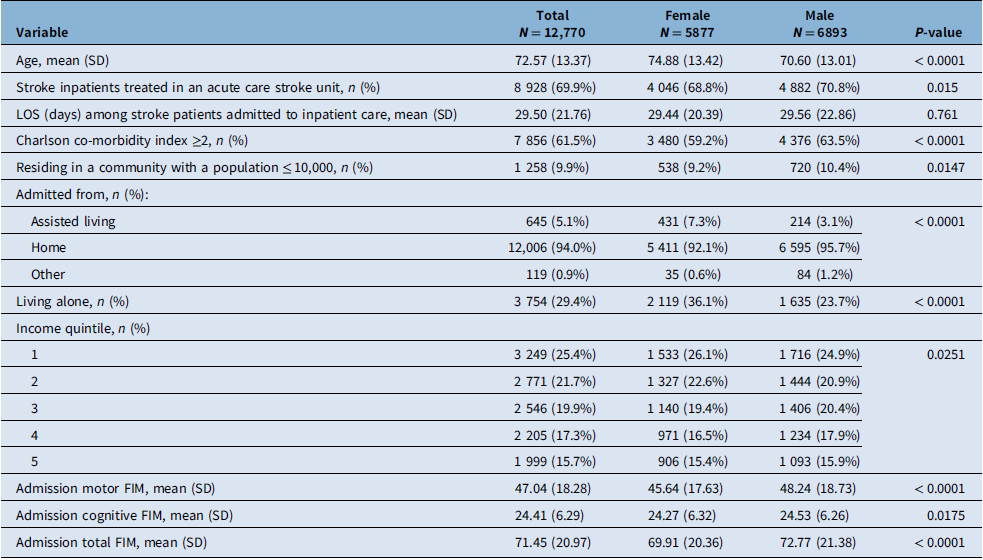
SD = standard deviation; LOS = length of stay; FIM = functional independence measure.
Mean (SD) RI was 75.86 min/day (29.69) for males and 73.33 min/day (29.76) for females (p < .0001). For each age category, males received higher RI than females. After adjusting for baseline factors, males <80 years of age continued to be more likely to receive higher RI than females (Table 2).
Unadjusted and adjusted risk differences in rehabilitation intensity by sex, stratified by age

SD = standard deviation; RI = rehabilitation intensity; CI = confidence interval.
This study examined sex differences in the provision of inpatient RI after stroke. Males <80 years of age were more likely to receive higher RI than females. Although this difference was statistically significant, the clinical significance is unclear as the absolute difference was small. However, there is potential that a combination of several factors, including RI, each with a relatively small individual effect size, may account for the sex difference in stroke functional outcomes reported by others, which was not explained by age, stroke severity or premorbid function.Reference Rexrode, Madsen, Yu, Carcel, Lichtman and Miller1,Reference Phan, Blizzard and Reeves3 Additionally, studies are limited in terms of the relationship between fatigue, pain and low mood and level of participation in rehabilitation. These conditions may be more prevalent in females than males, and several studies have demonstrated an association between these factors and outcomes after stroke.Reference Ozkan, Ambler and Banerjee6–Reference Poynter, Shuman, Diaz-Granados, Kapral, Grace and Stewart10 Future studies should address whether these, or other factors, account for the sex difference in the provision of inpatient stroke RI.
This analysis focused on the delivery of rehabilitation and not outcomes. Prior research has generally focused on RI and outcomes or sex differences in outcomes, but not the intersection of both. Additionally, much of the previous research is in the acute setting, and information regarding RI and sex differences in the rehabilitation setting is limited. Given the important role inpatient rehabilitation plays in recovery post-stroke, more research should focus on potential sex differences in access, delivery and outcomes in this setting. A previous study performed in Ontario demonstrated no difference in functional outcomes based on sex for those in an inpatient stroke rehabilitation unit.Reference MacDonald, Hall, Bell, Cronin and Jaglal11 It is possible that the sex difference in RI is associated with differences in other outcome measures not previously reported; however, it is anticipated that the effect size of any findings would be small. Further research is warranted on the interaction between RI and sex.
Acknowledgments
This study was supported by ICES, which is funded by an annual grant from the Ontario Ministry of Health and the Ministry of Long-Term Care. Funding was also received from the University of Toronto, Division of Physical Medicine and Rehabilitation.
Author contributions
SLM, EL, MB and JLF contributed to the study concept and design. IJ-HJ and JF conducted the analyses. SLM prepared the initial draft of the manuscript. All authors contributed to the interpretation of the data and critical revision of the manuscript for intellectual content.
Funding statement
SLM has received institutional support to attend academic conferences. She chairs/co-chairs committees for the Toronto Stroke Networks (unpaid).
MB has grants or contracts from the Canadian Institutes of Health Research, Brain Canada Foundation, UHN Foundation, Ministry of Health of Ontario Research Branch, Heart and Stroke Foundation of Canada, National Institutes of Health (USA) and National Health and Medical Research Council Australia. He is the Chair of the Rehabilitation Care Alliance of Ontario (unpaid) and the Co-chair of the March of Dimes After Stroke Advisory Committee (unpaid). He receives a stipend in his leadership role as Medical Director of UHN – Toronto Rehabilitation Institute.
Competing interests
This document used data adapted from the Statistics Canada Postal CodeOM Conversion File, which is based on data licensed from Canada Post Corporation, and/or data adapted from the Ontario Ministry of Health Postal Code Conversion File, which contains data copied under license from ©Canada Post Corporation and Statistics Canada. Parts of this material are based on data and/or information compiled and provided by Canadian Institute for Health Information (CIHI) and the Ontario Ministry of Health. The analyses, conclusions, opinions and statements expressed herein are solely those of the authors and do not reflect those of the funding or data sources; no endorsement is intended or should be inferred. Parts of this material are adapted from Statistics Canada, Census, 2016. This does not constitute an endorsement by Statistics Canada of this product.


 Open access

