

I. Introduction
Empirical evidence spanning different markets and institutions suggests that hedgers often behave like speculators. Cheng and Xiong (Reference Cheng and Xiong2014a), (Reference Cheng and Xiong2014b) show that the positions of commercial hedgers in futures markets for wheat, corn, soybeans, and cotton exhibit excess fluctuations for reasons unrelated to output fluctuations. Akey, Robertson, and Simutin (Reference Akey, Robertson and Simutin2021) and Easley, Michayluk, O’Hara, and Putnins (Reference Easley, Michayluk, O’Hara and Putnins2021) find evidence of closet speculation by index funds and ETFs. Dastarac (Reference Dastarac2021) provides suggestive evidence of speculation by dealers in the U.S. corporate bond market, in line with the motivation of the Volcker rule.Footnote 1 Jacque (Reference Jacque2010) reviews well-publicized examples of corporate hedgers engaging in speculative activities.
All these examples raise regulatory concerns as market participants are often regulated as much based on their official status as on their actual trading behavior.Footnote 2 Yet, the existing theoretical literature provides little guidance as to whether speculative activity by hedgers has a different welfare impact from speculative activity by other market participants, which could possibly justify a different treatment by the regulator. Cheng and Xiong (Reference Cheng and Xiong2014b) summarize the issue in the following way: “In this debate [on regulation of financial innovation and derivatives trading], as well as in other broad contexts of analyzing risk sharing and trading in financial markets, it is common to separate two groups of traders—one group of traders with established commercial interests labeled hedgers and another group of financial traders labeled speculators. Perhaps because of this distinction, the debate heavily focuses on examining the behavior and impact of speculators, with little attention on how hedgers trade in practice. Policy prescriptions often focus on the behavior of the speculator group while exempting the hedger group. Is this categorical treatment justified?”
This article provides a simple model to help the regulator answer the question above from a normative standpoint. The model has three key features: all agents are rational; acquisition of information is endogenous; and information has real effects as firm managers use the information produced in the financial market to make better investment decisions. The market microstructure is a simplified version of Glosten and Milgrom (Reference Glosten and Milgrom1985), with a competitive risk-neutral market-maker. I call “hedgers” agents who derive a private benefit from holding the asset. I call “speculators” agents who do not have such a private benefit. I call “speculation” the act of acquiring costly information that can be used to make trading profits.Footnote 3 I then ask whether hedgers who speculate and speculators who speculate have the same impact on welfare, I characterize the conditions under which under- or over-acquisition of information obtains at the equilibrium, and derive policy implications.
The central insight of the model is that the presence of a feedback effect implies strategic complementarities between the activity of a large trader and the pricing strategy of the market-maker, provided the trader gets hedging benefits from holding the asset. The reason why hedging benefits matter is that hedgers and speculators face different incentives to acquire information. A speculator acquires information if he or she can make a trading profit to compensate for the information acquisition cost. Trading profits arise when the market-maker charges a low spread. By way of contrast, because of his or her private benefit, a hedger is willing to buy the asset even if making no trading profits. Thus, he or she has little incentive to acquire information when the market-maker charges a low spread. When the spread gets higher, however, an uninformed hedger’s expected trading loss becomes large relative to the private benefit, which creates incentives to acquire information and buy the asset only if it is of high quality. This generates a strategic complementarity: when the market-maker anticipates that hedgers acquire information, he or she reacts by charging a high spread, which increases the incentives of hedgers to indeed acquire information. This effect is amplified by the feedback effect: when the firm manager anticipates that hedgers acquire information, he or she makes the investment policy of the firm contingent on the order flow, which destroys firm value if, in fact, no information was acquired. As it is not profitable for speculators to acquire information when hedgers are informed, we get multiple equilibria where information is acquired either by speculators or by hedgers (or not at all).
I then ask whether welfare is higher in the equilibrium where information is acquired by hedgers or in the equilibrium where it is acquired by speculators. The main insight here is that acquisition of information by hedgers comes at an additional welfare cost relative to that by speculators. A social planner always prefers the trader with the private benefit to hold the asset at the equilibrium. However, if a hedger acquires information and learns bad news about the quality of the asset, then he or she will not buy the asset, and gains from trade are foregone. It follows that, unless hedgers can produce significantly more information than speculators, which may happen if there are too few speculators in the market, welfare is higher when information is acquired by speculators than when it is by hedgers.Footnote 4
This finding implies that there is a role for regulation to help select the right equilibrium. Regulating hedgers less than speculators with this objective in mind may be optimal in specific circumstances. A necessary condition for information acquisition by hedgers to yield higher welfare than information acquisition by speculators is that the probability that a trade is initiated by a speculator rather than a hedger is small. A plausible example of such a market is commodity markets prior to 2004, thus providing support for policies such as the position limit exemption for commercial hedgers on U.S. commodity futures markets. In sharp contrast, however, the model suggests that the regulator should instead separate hedging and speculative activities in the spirit of the Volcker rule when the probability that trades are initiated by speculators becomes larger, as is now the case in most developed markets.
The model raises another regulatory issue, which is the possibility of under-provision of information when real efficiency gains more than compensate for the cost of acquiring information and foregone gains from trade. This occurs in the model when the ex ante level of uncertainty is high, and the probability that a trade is initiated by a hedger is small, in other words, for firms where managers face substantial uncertainty, with a potentially large impact on their investment strategy (technology stocks, young firms…), and whose stock is traded on illiquid markets. When the case, I show that a subsidy to the acquisition of information by speculators plus a transfer to hedgers to compensate for trading losses financed by a tax on the firm leads to a Pareto superior allocation. While such a policy may not be politically acceptable in practice, I also show that it can be, in great part, replicated by private contracts between market-makers and listed firms, whereby the firm pays the market-maker to reduce the bid–ask spread on its stock, thus making informed trading by speculators more profitable and equilibrium prices more informative. This possibility exists in some European markets but is currently not allowed in the U.S. (see https://www.finra.org/rules-guidance/rulebooks/finra-rules/5250).
This article is broadly related to six branches of the literature. The first one is the literature on feedback effects in financial markets, which arise when information in asset prices impacts firms’ investment and production decisions, and therefore firms’ future cash flows. This literature, initiated by the seminal paper of Dow and Gorton (Reference Dow and Gorton1997), is reviewed comprehensively by Bond, Edmans, and Goldstein (Reference Bond, Edmans and Goldstein2012) and Goldstein (Reference Goldstein2023).Footnote 5 Closest to this article is Dow and Rahi (Reference Dow and Rahi2003) who provide the first comprehensive welfare analysis of the trade-offs between productive and allocative efficiency, Dow, Goldstein, and Guembel (Reference Dow, Goldstein and Guembel2017) who endogenize the acquisition of information in a model of feedback, and Gervais and Strobl (Reference Gervais and Strobl2022), where a financial intermediary is exogenously endowed with information about fundamentals, which it sells to rational traders. My contribution here is twofold. First, I show that feedback can create strategic complementarities between the actions of strategic traders, market-makers, and firm managers, which generate multiple equilibria when traders have a strong enough hedging motive. Second, my model allows a rigorous discussion of the welfare implications of policies such as the Volcker rule or designated market-makers (DMM) that may have a first-order impact on the informativeness of asset prices.
The article also belongs to the literature on the acquisition of information by agents with private values initiated by the seminal work of Vives (Reference Vives2011), (Reference Vives2014). Rahi and Zigrand (Reference Rahi and Zigrand2018) and Rahi (Reference Rahi2021) show that strategic complementarities in the decisions to acquire information may arise when each agent tries to learn about his or her own private valuation, thus making the price less informative about the other agents’ valuation of the asset and increasing their incentives to acquire information.Footnote 6 This channel is absent from my model, as agents may only learn about the common value component of the asset. Multiple equilibria instead arise through self-fulfilling beliefs of the market-maker and the firm manager about the decision of hedgers to acquire information. Biais, Foucault, and Moinas (Reference Biais, Foucault and Moinas2015) use a model with rational traders and private valuation to assess the welfare impact of fast trading, which is modeled as a technology that simultaneously allows to learn about the common component of valuation of the asset and about active venues for trading. As their model assumes that the decision to acquire information is made before agents know their type, it cannot be used to study the incentives faced by different types of agents to acquire information.
Third, my work relates to a strand of the literature that looks at interactions between informed hedgers and informed speculators in the context of commodity markets. Goldstein, Li, and Yang (Reference Goldstein, Li and Yang2014) show in a model of segmented markets with correlated fundamentals that hedgers and speculators exposed to the same information may trade in opposite directions in the market where they are both present, which may reduce price informativeness and create complementarities in the decisions of speculators to acquire information. Xiong and Yang (Reference Xiong and Yang2021) show that the existence of a financial market may incentivize firms that compete in the product market to disclose information in order to benefit from more informative asset prices. Goldstein and Yang (Reference Goldstein and Yang2022) build on Goldstein et al. (Reference Goldstein, Li and Yang2014) and propose an integrated model of commodity spot and futures markets, with three types of agents: commodity producers, financial hedgers, and financial speculators. Their model can be calibrated to reproduce the patterns of price informativeness, futures prices bias, and cross-asset correlations that were observed during the growing financialization of commodity markets post-2004. The reduced form I adopt to model hedging needs does not allow me to analyze the rich interactions that are the object of Goldstein and Yang’s paper. Conversely, their setup does not allow them to analyze endogenous acquisition of information by hedgers and welfare, which are the focus of this article. We, however, share a common underlying message that financial speculators may have a positive impact on informational efficiency and welfare that cannot be substituted away by informed hedgers.
Fourth, my equilibrium multiplicity result speaks to the literature on financial fragility and crashes. Financial fragility, defined in a recent survey by Goldstein, Huang, and Yang (Reference Goldstein, Huang and Yang2025) as an amplified reaction of market prices to underlying shocks, is a topic of increasing importance for academics and regulators alike following the multiplication of flash events on stock and bond markets that threaten market efficiency and trust in financial markets (see, for example, Cespa and Vives (Reference Cespa and Vives2025)). Many mechanisms have been proposed to rationalize such events. Early papers relied on the irrationality of market participants (e.g., Gennotte and Leland (Reference Gennotte and Leland1990)). The next wave of models emphasized the role of constraints such as funding constraints (e.g., Gromb and Vayanos (Reference Gromb and Vayanos2002) or Brunnermeier and Pedersen (Reference Brunnermeier and Pedersen2009)), borrowing constraints (e.g., Yuan (Reference Yuan2005)), or short-sales constraints (e.g., Marin and Olivier (Reference Marin and Olivier2008)). More recent work has emphasized mechanisms based on information: Goldstein, Ozdenoren, and Yuan (Reference Goldstein, Ozdenoren and Yuan2013) show that feedback effects may lead speculators to overweight correlated noisy signals, such as rumors, in their trading decisions. Cespa and Foucault (Reference Cespa and Foucault2014) argue that cross-asset learning may lead to feedback loops whereby a small supply shock to the liquidity of one asset may propagate to the entire market. Cespa and Vives (Reference Cespa and Vives2015) show that persistent liquidity trading can generate strategic complementarities in the use of information by short-term informed traders, while Cespa and Vives (Reference Cespa and Vives2025) demonstrate that a lack of information on past order flow can create a self-sustaining loop affecting liquidity demanders. My article introduces a new channel through which strategic complementarities may appear, which calls for a different type of action from the regulator to avoid the instability inherent to multiple equilibria or getting stuck in the low-welfare equilibrium.
Finally, the policy implications of the article complement the insights of two branches of the existing literature, one on the consequences of the Volcker rule and one on DMM. The literature on the Volcker rule is mainly empirical in nature and has strived to test whether concerns expressed by Duffie (Reference Duffie2012) and Thakor (Reference Thakor2012) that the Volcker rule may result in lower liquidity, notably in times of stress, have materialized. Two representative papers of this line of research are Bao, O’Hara, and Zhou (Reference Bao, O’Hara and Zhou2018) and Trebbi and Xiao (Reference Trebbi and Xiao2019). My main contribution here is to point out that, while liquidity in times of stress is an important driver of welfare, a proper assessment of the Volcker rule should also consider its impact on the informativeness of prices and productive efficiency.
The literature on DMM is both theoretical and empirical. Bessembinder, Hao, and Zheng (Reference Bessembinder, Hao and Zheng2015) provide a model where an IPO may fail when investors anticipate that the secondary market will be illiquid because of asymmetric information.Footnote 7 They show that a contract whereby the DMM commits to a low bid–ask spread, and the firm compensates the DMM for its trading losses, can bring a Pareto improvement: the DMM and the investor break even, while the firm receives a sufficiently higher price for the IPO to more than compensate for the payment to the DMM. Venkataraman and Waisburd (Reference Venkataraman and Waisburd2007), Anand, Tanggard, and Weaver (Reference Anand, Tanggard and Weaver2009), and Menkveld and Wang (Reference Menkveld and Wang2013) all find evidence consistent with Bessembinder et al. (Reference Bessembinder, Hao and Zheng2015): younger, smaller firms tend to sign DMM agreements, DMM tend to increase liquidity and price discovery, and the announcement of a DMM contract generates a positive abnormal return.Footnote 8 My model provides an alternative, and complementary, motivation for why a firm may wish to enter a private agreement with a DMM: to stimulate information acquisition by speculators and generate productive efficiency gains through the feedback effect. This alternative motivation shares the same testable implications as the model of Bessembinder et al. (Reference Bessembinder, Hao and Zheng2015), plus a new one: Firms that sign a contract with a DMM should display a stronger feedback effect than comparable firms without a DMM contract.
The remainder of the article is organized as follows: I lay out the model in Section II. Section III is devoted to the equilibrium and welfare analysis of a benchmark economy where only speculators can acquire information, which can be interpreted as an economy where a “Volcker rule” has been implemented. I look at the implications of hedgers acquiring information in Section IV: I first show that the incentives of hedgers and speculators to acquire information differ and that multiple equilibria can arise. I then look at the welfare implications. Policy implications are discussed in Section V. Section VI concludes.
II. The Model
In this section, I lay out the baseline model, define the equilibrium and welfare concepts, and outline the solution method.
A. The Agents
The model is a one-period model with three ingredients. First, there is a firm, where a firm manager needs to decide on an investment project based on his or her private information as well as the information revealed by trading on a financial market. Second, there is a trader who may decide to acquire information about the profitability of the firm’s investment project. Finally, there is a market-maker who is endowed with shares of the firm and who quotes an ask price to the trader taking into account the fact that the trader may have superior information. All agents are risk-neutral.
1. The Firm
The firm comprises existing assets and a new investment project, each with independent cash flows. The firm issues equity that pays the cash flows generated by its assets at the end of the period. There is no limited liability, so the dividend paid may be either positive or negative. The firm is managed by a manager who maximizes the expected value of the firm. I assume the following about the firm’s assets and the information set of the firm manager:
-
• The expected cash flow of existing assets and the start-up cost of the investment project are both normalized to zero.
-
• If the manager decides to invest, the project generates a cash flow per share $ \tilde{CF}=\tilde{\theta}-\tilde{x} $
at the end of the period, where:
$ \tilde{\theta} $
can take two values, 0 or a, each with probability 1/2, and with
$ 0<a<1 $
.
$ \tilde{x} $
is uniformly distributed on [0,1].
$ \tilde{CF}=\tilde{\theta}-\tilde{x} $
at the end of the period, where:
$ \tilde{\theta} $
can take two values, 0 or a, each with probability 1/2, and with
$ 0<a<1 $
.
$ \tilde{x} $
is uniformly distributed on [0,1]. -
• The realization of
$ \tilde{\theta} $
, which can be interpreted as the potential income from the investment project, is unknown to the firm manager but may be learned (at a cost) by the trader. -
• The realization of
$ \tilde{x} $
, which can be interpreted as the cost of the investment project, is known to the firm manager but not to the trader. -
• The firm manager observes the ask price of the market-maker and whether a trade takes place before deciding whether to invest in the new project.


These assumptions imply that the firm’s value, V, is solely determined by the decision D $ \in $
{0, 1} of the manager, where 0 stands for “not invest” and 1 stands for “invest,” and by the cash flow of the investment project at the end of the period:
$ \in $
{0, 1} of the manager, where 0 stands for “not invest” and 1 stands for “invest,” and by the cash flow of the investment project at the end of the period:
 $$ V\left(D,\theta, x\right)=D\left(\theta -x\right). $$
2. The Trader
The second ingredient of the model is a trader who can be one of two types and who may decide to acquire information about the realization of $ \tilde{\theta} $
. I assume the following about the trader:
$ \tilde{\theta} $
. I assume the following about the trader:
-
• The trader is strategic and is endowed with an initial amount of cash,
$ {W}_0 $
. -
• At the start of the period, the trader learns whether he or she is a Hedger (H), with probability
$ 0<q<1 $
, or a Speculator (S), with probability 1 – q.If the trader is a hedger, then he or she obtains a private benefit
$ B>0 $
if (and only if) he or she owns a share of the firm’s equity at the end of the period. If the trader is a speculator, then he or she does not have a private benefit. The private benefit is the only difference between hedger and speculator in the model. It enters the utility of the trader additively.Footnote
9 -
• Once the trader knows his or her type, he or she may decide to learn
$ \theta $
at a cost
$ c>0 $
. -
• The trader can place market orders, but is both short-sale and capacity constrained. This implies that the only two choices available are “buy” (1 share) and “no trade.”Footnote 10
-
• The trader cannot commit ex ante (not) to acquire information. Neither the trader’s type nor his or her decision to acquire information is observable.


3. The Market-Maker
The last ingredient of the model is a market-maker à la Glosten and Milgrom (Reference Glosten and Milgrom1985), with the following characteristics:
-
• The market-maker is endowed with a share of the firm’s equity.
-
• The market-maker observes neither
$ \theta $
nor x, but has rational expectations about the equilibrium strategies of the trader and of the firm manager. He or she updates his or her beliefs that
$ \theta =a $
using Bayes’ rule depending on whether the trader places a buy order. -
• The market-maker behaves competitively and sets his or her ask price to break even at the equilibrium.


I adopt the following notations: I call $ \overline{p} $
the probability that
$ \overline{p} $
the probability that $ \theta =a $
conditional on observing a buy order and
$ \theta =a $
conditional on observing a buy order and $ \underline{p} $
the probability that
$ \underline{p} $
the probability that $ \theta =a $
conditional on observing no trade.
$ \theta =a $
conditional on observing no trade. $ \overline{p} $
and
$ \overline{p} $
and $ \underline{p} $
are determined at the equilibrium.
$ \underline{p} $
are determined at the equilibrium. $ P\left(\overline{p}\right) $
denotes the expected value of the firm conditional on observing a buy order.
$ P\left(\overline{p}\right) $
denotes the expected value of the firm conditional on observing a buy order.
The zero-profit condition implies that the price asked by the market-maker is equal to $ P\left(\overline{p}\right) $
. Provided there is at least some informed agent in the market, the ask price
$ P\left(\overline{p}\right) $
. Provided there is at least some informed agent in the market, the ask price $ P\left(\overline{p}\right) $
is strictly larger than the valuation of the firm by the market-maker conditional on observing no trade, which I note P(
$ P\left(\overline{p}\right) $
is strictly larger than the valuation of the firm by the market-maker conditional on observing no trade, which I note P( $ \underline{p} $
). The difference P(
$ \underline{p} $
). The difference P( $ \overline{p} $
) – P(
$ \overline{p} $
) – P( $ \underline{p} $
) can be interpreted as half the bid–ask spread.
$ \underline{p} $
) can be interpreted as half the bid–ask spread.
B. Timeline
The model unfolds as follows:
-
1. The firm manager learns x
-
2. The trader learns his or her type, Hedger (H) or Speculator (S).
-
3. The market-maker posts an ask price based on his or her equilibrium beliefs.
The trader decides whether to acquire information, in which case he or she learns
$ \theta $
. -
4. The trader decides whether to place a market buy order or abstain from trading.
The firm manager observes whether a trade took place.
-
5. The firm manager decides whether to invest.
If investment take place, uncertainty is resolved, and the firm pays the cash flow as dividend.

Note that the decision to acquire information is made after the trader learns his or her type, with no possibility of pre-commit. This assumption is necessary to be able to discuss the respective incentives of hedger and speculator to acquire information. It also creates a game between the two types. I discuss this further in the next section, after having defined the equilibrium.
C. Definition of Equilibrium and Solution Method
Definition 1. The equilibrium concept is Perfect Bayesian Equilibrium. An equilibrium is defined by:
-
1. A probability of acquiring information and a trading rule that maximize the expected utility of the hedger given the price asked by the market-maker and the investment decision rule of the firm manager.
-
2. A probability of acquiring information and a trading rule that maximize the expected utility of the speculator given the price asked by the market-maker and the investment decision rule of the firm manager.
-
3. An investment decision rule that maximizes the expected value of the firm given x,
$ \overline{p} $
, and
$ \underline{p} $
. -
4. An ask price by the market-maker, which is equal to the expected value of the firm conditional on observing a buy order given the investment decision rule by the firm manager, and
$ \overline{p} $
.


 $ \overline{p} $
and
$ \overline{p} $
and $ \underline{p} $
are derived from the equilibrium strategies of hedger and speculator using Bayes’ rule.
$ \underline{p} $
are derived from the equilibrium strategies of hedger and speculator using Bayes’ rule.
Note that Definition 1 treats hedger and speculator as separate agents. This is because the decision to acquire information is made after the types are determined, and the market-maker cannot tell which of the two types he or she is trading with. This implies that, even though there is a single trader and a single trade, everything in the model works as if the two types were separate agents who each need to play best responses to the other’s strategy.
Definition 1 underlines the fixed-point problem that is common to all models with a feedback effect: the investment decision by the firm’s manager depends on his or her beliefs about the random variable $ \tilde{\theta} $
. These beliefs are updated depending on the actions of the trader, which are based on his or her valuation of the firm’s assets, which is itself affected by the investment decision of the manager. The setup of this model, however, simplifies the fixed point problem considerably in that it concerns only one variable:
$ \tilde{\theta} $
. These beliefs are updated depending on the actions of the trader, which are based on his or her valuation of the firm’s assets, which is itself affected by the investment decision of the manager. The setup of this model, however, simplifies the fixed point problem considerably in that it concerns only one variable: $ \overline{p} $
, that is the probability that
$ \overline{p} $
, that is the probability that $ \theta =a $
conditional on observing a buy order.
$ \theta =a $
conditional on observing a buy order.
This allows the following approach to solve the model:
-
1. Conjecture a possible equilibrium characterized by the optimal strategies (acquisition of information and trading rules) of hedger and speculator.
-
2. Using Bayes’ rule, derive the
$ \overline{p} $
implied by these strategies. -
3. Given
$ \overline{p} $
, derive the investment decision rule by the firm manager and the ask-price by the market-maker. -
4. Given the investment decision rule by the firm manager and the ask-price by the market-maker, check whether the conjectured strategies of hedger and speculator are optimal.
-
5. Iterate until all possible equilibria have been covered.


While it may seem cumbersome to cover all possible cases, the task is simplified by two observations. First, it can never be optimal to purchase information but not use it. This implies that the optimal trading rule for a trader who learned that $ \theta =a $
must be “buy,” and that the optimal trading rule for a trader who learned that
$ \theta =a $
must be “buy,” and that the optimal trading rule for a trader who learned that $ \theta =0 $
must be “no trade.” Second, a uniformed speculator can never be (strictly) better off buying the asset since he or she has neither a private benefit nor an informational advantage. Thus, “no trade” must always be an optimal trading rule for the uninformed speculator. In sum, the decision to acquire, or not acquire, information implies the optimal trading rule in all cases except one: the uninformed hedger, who may find it optimal to either buy the asset or not trade.
$ \theta =0 $
must be “no trade.” Second, a uniformed speculator can never be (strictly) better off buying the asset since he or she has neither a private benefit nor an informational advantage. Thus, “no trade” must always be an optimal trading rule for the uninformed speculator. In sum, the decision to acquire, or not acquire, information implies the optimal trading rule in all cases except one: the uninformed hedger, who may find it optimal to either buy the asset or not trade.
D. Welfare
I finally define the welfare function:
Definition 2. The welfare criterion is utilitarian welfare.
The equilibrium welfare is equal to the sum of the initial cash endowment of the trader plus the (unconditional) expected value of the firm plus the expected private benefits of the trader minus the expected cost of acquiring information.
The equilibrium welfare in Definition 2 is obtained by adding the ex ante expected utility of the trader and of the market-maker. Since they are both risk-neutral, trading gains or losses cancel out. What is left are the value of the initial endowments, the private benefits that accrue when the trader is a hedger and buys the stock, and any cost that has been incurred to acquire information. The initial endowments are of two types: the cash endowment of the trader, which is fixed, and the equity endowment of the market-maker, whose value depends on the investment decision of the firm manager. More information leads to a better decision by the firm manager and therefore a higher expected value of the firm. This productive efficiency gain needs to be compared to the direct cost of acquiring information and the indirect impact on expected private benefits to obtain the total impact of the acquisition of information on welfare.
III. Benchmark Economy
In this section, I solve for the equilibrium of a benchmark economy where only the speculator can acquire information and characterize the cases where too little or too much information is acquired at the equilibrium. Besides its value as an expositional tool, the benchmark economy plays an important role in the policy discussion in Section V as it can be interpreted as an economy where a “Volcker rule,” mandating the separation of hedging and speculative activities, has been implemented.
A. The Firm’s Optimization Problem
The firm manager chooses D $ \in $
{0;1} to maximize the expected value of
$ \in $
{0;1} to maximize the expected value of $ V\left(D,\theta, x\right)=D\left(\theta -x\right) $
. He or she knows x and has equilibrium beliefs about
$ V\left(D,\theta, x\right)=D\left(\theta -x\right) $
. He or she knows x and has equilibrium beliefs about $ \tilde{\theta} $
: if the trader places a buy order, the manager infers that
$ \tilde{\theta} $
: if the trader places a buy order, the manager infers that $ \theta =a $
with probability
$ \theta =a $
with probability $ \overline{p} $
and that
$ \overline{p} $
and that $ \theta =0 $
with probability 1 –
$ \theta =0 $
with probability 1 – $ \overline{p} $
. If no trade takes place, then the manager infers that
$ \overline{p} $
. If no trade takes place, then the manager infers that $ \theta =a $
with probability
$ \theta =a $
with probability $ \underline{p} $
and that
$ \underline{p} $
and that $ \theta =0 $
with probability 1 –
$ \theta =0 $
with probability 1 – $ \underline{p} $
.
$ \underline{p} $
.
It immediately follows that the optimal investment decision is:
-
• If buy order: invest (D = 1) if and only if
 $$ E\left(\tilde{\theta}\right)-x>0\iff x<a\overline{p}. $$
-
• If no trade: invest (D = 1) if and only if
 $$ E\left(\tilde{\theta}\right)-x>0\iff x<a\underline{p}. $$
Note that $ a\overline{p} $
and
$ a\overline{p} $
and $ a\underline{p} $
can be interpreted as conditional probabilities of investment from the perspective of an agent who does not know
$ a\underline{p} $
can be interpreted as conditional probabilities of investment from the perspective of an agent who does not know $ x $
.
$ x $
.
B. Expected Firm Value and Trading Profits
Once the firm’s optimal investment strategy is known, it is easy to compute the expected value of the firm. A point of attention is that not all agents have the same information set and therefore disagree on the expected value of the firm. With this in mind, I define $ E\left(V|p;\overline{p}\right) $
as the expected value of the firm from the standpoint of an agent who believes that the probability that
$ E\left(V|p;\overline{p}\right) $
as the expected value of the firm from the standpoint of an agent who believes that the probability that $ \theta =a $
is equal to
$ \theta =a $
is equal to $ p $
but who knows that the firm manager believes that the probability is equal to
$ p $
but who knows that the firm manager believes that the probability is equal to $ \overline{p} $
, which may or may not be equal to
$ \overline{p} $
, which may or may not be equal to $ p $
. We get after substituting (2):
$ p $
. We get after substituting (2):
 $$ E\left(V|p;\overline{p}\right)={\int}_0^{a\overline{p}}\left( ap-x\right) dx={a}^2\overline{p}\left(p-\frac{\overline{p}}{2}\right). $$
1. Ask Price of the Market-Maker
The ask price by the market-maker, that is, the price he or she is willing to sell at if he or she receives a buy order, follows immediately from (4):
 $$ P\left(\overline{p}\right)=E\left(V|\overline{p};\overline{p}\right)=\frac{a^2}{2}{\overline{p}}^2. $$
The expected value of the firm conditional on no trade is derived the same way:
 $$ P\left(\underline{p}\right)=E\left(V|\underline{p};\underline{p}\right)=\frac{a^2}{2}{\underline{p}}^2. $$
2. Expected Trading Profits and Losses
Given the expressions for the expected value of the firm (4) and the ask price by the market-maker (5), it is straightforward to derive the expected profit of an informed trader who received positive information about $ \theta $
, which I note
$ \theta $
, which I note $ {\pi}_{I^{+}}\left(\overline{p}\right) $
, and the expected loss of an uninformed trader, which I note
$ {\pi}_{I^{+}}\left(\overline{p}\right) $
, and the expected loss of an uninformed trader, which I note $ {\pi}_{NI}\left(\overline{p}\right) $
:
$ {\pi}_{NI}\left(\overline{p}\right) $
:
 $$ {\pi}_{I^{+}}\left(\overline{p}\right)=E\left(V|1;\overline{p}\right)-P\left(\overline{p}\right)={a}^2\overline{p}\left(1-\overline{p}\right)\ge 0, $$
 $$ {\pi}_{NI}\left(\overline{p}\right)=E\left(V|\frac{1}{2};\overline{p}\right)-P\left(\overline{p}\right)={a}^2\overline{p}\left(\frac{1}{2}-\overline{p}\right)\le 0. $$
Note that the expected trading loss of an uninformed trader, $ {\pi}_{NI}\left(\overline{p}\right) $
, stems from two channels. The first channel, which is standard, is that the ask price contains a premium to account for the fact that the market-maker may be trading with an informed trader. The second channel, which is less standard, stems from the dual assumption of a feedback effect and of a strategic trader: any buy order, whether informed or uninformed, makes the firm manager update his or her beliefs and invest whenever
$ {\pi}_{NI}\left(\overline{p}\right) $
, stems from two channels. The first channel, which is standard, is that the ask price contains a premium to account for the fact that the market-maker may be trading with an informed trader. The second channel, which is less standard, stems from the dual assumption of a feedback effect and of a strategic trader: any buy order, whether informed or uninformed, makes the firm manager update his or her beliefs and invest whenever $ x<a\overline{p} $
. When the buy order comes from an uninformed trader, this investment policy is over-optimistic since the optimal investment policy when no information is available about
$ x<a\overline{p} $
. When the buy order comes from an uninformed trader, this investment policy is over-optimistic since the optimal investment policy when no information is available about $ \theta $
is to invest if and only if
$ \theta $
is to invest if and only if $ x<\frac{a}{2} $
. The uninformed trader internalizes in the computation of
$ x<\frac{a}{2} $
. The uninformed trader internalizes in the computation of $ {\pi}_{NI}\left(\overline{p}\right) $
the decrease in the firm’s expected value resulting from the mistake made by the firm manager. Ceteris paribus, this effect increases the incentives of the trader to acquire information relative to the incentives a competitive trader would have, or that would exist in the absence of a feedback effect.Footnote
11
$ {\pi}_{NI}\left(\overline{p}\right) $
the decrease in the firm’s expected value resulting from the mistake made by the firm manager. Ceteris paribus, this effect increases the incentives of the trader to acquire information relative to the incentives a competitive trader would have, or that would exist in the absence of a feedback effect.Footnote
11
3. Incentives of Speculators to Acquire Information
As an uninformed speculator never trades, his or her payoff is equal to zero. An informed speculator places a buy order if and only if the information is positive, which happens with probability 1/2, and does not trade otherwise. Thus, the expected payoff of an informed speculator is equal to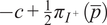 $ -c+\frac{1}{2}{\pi}_{I^{+}}\left(\overline{p}\right) $
. Comparing the two and substituting (7) yields the following lemma.
$ -c+\frac{1}{2}{\pi}_{I^{+}}\left(\overline{p}\right) $
. Comparing the two and substituting (7) yields the following lemma.
Lemma 1. It is optimal for the speculator to acquire information if and only if
 $$ c\le \frac{a^2}{2}\overline{p}\left(1-\overline{p}\right). $$
Since $ \overline{p}\ge \frac{1}{2} $
, the RHS of (9) is decreasing in
$ \overline{p}\ge \frac{1}{2} $
, the RHS of (9) is decreasing in $ \overline{p} $
. The intuition is straightforward: the lower is
$ \overline{p} $
. The intuition is straightforward: the lower is $ \overline{p} $
, the lower is the price charged by the market-maker and the higher is the expected trading profit.
$ \overline{p} $
, the lower is the price charged by the market-maker and the higher is the expected trading profit.
C. Equilibrium and Welfare
Provided B is not too large, a trivial no-trade equilibrium exists as in Glosten and Milgrom (Reference Glosten and Milgrom1985), where the market-maker asks a price $ P(1)=\frac{a^2}{2} $
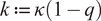
and where neither hedger nor speculator buys the asset. Since information can only be acquired by the speculator in the benchmark economy, three types of equilibria where trading occurs may exist: two pure strategy equilibria and one mixed strategy equilibrium. Using condition (9) and the solution method discussed in Section II.C, I show the following result in the Appendix:
$ P(1)=\frac{a^2}{2} $
and where neither hedger nor speculator buys the asset. Since information can only be acquired by the speculator in the benchmark economy, three types of equilibria where trading occurs may exist: two pure strategy equilibria and one mixed strategy equilibrium. Using condition (9) and the solution method discussed in Section II.C, I show the following result in the Appendix:
Proposition 1.
-
1. An equilibrium of the benchmark economy where no information is acquired and where the hedger buys the asset exists if and only if
(10)The equilibrium welfare is equal to
$$ c\ge \frac{a^2}{8}. $$
(11)
$$ {W}_0+\frac{a^2}{8}+ qB. $$
-
2. An equilibrium of the benchmark economy where the speculator acquires information with probability
$ \kappa \in \left(0,1\right) $
exists if and only if(12)and
$$ \frac{a^2}{2}\frac{q}{{\left(1+q\right)}^2}<c<\frac{a^2}{8}, $$
(13)where
$$ B\ge \frac{kc}{q}, $$
$ k:= \kappa \left(1-q\right) $
is the probability that the trader is informed at the equilibrium.
The equilibrium welfare is equal to
(14)
$$ {W}_0+\left(\frac{2q\left(1-q\right)+k\left(1-2q\right)}{\left(k+2q\right)\left(2\left(1-q\right)-k\right)}\right)\frac{a^2}{4}+ qB- kc. $$
-
3. An equilibrium of the benchmark economy where the speculator acquires information with probability 1 exists if and only if
(15)and
$$ c\le \frac{a^2}{2}\frac{q}{{\left(1+q\right)}^2} $$
(16)The equilibrium welfare is equal to
$$ B\ge \frac{a^2}{2}\frac{1-q}{{\left(1+q\right)}^2}. $$
(17)
$$ {W}_0+\frac{1}{1+q}\frac{a^2}{4}+ qB-\left(1-q\right)c. $$




Proof. See the Appendix.
A first observation is that two conditions need to hold jointly for the speculator to acquire information at the equilibrium: the cost $ c $
of acquiring information needs to be low enough for the acquisition of information to be profitable for the speculator and the private benefit
$ c $
of acquiring information needs to be low enough for the acquisition of information to be profitable for the speculator and the private benefit $ B $
needs to be high enough for the hedger to be willing to buy the asset despite paying the premium generated by adverse selection.
$ B $
needs to be high enough for the hedger to be willing to buy the asset despite paying the premium generated by adverse selection.
A second observation is that the domains of the three equilibria with trading do not overlap: for a given set of parameters, the benchmark economy has at most one non-trivial equilibrium. We shall see in the next section that the same property does not hold when hedgers can acquire information.
Expression (14) in Proposition 1 provides the welfare of the benchmark economy as a function of the probability of informed trading, $ k $
. For
$ k $
. For $ k=0 $
, equation (14) collapses into equation (11). When
$ k=0 $
, equation (14) collapses into equation (11). When $ k $
takes its maximum value of
$ k $
takes its maximum value of $ 1-q $
, equation (14) becomes equation (17). The main trade-off is between the cost of acquiring information, which varies linearly with
$ 1-q $
, equation (14) becomes equation (17). The main trade-off is between the cost of acquiring information, which varies linearly with $ k $
from 0 to
$ k $
from 0 to $ \left(1-q\right)c $
and the expected value of the firm, which varies non-linearly from
$ \left(1-q\right)c $
and the expected value of the firm, which varies non-linearly from $ \frac{a^2}{8} $
to
$ \frac{a^2}{8} $
to $ \frac{a^2}{4}\frac{1}{1+q} $
. The other two terms,
$ \frac{a^2}{4}\frac{1}{1+q} $
. The other two terms, $ {W}_0 $
and
$ {W}_0 $
and $ qB $
, are constant across the three equilibria,
$ qB $
, are constant across the three equilibria, $ {W}_0 $
because it is a cash endowment,
$ {W}_0 $
because it is a cash endowment, $ qB $
because the hedger buys the firm’s equity with probability 1.
$ qB $
because the hedger buys the firm’s equity with probability 1.
I show in the Appendix that the welfare function is convex, which implies that welfare is maximized either when $ k=0 $
or when
$ k=0 $
or when $ k=1-q $
. Comparing equations (11) and (17) then yields the following proposition.
$ k=1-q $
. Comparing equations (11) and (17) then yields the following proposition.
Proposition 2. Welfare in the benchmark economy is maximized:
-
• When no information is acquired if
$ c\ge \frac{a^2}{8}\frac{1}{1+q}. $
-
• When the speculator acquires information with probability 1 if
$ c\le \frac{a^2}{8}\frac{1}{1+q}. $


Proof. See the Appendix.
The conditions in Proposition 2 become easier to interpret if we multiply both sides by $ \left(1-q\right) $
. Indeed,
$ \left(1-q\right) $
. Indeed, $ c\left(1-q\right) $
is the expected acquisition cost of information, while
$ c\left(1-q\right) $
is the expected acquisition cost of information, while $ \frac{a^2}{8}\frac{1-q}{1+q}=\frac{a^2}{4}\frac{1}{1+q}-\frac{a^2}{8} $
is the increase in expected firm value due to more efficient investment decisions in the equilibrium with an informed speculator. Thus, Proposition 2 simply says that acquiring information is optimal if and only the social cost of information is less than the social value of information, and that if the condition is satisfied, then we should acquire as much information as possible.
$ \frac{a^2}{8}\frac{1-q}{1+q}=\frac{a^2}{4}\frac{1}{1+q}-\frac{a^2}{8} $
is the increase in expected firm value due to more efficient investment decisions in the equilibrium with an informed speculator. Thus, Proposition 2 simply says that acquiring information is optimal if and only the social cost of information is less than the social value of information, and that if the condition is satisfied, then we should acquire as much information as possible.
Note that the social value of information is decreasing in $ q $
and increasing in
$ q $
and increasing in $ a $
. Both properties are intuitive. A smaller
$ a $
. Both properties are intuitive. A smaller $ q $
implies a larger probability that the trader is a speculator and thus that the order contains information, while the parameter
$ q $
implies a larger probability that the trader is a speculator and thus that the order contains information, while the parameter $ a $
scales the project: the larger it is, the higher the level of ex ante uncertainty,Footnote
12 and therefore the higher the expected productive efficiency gains from a given level of information.
$ a $
scales the project: the larger it is, the higher the level of ex ante uncertainty,Footnote
12 and therefore the higher the expected productive efficiency gains from a given level of information.
The convexity of the expected value of the firm, and therefore of welfare, as a function of k implies that private and social incentives to acquire information are misaligned. Private incentives of the speculator are maximized when $ k=0 $
and thus
$ k=0 $
and thus $ \overline{p}=\frac{1}{2} $
. On the other hand, I show in the Appendix that
$ \overline{p}=\frac{1}{2} $
. On the other hand, I show in the Appendix that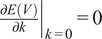 $ {\left.\frac{\partial E(V)}{\partial k}\right|}_{k=0}=0 $
, which implies that the net social value of spending resources to increase the probability of acquiring information from 0 to
$ {\left.\frac{\partial E(V)}{\partial k}\right|}_{k=0}=0 $
, which implies that the net social value of spending resources to increase the probability of acquiring information from 0 to $ \epsilon $
is negative: having just a little bit of information does not provide enough of an improvement in the investment decision to justify the cost. The social value of information increases and becomes positive as more information gets produced, while private incentives of the speculator move in the opposite direction: the larger is k, and therefore
$ \epsilon $
is negative: having just a little bit of information does not provide enough of an improvement in the investment decision to justify the cost. The social value of information increases and becomes positive as more information gets produced, while private incentives of the speculator move in the opposite direction: the larger is k, and therefore $ \overline{p} $
, the lower are the profits of an informed trader,
$ \overline{p} $
, the lower are the profits of an informed trader, $ {\pi}_{I+} $
. As a result, the equilibrium may be characterized by under- or over-production of information.
$ {\pi}_{I+} $
. As a result, the equilibrium may be characterized by under- or over-production of information.
Comparing the conditions for the existence of the three types of equilibria in Proposition 1 with the condition for optimality in Proposition 2 allows us to tell which is the case depending on the value of the cost parameter $ c $
:
$ c $
:
Proposition 3. In the benchmark economy:
-
• The amount of information produced at the equilibrium is efficient if
either:
$ c>\frac{a^2}{8} $
or:
$ c<\mathit{\operatorname{Min}}\left(\frac{a^2}{8}\frac{1}{1+q},\frac{a^2}{2}\frac{q}{{\left(1+q\right)}^2}\right). $
-
• Too much information is produced at the equilibrium if
$ \frac{a^2}{8}\frac{1}{1+q}<c<\frac{a^2}{8}. $
-
• Too little information is produced at the equilibrium if
$ \frac{a^2}{8}\frac{1}{1+q}>\frac{a^2}{2}\frac{q}{{\left(1+q\right)}^2}\iff q<\frac{1}{3} $
and
$ \frac{a^2}{2}\frac{q}{{\left(1+q\right)}^2}<c<\frac{a^2}{8}\frac{1}{1+q}. $


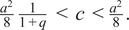

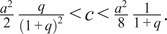
The first bullet point in Proposition 3 states that when the cost of acquiring information is either very small or very large, the information produced at the equilibrium is efficient: acquired with probability 0 when the cost is very large, or acquired with probability 1 if the cost is very small. Under- or over-production of information thus occurs only for intermediate values of the cost, when speculators acquire information with probability $ \kappa $
comprised in
$ \kappa $
comprised in $ \left(0,1\right) $
. The probability that the market-maker is trading with a hedger,
$ \left(0,1\right) $
. The probability that the market-maker is trading with a hedger, $ q $
, plays an important role in determining whether
$ q $
, plays an important role in determining whether $ \kappa $
is too large or too small, which is intuitive: the lower is
$ \kappa $
is too large or too small, which is intuitive: the lower is $ q $
, the more revealing is the equilibrium price, which is bad for the private incentives of speculators to acquire information but is good for welfare as it strengthens the feedback effect and makes investment decisions of the firm manager more efficient. Thus, under-production of information may only occur in markets where there are “too few hedgers” relative to speculators.
$ q $
, the more revealing is the equilibrium price, which is bad for the private incentives of speculators to acquire information but is good for welfare as it strengthens the feedback effect and makes investment decisions of the firm manager more efficient. Thus, under-production of information may only occur in markets where there are “too few hedgers” relative to speculators.
IV. Economy Where Hedgers can Acquire Information
In this section, I analyze the full model where both hedger and speculator are able to acquire information. I first derive the incentives of the hedger to acquire information and show that they are qualitatively different from the incentives of the speculator. I then show that multiple equilibria arise when the hedger can acquire information. I finally compare welfare across equilibria and ask whether it can ever be socially optimal for the hedger to acquire information.
A. Incentives of the Hedger to Acquire Information
An uninformed hedger differs from an uninformed speculator in that it may be optimal for him or her either to buy the asset or to abstain from trading. Thus, for acquisition of information to be optimal for a hedger, it needs to dominate both “never trade” and “always buy.” The payoff for “never trade” is 0. The payoff for “always buy” is $ B+{\pi}_{NI}\left(\overline{p}\right) $
. The expected payoff for acquiring information is equal to
$ B+{\pi}_{NI}\left(\overline{p}\right) $
. The expected payoff for acquiring information is equal to $ -c+\frac{1}{2}{\pi}_{I^{+}}\left(\overline{p}\right)+\frac{B}{2} $
. Comparing the three terms and substituting (7) and (8) provides the following lemma.
$ -c+\frac{1}{2}{\pi}_{I^{+}}\left(\overline{p}\right)+\frac{B}{2} $
. Comparing the three terms and substituting (7) and (8) provides the following lemma.
Lemma 2. It is optimal for the hedger to acquire information if and only if
 $$ c\le \mathit{\operatorname{Min}}\left(\frac{a^2{\overline{p}}^2}{2}-\frac{B}{2};\frac{a^2\overline{p}\left(1-\overline{p}\right)}{2}+\frac{B}{2}\right). $$
Provided the private benefit, B, is large enough, condition (18) simplifies into
 $$ c+\frac{B}{2}\le \frac{a^2{\overline{p}}^2}{2}. $$
Condition (19) differs from the corresponding condition for the speculator, (9), in two respects. First, the private benefit enters the LHS of (19) next to the cost $ c $
: this is because acquiring information implies forfeiting private benefits when
$ c $
: this is because acquiring information implies forfeiting private benefits when $ \theta =0 $
, which happens with probability 1/2. Thus, the hedger bears an additional cost of acquiring information compared to the speculator. Second, and perhaps more surprisingly, the RHS of (19) is increasing in
$ \theta =0 $
, which happens with probability 1/2. Thus, the hedger bears an additional cost of acquiring information compared to the speculator. Second, and perhaps more surprisingly, the RHS of (19) is increasing in $ \overline{p} $
rather than decreasing as the RHS of (9). This is because the hedger has no incentive to acquire information when the price charged by the market-maker is low, as the private benefit more than compensates for the expected trading loss. It is only when the ask price by the market-maker, and therefore the expected trading losses of an uninformed trader, become too high that the hedger finds it optimal to acquire information.
$ \overline{p} $
rather than decreasing as the RHS of (9). This is because the hedger has no incentive to acquire information when the price charged by the market-maker is low, as the private benefit more than compensates for the expected trading loss. It is only when the ask price by the market-maker, and therefore the expected trading losses of an uninformed trader, become too high that the hedger finds it optimal to acquire information.
This property suggests that multiple equilibria may arise in the model: if the market-maker initially believes that the trader is unlikely to be informed, he or she charges a low price, and the hedger indeed chooses not to acquire information. If the market-maker instead believes that the trader is likely to be informed, he or she charges a high price, and the hedger indeed chooses to acquire information.
While the presence of a feedback effect is not crucial for the existence of a strategic complementarity between the hedger’s activity and the market-maker’s pricing strategy, it amplifies its effect, enlarging the set of multiple equilibria in the economy.Footnote 13 The reason is that, with feedback, it is more costly for the hedger to deviate from the equilibrium where he or she is expected to acquire information, as doing so induces suboptimal investment decisions by the firm manager, which exacerbate trading losses.
B. Equilibrium and Welfare
Compared to the benchmark economy, the fact that the hedger can now acquire information has two impacts on equilibrium. The first impact is to restrict the set of parameters for which an equilibrium where the speculator acquires information exists. Indeed, when the cost of information, $ c, $
is very low, or when the private benefit,
$ c, $
is very low, or when the private benefit, $ B $
, is not too high, the hedger’s best response to the speculator acquiring information is no longer to buy the asset, but to acquire information. As the hedger acquires information, it no longer becomes profitable for the speculator to do so, and the equilibrium unravels. The second impact is that a new type of equilibrium, where the hedger acquires information, exists and may, depending on parameters, either supersede or co-exist with equilibria where information is acquired by the speculator.
$ B $
, is not too high, the hedger’s best response to the speculator acquiring information is no longer to buy the asset, but to acquire information. As the hedger acquires information, it no longer becomes profitable for the speculator to do so, and the equilibrium unravels. The second impact is that a new type of equilibrium, where the hedger acquires information, exists and may, depending on parameters, either supersede or co-exist with equilibria where information is acquired by the speculator.
I start with the first impact and derive the conditions under which equilibria of the benchmark economy continue to exist when the hedger can acquire information:
Proposition 4.
-
1. An equilibrium where no information is acquired and where the hedger buys the asset exists if and only if
(20)
$$ c\ge \frac{a^2}{8}. $$
-
2. An equilibrium of the benchmark economy where the speculator acquires information with probability
$ \kappa \in \left(0,1\right) $
and where the hedger buys the asset exists if and only if(21)and
$$ \frac{a^2}{2}\frac{q}{{\left(1+q\right)}^2}<c<\frac{a^2}{8} $$
(22)where
$$ \frac{B}{2}\ge \frac{kc}{q}, $$
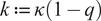
$ k:= \kappa \left(1-q\right) $
is the probability that the trader is informed at the equilibrium.
-
3. An equilibrium where the speculator acquires information with probability 1 and where the hedger buys the asset exists if and only if
(23)and
$$ \frac{a^2}{2}{\left(\frac{1}{1+q}\right)}^2-\frac{B}{2}\le c\le \frac{a^2}{2}\frac{q}{{\left(1+q\right)}^2} $$
(24)
$$ \frac{a^2}{2}\frac{1-q}{{\left(1+q\right)}^2}\le \frac{B}{2}. $$
-
4. Welfare is the same as in the benchmark economy.




Proof. Identical to the proof of Proposition 1, except that we now need to check that “always buy” dominates “acquisition of information” for the hedger. Details: see the Supplementary Material.
We observe that conditions (22) and (24) in Proposition 4 are indeed strictly more stringent than the corresponding conditions in Proposition 1: The private benefit needs to be larger for an equilibrium where the speculator acquires information with positive probability to exist. Conditional on existence, however, this equilibrium is identical in all respects to the equilibrium in the benchmark economy.
I now solve for the new equilibria, where the hedger acquires information. Both pure and mixed strategy equilibria exist. For ease of exposition, I discuss only the pure strategy equilibrium in the main text and confine the description of the mixed strategy equilibria to the Supplementary Material.Footnote 14 Details of the proof of the following proposition are similarly confined to the Supplementary Material, as the line of argument is identical to that of Proposition 1:
Proposition 5. An equilibrium where the hedger acquires information with probability 1 and where the speculator does not trade exists if and only if
 $$ c\le \mathit{\operatorname{Min}}\left(\frac{B}{2};\frac{a^2}{2}-\frac{B}{2}\right). $$
The equilibrium welfare is equal to
 $$ {W}_0+\frac{a^2}{4}\frac{1}{2-q}+q\left(\frac{B}{2}-c\right). $$
Proof. See the Supplementary Material.
Comparing equation (25) in Proposition 5 with the corresponding conditions in Proposition 4 immediately implies that the equilibrium with an informed hedger may overlap with any of the other three equilibria. The value of the private benefit $ B $
determines how much of an overlap there is with each equilibrium. To understand the role played by
$ B $
determines how much of an overlap there is with each equilibrium. To understand the role played by $ B $
in the equilibrium with an informed hedger, it is useful to rewrite equation (25) as
$ B $
in the equilibrium with an informed hedger, it is useful to rewrite equation (25) as
 $$ c\le \frac{B}{2}\le \frac{a^2}{2}-c. $$
Condition (27) states that for an equilibrium with an informed hedger to exist, the private benefit of the hedger should be neither too small nor too high. To see why this makes sense, first note that $ \overline{p}=1 $
in this equilibrium. This is because the only type that places a buy order is a hedger who learned that
$ \overline{p}=1 $
in this equilibrium. This is because the only type that places a buy order is a hedger who learned that $ \theta =a $
. But
$ \theta =a $
. But $ \overline{p}=1 $
implies that the trading profit of an informed trader is equal to 0. Thus, if the private benefit is so small that it does not compensate for the cost of acquiring information, then the best response of the hedger when the market-maker asks a price P(1) is to stop trading. Conversely, if the private benefit is so large that it more than compensates the expected trading loss of an uninformed trader at price P(1), then the best response of the hedger is to buy the asset without acquiring information. Only when private benefits are in between do we get the equilibrium with an informed hedger.
$ \overline{p}=1 $
implies that the trading profit of an informed trader is equal to 0. Thus, if the private benefit is so small that it does not compensate for the cost of acquiring information, then the best response of the hedger when the market-maker asks a price P(1) is to stop trading. Conversely, if the private benefit is so large that it more than compensates the expected trading loss of an uninformed trader at price P(1), then the best response of the hedger is to buy the asset without acquiring information. Only when private benefits are in between do we get the equilibrium with an informed hedger.
As we get multiple equilibria, it is natural to ask which equilibrium generates a higher welfare. Welfare is the same as in the benchmark economy when hedgers do not acquire information. We thus need to compare (26) with the welfare expressions in Proposition 1, which yields the following proposition.
Proposition 6.
-
1. Whenever both the equilibrium with no acquisition of information and the equilibrium with informed hedger exist, welfare is strictly higher in the equilibrium with no acquisition of information.
-
2. Whenever both the equilibrium where the hedger acquires information with probability 1 and the equilibrium where the speculator acquires information with probability 1 exist, welfare is higher in the equilibrium where the speculator acquires information if and only if
(28)
$$ \left(1-2q\right)\left(\frac{a^2}{4}\frac{1}{\left(2-q\right)\left(1+q\right)}-c\right)+\frac{qB}{2}\ge 0. $$

The first part of Proposition 6 is unsurprising since the equilibrium with no acquisition of information is efficient: the social value of information is bounded above by $ \frac{a^2}{8} $
as the expected firm value under perfect information is equal to
$ \frac{a^2}{8} $
as the expected firm value under perfect information is equal to $ \frac{a^2}{4}=\frac{1}{2}{\int}_0^a\left(a-x\right) dx+\frac{1}{2}\ast 0 $
while the expected firm value under no information is equal to
$ \frac{a^2}{4}=\frac{1}{2}{\int}_0^a\left(a-x\right) dx+\frac{1}{2}\ast 0 $
while the expected firm value under no information is equal to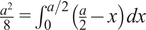 $ \frac{a^2}{8}={\int}_0^{a/2}\left(\frac{a}{2}-x\right) dx $
. Thus, condition (20) for the existence of the equilibrium with no acquisition of information also implies that the social cost of information is strictly larger than its social value for these parameter values.
$ \frac{a^2}{8}={\int}_0^{a/2}\left(\frac{a}{2}-x\right) dx $
. Thus, condition (20) for the existence of the equilibrium with no acquisition of information also implies that the social cost of information is strictly larger than its social value for these parameter values.
The key insight behind the second part of Proposition 6 is that if the same amount of information is generated in both equilibria, then the social planner unambiguously prefers the equilibrium where the speculator acquires information since the information is produced for a lower social cost (no foregone gains from trade). As can easily be observed by substituting $ q=1/2 $
into (28), this implies that the welfare in the equilibrium with informed speculator is always strictly larger than the welfare in the equilibrium with informed hedgers if there are not more hedgers than speculators. Only for a
$ q=1/2 $
into (28), this implies that the welfare in the equilibrium with informed speculator is always strictly larger than the welfare in the equilibrium with informed hedgers if there are not more hedgers than speculators. Only for a $ q $
large enough can the ordering of the two equilibria be reversed. The intuition for the result is that when the proportion of hedgers is sufficiently larger than 1/2, more information is produced in the equilibrium where the hedger acquires information than in the equilibrium where the speculator does. If information is socially valuable, that is if
$ q $
large enough can the ordering of the two equilibria be reversed. The intuition for the result is that when the proportion of hedgers is sufficiently larger than 1/2, more information is produced in the equilibrium where the hedger acquires information than in the equilibrium where the speculator does. If information is socially valuable, that is if $ c $
is small relative to
$ c $
is small relative to $ a $
, and if the private benefit,
$ a $
, and if the private benefit, $ B $
, is not too large, then the efficiency gain of more revealing prices could more than compensate the loss of private benefits.
$ B $
, is not too large, then the efficiency gain of more revealing prices could more than compensate the loss of private benefits.
Could we ever get into a situation where the economy would coordinate on the bad equilibrium? While equilibrium selection can be a slippery topic, an element of answer is that beliefs of the market-maker play a key role in selecting the equilibrium. Take for instance the case where both the equilibrium without acquisition of information and the equilibrium with informed hedger co-exist. If the market-maker believes that $ \overline{p}=\frac{1}{2} $
, then the price he or she asks will not lead to any acquisition of information. Conversely, if the market-maker believes that
$ \overline{p}=\frac{1}{2} $
, then the price he or she asks will not lead to any acquisition of information. Conversely, if the market-maker believes that $ \overline{p}=1 $
, then the price he or she asks will incentivize the hedger to acquire information, thus validating the beliefs of the market-maker. But notice that the market-maker is better off in the bad equilibrium. This is because the market-maker is endowed with equity, and the value of this initial endowment is strictly increasing in the information produced in the financial market. The cost of acquiring information and the foregone private benefits are both borne by the trader, not by the market-maker. So, and even though this is stepping outside the model, there are reasons to think that, if market-makers were strategic rather than competitive, the economy could coordinate on an equilibrium where hedgers acquire information even though they should not. This in turn implies that the regulator may need to step in, which we discuss in the next section.
$ \overline{p}=1 $
, then the price he or she asks will incentivize the hedger to acquire information, thus validating the beliefs of the market-maker. But notice that the market-maker is better off in the bad equilibrium. This is because the market-maker is endowed with equity, and the value of this initial endowment is strictly increasing in the information produced in the financial market. The cost of acquiring information and the foregone private benefits are both borne by the trader, not by the market-maker. So, and even though this is stepping outside the model, there are reasons to think that, if market-makers were strategic rather than competitive, the economy could coordinate on an equilibrium where hedgers acquire information even though they should not. This in turn implies that the regulator may need to step in, which we discuss in the next section.
V. Policy Implications
The article started with the policy question of whether traders who speculate should be regulated differently depending on their status as hedger or non-hedger. The answer provided by the model to this question is nuanced, as optimal regulation depends on parameter values.
A first key parameter is the social value of information, which results from the comparison between the expected increase in firm value generated by learning in financial markets, which in the model is driven by the parameter $ a $
, and the cost of acquiring information,
$ a $
, and the cost of acquiring information, $ c $
. When the social value of information is negative, then the optimal regulation is to tax or prohibit speculative activities, whether they are conducted by hedger or speculator. The more uncertain the technology is and the lower the cost of acquiring information, the less likely this is to be in this case.
$ c $
. When the social value of information is negative, then the optimal regulation is to tax or prohibit speculative activities, whether they are conducted by hedger or speculator. The more uncertain the technology is and the lower the cost of acquiring information, the less likely this is to be in this case.
Assuming that the cost of acquiring information is below this threshold, a first role for regulation in the model is equilibrium selection. Two main parameters determine which way the regulator should go: the probability that a trade is initiated by a hedger and the size of the hedging benefits. Proposition 6 states that if the probability that a trade is initiated by a hedger is large enough and the size of the private benefits is small enough, then welfare is higher when the hedger acquires information. When the two conditions are met, policies that provide an edge to hedgers, and thus help unravel the equilibrium with an informed speculator, may increase welfare. One can argue that the position limit exemption on U.S. commodity futures markets fits in this category, at least prior to 2004 and the rise in the number of financial speculators on commodity markets.Footnote 15 In sharp contrast, when the probability that a trade is initiated by a speculator increases, Proposition 6 implies that the optimal regulation, far from providing an edge to hedgers, should instead implement a rule akin to the Volcker rule, whereby hedgers are prohibited from engaging in speculative activities.
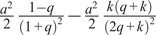
Once equilibrium selection is taken care of, a second role for regulation arises when the probability that a trade is initiated by a hedger is small and when the cost of acquiring information is neither too small nor too large. In this case, indeed, Proposition 3 shows that too little information is acquired at the competitive equilibrium. Within the model, the most natural policy to remedy this inefficiency is to tax firms, use the tax proceeds to subsidize information acquisition by the speculator, and compensate the hedger for his or her increased trading losses. As stated in the following proposition and proved in the Appendix, this results in a Pareto-superior allocation:
Proposition 7. Assume that:
-
•
$ q<1/3 $
and a Volcker rule has been implemented, -
•
$ \frac{a^2}{2}\frac{q}{{\left(1+q\right)}^2}<c<\frac{a^2}{8}\frac{1}{1+q}, $
-
•
$ B\ge kc, $



where: k is the probability that the trader is informed in the initial equilibrium.
Then the following policy leads to a Pareto-superior equilibrium allocation:
-
• Give a subsidy to the speculator equal to
$ c-\frac{a^2}{2}\frac{q}{{\left(1+q\right)}^2} $
if he or she acquires information. -
• Give a subsidy to the hedger equal to
$ \frac{a^2}{2}\frac{1-q}{{\left(1+q\right)}^2}-\frac{a^2}{2}\frac{k\left(q+k\right)}{{\left(2q+k\right)}^2} $
if he or she buys the asset. -
• Finance the subsidies by a tax on the firm.

Proof. See the Appendix.
Even though the policy leads to a Pareto improvement in the model, there are some reasons why it may not be adopted in practice. One reason is that the regulator may find it hard to estimate to what extent information in asset prices is unknown to managers of a given firm or in a given industry and relevant for their corporate decisions. Another reason is that subsidizing information acquisition by speculators is unlikely to be politically acceptable.
A market-based solution that achieves almost the same outcome as the transfer policy without being subject to the same objections is to allow private contracts between the firm and the market-maker, whereby the firm pays the market-maker to charge a lower spread. Such private contracts exist in Europe but are currently not allowed on U.S. markets (see https://www.finra.org/rules-guidance/rulebooks/finra-rules/5250). The base mechanism by which these contracts may increase welfare is the same as in Proposition 7: they implement a transfer from the firm to the speculator to incentivize the production of information. The main difference with Proposition 7 is the fact that transfers are intermediated by a market-maker and take the form of a lower spread, which implies that it is not possible to specify the transfer to the speculator independently of the transfer to the hedger, and makes it harder to get a Pareto-superior allocation. More formally, I show that:
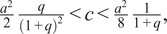
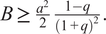
Proposition 8. Assume that:
-
•
$ q<1/3 $
and a Volcker rule has been implemented, -
•
$ \frac{a^2}{2}\frac{q}{{\left(1+q\right)}^2}<c<\frac{a^2}{8}\frac{1}{1+q}, $
-
•
$ B\ge \frac{a^2}{2}\frac{1-q}{{\left(1+q\right)}^2}. $

Then, the following policy strictly increases total welfare:
-
• The firm pays to the market-maker a subsidy S equal to
$$ S=\frac{1+q}{2}\left(E\left(V|\frac{1}{1+q};\frac{1}{1+q}\right)-E\left(V|\frac{q+k}{2q+k};\frac{q+k}{2q+k}\right)\right). $$
-
• The market-maker commits to quote an ask price P equal to
where: k is the probability that the trader is informed in the initial equilibrium and
$$ P=E\left(\hat{V}|\frac{q+k}{2q+k};\frac{q+k}{2q+k}\right), $$
$ \hat{V}=V-S $
.


Proof. See the Appendix.
The result in Proposition 8 is closely related to the literature on DMM. Bessembinder et al. (Reference Bessembinder, Hao and Zheng2015) provide the first theoretical rationale for why contracts between firms and DMMs may be welfare-enhancing in an IPO context. In their model, liquidity issues due to asymmetric information in the secondary market may cause an IPO to fail at the initial stage. A contract between the firm and the market-maker can be Pareto improving provided that the expected increase in the IPO price more than compensates the market-maker for his or her trading losses resulting from the low spread agreed upon in the contract. A similar mechanism is at play here, where the incentives of the firm to pay the market-maker stem from the productive efficiency gains generated by the feedback effect. The introduction of DMM contracts in my model generates testable implications that are common with those of the model by Bessembinder et al. (Reference Bessembinder, Hao and Zheng2015) and that have been validated by the empirical literature: younger, smaller firms, with a higher level of ex ante uncertainty, should be more likely to sign DMM agreements, DMM should increase liquidity and price discovery, and the announcement of a DMM contract should generate a positive abnormal return (see Venkataraman and Waisburd (Reference Venkataraman and Waisburd2007), Anand et al. (Reference Anand, Tanggard and Weaver2009), and Menkveld and Wang (Reference Menkveld and Wang2013)). The model, however, also implies a specific new testable implication: firms that sign a contract with a DMM should display a stronger feedback effect than comparable firms without a DMM contract.
VI. Conclusion
Like the celebrated Dr Jekyll in “The strange case of Dr Jekyll and Mr Hyde” by Stevenson (Reference Stevenson1886), the trader in my model is “cursed by the duality of his purpose.” A hedger who can acquire costly information may decide to do so but find himself or herself worse off than if he or she did not have this flexibility. He or she may instead gain by restricting himself or herself to trading for hedging purposes and have another type, a financial speculator, freely acquire information and make trading profits, the same way as Dr Jekyll initially gained having Mr Hyde “delivered from the aspirations and remorse of his more upright twin.”
The model also suggests that allowing hedgers to speculate may be the cause of financial fragility in the form of multiple equilibria, while, in sharp contrast, financial speculators may not acquire enough information. I show that possible remedies include separating hedging and speculative activities in the spirit of the Volcker rule to select the higher welfare equilibrium and allowing private contracts between firms and market-makers, whereby firms pay market-makers to charge a lower spread and benefit in return from a more informative stock price that allows them to make better-informed investment decisions.
Appendix
For the sake of brevity, I use acronyms in all appendices to describe both the trader’s type, H or S, and his or her information set: NI for Not Informed; I+ for Informed and learned that $ \theta =\mathbf{a} $
; I– for Informed and learned that
$ \theta =\mathbf{a} $
; I– for Informed and learned that $ \theta =\mathbf{0} $
. This yields six possible acronyms: HNI; HI+; HI–; SNI; SI+; and SI–.
$ \theta =\mathbf{0} $
. This yields six possible acronyms: HNI; HI+; HI–; SNI; SI+; and SI–.
A. Proof of Proposition 1
1. Proof of Part 1
We need to check when the following candidate equilibrium strategies are optimal:
-
• neither H nor S acquires information,
-
• HNI buys,
-
• SNI does not trade,
-
• Firm manager and market-maker act optimally given the trader’s strategy.
Given that no information is acquired in the candidate equilibrium, we have
 $$ \overline{p}=\underline{p}=\frac{1}{2}. $$
 $$ P\left(\overline{p}\right)=P\left(\underline{p}\right)=\frac{a^2}{8}. $$
 $$ {\pi}_{I+}\left(\overline{p}\right)=\frac{a^2}{4}, $$
 $$ {\pi}_{NI}\left(\overline{p}\right)=0. $$
We first check that “no trade” dominates “acquisition of information” for the speculator. From (9) and (A.1), this is the case when
 $$ c\ge \frac{a^2}{8}. $$
We next check that “always buy” dominates “no trade” for the hedger. This is the case when
 $$ B+{\pi}_{NI}\left(\overline{p}\right)\ge 0. $$
Equation (A.6) is always satisfied because of (A.4) and the fact that $ B>0 $
.
$ B>0 $
.
Putting it all together, we find that the candidate equilibrium strategies are indeed optimal if (10) is satisfied.
To compute the equilibrium welfare, we need to compute the unconditional expected value of the firm. The equilibrium strategies imply that the probability of a buy order is equal to q and that the probability of no trade is equal to 1 – q. Then, we get
 $$ E(V)= qP\left(\overline{p}\right)+\left(1-q\right)P\left(\underline{p}\right)=\frac{a^2}{8}. $$
Since the hedger always buys the asset, the expected private benefit is equal to $ qB $
. Since no one acquires information, the expected cost of acquiring information is 0. Putting it all together yields (11). QED.
$ qB $
. Since no one acquires information, the expected cost of acquiring information is 0. Putting it all together yields (11). QED.
2. Proof of Part 2
We need to check when the following candidate equilibrium strategies are optimal:
-
• S acquires information with probability
$ \kappa $
, -
• H does not acquire information,
-
• SI+ buys; SI– and SNI do not trade,
-
• HNI buys,
-
• Firm manager and market-maker act optimally given the trader’s strategy.

From the equilibrium strategies, a buy order can come from types HNI (of mass $ q $
) and SI+ (of mass
$ q $
) and SI+ (of mass $ \frac{k}{2} $
, where
$ \frac{k}{2} $
, where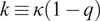 $ k\equiv \kappa \left(1-q\right) $
). Out of these buy orders, half of the orders from HNI and all the orders from SI+ coincide with
$ k\equiv \kappa \left(1-q\right) $
). Out of these buy orders, half of the orders from HNI and all the orders from SI+ coincide with $ \theta =a $
.
$ \theta =a $
.
Conversely, no trade comes from type SI– (of mass $ \frac{k}{2} $
) and SNI (of mass
$ \frac{k}{2} $
) and SNI (of mass $ 1-q-k $
). Out of those, half of the no trade from SNI and none from SI– coincide with
$ 1-q-k $
). Out of those, half of the no trade from SNI and none from SI– coincide with $ \theta =a $
.
$ \theta =a $
.
We then get from Bayes’ law:
 $$ \overline{p}=\frac{\frac{q}{2}+\frac{k}{2}}{q+\frac{k}{2}}=\frac{q+k}{2q+k}, $$
 $$ \underline{p}=\frac{\frac{1-q-k}{2}}{\frac{k}{2}+1-q-k}=\frac{1-q-k}{2\left(1-q\right)-k}. $$
 $$ P\left(\overline{p}\right)=\frac{a^2}{2}\frac{{\left(q+k\right)}^2}{{\left(2q+k\right)}^2}, $$
 $$ P\left(\underline{p}\right)=\frac{a^2}{2}\frac{{\left(1-q-k\right)}^2}{{\left(2\left(1-q\right)-k\right)}^2}. $$
 $$ {\pi}_{I+}\left(\overline{p}\right)={a}^2\frac{q\left(q+k\right)}{{\left(2q+k\right)}^2}, $$
 $$ {\pi}_{NI}\left(\overline{p}\right)=-\frac{a^2}{2}\frac{k\left(q+k\right)}{{\left(2q+k\right)}^2}. $$
We first compute the value of k that makes the speculator indifferent between “acquisition of information” and no trade. From (9) and (A.8), this is the case when
 $$ c=\frac{a^2}{2}\frac{q\left(q+k\right)}{{\left(2q+k\right)}^2}. $$
We note that the RHS of (A.14) is strictly decreasing in k and takes the value $ \frac{a^2}{8} $
when
$ \frac{a^2}{8} $
when $ k=0 $
and value
$ k=0 $
and value $ \frac{a^2}{2}\frac{q}{{\left(1+q\right)}^2} $
when
$ \frac{a^2}{2}\frac{q}{{\left(1+q\right)}^2} $
when $ k=1-q $
.
$ k=1-q $
.
We next check that “always buy” dominates “no trade” for the hedger. This is the case when $ B+{\pi}_{NI}\left(\overline{p}\right)\ge 0 $
, which after substituting (A.13) then (A.14) yields
$ B+{\pi}_{NI}\left(\overline{p}\right)\ge 0 $
, which after substituting (A.13) then (A.14) yields
 $$ B\ge \frac{a^2}{2}\frac{k\left(q+k\right)}{{\left(2q+k\right)}^2}=\frac{k}{q}c. $$
Putting it together, we find that the candidate equilibrium strategies are indeed optimal if (12) and (13) are satisfied.
To compute the equilibrium welfare, we need to compute the unconditional expected value of the firm. The equilibrium strategies imply that the probability of a buy order is equal to $ q+\frac{k}{2} $
and that the probability of no trade is equal to
$ q+\frac{k}{2} $
and that the probability of no trade is equal to $ 1-q-\frac{k}{2} $
. Then, we get after substituting (A.10) and (A.11) and simplifying:
$ 1-q-\frac{k}{2} $
. Then, we get after substituting (A.10) and (A.11) and simplifying:
 $$ E(V)=\left(q+\frac{k}{2}\right)\left(\frac{a^2}{2}\frac{{\left(q+k\right)}^2}{{\left(2q+k\right)}^2}\right)+\left(1-q-\frac{k}{2}\right)\left(\frac{a^2}{2}\frac{{\left(1-q-k\right)}^2}{{\left(2\left(1-q\right)-k\right)}^2}\right), $$
 $$ \iff E(V)=\frac{a^2}{4}\frac{2q\left(1-q\right)+k\left(1-2q\right)}{\left(k+2q\right)\left(2\left(1-q\right)-k\right)}. $$
Since the hedger always buys the asset, the expected private benefit is equal to $ qB $
. Since the speculator acquires information, the expected cost of acquiring information is
$ qB $
. Since the speculator acquires information, the expected cost of acquiring information is $ kc $
. Putting it all together yields (14). QED.
$ kc $
. Putting it all together yields (14). QED.
3. Proof of Part 3
We need to check when the following candidate equilibrium strategies are optimal:
-
• S acquires information with probability 1,
-
• H does not acquire information,
-
• SI+ buys; SI– does not trade,
-
• HNI buys,
-
• Firm manager and market-maker act optimally given the trader’s strategy.
From the equilibrium strategies, a buy order can come from types HNI (of mass $ q $
) and SI+ (of mass
$ q $
) and SI+ (of mass $ \frac{1-q}{2} $
). Out of these buy orders, half of the orders from HNI and all the orders from SI+ coincide with
$ \frac{1-q}{2} $
). Out of these buy orders, half of the orders from HNI and all the orders from SI+ coincide with $ \theta =a $
. Conversely, no trade comes only from type SI–, of which none coincide with
$ \theta =a $
. Conversely, no trade comes only from type SI–, of which none coincide with $ \theta =a $
. We then get from Bayes’ law:
$ \theta =a $
. We then get from Bayes’ law:
 $$ \overline{p}=\frac{\frac{q}{2}+\frac{1-q}{2}}{q+\frac{1-q}{2}}=\frac{1}{\left(1+q\right)}, $$
 $$ \underline{p}=0. $$
 $$ P\left(\overline{p}\right)=\frac{a^2}{2}\frac{1}{{\left(1+q\right)}^2}, $$
 $$ P\left(\underline{p}\right)=0. $$
 $$ {\pi}_{I+}\left(\overline{p}\right)={a}^2\frac{q}{{\left(1+q\right)}^2}, $$
 $$ {\pi}_{NI}\left(\overline{p}\right)=\frac{a^2}{2}\frac{q-1}{{\left(1+q\right)}^2}. $$
We first check that “acquisition of information” dominates “no trade” for the speculator. From (9) and (A.17), this is the case when
 $$ c\le \frac{a^2}{2}\frac{q}{{\left(1+q\right)}^2}. $$
We next check that “always buy” dominates “no trade” for the hedger. This is the case when $ B+{\pi}_{NI}\left(\overline{p}\right)\ge 0 $
, which after substituting (A.22) yields
$ B+{\pi}_{NI}\left(\overline{p}\right)\ge 0 $
, which after substituting (A.22) yields
 $$ B\ge \frac{a^2}{2}\frac{1-q}{{\left(1+q\right)}^2}. $$
Putting it together, we conclude that the candidate equilibrium strategies are indeed optimal if (15) and (16) are satisfied.
To compute the equilibrium welfare, we need to compute the unconditional expected value of the firm. The equilibrium strategies imply that the probability of a buy order is equal to $ q+\frac{1-q}{2} $
and that the probability of no trade is equal to
$ q+\frac{1-q}{2} $
and that the probability of no trade is equal to $ \frac{1-q}{2} $
. Then, we get after substituting (A.19) and (A.20):
$ \frac{1-q}{2} $
. Then, we get after substituting (A.19) and (A.20):
 $$ E(V)=\left(q+\frac{1-q}{2}\right)\left(\frac{a^2}{2}\frac{1}{{\left(1+q\right)}^2}\right)+\frac{1-q}{2}\ast 0=\frac{a^2}{4}\frac{1}{1+q}. $$
Since the hedger always buys the asset, the expected private benefit is equal to $ qB $
. Since the speculator acquires information, the expected cost of acquiring information is
$ qB $
. Since the speculator acquires information, the expected cost of acquiring information is $ \left(1-q\right)c $
. Putting it all together yields (17). QED.
$ \left(1-q\right)c $
. Putting it all together yields (17). QED.
B. Proof of Proposition 2
To prove Proposition 2, we need to show that welfare is a convex function of k on the interval [0, 1 – q]. The conclusion then follows from the Bauer Maximum Principle: Any continuous convex function defined on a compact set reaches its maximum at an extreme point.
Differentiating (14) with respect to k yields
 $$ \frac{\partial E(V)}{\partial k}=\frac{a^2}{4}\frac{k\left(4q\left(1-q\right)+k\left(1-2q\right)\right)}{{\left(k+2q\right)}^2{\left(2\left(1-q\right)-k\right)}^2}. $$
We remark that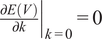 $ {\left.\frac{\partial E(V)}{\partial k}\right|}_{k=0}=0 $
.
$ {\left.\frac{\partial E(V)}{\partial k}\right|}_{k=0}=0 $
.
Differentiating (A.26) provides
 $$ \frac{\partial^2E(V)}{\partial {k}^2}=\frac{a^2}{2}\frac{8{q}^2{\left(1-q\right)}^2+6{k}^2q\left(1-q\right)+{k}^3\left(1-2q\right)}{{\left(k+2q\right)}^3{\left(2\left(1-q\right)-k\right)}^3}. $$
The only possibly negative term in the numerator of (A.27) is the term in $ {k}^3\left(1-2q\right) $
. However, the fact that q < 1 and k
$ {k}^3\left(1-2q\right) $
. However, the fact that q < 1 and k $ \le $
1 – q implies that
$ \le $
1 – q implies that $ {k}^3\left(1-2q\right)+{k}^2q\left(1-q\right)>0 $
. It follows that the numerator of () is strictly positive. This implies that both E(V) and the welfare in (14) are strictly convex functions of k. Thus, it is either maximized at
$ {k}^3\left(1-2q\right)+{k}^2q\left(1-q\right)>0 $
. It follows that the numerator of () is strictly positive. This implies that both E(V) and the welfare in (14) are strictly convex functions of k. Thus, it is either maximized at $ k=0 $
or at
$ k=0 $
or at $ k=1-q $
.
$ k=1-q $
.
k = 1 – q is optimal if and only if welfare for $ k=1-q $
given by (17) is larger than the welfare for
$ k=1-q $
given by (17) is larger than the welfare for $ k=0 $
given by (11), which is equivalent to the condition in Proposition 2. QED.
$ k=0 $
given by (11), which is equivalent to the condition in Proposition 2. QED.
C. Proof of Proposition 7
Since the Volcker rule has been implemented, the initial equilibrium allocations and welfare are given by Proposition 1. The assumptions of Proposition 7 furthermore imply that the initial equilibrium is the mixed strategy equilibrium described in Part 2 of the proposition.
We now solve for the equilibrium after the subsidy. Note first that both expected value of the firm and ask price of the market-maker go down by the amount paid by the firm to finance the subsidy, which leaves expressions (7) and (8) for, respectively, expected profits of informed trader and expected losses of uninformed trader unchanged.
Notice next that the post-subsidy cost of acquiring information for the speculator is given by $ \frac{a^2}{2}\frac{q}{{\left(1+q\right)}^2} $
and that the subsidy for the hedger is exactly equal to the difference between expected losses in the initial equilibrium,
$ \frac{a^2}{2}\frac{q}{{\left(1+q\right)}^2} $
and that the subsidy for the hedger is exactly equal to the difference between expected losses in the initial equilibrium, $ {\pi}_{NI}\left(\frac{q+k}{2q+k}\right) $
, and expected losses in an equilibrium where the speculator acquires information with probability 1,
$ {\pi}_{NI}\left(\frac{q+k}{2q+k}\right) $
, and expected losses in an equilibrium where the speculator acquires information with probability 1, $ {\pi}_{NI}\left(\frac{1}{1+q}\right) $
. It then follows from the proof of Part 3 of Proposition 1 that a speculator acquiring information with probability 1 and a hedger always buying the asset is an equilibrium.
$ {\pi}_{NI}\left(\frac{1}{1+q}\right) $
. It then follows from the proof of Part 3 of Proposition 1 that a speculator acquiring information with probability 1 and a hedger always buying the asset is an equilibrium.
As the subsidy that the hedger receives is exactly equal to the increase in expected losses, his or her welfare is left unchanged.
As the speculator was indifferent between acquiring information and not trading in the initial equilibrium, he or she cannot be worse off after the subsidy.
Finally, to derive the net impact of the tax/subsidy scheme on expected firm value, and thus on the value of the endowment of the market-maker, we first compute the expected cost, EC, of the two subsidies that the firm has to pay:
 $$ {\displaystyle \begin{array}{rcl} EC& =& \left(1-q\right)\left(c-\frac{a^2}{2}\frac{q}{{\left(1+q\right)}^2}\right)+q\left(\frac{a^2}{2}\frac{1-q}{{\left(1+q\right)}^2}-\frac{a^2}{2}\frac{k\left(q+k\right)}{{\left(2q+k\right)}^2}\right)\\ {}& =& c\left(1-q\right)-\frac{a^2}{2}\frac{kq\left(q+k\right)}{{\left(2q+k\right)}^2}.\end{array}} $$
From A.14, we know that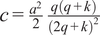 $ c=\frac{a^2}{2}\frac{q\left(q+k\right)}{{\left(2q+k\right)}^2} $
, which implies that (A.28) can be rewritten as
$ c=\frac{a^2}{2}\frac{q\left(q+k\right)}{{\left(2q+k\right)}^2} $
, which implies that (A.28) can be rewritten as
 $$ EC=\left(1-q-k\right)c. $$
The assumptions of Proposition 7 imply that welfare in the pure strategy equilibrium where information is acquired with probability 1 is larger than welfare in the mixed strategy equilibrium, which, from equations (14) and (17), implies that $ \left(1-q-k\right)c $
is strictly lower than the increase in firm value, thus making the market-maker strictly better off. QED.
$ \left(1-q-k\right)c $
is strictly lower than the increase in firm value, thus making the market-maker strictly better off. QED.
D. Proof of Proposition 8
Since the Volcker rule has been implemented, the initial equilibrium allocations and welfare are given by Proposition 1. The assumptions of Proposition 8 furthermore imply that the initial equilibrium is the mixed strategy equilibrium described in Part 2 of the proposition. Proposition 2 finally implies that if the equilibrium of the economy with the proposed contract is characterized by a speculator purchasing information with probability 1 and a hedger always buying the asset, then total welfare is strictly higher than in the initial economy.
We recall from the proof of Proposition 1 that $ \overline{p}=\frac{1}{1+q} $
when the speculator acquires information with probability 1, while
$ \overline{p}=\frac{1}{1+q} $
when the speculator acquires information with probability 1, while $ \overline{p}=\frac{q+k}{2q+k} $
in the mixed strategy equilibrium.
$ \overline{p}=\frac{q+k}{2q+k} $
in the mixed strategy equilibrium.
We adopt the following notations:
 $$ \Delta E(V)=E\left(V|\frac{1}{1+q};\frac{1}{1+q}\right)-E\left(V|\frac{q+k}{2q+k};\frac{q+k}{2q+k}\right), $$
 $$ \hat{V}=V-S. $$
We first show that acquiring information dominates no trade for the speculator. We have
 $$ {\pi}_{I+}=E\left(\hat{V}|1;\frac{1}{1+q}\right)-P=E\left(\hat{V}|1;\frac{1}{1+q}\right)-E\left(\hat{V}|\frac{q+k}{2q+k};\frac{q+k}{2q+k}\right), $$
 $$ =E\left(V|1;\frac{1}{1+q}\right)-E\left(V|\frac{q+k}{2q+k};\frac{q+k}{2q+k}\right). $$
From (4), we get that $ E\left(V|1;\frac{1}{1+q}\right)>E\left(V|1;\frac{q+k}{2q+k}\right) $
and thus
$ E\left(V|1;\frac{1}{1+q}\right)>E\left(V|1;\frac{q+k}{2q+k}\right) $
and thus
 $$ {\pi}_{I+}>E\left(V|1;\frac{q+k}{2q+k}\right)-E\left(V|\frac{q+k}{2q+k};\frac{q+k}{2q+k}\right)={a}^2\frac{q\left(q+k\right)}{{\left(2q+k\right)}^2}. $$
From (A.14), we have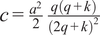 $ c=\frac{a^2}{2}\frac{q\left(q+k\right)}{{\left(2q+k\right)}^2} $
. We conclude that
$ c=\frac{a^2}{2}\frac{q\left(q+k\right)}{{\left(2q+k\right)}^2} $
. We conclude that $ -c+\frac{\pi_{I+}}{2}>0 $
, that is, acquiring information dominates no trade for the speculator.
$ -c+\frac{\pi_{I+}}{2}>0 $
, that is, acquiring information dominates no trade for the speculator.
We next show that it is optimal for the hedger to buy the asset. We have
 $$ {\pi}_{NI}=E\left(\hat{V}|0;\frac{1}{1+q}\right)-P=E\left(\hat{V}|0;\frac{1}{1+q}\right)-E\left(\hat{V}|\frac{q+k}{2q+k};\frac{q+k}{2q+k}\right), $$
 $$ =E\left(V|0;\frac{1}{1+q}\right)-E\left(V|\frac{q+k}{2q+k};\frac{q+k}{2q+k}\right). $$
From (4), we get that $ E\left(V|\frac{q+k}{2q+k};\frac{q+k}{2q+k}\right)<E\left(V|\frac{1}{1+q};\frac{1}{1+q}\right) $
and thus
$ E\left(V|\frac{q+k}{2q+k};\frac{q+k}{2q+k}\right)<E\left(V|\frac{1}{1+q};\frac{1}{1+q}\right) $
and thus
 $$ {\pi}_{NI}>E\left(V|0;\frac{1}{1+q}\right)-E\left(V|\frac{1}{1+q};\frac{1}{1+q}\right)=\frac{a^2}{2}\frac{q-1}{{\left(1+q\right)}^2}. $$
Proposition 8 assumes that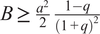 $ B\ge \frac{a^2}{2}\frac{1-q}{{\left(1+q\right)}^2} $
. We conclude that
$ B\ge \frac{a^2}{2}\frac{1-q}{{\left(1+q\right)}^2} $
. We conclude that $ B+{\pi}_{NI}>0 $
, that is, buying the asset dominates no trade for the hedger.
$ B+{\pi}_{NI}>0 $
, that is, buying the asset dominates no trade for the hedger.
We now turn to the market-maker. We first check that the zero-profit condition is satisfied with the proposed contract. The market-maker makes a loss per trade equal to the difference between its valuation of the firm and the ask price he or she agreed to quote, that is,
 $$ E\left(\hat{V}|\frac{1}{1+q};\frac{1}{1+q}\right)-E\left(\hat{V}|\frac{q+k}{2q+k};\frac{q+k}{2q+k}\right)=E\left(V|\frac{1}{1+q};\frac{1}{1+q}\right)-E\left(V|\frac{q+k}{2q+k};\frac{q+k}{2q+k}\right). $$
A trade occurs either when the trader is a hedger, with probability $ q $
, or when the trader is a speculator and has learned that
$ q $
, or when the trader is a speculator and has learned that $ \theta =a $
, with probability
$ \theta =a $
, with probability $ \frac{1-q}{2} $
. Thus, the probability of a trade is equal to
$ \frac{1-q}{2} $
. Thus, the probability of a trade is equal to $ \frac{1+q}{2} $
and the expected loss is exactly equal to the subsidy received from the firm.
$ \frac{1+q}{2} $
and the expected loss is exactly equal to the subsidy received from the firm.
Finally, it is immediate to check that it is optimal for the firm manager to offer the contract to the market-maker as the value of the assets goes up by $ \Delta E(V) $
while the subsidy paid to the market-maker is equal to
$ \Delta E(V) $
while the subsidy paid to the market-maker is equal to $ \frac{1+q}{2}\Delta E(V)<\Delta E(V). $
Thus, a speculator purchasing information with probability 1 and a hedger always buying the asset is an equilibrium of the economy with the proposed contract, and welfare is strictly higher than in the initial economy by Proposition 2. QED.
Supplementary Material
To view supplementary material for this article, please visit http://doi.org/10.1017/S0022109026102671.


 Open access

