

Hostname: page-component-76d6cb85b7-ntvhh Total loading time: 0 Render date: 2026-07-22T13:29:26.662Z Has data issue: false hasContentIssue false

In situ low-temperature hydrothermal synthesis of LiMn2O4 nanocomposites based on graphene oxide/carbon nanotubes hydrogel and its capacities

Published online by Cambridge University Press:  17 July 2020

Kelei Wang
Affiliation:
Anhui Province Key Laboratory of Advance Catalytic Material and Reaction Engineering, School of Chemistry and Chemical Engineering, Hefei University of Technology, Hefei230009, PR China
Lei Hua
Affiliation:
Anhui Province Key Laboratory of Advance Catalytic Material and Reaction Engineering, School of Chemistry and Chemical Engineering, Hefei University of Technology, Hefei230009, PR China
Zhongbing Wang
Affiliation:
Anhui Province Key Laboratory of Advance Catalytic Material and Reaction Engineering, School of Chemistry and Chemical Engineering, Hefei University of Technology, Hefei230009, PR China
Guanping Jin*
Affiliation:
Anhui Province Key Laboratory of Advance Catalytic Material and Reaction Engineering, School of Chemistry and Chemical Engineering, Hefei University of Technology, Hefei230009, PR China
Chunnian Chen*
Affiliation:
Anhui Province Key Laboratory of Advance Catalytic Material and Reaction Engineering, School of Chemistry and Chemical Engineering, Hefei University of Technology, Hefei230009, PR China
*
b)e-mail: jgp@hfut.edu.cn
a)Address all correspondence to these authors. e-mail: chencn@hfut.edu.cn
Get access

Abstract

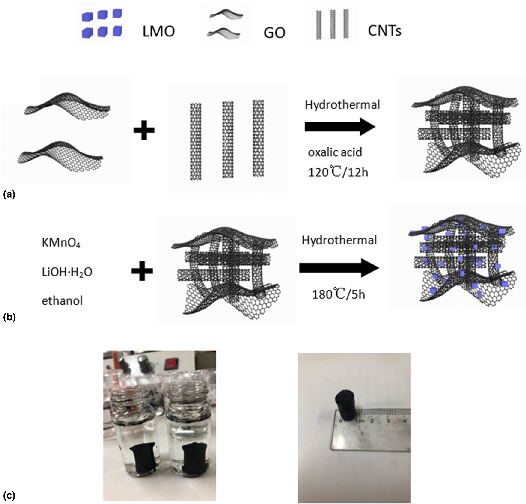
Integrating LiMn2O4(LMO) and different carbon materials to build a mixed cathode system can provide fast transport channels to improve the conduction of both electrons and ions. In this paper, our work studied in situ low-temperature hydrothermal synthesis of LMO nanocomposites based on graphene oxide (GO)/carbon nanotubes (CNTs) hydrogel. Compared with the pure LMO nanoparticles, GO/CNTs/LMO (GCLMO) composites greatly improved electrochemical performance in specific capacity, cycle performance and rate ability. The electrochemical test results showed that the specific capacitance of GCLMO nanocomposites reached 396 F/g at the current density of 0.5 A/g, which was much higher than 221 F/g of pure LMO. Even at the current density of 10 A/g, the specific capacitance was still as high as 309 F/g. Besides, after 2000 cycles, the specific capacitance retention of the composite was 93%. Electrochemical data showed that GCLMO composite is an ideal cathode material for supercapacitors.

Information

Type
Article
Copyright
Copyright © Materials Research Society 2020

Access options

Get access to the full version of this content by using one of the access options below. (Log in options will check for institutional or personal access. Content may require purchase if you do not have access.)

Article purchase

Temporarily unavailable