


This first part lays the groundwork for the book’s argument that hype is a significant and evolving phenomenon deserving sustained academic attention. Interest in its effects is growing – particularly in how actors engage with technologies surrounded by heightened expectations (Logue & Grimes, Reference Logue and Grimes2022; Garud et al., Reference Garud, Snihur, Thomas and Phillips2023; Ometto et al., Reference Ometto, Lounsbury, Gehman, Felin, Foss and Zenger2023) – yet the topic remains relatively underexplored (Bourne, Reference Bourne2024). We still lack clarity on what scholars mean by hype and what it offers as an analytical lens distinct from related concepts. Existing discussions are scattered across diverse fields – Media Studies, Philosophy, Science and Technology Studies (STS), Organisation and Management Theory (OMT), Economics, Sociology, and Market Studies – each with different assumptions and definitions. This disciplinary fragmentation hinders cross-field understanding, even as the breadth of work suggests hype’s potential as a valuable research concept. We also identify a need to study hype’s new actors – the expert groups that have emerged to produce, circulate, and manage responses to hype.
The following two chapters address these gaps. Chapter 2, What Is Hype?, reviews and consolidates existing scholarship, proposing a more nuanced understanding that goes beyond simplistic notions of exaggeration or deception. We emphasise hype’s dynamic, structured, and strategic role in promissory arenas and introduce Seven Tenets to guide future research and contribute to the emerging field of Hype Studies.
Chapter 3, Decision-Making about Unpredictable Technology Futures, examines how hype has moved from the periphery to the centre of organisational strategy. In markets where emerging technologies can redefine entire sectors, organisations must now actively engage with hype to remain competitive. This chapter explores how technology adopters, investors, and other market participants navigate its risks and opportunities under conditions of incomplete knowledge. The chapter also introduces the business of hype – a growing set of promissory products that help organisations evaluate and act on hyped claims, marking the professionalisation of hype management in contemporary innovation landscapes.
This chapter develops the conceptual foundation for Hype Studies by reviewing how hype is treated across different fields and proposing seven core tenets for its analysis. It clarifies how hype overlaps with, but is distinct from, concepts such as speculative bubbles, fashions, organising visions, and promises. Despite its prevalence, hype remains inconsistently defined and theoretically underdeveloped. To address this, we synthesise insights from Science and Technology Studies (STS), especially the Sociology of Expectations; Organisation and Management Theory (OMT); Information Systems (IS); Economics; Economic Sociology; and Cultural Entrepreneurship. Each of the seven tenets addresses a key dimension of hype, offering a framework to better understand how it operates and why it matters. This set of tenets is not intended to be exhaustive – especially when considering areas beyond the digital economy – and some are illustrated more fully than others. Nonetheless, they introduce and foreground the central themes developed in the chapters that follow, and we hope they provide a helpful foundation for the approach to hype advanced in this book.
2.1 Tenet One: Who Creates Hype – Beyond Promise Entrepreneurs to Collective Promissory Arenas
Brown (Reference Brown2003, p. 13) asks, ‘Where do expectations of the future originate’, and ‘by what means do they come to take hold of our imaginations and actions?’. Building on that provocation, we ask whether hype is created by singular ‘promise entrepreneurs’ or emerges from broader ‘promissory arenas’ in which future claims circulate and gain force.
Much existing work emphasises charismatic narrators. Economic analyses of technological bubbles point to ‘narrative accelerators’ (Shiller, Reference Shiller2019; Goldfarb & Kirsch, Reference Goldfarb and Kirsch2019). Cultural Entrepreneurship research foregrounds entrepreneurial ‘storytelling’ and ‘projective storytelling’ as mechanisms for mobilising audiences and resources (Lounsbury & Glynn, Reference Lounsbury and Glynn2001; Garud et al., Reference Garud, Schildt and Lant2014b). STS scholars similarly identify the ‘promise entrepreneur’, who crafts promissory claims to galvanise action (Joly & Le Renard, Reference Joly and Le Renard2021).
Yet such individualised accounts risk creating heroic, actor-centred narratives that retrospectively attribute innovation success to persuasive entrepreneurs while overlooking the institutional, relational, and infrastructural conditions that render their narratives actionable. They also invite survivor bias, leading to an overemphasis on successful innovation stories and an under-representation of those involving failed innovation (Geels & Smit, Reference Geels and Smit2000).
We therefore foreground ‘promissory arenas’ – the collective platforms, networks, and communities through which future-oriented narratives circulate, compete, reinforce one another, and gain power (Bakker et al., Reference Bakker and Budde2012). Individual storytellers matter, but they draw influence from broader infrastructures of promise-making that enrol multiple actors and interacting narratives.
The Sociology of Expectations provides a helpful lens for analysing these promissory arenas. Van Lente’s (Reference Van Lente1993) classic work introduced ‘promise‑requirement cycles’ in technological development: an initial generic promise mobilises interest; users, funders, regulators, and other stakeholders translate that promise into more specific requirements; progress is subsequently assessed against emerging milestones; and promises are recalibrated – strengthened, qualified, or withdrawn – in light of results. Gaps between promise and performance may be tolerated; success builds credibility and mobilises additional support, while shortfalls prompt adjustments or raise doubts. Importantly, the cycle repeats: promises are updated, expectations reset, and resources mobilised or withdrawn depending on whether interim results ‘live up’ to prior claims.
Such longitudinal, cyclical work shows that hype must be continually sustained and negotiated throughout the innovation process. When bold claims remain unproven, actors engage in repair work – adjusting narratives, supplying evidence, or reframing trajectories to maintain credibility (Garud et al., Reference Garud, Schildt and Lant2014b; Hampel & Dalpiaz, Reference Hampel and Dalpiaz2025). In this sense, hype is not a one-off act of overstatement but an evolving dialogue between promise-makers and promise-takers that unfolds over time.
Subsequent scholarship extends analysis from local promise‑requirement exchanges to the broader ecology of discursive and institutional formations that support and contest technological futures (Bakker et al., Reference Bakker, Van Lente and Meeus2011). These studies highlight ‘arenas of expectations’, field-level settings in which entrepreneurs, investors, corporations, regulators, media, analysts, and others contend over competing technological visions (Bakker et al., Reference Bakker, Van Lente and Meeus2011). Multiple arenas may coexist at different levels of aggregation (Bakker et al., Reference Bakker, Van Lente and Meeus2011).
Ruef and Markard (Reference Ruef and Markard2010) identify three levels of expectations that operate across and within such arenas. First, specific expectations are often attached to particular innovations or projects and can be volatile. Second, more general expectations concern the trajectory of a broader technological field and tend to be more durable. Third, higher-level societal imaginaries articulate the technology’s role in society and typically endure longest.
The promissory world is complex and loosely bounded, encompassing multiple expectational alignments of differing intensity, duration, and scale. As Joly (Reference Joly, Akrich, Barthe, Muniesa and Mustar2010, p. 4) argues, this calls for attention to the ‘diversity of arenas’ and for mapping the ‘topology of this space’ of expectations in what he terms the ‘economics of techno-scientific promises’. We build on this point to foreground how hype now underpins a market of its own – a coordinated set of actors and tools devoted to producing and exploiting promissory narratives. In our account, this diversity of arenas is no longer simply a descriptive feature of the promissory world but the basis of an organised economic field in which specialist actors occupy distinct niches, develop proprietary tools, and trade in the management of expectations. By tracing how these arenas interconnect and transact, we show how the business of hype operates as a structured market within the broader economy of expectations.
2.2 Tenet Two: Not All Technologies Generate Hype Equally
Hype is often seen as pervasive in today’s digital economy, but do all technologies generate it to the same extent? Garud et al. (2018, p. 4) raise this question directly, asking whether ‘all fields experience hype cycles’ – prompting us to consider what varies when hype takes shape. Our analysis suggests that hype is far from uniform: both its prevalence and character are uneven. Some domains are intensely saturated with hype, while others remain relatively muted – or even appear ‘hype-resistant’ (Potts, Reference Potts and Potts2017). We identify at least three dimensions along which hype varies: how it functions as a resource, how it operates as a structure, and who (and what) serve as its key catalysts.
2.2.1 Hype as a Resource
Hype confers legitimacy, direction, and coordination capacity in early innovation, yet it also creates obligations that can later backfire. Van Lente (Reference Van Lente2012) conceptualises hype as a resource that performs three critical functions in innovation processes. First, it provides legitimacy, helping to support emerging technologies and create ‘protected spaces’ where promissory narratives can circulate with fewer challenges (van Lente & Rip, Reference Van Lente, Rip, Disco and van der Meulen1998). Second, it offers direction, reducing uncertainty by suggesting plausible technological trajectories and guiding actors through moments of indeterminacy (Deuten & Rip, Reference Deuten and Rip2000). Third, it enables coordination, helping to align diverse stakeholders by defining roles, expectations, and responsibilities within innovation networks.
Yet this resource is not without risk. As van Lente et al. (Reference Van Lente, Spitters and Peine2013) caution, hype can unravel when expectations are not met. Ruef and Markard (Reference Ruef and Markard2010) expand on this, warning that declining hype can lead to disappointment, resource withdrawal, and a loss of momentum, as attention wanes and actors begin to exit the field. Similarly, Logue and Grimes (Reference Logue and Grimes2022, p. 1055) characterise hype as a ‘short-term resource but long-term risk’, suggesting that while hype may initially attract interest and support, it can also generate a growing burden of accountability. Over time, the promises embedded in hype create a sense of obligation between ventures and their audiences – obligations that may prove challenging to satisfy and that can backfire when expectations are not met.
2.2.2 Hype as Structure
When many actors repeatedly draw on hype as a resource, their efforts can sediment into broader structures of expectation. Palavicino (Reference Palavicino2016, p. 26) distinguishes between individual ‘hyping practices’ and the emergence of ‘meta-level’ hype phenomena, such as categories. In practice, this means repeated promotional storytelling around a technology can crystallise into a shared narrative or category that transcends any promoter. The case of Juvo’s FIDaaS category exemplifies this process, where what began as a strategic label for a single venture evolved into a recognisable market category. Rip and Voß (2009) characterise as an ‘umbrella term’ the categories that structure expectations and align actors.
This analytical aspect raises important questions about how hype evolves from individual performance to collective infrastructure. Van Lente and Rip (Reference Van Lente, Rip, Disco and van der Meulen1998) offer a helpful lens, theorising how emergent hype categories can become ‘macro actors’ – entities that not only gain visibility but also shape the contours of a field, including its dominant narratives and key players. Logue and Grimes (Reference Logue and Grimes2022, p. 1055) similarly stress the importance of ‘collective expectations’ and argue that individual acts of entrepreneurial hyping – however compelling – may fail unless embedded in a ‘corresponding vision that is collectively espoused and increasing in attention’. They suggest that projective storytelling risks ringing hollow without this shared uptake, lacking the structural support necessary to mobilise wider belief and engagement.
2.2.3 Hype’s Catalysts
Building on the insight above that multiple actors inhabit promissory arenas, we ask who amplifies or filters hype, and what events set hype in motion. Research in the Sociology of Expectations and further afield has differentiated between types of actors, noting that not everyone involved in innovation contributes to hype equally. For instance, Konrad and Alvial-Palavicino (Reference Konrad, Alvial-Palavicino, Konrad, Rohracher and von Schomberg2017) draw a line between ‘innovation creators’ and ‘hype creators’. Scientists or developers (‘innovation creators’) may focus on making the technology and only engage in minimal ‘expectation work’ if necessary. In contrast, other actors – specialised journalists, consultants, and analysts (‘hype creators’) – devote much of their effort to shaping narratives about innovations, despite not being directly involved in building the innovations themselves.
Bakker and Budde (Reference Bakker and Budde2012) offer a complementary typology, distinguishing between ‘hype enactors’ – such as innovators and entrepreneurs – and ‘hype selectors’ – including investors, adopters, and industry analysts. Hype enactors are those directly engaged in developing technologies or promoting specific futures, whereas hype selectors evaluate these futures, deciding whether to allocate resources, endorse claims, or adopt emerging solutions. Selectors’ due diligence and critical distance are vital: their filtering function strongly conditions whether hype diffuses, stalls, or dissipates (Bakker & Budde, Reference Bakker and Budde2012).
Moreover, hype often coalesces around ‘trigger events’ – moments that amplify attention, mobilise interest, and shape early public perceptions (Kiefer, Reference Kiefer2013). For example, Simakova and Coenen (Reference Simakova, Coenen, Owen, Bessant and Heintz2013) emphasise the role of ‘conferences’ in animating hype, which Garud and colleagues (Reference Garud2008) conceptualise as ‘field-configuring events’ – events that serve as pivotal interventions that help construct and legitimise technological futures by establishing early narratives and drawing diverse actors into alignment. Brown (Reference Brown2003) draws attention to the ‘press release’ in scientific contexts, framing it as a ‘point of translation’ through which technical research is transformed into accessible and often promissory public narratives. Similarly, Pontikes and Barnett (Reference Pontikes and Barnett2017) examine ‘vital events’ such as major venture capital (VC) funding rounds, which generate visibility and credibility, helping to construct ‘hot markets’ around nascent technologies. As Konrad et al. (Reference Konrad, Van Lente, Groves, Selin, Felt, Fouché, Miller and Smith-Doerr2016) noted, government investment initiatives also operate as trigger events, signalling institutional commitment to specific futures and lending weight to accompanying promotional claims.
2.2.4 Uneven Distribution of Hype
Returning to our guiding question, hype accompanies most innovations to some degree, but its intensity, reach, and duration vary widely. Most innovations are subject to some level of heightened expectation, driven by the inherent uncertainty surrounding their outcomes. However, hype’s intensity, reach, and duration can vary considerably depending on the nature of the technology. In some cases, hype remains localised and short-lived; in others, it becomes widespread, sustained, and strategically cultivated over long periods.
Radical or disruptive innovations are especially prone to attracting significant public interest and media attention (Beckert, Reference Beckert2016; Byrne & Giuliani, Reference Byrne and Giuliani2025; Magalhães & Smit, Reference Magalhães and Smit2025). These technologies typically involve ambitious long-term visions, requiring substantial investment and extended timelines before outcomes can be realised. Gaining support thus demands a particularly proactive process of mobilising expectations and sustaining belief across multiple stakeholders. As Beckert (Reference Beckert2016) argues, the more uncertain the future path of an innovation, the greater the effort required to coordinate imaginations – and the more intense the surrounding hype tends to be (see also van Lente & Bakker, Reference Van Lente and Bakker2010).
By contrast, incremental innovations often receive lower (and more localised) levels of hype, even though they may deliver significant cumulative gains (Gardner et al., Reference Gardner, Samuel and Williams2015). Why is this? Several factors help explain this disparity. Incremental developments usually emerge within established technological communities, where claims can be more easily evaluated and scrutinised through existing relationships and accountability mechanisms. Familiarity with vendors and prior evaluation criteria may thus reduce the space for exaggerated expectations.
Certain technologies draw more hype for other reasons. Some are more ‘hype-able’ than others (Potts, Reference Potts and Potts2017). For example, in the 1980s, industrial robots dominated public and policy discourse, while other, arguably more impactful automation tools, such as programmable logic controllers, received far less attention (Fleck et al., Reference Fleck, Webster and Williams1990). The robot served as a striking, media-friendly figure, offering a simplified and intelligible representation of complex developments. In contrast, less visually or imaginatively compelling technologies, such as programmable logic controllers, despite their profound real-world effects, remained largely invisible in public and policy discussions.
This asymmetric distribution of hype has significant consequences. If hype is understood as a resource, visibility becomes a critical currency in the digital economy. While all technologies require attention to progress, only a select few succeed in attracting the concentrated expectations that unlock funding, legitimacy, and broader momentum (Faxon et al., Reference Faxon, Fields and Wainwright2024).
Crucially, the capacity to generate and circulate hype appears to be unevenly distributed (Byrne & Giuliani, Reference Byrne and Giuliani2025). As Brown (Reference Brown2003, p. 5) observes, hype reflects the ‘asymmetries between people and groups in their access to information within the knowledge economy of expectations’. This leads to a spotlight effect, where highly hyped technologies overshadow other promising innovations (Potts, Reference Potts and Potts2017). Technologies lacking access to influential sponsors or gatekeepers may struggle to gain visibility, regardless of their technical merits. As Bakker and Budde (Reference Bakker and Budde2012) suggest, such innovations often falter due to insufficient attention and resource mobilisation. In some cases, this may even contribute to the emergence of ‘innovation deserts’ – fields that remain underdeveloped not because of a lack of potential but because of a lack of hype (Sharma & Meyer, Reference Sharma and Meyer2019).Footnote 1
2.3 Tenet Three: Hype’s Conceptual Boundaries – Overlaps with but Distinct from Similar Concepts
Research identifies various ‘modes of constructing the future’ (Konrad et al., Reference Konrad, Van Lente, Groves, Selin, Felt, Fouché, Miller and Smith-Doerr2016, p. 11), including speculative bubbles, fashions, promises, visions, and imaginaries. What is the relationship between hype and these other related future-based concepts? It is interesting to explore how various contributions with different disciplinary roots and concerns have converged on a specific area of expectations (with many explicitly considering hype). Notwithstanding this convergence, the multiple traditions have their own conceptual baggage and concerns. These concepts share commonalities with hype, but each operates through distinct mechanisms and emphasises different dynamics. In our view, hype is a defining (if variable) feature of emerging technology futures, surfacing in diverse forms under conditions of uncertainty. While related to these concepts, hype also has unique characteristics that warrant closer examination. Below, we consider six adjacent concepts – speculative bubbles, management fashions, organising visions, promise, sociotechnical visions, and imaginaries – to clarify where hype aligns with and diverges from each.
2.3.1 Speculative Bubbles
Speculative bubbles are a market phenomenon in which asset prices rise rapidly to levels far exceeding their intrinsic value, often fuelled by ‘irrational exuberance’ and ‘herd behaviour’ (Shiller, Reference Shiller2015; Goldfarb & Kirsch, Reference Goldfarb and Kirsch2019). Kindleberger and Aliber (Reference Kindleberger and Aliber2005, p. 25) define an asset pricing bubble as an ‘upward price movement over an extended period of 15–40 months that then implodes’, while Taleb (Reference Taleb2010) highlights the role of collective overconfidence in sustaining these inflated valuations. Central to bubbles is Greater Fool Theory – how investors buy overvalued assets expecting to sell them to someone else at a higher price (Barlevy, Reference Barlevy2015).
Hype and bubbles share common patterns of rapid escalation in attention and investment. Both are fuelled by optimism and anticipation, often amplifying expectations well beyond current realities. However, while speculative bubbles are typically followed by a sharp correction or dramatic collapse, hype does not necessarily follow the same trajectory. As Goodnight and Green (Reference Goodnight and Green2010, p. 116) put it, bubbles are ‘temporary departures from rational norms awaiting correction’. Floridi (Reference Floridi2024, p. 127) notes that while hype cycles may resemble ‘tech bubbles in the making’, they do not always culminate in collapse. All bubbles involve hype, but not all hype produces bubbles. Hype may instead persist, evolve, or taper without implosion – especially when underlying promises begin to be realised. As Logue and Grimes (Reference Logue and Grimes2022) observe, bubbles tend to implode when expectations are not met, whereas hype can stabilise and mature if evidence emerges that supports its claims.
2.3.2 Management Fashions
Management fashions are transitory waves of managerial ideas that diffuse and fade as attention shifts among knowledge consumers. OMT has long used the concept of management fashions to describe the fads and waves of popular ideas in the business world, such as Total Quality Management, Six Sigma, and Business Process Reengineering. Abrahamson and Fairchild (Reference Abrahamson and Fairchild1999, p. 709) define management fashions as ‘relatively transitory collective beliefs that certain management techniques are at the forefront of rational management progress’. Like hype, fashions generate bursts of enthusiasm, creating temporary spaces for exploration and experimentation before enthusiasm wanes and the field moves on (Rip, Reference Rip2000).
Yet there are critical differences between fashions and hype, and we foreground one in particular: carrying capacity. Abrahamson and Fairchild (Reference Abrahamson and Fairchild1999, p. 713) argue that management fashions have a ‘finite carrying capacity’, because ‘knowledge consumers can only attend to a limited number of fashions simultaneously’. In other words, the management world can only sustain a handful of dominant fashions at any one time; the collapse of one would free up space for another to take its place.
Hype, by contrast, appears to operate on a very different scale and is not subject to the same dynamics. Industry analysts now track hundreds of concurrent ‘hype cycles’ in the digital economy (see Chapter 6), where management fashions once moved in relatively slow, sequential waves. Hype more closely resembles a ‘sea of expectations’ – to borrow van Lente’s (Reference Van Lente2012) evocative phrase – with countless overlapping narratives simultaneously competing for attention. This proliferation suggests that hype has far greater carrying capacity: it can sustain a crowded, turbulent ecosystem of expectations without requiring one narrative to collapse before another can rise.
2.3.3 Organising Visions
Organising visions are practitioner‑anchored community ideas that make a digital innovation intelligible, useful, and actionable (Swanson & Ramiller, Reference Swanson and Ramiller1997). An organising vision provides a shared way for practitioners to name, explain, and justify an emerging technology: what it is, why it matters, and how it might be implemented. Swanson and Ramiller (Reference Swanson and Ramiller1997, p. 460) define an organising vision as a ‘focal community idea for the application of information technology in organisations’. By furnishing a common vocabulary and set of usage scenarios, organising visions helps align users, vendors, consultants, and other stakeholders around a technology’s potential.
Organising visions have temporal ‘careers’ (Ramiller & Swanson, Reference Ramiller and Swanson2003). They often emerge in vague form, struggle for legitimacy, and – if they gain traction – diffuse, stabilise, and eventually fragment or decline as new visions take their place (Swanson et al., Reference Swanson, Ramiller and Wang2025). Classic examples include Enterprise Resource Planning (ERP) and Customer Relationship Management (CRM) (see Chapter 7).
Because organising visions must support implementation conversations, they usually require a threshold level of stability and clarity; practitioners need to be able to discuss scope, benefits, and integration choices to act (Swanson et al., Reference Swanson, Ramiller and Wang2025). Hype, by contrast, can thrive on ambiguity, allowing multiple audiences to project their hopes and interpretations onto an innovation well before a coherent community forms. Put differently, an organising vision acts as a sense‑making device for a community; hype functions as an attention‑making device that can precede community formation and, at times, help bring one into being.
2.3.4 Promise
In the Sociology of Expectations, a promise is a problem‑oriented commitment that maps a pathway from an identified challenge to a prospective technological solution. Numerous terms – such as promise, expectations, visions, and imaginaries – have been used within the Sociology of Expectations with varying consistency and are often employed in overlapping ways. These differences in terminology can partly be attributed to the distinct initial problems they address, with each term carrying a heritage that has influenced subsequent discourse. The concept of promise, for example, forms the foundation of the Sociology of Expectations, yet it is frequently discussed alongside the notion of vision. For instance, Borup et al. (Reference Borup, Brown, Konrad and van Lente2006) often refer to ‘expectations and visions’ in tandem, reflecting their interconnected roles.
Promise is also used interchangeably with hype, yet each concept encapsulates distinct dynamics. Brown and Michael (Reference Brown and Michael2003, p. 3) describe promises as ‘crucial to providing the dynamism and momentum upon which so many ventures in science and technology depend’, highlighting their role in framing a pathway towards specific solutions. Similarly, Joly (Reference Joly, Akrich, Barthe, Muniesa and Mustar2010, p. 5) observes that promises focus on addressing a clearly defined ‘problem which has to be fixed’, making them particularly compelling when the problem is urgent and widely recognised.
While hype and promise share a focus on mobilising attention and resources, they diverge in scope and emphasis. Research on promises examines how generic claims are translated into specific, achievable requirements and obligations over time. Promises are typically more structured and directed, anchoring innovation as a targeted response to particular stakeholders or societal challenges. In contrast, hype operates more diffusely, amplifying the urgency and visibility of promises while broadening their appeal. It thrives on creating excitement and attention across a competitive landscape, emphasising the potential of multiple innovations to dominate the field and securing resources for expected winners.
Promises are foundational elements in the innovation narrative, setting precise trajectories for development and offering a rationale for investment and support (Berkhout, Reference Berkhout2006). Hype, however, magnifies the scope of these promises, leveraging the dynamics of attention and commitment to generate widespread anticipation. Where promises articulate targeted goals and solution pathways, hype acts as a force multiplier – extending reach, intensifying urgency, and inserting those promises into broader competitive contexts.
2.3.5 Sociotechnical Visions
Sociotechnical visions articulate value‑laden images of preferred futures that link technological change to social orders, policy goals, and cultural commitments. The work on visions starts with the problem faced by technology application developers and later emerging technology R&D programmes in envisioning a future technology and the world it would operate in. Arguably, the starting point was the concept of ‘script’ arising from Akrich’s (Reference Akrich, Bijker and Law1992) early work on user representations. The vision concept was used to analyse the sociopolitical agendas informing particular design choices. A key challenge with novel technologies is that there are no actual users or markets in the early stages of radical innovation. Therefore, what mobilises support is visions of potential users and uses. Scholarship here aims to make explicit the (often tacit) sets of ideas that shape the development effort. Innovators are seen to mobilise visions and expectations, with visions thus having a normative role in motivating support (while temporarily ignoring counter-programmes and their dystopian vision) (Berkhout, Reference Berkhout2006). So, envisioning is the work of bringing these representations into existence and mobilising support around particular representations and scripts.
Visions represent broad, collective images of the future that capture a community or society’s shared expectations regarding the trajectory and benefits of scientific and technological advancements (Konrad et al., Reference Konrad, Van Lente, Groves, Selin, Felt, Fouché, Miller and Smith-Doerr2016). As Berkhout (Reference Berkhout2006, p. 300) notes, ‘visions of the future tend to be ‘moralised’, in the sense of being encoded and decoded as either utopias or dystopias’. Thus, visions are deeply rooted in cultural values and societal goals, providing a framework for conceptualising and working towards a collective future that influences the direction of technological development by aligning research, policy, and social objectives. Similarly, as Konrad et al. (Reference Konrad, Van Lente, Groves, Selin, Felt, Fouché, Miller and Smith-Doerr2016, p. 3) note, visions ‘imply normative connotations, often being statements of desirable or preferable futures, while not necessarily including assessments of likelihood or plausibility’.
In contrast, while hype is more focused on capturing immediate attention and tends to be short-lived, visions are longer-term, stable, and woven into societal frameworks. Hype can support a vision by attracting attention and resources to bring about a particular future; however, a vision is not solely reliant on hype. Instead, they form part of a larger narrative about society’s aspirations for its technological potential. While hype typically builds around specific visions, the latter, as Konrad et al. (Reference Konrad, Van Lente, Groves, Selin, Felt, Fouché, Miller and Smith-Doerr2016, p. 3) point out, ‘relay a fuller portrait of an alternative world that includes revised social orders, governance structures, and societal values’.
2.3.6 Sociotechnical Imaginaries
Sociotechnical imaginaries extend visions by embedding future technologies within institutionally stabilised, publicly performed narratives about desirable social orders. Imaginaries present a future technology and the world in which it is embedded, providing commentary on why particular collectively imagined societies are emerging and being upheld through institutions and public discourse. The notion of imaginary thus extends the account of the better world into which technology will be introduced and explicitly recognises the roles and practices involved. Though the term can be traced back to Gregory (Reference Gregory2000) and Hyysalo (Reference Hyysalo2006), Jasanoff has popularised it. Jasanoff and Kim (Reference Jasanoff and Kim2015, p. 6) define sociotechnical imaginaries as ‘collectively held, institutionally stabilised, and publicly performed visions of desirable futures, animated by shared understandings of forms of social life and social order attainable through, and supportive of, advances in science and technology’. Hype differs from an imaginary in that it does not ask you to judge the direction of innovation or choose a desirable or preferred future. Instead, it generates interest in innovation, bringing it to the attention of key players in the innovation landscape and facilitating the securing of investments.
2.3.7 Hype’s Characteristics
Having compared hype with related concepts, we can now provisionally distil what makes it distinctive as a phenomenon of interest. We identify four core characteristics that differentiate hype and help explain its influence on technologies: (i) mobilisation and interessement, (ii) exaggeration and the ‘Hiding Hand’, (iii) uncertainty amplification, and (iv) shifting focus and demobilisation. Together, these dynamics illuminate how hype mobilises resources, amplifies excitement, directs (and redirects) attention, and shapes the innovation process.
2.3.7.1 Mobilisation and Interessement
Hype primarily functions to mobilise attention and resources, especially in contexts marked by uncertainty and unpredictable outcomes, such as the projections surrounding radical technologies. At its core, hype generates attention and the conditions for investment in radical or disruptive technologies. It concentrates attention and attracts resources in the face of high uncertainty, drawing diverse actors into provisional alignment – what Callon (Reference Callon1984) terms interessement.
The funding and interest that hype attracts can accelerate innovation. Brown (Reference Brown2003, p. 11) observes that the resources mobilised by hype are ‘fundamental to producing the incentives and obligations necessary’ for a new technological sector to grow. By priming audiences and committing resources before performance evidence exists, hype can speed technological development beyond what incremental, evidence‑led investment would permit. Its generativity lies in its capacity to embed a technology in the collective imagination, reshaping expectations ahead of demonstrable proof.
Radical innovation requires that belief precede evidence. While some view this as hype producing ‘misleading claims’ – implying unproductive technologies or overreach (Vinsel & Russell, Reference Vinsel and Russell2020; Min, Reference Min2024) – early unverifiability need not imply deception. There are many reasons why claims cannot be fully verified at the outset (Konrad, Reference Konrad2006):
Limited Evidence. A technology may be beneficial, but there has not yet been sufficient time or opportunity to collect and appraise performance data. Radical novelty can generate Knightian uncertainty (Knight, Reference Knight1921; see Chapter 3).
Social Learning. Novel technologies are often immature and require iterative refinement – in the product/service and the surrounding socio‑technical context – before productivity can be realised (Arrow, Reference Arrow1962; Sørensen, Reference Sørensen1996).
Scaling Dependencies. Without a critical mass of users and complementary producers, cost‑effectiveness, profitability, and sustainability remain indeterminate (Williams et al., Reference Williams, Stewart and Slack2005).
Given these constraints, some level of inflated expectation is necessary – and, some would argue, beneficial (Potts, Reference Potts and Potts2017) – enabling promising technologies to move towards realisation. Therefore, the test of whether hype is productive relies not on whether it is true but on whether it is ‘performative’ – insofar as it allows a promising technology to come to fruition. By enabling investors, entrepreneurs, and collaborators to behave as though the proposed outcomes are real, hype helps bring those outcomes about. In short, hype is more than mere optimism – it propels investment, collaboration, and experimentation towards the hyped vision (see Tenet Five for how this process unfolds).
2.3.7.2 Exaggeration and the ‘Hiding Hand’
How might we conceptualise the role of exaggeration in hype? On the face of it, overstated promises and inflated expectations seem problematic, setting the stage for inevitable disappointment. Yet in the history of innovation, exaggeration often appears to have a generative role. Rather than merely distorting, it can stimulate action and commitment that might not otherwise occur.
Hirschman’s (Reference Hirschman1967) idea of the ‘Hiding Hand’ provides one way to make sense of this paradox. The idea suggests that actors often embark on ambitious projects with misplaced or ‘blind’ confidence without fully understanding the challenges. While this initial misjudgement might appear detrimental, Hirschman (Reference Hirschman1967) posits that the subsequent confrontation with unforeseen challenges triggers a resourceful and creative response, ultimately transforming potential failure into success. Ironically, as Hirschman sees it, misplaced confidence – believing a project will be more straightforward than it is – enables the courage to start it in the first place. As Hirschman (Reference Hirschman1967, p. 13) explains, the hiding hand’s value lies in ‘inducing risk-averters to commit themselves to risk-taking behaviour’, thereby enabling an ‘acceleration of economic growth’.
This principle is especially instructive in analysing hype. The ‘exaggeration of benefits’ (Hirschman, Reference Hirschman1967, p. 26), a hallmark of hype, serves a similar purpose: warding off the ‘missed opportunity’ of inaction driven by uncertainty or scepticism. The utility of hype extends beyond generating initial enthusiasm; it also fosters resilience and adaptability when unexpected challenges arise. As Hirschman (Reference Hirschman1967, p. 15) describes, market actors who have committed significant resources and energy to a project become motivated to ‘generate all the problem-solving energy of which they are capable’. In this way, hype, like the Hiding Hand, transforms adversity into a catalyst for innovation and progress. This interplay between optimism and adaptability is central to transforming hype into realised innovations. It aligns with the broader discussions in After Hype, where hype is framed not merely as a by-product of innovation cycles but as a strategic tool for navigating the complexities and uncertainties of technological futures (Mouritsen & Kreiner, Reference Mouritsen and Kreiner2016).
2.3.7.3 Uncertainty Amplification
Hype is closely associated with breakthrough or disruptive technologies. Radical claims strain established evaluative frameworks, opening contested arenas in which bold projections proliferate. Beckert (Reference Beckert2016, p. 186) notes that ‘while levels of uncertainty differ among innovations, growth dynamics and high profits tend to come from the most radical ones, which are generally also the ones with the highest levels of uncertainty’. Felt et al. (Reference Felt, Wynne, Callon, Gonçalves, Jasanoff, Jepsen, Joly, Konopasek, May, Neubauer, Rip, Siune, Stirling and Tallacchini2007) similarly show that hype both draws on and magnifies uncertainty about the future.
Crucially, the most‑hyped technologies are framed as radically disruptive, and their claims can destabilise – or even render obsolete – established evaluative frameworks. McBride et al. (Reference McBride, Packard and Clark2024, p. 410) describe this as the ensuing ‘battle for assessment contexts’ as actors compete to define the metrics by which these technologies should be judged. When no settled measures exist, bold projections more easily ‘get a hearing’ (Borup et al., 2006, p. 410). Each wave of radical announcements enlarges this vacuum, triggering new rounds of hype. This destabilisation is not a side effect; it is what allows hype to flourish. By undermining established evaluative infrastructures, disruptive technologies create profound Knightian uncertainty (Knight, Reference Knight1921; see Chapter 3), where new claims can circulate freely, inviting a proliferation of related projections (see Figure 2.1).
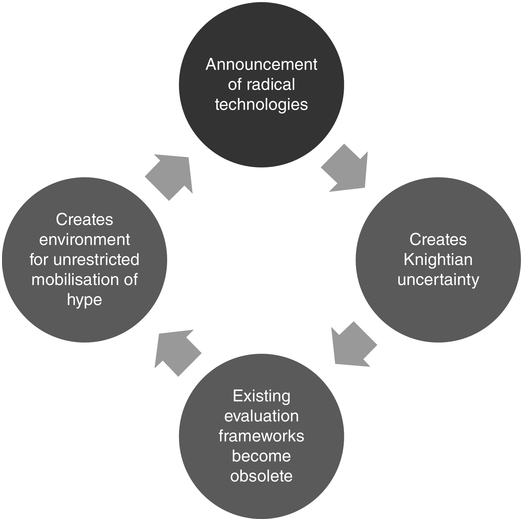
Figure 2.1 Long description
The diagram has four elements connected via arrows in a cyclical arrangement. The elements in the clockwise order are as follows: Announcement of radical technologies, Creates Knightian uncertainty, Existing evaluation frameworks become obsolete, and Creates
environment for unrestricted mobilisation of hype.
Our book captures the moment when radically framed technologies prompted industry analysts to develop new evaluation tools. They initially lacked metrics that could accommodate two critical developments: (i) the rise of emerging technologies (Chapters 6 and 7) and (ii) the proliferation of disruptive start-ups (Chapters 4 and 5). Both shifts initially sat outside established evaluative frameworks, creating fertile ground for hype to take hold. Metrics designed for mature products – such as the Magic Quadrant – proved inadequate. We show how industry analysts – initially slow to recognise these developments – were eventually compelled to respond. They introduced instruments like the Hype Cycle Chart (HCC) and Cool Vendors, which foreground the prospective performance of emerging technologies and new ventures.
2.3.7.4 Shifting Focus and Demobilisation
Hype Rarely Stands Still. Unlike relatively stable expectations (imaginaries, visions, promises), hype is transient and shifting: it may surge rapidly to attract interest and investment, then fade, fragment, or migrate to the next opportunity. Because hype is transient, support can unwind, and attention can shift rapidly, disengaging actors from current projects and redirecting them towards the next opportunity. Its transient nature introduces phases of demobilisation: when expectations stall or disappoint, attention, investment, and organisational commitment can contract (Ruef & Markard, Reference Ruef and Markard2010). Importantly, hype not only generates new interest; it also reallocates attention, pulling resources away from ongoing developments. Stakeholders with weaker ties can switch allegiance quickly when a new, more hyped innovation appears (Bakker & Budde, Reference Bakker and Budde2012).
Promoting a new hyped technology often entails a strategic distancing from incumbent alternatives. Proponents typically have to ‘fight against old technologies’, and, as Joly (Reference Joly, Akrich, Barthe, Muniesa and Mustar2010, p. 4) points out, that ‘battle is not easily won’. Emphasising radical novelty helps recast existing solutions as outdated.
One way hype accelerates such shifts is by creating a sense of urgency. Innovation is often portrayed as a global race, with the implication that there is ‘no time to lose’ (Felt et al., Reference Felt, Wynne, Callon, Gonçalves, Jasanoff, Jepsen, Joly, Konopasek, May, Neubauer, Rip, Siune, Stirling and Tallacchini2007, p. 79). Hype pressures as well as excites. Fear of missing out (FOMO; Vinsel & Russell, Reference Vinsel and Russell2020) implies that only early adopters – those bold enough to embrace the latest breakthrough – will emerge as winners. Under the grip of such promissory narratives, we may, Felt and colleagues caution, ‘risk subordinating ourselves’ to the imagined futures they project (2007, p. 79).
2.4 Tenet Four: Hype as an Actor Concept – Used and Managed Knowingly by Practitioners
Up to now, we have been examining hype from an analytical perspective – how we, as researchers, might conceptualise hype’s origins, distribution, and distinct features. However, we want to shift the view to consider how market actors involved in innovation themselves understand and manage hype. We will argue that hype is not just an analyst’s category; it is also an actor’s category. While concepts such as imaginaries, promises, and visions function purely as analyst constructs, hype uniquely operates as both. The very word ‘hype’ is used by practitioners, investors, industry commentators, etc., as part of their everyday vocabulary. Put differently, hype functions as a ‘folk concept’ (Swedburgh, Reference Swedberg2018) in innovation, meaning that it carries practical significance for those actors involved.
Recognising hype as an actor concept has important implications. It implies the existence of a lay theory of hype – one that may diverge from social‑science accounts. Academic treatments often frame hype as noise or misleading exaggeration, yet our fieldwork indicates that market actors deploy a richer taxonomy of hype distinctions than scholars often credit (Swedberg, Reference Swedberg2018). They sort ‘good’ from ‘bad’ hype and calibrate their language accordingly.
Take, for example, analyst relations (AR) experts – the professionals discussed in this book who coach technology ventures on how to pitch to industry analysts. They provide detailed guidance on crafting promissory narratives and explicitly caution against using specific ‘hyped-up’ terms that may undermine credibility. These include phrases like ‘game changer’, ‘best in class’, ‘industry-leading’, ‘world-beating’, and ‘we have no competitors’. When overused, such language serves as a red flag to seasoned analysts, signalling either a lack of substance or naive over-enthusiasm.
This kind of practitioner insight forms part of what we mean by hype as an actor concept (see De Togni et al., Reference De Togni, Erikainen, Chan and Cunningham-Burley2024). To illustrate this, we compiled a list of commonly discouraged hype terms (see Box 2.1), drawn from AR advisory materials, showing that practitioners operate with their own informal heuristics for evaluating and deploying hype.
‘First’
‘Game changer’
‘Only’
‘Superiority’
‘Best in class’
‘World class’
‘The Leader’ and related…’
‘Industry leading’
‘Market leading’
‘We always beat [a market leader]’
‘Top tier’
‘We have no competitors’ and related…’
‘Our only competition is in-house development’
‘Only indirect competitors are enterprise home-grown applications’
‘We never see [a market leader]’
‘We’ve open sourced our code’
Why does it matter that market actors have a rich understanding of hype? For one, it suggests that academic analysis tends to produce a simplified, ‘thin’ account. Pollner (Reference Pollner and Woolgar2002) warns of the dangers of ‘conceptual deflation’, where scholarly work fails to provide new insights or challenge taken-for-granted assumptions. The upshot is that we tell those we study what they already know (or even less than they know).
One example is the growing number of academic studies suggesting that particular technologies have entered a ‘hype cycle’ (e.g. Geiger & Gross, Reference Geiger and Gross2017). Though such an observation may be helpful, scholarly discussion needs to do more than reproduce actor terms, which may simply confirm rather than challenge prevailing perceptions. One goal of this book is to develop a more nuanced empirical understanding of how hype is generated, assessed, and consumed, as well as its impact. If our existing analytical concepts are not significantly different (or perhaps even inferior) to those of the individuals we study, then we may need to develop new ones. In this book, we use the actor term but locate it within a more carefully considered framework.
While scholarship has not shown much interest in hype as an actor concept, some exceptions exist. A frequent starting point has been to emphasise the colloquial connotations of hype as overstatement. Thus, Palavicino (Reference Palavicino2016, p. 149) describes hype as a ‘strategic act of exaggeration by innovation actors’. However, Wüstenhagen et al. (Reference Wüstenhagen, Wuebker, Bürer, Goddard, Truffer, Markard, Wüstenhagen and Wiek2009, p. 123) note innovators’ awareness of expectation dynamics and how they ‘use them to their advantage, communicating (and sometimes overstating) the promise of the technology to garner these resources’ (see also Minkkinen et al., Reference Minkkinen, Zimmer and Mäntymäki2023).
Birch’s (Reference Birch2023) concept of ‘reflexive expectations’ goes further, highlighting actors’ gameful generation of strategic narratives. He notes that actors are ‘deliberately and consciously generating stories or acting reflexively concerning them as part of their investment expectations, decisions, and strategies’ (Birch, Reference Birch2023, p. 45). This means that at least some actors are self-aware about the game of hype – they know they are constructing narratives and do so with intent, adjusting their message as needed to keep investors interested.
One striking example of an actor concept is the Hype Cycle Chart (HCC), which Rip (Reference Rip2019) characterises as a ‘folk theory’. Developed by the analyst firm Gartner, the HCC depicts the typical trajectory of hype associated with emerging technologies. While Rip critiques the model as being ‘plainly wrong’ in empirical terms, he also acknowledges its resonance, describing it as offering a ‘plausible storyline about how things go’ (2019, p. 361).
This discussion highlights a broader tension in scholarly debates around such tools. The assumption is that their value may not lie in empirical accuracy but in their social robustness and performative influence. As Rip puts it, the power of folk theories stems from their widespread circulation – ‘their robustness derives from their being generally accepted, and thus part of a repertoire current in a group or in our culture more generally’ (2019, p. 361). This insight invites us to take seriously how these devices operate, not just as representations but as instruments of coordination and influence.
Indeed, academic criticism of hype tools like the HCC can miss their practical significance. For instance, Borup and colleagues (Reference Borup, Brown, Konrad and van Lente2006, p. 292) have criticised the HCC for producing a ‘highly linear understanding of a technology’s path dependency and fails to account for the way artefacts or technologies actually change over time in a continual and practical process of reconfiguring and being reconfigured in use’. While these critiques are valid from an innovation scholar’s standpoint, they overlook how such tools have become embedded in practice. Many decision-makers are aware that technologies may deviate from the HCC pattern (Chapter 6), but the key point is that it has become integral to the actor’s toolkit, influencing market behaviour. Therefore, studies of hype should incorporate how such folk theories of hype shape real-world actions (rather than only pointing out their flaws).
More scholarly attention could be dedicated to understanding hype as an actor concept. This is particularly important, given the emergence of hype’s new actors and industry analyst tools like the HCC, which potentially encourage innovation communities to react differently to the uncertainties generated by the sea of competing claims. Embracing hype as an actor concept pushes us to ask new questions. For instance, how does introducing tools like the HCC change how technology adopters navigate hype? We suspect that with the institutionalisation of such hype tools, market actors no longer react to hype in the way they did before their introduction. For instance, as discussed in Chapter 6, the very act of saying a specific technology is in ‘The Trough of Disillusionment now’ (one of the HCC’s stages) provides a narrative for timing investments that differs from the past.
This evolution suggests that the phenomenon of hype itself is changing. As actors become more reflexive – aware of recurring patterns and increasingly equipped with tools to manage them – hype waves may now inflate and deflate in ways that differ from the past. Hype is shifting from something that simply happens to actors to something they actively navigate and shape. This transformation invites a corresponding shift in scholarly approaches.
2.5 Tenet Five: Hype’s Influence – From Performativity (Enacting Futures) to Reflexivity (Adapting Narratives)
One of the most contested questions in the study of hype concerns its ability not merely to describe possible futures but to help bring them into being. Does hype simply gesture towards a potential horizon, or can it actively contribute to realising that future (performativity) by mobilising belief, investment, and coordinated action? Or must it adapt as reality unfolds (reflexivity)?
Early work in the Sociology of Expectations and related fields focused on the performativity of expectations, suggesting that strong expectations can become self-fulfilling (Kriechbaum et al., Reference Kriechbaum, Posch and Hauswiesner2021). Brown (Reference Brown2003, p. 5) argued that ‘hype is constitutive’, mobilising the ‘future into the present’. Beckert (Reference Beckert and Musselin2013, p. 226, our emphasis) likewise suggested that ‘imaginings of future states become determinate’. Garud et al. (Reference Garud, Gehman and Giuliani2014a, p. 1183, our emphasis) observed that ‘innovation is driven by entrepreneurs’ imagination of the future’. More recently, Bareis and Katzenbach (Reference Bareis and Katzenbach2022, p. 876) pointed to the performativity of national artificial intelligence (AI) strategies. As they note, governments do not simply describe technological futures – they actively participate in ‘coproducing the instalment of these futures’ by backing visions with ‘massive resources and investments’, thereby ‘locking in’ particular ‘trajectories’.
Together, these arguments support a performative view of hype: it does not just forecast; it can help enact what it proclaims by attracting resources and framing problems and solutions. This perspective offered a powerful rejoinder to dismissals of hype as mere exaggeration or noise. Traditional academic perspectives struggled with the fact that future outcomes are unknowable until hindsight reveals them – often too late to be useful (Master & Resnik, Reference Master and Resnik2013). Performativity shifted the analytical focus: rather than asking whether early claims are ‘true’, it examined how they mobilise actors and resources in ways that can change what eventually becomes true.
However, the performativity thesis has not gone unchallenged. Critics note that it does not fully explain why some expectations become self-fulfilling while others are revised, deferred, or abandoned (Oomen et al., Reference Oomen, Hoffman and Hajer2022). In addition, the presumed performativity of hype often rests on episodic case studies that focus on the articulation of visions while implicitly assuming their eventual realisation. In doing so, researchers risk being drawn into the narrative frames of ‘promise entrepreneurs’, blurring the line between aspirational rhetoric and unfolding reality (e.g. Goldfarb & Kirsch, Reference Goldfarb and Kirsch2019, p. 61).
While the concept of performativity offers valuable insight, it requires more qualified application. The idea of simple performativity – where an a priori vision cleanly and fully shapes reality – is arguably no more plausible than imagining an engineer or manager could specify a successful innovation entirely in advance and then implement it exactly as planned (MacKenzie, Reference MacKenzie2009). When such direct performative effects do occur, they are often linked more to failure than to success (see MacKenzie, Reference MacKenzie2006, on counter-performativity). For example, branding a technology as ‘overhyped’ can dampen investment and support, potentially derailing a project that might otherwise have succeeded – though such negative feedback loops remain underexplored and merit further empirical study.
Crucially, context matters – and particularly the stage of innovation. In early-stage, exploratory science, hype can play a constitutive role in shaping the very emergence of a field. Stephens, Kind, and Lyall (Reference Stephens, King and Lyall2018) demonstrate how exaggerated future claims surrounding nanotechnology helped secure sustained R&D funding, attracting resources, attention, and talent over time.
Yet as innovations move towards commercialisation and broader diffusion, the role of hype often changes. In later-stage, market-facing contexts, hype is tempered by immediate feedback and heightened accountability. Narratives face closer scrutiny and must continually evolve to meet the shifting expectations of diverse, discerning audiences. Under these conditions, the kind of straightforward performativity sometimes seen in earlier stages becomes far less likely. Instead, hype takes on a more transitional (O’Connor, Reference O’Connor, Hjorth and Steyaert2004) or provisional (Mützel, Reference Mützel2022) character – constantly reshaped as ventures pivot, iterate, and reposition themselves in response to ongoing evaluation.
To capture this adaptive narrative work, we draw on Birch’s (Reference Birch2023) concept of reflexive expectations. While initial expectations often stem from compelling visions of radical innovation, they rarely remain static. As ventures transition from technoscientific promise to financial and commercial arenas, their narratives pivot to engage new evaluative audiences and criteria. These stories are continually revised as financing processes unfold and strategic roadmaps are recalibrated. As Birch (Reference Birch2023, p. 45) observes, entrepreneurs ‘construct new stories or amend old ones to make valuation judgements and attract investment’.
In the Juvo case, for example, we observed how an initial focus on the product’s disruptive technological potential gradually gave way to stories about market readiness, customer adoption, and value creation. These shifts did not occur in a straight line, nor were they under the sole control of the start-up founder. Instead, they were collaborative and iterative, involving analysts, AR specialists, investors, and other audiences who each contributed to reshaping the narrative.
Reframing hype’s influence from performativity alone to a combination of performativity and reflexivity offers a more nuanced understanding of the complex, adaptive life of hyped expectations. Rather than a one-off performative act, hype – particularly in later stages – operates as a dynamic, negotiated, and recursive process in which claims are continually reworked in response to shifting evidence, audiences, and incentives. As Chapter 4 will show through its analysis of start-up storytelling, entrepreneurs must learn to adapt and recalibrate their narratives as they move from early-stage funding pitches to later-stage analyst briefings.
2.6 Tenet Six: When Hype Matters – Shifting Roles across the Innovation Lifecycle
The previous discussion highlights a critical gap in current scholarship where it fails to adequately engage with the different temporal settings of hyped expectations, particularly how hype operates across both early and later stages of innovation. While the Sociology of Expectations scholarship focused primarily on early-stage developments, our analysis reveals hype’s crucial role throughout the innovation lifecycle, especially in processes of market making and market operation. This limitation is problematic because it tacitly underplays or ignores how hype continues into later phases, leaving us with a dearth of studies on how hype operates in market situations.
Prior research overwhelmingly positions hype as a ‘front‑end’ phenomenon. Brown (Reference Brown2003, p. 11) places hype in the ‘opening moments of resource and agenda building’, emphasising how ‘the whole language of novelty, newness and revolutionary potential is actually part and parcel of the hyperbolic discourse surrounding the early or opening moments of resource and agenda building’. Similarly, Wüstenhagen et al. (Reference Wüstenhagen, Wuebker, Bürer, Goddard, Truffer, Markard, Wüstenhagen and Wiek2009, p. 123) emphasise expectation dynamics in ‘earliest stages of technology-driven innovation’, while Palavicino (Reference Palavicino2016, p. 144) notes how hype ‘brings actors together in early stages of technology development to take high-risk decisions under high uncertainty’. Taken together, these accounts suggest that once technologies solidify – products exist and markets form – hype recedes behind more concrete considerations.
This upstream bias has consequences. We know far more about hype before markets exist than about how it is translated, operationalised, and governed once market actors must buy, sell, compare, and adopt competing offerings (Gardner et al., Reference Gardner, Samuel and Williams2015). Integrating upstream expectation work with downstream market decision‑making remains rare (Rotolo et al., Reference Rotolo, Hicks and Martin2015). Hardly any scholarship has integrated this with the downstream world of market actors and organisational decision-makers, who decide whether to invest in particular firms or the decisions facing organisational users concerning the adoption of specific products. Despite its concerns about addressing futures, scholarship has failed to engage with these different temporal settings and how processes of creating, circulating, and consuming hype are differently modulated between early and later phases.
We extend hype analysis across the innovation lifecycle. Hype does not dissipate at market entry; it evolves – and can even intensify – as stakes, competition, and formal structures grow. Our research aims to bridge this gap by extending hype analysis to later phases, specifically the development of applications and their adoption by market actors, such as technology adopters. We contend that hype evolves its role throughout the innovation lifecycle rather than merely being a transient wave that dissipates after the introductory phase. For instance, by the time an innovation reaches the market, there are often more financial resources at stake, more competitors, and more formal structures in place – all of which shape the form of hype.
To help unpack this, we distinguish four overlapping stages that recur across many innovation journeys (Bergek et al., Reference Bergek, Jacobsson, Carlsson, Lindmark and Rickne2008): (1) exploratory science/field‑forming (pre‑market); (2) translational/venture‑building (pre‑commercial); (3) early market/market‑making (initial customers, few vendors); and (4) established market/market operation (wider adoption, comparative evaluation). These stages provide a helpful framework for understanding how the role and management of hype shift over time. Hype plays different roles and is mediated by various actors and instruments at each stage of the process.
We find Konrad and Palavicino’s (Reference Konrad, Van Lente, Groves, Selin, Felt, Fouché, Miller and Smith-Doerr2016) study of graphene useful in this regard. While early hype helped spawn a research field and initial start-ups (stages 1 and 2), one might have expected that hype would die down once the initial excitement settled. However, their study shows that hype continued to shape the field over time (stage 3). A pivotal trigger came when the Nobel Prize was awarded for graphene research in 2010: the award reignited interest, attracted additional funding, conferred credibility, and fuelled renewed promises of applications.
Moreover, they note that the management of hype – and the actors involved in doing so – changed in these later phases. Konrad and Bohle (Reference Konrad and Böhle2019, p. 102) elaborate on how the graphene field witnessed an influx of policymakers and market actors engaging in ‘practices of futuring’, where there was the provision of ‘market forecasts, carrying out foresight processes (e.g. Delphi studies), hype assessments, or developing dynamic models, scenarios or roadmaps’. These are hallmarks of stage 3 (early market) and stage 4 (established market), where more formalised instruments and governance structures begin to shape the trajectory of innovation. Konrad and colleagues argue that this moved graphene into a new phase with enhanced structure, governance, and planning. Yet despite these shifts, hype remained a driving force – now institutionalised through strategic roadmaps, government initiatives, and industry consortia.
In these later stages (3 and 4), hype also begins to perform boundary-setting and coordination functions. Logue and Grimes (Reference Logue and Grimes2022, p. 7) point out that in later stages, actors leverage hype to formalise field boundaries and networks: actors ‘take advantage of hype to configure boundaries around the field, create more efficient exchanges within the field, and situate their own ventures relationally within important networks’.
Our book will highlight how a key aspect of the digital economy is the prominent role of market gatekeepers, such as industry analysts, in these later stages. These actors typically enter when an emerging technology is on the verge of broader adoption – in the early market or established market phase (stages 3 and 4). They translate diffuse expectations into actionable decision inputs for buyers. Their focus is on the near future rather than the distant horizon. They introduce promissory products (like categories and rankings) that effectively operationalise hype, turning it into something that can be rated, ranked, and digested by decision-makers. By doing so, they bring a certain closure to the open-ended hype of earlier stages.
However, our book shows that these market gatekeepers are beginning to enter the process earlier, as the transition from stage 2 (venture-building) to stage 3 (early market) occurs, with technologies moving from translational efforts to initial commercialisation. Industry analysts, for instance, often produce their first reports on a technology when a handful of vendors begin to sell to customers, even if the technology is not yet mainstream (e.g. Cool Vendor appellations and HCCs).
Our contribution – and the focus of the empirical chapters that follow – is to demonstrate how hype is managed, particularly in stages 2, 3, and 4, when technologies transition from emergence to market consolidation. As technologies become more established, hype does not evaporate; it becomes embedded in promissory products that continue to shape expectations and flows of resources.
2.7 Tenet Seven: Living Up to the Hype – Emerging Accountability Mechanisms
A common presumption is that actors are rarely held accountable for the claims they make, creating a grace period in which bold assertions face little immediate scrutiny or sanction if they are not substantiated. This assumption rests on two key conditions: (i) the belief that there is little in the way of an evaluative infrastructure surrounding hyped claims; and (ii) the observation that proof often arrives only after attention, actors, and market conditions have shifted. In such circumstances, those who make grand claims may never be penalised; the accountability window can close before verdicts are rendered.
First, Joly (Reference Joly, Akrich, Barthe, Muniesa and Mustar2010, p. 7) notes, ‘there are few ways to assess [hype’s] validity’; Grodal and Granqvist (Reference Grodal, Granqvist, Ashkanasy, Zerbe and Härtel2014, p. 141) similarly argue that without ‘existing benchmarks for evaluation’, this means that expectations ‘become self-perpetuating and give rise to fads, hypes, and bubbles’. Second, Rip (Reference Rip, Hisschemöller, Hoppe, Dunn and Ravetz2018) highlights the innovator’s dilemma: they must hype their ideas enough to gain support, but the evidence to confirm or refute their claims will only emerge later, by which point audiences may have moved on (van Lente, Reference Van Lente2012; Master & Resnik, Reference Master and Resnik2013). By then, the evaluative context may have changed, and the original promissory conditions may no longer apply.
Indeed, according to Joly (Reference Joly, Akrich, Barthe, Muniesa and Mustar2010), tools like the Gartner HCC have helped normalise deferred disappointment by building a ‘Trough of disillusionment’ into the expected trajectory. As he notes, ‘[o]ne of the effects of the cycle is to naturalise the disillusionment’ – the ‘Trough of disillusionment’ is built into the tool as a natural, even necessary step in the innovation process (Joly, Reference Joly, Akrich, Barthe, Muniesa and Mustar2010, p. 13), thus further institutionalising the deferral of evaluation and deepening the accountability gap.
These perspectives rightly highlight the fluid and promissory nature of hype. However, a central argument of this book is that expectations are no longer as unaccountable as they once were. We contend that the landscape has shifted: hyped claims are increasingly subject to scrutiny and formal evaluation. In contrast to earlier eras where hype could run free (until a ‘crash’: see Garud et al., Reference Garud, Schildt and Lant2014b), today we see emerging mechanisms that hold promise-makers to account (albeit in new ways).
As innovation moves from speculative projections to more concrete phases of market implementation, new forms of accountability begin to crystallise. Yet we still know little about how these mechanisms function in practice. Beckert and Ergen (Reference Beckert2021, p. 13) observe that the ‘evaluative structures’ surrounding hyped expectations represent a ‘vast and understudied research field’, highlighting the need for deeper empirical and conceptual enquiry.
Martin (Reference Martin2015) offers a useful framing for how accountability tightens over time, contrasting a ‘regime of hope’ with a ‘regime of truth’. In the regime of hope, ventures like start-ups operate within a speculative space characterised by uncertainty and anticipation: they may have ‘no products on the market’, remain ‘poorly integrated’ into existing industry structures, and trade promissory assets that cannot yet be fully valued (Martin, Reference Martin2015, p. 434). Here, hype functions as a key mechanism for attracting attention, credibility, and resources.
By contrast, the regime of truth marks a more mature stage of market engagement, where ventures have ‘products on the market, significant sales and profits, a relatively large number of products in late-stage development’, and are ‘well-integrated’ into the industry – what Martin calls ‘the real economy’ (2015, p. 437). At this point, the scope for speculation narrows, and demands for demonstrable results intensify (see also Hogarth, Reference Hogarth2017).
Beckert’s (Reference Beckert2016) analysis also captures this shift, showing how early ‘myths’ about the future give way to demands for evidence and performance. Cultural Entrepreneurship scholars make a similar point: while exaggerated narratives may help attract initial interest and investment, they eventually entangle entrepreneurs in webs of accountability. Lounsbury and Glynn (Reference Lounsbury and Glynn2001), for instance, demonstrate that ventures founded on unverifiable or overly grandiose claims face reputational risks. Garud et al. (Reference Garud, Schildt and Lant2014b) show how, during the dotcom crash, many firms were forced to revise their stories in light of missed milestones and shaken investor confidence.
In short, expectations remain pliable only up to a point. Logue and Grimes (Reference Logue and Grimes2022) argue that ventures become bound by the stories they tell; to ‘live up to the hype’, they must ultimately deliver evidence. Early in this process, proxies in the form of ‘social proof’ – endorsements, awards, media coverage – can sustain credibility. But without the progressive accumulation of such markers, legitimacy erodes, and audiences begin to question not only the promise but the venture’s capacity to perform.
While Logue and Grimes (Reference Logue and Grimes2022) effectively illuminate the role of informal accountability mechanisms – such as social proof – in sustaining hype, we argue that more structured and formalised evaluation processes are playing an increasingly influential role in the digital economy. These include rankings, ratings, certifications, league tables, and other structured performance metrics that make technologies more comparable, auditable, and governable.
Among the most significant actors in this shift are industry analysts, who shape how hype is interpreted and made accountable. Unlike informal endorsements, which rely on reputation, charisma, or peer validation, analysts offer structured and ostensibly objective assessments that influence how technologies are understood, valued, and prioritised within markets. Taken together, this progression – from soft to institutionalised forms of accountability – is central to understanding how the digital economy governs its futures. Hype is not sustained by exuberant promissory narratives alone but also by the infrastructures that discipline, translate, and, at times, tame them.
Several important questions remain unresolved: How does the digital economy transition from a ‘regime of hope’ to a ‘regime of truth’? Who mediates the shift from promissory claims to demonstrable outcomes? At what point do audiences begin to demand evidence beyond social proof? And how do evaluation tools influence both the timing and content of narrative pivots? These are questions we take up in the chapters that follow.
***
Together, these seven tenets provide a foundation for treating hype not as a peripheral phenomenon but as a dynamic, structured, and strategic resource shaping the digital economy. They also set the stage for a critical shift in focus: from understanding what hype is to examining how actors respond to it. In Chapter 3, we explore how organisations navigate the uncertainties generated by hype, sometimes treating it as a source of risk to be mitigated, and at other times as a resource to be cultivated.
The previous chapters have begun to examine how hype is created, circulated, and increasingly institutionalised within the digital economy. We now shift our focus from producing hype to navigating, interpreting, and evaluating it. This chapter demonstrates that in an era of continual disruption, decision-makers are pressured to treat hype not as mere noise but as a strategic factor – one that demands deliberate evaluation, careful timing, and active management. We begin by illustrating the stakes through historical and contemporary examples, then examine the challenges posed by uncertainty in innovation, and conclude by showing how organisations are responding through emerging hype-evaluation practices. We trace the rise of hype’s new experts – most notably industry analysts – tasked with helping organisations separate genuinely promising innovations from overblown claims.
This chapter, therefore, turns to the organisational decision-makers who must make sense of, and act within, an environment saturated with competing and exaggerated technological narratives. An unprecedented surge in digital innovations – particularly those billed as radical or disruptive – means that organisations face a dual challenge: spotting genuine opportunities while mitigating the risks of chasing inflated promises.
Consider a start-up like Juvo, which claims to disrupt traditional banking models. The instinctive reaction might be to dismiss such rhetoric outright. Yet, as argued here, decision-makers can no longer afford to ignore such claims. Hyped innovations have become a strategic variable with potentially life-or-death consequences for firms (Arnold et al., Reference Arnold, Breitenmoser, Röth and Spieth2022).
A historical example illustrates how organisational responses to hype have evolved. One of the authors conducted research in the 1980s on the financial sector (Fincham et al., Reference Fincham, Fleck, Procter, Scarbrough, Tierney and Williams1995), finding that banks at the time underestimated the disruptive potential of automated teller machines (ATMs). Professional bankers of that era dismissed predictions of significant industry change as speculative and unrealistic. As their terminology reveals, they saw ATMs as mere extensions of the teller function – a means of improving efficiency rather than a transformative innovation. Yet within a decade, ATMs had not only proliferated but also paved the way for online banking – a transformation those bankers failed to foresee. This perspective reflected a wider mindset of the time, which treated computing technologies as incremental aids rather than as drivers of fundamental change. Indeed, ATMs – initially introduced simply as an ‘automatic’ teller – were not recognised as precursors to a major industry transformation (see Locatelli et al., Reference Locatelli, Schena, Tanda, King, Stentella Lopes, Srivastav and Williams2021).
These historical missteps highlight the risks associated with discounting technological hype while underestimating the transformative potential of emerging innovations. Juvo’s ambitious assertions may indeed be inflated, yet the possibility remains that they could catalyse significant disruption in the banking sector. This highlights a recurrent organisational dilemma: dismissing hype risks forgoing genuine opportunities for innovation while embracing it risks committing resources to ultimately insubstantial promises. Compounding this dilemma is a further contemporary challenge: organisations must increasingly navigate a proliferation of overlapping and competing promissory narratives – each pitched as a strategic opportunity or threat – without becoming paralysed or distracted.
3.1 The Timing of Innovation Responses
Today’s landscape demands a fundamentally different approach to innovation. Kumaraswamy et al. (Reference Kumaraswamy, Garud and Ansari2018, p. 1026) observe that the twenty-first century is characterised by ‘continual disruption in which technological innovations and new business model changes affect not just individual firms, but entire industries and ecosystems’. In this environment, understanding and responding to hype – in essence, managing the timing of innovation responses – has become a crucial issue.
Innovation has long been recognised as important for an organisation to survive in an increasingly competitive market; however, its role is now seen as far more strategic. In the past, innovation was viewed primarily as a way to sustain productivity and competitiveness (Godin, Reference Godin2015). Today, however, it is increasingly seen as a strategic matter because of its potential to transform the industrial landscape and radically restructure the position of players within that landscape. Incumbent organisations may find themselves at risk of being displaced by challengers wielding radical new technologies (Freeman, Reference Freeman1994) or disruptive business models (Christensen, Reference Christensen1997), generating what Schumpeter (Reference Schumpeter1942) characterised as ‘gales of creative destruction’. Conversely, these developments open up opportunities for challengers like Juvo, which can ride these waves to achieve rapid growth, higher profits, and perhaps ultimately exclude rivals in winner-takes-all competitions (Palmié et al., Reference Palmié, Wincent, Parida and Caglar2020). The stakes are thus rising significantly.
This shift in focus to the strategic impact of innovation has coincided with a dramatic increase in the pace and dynamism of technological change. These trends further amplify the challenges that innovation poses to decision-makers. The field of Innovation Studies (Godin, Reference Godin2015) emerged in the twentieth century, examining how major technological advances, such as steam power and electric motors, gradually worked their way through the economy, patterns reflected in generation-long Kondratiev waves (Perez, Reference Perez2015). By contrast, the current era of digital innovation features vastly higher rates of development and uptake of new products.
Together with shorter product life cycles, this acceleration generates massive market turbulence (Perez, Reference Perez2015). Large multidivisional firms with dedicated R&D departments – once the powerhouses of innovation in the nineteenth and twentieth centuries – have now been outpaced by a proliferation of smaller, newer players, particularly in digital innovation (Menz et al., Reference Menz, Kunisch, Birkinshaw, Collis, Foss, Hoskisson and Prescott2021). There is, in consequence, a multiplication in the number of voices articulating claims about a rapidly growing array of novel solutions and the benefits these will bring (Yoo et al., Reference Yoo, Boland, Lyytinen and Majchrzak2012).
This accelerating flood of digital innovations – especially radical or disruptive ones – presents both opportunities and challenges for organisational managers and other market actors. The need to respond to potentially disruptive changes brings this dilemma to the forefront: How can managers navigate and evaluate these competing claims? As we will explore later, claims of novelty inherently – and often deliberately – generate uncertainty (Jalonen, Reference Jalonen2012). It is in this context that the term ‘hype’ first emerged to highlight the risk (indeed, the likelihood) that vendor claims may be unrealistic. A vendor might behave opportunistically (Williamson, Reference Williamson1975), exaggerating potential benefits or underestimating the difficulties of achieving them.
Traditional business wisdom has emphasised the risks of failure associated with promising innovations, concluding that it is often best to delay adoption until the prospects are more clearly established (Khanagha et al., Reference Khanagha, Ramezan Zadeh, Mihalache and Volberda2018). However, as hype’s strategic significance grows, so does the need for structured approaches to evaluate and respond to it. In the following sections, we examine emerging frameworks for navigating the uncertainties inherent in hype-driven innovation.
3.2 Innovation Dilemma: The Used Apple Policy
Organisations face a profound tension in navigating technological innovation: the need to act early to seize opportunities versus the risk of committing to unproven solutions. This paradox – the innovation dilemma – requires balancing urgency with caution, particularly in today’s rapidly evolving digital economy.
Theodore Levitt’s (Reference Levitt1965) classic paper in Harvard Business Review highlights the high costs, frequent failure and consequently deeply uncertain returns of new product developments. In a period in which the innovation literature focused on the maturation of product cycles of successful products, Levitt notes that ‘most new products don’t have any sort of classical life cycle curve at all’. Instead, ‘from the very outset’, they have ‘an infinitely descending curve’. The ‘product not only doesn’t get off the ground; it goes quickly underground – six feet under’ (Levitt, Reference Levitt1965, p. 82).
These costs and risks might be presumed to inhibit innovation altogether. However, Levitt goes on to propose a different strategy that ‘badly burned’ organisations have developed that he calls the ‘used apple policy’:
Instead of aspiring to be the first company to see and seize an opportunity, they systematically avoid being first. They let others take the first bite of the supposedly juicy apple that tantalises them. They let others do the pioneering. If the idea works, they quickly follow suit…. [T]hey say ‘We don’t have to get the first bite of the apple. The second one is good enough’, but they try to be alert enough to make sure it is only slightly used – that they at least get the second big bite, not the tenth skimpy one.
Levitt’s observation highlights the dilemma confronting organisational managers seeking to minimise risks and maximise benefits in uncertain technology markets. Innovation is highly uncertain. High costs and risks of failure can offset potentially high returns. These uncertainties vary substantially over the life cycle of an innovation. Uncertainties are highest in the early stages of development and adoption of a technology (Rosenberg, Reference Rosenberg2009). Levitt warns of the risks faced by early adopters, arguing that being first can be perilous. Rosenberg (Reference Rosenberg1976) similarly wrote of ‘anticipatory retardation’ to describe situations where firms delay adoption due to expectations that improved versions of a technology are imminent. Thus, delaying adoption may be sensible. However, where technology creates strategic market transformation shifts rather than merely improving productivity, the difference between getting the first and last bite of the apple matters hugely (Geels & Smit, Reference Geels and Smit2000).
Timing (concerning a technology’s lifecycle) matters. It seems safer to delay investing in an unproven innovation. However, though uncertainty and the risk of expensive failures are highest at the early stages of a novel technology, so too are the potential benefits. Early adopters may secure a competitive advantage before this is eroded by the wide availability of equivalent functionality as the market matures (Ward, Reference Ward1987). Entrepreneurs and investors may derive greatly enhanced profits from their temporary monopoly of exploitation of novel innovations (Schumpeter, Reference Schumpeter1942), which sweep through industries in a ‘wave of creative destruction’. Today, attention focuses on the opportunity for disruptive innovators to displace existing incumbents and capture new market territory through new platform technologies and business models (Bower & Christensen, Reference Bower and Christensen1995).
Levitt’s early contribution thus introduces some of the critical issues in our investigation into hype. The most significant opportunities for profit and growth arise in precisely the period when uncertainties are at their highest (Knight, Reference Knight1921). Those wanting to share the benefits of early adoption and avoid being displaced by challengers like Juvo are called on to invest when reliable information to inform a decision is least available. This is the paradox at the heart of our enquiry. And it is growing more acute in the era of digital innovation, as the rate of new digital innovation increases, accompanied by shorter software development cycles and more rapid maturation and obsolescence (Nylén & Holmström, Reference Nylén and Holmström2015). Platform innovations and other radical and disruptive innovations have gained huge salience with their promise to displace incumbents and deliver market share and profit to early investors and adopters (Gawer, Reference Gawer2011).
Adopters must invest in opportunities before verifiable evidence becomes available that the technologies will be productive (Spieth et al., Reference Spieth, Röth, Clauss and Klos2021). This means the capability to gauge the plausibility of hype becomes critical. To avoid what Kumaraswamy et al. (Reference Kumaraswamy, Garud and Ansari2018) characterise as ‘errors of commission’, traditional business wisdom emphasises the risks of failure for promising innovations and concludes that it is often best to delay adoption until the prospects are more clearly established. However, the temporality of innovation responses has become a crucial factor.
Delaying a response until robust evidence emerges of the prospects of a promising technology may reduce the risk of costly investment in unsuccessful technology pathways. However, it creates new risks from delayed access to expected benefits, and more crucially, from missing out on new opportunities for first movers from radical and disruptive change and the elevated rewards they may bring for investors and adopters. In this scenario, catch-up strategies may be expensive and miss out on the most significant rewards – characterised by Kumaraswamy et al. (Reference Kumaraswamy, Garud and Ansari2018) as ‘errors of omission’.
Timing is also vital because these complex digital and organisational innovations are not ‘plug and play’ solutions offering readily identifiable and achievable benefits (Pollock & Williams, Reference Pollock and Williams2008). Adopters may need to invest significant attention and money to assess novel, perhaps arcane, technological fields (Schot & Geels, Reference Schot and Geels2008). They may also need to acquire the necessary expertise and intelligence to appraise and exploit/appropriate them.
Considerable work may be required to get a new offering operating effectively in its intended context, and over time, to optimise performance (Fleck, Reference Fleck1994). Organisational managers may also need to unlearn entrenched views of how technology may be utilised. Acquiring technologies and developing responses may be delayed by competition between organisational teams wedded to existing and novel approaches (Volberda et al., Reference Volberda, Khanagha, Baden-Fuller, Mihalache and Birkinshaw2021).
To make timely decisions, decision-makers must, in the words of Kumaraswamy et al. (Reference Kumaraswamy, Garud and Ansari2018, p. 1030), ‘cultivate the capacity to read weak signals about potentially disruptive innovations and explore options before it is too late’. But one effect of the ‘continual disruption’ (Kumaraswamy et al. Reference Kumaraswamy, Garud and Ansari2018) described above is even greater uncertainty for those navigating the sea of hype.
3.3 Uncertainty and Innovation
Uncertainty is not just an incidental (if unwelcome) by-product of innovation. Innovation inherently generates uncertainty, disrupting traditional decision-making frameworks. However, this uncertainty is not merely a hurdle; it also drives economic dynamism, pushing organisations to develop new strategies for navigating risk and opportunity (Dorobat et al., Reference Dorobat, McCaffrey, Foss and Klein2025).
This paradox of innovation under uncertainty has long been recognised in economic thought. For instance, Knight’s (Reference Knight1921) classic text argues that profit depends on imperfect knowledge and indeed that profit ‘would not arise’ under conditions of certainty (Knight, Reference Knight1921, p. 198). Knight differentiates between risk, which involves calculable probabilities (such as market volatility), and uncertainty, where the combinatorial complexity of economic life and countless unknown factors make probabilities incalculable within business decision timeframes. His account marks a sharp departure from neo-classical models of markets composed of rational actors with perfect information. He proposes that imperfect knowledge and asymmetrical access to information are crucial for profit and even play a generative role in the economy. In short, because the future cannot be calculated in advance, decision-makers must rely on judgement and storytelling – which is exactly the space where hype operates.
Keynes (Reference Keynes1936) focused on decision-making under uncertainty and introduced the concept of ‘animal spirits’ to describe the instincts, sentiments, and spontaneous urges that shape economic behaviour when rational calculation reaches its limits. For Keynes, in conditions where outcomes cannot be known by ‘quantitative probabilities’, investment decisions are not made purely through ‘mathematical expectation’ but are instead driven by confidence, mood, and social cues (Keynes, Reference Keynes1936, cited in Dow & Dow, Reference Dow and Dow2012). In other words, he shows how exaggerated optimism or pessimism can drive decisions when evidence is lacking. As Keynes sees it, these animal spirits, which include emotions like confidence, optimism, pessimism, and fear, are not irrational; rather, they are necessary responses to radical uncertainty – ‘of a spontaneous urge to action rather than inaction’ (1936, p. 161) – arising in the absence of stable expectations. Keynes’ perspective further challenges the image of the rational economic actor, underscoring how markets are propelled not just by information and analysis but by shifting waves of confidence and belief (Akerlof & Shiller, Reference Akerlof and Shiller2010).
Schumpeter (Reference Schumpeter1947, p. 151) further develops this point, arguing that innovation is the primary driver of growth in capitalist societies. His evolutionary economic account revolves around the entrepreneur/innovator, willing to take a risk, and in return secure enhanced rent from monopoly exploitation of radical innovations by ‘the doing of new things or the doing of things that are already being done in a new way’. For Schumpeter (Reference Schumpeter1912, p. 163), innovation involves recombination: ‘innovation combines components in a new way’, with entrepreneurs using their ‘more acute intelligence and a more active imagination’ to envisage ‘countless new combinations’.
In sum, these classic perspectives show that because the future cannot be calculated, judgement and persuasive narratives become crucial in innovation.
Building on these ideas, modern innovation economists note that radical innovations carry especially high uncertainty. Freeman (Reference Freeman1974, p. 226) pointed out that radical innovations demand major shifts in skills and often bring in new players, thus entailing a ‘very high degree of uncertainty’. Abernathy and Clark (Reference Abernathy and Clark1985) identified four innovation types based on whether an innovation conserves or disrupts existing competences and linkages. Particularly notable are architectural innovations (which disrupt competences and linkages) and revolutionary innovations (which disrupt competences but conserve linkages). This typology highlights that innovation is an inherently uncertain and combinatorial process, often requiring the creation of new knowledge and networks.
These were just the beginning of a growing body of work aimed at highlighting and classifying forms of innovation that diverge from existing technological and business models. A substantial body of literature has developed taxonomies to differentiate forms of innovation (Godin, Reference Godin2015). Though little agreement exists about the relationship between these frameworks, they exhibit homologies (Edwards-Schachter, Reference Edwards-Schachter2018). Many of these taxonomic efforts have focused on discontinuities in innovation (Breschi et al., Reference Breschi, Malerba and Orsenigo2000), which are variously conceived as a corollary to periods of stability. These accounts start with the observation that most innovation involves ‘incremental’ (Freeman, Reference Freeman1974) changes to existing technologies and processes in which the innovation ‘trajectory’ follows an established ‘paradigm’ (Dosi, Reference Dosi1982) or ‘regime’ (Nelson & Winter, Reference Nelson and Winter1982) patterned by broadly shared knowledge, design heuristics, standards, and regulations within a sector.
This emphasis on periods of stability also accentuates periodic shifts in technological paradigm (Constant, Reference Constant1973; Dosi, Reference Dosi1982). The factors creating discontinuous forms of innovation have been labelled variously in successive accounts as radical (Freeman, Reference Freeman1974), revolutionary (Constant, Reference Constant1973; Abernathy & Clark, Reference Abernathy and Clark1985), disruptive (Christensen, Reference Christensen1997), or emerging (Ho & Lee, Reference Ho and Lee2015; Rotolo et al., Reference Rotolo, Hicks and Martin2015). Though different authors use varying terms – radical, revolutionary, disruptive, emerging – these frameworks all point to the disruptive consequences of discontinuities in innovation (Constant, Reference Constant1973; Dosi, Reference Dosi1982; Christensen, Reference Christensen1997; Rotolo et al., Reference Rotolo, Hicks and Martin2015). These paradigm shifts, variously conceived, all appear to involve changes both in the knowledge and understanding required and in relationships between actors (Abernathy & Clark, 1995), changes which pose deep uncertainties for the players involved.
This recurring emphasis on discontinuities in innovation raises questions about existing knowledge, suggesting that prior understandings may no longer be valid. Existing competences, routines, and evaluation criteria for technology design and business models are called into question (McBride et al., Reference McBride, Packard and Clark2024). New understandings of the operation of a promising technology and its potential uses and users may need to be developed. The requirement for new kinds and combinations of knowledge may call for the inclusion of additional players and changes in the relationships between them (Breschi et al., Reference Breschi, Malerba and Orsenigo2000).
Uncertainty is not merely incidental but intrinsic to the claim of novelty that lies at the heart of innovation. Moreover, the claim to novelty by those vendors developing or promoting new innovations purposefully generates radical uncertainty. According to Joly (Reference Joly, Akrich, Barthe, Muniesa and Mustar2010), this is intentional, as innovators must show how their ideas vastly differ from what came before to attract support and mobilise resources. This insight helps explain why hyped expectations around emerging technologies tend to unfold, as Joly (Reference Joly, Akrich, Barthe, Muniesa and Mustar2010, p. 14) sees it, in predictable ways: the ‘technology is presented as brand new’ where ‘it will create a new society’. However, by stressing this dramatic break from established methods, innovators and entrepreneurs inadvertently introduce profound uncertainties about these technologies as they declare existing evaluation criteria obsolete, and traditional metrics and assessment methods become less relevant in this context (see Tenet Three, which discusses how hype asserts the obsolescence of established evaluation criteria).
This generates a profound paradox for decision-makers. When innovation departs from known paradigms, traditional ways of understanding, and evaluating technologies – rooted in extrapolating from past performance – break down. How can organisations evaluate novel capabilities if old models no longer apply?
3.4 Evaluating Radical Futures
Given this paradox, the uncertainties surrounding radical innovation challenge traditional ideas of decision-making as a rational calculation among finite alternatives. Knight places at the core of his economic model what he called a ‘theory of knowledge’ (Knight, Reference Knight1921, p. xii). He observed that the process of retrospectively classifying events with similar behaviours – the hallmark of ‘mechanistic science’ – cannot be applied to typical business decisions, which ‘deal with situations which are far too unique, generally speaking, for any sort of statistical tabulation to have any value for guidance’ (Knight, Reference Knight1921, p. 231).
Knight’s (Reference Knight1921, p. 209) theory of knowledge closely follows the traditional positivist model of science, describing it as a ‘theory of exact knowledge, of rigorous demonstration’. Yet he shows that this model becomes unworkable in everyday economic life, where constant change undermines the stability required for such knowledge to function. As he notes, ‘the properties of things and their relationships are constantly changing’ (Knight, Reference Knight1921, p. 207). As a result, profound uncertainty – what we now term Knightian uncertainty – arises. When there is ‘real change’ – for example, when considering emerging futures – ‘it seems clear that reasoning is impossible’ (Knight, Reference Knight1921, p. 209). Put simply, Knight argues that the future cannot be known through statistical generalisation, as each business situation is irreducibly unique. Therefore, economic actors must make decisions in the absence of calculable probabilities, and it is this uncertainty that gives rise to the possibility of profit.
This insight casts doubt on the possibility of knowing technological futures in any definitive sense. Clardy (Reference Clardy2022, p. 1) similarly argues that studies of the future cannot produce ‘knowledge’ in the strict epistemological sense, because ‘their actual truth values cannot be determined until some later time’. Thus, claims about the future cannot be verified or falsified in advance. Futures studies, therefore, grapple with a fundamental epistemic limitation.
Adam (Reference Adam2023, p. 280) echoes this position by arguing that the ‘future is not yet and as such cannot be considered factual’. Mirroring Knight’s (Reference Knight1921) critique of mechanistic science, Adam notes that ‘in the scientific mode of enquiry, the future per se is actually dis-attended’. She writes that while it is ‘possible to produce probability calculations, predictions and models of the future, which are compatible with scientific methods of enquiry’, this ‘way of knowing the future is rooted in past and present actions or events, its results are inescapably past-based simulations, masquerading as “knowledge” of a future – at best imperfect’ (Adam, Reference Adam2023, p. 280). In other words, scientific approaches project the future based on historical patterns, but this projection is always provisional and incomplete.
Adam (Reference Adam2023, p. 280) further notes that the temporal orientation of social science and economics is largely retrospective: ‘The temporal orientation of scientific investigation of this social world is focused primarily on completed (past) acts or (present) reported anticipations’. She writes (2023, p. 281) that when ‘politicians, policymakers, economists and teachers, for example, want to know what lies ahead, they rely on spatial and material knowledge of the past, from which they extrapolate what might be’.
However, there are contrasting accounts that challenge the idea that the past entirely constrains the future. Some scholars, on the one hand, emphasise the future’s open-ended indeterminacy. For instance, Selin (Reference Selin2008, p. 1888) introduces the notion of the ‘ontological indeterminacy of the future’, suggesting that we are ‘actively creating and re-creating multiple futures’. Similarly, Köhler et al. (Reference Köhler, Geels, Kern, Markard, Onsongo, Wieczorek and Wells2019, p. 3) emphasise that the future is ‘open-ended’ and that it is ‘impossible to predict which [promising innovations] will prevail’. These perspectives highlight the radically contingent nature of the future but can risk presenting it as a vague or undifferentiated cloud of possibilities.
On the other hand, scholars argue that the future is not a blank slate. For instance, Halford and Southerton (Reference Halford and Southerton2023, p. 273) argue that the future is ‘not empty’, open to ‘any kind of hopes or possibilities’ but is ‘already here’ – shaped by ‘latent materialities’ such as infrastructures, investments, and institutional legacies. These pre-existing elements condition the shape of plausible futures. In their view, actors are not operating on a blank canvas but are constantly navigating futures already partly determined by historical and material constraints.
Rather than seeing the unknowability of the future as a dead end, other scholars (Tutton, Reference Tutton2017) focus on how future imaginaries function in the present. For example, while acknowledging that the facticity of future claims cannot be verified, Tutton (Reference Tutton2017) argues that propositions about the future can still be studied in terms of their effects. Drawing on Bell and Mau (Reference Bell and Mau1971), he suggests that the future is real ‘to the extent to which present alternatives or possibilities for the future are real’, and that we can understand futures by analysing the ‘images of the future’ that guide present action (Tutton, Reference Tutton2017, p. 481). That is, imagined futures have a performative role and can be empirically examined as social facts. We can study how actors navigate and evaluate unpredictable technology futures as routine practice. In other words, despite the limits to knowing the future, actors and organisations are continually engaging in future-oriented practices. How does this play out in everyday business decision-making?
3.5 An Economy Obsessed with the Future
According to Joly (Reference Joly, Akrich, Barthe, Muniesa and Mustar2010), there is an increasing orientation of market actors towards the future (see also Wenzel et al., Reference Wenzel, Cabantous and Koch2025). If this is the case, how do market actors routinely assess and steer their way through the shifting terrain of plausible futures? Despite the uncertainties, actors routinely engage in practical, everyday activities to navigate and evaluate the future.
Halford and Southerton (Reference Halford and Southerton2023, p. 274) argue that researchers must ‘explicitly recognise [actors’] capacity to engage directly in future-making practice’. By future-making practice, they mean the ‘doings and sayings of a diverse range of actants actively engaging in claiming what futures might and should be, and in materialising these claims’ (Halford & Southerton, Reference Halford and Southerton2023, p. 274). In this view, organisations are not merely responding to a pre-given future but are actively shaping it through their expectations, plans, and investments.
Adam (Reference Adam2023) offers a complementary perspective, suggesting that much of daily life is conducted with a view to the future. As she puts it:
At the everyday level, life is conducted projectively: imagined, anticipated, expected, planned, designed and actioned within the open and fluid horizon of both past and future. People move in this temporal domain with great competence, encompassing the past and future simultaneously. Without giving much thought to the matter, they operate with equal confidence in the action domains of planning and future making, alternating their perspective between anticipated and enacted futures.
Bazzani (Reference Bazzani2023, p. 384) also explores this idea through the concept of ‘practical consciousness’, which enables actors to navigate the future without explicit deliberation. He describes it as the tacit knowledge that allows individuals to ‘go on in the contexts of social life without being able to give them direct discursive expression’ (Bazzani, Reference Bazzani2023, p. 384). This form of engagement, he adds, often involves the deployment of ‘routines’, which are ‘unreflective flows of activities in which habits do all the perceiving, recalling, judging, conceiving and reasoning that is done’.
Thompson and Byrne (Reference Thompson and Byrne2022) highlight the importance of constructing plausible visions of the future. They suggest that market actors develop practical knowledge distinct from scientific knowledge – a distinction they argue warrants further exploration. As they ‘cannot act solely by identifying optimal choices based on past statistical information’, they ‘create and use imagined futures to attend to questions of possibility rather than epistemology’ (Thompson & Byrne Reference Thompson and Byrne2022, p. 248). It is these ‘imagined futures’ that help orient present actions. As Thompson and Byrne (Reference Thompson and Byrne2022, p. 248) explain:
Entrepreneurs, managers and workers aim to create convincing future scenarios to help shape reality. These ‘imagined futures’ become active forces in the present moment by influencing how people make decisions, form relationships, and set their expectations.
These ideas closely align with Beckert’s (Reference Beckert2016, Reference Beckert2021) influential concept of fictional expectations. Beckert (Reference Beckert2021, p. 2) notes that ‘organisations respond to the question of how to handle the future … by creating imaginaries of the future as “placeholders” … allowing them to make sense of the future and to act “as if” the future would unfold in a specific way’.
Together, these perspectives suggest that while the future remains fundamentally unknowable, it is not ungovernable. Moreover, it also points to how organisations are not paralysed by uncertainty. Despite the epistemic challenges, modern organisations are far from passive – in fact, they are increasingly future-oriented in their day-to-day operations. How, then, do they go about envisioning and assessing the future? Market actors deploy a range of tools, imaginaries, and practices – explicit and tacit – to make the future actionable. The task is not to predict the future with certainty but to engage with it through strategic and situated forms of judgement (Wenzel et al., Reference Wenzel, Cabantous and Koch2025).
Crucially, Beckert goes further by arguing that actors not only navigate uncertainty through imaginative projection but also develop criteria for distinguishing more plausible futures from less plausible ones. Although fictional expectations cannot be verified in advance, he argues, it is clear that they can be evaluated for plausibility: ‘They can be deemed credible, but their actual accuracy cannot be known’ (2021, p. 4). For Beckert (Reference Beckert2021, p. 4), fictional expectations do not mean ‘fanciful fantasies, but rather assessments of future developments that combine known facts with assumptions, informed judgements and emotions’. He goes on,
To what extent can this assessment of the foundations of credibility of fictional texts be applied to the analysis of expectations under conditions of uncertainty in the economy? One important difference is that in economic decision-making, actors scrutinise expectations not just with regard to their inherent convincingness as narratives, but with regard to their practical credibility.
However, he notes that their ‘broken relationship to reality’ (Beckert, Reference Beckert2013, p. 225), which is an inherent characteristic of economic predictions under uncertainty: ‘In Economics, people evaluate predictions not just on how compelling their narrative is but also on their practical credibility. This is because the future reality simply cannot be known in the present’ (Beckert, Reference Beckert2021, p. 4, emphasis in original).
Beckert’s choice of the term ‘fictional’ is doubtless chosen for its rhetorical value in displacing entrenched ideas of economic decision-making based on rational calculation. By highlighting the narrative creativity underpinning economic projections, he draws attention to the performative and imaginative dimensions of markets. The fiction terminology is potentially unhelpful as it implies an openness about articulating fictional claims.
Beckert himself acknowledges the risk of the term ‘fictional’ being misunderstood. In a later paper, he warns that departing from a rational-planning perspective could send us ‘down the rabbit hole’ of treating all knowledge as fiction (Beckert, Reference Beckert2021, p. 6). A way to circumvent this, he argues (Beckert, Reference Beckert2021, p. 6), is to distinguish between ‘types of situations’. This seems important for our analysis of hype. He writes:
When crucial aspects of the future cannot be known, planning can be seen as having largely a symbolic role, which consists in providing ‘rationality badges’, labels proclaiming that organisations and experts can control things that are, most likely, outside the range of their expertise… Assumptions are made that appear plausible but lack empirical anchoring and thus lead to ‘mystical numbers’…. In other situations, however, more facts are known or the distribution of power puts limits on what will happen in the future. Under these conditions, strategic planning can indeed play a rational role.
In other words, Beckert invites us to differentiate between fictional expectations based on the degree of empirical grounding that is possible. In early-stage innovation, projections often serve a symbolic role – what he calls ‘rationality badges’ – providing an appearance of rigour even when mainly based on assumptions. Such predictions may involve ‘mystical numbers’, suggesting spurious precision. However, as innovations mature, expectations should be held to higher standards of evidence and credibility. Beckert (Reference Beckert2021) thus reminds us that claims about the future are subject to varying forms of accountability. As he (Reference Beckert2016, p. 177) sees it, the early phase of innovation is ‘particularly prone to myths’, but the later stage claims less so, as they are subject to more accountability.
Logue and Grimes (Reference Logue and Grimes2022) make a similar point. They suggest that hype performs different roles over time and is subject to shifting forms of accountability: ‘Inasmuch as hype presents entrepreneurs with both a resource for motivating early engagement and also a relational liability for sustaining such engagement, it is essential that new ventures understand how to manage hype over time’ (Logue & Grimes, Reference Logue and Grimes2022, p. 1078).
These insights are directly relevant to our analysis of hype. While often dismissed wholesale as misleading or deceptive (Vinsel & Russell, Reference Vinsel and Russell2020), the work of scholars such as Beckert (Reference Beckert2016, Reference Beckert2021) and Logue and Grimes (Reference Logue and Grimes2022) offers a foundation for distinguishing between different forms and contexts. As our book argues, hyped expectations vary in their plausibility – some are grounded in technical feasibility and accumulated expertise, while others rest on hopeful speculation or tenuous assumptions.
3.5.1 Towards Evaluating Hype
Rather than dismissing hype outright or accepting it blindly, decision-makers are beginning to parse hype in terms of plausibility. This allows us to reframe the conversation: hype should neither be dismissed wholesale nor accepted at face value. Instead, it can be assessed for plausibility by examining its underlying assumptions, supporting evidence, and the contextual conditions that render certain futures more credible than others. Not all hype is equal – some promissory narratives have more substance than others, even if they cannot be fully verified in advance.
This line of argument finds further support in the growing literature on ‘non-knowledge’, which reinforces the need to treat claims about the future as situated, variable, and assessable rather than inherently flawed or deceptive. For instance, the argument resonates strongly with Adam’s (Reference Adam2023, p. 280) observation that ‘engagement with the future is a confrontation with imperfect knowledge, ignorance, even non-knowledge’.
Non-knowledge refers to the recognition that ignorance, uncertainty, and the unknowable are integral to decision-making (Japp, Reference Japp2000; Croissant, Reference Croissant2014). Agnotology scholars examine the social distribution of ignorance (Schiebinger & Proctor, Reference Schiebinger and Proctor2008) and argue that non-knowledge is not uniform but varies between contexts (Japp, Reference Japp2000; Croissant, Reference Croissant2014). Japp (Reference Japp2000) calls for the explicit identification and description of non-knowledge and distinguishes between ‘specific unknowns’ and ‘unspecific unknowns’. The former refers to risks that can be identified and potentially mitigated; the latter signals areas where outcomes are fundamentally unknowable. Each form has distinct implications for how actors assess risk and make decisions.
While hype should not be reduced to non-knowledge, as some suggest (e.g. Intemann, Reference Intemann2022), insights from this literature help to illuminate its dynamics. Hype claims often span a spectrum. Some concern specific unknowns – for example, whether a start-up like Juvo can deliver on its technical promises – which can be probed through due diligence or benchmarking. Others hinge on unspecific unknowns – for instance, whether a technological innovation will transform an entire sector – which are far harder to anticipate or control. Attending to this distinction highlights how organisations can, and increasingly do, develop strategies to parse and respond to different forms of uncertainty.
Specifically, our book shows how hype’s new actors, particularly market gatekeepers such as industry analysts, are emerging to help organisations navigate this complexity. Rather than dismissing all hype as empty or equal, these gatekeepers work to assess which parts of hyped narratives are credible and actionable, and which remain highly speculative. As we demonstrate in the pages that follow, they dissect claims, scrutinise their elements, and judge which uncertainties can be strategically tolerated, and which demand more substantial evidence before resources are committed. Evaluating hype, in other words, is not a binary exercise of truth versus falsehood. It is a matter of assessing degrees of plausibility under varying conditions of uncertainty.
In sum, because organisations cannot rely on traditional methods to evaluate novel technologies, they are developing new strategies and even outsourcing this function. In fact, an entire business – the ‘business of hype’ – has emerged to help organisational and market actors navigate unpredictable technology futures.
3.6 The Business of Hype
In the digital economy, the task of navigating and evaluating hype has shifted from being an in-house, ad hoc activity to the basis of a specialist business – and a big one at that. Today, navigating hype is itself outsourced to specialist experts – industry analysts and analyst relations (AR) professionals – indicating that interpreting hype has become a commodified business function. Indeed, it could be argued that hype mobilisation and evaluation is now an industry in its own right – traded through consulting services and subscription-based research products. What was once an informal narrative practice – undertaken by firms to generate interest and secure resources – has evolved into a structured business populated by expert actors.
Economic sociologist Mützel (Reference Mützel2022) describes this as a ‘market of expectations’, where gatekeepers actively create and trade in stories – expectations, projections, and imaginings – about the future. It bears emphasising that hype’s new actors profit from the very excitement they help stage-manage. Analyst firms derive substantial revenues from selling (hype) evaluations and advice, while technology vendors pay AR professionals and agencies to boost their (hype) visibility. In other words, hype has become a monetised service. The fervour around future technologies is not just a cultural phenomenon but a commercial commodity – one that is packaged, traded, and strategically modulated by expert firms in the business of hype.
In our previous research, we identified how this business of expectations was not accidental or unstructured but orchestrated by promissory organisations (Pollock & Williams, Reference Pollock and Williams2010, Reference Pollock and Williams2016) – organisations whose core function is to craft, manage, and circulate future-oriented expectations. Among the most prominent examples of such organisations are industry analyst firms, though they are by no means the only ones (see Beckert, Reference Beckert2021). What we want to do here is examine more closely how these firms produce what we call ‘promissory products’.
Drawing on Espeland and Stevens (Reference Espeland and Stevens2008), we define promissory products as mechanisms for rendering hype visible and actionable – by checking, visualising, commensurating, and quantifying it. They are tools that allow technology adopters and investors to make sense of competing claims without having to vet each one individually. Whereas in the dotcom era, a technology buyer might have had to personally assess the credibility of dozens of start-up claims (Garud et al., Reference Garud, Gehman and Giuliani2014), today – confronted with potentially an order of magnitude more claims – they are more likely to rely on promissory products such as the Gartner Hype Cycle Chart (HCC), Magic Quadrant, or something similar. These tools serve to pre-filter the deluge of expectations, effectively outsourcing the initial sorting and prioritisation of hype to specialised experts.
We previously explored how industry analysts arose in response to fundamental uncertainties in the supply of off-the-shelf software systems in the market (Pollock & Williams, Reference Pollock and Williams2016). These uncertainties centred on a solution’s fit with a technology adopter organisation’s specific requirement and working methods, alongside questions about software providers’ capabilities to deliver on promises. Since these factors could not be established through simple inspection or a comparative assessment of vendors within the technology field, industry analysts introduced tools, such as the Magic Quadrant ranking, to help organisational managers make procurement decisions (Pollock & Williams, Reference Pollock and Williams2016).
However, the needs of industry analysts’ core clients – primarily technology adopters – have evolved significantly since the 2010s. Driven by dramatic changes in digital innovation as discussed above (Nambisan, Reference Nambisan2017), today’s adopters must look beyond mature products to emerging innovations that are not yet fully developed or tested. This shift has created two crucial requirements:
Future Scanning: A temporal shift from examining existing mature products to anticipating emerging offerings, requiring new forms of anticipatory engagement.
Horizon Scanning: The need to look beyond existing peers and their supply chains for radical innovations emerging from adjacent or entirely different sectors. While incremental innovation typically emerges within existing technology supply chains, radical innovations require broader search capabilities and expertise to track an array of potential solutions effectively.
These developments have increased the difficulty of technology appraisal, particularly for managers in adopter organisations. Unlike venture capital (VC) investors, who can specialise in specific domains and make concentrated bets (Pflueger & Mouritsen, 2024), organisational technology adopters must maintain a broad perspective. They need to monitor a wide portfolio of developments, often without the resources or incentives to conduct in-depth investigations. As a result, many organisations outsource these anticipatory functions to industry analysts, consultants, and other types of futurists (Mangnus et al., Reference Mangnus, Oomen, Vervoort and Hajer2021).
Industry analysts have responded strategically to these changing demands, evolving from guiding buyers through existing markets to helping clients navigate the uncertainties of emerging technologies. Their analysts employ a ‘T-shaped’ distribution of expertise, combining in-depth knowledge of specific domains with a broad understanding of developments across the digital economy (Pollock & Williams, Reference Pollock and Williams2016). This capacity underpins the development of new products, such as the HCC and Cool Vendor designation, that target proto-fields and embryonic markets.
Our book examines the origins and motivation of various promissory products and the epistemic system surrounding their production and maintenance. We will focus on four key types of promissory products:
Hype Tools: We define hype tools as evaluative frameworks that guide organisational actors when approaching hyped markets, influencing the timing of their actions and decision-making processes. The HCC is a prime example of such a tool, designed to measure and quantify hype. Providing a visual and conceptual language for where a technology stands in its hype trajectory, it is both descriptive and performative: it describes what is hyped, and the mere act of being on the chart lends that technology a certain status (and omitting others implicitly devalues them). As we will argue, such tools aim to tame hype by predicting its rise and fall, thereby helping actors decide when to invest or adopt. Chapter 6 will demonstrate that the HCC represents a particularly sophisticated tool as it attempts to systematically capture, map, and convey the shifting credibility surrounding promising technologies, picking up signals at pace and across a broad remit – the entire digital economy and beyond.
Creating HCCs requires a large-scale research effort, involving the tracking of over a thousand emerging technologies to identify signals of progress or setbacks. According to Jackie Fenn, the Gartner analyst who created the tool, ‘there’s this massive database of 1,000 to 1,500 technologies that get updated and tracked on those [HCCs]’ (Fenn, interview). This is hype management on an industrial scale – a capacity that was not present just a few decades ago. The HCC has very few direct competitors due to its scale and the resource requirements; the costs of scanning the whole territory prevent other players from entering the field. According to Fenn, ‘not many organisations have the resources to put in that effort as an annual activity’ (Fenn, interview). Thus, the HCC has become a de facto standard in discussing technology trends, providing a reference that entire industries use to calibrate their expectations.
Categories: These are classificatory schemes created by industry analysts to organise emerging innovations into named categories that guide evaluation, comparison, and investment decisions (Kennedy, Reference Kennedy2008; Durand & Thornton, Reference Durand and Thornton2018). Chapter 7 shows that industry analysts frequently spearhead the introduction of new categories in the digital economy. The analyst’s challenge is to make sense of competing narratives from vendors. When hype coalesces around a cluster of technologies, analysts may formalise it into a new category – naming it, defining its scope, and identifying its leading vendors.
Our book uncovers the extensive behind‑the‑scenes work by analysts that shapes the category lifecycle. For instance, we show that hype can precipitate premature category formation. Analysts work under intense pressure to remain relevant to their clients. Their challenge is to interpret the flow of narratives from vendors and other actors, identify the most promising narratives, and translate them into category interventions that clients can comprehend and deploy. Thus, industry analysts continuously scan emerging developments, coin names for new fields, delineate boundaries, and spotlight exemplary vendors.
Categories are not passive reflections of market developments but strategic tools designed with clients in mind. While analysts create categories for their clients, the introduction of a category can have broader effects on the digital economy. It can trigger a ‘gold rush’ effect, drawing a diverse range of vendors, investors and others into the nascent category/market. Yet, as Chapter 7 reveals, these categories can be retracted just as quickly, effectively extinguishing the very market they had animated, demonstrating how analysts act not only as observers of markets but also as powerful shapers of their trajectory. Why do they act in this way, and with what consequences for the broader digital economy?
The interplay between hype and categorisation offers a fertile field of study. We will argue that ‘category work’ increasingly constitutes an important form of ‘hype work’. Because analysts attempt to organise ambiguity and channel enthusiasm, categories operate as infrastructures that render hype durable and actionable. They give hype a tangible and actionable form, linking it to market strategies and investment decisions. Categories, then, do more than label; they channel enthusiasm, organise ambiguity, and shape markets.
Rankings: The proliferation of rankings – such as Gartner’s Magic Quadrant, Forrester’s Wave, IDC’s MarketScape, and numerous niche ones – reflects a need to continually evaluate the performance and promise of vendors within established technology sectors. In the digital economy, these rankings have become highly influential because purchasing enterprise technology is complex and fraught with information asymmetries (Williamson, Reference Williamson1975). Rankings respond to this by offering a comparative assessment of vendors’ ability to deliver on their promises, literally mapping ‘completeness of vision’ against ‘ability to execute’ that vision. The Magic Quadrant exemplifies how hype can be distilled into a marketable format: its four-quadrant chart translates a chaotic landscape of promissory claims into a structured snapshot that decision-makers can readily digest as authoritative market guidance.
Yet, paradoxically, the growing influence of these evaluations has reshaped promissory practices in the digital economy. In some ways, the existence of rankings has also generated more hype. Much of today’s hype is no longer self-generated but triggered in response to the demands of these rankings. Our fieldwork indicates vendors now engage with dozens of such evaluations, pursuing what one interviewee called ‘landmark evaluations’, meaning those that can significantly influence customer perceptions. To excel in these evaluations, vendors must craft compelling future narratives and provide credible evidence of tangible progress towards fulfilling those promises. Thus, continuous rankings impose an ongoing accountability on hype: the vendor cannot simply claim leadership; an evaluator must anoint them as a leader, and they will re-evaluate each year.
Appellations: These are market devices that qualify products by attaching them to a designation that conveys specific, institutionally backed characteristics (Karpik, Reference Karpik2010). In the digital economy, analyst firms perform this role by bestowing labels – such as ‘Cool Vendor’ – to spotlight up-and-coming ventures, signalling a change in what – and who – counts as worthy of attention in emerging markets. Established in the mid-2000s, Gartner defines a Cool Vendor as a small company that ‘offers technologies or solutions that are innovative, impactful and intriguing’. In most cases, Cool Vendors are seen as offering a ‘major disruptive capability or opportunity’.
Our discussion of the creation of the Cool Vendor designation shows how analyst firms adapted their promissory products to keep pace with shifting dynamics in digital innovation. As noted earlier, we examine these appellations at a pivotal moment – their introduction – when industry analysts began broadening their evaluative focus beyond large, established vendors to include previously overlooked start-ups. By the early 2000s, a growing sense within Gartner – and among its clients – was that the firm had already missed several key transformative developments (Chapter 6). At the same time, the rise of ‘digital disruption’ as a strategic concern meant that clients were increasingly focused on emerging technologies and fast-moving challenger ventures, such as Juvo, that often lay outside the conventional frame of reference of analysts.
These pressures coalesced into a mandate for a new evaluative tool, one better suited to tracking novelty and disruption across a rapidly expanding innovation field. As we discuss in Chapter 4, assessing such start-ups poses particular challenges, since the evidence available for scrutiny often consists solely of promissory narratives.
Such labels serve as sanctioned hype, highlighting a select few start-ups and essentially endorsing them with an official stamp. For the chosen start-ups, it is a significant boost – being named a Cool Vendor can put a young venture on the map and attract customers or investors who would otherwise not have noticed them (Chapter 5). These labels also create a sense of curated hype, rather than a free-for-all where any start-up can claim to be disruptive. It is another filtering mechanism, turning the chaotic space of start-ups into a ranked field of attention.
3.6.1 Promissory Product Spiral
The growth of promissory products in the digital economy has been striking – and highly consequential. (Indeed, it was this proliferation that first drew our attention to the question of taming in the first place.) A notable example is the increasing emphasis on start-up evaluation. Once Gartner formalised this with its Cool Vendor appellation, rival analyst firms quickly followed, launching their own frameworks – from Hot Vendors to Innovators and Market Disruptors – each designed to capture and monetise the momentum of emerging technologies. This proliferation of labels makes clear that analyst firms are active market-makers whose business models depend on producing, packaging, and selling hype. The sheer expansion of promissory products underscores that hype is no longer incidental or episodic but has been deliberately institutionalised as a core innovation strategy in the digital economy.
To theorise this institutionalisation, we introduce the notion of the promissory product spiral, inspired by Robert Merton’s ‘financial innovation spiral’ (MacKenzie, Reference Mackenzie2000; Beunza, Reference Beunza2019). Merton (Reference Merton1992) originally used the term to describe how leading financial organisations continuously innovate and commodify services, which competitors then replicate. In response, the original innovators develop new services to stay ahead, thus triggering an ongoing cycle of product development and commoditisation.
A similar dynamic is now at play in the digital economy. As one promissory product gains traction, competing analyst firms seek to imitate its format, while the original developers pivot to create the next evaluative tool. This spiral of innovation, imitation, and differentiation has driven a rapid expansion in the number and variety of promissory products. A key feature of the spiral is that it operates on multiple levels – both across products and within them.
At the cross-product level, the spiral is evident in how competing analyst firms replicate each other’s innovations. When Gartner introduced the Magic Quadrant in the mid-1980s, competitors soon followed with equivalent rankings, such as Forrester’s Wave and IDC’s Marketscape. This dynamic continues today, as new evaluation frameworks are frequently launched and rapidly imitated, sustaining a competitive cycle of innovation and standardisation.
Moreover, successful products often branch out within an analyst firm: The Magic Quadrant started as one or two reports, but now there are more than a hundred versions of this ranking covering every niche domain. Each major technology category has been subdivided into subcategories and sub-sub-categories as industries have grown. This internal proliferation means that as innovation fields expand, the evaluative infrastructure multiplies alongside them.
Another core feature of the promissory product spiral is ‘reactivity’ – a dimension not present in Merton’s (Reference Merton1992) original discussion of the financial innovation spiral, but one we import here as particularly useful for understanding the dynamics of promissory products. Borrowing from Espeland and Sauder (Reference Espeland, Sauder and Espeland2016), who studied how ranked actors respond to rankings, we see how promissory products provoke recursive interactions between vendors and analysts. Introduced after the dotcom crash as a way to tame unregulated vendor hype, these tools soon became strategically significant. Vendors responded by investing in AR expertise and crafting more targeted narratives to improve their standing. Analysts, in turn, refined their frameworks to incorporate these inputs, generating more granular and differentiated evaluative tools. This reactivity fuelled further proliferation: each vendor adaptation prompted analysts to develop new products, which in turn required vendors to expand their strategies. Reactivity is thus not peripheral but constitutive of the spiral, locking vendors and analysts into a recursive relationship that institutionalises the management of hype.
Together, these dynamics have profound implications for the organisation of hype in the digital economy. What was once a largely unstructured phenomenon – ‘hype in the wild’ – has become increasingly formalised, structured, and governed through evaluative infrastructures. Hype is no longer simply a product of bold claims – it is shaped and mediated through layered systems of feedback between vendors, analysts, and AR experts. Each new promissory product (a ranking, a hype tool, a Cool Vendor appellation) generates demand for interpretation and response – spurring vendors to invest in specialist expertise and, in turn, prompting analysts to develop yet more tools. This spiral is not just an intellectual evolution; it is a business growth cycle, expanding the business of hype with every turn. This evolving promissory arena demands sophisticated forms of engagement from all sides, as vendors must navigate an expanding array of promissory products, and adopters must interpret them within increasingly complex evaluative environments.
We will return to this spiral metaphor in Chapter 9, where we develop it further to show how it operates as a managed process of adaptation and entrainment.
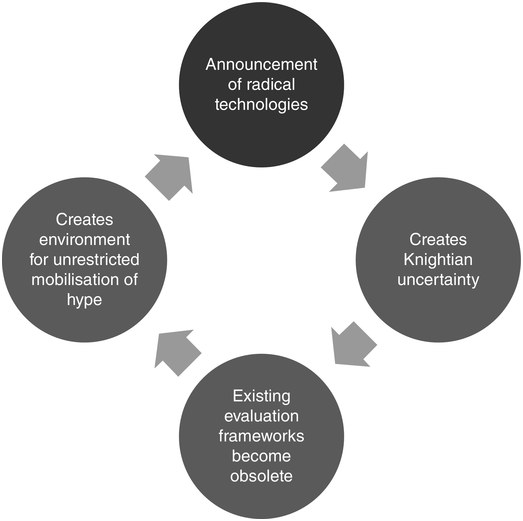

 Open access