

In 1622, Frances Gawen, an English nun in the Benedictine convent in Brussels, wrote a frustrated letter to Jacobus Boonen, the archbishop of Mechelen. She lamented the ‘division’ among the nuns because of a new confessor, and the subsequent ‘extreme disorder and confusion’ that their community faced.Footnote 1 The convent's two ordinary confessors were jostling for power, and Gawen suggested that there needed to be only ‘one head, that is to say a principal Confessor by whose order all that must be governed, and that the other confessor is attached to him as an inferior subordinate’.Footnote 2 She further complained how the abbess was preventing their ‘liberty’ by interrogating the ‘Thourier’ – who was in charge of the ‘Tour’ (the turning box in the wall, located in the parlour) which let objects like letters in and out – about who had been sending correspondence recently.Footnote 3 In order to communicate with their Flemish archbishop, Gawen also utilized the services of Gabriel Colford, a layman and father of a fellow nun, to translate her letter into French. This prompted further tensions in the community, and Gawen begged Boonen ‘to give us the assistance of someone…and to grant us general licence to speak to him freely at the grille without Madame knowing, because otherwise we have no one to translate and carry our letters and messages, when there is need to write to you’.Footnote 4
Frances Gawen's letter highlights the problem she faced between obeying her superiors and ensuring she was able to communicate. Gawen described the breakdown of authority in the convent: the power struggles between rival confessors and correspondences that were to be translated and sent ‘without Madame [the abbess] knowing’. Frances Gawen's letter epitomizes the entanglement of language, power, and authority present within the convent, and which forms the subject of my article. Moreover, she was not alone in her desire to use translators, and her letter draws attention to an important question that has so far remained unaddressed. How did the thousands of English women travelling to the continent to join exiled convents during the seventeenth and eighteenth centuries negotiate the language barriers many of them faced?
In recent years, scholarship on English Catholics in exile has flourished after a period of neglect following John Bossy's remark that English Catholics were separate from the ‘Catholicisms of the continent’.Footnote 5 For example, Caroline Bowden, James Kelly, and contributors to a recent essay collection on exiled English Catholic nuns demonstrate the value of looking beyond England's borders.Footnote 6 Yet, there has been little consideration of linguistic encounter, despite the fact that English travellers would have had no choice but to become competent in foreign languages because English was hardly spoken outside of England during this period. As pioneering scholarship from Peter Burke and Roy Porter has shown, historians have much to learn by investigating the role language played in past societies, and what happened at points of contact between different language speakers.Footnote 7
The response to Burke and Porter's call has been fruitful. We now know a great deal about the transformation of early modern European vernaculars and their complex role within polyglot societies, and the importance of multi-lingualism and language acquisition in European and worldwide encounters.Footnote 8 Indeed, much recent scholarship on transnational and transcultural encounter, particularly that concerning power relations, has been produced within the context of colonial and global interaction.Footnote 9 However, this has typically focused on men's interactions – ambassadors, diplomats, male travellers, spies, missionaries, merchants – and this article breaks new ground by exploring women's roles in similar forms of linguistic and power negotiation within the context of English convents in Europe.
When scholars of English convents have paid attention to foreign language encounter, it has been in the context of asserting how unfamiliar languages heightened perceptions of difference. Language barriers, for example, were a significant motivating factor behind the original establishment of convents for English women. The Brussels Benedictine convent was the first of twenty-one new enclosed communities established during the seventeenth century across what is now France and Belgium. Known as the convent of the Assumption of our Blessed Lady, the community was established by Mary Percy in 1598. Percy was one of the four daughters of Thomas Percy, seventh earl of Northumberland, who was executed on 22 August 1572 due to his involvement in the 1569 Northern Rising. In the aftermath, his widow Anne Somerset fled abroad and her daughter Mary subsequently spent time in a Flemish Augustinian convent. This experience apparently motivated her to found a convent specifically for English women, as many English nuns lacked sufficient language skills in order to communicate with their sisters and confessors in continental houses.Footnote 10 Percy was not alone in this; at the St Omer Poor Clare house that Mary Ward joined in 1606, Ward and the rest of her English sisters ‘had not a word of Dutch or French between them, and could not follow convent instructions’.Footnote 11 Not having language skills made Ward feel like a ‘foreigner’, and she struggled to communicate with her Walloon confessor.Footnote 12 As a result, she left the convent to found a new Poor Clare house for English women at Gravelines in 1607.
Language issues were not resolved with the institution of these houses, however, and by asking how English nuns negotiated language barriers, this article stands as a corrective to scholarship on English Catholic exile which, in the words of one critic, suffers from an ‘apparent obsession with ethnic exclusiveness’.Footnote 13 Scholars have argued that English convents were ‘stridently English’ in their orientation and composition;Footnote 14 and even that ‘nunneries functioned in effect as little self-enclosed Englands that shut out foreign cultures around them’.Footnote 15 Although since the 1990s scholarship on conventual life after the Council of Trent has demonstrated the permeability of enclosure, and emphasized the interactions of cloisters with the worlds beyond their walls, the stress upon English convents’ ‘Englishness’ has prevailed.Footnote 16 Therefore, it might well have not occurred to some that the nuns may have needed to communicate in a language other than their own. A potentially misleading picture has been painted, distorting our understanding of ‘English’ exile experiences that crossed linguistic and cultural lines.
This article uses as its evidence ten years’ worth of correspondence from the Brussels Benedictine convent from c. 1621 to 1631. This period marks the outbreak of controversies within the convent that were to last until the latter half of the seventeenth century. The disputes were complex and grounded in issues of power and authority. When the Brussels convent was founded, the new English Benedictine congregation was not yet restored and therefore the community was placed under the spiritual jurisdiction of the archbishop of Mechelen. The Brussels convent statutes granted varying amounts of authority to key office holders who were subordinate to the archbishop: the convent's Visitor (who was appointed by the abbess and the convent, but they were all to obey his orders), the ordinary confessor (appointed by the archbishop), the abbess (who was elected by the convent and held her term for life), and extraordinary confessors (who could technically either be appointed by the archbishop or the abbess, but most were chosen by the abbess and heard confessions with her permission). Subject to multiple figures of authority, ‘the English Benedictine convent in Brussels was a fertile ground for power struggles over spiritual direction’, as Frances Gawen's letter underlines.Footnote 17
As well as issues with power and authority, the divisions were grounded in, and exacerbated by, the problems caused by language barriers. As Ursula Hewicke wrote to Jacobus Boonen on 7 April 1623: ‘I am assured many inconveniences would have bin avoyded that have bin and are amongst us: which we wanting language to write or speake of to Superiours abroad, might by this secret meanes be imparted and therby things composed to amendment with prudence and peace.’Footnote 18 The ‘inconveniences’ in the convent generated hundreds of letters now held in the archive of the archbishop of Mechelen. They are bundled within a haphazard collection of documents relating to the community in several uncatalogued boxes. Drawing attention to these little known sources, I demonstrate how the nuns negotiated language barriers through the use of translators.
By investigating the men (predominantly their confessors, but also a layman) and women (their fellow nuns) tasked with translation, this article also develops recent scholarship on collaborative authorship. Much work on multiple textual producers has been on same-sex collaborations among men, and yet in recent years scholars of women's writing have done much to bring mixed-sex co-authorship to our attention. The work of Jodi Bilinkoff, Helen Smith, Brenda Hosington, and Jaime Goodrich, for example, has demonstrated the multi-faceted forms of female authorial agency present in spiritual biographies and autobiographies of female religious, and women's transcriptions and translations of male-authored texts.Footnote 19 Very little attention, however, has been paid to same-sex authorial collaboration between women. This article demonstrates how the choice between, and employment of, same-sex or mixed-sex collaborative authorial strategies afforded the nuns a sense of authority over their texts. Such texts were vital avenues for the women to express dissent, and raise concerns over the way their community was governed. Moreover, it is evident that linguistic choices were inextricable from the religious politics of the community.
What follows, then, is an analysis of the ways that language barriers were negotiated by the English nuns in Brussels, and the power the women wielded through different authorial strategies. The nuns’ letters demonstrate that convents in exile were not unproblematically ‘English’, nor were they monoglot spaces, but permeable sites of multi-lingual encounter.
I
In a pioneering survey of letter writing in early modern English convents, Claire Walker suggested that penning (often illicit) external correspondence was a vital part of convent survival; letters were necessary for securing patronage, maintaining contacts with friends and family, and allowed the women to wield power locally, and on the ‘wider political stage’.Footnote 20 This article extends Walker's analysis by considering a further sub-genre of letters that has received significantly less attention from scholars – those written by female religious to their male superiors.
Frances Gawen's letter was one of 190 sent from the Brussels convent to the archbishop of Mechelen and other male superiors during the 1620s.Footnote 21 Nearly all of the letters were about convent governance and issues over spiritual direction, and were written using petitionary language of deference and supplication (the majority of the letters are signed, for example, with ‘your Lordships most obedient child’). Yet, mirroring James Daybell's argument for women's letters in the sixteenth century more generally, the nuns' letters defy easy categorization and should be viewed as both spiritual and political because they were composed to persuade and influence.Footnote 22
It was enshrined in the Brussels statutes that the women were to have a free channel of communication to their superiors. This particular type of letter was to be kept secret from the rest of the community, even protected from the eyes of the abbess who was responsible for reading any other mail sent or received beyond the convent walls. As the statutes decreed:
If any of the Professed would at any time write to the Bishop or Visitor, she shall have free liberty to do the same, and she may deliver her letters to the Thourier, who may not…discover to any, that ever she received any such letters to be addressed vnto them.Footnote 23
The statutes continued: ‘the Abbess or any other Superiors [must not] either Directly, by any ways, signs or outward shew of Countenances, hinder the free writing of their Religious to their Superiors’.Footnote 24 These letters were therefore written with the desire and presumption of at least some level of privacy and secrecy. Therefore – as their recipients could not read English – if the nun herself could not write in any other language, their choice of translator was of great importance.
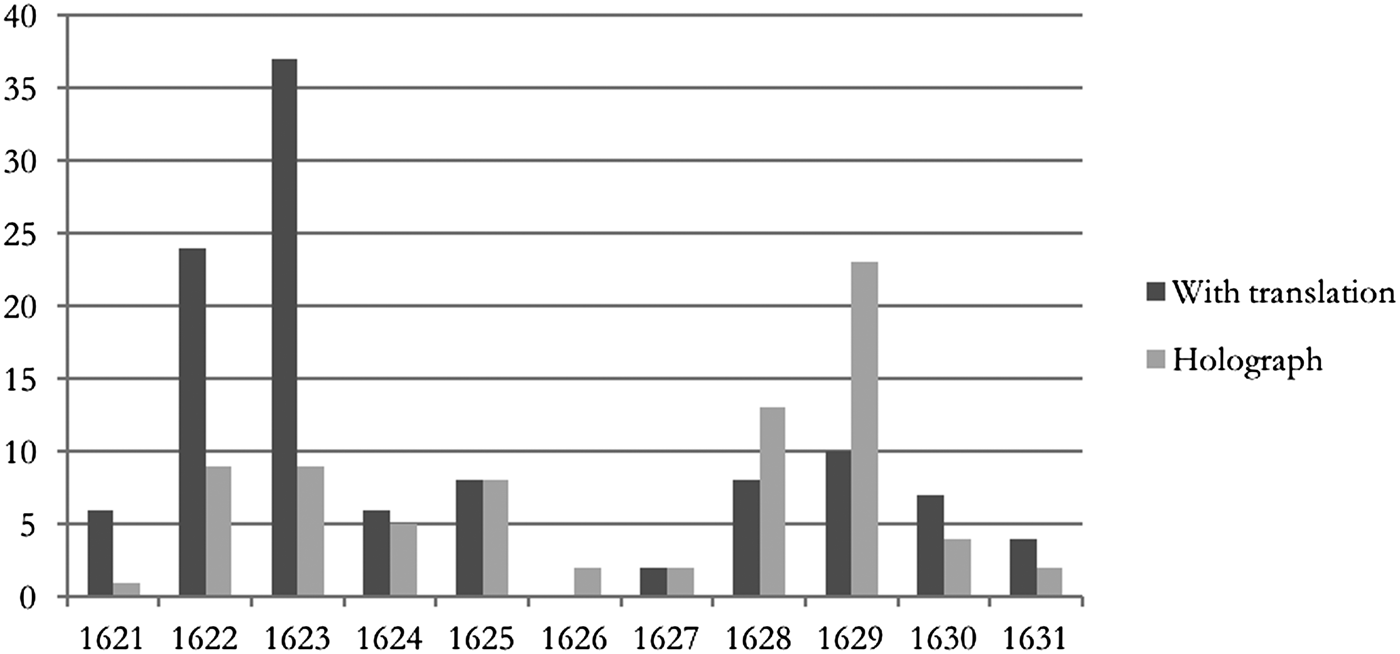
Of the 190 letters, 112 were written with the assistance of 19 translators. A further 55 letters were sent directly in French, 4 in Dutch, and 2 in Latin, all seemingly without assistance, and 17 were sent to the archbishop directly in English. Figure 1 shows the amount of correspondence sent directly by the nuns in comparison to the amount sent using a translator. The two peaks in the graph directly relate to peaks of controversies within the convent first in 1622–3 and then in 1628–9.
Number of nuns’ letters sent with translations compared with holograph letters.
The troubles arising in the convent in the early 1620s were largely due to the growing rift between the abbess Mary Percy and their ordinary confessor Robert Chambers. It was this clash of personalities that catalysed controversies that were to last several decades.Footnote 25 The convent statutes envisioned a close relationship between the abbess and the ordinary confessor, who were both responsible for the spiritual welfare of the convent. Yet, as Ursula Hewicke complained on 7 April 1623, the ongoing dispute between Percy and Chambers meant ‘they lose the authority due to them, and we living thus suspended’.Footnote 26 The house also became vehemently divided on the subject of a young priest, Francis Ward, who arrived around May 1622 to assist Chambers. However, rather than assisting, Ward's equally authoritative position with Chambers was the source of some contention. This was exacerbated by Mary Percy's high regard for Ward (she stopped confessing to Chambers entirely after his arrival). Many in the community were extremely unhappy with Ward's appointment; he was inexperienced, ‘forward and much conceited of him selfe’.Footnote 27 Many were also disgruntled at Ward's infringement on the Jesuits’ traditional role at the convent by offering the nuns the Spiritual Exercises (despite being a secular priest).Footnote 28 As Jaime Goodrich has argued, where the abbess and the confessor ‘should have reinforced each other's power, their disagreements normalized insubordination and created factions’ and the controversies dictated the nuns’ authorial strategies.Footnote 29
II
In response to the controversies in the convent, the nuns wrote urgently to male superiors for assistance, and nearly always with the assistance of translators. Using particular translators was a purposeful collaborative authorial strategy employed by the nuns, and a strategy which shifted throughout the course of the 1620s.
In the early 1620s, the nuns predominantly utilized the services of male translators. The highest number of translated letters that survive were composed with the assistance of Gabriel Colford (he translated thirty-five letters for fourteen nuns) who was active throughout the conflicts until his death in 1628. Colford was also the only lay-translator to support the convent, and was approved as the house's interpreter by their first archbishop, Mathias Hovius (d. 1620).Footnote 30 After his daughter Martha's profession in 1611, Colford also acted as the convent's procurator (their financial manager). The other male translators, John Daniel, John Knatchbull SJ (alias Norton), Francis Ward, Charles Waldegrave SJ, William Talbot, and Anthony Champney (in order of surviving number of translations) were all confessors, and the nuns they translated for were usually in their spiritual care.
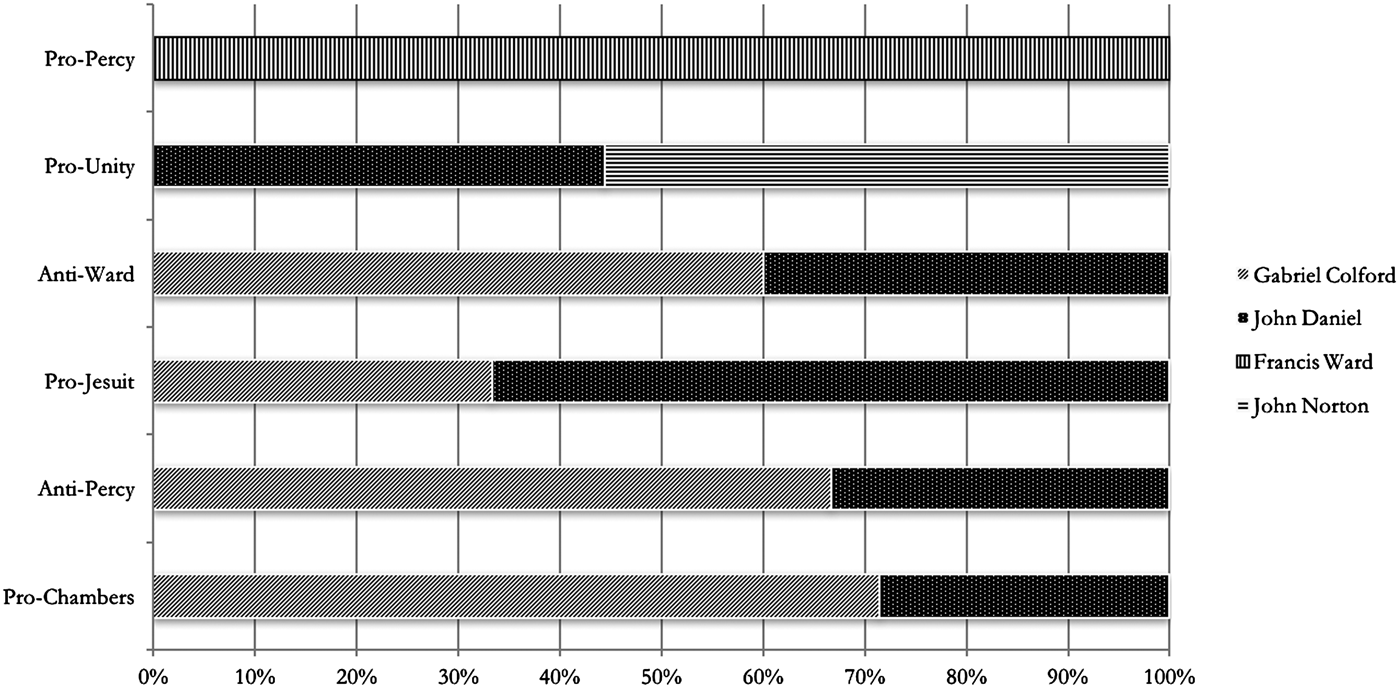
The conflicts of the early 1620s resulted in the development of several factions, and, as a result, the nuns’ choice of translator depended on their factional perspective. On 16 May 1623, Mary Percy identified two groups ‘specially united together’ that challenged the peace of the convent.Footnote 31 The first was Potentiana Deacon, Frances Gawen, Scholastica Smith, and Elizabeth Southcott, who from 1622 to 1623 used Gabriel Colford as a translator (and Deacon also translated a letter for Southcott during this period). These women supported Chambers, and were opposed to Percy's behaviour towards him. The second group was Eugenia Poulton, Lucy Knatchbull, and Magdalen Digby; all were pro-Jesuit and used John Daniel as a translator. Several other nuns were also broadly concerned by the breakdown of authority, and the apparent subversion of convent hierarchical norms. For example, Mary Wintour complained to Boonen that the converse sisters had ‘to[o] much freedom’ in ‘speaking amongs themselves of theyr dislike of any thing in the Convent, giving of ther censures very indiscreetly’.Footnote 32 All of the surviving letters translated into Latin by John Norton were from nuns that expressed discontent about the disputes, but did not directly challenge Percy's or Chambers's authority. By characterizing the content of letters translated (see Figure 2), it is clear that choice of translator was inextricable from the stance that nuns took on the convent conflict.
Characterization of the content of externally translated letters, 1622–3.
External translators also intervened in conflicts on their authors' behalf. Gabriel Colford wrote to Boonen on 18 April 1623 that the disorders in the community were so bad he could ‘not see what remedy can be given without breaking up the monastery and making three…the Corruption, and bad humours of several here are too great to exert a remedy which would work’.Footnote 33 Within a year, both Ward and Chambers had left, and two more convents were founded, ‘making three’, as Colford had suggested. Percy sent a few dissident nuns to establish a house at Cambrai in 1623 (Potentiana Deacon, Frances Gawen, and Viviana Yaxley), and then in 1624 Lucy Knatchbull, Magdalen Digby, Eugenia Poulton, and Mary Roper founded another convent in Ghent specifically under Jesuit direction. As Figure 1 shows, the volume of correspondence significantly reduced after these events occurred.
Despite the foundation of two new convents, the situation remained fraught and as the decade progressed the nuns clashed over the use of Jesuits as extraordinary confessors, and whether Ignatian spirituality was suitable for those professed within the Benedictine tradition. By 1627, Mary Percy had ‘little agreement’ with the Jesuits, and both Aurea James and Mary Wintour complained to Boonen that they were afraid the convent would lose the Society's support.Footnote 34 The abbess had turned against the Jesuits because they had not shared her views on Chambers, nor had they approved of Ward. As she wrote to Boonen on 16 February 1628, ‘it is playn & sertain that the societie hath manteyned a faction many years against the cheef superior of this place’.Footnote 35 Moreover, later that year Anthony Champney joined the community as ordinary confessor. This was a controversial choice, matched with a spike in communication: Champney had been involved in the anti-Jesuit movement, and was one of thirteen priests who had signed the protestation of allegiance to Queen Elizabeth in 1603. Many were scandalized by his presence, and an anonymous libel circulated within the convent that compared Champney's ‘seditious spirit’ to Calvin and Luther.Footnote 36 By early 1629, the Jesuits were refusing to assist the community and, in contrast to the multiple divisions in the first half of the decade, two strong factions emerged: a pro-Jesuit party led by Mary Vavasour, and a party in support of the abbess Mary Percy and the prioress Agatha Wiseman.
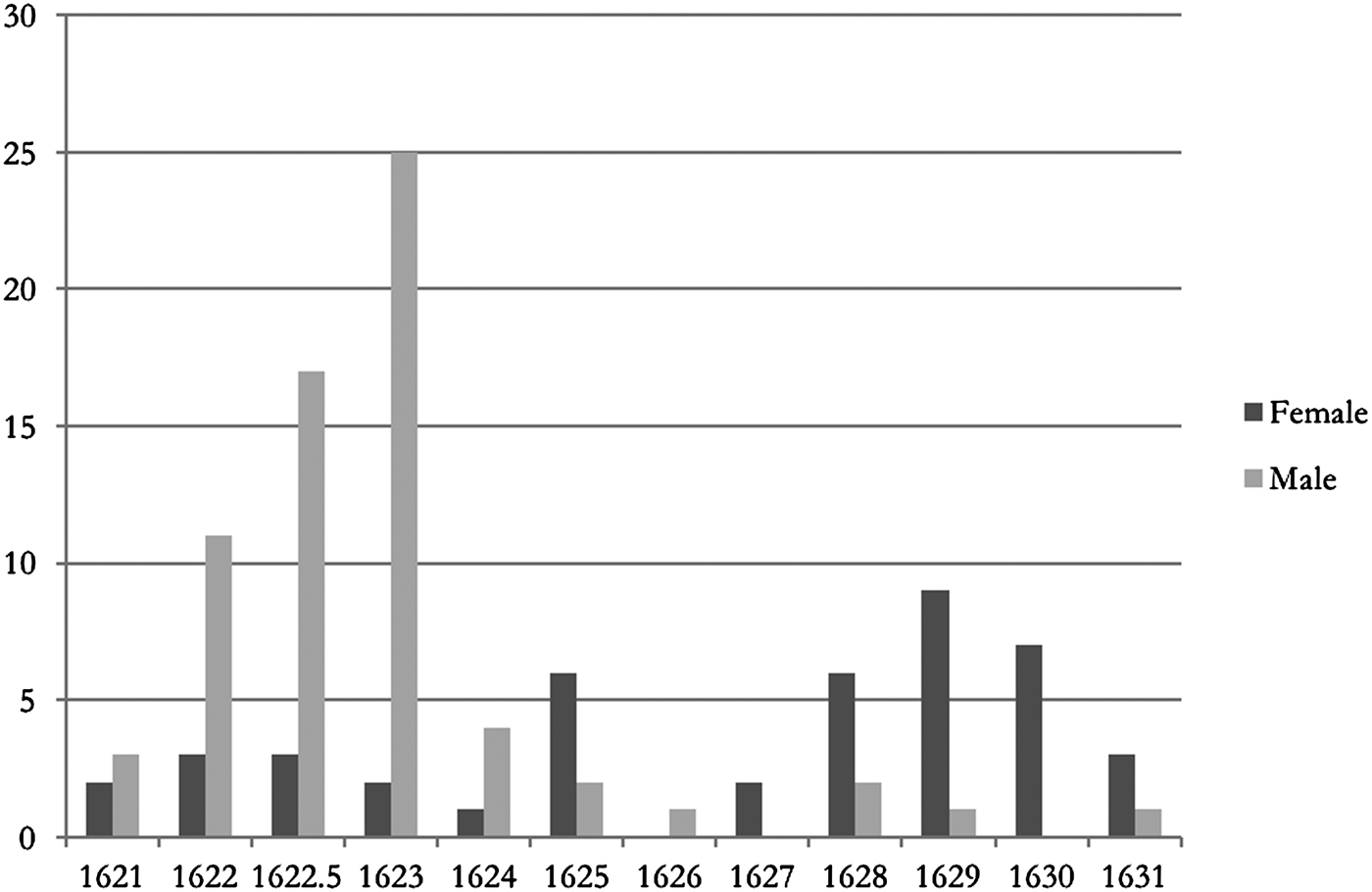
Quantitative analysis of the correspondence demonstrates two important trends that indicate relationship changes within the convent during this turbulent decade. The first is that the use of male translators was overtaken by the use of female translators. As Figure 3 shows, women were utilized increasingly until the use of male translators stopped almost entirely. The second is that the number of letters sent directly by women without the use of a translator also steadily increased (see Figure 1). The reasons for this are twofold: first, there were rising tensions and problems with using external translators, which became inextricable from the controversies within the community, and second, linguistic competence increased within the convent.
Number of letters sent by male translators in comparison to female translators.
III
Using external translators was a complex collaborative authorial process, and circulation practices demonstrate that the agency of the female authors was not outweighed by the presence of male translators as the authorial role of the female religious was clearly distinguished.
All of the nuns, including the abbess, needed to ensure they had the appropriate authorization to complete the various stages of the translation process. First, they had to ask permission from the archbishop; Abbess Mary Percy wrote to Boonen on 8 September 1621 ‘for as much as I myself cannot write in French, with the approval of your reverence I will write my letters in English to the Prior of the Carthusians, so that he puts them into Latin, which I assure myself he will do very faithfully’.Footnote 37 The nuns then met their translators in person to discuss their letters through the grille (the grating which separated the nuns from visitors in the parlour, where the Tour was located). The nun in charge of the parlour, the Thourier, therefore required a written note from the archbishop in order to prove the women had been granted permission to meet with the translators. As Frances Gawen wrote to Boonen on 5 April 1623, ‘I shall beg you to send a little note in your hand to D. Catherine [Paston] who is in charge of the Parlour, so that she will not cause any difficulties about permitting me.’Footnote 38
The nuns then gave their letters to their interpreters at the grate, for them to translate and forward on, and Gabriel Colford described in some detail the textual circulation practices in his letter to Boonen on 18 April 1623:
I sent you on the eve of Easter by an English Gentleman who left here to go to Malines, the papers of some English Nuns translated by the Reverend Father Norton, monsieur Daniel and myself, in three packets, but all put in a little canvas bag addressed to Your Illustrious Lordship.Footnote 39
As Scholastica Smith directed Gabriel Colford: ‘good master Cholford I beseeche you to doe me the favor as tranclat this writting into frence and deliver it and this writting alredy translated unto my Loard Beshap’.Footnote 40 The translators wrote out their copy, and enclosed their translation with the nun's original, as we see in Figure 4 in a letter from Ursula Hewicke, where Colford has then signed his name on the address leaf.Footnote 41
Ursula Hewicke to Jacobus Boonen, 7 April 1623.
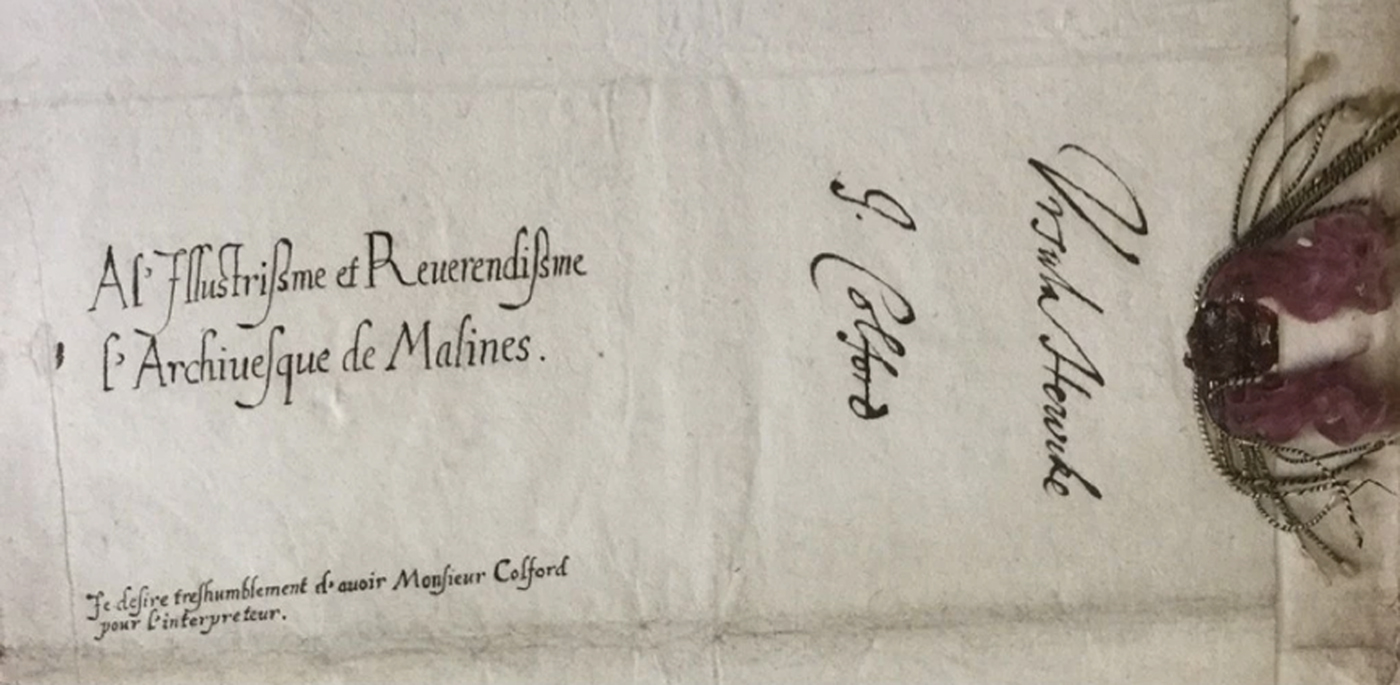
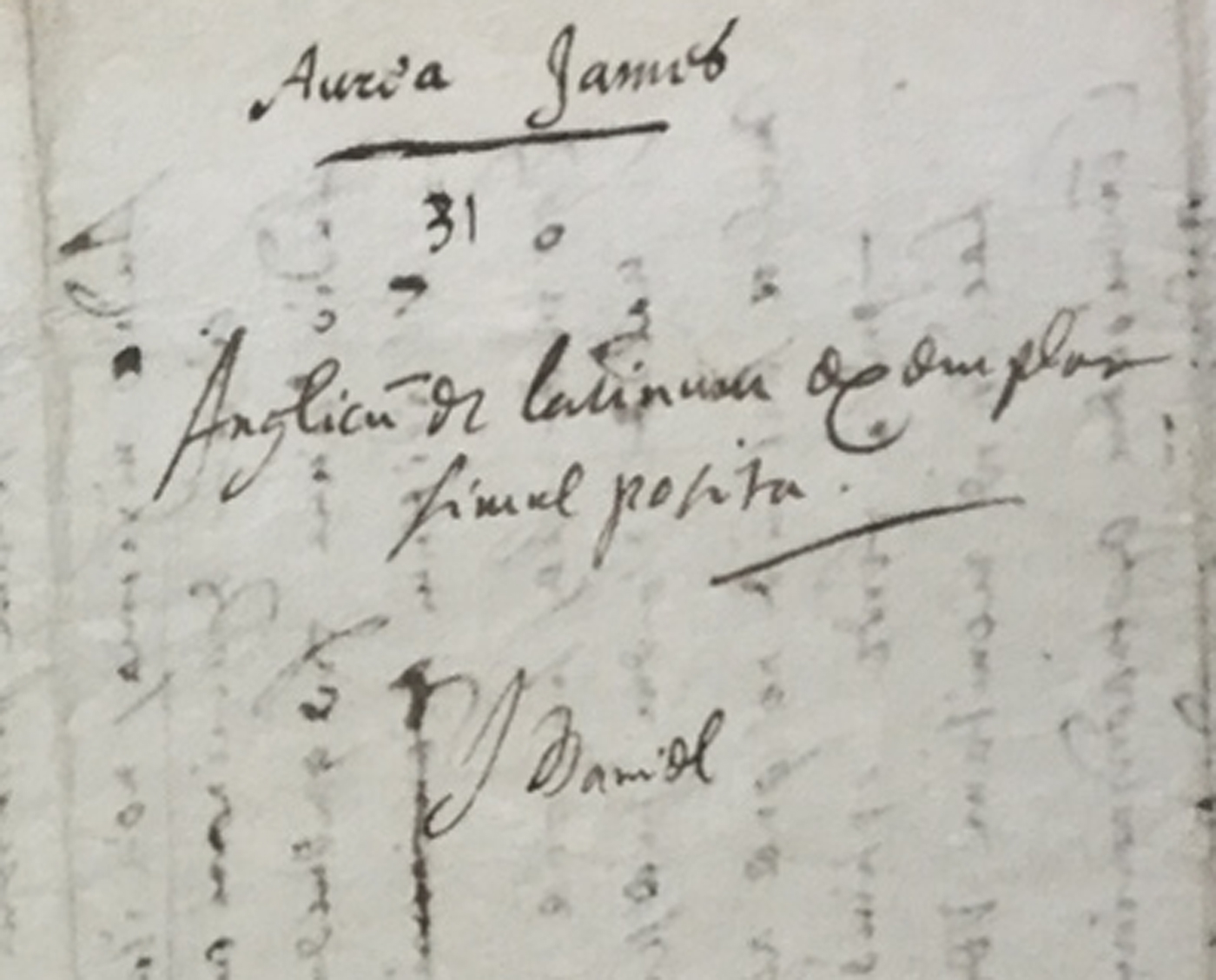
Of the sixty-seven extant letters sent using male translators, fifty have surviving English copies. Of these, twenty-eight have the translator indicated by name, either in the main body of text or on the address leaf, and yet the nuns' status as the author was made explicit by the circulation of the original and translation together. The translation was either enclosed with the original in the same packet as described by Colford, or written on the same sheet or bifolium as the English copy. Several letters have notes on the address leaves such as ‘Anglicum exemplar’ or ‘Latinum exemplar’ written by the translator, and testifying to their mutual circulation (see Figure 5).Footnote 42
Aurea James to Jacobus Boonen, c. 1622–3.
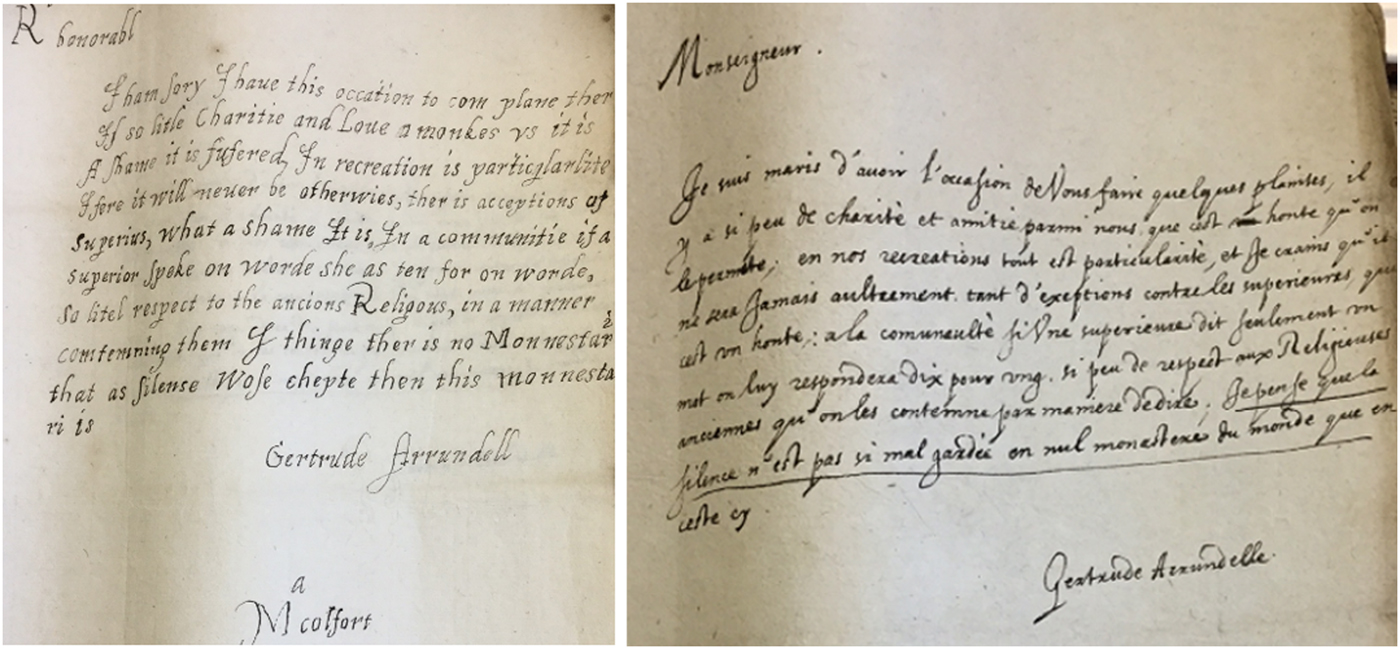
Sending the translation with the original was evidently important, and acted as testimony of the translator's faithfulness, as well as their level of intervention. This varied depending on the female author or authors. It could be simple changes, like Eugenia Poulton and her faction's letter to Boonen from 18 May 1623, where John Daniel changed the pronouns from the first person to third person plural.Footnote 43 Or the changes could be significant, such as Gabriel Colford's translation of Gertrude Arundell's letter from the early 1620s, which can be seen in Figure 6. Arundell's spelling and punctuation is especially erratic (despite the lack of standardization during the period), and it seems that she composed her letter phonetically. Words and phrases such as ‘I am’, ‘complain’, and ‘particularity’ are rendered as ‘I ham’, ‘com plane’, and ‘particqlarlite’ (note the ‘q’ here for the sound ‘cue’). Gabriel Colford has arguably made the letter more intelligible in French than it was in English. For example, Colford intervenes in Arundell's text by pausing at the end of natural phrases; in the first two lines of both texts he has inserted a comma between ‘quelques plaintes’ and ‘il y a’.Footnote 44 Translators also consolidated letters given to them in fragments. For example, Scholastica Smith in December 1622 wrote a lengthy missive on the problems facing the community.Footnote 45 She wrote across two verso sides of one bifolium, one side of a single sheet, and three sides of a further bifolium. However, in the translation sent to Boonen, Gabriel Colford consolidated the texts onto three sides of a single bifolium. Other interventions from the translator included adding minor details that the author had omitted. For example, in a letter from Clare Curson to Jacobus Boonen, Colford has added: ‘ce papier n'apas de date mais estoit escript le 13 de April [sic] 1623’.Footnote 46
Gertrude Arundell to Jacobus Boonen, c. 1621–8.
Regardless of the extent of the intervention, the agency of the male translator did not outweigh the authorial agency of the female writer. When considering mixed-sex collaborations, scholars such as Jodi Bilinkoff have focused on the confessor–penitent relationship and the production of spiritual autobiography and hagiography. In these collaborations, although the women had authorial agency by writing or dictating their lives, this was always limited. Power in these narratives lay with the confessors as their editors, publishers, and distrubitors; as Bilinkoff argues, ‘[w]omen wrote because so ordered by their confessors’.Footnote 47 However, in the letters penned by the nuns in the Brussels cloister, the power dynamic was inverted, as the male translators wrote because they were ‘so ordered’ (politely requested) to by the women.
Moreover, the nuns’ authorial agency was underlined as their originals were circulated with the translations. As James Daybell has explained, ‘a woman's own handwriting conferred a particular authority on her correspondence’, and their hands were regarded by recipients as guarantors of the letter's contents.Footnote 48 The presence of the nun's hand also conveyed intimacy and affection, which was reinforced through decorative letter fastenings, to support the nuns’ petitions (such as the red thread in Figure 4 used by Ursula Hewicke in her seal).Footnote 49
The relationship between the author and the translator was nonetheless a collaborative one; the translator was not a passive conduit for the text as he or she had an impact on the way the nun's letter was received and circulated. John Daniel, for example, always translated his letters into Latin, whereas Gabriel Colford always wrote in French. The material page provided the first impression, as choice of translator indicated the nun's faction, and the recipient therefore had a sense of the perspective of the author from an initial glance.
IV
Letter translation empowered the female religious and enabled them to bolster their position with the archbishop on the subject of their various issues, which for most centred upon Abbess Mary Percy's many alleged failings. As a result, Percy became increasingly concerned with what the nuns were saying about her. Despite the express instructions in the statutes, the abbess tried to control and suppress the nuns’ communications, leading several to appeal to Boonen to stop her. As Frances Gawen wrote in the early 1620s, requesting ‘freedom to speak or write to Your Most Illustrious Lordship or to the Visitor, which we are being prevented from doing’.Footnote 50 The nuns complained that the abbess was searching through their rooms looking for letters; Elizabeth Southcott wrote on 23 April 1623 begging Boonen ‘absolutly to forbidd My lady when she visiteth our celles not to reade paperes that she by chance findeth written eyther Conserninge our Confessiones, or anything to be sent to your Lordship or the visitor’.Footnote 51 Lucy Knatchbull also complained that she had heard the abbess say ‘if she could by chance to meet with a letter to be sent to your Lordship she would make no scruple to open it, and see what were in it, for that she gave no cause of complaints and therefore they must needs write untruths’.Footnote 52
Percy's desire to control correspondence from the convent also led to her interrogation of the Thouriers and translators. Gabriel Colford's daughter Martha was Thourier in 1622 and wrote to Boonen complaining of the ‘frequent examinations’ she received regarding the religious who spoke with her father.Footnote 53 The abbess, Martha continued, was attempting to forbid the nuns from speaking with him, despite the fact that Martha had checked with the Visitor a few times to ensure they did have permission, and was assured they had: ‘Monsieur responded that he freely gave leave to speak in person or in writing to be translated by him.’Footnote 54 Martha was most afflicted by the contradictory messages she was receiving, and her inability to obey both of her superiors simultaneously: ‘because in this Monsieur the vicar commanded me to do one thing and Madame another’.Footnote 55 In 1623, when Katherine Paston was Thourier, she also complained to Boonen of the same problem. ‘My Lady doth both in private and publicke chapters speake against any private going to the grate insinuating that “Why? or upon what account or cause so ever?”’ As a result, Paston explained, there were ‘many confusions in sending in of letters and other things for that they cannot be delivered att the grates but ar enforced to convey them into the house at any place wher they may find entrance’.Footnote 56
Percy seemed particularly infuriated by the nuns’ use of translators, for without them, of course, many of the women would have easily been silenced. On 16 May 1623, Percy wrote to Boonen about members of the convent ‘taking too much liberty about conferring and conversing together within the monastery and with persons from outside, and especially with Monsieur Daniel and Monsieur Colford, for under the pretext that they are their interpreters, they think of talking with them at any time and at any hour’.Footnote 57 It is noteworthy that Percy did not complain about the other external translators active during this period: Fathers Ward and Norton. It seems then that the abbess took particular issue with Daniel and Colford, at least in part, due to the opinions of the women they translated for (see Figure 2).
Particular external translators were embroiled in Percy's concerns about sedition being stirred against her, which she feared would undermine the reputation of the convent. The abbess wrote in 1622 that ‘the cause of my suspicions was increased, by understanding continually that relations was made out of the monastery to the disgrace thereof but yet could never know the authors’.Footnote 58 Percy was extremely concerned about the damage that external translators might cause to the convent's reputation, as she feared news of their conflicts would spread beyond the walls of the cloister as she struggled to maintain control. Percy's suspicions were not unfounded; in December 1622, the convent received a letter from England comparing the community to the ‘ruins of Troy’.Footnote 59 After the quarrel in 1622–3 abated, and the quantity of correspondence reduced, it is therefore significant that the use of external male translators sharply declined.
V
Being unable to use external translators meant the nuns had to formulate alternative strategies in order to negotiate the language barrier. By 1623, several nuns had petitioned the archbishop for language lessons; Aurea James asked Boonen that ‘sum order may be taken that those may learn french that desire it wherof my self is on[e]’.Footnote 60 In early 1622, Frances Gawen asked Boonen for permission to use Gabriel Colford as her translator, and requested to ‘learn French from him’.Footnote 61 Considering Mary Percy's increasing dislike of external translators visiting the convent, it is perhaps not surprising that the abbess was resistant to this practice. On 13 April 1623, Gawen wrote again beseeching Boonen that he use his ‘authoritie to will of my Lady we may practice the french tongue and that those that have some beginning may be helpen therin’.Footnote 62 It is possible that in the early 1620s outsiders (like Colford) were enlisted to instruct the religious, and processes of acquisition were oral as they were instructed through the grille. By the end of the 1620s, there were at least five further women writing in French who had previously used a translator.Footnote 63 This increase in competence is reflected in Figure 1, which shows the increasing number of letters sent without the use of translators. Women unable to learn French themselves were therefore more able to turn to support from within the convent walls as the decade progressed.
A number of women wrote to Boonen on behalf of their fellow religious. In late 1623, Frances Gawen explained she was writing for ‘several of my sisters’ with fears that Chambers would soon abandon them because of the poor treatment he had received ‘by the hand of Madame’.Footnote 64 Shortly afterwards, Chambers left and Martha Colford wrote to Boonen on behalf of several nuns ‘afflicted by this news that we have lost our very dear Father’. Martha explained that the nuns had wanted to ‘write themselves in private to your Lordship, but because their interpreter is not here’ she had ‘written on their behalf’.Footnote 65 During the course of the second crisis of the decade, it is clear that the use of female translators was crucial. Agatha Wiseman wrote a six-page letter on 8 July 1628 ‘on the insistence of a great number of Religious’ to ensure that Boonen and the Visitor were up to speed on the conflicts.Footnote 66 On 12 December 1628, Scholastica Smith wrote herself in French to Boonen begging him to come to the convent because Mary Percy had announced she was going to resign. This letter, she explained, was written ‘de ma part, et de la part de plusieurs d'autres’.Footnote 67
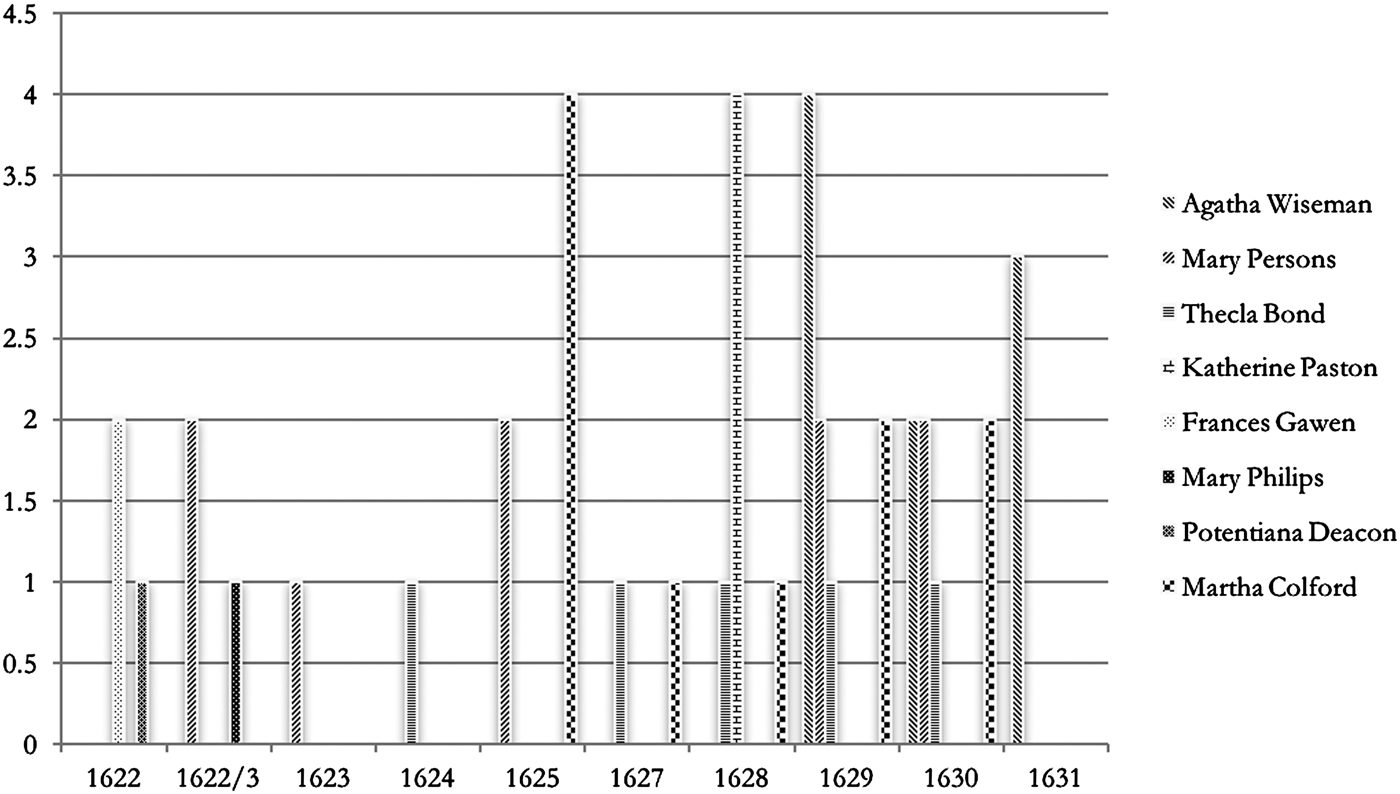
As well as writing on their behalf, many women acted as translators for their fellow religious. As Figure 7 demonstrates, female translators were used far more often by the end of the decade than male translators, and at least eight female translators were resident in the convent over the course of the 1620s. Six women had French (or in Mary Philips's case, Dutch) when they entered the convent, and Frances Gawen and Katherine Paston improved their written French so much in the early 1620s that they stopped using translators, wrote their own letters, and then started translating the missives of their fellow nuns. As with the use of male translators, a nun's choice of female translator was political as much as practical. Agatha Wiseman and Mary Persons, for example, only translated on behalf of Mary Percy and her faction during the conflicts in the latter part of the decade. The letters translated by Martha Colford and Katherine Paston during the later crisis also supported Percy; however, Katherine Thecla Bond seems only to have translated for the pro-Jesuit nuns.
Number of letters sent by particular female translators each year.
Notably, material translation practices were gendered. Whereas male translators sent the original and translated copies together, female translators only sent autograph copies. The female translator acted as an anonymous scribe (I have uncovered their identities from their handwriting), as the nun dictated her letter to her fellow religious before signing her own name. This demonstrates an increased sense of reliability and credibility involved when the nuns employed same-sex collaborative authorial strategies, which was likely due to the women's physical proximity to each other within the convent. The signature of the author in the female translation attested to the fact that content of the letter had been reviewed and their message conveyed. This indicates a level of trust and access not available when male translators were used, and perhaps suggests that more women had the ability to read French than could write it.
VI
When translators were selected, they were chosen on the basis of trust, as the author relied on them to have their message conveyed appropriately. Trust was highly important when selecting a translator, as the nuns were sharing private information they hoped would have limited circulation. On 16 May 1623, Lucy Knatchbull wrote to Boonen (using John Daniel as translator) about the inappropriate relationship that had developed between Francis Ward and Mary Philips, the details of which she had been told in confidence by a third party. Notably, she said to Boonen that she hoped she had not abused ‘the trust they reposed in me when I aquaint none by your Grace with all’, which seems strange when obviously Daniel was also being ‘acquainted’ with this information.Footnote 68 Ursula Hewicke behaved similarly on 17 May 1623 when using Gabriel Colford as a translator for her letter discussing the vocation of a novice. She said it was her duty ‘to give our Lordship account in secret what hath passed between her [the novice] and me concerning this matter’ and she says that ‘she nor any other person knowes that I write this’.Footnote 69 Yet Colford is of course privy to all of it. Neglecting to mention their translators’ access to the contents of their letters is curious, but perhaps unsurprising when confessors were used, as the seal of the confessional would have been enough to ensure the priests’ silence on the contents of the missives. The priests’ translation of the letters allowed mediation between the women and the archbishop as they also did between them and God.Footnote 70
Significantly, this was not the case for Gabriel Colford. As the use of male translators became linked with the developing factional disputes in the early 1620s, it seems that Gabriel Colford's position as a layman became a source of contention. Scholastica Smith wrote to Boonen on 11 June 1622 that several nuns were ‘so childish and suspicious about those who had Monsieur Colford as their interpreter’ and how they ‘they persuaded one another that it was not proper to have a layman as the interpreter for nuns’.Footnote 71 Yet, although Smith felt that the complaints of her fellow religious were petty and politically motivated, Colford's intimacy with the female religious was highly unusual. As well as translating their messages by hand, it is clear that Colford and many female religious spent time together at the grate, receiving messages to deliver to the archbishop that the nuns felt unable to commit to paper. Frances Gawen had asked Boonen's permission that Colford be able to translate her papers ‘orally, to convey some message on my behalf when the need and the occasion arise’.Footnote 72 It is clear that Colford also delivered responses to the nuns’ letters orally at the grille, as Ursula Hewicke explained: ‘The other day, Mr. Colford wanted to speak with me on behalf of your Reverence, concerning the letter that I recently sent you.’Footnote 73 It is perhaps not surprising that his close proximity to the women, mimicking that of a confessor–penitent relationship, was a cause of concern.
For female translators, trust was dependent, as we have seen, on the factional perspective of the linguistically gifted nun. Analysing the age difference between female translators and authors also suggests no evidence that age in profession (and resulting spiritual authority) made any difference to choice of translator.Footnote 74 For example, although Martha Colford was eight years older than Mary Watson when she translated her letter of 25 April 1627, she was eight years younger than Agnes Lenthall when translating her letter of 11 February 1625.Footnote 75 The nuns’ physical proximity in the convent, language skills, and knowledge that their translator shared their point of view was enough to reassure the nun that the contents of her private missive were safe.
Not all the nuns shared such a high level of trust in their interpreters. Throughout the 1620s, there were increasing issues with the use of translators and access to information. For example, in February 1628, Mary Percy wrote to Boonen about the ‘extreme necessitie wee have of a ghostly father and the inconveniens we find by relying on the [Jesuit] fathers’.Footnote 76 Percy went on to say how she ‘would have soner aquanted your lordship with thes matters but I had no interpretour I could trust, for allthough mr colford hath done some good offices in removing some of the societie that wear imp[er]tinent heer, yet I know he is wholy for them and wil not displeas them in any sort’. Her lack of trust in Colford, due to his own stance on the Jesuits, had hindered her ability to communicate earlier with Boonen.Footnote 77
Despite the nuns increasingly turning to female translators from within the convent walls, letter-interception and interrogation practices remained. On 24 April 1629, Elizabeth Southcott wrote to Boonen, horrified that some of her letters to the archbishop (which she kept in a little box that had a lock and key) were stolen on the orders of Percy by Teresa Gage, Anne Trentham (a novice), and two other recently professed nuns.Footnote 78 Moreover, Southcott implied that the abbess had resorted to stealing the papers because Southcott had not yet had them interpreted, suggesting that Percy questioned the translators. ‘Among others, there was one that concerned her, she found and kept it, which she would have seen earlier if I had had the desire[d] opportunity to confer with your Most Illustrious Lordship by the interpretation of a confessor.’Footnote 79 As well as questioning confessor-translators, Mary Persons's letter from 12 January 1629 confirmed Percy's interrogation of female translators. Persons had been pestered to write to Boonen on behalf of a novice who had fallen out with Percy, and as a result, Persons's conscience was ‘greatly troubled’ because the abbess had ‘by her inquisitions…made me confess what I fear I was obliged to keep secret, and it was that I was passing between your Most Illustrious Lordship and the said novice when I was her interpreter’.Footnote 80 Continued interrogation, coupled with increasing numbers of nuns feeling unable to confide in a translator due to the sensitive content of their missives, meant that several nuns started to bypass the use of interpreters entirely.
Rising numbers of letters were sent directly to Boonen in English, which suggests that the nuns either assumed Boonen might be able to read the letter himself, or that he would select his own translator. On 5 March 1629, Barbara Duckett wrote that she had been told ‘your Lordship understands English’. Footnote 81 However, the thought that letters might potentially circulate to an unknown interpreter led some of the nuns to request anonymity. Despite being informed of Boonen's new linguistic ability, later in her letter Duckett added that if Boonen did need to use a translator ‘for what I writt here, I most humbly crave the favour of your Lordship to conceale my name’.Footnote 82 Aurea James echoed Duckett in her letter, adding a note in French: ‘if your Lordship does not understand what I have written I humbly beg for this to be interpreted by any Priest or Jesuit Father who knoweth me not’.Footnote 83 These nuns were conscious of the translator's ability to access the information within their letters, and wanted to limit circulation.
Issues with trust and secrecy (or lack thereof) facilitated politicized translation choices. Mary Percy, as Jaime Goodrich has argued, often sought collaborators and translators whose attributes would bolster her political position and credibility.Footnote 84 It is clear that Percy was not alone in this; many of the nuns in the Brussels convent were adept at using translation and translators for political manoeuvring, and to claim advantage over their factional rivals. On 29 July 1623, Frances Gawen used Gabriel Colford as her translator, despite the fact that Gawen herself was able to write in French by this time. She wrote her own letter in French on 5 April 1623, and she translated letters to Boonen from Alexia Blanchard on 22 September and 22 November 1622. Using Colford for her translator on this occasion was therefore politically motivated. In the letter, Gawen complained how
divers times my Lady both by wordes, countenances, and reprehensions have dauted our freedome as wel to your Lordship as Visateur…my Lady made particular inquirie of the Thouriere if any had sent to your Lordship…it is evident that if my Lady doe but suspect those that wil have freedome with your Lordship or Visitour she doth…account [them] turbulent parsons.Footnote 85
Having Colford translate her letter meant that Gawen was defiantly acting as a ‘turbulent’ person, and ensured that Colford knew that she supported him against his detractors. Gawen's use of Colford emphasized that she believed it was the convent's right to have free access to him and other translators. At the end of the decade, translators were still being used to make political statements. In c. 1631 Thecla Bond wrote a letter in English to the archbishop complaining about the appellant (pro-Jesuit) nuns, and she nominated Anthony Champney as the translator.Footnote 86 This is a noteworthy departure for Bond, who from 1627 to 1629 translated several letters into French on behalf of women who favoured Jesuits. By nominating Champney, she was therefore emphasizing her new loyalty to the house's ordinary confessor, and made her change in position clear to Boonen before he had even read the contents of the letter.
Despite some increase in ability as the decade progressed, linguistic competence continued to be a source of contention in the community, as some abused their skills to promote their own agenda. On 5 August 1628, Katherine Paston wrote to the archbishop on behalf of those within the convent that lacked language. She complained about the way some of the nuns with linguistic ability were taking advantage of ‘the natural excellence of the new Reverend Visitor’.Footnote 87 Her particular criticisms were directed at Mary Philips, who was accused of manipulating the Visitor to make him see her point of view. Added to this, there were further allegations made in the convent that people were being persuaded to sign co-authored letters to the archbishop in languages they did not understand. On 25 January 1629, Agatha Wiseman accused Mary Vavasour of pressurizing Apolonia Waldegrave into signing a letter from the pro-Jesuit faction.Footnote 88 In her letter, Wiseman suggested to the dean of St Catherine's that these types of communications should be prohibited, and that if anyone wants to write to him or the archbishop they should do so ‘without demanding the assistance of others, and those that cannot write French, that they write in English’.Footnote 89 As such, there would be no suggestion that their sentiments were not genuine, or manipulated in any way. It is not insignificant, then, that 70 per cent of English letters that survive were sent after 1628.
VII
In the field of socio-linguistics, it is by now a truism to assert that there is a mutual relationship between language and power.Footnote 90 This is evident in the Brussels Benedictine convent, where divisions were grounded in language issues and linguistic choices, and reflected in the way language barriers were negotiated. The majority of the nuns were entirely reliant on translators in order to correspond with their superiors, and this communication was vital for the women to express complaint, and assert their opinions on the way their community should be governed. The nuns initially looked outside the convent walls for assistance; some enlisted their confessors as translators, who were bound by the secrecy of the confessional to ensure the content of the nuns’ letters remained secret. The most prolific male translator, however, was Gabriel Colford, and it is striking that a layman could forge such close and trusting relationships with female religious through interpreting and conveying their private messages.
Soon these men became embroiled in the factional disputes that shattered the peace of the convent throughout the decade and the nuns were forced to formulate alternative authorial strategies in order to overcome the language barrier. As the 1620s progressed, male translators were gradually replaced by the use of translators from within the convent walls, as increasing language competence meant that the women were able to empower factionally likeminded members of their community. Female translators were even more entangled in the convent's religio-political conflicts, and while some had the power to communicate, others did not. This became particularly acute when some of the nuns were accused of forcing other nuns to sign letters in languages that they did not understand, and abusing their spoken language skills to manipulate superiors. Political manoeuvring was present from the top down, and involved the abbess, the choir and converse sisters, and the novices. Moreover, in direct contravention of their statutes, Mary Percy tried throughout the decade to control and silence her nuns by interrogating translators, intercepting letters, and impeding their ability to use French.
By attending to the question of how English Catholic women on the continent overcame their language barriers, it is evident that the ‘language and culture’ of convents in exile was not, as it continues to be asserted, straightforwardly ‘English’.Footnote 91 Rather than ‘self-enclosed Englands’, the nuns’ ‘Englishness’ was a problem that often needed to be resolved. Foreign language competence was highly desirable, and in regular correspondence with their Flemish male superiors, the nuns came into frequent contact with languages other than their own. These linguistic encounters were mediated orally and on paper via the grille through collaborative authorial strategies as the women used male translators who sent holograph and scribal copies as proof of their faithfulness. Moreover, epistolary manuscript practices were gendered; when using female translators, language barriers were mediated on the page, the nun's signature alone testified to the translator's accuracy in conveying their message.
This examination of the linguistic ecology of one English convent in exile demonstrates the necessity of individual and communal multi-lingualism for the convent's stability and survival. Indeed, this case-study illuminates the need for further, broader enquiry into the negotiation of language barriers within other communities in exile during the period, and to continue to explore the ways in which convents were not simply ‘English’ spaces, but porous sites of polyglot encounter.


 Open access

