




1 Placement of unstressed constituents in Germanic verse
Kuhn's First Law (henceforth K1) restricts the placement of high-frequency words that are major constituents of the clause, e.g. sentence conjunctions, sentential adverbs, pronoun subjects and objects, ‘be’ verbs and finite auxiliaries.Footnote 2 Kuhn called such words Satzpartikeln ‘sentence particles’. I will call them SPs. According to Kuhn, an unstressed SP must appear before the first or second stress of a clause; otherwise, the SP acquires stress. When there are two or more SPs, they must all be placed in just one of the two permissible locations. SPs contrast with constituents of small phrases, e.g. unstressed prefixes, prepositions, determiners, conjunctions that link small phrases, and adverbs that modify adjectives or other adverbs. Kuhn called these Satzteilpartikeln ‘sentence-part particles’. I will call them STPs. According to Kuhn's Second Law (henceforth K2), any STP before the first stress of the clause must be accompanied by an SP. Many of Kuhn's Partikeln are not ‘particles’ in the current technical sense of the term: ‘an invariable item with a grammatical function, especially one that does not readily fit into a standard definition of parts of speech’ (Crystal Reference Crystal1985: 222). I use ‘SP’ and ‘STP’ to avoid confusion.
Item (1) shows how Kuhn's Laws apply in Beowulf, the oldest long poem in a Germanic language with Germanic narrative content (c. 700 CE).Footnote 3 The clause in (1a) consists of three half-lines called verses, which are designated by the line number followed by ‘a’ for the first verse of the line (the a-verse) or ‘b’ for the second (the b-verse). The midline caesura is represented by extra spaces. Alliterating syllables are in boldface.Footnote 4 All syllables before the first alliteration of the verse are treated like unstressed syllables in Old English poetry (Russom Reference Russom1998: 128–34).
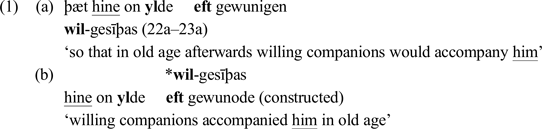
Item (1b) has acceptable verse patterns and the most common word order in the poem but the order of verses puts the unstressed SP hine in the second verse of the clause, violating K1. In item (1a), hine and the unstressed SP þæt occupy the same permissible location, in accord with K1, and the prepositional STP on is accompanied by these SPs, in accord with K2.
2 Evolutionary scenarios for Germanic syntax
The critique of Kuhn's Laws in Smith (Reference Smith1971: 1–14) provides a survey of previous work available to Kuhn, which can be summarized briefly. Ries (Reference Ries1880: 91–111) argued that the original word order in Common Germanic was subject first, verb last and everything else in between. Behaghel (Reference Behaghel1897: 7–33) basically agreed. According to Erdmann (Reference Erdmann1886: 191–5), the key factor was placement of the verb relative to all other words in the sentence. Braune (Reference Braune and Hildebrand1894: 34–51) thought that placement of the verb in first or second position was the first step toward syntactic patterning in a proto-language with originally free word order. Wackernagel (Reference Wackernagel1892: 333–436) thought that verb-second order in Modern German was a direct reflex of IE syntax. Just after Smith wrote, Vennemann (Reference Vennemann, Anderson and Jones1974: 368) hypothesized that Proto-Germanic verbs stood in second position between topics and complements. This hypothesis was rejected by Antonsen (Reference Antonsen2002: 294), who maintained that Germanic inscriptions in the oldest runic alphabet had SOV order. I will not critique later publications that posit verb-second order in Proto-Germanic, whether crucially or incidentally. Instead I will focus on showing that verb-second order is ruled out by metrical evidence.Footnote 5
Following Wackernagel, Kuhn (Reference Kuhn1933: 61) assumed that SPs were enclitic to the first stressed word of the clause in the immediate ancestor of Proto-Germanic. When word stress shifted to the first syllable in late Proto-Germanic, he argued, the result would be falling rhythm at the level of both word and clause, something he found unschöne und unbequeme ‘unlovely and unpleasant’ (Kuhn Reference Kuhn1933: 22). The problem was supposedly mitigated by reanalysis of enclitic SPs as proclitics to the second stressed word. These created precedents for proclitics to the first stressed word and a second location for unstressed SPs developed.Footnote 6
3 German ‘Partikeln’ and English ‘clitics’
Kuhn's clitic SPs were subordinated within the clause but were not ‘clitics’ in the current technical sense, which designates closely bound STPs that cannot stand alone in a normal sentence (Crystal Reference Crystal1985: 51). To form a natural syntactic constituent, a clitic like Modern English the must be accompanied by its stressed noun host. Pronoun subjects and objects are SPs but they stand alone as well-formed noun phrases and are obviously not clitics in the technical sense. Finite ‘be’ verbs and auxiliaries in early Proto-Germanic were certainly not like the enclitic SPs in I'm and I'll, which have been incorporated into their hosts. They were probably more like am or will in constructions like if yóu aren't willing, Í àm or if yóu won't do it, Fréd wìll. In such constructions the verbal SPs are subordinated to the preceding stressed word but sufficiently prominent to prevent contraction. A rare instance of contraction in a popular song is obviously for laughs: I'm bidin’ my time / ’Cause that's the kind of guy I'm. As Campbell emphasizes (Reference Campbell1959: 35), we have evidence only for stress as governed by metrical rules, which can show when one word was subordinated to another but provide little help in distinguishing weak phrasal stress from zero stress.
4 Language typology and generative syntax
Since 1933 our understanding of basic word order has been enhanced by the typological approach introduced in Greenberg (Reference Greenberg and Greenberg1966) and extended to an even wider variety of languages in Croft (Reference Croft2003) and Dryer (Reference Dryer and Shopen2007). Smith (Reference Smith1971) draws on Greenberg and on available generative analyses of deletion, which obscures basic order (Ross Reference Ross1970; Jackendoff Reference Jackendoff1971; Maling Reference Maling1972). Greenberg defines basic order as a single order of subject (S), direct object (O) and verb (V). Kuhn's theory looks odd typologically because he posits sentence rhythm as the determinant of word order, whereas the usual determinant in typology is the normal order in a declarative sentence with a lexical subject, a lexical direct object and a finite main verb.
Smith (Reference Smith1971: 1–3) adopts the consensus view that Indo-European was an SOV language. His hypothesis is that Proto-Germanic retained its inherited SOV constructions and evolved in a typologically plausible way toward SVO syntax, with gradual loss of SOV constructions in the daughter languages. Smith's hypothesis is based on his study of syntactic evolution in chronologically stratified corpora of early Germanic texts, which include runic inscriptions, archaic laws and the Gothic prose least likely to be influenced by a source language. To my knowledge this contribution to historical syntax is available only in Smith's dissertation, which may explain why recent publications on Germanic word order do not mention it.Footnote 7 Lehmann (Reference Lehmann and Slocum2005–7) does not cite Smith in his Proto-Germanic grammar but provides generative arguments that support Smith's hypothesis.
5 Metrical constraints versus linguistic constraints
Kuhn (Reference Kuhn1933: 55–6) argued that his laws were exceptionless linguistic rules in prehistory but exerted weaker influence when the earliest prose texts were composed. He attributed stricter application of the laws in poetry to the conservatism of formulaic poets. The evidence is equally consistent, however, with the possibility that Kuhn's Laws were rules of poetic meter (cf. Stockwell & Minkova Reference Stockwell, Minkova, Swan, Mørck and Jansen1994).
In considering why SPs are restricted to the first verse of the clause we need to distinguish SPs that are movable from those that are not. Sentential adverbs are not closely bound to any constituent of the clause and move quite freely. Conjunctions that link one clause to another also qualify as SPs because they modify a whole clause rather than any constituent within it. Unlike SP adverbs, however, SP conjunctions are restricted to clause-initial position by purely linguistic rules (Mines Reference Mines2002: 349). Restriction of clause markers to the first verse of the clause can hardly be attributed to Kuhn's Laws, which would incorrectly permit them to appear between the first and second stressed words. Kuhn does not adequately distinguish metrical constraints from constraints of ordinary language (cf. Kendall Reference Kendall1991: 20; Getty Reference Getty1997; Orton Reference Orton1999; Blockley & Cable Reference Blockley, Cable and Baker2000; O'Neal Reference O'Neal2018).
6 Kuhn's concept of the verse clause
Analysis of verbal SPs is complicated by the fact that they sometimes alliterate in the same locations occupied by metrically unstressed SPs. Kuhn (Reference Kuhn1933: 50–1) argued that some clauses with problematic alliteration were rightward constituents of a larger verse clause consisting of clauses with no obvious syntactic connection that were closely connected in meaning. Applying within this larger clause, K1 would assign stress to any verb in a rightward subclause. Mitchell (Reference Mitchell1985: section 3947) identifies serious problems with this maneuver. For more recent analysis of dependent and independent clauses in Old English poetry see Blockley (Reference Blockley2001), who undertakes the fresh study called for by Mitchell. Momma (Reference Momma1997: ch. 3) reviews criticisms of Kuhn's distinctions between SPs and STPs, which are sometimes blurred to defend against counterexamples.
Some adherents of Kuhn's Laws have adopted a method for dealing with the remaining problematic verbs. Bliss (Reference Bliss1967: ch. 2) cuts the Gordian knot by claiming that these verbs had ‘ornamental’ alliteration when unstressed (cf. Lucas Reference Lucas1987; Kendall Reference Kendall1991). However, as Griffith (Reference Griffith and Neidorf2016: 105) observes, Bliss’ only apparent reason for positing this peculiar form of alliteration is ‘to explain away the inconvenient fact that many verbs alliterate where his view of the syntax predicts that they ought not to do so’. Getty (Reference Getty2002: 61) finds Bliss’ approach unacceptable because ‘alliteration is biased toward robustly lexical verbs’ (i.e. toward prominent main verbs of low frequency).
Here I propose a more straightforward concept of the verse clause as the domain of the finite verb. This domain includes infinitive clauses governed by the finite verb of a main clause in sentences like Beowulf decided to help him. In an equivalent Old English sentence the pronominal SP him would lie within the domain of decided. In sentences like Beowulf heard that he needed help, on the other hand, the subordinate clause constitutes a second finite-verb domain, and the SP he does not lie within the domain of heard.
7 Word placement and syntactic movement
The requirement that unstressed SPs must be placed in the first verse of the clause can be formulated as an sp movement rule (spmr). This rule restricts the placement of an SP moved from its underlying syntactic position to a position normally occupied by unstressed constituents. It does not prevent an SP from remaining in a stressed position or moving to a stressed position.
SPMR. In order to appear without metrical stress, an SP must move to the first verse of the clause from any rightward verse.
Although the SPMR does not apply in prose, the kind of movement it requires is very common. SP movement reflects a universal tendency toward rightward placement of long, heavy, complex constituents and leftward placement of short, light, easily processed constituents (Croft Reference Croft2003: 70–1). K1 represents stress on late-placed SPs as something assigned to a normally unstressed SP. This implies rightward movement of the SP to a stressed position, which is more difficult to explain than leftward movement of an SP to a position where stress is reduced or lost. Pintzuk & Kroch (Reference Pintzuk and Kroch1989), who regard Old English as a verb-final language, formulate SP movement as a rule that ‘floats’ SPs upward and leftward from lower-level constituents toward the beginning of the clause. I assume that movement of SPs from the first verse to a rightward unstressed position is blocked by a purely linguistic requirement that movement of constituents to unstressed positions must be leftward.
8 Prominence differences among unstressed constituents
Unstressed constituents vary in psychological prominence and Old English meter is sensitive to such variation (Russom Reference Russom2017: ch. 2). SPs are more prominent than STPs; and within each category, constituents with higher token frequency and lower information content are less prominent. Lower prominence can be detected independently of the meter as greater vulnerability to reduction, contraction, deletion or loss from the language. In Anttila, Dozat, Galbraith & Shapiro (Reference Anttila, Dozat, Galbraith, Shapiro, Kentner and Kremers2020), meaningful prominence in unstressed constituents is distinguished from mechanical prominence assigned by stress rules based on syntax. According to Kiparsky (Reference Kiparsky2018), inflections are less prominent than STPs because an inflection contrasts with a stressed syllable in the smallest prosodic domain. The same principle might explain why SPs are more prominent than STPs, since STPs contrast with stressed constituents in smaller domains.
The least prominent verbal SPs are Old English finite auxiliaries and ‘be’ verbs, which have highest token frequency and lowest information content.Footnote 8 These SPs can have two metrical values.
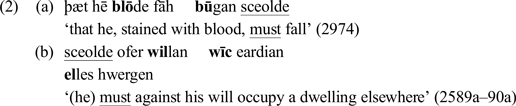
In (2a) the finite auxiliary sceolde is placed after the second stress of the clause. Normal scansion is impossible here unless sceolde bears metrical stress. In (2b) sceolde appears without alliteration before the first alliterating word. Normal scansion is impossible if sceolde bears metrical stress. Campbell (Reference Campbell1959: 35–6) follows Kuhn (Reference Kuhn1933) in his discussion of phrasal stress and represents stressed verbal SPs as ‘delayed’, i.e. moved rightward.
Adpositions are STPs but they scan like the verbal SPs in (2a, b). Normal scansion requires metrical stress on the verse-final adposition in (3a) and absence of metrical stress on the verse-initial adposition in (3b).
(3)
(a) Scede-landum in ‘in South Swedish lands’ (19b)
(b) in Hrefnes Holt ‘in Ravens’ Wood’ (2935a)
Item (3a) is discussed by Campbell (Reference Campbell1959: 36), who formulates a rule for function words not governed by Kuhn's laws: ‘Proclitic words receive a full stress if they are removed from their natural position immediately before the governed word.’ Important generalizations are missed with these assumptions about naturalness and movement. The stressed SPs in (2a) and (3a) appear in typical SOV constructions with weakly accented words placed after their hosts (Dryer Reference Dryer and Shopen2007: 42, 72). In SOV languages, finite auxiliaries normally follow the more prominent main verb, as in (2a). Adpositions are normally postpositions, as in (3a), rather than prepositions, as in (3b). The simplest explanation for the metrical facts is that the verse-final words in (2a) and (3a) retained a late Proto-Germanic phrasal stress that was sufficiently prominent to be interpreted as metrical stress, and that such words lost metrical stress when moved leftward to positions normally occupied by unstressed words.
9 Metrical and linguistic distinctions among finite verbs
As we have seen (section 6), it is difficult to reconcile Kuhn's Laws with alliteration on verbal SPs in locations normally occupied by unstressed SPs. The SPs primarily responsible for the difficulty are finite main verbs of relatively high frequency and correspondingly low prominence, e.g. verbs of motion, cognition and speaking (Russom Reference Russom2017: 119–23). Such verbs have three metrical realizations, as shown in item (4).
(4)
(a) ðā him Hrōþgār gewāt ‘then Hrothgar took himself [outside]’ (662a)
(b) gewāt him hām þonon ‘he took himself home from there’ (1601b)
(c) gewāt þā ofer wǣg-holm ‘(the boat) went then over the billowy sea’ (217a)
The non-alliterating realizations in (4a, b) are like those in (2a, b) and (3a, b). In (4c) the finite main verb is placed like the verb in (4b) but alliterates before an alliterating noun. There is nothing comparable to (4c) with an alliterating auxiliary or ‘be’ verb.
Only five verses in Beowulf have an alliterating auxiliary or ‘be’ verb followed by a word that does not alliterate. Four of these are like (5a, b).
(5)
(a) hyt ne mihte swā ‘it could not (be) that way’ (2091b, cf. 762b, 797b)
(b) hwæt syndon gē ‘what are you?’ (237a)
Given the universal association between alliteration and stress (Kiparsky Reference Kiparsky1973: 231), we would expect the verbs in (5a, b) to be significantly more prominent than the following words; and this expectation is confirmed by the evidence of anacrusis (addition of extrametrical syllables before the first foot in verses of Sievers’ types A and D). As we shall see (sections 14 and 16), anacrusis favors STPs with very low prominence, especially unstressed prefixes. SPs like swā and gē appear occasionally in anacrusis but finite ‘be’ verbs and auxiliaries never do so (Russom Reference Russom2017: 91–2). Alliteration in (5a, b) conforms to Sievers’ rule of precedence, which requires alliteration on a word with significantly greater prominence than any other word in the same verse. This requirement does not apply to verses with a lexical noun modified by a lexical adjective or by another lexical noun, since Sievers (Reference Sievers1893: 41–6) posits approximately equal stress on the constituents in these constructions. With regard to level stress in adjective-noun constructions see Redford (Reference Redford, Fikkert and Jacobs2003: 176–7). Item (6) is similar to (5a, b) but in this case the verbal SP has been separated from its host by interjected constituents.

Interjection has similar effects in Modern English, where it adds perceptible stress, preventing contraction. We can say John's perfectly welcome or John ís, after all, perfectly welcome, but not *John's, after all, perfectly welcome.
In (7a) the finite main verb forgrand alliterates before an alliterating word.
(7)
(a) forgrand gramum ‘(he) ground down the attackers’ (424a)
(b) ðā gebēah cyning ‘then fell the king’ (2980b)
The vast majority of finite main verbs are like forgrand, with lower frequency and higher prominence than gewāt. Low-frequency main verbs appear in verses like (4a) and (4c) but never before the first alliteration in verses like (4b). Even the most prominent finite verbs are less prominent than lexical nouns and adjectives (Campbell Reference Campbell1959: 35–6). When the first alliteration falls on a finite verb, a following noun or adjective normally alliterates also, as in (7a). A few exceptions like (7b) occur under special conditions (Fulk, Bjork & Niles Reference R. D., Bjork and Niles2008: 334).
10 Verb fronting in ancient Indo-European languages
In the Indo-European (IE) languages surveyed by Luraghi (Reference Luraghi, Noonan and Dowling1995: 359), ‘initial verbs tend to some extent to occur in clusters, in cases where a number of subsequent sentences can be singled out as constituting a textual sub-unit. Uniformity in word order highlights the coherence of the sub-unit’. Smith (Reference Smith1971: 64–5, 92) is aware of the IE linking function and discusses fronted verbs that perform the same function in early runic prose. Luraghi's textual sub-units bear some resemblance to the verse clauses posited by Kuhn to explain alliteration on fronted verbs (section 6). Smith and Luraghi represent the linked sentences as discourse units rather than as syntactic constituents, however; and linkage was only one of the functions performed by fronted verbs. Luraghi (Reference Luraghi, Noonan and Dowling1995: 364) adds ‘presentative’ sentences in which fronted verbs highlight a change of topic and subsequent sentences in the discourse unit use a different word order for linkage. Smith (Reference Smith1971: 64) regards verb fronting as normal in early Germanic sentences with ‘heavy emphasis on the verb’. These include questions, imperatives, optatives with imperative force and clauses with dramatic or pathetic force (Smith Reference Smith1971: 92). Given the relation between verb fronting and emphasis, it seems very unlikely indeed that fronted verbs could be metrically unstressed when they alliterated. Like other IE languages, Proto-Germanic must have permitted fronting of verbs with prominent semantic content to a position where stress was maintained or augmented.Footnote 9
Varying alliteration on fronted main verbs like gewāt is predictable from their intermediate prominence. If the available landing sites for these verbs are (i) an alliterating S position suitable for more prominent main verbs or (ii) a non-alliterating x position suitable for less prominent auxiliaries and ‘be’ verbs, neither position is entirely suitable for high-frequency main verbs and neither is entirely unsuitable. We should not be surprised to find that these main verbs can be fronted to either kind of position. It is worth emphasizing that the alliterative evidence in item (4) is entirely independent of the evidence for intermediate linguistic prominence in verbs like gewāt: higher token frequency and lower information content by comparison with other main verbs and, by comparison with ‘be’ verbs or auxiliaries, lower token frequency, higher information content and greater resistance to reduction, contraction or deletion. See Getty (Reference Getty1997: 162–5) on syntactic earmarks of verbs with intermediate prominence.
11 A universalist theory of poetic meter
In Russom (Reference Russom2017) I proposed a universalist theory that derives the rules of a given meter from general principles of verse construction. Although originally formulated to explain rules that have nothing to do with K1, 2, principles P1–9 also do the work of Kuhn's Laws.
-
P1. Metrical constituents are abstracted from constituents of the language in which the meter originates and are realized as those constituents in the unmarked case. Old English meter employs metrical positions abstracted from syllables, feet abstracted from words, verses abstracted from phrases and lines abstracted from sentences.
-
P2. Norms for metrical constituents are abstracted from norms for the corresponding linguistic constituents. These norms are ranked, like the universal tendencies formulated as violable rules in Optimality Theory (Prince & Smolensky Reference Prince and Smolensky2004). When two norms conflict, as for example with P5 and P8, the higher-ranking norm exerts more influence (see Russom Reference Russom and Neidorf2016, Reference Russom2018).
-
P3. Extrametrical positions have no metrical prominence and are normally not occupied by syllables. Constituents of very low prominence are the least unsuitable occupants of extrametrical positions.
-
P4. When two norms conflict in constituents of different size, the norm for the larger constituent ranks higher (Youmans Reference Youmans, Kiparsky and Youmans1989: 376; Russom Reference Russom2017: 58).
-
P5. Long and heavy metrical constituents are normally placed toward the end of a larger metrical constituent. This is called winnowing in Finnish alliterative verse (Leino Reference Leino1986: 133–4).
-
P6. Departure from metrical norms causes metrical complexity.
-
P7. A competent poet normally exploits opportunities to reduce metrical complexity, restricting the frequency of complex metrical constituents.
-
P8. Metrical complexity inhibits the placement of a metrical constituent toward the end of a larger metrical constituent (the principle of closure).
-
P9. Metrical complexity is additive. Each departure from a norm adds to complexity. Two lower-ranking norms can exert more influence than a single higher-ranking norm.
Like the violable rules of Optimality Theory, Principles P1–9 usually permit departure from norms, but some norms of very high rank never come into conflict with higher-ranking norms and apply categorically. In Germanic meters norms for alliterative line patterns outrank all other line-level norms. Since conflict can take place between norms for the same constituent as well as between norms for different constituents, it does not follow from principle P4 that the line will stay closer to all of its norms than the verse. Consider the most conspicuous formulaic technique in Beowulf: employment of modified constituents where no modifier would be used in ordinary speech. Semantically inessential modifiers provide the obligatory alliteration, allowing for use of their modified constituents in grammatical constructions that the poet wants to use (Fulk, Bjork & Niles Reference R. D., Bjork and Niles2008: cxii-iv; Russom Reference Russom2010: 71–4). These modifiers make it easier to construct two-word verses but they tend to expand the clause beyond its ideal size of a single line. Lines accordingly depart from ideal syntactic realization more often than verses do, but the line-level syntactic norm is overridden by the line-level alliterative norm, not by the verse-level syntactic norm.
12 The SPMR as a metrical constraint
Old English meter has strict constraints on enjambment, a kind of complexity resulting from mismatch between verse boundaries and phrase boundaries. A verse is optimally realized as a small phrase with no extraneous words, in accord with P1, 2. Since SPs are not constituents of small phrases, they are often extraneous at verse level. Consider items (1a, b), repeated here as (8a, b).
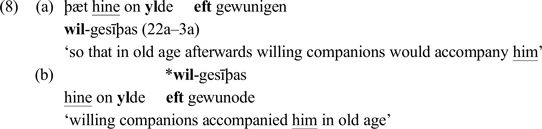
The second verse in (8b) is not a natural syntactic constituent. The pronoun SP hine has a closer syntactic relation to gewunode in the third verse than to on ylde in the second verse. If the verse clause is a metrical domain, leftward movement of SPs like hine is explained by general principles of verse construction. By P1, P2 and P6, syntactic complexity will correspond to metrical complexity in metrical constituents abstracted from syntactic constituents. By P7, the poet will exploit opportunities to avoid syntactic complexity in these metrical constituents. By P8, unavoidable syntactic complexity will be concentrated toward the beginning of a larger metrical constituent.Footnote 10 Within the line, P8 strongly promotes concentration of metrical complexity in the a-verse (Russom Reference Russom2018: 13–15). By P4, P8 will exert even stronger influence within a verse clause that extends beyond a line. SPs that cause metrical complexity will be concentrated in the b-verse if it is the first verse of the clause.
13 Line patterns and typological sentence patterns
If alliterative lines were abstracted from SOV sentences in late Proto-Germanic, SOV order should be reflected in line patterns. This turns out to be the case. The least prominent constituent in a typologist's SOV, SVO or VSO sentence is the finite verb. In such sentences the verb is subordinated to an adjacent stressed argument (Gussenhoven Reference Gussenhoven and Roca1992; Truckenbrot Reference Truckenbrodt and Brown2006). The subordinate verb in an SOV sentence corresponds to a subordinate metrical position in the b-verse, a position on which alliteration is ruled out in all the cognate Germanic meters. Moreover, one of the most influential norms in Beowulf is placement of the finite verb at the end of the line, the metrical equivalent of the end of the sentence (Russom Reference Russom2018: 10–11).
As a representative sentence from the oldest runic inscriptions, Antonsen (Reference Antonsen2002: 75) cites the earliest surviving line of alliterative verse, dated c. 300 CE.Footnote 11
(9) ek hlewagastiz holtijaz horna tawido
‘I, Hlewagast, descendant of Holt, made the horn’
The principles of line construction are already observed in (9), which has SOV order. The a-verse is a subject noun phrase with two prominent alliterating nouns in apposition to a pronoun. The b-verse is a verb phrase with an alliterating object followed by a less prominent finite verb that does not alliterate. Neither verse contains a syntactically extraneous constituent. The b-verse realizes each foot as a word, in accord with P1. The a-verse has an extrametrical pronoun ek, which stands in anacrusis before the first foot. In accord with the principle of closure (P8), the complexity caused by anacrusis occurs in the a-verse.
The Beowulf poet adheres to SOV syntax at clause level with remarkable consistency when there are no adverse metrical consequences. Verbs are fronted primarily where fronting is expected in SOV languages. In small phrases the poet adheres less consistently to SOV constructions that were obsolescent in Old English, e.g. postpositional phrases. These syntactic archaisms have important metrical functions in Beowulf, as shown in section 17, but they have lower frequency than the corresponding innovative constructions. In accord with standard typological practice, I define clause-initial and clause-final positions by reference to the order of major sentence constituents, excluding irrelevant constituents like vocatives and appositives (cf. Smith Reference Smith1971: v-vii). The subject is clause-initial in Jack, you're a rat! and the verb is clause-final in constructions like Jack snitched, the rat!
14 Freedom of patterning and constraints on mismatch
To assess the role of SOV syntax we need a closer look at Old English metrical constituents. A metrical ‘S’ position is abstracted from syllables with primary word stress, an ‘s’ position from syllables with subordinate word stress and an ‘x’ position from unstressed syllables. Every Old English word has a corresponding metrical foot, except for large compounds that fill two feet. The nine permissible foot patterns correspond to words like mid ‘with’ (x), ofter ‘over’ (xx), hār ‘old’ (S), rincas ‘men’ (Sx), tryddode ‘trod’ (Sxx), swāt-fāh ‘blood-stained’ (Ss), won-sǣlig ‘ill-fated’ (Ssx), hilde-rinc ‘fighting man’ (Sxs) and sibbe-ge-driht ‘band of friends’ (Sxxs). The normative foot has the most common word pattern, the trochaic Sx pattern of rincas. The normative verse is a two-word phrase consisting of two normative feet, notated Sx/Sx. Such two-word phrases have remarkably higher frequency in poetry than in prose (Russom Reference Russom and Neidorf2016: 95–7). Extrametrical unstressed constituents can appear before the first or second foot. In accord with P3, these constituents are normally unstressed prefixes, the Germanic STPs most vulnerable to loss, as shown by massive loss of unstressed prefixes in Old Norse (Kuhn Reference Kuhn1929; Russom Reference Russom1998: 13–14, 49–50).
Iambic pentameter has a single foot pattern (xS) and a single line pattern (xS/xS/xS/xS/xS). Since the underlying metrical pattern is predictable, poets can depart rather far from it to provide metrical variety. In alliterative meter, adequate variety is provided by the many permissible foot patterns and verse patterns. This freedom of patterning imposes compensatory restrictions on departure from patterns. The Beowulf poet adheres to principles OE1–5, which apply less strictly or not at all in iambic pentameter.
-
E1. Avoid confusion between large foot patterns and small verse patterns.
-
E2. Avoid confusion between extrametrical syllables and light feet.
-
E3. Avoid confusion about the location of foot, verse and line boundaries.
-
E4. When feet are realized as word groups, restrict departure from the morphological structure of the foot. Application of this principle is especially strict when the foot pattern corresponds to an unusual word pattern.
-
E5. Restrict departure from norms established by the unmarked realization of the verse (two-word Sx/Sx).
The relation between feet and words stands out with particular clarity in feet abstracted from compounds like hilde-rinc (Sxs) and sibbe-gedriht (Sxxs). These feet are severely restricted by OE4 because they have the least common compound patterns. Most Old English compounds end with an unstressed inflection and have no unstressed syllables internally. Only two kinds of unstressed syllables occur inside Old English compounds: infixed prefixes like -ge- in sibbe-gedriht and syllables like -e- in hilde-rinc. In the vast majority of word groups occupying an Sxs or Sxxs foot, x positions are filled by an unstressed prefix or a final syllable of the first constituent (Russom Reference Russom2017: 75–80). These x positions are filled occasionally by an STP conjunction or adverb, but are filled by an SP only three times in Beowulf (verses 272b, 455b and 525a).
15 Placement of the verb in Beowulf
Items (10a, b) have the most common type B and C patterns, with a light foot followed by a compound foot. The compound foot in type C has the Ssx pattern of won-sǣlig. In type B the compound foot has the Sxs pattern of hilde-rinc or the Sxxs pattern of sibbe-gedriht. The boundary between feet is notated with a slash in numbered examples and in notations for verse patterns. The examples in (10a–d) are complete one-verse clauses. A parenthesized ‘x’ indicates that one or more extrametrical constituents have been added to complete the clause.

Among 313 one-verse clauses like (10a–d) in Beowulf, 299 end with a finite verb as in (10a, b). There are only 14 instances of verb-fronting and all have metrical explanations. A change to SOV syntax would have adverse metrical consequences in (10c, d) and in two similar instances (740a and 1218b). There are no clear cases in Beowulf of a verse like *ðū be þon þē lǣr or *ond fore nō mearn (Fulk, Bjork & Niles Reference R. D., Bjork and Niles2008: 330). It is worth adding that in 1218b and (10c) the fronted verb is imperative and stands in its normal SOV location.
Final placement of the verb would cause a different metrical problem in seven b-verses like (11a) with a stressed SP adverb in final position

The SP adverb would be unstressed in (11b), the corresponding SOV construction, classified by Sievers as type A3.Footnote 12 With its single stress, type A3 represents an extreme departure from the norm of two syllables with primary word stress and is severely restricted by the principle of closure (P8). In Beowulf, P8 restricts all 295 instances of type A3 to the a-verse. The type A3 pattern in (11b) is not a permissible alternative for b-verses like (11a). Things are different in the a-verse.
(12)
(a) hī hyne þā æt- / bǣron ‘They carried him then’ (28a)
(b) þæs ne / wēndon ǣr ‘They did not expect that before’ (778a)
Item (12a), with adverbial þā before the verb, is one of eight a-verses with verb-final word order.Footnote 13 Item (12b) is the only comparable a-verse with the adverb in final position. Where type A3 is permissible, the usual preference for SOV syntax prevails. The type B pattern of (12b) has much higher frequency than the A3 pattern of (12a). The poet will employ a more complex pattern to place the verb in final position.
The poet rarely resorts to VS or VO order simply to obtain the required alliteration. This occurs in only three one-verse clauses, two of which are identical.
(13)
(a) þonne / hniton fēþan ‘when foot-troops clashed together’ (1327b, 2544b)
(b) þæt ge- / bearh fēore ‘it (a mail-coat) protected life’ (1548b)
Here a lexical noun without alliteration follows an alliterating finite verb. Verse-final placement of the alliterating verb would create an anomalous type B verse lacking alliteration on the first metrical stress. A handful of such anomalies in Beowulf are emended out by editors (Fulk, Bjork & Niles Reference R. D., Bjork and Niles2008: 330–1).
Normative two-word realizations of type A1 provide a unique opportunity for study of unmarked word order. There is a rich sample of 244 normative realizations with a finite verb, including 85 instances with a finite auxiliary and 11 with a finite ‘be’ verb. These natural constituents of two stressed words are easily analyzed and the pattern Sx/Sx is unchanged when the order of feet is reversed.
(14)
(a) bēagas / dǣlde ‘(he) distributed rings’ (80b)
(b) hēolde / lange ‘(he) had (it) for a long time’ (2344b; cf. 1728b, 2008a)
Of the 244 total instances, 241 have grammatical structures characteristic of SOV languages, with the finite verb at the end, as in (14a). In the three remaining instances like (14b), verb-final order would create an otherwise unattested realization of type A3 (Russom Reference Russom1998: 50). In 2008a the fronted verb is imperative.
16 Metrical reasons for SP placement within the verse
Kuhn misses important generalizations by ignoring differences among verse types and focusing on the first two stresses of the clause (cf. Russom Reference Russom1998: 54–63). In types A3 and C the only location for an unstressed SP is before the first stress. In type B this location is vastly preferable because an SP after the first stress creates a rare mismatch in an Sxs or Sxxs foot (section 14), whereas an SP before the first stress avoids confusion between the light foot and anacrusis, in accord with OE2. In the remaining verse types the location before the first stress is the extrametrical anacrusis position, which is not normally filled. In a given verse, SPs appear in just one location, as K1 requires, but only because alternative locations are metrically unsuitable or nonexistent. An STP is usually accompanied by an SP before the first stress, as K2 requires, but that would be expected for other reasons. SPs outnumber the ideal locations for them before the first stress and there are fewer STPs than SPs (Mines Reference Mines2002: 350–2, 354–5). In types A3, B and C we would not expect to find many STPs in locations unoccupied by SPs. Exceptions to K2 in these types, though relatively few, have special weight.Footnote 14 In the remaining types the verse-initial anacrusis position, when filled at all, is normally occupied by an unaccompanied prefix that violates K2.
17 SOV as the unmarked word order in Beowulf
In verses with subject and object pronouns before the first stress, the order of pronouns is not governed by metrical constraints or by Kuhn's Laws and the unmarked word order can emerge. Beowulf contains 41 verses with a subject pronoun, a direct object pronoun and a finite verb. All 41 have SOV order, like (15a).Footnote 15
(15)
(a) ic ēow / wīsige ‘I (will) guide you’ (292b)
(b) syðþan hē hine tō / gūðe ge- / gyred hæfde
‘after he had prepared himself for combat’ (1472)
An additional 16 verses have pronoun subjects and accusative pronoun objects, with the finite verb in a later verse. In all 16 the subject stands before the object, as in (15b).Footnote 16
OS order does occur in verses with a stressed verse-initial subject. There are 36 instances like (16a–f), where a direct object pronoun stands before a stressed subject that provides the mandatory alliteration. Items (16d–e) are followed by a finite verb in a later verse.

A change to SOV order in (16a–f) would create unnecessarily complex or impermissible departures from norms in sections 11 and 14. Item (17) provides an example for each unacceptable departure and the number of instances that would result in Beowulf.
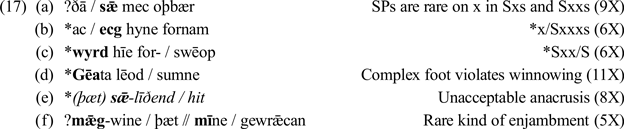
If changed to SOV order, (16a) and eight other instances would have an SP on an internal x in an Sxs or Sxxs foot, as in (17a).Footnote 17 As we have observed (section 14), this occurs only three times in Beowulf. Six instances like (16b) would have a compound foot with more than two internal x positions, as in (17b).Footnote 18 Since there are no Old English compounds with such patterns, verses like (17b) are ruled out by P1. Six instances like (16c) would have patterns with initial and final S positions separated by x positions, as in (17c).Footnote 19 These patterns violate OE1, which excludes verse patterns that could be confused with foot patterns. Item (17c) would look too much like an Sxxs foot (Russom Reference Russom1987: 26–7). Editors regard the pattern of (17c) as vanishingly rare if not unmetrical (Fulk, Bjork & Niles Reference R. D., Bjork and Niles2008: 332). For verses like (16d) the equivalent SOV alternatives would be like (17d), which has more than the usual number of stresses and also violates the winnowing constraint, creating unacceptable additive complexity.Footnote 20 An alternative analysis with the acceptable pattern Sx/Ssx is unavailable for (17d) because the internal foot boundary of the verse must coincide with the major syntactic break (Russom Reference Russom1987: 84–6). This constraint avoids confusion about the location of the verse-internal foot boundary, in accord with OE3. Eight verses like (16e) would have an unacceptable form of anacrusis, like (17e).Footnote 21 The remaining five verses like (16f) would have a rare kind of enjambment, as in (17f), where a verse-final object pronoun is split from its governing verb by the caesura.Footnote 22 The only comparable instance in Beowulf is 955b.
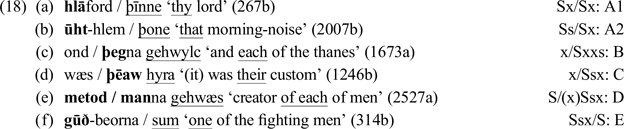
Although SVO syntax predominates in the Beowulf poet's small phrases, small SOV phrases are still used to avoid enjambment between a verse-final STP and a noun host at the beginning of the next verse. When STPs like quantifiers, possessive adjectives and possessive pronouns stand in verse-final position, the noun host normally precedes them in an SOV construction, avoiding enjambment. Item (18) provides examples of these archaic constructions in several verse types.
18 Conclusions
A theory that abstracts metrical constituents from linguistic constituents provides convenient metrical evidence for linguistic research. Such a theory makes it possible to explain constraints observed by Kuhn (Reference Kuhn1933) and Sievers (Reference Sievers1893) with the same set of universal principles. It then becomes clear that departures from verb-final placement in Beowulf have purely metrical explanations and provide no evidence for a Proto-Germanic ancestor with verb-second order, free word order or an order based on sentence rhythm. Beowulf represents a stage in the evolution of English at which SVO constructions had become predominant in small phrases but an SOV order inherited from Proto-Germanic was still predominant at clause level.


 Open access

