


Advanced economies have undergone profound economic and political transformations over recent decades, driven in large part by the reorganization of global production. One prominent manifestation of this shift is the rise of China as a manufacturing powerhouse. A large literature links the resulting “China shock” to the decline of manufacturing and middle-skill jobs, with highly uneven consequences across workers and regions, including persistent unemployment, reduced labor force participation, and wage losses in affected localities.Footnote 1 Scholars in international political economy (IPE) have connected these economic disruptions to major political shifts, including declining support for incumbent parties and the rise of far-right and populist movements.Footnote 2
While this literature provides clear evidence that trade shocks reshape aggregate political behavior, key questions remain about the mechanisms through which international economic change translates into domestic political conflict.Footnote 3 In particular, existing work has focused primarily on aggregate local exposure to trade shocks, offering limited insight into how racially distinct economic disruptions generate racialized political responses rather than generalized discontent. Although scholars debate the relative roles of material interests and non-material factors such as identity, culture, and status threat, how these processes operate through group-based inequalities within local labor markets remains less well understood.
This gap is especially consequential in the United States, where race constitutes a foundational axis of economic stratification and political conflict. Racial inequalities in employment, job quality, and exposure to risk, rooted in the legacy of slavery and enduring patterns of discrimination, systematically position racial groups differently within local economies. As a result, economic shocks are unlikely to affect racial groups uniformly. Yet in IPE, scholars frequently rely on a white/nonwhite binary, which bundles together heterogeneous experiences and potential cleavages. As a result, observed effects may reflect mechanisms related to nativism, anti-immigration sentiment, or concerns about demographic change, leaving unanswered how international economic shocks reshape racial relations when these alternative channels are held constant.
We argue that trade shocks partially operate through a fundamentally relational mechanism that has been underexplored in the literature. Due to enduring patterns of occupational and industrial segregation,Footnote 4 international trade shocks are not experienced uniformly within local labor markets, a point highlighted and demonstrated in recent work in labor economics.Footnote 5 White workers were also less geographically mobile than other groups, contributing to their persistence in economically declining communities.Footnote 6 As a result, trade shocks frequently altered not only aggregate economic conditions, but also the relative economic standing of racial groups within the same local labor markets, thus reshaping local group hierarchies rather than solely producing uniform economic distress.
Building on group position theory,Footnote 7 we argue that relative exposure to international economic shocks is a central mechanism linking globalization to racial animus and associated political behavior. Specifically, we examine how differences in exposure to the China shock between white and Black workers in the same local labor market shape anti-Black racial animus and presidential voting outcomes. Thus our argument is distinct from those that condition on demographic characteristics of the community.Footnote 8 We focus on the Black–white racial hierarchy because it is the most durable and politically salient axis of group competition in American politics.Footnote 9 Theoretically and empirically, emphasis on the Black–white comparison isolates economic group position. In this context, international economic shocks intervene in long-standing racial relations by altering relative economic standing within local communities, largely apart from anti-immigrant sentiment or concerns about demographic change.
Empirically, the rise of China in the global economy generates plausibly exogenous variation in local US labor market conditions. Beginning in 2000, imports from China increased sharply following the normalization of trade relations and China’s entry into the World Trade Organization in 2001. Local exposure was largely determined by pre-existing industrial composition and racial employment patterns established well before the surge in Chinese imports.Footnote 10 We construct race-specific measures of local import exposure and use them to capture relative exposure between white and Black workers (namely, the gap). We examine multiple indicators of anti-Black racial animus—including implicit bias and feeling thermometers from the Harvard Implicit Association Test, anti-Black hate crimes, and the presence of hate groups—and finally, two-party presidential vote share from 2000 to 2020.
Across multiple data sets and outcomes, we find that a larger white–Black gap in import exposure is associated with greater anti-Black racial animus and a shift away from the Democratic Party toward Republican presidential candidates. Importantly, these effects are driven by relative exposure across racial groups; once this gap is accounted for, the effect of standard import exposure often becomes statistically insignificant. This pattern indicates that the political consequences of the China shock cannot be understood solely as a response to generalized economic hardship, but instead reflect the racialized distribution of economic decline within local labor markets.
This article contributes to the IPE field in several key ways. First, we show how international economic shocks reshape domestic social hierarchies rather than solely generating aggregate political backlash. By conceptualizing status threat as a relational, group-based mechanism rooted in relative economic exposure and relative economic effects, we provide a micro-foundation for linking globalization to racialized political outcomes. Second, and more broadly, our findings suggest that the domestic political consequences of global economic integration depend not (only) on the magnitude of economic disruption, but on how economic losses are distributed across entrenched social groups within local labor markets. In particular, we show that relative distribution of trade-induced losses—rather than overall exposure or racially heterogeneous average effects—drives political outcomes through materially grounded mechanisms. Accordingly, our goal is not to wholly explain support for trade protectionism or for a particular candidate, but to isolate a mechanism through which international economic shocks generate racial animus among dominant groups and shape electoral outcomes. In doing so, we bridge debates in IPE and American politics by demonstrating how global economic transformations intersect with durable domestic hierarchies to produce racialized political conflict.
Global Economic Shocks and Domestic Political Conflict
A large literature in IPE documents the domestic economic and political consequences of exposure to international trade. This body of work has firmly established that international economic shocks have politically consequential distributional effects at the local level.Footnote 11 However, much of the literature measures exposure regionally, implicitly treating exposure within local labor markets as homogeneous. As a result, existing accounts primarily explain where political backlash to globalization emerges, while offering more limited insight into how global economic change is translated into individual attitudes and behaviors within local communities.
Against this backdrop, a central debate in the IPE literature concerns the mechanisms linking economic shocks to political outcomes. One strand of research emphasizes material economic interests, arguing that individuals respond politically to trade-induced changes in employment, wages, and economic security.Footnote 12 From this perspective, the globalization backlash reflects rational responses to economic losses and heightened demand for protection or redistribution. A competing perspective highlights non-material channels, including identity, culture, sociotropic considerations, and perceived threat, which may be activated by economic change even among individuals who are not directly harmed.Footnote 13 Within this tradition, research on status threat has been especially influential, emphasizing how economic shocks can challenge existing social hierarchies and provoke political backlash rooted in identity concerns rather than material deprivation.Footnote 14
Despite substantial progress, disentangling material and non-material mechanisms remains difficult. Economic shocks may influence behavior through direct material effects, through changes in values and beliefs, or both mechanisms operating simultaneously.Footnote 15 Empirical strategies, especially those based on survey data, face significant methodological challenges.Footnote 16 Recent syntheses emphasize the need to better connect geographically uneven economic change to individual-level political attitudes and behavior, identifying this as a key research frontier in IPE.Footnote 17
With these considerations in mind, recent work at the regional level shows that economic disruptions can produce racially differentiated voting responses. For example, Baccini and Weymouth find that manufacturing layoffs among white workers are associated with declining Democratic vote share, whereas layoffs among nonwhite workers are associated with increased Democratic support.Footnote 18 In a similar vein, Freund estimates an interaction model and finds that manufacturing decline is linked to increased Republican vote share in predominantly white counties, but increased Democratic support in more racially diverse counties.Footnote 19 Finally, work at the individual level documents racial heterogeneity in trade preferences.Footnote 20
These patterns are commonly interpreted as consistent with racial status threat among white voters seeking to preserve an existing racial hierarchy. However, in most accounts, status threat is invoked largely in broad or implicit terms. Existing work does not clearly specify the relevant comparison group, nor does it identify the mechanism through which economic loss becomes politically racialized. For instance, Baccini and Weymouth offer white status threat as a mechanism to explain why layoffs affecting white manufacturing workers lead to greater support for Republican presidential candidates, though they do not directly offer evidence of this.Footnote 21 As a result, it remains unclear when and why international economic shocks generate racialized political responses. Moreover, existing accounts focused on white versus nonwhite may conflate domestic racial dynamics with immigration-related processes—such as xenophobia, nativism, or concerns about demographic change—making it difficult to isolate the role of race itself in shaping responses to global economic shocks.
Taken together, this literature leaves open a central question for IPE: how do international economic shocks reshape domestic social hierarchies, and under what conditions do these changes translate into racial animus and related electoral outcomes? Addressing this question requires moving beyond aggregate measures of exposure and specifying how the distributional effects of globalization operate across entrenched group boundaries within local labor markets.
Theory
Our theory provides insight into how and when a local labor market shock influences racial attitudes and voting. We argue that disparities in labor market shocks that disproportionately negatively affect the dominant racial group will intensify racial animus and influence voting behavior, with an emphasis on material changes in group position. Specifically, we consider how the relative exposure of white workers compared to Black workers drives these effects. We focus on this both because of the importance and salience of white–Black relations in US politics, and because this emphasis allows us to isolate our proposed theoretical channel of economic group position. As we discuss further in a later section, our proposed theoretical channel of relative exposure may be active in comparisons between other dominant and nondominant groups (for example, native versus foreign-born), but other mechanisms may also operate simultaneously in those cases.
Relative Economic Shocks
Our argument emphasizes how labor market shocks affect groups in relative rather than absolute terms. While the mechanism we identify potentially applies to a range of economic disruptions (for example, including import competition, automation, and deindustrialization), we focus on the China import shock as a paradigmatic international economic shock. The China shock provides a particularly compelling case because it constitutes a large, externally driven transformation whose local impacts were shaped by pre-existing industrial and occupational structures. We define absolute exposure following standard measures of exposure to local import competition from China, and relative exposure as the difference in exposure between racial groups within the same local labor market.
We present a stylized example in Table 1 to illustrate how our concept of relative shock differs from an absolute (that is, overall) shock. In this example, exposure to shocks between groups varies across two labor markets, A and B, and two sectors, textiles and services. Suppose textiles face a 40 percent increase in imports from China while services are unaffected. For each group, exposure to the shock is equal to the sum of the change in imports in each industry, weighted by the share of workers in the group in the labor market. Thus in Labor Market A, prior to the shock, 10 percent of Black workers are employed in textiles and 90 percent in services, while 60 percent of white workers are employed in textiles and 40 percent in services. The level of exposure for Black workers in Labor Market A is 0.04 ( $=10*.4+90*0$
) and for white workers is 0.24 (
$=10*.4+90*0$
) and for white workers is 0.24 ( $=60*.4+40*0$
). Thus white workers are more exposed to the negative shock relative to Black workers. In Labor Market B, where white and Black workers are employed in textiles and services at the same rate, there is no difference in the level of exposure between groups. Thus in absolute terms, white workers experience the same shock in both markets, but they are relatively more exposed in Labor Market A as a result of the shock.Footnote
22
$=60*.4+40*0$
). Thus white workers are more exposed to the negative shock relative to Black workers. In Labor Market B, where white and Black workers are employed in textiles and services at the same rate, there is no difference in the level of exposure between groups. Thus in absolute terms, white workers experience the same shock in both markets, but they are relatively more exposed in Labor Market A as a result of the shock.Footnote
22
Numerical example of relative import shock

Table 1 Long description
The table presents a stylized example illustrating how relative shock exposure differs from absolute shock exposure. It compares two labor markets, A and B, and two sectors, textiles and services. In Labor Market A, 10 percent of Black workers are employed in textiles and 90 percent in services, while 60 percent of White workers are employed in textiles and 40 percent in services. The exposure level for Black workers in Labor Market A is 0.04, calculated as 10 percent of 0.4 plus 90 percent of 0, and for White workers, it is 0.24, calculated as 60 percent of 0.4 plus 40 percent of 0. In Labor Market B, both Black and White workers are employed in textiles and services at the same rate, resulting in no difference in exposure levels between the groups. This indicates that while White workers experience the same absolute shock in both markets, they are relatively more exposed in Labor Market A due to the shock.
Relative Shocks and Racial Animus
Drawing on group position theory, we develop predictions about how racial attitudes vary across local labor markets experiencing different relative economic shocks. The primary insight from group position theory is that the racial animus of a historically dominant group is generated or exacerbated by the perception that another group is challenging their status or resources.Footnote 23 Although challenges could stem from social, political, or economic changes,Footnote 24 we focus on the economic channel. We argue that real—but relative—economic change triggers a threat to the dominant group position. Group position theory provides a framework for integrating symbolic or perceived threat with group-based economic interests. In this way, it is distinct from other theories emphasizing economic factors, including realistic group conflict theory or individual-level material self-interest (for example, the left-behind thesis).Footnote 25
Specifically, we posit that a racial gap in import exposure, where white workers are more exposed to an import shock than Black workers, leads to an increase in expressions of anti-Black racism. While others have posited a link between relative economic decline and status threat, we address this explicitly in both our theory and empirical analysis. If, as we argue, group status threat is a relevant mechanism, we should observe a relationship between racial disparities in economic shocks that harm the dominant group and in expressions of racial animus and related political behavior.
Thus we hypothesize that when white workers are disproportionately exposed to the China shock relative to Black workers in the same labor market, expressions of anti-Black racism will be exacerbated. We specifically focus on animus as the concept of interest, rather than racial resentment, because the latter may include both prejudice and deservingness. This distinction is important to our theory because white citizens who do not feel their group’s status is threatened may still oppose welfare programs that benefit poor Black Americans, not due to status threat, but because they view the group as undeserving.Footnote 26 Relatedly, recent work highlights how the commonly used racial resentment measures conflates prejudicial attitudes with moral conservatism and policy preferences.Footnote 27
Relative Shocks and Voting
We next examine variation in presidential voting outcomes as a function of the racial gap in local import exposure. Although partisan preference is not inherently linked to racial attitudes or perceived group position threat, it can become linked through salient political events and the rhetoric and position taking of political entrepreneurs. In this account, shifts in presidential voting reflect a political expression of group-based threat activated by relative economic shocks.
Political entrepreneurs can activate feelings of threatFootnote 28 and embolden those with prejudices to act in line with those beliefs.Footnote 29 The election of President Obama posed a threat to whites’ group position.Footnote 30 Politicians like Trump invoked racial rhetoric to gather political support,Footnote 31 accelerating the rightward shift in the Republican Party.Footnote 32 Notably, scholars have documented an increase in white identityFootnote 33 and a growing link between racial attitudes, preferences on nonracial policies, and views of the presidency during the Obama administration.Footnote 34 See Stephens for a review of research on how the Obama presidency generated a threat to the dominance of white Americans.Footnote 35
In the US context, racial attitudes are a significant predictor of policy and political preferences.Footnote 36 These racialized perceptions influence voting patterns due to the ability of political entrepreneurs to take advantage of concerns around the relative position of the group.Footnote 37 Further, white voters perceiving a threat due to relative economic decline will be more likely to support parties and politicians that are expected to implement policies that preserve the racial hierarchy and status quo.Footnote 38
Overall, we anticipate that a greater relative threat to white workers will decrease (increase) the Democratic (Republican) Party vote share. Importantly, we do not conceptualize these electoral outcomes as independent of racial animus or mediated by animus, but rather as one domain through which group-based threat is politically expressed. In other words, changes in relative economic outcomes are the mechanism linking exposure to animus-related outcomes. An additional implication of the shift in the rhetoric and policy positions of the Democratic and Republican parties over time is that the link between relative import exposure and perceived group position threat may not be constant over time. Rather, we expect that relative import shocks became more closely tied to partisan preferences through elite rhetoric and position taking during the Obama administration and beyond.
Thus our expectations differ from previous work in two key ways. First, the standard story about a local negative economic shock anticipates effects on attitudes and voting in both labor markets that experience that same level of overall shock. Second, our prediction differs from the intuition of Baccini and Weymouth,Footnote 39 whose theory would anticipate similar levels of white status threat in both A and B, because the level of exposure of white workers is similar, whereas we expect to find it only in Labor Market A.
Additional Considerations
In this section, we discuss implicit assumptions of our theory and how our theory relates to potential alternatives raised in the literature.
Our theory assumes that white people are aware of the local gap in exposure between white and Black workers. There are several channels through which this awareness can occur. Familiarity and embeddedness in the local labor market (and/or community) can generate awareness of the nature of exposure to negative shocks and any potential gap in exposure by group.Footnote 40 Individuals may learn about the gap from the media or political elites. Although we do not have direct evidence that citizens perceive racial gaps in exposure to import competition at the local level, existing research suggests that individuals respond to local political and economic conditions, including along racial lines. With respect to trade, voters in soybean-producing areas punished Republicans in the 2018 election for the US–China trade war.Footnote 41 In American politics, research suggests that citizens accurately perceive local inequality,Footnote 42 and that inequality increases support for redistributive policies only when economic disadvantage is not concentrated among Black residents.Footnote 43 If white workers do not perceive relative economic decline even where it exists for whatever reason, then we are unlikely to observe the hypothesized effects.
One might also wonder about the potential symmetry of our hypothesized effects. One form of symmetry is across groups. Group position theories speak to the attitudes and behaviors of members of the dominant group during periods of perceived threat. Thus our argument does not offer predictions about how members of the nondominant group will respond to economic shocks in relative or absolute terms. Further, we focus on a threat environment where the dominant group is perceived as becoming worse off relative to the nondominant group. It is not necessarily the case that a scenario where white workers might benefit disproportionately from a positive economic shock will have the opposite political effects.Footnote 44 Another form of symmetry relates to whether positive shocks have the reverse effect of negative shocks. Imagine that one commuting zone starts with a small or nonexistent exposure gap that narrows further over time, while another starts from the same level but experiences a growing gap that generates perceived threat. We do not expect these scenarios to be mirror images of each other because, where the threat was never perceived to begin with, reductions in the gap are unlikely to produce meaningful political change. Perception of threat likely requires that the gap in differential exposure to negative labor market outcomes crosses some unmeasurable threshold—below which economic change is not experienced as status loss. That being said, when the perceived group threat due to a high gap in exposure to import competition declines from a previously high level, we might imagine a return to lower levels of animus in our outcome measures.
Turning to alternative explanations, we consider several factors, recognizing that electoral outcomes in particular are the product of multiple, overlapping determinants. Prior research shows that commuting zones more exposed to Chinese import competition experienced increased conservative media consumption, ideological polarization, and Republican vote share—particularly in majority white districts.Footnote 45 Similarly, white voters in NAFTA-exposed areas were more likely to shift away from Democratic candidates.Footnote 46 These findings raise the possibility that our results reflect the overall magnitude of local trade exposure rather than racially differentiated effects. Accordingly, we account for absolute exposure to the China shock in all empirical models, allowing us to assess whether racial differences in exposure—beyond the size of the shock itself—help explain observed political outcomes.
Relatedly, one might be concerned that aggregate shifts in political attitudes reflect changes in the racial composition of communities rather than attitudinal change among existing residents. For example, research suggests that trade-exposed commuting zones have seen full employment recovery, but this is largely due to an influx of young adults and foreign-born immigrants entering non-manufacturing sectors. In contrast, displaced manufacturing workers (disproportionately white) tended to remain in place, experienced persistent earnings losses, and rarely transitioned to new industries.Footnote 47 Political shifts in such contexts could therefore arise from demographic replacement rather than changes in attitudes among incumbent residents.Footnote 48 To address this concern, we examine whether relative exposure is associated with changes in local racial composition in Table A13, including shifts in the white population share. This allows us to better distinguish between demographic change and attitudinal responses among existing residents. In addition, all models control for the percent foreign-born and the percent Black population.
Finally, our theory focuses on exposure by industry and race group. However, industries contain a range of occupations that vary in their exposure to trade competition and the ability of workers in those occupations to adjust to it.Footnote 49 For example, the manufacturing industry includes both highly specific, less mobile production jobs and more mobile roles in management or low-skill services.Footnote 50 To the extent that racial occupational segregation may place white workers in more trade-exposed, middle-skill jobs and Black workers in lower-skill but less exposed roles, we may underestimate the effects of white workers’ relative exposure to trade competition.
Data, Measurement, and Empirical Approach
For causal identification, we leverage the “China shock”: the rise in Chinese exports in the 2000s, which disproportionately affected some manufacturing industries. As a result, only local economies specialized in these industries at the start of the period experienced substantial impacts. The standard measure of local exposure is the interaction of initial industrial composition with national, year-by-industry changes in imports from China. This approach generates variation that is exogenous to localized year-to-year economic, demographic, or political changes, conditional on controls and fixed effects described in what follows.
Measurement of Relative Import Shocks
We follow the standard empirical approach in the China shock literature in several respects. First, we capture changes in outcomes in year y relative to the base year 2000, which precedes the sharp rise in Chinese exports.Footnote 51 Second, we focus on commuting zones (CZs), which group counties based on labor market integration and cover the entire United States.
Our main innovation is to construct race-specific measures of localized import exposure. While Kahn and colleagues document group-specific impacts of exposure on labor market outcomes,Footnote 52 we focus on relative import exposure, which we define as white import exposure–black import exposure.
To calculate these measures, we combine two key data sources. First, we obtain annual industry-level imports from China to the United States reported by the Census Bureau, which provides the dollar value of imports by year and industry.Footnote
53
We compute the change in imports relative to 2000 as: $\Delta M_{tk} = (M_{tk} - M_{2000k})/M_{2000k}$
, where
$\Delta M_{tk} = (M_{tk} - M_{2000k})/M_{2000k}$
, where $M_{tk}$
is the dollar value of imports to the United States from China in industry k and year t. Although this trade data are available at a relatively disaggregated level, to merge these data with our other data, we follow the industry coding of Autor to aggregate to eighty industry codes corresponding to those reported in the Census.Footnote
54
$M_{tk}$
is the dollar value of imports to the United States from China in industry k and year t. Although this trade data are available at a relatively disaggregated level, to merge these data with our other data, we follow the industry coding of Autor to aggregate to eighty industry codes corresponding to those reported in the Census.Footnote
54
Second, we use Census data from 2000 to measure the share of workers in each industry k within each CZ c, defined as: $share_{ck}=n_{ck}/n_c$
, where
$share_{ck}=n_{ck}/n_c$
, where $n_{ck}$
is the number of workers in industry k in the CZ c and
$n_{ck}$
is the number of workers in industry k in the CZ c and $n_c=\sum_k n_{ck}$
.
$n_c=\sum_k n_{ck}$
.
We then construct the standard measure of CZ import exposure used in the literature:
 $$I{E_{ct}} = \sum\limits_k \Delta {M_{tk}} \times shar{e_{ck}}$$
This measure captures how local labor markets with more workers initially employed in industries exposed to Chinese imports face larger economic effects.
We extend this framework by constructing separate measures by race/ethnic group. We construct race-specific employment shares by industry and CZ: $share_{ckr}=n_{ckr}/n_{cr}$
, where
$share_{ckr}=n_{ckr}/n_{cr}$
, where $n_{ckr}$
is the number of workers from race group r in CZ c and industry k. Thus we separately calculate:
$n_{ckr}$
is the number of workers from race group r in CZ c and industry k. Thus we separately calculate:
 $$\eqalign{ & {\rm{White }}\,I{E_{ct}} = \sum\limits_k \Delta {M_{tk}} \times shar{e_{ck,{\rm{white}}}} \cr & {\rm{Black }}\,I{E_{ct}} = \sum\limits_k \Delta {M_{tk}} \times shar{e_{ck,{\rm{Black}}}} \cr} $$
Finally, our primary measure of interest is the gap between the two race-specific measures of import exposure: $ Wht. I.E. - Blk. I.E._{ct}$
. This measure is zero by construction in 2000 and captures divergence in exposure over time.
$ Wht. I.E. - Blk. I.E._{ct}$
. This measure is zero by construction in 2000 and captures divergence in exposure over time.
Outcomes Data
Our outcome variables are initially measured at either the county or individual level. For county-level variables, we aggregate them to the CZ-by-year level, to match the geographic level of the import exposure that we construct; for the others, we leave the data at the individual level, but identify an individual’s CZ. For most measures, we have a panel running from 2000 to 2020. We generally use the year 2000 as the base year and then use data from 2008 to 2020 as “impacted years.” We omit 2001 to 2007 to allow us to begin measuring the impacts of import exposure on our outcomes (relative to 2000) once that exposure has potentially had enough time to impact first labor markets and then the outcomes we study.
Anti-Black implicit and explicit bias. Our first set of outcomes is drawn from Project Implicit’s data repository, which makes available individual-level data from respondents’ completion of the Implicit Association Test (IAT) and associated survey questions.Footnote 55 The IAT is a well-known attempt to measure individuals’ implicit attitudes about race, ethnicity, and other characteristics.Footnote 56 We focus on the race implicit association test, which measures implicit attitudes about Black and white individuals. Data on responses are available from 2002 to 2020, one of the longest-running of the IAT studies.
We use the “Overall IAT D score,” which captures the overall association between “Black” and “negative”—a more positive association indicates greater anti-Black bias. There has been some debate about the predictive validity of the IAT and the magnitude of its correlation with other relevant measures across a series of meta-analyses.Footnote 57 Greenwald and colleagues, in particular, argue that the IAT, even if weakly correlated with other relevant measures, can aggregate to have a significant societal effect on, for instance, outcomes of elections.Footnote 58 Perez offers thorough discussions on this front, as well as evidence of the usefulness of the IAT measure in specifically linking racial to political attitudes and behavior.Footnote 59 Given the debate about the utility of IAT both in favor of and against, we present it as one of several outcomes in this research.
In addition to the implicit measure, respondents also complete a survey that includes direct “thermometer”-style questions asking about explicit attitudes about white and Black people, with responses ranging from zero (negative attitudes) to ten (positive attitudes). We use the gap between reported white and Black thermometer measures as an alternative outcome. As with the implicit association measure, positive numbers indicate a preference for white over Black, zero indicates no bias, and negative numbers indicate a preference for Black over white.
We use these measures at the individual level. The data include the year that the respondents took the test and also the county that they live in, allowing us to link them to the localized import exposure they face. The data also report the respondents’ race and ethnicity. We restrict our attention to white respondents. Lacking a natural interpretation of the magnitude of the measures described earlier, we standard-normalize them so that results can be interpreted in units of standard deviations.
We expect a greater gap to generate more anti-Black sentiment among white respondents, using both implicit and explicit bias measures.
Hate crimes. Our next outcome variable is the count of anti-Black hate crimes, based on data from the Federal Bureau of Investigation’s Uniform Crime Reporting system. The hate crimes portion of the data “covers crimes that are reported to the police and judged by the police to be motivated by hate.”Footnote 60 Hate crimes are reported to the FBI by law enforcement agencies. For local agencies, reporting is voluntary but relatively widespread. Using Kaplan’s compilation of individual hate crime incidents, we focus on anti-Black hate crimes and aggregate the count of such crimes to the CZ-by-year level for the years 2000 to 2020.Footnote 61 In our analyses, our outcome variable is the CZ-by-year count of (reported) anti-Black hate crimes per 10,000 people in the population. We include only counties reporting hate crimes more than once during the sample period.
Voluntary reporting is one limitation of the hate crimes data. This can lead to undercounting and potential bias if reporting jurisdictions differ systematically. In our panel setting, CZ fixed effects address these concerns by focusing on within-area changes in the population-normalized count of anti-Black hate crimes. Still, underreporting likely persists, making our estimates muted relative to true effects. We expect a larger gap to generate more anti-Black hate crimes.
Hate groups. As a third measure of explicit anti-Black racial animus, we draw on data from the Southern Poverty Law Center (SPLC) “Hate Map,” which reports the location of each chapter of a hate group identified by SPLC. We use data from 2000, 2008, 2012, and 2016 and aggregate data to the CZ-by-year level. Hate groups are newly identified each year by the SPLC; to construct a consistent measure of hate group presence, we restrict our attention to a set of categories of hate groups that are present throughout this time period and characterized by anti-Black hate. With those parameters in mind, we focus on those categorized by SPLC as Ku Klux Klan chapters, White Nationalist groups, and Neo-Confederate groups. Hate groups are relatively uncommon in the data, so we construct a dummy if there is a chapter of a hate group in any of these categories in a given CZ-by-year. We expect a larger gap to increase the likelihood of the presence of hate groups.
Survey-based data: American National Election Studies. In additional analyses, we draw on data from American National Election Studies (ANES) surveys. We discuss the data and analysis in greater detail in the appendix. Here, we simply note that incorporating the ANES is challenging in part because we cannot cleanly identify the CZ that an individual lives in. Still, we draw on the ANES to estimate effects on commonly used measures of racial resentmentFootnote 62 —though we prioritize more direct measures of animus as being more closely linked to our theory—as well as individual-level vote choice data.
Presidential vote shares. As our final outcome, we draw on county-level presidential election partisan vote totals for the 2000, 2008, 2012, 2016, and 2020 elections. We aggregate these vote totals up to the CZ-by-election year level and construct a two-party Democratic candidate vote share at that level equal to total Democratic votes divided by total Democratic and Republican votes. We expect a larger gap to lead to a lower Democratic vote share.Footnote 63
Empirical Specifications
We estimate models of the following form:
 $${y_{ct}} = \beta\, {\left[ {{\rm{Wht}}{\rm{. \,I}}{\rm{.E}}{\rm{.}} - {\rm{Blk}}{\rm{. \,I}}{\rm{.E}}{\rm{.}}} \right]_{ct}} + {\delta _t} + {\gamma _c} + {\epsilon _{cy}}$$
where white import exposure–black import exposure is the gap between white and Black Import Exposure in CZ c in a given year t relative to the year 2000—and is equal to zero in the year 2000. $y_{ct}$
is an outcome measure (measures of racial attitudes, presidential vote share, etc.) in that CZ and year;
$y_{ct}$
is an outcome measure (measures of racial attitudes, presidential vote share, etc.) in that CZ and year; $\delta_t$
are year fixed effects;
$\delta_t$
are year fixed effects; $\gamma_c$
are CZ fixed effects. We therefore capture within-CZ changes in our outcomes of interest as a function of within-CZ changes in white import exposure–black import exposure while also controlling for any year-specific shocks to the outcomes. Because the CZ is the unit of treatment in our analysis, we cluster standard errors at the CZ level in all analyses.
$\gamma_c$
are CZ fixed effects. We therefore capture within-CZ changes in our outcomes of interest as a function of within-CZ changes in white import exposure–black import exposure while also controlling for any year-specific shocks to the outcomes. Because the CZ is the unit of treatment in our analysis, we cluster standard errors at the CZ level in all analyses.
One concern in our setting is that if racial gaps in import exposure, white import exposure–black import exposure, are correlated with overall levels of import exposure, then it is less clear that we are capturing a substantially different phenomenon from research focused only on overall import exposure. Furthermore, research shows that overall import exposure is associated with a number of negative economic and social outcomes at the community level; these are important to account for. As such, in our key specification of interest, we control for both the gap and the level of import exposure:
 $${y_{ct}} = {\beta _1}\,{\left[ {{\rm{Wht}}{\rm{. \,I}}{\rm{.E}}{\rm{.}} - {\rm{Blk}}{\rm{. \,I}}{\rm{.E}}{\rm{.}}} \right]_{ct}} + {\beta _2}I.E{._{ct}} + {\delta _t} + {\gamma _c} + {\epsilon _{cy}}$$ $I.E._{ct}$
captures the generic overall import exposure in CZ c in year t as more typically constructed. In that model,
$I.E._{ct}$
captures the generic overall import exposure in CZ c in year t as more typically constructed. In that model, $\beta_1$
remains the primary coefficient of interest, as it captures the distinct effect of a difference in relative exposure of imports experienced by white workers, in this case holding fixed the overall level of exposure. We also present models that are a variation on this, where instead of adding a control for overall import exposure, we add a control specifically for the level of white import exposure.
$\beta_1$
remains the primary coefficient of interest, as it captures the distinct effect of a difference in relative exposure of imports experienced by white workers, in this case holding fixed the overall level of exposure. We also present models that are a variation on this, where instead of adding a control for overall import exposure, we add a control specifically for the level of white import exposure.
In our main analyses, we restrict the sample to CZs above the median of the Black population share. This drops CZs with very low Black population shares (less than approximately 3 percent). Despite dropping half of all CZs, we are dropping only roughly 13 percent of the US population. We do this for two reasons. First, our theoretical framework puts forth that local perceived threat to group position drives changes in white workers’ attitudes and behaviors; if the Black population is very small, differential import exposure may be unlikely to be sufficiently salient to drive changes. Second, the construction of our measures are based on a sample of the Census data. Thus when the Black population share is small, our measure is less likely to reliably capture the phenomenon we aim to capture. To document that our results are not driven by this decision, we present similar results when using the full sample in the appendix.
Threats to identification
A potential threat to identification is that commuting zones (CZs) that ultimately experience larger white–Black gaps in import exposure differ in important ways prior to the China shock from CZs with smaller gaps.Footnote 64 Our empirical strategy addresses this concern primarily through the use of CZ fixed effects. With these fixed effects, identification comes from within-CZ changes over time in the relative exposure of white and Black workers, net of overall import exposure. As a result, we do not require that CZs with larger versus smaller relative exposure gaps be similar in levels in the pre-treatment period; instead, we require that changes in the white–Black exposure gap are exogenous conditional on fixed effects and controls.
Importantly, CZ fixed effects absorb all time-invariant differences across places (during the sample period), including pre-shock manufacturing intensity, racial composition, and long-standing patterns of residential and occupational segregation. This implies that our estimates account for differential exposure that predates the China shock, including differences driven by historical discrimination in hiring, industrial sorting, or baseline racial animus.
CZ fixed effects alone, however, cannot account for confounders that vary over time during our sample period. Our main specifications therefore include several time-varying controls designed to address alternative mechanisms emphasized in the literature. First, to account for the possibility that import exposure is offset by growth in nontradable sectors, we include a Bartik-style measure of employment growth in industries not exposed to Chinese imports.Footnote 65 This measure is constructed analogously to the standard import exposure variable, using CZ industry composition in 2000 interacted with national employment growth in nontradable industries. Second, we include controls for the percent Black, percent foreign-born, and percent of employment in manufacturing to address demographic and structural changes within CZs over time.Footnote 66 Both the Bartik measure of nontradable employment growth and the manufacturing employment share also help account for alternative sources of structural economic change emphasized in the literature.
Including time-varying controls raises the concern that some controls may themselves respond to treatment, potentially biasing estimates. To address this, we present robustness checks in the appendix that instead interact base-year (2000) characteristics with linear time trends. In those specifications, the base-year controls we include are: the proportions that are college educated, foreign born, and Black, the share of employment in manufacturing, and a Gini coefficient for inequality. Those are all measured in the year 2000. We also include a control for the commuting-zone level vote share for George Wallace in 1968 as a proxy for pre-existing anti-Black racial animus. These specifications allow CZs with different baseline characteristics to evolve differently over time without conditioning on post-treatment outcomes.
We also directly address concerns related to pre-existing racial and political dynamics. Importantly, Black Americans have been excluded from a variety of industries throughout much of American history.Footnote 67 The local racial distribution across industries may itself be a result of racial animus. In some specifications we include controls specifically related to the legacy of anti-Black racism. These include the Wallace vote share just referenced, as well as a measure of white-Black residential segregation in the base year (2000).Footnote 68 We also include an indicator for whether the area was covered by the Voting Rights Act’s preclearance provision (which in turn was determined historically based on a history of electoral discrimination). Of course, all of these are fixed characteristics of commuting zones. As such, any effects of these variables alone are captured in commuting zone fixed effects. But if there is a concern that areas that differ on these dimensions evolve differently during our sample period, that would not be captured by fixed effects. To allow for this, in some specifications, we interact each of these variables with year fixed effects. Additionally, to more directly address the concern related to potential endogeneity in the local distribution of race groups across industries, for some analyses, we implement an instrumental variable strategy that replaces observed local race-industry shares with predicted values based on national employment patterns and local industrial composition. This approach removes direct dependence on local racial sorting from our measure. The resulting estimates, reported in the appendix, remain substantively similar to our baseline results.
A related concern is that CZs that later experience larger white–Black exposure gaps were already trending in a more conservative direction, independent of trade shocks. This concern is particularly relevant for analyses of presidential elections. We address it in two ways. First, our main specifications control for overall import exposure, isolating variation due specifically to racial differences in exposure rather than generalized trade effects. Second, using the long panel available for electoral outcomes, we conduct explicit placebo and pre-trend tests, showing that changes in Republican vote share do not precede the emergence of racial exposure gaps. These tests are presented in the results section and support the parallel trends assumption underlying our design.
Separate from those concerns, an oft-cited empirical concern in the China shock literature is the endogeneity of targeted industries, even if the basic measure already uses nationwide changes in imports to isolate the measure from locally driven endogeneity. For some analyses, we further support the causal interpretation of our results by adopting a two-stage-least-squares approach that is standard to the China shock literature; namely, we construct an instrumental variable that replaces measures of Chinese imports to the United States with imports from China to other advanced economies. The approach is described in detail in the appendix.
Finally, recent workFootnote 69 shows that ignoring supply-chain exposure may understate manufacturing losses and overstate non-manufacturing losses. The implication for our analysis depends on the racial composition of indirectly exposed workers. Because Black workers are disproportionately employed in non-manufacturing sectors,Footnote 70 failing to fully account for indirect exposure likely attenuates the white–Black exposure gap we estimate. To the extent that this bias exists, it should work against finding effects. Moreover, our inclusion of nontradable Bartik shocks and manufacturing employment shares partially captures these dynamics.
Taken together, while causal inference in this setting is necessarily imperfect, our strategy follows established approaches in the China shock literature, leverages within-CZ variation, incorporates multiple robustness and placebo tests, and addresses leading alternative explanations. These features collectively strengthen a causal interpretation of the relationship between relative economic exposure, racial animus, and political outcomes. Short of this, our findings highlight important new patterns for further research in a literature that so far has focused on overall exposure.
Descriptive Statistics
In Figure 1, we provide a descriptive geographic account of both overall import exposure and the relative racial import exposure gap (white import exposure–black import exposure). The top two maps in the figure depict which CZs fall in the highest, middle, and lowest terciles of overall import exposure in 2008 and 2016. The bottom two maps depict which CZs fall in the top, middle, and bottom terciles of white import exposure–black import exposure. The darkest shade in each map captures the highest tercile; for the bottom two maps, that is where there is the largest difference between white workers’ import exposure and Black workers’ exposure. We anticipate the largest changes in racial attitudes and voting patterns in these areas. In both sets of maps, the areas labeled as “Omitted” represent the CZs that are below the median in Black population share, which are omitted from our sample for our main analysis.
Geographic dispersion of generic import exposure and white–Black relative import exposure gap
Notes: The top two maps depict CZs in the highest, middle, and lowest terciles of overall import exposure in 2008 and 2016. The bottom two maps depict terciles of white import exposure–black import exposure. “Omitted” CZs are below the median in Black population share.

Figure 1 Long description
The image contains four maps of the United States. The top two maps show import exposure in 2008 and 2016, respectively. The bottom two maps show the white-Black relative import exposure gap in 2008 and 2016. The maps use color coding to indicate different levels of exposure and gaps. In the top maps, red indicates large import exposure, orange indicates mid import exposure, and light orange indicates low import exposure. In the bottom maps, dark blue indicates a large white-Black gap, light blue indicates a mid white-Black gap, and very light blue indicates a small or no white-Black gap. The maps highlight regional differences in import exposure and the relative gap between white and Black populations over time.
Two patterns stand out. First, although there is some correlation between areas with high overall import exposure and large differences in white–Black import exposure, there is not perfect spatial overlap in these two measures. Second, both overall import exposure and white–Black gaps in import exposure vary over time, with both becoming more intense from 2008 to 2016. In the appendix, we report maps for a broader set of years (Figures A1 and A2). For completeness, these maps also include data for all CZs. Those figures document that both measures are generally increasing over time, until 2020, when both measures become less intense in much of the country. In sum, these maps collectively document that there is substantial space and time variation to leverage in our analysis, and that areas with high general import exposure and large white–Black gaps in exposure are not perfectly overlapping.
Finally, in Table A2 of the appendix, we present the mean for each of the outcomes in 2008 and 2016, across three terciles of the gap in white and Black import exposure.
Results
Labor Market Outcomes
In Table 2, we first examine the impacts of our import exposure measures on labor market outcomes as evidence of our mechanism. Specifically, our argument is that differential exposure to trade leads to changes in relative economic outcomes (that is, white–Black earnings gaps) and that those real relative economic changes in turn produce the impacts on our main outcomes.
Aggregate labor outcomes

Table 2 Long description
The table presents data on the impacts of import exposure on labor market outcomes, specifically examining white-black income and employment gaps. It includes two columns labeled WB Income gap and WB Emp. gap, each with corresponding variables and observations. The first row shows the impact of white-black income earnings with a value of -861.086 and a standard error of 308.921. The second row indicates the impact of import exposure with a value of 168.313 and a standard error of 261.966. The observations for each column are 1352. The table aims to demonstrate how differential exposure to trade affects relative economic outcomes and subsequently impacts labor market outcomes.
Notes: Both specifications include commuting zone and year fixed effects. Data are the 2000 Census and the 2008, 2012, 2016, and 2020 American Community Surveys. white–black i.e. is the difference in localized white Chinese import exposure and Black Chinese import exposure. That measure and overall import exposure are divided by their standard deviations for ease of interpretation. wb income gap is white–Black income gap, aggregated to commuting zone by year level. wb emp. gap is the white–Black employment gap. More positive numbers indicate larger white–Black differences. *p $\lt $
.10; **p
$\lt $
.10; **p $\lt $
.05; ***p
$\lt $
.05; ***p $\lt $
.01.
$\lt $
.01.
To align with years in our main analysis, we draw on data from the 2000 Census and 2008, 2012, 2016, and 2020 American Community Surveys. We restrict to white and Black individuals between the ages of eighteen and sixty-five who are in the labor force (working or unemployed but looking for work). So that our analysis aligns with our main analysis, we aggregate to the commuting zone-by-year level. We do so by first regressing individual-level total annual income and employment status (working/not working) on a vector of individual-level controls (age, sex, and educational attainment) and year fixed effects and calculating the residuals. We then average those to the commuting zone-by-year level and estimate the specification described in Equation 4.
Results reported in Table 2 reveal that our main measure (the white–Black gap in import exposure) is associated with a reduction in the white–Black earnings difference—a gap that is otherwise large and positive on average. Column 2 reveals that there is less of an impact at the aggregate level on employment status.
To provide some sense of magnitude: the base-year sample average of the raw (nonresidualized) white–Black earnings difference is USD 10,522. Thus our results reveal that a one standard deviation increase in the white–Black gap in China-driven import exposure is associated with a roughly 8 percent reduction in the white–Black earnings difference. Of course, this effect would be felt unequally across workers in the commuting zone, with some working in industries unaffected by the increased import exposure and others more directly impacted. In the appendix, we report results from specifications at the individual-level, rather than aggregating up to the commuting zone-by-year. The general conclusions are the same.
In short, this article is premised on the idea that differential relative exposure to imports leads to changes in attitudes and/or behavior, and that the channel through which that happens is through changes in economic circumstances of white and Black workers. This subsection has shown how that channel is active—specifically by reducing the white–Black earnings gap in more impacted areas.
Analysis of Racial Animus
We present results from all of our animus-related outcomes (IAT, hate crimes, and presence of hate groups) in Table 3. For brevity, we show only our main specification for these outcomes. Additional specifications are presented in the appendix but will be discussed in this section.
Anti-Black racial animus

Table 3 Long description
The table presents data on anti-Black racial animus, focusing on different variables and their measurements. It includes four columns labeled Anti-Black, Wh.-Blk., Anti-Black crime, and Any hate group, each with specific metrics such as imp. assoc., therm. gap, Anti-Black crime per 10k in population, and the presence of any hate group. The rows include variables like WHITE-BLACK I.E., Import exposure, Observations, Data, and CZ and year FE, with corresponding values and standard errors. The table highlights significant findings, such as the impact of import exposure on anti-Black sentiments and the presence of hate groups.
Notes: white–black i.e. is the difference in localized white Chinese import exposure and Black Chinese import exposure. It is divided by its standard deviation for ease of interpretation. The outcomes in columns 1 and 2 are drawn from IAT data. Both measures are divided by and can be interpreted in units of standard deviations. Column 3 reports the marginal effects results of a Poisson regression. The outcomes of columns 3 and 4 are as described in column headers. The sample average of the outcome in column 3 is 0.086; the average of the outcome in column 4 is 0.34. *p $\lt $
.10; **p
$\lt $
.10; **p $\lt $
.05; ***p
$\lt $
.05; ***p $\lt $
.01.
$\lt $
.01.
Columns 1 and 2 of Table 3 draw on data from the IAT data. Column 1 reports the impacts of import exposure on the Implicit Association score, which has been standard-normalized. Higher scores indicate more anti-Black bias. We find that a one standard deviation increase in the relative import exposure measure is associated with a 0.035 standard deviation increase in the IAT score. In other words, an increase in white workers’ relative exposure to import competition is associated with an increase in implicit anti-Black sentiment, even controlling for the overall level of localized import exposure. Column 2 takes on the explicit measure of anti-Black sentiment from the IAT data set—a gap in respondents’ reported attitudes toward white and Black Americans—and reveals a similar pattern; more relative exposure to import competition exacerbates white respondents’ anti-Black sentiment. While these are not large effects, that is to be expected: our “treatment” impacts the CZ as a whole, but we expect that only some fraction of IAT respondents will be directly impacted. In that sense, our estimates can essentially be considered intent-to-treat effects. That, paired with the fact that we do not necessarily expect large changes among individuals for whom the treatment is more salient, would imply a small estimated effect.
Column 3 takes the count of anti-Black hate crimes (per ten thousand in the population) as our outcome. Note that, given the count data nature of this outcome, we estimate a Poisson model and report marginal effects from that model. Using SPLC data, column 4 takes a simple dummy variable indicating whether there is any hate group in the CZ-by-year observation. For both of these outcomes, the coefficients on white–black i.e. follow the same pattern as the first two columns: an increase in white workers’ relative exposure to import competition, controlling for overall import exposure, is associated with an increase in anti-Black hate crime (an increase of roughly 15 percent relative to the outcome’s sample average) and the likelihood of the presence of a hate group (17 percent relative to sample average) within the CZ.
We subject each of these outcomes to a set of robustness tests in Tables A4, A5, A6, and A7 of the appendix. Each table includes the same set of tests: (1) expanding to the universe of CZs in the United States rather than dropping those with a small Black population; (2) dropping the time-varying controls present in our main specification; (3) replacing the time-varying controls with a set of base-year controls (described in a previous section) interacted with linear time trends; and (4) replacing the generic import exposure control with a control specifically for white import exposure. Finally, Table A14 in the appendix adds a set of controls related to historical legacy racism (Wallace vote share, VRA preclearance coverage, residential segregation) interacted with year fixed effects. For all outcomes, and across all of these tests, our conclusions are unchanged. Appendix Table A15 documents that we obtain similar results on IAT and hate crimes when applying a two-stage-least-squares approach to our setting to address endogeneity in industries impacted by the China shock.
Finally, in Appendix Table A17, we report results from an analysis of ANES data. With the caveat that we cannot as easily match individuals in that survey to CZs, we find that the white–black i.e. measure is positively associated with the standard racial resentment scale. For instance, white respondents who face a larger white–Black import exposure gap are more likely to disagree with the claim that “generations of slavery and discrimination have created conditions” that make it difficult for Black Americans to succeed.
Analysis of Voting
Turning to voting as another expression of group-based threats activated by relative economic shocks, Table 4 reports results from several specifications, all taking two-party Democrat vote share at the CZ-year level in presidential elections as the outcome. As a reminder, the analysis includes the 2000 presidential election (as a baseline year) and the 2008, 2012, 2016, and 2020 elections. First, in column 1, we find that a one-standard deviation increase in white relative to Black import exposure decreases the Democratic candidate’s vote share by 2.2 percentage points. Column 2 adopts the more typical approach taken by others—using a generic import exposure measure—and documents, like others have, that the measure is also associated with a decrease in Democratic vote share.Footnote 71 However, upon controlling for both, we find that it is primarily our relative import exposure measure that drives changes in presidential vote share (column 3), suggesting that the pathway to a shift in political behavior is driven more by relative status concerns than overall economic anxiety. Column 4 adds base year controls related to the historical legacy of racism discussed earlier, interacted with year fixed effects.
Impacts of overall and differential-by-race import exposure on presidential election democratic vote shares

Table 4 Long description
The table presents data on the impacts of overall and differential-by-race import exposure on presidential election democratic vote shares. It consists of four columns and five rows, including headers. The columns are labeled as Two-party dem. share, Two-party dem. share, Two-party dem. share, and Two-party dem. share. The rows include variables such as WHITE-BLACK I.E., Import exposure, Observations, CZ and year FE, and Added race covs. The table shows coefficients and standard errors for different specifications. Column 1 indicates that a one-standard deviation increase in white relative to Black import exposure decreases the Democratic candidate’s vote share by 2.2 percentage points. Column 2 uses a generic import exposure measure and shows a decrease in Democratic vote share. Column 3 suggests that the relative import exposure measure primarily drives changes in presidential vote share. Column 4 adds base year controls related to the historical legacy of racism, interacted with year fixed effects.
Notes: All specifications include CZ and year fixed effects. The sample includes presidential elections in the years 2000, 2008, 2012, 2016, and 2020. Standard errors clustered at the CZ level. *p $\lt $
.10; **p
$\lt $
.10; **p $\lt $
.05; ***p
$\lt $
.05; ***p $\lt $
.01.
$\lt $
.01.
We decompose these results by election year and report results graphically in Figure 2. The figure plots coefficient estimates from a single regression that interacts both relative import exposure and generic import exposure with year indicators. Thus the model is a richer version of the model we reported in column 3 of the preceding table. All coefficients are relative to the base year (2000). Panel (a) reports coefficients from the relative import exposure measure; panel (b) reports coefficients from the generic import exposure measure.
Impacts of overall and differential-by-race import exposure on presidential election democratic vote shares
Notes: Lines represent 90 percent (thick) and 95 percent (thin) confidence intervals. The specifications include CZ and year fixed effects. Estimates are relative to the year 2000. Standard errors are clustered at the CZ level.

Figure 2 Long description
The image contains two line graphs. The first graph, labeled (a), shows the impact of the white-black gap in import exposure on democratic vote shares over election years 2008, 2012, 2016, and 2020. The y-axis represents the coefficient estimate of the impact on democratic vote share, ranging from 0 to -0.05. The data points indicate a negative trend, with the impact becoming more negative over time. The second graph, labeled (b), illustrates the impact of the overall level of import exposure on democratic vote shares for the same election years. The y-axis here ranges from -0.02 to 0.02. The data points show a slight positive trend over time. Both graphs use blue dots to represent the coefficient estimates and vertical lines to indicate the confidence intervals. The overall message is that the white-black gap in import exposure has a increasingly negative impact on democratic vote shares, while the overall level of import exposure has a slightly positive impact.
The relationship between relative and generic import exposure and presidential vote share changed over time. In the 2008 Obama versus McCain election, we do not observe significant impacts of either measure. However, all elections thereafter are characterized by a very different pattern—one that more closely matches the results captured in Table 4. From 2012 onwards, there is a significant negative impact of the racial gap in import exposure on Democratic vote share; those effects become increasingly negative over time. From the same models, we observe no statistically significant impact of overall import exposure on Democratic vote share (with the exception of 2012, where the coefficient is positive and marginally significant).
One explanation for this pattern was previewed in our theoretical framework. Following group position theory, our previous outcomes measuring racial animus may be immediately impacted by a relative shift in import exposure between groups. Partisan preference can then become linked via rhetoric and position taking of political entrepreneurs, as detailed in the theory section. As such, the linking of a racial gap in import exposure to perceived group position threat may not be constant throughout our time period, but may have been increasingly linked to partisan preferences via rhetoric and position taking of elites during the Obama years.
These estimates are highly robust to the same set of robustness tests used for other outcomes, such as, re-estimating in the full set of CZs, dropping covariates, etc. (see Table A8 of the appendix).
Identification and robustness
Next, with the presidential elections data, we can address broader alternative explanations for our findings. In particular, it may be that areas that have larger white–Black gaps in import exposure from 2008 to 2020 are trending towards stronger Republican vote share and would do so in the absence of our “treatment” measure. We speak to this concern in two ways. First, we conduct a placebo test, extending our measure of import exposure from 2008 to 2020 (relative to 2000) backwards in time. Specifically, for each CZ, we calculate the average overall import exposure and also the white–Black gap in import exposure from 2008 to 2020. Then, we set that value as the import exposure in 1992 and 1996. As in the main specifications, 2000 serves as the comparison year; both measures equal zero in that year. If the areas that would have larger white–Black gaps were already trending Republican, we would observe a relationship between our treatment measure and the 1992 and 1996 elections (relative to 2000). According to Table A9 in the appendix, we do not.
A second approach to addressing this issue leverages the fact that, while both the overall import exposure and the white–Black gap measure steadily increase from 2008 to 2016, they both decrease in 2020. This is visible in the maps plotted in the appendix (Figures A1 and A2), with fewer areas in the highest category of white–Black gap or import exposure in 2020 relative to 2016. Areas “trending Republican” should continue to do so from 2016 to 2020. However, many areas were simultaneously “trending” toward larger white–Black gaps in import exposure until 2016, which then moved in the opposite direction. If the effect of our measure is causal, and not confounded by or simply reflecting broader trends in partisan voting patterns, areas with a high white–Black gap measure in 2016 that then experience a decrease in that measure in 2020 should experience an increase in Democratic vote share. We test that notion by conducting a simple difference-in-differences style specification. We restrict our analysis to 2012, 2016, and 2020. We further restrict our sample to areas that were above median in the white–Black gap measure in 2012 and 2016 and construct a dummy variable to capture which areas had a below median white–Black gap measure in 2020. We then interact the “below-median white–Black gap” dummy variable with an indicator variable for the year 2020. We include the same CZ and year fixed effects, as well as controls for overall import exposure. These results are in Appendix Table A10. Consistent with a causal impact of our measure—and inconsistent with an alternative explanation wherein our measure is simply identifying areas trending Republican for other reasons—we indeed find that areas that had large white–Black gaps in import exposure but then moved in the opposite direction in 2020 experienced increases in Democratic vote share (relative to CZs that remained at a high level of white–Black import exposure gap).
We also note that our election results are robust to the two distinct instrumental variable approaches described in a prior section and elaborated upon in the appendix. The first adopts the approach typical to the literature, reconstructing our import exposure measures using changes in imports from China to other advanced economies (rather than to the United States); those results are in Table A15 in the appendix. The second addresses endogeneity in local racial distribution of workers across industries, replacing the portion of our measure that is based on local counts of workers by race and industry with predicted counts; those results, and full details on the method, are in the appendix (Table A16).
And, as in the prior subsection, we draw on data from ANES for additional evidence. ANES serves as a useful complement to our aggregate election analysis by allowing us to examine individual-level patterns among white voters, helping to mitigate concerns about aggregation bias or ecological inference. Appendix Table A18 provides this evidence. White ANES respondents with higher values of our main measure are more likely to report turning out to vote for the Republican presidential candidate, with no similar increase in likelihood of turning out and voting for the Democratic candidate. This, in turn, would drive the decrease in Democratic vote share observed in the aggregate analysis.
Additional implications
One may reasonably ask whether the electoral effects we document are specific to the Black–white status threat in the United States or whether similar dynamics extend to whites’ relations with other nondominant groups. This question is especially salient given that, alongside racially coded rhetoric directed at Black Americans, anti-immigrant—particularly anti-Latino—rhetoric featured prominently in Donald Trump’s campaigns. In Appendix Table A11, we present supplementary evidence showing that a white–Latino exposure gap in import exposure leads to greater support for Republican presidential candidates, consistent with the possibility of broader status-based responses to economic shocks.
At the same time, we caution against placing substantial weight on these results without further investigation. In contrast to Black–white relations, multiple alternative mechanisms plausibly link economic shocks to whites’ attitudes toward Latinos in ways that are conceptually distinct from economic group position theory grounded in domestic racial hierarchy. Because our aim here is to examine how import exposure affects attitudes and behavior through the economic channel emphasized by group position theory, focusing on white–Black differences in import exposure better isolates this mechanism. Other group gaps, while substantively important, may reflect additional processes such as immigration or cultural threat which complicate interpretation.Footnote 72 We therefore view these results as suggestive and leave a fuller examination of these alternative mechanisms for future work.
Empirically, one might worry that, if both white–Latino gaps and white–Black gaps in import exposure impact vote share in the same way, then perhaps our previously documented results are in fact driven by some correlation with white–Latino gaps and not related to white–Black gaps at all. We rule this out by adding additional sample restrictions to our previous analyses. In Appendix Table A12, we start from our main sample, wherein we drop commuting zones with a below median Black population. In one specification, we then add a second sample restriction: dropping high Latino share commuting zones. In another specification, we add a different sample restriction in the same spirit: restrict to commuting zones where at least 94 percent of the population (the median value) is either non-Hispanic Black or non-Hispanic white. In both such cases, the impact of the white–Black import exposure gap is isolated; in both cases, we find results nearly identical to our main results.
Conclusion
There has been substantial discussion in the past decade, in both scholarly work and the popular press, about the relationship between race and racism, on the one hand, and support for Trump and populist politics more generally, on the other. This debate has often been framed as a contrast between racial animus and “economic anxiety,” particularly in light of long-run changes in the American economy that disproportionately affected manufacturing regions. However, as others have noted, this framing obscures how economic change and racial attitudes intersect.Footnote 73
Our article reframes this debate by moving beyond aggregate measures of political backlash and instead focusing on the relational distribution of economic shocks between white and Black workers. In doing so, we bring together two strands of research. One literature documents how local labor market shocks shape political attitudes and behavior. A second emphasizes perceived threats to group position as a driver of racial animusFootnote 74 and as a factor linked to support for Republican candidates in recent elections.Footnote 75 Bridging these perspectives, we argue that it is not the overall severity of economic shocks that matters most for racial attitudes and political behavior, but how those shocks alter the relative economic standing of groups within the same local labor markets. Specifically, we theorize and show that when white workers are more exposed to the China trade shock than Black workers in the same area (and thus where they are worse off economically), racial animus and Republican vote share increase. By contrast, we expect—and find—more muted effects in areas where trade exposure is high but more evenly distributed across groups.
Empirically, we operationalize this argument by constructing race-specific measures of import exposure that capture differential exposure to rising Chinese import competition across industries and commuting zones. We then assess whether attitudinal and behavioral outcomes are better explained by overall exposure or by the relative exposure of white workers compared to Black workers. Across multiple outcomes and data sets, the evidence consistently supports the latter interpretation. Where white workers face greater relative exposure, white respondents are more likely to express anti-Black attitudes in survey-based measures, and these areas experience higher levels of anti-Black hate crimes. Presidential voting exhibits the same pattern: relative white exposure—rather than aggregate exposure—is associated with increased support for Republican candidates. Notably, this relationship emerges in 2012 and persists through 2016 and 2020, but is absent in 2008, consistent with scholarship documenting a growing alignment between racial attitudes, elite rhetoric, and partisan identities during and after the Obama administration.Footnote 76
Taken together, these findings support a unified interpretation of racial attitudes, racially motivated behavior, and electoral outcomes as distinct expressions of a common underlying process. Relative economic decline that reorders local racial hierarchies activates group-based threat, which can manifest in attitudinal change, behavioral expression, and political alignment among members of the dominant group. Rather than treating voting as a separate outcome or as evidence of a generalized globalization backlash, our results highlight how international economic shocks become politically consequential through their interaction with entrenched domestic hierarchies.
Our framework suggests several directions for future research. First, relative group position may shape attitudes and behavior vis-à-vis other historically marginalized groups. For example, future work could examine whether relative exposure to economic shocks affects attitudes toward Latinos or immigrants, particularly in contexts where political elites explicitly link economic decline to border politics or immigration policy. A second extension concerns anti-Asian sentiment, which may similarly reflect shifts in perceived group position under conditions of economic change. Both streams of work in this case will need to address other channels that can lead to the politicization of anti-“immigrant” attitudes. More broadly, the relevant group boundary need not be racial or ethnic; in other settings, relative economic shocks may activate group-based threat along alternative cleavages, such as urban–rural divides.Footnote 77 Identifying the politically salient groups and local hierarchies in each context remains a key task for extending this framework.
Finally, while our analysis focuses on trade-induced shocks, the broader implication of our findings is that the political consequences of economic change depend on how material pressures are distributed across social groups. Trade and technology are closely intertwined, and future research could examine whether similar relational dynamics emerge in the context of automation or other forms of technological change as data and measurement improve. More generally, a fuller accounting of the distributional consequences of globalization—including both losses and gains—will be essential for understanding how international economic transformations reshape domestic political conflict.
Acknowledgments
For helpful feedback, we thank Joan Barcelo, Jim Bisbee, John Freeman, Carolina Garriga, Dennis Quinn and Brooke Shannon, and participants in seminars at the George Washington School of Business, the O’Neill School at Indiana University, NYU Abu Dhabi, and the American Political Science Association, European Political Science Association, and International Political Economy Society annual meetings. We also thank the editors and reviewers.
Funding
Erica Owen gratefully acknowledges the Niehaus Center for Globalization and Governance at Princeton University for support provided during a visiting fellowship, during which a portion of this research was conducted.
Data Availability Statement
Replication files for this article may be found at <https://doi.org/10.7910/DVN/KC9N5T>.
Supplementary Material
Supplementary material for this article is available at <https://doi.org/10.1017/S0020818326101428>.
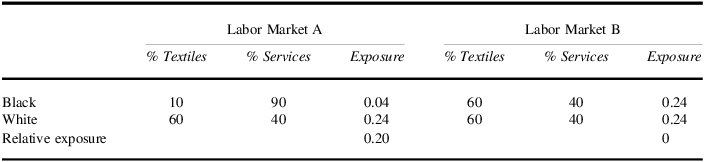

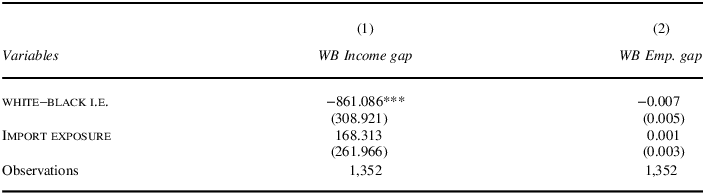
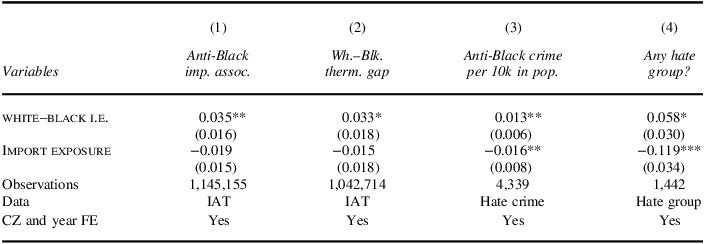
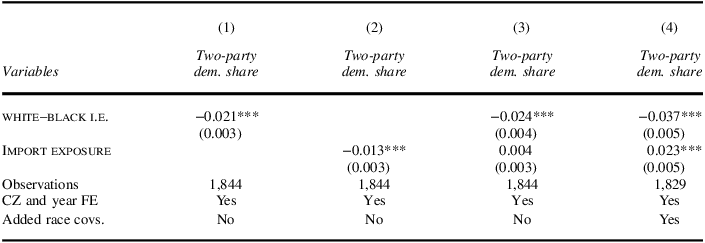
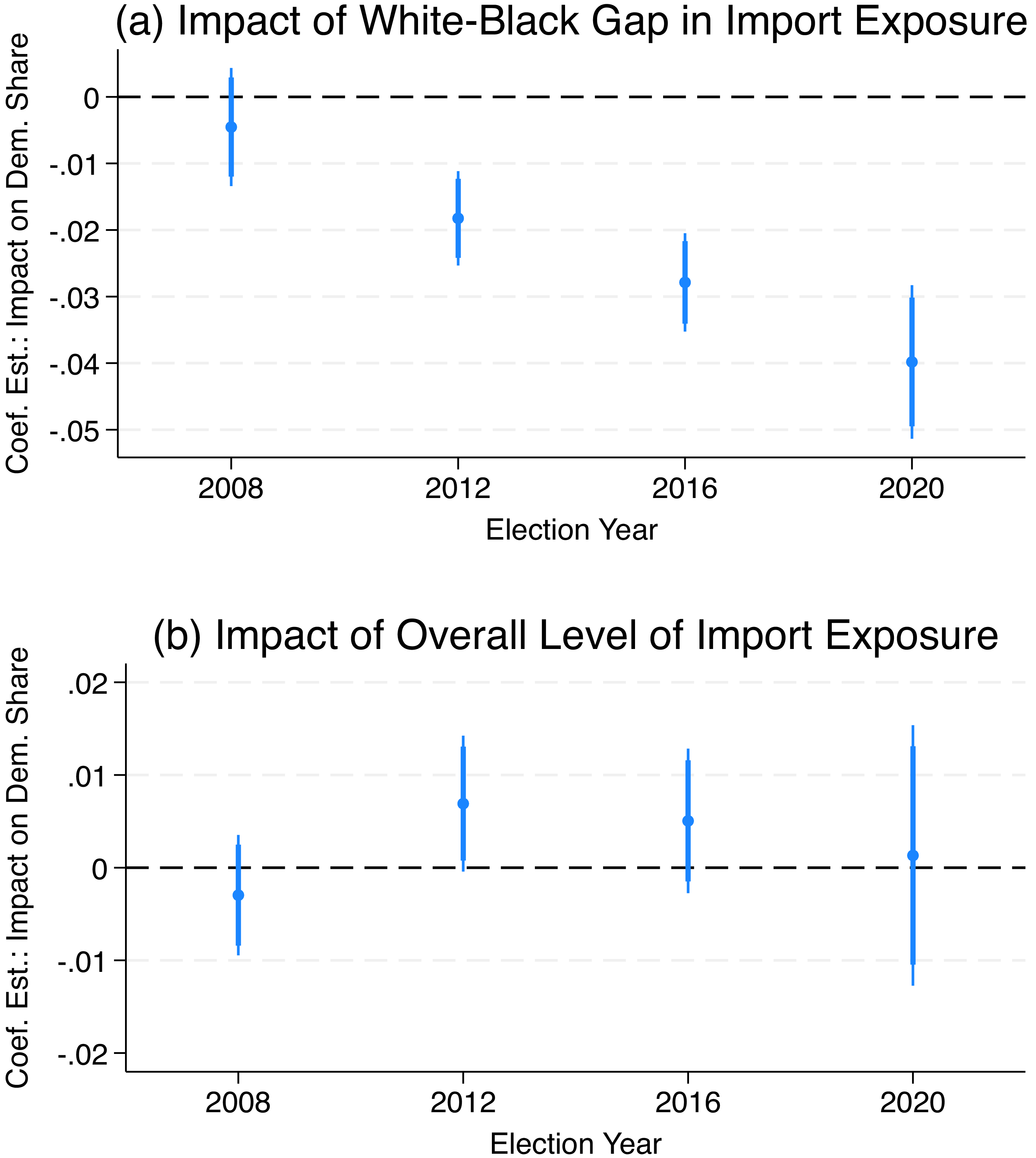


 Open access

