


Over the past two decades, the number of studies linking diet to the food environment has increased( Reference Larson and Story 1 – Reference Minaker, Raine and Wild 4 ). It is widely believed that the environment can influence eating behaviour and weight status( Reference Larson and Story 1 , Reference Caspi, Sorensen and Subramanian 3 , Reference Minaker, Raine and Wild 4 ). Researchers and policy makers have a shared interest in how the food environment contributes to health outcomes( Reference Minaker, Raine and Wild 4 ).
Geographic information systems (GIS) have been a predominant tool used to characterize the food environment, typically describing the objective, spatial availability of or distance to retail food outlets( Reference Larson, Story and Nelson 2 , Reference Thornton, Pearce and Kavanagh 5 – Reference Van Meter, Lawson and Colabianchi 7 ). Associations between the food environment and dietary outcomes have varied based on the measurement used in each study( Reference Caspi, Sorensen and Subramanian 3 ). Recently, perception measures of the food environment based on individuals’ self-report have gained in popularity. Perception-based measures are advantageous, as they allow researchers to capture how people view and utilize their environment( Reference Caspi, Sorensen and Subramanian 3 ). It has been suggested that perception measures may be more convenient and cheaper, because geographic measures are typically derived from secondary data sources and field validation is often not feasible and is too expensive( Reference Liese, Colabianchi and Lamichhane 8 – Reference Forsyth, Lytle and Riper 10 ). However, the use of perception-based measures has drawbacks( Reference Caspi, Kawachi and Subramanian 11 ). Perception measures may be biased because of personal preferences or behaviours, how a person interprets survey question(s) (including definitions of food outlets or items) and understanding of the concept of ‘neighbourhood’( Reference Caspi, Kawachi and Subramanian 11 , Reference Coulton and Jennings 12 ). In addition, only a few questionnaires assessing the perceived food environment have been validated by researchers( Reference Echeverria, Diez Roux and Link 13 – Reference Ma, Barnes and Freedman 15 ).
A handful of studies have examined relationships between geographic measures and perceptions of the food environment( Reference Moore, Diez Roux and Nettleton 16 – Reference Barnes, Bell and Freedman 25 ). However, only a few have focused specifically on the perceived availability of healthy foods, i.e. fresh fruits and vegetables and low-fat foods, compared with direct, objective measures of retail food outlet availability (e.g. presence, count or density) or distance( Reference Moore, Diez Roux and Brines 17 , Reference Gustafson, Sharkey and Samuel-Hodge 19 , Reference Zenk, Schulz and Lachance 20 ). Two studies have reported a significant positive association between supermarket availability, assessed by either the presence or density of stores, and perceived availability of healthy foods( Reference Moore, Diez Roux and Brines 17 , Reference Gustafson, Sharkey and Samuel-Hodge 19 ). No study has addressed non-traditional food outlets (e.g. dollar stores or pharmacies) that offer a variety of food products and are attracting an increasing market share( Reference Martinez 26 , Reference Gantner, Olson and Frongillo 27 ). Further, many initiatives have been established to improve spatial access to healthier food retailers (e.g. larger grocery stores, food hubs and farmers’ markets), such as the Healthy Food Financing Initiative( 28 ); however, policy makers are not fully aware whether consumers with access to certain retail outlets are indeed aware of these opportunities and whether positive perceptions of them exist. Moreover, by examining associations between perceptions of healthy foods and food outlets other than supermarkets and supercentres, researchers and policy makers can determine whether current initiatives are sufficient or whether targeted policies and interventions that include non-traditional food outlets and better awareness (including changes) of the environment are warranted.
The objective of the present study was to expand the scope of research and examine the relationship of both GIS-derived presence and distance to various types of retail outlet with participants’ perceptions of healthy food availability within their neighbourhoods. In our analyses, distance was defined using the closest food outlet type via street networks, and GIS-derived presence was defined as the existence of retail food outlets (yes or no) within 1·61 and 8·05 km (1- and 5-mile) buffers around each participant’s home address. Perceived availability of healthy foods was characterized using a summary score that has been commonly used in the literature to describe a person’s food environment( Reference Echeverria, Diez Roux and Link 13 – Reference Ma, Barnes and Freedman 15 ).
Methods
Study region
The study area consisted of a contiguous geographical area encompassing eight, predominantly rural (e.g. non-urban) counties in the Midlands region of South Carolina, USA and has been described previously( Reference Liese, Colabianchi and Lamichhane 8 , Reference Liese, Barnes and Lamichhane 9 ).
Design and recruitment
The study was approved by the University of South Carolina Institutional Review Board.
Using a cross-sectional design, a geographically based sample of 968 adults serving as the primary food shoppers for their households was recruited in the eight-county study region between April and June 2010 as part of a larger study( Reference Ma, Barnes and Freedman 15 , Reference Barnes, Bell and Freedman 25 , Reference Liese, Bell and Barnes 29 ). The sample was generated from random selection of landline telephone numbers with listed addresses restricted to sixty-four eligible ZIP codes. To achieve good spatial coverage, research staff aimed to interview approximately fifteen respondents per ZIP code. Recruitment calls were performed by the University of South Carolina Survey Research Laboratory. Respondents were screened with respect to certain eligibility criteria, including being (i) at least 18 years old, (ii) the primary food shopper, (iii) capable of speaking English and (iv) living in the eight-county region. Of 2477 people screened, a total of 968 were eligible and completed the interview. This resulted in a response rate of 47 %( 30 ), which is comparable to other evaluations among landline households conducted in the USA( Reference Hu, Balluz and Battaglia 31 ). For analyses, participants were removed if they were missing data on demographic characteristics (age, n 71; race/ethnicity, n 73; education, n 69; employment status, n 68; household income, n 215; Supplemental Nutrition Assistance Program (SNAP) status, n 69; spouse or partner status, n 64; number of household members, n 74), geographic measures (n 19), perceived availability of healthy foods (n 5) and urbanicity (n 18), resulting in a final sample within non-missing data of 705 participants (73 % of completed interviews).
Perceived availability of healthy foods
Perceptions of the food environment were ascertained using previously validated questions( Reference Echeverria, Diez Roux and Link 13 – Reference Ma, Barnes and Freedman 15 ). Survey participants indicated their agreement on a 5-point Likert scale with the following statements: (i) ‘A large selection of fruits and vegetables is available in my neighbourhood’; (ii) ‘The fresh fruits and vegetables in my neighbourhood are of high quality’; and (iii) ‘A large selection of low-fat products is available in my neighbourhood’. Neighbourhood was defined as a 1·61 km (1-mile) buffer or 20-min walk from home. Responses for each question ranged from 1 to 5 (1=‘strongly agree’, 2=‘agree’, 3=‘neutral (neither agree nor disagree)’, 4=‘disagree’ and 5=‘strongly disagree’). For ease of interpretability, a summary perceptions score was created( Reference Moore, Diez Roux and Nettleton 16 , Reference Moore, Diez Roux and Brines 17 , Reference Moore, Diez Roux and Franco 22 ). Responses were reverse coded, summed and then re-scaled to a starting point of zero to reflect a summary score in which 0 indicates the worst availability of healthy foods and 12 indicates the best availability.
Geographic measures of the food environment
All geospatial analyses were conducted using ArcGIS 10·0 (ESRI, Redlands, CA USA; 2010). Geographic measures were calculated using the geocoded participants’ home addresses as the point of reference, with both a 1·61 and 8·05 km (1- and 5-mile) street and road network buffer representing their neighbourhood boundaries. Buffers of 1·61 km (1 mile) and 8·05 km (5 miles) were used to reasonably reflect the range of distances participants may have to travel to the nearest retailer, especially in our predominantly non-urban study region. Furthermore, the nearest retailer ranged from 4·83 to 12·87 km (3 to 8 miles) from home, depending on store type. For urban participants, distance to the nearest retailer ranged from 1·61 to 3·22 km (1 to 2 miles), but for non-urban participants, these distances ranged from 4·83 to 14·48 km (3 to 9 miles). Addresses were then linked with an existing, previously validated geospatial database on food retail outlets( Reference Liese, Colabianchi and Lamichhane 8 , Reference Liese, Barnes and Lamichhane 9 ) and the presence of food outlets within the buffer (availability), defined as yes or no. Distance to the nearest retail food outlet was calculated using the shortest street distance based on StreetMap Premium for ArcGIS (ESRI; 2008). The outlet types included supermarkets, supercentres, warehouse clubs (of note, there is only one warehouse club within the study region), convenience stores, drug and pharmacy stores, dollar and variety stores, and franchised fast-food restaurants. Supermarkets, supercentres and warehouse clubs were aggregated and considered together as supermarkets. This classification has been used previously by the Centers for Disease Control and Prevention in the 2013 State Indicator Report on Fruits and Vegetables( 32 ).
Participant characteristics
Demographic and socio-economic characteristics based on the Behavioral Risk Factor Surveillance Survey (BRFSS)( 33 ) were collected, including age, race/ethnicity, annual household income, education, employment, SNAP use, number of household members and marital/partner status. Each respondent was also classified on level of urbanicity using the 2010 US Census urban classification method via a point-in-polygon operation within ArcGIS( 34 ). Specifically, an urban area was defined as any census tract classified as either an ‘urbanized area of 50 000 or more people or urban cluster consisting of at least 2500 and less than 50 000 people’. All census tracts not designated as urban were considered to be non-urban.
Statistical analyses
Ordinary least-squares regression was used to assess the relationship between the geographic presence of and distance to specific outlets and the perceived availability of healthy foods in the participants’ neighbourhoods. Geographic presence and distance to the nearest food outlet were used as independent variables and perceived availability of healthy foods was the outcome variable for all models. Covariates included age, sex, race/ethnicity, education, employment, household income, SNAP utilization, marital/partner status, household size and urbanicity. No violations of the assumption of independent observations, linearity, homoscedasticity or normality of the residuals were noted and no evidence for multicollinearity between the geographic measures was found (all variance inflation factors ≤10).
First we examined the independent influence of presence of or distance to a specific type of food retail outlet, without controlling for other outlet types, using separate models that adjusted for the listed demographic covariates only. Next we examined models in which presence of or distance to all food outlet types were considered simultaneously. The R 2 of each model was examined to determine how much each model explained the variance in the outcome. The squared semi-partial correlation type II, also known as the unique R 2, was also used to examine the unique contribution of each specific exposure in explaining variation in the outcome.
Results
The majority of participants in the present study were female (77·7 %), non-Hispanic white (65·5 %) and lived in non-urban neighbourhoods (79·1 %; Table 1). Ninety-four per cent of participants used a personal vehicle for primary shopping trips. Many participants did not have any retail food outlets near their home (i.e. within a 1·61 or 8·05 km (1- or 5-mile) buffer). For example, 88·6 % of participants did not have a supermarket in their neighbourhood and 71·5 % did not have a convenience store within 1·61 km (1 mile). The mean distance to the nearest supermarket from a participant’s home was 9·50 km (5·9 miles) and the distances to other food outlets ranged from 4·67 to 12·55 km (2·9 to 7·8 miles). The mean perceived availability of healthy foods score was 6·2 on a scale of 0 to 12.
Descriptive statistics of participants; household shoppers (n 705) from a predominantly rural, eight-county region of South Carolina, USA, 2010
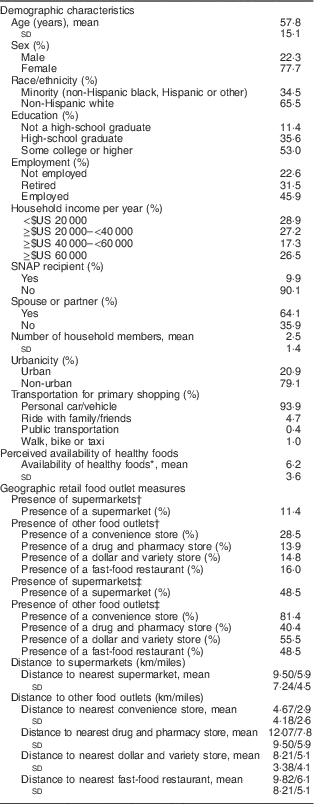
SNAP, Supplemental Nutrition Assistance Program.
* Scoring range: 0–12.
† Within a 1·61 km (1-mile) buffer.
‡ Within an 8·05 km (5-mile) buffer.
Table 2 displays the results for both the separate and full models examining the relationship between the presence of and distance to each type of food outlet and the perceived availability of healthy foods. In separate models, the presence of each type of food outlet was significantly and positively associated with perceived availability of healthy foods. Supermarkets were most strongly associated with perception at the 1·61 km (1-mile) buffer (β=1·93, P<0·001), followed by drug and pharmacy outlets (β=1·77, P<0·001). Moreover, all food outlet types were found to be significantly associated with perceived availability of healthy foods in separate models using either the 1·61 or 8·05 km (1- or 5-mile) buffer. However, the unique R 2 values were low, accounting for only 1–3 % of variation. For each food outlet type, distance to the nearest store was significantly negatively associated with perceived availability of healthy foods. Thus, for every 1·61 km (1-mile) increase in distance to the nearest supermarket, a participant’s perceived availability of healthy foods decreased by 0·20 points (unique R 2=4 %).
Relationships between geographic retail food outlet measures and perceived availability of healthy foods among household shoppers (n 705) from a predominantly rural, eight-county region of South Carolina, USA, 2010

SNAP, Supplemental Nutrition Assistance Program.
* Squared semi-partial correlation type II for each variable separately.
† Each geographic retail food outlet measure modelled separately.
‡ Includes all geographic retail food outlet measures for either presence of or distance to outlets in models. All models adjusted for the covariates age, sex, race/ethnicity, education, employment status, household income, SNAP status, spouse or partner, number of household members and urbanicity.
§ Within a 1·61 km (1-mile) buffer.
|| Within an 8·05 km (5 mile) buffer.
When all food outlets were considered jointly, there were no associations between the presence of any type of store and perceived availability of healthy foods using the 1·61 km (1-mile) buffer. However, the presence of a supermarket within an 8·05 km (5-mile) buffer area was significantly associated with perceived availability of healthy foods (β=1·09, P=0·025) when controlling for all other food outlet types. Conversely, distance to the nearest supermarket was significantly inversely associated with perceived availability of healthy foods when accounting for distance to all other outlets (β=−0·16, P=0·003). Thus, for every 1·61 km (1-mile) increase in distance to the nearest supermarket, the perceived availability healthy foods decreased by 0·16 points. Additionally, distance to the nearest dollar and variety store was also inversely associated with perceived availability of healthy foods, whereas distance to the nearest fast-food restaurant was significantly positively associated with perceived availability of healthy foods. So, as fast-food restaurants get further away, healthy food perceptions go up. For each significant food outlet type, the unique R 2 value was only 1 %. In all models, urbanicity explained as much of the variability in perceived availability of healthy foods (unique R 2 values ranging from 2 % to 4 %) as any of the GIS-derived measures.
Discussion
Our findings show that using GIS-derived presence of retail food outlets may not predict the perceived availability of healthy foods when accounting for all types of food outlet. Previous studies have generally suggested a significant positive association between supermarket availability, assessed by either the presence or number of stores, with perceived availability of healthy foods( Reference Moore, Diez Roux and Brines 17 , Reference Gustafson, Sharkey and Samuel-Hodge 19 ). Our findings are interesting because we examined both presence and distance measures of the food environment and found that only the presence of a supermarket within an 8·05 km (5-mile) buffer and the distance measures to supermarkets, dollar and variety stores, and fast-food restaurants were significant predictors of perceived healthy food options when considering all other food outlets. These findings could reflect that fact that our study took place in a predominantly rural environment and therefore associations are sensitive to boundary selection in the case of GIS-derived presence. Furthermore, our results demonstrate that the selection of study region and geographic measurement may be important factors to consider when assessing geographic- and perception-based food environments together.
Other differences between our study and previous research are in the variety of food outlet types included, i.e. supermarkets (‘traditional’) and non-traditional retailers. Previous studies have evaluated the relationship between only one geographic measure of a food outlet (typically a supermarket or convenience store) and perceived availability of healthy foods using each outlet type separately. Our study offered a complementary approach by examining all types of food outlet simultaneously and controlling for possible confounding effects. Thus, it is possible that some significant associations could cancel out in full models because of controlling for both the presence of supermarkets and less healthy options such as fast-food restaurants in the models. This method could be useful in examining future associations involving certain geographic measures of the food environment. However, there is the possibility of multicollinearity( Reference Clary, Ramos and Shareck 35 ), which would have to be examined. Fortunately, in our study, we found no multicollinearity between measures of food outlets (all variance inflation factors ≤10 in the full models).
In our studies, the presence of all food outlet types – including fast-food restaurants – had a significant positive association with the perceived availability of healthy foods in separate models. One possible explanation for this association with fast-food restaurants is spatial co-occurrence of supermarkets and non-traditional food outlets in the food environment( Reference Lamichhane, Warren and Puett 36 ). Thus, other types of food outlet may be located together with supermarkets (e.g. all within the sample shopping area) and are actually markers for the presence of a supermarket that carries fresh fruits and vegetables and low-fat products. However, when examining whether such co-location of stores existed in our sample, we found that only 9 % of participants had a supermarket present within a 1·61 km (1-mile) buffer of their home along with a fast-food restaurant (44 % using an 8·05 km (5-mile) buffer), and only 10 % of participants had both a supermarket and a convenience store present within a 1·61 km (1-mile) buffer (47 % using an 8·05 km (5-mile) buffer). Both fast-food restaurants and convenience stores were present for only 15 % of all participants using a 1·61 km (1-mile) buffer (16 % using an 8·05 km (5-mile) buffer).
Our study has several limitations. First, our respondents were predominantly female and our landline-based telephone sample yielded a predominantly middle-to-older age distribution. Second, our survey response rate was only 47 %; however, this is comparable to the findings from a published evaluation of BRFSS landline response rates (49 %)( 30 ) and from previous studies( Reference Moore, Diez Roux and Brines 17 ). Third, the perception questions used may not have adequately characterized the availability of healthy foods in participants’ neighbourhoods based on each individual’s perspectives and knowledge. It is possible that participants have different perspectives of what constitute fresh or quality foods and/or what food items are considered fruits and vegetables or low-fat foods. In addition, there was an approximate 1-year interval between the completion of the validation study and the perceptions survey; however, this is a similar or shorter time gap than those reported in other studies( Reference Moore, Diez Roux and Brines 17 ). Finally, the study operationalized GIS-derived measures centred only on the participants’ residences. However, people can purchase food outside the boundaries of their residential neighbourhood (e.g. near or en route to their place of work, school, etc.). Moreover, our study did not examine how food environments are affected by actual shopping patterns or test whether differences in perception of the availability of healthy foods influenced food purchases or consumption. However, the study offers a perspective of the food environment that has been typically characterized throughout the research literature. Future studies should link shopping and dietary habits of individuals with objective and perceived measures of the food environment.
Strengths of our study include the use of GIS-based measures established by validated fieldwork( Reference Liese, Colabianchi and Lamichhane 8 , Reference Liese, Barnes and Lamichhane 9 ), whereas previous researchers have used measures derived from secondary data sources( Reference Moore, Diez Roux and Brines 17 , Reference Gustafson, Sharkey and Samuel-Hodge 19 ). In addition, our study area contained both urban and non-urban communities and may thus be comparable to any new studies examining populations in the south-eastern USA. Our study also included geographic measures of distance in addition to the more traditionally studied presence (availability) of food outlets and included not only supermarkets but also many non-traditional food outlets.
Our study examined the relationship between two types of food environment measure, i.e. geographic and perceived measures. Our results suggest that distance to, not presence of, food outlets is a significant predictor of perceived healthy food options in a person’s neighbourhood food environment when considering all types of food outlet. These findings may assist in the development of better measures. Moreover, this research suggests that the perceived availability of healthy foods and GIS-derived food outlet measures may be two different constructs, and researchers should not assume that perception-based measures can be substituted for geographic measures or vice versa. In addition, the food environment does not simply comprise presence or proximity to outlets but also includes the selection of products that are offered. Public health professionals and policy makers should consider carefully which type of measure – geographic or perception-based – is most appropriate when assessing the food environment.
Acknowledgements
Financial support: This project was supported by the National Cancer Institute (NCI) (grant number R21CA132133-02S1). The contents of this article are solely the responsibility of the authors and do not necessarily represent the official views of NCI or the National Institutes of Health. Conflict of interest: None. Authorship: T.L.B. conceptualized and drafted the manuscript and performed the primary statistical analyses. B.A.B. contributed to the statistical analyses. D.A.F., N.C. and A.D.L. contributed to editing and writing the final manuscript. Ethics of human subject participation: This research was approved by the University of South Carolina Institutional Review Board.



