





Non-technical Summary
Fossils from the Avalon (Ediacaran) represent some of the first animals in the fossil record. The Avalon fossil record is exceptional; these organisms are preserved as entire communities where they would have lived on the deep-sea floor. These early animals lived in regularly disturbed environments, where underwater sedimentation events killed entire communities. In post-disturbance environments, new organisms would have likely arrived via waterborne propagules that may have had to travel long distances. However, there could be a substantial advantage if some of these animals were able to leave biological material (surviving organisms, reproductively active remains). Such strategies would allow for local recolonization, which could be faster and permit surviving organisms to become dominant in the post-disturbance community. We tested this possibility by investigating the ecological dynamics of fossil communities that contained fossilized evidence of such strategies: either fragmented remains that could be reproductively active, or exceptionally large specimens that may represent animals that survived a sedimentation event. We found that fragmented specimens of Fractofusus were surrounded by high densities of much smaller complete Fractofusus specimens, indicating that fragmentary reproduction in the aftermath of a disturbance event was a viable reproductive strategy for this taxon. Use of this strategy is particularly notable in Fractofusus, as it is one of the most dominant Avalon fossils, and ecological innovations such as the capacity to recolonize environments quickly may have led to this dominance. However, surviving individuals had no such associations, indicating that the advantage to growing large may not have been to survive disturbance events. The trade-off between long-distance and local recolonization strategies is seen in extant environments, but our work demonstrates that such trade-offs were already present in some of the earliest animal communities.
Introduction
The first geographically widespread metazoans constitute the Avalon assemblage (574–560 million years ago) during the terminal Ediacaran (Liu et al. Reference Liu, Kenchington and Mitchell2015; Dunn et al. Reference Dunn, Liu, Grazhdankin, Vixseboxse, Flannery-Sutherland, Green, Harris, Wilby and and2021; Runnegar Reference Runnegar2022; Mitchell and Pates Reference Mitchell and Pates2025). Avalon paleocommunities were dominated by enigmatic rangeomorphs and arboreomorphs (Narbonne Reference Narbonne2004; Brasier et al. Reference Brasier, Antcliffe and Liu2012), alongside rare, more familiar crown-group cnidarians (Dunn et al. Reference Dunn, Kenchington, Parry, Clark, Kendall and Wilby2022) and putative sponges (Sperling et al. Reference Sperling, Peterson and Laflamme2011; Aragonés Suarez and Leys Reference Aragonés Suarez and Leys2022). The Avalon paleocommunities are preserved in situ and near-census (O’Brien and King Reference O’Brien and King2005) in Newfoundland, Canada, and Charnwood Forest, Leicestershire, UK (Benus Reference Benus1988; Noble et al. Reference Noble, Condon, Carney, Wilby, Pharaoh and Ford2015; Wood et al. Reference Wood, Dalrymple, Narbonne, Gehling and Clapham2003), in deep-water, slope environments adjacent to a volcanically active island arc system (Wood et al. Reference Wood, Dalrymple, Narbonne, Gehling and Clapham2003). Disturbance from sedimentation events (ash influx, turbidites) was likely to be a substantial and potentially regular cause of mortality for these early animal communities (Clapham et al. Reference Clapham, Narbonne and Gehling2003; Wilby et al. Reference Wilby, Kenchington and Wilby2015). Environmental disturbance has therefore been suggested to have substantially shaped the ecology and evolution of Avalon communities (Clapham et al. Reference Clapham, Narbonne and Gehling2003; Wilby et al. Reference Wilby, Kenchington and Wilby2015; Kenchington et al. Reference Kenchington, Dunn and Wilby2018; Delahooke et al. Reference Delahooke, Liu, Stephenson and Mitchell2024).
Periodic pulse disturbances by intensive sedimentary events smothered entire Avalon communities, and so were typically lethal (Seilacher Reference Seilacher1999; Clapham et al. Reference Clapham, Narbonne and Gehling2003; Wilby et al. Reference Wilby, Kenchington and Wilby2015), leaving behind barren substrate. For new communities to emerge, recolonization processes were required. These could be either a new primary succession, sourced via dispersal from outside the mapped area, that is, long distance from the metacommunity (Clapham et al. Reference Clapham, Narbonne and Gehling2003; Mitchell et al. Reference Mitchell, Kenchington, Liu, Matthews and Butterfield2015; Boddy et al. Reference Boddy, Mitchell, Merdith and Liu2022; Eden et al. Reference Eden, Manica and Mitchell2022), or a secondary succession from local recolonization, whereby either biological remains or surviving organisms aid local recolonization—a “biological legacy” (Wilby et al. Reference Wilby, Kenchington and Wilby2015). In modern sessile systems, surviving organisms often have a substantial impact on the post-disturbance community composition (Bače et al. Reference Bače, Svoboda, Janda, Morrissey, Wild, Clear, Čada, Donato and Chen2015), ecosystem functions (Nyström and Folke Reference Nyström and Folke2001), and ecological dynamics (Wild et al. Reference Wild, Kopecký, Svoboda, Zenáhlíková, Edwards‐Jonášová and Herben2014). Usually, survivors represent the most common taxa in a given area (Wild et al. Reference Wild, Kopecký, Svoboda, Zenáhlíková, Edwards‐Jonášová and Herben2014), generating legacy effects that can determine the spatial ecology of the recolonizing community, where the secondary community is characterized either by clustering around suitable habitat near biological remains (e.g., logs and tree stumps) or by reproductive clusters around survivors (e.g., coral fragments) (Maldonado and Uriz Reference Maldonado and Uriz1999; Okubo et al. Reference Okubo, Motokawa and Omori2007; Wild et al. Reference Wild, Kopecký, Svoboda, Zenáhlíková, Edwards‐Jonášová and Herben2014; Bače et al. Reference Bače, Svoboda, Janda, Morrissey, Wild, Clear, Čada, Donato and Chen2015; Kim et al. Reference Kim, Wild and Tilstra2022). Such legacies can sometimes effect succession trajectories and lead to alternative stable states (Jõgiste et al. Reference Jõgiste, Korjus, Stanturf, Freelich, Baders, Donis and Jansons2017; Pérez-Hernández and Gavilán Reference Pérez-Hernández and Gavilán2021). However, such ecological benefits of biological legacies for Avalon paleocommunities could be compounded by the relative slowness of recolonizing processes because of their deep-sea habitat, similar to the slowness of modern deep-sea recolonizing processes (Grassle Reference Grassle1977). Still, the temporal record of many Avalon taxa stretches over millions of years, demonstrating that the taxa could survive regular disturbances.
Within Avalon paleocommunities, there are two possible examples of specimens that could provide evidence of biological legacies. First, fragmented fossils of Fractofusus andersoni (Dunn et al. Reference Dunn, Donoghue and Liu2025; Fig. 1A) alongside complete, but much smaller F. andersoni fossils on the Brasier surface in Mistaken Point Ecological Reserve, Newfoundland, Canada, could represent vegetative, reproductive fragments—perhaps generated by a disturbance event. Fragmented specimens of F. andersoni are truncated partway along the central axis, orthogonal to the biterminal directions of growth (Fig. 1B–F). Fragments could have been formed by physical damage from disturbance events, which could rip specimens (Dunn et al. Reference Dunn, Donoghue and Liu2025). Evidence of such damage is also seen in other rangeomorphs, such as Hyllaecullulus (Kenchington et al. Reference Kenchington, Dunn and Wilby2018) and physical damage recorded in Dickinsonia specimens (Ivantsov et al. Reference Ivantsov, Zakrevskaya, Nagovitsyn, Krasnova, Bobrovskiy and Luzhnaya2020). These fragments are distinct from incomplete preservation because of the observation of the continuation of a central axis found in both complete and incomplete specimens (Dunn et al. Reference Dunn, Donoghue and Liu2025: fig. 2G,H; Fig. 2G). Second, surviving individuals could be identified as an outlier(s) within their population size distribution in the post-disturbance community (Wilby et al. Reference Wilby, Kenchington and Wilby2015) (Fig. 1B–F), because any individuals surviving the disturbance event would be older and therefore taller than individuals of the post-disturbance community. Such outlier individuals have been observed for Primocandleabrum, Charnia, Hyllaecullulus, and Charniodiscus in North Quarry Bed B (henceforth Bed B) in Charnwood Forest (Wilby et al. Reference Wilby, Kenchington and Wilby2015). The advantages of local reproduction following the survival of disturbance events could therefore provide an additional driver for the evolution of longer-distance dispersal (Mitchell and Kenchington Reference Mitchell and Kenchington2018).
A, Outlier Primocandelabrum sp. on Bed B. Scale bar, 2 cm. B–F, Fragment Fractofusus andersoni specimens from the Brasier surface. G–I, Complete F. andersoni on the Brasier surface. Dashed lines denote broken edges of specimens. Note continuation of central axis in G (as in Dunn et al. Reference Dunn, Donoghue and Liu2025: fig. 2G). Scale bars, 1 cm.

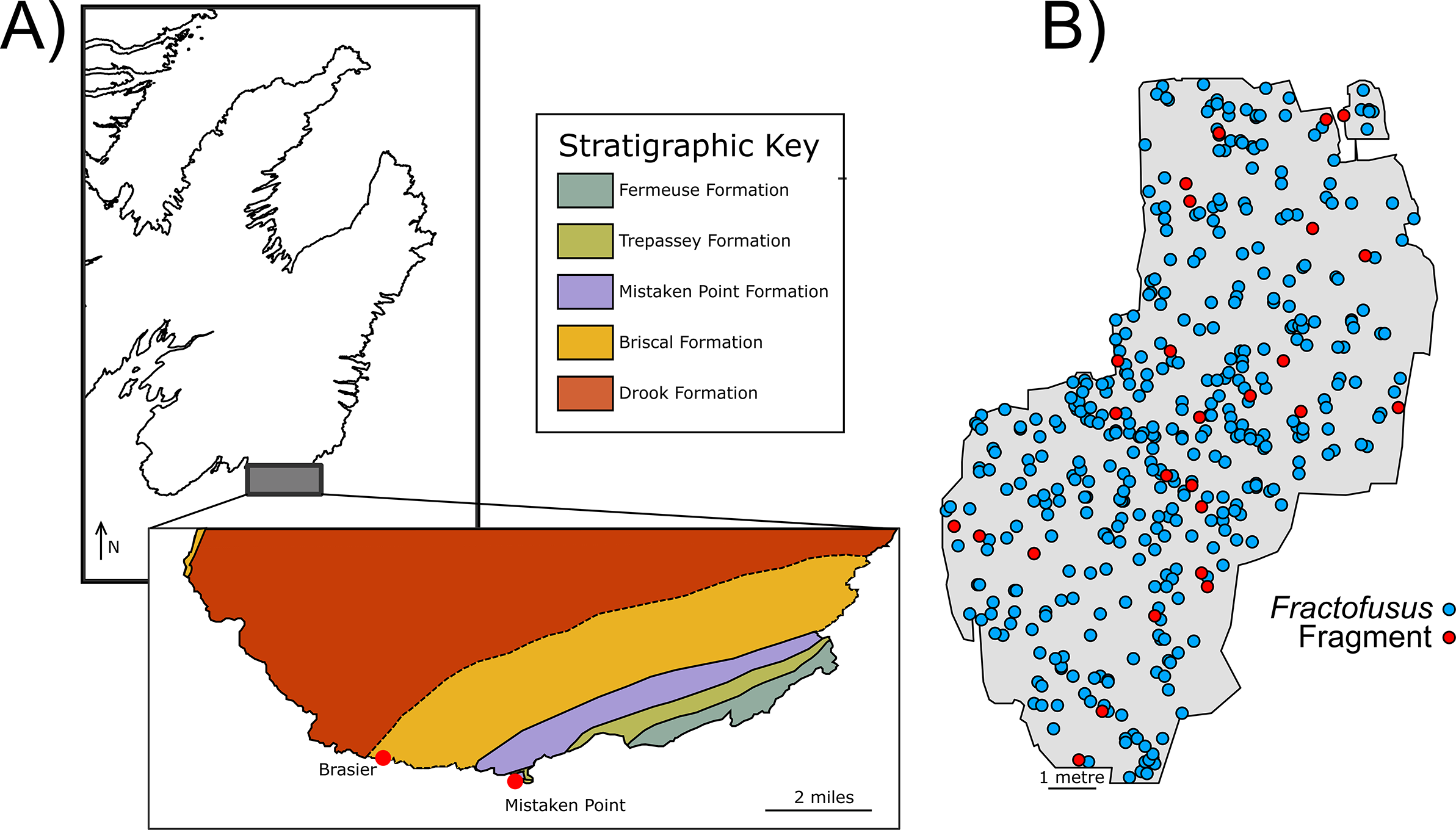
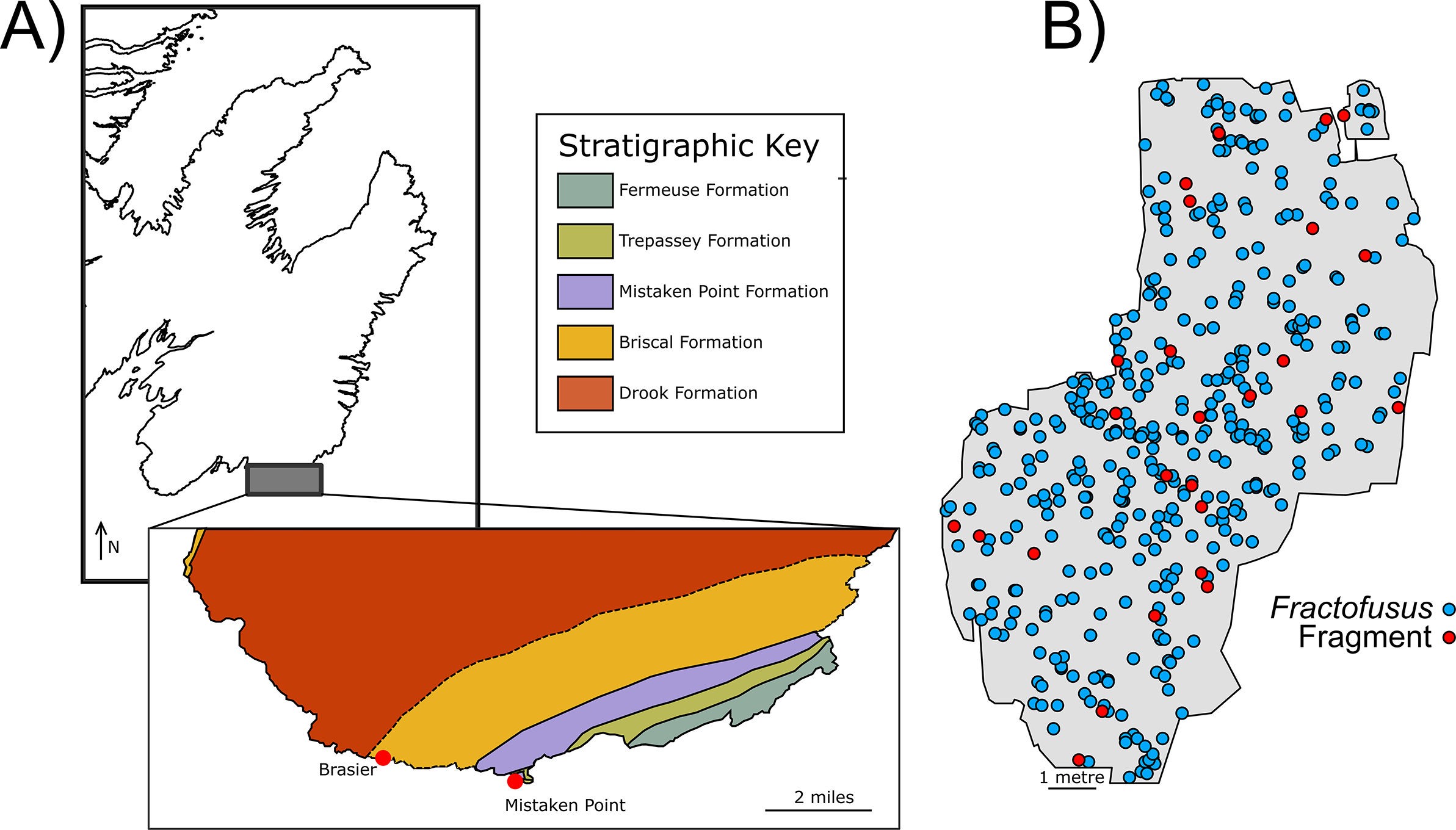
A, Stratigraphic map of Mistaken Point Ecological Reserve, Newfoundland, Canada (adapted from Matthews et al. Reference Matthews, Liu, Yang, McIlroy, Levell and Condon2021), with Brasier surface labeled. B, Brasier surface with complete (blue) and fragmented (red) Fractofusus andersoni specimens.
Spatial point process analysis (SPPA) enables the inference of ecological processes from the underlying spatial patterns of fossil specimens, because for sessile organisms, such as Avalon taxa, there is only a limited set of possible processes behind observed spatial patterns. This limited set of processes means that by comparing the observed patterns with those produced by well-established models, we can determine the most likely underlying processes for any patterns found across plant, coral, fungi, and sessile fossil communities (Velázquez et al. Reference Velázquez, Martínez, Getzin, Moloney and Wiegand2016; McFadden et al. Reference McFadden, Bartlett, Wiegand, Turner, Sack, Valencia and Kraft2019; Mitchell and Harris Reference Mitchell and Harris2020). Therefore, these techniques can be used to investigate the potential influences of recolonization processes in Avalon paleocommunities, and have been applied in a variety of paleoecological contexts, such as Ediacaran body fossils (Mitchell et al. Reference Mitchell, Kenchington, Liu, Matthews and Butterfield2015, Reference Mitchell, Harris, Kenchington, Vixseboxse, Roberts, Clark, Dennis, Liu and Wilby2019, Reference Mitchell, Bobkov, Bykova, Dhungana, Kolesnikov, Hogarth and Liu2020, Reference Mitchell, Stephenson, Buma-at, Roberts, Dennis and Kenchington2025; Mitchell and Kenchington Reference Mitchell and Kenchington2018; Boan et al. Reference Boan, Evans, Hall and Droser2023, Reference Boan, Evans and Droser2024; Delahooke et al. Reference Delahooke, Liu, Stephenson and Mitchell2024), other benthic taxa (Dhungana and Mitchell Reference Dhungana and Mitchell2021), and more recently, trace fossils both on bedding planes (Mitchell et al. Reference Mitchell, Bobkov, Bykova, Dhungana, Kolesnikov, Hogarth and Liu2020) and through SPPA of traces (Rojas et al. Reference Rojas, Dietl, Kowalewski, Portell, Hendy and Blackburn2020, Reference Rojas, Huntley, Caffara and Scarponi2025). We hypothesize: (1) that F. andersoni fragments on the Brasier surface have a substantial positive effect on Fractofusus population structure (densities in proximity to fragments redolent of a reproductive mechanism); and (2) that the presence of outlier individuals has a substantial positive effect on community structure (relative abundances) and population spatial structure (higher densities in proximity to the outlier specimens), which we systematically test using SPPA.
Geological Setting
Avalon Ediacaran macrofossils occur in the Conception and St. John’s groups in Newfoundland, Canada, and the Charnian Supergroup in Leicestershire, UK, specifically within thick siliciclastic–volcaniclastic units composed of fine-grained turbiditic facies. These successions represent deep-marine slope environmental settings (O’Brien et al. Reference O’Brien, Wardle and King1983; Myrow Reference Myrow1995), and substantial volcaniclastic sediments in these units indicate ash input from nearby volcanic arcs (Wood et al. Reference Wood, Dalrymple, Narbonne, Gehling and Clapham2003). The paleocommunities in this study come from the Mistaken Point Ecological Reserve (MPER) (Benus Reference Benus1988; Fig. 2), Bay Roberts and Spaniard’s Bay (Ichaso et al. Reference Ichaso, Dalrymple and Narbonne2007), and the Discovery Geopark (DG) in the Bonavista Peninsula (Hofmann et al. Reference Hofmann, O’Brien and King2008). The MPER and DG successions were likely deposited in different deep-water basins within the Avalon Terrane (O’Brien and King Reference O’Brien and King2005).
The three key surfaces within this study are (1) The Brasier surface, (2) the E surface, and (3) Bed B. The Brasier surface (567.8 Ma; Fig. 2), which occurs within the lower Briscal Formation, consists of normally graded medium- to coarse-grained sandstones with a greenish hue due to their high tuffaceous content (Matthews et al. Reference Matthews, Liu, Yang, McIlroy, Levell and Condon2021). The E surface (565 Ma), within the Mistaken Point Formation, is characterized by medium-bedded siltstones deposited by strong turbidity flows, capped by fine-grained hemipelagic sediments containing coarse-grained crystal tuffs (Narbonne Reference Narbonne2005). Bed B, Charnwood Forest, is within the Bradgate Formation, which consists of fine-grained sedimentary–volcaniclastic rocks deposited in deep-marine slope settings, well below the storm wave base, within a back-arc basin (Le Bas Reference Le Bas1984; Pharaoh et al. Reference Pharaoh, Webb, Thorpe and Beckinsale1987). The base of the Bradgate Formation is dated to 561.9 ± 0.9 Ma, so it provides a lower bound for the age of Bed B (Noble et al. Reference Noble, Condon, Carney, Wilby, Pharaoh and Ford2015).
Materials and Methods
Material
In this study, we assessed 19 bedding plane assemblages: “Yale” outcrops of the D and E surfaces at Mistaken Point; the Bristy Cove surface from MPER; and the St. Shott’s surface at Western Head, Newfoundland, Canada, from Mitchell et al. (Reference Mitchell, Harris, Kenchington, Vixseboxse, Roberts, Clark, Dennis, Liu and Wilby2019); the Brasier surface; the Clapham’s Pigeon Cove (CPC) surface; the Shingle Head surface; the Lower Mistaken Point surface; the “Queens” outcrop of the G surface at Mistaken Point; and the Pizzeria surface from MPER, using data from (Stephenson et al. Reference Stephenson, Delahooke, Barnes, Rideout, Kenchington, Manica and Mitchell2024); the Bishop’s Cove surface and the Green Point surface from the Bay Roberts area in Newfoundland, Canada, from Stephenson et al. (Reference Stephenson, Delahooke, Barnes, Rideout, Kenchington, Manica and Mitchell2024); the H14 surface from Mitchell et al. (Reference Mitchell, Harris, Kenchington, Vixseboxse, Roberts, Clark, Dennis, Liu and Wilby2019); the H5 surface from Delahooke et al. (Reference Delahooke, Liu, Stephenson and Mitchell2024); the H26 surface, the Capelin Gulch site, the Goldmine surface, and the H31 surface from Stephenson et al. (Reference Stephenson, Delahooke, Barnes, Rideout, Kenchington, Manica and Mitchell2024) all in the DG in Newfoundland, Canada; and Bed B from Charnwood Forest from Mitchell et al. (Reference Mitchell, Harris, Kenchington, Vixseboxse, Roberts, Clark, Dennis, Liu and Wilby2019).
The surfaces were mapped using a combination of methods (cf. Mitchell et al. Reference Mitchell, Harris, Kenchington, Vixseboxse, Roberts, Clark, Dennis, Liu and Wilby2019). All surfaces were LiDAR scanned using (FARO Focus, mean resolution up to 0.5 mm) (apart from the H31 surface, which was not scanned) and mapped using photogrammetry in Agisoft Metashape v. 1.7.5. Additional laser-line probe scans were used for the Pizzeria, Brasier, G, D, and E surfaces to a 0.050 mm resolution (Mitchell et al. Reference Mitchell, Harris, Kenchington, Vixseboxse, Roberts, Clark, Dennis, Liu and Wilby2019). To create the specimen maps, three-dimensional models created from photogrammetry were used to make orthomosaics (two-dimensional photomaps) from which two-dimensional vector maps containing information on the spatial position, disk length and width, stem and frond length and width, and species-level identification were made (cf. Stephenson et al. Reference Stephenson, Delahooke, Barnes, Rideout, Kenchington, Manica and Mitchell2024: extended data table 3) in Inkscape v. 1.3. Fractofusus fragments were specifically noted within the Brasier surface dataset. A custom script (https://github.com/nis38/NPS_dex.git in R v, 4.2.2 [R Core Team 2023] adapted from Delahooke et al. [Reference Delahooke, Liu, Stephenson and Mitchell2024]) was used to extract data from vector maps. All surface datasets (surface outlines, specimen sizes, specimen spatial positions) were retrodeformed by quantifying tectonic deformation through comparisons of the lengths and widths of holdfasts >10 mm, with the assumption of original circularity using the constant area method (cf. Vixseboxse et al. Reference Vixseboxse, Kenchington, Dunn and Mitchell2021), apart from on the CPC surface, which did not have sufficient holdfasts (Clapham et al. Reference Clapham, Narbonne and Gehling2003). The total dataset comprised 18,060 specimens from 43 morphotaxa (taxa listed in Supplementary Table S2 plus effaced fronds, disks, and Ivesheadiomorphs).
Spatial Analysis of Fragments
Univariate Analysis of Complete Fractofusus Specimens
In this study, we investigated the population ecology of Fractofusus (whole and fragmented specimens) on the Brasier surface (Fig. 1B–F) by means of univariate and bivariate SPPA (Wiegand and Moloney Reference Wiegand and Moloney2014; Mitchell et al. Reference Mitchell, Harris, Kenchington, Vixseboxse, Roberts, Clark, Dennis, Liu and Wilby2019) to test that hypothesis that Fractofusus andersoni fragments on the Brasier surface have a substantial positive effect on Fractofusus population structure. To compare the differences in size between fragmented and complete Fractofusus specimens, we used a Mann-Whitney U-test (Mann and Whitney Reference Mann and Whitney1947).
We used the pair correlation function (PCF) summary statistic to quantify how the density of points (here, fossils) at a given distance r from a given point change as a function of distance from that point (Illian et al. Reference Illian, Penttinen, Stoyan and Stoyan2008; Wiegand and Moloney Reference Wiegand and Moloney2014). The simplest spatial pattern, complete spatial randomness (CSR), can be modeled as a homogenous Poisson process (Illian et al. Reference Illian, Penttinen, Stoyan and Stoyan2008). CSR reflects no biotic or abiotic interactions at the spatial scales considered (Illian et al. Reference Illian, Penttinen, Stoyan and Stoyan2008; Velázquez et al. Reference Velázquez, Martínez, Getzin, Moloney and Wiegand2016). Where spatial patterns are not CSR, they can be aggregated (PCF > 1) or segregated (PCF < 1), and these patterns can be detected at a range of spatial scales and combinations of aggregations and segregations (Illian et al. Reference Illian, Penttinen, Stoyan and Stoyan2008). Aggregation within a population can be caused by habitat associations, whereby organisms cluster within an area of preferable resources (cf. Shen et al. Reference Shen, Yu, Hu, Mi, Ren, Sun and Ma2009), by dispersal-limited reproduction (cf. Mitchell et al. Reference Mitchell, Kenchington, Liu, Matthews and Butterfield2015; McFadden et al. Reference McFadden, Bartlett, Wiegand, Turner, Sack, Valencia and Kraft2019), or by both processes contemporaneously (Wiegand and Moloney Reference Wiegand and Moloney2014). Habitat-associated aggregation processes can be modeled by heterogenous Poisson (HP) processes (Wiegand and Moloney Reference Wiegand and Moloney2014), whereas reproductive aggregation can be modeled by Thomas cluster (TC) processes (Thomas Reference Thomas1949; Wiegand and Moloney Reference Wiegand and Moloney2014; Mitchell et al. Reference Mitchell, Kenchington, Liu, Matthews and Butterfield2015). Reproductive- and habitat-associated processes combined would thus be best modeled by Thomas clustering processes over a heterogenous background—inhomogenous Thomas clusters (ITC) (Illian et al. Reference Illian, Penttinen, Stoyan and Stoyan2008).
Random Labeling Analysis
To understand whether complete Fractofusus specimens were clustered around fragments, a density map of the fragments using an Epanechnikov kernel (Wiegand and Moloney Reference Wiegand and Moloney2014) and a distance of 1.7 m was produced. A kernel of 1.7 m was used because this distance provided a balance between the locations of the fragments and the variation generated by them. This density map was used as a covariate in the HP and ITC models (Illian et al. Reference Illian, Penttinen, Stoyan and Stoyan2008) in Programita (v. February 2014) (Wiegand Reference Wiegand2014). CSR and HP models were fit using maximum-likelihood methods, and TC and ITC models were fit using minimum-contrast methods (Diggle and Gratton Reference Diggle and Gratton1984; Baddeley Reference Baddeley2015). To test whether a given PCF was best fit to any given theoretical model PCF, 9,999 Monte Carlo simulations were run for the theoretical process, and the simulation envelopes were chosen to be between the 5% highest and lowest values (Baddeley Reference Baddeley2015).
To investigate the differences in the spatial patterns between the whole versus fragmented Fractofusus specimens, we used random labeling analysis (RLA) (Getzin et al. Reference Getzin, Dean, He, Trofymow, Wiegand and Wiegand2006, Reference Getzin, Wiegand, Wiegand and He2008). RLAs are a type of SPPA wherein the positions of points remain the same, but the labels (here, fragmented vs. whole specimen) are randomly and repeatedly permuted (Jacquemyn et al. Reference Jacquemyn, Endels, Honnay and Wiegand2010; Raventós et al. Reference Raventós, Wiegand and De Luis2010; Mitchell et al. Reference Mitchell, Kenchington, Harris and Wilby2018). As such, RLAs do not measure spatial segregation or aggregation and therefore do not test processes that resulted in the fossil’s location, but instead measure the differences in the spatial distributions of the permuted labels (Getzin et al. Reference Getzin, Wiegand, Wiegand and He2008). To test whether fragments appeared in areas of high Fractofusus densities (high density dependence between fragments and whole specimens), we used the difference test, which detects where one type of pattern is in areas of high density of the joined point pattern (Wiegand and Moloney Reference Wiegand and Moloney2014); this test was used to detect density dependence of the fragments in the F. andersoni population on Brasier surface in Programita (v. November 2018) (Wiegand Reference Wiegand2018).
Diggle’s goodness-of-fit test (pd) was then used to quantitatively assess differences between the observed and simulated PCFs generated by univariate SPPA and RLA. Diggle’s goodness-of-fit test provides a hypothesis test, with the alternative hypothesis being that the measured process (here, PCF of the fossil’s point pattern) departs from the modeled process over a specified, biologically relevant distance interval (e.g., 2–10 cm) (Diggle Reference Diggle2003). A high pd is interpreted to be a good model fit, alongside visual inspection of the simulation envelopes of the PCF plot, and a low pd is interpreted to be a bad model fit (Diggle Reference Diggle2003; Wiegand and Moloney Reference Wiegand and Moloney2014).
Identifying Outliers and Impacts on Population and Community Ecology
To test the hypothesis that the presence of outlier individuals has a substantial positive effect on community structure (relative abundances) and population spatial structure, we needed to first identify outliers. Rosner tests enable the quantitative identification of multiple outliers from a distribution of data. Rosner tests produce a test statistic, R,
 $$ {R}_{i+1}=\frac{\mid {x}^i-{\overline{x}}^i\mid }{s^i} $$
where xi is the sample value, $ {\overline{x}}^i $
is the sample mean and
$ {\overline{x}}^i $
is the sample mean and $ {s}^i $
is the standard deviation after the i most extreme observations have been removed. The hypothesis that there are k outliers is tested by comparing Rk to the critical value λ
k for a significance level α (here, α = 0.05) with outliers present where Rk > λ
k (Millard Reference Millard2013). The larger the R value, the greater the outlier is from the rest of the distribution.
$ {s}^i $
is the standard deviation after the i most extreme observations have been removed. The hypothesis that there are k outliers is tested by comparing Rk to the critical value λ
k for a significance level α (here, α = 0.05) with outliers present where Rk > λ
k (Millard Reference Millard2013). The larger the R value, the greater the outlier is from the rest of the distribution.
We used Rosner tests from the EnvStats package (Millard Reference Millard2013) in R on the height distribution of all abundant (n > 30) populations in our dataset to identify outliers of height distributions inferred to be potential survivors. We used height for all upright taxa, and one-third of the frond width for non-upright taxa Fractofusus and Hapsidophyllas as a proxy distance above the substrate (cf. Gehling and Narbonne Reference Gehling and Narbonne2007; Mitchell and Kenchington Reference Mitchell and Kenchington2018). Statistically significant outliers were then assessed visually, and substantial outliers (>10 cm difference from the population mean height) were considered different enough to be survivors.
Because, outliers are few individuals by definition, we had a low sample size with which to investigate their impact on population dynamics. We therefore noted whether outliers were representative of the most abundant taxa on a given surface. Kolmogorov-Smirnov (KS) tests (Kolmogorov Reference Kolmogorov1933; Smirnov Reference Smirnov1948) were used to test whether there were systematic changes in all population densities on a given surface with distance from each outlier with a heterogenous Poisson distribution compared to what was expected by random. KS tests were performed in the spatstat package in R (Baddeley Reference Baddeley2015, Reference Baddeley2024).
Results
We found fragments and outliers on 5 of 19 surfaces: fragments of Fractofusus andersoni on the Brasier surface, and outliers on the Brasier surface, Bed B, H26, Bishop’s Cove, and the E surface.
Fragments
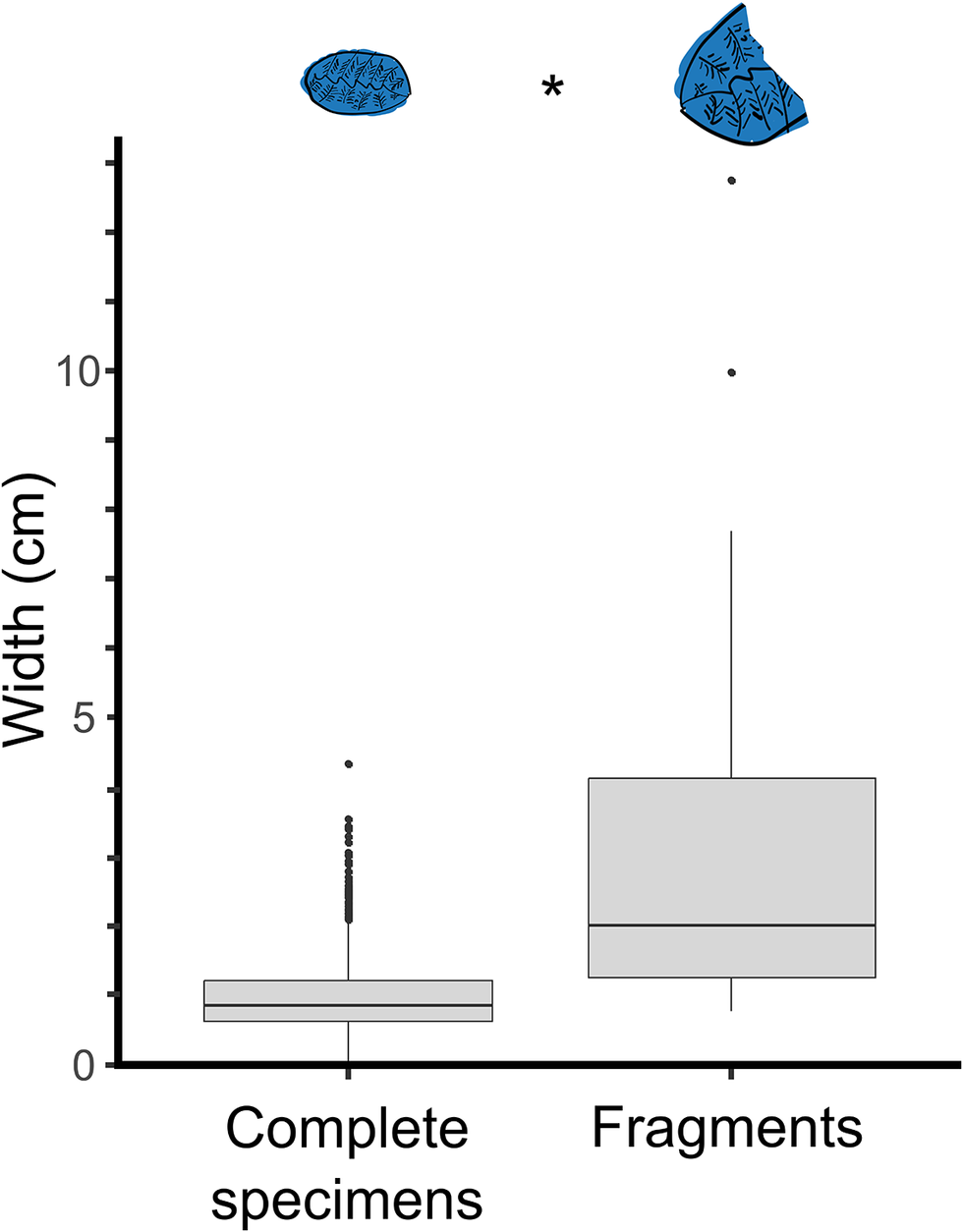
We identified 407 complete F. andersoni specimens and 28 fragmented specimens (Fig. 1B–I) on the Brasier surface (Fig. 2). We found that fragments had a significantly larger width than complete Fractofusus specimens (mean frond width: complete specimens = 1.05 cm, fragmented specimens = 3.40 cm; W = 1737, p < 0.001; Fig. 3).
Differences in the width of fragments and complete specimens of Fractofusus andersoni on the Brasier surface. Asterisk denotes a statistically significant difference.
Univariate Analysis of Complete Fractofusus Specimens
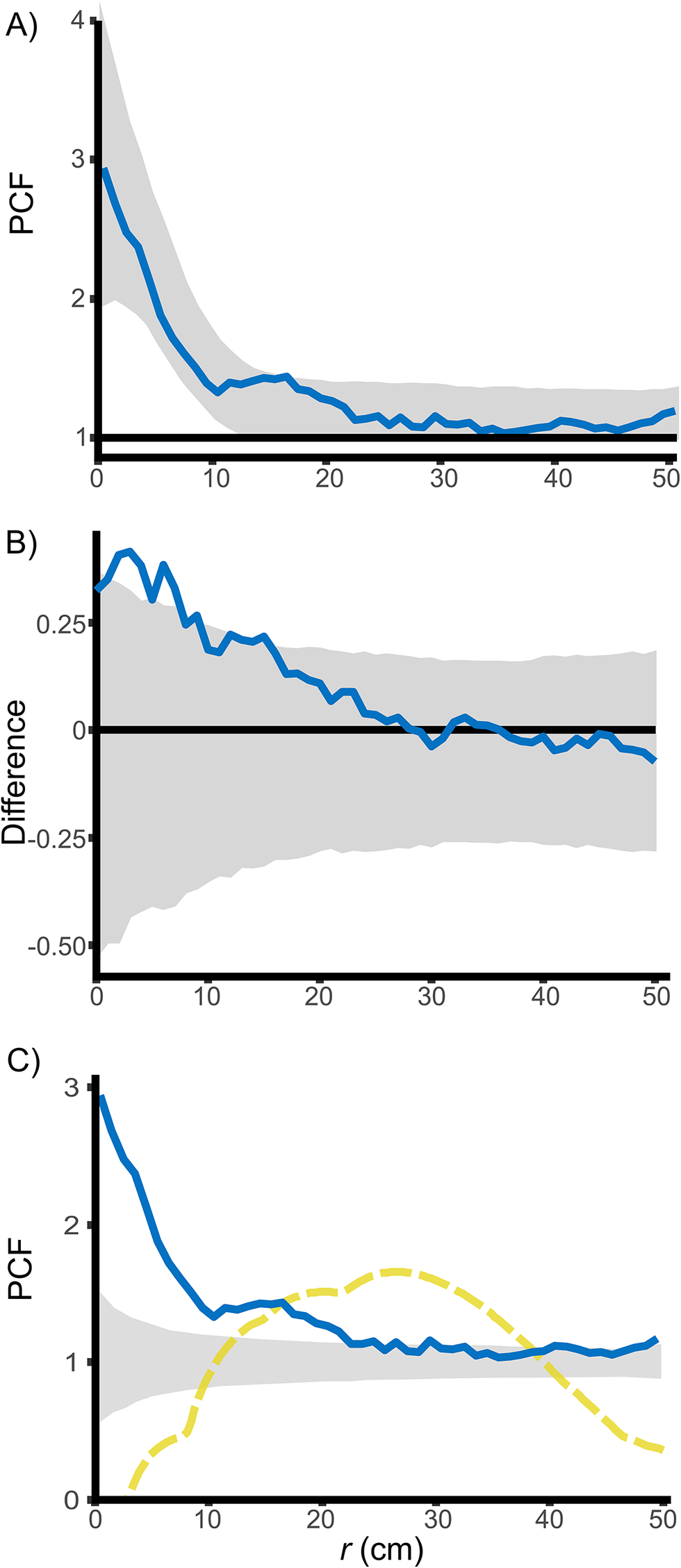
Complete F. andersoni specimens on the Brasier surface were clustered in areas where fragment density was highest, indicated by a good fit to an ITC model (pd = 0.793, range = 0–20 cm; Fig. 4A), indicating reproductive clusters forming in high fragment-density areas. In comparison, a CSR model (pd < 0.001, range = 0–20 cm) indicating no biotic or abiotic effects, a TC model (pd < 0.001, range = 0–20 cm) indicating independence from the fragments, and an HP model (pd = 0.004, range = 0–20 cm) indicating no clustering within areas of high habitat preference all had poor fit.
A, Pair correlation function (PCF) plot for inhomogenous Thomas cluster model for Fractofusus andersoni on the Brasier surface with the inhomogenous background generated from the density of fragments. B, PCF plot for density-dependent random labeling of fragments of F. andersoni on the Brasier surface. PCF in blue, simulation envelope in gray. Excursions above the simulation envelope indicate more fragments are present in areas of higher Fractofusus densities at a given distance r. C, PCFs of complete (blue) and fragmented (yellow) F. andersoni specimens on the Brasier surface. Envelope generated from complete spatial randomness model of complete Fractofusus specimens.
Random Labeling Analysis
We found that fragments were in areas of high Fractofusus densities indicated by a deviation from CSR using RLA at small spatial scales (pd = 0.059, range = 2–10 cm; Fig. 4B).
The RLA PCFs show us that the fragments and whole Fractofusus specimens on the Brasier surface are not alike, which suggests that the spatial patterns are unlikely to be caused by similar ecological processes (Fig. 4C).
Survivors
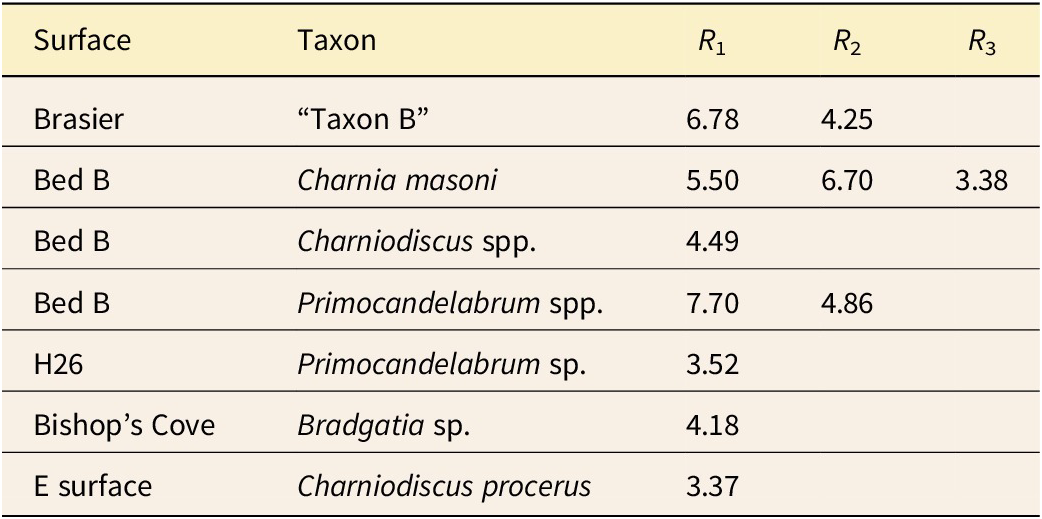
Eleven outlier specimens were identified from Rosner tests and subsequent visual assessment from seven populations across four surfaces (Table 1, Supplementary Table S1): three Charnia, two Primocandelabrum spp., and one Charniodiscus sp. specimen on Bed B; two “Taxon B” (an undescribed unifoliate rangeomorph frond) specimens on the Brasier surface; one Bradgatia sp. on the Bishop’s Cove surface; and one Charniodiscus procerus specimen on the E surface (Fig. 5). An outsized Primocandelabrum sp. specimen on H26 was also identified qualitatively, but the population on H26 was too small to apply subsequent quantitative analyses (Supplementary Table S1). All of these outlier specimens were therefore interpreted to be survivors from a disturbance event (cf. Wilby et al. Reference Wilby, Kenchington and Wilby2015). We observed that in 9 of 11 cases, the survivors represented the most abundant taxa on their respective surfaces, except for “Taxon B,” which was second most abundant behind F. andersoni on the Brasier surface and Charniodiscus procerus on the E surface (Supplementary Table S2). Notably, across all seven populations, there was no apparent signal from the presence or absence of stems: Primocandelabrum and Charniodiscus have stems and Charnia, Bradgatia, and “Taxon B” do not.
Populations with outliers identified by Rosner tests. Each Rosner statistic (R 1, R 2, and R 3) represents the statistic for an outsized individual.
Height distributions of the outlier specimens (red arrowheads) identified by Rosner tests with >10 cm difference from the population’s mean height (black arrowheads). Cartoons represent taxa: A, yellow Charnia on Bed B; B, yellow Primocandelabrum on Bed B; C, pink Charniodiscus on Bed B; D, red “Taxon B” on Brasier surface; E, pink Charniodiscus procerus on E surface; F, orange Bradgatia sp. on Bishop’s Cove.
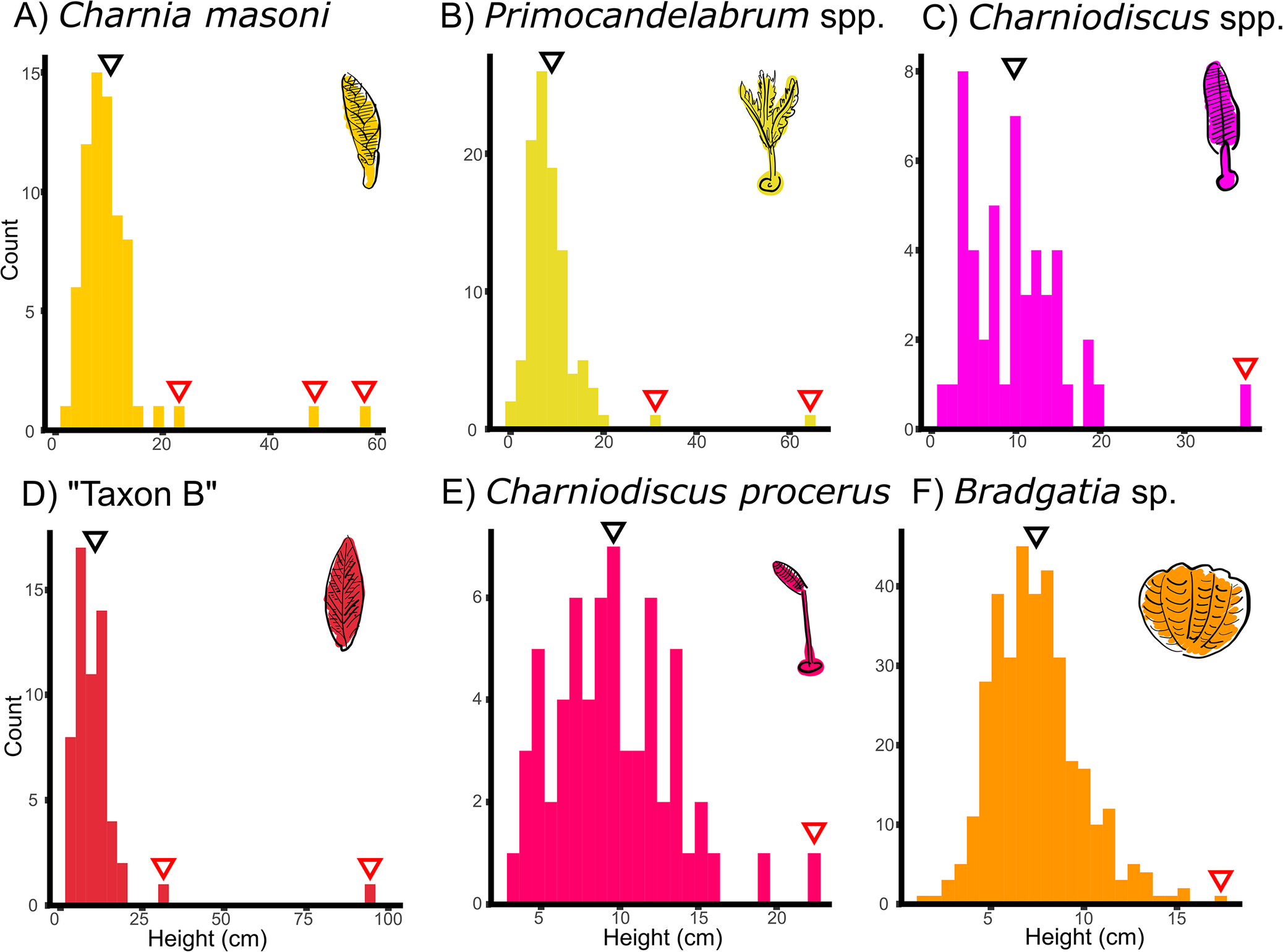
All KS tests comparing a heterogenous Poisson-distributed intensity from each outlier to a random distribution were nonsignificant (i.e., p > 0.05) (Supplementary Table S3), indicating no association between outsize specimens (survivors) and conspecific population densities.
Discussion
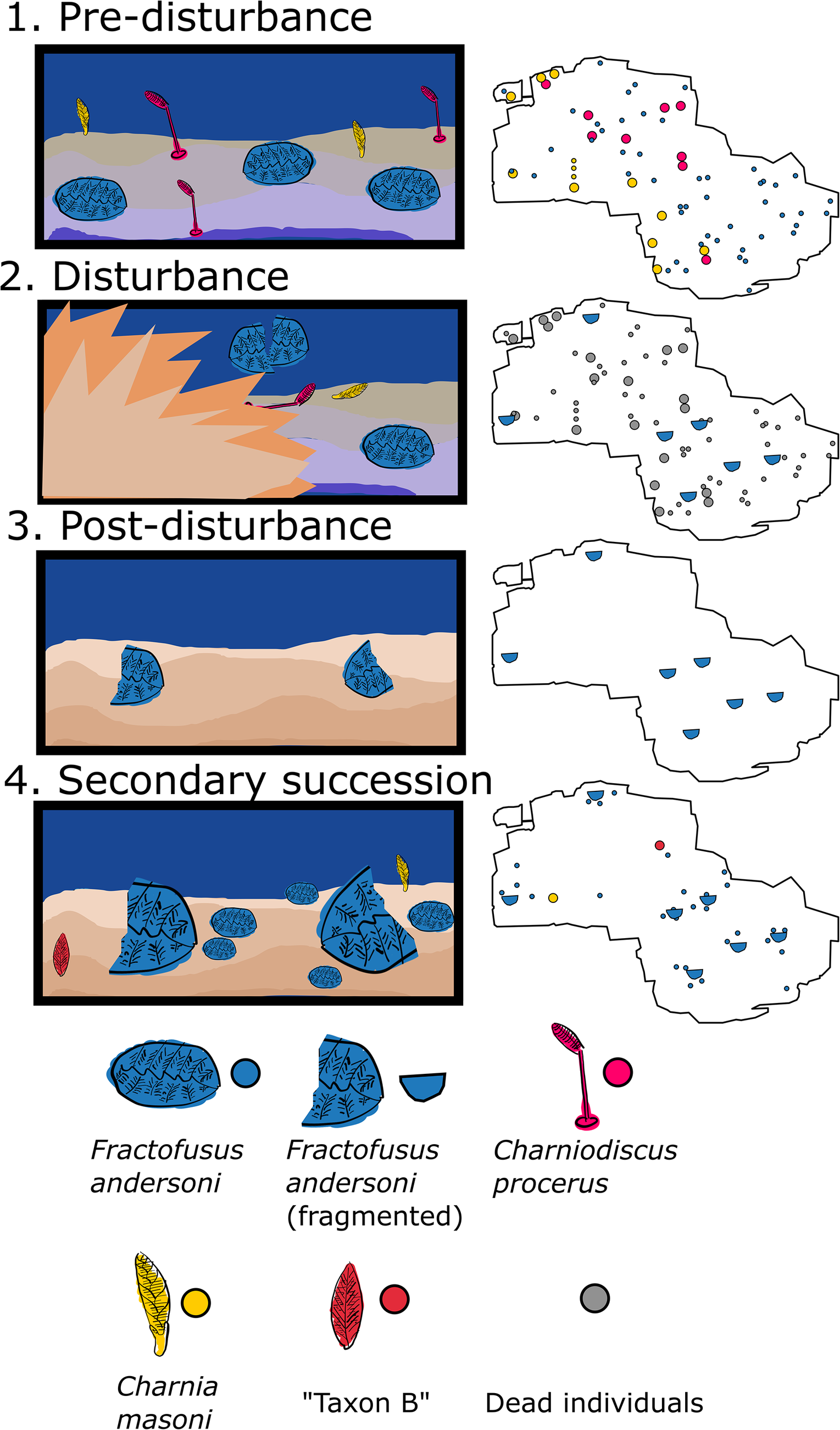
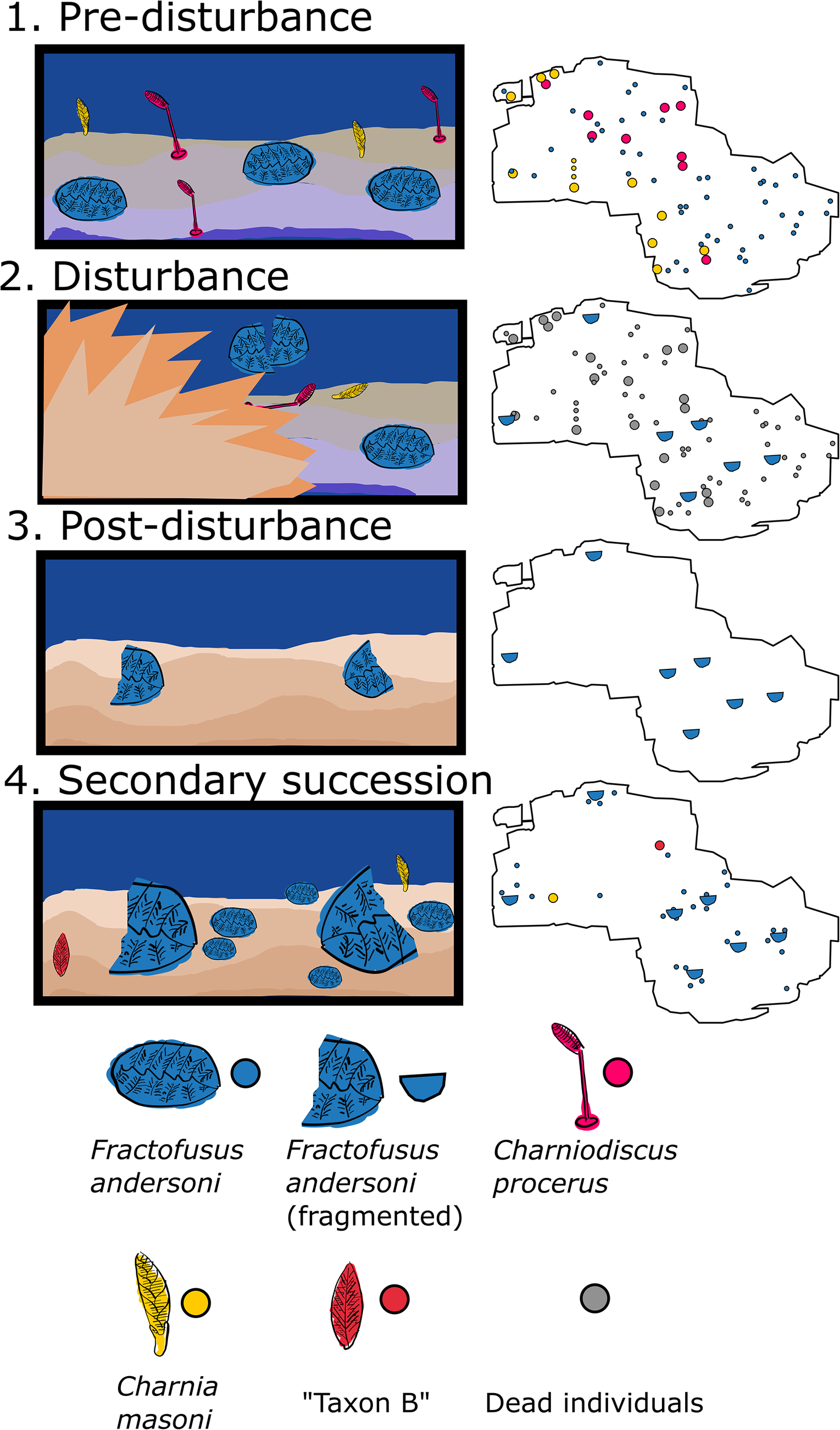
After environmental disturbance, extant organisms use both local- (meter-scale) and long-distance (greater than kilometer-scale) dispersal processes to recolonize environments (Wild et al. Reference Wild, Kopecký, Svoboda, Zenáhlíková, Edwards‐Jonášová and Herben2014; Brunner et al. Reference Brunner, Chen, Giguère, Kawagucci, Tunnicliffe, Watanabe and Mitarai2022; Kim et al. Reference Kim, Wild and Tilstra2022; Burt et al. Reference Burt, Vogt-Vincent, Johnson, Sendell-Price, Kelly, Clegg and Head2024). We tested how two types of local recolonization processes—reproductively active fragments of Fractofusus and outsize (presumed surviving) individuals—influenced the post-disturbance communities in the Avalon. Our spatial analyses showed that fragments of Fractofusus on the Brasier surface showed a positive density-dependent correlation with smaller, complete Fractofusus fossils. The dominance of Fractofusus on this surface (77.1% relative abundance), coupled with our results, are consistent with the hypothesis that fragments were reproductively active on the Brasier surface and aided in recolonization and therefore influenced secondary community succession. From our results, we interpret that a disturbance event damaged a previous population of Fractofusus, leading to fragmentation of full specimens. These fragments then reproductively seeded the preserved population of Fractofusus on the Brasier surface. Our results provide evidence that fragmentary reproduction is an effective recolonization mechanism (Fig. 6) and provide the first evidence supporting reproduction from fragments (as opposed to putative budding, waterborne propagules, or stolon from complete specimens) in early animals in the Avalon. We found that Fractofusus fragments on the Brasier surface were significantly wider than complete specimens (Fig. 4), indicating that fragments were adults in the previous community, and smaller, complete specimens represent a young, post-disturbance generation. It could be that only fragments of adults from the previous community are found on Brasier surface because the disturbance event that caused fragmentation also removed smaller individuals as a consequence of size-sorting processes. It is noteworthy that Fractofusus appears to be the most reproductively plastic Avalon taxon (waterborne [Darroch et al. Reference Darroch, Laflamme and Clapham2013; Mitchell et al. Reference Mitchell, Kenchington, Liu, Matthews and Butterfield2015], stolon [Mitchell et al. Reference Mitchell, Kenchington, Liu, Matthews and Butterfield2015; Liu and Dunn Reference Liu and Dunn2020; Delahooke et al. Reference Delahooke, Liu, Stephenson and Mitchell2024], and fragmentary reproduction described here), although detection of reproductive plasticity could be due to high abundance of Fractofusus enabling a higher likelihood of detection afforded by greater statistical power. Post-fragmentation reproductive methods are hard to disentangle; radii (2σ) of clusters from the ITC model on the Brasier surface were 6.9 cm, comparable to radii on other Avalon surfaces where reproductive Fractofusus clusters have been suggested to be stoloniferous (8.6 cm on D surface, 7.3 cm on E surface, and 5.7 cm on H14 [Mitchell et al. Reference Mitchell, Kenchington, Liu, Matthews and Butterfield2015; Supplementary Material]). We found no evidence of regrowth in any fragments (also noted in Dunn et al. [Reference Dunn, Donoghue and Liu2025]) and no evidence of stolon rip-up structures. We do not know whether the fragmented specimens originated from within the mapped area or had been moved potentially large distances from outside the mapped area. The Brasier surface is an early-succession community (Stephenson et al. Reference Stephenson, Delahooke, Barnes, Rideout, Kenchington, Manica and Mitchell2024), so because Avalon communities do not undergo turnover during succession but instead accumulate diversity while maintaining similar community compositions, it is plausible that the Brasier community could have matured to look similar to later-stage Fractofusus andersoni–dominated communities such as the Goldmine or H14 surfaces. On the D, E, and H14 surfaces—all dominated by Fractofusus, but later in succession than Brasier (Stephenson et al. Reference Stephenson, Delahooke, Barnes, Rideout, Kenchington, Manica and Mitchell2024)—we observed Fractofusus fragments, but in much lower relative abundances (0.1%, 0.3%, and 0.3% on D, E, and H14 surfaces, respectively; Supplementary Table S2). Fragments on later-stage surfaces may indicate that fragmentation could have influenced the community ecology of these surfaces earlier in succession alongside presumed long-distance, waterborne propagule effects (Clapham et al. Reference Clapham, Narbonne and Gehling2003; Mitchell et al. Reference Mitchell, Kenchington, Liu, Matthews and Butterfield2015; Eden et al. Reference Eden, Manica and Mitchell2022) by contributing to Fractofusus dominance. It is possible (although not known) that these cryptic fragments could result in “fairy ring”–like patterns of F. andersoni, which could be areas where a fragment was present, but has since decayed—a qualitative pattern observed on the H14 surface (Supplementary Fig. S1).
Planar view schematic of the processes leading to secondary Fractofusus colonization on the Brasier surface. (1) Later-succession, pre-disturbance Fractofusus-dominated community; (2) a sedimentary disturbance; (3) fragmentary remains of Fractofusus (blue) generated from the pre-disturbance community settled onto the post-disturbance substrate; (4) the post-disturbance community later in the succession—secondary processes have led to the dominance of Fractofusus due to the ecological impacts of fragments, and other taxa (yellow and red frondomorphs) have arrived via long-distance dispersal but have lower abundances. Each panel is accompanied by the expected spatial pattern of organisms for each stage of the process; the colors of points correspond to the colors of the cartoons. Gray points indicate individuals killed by the sedimentation event depicted in stage 2. Purple substrate on stage 1 indicates substrate of the previous (not fossilized) Brasier surface community, whereas orange substrate on stages 3 and 4 indicates substrate of fossilized Brasier surface community deposited by a disturbance event (stage 2).
In contrast to the fragments, surviving fronds (those that were outliers in a population’s height distribution) had minimal impact on the spatial population ecology in the 11 instances in which they were found. However, we note that, as in Wilby et al. (Reference Wilby, Kenchington and Wilby2015), 9 of 11 outlier individuals were representative of one of the most common taxa where they were found (the exceptions being “Taxon B” on the Brasier surface, which was the second most abundant taxon [10.9% relative abundance], and Charniodiscus procerus on the E surface [2.9% relative abundance]). While not included in the mapped areas of our dataset, we are aware of at least two other instances of outlier individuals that do not represent the most abundant taxon in the community: the holotype Pectinifrons specimen on Mistaken Point North (Bamforth et al. Reference Bamforth, Narbonne and Anderson2008: fig. 4) is much larger than all other specimens on the surface, which also have low abundance; and the large Frondophyllas grandis specimen on Lower Mistaken Point (Bamforth and Narbonne Reference Bamforth and Narbonne2009: fig. 2.2), which is one of only three Frondophyllas specimens on the surface. Our results show that there is no significant benefit to survival of disturbances through increased height, suggesting that height may not have evolved to survive disturbance events.
Our results show that outlier specimens are present in 5 of 19 communities, with outliers representing the most abundant taxa for 5 of 7 populations (on 3 out of 5 communities). The taxonomic identity of outliers results from a combination of random chance (which specimens get smothered, or not) and the relative abundances of the species (the greater the abundance, the more likely a single representative is to survive). The variation of taxonomic identity (Fig. 5) shows a lack of species-specific signal to survival. Therefore, the outliers were likely to be from the most abundant taxa within the pre-disturbance communities. The similarities between the taxonomic identification of the outliers with the most abundant taxa in the post-disturbance communities suggest that the sources for both pre- and post-disturbance colonizations were similar and, because our results (Supplementary Table S3) excluded local recolonization from the outlier individuals (i.e., there is no increased density around or downstream of the outliers of conspecifics), these results instead suggest that it is long-distance dispersal (i.e., from outside the mapped communities) that is seeding new communities. Our results instead reinforce the role of height in reproduction for upright Avalon taxa, as increased height increases dispersal distance, but not local survival (Gaylord et al. Reference Gaylord, Reed, Raimondi, Washburn and McLean2002; Mitchell and Kenchington Reference Mitchell and Kenchington2018), and provide further evidence of the importance of long-distance dispersal processes to Avalon community ecology (Mitchell and Kenchington Reference Mitchell and Kenchington2018; Mitchell et al. Reference Mitchell, Harris, Kenchington, Vixseboxse, Roberts, Clark, Dennis, Liu and Wilby2019, Reference Mitchell, Bobkov, Bykova, Dhungana, Kolesnikov, Hogarth and Liu2020).
In terms of time averaging on Avalon surfaces, there are two scales of time averaging that concern the analyses presented here: (1) environmentally condensed time averaging, where individuals from multiple communities, potentially separated by substantial periods of time and possibly representing different environmental regimes, appear to be preserved together; and (2) within-habitat time averaging, where multiple individuals from different generations, including dead individuals, are preserved together (Kidwell Reference Kidwell1997).
On the Avalon bedding planes, environmentally condensed time averaging is limited, because it is highly unlikely to occur with soft-bodied preservation (Butterfield Reference Butterfield2003; Liu et al. Reference Liu, Mcilroy, Antcliffe and Brasier2011, Reference Liu, Mcilroy, Matthews and Brasier2012, Reference Liu, Kenchington and Mitchell2015; Mitchell et al. Reference Mitchell, Stephenson, Buma-at, Roberts, Dennis and Kenchington2025). However, within-habitat time averaging on Avalon bedding planes can be present either in the form of decaying remains (Liu et al. Reference Liu, Mcilroy, Antcliffe and Brasier2011) or as survivors seeding secondary successions (Wilby et al. Reference Wilby, Kenchington and Wilby2015). The decaying remains of frondose taxa can be characterized into three different groups: (1) decayed such that the body form is no longer identifiable, as seen in Ivesheadiomorphs (Liu et al. Reference Liu, Mcilroy, Antcliffe and Brasier2011); (2) partially decayed specimens such that details are missing, but the gross morphology is still identifiable as a frond, or perhaps even to genus or species level (see treatment of effaced fronds in Stephenson et al. [Reference Stephenson, Delahooke, Barnes, Rideout, Kenchington, Manica and Mitchell2024]); and (3) recently dead, but with no signs of decay, so not distinguishable from specimens living at the time of burial (also see “Discussion” in Mitchell et al. [Reference Mitchell, Stephenson, Buma-at, Roberts, Dennis and Kenchington2025]). Ivesheadiomorphs are not thought to contribute to any time averaging, because they are identifiable due to their morphology (Liu et al. Reference Liu, Mcilroy, Antcliffe and Brasier2011; Mitchell and Butterfield Reference Mitchell and Butterfield2018; Mitchell et al. Reference Mitchell, Stephenson, Buma-at, Roberts, Dennis and Kenchington2025). The impacts of effaced frond taphomorphs on our Fractofusus population analyses are minimal, because Fractofusus are unlikely to be incorrectly identified as a taphomorph (e.g., an effaced frond) due to their unique branching pattern and biterminal morphology (Matthews et al. Reference Matthews, Liu, Yang, McIlroy, Levell and Condon2021; Stephenson et al. Reference Stephenson, Delahooke, Barnes, Rideout, Kenchington, Manica and Mitchell2024).
The suggestion that the Mistaken Point communities are time averaged, insomuch as the assemblages preserved include multiple communities each separated by death events superimposed atop one another (thus potentially environmentally condensed) with limited distinction between the preservation of the fossils (cf. Antcliffe et al. Reference Antcliffe, Hancy and Brasier2015), is inconsistent with the statistical identification of reproductive clusters with nonrandom spatial patterns between different size classes (Mitchell et al. Reference Mitchell, Kenchington, Liu, Matthews and Butterfield2015, Reference Mitchell, Harris, Kenchington, Vixseboxse, Roberts, Clark, Dennis, Liu and Wilby2019, Reference Mitchell, Stephenson, Buma-at, Roberts, Dennis and Kenchington2025), log-normal size distributions within populations (Darroch et al. Reference Darroch, Laflamme and Clapham2013), consistent features in Thectardis and Charniodiscus (which were implied to be taphomorphs) across multiple bedding planes (Clapham et al. Reference Clapham, Narbonne and Gehling2003; Mitchell et al. Reference Mitchell, Harris, Kenchington, Vixseboxse, Roberts, Clark, Dennis, Liu and Wilby2019, Reference Mitchell, Stephenson, Buma-at, Roberts, Dennis and Kenchington2025; Stephenson et al. Reference Stephenson, Delahooke, Barnes, Rideout, Kenchington, Manica and Mitchell2024), and sedimentological evidence that the Mistaken Point bedding planes represent true substrates and so capture in situ paleocommunities representative of original ecosystems (McMahon et al. Reference McMahon, Liu, Veenma, Vixseboxse and Boddy2025).
The impact of long-distance dispersal and colonization has been found through the primary colonization of barren substrates by waterborne Fractofusus (Mitchell et al. Reference Mitchell, Kenchington, Liu, Matthews and Butterfield2015), with lasting effects through subsequent development, because species turnover, environmental filtering, and interspecific interactions throughout succession are limited (Stephenson et al. Reference Stephenson, Delahooke, Barnes, Rideout, Kenchington, Manica and Mitchell2024). Between-community (within-metacommunity) evidence of the importance of dispersal limitation is seen in the metacommunity structure of the Avalon, where species-poor communities are subsets of species-rich communities (Eden et al. Reference Eden, Manica and Mitchell2022). In this structure, species-poor communities correspond to species-specific characteristics, which is a pattern found where there is a large species pool, with long-dispersal patterns leading to different community compositions (Presley et al. Reference Presley, Higgins and Willig2010). However, once the substrate has been colonized, local reproductive processes (fragmentation and different stoloniferous strategies [Mitchell et al. Reference Mitchell, Kenchington, Liu, Matthews and Butterfield2015; Liu and Dunn Reference Liu and Dunn2020; Delahooke et al. Reference Delahooke, Liu, Stephenson and Mitchell2024] and putative budding [Pasinetti and McIlroy Reference Pasinetti and McIlroy2023]) appear to have strong impacts on subsequent community succession. The capacity of Avalon taxa to exhibit both long-distance (Darroch et al. Reference Darroch, Laflamme and Clapham2013; Mitchell et al. Reference Mitchell, Kenchington, Liu, Matthews and Butterfield2015) and these local reproductive modes (Mitchell et al. Reference Mitchell, Kenchington, Liu, Matthews and Butterfield2015; Delahooke et al. Reference Delahooke, Liu, Stephenson and Mitchell2024; our results), perhaps mediated by the intensity of environmental disturbance, could be key in dictating community composition.
While true analogues to Avalon ecosystems are limited in the Phanerozoic (Butterfield Reference Butterfield2011; Mitchell and Pates Reference Mitchell and Pates2025), in extant, regularly disturbed ecosystems, biological legacies are important contributors to post-disturbance community ecology (Nyström and Folke Reference Nyström and Folke2001; Wild et al. Reference Wild, Kopecký, Svoboda, Zenáhlíková, Edwards‐Jonášová and Herben2014; Bače et al. Reference Bače, Svoboda, Janda, Morrissey, Wild, Clear, Čada, Donato and Chen2015; Pérez-Hernández and Gavilán Reference Pérez-Hernández and Gavilán2021). In many modern deep-sea environments, particularly in isolated environments such as hydrothermal vents, long-distance dispersal is an important component of community structuring (Brunner et al. Reference Brunner, Chen, Giguère, Kawagucci, Tunnicliffe, Watanabe and Mitarai2022). Similarly, patchy disturbance generated by sedimentation events (such as turbidites in the Avalon) is likely to have produced large-scale heterogeneity and mosaic effects (Bigham et al. Reference Bigham, Rowden, Leduc and Bowden2021), with long-distance dispersal helping to populate these patches. Given a global distribution of taxa such as Charnia in the Ediacaran (Grazhdankin et al. Reference Grazhdankin, Balthasar, Nagovitsin and Kochnev2008; Darroch et al. Reference Darroch, Laflamme and Clapham2013; Boddy et al. Reference Boddy, Mitchell, Merdith and Liu2022; Wu et al. Reference Wu, Pang, Chen, Wang, Zhou, Wan, Yuan and Xiao2024), and an Avalon metacommunity structure wherein the diversity of individual sites represents subsets of the total diversity pool within limited environmental specialization (Eden et al. Reference Eden, Manica and Mitchell2022), coupled with our results showing the importance of local colonization strategies, it is likely that similar long-distance adaptations were in place in the Avalon. Similar patterns of intense disturbance alongside dispersal limitations are seen in the Antarctic deep sea (Griffiths et al. Reference Griffiths, Whittle and Mitchell2023), where most sessile organisms are dispersal limited (Thatje Reference Thatje2012), shaping high beta diversity (Thrush et al. Reference Thrush, Hewitt, Cummings, Norkko and Chiantore2010). Disturbance in the form of ice scours provides the major form of ecological turnover (Thatje Reference Thatje2012) in the absence of widespread predation (Smith et al. Reference Smith, Aronson, Steffel, Amsler, Thatje, Singh and Anderson2017; Khan et al. Reference Khan, Griffiths, Whittle, Stephenson, Delahooke, Purser, Manica and Mitchell2024), so that the survival of disturbance and occupation of refugia is of substantial ecological importance (Potthoff et al. Reference Potthoff, Johst and Gutt2006; Barnes and Conlan Reference Barnes and Conlan2007), thus similar to the frequently disturbed Avalon communities. Therefore, the importance of a combination of long-distance dispersal and local recolonization effects in the Avalon is strikingly similar to trade-offs in some modern deep-sea organisms, as alternative colonization strategies in the Avalon reflect a combination of disturbance responses alongside the influence of long-distance dispersal from the surrounding metacommunity.
Acknowledgments
Funding was provided by a School of Biological Sciences Balfour Studentship (PFAG/076) to NPS; a Natural Environment Research Council C-CLEAR DTP studentship (LBAG/265.03.G10) to KMD; a Natural Environment Research Council C-CLEAR DTP studentship (NE/S007164/1, with project reference 2889755) to PAB; Leverhulme Trust Funding (ECF-2018-542) and from the Isaac Newton Trust (INT18.08(h)) to CGK; a Natural Environment Research Council Standard Grant (NE/P002412/1) and an Independent Research Fellowship (NE/S014756/1) to EGM. The Parks and Natural Areas Division, Department of Environment and Conservation, Government of Newfoundland and Labrador, provided permits to conduct research within the Mistaken Point Ecological Reserve (MPER) in 2010, 2016–2019, and 2021–2023. Readers are advised that access to MPER is by scientific research permit only. Fossil surfaces in the Bonavista Peninsula and Bay Roberts area are protected under Reg. 67/11, of the Historic Resources Act 2011 and their access is only allowed under permit from the Government of Newfoundland and Labrador. Fieldwork in the Discovery Geopark and the Bay Roberts area was conducted under permit from the Government of Newfoundland and Labrador. Bed B forms part of a designated Site of Special Scientific Interest (SSSI), protected in law and administered by Natural England. Access to Bed B casts was facilitated by BGS and P. Wilby. We thank F. Dunn for helpful discussion. We thank E. Samson for everything she does to support us and our work.
Author Contribution
This work was conceptualized by N.P.S. and E.G.M. Data collection was carried out by N.P.S., K.M.D., N.B., B.W.T.R., C.G.K., and E.G.M., and the data were processed by N.P.S., K.M.D., and E.G.M. Statistical analyses were conducted by N.P.S., K.M.D., and E.G.M. The original draft was written by N.P.S., P.A.B., A.M., and E.G.M., and all authors contributed to the review and editing of the final manuscript.
Competing Interests
The authors declare no conflicts of interest.
Data Availability Statement
Code to reproduce this research is available at: https://github.com/nis38/NPS_dex and https://github.com/nis38/Secondary_Succession. Data are available at the Dryad digital repository at https://doi.org/10.5061/dryad.66t1g1kcx and the Zenodo digital repository at https://doi.org/10.5281/zenodo.16921058.




 Open access

