


Introduction
Financial exploitation (FE) of older adults is defined as the improper or illegal use of an older person’s funds, properties or assets (Wood and Lichtenberg Reference Wood and Lichtenberg2017). Approximately 1 in 20 older adults will experience FE each year (Burnes et al. Reference Burnes, Henderson, Sheppard, Zhao, Pillemer and Lachs2017), though higher estimates have been suggested more recently (e.g. 15 per cent according to a 2021 AARP report; Shadel et al. Reference Shadel, Williams, Pak and Choi-Allum2021). Such estimates are likely to be conservative as many cases go unreported for various reasons, including reluctance to report (Spreng et al. Reference Spreng, Karlawish and Marson2016) and recent technological shifts (e.g. the rise of artificial intelligence, online banking) having created many new fraud and scam modalities.
Financial exploitation is a serious event that results in devastating consequences. Beyond the significant financial impact of FE (Gunther Reference Gunther2023), the literature has documented negative social (Lowenstein et al. Reference Lowenstein, Eisikovits, Band-Winterstein and Enosh2009; Nguyen et al. Reference Nguyen, Mosqueda, Windisch, Weissberger, Axelrod and Han2021), physical (Dong and Simon Reference Dong and Simon2013; Burnett et al. Reference Burnett, Jackson, Sinha, Aschenbrenner, Murphy, Xia and Diamond2016) and mental health consequences (Lavery et al. Reference Lavery, Hasche, DePrince, Gagnon, Srinivas and Boyce2020; Wu et al. Reference Wu, Shen, Chen, Zhang, Cao, Xiang and Wang2013; see Folorunsho and Okyere Reference Folorunsho and Okyere2025 for review). In an effort to understand how to prevent FE in older adulthood, a growing body of work over recent years has identified various psychosocial, cognitive and behavioural risk factors of FE (see Spreng et al. Reference Spreng, Ebner, Levin, Turner and Factora2021 for review). In this study, we examined the interactive role of different types of social relationships and cognitive functioning in predicting FE experiences in a nationally representative sample of older adults living in the Israeli community.
Literature review
The experience of FE usually involves a social transaction between the victim and the exploiter (Spreng et al. Reference Spreng, Karlawish and Marson2016). Thus, it stands to reason that social factors may play an important role in modifying FE risk. Consistent with this, social network size, loneliness and reduced social support have been identified as correlates of FE or FE risk (Lichtenberg et al. Reference Lichtenberg, Stickney and Paulson2013; Liu et al. Reference Liu, Wood, Xi, Berger and Wilber2017; Beach et al. Reference Beach, Schulz and Sneed2018; Lim et al. Reference Lim, Mosqueda, Nguyen, Mason, Weissberger, Fenton, Lichtenberg and Han2023; DeLiema et al. Reference DeLiema, Gao, Brannock and Langton2024; Weissberger Reference Weissberger2024). While the exact reason why certain social factors modify FE risk remains unclear, it has been suggested that the presence of close others in supportive roles may help safeguard individuals who face the malicious intentions of exploiters (DeLiema et al. Reference DeLiema, Gao, Brannock and Langton2024). This idea is consistent with routine activity theory (Cohen and Felson Reference Cohen and Felson1979), adapted by DeLiema (Reference DeLiema2018) to explain FE of older adults. Routine activity theory posits that for criminal acts to occur, there must be a motivated offender, a suitable target and the absence of capable guardians (Cohen and Felson Reference Cohen and Felson1979). In DeLiema’s (Reference DeLiema2018) application of the theory, suitable targets of fraud (FE by someone unknown to the victim) or financial abuse (FE by someone known to the victim; termed FE in her study) are those who carry certain vulnerabilities such as being cognitively impaired and/or socially isolated. In examining records of forensic center elder mistreatment cases, DeLiema found that fraud victims were more likely to be childless and financial abuse victims were more likely to be widowed, suggesting that their family structures may have increased their suitability as targets of FE and reduced the likelihood that social safeguards (i.e. capable guardians) were in place to help prevent the FE from occurring (DeLiema Reference DeLiema2018). These findings underscore the importance of a thorough investigation of social network compositions in a large and representative sample of older adults with experienced FE.
Cognitive functioning may also play an important role in the degree to which someone is a suitable target of FE. Research has demonstrated that poor cognitive functioning can negatively impact financial decision-making (Boyle et al. Reference Boyle, Yu, Wilson, Gamble, Buchman and Bennett2012; Han et al. Reference Han, Boyle, James, Yu and Bennett2015; James et al. Reference James, Boyle, Yu, Han and Bennett2015), thereby increasing susceptibility to FE (Fenton et al. Reference Fenton, Weissberger, Boyle, Mosqueda, Yassine, Nguyen, Lim and Han2022). Cognitive functioning may also play a role in the degree to which social safeguards are needed (DeLiema Reference DeLiema2018). In this regard, DeLiema (Reference DeLiema2018) posits that older adults without significant or obvious cognitive impairments are less likely to rely on others within their social circle for help with financial decisions. In contrast, those with cognitive impairment will be more likely to need dependable guardians to help safeguard their financial decisions. A number of studies have shown that victims of FE, or those at greater risk of FE, have lower cognitive functioning (Boyle et al. Reference Boyle, Wilson, Yu, Buchman and Bennett2013; Wood et al. Reference Wood, Rakela, Liu, Navarro, Bernatz, Wilber, Allen and Homeier2014; Lim et al. Reference Lim, Weissberger, Axelrod, Mosqueda, Nguyen, Fenton, Noriega, Erdman and Han2025), though other studies have not (Spreng et al. Reference Spreng, Cassidy, Darboh, DuPre, Lockrow, Setton and Turner2017; Ueno et al. Reference Ueno, Daiku, Eguchi, Iwata, Amano, Ayani, Nakamura, Kato, Matsuoka and Narumoto2021; see Fenton et al. Reference Fenton, Weissberger, Boyle, Mosqueda, Yassine, Nguyen, Lim and Han2022 for a review). These contradictions indeed raise the possibility that impaired cognitive functioning is an important risk factor of FE when it co-occurs with other vulnerabilities, such as a lack of dependable and/or trustworthy guardians within one’s social network. Thus, examining whether cognitive functioning interacts with the presence of certain social network relationships to predict FE may shed light on the nuances of these separate risk factors and their relationships to FE.
The present cross-sectional study aimed to examine the social network compositions of older adults who self-reported (versus those who did not report) an experience of FE in the Israeli component of the Survey of Health, Ageing and Retirement in Europe (SHARE-Israel), a nationally representative survey of community living older adults. As a first aim, we examined whether the presence of specific relationship types (children, spouses, other family or friends) within a person’s social network predicts FE group membership. As a second aim, we examined whether the presence or absence of these different relationship types interacted with a composite score of cognitive functioning (comprising word list learning and recall, animal fluency, and serial 7s) to predict FE group membership. Exploratory follow-up models examined cognitive tests separately. First, we hypothesized that a lack of children and spouses in particular would predict FE group membership, consistent with previous studies that have shown that not being in a relationship (Podnieks Reference Podnieks1992; Laumann et al. Reference Laumann, Leitsch and Waite2008; DeLiema Reference DeLiema2018) or being childless (DeLiema Reference DeLiema2018; though see Parti Reference Parti2023) is associated with FE or risk of FE. Second, we hypothesized that lower cognitive functioning would be associated with FE group membership. Finally, we hypothesized that the association between each relationship type and FE group membership would be strongest for those with lower cognitive functioning, as these may be the individuals in most need of social safeguards.
Method
Participants and procedure
Participants were part of SHARE-Israel Wave 8 (Bergmann and Börsch-Supan Reference Bergmann and Börsch-Supan2021; Börsch-Supan et al. Reference Börsch-Supan, Brandt, Hunkler, Kneip, Korbmacher, Malter, Schaan, Stuck and Zuber2013; SHARE-ERIC 2024), which represents a national sample of community-dwelling Israelis aged 50 or older. Data for this wave were collected during 2019/2020 but, due to the outbreak of Coronavirus in March 2020, only 70 per cent of data collection for Wave 8 had been completed prior to the outbreak (SHARE-ERIC 2024). Data were collected via computer-assisted personal interviews. A supplementary paper drop-off questionnaire, which includes questions unique to each country, was also completed and returned. All respondents provided their informed consent prior to beginning the interview. SHARE-Israel received ethical approval from the Institutional Review Board of Hebrew University (for more on SHARE-Israel, see Shrira et al. Reference Shrira, Shmotkin and Litwin2012).
Our focus in this study was on the question regarding FE, which was included within the Israeli drop-off questionnaire. Thus, our sample was limited to those individuals who answered this question. Of the 936 participants who participated in the Israeli Wave 8 sample and had social network data available, 774 responded to the drop-off questionnaire. These participants were younger (p < 0.001), more educated (p < 0.001), reported fewer chronic diseases (p = 0.005), self-reported being healthier (p < 0.001), and reported less financial strain (p < 0.001) compared to the group that did not complete the drop-off questionnaire. Groups did not differ in gender distribution (p = 0.189). Of the 774 participants who completed the drop-off questionnaire, 5 participants did not respond to the question regarding FE. Two additional participants were under the age of 50 and thus excluded from the analyses. Due to the fact that cognitively impaired individuals in the SHARE do not complete the full cognitive assessment, we also excluded participants who indicated ever having received or currently having a diagnosis of ‘Alzheimer’s disease, dementia, senility’. There were 21 participants (2 with FE, 19 without FE) who were excluded for responding affirmatively to this question. Two did not respond to the question and were also excluded. An additional 25 participants were missing at least two of the four cognitive test scores. Finally, we excluded participants with orientation scores of 0 or 1. On this item, participants are asked to indicate the date, month, day of the week and year. The score falls on a scale of 0 ‘not oriented’ to 4 ‘fully oriented’. There were 15 participants who received a score of 0 or 1 on this item, leaving a total sample of 704 participants (76.8 per cent of the total Israeli sample who participated in Wave 8 prior to the Covid-19 outbreak; M age = 71.90, SD = 8.08, range = 53–103; 58.8 per cent female).
Measures
Financial exploitation (FE)
In Israel’s drop off questionnaire, participants are asked to indicate the number of times (once, more than once) they have experienced certain situations over the past 12 months. The item referring to FE (‘I have experienced financial harm or exploitation because of my age’) was used in the present study. Of the 704 participants, 124 participants (17.6%) answered affirmatively to this question. Of those who responded positively, 78 (62.9%) indicated experiencing FE ‘once’ and 47 (37.1%) indicated ‘more than once’. There were 580 participants who answered ‘never’. For the purposes of the present study, this variable was dichotomized such that those who indicated at least one FE experience (n = 124) were included in the FE group (coded as 1) while those who denied an experience (n = 580) were included in the non-FE group (coded as 0).
Social networks
In this survey module, participants are asked to name up to a maximum of seven people whom they consider to be confidants. Then, participants are queried regarding their relationship to each social network member and other characteristics. In this investigation, we focused on the presence (1) or absence (0) of relationship types within participants’ social networks, with specific focus on the following relationship types: children, spouses, other family (i.e. not children or spouses) and friends. Responses of ‘does not apply’ were treated as 0 for each relationship type. Other response options of ‘don’t know’ and ‘refusal’ were treated as missing.
Cognitive functioning
A global cognitive score was calculated for each participant based on four cognitive tests administered during Wave 8. These tests included word list total learning, word list total delayed recall, verbal animal fluency, and serial 7s (referred to as numeracy within the survey; subtracting backwards from 100 in increments of 7). With regards to the word list, participants were presented with a list of ten words and asked to immediately recall the list, and to recall the list after a delay during which they performed other cognitive tests. In order to calculate the global cognition score for each participant, each cognitive test score was z-transformed based on the test’s sample mean and standard deviation. The average of the z-scores across the four cognitive tests was then calculated to extract a global cognition score for each participant. Participants missing two or more test scores were excluded from the analyses. In follow-up analyses, each individual test’s z-score was considered separately in statistical models.
Covariates
Age at the time of the interview, gender (male = 0, female = 1) and education level were considered as covariates in all models. Education ranged on a scale of 1 to 6 and was based on the International Standard Classification of Education (ISCED-97) codes. Health status was also considered in all models using both self-reported health, ranging on a scale from 1 ‘poor’ to 5 ‘excellent’, and number of chronic diseases (ranging from 0 to 10). Self-rated financial status (‘To what degree is your household able to make ends meet?’) was also entered as a covariate in all models. This variable ranged on a scale of 1 (‘with great difficulty’) to 4 (‘easily’).
Statistical analyses
All statistical analyses were conducted in R Statistical Software (v4.3.2; R Core Team 2021). Prior to testing study hypotheses, bivariate analyses were performed to examine differences between FE and non-FE groups across all other study variables. Then, to examine main effects and interaction effects of different social network relationship types and global cognition on FE group status, we ran a hierarchical logistic regression model. Covariates of age, gender, education, number of chronic diseases, self-rated health and self-rated financial status were included and entered as the first step. In the second step, we entered the main effects of global cognition and the four relationship types. Following this step, we added the interaction of global cognition and a social network relationship type. This third step was repeated for each of the four relationship types. Significant interactions were probed using the PROCESS Macro for R (Hayes Reference Hayes2018). Follow-up logistic regression analyses considered interactions with each cognitive test separately for only those relationship types that interacted significantly with the global cognition score in predicting FE status. Multicollinearity between study variables was rejected as variance inflation factors ranged between 1.05 and 1.62.
Results
Differences between FE and non-FE groups across study variables
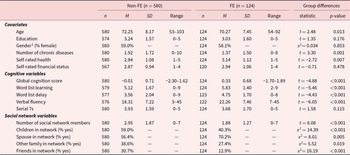
There were 124 participants (M age = 70.27, SD = 7.45, range = 54–92, 58.1 per cent female) included within the FE group for responding affirmatively to the FE question, and 580 participants included in the non-FE group for denying an FE experience (M age = 72.25, SD = 8.17, range = 53–103; 59.0 per cent female). Participant characteristics and descriptive statistics, as well as group differences across study variables, are presented in Table 1. The FE group was significantly younger (p = 0.013) than the non-FE group. With regards to health status, the FE group self-rated their health as significantly better (p = 0.007) and reported fewer chronic diseases (p = 0.001) than the non-FE group. Groups did not differ with regards to reported education level, gender or self-rated financial status (all ps  $ \geqslant $0.176).
Participant characteristics, scores on cognitive tests, and composition of social networks separately for FE (n = 124) and non-FE (n = 580) participants. Differences between FE and non-FE participants were tested using independent samples t-tests or chi-square tests of independence

Table 1 Long description
The table compares characteristics, cognitive test scores, and social network composition between financially exploited and non-exploited participants. Financially exploited individuals scored higher on a composite score of cognition, and on tests of word list learning, word list delay, and verbal fluency, with significant differences noted. However, they had fewer social network members and a lower percentage of children and friends in their networks compared to non-exploited participants. Age and education levels showed no significant differences between the groups.
Notes:
1Male = 0; female = 1; FE = financially exploited group; non-FE = non-financially exploited group; M = mean; SD = standard deviation; education was based on the ISCED-97 codes (1 = primary education or first stage basic education; 2 = lower secondary or second stage basic education; 3 = upper secondary education; 4 = post-secondary non-tertiary education; 5 = first stage tertiary education; 6 = second stage tertiary education).
With regards to cognition, global cognition composite scores were significantly higher in the FE group (p < 0.001). Examining each cognitive test separately revealed that the FE group obtained higher scores on all cognitive tests (verbal fluency, word list learning, and word list delay; all ps < 0.001) with the exception of serial 7s in which they did not differ from non-FE participants (p = 0.115).
With regards to social network variables, the FE group had on average one fewer social network member than the non-FE group (mean social network size: FE, M = 1.88, SD = 1.27; non-FE, M = 2.95, SD = 1.87), a statistically significant difference (p < 0.001). Chi-square tests of independence revealed that a smaller percentage of FE participants reported having a child in their network (40.3%) compared to the non-FE group (59.0%), a statistically significant difference (p < 0.001). In contrast, the FE group was more likely to report a spouse in network (70.2%) compared to the non-FE group (56.4%; p = 0.005). A smaller percentage of FE participants reported having other family (non-children, non-spouses) in their network (27.4%) compared to the non-FE group (38.6%; p = 0.019). Finally, the FE group was less likely to report the presence of friends in their networks (12.9%) compared to the non-FE group (30.7%; p < 0.001).
Logistic regression models examining main effects of relationship types within social networks and interactions with global cognition on FE group status
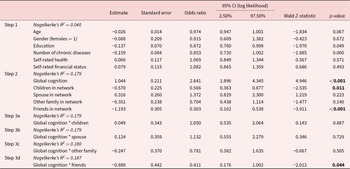
Results of the logistic regression models are summarized in Table 2. In the first step, covariates of age, education, gender, number of chronic diseases, self-rated health status and self-rated financial status were entered into the model. This revealed a main effect of education such that higher education was associated with a lower likelihood of FE group membership (OR = 0.87, 95% CI [0.76–1.00], p = 0.049). In the second step, we found a main effect of global cognition, such that having higher global cognition was associated with a higher likelihood of FE group membership (OR = 2.84, 95% CI [1.90–4.35], p < 0.001). With regards to the social network relationship types, the presence of children or friends in network were associated with lower likelihood of FE group membership (children: OR = 0.57, 95% CI [0.36–0.88], p = 0.011; friends: OR = 0.30, 95% CI [0.16–0.54], p < 0.001). Main effects of spouse and other family were not found (both p = 0.140).
Results of the logistic regression analyses which regressed FE group (1 = yes; 0 = no) on covariates (step 1), social network relationship types and global cognition (step 2) and interactions between relationship types and global cognition (steps 3a–3d)
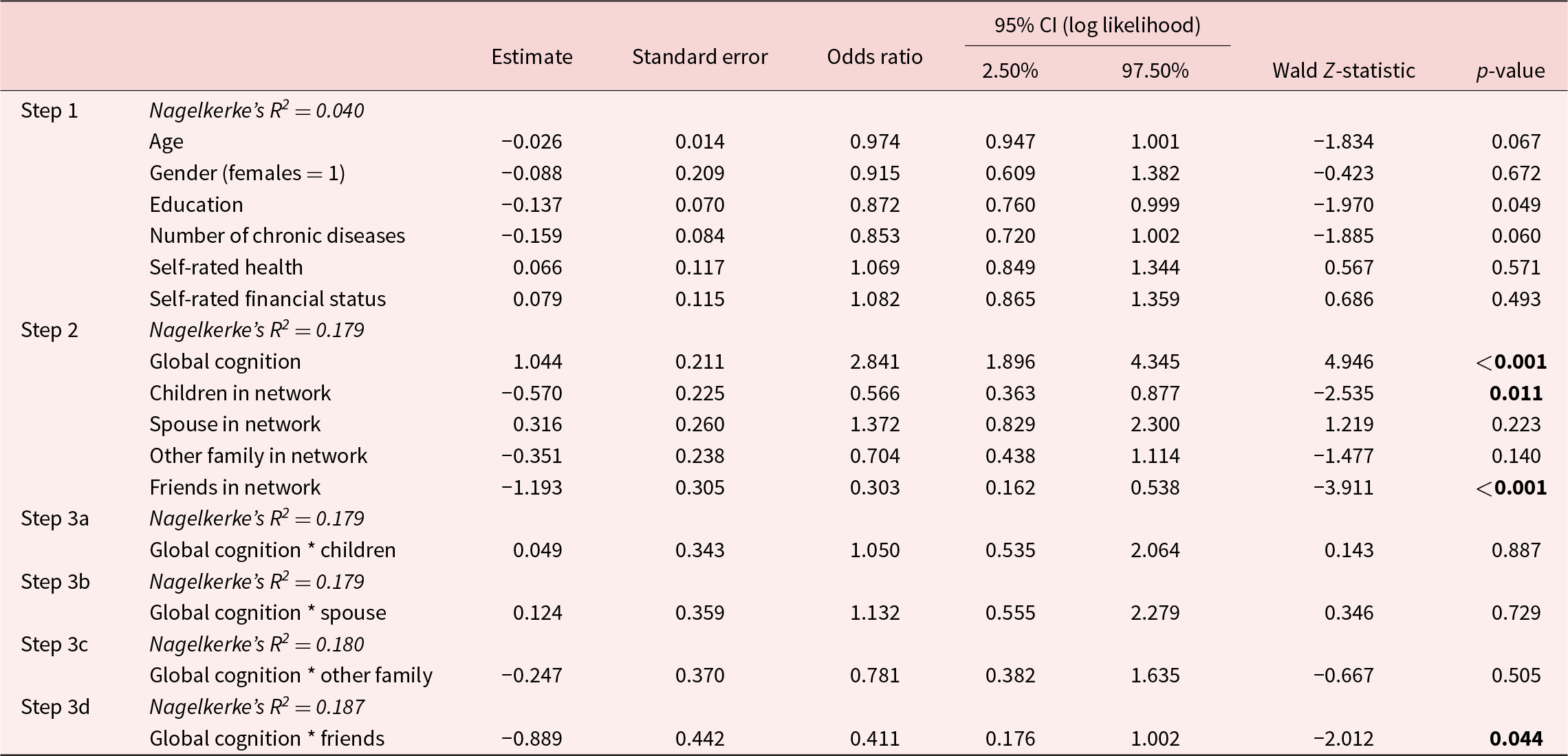
Table 2 Long description
The table presents logistic regression results examining factors associated with FE group membership. Step 1 shows age, education, and number of chronic diseases slightly reduce odds, while self-rated health and financial status have minimal effect. Step 2 highlights global cognition as a strong positive predictor, whereas having children or friends in the network reduces odds. Step 3 explores interactions between global cognition and social network types, revealing non-significant effects except for a significant effect with friends.
Note: For all dichotomous social network variables, presence of the relationship type was coded as 1 and absence was coded as 0.
Step 3 of the model tested the interaction between global cognition and relationship types. This step was repeated four times, once for each relationship type. This revealed that the interaction between global cognition and the presence of friends in network was significant (OR = 0.41, 95% CI [0.18–1.00], p = 0.044). The interactions between global cognition and children, spouses and other family were not significant (all p= 0.505).
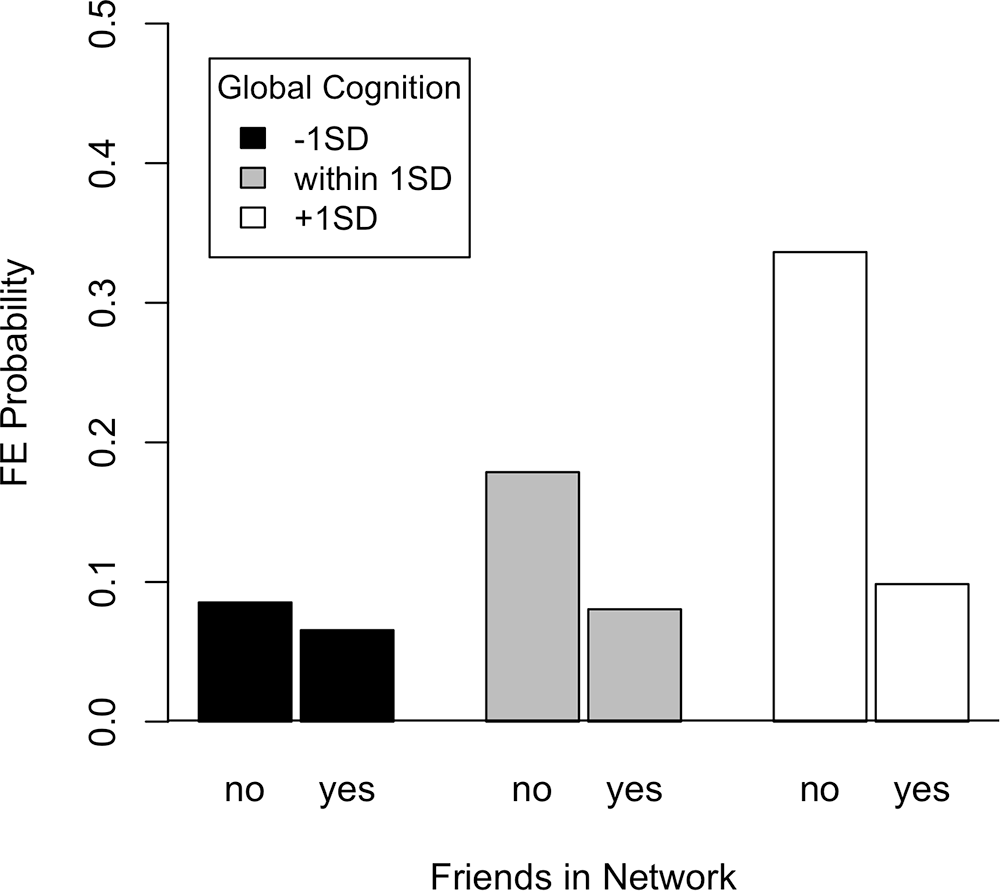
The significant interaction was probed in PROCESS. In this regard, the conditional effect of having friends in network was examined at three different levels of global cognition composite scores: scores falling below one standard deviation (SD) of the mean (−1SD), scores within one SD of the mean (within 1SD) and scores above one SD of the mean (+1SD). Having friends in network was associated with a lower probability of FE for those with average global cognition (within 1SD; B = −0.91, SE = 0.31, p = 0.004) and for those with high global cognition (+1SD; B = −1.53, SE = 0.37, p < 0.001). The effect was not significant for those with low global cognition (p = 0.568). Figure 1 displays this interaction effect.
Probability of being in the FE group for those with and without friends in network at three different levels of global cognition: (1) global cognition scores below one standard deviation of the mean (−1SD); (2) global cognition scores within one standard deviation of the mean (within 1SD); (3) global cognition scores above one standard deviation of the mean (+1SD).

Figure 1 Long description
A bar graph illustrating FE probability based on friends in network and global cognition levels. The x-axis is labeled 'Friends in Network' with categories 'no' and 'yes'. The y-axis is labeled 'FE Probability' ranging from 0 to 0.5. Three sets of bars represent different global cognition levels: below one standard deviation (black), within one standard deviation (gray) and above one standard deviation (white). For 'no' friends, the probabilities are approximately 0.1, 0.25 and 0.45 for each cognition level respectively. For 'yes' friends, the probabilities are approximately 0.1, 0.15 and 0.1 for each cognition level respectively.
Of note, we conducted a supplementary analysis to examine whether associations differed between younger and older participants in the sample, defined using a median split at age 71. Specifically, we tested interactions between age groups and the main predictor variables (main effects and two-way interactions). None of the interactions with age group were significant and patterns of results remained the same. This suggests that findings were not driven primarily by younger or older participants in the sample.
Exploratory logistic regression models examining interactions between social network variables and specific cognitive domains
We considered the interactive effect of each cognitive test separately in a series of exploratory logistic regression models to examine whether specific cognitive functions were driving the effects observed. To this end, four models, one for each cognitive test, were run to test interactions with friends in network as this was the only social network variable found to interact significantly with global cognition in the main analyses. In the first step, covariates were entered into the model along with the other social network relationship types (children, spouse, other family). In the second step, main effects of friends in network and the cognitive test were examined. Finally, a third step added the friends by cognitive test interaction term. Steps 2 and 3 were repeated for each cognitive test. Results are presented in Supplementary Table 1. The interaction effect was significant for word list delay (OR = 0.54; 95% CI [0.30–0.98], p = 0.040). A marginal effect was found for verbal fluency (OR = 0.56; 95% CI [0.30–1.01], p = 0.057) and word list learning (OR = 0.56; 95% CI [0.30–1.06], p = 0.070). The interaction effect was not significant for serial 7s (p = 0.399).
The significant interaction effect was probed with PROCESS. A pattern similar to that observed with global cognition was found; the effect of friends in network on FE group membership was significant for those with average and high word list delay scores (within 1SD, B = −0.81, SE = 0.32, p = 0.010; +1SD, B = −1.44, SE = 0.35, p < 0.001), but not for those with low word list delay scores (p = 0.707). See Supplementary Figure 1 for a visualization of this interaction.
Discussion
In this study, we examined which social network relationship types are associated with FE group membership and whether cognitive functioning moderates these relationships. Our hypotheses were partially confirmed. We found that the absence of children and friends, but not spouses, was associated with FE group membership. Contrary to our expectations, higher global cognitive functioning was associated with FE, and the absence of friends in network increased the likelihood of belonging to the FE group specifically for those with average or above-average levels of global cognition. Follow-up analyses showed that this was largely driven by word list delay, a measure of episodic memory.
A handful of other studies have found that older adults who experienced FE were more likely to be childless (Jackson and Hafemeister Reference Jackson and Hafemeister2011; DeLiema Reference DeLiema2018). In interpreting these findings through the lens of routine activity theory (Cohen and Felson Reference Cohen and Felson1979; DeLiema Reference DeLiema2018), which posits that crimes occur when there is a suitable target, lack of capable guardians and a motivated offender, children and friends may fill in roles of capable guardians in that they may help safeguard older adults who come into contact with exploiters (DeLiema et al. Reference DeLiema, Gao, Brannock and Langton2024).
Contrary to past studies (e.g. Podnieks Reference Podnieks1992; Laumann et al. Reference Laumann, Leitsch and Waite2008; DeLiema Reference DeLiema2018), the absence of a spouse in network did not predict FE group membership. In fact, when examining bivariate analyses, a higher percentage of the FE group had a spouse (70.2%) compared to the non-FE group (56.4%). Differences between studies may lie in the fact that other contextual and psychosocial factors determine the degree to which certain relationship types are protective against FE. For example, Weissberger and Bergman (Reference Weissberger and Bergman2025) similarly did not find a main effect of being in a relationship (marriage or long-term partnership) and FE vulnerability. However, the authors found that being in a relationship mitigated FE vulnerability specifically for those who had poor reflective functioning (i.e. mentalization) abilities. Future research may focus on further elucidating the ways in which different relationship types interact with other risk factors to modify FE vulnerability, and why certain relationship types may be more protective than others.
While we hypothesized that relationship types would be most predictive of FE group membership for those with lower levels of cognitive functioning, as these would be the individuals in most need of social safeguards (i.e. capable guardians), we found the opposite to be the case in regards to friends in network. According to DeLiema (Reference DeLiema2018), when cognitive decline is subtle or unobservable, capable guardians may remain uninvolved in the financial decisions of the older adult; this may consequently increase the individual’s vulnerability to FE by those outside of their social network, such as strangers (i.e. frauds and scams). In these types of circumstances, it may be that friends are most protective. Highlighting the importance of friends in protecting against fraud, one study found that the most common source of informal advice regarding frauds and scams was provided by friends and family, and that this source of advice was regarded as the most useful and of the highest quality among older adults (Button et al. Reference Button, Shepherd, Hawkins and Tapley2024). It may also be the case that the extent to which advice is optimally followed may depend on a higher level of cognitive functioning. Thus, friends may play a particularly important role in safeguarding cognitively healthy older adults from FE.
In contrast to previous studies demonstrating a relationship between poorer cognitive functioning and FE (Boyle et al. Reference Boyle, Wilson, Yu, Buchman and Bennett2013; Wood et al. Reference Wood, Rakela, Liu, Navarro, Bernatz, Wilber, Allen and Homeier2014; Lim et al. Reference Lim, Weissberger, Axelrod, Mosqueda, Nguyen, Fenton, Noriega, Erdman and Han2025), higher global cognition was associated with a greater likelihood of belonging to the FE group in this study. While a vast majority of the studies that have shown a relationship between poorer cognitive functioning and FE utilized risk measures of FE (e.g. Boyle et al. Reference Boyle, Wilson, Yu, Buchman and Bennett2013; Lim et al. Reference Lim, Weissberger, Axelrod, Mosqueda, Nguyen, Fenton, Noriega, Erdman and Han2025), a study by Wood et al. (Reference Wood, Rakela, Liu, Navarro, Bernatz, Wilber, Allen and Homeier2014) retrospectively compared forensic center cases of FE to matched controls. In their study, the FE cases had lower cognitive performances as well as scores on the Mini-Mental State Examination (MMSE) that fell in the range of mild to moderate dementia (Wood et al. Reference Wood, Rakela, Liu, Navarro, Bernatz, Wilber, Allen and Homeier2014). It is important to note that these were cases of FE referred to the forensic center, and may reflect a particularly vulnerable group of older adults with experienced FE, some of whom were already cognitively impaired. In contrast, a study examining cognitive differences between FE and non-FE participants in a community-based sample of cognitively healthy older adults did not find differences between the groups (Spreng et al. Reference Spreng, Cassidy, Darboh, DuPre, Lockrow, Setton and Turner2017).
The differences between these two studies and the present study highlight the importance of considering how FE is assessed across studies. Accordingly, several non-mutually exclusive possibilities may explain the cognitive differences observed in this study. A first possibility relates to the fact that participants in this study self-reported whether or not they experienced FE. Self-reported instances of FE may be prone to recall bias such that those with poorer cognitive functioning may have a more difficult time recalling FE experiences. A second possibility may relate to the types of FE that participants in this study experienced. Risk factors and consequences of FE may indeed differ based on different FE subtypes (e.g. fraud/scams versus financial abuse), though few research studies have actually examined subtypes of FE separately (for exceptions, see DeLiema Reference DeLiema2018; Burnes et al. Reference Burnes, DeLiema and Langton2020; DeLiema et al. Reference DeLiema, Deevy, Lusardi and Mitchell2020; Hall et al. Reference Hall, Gómez and Lichtenberg2023). The FE question in the SHARE-Israel drop-off questionnaire is very general and may elicit an inherent response bias such that one type of FE is captured more than others. For example, participants who experienced FE at the hands of someone in their inner circle (i.e. financial abuse) may be less likely to respond to this question for fear of retaliation by the perpetrator, fear of harm to the perpetrator, shame and/or guilt (Acierno et al. Reference Acierno, Steedley, Hernandez-Tejada, Frook, Watkins and Muzzy2020; Dow et al. Reference Dow, Gahan, Gaffy, Joosten, Vrantsidis and Jarred2020; Fraga Dominguez et al. Reference Fraga Dominguez, Storey and Glorney2021). Working off of the idea that victims of fraud/scams (i.e. FE by strangers) may have better cognitive functioning (see DeLiema Reference DeLiema2018), this may explain why FE participants had higher scores on tests of cognition. Of course, this is speculative and future studies should focus on delineating risk factors of FE separately by its subtypes.
Follow-up exploratory analyses showed that the interaction between friends in the network and word list delay, a measure of episodic memory, was significant. The interactions with verbal animal fluency, a measure of semantic memory, and word list learning trended towards significance. Importantly, these tests measure cognitive abilities that are particularly vulnerable to early changes associated with Alzheimer’s disease (Mortamais et al. Reference Mortamais, Ash, Harrison, Kaye, Kramer, Randolph, Pose, Albala, Ropacki and Ritchie2017). It is possible that these types of cognitive difficulty are more observable to capable guardians, thereby warranting their desire to step in and help safeguard the older adult’s financial transactions. When these functions appear intact, capable guardians may be less involved and friends may be the first line of protection against FE.
Although this study was conducted in Israel, findings have broader relevance for understanding FE in ageing societies globally. Cross-national differences in degree of social and familial embeddedness, formal and informal supports available to older society members and financial and welfare systems may shape the extent to which certain social relationships are associated with FE and how they interact with cognitive functioning to predict FE. In this regard, Israel is a highly socially embedded nation, with its small size facilitating close and frequent contact with family and friends (Schwartz et al. Reference Schwartz, Khalaila and Litwin2019). Social relationships may play a particularly important protective role within these contexts. In societies and cultures in which there is less of an emphasis on remaining near ageing family members, friends may play an even more prominently protective role in the face of FE. Future cross-national research using harmonized measures of FE will clarify how social and cognitive risk factors operate across diverse socio-cultural contexts.
The present study has several noteworthy limitations. First, Wave 8 of SHARE-Israel was interrupted by Covid-19. Thus, not all Wave 8 participants were included in the present analysis since some received an adapted questionnaire following the outbreak. Second, data on social networks were limited to seven members and this may miss some important relationship types for participants with larger networks. Similarly, our measure of FE was limited in that it did not detail the types of FE experienced. Thus, while we speculate that the question may have had inherent biases in terms of the types of FE it captured among participants, this notion cannot be verified with the present dataset. Relatedly, the FE question includes within it a causal attribution of the FE experience to age (‘because of my age’) which arguably invokes ageism as part of the FE experience. This may have biased some individuals who experienced FE to answer ‘no’ to the question, specifically if they did not perceive the FE to have occurred due to their age. This framing may have also unintentionally introduced an age-related reporting bias, whereby younger participants (those in their 50s and early 60s) may have under-reported exploitation as they do not self-identify as ‘older’ and therefore do not attribute their own FE experiences to age-specific causes. Conversely, older participants for whom ageism may be more salient may be more likely to respond affirmatively to this question. However, examination of age means for the FE and the non-FE groups (see Table 1) reveals that the FE group was significantly younger than the non-FE group, making it less likely that a potential age bias affected the entire sample as a whole. An additional limitation relates to the limited cognitive assessment. It may be that certain cognitive functions not measured in the SHARE study (e.g. executive functions) are especially relevant in predicting FE. Relatedly, participants with cognitive impairment were excluded from the analyses due to missing cognitive assessment data. As a result, reported findings may not be generalizable to some of the most cognitively vulnerable older adults who are often the most affected by FE. Accordingly, findings should be interpreted to reflect social and cognitive correlates of FE among cognitively intact or higher-functioning older adults. Finally, given strong relationships between income and FE (Aslan and Erci Reference Aslan and Erci2020; Peterson et al. Reference Peterson, Burnes, Caccamise, Mason, Henderson, Wells, Berman, Cook, Shukoff, Brownell, Powell, Salamone, Pillemer and Lachs2014), income would be an ideal measure to include as a covariate in our models. However, 241 participants in our sample (34.2%) did not respond to the SHARE income question, which led us to instead use financial strain. Future studies should consider a more direct measure of financial status, such as income, in addition to the more subjective measure utilized in the present study.
Nevertheless, this study illuminated components of social networks that are associated with FE in a nationally representative sample of older adults living in Israel. The findings of this study have noteworthy practical implications. Specifically, they suggest that the presence of friends in social networks should not be overlooked as a potentially protective factor for older adults aged 50 and older, especially for those who are cognitively healthy. Through the lens of routine activity theory, friends may serve as capable guardians, safeguarding older adults who are functioning well from experiencing FE. Research aimed at developing prevention models of FE may consider and test this possibility. Preventative programmes may focus on strengthening friendships among older adults at higher risk of FE. Finally, future research may focus on clarifying the mechanisms that may explain the relationships observed in the present study among social relationship types, cognitive functioning and experiences of FE.
Supplementary material
The supplementary material for this article can be found at https://doi.org/10.1017/S0144686X26100804.
Acknowledgements
This paper uses data from SHARE Waves 1, 2, 3, 4, 5, 6, 7, 8, and 9 (DOIs: 10.6103/SHARE.w1.900, 10.6103/SHARE.w2.900, 10.6103/SHARE.w3.900, 10.6103/SHARE.w4.900, 10.6103/SHARE.w5.900, 10.6103/SHARE.w6.900, 10.6103/SHARE.w6.DBS.100, 10.6103/SHARE.w7.900, 10.6103/SHARE.w8.900, 10.6103/SHARE.w8ca.900, 10.6103/SHARE.w9.900, 10.6103/SHARE.w9ca900, 10.6103/SHARE.HCAP1.100). See Börsch-Supan et al. (Reference Börsch-Supan, Brandt, Hunkler, Kneip, Korbmacher, Malter, Schaan, Stuck and Zuber2013) for the methodological details.
Author contributions
GHW was involved in study conception and design, analysis and interpretation of data, as well as drafting the article and revising it. SP was involved in data analysis, interpretation of data and revising the article. ECS was involved in study conception and design, interpretation of data and revising the article. All authors approved the submitted version of the manuscript.
Financial support
The SHARE data collection was funded by the European Commission, DG RTD through FP5 (QLK6-CT-2001-00360), FP6 (SHARE-I3: RII-CT-2006-062193, COMPARE: CIT5-CT-2005-028857, SHARELIFE: CIT4-CT-2006-028812), FP7 (SHARE-PREP: GA N°211,909, SHARE-LEAP: GA N°227,822, SHARE M4: GA N°261,982, DASISH: GA N°283,646) and Horizon 2020 (SHARE-DEV3: GA N°676,536, SHARE-COHESION: GA N°870,628, SERISS: GA N°654,221, SSHOC: GA N°823,782, SHARE-COVID19: GA N°101,015,924) and by DG Employment, Social Affairs and Inclusion through VS 2015/0195, VS 2016/0135, VS 2018/0285, VS 2019/0332, VS 2020/0313, SHARE-EUCOV: GA N°101,052,589 and EUCOVII: GA N°101,102,412. Additional funding from the German Federal Ministry of Education and Research (01UW1301, 01UW1801, 01UW2202), the Max Planck Society for the Advancement of Science, the US National Institute on Aging (U01_AG09740-13S2, P01_AG005842, P01_AG08291, P30_AG12815, R21_AG025169, Y1-AG-4553-01, IAG_BSR06-11, OGHA_04-064, BSR12-04, R01_AG052527-02, R01_AG056329-02, R01_AG063944, HHSN271201300071C, RAG052527A) and from various national funding sources is gratefully acknowledged (see www.share-eric.eu).
Competing interests
The authors declare none.
Ethical standards
SHARE-Israel received ethical approval from the Institutional Review Board of Hebrew University of Jerusalem. All participants provided their written informed consent to participate in the study.


 Open access

